

COVID-19–Related Infodemic and Its Impact on Public Health: A Global Social Media Analysis
Open accessThe DOI matches its Crossref record; 21 of the 21 references it cites were found in a registry or an index.
Abstract
Infodemics, often including rumors, stigma, and conspiracy theories, have been common during the COVID-19 pandemic. Monitoring social media data has been identified as the best method for tracking rumors in real time and as a possible way to dispel misinformation and reduce stigma. However, the detection, assessment, and response to rumors, stigma, and conspiracy theories in real time are a challenge. Therefore, we followed and examined COVID-19-related rumors, stigma, and conspiracy theories circulating on online platforms, including fact-checking agency websites, Facebook, Twitter, and online newspapers, and their impacts on public health. Information was extracted between December 31, 2019 and April 5, 2020, and descriptively analyzed. We performed a content analysis of the news articles to compare and contrast data collected from other sources. We identified 2,311 reports of rumors, stigma, and conspiracy theories in 25 languages from 87 countries. Claims were related to illness, transmission and mortality (24%), control measures (21%), treatment and cure (19%), cause of disease including the origin (15%), violence (1%), and miscellaneous (20%). Of the 2,276 reports for which text ratings were available, 1,856 claims were false (82%). Misinformation fueled by rumors, stigma, and conspiracy theories can have potentially serious implications on the individual and community if prioritized over evidence-based guidelines. Health agencies must track misinformation associated with the COVID-19 in real time, and engage local communities and government stakeholders to debunk misinformation.
Overview
The claims and statistics of this paper haven’t been checked yet.
Free: it reads the open-access text and checks the first 5 claims that cite a source we can check. Create a free account to check every claim.
Integrity signals
Registry
Cites
Statistics
Figures
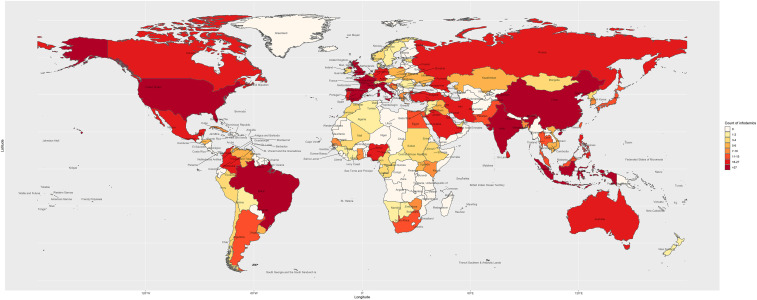
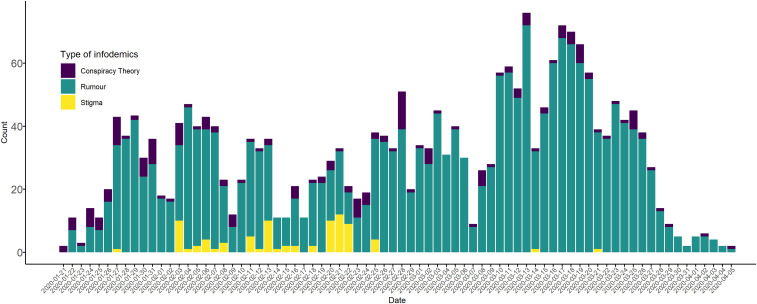
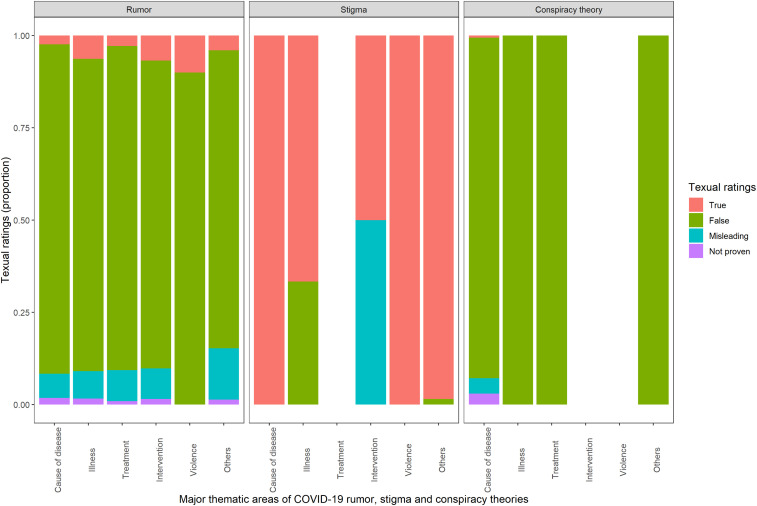
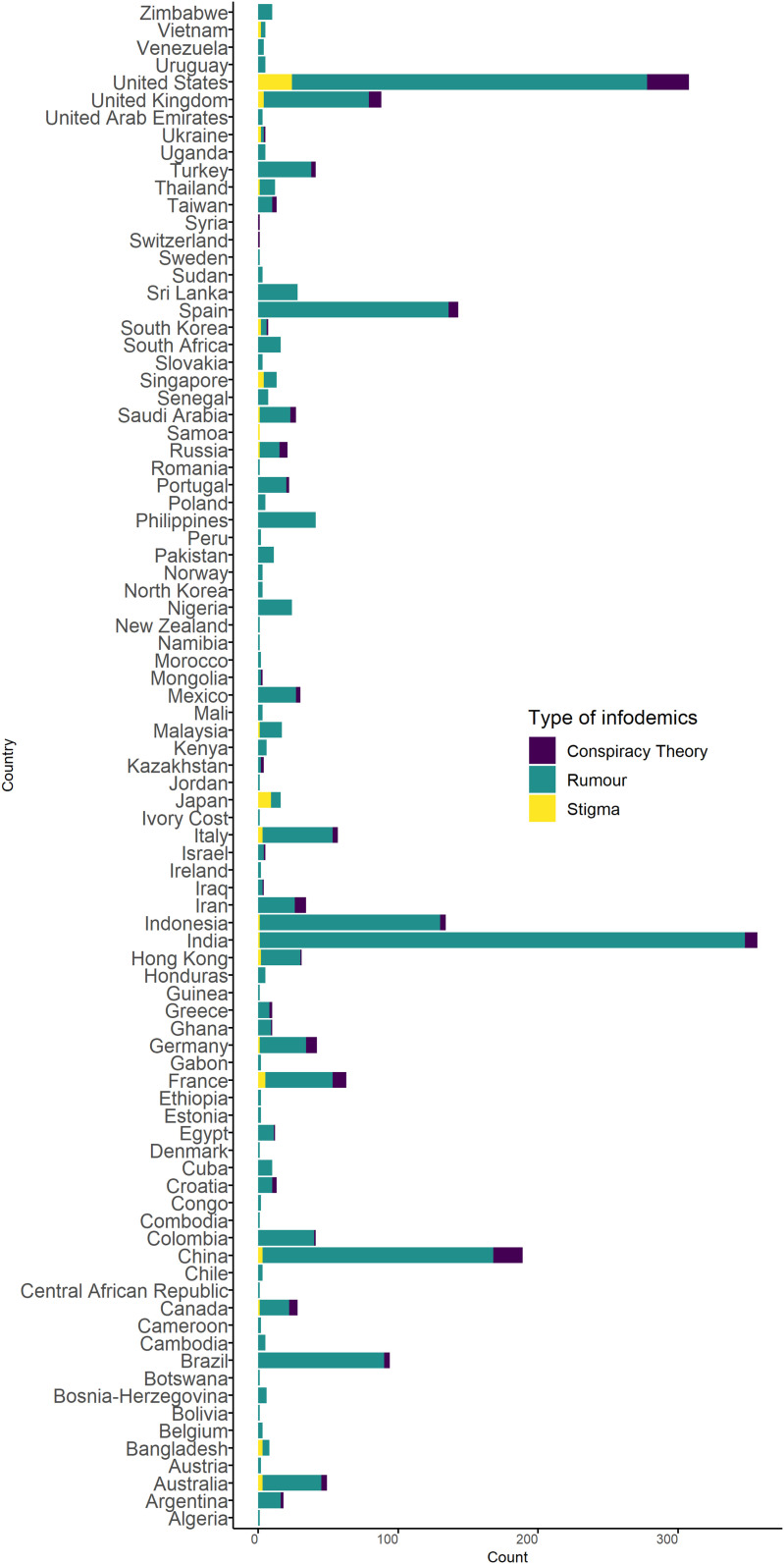
Verification
Claims the paper makes
The claims and statistics of this paper haven’t been checked yet.
Free: it reads the open-access text and checks the first 5 claims that cite a source we can check. Create a free account to check every claim.
Claims other papers make about this one
Each is checked against this paper’s own text: does it say what the citing paper says it does?
The cited source says what the claim attributes to it.
In the citing paper
“Misinformation during the Ebola outbreak in the Democratic Republic of the Congo in 2019 was associated with aggression, mistrust, social unrest, and targeted assaults on healthcare workers [45].”
From Social Media Role and Its Impact on Public Health: A Narrative Review (2023) · cites this paper as [45]
The cited source says what the claim attributes to it.
In the citing paper
“Rumors about COVID-19 have been labeled a global enemy by the UN secretary-general [45].”
From Social Media Role and Its Impact on Public Health: A Narrative Review (2023) · cites this paper as [45]
The cited source says what the claim attributes to it.
In the citing paper
“During the SARS outbreak in China in 2002-2003, Asian people faced social stigma as a result of their fear of contracting the disease [45].”
From Social Media Role and Its Impact on Public Health: A Narrative Review (2023) · cites this paper as [45]
Self-check
Percentages, sums and reported differences re-computed from the paper’s own numbers.
The self-check needs the paper’s full text.
Citations
Cites
Understanding Conspiracy Theories
Douglas, K. M., Uscinski, J. E., Sutton, R. M., Cichocka, A., Nefes, T., Ang, C. S., & Deravi, F. (2019) · Political Psychology · doi:10.1111/pops.12568 · Cited by 1,511 · cited 1×
“defined as explanatory beliefs about an individual or group of people working in secret to reaching malicious goals.(16) Data extraction and consistency.”
BackgroundFear and Stigma: The Epidemic within the SARS Outbreak
Person, B., Sy, F., Holton, K., Govert, B., Liang, A., the, N. C. I. D., SARS Community Outreach Team (listed in alphabetical order), Garza, B., Gould, D., Hickson, M., et al. (2004) · Emerging Infectious Diseases · doi:10.3201/eid1002.030750 · Cited by 790
YouTube as a source of information on COVID-19: a pandemic of misinformation?
Li, H. O.-Y., Bailey, A., Huynh, D., & Chan, J. (2020) · BMJ Global Health · doi:10.1136/bmjgh-2020-002604 · Cited by 781
See Something, Say Something: Correction of Global Health Misinformation on Social Media
Bode, L., & Vraga, E. K. (2018) · Health Communication · doi:10.1080/10410236.2017.1331312 · Cited by 745 · cited 1×
“aimed at promoting evidence against misinformation quickly and clearly might change people’s perception and healthseeking behaviors.(52,53) Currently, the WHO and other health”
BackgroundZubiaga, A., Liakata, M., Procter, R., Wong Sak Hoi, G., & Tolmie, P. (2016) · PLOS ONE · doi:10.1371/journal.pone.0150989 · Cited by 722 · cited 1×
“Rumor is defined as unverified information that canbe foundas true, fabricated, or entirely false after verification.(14) Stigma is a socially constructed process through which a person with stigma can experience discrimination and devaluation in society.”
BackgroundTuran, B., Budhwani, H., Fazeli, P. L., Browning, W. R., Raper, J. L., Mugavero, M. J., & Turan, J. M. (2017) · AIDS and Behavior · doi:10.1007/s10461-016-1451-5 · Cited by 480
Prevention is better than cure: addressing anti-vaccine conspiracy theories
Jolley, D., & Douglas, K. M. (2017) · Journal of Applied Social Psychology · doi:10.1111/jasp.12453 · Cited by 446 · cited 1×
“aimed at promoting evidence against misinformation quickly and clearly might change people’s perception and healthseeking behaviors.(52,53) Currently, the WHO and other health”
BackgroundEbola, Twitter, and misinformation: a dangerous combination?
Oyeyemi, S. O., Gabarron, E., & Wynn, R. (2014) · BMJ · doi:10.1136/bmj.g6178 · Cited by 348 · cited 1×
“Last, there are the well-documented issues with misinformation with Ebola, including false treatments, health workers were deliberately spreading the Ebola virus, and Ebola epidemic was a hoax.(49,50) Such conspiracy theories and misinformation may have impeded the ability of healthcare workers and emergency responder…”
BackgroundAttacks against health-care personnel must stop, especially as the world fights COVID-19
McKay, D., Heisler, M., Mishori, R., Catton, H., & Kloiber, O. (2020) · The Lancet · doi:10.1016/s0140-6736(20)31191-0 · Cited by 186
Young, W. B., Park, J. E., Tian, I. X., & Kempner, J. (2013) · PLoS ONE · doi:10.1371/journal.pone.0054074 · Cited by 138 · cited 1×
“Stigma is a socially constructed process through which a person with stigma can experience discrimination and devaluation in society.(15) A conspiracy theory is”
Background
Research works printed but not linked: 29
- World Health Organization, 2020 Coronavirus Disease 2019 (COVID-19) Situation Report – 13. Geneva, Switzerland: WHO.
- Lederer EM, 2020 U.N. Chief Antonio Guterres: Misinformation about COVID-19 Is the New Enemy. TIME. New York, NY: TIME.
- World Health Organization, 2018 Managing Epidemics: Key Facts about Major Deadly Diseases. Luxembourg: WHO.
- Center for Preparedness and Response, 2020 Responding to Rumors and Misinformation. Emergency Preparedness and Response. Atlanta, GA: Centre for Disease Control and Prevention.
- Eckert KS 2016 Evidence Syntheses to Support the Guideline on Emergency Risk Communication. Geneva, Switzerland: World Health Organization.
- Victoria Knight of Kaiser Health News, 2020 COVID-19: Beware Online Tests and Cures, Experts Say. The Guardian. Surry Hills, NSW, Australia: The Guardian.
- Spencer SH, 2020 Fake Coronavirus Cures, Part 1: MMS Is Industrial Bleach. Available at: https://www.factcheck.org/2020/02/fake-coronavirus-cures-part-1-mms-is-industrial-bleach/. Accessed April 4, 2020.
- Vrajlal A, 2020 Chinese-Australians Facing Racism after Coronavirus Outbreak. Available at: https://www.huffingtonpost.com.au/entry/coronavirus-australia-racism_au_5e33a522c5b6f2623326d72b. Accessed April 4, 2020.
- BBC Reality Check Team, 2020 Coronavirus: Does Drinking Tea Help? BBC News. Delhi, India: BBC News.
- Cable T, 2020 CDD FACT CHECK: Can Camel Urine, Lime Cure Coronavirus? The Cable. Abuja, Nigeria: The Cable Newspaper.
- Landsverk G, 2020 Holding Your Breath Can’t Help You Self-Diagnose the Coronavirus. Here’s What You Should Do Instead. Business Insider Australia. Surry Hills, NSW, Australia: Business Insider Australia.
- Ellis-Petersen H Rahman SA, 2020 Indian Doctors Being Evicted from Homes over Coronavirus Fears. The Guardian. Surry Hills, NSW, Australia: The Guardian.
- Mead WR, 2020 China Is the Real Sick Man of Asia. The Wall Street Journal. New York, NY: The Wall Street Journal.
- Breland A, 2020 Russian Media Outlets Are Blaming the Coronavirus on the United States. Mother Jones. San Francisco, CA: Mother Jones.
- Gertz B, 2020 Coronavirus May Have Originated in Lab Linked to China’s Biowarfare Program. The Washington Post. Washington, DC: The Washington Post.
- Gregory J, 2020 The Coronavirus ‘Infodemic’ Is Real. We Rated the Websites Responsible for It. Statnews. Boston, MA: Statnews.
- Richtel M, 2020 WHO Fights a Pandemic besides Coronavirus: An ‘Infodemic’. The New York Times. New York, NY: The New York Times.
- Meddle East Media Research Institute, 2020 Arab Writers: The Coronavirus Is Part of Biological Warfare Waged by the U.S. against China. Egypt, Saudi Arabia, and Syria: Meddle East Media Research Institute TV.
- Farda R, 2020 Iran Cleric Blames Trump for Coronavirus Outbreak in Religious City. Radio Farda. Prague, Czech Republic: Radio Farda.
- Colson T, 2020 A Fake Claim That Cocaine Cures the Coronavirus Is Spreading Online, and the French Government Was Forced to Tell People That It Won’t. Business Insider Australia. Surry Hills, NSW, Australia: Business Insider Australia.
- Frenkel S Alba D Zhong R, 2020 Surge of Virus Misinformation Stumps Facebook and Twitter. The New York Times. New York, NY: The New York Times.
- World Health Organization, 2020 Alcohol Does Not Protect against COVID-19; Access Should Be Restricted during Lockdown. Alcohol Use. Geneva, Switzerland: WHO, Regional Office for Europe.
- CNN Türk, 2020 9 Kişi Daha Saf Alkolden Öldü [9 More Poeple Died from Pre Alcohol]. Available at: https://www.cnnturk.com/video/turkiye/9-kisi-daha-saf-alkolden-oldu. Accessed June 4, 2020.
- Staff Reporter, 2020 Twelve Taken Ill after Consuming ‘Coronavirus Shaped’ Datura Seeds. The Hindu. Andhra Pradesh, India: The Hindu.
- Chan-Kyong P, 2020 Coronavirus: Saltwater Spray Infects 46 Church-Goers in South Korea. South China Morning Post. Causeway Bay, Hong Kong: South China Morning Post.
- Eckel M, 2020 Tractors, Herbs, Vodka, Saunas? Some Leaders Offer Strange, Unhelpful Advice On Warding Off COVID-19. Available at: https://www.rferl.org/a/coronavirus-unhelpful-advice-tractors-herbs-vodka-saunas-gurbanguly-lukashenka-vucic/30495810.html. Accessed June 4, 2020.
- Tajmim T, 2020 Coronavirus: 41 Doctors, 10 Nurses Infected. The Business Standard. Dhaka, Bangladesh: The Business Standard.
- National Herald, 2020 Social Stigma Forcing Corona Patients to Avoid Screening in India. National Herald. New Delhi, India: National Herald.
- Kabananukye K, 2001 Denial, Discrimination and Stigmatisation: The Case of Ebola Epidemic in Some Districts. Kampala, Uganda: Ugandan Ministry of Health, National Ebola Task Force.
Cited by
Items 901–997 of 997
Christina, E., Setiawan, D., Juwita, D. R., & Lianawati (2022) · JURNAL FARMASI DAN ILMU KEFARMASIAN INDONESIA · doi:10.20473/jfiki.v9i32022.314-322
“This is demonstrated by the number of COVID-19 cases that have occurred since September 8, 2020, which is consistently greater than 3,000 cases per day (Islam et al., 2020; Susanna, 2020; WHO, 2020).”
BackgroundAs consequências da pandemia do COVID-19 na ansiedade e depressão
Alves, M. R. F., Guimarães, B. G. F., Cavalcanti, L. T. M. D. A., Silva, P. H. W., & de Almeida, L. M. (2022) · Anais da Faculdade de Medicina de Olinda · doi:10.56102/afmo.2022.221
The monkeypox outbreak: What lessons can we learn from the COVID-19 infodemic?
Manan, M. R., Nawaz, I., & Manan, H. (2022) · Ethics Medicine and Public Health · doi:10.1016/j.jemep.2022.100868
Natarov, О. (2022) · Naukovì pracì Nacìonalʹnoï bìblìoteki Ukraïni ìmenì V Ì Vernadsʹkogo · doi:10.15407/np.64.307
Bedeutung von Umweltrisiken für die Gesundheit von Bevölkerungen und Individuen
Plaß, D., & Straff, W. (2022) · Elsevier eBooks · doi:10.1016/b978-3-437-22262-7.00009-0
Multi-dimensional characteristics and governance strategies of rumors about the COVID-19 pandemic
Zhang, X., & Cheng, Y.-R. (2022) · International Conference on Data Science and Information Technology (DSIT) · doi:10.1109/dsit55514.2022.9943892
“compiled 311 pandemic-related rumors and reported conspiracy theories gathered from social media platforms such as Twitter and Facebook and then analyzed their contents[5].”
BackgroundBadr, A. F., Alghamdi, L., Baraidah, H., & Alsulami, R. Y. (2022) · Saudi Journal of Clinical Pharmacy · doi:10.4103/sjcp.sjcp_6_22 · Cited by 1
Social Representations of COVID-19 Among Brazilian Elderly Women: A Structural Approach
Ferreira, A. V. C., de Araújo, L. F., & Neto, R. N. D. S. (2022) · Liberabit Revista Peruana de Psicología · doi:10.24265/liberabit.2022.v28n2.617 · Cited by 4
“These results are consistent with findings, in the pandemic context, of feelings of loneliness, fear and anxiety, together with the fear by the high rates of viral transmission (Bezerra, Saintrain, et al., 2020; Islam et al., 2020; Lin, 2020).”
Singh, S. R., Koundinya, K., Bobdey, S., Teli, P. T., Yadav, A. K., & Kaushik, S. K. (2023) · Industrial Psychiatry Journal · doi:10.4103/ipj.ipj_65_22
Pant, I., Broniatowski, D. A., Long, M. W., Duwal, S., Polackal, J., Chandarana, S., & Turner, M. M. (2023) · doi:10.2196/preprints.45686
Li, W., Jiang, L., Ma, H., & Shi, H. (2022) · International Conference on Bioinformatics Research and Applications (ICBRA) · doi:10.1145/3569192.3569207
“We noticed that, in the area of NLP, some researchers have successfully extracted information from text [18-20] and new methods based on deep learning can even capture deeper semantic and context information.”
BackgroundZhang, X., Zhong, Z., Luo, P., Zhu, C., Huang, Y., Wu, C., Pan, X., & Huang, Z. (2023) · medRxiv · doi:10.1101/2023.01.30.23285173
Ming, Z., Li, J., Cheng, P., Ning, P., & Hu, G. (2022) · PubMed Central · doi:10.11817/j.issn.1672-7347.2022.210799
Li, Z., Wu, X., Lin, X., Liu, M., & Huang, C. (2022) · doi:10.2196/preprints.45296
Brusk, J. J., & Bensley, R. J. (2023) · JMIR Formative Research · doi:10.2196/38667
Spike glycoprotein of coronavirus of animals and sars-Cov-2
Pattnaik, B., Kuralayanapalya, S. P., Shivamallu, C., Kollur, S. P., Yadav, M. P., Jacob, S. S., Pandey, A. B., Shyamsundar, K. A., & Patil, S. S. (2022) · Indian Journal of Comparative Microbiology Immunology and Infectious Diseases · doi:10.5958/0974-0147.2022.00020.4
Fake News and Threats to IoT—The Crucial Aspects of Cyberspace in the Times of Cyberwar
Pawlicka, A., Pawlicki, M., Kozik, R., & Choraś, M. (2023) · Springer proceedings in complexity · doi:10.1007/978-3-031-19560-0_3
Pandemia da COVID-19: revelando interfaces entre saúde, ambiente e desenvolvimento
dos Santos, S. L., Augusto, L. G. D. S., de Medeiros, M. S., Costa, A. M., & Mertens, F. (2023) · Desenvolvimento e Meio Ambiente · doi:10.5380/dma.v61i0.78863 · Cited by 2
Topics, concerns, and feelings commented on Facebook after the first death by COVID-19 in Mozambique
Muitana, G. O. E., & Amato, C. A. D. L. H. (2023) · Revista de Investigación e Innovación en Ciencias de la Salud · doi:10.46634/riics.165
Creating Safe Communication Spaces Amidst the Disinformation Quandary
Chua, Y. T., & Khan, R. E. (2023) · Sustainable development goals series · doi:10.1007/978-3-031-19142-8_8 · Cited by 1
Quality and Content of Online Information Related to “Immunity Boosting”
Shrivastava, A., Agarwal, A., & Jain, S. (2022) · Asian Pacific Journal of Health Sciences · doi:10.21276/apjhs.2022.9.4s.58
Taofik, O., Surajudeen, B., Rasheedat, I. M., Sherifat, K., Tajudeen, I. A., Abdulazeez, I., & Rasaq, O. (2023) · Journal of Public Health and Epidemiology · doi:10.5897/jphe2023.1431
“(7) Misinformation and disinformation: In a report, 82% of information (that is, the origin and threat of the disease, its spread, treatment and vaccine) shared on social media regarding covid-19 were false (Islam et al., 2020).”
BackgroundWidowati, Supriyadi, & Agustinawati, E. (2023) · International Conference on Industrial Engineering and Operations Management (IEOM) · doi:10.46254/au01.20220226
Aboushady, A. T., Nawwar, A. E., Seddik, S. A., Emam, O., Hemida, M., Zohny, M., Aboismail, E., Khattab, L., Abubakr, N. M., & Hegazy, A. A. (2023) · doi:10.2196/preprints.47589
Hoeyer, K. (2023) · The MIT Press eBooks · doi:10.7551/mitpress/14926.003.0012
Institutional awareness campaign: COVID-19 vaccination drive among nursing students
Mishra, R., Kalyani, C. V., Singh, M., & Saxena, V. (2023) · Heliyon · doi:10.1016/j.heliyon.2023.e16268
Fukase, R., Murakami, M., & Ikeda, T. (2023) · Family Practice · doi:10.1093/fampra/cmad059
Pinto, P. A., Lopes, I. D. S., & Leal, D. D. U. (2023) · REVISTA ESPAÑOLA DE COMUNICACIÓN EN SALUD · doi:10.20318/recs.2023.7273 · Cited by 2
Complexities in Falsehoods Management and Implications for Research and Practice
Soon, C. (2023) · Mobile communication in Asia · doi:10.1007/978-94-024-2225-2_1
Yıldız, G. K., & Azak, M. (2023) · Children s Health Care · doi:10.1080/02739615.2023.2215441 · Cited by 1
“According to one study, rumors were the source of 89% of information shared online about COVID-19 treatments (e.g., drinking bleach or exposure to intense ultraviolet radiation) (Islam et al., 2020).”
Interacciones comunicativas pandémicas. Reconfiguraciones del des/encuentro con el otro
Miller, K. M. H. (2022) · Mundos Plurales - Revista Latinoamericana de Políticas y Acción Pública · doi:10.17141/mundosplurales.1.2022.5317
Diálogos da educação científica e o ensino de química
Derossi, I. N., & Barboza, L. C. (2023) · doi:10.51795/9786526505625
Hodalska, M., Lisowska-Magdziarz, M., & Całek, A. (2023) · Zeszyty Prasoznawcze · doi:10.4467/22996362pz.23.004.17196
Informing social media analysis for public health: A cross-sectional survey of professionalsPreprint
White, B. K., Wilhelm, E., Ishizumi, A., Abeyesekera, S., Pereira, A., Yau, B., Kuzmanovic, A., Nguyen, T., Briand, S. C., & Purnat, T. D. (2023) · Research Square · doi:10.21203/rs.3.rs-3054751/v1
de Paiva, E. M., Neto, G. R. D. S., da Silva, A. D. F., & da Cunha, J. A. C. (2023) · Future Studies Research Journal Trends and Strategies · doi:10.24023/futurejournal/2175-5825/2023.v15i1.744
Anonymous COVID-19 Channel on Jodel: A Quantitative Content Analysis
Jüttner, K., Nowak, P., Imeri, A., & Stock, W. G. (2023) · Lecture notes in computer science · doi:10.1007/978-3-031-35927-9_23
Walther, C. C. (2023) · Springer eBooks · doi:10.1007/978-3-031-36043-5_3
Dias, A. P. (2023) · Digital Library of Theses and Dissertations (Universidade de São Paulo) · doi:10.11606/d.84.2023.tde-19072023-190515 · Cited by 2
La infodemia: fenómeno social creciente asociado con la pandemia por COVID-19
Montes-Arcon, P. S. (2023) · Revista Colombiana de Neumología · doi:10.30789/rcneumologia.v35.n1.2023.615
Kim, T. Đ. T., & Ngọc, D. N. (2023) · Tạp chí Kinh tế và Phát triển · doi:10.33301/jed.vi.1135
Interconnected Disaster Risks Technical Report: COVID-19 Pandemic
Hassel, J., Schütze, S., & Hagenlocher, M. (2021) · UNU Collections (United Nations University) · doi:10.53324/tzjd9281 · Cited by 1
Kurniati, D. P. Y., Indrayathi, P. A., Pradnyani, P. E., Ulandari, L. P. S., Januraga, P. P., Yuliarti, M. S., & Santosa, K. S. (2023) · Kesmas National Public Health Journal · doi:10.21109/kesmas.v18i3.7034
Politicization of COVID-19 and Conspiratorial Beliefs Among Emergency & Public Health Officials
DeYoung, S. E., & Farmer, A. K. (2023) · Journal of Homeland Security and Emergency Management · doi:10.1515/jhsem-2021-0072 · Cited by 1
Cavadas, B., & Linhares, E. (2023) · Springer eBooks · doi:10.1007/978-3-031-04560-8_86
The Impact of (COVID)-19 on Beverage Purchasing Behaviors in Korea
Eom, H., Kim, N., Lee, C., Choi, S.-H., & Moon, J. (2023) · American Journal of Health Behavior · doi:10.5993/ajhb.47.3.9
Les réseaux sociaux pour l'infectiologue
Sauvat, L., Bleibtreu, A., & Peiffer‐Smadja, N. (2023) · Médecine et Maladies Infectieuses Formation · doi:10.1016/j.mmifmc.2023.06.007 · Cited by 1
تعزيز استجابة الشرطة لـ كوفيد- 19 مع المشاركة الإعلامية: تجربة الإمارات العربية المتحدة
علم, إ. (2022) · Policing A Journal of Policy and Practice · doi:10.1093/police/paac090
Wissenschaftliche Falschinformation: Erforschung von Faktoren der Verbreitung im Gesundheitsbereich
Stiller, Trkulja, Dewitz, Peters, Henkel, & Bressel (2023) · Nomos Verlagsgesellschaft mbH & Co. KG eBooks · doi:10.5771/9783748938743-319
Infodemic Accelerates Psychological Effect in Covid-19 Pandemic: A Cross Sectional Study
Mahmud, M. K., Hasan, M., Sultana, T., & Islam, M. (2023) · Advances in Journalism and Communication · doi:10.4236/ajc.2023.113021
Self-citationMatulessy, A., Efendy, M., Rini, A. P., & Maulidia, A. S. (2023) · SSRN Electronic Journal · doi:10.2139/ssrn.4560882 · Cited by 1
Covid-19: A Retrospective Study
Babar, M., Wasti, Q. Z., Haq, H. M. S. U., Fatima, M., & Perveen, R. (2023) · International Journal of Cell Science & Molecular Biology · doi:10.19080/ijcsmb.2023.07.555713
Lliteras, A. B., & Delgado, V. A. (2023) · Facultad de Informática (UNLP) eBooks · doi:10.35537/10915/158339
The impact of fake news on social media users during the COVID-19 pandemic: A deep lookPreprint
Mahlous, A. R. (2023) · doi:10.36227/techrxiv.24272326
The impact of fake news on social media users during the COVID-19 pandemic: A deep lookPreprint
Mahlous, A. R. (2023) · doi:10.36227/techrxiv.24272326.v1
Rahim, A. R., Syamsuri, A. S., Muhalim, M., & Arifuddin, A. (2023) · RETORIKA Jurnal Bahasa Sastra dan Pengajarannya · doi:10.26858/retorika.v16i2.32531
UIN Syarif Hidayatullah, J., Nasuki, A., Askar, R. A. B., & UIN Syarif Hidayatullah, J. (2023) · el-Tarbawi · doi:10.20885/tarbawi.vol16.iss1.art3
Sobre a retórica do negacionismo da COVID-19
Monteiro, C. V., & Ribeiro, H. J. (2023) · Revista Filosófica de Coimbra · doi:10.14195/0872-0851_64_2
Knowledge about COVID-19 in the General Population of Mexico
Otálvaro, A. F. T., Cassiani-Miranda, C. A., Rodríguez-Verdugo, M. S., Campo‐Arias, A., Scoppetta, O., & Arismendy-López, Y. A. (2023) · Hacia la Promoción de la Salud · doi:10.17151/hpsal.2023.28.1.9
Valenzi, N. (2023) · Western Journal of Emergency Medicine · doi:10.5811/westjem.62602
Correspondence on ‘Suicidal ideation and associated risk factors among COVID-19 patients’
Tung, C.-C., Jou, I. M., & Chang, R. (2023) · QJM · doi:10.1093/qjmed/hcad285
Proliferation and Impacts of Health Misinformation on Social Media During COVID-19 in Kenya
Magut, H. J., & Guto, R. (2023) · Routledge eBooks · doi:10.4324/9781003425861-13 · Cited by 1
Pal, R., Srinidhi, S., Mahto, D., Agrawal, K., Mengi, G., Nagpal, S., Devadiga, A., & Sethi, T. (2023) · SSRN Electronic Journal · doi:10.2139/ssrn.4677013
Nasuki, A. (2023) · Kuriositas Media Komunikasi Sosial dan Keagamaan · doi:10.35905/kur.v16i1.2611
Silverman, R., Short, D., Wenzel, S. G., Friesen, M. A., & Cook, N. E. (2024) · PeerJ · doi:10.7717/peerj.16714
Digital Activism of Health Professional during Pandemic: a Lesson Learned from @Pandemictalks
Wijaya, G., Wahyudi, I., & Ida, R. (2024) · Jurnal Ilmu Komunikasi · doi:10.31315/jik.v21i3.9067
العجمي, ب. ب. م., & الكندي, س. ب. س. (2024) · Journal of Arts and Social Sciences [JASS] · doi:10.53542/jass.v14i3.6272
Rashid, T., Arefin, S., Bhattacharjee, M., & Islam, M. A. (2024) · Research Square · doi:10.21203/rs.3.rs-3851663/v1
Self-citationDoctor Facebook: Social Media and Health (Mis)Information
Revez, J. (2023) · MDPI eBooks · doi:10.3390/books978-3-0365-1347-8-3
Seitz, P., Eisenegger, M., & Bergman, M. M. (2023) · MDPI eBooks · doi:10.3390/books978-3-0365-1347-8
Okati‐Aliabad, H., Mohammadi, M., Khorashad, A. S., Ansari‐Moghaddam, A., Bor, M. H., & Nejati, J. (2024) · international journal high risk behaviors & addiction · doi:10.5812/ijhrba-142986
Anila, R. S., Patel, G. M., Borah, N., & Sindwani, P. (2024) · Multidisciplinary Reviews · doi:10.31893/multirev.2023ss005
Image Splicing Detection Using Retinex Based Contrast Enhancement and Deep Learning
Mamta, M., Pillai, A., & Punj, D. (2023) · doi:10.1109/icacctech61146.2023.00127
“Recently, during the covid-19 pandemic surge there were various images which went viral creating havoc among the society [1].”
BackgroundTongat, & Salahudin, S. (2024) · Technium Social Sciences Journal · doi:10.47577/tssj.v55i1.10636
BIOPOLITICS AND NEOLIBERAL GOVERNANCE IN THE COVID-19 INFODEMIC: THE EPISTEMIC OF AN EPIDEMIC
YILMAZ, M. (2024) · Beykoz Akademi Dergisi · doi:10.14514/beykozad.1367683
Labeled data and models for COVID-19 vaccine related tweets with stance, location, and topics
Rahman, A., Ehsan, M., & Alhoori, H. (2024) · Zenodo (CERN European Organization for Nuclear Research) · doi:10.5281/zenodo.6842883
The Strengths and Advantages of SARS-CoV-2 Management of a Southern University Hospital in Thailand
Saejiw, N., Choosong, T., Sathirapanya, C., Ngamchaliew, P., Senthong, P., Surasombatpattana, S., Yingkajorn, M., Pipithsuntornsan, N., Chusri, S., & Vongkamjan, K. (2024) · Asia Pacific Journal of Public Health · doi:10.1177/10105395241240969
HOW THE INFODEMIC HAS FUELLED STIGMATIZATION DURING THE COVID-19 PANDEMIC
Taule, T. S., & Boštíková, V. (2024) · Military Medical Science Letters · doi:10.31482/mmsl.2024.007
Media Coverage of China During COVID-19: A Systematic Review
Hu, X., Kasimon, D. N., & Abas, W. A. W. (2024) · Studies in Media and Communication · doi:10.11114/smc.v12i2.6792
“…with high intensity in this research area, this is because the outbreak of COVID-19 virus has put people in a great panic and they are in urgent need of information related to the virus, which provides opportunities for unscrupulous people to take advantage of the situation (Islam et al., 2020).”
BackgroundNooh, M. N. (2024) · International Journal of Academic Research in Accounting Finance and Management Sciences · doi:10.6007/ijarafms/v14-i2/21192
The Intersection of Change: Decoding the Media-Democracy Dynamic in South Asia in the ‘Social’ Times
Khan, F. B. (2024) · Springer eBooks · doi:10.1007/978-981-99-6675-2_4
Alassad, M., & Agarwal, N. K. (2024) · Research Square · doi:10.21203/rs.3.rs-4426978/v1 · Cited by 1
Multi-Scale Feature Aggregation for Rumor Detection: Unveiling the Truth within Text
Wu, J., Chen, S., Wang, G., Wang, H., & Li, H. (2023) · IEEE International Conference on Trust, Security and Privacy in Computing and Communications (TrustCom) · doi:10.1109/trustcom60117.2023.00150
“For example, during the COVID-19 pandemic, various erroneous information and rumors related to the outbreak circulated on social media platforms [2].”
BackgroundPaltra, S., & Rehmann, J. (2024) · Lecture notes in computer science · doi:10.1007/978-3-031-61312-8_12
Analisis Media Monitoring terhadap Brand EIGER pada Peluncuran Lini Koleksi “Safar Series”
Kalaite, M. A. (2024) · Jurnal Bisnis dan Komunikasi Digital · doi:10.47134/jbkd.v1i3.2593 · Cited by 1
Mingoia, J., & Busque, B. L. (2022) · Interactions Studies in Communication & Culture · doi:10.1386/iscc_00054_1 · Cited by 1
Maison, P., Bacon, T., Daynès, P., Decoene, C., Mazet, R., Vial, T., Vignot, S., Belgodère, L., Oualikene-Gonin, W., & Ratignier-Carbonneil, C. (2024) · Therapies · doi:10.1016/j.therap.2024.06.002
Nădășan, V., Kasza, D., Kiss, K.-O., Maior, D., & Mărușteri, M. (2024) · The Journal of Critical Care Medicine · doi:10.2478/jccm-2024-0011
“…that aimed to evaluate the quality of infectious disease hospital websites in Poland investigated only website accessibility, performance, content readability, and graphical appeal, did not focus on HAIs, and did not address the issue of completeness and scientific accuracy of information [55].”
BackgroundCzy adwersarze uczą się na własnych błędach? Ewolucja nagłówków fake news
Pawlicka, A. (2024) · Wydawnictwa Uniwersytetu Warszawskiego eBooks · doi:10.31338/uw.9788323562542.pp.95-118
Reis, M., Michalski, N., Bartig, S., Wulkotte, E., Poethko‐Müller, C., Graeber, D., Rosario, A. S., Hövener, C., & Hoebel, J. (2024) · Research Square · doi:10.21203/rs.3.rs-4630528/v1
Science Communication: Communicating Science and Technology—Policies and Practices
Khan, F., & Kaur, P. J. (2024) · Springer eBooks · doi:10.1007/978-981-97-2815-2_16
Effiong, D. E., Essiet, J. I., Ediomo-Abasi, U. D., & Kālu, M. U. (2024) · Asian Journal of Emerging Research · doi:10.3923/ajer.2024.41.55
Metadata
- Authors
- Islam, M. S., Sarkar, T., Khan, S. H., Mostofa Kamal, A.-H., Hasan, S. M. M., Kabir, A., Yeasmin, D., Islam, M. A., Amin Chowdhury, K. I., Anwar, K. S., Chughtai, A. A., & Seale, H.
- Affiliations
- International Centre for Diarrhoeal Disease Research (BD)
- Khulna University of Engineering and Technology, Khulna, Bangladesh;
- Mahidol University (TH)
- UNSW Sydney (AU)
- Program for Emerging Infections, Infectious Diseases Division, icddr,b, Dhaka, Bangladesh;
- International University of Health and Welfare (JP)
- Corresponding author
- Islam, Md Saiful
- Islam, Mohammad Ariful
- ORCID
- Venue
- The American Journal of Tropical Medicine and Hygiene
- Published
- 2020-10-07
- Volume
- 103
- Issue
- 4
- Pages
- 1621-1629
- ISSN
- 0002-9637 (ISSN-L)
- 1476-1645
- PMC
- PMC7543839
- OpenAlex
- W3048848247
- Cited by
- 1,178
- References
- 21
- Citations by year
- 2026: 88 · 2025: 117 · 2024: 127 · 2023: 207 · 2022: 319 · 2021: 274 · 2020: 45
- FWCI
- 282.36
- Type
- journal article
- Language
- en
- Open access
- bronze
- doi.org
- Locations
- American Journal of Tropical Medicine and Hygiene (publishedVersion)
- PubMed Central (publishedVersion, cc-by)
- PubMed (publishedVersion)
- Funders
- International Centre for Diarrhoeal Disease Research, Bangladesh
- Topics
- Social Sciences › Sociology and Political Science › Misinformation and Its Impacts
- Social Sciences › Communication › Communication and COVID-19 Impact
- Social Sciences › Library and Information Sciences › Academic Publishing and Open Access
- Keywords
- COVID-19 pandemic, infodemic, misinformation, rumors, stigma, conspiracy theories, social media, public health impact, fact-checking, misinformation debunking, COVID-19 containment measures
- MeSH terms
- Betacoronavirus, Data Analysis, COVID-19, SARS-CoV-2, Data Collection, Humans, Pneumonia, Viral, Public Health, Retrospective Studies, Global Health, Coronavirus Infections, Social Stigma, Pandemics, Social Media, Social Discrimination
About these checks
Registry, retraction, Cites and statistics results are computed, not judged, with one exception: a printed reference that no index lists is read once by a model before it counts as a citation error. Claims are extracted by a model and kept only when their quote appears verbatim in the text; each cited source is then checked, with a model’s help, for whether it says what the claim relies on. Those verdicts can be wrong — read the claim’s quote and the cited source before relying on one.
Statistics and arithmetic are recomputed, not judged.
Confidence bands are shown only for fields calibrated on our annotated test set. None is calibrated yet, so no band is shown.
What counts as a claim ›How we measure confidence ›How we check this ›
Are you an author, or do you see a problem with this page? Request a review
Data sources
Bibliographic data: Semantic Scholar, OpenAlex, Crossref.
Contains information from the Semantic Scholar Academic Graph Datasets, made available under the ODC Attribution License (ODC-BY 1.0).
Semantic Scholar’s data is described in: Kinney, R., et al. (2023). The Semantic Scholar Open Data Platform. arXiv:2301.10140.
