

COVID-19–Related Infodemic and Its Impact on Public Health: A Global Social Media Analysis
Open accessThe DOI matches its Crossref record; 21 of the 21 references it cites were found in a registry or an index.
Abstract
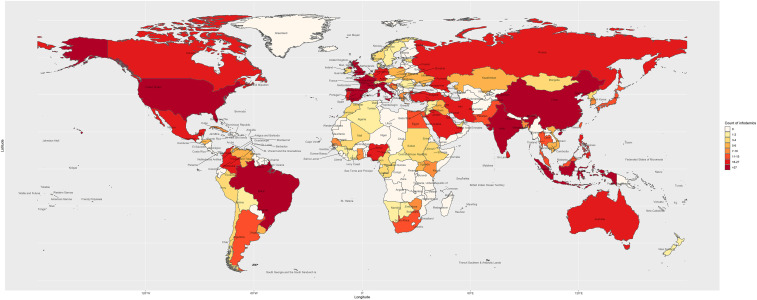
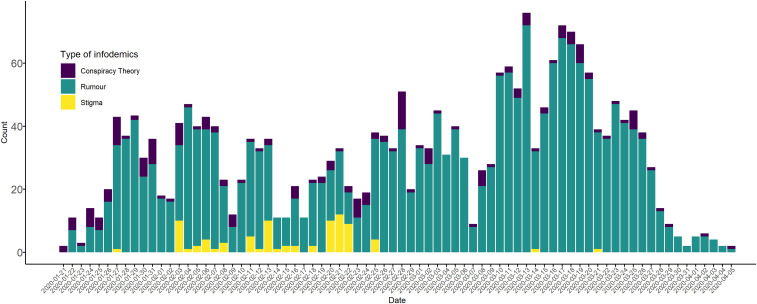
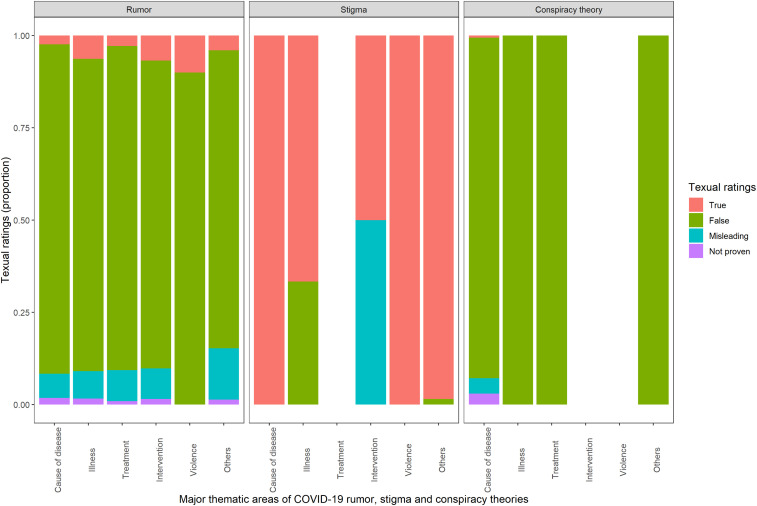
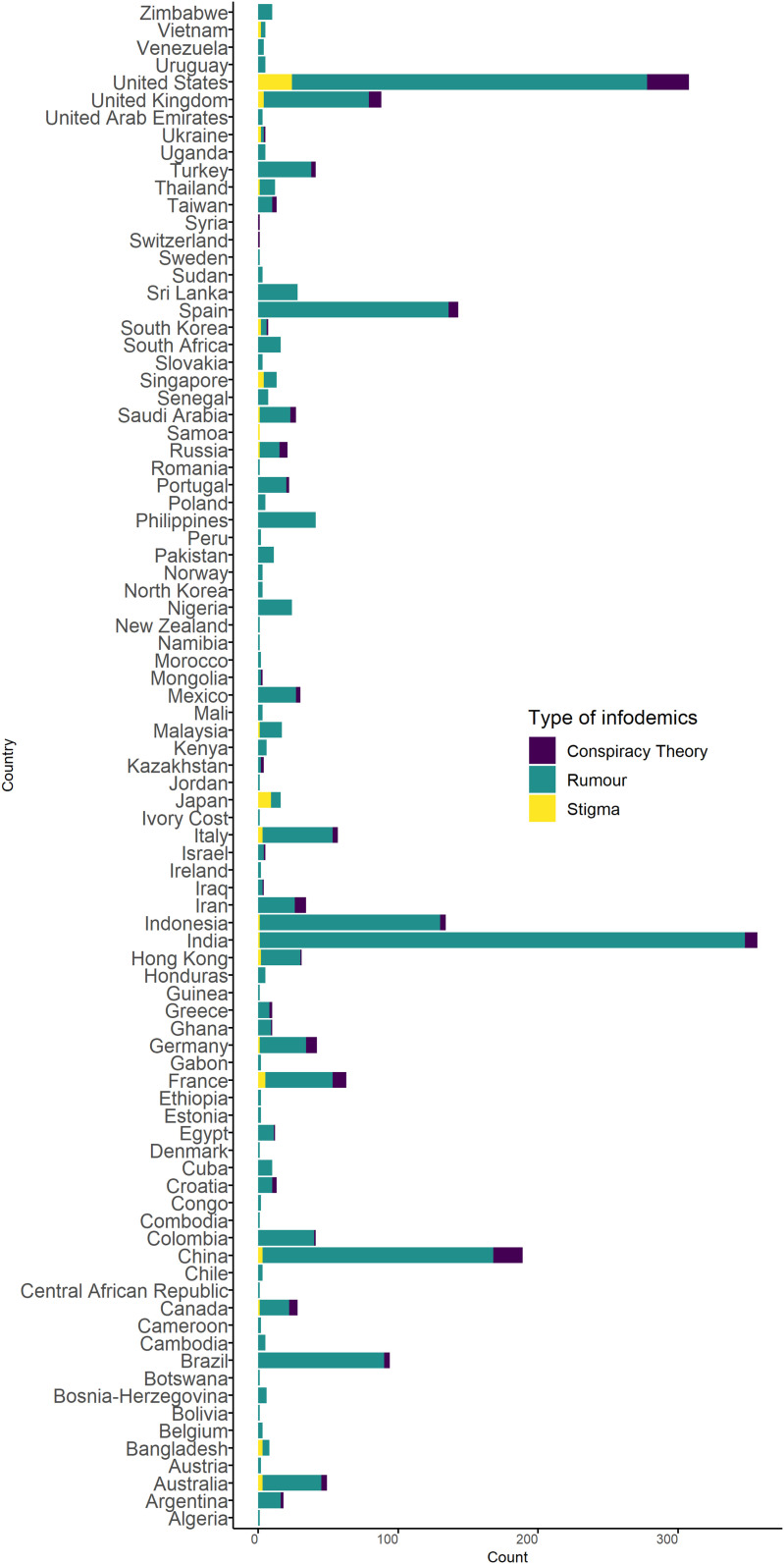
Infodemics, often including rumors, stigma, and conspiracy theories, have been common during the COVID-19 pandemic. Monitoring social media data has been identified as the best method for tracking rumors in real time and as a possible way to dispel misinformation and reduce stigma. However, the detection, assessment, and response to rumors, stigma, and conspiracy theories in real time are a challenge. Therefore, we followed and examined COVID-19-related rumors, stigma, and conspiracy theories circulating on online platforms, including fact-checking agency websites, Facebook, Twitter, and online newspapers, and their impacts on public health. Information was extracted between December 31, 2019 and April 5, 2020, and descriptively analyzed. We performed a content analysis of the news articles to compare and contrast data collected from other sources. We identified 2,311 reports of rumors, stigma, and conspiracy theories in 25 languages from 87 countries. Claims were related to illness, transmission and mortality (24%), control measures (21%), treatment and cure (19%), cause of disease including the origin (15%), violence (1%), and miscellaneous (20%). Of the 2,276 reports for which text ratings were available, 1,856 claims were false (82%). Misinformation fueled by rumors, stigma, and conspiracy theories can have potentially serious implications on the individual and community if prioritized over evidence-based guidelines. Health agencies must track misinformation associated with the COVID-19 in real time, and engage local communities and government stakeholders to debunk misinformation.
Overview
The claims and statistics of this paper haven’t been checked yet.
Free: it reads the open-access text and checks the first 5 claims that cite a source we can check. Create a free account to check every claim.
Integrity signals
Registry
Cites
Statistics
Figures
Verification
Claims the paper makes
The claims and statistics of this paper haven’t been checked yet.
Free: it reads the open-access text and checks the first 5 claims that cite a source we can check. Create a free account to check every claim.
Claims other papers make about this one
Each is checked against this paper’s own text: does it say what the citing paper says it does?
The cited source says what the claim attributes to it.
In the citing paper
“Misinformation during the Ebola outbreak in the Democratic Republic of the Congo in 2019 was associated with aggression, mistrust, social unrest, and targeted assaults on healthcare workers [45].”
From Social Media Role and Its Impact on Public Health: A Narrative Review (2023) · cites this paper as [45]
The cited source says what the claim attributes to it.
In the citing paper
“Rumors about COVID-19 have been labeled a global enemy by the UN secretary-general [45].”
From Social Media Role and Its Impact on Public Health: A Narrative Review (2023) · cites this paper as [45]
The cited source says what the claim attributes to it.
In the citing paper
“During the SARS outbreak in China in 2002-2003, Asian people faced social stigma as a result of their fear of contracting the disease [45].”
From Social Media Role and Its Impact on Public Health: A Narrative Review (2023) · cites this paper as [45]
Self-check
Percentages, sums and reported differences re-computed from the paper’s own numbers.
The self-check needs the paper’s full text.
Citations
Cites
Understanding Conspiracy Theories
Douglas, K. M., Uscinski, J. E., Sutton, R. M., Cichocka, A., Nefes, T., Ang, C. S., & Deravi, F. (2019) · Political Psychology · doi:10.1111/pops.12568 · Cited by 1,511 · cited 1×
“defined as explanatory beliefs about an individual or group of people working in secret to reaching malicious goals.(16) Data extraction and consistency.”
BackgroundFear and Stigma: The Epidemic within the SARS Outbreak
Person, B., Sy, F., Holton, K., Govert, B., Liang, A., the, N. C. I. D., SARS Community Outreach Team (listed in alphabetical order), Garza, B., Gould, D., Hickson, M., et al. (2004) · Emerging Infectious Diseases · doi:10.3201/eid1002.030750 · Cited by 790
YouTube as a source of information on COVID-19: a pandemic of misinformation?
Li, H. O.-Y., Bailey, A., Huynh, D., & Chan, J. (2020) · BMJ Global Health · doi:10.1136/bmjgh-2020-002604 · Cited by 781
See Something, Say Something: Correction of Global Health Misinformation on Social Media
Bode, L., & Vraga, E. K. (2018) · Health Communication · doi:10.1080/10410236.2017.1331312 · Cited by 745 · cited 1×
“aimed at promoting evidence against misinformation quickly and clearly might change people’s perception and healthseeking behaviors.(52,53) Currently, the WHO and other health”
BackgroundZubiaga, A., Liakata, M., Procter, R., Wong Sak Hoi, G., & Tolmie, P. (2016) · PLOS ONE · doi:10.1371/journal.pone.0150989 · Cited by 722 · cited 1×
“Rumor is defined as unverified information that canbe foundas true, fabricated, or entirely false after verification.(14) Stigma is a socially constructed process through which a person with stigma can experience discrimination and devaluation in society.”
BackgroundTuran, B., Budhwani, H., Fazeli, P. L., Browning, W. R., Raper, J. L., Mugavero, M. J., & Turan, J. M. (2017) · AIDS and Behavior · doi:10.1007/s10461-016-1451-5 · Cited by 480
Prevention is better than cure: addressing anti-vaccine conspiracy theories
Jolley, D., & Douglas, K. M. (2017) · Journal of Applied Social Psychology · doi:10.1111/jasp.12453 · Cited by 446 · cited 1×
“aimed at promoting evidence against misinformation quickly and clearly might change people’s perception and healthseeking behaviors.(52,53) Currently, the WHO and other health”
BackgroundEbola, Twitter, and misinformation: a dangerous combination?
Oyeyemi, S. O., Gabarron, E., & Wynn, R. (2014) · BMJ · doi:10.1136/bmj.g6178 · Cited by 348 · cited 1×
“Last, there are the well-documented issues with misinformation with Ebola, including false treatments, health workers were deliberately spreading the Ebola virus, and Ebola epidemic was a hoax.(49,50) Such conspiracy theories and misinformation may have impeded the ability of healthcare workers and emergency responder…”
BackgroundAttacks against health-care personnel must stop, especially as the world fights COVID-19
McKay, D., Heisler, M., Mishori, R., Catton, H., & Kloiber, O. (2020) · The Lancet · doi:10.1016/s0140-6736(20)31191-0 · Cited by 186
Young, W. B., Park, J. E., Tian, I. X., & Kempner, J. (2013) · PLoS ONE · doi:10.1371/journal.pone.0054074 · Cited by 138 · cited 1×
“Stigma is a socially constructed process through which a person with stigma can experience discrimination and devaluation in society.(15) A conspiracy theory is”
Background
Research works printed but not linked: 29
- World Health Organization, 2020 Coronavirus Disease 2019 (COVID-19) Situation Report – 13. Geneva, Switzerland: WHO.
- Lederer EM, 2020 U.N. Chief Antonio Guterres: Misinformation about COVID-19 Is the New Enemy. TIME. New York, NY: TIME.
- World Health Organization, 2018 Managing Epidemics: Key Facts about Major Deadly Diseases. Luxembourg: WHO.
- Center for Preparedness and Response, 2020 Responding to Rumors and Misinformation. Emergency Preparedness and Response. Atlanta, GA: Centre for Disease Control and Prevention.
- Eckert KS 2016 Evidence Syntheses to Support the Guideline on Emergency Risk Communication. Geneva, Switzerland: World Health Organization.
- Victoria Knight of Kaiser Health News, 2020 COVID-19: Beware Online Tests and Cures, Experts Say. The Guardian. Surry Hills, NSW, Australia: The Guardian.
- Spencer SH, 2020 Fake Coronavirus Cures, Part 1: MMS Is Industrial Bleach. Available at: https://www.factcheck.org/2020/02/fake-coronavirus-cures-part-1-mms-is-industrial-bleach/. Accessed April 4, 2020.
- Vrajlal A, 2020 Chinese-Australians Facing Racism after Coronavirus Outbreak. Available at: https://www.huffingtonpost.com.au/entry/coronavirus-australia-racism_au_5e33a522c5b6f2623326d72b. Accessed April 4, 2020.
- BBC Reality Check Team, 2020 Coronavirus: Does Drinking Tea Help? BBC News. Delhi, India: BBC News.
- Cable T, 2020 CDD FACT CHECK: Can Camel Urine, Lime Cure Coronavirus? The Cable. Abuja, Nigeria: The Cable Newspaper.
- Landsverk G, 2020 Holding Your Breath Can’t Help You Self-Diagnose the Coronavirus. Here’s What You Should Do Instead. Business Insider Australia. Surry Hills, NSW, Australia: Business Insider Australia.
- Ellis-Petersen H Rahman SA, 2020 Indian Doctors Being Evicted from Homes over Coronavirus Fears. The Guardian. Surry Hills, NSW, Australia: The Guardian.
- Mead WR, 2020 China Is the Real Sick Man of Asia. The Wall Street Journal. New York, NY: The Wall Street Journal.
- Breland A, 2020 Russian Media Outlets Are Blaming the Coronavirus on the United States. Mother Jones. San Francisco, CA: Mother Jones.
- Gertz B, 2020 Coronavirus May Have Originated in Lab Linked to China’s Biowarfare Program. The Washington Post. Washington, DC: The Washington Post.
- Gregory J, 2020 The Coronavirus ‘Infodemic’ Is Real. We Rated the Websites Responsible for It. Statnews. Boston, MA: Statnews.
- Richtel M, 2020 WHO Fights a Pandemic besides Coronavirus: An ‘Infodemic’. The New York Times. New York, NY: The New York Times.
- Meddle East Media Research Institute, 2020 Arab Writers: The Coronavirus Is Part of Biological Warfare Waged by the U.S. against China. Egypt, Saudi Arabia, and Syria: Meddle East Media Research Institute TV.
- Farda R, 2020 Iran Cleric Blames Trump for Coronavirus Outbreak in Religious City. Radio Farda. Prague, Czech Republic: Radio Farda.
- Colson T, 2020 A Fake Claim That Cocaine Cures the Coronavirus Is Spreading Online, and the French Government Was Forced to Tell People That It Won’t. Business Insider Australia. Surry Hills, NSW, Australia: Business Insider Australia.
- Frenkel S Alba D Zhong R, 2020 Surge of Virus Misinformation Stumps Facebook and Twitter. The New York Times. New York, NY: The New York Times.
- World Health Organization, 2020 Alcohol Does Not Protect against COVID-19; Access Should Be Restricted during Lockdown. Alcohol Use. Geneva, Switzerland: WHO, Regional Office for Europe.
- CNN Türk, 2020 9 Kişi Daha Saf Alkolden Öldü [9 More Poeple Died from Pre Alcohol]. Available at: https://www.cnnturk.com/video/turkiye/9-kisi-daha-saf-alkolden-oldu. Accessed June 4, 2020.
- Staff Reporter, 2020 Twelve Taken Ill after Consuming ‘Coronavirus Shaped’ Datura Seeds. The Hindu. Andhra Pradesh, India: The Hindu.
- Chan-Kyong P, 2020 Coronavirus: Saltwater Spray Infects 46 Church-Goers in South Korea. South China Morning Post. Causeway Bay, Hong Kong: South China Morning Post.
- Eckel M, 2020 Tractors, Herbs, Vodka, Saunas? Some Leaders Offer Strange, Unhelpful Advice On Warding Off COVID-19. Available at: https://www.rferl.org/a/coronavirus-unhelpful-advice-tractors-herbs-vodka-saunas-gurbanguly-lukashenka-vucic/30495810.html. Accessed June 4, 2020.
- Tajmim T, 2020 Coronavirus: 41 Doctors, 10 Nurses Infected. The Business Standard. Dhaka, Bangladesh: The Business Standard.
- National Herald, 2020 Social Stigma Forcing Corona Patients to Avoid Screening in India. National Herald. New Delhi, India: National Herald.
- Kabananukye K, 2001 Denial, Discrimination and Stigmatisation: The Case of Ebola Epidemic in Some Districts. Kampala, Uganda: Ugandan Ministry of Health, National Ebola Task Force.
Cited by
Items 801–900 of 997
Rosa, L. C., Guimarães, P. P., & Carnielli‐Queiroz, L. (2022) · Revista Eletrônica Acervo Saúde · doi:10.25248/reas.e11357.2022 · Cited by 1
Dewi, A., Safaria, T., Supriyatiningsih, S., & Dewi, D. T. K. (2023) · BMC Pregnancy and Childbirth · doi:10.1186/s12884-023-05383-1 · Cited by 4
“The selection of information must also be based on accurate and reliable sources so that health agencies and government stakeholders can track misinformation in real-time [31, 32].”
BackgroundUtilizing Information Technology to Fight the Spread of the Covid-19 Virus
Suhariyanti, E., & Prabowo, N. A. (2023) · Advances in Social Science, Education and Humanities Research/Advances in social science, education and humanities research · doi:10.2991/978-2-494069-49-7_88 · Cited by 1
Checagem de fatos no Twitter: desinformação nas eleições do Brasil em 2022
Tavares, L. P., Silva, G. D. S., & de Oliveira, D. L. (2023) · Animus Revista Interamericana de Comunicação Midiática · doi:10.5902/2175497772251 · Cited by 1
Promoting Dialogue by Thinking Differently about Framing and Correcting Misinformation
Gesser‐Edelsburg, A. (2023) · Springer eBooks · doi:10.1007/978-3-031-24490-2_9 · Cited by 1
Coping Strategies During the COVID-19 Pandemic and Self-Determination: A Review of Russian Studies
Kuznetsova, E. A., Moskvicheva, N., Zinovyeva, E. V., & Николаевна, К. С. (2023) · Psychology in Russia State of Art · doi:10.11621/pir.2023.0201 · Cited by 1
Saúde mental e tópicos expressados no Facebook num estágio da Covid-19 em Moçambique
Muitana, G. O. E., & Guambe, A. J. (2023) · Cadernos de Pós-Graduação em Distúrbios do Desenvolvimento · doi:10.5935/cadernosdisturbios.v23n2p53-74
Maqsood, S., Iqbal, S., Zakar, R., Zakar, M. Z., & Fischer, F. (2020) · Research Square · doi:10.21203/rs.3.rs-105800/v1 · Cited by 1
“Secondly, it is responsible for countering infodemics by avoiding misinformation regarding any health-related issue [36].”
BackgroundHoying, J., & Zadvinskis, I. M. (2021) · Worldviews on Evidence-Based Nursing · doi:10.1111/wvn.12538 · Cited by 1
What we need for COVID-19 post-acute care
Chen, L., Woo, J., & Arai, H. (2021) · European Geriatric Medicine · doi:10.1007/s41999-021-00579-0 · Cited by 1
Pang, P. C., Cai, Q., Jiang, W., & Chan, K. S. (2020) · doi:10.2196/preprints.26538 · Cited by 1
The 2020 Research on Problematic Information on the COVID19 Pandemic. A Systematic Literature ReviewPreprint
Righetti, N., Rossi, L., & Marino, G. (2021) · SocArXiv (OSF Preprints) · doi:10.31235/osf.io/fn3cj · Cited by 2
COVID-19 vaccine: factual reporting, dynamic preferences, and gender hesitancyPreprint
Rinaldi, A., & Dellino, P. (2022) · Research Square · doi:10.21203/rs.3.rs-1292924/v1 · Cited by 1
Kopsco, H. L., Krell, R. K., Mather, T. N., & Connally, N. P. (2022) · doi:10.2196/preprints.37871 · Cited by 1
Rovetta, A., & Castaldo, L. (2021) · SocArXiv (OSF Preprints) · doi:10.31235/osf.io/6pj5x · Cited by 1
I Seven International Medical and Nursing Congress
Coelho, P., Rodrigues, F., & Gouveia, A. (2022) · doi:10.56238/sevenmedicalnursing2022 · Cited by 1
(2022) · Emerald Group Publishing Limited eBooks · doi:10.1108/978-1-80382-271-620221019 · Cited by 1
Understanding the efficacy of provenance interventions for tackling misinformationPreprint
Bereskin, C. (2023) · OSF Preprints (OSF Preprints) · doi:10.31219/osf.io/4a2fw · Cited by 2
Ng, J. Y., Liu, S., Maini, I., Pereira, W., Cramer, H., & Moher, D. (2023) · doi:10.31219/osf.io/d2mkr · Cited by 1
Comment on “Cow products: boon to human health and food security”
da Silva, J. A. T. (2023) · Tropical Animal Health and Production · doi:10.1007/s11250-023-03712-2 · Cited by 1
“The academic community is very conscientious of local and/or unproved or scientifically untested “treatments,” including the use of cow urine, to “treat” COVID-19 (Islam et al. 2020; Daria and Islam 2021; Mukhtar 2021).”
BackgroundMakri, S., & Willson, R. (2024) · Elsevier eBooks · doi:10.1016/b978-0-323-95689-5.00172-3 · Cited by 2
Editorial: Health misinformation: examining its presence and impact across communication contexts
McKinley, C. J. (2025) · Frontiers in Communication · doi:10.3389/fcomm.2025.1675054 · Cited by 1
In Search of Infodemics: US Media Amplification of RiskPreprint
Bryce, C., Dowling, M., Long, S., & Wardman, J. K. (2022) · SSRN Electronic Journal · doi:10.2139/ssrn.4061767 · Cited by 1
(Un)Masked COVID-19 Trends from Social MediaPreprint
Singh, A. K., Mehan, P., Sharma, D., Pandey, R., Sethi, T., & Kumaraguru, P. (2020) · arXiv (Cornell University) · doi:10.48550/arxiv.2011.00052 · Cited by 1
COVID-19 Infodemic and Indian Media: An Evaluative Study
Pathak, K. (2020) · IntechOpen eBooks · doi:10.5772/intechopen.94230
“[6] points out that “Facebook, Twitter, and online newspapers have been identified as the best platforms for monitoring misinformation and dispelling rumors, stigma, and conspiracy theories among the general people.”
BackgroundMahumane, S. (2021) · Biomedical Journal of Scientific & Technical Research · doi:10.26717/bjstr.2021.33.005449
“However, infodemics, often including rumours, stigma, and conspiracy theories, have been common during the COVID-19 pandemic [4].”
BackgroundEstimating the Reliability of Health-related Search Results
Fernández-Pichel, M. (2021) · International ACM SIGIR Conference on Research and Development in Information Retrieval (SIGIR) · doi:10.1145/3404835.3463266
“The urgent demand for effective quality filtering devices has been underlined during the COVID-19 pandemic, when large quantities of information about COVID-19 and its treatments was of questionable or poor quality [3].”
BackgroundCOVID and Climate: Exploring Categorical Resilience in the Built Environment
Keenan, J. M. (2021) · Risk, systems and decisions · doi:10.1007/978-3-030-71587-8_15 · Cited by 1
Letter to the Editor: COVID-19 ‘Solutions’ in Bangladesh
Al-Zaman, M. S. (2021) · Journal of Korean Medical Science · doi:10.3346/jkms.2021.36.e160
The Influence of Mass Media on Italian Web Users During COVID-19: An Infodemiological AnalysisPreprint
Rovetta, A., & Castaldo, L. (2021) · Research Square · doi:10.21203/rs.3.rs-563151/v1
Case Study on Detecting COVID-19 Health-Related Misinformation in Social MediaPreprint
Pritom, M. M. A., Rodriguez, R. M., Khan, A. A., Nugroho, S. A., Alrashydah, E., Ruiz, B. N., & Rios, A. (2021) · arXiv (Cornell University) · doi:10.48550/arxiv.2106.06811 · Cited by 1
Tvaliashvili, A., & Chiabrishvili, K. (2021) · International Journal of Innovative Technologies in Economy · doi:10.31435/rsglobal_ijite/30062021/7546
Tackling the COVID-19 Pandemic: A Review on Way Forward
Dutta, V. (2021) · Bioscience Biotechnology Research Communications · doi:10.21786/bbrc/14.6.46
Health Care System in India: A Review on How Prepared we are for Covid-19
Jain, S. (2021) · Bioscience Biotechnology Research Communications · doi:10.21786/bbrc/14.6.50
Omaña‐Ávila, Ó. D., Paredes, E. N. N., Hachem, A. C. L.-E., Contreras, Y., Escalante-Pérez, I. A., Godoy, J. P., & Rísquez, A. (2021) · Gaceta Médica de Caracas · doi:10.47307/gmc.2021.129.2.4
Türkçapar, M. H., Kahya, Y., Taşkesen, T. Ç., & Işık, H. (2021) · TURKISH JOURNAL OF MEDICAL SCIENCES · doi:10.3906/sag-2106-175
Joshi, G., Pande, A., Gupta, O., Nautiyal, A., Jasola, S., & Gahtori, P. (2021) · medRxiv · doi:10.1101/2021.09.03.21263064
Cruz‐Ramirez, Y. M. D. L., Olaza‐Maguiña, A. F., & Cruz-Ramirez, N. T. D. L. (2021) · Communications in computer and information science · doi:10.1007/978-3-030-89586-0_12
Assess the Facts and Myths of Covid-19 among Patients in Tertiary Care Hospital Karachi Pakistan
RAzzaque, M. A., Hussain, S., Hafeez, R., & Razzaque, A. (2021) · Journal of Liaquat University of Medical & Health Sciences · doi:10.22442/jlumhs.2021.00869
Gambaran Stigma Masyrakat Terhadap Pandemi Covid-19 :Literature Review
Islamiyah, D., & Izzah, N. (2021) · Prosiding Seminar Nasional Kesehatan · doi:10.48144/prosiding.v1i.690
ANALYSIS OF A CIRCULAR WAVEGUIDE CAVITY LOADED WITH THICK MAGNETIZED FERRITE DISKS
Hellums, J. M. (1977) · Rice Research Repository (Rice University) · Cited by 2
Akel, K. B., Noppert, G. A., Rajamoorthy, Y., Lu, Y., Singh, A. K., Harapan, H., Chang, H., Shih, S., & Wagner, A. L. (2021) · Research Square · doi:10.21203/rs.3.rs-1139346/v1
Exploring Author Profiling for Fake News DetectionPreprint
Rathod, S. (2021) · doi:10.36227/techrxiv.17197655.v1
“Fake news has led to a human toll, too; according to the American Journal of Tropical Medicine and Hygiene, an estimated 5,800 people have been admitted to the hospital after they followed advice found online which was later flagged false [18].”
BackgroundExploring Author Profiling for Fake News DetectionPreprint
Rathod, S. (2021) · doi:10.36227/techrxiv.17197655.v2
The Challenges of the COVID-19 Infodemic: Consequences and Information Management
Mirek-Rogowska, A., & Gajdka, K. (2021) · Practice, progress, and proficiency in sustainability · doi:10.4018/978-1-7998-8339-5.ch003
(2021) · Kultura - Media - Teologia · doi:10.21697/kmt.48.17 · Cited by 1
Współczesne paradygmaty komunikacji społecznej
(2021) · Kultura - Media - Teologia · doi:10.21697/kmt.48
Ciência, A. C. B. (2021) · Scripta · doi:10.5752/p.2358-3428.2021v25n54p235-264
Li, W., Jiang, L., Shi, H., & Ma, H. (2021) · doi:10.2196/preprints.34938
Exploring Author Profiling for Fake News DetectionPreprint
Rathod, S. (2021) · doi:10.36227/techrxiv.17197655 · Cited by 1
COVO-CHAT: An Innovative Telemedicine Tool for Online Consultation during the COVID-19 PandemicPreprint
Heidary, F., & Gharebaghi, R. (2021) · SSRN Electronic Journal · doi:10.2139/ssrn.3987937
Setyawan, D. B. A., & Ashari, R. G. (2021) · Jurnal HAM · doi:10.30641/ham.2021.12.405-428
The Covidiots of the COVID-19 Infodemic: A Systems PerspectivePreprint
Ouma, C. N. M., Odhiambo, N. A., & Ochara, N. M. (2021) · SSRN Electronic Journal · doi:10.2139/ssrn.3991037 · Cited by 2
Avoidable deaths due to infodemic about COVID ‐19
(2020) · Journal of Paediatrics and Child Health · doi:10.1111/jpc.15199
Hwang, J., Su, M.-H., Jiang, X., Lian, R., Tveleneva, A., & Shah, D. V. (2021) · doi:10.2196/preprints.29402
The Importance of Science in the Misinformation Infodemic Associated with COVID-19
Parada, B. (2022) · Acta Urológica Portuguesa · doi:10.24915/aup.37.1-2.174
Pollack, C. C., Emond, J. A., O’Malley, A. J., Byrd, A. I., Green, P., Miller, K., Vosoughi, S., Gilbert‐Diamond, D., & Onega, T. (2022) · doi:10.2196/preprints.36729
Ali, I., & Davis‐Floyd, R. (2022) · Routledge eBooks · doi:10.4324/9781003187462-1
Local Perceptions of COVID-19 in Pakistan's Sindh Province
Ali, I., Sadique, S., & Ali, S. (2022) · Routledge eBooks · doi:10.4324/9781003187462-22
Ming, Y., Zhu, Y., & Matteson, M. L. (2022) · Lecture notes in computer science · doi:10.1007/978-3-030-96960-8_7 · Cited by 1
How Collective Intelligence Restrains the Rumor Spreading in Emergencies?
Wu, P., Qu, X., & Zhong, Z. (2022) · BCP Social Sciences & Humanities · doi:10.54691/bcpssh.v16i.452
“At the beginning of 2020, the sudden COVID-19 epidemic had a huge impact on various countries around the world (Nikolopoulos et al, 2020), which has brought out "Infodemic" (Islam et al., 2020) referring to Internet rumor, making an unpredictable negative impact on epidemic prevention.”
BackgroundAlmeda, N., Díaz-Milanés, D., Gutiérrez-Colosía, M. R., & GARCÍA-ALONSO, C. R. (2022) · Research Square · doi:10.21203/rs.3.rs-1435926/v1
AlFaris, E., Alhazzani, Y., Irfan, F., Alkhenizan, A. H., Almunif, N., Alyousefi, N. A., Alfaris, H., Alodhaibi, K., & Ahmed, A. M. A. (2022) · doi:10.2196/preprints.38476
Sharma, A. E., Khosla, K., Potharaju, K. A., Mukherjea, A., & Sarkar, U. (2022) · doi:10.2196/preprints.38607
(2021) · International Journal of Media and Information Literacy · doi:10.13187/ijmil.2021.2.406
How Could Egyptian Young Adults Detect False Information About COVID-19 on Social Media Platforms?
Labeeb, H. A. (2022) · Advances in human services and public health (AHSPH) book series · doi:10.4018/978-1-7998-8973-1.ch008
Social Media During the COVID-19 and Vaccine Hesitancy Among People
Khan, A. H., Joshi, R. P., & Gulhane, K. (2022) · Springer proceedings in business and economics · doi:10.1007/978-981-19-0357-1_10
Ullah, S., Shahid, S. A., Hafeez, S., Fatima, S., Zia, F., & Ali, M. N. (2022) · Proceedings of the Pakistan Academy of Sciences B Life and Environmental Sciences · doi:10.53560/ppasb(58-3)668
Walther, C. C. (2020) · Springer eBooks · doi:10.1007/978-3-030-53641-1_3
Abdeen, M. A. R., Hamed, A. A., & Wu, X. (2020) · doi:10.2196/preprints.26785
RESETTING THE OUTPATIENT PRACTICE AND SURGERIES IN COVID ERA
Vasudev, B. M., Bhatia, N., Bhatia, H., Amruta, B., & Bhatia, P. (2022) · INTERNATIONAL JOURNAL OF SCIENTIFIC RESEARCH · doi:10.36106/ijsr/5708384
Maklumat COVID-19 Dan Persepsi Pengguna
Redyantanu, B. P. (2022) · Jurnal Ekonomi Malaysia · doi:10.17576/jem-2022-5601-08 · Cited by 2
Knowledge, Anxiety, and Protective Behaviors Regarding Omicron among Secondary School Students
Amin, S. M., Elzohairy, N. W., & Elbialy, A. A. (2022) · International Egyptian Journal of Nursing Sciences and Research · doi:10.21608/ejnsr.2022.247084
Bergh, A. (2022) · Advanced sciences and technologies for security applications · doi:10.1007/978-3-030-94825-2_8
The Covid-19 pandemic on television and public health communication strategies in Portugal
Cunha, I. F., Martins, C., & Cabrera, A. (2021) · Portuguese National Funding Agency for Science, Research and Technology (RCAAP Project by FCT)
Tempos de pandemia pedem novas práticas de comunicação no trabalho dos Agentes Comunitários de Saúde
de Sousa, M. F., de Sousa, J. K. L. L., & Mendonça, A. V. M. (2021) · doi:10.29327/561168.1-7 · Cited by 2
Rocha, C. M. F., Mattioni, F. C., Lena, M. S., Vieira, L. A., & Brochier, L. S. B. (2021) · doi:10.29327/561168.1-4 · Cited by 1
Comunicação em Saúde e a pandemia do Covid-19 no Brasil e no mundo: uma revisão sistemática
Diniz, T. C., & Drummond, A. M. A. (2021) · doi:10.29327/561168.1-1
Qualidade da informação em saúde na web na pandemia: uma análise de sites institucionais
da Costa, L. D., de Andrade, N. F., dos Santos, P. V. F. P., de Sousa, M. F., & Mendonça, A. V. M. (2021) · doi:10.29327/561168.1-6
Signos televisivos uruguaios na era da covid-19
Andacht, F. (2021) · doi:10.29327/561168.1-8
Uso de redes sociales para la prevención del abuso de sustancias durante la cuarentena por COVID-19
Hernández, G. Y. S., Fernández-Torres, M., Rey, G. N., Vélez, N. A. M., Arroyo, M., & Tiburcio, M. (2022) · Revista Internacional de Investigación en Adicciones · doi:10.28931/riiad.2022.2.06
An Examination of Construction of Health Misinformation about COV-2 (Coronavirus) on Face-BookPreprint
Naz, M. (2022) · SSRN Electronic Journal · doi:10.2139/ssrn.4195543
Solidarität in der Sozialversicherung – Chancen und Risiken von Social Media
Gräfingholt, D. (2022) · Sozialer Fortschritt · doi:10.3790/sfo.71.3-4.217
Falyuna, N. (2022) · Magyar Tudomány · doi:10.1556/2065.183.2022.5.7
Perwita, F., & Tejamaya, M. (2022) · PREPOTIF Jurnal Kesehatan Masyarakat · doi:10.31004/prepotif.v6i1.3710 · Cited by 1
“Fakta bahwa informasi yang salah tentang COVID-19 tersebar luas di media sosial relevan dengan temuan Islam et al. (2020).”
BackgroundOs impactos das fake news na prevenção e controle da COVID-19: uma Revisão Integrativa de Literatura
Amêndola, I. L. D. S., Viana, L. R., de Jesus, M. B., Caleman, G., & Vernasque, J. R. D. S. (2021) · Saúde em Redes · doi:10.18310/2446-4813.2021v7n1supp215-230 · Cited by 2
Impacts of the COVID-19 Pandemic on Artisanal Fisheries and Education in The Gambia
Hochiemy, M., Faal, M., Hydara, A., & Tang, K. W. (2022) · Journal of Humanities and Social Sciences Studies · doi:10.32996/jhsss.2022.4.4.12
“The importance of this issue is laid bare by the fact that misinformation on social media has been spreading rapidly and is threatening to derail the efforts to control the pandemic (Islam et al., 2020; Kouzy et al., 2020).”
BackgroundOchieng, O. E. (2022) · Journal of Policy and Development Studies (JPDS) · doi:10.51317/jpds.v4i1.255
Developing COVID-19 Information validation system Using Natural language inference
Widiana, P. G. A. T., Purwarianti, A., & Ruskanda, F. Z. (2022) · International Conference on Advanced Informatics: Concepts, Theory and Applications (ICAICTA) · doi:10.1109/icaicta56449.2022.9932931
“…the globe are: (1) Eating garlic can cure viruses; (2) Drinking methanol can kill viruses; (3) Drinking bleach can kill viruses; (4) Drinking bleach can kill viruses; and (5) Keeping the throat moist and consuming large amounts of vitamin C can prevent infection with the virus (Islam et al., 2020).”
BackgroundInfluentialInformation Technology and Management, Misinformation, and the Impact on Patient Safety and Outcomes
Ranney, D. J., & Adolphe, A. (2022) · Advances in healthcare information systems and administration book series · doi:10.4018/978-1-6684-5499-2.ch004
Spread of misinformation during COVID-19: The case of Mauritius
Beebeejaun, A. (2022) · IFLA Journal · doi:10.1177/03400352221134347
Edukasi Adaptasi dan Membedakan Mitos dan Fakta pada Masa New Normal bagi Kader PKK
Rinawati, R., Novitasari, D., & Anggara, A. D. (2022) · Indonesian Journal of Community Services · doi:10.30659/ijocs.4.2.193-198
“Adapun Islam et al. (2020) menyebut misinformasi yang kemudian disebut sebagai infodemi yang disebabkan oleh kelimpahan informasi—baik akurat maupun tidak—yang membuat masyarakat kesulitan untuk menemukan sumber yang terpercaya maupun panduan yang sahih ketika dibutuhkan.”
BackgroundCosta, A. D. A., Maciel, B. L. L., Marchioni, D. M. L., & Rolim, P. M. (2022) · Foods · doi:10.3390/foods11233919
“However, the risks could not be denied [8,9].”
BackgroundMa, H., Zhao, T., Wan, C., Liu, F., & Christensen, M. (2022) · European Journal of Oncology Nursing · doi:10.1016/j.ejon.2022.102255
Metadata
- Authors
- Islam, M. S., Sarkar, T., Khan, S. H., Mostofa Kamal, A.-H., Hasan, S. M. M., Kabir, A., Yeasmin, D., Islam, M. A., Amin Chowdhury, K. I., Anwar, K. S., Chughtai, A. A., & Seale, H.
- Affiliations
- International Centre for Diarrhoeal Disease Research (BD)
- Khulna University of Engineering and Technology, Khulna, Bangladesh;
- Mahidol University (TH)
- UNSW Sydney (AU)
- Program for Emerging Infections, Infectious Diseases Division, icddr,b, Dhaka, Bangladesh;
- International University of Health and Welfare (JP)
- Corresponding author
- Islam, Md Saiful
- Islam, Mohammad Ariful
- ORCID
- Venue
- The American Journal of Tropical Medicine and Hygiene
- Published
- 2020-10-07
- Volume
- 103
- Issue
- 4
- Pages
- 1621-1629
- ISSN
- 0002-9637 (ISSN-L)
- 1476-1645
- PMC
- PMC7543839
- OpenAlex
- W3048848247
- Cited by
- 1,178
- References
- 21
- Citations by year
- 2026: 88 · 2025: 117 · 2024: 127 · 2023: 207 · 2022: 319 · 2021: 274 · 2020: 45
- FWCI
- 282.36
- Type
- journal article
- Language
- en
- Open access
- bronze
- doi.org
- Locations
- American Journal of Tropical Medicine and Hygiene (publishedVersion)
- PubMed Central (publishedVersion, cc-by)
- PubMed (publishedVersion)
- Funders
- International Centre for Diarrhoeal Disease Research, Bangladesh
- Topics
- Social Sciences › Sociology and Political Science › Misinformation and Its Impacts
- Social Sciences › Communication › Communication and COVID-19 Impact
- Social Sciences › Library and Information Sciences › Academic Publishing and Open Access
- Keywords
- COVID-19 pandemic, infodemic, misinformation, rumors, stigma, conspiracy theories, social media, public health impact, fact-checking, misinformation debunking, COVID-19 containment measures
- MeSH terms
- Betacoronavirus, Data Analysis, COVID-19, SARS-CoV-2, Data Collection, Humans, Pneumonia, Viral, Public Health, Retrospective Studies, Global Health, Coronavirus Infections, Social Stigma, Pandemics, Social Media, Social Discrimination
About these checks
Registry, retraction, Cites and statistics results are computed, not judged, with one exception: a printed reference that no index lists is read once by a model before it counts as a citation error. Claims are extracted by a model and kept only when their quote appears verbatim in the text; each cited source is then checked, with a model’s help, for whether it says what the claim relies on. Those verdicts can be wrong — read the claim’s quote and the cited source before relying on one.
Statistics and arithmetic are recomputed, not judged.
Confidence bands are shown only for fields calibrated on our annotated test set. None is calibrated yet, so no band is shown.
What counts as a claim ›How we measure confidence ›How we check this ›
Are you an author, or do you see a problem with this page? Request a review
Data sources
Bibliographic data: Semantic Scholar, OpenAlex, Crossref.
Contains information from the Semantic Scholar Academic Graph Datasets, made available under the ODC Attribution License (ODC-BY 1.0).
Semantic Scholar’s data is described in: Kinney, R., et al. (2023). The Semantic Scholar Open Data Platform. arXiv:2301.10140.
