

COVID-19–Related Infodemic and Its Impact on Public Health: A Global Social Media Analysis
Open accessThe DOI matches its Crossref record; 21 of the 21 references it cites were found in a registry or an index.
Abstract
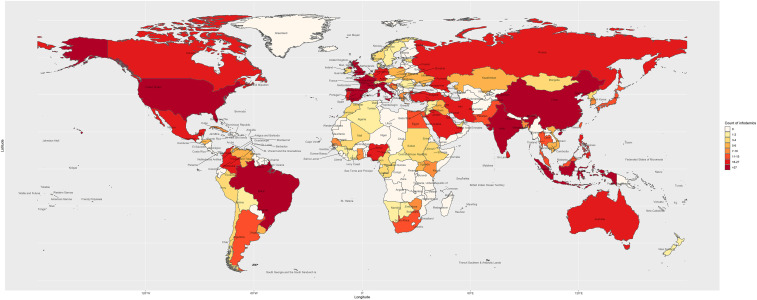
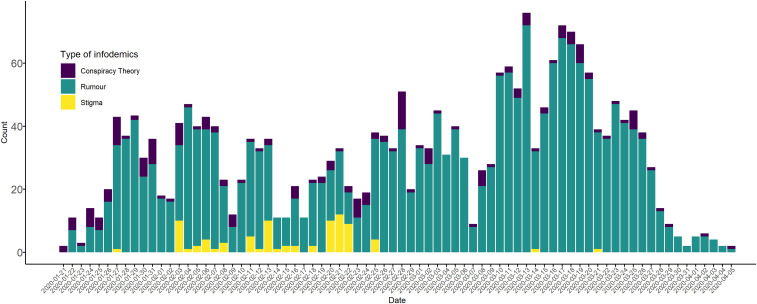
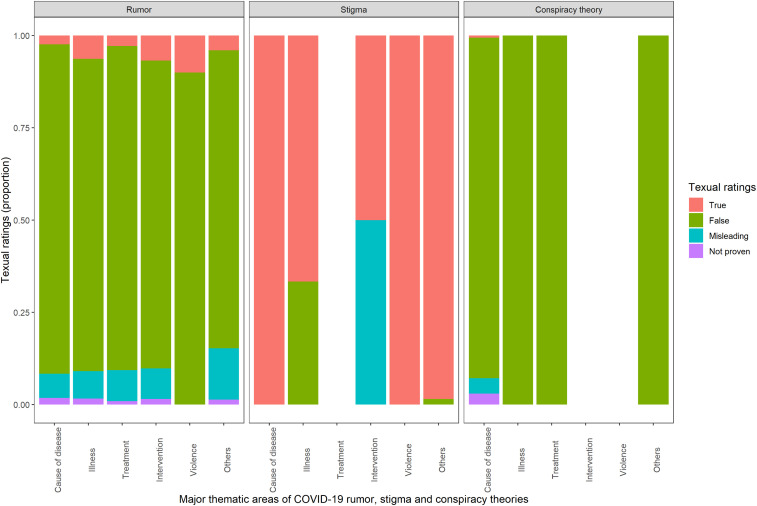
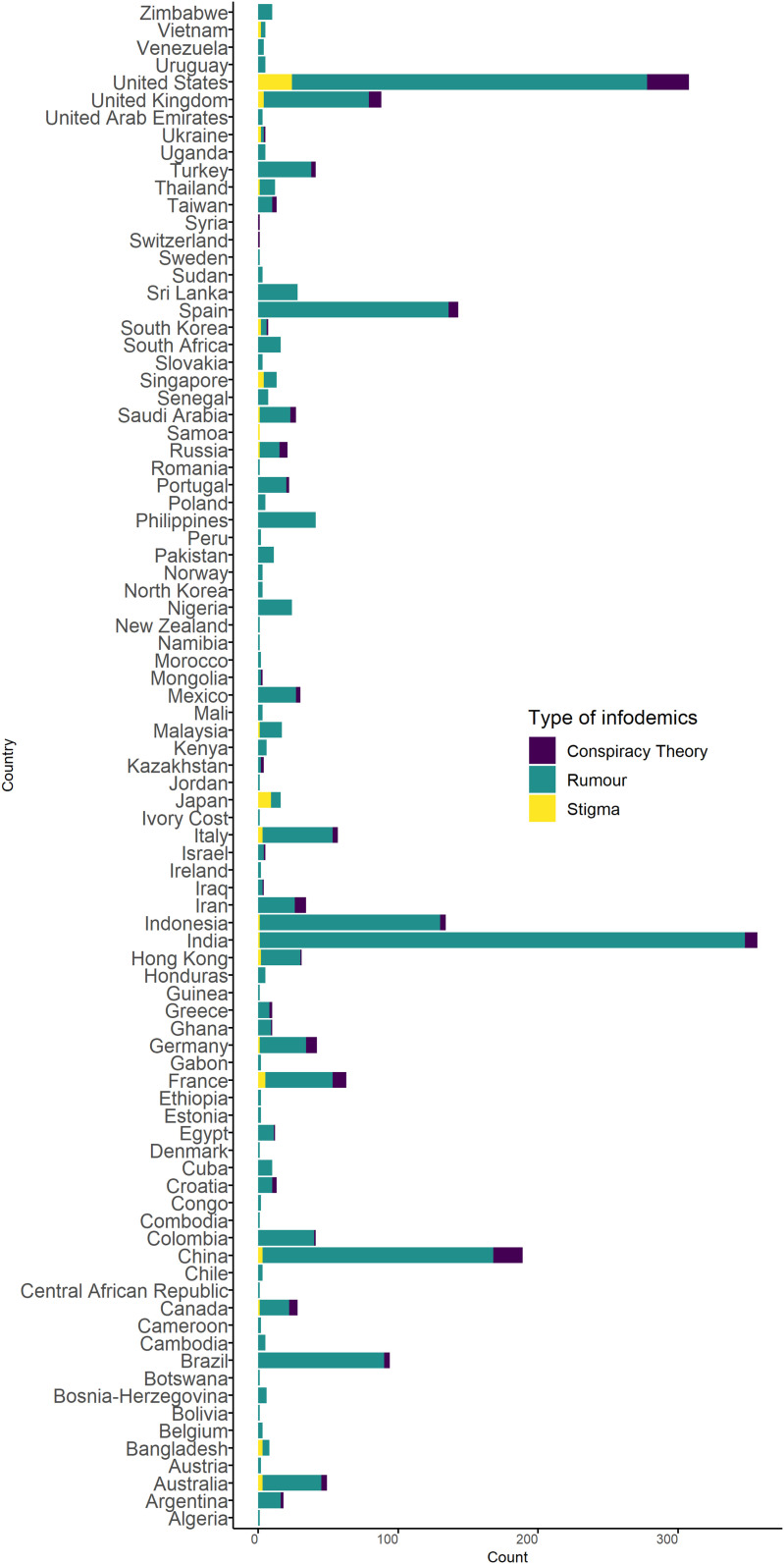
Infodemics, often including rumors, stigma, and conspiracy theories, have been common during the COVID-19 pandemic. Monitoring social media data has been identified as the best method for tracking rumors in real time and as a possible way to dispel misinformation and reduce stigma. However, the detection, assessment, and response to rumors, stigma, and conspiracy theories in real time are a challenge. Therefore, we followed and examined COVID-19-related rumors, stigma, and conspiracy theories circulating on online platforms, including fact-checking agency websites, Facebook, Twitter, and online newspapers, and their impacts on public health. Information was extracted between December 31, 2019 and April 5, 2020, and descriptively analyzed. We performed a content analysis of the news articles to compare and contrast data collected from other sources. We identified 2,311 reports of rumors, stigma, and conspiracy theories in 25 languages from 87 countries. Claims were related to illness, transmission and mortality (24%), control measures (21%), treatment and cure (19%), cause of disease including the origin (15%), violence (1%), and miscellaneous (20%). Of the 2,276 reports for which text ratings were available, 1,856 claims were false (82%). Misinformation fueled by rumors, stigma, and conspiracy theories can have potentially serious implications on the individual and community if prioritized over evidence-based guidelines. Health agencies must track misinformation associated with the COVID-19 in real time, and engage local communities and government stakeholders to debunk misinformation.
Overview
The claims and statistics of this paper haven’t been checked yet.
Free: it reads the open-access text and checks the first 5 claims that cite a source we can check. Create a free account to check every claim.
Integrity signals
Registry
Cites
Statistics
Figures
Verification
Claims the paper makes
The claims and statistics of this paper haven’t been checked yet.
Free: it reads the open-access text and checks the first 5 claims that cite a source we can check. Create a free account to check every claim.
Claims other papers make about this one
Each is checked against this paper’s own text: does it say what the citing paper says it does?
The cited source says what the claim attributes to it.
In the citing paper
“Misinformation during the Ebola outbreak in the Democratic Republic of the Congo in 2019 was associated with aggression, mistrust, social unrest, and targeted assaults on healthcare workers [45].”
From Social Media Role and Its Impact on Public Health: A Narrative Review (2023) · cites this paper as [45]
The cited source says what the claim attributes to it.
In the citing paper
“Rumors about COVID-19 have been labeled a global enemy by the UN secretary-general [45].”
From Social Media Role and Its Impact on Public Health: A Narrative Review (2023) · cites this paper as [45]
The cited source says what the claim attributes to it.
In the citing paper
“During the SARS outbreak in China in 2002-2003, Asian people faced social stigma as a result of their fear of contracting the disease [45].”
From Social Media Role and Its Impact on Public Health: A Narrative Review (2023) · cites this paper as [45]
Self-check
Percentages, sums and reported differences re-computed from the paper’s own numbers.
The self-check needs the paper’s full text.
Citations
Cites
Understanding Conspiracy Theories
Douglas, K. M., Uscinski, J. E., Sutton, R. M., Cichocka, A., Nefes, T., Ang, C. S., & Deravi, F. (2019) · Political Psychology · doi:10.1111/pops.12568 · Cited by 1,511 · cited 1×
“defined as explanatory beliefs about an individual or group of people working in secret to reaching malicious goals.(16) Data extraction and consistency.”
BackgroundFear and Stigma: The Epidemic within the SARS Outbreak
Person, B., Sy, F., Holton, K., Govert, B., Liang, A., the, N. C. I. D., SARS Community Outreach Team (listed in alphabetical order), Garza, B., Gould, D., Hickson, M., et al. (2004) · Emerging Infectious Diseases · doi:10.3201/eid1002.030750 · Cited by 790
YouTube as a source of information on COVID-19: a pandemic of misinformation?
Li, H. O.-Y., Bailey, A., Huynh, D., & Chan, J. (2020) · BMJ Global Health · doi:10.1136/bmjgh-2020-002604 · Cited by 781
See Something, Say Something: Correction of Global Health Misinformation on Social Media
Bode, L., & Vraga, E. K. (2018) · Health Communication · doi:10.1080/10410236.2017.1331312 · Cited by 745 · cited 1×
“aimed at promoting evidence against misinformation quickly and clearly might change people’s perception and healthseeking behaviors.(52,53) Currently, the WHO and other health”
BackgroundZubiaga, A., Liakata, M., Procter, R., Wong Sak Hoi, G., & Tolmie, P. (2016) · PLOS ONE · doi:10.1371/journal.pone.0150989 · Cited by 722 · cited 1×
“Rumor is defined as unverified information that canbe foundas true, fabricated, or entirely false after verification.(14) Stigma is a socially constructed process through which a person with stigma can experience discrimination and devaluation in society.”
BackgroundTuran, B., Budhwani, H., Fazeli, P. L., Browning, W. R., Raper, J. L., Mugavero, M. J., & Turan, J. M. (2017) · AIDS and Behavior · doi:10.1007/s10461-016-1451-5 · Cited by 480
Prevention is better than cure: addressing anti-vaccine conspiracy theories
Jolley, D., & Douglas, K. M. (2017) · Journal of Applied Social Psychology · doi:10.1111/jasp.12453 · Cited by 446 · cited 1×
“aimed at promoting evidence against misinformation quickly and clearly might change people’s perception and healthseeking behaviors.(52,53) Currently, the WHO and other health”
BackgroundEbola, Twitter, and misinformation: a dangerous combination?
Oyeyemi, S. O., Gabarron, E., & Wynn, R. (2014) · BMJ · doi:10.1136/bmj.g6178 · Cited by 348 · cited 1×
“Last, there are the well-documented issues with misinformation with Ebola, including false treatments, health workers were deliberately spreading the Ebola virus, and Ebola epidemic was a hoax.(49,50) Such conspiracy theories and misinformation may have impeded the ability of healthcare workers and emergency responder…”
BackgroundAttacks against health-care personnel must stop, especially as the world fights COVID-19
McKay, D., Heisler, M., Mishori, R., Catton, H., & Kloiber, O. (2020) · The Lancet · doi:10.1016/s0140-6736(20)31191-0 · Cited by 186
Young, W. B., Park, J. E., Tian, I. X., & Kempner, J. (2013) · PLoS ONE · doi:10.1371/journal.pone.0054074 · Cited by 138 · cited 1×
“Stigma is a socially constructed process through which a person with stigma can experience discrimination and devaluation in society.(15) A conspiracy theory is”
Background
Research works printed but not linked: 29
- World Health Organization, 2020 Coronavirus Disease 2019 (COVID-19) Situation Report – 13. Geneva, Switzerland: WHO.
- Lederer EM, 2020 U.N. Chief Antonio Guterres: Misinformation about COVID-19 Is the New Enemy. TIME. New York, NY: TIME.
- World Health Organization, 2018 Managing Epidemics: Key Facts about Major Deadly Diseases. Luxembourg: WHO.
- Center for Preparedness and Response, 2020 Responding to Rumors and Misinformation. Emergency Preparedness and Response. Atlanta, GA: Centre for Disease Control and Prevention.
- Eckert KS 2016 Evidence Syntheses to Support the Guideline on Emergency Risk Communication. Geneva, Switzerland: World Health Organization.
- Victoria Knight of Kaiser Health News, 2020 COVID-19: Beware Online Tests and Cures, Experts Say. The Guardian. Surry Hills, NSW, Australia: The Guardian.
- Spencer SH, 2020 Fake Coronavirus Cures, Part 1: MMS Is Industrial Bleach. Available at: https://www.factcheck.org/2020/02/fake-coronavirus-cures-part-1-mms-is-industrial-bleach/. Accessed April 4, 2020.
- Vrajlal A, 2020 Chinese-Australians Facing Racism after Coronavirus Outbreak. Available at: https://www.huffingtonpost.com.au/entry/coronavirus-australia-racism_au_5e33a522c5b6f2623326d72b. Accessed April 4, 2020.
- BBC Reality Check Team, 2020 Coronavirus: Does Drinking Tea Help? BBC News. Delhi, India: BBC News.
- Cable T, 2020 CDD FACT CHECK: Can Camel Urine, Lime Cure Coronavirus? The Cable. Abuja, Nigeria: The Cable Newspaper.
- Landsverk G, 2020 Holding Your Breath Can’t Help You Self-Diagnose the Coronavirus. Here’s What You Should Do Instead. Business Insider Australia. Surry Hills, NSW, Australia: Business Insider Australia.
- Ellis-Petersen H Rahman SA, 2020 Indian Doctors Being Evicted from Homes over Coronavirus Fears. The Guardian. Surry Hills, NSW, Australia: The Guardian.
- Mead WR, 2020 China Is the Real Sick Man of Asia. The Wall Street Journal. New York, NY: The Wall Street Journal.
- Breland A, 2020 Russian Media Outlets Are Blaming the Coronavirus on the United States. Mother Jones. San Francisco, CA: Mother Jones.
- Gertz B, 2020 Coronavirus May Have Originated in Lab Linked to China’s Biowarfare Program. The Washington Post. Washington, DC: The Washington Post.
- Gregory J, 2020 The Coronavirus ‘Infodemic’ Is Real. We Rated the Websites Responsible for It. Statnews. Boston, MA: Statnews.
- Richtel M, 2020 WHO Fights a Pandemic besides Coronavirus: An ‘Infodemic’. The New York Times. New York, NY: The New York Times.
- Meddle East Media Research Institute, 2020 Arab Writers: The Coronavirus Is Part of Biological Warfare Waged by the U.S. against China. Egypt, Saudi Arabia, and Syria: Meddle East Media Research Institute TV.
- Farda R, 2020 Iran Cleric Blames Trump for Coronavirus Outbreak in Religious City. Radio Farda. Prague, Czech Republic: Radio Farda.
- Colson T, 2020 A Fake Claim That Cocaine Cures the Coronavirus Is Spreading Online, and the French Government Was Forced to Tell People That It Won’t. Business Insider Australia. Surry Hills, NSW, Australia: Business Insider Australia.
- Frenkel S Alba D Zhong R, 2020 Surge of Virus Misinformation Stumps Facebook and Twitter. The New York Times. New York, NY: The New York Times.
- World Health Organization, 2020 Alcohol Does Not Protect against COVID-19; Access Should Be Restricted during Lockdown. Alcohol Use. Geneva, Switzerland: WHO, Regional Office for Europe.
- CNN Türk, 2020 9 Kişi Daha Saf Alkolden Öldü [9 More Poeple Died from Pre Alcohol]. Available at: https://www.cnnturk.com/video/turkiye/9-kisi-daha-saf-alkolden-oldu. Accessed June 4, 2020.
- Staff Reporter, 2020 Twelve Taken Ill after Consuming ‘Coronavirus Shaped’ Datura Seeds. The Hindu. Andhra Pradesh, India: The Hindu.
- Chan-Kyong P, 2020 Coronavirus: Saltwater Spray Infects 46 Church-Goers in South Korea. South China Morning Post. Causeway Bay, Hong Kong: South China Morning Post.
- Eckel M, 2020 Tractors, Herbs, Vodka, Saunas? Some Leaders Offer Strange, Unhelpful Advice On Warding Off COVID-19. Available at: https://www.rferl.org/a/coronavirus-unhelpful-advice-tractors-herbs-vodka-saunas-gurbanguly-lukashenka-vucic/30495810.html. Accessed June 4, 2020.
- Tajmim T, 2020 Coronavirus: 41 Doctors, 10 Nurses Infected. The Business Standard. Dhaka, Bangladesh: The Business Standard.
- National Herald, 2020 Social Stigma Forcing Corona Patients to Avoid Screening in India. National Herald. New Delhi, India: National Herald.
- Kabananukye K, 2001 Denial, Discrimination and Stigmatisation: The Case of Ebola Epidemic in Some Districts. Kampala, Uganda: Ugandan Ministry of Health, National Ebola Task Force.
Cited by
Items 201–300 of 997
Bhattacharya, S., & Singh, A. P. (2025) · Frontiers in Communication · doi:10.3389/fcomm.2025.1560936 · Cited by 37
Wang, Q., Xie, L., Song, B., Di, J., Wang, L., & Mo, P. K. H. (2022) · JMIR Medical Informatics · doi:10.2196/28183 · Cited by 26
“These findings concurred with previous studies, which showed that negative emotions during the COVID-19 outbreak could be amplified by misinformation fueled with rumors about the severity of the disease [54].”
Uchibori, M., Ghaznavi, C., Murakami, M., Eguchi, A., Kunishima, H., Kaneko, S., Maruyama‐Sakurai, K., Miyata, H., & Nomura, S. (2022) · International Journal of Environmental Research and Public Health · doi:10.3390/ijerph192114511 · Cited by 22
“Additionally, a detailed analysis of social media and the disease is ongoing in general, but further research is needed to examine the effects [31,32].”
BackgroundHurstak, E., Paasche‐Orlow, M. K., Hahn, E. A., Henault, L. E., Taddeo, M. A., Moreno, P. I., Weaver, C., Marquez, M., Serrano, E., Thomas, J. L., et al. (2023) · Vaccine · doi:10.1016/j.vaccine.2023.02.059 · Cited by 25
“COVID-19 has spawned an infodemic [70–72] given the tremendous volume of unverified, misleading, or false information about the COVID-19 virus and vaccination [73–75].”
Madni, H. A., Umer, M., Abuzinadah, N. E., Hu, Y., Saidani, O., Alsubai, S., Hamdi, M., & Ashraf, I. (2023) · Electronics · doi:10.3390/electronics12061302 · Cited by 24
“Figure 1 depicts the spread of COVID-19-related rumors, stigma, and conspiracy theories that were discovered in 2020, according to the American Journal of Tropical Medicine and Hygiene [18].”
BackgroundNing, P., Cheng, P., Li, J., Ming, Z., Schwebel, D. C., Yang, Y., Lü, P., Li, M., Zhang, Z., & Hu, G. (2021) · Journal of Medical Internet Research · doi:10.2196/27339 · Cited by 23
“The findings of previous studies, regarding fluctuations in the number of rumors reported on a daily basis, the geographic variations for those reports across China [14], and major topics of the COVID-19 rumors [14,15], were generally concordant with our findings.”
Cianciulli, A., Santoro, E., Manente, R., Pacifico, A., Quagliarella, S., Bruno, N., Schettino, V., & Boccia, G. (2025) · Healthcare · doi:10.3390/healthcare13202623 · Cited by 30
Public Policy Measures to Increase Anti-SARS-CoV-2 Vaccination Rate in Russia
Boguslavsky, D. V., Sharova, N. P., & Sharov, K. S. (2022) · International Journal of Environmental Research and Public Health · doi:10.3390/ijerph19063387 · Cited by 20
Sialubanje, C., Nawa, M., Ng'andu, M., Sumani, E. M., Nkonkomalimba, M., Lyatumba, D. E., Mwale, A., Mpiana, F., Zulu, J. M., Mweempwa, B., et al. (2022) · BMJ Open · doi:10.1136/bmjopen-2021-058028 · Cited by 26
Aghabozorgi, K., van der Jagt, A., Bell, S., & Brown, C. (2023) · Health & Place · doi:10.1016/j.healthplace.2023.103141 · Cited by 25
Employee Volunteerism—Conceptual Study and the Current Situation
Kolnhofer-Derecskei, A., & Nagy, V. (2020) · Sustainability · doi:10.3390/su12208378 · Cited by 25
“The lack of reliable information facilitates the spread of infodemics, as the authors of new research [82] call misleading online information or rumors; that is very risky nowadays.”
BackgroundDror, A. A., Morozov, N. G., Layous, E., Mizrachi, M., Daoud, A., Eisenbach, N., Rayan, D., Kaykov, E., Marei, H. F., Barhum, M., et al. (2021) · Frontiers in Medicine · doi:10.3389/fmed.2020.618337 · Cited by 25
Undergraduate nursing students’ COVID-19 vaccine intentions: A national survey
Fontenot, H. B., Mattheus, D. B., Lim, E., Michel, A. D., Ryan, N., Knopf, A., Abuelezam, N. N., Stamp, K. D., Hekel, B. E., Branson, S., et al. (2021) · PLoS ONE · doi:10.1371/journal.pone.0261669 · Cited by 21
Campos, P. A., Alfaro–Ponce, B., Pérez, B. M. R., Bernal-Serrano, D., Contreras-Loya, D., & Wirtz, V. J. (2024) · Social Science & Medicine · doi:10.1016/j.socscimed.2024.117646 · Cited by 26
‘Falsehood flies, and the truth comes limping after it’: social media and public health
Moore, J. B., Harris, J. K., & Hutti, E. T. (2021) · Current Opinion in Psychiatry · doi:10.1097/yco.0000000000000730 · Cited by 26
Covid-19 stigmatization: A systematic literature review
Kartono, R., Salahudin, S., & Sihidi, I. T. (2022) · Journal of Public Health Research · doi:10.1177/22799036221115780 · Cited by 22
Quansah, F., Ankomah, F., Agormedah, E. K., Abieraba, R. S. K., Srem‐Sai, M., Hagan, J. E., Okan, O., Dadaczynski, K., & Schack, T. (2022) · Health Science Reports · doi:10.1002/hsr2.916 · Cited by 20
Adle, M., Behre, J., Real, B., & Jean, B. S. (2022) · The Library Quarterly · doi:10.1086/722553 · Cited by 18
“Citing an earlier study (Saiful Islam et al. 2020) that was published in the American Journal of Tropical Medicine and Hygiene, an August 2020 BBC News article (Coleman 2020) reported that at least 800 people may have died worldwide and that 5,800 people had been hospitalized after acting on false…”
MethodRuani, M. A., & Reiss, M. J. (2023) · Nutrients · doi:10.3390/nu15020451 · Cited by 26
“Undoubtedly, health and nutrition misinformation and disinformation have been a major public health concern since the outset of the COVID-19 pandemic [6,9,10], to the extent that the ‘infodemic’ phenomenon was deemed a secondary public health threat by the WHO [11].”
BackgroundDolan, E. H., Goulding, J., Marshall, H., Smith, G., Long, G., & Tata, L. J. (2023) · Nature Communications · doi:10.1038/s41467-023-42776-4 · Cited by 24
“When self-reports are obtained indirectly through analysis of social media accounts they too have similar response biases due to both memory failure and social desirability 13,14 .”
Transformer-based models for combating rumours on microblogging platforms: a review
Anggrainingsih, R., Hassan, G. M., & Datta, A. (2024) · Artificial Intelligence Review · doi:10.1007/s10462-024-10837-9 · Cited by 29
Wang, S., Li, L. Z., van Antwerpen, N., Suparman, S., Gayatri, M., Sari, N. P., & Zhang, S. X. (2021) · American Journal of Tropical Medicine and Hygiene · doi:10.4269/ajtmh.21-0463 · Cited by 27
“healthcare workers in less developed countries or regions to believe in misinformation.(22) In other words, even if some”
Liu, H., Chen, Q., & Evans, R. D. (2022) · International Journal of Environmental Research and Public Health · doi:10.3390/ijerph19116751 · Cited by 18
“Recent studies have focused their efforts on examining the effects of the infodemic on citizens’ psychological issues and mental health [6,34], and how private social media use has affected the infodemic [1,12,45].”
BackgroundDowning, S. T., McCarty, R. J., Guastello, A. D., Cooke, D. L., & McNamara, J. P. H. (2022) · Psychology Health & Medicine · doi:10.1080/13548506.2022.2093925 · Cited by 19
“Misinformation has undermined efforts to increase NPI adherence (Tasnim et al., 2020) and promoted unproven and dangerous alternatives (Islam et al., 2020; Knight, 2020; Li et al., 2020).”
BackgroundA Systematic Review of 5110 Cases of Monkeypox: What Has Changed Between 1970 and 2022?
Kumar, R., Singh, S., & Singh, S. K. (2022) · Cureus · doi:10.7759/cureus.30841 · Cited by 17
“More importantly, the recent clustering of cases around sexual networks is driving a sense of stigma that might deter high-risk groups from coming forward and seeking help [18].”
BackgroundGao, H., Guo, D., Yin, H., Wu, J., Cao, Z., & Li, L. (2022) · Journal of Applied Communication Research · doi:10.1080/00909882.2022.2144409 · Cited by 21
“Scholars found that the rumors about COVID-19 on social media mainly focused on the origin of the disease, the means of prevention and medical treatment, the cognition of the disease, and the specific measures to deal with the pandemic (Islam et al., 2020).”
BackgroundSusmann, M. W., & Wegener, D. T. (2022) · Memory & Cognition · doi:10.3758/s13421-022-01374-3 · Cited by 27
“For example, misinformation about the COVID-19 pandemic is prevalent and harmful, having been linked to thousands of deaths and hospitalizations (Islam et al., 2020).”
BackgroundObeidat, R., Gharaibeh, M., Abdullah, M., & Alharahsheh, Y. (2022) · PeerJ Computer Science · doi:10.7717/peerj-cs.1151 · Cited by 20
“Several fatalities and hospitalizations have been reported globally due to promoting the consumption of toxic substances to cure the virus (Barua et al., 2020; Islam et al., 2020).”
BackgroundWageck, B., Noal, I. S., Guterres, B. D., Adami, S. L., Bordin, D., Fanfa, M. D. S., & Nunes, G. S. (2023) · Brazilian Journal of Physical Therapy · doi:10.1016/j.bjpt.2023.100484 · Cited by 28
A Survey on COVID-19 Data Analysis Using AI, IoT, and Social Media
Butt, M. J., Malik, A. K., Qamar, N., Yar, S., Malik, A. J., & Rauf, U. (2023) · Sensors · doi:10.3390/s23125543 · Cited by 24
“In the end, the authors evaluated the BERT technique with five other ML and DL techniques and the results showed that the proposed technique outperformed the rest of the techniques by achieving 99.1% accuracy.”
MethodInfluentialThe Negative Role of Social Media During the COVID-19 Outbreak
Yas, H., Jusoh, A., Štreimikienė, D., Mardani, A., Nor, K. M., Alatawi, A., & Umarlebbe, J. H. (2021) · International Journal of Sustainable Development and Planning · doi:10.18280/ijsdp.160202 · Cited by 35
“However, many studies have highlighted that social media has been employed to create fear and panic among its many users [43].”
BackgroundAgormedah, E. K., Quansah, F., Ankomah, F., Hagan, J. E., Srem‐Sai, M., Abieraba, R. S. K., Frimpong, J. B., & Schack, T. (2022) · Frontiers in Digital Health · doi:10.3389/fdgth.2022.968806 · Cited by 21
“, 1,856 of the 2,276 reports) were classified as being “false” (13).”
BackgroundRömer, D., & Jamieson, K. H. (2022) · Scientific Reports · doi:10.1038/s41598-022-22014-5 · Cited by 22
Yang, W., Wang, S., Peng, Z., Shi, C., Ma, X., & Yang, D. (2022) · Proceedings of the International AAAI Conference on Web and Social Media · doi:10.1609/icwsm.v16i1.19366 · Cited by 26
Estratégias adotadas na América do Sul para a gestão da infodemia da COVID-19
Haraki, C. A. C. (2021) · Revista Panamericana de Salud Pública · doi:10.26633/rpsp.2021.43 · Cited by 30
“Em contextos de epidemia, a disseminação de rumores, teorias da conspiração e informações que causam estigma em determinado grupo populacional ou profissional tem sido observada na literatura desde a gripe espanhola até tempos mais recentes — por exemplo, nas epidemias de HIV, Zika vírus e Ebola (4-6).”
BackgroundAbdeen, M. A. R., Hamed, A. A., & Wu, X. (2021) · Applied Sciences · doi:10.3390/app11167265 · Cited by 19
“In fact, similar theories emerged during the SARS outbreak in China and the Ebola outbreak the Congo [12]; (3) Misinformation and public health damage has been related to tweeting bad advice from people of authority.”
BackgroundDeep Feature Fusion for Rumor Detection on Twitter
Luo, Z., Li, Q., & Zheng, J. J. (2021) · IEEE Access · doi:10.1109/access.2021.3111790 · Cited by 22
“During the COVID-19 pandemic, there was a popular myth that the consumption of highly concentrated alcohol could disinfect the body and kill the virus, which led to the death of approximately 800 people [2].”
BackgroundAntibiotics against viruses: Brazilian doctors adrift
Silva, H. M. (2021) · Infection Control and Hospital Epidemiology · doi:10.1017/ice.2021.434 · Cited by 16
“A responsible doctor would refrain from recommending (or prescribing) a medication without any discussion of its risks and possible side effects [3].”
BackgroundPollack, C. C., Emond, J. A., O’Malley, A. J., Byrd, A. I., Green, P., Miller, K., Vosoughi, S., Gilbert‐Diamond, D., & Onega, T. (2022) · Journal of Medical Internet Research · doi:10.2196/36729 · Cited by 23
“Although social media promises to foster meaningful connections between individuals around the world, it has been exploited to spread misinformation and disinformation on a variety of topics, from the 2016 presidential election to the COVID-19 pandemic [2,3].”
He, L., & He, C. (2022) · Proceedings of the ACM on Human-Computer Interaction · doi:10.1145/3555138 · Cited by 21
“During the COVID-19 pandemic, the global internet was fraught with misinformation regarding origins of the virus, interventions, and treatments [23,56].”
BackgroundWang, J., & Tanes, Z. (2022) · Journal of Broadcasting & Electronic Media · doi:10.1080/08838151.2022.2153842 · Cited by 19
“For instance, regarding COVID-19, it is estimated that more than 2,000 rumors and conspiracy theories about the disease were generated and proliferated on social media (Islam et al., 2020).”
BackgroundGao, J., Raza, S. H., Yousaf, M., Shah, A. A., Hussain, I., & Malik, A. N. (2023) · Vaccines · doi:10.3390/vaccines11010114 · Cited by 21
“The prior items were adapted from the literature [7,72] and modified based on the results obtained by the Google Trends tools to ensure the alignment between the public search about the COVID-19 vaccine and their perception.”
Alshehri, S., & Sallam, M. (2023) · Human Vaccines & Immunotherapeutics · doi:10.1080/21645515.2023.2275962 · Cited by 18
O’Connor, C., O’Connell, N., Burke, E., Nolan, A., Dempster, M., Graham, C. D., Nicolson, G., Barry, J., Scally, G., Crowley, P., et al. (2021) · International Journal of Environmental Research and Public Health · doi:10.3390/ijerph18189542 · Cited by 20
Pharmacological management of COVID-19 in type 2 diabetes
Ceriello, A., & Prattichizzo, F. (2021) · Journal of Diabetes and its Complications · doi:10.1016/j.jdiacomp.2021.107927 · Cited by 17
“Reports of success in early clinical studies were widely publicized by news outlets, politicians and on social media.(65) However, hydroxychloroquine may have serious adverse effects, particularly for the heart.”
BackgroundThe impact of the COVID-19 pandemic on cybercrime
Gryszczyńska, A. (2021) · Bulletin of the Polish Academy of Sciences Technical Sciences · doi:10.24425/bpasts.2021.137933 · Cited by 15
“The media and literature are increasingly referring to this phenomenon as infodemic [14].”
BackgroundEpidemic proximity and imitation dynamics drive infodemic waves during the COVID-19 pandemic
d’Andrea, V., Artime, O., Castaldo, N., Sacco, P. L., Gallotti, R., & Domenico, M. D. (2022) · Physical Review Research · doi:10.1103/physrevresearch.4.013158 · Cited by 18
Zhang, Q., Phang, C. W., & Zhang, C. (2022) · Government Information Quarterly · doi:10.1016/j.giq.2022.101749 · Cited by 17
“This phenomenon is defined as an overabundance of information that makes it difficult for people to find trustworthy sources and reliable guidance when they need it (Islam et al., 2020; Islam et al., 2020).”
BackgroundLi, Z., Wu, X., Lin, X., Liu, M., & Huang, C. (2023) · Journal of Medical Internet Research · doi:10.2196/45019 · Cited by 18
Saleem, S. M., & Jan, S. S. (2024) · Frontiers in Public Health · doi:10.3389/fpubh.2023.1324330 · Cited by 26
AI vs linguistic-based human judgement: Bridging the gap in pursuit of truth for fake news detection
Pawlicka, A., Pawlicki, M., Kozik, R., Andrychowicz-Trojanowska, A., & Choraś, M. (2024) · Information Sciences · doi:10.1016/j.ins.2024.121097 · Cited by 22
Vulnerability to rumours during the COVID-19 pandemic in Singapore
Long, V. J. E., Koh, W. S., Saw, Y. E., & Liu, J. C. (2021) · Annals of the Academy of Medicine Singapore · doi:10.47102/annals-acadmedsg.2020523 · Cited by 21
Using Google Health Trends to investigate COVID-19 incidence in Africa
Fulk, A., Romero-Álvarez, D., Abu-Saymeh, Q., Onge, J. M. S., Peterson, A. T., & Agusto, F. B. (2022) · PLoS ONE · doi:10.1371/journal.pone.0269573 · Cited by 20
“Factors determining this context include disinformation via social media [15], lack of syringes, lack of health workers to administer vaccines, especially in rural areas [13], limited government planning and testing, and complicated efforts of vaccine allocation [16].”
BackgroundSocial Media Reinvented: Can Social Media Help Tackle the Post-Pandemic Mental Health Onslaught?
Sarangi, A., Amor, W., Co, E. L., Javed, S., Usmani, S., & Rashid, A. (2022) · Cureus · doi:10.7759/cureus.21070 · Cited by 19
“The threats have included COVID-19 stigma, rumors, and other infodemics, a term that was coined way back in 2019 during the Ebola outbreak to mean a mixture of accurate and exaggerated information, something that makes it hard to decipher which one is trustworthy or not [3].”
BackgroundPandemics, infodemics and health promotion
White, B. K., Phuong, L., Roach, J., Teggelove, N., & Wallace, H. (2022) · Health Promotion Journal of Australia · doi:10.1002/hpja.644 · Cited by 14
“Early on in the pandemic in Australia, newspapers published inflammatory content about Chinese children, and there was reported harassment and violence towards people of Asian descent.(2) Mis/disinformation drives stigma and discrimination and creates a barrier to early testing and seeking health assistance when requi…”
BackgroundInfluentialWhite, B. K., Gombert, A., Nguyen, T., Yau, B., Ishizumi, A., Kirchner, L., León, A., Wilson, H., Jaramillo-Gutierrez, G., Cerquides, J., et al. (2023) · JMIR Infodemiology · doi:10.2196/47317 · Cited by 25
“The infodemic can have a poor impact on public health outcomes [2,3], and there is evidence that those who are most at risk may be most vulnerable to infodemic [4].”
BackgroundHaupt, M. R., Chiu, M., Chang, J., Li, Z., Cuomo, R. E., & Mackey, T. K. (2023) · PLoS ONE · doi:10.1371/journal.pone.0295414 · Cited by 20
Charania, N. A., Tonumaipe’a, D., Barbarich-Unasa, T. W., Iusitini, L., Davis, G., Pacheco, G. A., & Wilson, D. (2024) · Human Vaccines & Immunotherapeutics · doi:10.1080/21645515.2023.2301626 · Cited by 20
“58 Also, it is vital that HCPs and the health sector more broadly regains credibility as trusted sources of unbiased health information among Māori and Pacific whānau.”
Unsupervised Domain-Agnostic Fake News Detection Using Multi-Modal Weak Signals
Silva, A., Luo, L., Karunasekera, S. A., & Leckie, C. A. (2024) · IEEE Transactions on Knowledge and Data Engineering · doi:10.1109/tkde.2024.3392788 · Cited by 24
The sequel to COVID-19: the antithesis to life
Bhandari, S., Shaktawat, A. S., Patel, B., Dube, A., Kakkar, S., Tak, A., Gupta, J., & Rankawat, G. (2020) · Journal of Ideas in Health · doi:10.47108/jidhealth.vol3.issspecial1.69 · Cited by 17
“must take appropriate measures to track and prevent the spread of misinformation, rumors, stigma, and conspiracy theories on social media platforms, as it can lead to severe implications on people and the community [75].”
BackgroundPulido, C., Ovseiko, P. V., Palomar, M. F., Kumpulainen, K., & Ramis‐Salas, M. (2021) · International Journal of Qualitative Methods · doi:10.1177/16094069211050163 · Cited by 16
“…al., 2021), citizens ’ hesitancy to vaccines (Hernandez et al., 2021; Piedrahita-Vald´es et al., 2021), the responses provided by world leaders (Rufai & Bunce, 2020) and the impact of fake news (Atehortua & Patino, 2021; Islam et al., 2020; Pulido, Ruiz-Eugenio, et al., 2020), among other topics.”
BackgroundCyberchondria in the Time of the COVID-19 Pandemic
Jokić‐Begić, N., & Bagarić, B. (2021) · Advances in media, entertainment and the arts (AMEA) book series · doi:10.4018/978-1-7998-8630-3.ch010 · Cited by 14
Visualizing Social Media Research in the Age of COVID-19
Michailidis, P. D. (2022) · Information · doi:10.3390/info13080372 · Cited by 15
Influencing factors of anxiety and depression of discharged COVID-19 patients in Wuhan, China
Dai, Z., Xiao, W., Wang, H., Wu, Y., Huang, Y., Si, M., Fu, J., Chen, X., Jia, M., Leng, Z., et al. (2022) · PLoS ONE · doi:10.1371/journal.pone.0276608 · Cited by 17
“Moreover, social media were suggested to contribute to eliminating stigma by challenging stereotyping and stigmatization, spreading knowledge on COVID-19 to a wider audience, stopping rumors, and dispelling misinformation and conspiracy theories on COVID-19 [47].”
BackgroundSafety and Reverence: How Roman Catholic Liturgy Can Respond to the COVID-19 Pandemic
Budaev, S. V. (2020) · Journal of Religion and Health · doi:10.1007/s10943-021-01282-x · Cited by 17
AraCOVID19-MFH: Arabic COVID-19 Multi-label Fake News and Hate Speech Detection DatasetPreprint
Ameur, M. S. H., & Aliane, H. (2021) · arXiv (Cornell University) · doi:10.48550/arxiv.2105.03143 · Cited by 14
“The spread of these misinformations has led people to distrust some medical treatments and vaccines and to even refuse several essential COVID-19 protection measures such as self-isolation, social distancing, and wearing masks [3, 4, 5].”
BackgroundCoronavirus Misinformation, Social Media and Freedom of Speech
Howard, J. W. (2021) · doi:10.5040/9781350225930.ch-013 · Cited by 14
COVID-19: The Pseudo-Environment and the Need for a Paradigm Change
Stein, R. A., Ometa, O., & Broker, T. R. (2021) · GERMS · doi:10.18683/germs.2021.1283 · Cited by 18
Rendell, N., & Sheel, M. (2022) · PLOS Global Public Health · doi:10.1371/journal.pgph.0000529 · Cited by 14
“The emergence of social media as a platform for wide-scale and rapid information sharing was useful and advantageous for rapidly disseminating information and encouraging community participation, but was accompanied by the emergence of the mis-information “infodemic” [33, 34].”
BackgroundExploring Canadian perceptions and experiences of stigma during the COVID-19 pandemic
Fahim, C., Cooper, J., Theivendrampillai, S., Pham, B., & Straus, S. E. (2023) · Frontiers in Public Health · doi:10.3389/fpubh.2023.1068268 · Cited by 16
Realfood and Cancer: Analysis of the Reliability and Quality of YouTube Content
Segado-Fernández, S., Herrera‐Peco, I., Jiménez-Gómez, B., Ruíz-Núñez, C., Hidalgo, P. J. J., de Gracia, E. B., González‐Rodríguez, L. G., Torres-Ramírez, C., & Lozano-Estevan, M. D. C. (2023) · International Journal of Environmental Research and Public Health · doi:10.3390/ijerph20065046 · Cited by 16
Zimmermann, B. M., Buyx, A., & McLennan, S. (2023) · SSM - Population Health · doi:10.1016/j.ssmph.2023.101388 · Cited by 18
“While many welcomed strict policy interventions at the beginning of the crisis, the voices of critics and skeptics were getting louder as the pandemic progressed (Georgiou, Delfabbro, & Balzan, 2020; Islam et al., 2020).”
Disinformation enabled Donald Trump’s second term and is a crisis for democracies everywhere
McKee, M., Pagel, C., & Buse, K. (2024) · BMJ · doi:10.1136/bmj.q2485 · Cited by 13
Improving Understanding of and Response to Infodemics During Public Health Emergencies
Sell, T. K., Hosangadi, D., Trotochaud, M., Purnat, T. D., Nguyen, T., & Briand, S. C. (2021) · Health Security · doi:10.1089/hs.2021.0044 · Cited by 17
“Disinformation has become increasingly sophisticated, hard to track, and emotive and can imperil public trust in health authorities and service delivery.(2,3) Misinformation and distrust can be a particularly toxic mix that causes people to reject health interventions such as vaccines, as in the case of polio(4); disr…”
BackgroundReliability Prediction for Health-Related Content: A Replicability Study
Fernández-Pichel, M., Losada, D. E., Pichel, J. C., & Elsweiler, D. (2021) · Lecture notes in computer science · doi:10.1007/978-3-030-72240-1_4 · Cited by 17
Community Health Education for Health Crisis Management: The Case of COVID-19 in Cameroon
Mbah, M. F., Bang, H. N., Ndi, H. N., & Ndzo, J. A. (2021) · Community Health Equity Research & Policy · doi:10.1177/0272684x211031106 · Cited by 20
Internet Rumors During the COVID-19 Pandemic: Dynamics of Topics and Public Psychologies
Xiao, Q., Huang, W., Zhang, X., Wan, S., & Li, X. (2021) · Frontiers in Public Health · doi:10.3389/fpubh.2021.788848 · Cited by 17
“In addition, in studies on the governance of COVID-19-related Internet rumors, it was suggested that researchers should pay attention to their risks and hazards, and the government should take timely regulatory measures (18, 33, 34).”
BackgroundSidani, J. E., Hoffman, B. L., Colditz, J. B., Wolynn, R., Hsiao, L., Chu, K., Rose, J. J., Shensa, A. S., Davis, E. M., & Primack, B. A. (2022) · JMIR Formative Research · doi:10.2196/26335 · Cited by 12
“Our findings were also consistent with others who have reported rapid spread of misinformation related to COVID-19 in general [29,30].”
BackgroundResultHu, D., Liu, Z., Gong, L., Kong, Y., Liu, H., Wei, C., Wu, X., Zhu, Q., & Guo, Y. (2022) · Vaccines · doi:10.3390/vaccines10081336 · Cited by 13
“Third, conspiracy theories about COVID-19 vaccines are being widely circulated on unregulated social media platforms [52,53], sometimes by highly organized anti-vaccination groups [54–56].”
BackgroundAn exploratory study of social media users’ engagement with COVID-19 vaccine-related content
Al-Zaman, M. S. (2021) · F1000Research · doi:10.12688/f1000research.51210.3 · Cited by 14
“For example, social media was responsible for fake COVID-19 prescriptions and medications that claimed many human lives (Islam et al., 2020).”
Leveraging learner‐centered educational frameworks to combat health mis/disinformation
Sheng, A. Y., Gottlieb, M. A., & Welsh, L. A. (2021) · AEM Education and Training · doi:10.1002/aet2.10711 · Cited by 13
Costantino, C., Rizzo, C., Rosselli, R., Battista, T., Conforto, A., Cimino, L., Poscia, A., & Fiacchini, D. (2022) · Vaccines · doi:10.3390/vaccines10071030 · Cited by 15
“In response to the pressing demand for information about COVID-19, in fact, the WHO established the Information Network for Epidemics (EPI-WIN), which disseminates and amplifies evidence-based information about COVID-19, and tracks and responds to misinformation, myths, and rumors.”
BackgroundInfluentialIMPACT OF FAKE NEWS AND MYTHS RELATED TO COVID-19
Kabha, R., Kamel, A. M., Elbahi, M., Hafiz, A. M. D., & Dafri, W. (2020) · Journal of Content Community and Communication · doi:10.31620/jccc.12.20/25 · Cited by 18
Oral Dietary Supplements Use among Healthcare Workers during the COVID-19 Pandemic in Malaysia
Lee, H. T., Loh, H. C., Ramlee, S. N. L., & Looi, I. (2021) · Progress In Microbes & Molecular Biology · doi:10.36877/pmmb.a0000236 · Cited by 16
New Insights Into the Social Rumor Characteristics During the COVID-19 Pandemic in China
Lv, W., Zhou, W., Gao, B., Han, Y., & Fang, H. (2022) · Frontiers in Public Health · doi:10.3389/fpubh.2022.864955 · Cited by 16
Conversational Agents to Facilitate Deliberation on Harmful Content in WhatsApp Groups
Agarwal, D., Shahid, F., & Vashistha, A. (2024) · Proceedings of the ACM on Human-Computer Interaction · doi:10.1145/3687030 · Cited by 27
“This has contributed to election manipulation [20, 51, 61], deaths due to health myths [30], and mob violence [77] in many countries in the Global South.”
BackgroundXu, R. H., Liang, X., & Starčević, V. (2025) · Journal of Medical Internet Research · doi:10.2196/72414 · Cited by 13
“Misinformation can also perpetuate mental health stigma, making individuals less likely to seek help or openly discuss their struggles [35].”
Hossain, M. B., Alam, M. Z., Islam, M. S., Sultan, S., Faysal, M. M., Rima, S., Hossain, M. A., Mahmood, M. M., Kashfi, S. S., Mamun, A. A., et al. (2021) · Stigma and Health · doi:10.1037/sah0000305 · Cited by 11
Self-citationYang, Q., Luo, Z., Li, M., & Liu, J. (2021) · Global Health Promotion · doi:10.1177/17579759211035053 · Cited by 12
“The identification of prevention and treatment misinformation topics on social media shows consistency with previous findings of COVID-19 misinformation trends in Australia (42) and Iran (43), respectively, as well as Islam et al .’s (44) report of COVID-19-related infodemics across 87 countries.”
Daradkeh, M. K. (2021) · International Journal of Business Analytics · doi:10.4018/ijban.292056 · Cited by 21
“…pandemic, social media platforms such as Facebook, Twitter, and Instagram have become an important tool for governments and public health organizations to disseminate important information and raise public awareness about COVID-19 vaccination campaigns (Islam et al., 2020; Loomba et al., 2021).”
BackgroundInfluentialLee, H., & Kim, J. (2021) · Health Communication · doi:10.1080/10410236.2021.2012956 · Cited by 13
“In emergencies, rumors can cause excessive public fear, social disturbances, mistrust in government, and violence (Islam et al., 2020).”
BackgroundMillions of Bangladeshi Children Missed Their Scheduled Vaccination Amidst COVID-19 Pandemic
Hanifi, S., Jahan, N., Sultana, N., Hasan, S.-A., Paul, A., & Reidpath, D. D. (2022) · Frontiers in Public Health · doi:10.3389/fpubh.2021.738623 · Cited by 12
“The spread of panic and misinformation; stigmatization of patients affected by the COVID-19 disease; the lack of personal protective equipment for health workers; inadequate numbers of health workers; travel limitations; and patient hesitation in leaving home, all negatively affected health-care seeking behavior (7, 8…”
BackgroundSelf-citationAnalysis of People’s Attitude Toward COVID-19 Vaccine and Its Information Sources in Thailand
Yoda, T., Suksatit, B., Tokuda, M., & Katsuyama, H. (2022) · Cureus · doi:10.7759/cureus.22215 · Cited by 14
“2% of respondents stated that they wanted to be vaccinated [12,13].”
BackgroundHuang, K., Wang, X., Luo, S., Su, Q., & Li, L. (2022) · Data and Information Management · doi:10.1016/j.dim.2022.100005 · Cited by 16
Examining Source Effects on Perceptions of Fake News in Rural India
Shahid, F., Mare, S., & Vashistha, A. (2022) · Proceedings of the ACM on Human-Computer Interaction · doi:10.1145/3512936 · Cited by 18
“In this environment, fake news has led to devastating events, including lynchings [108], civil unrest [91], and hundreds of deaths [51].”
(Des)infodemia: lecciones de la crisis de la covid-19
Quian, A. (2023) · Revista de Ciencias de la Comunicación e Información · doi:10.35742/rcci.2023.28.e274 · Cited by 19
Reiriz, M., González, M. D., Rodríguez-Expósito, B., Uceda, S., & Beltrán-Velasco, A. I. (2023) · Sustainability · doi:10.3390/su15043087 · Cited by 20
How School Libraries Can Promote Health Literacy in Challenging Times
Merga, M. K. (2023) · Journal of Library Administration · doi:10.1080/01930826.2023.2177923 · Cited by 19
“Researchers note that “ misinformation fueled by rumors, stigma, and conspiracy theories can have potentially severe implications on public health if prioritized over scientific guidelines ” (Islam et al., 2020, p. 1627), and students need strong critical skills to discern fact from fiction.”
BackgroundFortunato, F., Lillini, R., Martinelli, D., Iannelli, G., Ascatigno, L., Casanova, G., Lopalco, P. L., & Prato, R. (2023) · International Journal of Health Geographics · doi:10.1186/s12942-023-00332-9 · Cited by 16
“Such misinformation regarded an exaggeration by the experts about the disease severity and the extent of virus spread, and the cause of the disease itself, among other factors [60, 61].”
BackgroundExline, J. J., Pait, K. C., Wilt, J. A., & Schutt, W. A. (2022) · Religions · doi:10.3390/rel13060519 · Cited by 17
Metadata
- Authors
- Islam, M. S., Sarkar, T., Khan, S. H., Mostofa Kamal, A.-H., Hasan, S. M. M., Kabir, A., Yeasmin, D., Islam, M. A., Amin Chowdhury, K. I., Anwar, K. S., Chughtai, A. A., & Seale, H.
- Affiliations
- International Centre for Diarrhoeal Disease Research (BD)
- Khulna University of Engineering and Technology, Khulna, Bangladesh;
- Mahidol University (TH)
- UNSW Sydney (AU)
- Program for Emerging Infections, Infectious Diseases Division, icddr,b, Dhaka, Bangladesh;
- International University of Health and Welfare (JP)
- Corresponding author
- Islam, Md Saiful
- Islam, Mohammad Ariful
- ORCID
- Venue
- The American Journal of Tropical Medicine and Hygiene
- Published
- 2020-10-07
- Volume
- 103
- Issue
- 4
- Pages
- 1621-1629
- ISSN
- 0002-9637 (ISSN-L)
- 1476-1645
- PMC
- PMC7543839
- OpenAlex
- W3048848247
- Cited by
- 1,178
- References
- 21
- Citations by year
- 2026: 88 · 2025: 117 · 2024: 127 · 2023: 207 · 2022: 319 · 2021: 274 · 2020: 45
- FWCI
- 282.36
- Type
- journal article
- Language
- en
- Open access
- bronze
- doi.org
- Locations
- American Journal of Tropical Medicine and Hygiene (publishedVersion)
- PubMed Central (publishedVersion, cc-by)
- PubMed (publishedVersion)
- Funders
- International Centre for Diarrhoeal Disease Research, Bangladesh
- Topics
- Social Sciences › Sociology and Political Science › Misinformation and Its Impacts
- Social Sciences › Communication › Communication and COVID-19 Impact
- Social Sciences › Library and Information Sciences › Academic Publishing and Open Access
- Keywords
- COVID-19 pandemic, infodemic, misinformation, rumors, stigma, conspiracy theories, social media, public health impact, fact-checking, misinformation debunking, COVID-19 containment measures
- MeSH terms
- Betacoronavirus, Data Analysis, COVID-19, SARS-CoV-2, Data Collection, Humans, Pneumonia, Viral, Public Health, Retrospective Studies, Global Health, Coronavirus Infections, Social Stigma, Pandemics, Social Media, Social Discrimination
About these checks
Registry, retraction, Cites and statistics results are computed, not judged, with one exception: a printed reference that no index lists is read once by a model before it counts as a citation error. Claims are extracted by a model and kept only when their quote appears verbatim in the text; each cited source is then checked, with a model’s help, for whether it says what the claim relies on. Those verdicts can be wrong — read the claim’s quote and the cited source before relying on one.
Statistics and arithmetic are recomputed, not judged.
Confidence bands are shown only for fields calibrated on our annotated test set. None is calibrated yet, so no band is shown.
What counts as a claim ›How we measure confidence ›How we check this ›
Are you an author, or do you see a problem with this page? Request a review
Data sources
Bibliographic data: Semantic Scholar, OpenAlex, Crossref.
Contains information from the Semantic Scholar Academic Graph Datasets, made available under the ODC Attribution License (ODC-BY 1.0).
Semantic Scholar’s data is described in: Kinney, R., et al. (2023). The Semantic Scholar Open Data Platform. arXiv:2301.10140.
