

COVID-19–Related Infodemic and Its Impact on Public Health: A Global Social Media Analysis
Open accessThe DOI matches its Crossref record; 21 of the 21 references it cites were found in a registry or an index.
Abstract
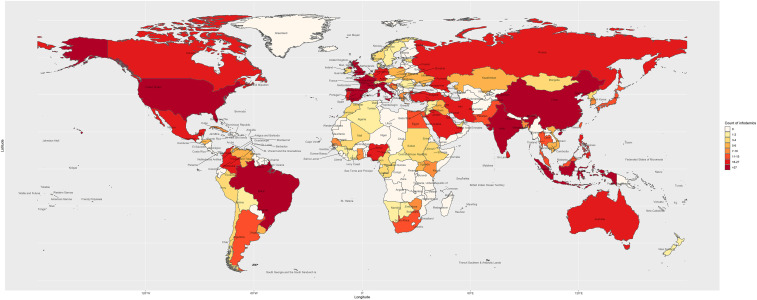
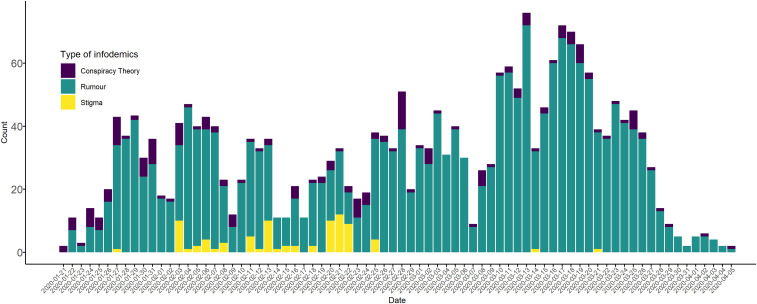
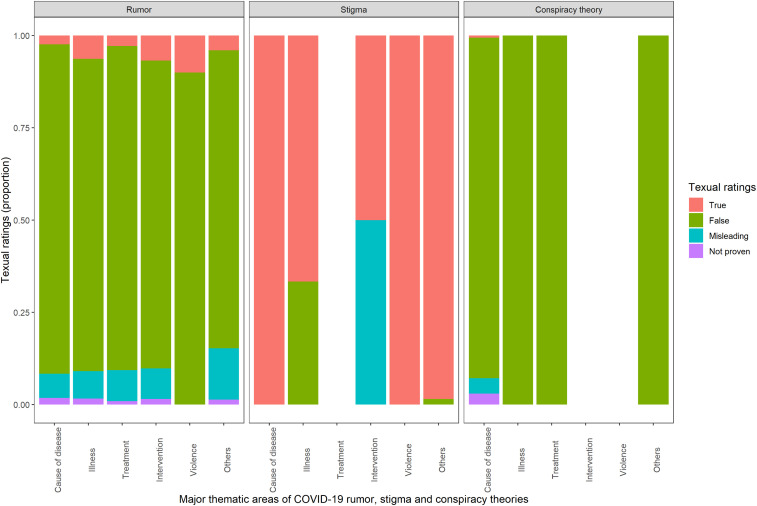
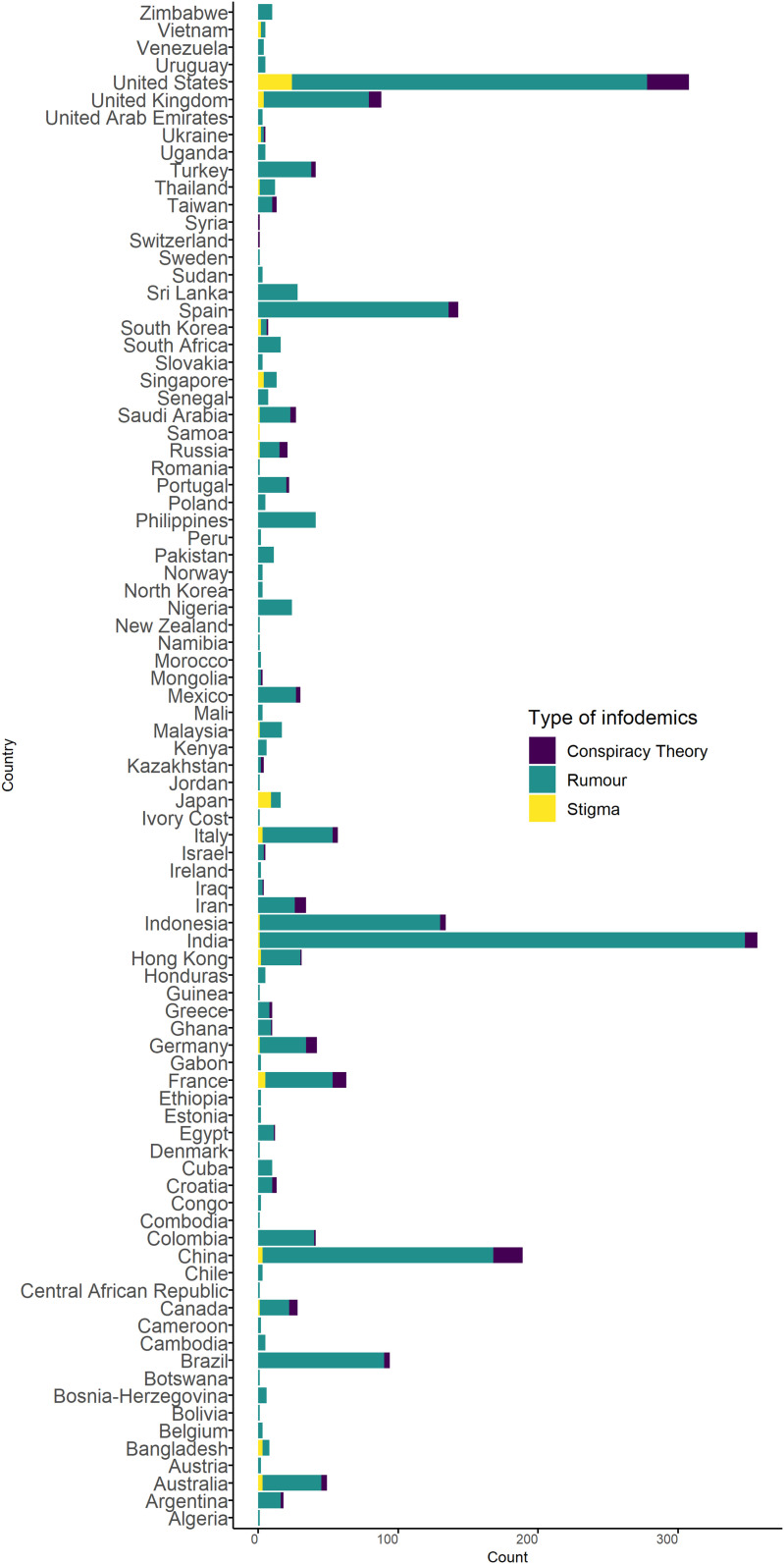
Infodemics, often including rumors, stigma, and conspiracy theories, have been common during the COVID-19 pandemic. Monitoring social media data has been identified as the best method for tracking rumors in real time and as a possible way to dispel misinformation and reduce stigma. However, the detection, assessment, and response to rumors, stigma, and conspiracy theories in real time are a challenge. Therefore, we followed and examined COVID-19-related rumors, stigma, and conspiracy theories circulating on online platforms, including fact-checking agency websites, Facebook, Twitter, and online newspapers, and their impacts on public health. Information was extracted between December 31, 2019 and April 5, 2020, and descriptively analyzed. We performed a content analysis of the news articles to compare and contrast data collected from other sources. We identified 2,311 reports of rumors, stigma, and conspiracy theories in 25 languages from 87 countries. Claims were related to illness, transmission and mortality (24%), control measures (21%), treatment and cure (19%), cause of disease including the origin (15%), violence (1%), and miscellaneous (20%). Of the 2,276 reports for which text ratings were available, 1,856 claims were false (82%). Misinformation fueled by rumors, stigma, and conspiracy theories can have potentially serious implications on the individual and community if prioritized over evidence-based guidelines. Health agencies must track misinformation associated with the COVID-19 in real time, and engage local communities and government stakeholders to debunk misinformation.
Overview
The claims and statistics of this paper haven’t been checked yet.
Free: it reads the open-access text and checks the first 5 claims that cite a source we can check. Create a free account to check every claim.
Integrity signals
Registry
Cites
Statistics
Figures
Verification
Claims the paper makes
The claims and statistics of this paper haven’t been checked yet.
Free: it reads the open-access text and checks the first 5 claims that cite a source we can check. Create a free account to check every claim.
Claims other papers make about this one
Each is checked against this paper’s own text: does it say what the citing paper says it does?
The cited source says what the claim attributes to it.
In the citing paper
“Misinformation during the Ebola outbreak in the Democratic Republic of the Congo in 2019 was associated with aggression, mistrust, social unrest, and targeted assaults on healthcare workers [45].”
From Social Media Role and Its Impact on Public Health: A Narrative Review (2023) · cites this paper as [45]
The cited source says what the claim attributes to it.
In the citing paper
“Rumors about COVID-19 have been labeled a global enemy by the UN secretary-general [45].”
From Social Media Role and Its Impact on Public Health: A Narrative Review (2023) · cites this paper as [45]
The cited source says what the claim attributes to it.
In the citing paper
“During the SARS outbreak in China in 2002-2003, Asian people faced social stigma as a result of their fear of contracting the disease [45].”
From Social Media Role and Its Impact on Public Health: A Narrative Review (2023) · cites this paper as [45]
Self-check
Percentages, sums and reported differences re-computed from the paper’s own numbers.
The self-check needs the paper’s full text.
Citations
Cites
Understanding Conspiracy Theories
Douglas, K. M., Uscinski, J. E., Sutton, R. M., Cichocka, A., Nefes, T., Ang, C. S., & Deravi, F. (2019) · Political Psychology · doi:10.1111/pops.12568 · Cited by 1,511 · cited 1×
“defined as explanatory beliefs about an individual or group of people working in secret to reaching malicious goals.(16) Data extraction and consistency.”
BackgroundFear and Stigma: The Epidemic within the SARS Outbreak
Person, B., Sy, F., Holton, K., Govert, B., Liang, A., the, N. C. I. D., SARS Community Outreach Team (listed in alphabetical order), Garza, B., Gould, D., Hickson, M., et al. (2004) · Emerging Infectious Diseases · doi:10.3201/eid1002.030750 · Cited by 790
YouTube as a source of information on COVID-19: a pandemic of misinformation?
Li, H. O.-Y., Bailey, A., Huynh, D., & Chan, J. (2020) · BMJ Global Health · doi:10.1136/bmjgh-2020-002604 · Cited by 781
See Something, Say Something: Correction of Global Health Misinformation on Social Media
Bode, L., & Vraga, E. K. (2018) · Health Communication · doi:10.1080/10410236.2017.1331312 · Cited by 745 · cited 1×
“aimed at promoting evidence against misinformation quickly and clearly might change people’s perception and healthseeking behaviors.(52,53) Currently, the WHO and other health”
BackgroundZubiaga, A., Liakata, M., Procter, R., Wong Sak Hoi, G., & Tolmie, P. (2016) · PLOS ONE · doi:10.1371/journal.pone.0150989 · Cited by 722 · cited 1×
“Rumor is defined as unverified information that canbe foundas true, fabricated, or entirely false after verification.(14) Stigma is a socially constructed process through which a person with stigma can experience discrimination and devaluation in society.”
BackgroundTuran, B., Budhwani, H., Fazeli, P. L., Browning, W. R., Raper, J. L., Mugavero, M. J., & Turan, J. M. (2017) · AIDS and Behavior · doi:10.1007/s10461-016-1451-5 · Cited by 480
Prevention is better than cure: addressing anti-vaccine conspiracy theories
Jolley, D., & Douglas, K. M. (2017) · Journal of Applied Social Psychology · doi:10.1111/jasp.12453 · Cited by 446 · cited 1×
“aimed at promoting evidence against misinformation quickly and clearly might change people’s perception and healthseeking behaviors.(52,53) Currently, the WHO and other health”
BackgroundEbola, Twitter, and misinformation: a dangerous combination?
Oyeyemi, S. O., Gabarron, E., & Wynn, R. (2014) · BMJ · doi:10.1136/bmj.g6178 · Cited by 348 · cited 1×
“Last, there are the well-documented issues with misinformation with Ebola, including false treatments, health workers were deliberately spreading the Ebola virus, and Ebola epidemic was a hoax.(49,50) Such conspiracy theories and misinformation may have impeded the ability of healthcare workers and emergency responder…”
BackgroundAttacks against health-care personnel must stop, especially as the world fights COVID-19
McKay, D., Heisler, M., Mishori, R., Catton, H., & Kloiber, O. (2020) · The Lancet · doi:10.1016/s0140-6736(20)31191-0 · Cited by 186
Young, W. B., Park, J. E., Tian, I. X., & Kempner, J. (2013) · PLoS ONE · doi:10.1371/journal.pone.0054074 · Cited by 138 · cited 1×
“Stigma is a socially constructed process through which a person with stigma can experience discrimination and devaluation in society.(15) A conspiracy theory is”
Background
Research works printed but not linked: 29
- World Health Organization, 2020 Coronavirus Disease 2019 (COVID-19) Situation Report – 13. Geneva, Switzerland: WHO.
- Lederer EM, 2020 U.N. Chief Antonio Guterres: Misinformation about COVID-19 Is the New Enemy. TIME. New York, NY: TIME.
- World Health Organization, 2018 Managing Epidemics: Key Facts about Major Deadly Diseases. Luxembourg: WHO.
- Center for Preparedness and Response, 2020 Responding to Rumors and Misinformation. Emergency Preparedness and Response. Atlanta, GA: Centre for Disease Control and Prevention.
- Eckert KS 2016 Evidence Syntheses to Support the Guideline on Emergency Risk Communication. Geneva, Switzerland: World Health Organization.
- Victoria Knight of Kaiser Health News, 2020 COVID-19: Beware Online Tests and Cures, Experts Say. The Guardian. Surry Hills, NSW, Australia: The Guardian.
- Spencer SH, 2020 Fake Coronavirus Cures, Part 1: MMS Is Industrial Bleach. Available at: https://www.factcheck.org/2020/02/fake-coronavirus-cures-part-1-mms-is-industrial-bleach/. Accessed April 4, 2020.
- Vrajlal A, 2020 Chinese-Australians Facing Racism after Coronavirus Outbreak. Available at: https://www.huffingtonpost.com.au/entry/coronavirus-australia-racism_au_5e33a522c5b6f2623326d72b. Accessed April 4, 2020.
- BBC Reality Check Team, 2020 Coronavirus: Does Drinking Tea Help? BBC News. Delhi, India: BBC News.
- Cable T, 2020 CDD FACT CHECK: Can Camel Urine, Lime Cure Coronavirus? The Cable. Abuja, Nigeria: The Cable Newspaper.
- Landsverk G, 2020 Holding Your Breath Can’t Help You Self-Diagnose the Coronavirus. Here’s What You Should Do Instead. Business Insider Australia. Surry Hills, NSW, Australia: Business Insider Australia.
- Ellis-Petersen H Rahman SA, 2020 Indian Doctors Being Evicted from Homes over Coronavirus Fears. The Guardian. Surry Hills, NSW, Australia: The Guardian.
- Mead WR, 2020 China Is the Real Sick Man of Asia. The Wall Street Journal. New York, NY: The Wall Street Journal.
- Breland A, 2020 Russian Media Outlets Are Blaming the Coronavirus on the United States. Mother Jones. San Francisco, CA: Mother Jones.
- Gertz B, 2020 Coronavirus May Have Originated in Lab Linked to China’s Biowarfare Program. The Washington Post. Washington, DC: The Washington Post.
- Gregory J, 2020 The Coronavirus ‘Infodemic’ Is Real. We Rated the Websites Responsible for It. Statnews. Boston, MA: Statnews.
- Richtel M, 2020 WHO Fights a Pandemic besides Coronavirus: An ‘Infodemic’. The New York Times. New York, NY: The New York Times.
- Meddle East Media Research Institute, 2020 Arab Writers: The Coronavirus Is Part of Biological Warfare Waged by the U.S. against China. Egypt, Saudi Arabia, and Syria: Meddle East Media Research Institute TV.
- Farda R, 2020 Iran Cleric Blames Trump for Coronavirus Outbreak in Religious City. Radio Farda. Prague, Czech Republic: Radio Farda.
- Colson T, 2020 A Fake Claim That Cocaine Cures the Coronavirus Is Spreading Online, and the French Government Was Forced to Tell People That It Won’t. Business Insider Australia. Surry Hills, NSW, Australia: Business Insider Australia.
- Frenkel S Alba D Zhong R, 2020 Surge of Virus Misinformation Stumps Facebook and Twitter. The New York Times. New York, NY: The New York Times.
- World Health Organization, 2020 Alcohol Does Not Protect against COVID-19; Access Should Be Restricted during Lockdown. Alcohol Use. Geneva, Switzerland: WHO, Regional Office for Europe.
- CNN Türk, 2020 9 Kişi Daha Saf Alkolden Öldü [9 More Poeple Died from Pre Alcohol]. Available at: https://www.cnnturk.com/video/turkiye/9-kisi-daha-saf-alkolden-oldu. Accessed June 4, 2020.
- Staff Reporter, 2020 Twelve Taken Ill after Consuming ‘Coronavirus Shaped’ Datura Seeds. The Hindu. Andhra Pradesh, India: The Hindu.
- Chan-Kyong P, 2020 Coronavirus: Saltwater Spray Infects 46 Church-Goers in South Korea. South China Morning Post. Causeway Bay, Hong Kong: South China Morning Post.
- Eckel M, 2020 Tractors, Herbs, Vodka, Saunas? Some Leaders Offer Strange, Unhelpful Advice On Warding Off COVID-19. Available at: https://www.rferl.org/a/coronavirus-unhelpful-advice-tractors-herbs-vodka-saunas-gurbanguly-lukashenka-vucic/30495810.html. Accessed June 4, 2020.
- Tajmim T, 2020 Coronavirus: 41 Doctors, 10 Nurses Infected. The Business Standard. Dhaka, Bangladesh: The Business Standard.
- National Herald, 2020 Social Stigma Forcing Corona Patients to Avoid Screening in India. National Herald. New Delhi, India: National Herald.
- Kabananukye K, 2001 Denial, Discrimination and Stigmatisation: The Case of Ebola Epidemic in Some Districts. Kampala, Uganda: Ugandan Ministry of Health, National Ebola Task Force.
Cited by
Items 501–600 of 997
Orunta, C. P., Ndu, C. O., Ijioma, C. E., Ogedegbe, O. J., Ogundipe, F. A., & Eze-Njoku, C. (2024) · Cureus · doi:10.7759/cureus.64984 · Cited by 6
“These findings show misinformation, superstitious beliefs, and myths prevalent among the respondents, which can significantly impede effective prevention and control of the disease [14,34].”
BackgroundPartisan Media, Trust, and Media Literacy: Regression Analysis of Predictors of COVID-19 Knowledge
Roschke, K., Koskan, A. M., Sivanandam, S., & Irby, J. (2024) · JMIR Formative Research · doi:10.2196/53904 · Cited by 5
“Research has shown that greater knowledge of infectious diseases impacts people’s health-seeking behaviors, which makes the presentation of clear, reliable information a critical component of public health campaigns [14-16].”
Graph Attention Network with Cross-Modal Interaction for Rumor Detection
Zhou, H., Zhong, Q., Li, P., & Zhu, Q. (2024) · International Joint Conference on Neural Networks (IJCNN) · doi:10.1109/ijcnn60899.2024.10650542 · Cited by 4
“Another example is during the COVID-19 pandemic, a newly published study shows that at least some 800 people died because of a rumor about drinking highly-concentrated alcohol can disinfect their bodies [4].”
BackgroundToward a Computational Mixed Methods Framework to Measure Online Deliberative Discourse
Duncan, S., Dwyer, L., Smith, H., Vallesi, D., Zeller, F., & Davis, C. (2024) · Communication and the Public · doi:10.1177/20570473241284759 · Cited by 5
“These platforms allow for broad discussions on critical social issues, such as racial injustice, climate change, and public health (Gaytan Camarillo et al., 2021; Graham et al., 2021; Hristova & Howard, 2021; Islam et al., 2020).”
Roncon, L., Zuin, M., Barco, S., Zuliani, G., & Konstantinides, S. (2020) · Journal of Thrombosis and Thrombolysis · doi:10.1007/s11239-020-02336-9 · Cited by 4
Maciaszek, J., Lenart‐Bugla, M., Misiak, B., Grzebieluch, J., Gawłowski, P., Ciułkowicz, M., Łuc, D., Szcześniak, D. M., & Rymaszewska, J. (2021) · Frontiers in Psychiatry · doi:10.3389/fpsyt.2021.704558 · Cited by 5
Ulayya, A. H., Widodo, N., Mubarok, A. Z., Widjanarko, S. B., & Marlita, M. (2021) · Electronic Journal of General Medicine · doi:10.29333/ejgm/11402 · Cited by 4
“Indonesia included as one of the biggest source of rumours, stigma, and conspiracy theories around Covid-19 pandemic, lead to mistrust with governments and health professionals [22].”
BackgroundSocial Media Movement and Covid-19 Prevention in Indonesia
Susanti, D., & Muliawanti, L. (2022) · Jurnal Komunikasi · doi:10.24912/jk.v14i1.13196 · Cited by 7
Nakanishi, M., Sakai, M., Takagi, G., Toshi, K., Wakashima, K., & Yoshii, H. (2022) · JMIR Formative Research · doi:10.2196/35806 · Cited by 4
“Therefore, Twitter users are more likely to be exposed to misinformation and stigmatizing messages, which in turn may exacerbate fear and anxiety and result in the further circulation of such messages [9].”
BackgroundSalcedo, P., Kotz, G., Espinoza, C. M. V., Sánchez-Hechavarría, M. E., Universidad de Concepción, C., Universidad de Concepción, C., Universidad de Concepción, C., Universidad de Concepción, C., & de Chile, U. A. (2022) · Revista Latinoamericana de Psicología · doi:10.14349/rlp.2022.v54.1 · Cited by 4
Caring for elderly people during the COVID-19 pandemic: the experience of family caregivers
Rezende, C. D. P., do Nascimento, M. M. G., de França, A. P., Santos, A. S. D. A., Oliveira, I. V., & de Oliveira, D. R. (2022) · Revista gaúcha de enfermagem · doi:10.1590/1983-1447.2022.20210038.en · Cited by 4
“Therefore, in addition to fighting the coronavirus, it is also necessary to detect and respond quickly to the mis-information disseminated on social media that generates a disservice to global health (14–15 , 17) .”
BackgroundMaking a Cocoon: The Social Factors of Pandemic Misinformation Evaluation
Yi, W., & Thompson, K. M. (2022) · Proceedings of the Association for Information Science and Technology · doi:10.1002/pra2.739 · Cited by 4
“Widely spread misinformation may exacerbate the pandemic, put people at risk, and threaten democracy (Ali, 2020; Hansson et al., 2021; Islam et al., 2020).”
BackgroundMayers, P. M., Olckers, L., Prinsloo, E. L., Raine, J., & Zweigenthal, V. (2022) · Journal of Nursing Scholarship · doi:10.1111/jnu.12859 · Cited by 3
“Persons who follow misinformed advice and resist preventive behavior endanger themselves and others (Douglas, 2021; Islam et al., 2020; Romer & Jamieson, 2020).”
BackgroundDiwan, V., Sharma, M., Sahoo, K. C., Negi, S., Kalyanasundaram, M., & Tiwari, R. R. (2022) · Journal of Family Medicine and Primary Care · doi:10.4103/jfmpc.jfmpc_526_22 · Cited by 5
“Similarly, a global social media study found that 82% of 2,276 media reports were false, 8% were misleading, and 1% were unproven facts.[25] Social stigma can have various negative consequences for COVID‐infected or recovered individuals, including anxiety, depression, social rejection, and self‐devaluation.”
BackgroundMonaci, S., & Persico, S. (2023) · Contemporary Italian Politics · doi:10.1080/23248823.2023.2182735 · Cited by 8
“Islam et al. (2020) found three main forms of disinformation with potentially serious impacts on public health on Facebook, Twitter, in online newspapers, and on the fact-checking agencies’ websites.”
BackgroundCanedo, C. M., Sanabria‐Mazo, J. P., Comendador, L., Rojas, J. S., Carmona-Cervelló, M., Crespo-Puig, N., Anyosa, F., Olid, C. S., Feliu‐Soler, A., Cardoner, N., et al. (2023) · Vaccine X · doi:10.1016/j.jvacx.2023.100301 · Cited by 7
“Since the outbreak of SARS-CoV-2, confidence in health institutions and in the opinions of health experts has been weakening [38,39], resulting in lower adherence to essential health recommendations and contributing to the transmission of the virus [38,40].”
Kabir, A., Karim, M. N., Karim, J., & Billah, B. (2023) · International Journal of Environmental Research and Public Health · doi:10.3390/ijerph20095629 · Cited by 5
“COVID-19-related infodemics as well as rumors and fear, misinformation, exclusion and neglect, stigma, and avoidance were common phenomena during the pandemic [35].”
BackgroundSelf-citationLee, K., Surti, M. S., Bruce, M., Beharaj, G., Giesbrecht, G. F., & Castillo, E. (2023) · Expert Review of Vaccines · doi:10.1080/14760584.2023.2221730 · Cited by 5
Kweon, Y., & Choi, B. (2023) · Governance · doi:10.1111/gove.12808 · Cited by 5
Covid-19 cure perceptions and media use in India
Arif, A., & Turaga, R. M. R. (2023) · Journal of Communications In Healthcare · doi:10.1080/17538068.2023.2228041 · Cited by 4
“Covid-19 has been no exception, with India emerging as one of the global hotspots for social media misinformation [8,9].”
BackgroundBrune, C., Agerholm, J., & Liljas, A. E. M. (2023) · Health Services Insights · doi:10.1177/11786329231222168 · Cited by 4
Hoeyer, K., Couturier, A., Barawi, K., Drew, C. J. G., Grundtvig, A., Lane, E. L., Munk, A. K., Whiteley, L., & Munsie, M. (2024) · Stem Cell Reports · doi:10.1016/j.stemcr.2023.12.009 · Cited by 4
The Infodemic within the Pandemic
Lawhorne, L. W., & Swedlund, S. (2021) · Journal of the American Medical Directors Association · doi:10.1016/j.jamda.2020.12.044 · Cited by 4
Моногарова, А. Г., Shiryaeva, T., & Arupova, N. (2021) · Journal of language and Education · doi:10.17323/jle.2021.13371 · Cited by 4
“According to a study on virus-related infodemic and its impact on public health (Islam et al. 2020), more than 5,800 people around the world were admitted to hospital and at least 800 people died in 2020 as a result of false information on social media.”
BackgroundA real-time platform for contextualized conspiracy theory analysis
Chong, D., Lee, E., Fan, M., Holur, P., Shahsavari, S., Tangherlini, T. R., & Roychowdhury, V. (2021) · IEEE ... International Conference on Data Mining workshops · doi:10.1109/icdmw53433.2021.00021 · Cited by 8
“…[3], an attack on a family pizzeria by an enraged gunman [4], efforts by armed militias to round up immigrants at the southern US border [5], deliberate interference with hospitals [6], a refusal to abide public health directives [7], and a concerted effort to encourage vaccine hesitancy [8].”
BackgroundSatter, S. M., Chowdhury, K. I. A., Tamanna, R., Abdullah, Z., Shafique, S., Islam, M. S., Rimi, N. A., Alam, M. R., Nazneen, A., Rahman, M., et al. (2022) · Tropical Medicine and Infectious Disease · doi:10.3390/tropicalmed7120447 · Cited by 5
Self-citationAmin, K. H. A. K., Yusof, M. H., Itam, M. F., Fisal, Z. A. M., Yatim, M. H. M., & Manaf, R. A. (2023) · Malaysian Journal of Medicine and Health Sciences · doi:10.47836/mjmhs.19.1.32 · Cited by 6
Socio-Life Science and the COVID-19 Outbreak: Public Health and Public Policy
Yano, M., Matsuda, F., Sakuntabhai, A., & Hirota, S. (2021) · Economics, law, and institutions in Asia Pacific · doi:10.1007/978-981-16-5727-6 · Cited by 8
Westmoreland, D. A., Berry, A., Zimba, R., Kulkarni, S., Parcesepe, A. M., Maroko, A., Poehlein, E., You, W., Mirzayi, C. A., Kochhar, S., et al. (2021) · medRxiv · doi:10.1101/2021.03.10.21252851 · Cited by 6
“Some claims assessed in this study were “conspiratorial” in nature and some, including purported preventive measures and cures, were harmful as evidenced by news media from around the globe (9, 25).”
BackgroundEditorial: COVID-19 pandemic: Mental health, life habit changes and social phenomena
Morgado, P. F., Gonda, X., Smirnova, D. A., & Fountoulakis, K. Ν. (2022) · Frontiers in Psychiatry · doi:10.3389/fpsyt.2022.1105667 · Cited by 5
Shenoy, E. S., Banach, D. B., Batshon, L. J., Branch‐Elliman, W., Dumyati, G. K., Haessler, S., Hsu, V. P., Jump, R., Malani, A. N., Mathew, T. A., et al. (2024) · Infection Control and Hospital Epidemiology · doi:10.1017/ice.2024.63 · Cited by 3
Liu, X., Shen, W., Hu, X.-Y., & Lu, F. (2025) · The American Journal of Psychology · doi:10.5406/19398298.138.1.03 · Cited by 3
Concept-enhanced heterogeneous graph network for fact verification
Chen, Z., Liao, L., Hui, S. C., & Huang, H. (2025) · Neural Networks · doi:10.1016/j.neunet.2025.107959 · Cited by 3
Karami, A., Zain, A., & Jamal, A. (2025) · Journal of Public Health · doi:10.1007/s10389-025-02639-2 · Cited by 5
Yuetikuer, A. (2026) · Frontiers in Public Health · doi:10.3389/fpubh.2025.1721245 · Cited by 3
Arik, A. O., Parlayandemir, G., & Çelik, S. (2026) · Egyptian Informatics Journal · doi:10.1016/j.eij.2026.100886 · Cited by 11
Paterson, A., Spies, R., Zauchenberger, C.-Z., Cheyne, A., Olliaro, P. L., & Rojek, A. M. (2026) · Frontiers in Public Health · doi:10.3389/fpubh.2026.1755092 · Cited by 3
“In contemporary outbreak settings, where misinformation can spread rapidly through digital and social media channels, there is a critical need for stigma-sensitive messaging delivered by trusted sources (28).”
Patienten und Angehörige richtig informieren
(2021) · Springer eBooks · doi:10.1007/978-3-658-35274-5 · Cited by 3
Aïm, O., & Depoux, A. (2022) · Questions de communication · doi:10.4000/questionsdecommunication.28909 · Cited by 6
Recognising and addressing health misinformation in nursing practice
Sharman, J. (2023) · Primary Health Care · doi:10.7748/phc.2023.e1791 · Cited by 3
Моногарова, А. Г., Shiryaeva, T. A., & Тихонова, Е. В. (2023) · Russian Journal of Linguistics · doi:10.22363/2687-0088-33757 · Cited by 6
Zhao, S., Zhou, J., & Wang, T. (2023) · PLoS ONE · doi:10.1371/journal.pone.0294681 · Cited by 3
Effects of Intervention Timing on Health-Related Fake News: Simulation Study
Gwon, N., Jeong, W., Kim, J. H., Oh, K. H., & Jun, J. K. (2024) · JMIR Formative Research · doi:10.2196/48284 · Cited by 3
“Researchers studying fake news urge related organizations to intervene to prevent their spread [7-9].”
BackgroundChiou, P., Tsao, W.-W., Li, C., Yu, J.-M., Su, W.-H., Liu, Z.-H., He, C.-R., Chang, Y.-C., & Tsai, Y.-H. (2024) · Journal of Medical Internet Research · doi:10.2196/54420 · Cited by 3
“In addition, the discussion dispelled common rumors regarding COVID-19, such as the possibility of COVID-19 transmission through mobile phones and that anti-HIV medication can prevent COVID-19 infection [46].”
Hayman, J., Nelson, S. W., Mallory, L. A., Dornblaser, E. K., Chaudron, L. H., Nichols, S. D., Mallar, C., Rocheleau, B., Stickney, I., Prast, B., et al. (2024) · MedEdPORTAL · doi:10.15766/mep_2374-8265.11461 · Cited by 3
Hasnin, E. A. H. (2025) · Journal of Ecohumanism · doi:10.62754/joe.v4i2.5913 · Cited by 6
“A conceptual framework that links businesses' well-being-focused initiatives to customers' perceived service well-being was put forth by Islam et al. (2020), who emphasized the moderating influence of customer attributes.”
Infodemic Management and Government Disinformation: The Brazilian Experience
Ballalai, I., & Lins, R. S. (2025) · Asian Bioethics Review · doi:10.1007/s41649-024-00353-x · Cited by 3
“A notable example is the myth that consuming highly concentrated alcohol could dis-infect the body from the virus, resulting in approximately 800 deaths, 5876 hospitalizations, and 60 cases of complete blindness due to methanol poisoning globally (Islam et al. 2020).”
Iqhrammullah, M., Gusti, N., Muzaffar, A., Khader, Y. S., Maulana, S., Rademaker, M., & Abdullah, A. (2025) · Health Policy and Technology · doi:10.1016/j.hlpt.2025.101058 · Cited by 7
AI-Powered Social Media for Development in Low- and Middle-Income Countries
Penh, B. (2025) · Media and Communication · doi:10.17645/mac.9577 · Cited by 3
The Mass Media Freedom in a State of Emergency: Infodemic vs. COVID-19 Pandemic
Стојановска-Стефанова, А., & Tasev, H. R. (2020) · SEEU Review · doi:10.2478/seeur-2020-0003 · Cited by 3
Clinical Poisonings Imposed by the COVID-19 Pandemic
Vahabzadeh, M., & Mostafazadeh, B. (2021) · International Journal of Medical Toxicology and Forensic Medicine · doi:10.32598/ijmtfm.v11i1.33859 · Cited by 3
Susanti, R. D., Juniarti, N., Yani, D. I., & Nurhasanah, N. (2021) · Open Access Macedonian Journal of Medical Sciences · doi:10.3889/oamjms.2021.7586 · Cited by 3
“In addition, the infodemic created confusion in the community and lack of knowledge about COVID-19 triggered stigma [7], [9], [16].”
BackgroundFountoulakis, K. Ν. (2021) · Springer eBooks · doi:10.1007/978-3-030-86541-2_25 · Cited by 3
Daama, A., Rakai Health Sciences Program, K., Nalugoda, F. K., Rakai Health Sciences Program, K., Kankaka, E. N., Rakai Health Sciences Program, K., Bulamba, R., James, N. M., Mugamba, S., Kyasanku, E., et al. (2021) · Journal of Health Promotion and Behavior · doi:10.26911/thejhpb.2021.06.02.08 · Cited by 3
Okoroiwu, H. U., Okafor, I. M., Echieh, C. P., Ogar, C. O., Abunimye, D. A., & Uchendu, I. K. (2022) · Pan African Medical Journal · doi:10.11604/pamj.2022.41.102.30262 · Cited by 3
Exploiting Ensemble of Transformer Models for Detecting Informative Tweets
Chowdhury, A. N., Guha, S., Amin, N., & Khan, S. I. (2021) · IEEE India Conference · doi:10.1109/indicon52576.2021.9691734 · Cited by 3
Self-citationWho wants to grow old in Welfare Sweden?
Marić, J. (2022) · European Conference on Social Media · doi:10.34190/ecsm.9.1.335 · Cited by 3
“Rumours and conspiracies thrive in environments of a low level of security and trust (Shahsavari et al. 2020) which in the case of the Covid-19 crisis resulted in infodemic or increased fake news sharing among social media users (Apuke and Omar 2021; Islam et al. 2020).”
BackgroundMuhvić, D., & Čulo, I. R. (2022) · Zbornik Pravnog fakulteta Sveučilišta u Rijeci · doi:10.30925/zpfsr.43.1.10 · Cited by 3
Cavadas, B., & Linhares, E. (2022) · Springer eBooks · doi:10.1007/978-3-030-68074-9_86-1 · Cited by 3
Desinformación y vacunas en redes: Comportamiento de los bulos en Twitter
Vivó, J. M. N., Grandío-Pérez, M. D. M., Villar-Rodríguez, G., Martín, A. G., & Camacho, D. (2022) · Revista Latina de Comunicación Social · doi:10.4185/rlcs-2022-1820 · Cited by 18
Von #HoloCough zu #GreatReset. Antisemitische Verschwörungstheorien um das Coronavirus
Gannuscio, V. (2022) · Muttersprache Vierteljahresschrift für deutsche Sprache · doi:10.53371/60415 · Cited by 3
Promoting AI Ethics Through Awareness and Case Studies
McSharry, P. (2023) · SpringerBriefs in ethics · doi:10.1007/978-3-031-23035-6_6 · Cited by 8
Li, Y., Mao, N., Guo, L., Guo, L., Chen, L., Zhao, L., Wang, Q., & Long, E. (2023) · Risk Analysis · doi:10.1111/risa.14129 · Cited by 3
“Infodemic has become a key challenge for the public to communicate effectively (Islam et al., 2020; World Health Organization, 2022b).”
Chen, J., Zhou, G., Lu, J., Wang, S., & Li, S. (2023) · Applied Sciences · doi:10.3390/app13095703 · Cited by 3
An Adaptive Digital Intelligence System to Support Infodemic Management: The WHO EARS Platform
White, B. K., Cabalero, I., Nguyen, T., Briand, S. C., Pastorino, A., & Purnat, T. D. (2023) · Studies in health technology and informatics · doi:10.3233/shti230296 · Cited by 3
“The infodemic during the COVID-19 pandemic has impacted poorly on public health [1].”
BackgroundIsip-Tan, I. T., Cleofas, J. V., Solano, G. A., Pillejera, J. G., & Catapang, J. K. (2023) · JMIR Formative Research · doi:10.2196/41134 · Cited by 5
Chew, H. E., & Chong, Y. K. (2023) · Mobile communication in Asia · doi:10.1007/978-94-024-2225-2_9 · Cited by 5
Dey, P., Parai, D., Hossain, S. T., & Mukherjee, S. K. (2023) · Universitas Scientiarum · doi:10.11144/javeriana.sc282.taoc · Cited by 4
The Impact of Meso-Level Factors on SARS-CoV-2 Vaccine Early Hesitancy in the United States
Kaliba, A. R. M., & Andrews, D. R. (2023) · International Journal of Environmental Research and Public Health · doi:10.3390/ijerph20136313 · Cited by 3
“Misinformation creates skepticism about vaccine efficacy and safety concerns, promoting negative health behaviors and erroneous practices [9–11], especially if prioritized over scientific guidelines [12,13].”
BackgroundDealing With Covid-19 in Casual Democracies
Steensen, S. (2023) · Media and Communication · doi:10.17645/mac.v11i3.6807 · Cited by 8
“Several studies have documented the spread of Covid‐19 related conspiracy theories and other forms of misinformation on social media platforms (e.g., Islam et al., 2020), while others have documented that such misinformation could cause psychological disorders and panic, fear, depression, and…”
BackgroundQuian, A., Elías, C., & Pérez, X. S. (2023) · El Profesional de la Informacion · doi:10.3145/epi.2023.jul.13 · Cited by 7
BENEFIT FINDING AND ACADEMIC ENGAGEMENT AMONG COLLEGE STUDENTS IN CHINA: ANXIETY AS A MODERATOR
Lu, R., JIANG, Y., Zhao, S., Juan, W. E. N., & Lingmin, H. U. (2023) · PSYCHOLOGIA · doi:10.2117/psysoc.2022-a192 · Cited by 3
Limitations of Fact-checking on Debunking Covid-19 Misinformation on Facebook: Case of Faktograf.hr
Brautović, M., & John, R. (2023) · Central European Journal of Communication · doi:10.51480/1899-5101.16.1(33).3 · Cited by 3
“In the first three months of 2020, in the Middle East around 6 000 people were hospitalized, and at least 800 people may have died, as a result of misinformation about COVID-19 (Islam et al., 2021).”
BackgroundA syntactic multi-level interaction network for rumor detection
Chen, Z., Zhuang, F., Liao, L., Jia, M., Li, J., & Huang, H. (2023) · Neural Computing and Applications · doi:10.1007/s00521-023-09140-5 · Cited by 4
Risks of scientific misinformation through press and pre-print articles
Silva, H. M. (2023) · Irish Journal of Medical Science (1971 -) · doi:10.1007/s11845-023-03574-5 · Cited by 3
“Never has the anti-vaccine movement been so strong: distrust of the safety and efficacy of vaccines has spread through the internet and its social networks around the world, in a phenomenon called the “info-demic” [14].”
Fake news como produção textual disruptiva
Bentes, A. C., & de Souza-Santos, J. E. (2023) · Cadernos de Estudos Lingüísticos · doi:10.20396/cel.v65i00.8673341 · Cited by 3
COVID-19 and Psychological Distress in Africa: Communitarian Perspectives
Ndasauka, Y. (2023) · Routledge eBooks · doi:10.4324/9781003425861 · Cited by 5
Spire, A., Sireyjol, A., & Bajos, N. (2023) · BMJ Open · doi:10.1136/bmjopen-2023-073465 · Cited by 5
“Disclaimer The funders had no role in study design, data collection and analysis, decision to publish, or preparation of the manuscript.”
BackgroundREDES SOCIALES Y DESINFORMACIÓN EN SALUD: EL CASO DE FACEBOOK
Revez, J. M. R. (2022) · Revista EDICIC · doi:10.62758/re.v2i3.106 · Cited by 8
“…spicy food, and the importance of taking vitamins C and D to help prevent the disease”, e “so -called treatments such as miracle mineral solutions that involved mixing sodium chlorite solution with citric acid or drinking bleach or alcohol for immunity and cures” (Islam et al., 2020, p. 1622).”
BackgroundRahman, A., Mohammadi, E., & Alhoori, H. (2024) · Natural Language Processing Journal · doi:10.1016/j.nlp.2024.100085 · Cited by 3
Fact or Fake? How News Title, Sentiment and Writing Style help AI to detect COVID-19 Fake News?
Wang, C.-S., Li, B., Wang, K.-W., & Lin, Z.-C. (2024) · Applied Artificial Intelligence · doi:10.1080/08839514.2024.2389502 · Cited by 3
“Throughout the pandemic, there has been a proliferation of conspiracy theories (Brett and Goroncy 2020), spurious news (Allcott and Gentzkow 2017), and misinformation about the virus, its origins (World Health Organization WHO 2020), prevention (Islam et al. 2020), and treatment methods.”
O’Farrell, A., Naughton, P., & Kavanagh, P. M. (2024) · Public Health · doi:10.1016/j.puhe.2024.07.010 · Cited by 4
Comparing public health-related material in print and web page versions of legacy media
Gaba, A., & Bennett, R. (2024) · JAMIA Open · doi:10.1093/jamiaopen/ooae104 · Cited by 3
“48 Bengtsson provides a concise overview of the content analysis methodology.”
BackgroundÇağlayan, S., & Taşoğlu, N. P. (2024) · Dokuz Eylül Üniversitesi Sosyal Bilimler Enstitüsü Dergisi · doi:10.16953/deusosbil.1523496 · Cited by 4
Christner, C., Makhortykh, M., & Gil‐López, T. (2025) · Telematics and Informatics · doi:10.1016/j.tele.2025.102250 · Cited by 7
South Korea’s Health Misinformation Response during COVID-19: A Narrative-Thematic Analysis
Wasti, S., Lee, H., & Kim, H. (2025) · Asian Bioethics Review · doi:10.1007/s41649-024-00323-3 · Cited by 4
“Early studies have suggested that nearly 6000 people were hospitalized and 800 people died due to COVID-19 misinformation (Islam et al. 2020, as cited by WHO 2021c).”
Граждане под короной, или как это делается в Израиле и около
Любов, Е. Б. (2020) · doi:10.32878/devi.20-4-01(6)-55-91 · Cited by 7
The Anxiety Dynamics amongst the Elderly during the Covid-19 Pandemic
Sulistiyaningsih, R., Rasyid, A. S., Amalia, D. N., Harna, F. F., & Mubarok, A. S. (2021) · KnE Social Sciences · doi:10.18502/kss.v4i15.8221 · Cited by 3
“During the early days of the pandemic, a limited knowledge relate the risk and prevention of covid-19 can cause anxiety and panic among communities, aggravated by rumours (Islam et al., 2020).”
Social Work and the Next Frontier of Racial Justice: Using COVID-19 as a Vehicle for Healing
Quinn, C. R., Johnson, S., Jones, K. V., Parekh, R., Munshi, A., & Boyd, D. T. (2022) · Social Work in Public Health · doi:10.1080/19371918.2022.2084197 · Cited by 4
“…of different capacities, including public health, economic, and environmental ramifications that will be felt for the near and distant future (Ammar et al., 2020; Gauttam, Singh, & Kaur, 2020; Islam et al., 2020; Maital & Barzani, 2020; Mofijur et al., 2021; Saadat, Rawtani, & Hussain, 2020).”
BackgroundFalyuna, N. (2022) · Scientia et Securitas · doi:10.1556/112.2022.00086 · Cited by 5
“…et al. 2018) are detrimental to people’s health, but pseudoscientific and conspiracy theories also emerged during the coronavirus epidemic, encouraging people to reject health recommendations and vaccination (cf. e.g. Islam et al. 2020; Bavel et al. 2020; Rzymski et al. 2021; Falyuna 2022b).”
BackgroundDaten-Fairness in einer globalisierten Welt
Engert, S., Kropf, J., Uhlmann, M., Friedewald, M., Roßnagel, A., Neuburger, R., Bieker, F., & Hornung, G. (2023) · Nomos Verlagsgesellschaft mbH & Co. KG eBooks · doi:10.5771/9783748938743 · Cited by 3
Bitzer, E., & Schaefer, C. (2023) · Springer Reference Pflege, Therapie, Gesundheit · doi:10.1007/978-3-662-62800-3_88-1 · Cited by 3
Negotiating the Pandemic: Cultural, National, and Individual Constructions of COVID-19
Ali, I., & Davis‐Floyd, R. (2022) · Routledge eBooks · doi:10.4324/9781003187462 · Cited by 8
The Nature of the Misinformation before and during Covid 19 (case study of Slovakia)
Tkáčová, H. (2022) · Clinical Social Work and Health Intervention · doi:10.22359/cswhi_13_1_08 · Cited by 7
“The time frame of the first part of the research is the interval from June 1, 2019 to December 31, 2019, when the Chinese office of the World Health Organization was officially informed about the outbreak of the disease (Islam et al. , 2020).”
BackgroundPyzik, O., Hertig, J. B., Kanso, H., & Khan, S. (2021) · Journal of EAHIL · doi:10.32384/jeahil17502 · Cited by 3
Self-citationOpinions on Homeopathy for COVID-19 on Twitter
Bopaiah, J., Garimella, K. V., & Kavuluru, R. (2022) · ACM Web Science Conference (WebSci) · doi:10.1145/3501247.3531575 · Cited by 4
Infodemic Challenges During COVID-19 Pandemic and the Strategies to Deal with Them: A Review Article
Aslani, N., Behmanesh, A., Davoodi, F., Garavand, A., & Shams, R. (2022) · Archives of Clinical Infectious Diseases · doi:10.5812/archcid-127022 · Cited by 3
Kopecký, K., Voráč, D., Mikulcová, K., Krejčí, V., & García, G. G. (2022) · Libri · doi:10.1515/libri-2021-0048 · Cited by 4
Minzenberg, M., & Yoon, J. H. (2022) · Frontiers in Psychiatry · doi:10.3389/fpsyt.2022.996582 · Cited by 4
COVID‐19 Infodemic: A study on the Fragile Five countries
Yıldırım, M. B. (2022) · Journal of Public Affairs · doi:10.1002/pa.2846 · Cited by 6
Metadata
- Authors
- Islam, M. S., Sarkar, T., Khan, S. H., Mostofa Kamal, A.-H., Hasan, S. M. M., Kabir, A., Yeasmin, D., Islam, M. A., Amin Chowdhury, K. I., Anwar, K. S., Chughtai, A. A., & Seale, H.
- Affiliations
- International Centre for Diarrhoeal Disease Research (BD)
- Khulna University of Engineering and Technology, Khulna, Bangladesh;
- Mahidol University (TH)
- UNSW Sydney (AU)
- Program for Emerging Infections, Infectious Diseases Division, icddr,b, Dhaka, Bangladesh;
- International University of Health and Welfare (JP)
- Corresponding author
- Islam, Md Saiful
- Islam, Mohammad Ariful
- ORCID
- Venue
- The American Journal of Tropical Medicine and Hygiene
- Published
- 2020-10-07
- Volume
- 103
- Issue
- 4
- Pages
- 1621-1629
- ISSN
- 0002-9637 (ISSN-L)
- 1476-1645
- PMC
- PMC7543839
- OpenAlex
- W3048848247
- Cited by
- 1,178
- References
- 21
- Citations by year
- 2026: 88 · 2025: 117 · 2024: 127 · 2023: 207 · 2022: 319 · 2021: 274 · 2020: 45
- FWCI
- 282.36
- Type
- journal article
- Language
- en
- Open access
- bronze
- doi.org
- Locations
- American Journal of Tropical Medicine and Hygiene (publishedVersion)
- PubMed Central (publishedVersion, cc-by)
- PubMed (publishedVersion)
- Funders
- International Centre for Diarrhoeal Disease Research, Bangladesh
- Topics
- Social Sciences › Sociology and Political Science › Misinformation and Its Impacts
- Social Sciences › Communication › Communication and COVID-19 Impact
- Social Sciences › Library and Information Sciences › Academic Publishing and Open Access
- Keywords
- COVID-19 pandemic, infodemic, misinformation, rumors, stigma, conspiracy theories, social media, public health impact, fact-checking, misinformation debunking, COVID-19 containment measures
- MeSH terms
- Betacoronavirus, Data Analysis, COVID-19, SARS-CoV-2, Data Collection, Humans, Pneumonia, Viral, Public Health, Retrospective Studies, Global Health, Coronavirus Infections, Social Stigma, Pandemics, Social Media, Social Discrimination
About these checks
Registry, retraction, Cites and statistics results are computed, not judged, with one exception: a printed reference that no index lists is read once by a model before it counts as a citation error. Claims are extracted by a model and kept only when their quote appears verbatim in the text; each cited source is then checked, with a model’s help, for whether it says what the claim relies on. Those verdicts can be wrong — read the claim’s quote and the cited source before relying on one.
Statistics and arithmetic are recomputed, not judged.
Confidence bands are shown only for fields calibrated on our annotated test set. None is calibrated yet, so no band is shown.
What counts as a claim ›How we measure confidence ›How we check this ›
Are you an author, or do you see a problem with this page? Request a review
Data sources
Bibliographic data: Semantic Scholar, OpenAlex, Crossref.
Contains information from the Semantic Scholar Academic Graph Datasets, made available under the ODC Attribution License (ODC-BY 1.0).
Semantic Scholar’s data is described in: Kinney, R., et al. (2023). The Semantic Scholar Open Data Platform. arXiv:2301.10140.
