

Technical Note: Downscaling RCM precipitation to the station scale using statistical transformations—A comparison of methods
Open accessPublished version of a preprint
The DOI matches its Crossref record; 41 of the 41 references it cites were found in a registry or an index.
Abstract
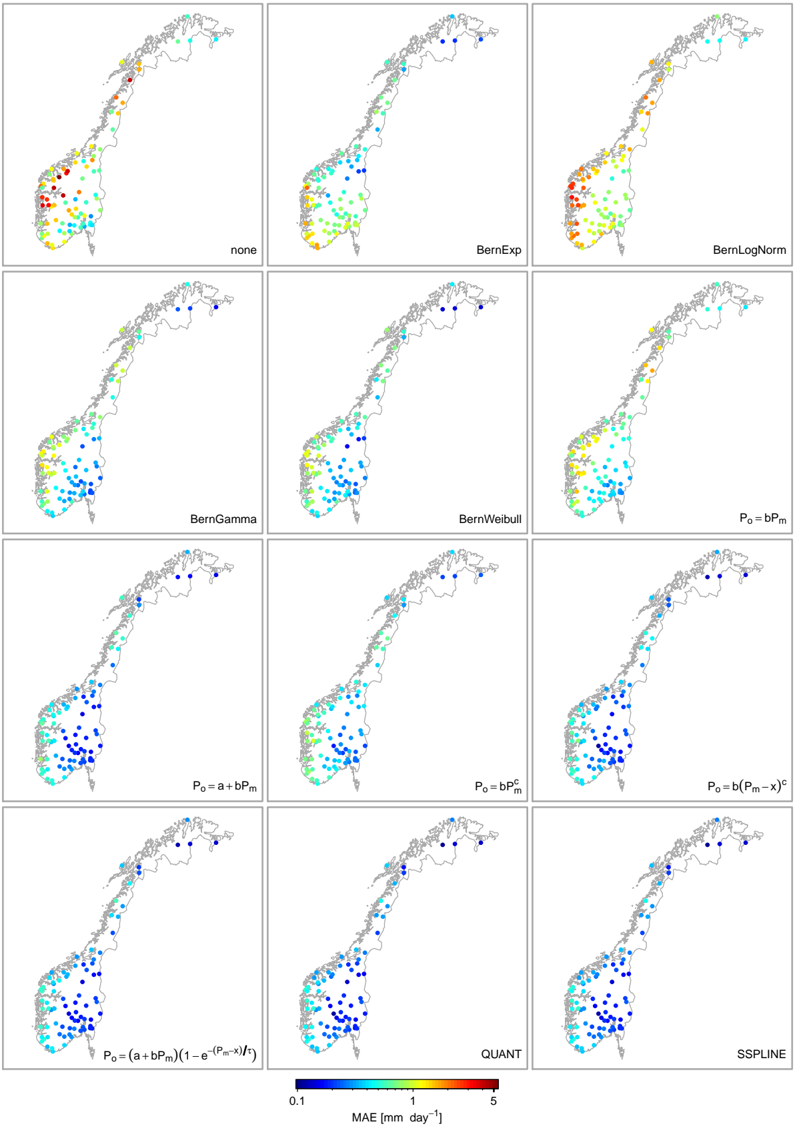
The impact of climate change on water resources is usually assessed at the local scale. However, regional climate models (RCMs) are known to exhibit systematic biases in precipitation. Hence, RCM simulations need to be post-processed in order to produce reliable estimates of local scale climate. Popular post-processing approaches are based on statistical transformations, which attempt to adjust the distribution of modelled data such that it closely resembles the observed climatology. However, the diversity of suggested methods renders the selection of optimal techniques difficult and therefore there is a need for clarification. In this paper, statistical transformations for post-processing RCM output are reviewed and classified into (1) distribution derived transformations, (2) parametric transformations and (3) nonparametric transformations, each differing with respect to their underlying assumptions. A real world application, using observations of 82 precipitation stations in Norway, showed that nonparametric transformations have the highest skill in systematically reducing biases in RCM precipitation.
Overview
The claims and statistics of this paper haven’t been checked yet.
Free: it reads the open-access text and checks the first 5 claims that cite a source we can check. Create a free account to check every claim.
Integrity signals
Registry
Cites
Statistics
Figures



Verification
Claims the paper makes
The claims and statistics of this paper haven’t been checked yet.
Free: it reads the open-access text and checks the first 5 claims that cite a source we can check. Create a free account to check every claim.
Claims other papers make about this one
Each is checked against this paper’s own text: does it say what the citing paper says it does?
The source backs part of the claim, not all of it — or backs it for a different population, condition or comparison.
In the citing paper
“Quantile mapping is the most used bias correction technique due to its ease of handling large amounts of data and its computational efficiency [58,59].”
From Climate Change Impacts on Streamflow in the Krishna River Basin, India: Uncertainty and Multi-Site Analysis (2022) · cites this paper as [58]
Experimental — accuracy not yet measured
Self-check
Percentages, sums and reported differences re-computed from the paper’s own numbers.
The self-check needs the paper’s full text.
Citations
Cites
The Elements of Statistical Learning
Hastie, T., Friedman, J., & Tibshirani, R. (2001) · Springer Series in Statistics · doi:10.1007/978-0-387-21606-5 · Cited by 24,162
Uppala, S. M., KÅllberg, P. W., Simmons, A. J., Andrae, U., Bechtold, V. D. C., Fiorino, M., Gibson, J. K., Haseler, J., Hernandez, A., Kelly, G. A., et al. (2005) · Quarterly Journal of the Royal Meteorological Society · doi:10.1256/qj.04.176 · Cited by 6,804 · cited 1×
“Modelled precipitation was extracted from a HIRHAM RCM simulation with 25 km resolution (Førland et al., 2009, 2011) forced with the ERA40 reanalysis (Uppala et al., 2005) on a model domain covering Norway and the Nordic Arctic.”
MethodTeutschbein, C., & Seibert, J. (2012) · Journal of Hydrology · doi:10.1016/j.jhydrol.2012.05.052 · Cited by 2,214 · cited 13×
“, 2011; Teutschbein and Seibert, 2012), the standard deviation (Engen-Skaugen, 2007; Li et al., 2010; Themeßl et al., 2011; Teutschbein and Seibert, 2012) and the skewness (Li et al.”
BackgroundMethodResultInfluentialHydrologic Implications of Dynamical and Statistical Approaches to Downscaling Climate Model Outputs
Wood, A. W., Leung, L. R., Sridhar, V., & Lettenmaier, D. P. (2004) · Climatic Change · doi:10.1023/b:clim.0000013685.99609.9e · Cited by 1,886 · cited 3×
“(2) using the empirical CDF of observed and modelled values instead of assuming parametric distributions (e.g.Panofsky and Brier, 1968; Wood et al., 2004; Reichle and Koster, 2004; Boé et al., 2007; Themeßl et al., 2011, 2012).”
BackgroundMethodMaraun, D., Wetterhall, F., Ireson, A. M., Chandler, R. E., Kendon, E. J., Widmann, M., Brienen, S., Rust, H. W., Sauter, T., Themeßl, M., et al. (2010) · Reviews of Geophysics · doi:10.1029/2009rg000314 · Cited by 1,805 · cited 3×
“Further, “statistical bias correction” (Piani et al., 2010a,b), “direct error correction methods” (Themeßl et al., 2011) and “model output statistics (MOS)” (Maraun et al., 2010) have been used to refer to the methods under investigation.”
MethodStatistical bias correction for daily precipitation in regional climate models over Europe
Piani, C., Haerter, J. O., & Coppola, E. (2010) · Theoretical and Applied Climatology · doi:10.1007/s00704-009-0134-9 · Cited by 1,154 · cited 9×
“…a set of scores is needed that quantifies the similarity of the observed and the (corrected) modelled empirical CDF. Previously used scores include overall measures, such as the root mean square error (Piani et al., 2010b) or the Kolmogorov-Smirnov two sample statistic (Dosio and Paruolo, 2011).”
BackgroundMethodInfluentialSome applications of statistics to meteorology
Panofsky, H. A., Brier, G. W., & Best, W. H. (1958) · University of Michigan Library Repository · Cited by 1,083
Li, H., Sheffield, J., & Wood, E. F. (2010) · Journal of Geophysical Research: Atmospheres · doi:10.1029/2009jd012882 · Cited by 901 · cited 6×
“Other suggested scores assess specific moments of the distribution including the mean (Engen-Skaugen, 2007; Li et al., 2010; Dosio and Paruolo, 2011; Themeßl et al., 2011; Turco et al., 2011; Teutschbein and Seibert, 2012), the standard deviation (Engen-Skaugen, 2007; Li et al., 2010; Themeßl et…”
BackgroundMethodInfluentialHow Well Do Coupled Models Simulate Today's Climate?
Reichler, T., & Kim, J. (2008) · Bulletin of the American Meteorological Society · doi:10.1175/bams-89-3-303 · Cited by 881
Piani, C., Weedon, G. P., Best, M., Gomes, S. M., Viterbo, P., Hagemann, S., & Haerter, J. O. (2010) · Journal of Hydrology · doi:10.1016/j.jhydrol.2010.10.024 · Cited by 868 · cited 9×
“…a set of scores is needed that quantifies the similarity of the observed and the (corrected) modelled empirical CDF. Previously used scores include overall measures, such as the root mean square error (Piani et al., 2010b) or the Kolmogorov-Smirnov two sample statistic (Dosio and Paruolo, 2011).”
BackgroundMethodInfluential
Cited by
Items 201–300 of 1,001
From global circulation to local flood loss: Coupling models across the scales
Felder, G., Gómez‐Navarro, J. J., Zischg, A. P., Raible, C. C., Röthlisberger, V., Bozhinova, D., Martius, O., & Weingartner, R. (2018) · The Science of The Total Environment · doi:10.1016/j.scitotenv.2018.04.170 · Cited by 56
“This so-called Quantile Mapping (QM) technique (Gudmundsson et al., 2012; Jakob Themeßl et al., 2011) calibrates a non-parametric statistical model that can be used to adjust the simulated events, with the underlying assumption being that the biases found during the calibration period are consistent across different t…”
MethodFaiz, M. A., Liu, D., Fu, Q., Li, M., Baig, F., Tahir, A. A., Khan, M. I., Li, T., & Cui, S. (2018) · Journal of Hydrology · doi:10.1016/j.jhydrol.2018.08.057 · Cited by 60
Muelchi, R., Rößler, O., Schwanbeck, J., Weingartner, R., & Martius, O. (2021) · Geoscience Data Journal · doi:10.1002/gdj3.117 · Cited by 60
Future changes in precipitation characteristics in China
Wu, S., Wu, Y., & Wen, J. (2019) · International Journal of Climatology · doi:10.1002/joc.6038 · Cited by 59
“In addition, it is well established that precipitation simulations from climate models have significant bias due to knowledge gaps in precipitation processes and/or insufficient spatial resolution (Rauscher et al., 2010; Gudmundsson et al., 2012).”
BackgroundBias in dynamically downscaled rainfall characteristics for hydroclimatic projections
Potter, N. J., Chiew, F. H. S., Charles, S. P., Fu, G., Zheng, H., & Zhang, L. (2020) · Hydrology and earth system sciences · doi:10.5194/hess-24-2963-2020 · Cited by 61
“We use the R package “qmap” (Gudmundsson et al., 2012) to estimate the cumulative density functions for the mapping function.”
Interpreting extreme climate impacts from large ensemble simulations—are they unseen or unrealistic?
Kelder, T., Wanders, N., van der Wiel, K., Marjoribanks, T. I., Slater, L. J., Wilby, R. L., & Prudhomme, C. (2022) · Environmental Research Letters · doi:10.1088/1748-9326/ac5cf4 · Cited by 71
“We estimate values of the empirical cumulative distribution function for regularly spaced quantiles via the ‘qmap’ Rpackage (Gudmundsson et al 2012).”
MethodDevelopment of a Glacio-hydrological Model for Discharge and Mass Balance Reconstruction
Kumar, R., Singh, S., Kumar, R., Singh, A., Bhardwaj, A., Sam, L., Randhawa, S. S., & Gupta, A. (2016) · Water Resources Management · doi:10.1007/s11269-016-1364-0 · Cited by 55
“Therefore, the precipitation recorded at Chhitkul from 2001 to 2008 was used to bias-correct the APHRODITE data using method suggested by Gudmundsson et al. (2012).”
MethodCMIP5 ensemble-based spatial rainfall projection over homogeneous zones of India
Akhter, J., Das, L., & Deb, A. (2016) · Climate Dynamics · doi:10.1007/s00382-016-3409-8 · Cited by 56
“In case of Empirical quantile mapping (Eqm) CDFs of observed and modelled precipitation are estimated using empirical percentiles and values in between the percentiles are approximated using linear interpolation (Gudmundsson et al. 2012).”
MethodCarvalho, D., Pereira, S. C., & Rocha, A. C. (2020) · Climate Dynamics · doi:10.1007/s00382-020-05472-3 · Cited by 65
Extreme weather events in Europe: preparing for climate change adaptation
Hov, Ø., Cubasch, U., Fischer, E. M., Höppe, P., Iversen, T., Kvamstø, N. G., Kundzewicz, Z. W., Řezáčová, D., Rios, D., Santos, F. D., et al. (2013) · ASEP · doi:10.7892/boris.47431 · Cited by 102
“Furthermore, the choice of bias correction method, which to some extent is subjective, will affect the estimates of extremes and future change (Gudmundsson et al., 2012; Räisänen, 2012).”
MethodProjected changes in flood indices in selected catchments in Poland in the 21st century
Osuch, M., Lawrence, D., Meresa, H. K., Napiorkowski, J. J., & Romanowicz, R. J. (2016) · Stochastic Environmental Research and Risk Assessment · doi:10.1007/s00477-016-1296-5 · Cited by 59
Using ERA-Interim reanalysis for creating datasets of energy-relevant climate variables
Jones, P. D., Harpham, C., Troccoli, A., Gschwind, B., Ranchin, T., Wald, L., Goodess, C. M., & Dorling, S. R. (2017) · Earth system science data · doi:10.5194/essd-9-471-2017 · Cited by 59
Did European temperatures in 1540 exceed present-day records?
Orth, R., Vogel, M. M., Luterbacher, J., Pfister, C., & Seneviratne, S. I. (2016) · Environmental Research Letters · doi:10.1088/1748-9326/11/11/114021 · Cited by 59
“…the present-day simulations to the values of the corresponding observations, while biases in TXx are addressed through a quantile mapping procedure (Gudmundsson et al 2012) where the shape of the GEV distribution of the modeled TXx is adjusted to the shape of the GEV distribution of the…”
MethodAlamdari, N., Sample, D. J., Ross, A. C., & Easton, Z. M. (2019) · Estuaries and Coasts · doi:10.1007/s12237-019-00649-4 · Cited by 59
Carreno-Madinabeitia, S., Ibarra‐Berastegi, G., Sáenz, J., & Ulazia, A. (2021) · Energy · doi:10.1016/j.energy.2021.120364 · Cited by 62
Kouhestani, S., Eslamian, S. S., Koupai, J. A., & Besalatpour, A. A. (2016) · Global and Planetary Change · doi:10.1016/j.gloplacha.2016.07.013 · Cited by 56
Effects of climate change on shallow landslides in a small coastal catchment in southern Italy
Ciervo, F., Rianna, G., Mercogliano, P., & Papa, M. N. (2016) · Landslides · doi:10.1007/s10346-016-0743-1 · Cited by 53
“The non-parametric quantile mapping approach (Gudmundsson et al. 2012; Villani et al. 2015) was used to bias-correct (BC) daily climate outputs (GCM+RCM+BC).”
Climate change effects on the marine characteristics of the Aegean and Ionian Seas
Makris, C. V., Γαλιατσάτου, Π., Τολίκα, Κ., Αnagnostopoulou, C., Kombiadou, K., Prinos, P. E., Velikou, K., Kapelonis, Z., Tragou, E., Androulidakis, Y. S., et al. (2016) · Ocean Dynamics · doi:10.1007/s10236-016-1008-1 · Cited by 59
Cook, L. M., Anderson, C., & Samaras, C. (2017) · Journal of Infrastructure Systems · doi:10.1061/(asce)is.1943-555x.0000382 · Cited by 60
“Quantile mapping has been used to apply expected changes to the empirical distribution of observed rainfall events at the temporal and spatial resolution of the observations (Laflamme et al. 2016; Boé et al. 2007; Gudmundsson et al. 2012; Wood et al. 2004).”
MethodPardo‐Igúzquiza, E., Collados‐Lara, A., & Pulido‐Velazquez, D. (2019) · Environmental Earth Sciences · doi:10.1007/s12665-019-8594-4 · Cited by 53
Pandey, V. P., Dhaubanjar, S., Bharati, L., & Thapa, B. R. (2020) · Journal of Hydrology Regional Studies · doi:10.1016/j.ejrh.2020.100691 · Cited by 53
“The future climate data at the meteorological stations were then bias-corrected using quantile mapping (QM) method (Gudmundsson et al., 2012; Teutchbein and Seibert, 2012), implemented in R using a qmap package (Gudmundsson et al., 2012).”
MethodRomanowicz, R. J., Bogdanowicz, E., Debele, S. E., Doroszkiewicz, J., Hisdal, H., Lawrence, D., Meresa, H. K., Napiorkowski, J. J., Osuch, M., Strupczewski, W. G., et al. (2016) · Acta Geophysica · doi:10.1515/acgeo-2016-0009 · Cited by 52
“Further details of these procedures can be found in Gudmundsson et al. (2012).”
BackgroundMethodHasson, S. U., Saeed, F., Böhner, J., & Schleussner, C. (2019) · Advances in Water Resources · doi:10.1016/j.advwatres.2019.06.010 · Cited by 51
Requena, A. I., Nguyen, T.-H., Burn, D. H., Coulibaly, P., & Nguyen, V. (2021) · Journal of Hydrology Regional Studies · doi:10.1016/j.ejrh.2021.100811 · Cited by 55
Huang, S., Krysanova, V., & Hattermann, F. F. (2014) · International Journal of Climatology · doi:10.1002/joc.3945 · Cited by 53
Sangelantoni, L., Russo, A., & Gennaretti, F. (2018) · Theoretical and Applied Climatology · doi:10.1007/s00704-018-2406-8 · Cited by 53
“…for Maritime Research and Experimentation, La Spezia, Italy 4 Université de Lorraine, AgroParisTech, INRA, UMR1434 Silva, 54000 Nancy, France et al. 2009; Berg et al. 2012; Dosio et al. 2012; Gudmundsson et al. 2012; Casati et al. 2013; Wilcke et al. 2013; Smith et al. 2014; Rajczak et al. 2015).”
BackgroundJha, P. K., Athanasiadis, P., Gualdi, S., Trabucco, A., Mereu, V., Shelia, V., & Hoogenboom, G. (2018) · Agricultural and Forest Meteorology · doi:10.1016/j.agrformet.2018.11.029 · Cited by 54
Crimp, S. J., Jin, H., Kokic, P. N., Bakar, K. S., & Nicholls, N. (2018) · Climate Dynamics · doi:10.1007/s00382-018-4188-1 · Cited by 50
“The first approach involves biascorrection using monthly climate model data, bias-corrected by matching simulated and observed quantiles (Dosio 2016; Gudmundsson 2014; Gudmundsson et al. 2012; Li et al. 2010).”
MethodNing, G., Wardle, D. A., & Yim, S. H. L. (2022) · Geophysical Research Letters · doi:10.1029/2021gl097090 · Cited by 51
Impact of climate change on snow avalanche activity in the Swiss Alps
Mayer, S., Hendrick, M., Michel, A., Richter, B., Schweizer, J., Wernli, H., & van Herwijnen, A. (2024) · The Cryosphere · doi:10.5194/tc-18-5495-2024 · Cited by 63
“…are based on the CH2018 climate change scenarios (CH2018, 2018), which are available for three Representative Concentration Path-ways (RCPs), each named according to the level of radiative forcing (in W − 2 ) projected to be reached by the end of the century (Stocker et al., 2013): scenario RCP2.”
Hydrologic responses to climate change using downscaled GCM data on a watershed scale
Chen, C., Kalra, A., & Ahmad, S. (2018) · Journal of Water and Climate Change · doi:10.2166/wcc.2018.147 · Cited by 58
Reservoir Governance in World's Water Towers Needs to Anticipate Multi‐purpose Use
Kellner, E., & Brunner, M. I. (2020) · Earth s Future · doi:10.1029/2020ef001643 · Cited by 57
Irwandi, H., Rosid, M. S., & Mart, T. (2023) · Scientific Reports · doi:10.1038/s41598-023-29592-y · Cited by 66
Precipitation Bias Correction: A Novel Semi‐parametric Quantile Mapping Method
Rajulapati, C. R., & Papalexiou, S. M. (2023) · Earth and Space Science · doi:10.1029/2023ea002823 · Cited by 64
“In hydrological studies, QM has been found to perform better than other BC techniques that correct just the mean or variance (Chen et al., 2013, 2015; Gudmundsson et al., 2012).”
BackgroundMethodZhang, C., Long, D., Liu, T., Slater, L. J., Wang, G., Zuo, D., Duan, L., Cui, Y., & Cui, Y. (2023) · Earth s Future · doi:10.1029/2023ef004037 · Cited by 55
“Three bias correction methods were used to correct different variables, including the delta approach, ratio method, and quantile mapping (Gudmundsson et al., 2012; Wood et al., 2004).”
MethodStatistical precipitation bias correction of gridded model data using point measurements
Haerter, J. O., Eggert, B., Moseley, C., Piani, C., & Berg, P. (2015) · Geophysical Research Letters · doi:10.1002/2015gl063188 · Cited by 52
Okwala, T., Shrestha, S., Ghimire, S., Mohanasundaram, S., & Datta, A. (2020) · Environmental Research · doi:10.1016/j.envres.2020.109544 · Cited by 49
Langousis, A., Mamalakis, A., Deidda, R., & Marrocu, M. (2016) · Water Resources Research · doi:10.1002/2015wr017556 · Cited by 50
Eum, H., Gupta, A., & Dibike, Y. B. (2020) · Journal of Hydrology · doi:10.1016/j.jhydrol.2020.125065 · Cited by 55
qmap: Statistical Transformations for Post-Processing Climate Model Output
Gudmundsson, L. (2012) · doi:10.32614/cran.package.qmap · Cited by 48
Self-citationDeep Learning for Bias‐Correcting CMIP6‐Class Earth System Models
Hess, P., Lange, S., Schötz, C., & Boers, N. (2023) · Earth s Future · doi:10.1029/2023ef004002 · Cited by 60
Kim, M., Kim, S., Kim, J., Heo, J., Park, J., Kwon, W., & Suh, M. (2016) · Asia-Pacific Journal of Atmospheric Sciences · doi:10.1007/s13143-016-0010-3 · Cited by 51
“…and compared various statistical downscaling techniques (Wilby and Wigley, 1997; Zorita and Von Storch, 1999; Giorgi et al., 2001; Fowler et al., 2007; Maraun et al., 2010; Raje and Mujumdar, 2011; Gudmundsson et al., 2012; Teutschbein and Seibert, 2012; Maraun et al., 2013; Sunyer et al., 2015).”
BackgroundMethodInfluentialDidovets, I., Lobanova, A., Bronstert, A., Snizhko, S., Maule, C. F., & Krysanova, V. (2017) · Water · doi:10.3390/w9030204 · Cited by 47
“An empirical statistical quantile mapping method was used for bias correction [53].”
MethodAn Integrated Statistical Method to Generate Potential Future Climate Scenarios to Analyse Droughts
Collados‐Lara, A., Pulido‐Velazquez, D., & Pardo‐Igúzquiza, E. (2018) · Water · doi:10.3390/w10091224 · Cited by 51
Han, Z., Shi, Y., Jia, W., Xu, Y., & Zhou, B. (2019) · Journal of Applied Meteorology and Climatology · doi:10.1175/jamc-d-19-0050.1 · Cited by 47
Oswald, S., Hollósi, B., Žuvela‐Aloise, M., See, L., Guggenberger, S., Hafner, W., Prokop, G., Storch, A., & Schieder, W. (2020) · Urban Climate · doi:10.1016/j.uclim.2020.100582 · Cited by 50
Gao, L., Schulz, K., & Bernhardt, M. (2014) · Advances in Meteorology · doi:10.1155/2014/472741 · Cited by 47
Hundecha, Y., Pinya, M. A. S., Lawrence, D., Madsen, H., Willems, P., Bürger, G., Kriaučiūnienė, J., Loukas, A. G., Martínková, M., Osuch, M., et al. (2016) · Journal of Hydrology · doi:10.1016/j.jhydrol.2016.08.033 · Cited by 46
Liersch, S., Tecklenburg, J., Rust, H. W., Dobler, A., Fischer, M., Kruschke, T., Koch, H., & Hattermann, F. F. (2018) · Hydrology and earth system sciences · doi:10.5194/hess-22-2163-2018 · Cited by 47
Impact of climate change on landslides frequency: the Esino river basin case study (Central Italy)
Sangelantoni, L., Gioia, E., & Marincioni, F. (2018) · Natural Hazards · doi:10.1007/s11069-018-3328-6 · Cited by 48
“As explained below, QDM advances the traditional postprocessing technique of quantile mapping (QM) (Boé et al. 2007; Dosio and Paruolo 2011; Berg et al. 2012; Gudmundsson et al. 2012; Casati et al. 2013; Wilcke et al. 2013; Smith et al. 2014) originally proposed by Panofsky and Brier (1968).”
MethodInfluentialFluixá-Sanmartín, J., Morales-Torres, A., Escuder‐Bueno, I., & Paredes-Arquiola, J. (2019) · Natural hazards and earth system sciences · doi:10.5194/nhess-19-2117-2019 · Cited by 53
Future projections of Malaysia daily precipitation characteristics using bias correction technique
Ngai, S. T., Juneng, L., Tangang, F., Chung, J. X., Salimun, E., Tan, M. L., & Amalia, S. A. S. (2020) · Atmospheric Research · doi:10.1016/j.atmosres.2020.104926 · Cited by 46
Das, P., Zhang, Z., & Ren, H. (2022) · Journal of Water and Climate Change · doi:10.2166/wcc.2022.299 · Cited by 46
de Velde, J. V., Demuzere, M., Baets, B. D., & Verhoest, N. E. C. (2022) · Hydrology and earth system sciences · doi:10.5194/hess-26-2319-2022 · Cited by 52
“, 1958) was shown to be the generally best performing method (Rojas et al., 2011; Gudmundsson et al., 2012).”
MethodQuilcaille, Y., Gudmundsson, L., Beusch, L., Hauser, M., & Seneviratne, S. I. (2022) · Geophysical Research Letters · doi:10.1029/2022gl099012 · Cited by 54
“Instead, we employ the fitted distributions to transform TXx to a standard normal distribution using the probability integral transform (Angus, 1994; Gneiting et al., 2007; Gudmundsson et al., 2012).”
MethodSelf-citationSong, Y. H., Shahid, S., & Chung, E. (2022) · International Journal of Climatology · doi:10.1002/joc.7386 · Cited by 45
“The smoothing spline method of the non-parametric transformation is fitted in a quantile to quantile manner with the observed and modelled times series (Kouhestani et al. 2016; Gudmundsson et al., 2012).”
MethodBias correction of global ensemble precipitation forecasts by Random Forest method
Zarei, M., Najarchi, M., & Mastouri, R. (2021) · Earth Science Informatics · doi:10.1007/s12145-021-00577-7 · Cited by 53
“(Gudmundsson et al. 2012) The Quantile Mapping method is applied to each ensemble forecast set per day.”
MethodFiddes, J., Aalstad, K., & Lehning, M. (2022) · Geoscientific model development · doi:10.5194/gmd-15-1753-2022 · Cited by 45
Kokkonen, T. V., Grimmond, S., Räty, O., Ward, H. C., Christen, A., Oke, T. R., Kotthaus, S., & Järvi, L. (2017) · Urban Climate · doi:10.1016/j.uclim.2017.05.001 · Cited by 46
“…the computational needs for applications, bias correction with quantile mapping (BCQM) has been found to be an effective method to correct daily precipitation intensities in climate projections (e.g. Gudmundsson et al., 2012; Räty et al., 2014; Sunyer et al., 2015; Teutschbein and Seibert, 2012).”
MethodTrends of atmospheric circulation during singular hot days in Europe
Jézéquel, A., Cattiaux, J., Naveau, P., Radanovics, S., Ribes, A., Vautard, R., Vrac, M., & Yiou, P. (2018) · Environmental Research Letters · doi:10.1088/1748-9326/aab5da · Cited by 53
Statistical reconstruction of daily precipitation and temperature fields in Switzerland back to 1864
Pfister, L., Brönnimann, S., Schwander, M., Isotta, F., Horton, P., & Röhr, C. (2020) · Climate of the past · doi:10.5194/cp-16-663-2020 · Cited by 48
Sidibé, M., Dieppois, B., Eden, J., Mahé, G., Paturel, J., Amoussou, E., Anifowose, B., Wiel, M. J. V. D., & Lawler, D. M. (2020) · Climate Dynamics · doi:10.1007/s00382-019-05102-7 · Cited by 49
Gurara, M. A., Jilo, N. B., & Tolche, A. D. (2021) · Journal of African Earth Sciences · doi:10.1016/j.jafrearsci.2021.104223 · Cited by 56
Downscaling Techniques for High-Resolution Climate Projections: From Global Change to Local Impacts
Kotamarthi, R., Hayhoe, K., Mearns, L. O., Wuebbles, D., Jacobs, J. M., & Jurado, J. (2021) · Cambridge University Press eBooks · doi:10.1017/9781108601269 · Cited by 67
Auflič, M. J., Bezak, N., Šegina, E., Frantar, P., Gariano, S. L., Medved, A., & Peternel, T. (2023) · Scientific Reports · doi:10.1038/s41598-023-50314-x · Cited by 44
“All calculations were performed in Toll R software, where we used the package “qmap” 53 .”
MethodHistorical trends and high-resolution future climate projections in northern Tuscany (Italy)
D’Oria, M., Ferraresi, M., & Tanda, M. G. (2017) · Journal of Hydrology · doi:10.1016/j.jhydrol.2017.10.054 · Cited by 49
González‐Zeas, D., Erazo, B., Lloret, P., Bièvre, B. D., Steinschneider, S., & Dangles, O. J. (2018) · The Science of The Total Environment · doi:10.1016/j.scitotenv.2018.09.309 · Cited by 51
Vrac, M., & Thao, S. (2020) · Geoscientific model development · doi:10.5194/gmd-13-5367-2020 · Cited by 46
Babaousmail, H., Ayugi, B. O., Rajasekar, A., Zhu, H., Oduro, C., Mumo, R., & Ongoma, V. (2022) · Atmosphere · doi:10.3390/atmos13050741 · Cited by 46
An all-Africa dataset of energy model “supply regions” for solar photovoltaic and wind power
Sterl, S. H., Hussain, B., Miketa, A., Li, Y., Merven, B., Ticha, M. B. B., Elabbas, M. A. E., Thiery, W., & Russo, D. (2022) · Scientific Data · doi:10.1038/s41597-022-01786-5 · Cited by 44
Balhane, S., Driouech, F., Chafki, O., Manzanas, R., Chehbouni, A., & Moufouma-Okia, W. (2021) · Climate Dynamics · doi:10.1007/s00382-021-05910-w · Cited by 45
Development of multi-model ensemble for projection of extreme rainfall events in Peninsular Malaysia
Noor, M., Ismail, T., Shahid, S., Nashwan, M. S., & Ullah, S. (2019) · Hydrology research · doi:10.2166/nh.2019.097 · Cited by 46
Kim, J. H., Sung, J. H., Chung, ., Kim, S. U., Son, M., & Shiru, M. S. (2021) · Sustainability · doi:10.3390/su13042066 · Cited by 44
“The quantile mapping is a representative method for the correction of the difference between the simulated value of GCM and the observed, and is one of the most effective bias correction methods [45,46].”
MethodInfluence of Bias Correcting Predictors on Statistical Downscaling Models
Vrac, M., & Ayar, P. V. (2016) · Journal of Applied Meteorology and Climatology · doi:10.1175/jamc-d-16-0079.1 · Cited by 42
“…developments, statistical bias correction (BC) methods have also been designed to adjust climate simulations by transforming the simulated data into new data with fewer or no statistical biases with respect to reference (e.g., Haddad and Rosenfeld 1997; Gudmundsson et al. 2012; Vrac et al. 2012).”
MethodIndices of Canada’s future climate for general and agricultural adaptation applications
Li, G., Zhang, X., Cannon, A. J., Murdock, T. Q., Sobie, S., Zwiers, F. W., Anderson, K., & Qian, B. (2018) · Climatic Change · doi:10.1007/s10584-018-2199-x · Cited by 53
“Various statistical downscaling methods, including versions of bias-correction/constructed analogues (BCCA, Maurer et al. 2010), quantile mapping (Gudmundsson et al. 2012), and bias-correction/spatial disaggregation (BCSD; Wood et al. 2004) were evaluated as a followup to the downscaling…”
MethodPastor, A. V., Nunes, J. P., Ciampalini, R., Koopmans, M., Baartman, J. E. M., Huard, F., Calheiros, T., Bissonnais, Y. L., Keizer, J. J., & Raclot, D. (2019) · Water · doi:10.3390/w11122617 · Cited by 50
“Burnt area scenarios under climate change were calculated using rainfall and DSR projections, the latter with a correction for bias using an empirical quantile mapping approach [54].”
MethodEvaluation of the Impact of Climate Change on Runoff Generation in an Andean Glacier Watershed
Escanilla-Minchel, R., Alcayaga, H., Soto-Alvarez, M., Kinnard, C., & Urrutia, R. (2020) · Water · doi:10.3390/w12123547 · Cited by 43
Das, J., & Umamahesh, N. V. (2017) · Journal of Hydrologic Engineering · doi:10.1061/(asce)he.1943-5584.0001571 · Cited by 41
Exploring Climate Change Effects on Drought Patterns in Bangladesh Using Bias-Corrected CMIP6 GCMs
Yildiz, S., Islam, H. M. T., Rashid, T., Sadeque, A., Shahid, S., & Kamruzzaman, M. (2023) · Earth Systems and Environment · doi:10.1007/s41748-023-00362-0 · Cited by 42
“The non-parametric empirical equation of QM is more effective at minimizing systematic bias than the parametric methods (Gudmundsson et al. 2012).”
Multi-hazard could exacerbate in coastal Bangladesh in the context of climate change
Rahman, M., Shufeng, T., Tumon, M. S. H., Hossain, M. A., Kim, H.-J., Islam, M. M., Alam, M., Sadiq, S., Ningsheng, C., Ullah, K., et al. (2024) · Journal of Cleaner Production · doi:10.1016/j.jclepro.2024.142289 · Cited by 41
Assessment of CMIP6 models and multi-model averaging for temperature and precipitation over Iran
Azad, N., & Ahmadi, A. (2024) · Scientific Reports · doi:10.1038/s41598-024-74789-4 · Cited by 53
“The quantile mapping method, as described by Panofsky et al. 44 , is widely recognized as one of the most effective approaches for bias adjustment 45,46 .”
MethodAddor, N., & Fischer, E. M. (2015) · Journal of Geophysical Research Atmospheres · doi:10.1002/2014jd022824 · Cited by 45
Raible, C. C., Bärenbold, O., & Gómez‐Navarro, J. J. (2017) · Tellus A Dynamic Meteorology and Oceanography · doi:10.1080/16000870.2017.1296226 · Cited by 41
“Quantile mapping is regularly used in downscaling and bias correction of model output (Raible et al., 2012; Themessl et al., 2011; Gudmundsson et al., 2012; Rajczak et al., 2016) and is similar to non-parametric approaches used in drought index definitions (Farahmand andAghaKouchak, 2015).”
MethodPilz, T., Delgado, J. M., Voß, S., Vormoor, K., Francke, T., Costa, A. C., Martins, E. S. P. R., & Bronstert, A. (2019) · Hydrology and earth system sciences · doi:10.5194/hess-23-1951-2019 · Cited by 50
“, 1996) which were bias corrected by empirical quantile mapping (EQM) (Boé et al., 2007; Gudmundsson et al., 2012).”
Asong, Z. E., Elshamy, M., Princz, D., Wheater, H. S., Pomeroy, J. W., Pietroniro, A., & Cannon, A. J. (2020) · Earth system science data · doi:10.5194/essd-12-629-2020 · Cited by 43
Impact of downscaled rainfall biases on projected runoff changes
Charles, S. P., Chiew, F. H. S., Potter, N. J., Zheng, H., Fu, G., & Zhang, L. (2020) · Hydrology and earth system sciences · doi:10.5194/hess-24-2981-2020 · Cited by 41
“The QQM-BC approach, using the R-package ‘qmap’ using the methodologies developed by Gudmundsson et al. (2012), is applied for each three-month season (i.e. DJF, MAM, JJA and SON) to each grid cell independently, mapping the simulated (WRF) to the observed (AWAP) daily rainfall cumulative density…”
Idier, D., Rohmer, J., Pedreros, R., Roy, S. L., Lambert, J., Louisor, J., Cozannet, G. L., & Cornec, E. L. (2020) · Natural Hazards · doi:10.1007/s11069-020-03882-4 · Cited by 44
Schardong, A., Simonović, S. P., Gaur, A., & Sandink, D. (2020) · Water · doi:10.3390/w12051243 · Cited by 46
“BCCAQ v2 [56] is a hybrid method that combines results from BCCA [57] and quantile mapping (QMAP) [58].”
MethodAssessment of the Skill of Coupled Physical–Biogeochemical Models in the NW Mediterranean
Ramírez‐Romero, E., Jordá, G., Amores, Á., Kay, S., Segura‐Noguera, M., Macias, D. M., Maynou, F., Sabatés, A., & Catalán, I. A. (2020) · Frontiers in Marine Science · doi:10.3389/fmars.2020.00497 · Cited by 44
Zhao, W., Kinouchi, T., & Nguyễn, H. Q. (2021) · Journal of Hydrology · doi:10.1016/j.jhydrol.2021.126461 · Cited by 43
Estimation of the rice water footprint based on machine learning algorithms
Mokhtar, A., Elbeltagi, A., Maroufpoor, S., Azad, N., He, H., Alsafadi, K., Gyasi‐Agyei, Y., & He, W. (2021) · Computers and Electronics in Agriculture · doi:10.1016/j.compag.2021.106501 · Cited by 44
Jiménez-Navarro, I. C., Jimeno‐Sáez, P., López-Ballesteros, A., Pérez‐Sánchez, J., & Senent‐Aparicio, J. (2021) · Forests · doi:10.3390/f12121803 · Cited by 44
“These were the robust empirical quantiles (RQUANT), distribution derived transformations (DIST), empirical quantiles (QUANT), parametric transformations (PTF), and smoothing spline (SSPLIN) [64].”
Li, H., Beldring, S., & Xu, C. (2013) · Hydrology research · doi:10.2166/nh.2013.009 · Cited by 40
Identifying hotspots cities vulnerable to climate change in Pakistan under CMIP5 climate projections
Ali, S., Kiani, R. S., Reboita, M. S., Dan, L., Eum, H., Cho, J., Dairaku, K., Khan, F., & Shreshta, M. L. (2020) · International Journal of Climatology · doi:10.1002/joc.6638 · Cited by 45
“…engaged to vigorously develop and employ statistical bias correction/downscaling algorithms to produce local scale climate projections required for impact studies (Wood et al., 2002, 2004; Gudmundsson et al., 2012; Sunyer et al., 2015; Hundecha et al., 2016; Su et al., 2016; Li Liu et al., 2017).”
BackgroundHuang, Z., Zhao, T., Xu, W., Cai, H., Wang, J., Zhang, Y., Liu, Z., Tian, Y., Yan, D., & Chen, X. (2022) · Journal of Hydrology · doi:10.1016/j.jhydrol.2022.127896 · Cited by 43
Chinasho, A., Bedadi, B., Lemma, T., Tana, T., Hordofa, T., & Cholo, B. E. (2021) · Advances in Meteorology · doi:10.1155/2021/9657460 · Cited by 47
Revisiting the bias correction of climate models for impact studies
Dinh, T. L. A., & Aires, F. (2023) · Climatic Change · doi:10.1007/s10584-023-03597-y · Cited by 44
“Gudmundsson et al. (2012) defined parametric and non-parametric transformations as the two common B-C methods.”
MethodPadhiary, J., Patra, K. C., Dash, S. S., & Jayakumar, K. (2019) · Journal of Water and Climate Change · doi:10.2166/wcc.2019.080 · Cited by 43
Silva, D. F., Simonović, S. P., Schardong, A., & Goldenfum, J. A. (2021) · Journal of Hydrology Regional Studies · doi:10.1016/j.ejrh.2021.100870 · Cited by 39
Future Hydrological Drought Analysis Considering Agricultural Water Withdrawal Under SSP Scenarios
Kim, J. H., Sung, J. H., Shahid, S., & Chung, E.-S. (2022) · Water Resources Management · doi:10.1007/s11269-022-03116-1 · Cited by 43
“Quantile mapping is an effective representative method to correct the difference between the GCM simulated and observed values (Dosio et al., 2011; Gudmundsson et al., 2012).”
Method
Metadata
- Authors
- Gudmundsson, L., Bremnes, J. B., Haugen, J. E., & Engen-Skaugen, T.
- Affiliations
- Norwegian Meteorological Institute (NO)
- Venue
- Hydrology and Earth System Sciences
- Publisher
- Copernicus GmbH
- Published
- 2012-09-21
- Volume
- 16
- Issue
- 9
- Pages
- 3383-3390
- ISSN
- 1027-5606 (ISSN-L)
- 1607-7938
- OpenAlex
- W2166535858
- Cited by
- 1,318
- References
- 41
- Citations by year
- 2026: 132 · 2025: 134 · 2024: 124 · 2023: 136 · 2022: 137 · 2021: 172 · 2020: 116 · 2019: 85 · 2018: 76 · 2017: 68 · 2016: 63 · 2015: 35 · 2014: 20 · 2013: 17 · 2012: 3
- FWCI
- 20.14
- Type
- journal article
- Language
- en
- Open access
- gold
- doi.org
- Licence
- Locations
- Hydrology and earth system sciences (publishedVersion, cc-by)
- DOAJ (DOAJ: Directory of Open Access Journals) (submittedVersion)
- Repository for Publications and Research Data (ETH Zurich) (submittedVersion, cc-by)
- ETH Zürich Research Collection (cc-by)
- Topics
- Physical Sciences › Environmental Science › Global and Planetary Change › Climate variability and models
- Physical Sciences › Earth and Planetary Sciences › Atmospheric Science › Precipitation Measurement and Analysis
- Physical Sciences › Environmental Science › Water Science and Technology › Hydrology and Watershed Management Studies
- Keywords
- dynamical downscaling, precipitation bias correction, statistical post-processing, parametric transformation, climate change impacts on water resources
About these checks
Registry, retraction, Cites and statistics results are computed, not judged, with one exception: a printed reference that no index lists is read once by a model before it counts as a citation error. Claims are extracted by a model and kept only when their quote appears verbatim in the text; each cited source is then checked, with a model’s help, for whether it says what the claim relies on. Those verdicts can be wrong — read the claim’s quote and the cited source before relying on one.
Statistics and arithmetic are recomputed, not judged.
Confidence bands are shown only for fields calibrated on our annotated test set. None is calibrated yet, so no band is shown.
What counts as a claim ›How we measure confidence ›How we check this ›
Are you an author, or do you see a problem with this page? Request a review
Data sources
Bibliographic data: Semantic Scholar, OpenAlex, Crossref.
Contains information from the Semantic Scholar Academic Graph Datasets, made available under the ODC Attribution License (ODC-BY 1.0).
Semantic Scholar’s data is described in: Kinney, R., et al. (2023). The Semantic Scholar Open Data Platform. arXiv:2301.10140.
