

LIMA: Less Is More for Alignment
Open accessThe DOI matches its Crossref record; 12 of the 12 references it cites were found in a registry or an index.
Abstract
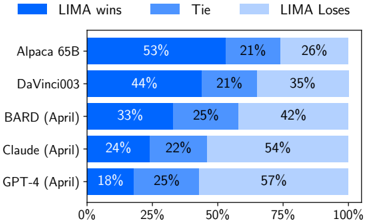
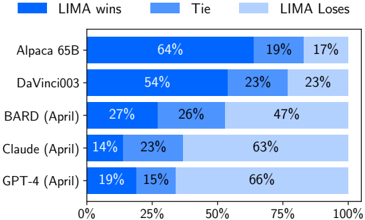
Large language models are trained in two stages: (1) unsupervised pretraining from raw text, to learn general-purpose representations, and (2) large scale instruction tuning and reinforcement learning, to better align to end tasks and user preferences. We measure the relative importance of these two stages by training LIMA, a 65B parameter LLaMa language model fine-tuned with the standard supervised loss on only 1,000 carefully curated prompts and responses, without any reinforcement learning or human preference modeling. LIMA demonstrates remarkably strong performance, learning to follow specific response formats from only a handful of examples in the training data, including complex queries that range from planning trip itineraries to speculating about alternate history. Moreover, the model tends to generalize well to unseen tasks that did not appear in the training data. In a controlled human study, responses from LIMA are either equivalent or strictly preferred to GPT-4 in 43% of cases; this statistic is as high as 58% when compared to Bard and 65% versus DaVinci003, which was trained with human feedback. Taken together, these results strongly suggest that almost all knowledge in large language models is learned during pretraining, and only limited instruction tuning data is necessary to teach models to produce high quality output.
Overview
The claims and statistics of this paper haven’t been checked yet.
Free: it reads the open-access text and checks the first 5 claims that cite a source we can check. Create a free account to check every claim.
Integrity signals
Registry
Cites
Statistics
Figures
Verification
Claims the paper makes
The claims and statistics of this paper haven’t been checked yet.
Free: it reads the open-access text and checks the first 5 claims that cite a source we can check. Create a free account to check every claim.
Claims other papers make about this one
Each is checked against this paper’s own text: does it say what the citing paper says it does?
The source backs part of the claim, not all of it — or backs it for a different population, condition or comparison.
In the citing paper
“However, when focusing specifically on a single task or narrow set of tasks, far fewer instruction instances may suffice.”
From A Survey of Large Language Models (2026) · cites this paper as [195]
Experimental — accuracy not yet measuredThe source backs part of the claim, not all of it — or backs it for a different population, condition or comparison.
In the citing paper
“Recent studies [323] show that the knowledge within LLMs is almost entirely acquired during pretraining.”
From Survey of Hallucination in Natural Language Generation (2023) · cites this paper as [323]
Experimental — accuracy not yet measuredThe source backs part of the claim, not all of it — or backs it for a different population, condition or comparison.
In the citing paper
“Redundancy and Inefficient Use of Information: Treating all N training samples ( x i , y i ) in D train as equally informative is inefficient, as the number of truly effective samples N eff is often much smaller than N (i.e., N eff ≪ N ) (Zhou et al., 2023).”
From TT-SI: Self-Improving LLM Agents with Test-Time Training (2026) · cites this paper as Zhou et al., 2023
Experimental — accuracy not yet measuredThe source backs part of the claim, not all of it — or backs it for a different population, condition or comparison.
In the citing paper
“Nevertheless, smaller datasets can be vital in enabling key post -training techniques such as fine-tuning, in-context learning, and prompt engineering (cf. [86, 122]).”
From Engaging Communities Meaningfully in Defining Disability Representation for AI Image Generation (2026) · cites this paper as [122]
Experimental — accuracy not yet measuredThe cited source says what the claim attributes to it.
In the citing paper
“For example, the authors of LIMA collected a diverse dataset of 1,000 carefully curated prompts and responses which are aligned with each other [323].”
From Survey of Hallucination in Natural Language Generation (2023) · cites this paper as [323]
3 more claims about this paper
Create a free account to see every claim other papers make about this one.
Self-check
Percentages, sums and reported differences re-computed from the paper’s own numbers.
The self-check needs the paper’s full text.
Citations
Cites
The publisher hasn’t deposited this paper’s reference list.
Research works printed but not linked: 7
- Yuntao Bai, Saurav Kadavath, Sandipan Kundu, Amanda Askell, Jackson Kernion, Andy Jones, Anna Chen, Anna Goldie, Azalia Mirhoseini, Cameron McKinnon, et al. Constitutional ai: Harmlessness from ai feedback. arXiv preprint arXiv:2212.08073, 2022b. · arXiv
- Ari Holtzman, Jan Buys, Li Du, Maxwell Forbes, and Yejin Choi. The curious case of neural text degeneration. In International Conference on Learning Representations, 2019.
- Yuval Kirstain, Patrick Lewis, Sebastian Riedel, and Omer Levy. A few more examples may be worth billions of parameters. arXiv preprint arXiv:2110.04374, 2021. · arXiv
- Long Ouyang, Jeffrey Wu, Xu Jiang, Diogo Almeida, Carroll Wainwright, Pamela Mishkin, Chong Zhang, Sandhini Agarwal, Katarina Slama, Alex Ray, et al. Training language models to follow instructions with human feedback. Advances in Neural Information Processing Systems, 35: 27730-27744, 2022.
- Victor Sanh, Albert Webson, Colin Raffel, Stephen Bach, Lintang Sutawika, Zaid Alyafeai, Antoine Chaffin, Arnaud Stiegler, Teven Le Scao, Arun Raja, et al. Multitask prompted training enables zero-shot task generalization. In The Tenth International Conference on Learning Representations, 2022.
- Yizhong Wang, Swaroop Mishra, Pegah Alipoormolabashi, Yeganeh Kordi, Amirreza Mirzaei, Anjana Arunkumar, Arjun Ashok, Arut Selvan Dhanasekaran, Atharva Naik, David Stap, et al. Super-naturalinstructions:generalization via declarative instructions on 1600+ tasks. In EMNLP, 2022b.
- Jason Wei, Maarten Bosma, Vincent Zhao, Kelvin Guu, Adams Wei Yu, Brian Lester, Nan Du, Andrew M Dai, and Quoc V Le. Finetuned language models are zero-shot learners. In International Conference on Learning Representations, 2022a.
Cited by
Items 901–938 of 938
Benchmarking LLM-Based Socratic Tutors for Conceptual Understanding of Ohm's Law
García, I. M., Pérez, A. E., Canet, M. J., & Pérez-Pascual, A. (2026) · Congreso de Tecnología, Aprendizaje y Enseñanza de la Electrónica (TAEE) · doi:10.1109/taee68119.2026.11702080
“Prior work [8] indicates that 500–1000 examples are typically required for stable pedagogical fine-tuning, a threshold far above the scale available in this study.”
Omri, M. N., & Louhichi, B. (2026) · Neural Computing and Applications · doi:10.1007/s00521-026-12365-9
BOSCARIOL, M. (n.d.) · Institutional Research Information System University of Turin (University of Turin) · Cited by 1
Bayram, M. A. (2026) · Yildiz Technical University - AVESIS
Effective knowledge extraction and knowledge-enhanced machine learning for health
Jiang, P. (2024) · Illinois Digital Environment for Access to Learning and Scholarship (University of Illinois at Urbana-Champaign)
Examining large language models for safety and robustness through the lens of social science
Jeoung, S. (2025) · Illinois Digital Environment for Access to Learning and Scholarship (University of Illinois at Urbana-Champaign) · Cited by 2
MERA: A Multi-expert LLM Framework for Severity Assessment of User Tickets in Mobile OS Beta Testing
Sun, Y., Zuo, Y., Zhang, Q., Hao, B., Gu, W., Luan, J., Zhou, S., Zhang, S., & Pei, D. (2026) · IEEE/ACM International Conference on Automated Software Engineering (ASE) · doi:10.1145/3832783.3834518
Self-citationSpatialDreamer: Incentivizing Spatial Reasoning via Active Mental Imagery
Cao, M., Li, X.-Y., Liu, X., Reid, I., & Liang, X.-D. (2025) · 2026 IEEE/CVF Conference on Computer Vision and Pattern Recognition- FINDINGS Track (CVPRF) · doi:10.1109/cvprf71909.2026.00689 · Cited by 22
Mix-to-Max: Optimizing Data Mixtures for Peak Vision-Language Efficiency
Zhao, E., Zeng, H., Xiao, W., Cao, S., Shan, Q., Wu, S., Su, J., & Liu, J. (2026) · doi:10.1109/cvprf71909.2026.00286
The CRAFT Assessment Framework
Madson, A. (2026) · Wiley eBooks · doi:10.1002/9781394421756.ch04
Benyoucef, O., & Dekhici, L. (2026) · Entropy · doi:10.3390/e28101116
Reasoning Models of Artificial Intelligence Think Like Humans DoPreprint
Xiang, J., Blakely, E. Q., & Schlinger, H. D. (2026) · Research Square · doi:10.21203/rs.3.rs-11132673/v1
AutoSFT: An Agentic System for Automated Data Research in Supervised Fine-TuningPreprint
He, B., Sun, P., Peng, S., Li, S., Xiao, H., Shi, H., Fu, Z., Qiao, Z., Zuo, Y., Qian, C., et al. (2026) · arXiv (Cornell University) · doi:10.48550/arxiv.2610.22194 · Cited by 1
“Early works show that curation matters more than scale: a small, well-chosen set can match or outperform a much larger one [Zhou et al., 2023a, Muennighoff et al., 2025], and data ordering alone shapes generalization [He et al., 2025a].”
Chen, Z., Jia, J., Wu, X., Yu, T., & Hu, S. (2026) · arXiv (Cornell University) · doi:10.48550/arxiv.2610.23167
ReaSafe: Reasoning-Centric Safety Alignment for Multimodal LLMs via Preference Optimization
Dong, X., Zhao, K., Hu, W., & Su, H. (2026) · International Joint Conference on Neural Networks (IJCNN) · doi:10.1109/ijcnn69854.2026.11729963
“Our goal is to equip MLLMs with safety reasoning capability, and we therefore emphasize data quality over blindly scaling data quantity, since scaling alone often yields diminishing returns (described in LIMA [30]).”
Gan, J., Ng, T., Raj, A., Duong, T., Shen, X., Zewde, K., Guo, H., & Ren, S. (2026) · arXiv · doi:10.48550/arxiv.2610.25458
“LIMA shows that a small set of carefully curated examples can align a large model, AlpaGasus filters instruction data with a strong model acting as a grader, and phi-1 trains a small model on textbook-quality data that includes synthetic text-books and exercises [34, 7, 10].”
FinSafeGuard: A Quality-Driven Synthetic Dataset for Financial AI SafetyPreprint
Thacil, J. T., Harsh, R. R., Saxena, K., Sarmah, B., & Pasquali, S. (2026) · arXiv (Cornell University) · doi:10.48550/arxiv.2610.26066
“LIMA [11] demonstrated that 1,000 carefully curated examples outperform datasets orders of magnitude larger, emphasizing quality over quantity.”
What RL Brings to Reasoning: A Few Decisions the Base Model Would Not MakePreprint
Zhang, S., Lu, Y., Li, Y. Y., Ding, Y., Zeng, K., Huo, Y., Guo, Y., Weng, R., Cai, X., & Tang, X. (2026) · arXiv · doi:10.48550/arxiv.2610.24663 · Cited by 1
Self-citationLiguori, P., Benedictis, A. D., Prisco, G., & Cotroneo, D. (2026) · Journal of Systems Architecture · doi:10.1016/j.sysarc.2026.104049
Wang, J., Zhao, H., Wu, L., Lv, B., & Jia, N. (2026) · Production and Operations Management · doi:10.1177/10591478261502836
Rewriting Scaling Laws for Synthetic Data with Compute and Data ConstraintsPreprint
Roberts, N. P., Ahmed, A., Kotha, S., Liang, P., Wang, Y., Renda, A., & Mani, N. (2026) · arXiv (Cornell University) · doi:10.48550/arxiv.2610.31867
Trajectory2Gym: Decision-Grounded Compositional Interaction Synthesis for Tool-Use AgentsPreprint
Hu, Y., Wen, Z., Lin, Y., Lu, S., Wang, P., Wu, W., Yang, J.-M., & Lin, T. (2026) · arXiv (Cornell University) · doi:10.48550/arxiv.2610.33568
安向京, Jiao, Z., & Chen, A. (2026) · arXiv · doi:10.48550/arxiv.2610.33451
Northen, T. R., & Wang, M. (2026) · arXiv (Cornell University) · doi:10.48550/arxiv.2610.37484
Özdemir, M. A., Özcan, H., & Pehlivanoğlu, M. K. (2026) · Applied Sciences · doi:10.3390/app162110690
From Geometry to Behavior: How Instruction Exposure Unlocks Latent Rhetorical Directions in LLMsPreprint
Xu, S.-J. (2026) · arXiv (Cornell University) · doi:10.48550/arxiv.2610.37685
Implicit Reasoning in Transformers: Bridging the Compositionality Gap in GPT-2-like ModelsPreprint
Venuto, D., & Venuto, L. (2026) · arXiv (Cornell University) · doi:10.48550/arxiv.2610.39016
Pribisalić, M., & Martinčić-Ipšić, S. (2026) · FinTech · doi:10.3390/fintech5040101
Watermark-Driven Curriculum Learning: An Automated SQA Framework for Edge IoT Models
Yu, X., Qiu, K., & Liu, M. (2026) · doi:10.1109/seai70065.2026.11751184
Bao, X. (2026) · Research Square · doi:10.21203/rs.3.rs-11254502/v1
Reliable Evaluation of QLoRA Data Selection: A Controlled Protocol for Auditing Subset Gains
Yim, J. (2026) · International Conference on Machine Learning and Applications · doi:10.1109/icmla69890.2026.00123
Hong, J.-H., & Yoo, S. (2026) · Applied Sciences · doi:10.3390/app162110895
Foundational challenges in assuring alignment and safety of large language models
Anwar, U., Saparov, A., Rando, J., Paleka, D., Turpin, M., Hase, P., Lubana, E., Jenner, E., Casper, S., Sourbut, O., et al. (2024) · Oxford University Research Archive (ORA) (University of Oxford) · Cited by 12
Mental Manipulation Detection in Conversational Dialogue via Large Language Models
Badalyan, K., & Butavyan, A. (2026) · doi:10.1109/codassca69992.2026.00070
GIST: Gibbs-Targeted Hierarchical Data Selection for Offline RLVRPreprint
Huang, X.-L., Zhao, T.-X., Qin, C.-W., & Shu, Y. (2026) · arXiv · doi:10.48550/arxiv.2611.06395
Yao, C. (2026) · York University Digital Library (York University)
Grattafiori, A., Dubey, A., Jauhri, A., Pandey, A., Kadian, A., Al-Dahle, A., Letman, A., Mathur, A., Schelten, A., Vaughan, A., et al. (2024) · arXiv · doi:10.48550/arxiv.2407.21783 · Cited by 505
Self-citationChameleon: Mixed-Modal Early-Fusion Foundation Models
Chameleon Team (2024) · arXiv · doi:10.48550/arxiv.2405.09818
Metadata
- Authors
- Zhou, C., Liu, P., Xu, P., Iyer, S., Sun, J., Mao, Y., Ma, X., Efrat, A., Yu, P., Yu, L., Zhang, S., Ghosh, G., Lewis, M., Zettlemoyer, L., & Levy, O.
- Venue
- Advances in Neural Information Processing Systems 36
- Published
- 2023
- Pages
- 55006-55021
- ISSN
- 1049-5258 (ISSN-L)
- OpenAlex
- W7133189643
- Semantic Scholar
- 546d0624adfc6e18fb87d8cc77e7705bb9ea7445
- Cited by
- 275
- References
- 0
- Citations by year
- 2026: 80 · 2025: 67 · 2024: 85 · 2023: 43
- FWCI
- 48.72
- Type
- conference paper
- Language
- en
- Open access
- green
- arxiv.org
- Licence
- cc-by
- Locations
- neural information processing systems (publishedVersion)
- arXiv (Cornell University) (submittedVersion, cc-by)
- arXiv (Cornell University) (cc-by)
- Topics
- Physical Sciences › Computer Science › Artificial Intelligence › Domain Adaptation and Few-Shot Learning
- Social Sciences › Education › Educational Assessment and Pedagogy
- Physical Sciences › Computer Science › Artificial Intelligence › Topic Modeling
- Keywords
- Lima, less is more, alignment, efficient large language models
About these checks
Registry, retraction, Cites and statistics results are computed, not judged, with one exception: a printed reference that no index lists is read once by a model before it counts as a citation error. Claims are extracted by a model and kept only when their quote appears verbatim in the text; each cited source is then checked, with a model’s help, for whether it says what the claim relies on. Those verdicts can be wrong — read the claim’s quote and the cited source before relying on one.
Statistics and arithmetic are recomputed, not judged.
Confidence bands are shown only for fields calibrated on our annotated test set. None is calibrated yet, so no band is shown.
What counts as a claim ›How we measure confidence ›How we check this ›
Are you an author, or do you see a problem with this page? Request a review
Data sources
Bibliographic data: Semantic Scholar, OpenAlex, Crossref.
Contains information from the Semantic Scholar Academic Graph Datasets, made available under the ODC Attribution License (ODC-BY 1.0).
Semantic Scholar’s data is described in: Kinney, R., et al. (2023). The Semantic Scholar Open Data Platform. arXiv:2301.10140.
