

LIMA: Less Is More for Alignment
Open accessThe DOI matches its Crossref record; 12 of the 12 references it cites were found in a registry or an index.
Abstract
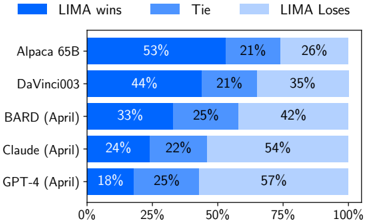
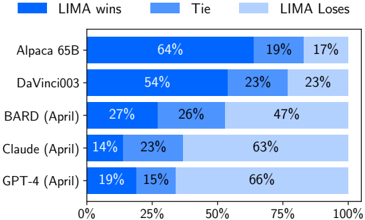
Large language models are trained in two stages: (1) unsupervised pretraining from raw text, to learn general-purpose representations, and (2) large scale instruction tuning and reinforcement learning, to better align to end tasks and user preferences. We measure the relative importance of these two stages by training LIMA, a 65B parameter LLaMa language model fine-tuned with the standard supervised loss on only 1,000 carefully curated prompts and responses, without any reinforcement learning or human preference modeling. LIMA demonstrates remarkably strong performance, learning to follow specific response formats from only a handful of examples in the training data, including complex queries that range from planning trip itineraries to speculating about alternate history. Moreover, the model tends to generalize well to unseen tasks that did not appear in the training data. In a controlled human study, responses from LIMA are either equivalent or strictly preferred to GPT-4 in 43% of cases; this statistic is as high as 58% when compared to Bard and 65% versus DaVinci003, which was trained with human feedback. Taken together, these results strongly suggest that almost all knowledge in large language models is learned during pretraining, and only limited instruction tuning data is necessary to teach models to produce high quality output.
Overview
The claims and statistics of this paper haven’t been checked yet.
Free: it reads the open-access text and checks the first 5 claims that cite a source we can check. Create a free account to check every claim.
Integrity signals
Registry
Cites
Statistics
Figures
Verification
Claims the paper makes
The claims and statistics of this paper haven’t been checked yet.
Free: it reads the open-access text and checks the first 5 claims that cite a source we can check. Create a free account to check every claim.
Claims other papers make about this one
Each is checked against this paper’s own text: does it say what the citing paper says it does?
The source backs part of the claim, not all of it — or backs it for a different population, condition or comparison.
In the citing paper
“However, when focusing specifically on a single task or narrow set of tasks, far fewer instruction instances may suffice.”
From A Survey of Large Language Models (2026) · cites this paper as [195]
Experimental — accuracy not yet measuredThe source backs part of the claim, not all of it — or backs it for a different population, condition or comparison.
In the citing paper
“Recent studies [323] show that the knowledge within LLMs is almost entirely acquired during pretraining.”
From Survey of Hallucination in Natural Language Generation (2023) · cites this paper as [323]
Experimental — accuracy not yet measuredThe source backs part of the claim, not all of it — or backs it for a different population, condition or comparison.
In the citing paper
“Redundancy and Inefficient Use of Information: Treating all N training samples ( x i , y i ) in D train as equally informative is inefficient, as the number of truly effective samples N eff is often much smaller than N (i.e., N eff ≪ N ) (Zhou et al., 2023).”
From TT-SI: Self-Improving LLM Agents with Test-Time Training (2026) · cites this paper as Zhou et al., 2023
Experimental — accuracy not yet measuredThe source backs part of the claim, not all of it — or backs it for a different population, condition or comparison.
In the citing paper
“Nevertheless, smaller datasets can be vital in enabling key post -training techniques such as fine-tuning, in-context learning, and prompt engineering (cf. [86, 122]).”
From Engaging Communities Meaningfully in Defining Disability Representation for AI Image Generation (2026) · cites this paper as [122]
Experimental — accuracy not yet measuredThe cited source says what the claim attributes to it.
In the citing paper
“For example, the authors of LIMA collected a diverse dataset of 1,000 carefully curated prompts and responses which are aligned with each other [323].”
From Survey of Hallucination in Natural Language Generation (2023) · cites this paper as [323]
3 more claims about this paper
Create a free account to see every claim other papers make about this one.
Self-check
Percentages, sums and reported differences re-computed from the paper’s own numbers.
The self-check needs the paper’s full text.
Citations
Cites
The publisher hasn’t deposited this paper’s reference list.
Research works printed but not linked: 7
- Yuntao Bai, Saurav Kadavath, Sandipan Kundu, Amanda Askell, Jackson Kernion, Andy Jones, Anna Chen, Anna Goldie, Azalia Mirhoseini, Cameron McKinnon, et al. Constitutional ai: Harmlessness from ai feedback. arXiv preprint arXiv:2212.08073, 2022b. · arXiv
- Ari Holtzman, Jan Buys, Li Du, Maxwell Forbes, and Yejin Choi. The curious case of neural text degeneration. In International Conference on Learning Representations, 2019.
- Yuval Kirstain, Patrick Lewis, Sebastian Riedel, and Omer Levy. A few more examples may be worth billions of parameters. arXiv preprint arXiv:2110.04374, 2021. · arXiv
- Long Ouyang, Jeffrey Wu, Xu Jiang, Diogo Almeida, Carroll Wainwright, Pamela Mishkin, Chong Zhang, Sandhini Agarwal, Katarina Slama, Alex Ray, et al. Training language models to follow instructions with human feedback. Advances in Neural Information Processing Systems, 35: 27730-27744, 2022.
- Victor Sanh, Albert Webson, Colin Raffel, Stephen Bach, Lintang Sutawika, Zaid Alyafeai, Antoine Chaffin, Arnaud Stiegler, Teven Le Scao, Arun Raja, et al. Multitask prompted training enables zero-shot task generalization. In The Tenth International Conference on Learning Representations, 2022.
- Yizhong Wang, Swaroop Mishra, Pegah Alipoormolabashi, Yeganeh Kordi, Amirreza Mirzaei, Anjana Arunkumar, Arjun Ashok, Arut Selvan Dhanasekaran, Atharva Naik, David Stap, et al. Super-naturalinstructions:generalization via declarative instructions on 1600+ tasks. In EMNLP, 2022b.
- Jason Wei, Maarten Bosma, Vincent Zhao, Kelvin Guu, Adams Wei Yu, Brian Lester, Nan Du, Andrew M Dai, and Quoc V Le. Finetuned language models are zero-shot learners. In International Conference on Learning Representations, 2022a.
Cited by
Items 701–800 of 938
Lu, T., Wang, H., Shao, H., Gao, J., & Yao, H. (2024) · arXiv (Cornell University) · doi:10.48550/arxiv.2402.15991 · Cited by 2
CodingTeachLLM: Empowering LLM's Coding Ability via AST Prior KnowledgePreprint
Chen, Z., Liu, C., & Duan, H. (2024) · arXiv (Cornell University) · doi:10.48550/arxiv.2403.15426 · Cited by 2
“Multi-Round Guidance Dataset: We source high-quality multi-turn dialogue data from ShareGPT10, MOSS [25], BELLE [24], LIMA [26], and COIG [27].”
Frustratingly Easy Jailbreak of Large Language Models via Output Prefix AttacksPreprint
Wang, Y., Chen, M., Peng, N., & Chang, K.-W. (2024) · Research Square · doi:10.21203/rs.3.rs-4385503/v1 · Cited by 6
Narayanan, S. (2024) · arXiv (Cornell University) · doi:10.48550/arxiv.2406.11845 · Cited by 1
“In the area of adaption of LLMs, advanced techniques such as leveraging large context length [22] [23] [24], and fine-tuning methods like instruction tuning [25], alignment tuning, & memory-efficient model adaptation [26] [27] [28] have emerged.”
MethodA Learn-Then-Reason Model Towards Generalization in Knowledge Base Question AnsweringPreprint
Zhang, L., Zhang, J., Wang, Y., Li, C., & Chen, H. (2024) · arXiv (Cornell University) · doi:10.48550/arxiv.2406.14763 · Cited by 1
Self-Pluralising Culture Alignment for Large Language ModelsPreprint
Xu, S., Leng, Y., Yu, L., & Xiong, D. (2024) · Qeios · doi:10.32388/q7ywfv · Cited by 4
Self-citationComplementary Learning ApproachPreprint
Asgari, N. (2025) · SSRN Electronic Journal · doi:10.2139/ssrn.5577090 · Cited by 1
Wang, Z., & Qi, Y. (2025) · arXiv (Cornell University) · doi:10.48550/arxiv.2503.12339 · Cited by 3
“This tendency was enabled by both the pretraining objectives (Devlin et al., 2018; Lample and Conneau, 2019) and magnitude of the training size (Zhou et al., 2023).”
Yao, D., Yuan, J., & Chen, R. (2025) · arXiv (Cornell University) · doi:10.48550/arxiv.2508.08466 · Cited by 1
“SLiC (Zhao et al., 2023) reformulates alignment as supervised learning via critiques, while reward distillation approaches (Zhou et al., 2023) simplify reward modeling yet still inherit RLHF inefficiencies.”
Das, A., Jain, V., & Chadha, A. R. (2025) · arXiv (Cornell University) · doi:10.48550/arxiv.2508.02063 · Cited by 1
“Drift is amplified by decoding strategy: while greedy decoding tends to default to safe completions, stochastic sampling increases the chance of reactivating memorized unsafe spans (Holtzman et al., 2020; Zhang et al., 2023).”
Linguistic Blind Spots of Large Language ModelsPreprint
Cheng, J., & Amiri, H. (2025) · arXiv (Cornell University) · doi:10.48550/arxiv.2503.19260 · Cited by 1
“Since we prompt Gemini to perform linguistic tasks, we conclude Gemini mis-interpret linguistic queries with harmful contents, and it may have been superficially aligned (Zhou et al., 2023) to restrict its ability when processing sensitive words in the prompt.”
LuxIT: A Luxembourgish Instruction Tuning Dataset from Monolingual Seed DataPreprint
Valline, J., Lothritz, C., Guo, S., & Cabot, J. (2025) · arXiv · doi:10.48550/arxiv.2510.24434 · Cited by 1
Efficiently Estimating Data Efficiency for Language Model Fine-tuningPreprint
Je, G. H., & Raffel, C. (2025) · arXiv · doi:10.48550/arxiv.2512.24991 · Cited by 1
Continually self-improving AIPreprint
Yang, Z. (2026) · arXiv · doi:10.48550/arxiv.2603.18073 · Cited by 1
Let the Target Select for Itself: Data Selection via Target-Aligned PathsPreprint
Yang, H., He, H., Kwok, T. S. T., & Cheng, G. (2026) · arXiv (Cornell University) · doi:10.48550/arxiv.2605.09404 · Cited by 1
RL Excursions during Pre-Training: Re-examining Policy Optimization for LLM trainingPreprint
Bansal, R., Mohri, C., Qin, T., Alvarez-Melis, D., & Kakade, S. (2026) · arXiv.org · doi:10.48550/arxiv.2606.04272 · Cited by 2
Kanazawa, R., Hidaka, K., Miyamoto, T., Kato, T., Ando, T., Wang, C., Jiang, D., Fujita, N., Saitoh, S., Kondo, A., et al. (2026) · arXiv (Cornell University) · doi:10.48550/arxiv.2606.08545 · Cited by 2
“LIMA[33], Tulu 3[20], and Qwen3[31] provide background for constructing domain-specific models, while PRM800K[21], DeepSeekMath[27], and DeepSeek-R1[13] show the effectiveness of optimization using verifiable signals.”
Ritchie, L., Mehta, S., Panavas, L., & Chen, E. (2026) · arXiv · doi:10.48550/arxiv.2608.01604 · Cited by 3
“Data-selection research has shown that value does not scale straightforwardly with volume: small curated sets can match or beat full corpora [Zhou et al., 2023a, Xia et al., 2024, Liu et al., 2024], generalization scales with the number and variety of distinct tasks rather than with examples per…”
CoTrace: Data Recipes for Training Terminal Agents with Harness-Model Co-EvolutionPreprint
Chen, J.-X., Zhang, J.-X., Ye, Q., Pruksachatkun, Y., Zhang, H., Zhuo, J.-M., Zhang, Y.-F., Dai, Y.-T., Tan, J.-T., Peng, X.-Y., et al. (2026) · arXiv (Cornell University) · doi:10.48550/arxiv.2610.10426 · Cited by 2
Nakagawa, S., & Yamamoto, A. (2026) · medRxiv · doi:10.64898/2026.10.09.26365134 · Cited by 1
Branch-Solve-Merge Improves Large Language Model Evaluation and Generation
Saha, S., Levy, O., Celikyilmaz, A., Bansal, M., Weston, J., & Li, X. (2023) · arXiv · doi:10.48550/arxiv.2310.15123 · Cited by 1
Self-citationConceptFormer: Towards Efficient Use of Knowledge-Graph Embeddings in Large Language Models
Barmettler, J., Bernstein, A., & Rossetto, L. (2025) · arXiv · doi:10.48550/arxiv.2504.07624 · Cited by 3
“Through this pretraining, LLMs acquire substantial amounts of knowledge, which is implicitly stored within their model weights [38, 56].”
A Meta-Synthesis of Factual Accuracy and Citation Hallucination in LLM Academic Assistants
Anantama, R., Bachtiar, M. I., & Rahman, Z. (2026) · Bulletin of Data Science · doi:10.47065/bulletinds.v5i3.10443
“This correlation confirms the hallucination taxonomy outlined by [14], where intrinsic hallucination (contradiction with the input context) occurs more frequently in long generative tasks that force the model to engage in extensive token interpolation and prediction, compared to factual…”
InfluentialSMoA: Improving Multi-agent Large Language Models with Sparse Mixture-of-Agents
Li, D., Tan, Z., Qian, P., Li, Y., Chaudhary, K. S., Hu, L., & Shen, J. (2024) · arXiv · doi:10.48550/arxiv.2411.03284 · Cited by 35
“…we use the Just-Eval (Lin et al., 2023) benchmark, which contains diverse samples from 5 alignment datasets: (1) AlpacaEval2 (Li et al., 2023c), (2) MT-Bench (Zheng et al., 2023), (3) LIMA (Zhou et al., 2024), (4) HH-RLHF-redteam (Ganguli et al., 2022) and (5) MaliciousInstruct (Huang et al.).”
GIER: Gap-Driven Self-Refinement for Large Language Models
Dewri, R. (2025) · arXiv · doi:10.48550/arxiv.2509.00325
Harnessing the Reasoning Economy: A Survey of Efficient Reasoning for Large Language Models
Wang, R., Wang, H., Xue, B., Li, Y., Pang, J., Liu, S., Chen, Y., Qiu, J., Wong, D. F., Chen, G., et al. (2025) · arXiv · doi:10.48550/arxiv.2503.24377
“By leveraging high-quality task-specific data [168, 237], SFT refines the model’s ability to generalize across various domains, improving both accuracy and reliability in real-world applications, such as summarization [39], machine translation [132], and question answering [85].”
Zeng, L., Zhong, L., Zhao, L., Wei, T., Yang, L., He, J., Cheng, C., Hu, R., Liu, Y., Yan, S., et al. (2024) · arXiv · doi:10.48550/arxiv.2407.08348
PIPPA: A Partially Synthetic Conversational Dataset
Gosling, T., Dale, A., & Zheng, Y. (2023) · arXiv · doi:10.48550/arxiv.2308.05884
“In order to harness their full potential and tailor them to specific domains, a set of high quality domain-specific samples are typically required during the supervised fine-tuning process (Zhou et al., 2023; Ouyang et al., 2022).”
BackgroundDataEvolver: Automatic Data Preparation for Large Language Models through Multi-Level Self-Evolving
Deng, C., Zhang, S., Fan, J., & Du, X. (2026) · arXiv · doi:10.48550/arxiv.2606.07001
“This indicates that DataEvolver significantly enhances data quality, aligning with previous findings that a small amount of high-quality data can lead to strong performance (Chen et al., 2024; Du et al., 2023; Lu et al., 2023; Zhou et al., 2023).”
Self-citationAn Intent-based and Annotation-free Method for Duplicate Question Detection in CQA Forums
Shu, Y., Gu, H., Zhang, P., Lu, T., & Gu, N. (2023) · Findings of the Association for Computational Linguistics: EMNLP (Findings of EMNLP) · doi:10.18653/v1/2023.findings-emnlp.596
Controlled Data Augmentation for Training Task-Oriented Dialog Systems with Low Resource Data
Steindl, S., Schäfer, U., & Ludwig, B. (2023) · doi:10.18653/v1/2023.pandl-1.9 · Cited by 2
“This has recently been achieved both with the RLHF framework (Ouyang et al., 2022) and standard supervised training (Zhou et al., 2023).”
MethodICE-GRT: Instruction Context Enhancement by Generative Reinforcement based TransformersPreprint
Chen, Z., Sun, K., Tang, D., Ma, Y., Zhang, Y., Xi, C., & Zhou, X. S. (2024) · arXiv (Cornell University) · doi:10.48550/arxiv.2401.02072
Tűzvédelmi szakértői rendszer létrehozása nagy nyelvi modellek segítségével
Karsa, R. (2024) · Rendvédelem · doi:10.53793/rv.2024.2.3
Discit Ergo Est: Training Data Provenance and Fair UsePreprint
Mahari, R., & Longpre, S. (2024) · SSRN Electronic Journal · doi:10.2139/ssrn.4795277 · Cited by 2
ProTeM: Unifying Protein Function Prediction via Text Matching
Qin, M., Li, X., Wang, Y., Li, Z., Ye, H., Wang, Z., Gao, W., Liang, S., Zhang, Q., & Ding, K. (2024) · Lecture notes in computer science · doi:10.1007/978-3-031-72353-7_10
Named Entity Recognition For Construction Documents Based on Fine-Tuning of Large Language Models
Zhou, J., & Ma, Z. (2024) · Creative Construction Conference (CCC) · doi:10.3311/ccc2024-175
Optimizing Instruction Synthesis: Effective Exploration of Evolutionary Space with Tree Search
Li, C., Chen, Q., Li, Z., FengTao, F., Li, Y., Chen, H., Yu, F., & Zhang, Y. (2024) · Findings of the Association for Computational Linguistics: EMNLP (Findings of EMNLP) · doi:10.18653/v1/2024.findings-emnlp.93
AlpaCream: an Effective Method of Data Selection on Alpaca
Li, Y., & Sun, Y. (2024) · Conference proceedings/Conference proceedings - IEEE International Conference on Systems, Man, and Cybernetics · doi:10.1109/smc54092.2024.10831719
“However, Zhou et al. [15] showed that even a few high-quality instructions could endow a model with solid instruction following capabilities.”
Gorbatovski, A., Razin, A. D., Aliev, A., & Kovalchuk, S. V. (2024) · Scientific and technical journal of information technologies mechanics and optics · doi:10.17586/2226-1494-2024-24-6-1024-1034
Steel-LLM:From Scratch to Open Source -- A Personal Journey in Building a Chinese-Centric LLMPreprint
Gu, Q., Li, S., Zheng, T., & Zhang, Z. (2025) · arXiv (Cornell University) · doi:10.48550/arxiv.2502.06635
Resilience of Free Will: A Quantum Cognitive Perspective of Individual ChoicePreprint
Yang, N. (2025) · SSRN Electronic Journal · doi:10.2139/ssrn.5090910
Enhancing Aspect-Based Sentiment Analysis for Portuguese Using Instruction Tuning
Pereira, G., Barbosa, L., Moreira, J., de Melo, T., & da Silva, A. (2024) · doi:10.5753/eniac.2024.245109 · Cited by 1
Shawon, A., Liscano, R., Azim, A., Sundaresan, V., & Chang, Y.-K. (2025) · ACM/SPEC International Conference on Performance Engineering (ICPE) · doi:10.1145/3680256.3721324
Meta-prompt tuning for low-resource visual question answering
Shao, M., Liu, Y., Meng, L., & Shao, X. (2025) · Multimedia Systems · doi:10.1007/s00530-025-01854-x
“Research [35] in the field of NLP has shown that instructions significantly impact the performance of models.”
Annotation error detection in painstakingly annotated data: Part-of-speech tagging as a case study
Liu, Y., Li, Z., Gong, C., Zhou, S., & Zhang, M. (2025) · Expert Systems with Applications · doi:10.1016/j.eswa.2025.128374
Augmented Adversarial Trigger Learning
Wang, Z., & Qi, Y. (2025) · Findings of the Association for Computational Linguistics: NAACL · doi:10.18653/v1/2025.findings-naacl.394 · Cited by 2
Identifying Highly Relevant Entries in Datasets: A Relevance-Based Classification
Delbianco, F., & Tohmé, F. (2025) · Journal of Classification · doi:10.1007/s00357-025-09513-6
SPOLRE: Semantic Preserving Object Layout Reconstruction for Image Captioning System Testing
Liu, Y., Wang, G., Zheng, X., Deng, G., Wang, K., Liu, Y., & Wang, H. (2026) · ACM Transactions on Software Engineering and Methodology · doi:10.1145/3748306
“Additionally, studies [31, 53] propose a metamorphic testing approach to detect issues such as fact-conflicting hallucinations and vector matching errors in large language models.”
Guariso, D., Adewoyin, R. A., Aguilar, G. R., Guerrero, O. A., & Davies, A. R. (2025) · Artificial Intelligence in Medicine · doi:10.1016/j.artmed.2025.103203
CPU Power Modeling Through Training Data Selection
Li, Z., Zhong, J., & Chen, J. (2024) · IEEE International Conference on High Performance Computing and Communications; IEEE International Conference on Smart City; IEEE International Conference on Data Science and Systems (HPCC/SmartCity/DSS) · doi:10.1109/hpcc64274.2024.00084
“The performance of software-based models is bounded by the quantity and quality of its training data [37].”
Khansa, H. A., Mustapha, A., & Awad, M. (2025) · Proceedings of the AAAI Symposium Series · doi:10.1609/aaaiss.v6i1.36049 · Cited by 1
Lee, U., Son, Y., Shin, J., Byun, G., Lee, Y., Koh, J., Jeon, M., & Kim, H. (2025) · Lecture notes in computer science · doi:10.1007/978-3-031-98284-2_17 · Cited by 3
Shi, W., Qu, Y., & Liu, J. (2025) · SSRN Electronic Journal · doi:10.2139/ssrn.5392757
Zhao, C., Liu, Y., Zeng, P., Luo, Y., Tao, S., He, M., Meng, W., Xu, S. H., Liu, C., Ma, H., et al. (2026) · International ACM SIGIR Conference on Research and Development in Information Retrieval (SIGIR) · doi:10.1145/3805712.3809946 · Cited by 1
“For English dataset, Superficial Alignment Hypothesis (SAH) [27] has been proposed, which posits that the IFT stage does not impart new knowledge but merely aligns the model’s output with human-preferred response intention and style, while assuming sufficient knowledge acquisition during Continuous…”
Advantageous Parameter Expansion Training Makes Better Large Language Models
Gu, N., Chen, Y., Zhang, Z., Fu, P., Lin, Z., Wang, S., Sun, Y., Wu, H., Wang, W., & Wang, H. (2026) · Conference on Empirical Methods in Natural Language Processing (EMNLP) · doi:10.18653/2026.emnlp-main.386
The Oracle Has Spoken: A Multi-Aspect Evaluation of Dialogue in PythiaPreprint
Chen, Z., Babkin, P., Gupta, A., Anumanchipalli, G., & Liu, X. (2025) · arXiv (Cornell University) · doi:10.48550/arxiv.2509.16487
Crash root-cause identification via trace-rewarded causation chain reasoning large language model.
Xie, N., Huang, J., Zhou, X., & Yu, R. (2026) · Accident Analysis and Prevention · doi:10.1016/j.aap.2026.108586
Crash Root-Cause Identification via Trace-Rewarded Causation-Chain Reasoning Large Language ModelPreprint
Xie, N., & Yu, R. (2025) · SSRN Electronic Journal · doi:10.2139/ssrn.5626468
In2X at WMT25 Translation Task
Pang, L., Mao, H., Xiao, Q., Ruihan, C., Zhang, J., Liu, H., & Li, X. (2025) · Conference on Machine Translation (WMT) · doi:10.18653/v1/2025.wmt-1.43 · Cited by 1
Evaluating Text Generation Quality Using Spectral Distances of Surprisal
Liu, Z., Li, Y., Xu, Y., Wang, Y., Yuan, Y., & Yang, Z. (2025) · Findings of the Association for Computational Linguistics: EMNLP (Findings of EMNLP) · doi:10.18653/v1/2025.findings-emnlp.132 · Cited by 3
Guo, J., Zeng, X., Wu, J., & Li, Z. (2025) · Communications in computer and information science · doi:10.1007/978-981-95-4088-4_15
Do I look like a `cat.n.01` to you? A Taxonomy Image Generation BenchmarkPreprint
Moskvoretskii, V., Lobanova, A., Neminova, E., Biemann, C., Panchenko, A., & Nikishina, I. (2025) · arXiv · doi:10.48550/arxiv.2503.10357
“At the very same time, the urge for manually created datasets and databases still remains popular, as more accurate and reliable (Zhou et al., 2023), even though they are time-consuming and expensive to be kept up-to-date.”
Go-UT-Bench: A Fine-Tuning Dataset for LLM-Based Unit Test Generation in GoPreprint
Pipalani, Y., Raj, H., Ghosh, R., Bhargava, V., & Dutta, D. (2025) · arXiv (Cornell University) · doi:10.48550/arxiv.2511.10868
“Fine-tuning typically benefits from datasets in the range of 1,000–10,000 examples [Spaceo.ai, 2024, Predibase, 2024, Zhou et al., 2023, Barnett et al., 2024, Community, 2022], placing Go-UT-Bench within the recommended scale for effective instruction-or task-specific adaptation.”
Mitigating Hallucinations in Zero-Shot Scientific Summarisation: A Pilot StudyPreprint
Jaaouine, I., & King, R. D. (2025) · arXiv (Cornell University) · doi:10.48550/arxiv.2512.00931
DiverSeed: Integrating Active Learning for Target Domain Data Generation in Instruction Tuning
Gao, J., Qi, M., Gao, X., Xiang, S., Ji, K., Ruan, J., Liu, T., & Fu, Y. (2025) · Machine Learning · doi:10.1007/s10994-025-06926-7
“Apart from this, LIMA (Zhou et al., 2023) observed that carefully curated, limited prompts and responses can yield superior performance compared to the results from instruction fine-tuning with larger-scale data, which underscores the importance of data selection.”
Lin, Z., Zhang, M., Wu, C., & Zhang, M. (2026) · Multimedia Systems · doi:10.1007/s00530-026-02562-w
ReasonBridge: Efficient Reasoning Transfer from Closed to Open-Source Language ModelsPreprint
Zhong, Z., Personal, D. T., & Tang, X. (2025) · arXiv · doi:10.13140/rg.2.2.12940.01928
Wu, J.-Q., Chen, C., Hou, C., & Yuan, X.-H. (2025) · Conference on Empirical Methods in Natural Language Processing · doi:10.48550/arxiv.2502.15594 · Cited by 8
TOWARDS SPECIALIZED REINFORCEMENT LEARNING FROM DIVERSE DATA
Chang, J. (2024) · eCommons (Cornell University) · doi:10.7298/se9b-8p97
Bringing Order Amidst Chaos: On the Role of Artificial Intelligence in Secure Software EngineeringPreprint
Esposito, M. (2024) · arXiv (Cornell University) · doi:10.13140/rg.2.2.36032.65281
Finetuning commercial Large Language Models with LoRA for enhanced Italian language understanding
Hartsuiker, J. M. (2023) · AMS Laurea Institutional Research Repository (University of Bologna) · Cited by 48
Towards reliability and interactive debugging for large language models
Paranjape, B. (2024) · ResearchWorks at the University of Washington (University of Washington) · Cited by 33
AI Ethics: A Study of Large Language Models in Autonomous Driving Scenarios
Silva, A. D. O. (2025) · Portuguese National Funding Agency for Science, Research and Technology (RCAAP Project by FCT) · Cited by 1
Adaptació de grans models de llenguatge per a aplicacions en àmbits limitats
Arméstar Rodrigo, D. (2024) · UPCommons institutional repository (Universitat Politècnica de Catalunya)
Fine-tuning Large Language Models for Code Documentation : generating Code Documentation with AI
Kauhanen, M. (2025) · Theseus (Ammattikorkeakoulujen) · Cited by 1
Orbis Idearum European Journal of the History of Ideas
(2024) · Jagiellonian University Repository (Jagiellonian University)
Towards Robust and Scalable Evaluation for Large Language Models
Chiang, W.-L. (2024) · eScholarship (California Digital Library)
SciRAG: A Retrieval-Focused Fine-Tuning Strategy for Scientific Documents
Vasantharajan, C. (2025) · MacSphere (McMaster University) · doi:10.71548/22514
Teaching Large Language Models to Use Tools at Scale
Patil, S. G. (2024) · eScholarship (California Digital Library) · Cited by 1
Neuromoninaista retoriikkaa keskustelevalla tekoälyllä
Luostarinen, V. (2024) · Aaltodoc (Aalto University)
Adolfsson, K. K. (2024) · Theseus (Ammattikorkeakoulujen)
Toward Extendable and Reliable Use of Large Foundation Models
Yang, X. (2024) · eScholarship (California Digital Library)
Towards Data-efficient Machine Learning Systems
Sachdeva, N. (2024) · eScholarship (California Digital Library)
MiniLingua: Training a multilingual small language model
Aksenova, A. (2025) · Aaltodoc (Aalto University)
Wubifying the Chinese Room : procedural and declarative memory at the syntax-semantics interface
Beavitt, T. A., & Beavitt, M. (2025) · Homo Politicus (Academy of Humanities and Economics in Lodz) · doi:10.13140/rg.2.2.12896.75521
DEO: Jailbreak a Black-box Multimodal Large Language Model with Dual-Embedding Alignment
Zhang, L., Wang, M., Zhao, Y., Lin, Z., & Chen, K. (2025) · International Joint Conference on Neural Networks (IJCNN) · doi:10.1109/ijcnn64981.2025.11229281
Beyond One-Size-Fits-All: Adaptive Fine-Tuning for LLMs Based on Data Inherent Heterogeneity
Zhang, W., Xu, Y., Ren, S., & Zhang, J. (2025) · Lecture notes in computer science · doi:10.1007/978-981-95-3343-5_22
Persona-Aware Alignment Framework for Personalized Dialogue Generation
Li, G., Liu, X., Wu, Z., & Dai, X. (2025) · Transactions of the Association for Computational Linguistics · doi:10.1162/tacl.a.57 · Cited by 2
“In exploring the critical aspect of alignment, LIMA (Zhou et al., 2023a) investigated the hypothesis that LLMs inherently develop knowledge and capabilities during their pre-training phase.”
Gan, C., カン, テ., & 甘, 程. (2025) · Institutional Repositories DataBase (IRDB) · doi:10.18880/0002001923
BRIDGE: Budget-aware Reasoning via Intermediate Distillation with Guided ExamplesPreprint
Le, X.-A., Tran, M.-N., & Nguyen, S. (2025) · arXiv (Cornell University) · doi:10.48550/arxiv.2512.20403 · Cited by 1
Guo, J., Zeng, X., Wu, J., & Li, Z. (2026) · arXiv (Cornell University) · doi:10.48550/arxiv.2601.01156 · Cited by 1
“Various mitigation strategies exist, such as using high-quality training data [36,12,24], reinforcement learning from external feedback [13,22,31,28], retrieval-augmented generation [18], and the use of model uncertainty [15,33].”
Unlearning bias in text diffusion models based on decoupled adapter
Li, Y. (2026) · Advances in Engineering Innovation · doi:10.54254/2977-3903/2026.31209
Evaluating Agentic AI Through a Geopolitical Simulation Sandbox
Dessureault, J.-S., Manzi, A. T. I., Ismaili, S. A., Barisoa, A. M., Djioke, D. Y., Bergeron, A., Yared-Amare, A., Lalancette, M., & Bélanger, É. (2026) · Communications in computer and information science · doi:10.1007/978-3-032-15632-7_11 · Cited by 2
Scalable Data Paradigms for Steering General-Purpose Language Models
Wang, Y. (2025) · ResearchWorks at the University of Washington (University of Washington)
Zhao, W. X., Zhou, K., Li, J., Tang, T., & Wen, J.-R. (2025) · Artificial intelligence: foundations, theory, and algorithms/Artificial intelligence: Foundations, theory, and algorithms · doi:10.1007/978-981-96-6259-3_7
S2Q: Teaching Language Models New Facts Through Knowledge Graph Instruction Synthesis
Zhao, Z., Cao, X., & Zhang, W. (2026) · Lecture notes in computer science · doi:10.1007/978-981-95-6196-4_17
Metadata
- Authors
- Zhou, C., Liu, P., Xu, P., Iyer, S., Sun, J., Mao, Y., Ma, X., Efrat, A., Yu, P., Yu, L., Zhang, S., Ghosh, G., Lewis, M., Zettlemoyer, L., & Levy, O.
- Venue
- Advances in Neural Information Processing Systems 36
- Published
- 2023
- Pages
- 55006-55021
- ISSN
- 1049-5258 (ISSN-L)
- OpenAlex
- W7133189643
- Semantic Scholar
- 546d0624adfc6e18fb87d8cc77e7705bb9ea7445
- Cited by
- 275
- References
- 0
- Citations by year
- 2026: 80 · 2025: 67 · 2024: 85 · 2023: 43
- FWCI
- 48.72
- Type
- conference paper
- Language
- en
- Open access
- green
- arxiv.org
- Licence
- cc-by
- Locations
- neural information processing systems (publishedVersion)
- arXiv (Cornell University) (submittedVersion, cc-by)
- arXiv (Cornell University) (cc-by)
- Topics
- Physical Sciences › Computer Science › Artificial Intelligence › Domain Adaptation and Few-Shot Learning
- Social Sciences › Education › Educational Assessment and Pedagogy
- Physical Sciences › Computer Science › Artificial Intelligence › Topic Modeling
- Keywords
- Lima, less is more, alignment, efficient large language models
About these checks
Registry, retraction, Cites and statistics results are computed, not judged, with one exception: a printed reference that no index lists is read once by a model before it counts as a citation error. Claims are extracted by a model and kept only when their quote appears verbatim in the text; each cited source is then checked, with a model’s help, for whether it says what the claim relies on. Those verdicts can be wrong — read the claim’s quote and the cited source before relying on one.
Statistics and arithmetic are recomputed, not judged.
Confidence bands are shown only for fields calibrated on our annotated test set. None is calibrated yet, so no band is shown.
What counts as a claim ›How we measure confidence ›How we check this ›
Are you an author, or do you see a problem with this page? Request a review
Data sources
Bibliographic data: Semantic Scholar, OpenAlex, Crossref.
Contains information from the Semantic Scholar Academic Graph Datasets, made available under the ODC Attribution License (ODC-BY 1.0).
Semantic Scholar’s data is described in: Kinney, R., et al. (2023). The Semantic Scholar Open Data Platform. arXiv:2301.10140.
