

LIMA: Less Is More for Alignment
Open accessThe DOI matches its Crossref record; 12 of the 12 references it cites were found in a registry or an index.
Abstract
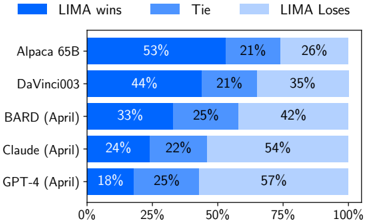
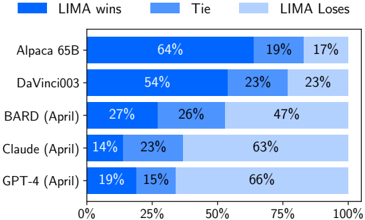
Large language models are trained in two stages: (1) unsupervised pretraining from raw text, to learn general-purpose representations, and (2) large scale instruction tuning and reinforcement learning, to better align to end tasks and user preferences. We measure the relative importance of these two stages by training LIMA, a 65B parameter LLaMa language model fine-tuned with the standard supervised loss on only 1,000 carefully curated prompts and responses, without any reinforcement learning or human preference modeling. LIMA demonstrates remarkably strong performance, learning to follow specific response formats from only a handful of examples in the training data, including complex queries that range from planning trip itineraries to speculating about alternate history. Moreover, the model tends to generalize well to unseen tasks that did not appear in the training data. In a controlled human study, responses from LIMA are either equivalent or strictly preferred to GPT-4 in 43% of cases; this statistic is as high as 58% when compared to Bard and 65% versus DaVinci003, which was trained with human feedback. Taken together, these results strongly suggest that almost all knowledge in large language models is learned during pretraining, and only limited instruction tuning data is necessary to teach models to produce high quality output.
Overview
The claims and statistics of this paper haven’t been checked yet.
Free: it reads the open-access text and checks the first 5 claims that cite a source we can check. Create a free account to check every claim.
Integrity signals
Registry
Cites
Statistics
Figures
Verification
Claims the paper makes
The claims and statistics of this paper haven’t been checked yet.
Free: it reads the open-access text and checks the first 5 claims that cite a source we can check. Create a free account to check every claim.
Claims other papers make about this one
Each is checked against this paper’s own text: does it say what the citing paper says it does?
The source backs part of the claim, not all of it — or backs it for a different population, condition or comparison.
In the citing paper
“However, when focusing specifically on a single task or narrow set of tasks, far fewer instruction instances may suffice.”
From A Survey of Large Language Models (2026) · cites this paper as [195]
Experimental — accuracy not yet measuredThe source backs part of the claim, not all of it — or backs it for a different population, condition or comparison.
In the citing paper
“Recent studies [323] show that the knowledge within LLMs is almost entirely acquired during pretraining.”
From Survey of Hallucination in Natural Language Generation (2023) · cites this paper as [323]
Experimental — accuracy not yet measuredThe source backs part of the claim, not all of it — or backs it for a different population, condition or comparison.
In the citing paper
“Redundancy and Inefficient Use of Information: Treating all N training samples ( x i , y i ) in D train as equally informative is inefficient, as the number of truly effective samples N eff is often much smaller than N (i.e., N eff ≪ N ) (Zhou et al., 2023).”
From TT-SI: Self-Improving LLM Agents with Test-Time Training (2026) · cites this paper as Zhou et al., 2023
Experimental — accuracy not yet measuredThe source backs part of the claim, not all of it — or backs it for a different population, condition or comparison.
In the citing paper
“Nevertheless, smaller datasets can be vital in enabling key post -training techniques such as fine-tuning, in-context learning, and prompt engineering (cf. [86, 122]).”
From Engaging Communities Meaningfully in Defining Disability Representation for AI Image Generation (2026) · cites this paper as [122]
Experimental — accuracy not yet measuredThe cited source says what the claim attributes to it.
In the citing paper
“For example, the authors of LIMA collected a diverse dataset of 1,000 carefully curated prompts and responses which are aligned with each other [323].”
From Survey of Hallucination in Natural Language Generation (2023) · cites this paper as [323]
3 more claims about this paper
Create a free account to see every claim other papers make about this one.
Self-check
Percentages, sums and reported differences re-computed from the paper’s own numbers.
The self-check needs the paper’s full text.
Citations
Cites
The publisher hasn’t deposited this paper’s reference list.
Research works printed but not linked: 7
- Yuntao Bai, Saurav Kadavath, Sandipan Kundu, Amanda Askell, Jackson Kernion, Andy Jones, Anna Chen, Anna Goldie, Azalia Mirhoseini, Cameron McKinnon, et al. Constitutional ai: Harmlessness from ai feedback. arXiv preprint arXiv:2212.08073, 2022b. · arXiv
- Ari Holtzman, Jan Buys, Li Du, Maxwell Forbes, and Yejin Choi. The curious case of neural text degeneration. In International Conference on Learning Representations, 2019.
- Yuval Kirstain, Patrick Lewis, Sebastian Riedel, and Omer Levy. A few more examples may be worth billions of parameters. arXiv preprint arXiv:2110.04374, 2021. · arXiv
- Long Ouyang, Jeffrey Wu, Xu Jiang, Diogo Almeida, Carroll Wainwright, Pamela Mishkin, Chong Zhang, Sandhini Agarwal, Katarina Slama, Alex Ray, et al. Training language models to follow instructions with human feedback. Advances in Neural Information Processing Systems, 35: 27730-27744, 2022.
- Victor Sanh, Albert Webson, Colin Raffel, Stephen Bach, Lintang Sutawika, Zaid Alyafeai, Antoine Chaffin, Arnaud Stiegler, Teven Le Scao, Arun Raja, et al. Multitask prompted training enables zero-shot task generalization. In The Tenth International Conference on Learning Representations, 2022.
- Yizhong Wang, Swaroop Mishra, Pegah Alipoormolabashi, Yeganeh Kordi, Amirreza Mirzaei, Anjana Arunkumar, Arjun Ashok, Arut Selvan Dhanasekaran, Atharva Naik, David Stap, et al. Super-naturalinstructions:generalization via declarative instructions on 1600+ tasks. In EMNLP, 2022b.
- Jason Wei, Maarten Bosma, Vincent Zhao, Kelvin Guu, Adams Wei Yu, Brian Lester, Nan Du, Andrew M Dai, and Quoc V Le. Finetuned language models are zero-shot learners. In International Conference on Learning Representations, 2022a.
Cited by
Items 601–700 of 938
Complexity-aware fine-tuningPreprint
Goncharov, A., Vyazhev, D., Sychev, P., Khalafyan, E., & Zaytsev, A. (2025) · arXiv (Cornell University) · doi:10.48550/arxiv.2506.21220 · Cited by 3
ENIGMA: The Geometry of Reasoning and Alignment in Large-Language ModelsPreprint
Seneque, G., Ho, L.-H., Saeedi, N. E., Molendijk, J., Kuperman, A., & Elson, T. (2025) · arXiv (Cornell University) · doi:10.48550/arxiv.2510.11278 · Cited by 3
Chang, P., Zhang, J., Chen, B., Wang, C., Guo, C., Zhang, Y., Gao, Y., Xiang, J., Gao, Y., Sun, C., et al. (2026) · International Conference on Learning Representations · doi:10.48550/arxiv.2601.23155 · Cited by 10
“A low-conflict selection (conflict measured by negative cosine alignment to the mean gradient) exhibits slower decay and thus higher information utility at equal budgets.”
Structured Distillation of Web Agent Capabilities Enables GeneralizationPreprint
Lù, X. H., & Reddy, S. (2026) · arXiv · doi:10.48550/arxiv.2604.07776 · Cited by 4
“Models trained on Flash data (lower loss) performed substantially worse than those trained on Pro data on WebArena, consistent with findings in instruction tuning (Zhou et al., 2023b).”
BLADE: Scalable Bi-level Adaptive Data Selection for LLM TrainingPreprint
Wang, J., Xiang, D., Xu, J., Liu, Z., Zhang, Z., Gong, G., Fang, J., Liu, C., Liu, P., Liu, T., et al. (2026) · arXiv (Cornell University) · doi:10.48550/arxiv.2606.18650 · Cited by 3
“However, as available corpora reach trillion-token scales, naively training on the entirety of these datasets often yields diminishing returns, as low-quality, noisy, or highly redundant tokens can degrade model reasoning capabilities [53, 9].”
Self-citationPersona Cartography: Charting Language Model Personality Traits in Weight SpacePreprint
Baines, L., Hawthorne, A. G., Koroliuk, M., Shalibashvili, I., Dumas, C., Voudouris, K., & Africa, D. D. (2026) · arXiv · doi:10.48550/arxiv.2607.07916 · Cited by 4
Preference Leakage: A Contamination Problem in LLM-as-a-judge
Li, D., Sun, R., Huang, Y., Zhong, M., Jiang, B., Han, J., Zhang, X., Wang, W., & Liu, H. (2025) · arXiv · doi:10.48550/arxiv.2502.01534 · Cited by 134
Instruction Mining: Instruction Data Selection for Tuning Large Language Models
Cao, Y., Kang, Y., Wang, C., & Sun, L. (2023) · arXiv · doi:10.48550/arxiv.2307.06290 · Cited by 2
Secure Your Model: An Effective Key Prompt Protection Mechanism for Large Language Models
Tang, R., Chuang, Y.-N., Cai, X., Du, M., & Hu, X. (2024) · Findings of the Association for Computational Linguistics: NAACL · doi:10.18653/v1/2024.findings-naacl.256 · Cited by 5
“This process proves to be labor-intensive and time-consuming, especially in high-stakes domains such as medicine, where it’s crucial to ensure the collected data are accurate and reliable (Ouyang et al., 2022; Zhou et al., 2023; Xu et al., 2023; Zhang et al., 2023; Chuang et al., 2023).”
Unveiling Imitation Learning: Exploring the impact of Data Falsity to Large Language Model
Cho, H. (2024) · Findings of the Association for Computational Linguistics: ACL (Findings of ACL) · doi:10.18653/v1/2024.findings-acl.6 · Cited by 3
Sequence-level Large Language Model Training with Contrastive Preference Optimization
Feng, Z., Ram, D., Hawkins, C., Rawal, A., Zhao, J., & Zha, S. (2025) · Findings of the Association for Computational Linguistics: NAACL · doi:10.18653/v1/2025.findings-naacl.233 · Cited by 2
Gu, X., Wang, M., Tian, Y., Li, N., Sun, J., Xu, J., Zhang, H., Xu, R., & Liu, M. (2025) · Computers · doi:10.3390/computers14070264 · Cited by 2
Self-citationPay more attention to the robustness of LLMs on adversarial prompt for instruction data mining
Wang, Q., Feng, D., Zhang, X., Shen, A., Xu, Y., Ding, B., & Wang, H. (2025) · Neural Networks · doi:10.1016/j.neunet.2025.107989 · Cited by 2
Mind the Gap: Data Rewriting for Stable off-Policy Supervised Fine-Tuning
Zhao, S., Zhao, X., Zhou, J., Kong, A., Li, Q., & Qin, Y. (2026) · IEEE International Conference on Acoustics Speech and Signal Processing · doi:10.1109/icassp55912.2026.11464510 · Cited by 3
Multi-agents Based User Values Mining for Recommendation
Chen, L., Yuan, W., Chen, T., Zhao, X., Nguyen, Q. V. H., & Yin, H. (2026) · Data Science and Engineering · doi:10.1007/s41019-026-00349-7 · Cited by 3
When Inverse Data Outperforms: Exploring the Pitfalls of Mixed Data in Multi-Stage Fine-Tuning
Deng, M., Li, X., Zhu, T., Yang, Z., Guo, Z., & Wang, W. (2025) · Findings of the Association for Computational Linguistics: EMNLP (Findings of EMNLP) · doi:10.18653/v1/2025.findings-emnlp.346 · Cited by 3
Wei, X., Lu, B., Zhang, X., Zhao, Z., Shen, D., Xia, L., & Yin, D. (2025) · Conference on Empirical Methods in Natural Language Processing (EMNLP) · doi:10.18653/v1/2025.emnlp-main.868 · Cited by 22
A value-aligned dataset (VAD) for supervised fine-tuning of large language models
Yingjie, L. I., Qidong, Y. A. N., Wu, W., Wang, D., & Ma, N. (2025) · China Scientific Data · doi:10.11922/11-6035.csd.2024.0212.zh · Cited by 2
Reading between the Lines: Context-Aware AI-based generation of software exploits
Improta, C., Liguori, P., Natella, R., Čukić, B., & Cotroneo, D. (2026) · Empirical Software Engineering · doi:10.1007/s10664-025-10796-x · Cited by 4
“We also note that the dataset size used for the experiments, approximately one thousand samples, aligns with other state-of-the-art corpora used for fine-tuning models in related domains (Zhou et al. 2023).”
Generation of Programmatic Rules for Document Forgery Detection Using Large Language Models
Schmidberger, V., Eberhardinger, M., Maghsudi, S., & Maucher, J. (2025) · International Conference on Machine Learning and Applications · doi:10.1109/icmla66185.2025.00225 · Cited by 2
Toward Scalable ASL Education: Egocentric Stereo Sensing with LLM Feedback for Error-Aware Learning
Cai, Y., Li, Z., Lu, T., Zhu, Y., Wu, Y.-S., Zhang, Q., Xu, X., Jin, Z. K., Gowda, M. K., & Jin, Y. (2026) · CHI Conference on Human Factors in Computing Systems · doi:10.1145/3772318.3790774 · Cited by 2
“To scale supervision, methods for synthetic instruction generation bootstrap data from seed prompts (Self-Instruct) and distill stronger “teacher” models into smaller students (e.g., Alpaca, LIMA) [75, 86].”
Lu, X., Chen, Y., Wu, R., Gao, H., Chen, X., Yang, X., Zhao, X., Zhou, A., Li, F., Wen, Y., et al. (2025) · IEEE/CVF International Conference on Computer Vision (ICCV) · doi:10.1109/iccv51701.2025.00400 · Cited by 4
EGAD: Entropy-Guided Adaptive Distillation for Token-Level Knowledge Transfer
Zhang, H., Zhang, Z., Wu, G., Ning, W., Guo, J., & Cheng, X. (2026) · Lecture notes in computer science · doi:10.1007/978-3-032-37657-2_24 · Cited by 2
A Systematic Evaluation of Trajectory Data Curation for LoRA Fine-Tuning of Code Agents
Han, Y. (2026) · Lecture notes in computer science · doi:10.1007/978-981-92-3492-9_4 · Cited by 2
Fang, Q., & Liu, W. (2026) · Computers and Education Artificial Intelligence · doi:10.1016/j.caeai.2026.100664 · Cited by 8
Böcekçi, S. C., & Yıldız, K. (2026) · Cluster Computing · doi:10.1007/s10586-026-06630-8 · Cited by 5
“If an LLM is being trained in technical fields requiring intensive logic such as health, law, mathematics and coding, the model should be trained using full fine-tuning [23 , 30 , 31 ].”
Enhancing Task Performance in Continual Instruction Fine-tuning Through Format Uniformity
Tan, X., Cheng, L., Qiu, X., Shi, S., Cheng, Y., Chu, W., Xu, Y., & Qi, Y. (2024) · International ACM SIGIR Conference on Research and Development in Information Retrieval (SIGIR) · doi:10.1145/3626772.3657920 · Cited by 7
Entity-level Factual Adaptiveness of Fine-tuning based Abstractive Summarization Models
Song, J., Park, N., Hwang, B., Yun, J.-W., Joe, S., Gwon, Y., & Yoon, S. (2024) · Conference of the European Chapter of the Association for Computational Linguistics · doi:10.18653/v1/2024.eacl-long.55 · Cited by 4
Delving into the Reversal Curse: How Far Can Large Language Models Generalize?
Lin, Z., Fu, Z., Liu, K., Xie, L., Lin, B., Wang, W., Cai, D., Wu, Y., & Ye, J. (2024) · neural information processing systems · doi:10.52202/079017-0966 · Cited by 13
Improving Human Resources’ Efficiency with a Generative AI-Based Resume Analysis Solution
Tran, T. T., Nguyen, T. G., Dang, T. H., & Yoshinaga, Y. (2023) · Communications in computer and information science · doi:10.1007/978-981-99-8296-7_25 · Cited by 7
Parameter-Efficient Tuning of Transformer Models for Anglicism Detection and Substitution in Russian
Lukichev, D., Kryanina, D., Bystrova, A., Fenogenova, A., & Tikhonova, M. (2023) · Computational Linguistics and Intellectual Technologies · doi:10.28995/2075-7182-2023-22-295-306 · Cited by 2
AlphaZero-Like Tree-Search can Guide Large Language Model Decoding and Training
Wan, Z., Feng, X., Wen, M., McAleer, S., Wen, Y., Zhang, W., & Wang, J. (2024) · International Conference on Machine Learning · Cited by 46
Winning the Adversarial Battle with Open-Source AI ModelsPreprint
Dang, A. (2023) · SSRN Electronic Journal · doi:10.2139/ssrn.4651571 · Cited by 2
PHOENIX: Open-Source Language Adaption for Direct Preference OptimizationPreprint
Uhlig, M., Schacht, S., & Barkur, S. K. (2024) · arXiv (Cornell University) · doi:10.48550/arxiv.2401.10580 · Cited by 3
“Since models learn almost their entire knowledge in pretraining [24], the LAION team [25] pursued another approach by further training current models using a large language-specific text corpus in the style of casual language modeling.”
MethodPrioritizing Informative Features and Examples for Deep Learning from Noisy DataPreprint
Park, D. (2024) · arXiv (Cornell University) · doi:10.48550/arxiv.2403.00013 · Cited by 2
Extensive Self-Contrast Enables Feedback-Free Language Model AlignmentPreprint
Liu, X., Song, X., Dong, Y., & Tang, J. (2024) · arXiv (Cornell University) · doi:10.48550/arxiv.2404.00604 · Cited by 3
Quantifying Uncertainty: A New Era of Measurement through Large Language ModelsPreprint
Audrino, F., Gentner, J., & Stalder, S. (2024) · SSRN Electronic Journal · doi:10.2139/ssrn.4903414 · Cited by 4
ASFT: Aligned Supervised Fine-Tuning through Absolute LikelihoodPreprint
Wang, R., Sun, J., Hua, S., & Fang, Q. (2024) · arXiv (Cornell University) · doi:10.48550/arxiv.2409.10571 · Cited by 3
“In contrast, there have been approaches that aim to build human-aligned language models by conducting SFT using filtered datasets alone (Zhou et al. 2023; Haggerty and Chandra 2024) indicated SFT with a limited amount of filtered data can effectively enhance the model’s capabilities.”
BackgroundSelf-citationInstaTrans: An Instruction-Aware Translation Framework for Non-English Instruction DatasetsPreprint
Kim, Y., & Park, C. (2024) · arXiv (Cornell University) · doi:10.48550/arxiv.2410.01512 · Cited by 2
Liu, J., & Fu, B. (2024) · arXiv (Cornell University) · doi:10.48550/arxiv.2410.17532 · Cited by 9
“According to the LIMA paper [74], the quality of fine-tuning data is more important than quantity.”
BackgroundSymphony: Edge-powered Decentralized Multi-agent Framework for Autonomous Co-evolving IntelligencePreprint
Wang, J., Feng, Y., Ai, L., & Shi, B. (2025) · SSRN Electronic Journal · doi:10.2139/ssrn.5361139 · Cited by 2
Du, Y., Wu, G., Tang, G., Wang, W., & Fan, Q. (2025) · arXiv (Cornell University) · doi:10.48550/arxiv.2510.05133 · Cited by 2
DETONATE: A Benchmark for Text-to-Image Alignment and Kernelized Direct Preference OptimizationPreprint
Prasad, R., Borah, A., Abdullah, H., Shyalika, C., Singh, G., Garimella, R., Roy, R., Surana, H., Imanpour, N., Trivedy, S., et al. (2025) · arXiv (Cornell University) · doi:10.48550/arxiv.2506.14903 · Cited by 2
Learning to Align, Aligning to Learn: A Unified Approach for Self-Optimized AlignmentPreprint
Wang, H., Yue, Y., Ye, Z., Zhang, S., Fan, L., Liang, J., Jiang, J., Cheng, W., Deng, J., Han, X., et al. (2025) · arXiv (Cornell University) · doi:10.48550/arxiv.2508.07750 · Cited by 2
“Empirical evidence supports SFT’s efficacy in aligning models with curated datasets, as shown in works like Zhou et al. (2023a), where even limited high-quality samples suffice, and Hag-gerty and Chandra (2024), which refines SFT models iteratively.”
Self-citationDetecting and Rectifying Noisy Labels: A Similarity-based ApproachPreprint
Huu-Tien, D., Nguyen, M.-P., & Inoue, N. (2025) · arXiv (Cornell University) · doi:10.48550/arxiv.2509.23964 · Cited by 3
“Recent research ( e.g., Zhou et al., 2023; Gunasekar et al., 2023) finds that high-quality training data significantly improves performance while reducing the training cost by orders of magnitude.”
Yan, J., Liu, L., Pan, Y., Chen, S., Xiang, Y., & Tang, B. (2025) · arXiv (Cornell University) · doi:10.48550/arxiv.2509.23574 · Cited by 3
“LIMA achieves strong performance with few examples, generalizing well to unseen tasks and requiring minimal instruction tuning (Zhou et al., 2023).”
Neologism Learning as a Parameter-Efficient Alternative to Fine-Tuning for Model SteeringPreprint
Park, S., Ramamurthi, V., & Terry, O. (2025) · arXiv (Cornell University) · doi:10.48550/arxiv.2512.18551 · Cited by 3
“Following [1], we use the LIMA dataset[16] for prompts ˜ x , appending "Give me a c answer." to get x as described in 3.1.”
InfluentialJeong, J. (2026) · arXiv · doi:10.48550/arxiv.2604.11050 · Cited by 2
“…add geometric evidence to — accounts in the literature that frame instruction tuning and RLHF as primarily structuring or exposing capabilities already present in the pretrained base, rather than installing new representations from scratch (Zhou et al. 2023; Lin et al. 2024), if it generalizes.”
Weight Patching: Toward Source-Level Mechanistic Localization in LLMsPreprint
Sun, C., Zhang, C., Qin, G., Dai, R., & Tian, X. (2026) · arXiv (Cornell University) · doi:10.48550/arxiv.2604.13694 · Cited by 2
Alignment midtraining for animalsPreprint
Brazilek, J., & Tidmarsh, M. (2026) · arXiv · doi:10.48550/arxiv.2604.13076 · Cited by 3
“It is commonly observed [Lin et al., 2023, Zhou et al., 2023] that QA pairs enable rapid learning of context-specific patterns, while unstructured documents require models to extract higher-level concepts in order to learn successfully.”
Tracking Representation Dynamics in Large Language Models with Persistent HomologyPreprint
Malhotra, N., Ambadkar, J., Gupta, A., Kasivel, K., Schwarz, A., Ferry, K., & Monod, A. (2026) · arXiv (Cornell University) · doi:10.48550/arxiv.2606.19542 · Cited by 3
“Although alignment often appears to modify only a small subset of model behaviors (Zhou et al. , 2023; Jain et al. , 2024; Lee et al. , 2024; Arditi et al. , 2024), substantial internal reorganization can occur before these behavioral changes become apparent (Barak et al. , 2022; Nanda et al. ,…”
Tian, A., Ding, A., Wu, S., & Chan, A. (2026) · arXiv (Cornell University) · doi:10.48550/arxiv.2607.18960 · Cited by 2
Style Outweighs Substance: Failure Modes of LLM Judges in Alignment Benchmarking
Feuer, B., Goldblum, M., Datta, T., Nambiar, S., Besaleli, R., Dooley, S., Cembalest, M., & Dickerson, J. P. (2024) · arXiv · doi:10.48550/arxiv.2409.15268 · Cited by 2
“In contrast, some authors contend that scaling laws do not apply in this setting (Zhou et al., 2023a).”
BackgroundTT-SI: Self-Improving LLM Agents with Test-Time Training
Acikgoz, E. C., Qian, C., Ji, H., Hakkani-Tür, D., & Tur, G. (2026) · Findings of the Association for Computational Linguistics: ACL 2026 · doi:10.18653/v1/2026.findings-acl.462 · Cited by 1
“• Computation Cost: The reliance on extremely large training datasets D train ( N ≫ 10 4 ) leads to substantial annotation and computational costs, both scaling with N , rendering agent development prohibitively expensive (Mirzasoleiman et al., 2020; Mindermann et al., 2022 et al., 2023).”
Engaging Communities Meaningfully in Defining Disability Representation for AI Image Generation
Thieme, A., Faia Marques, R., Grayson, M., Balachandar, S., Tyler Cassidy, C., Choksi, M. Z., Longden, C., Huda, R. S., Ileve Kalovwe, N., Mallon, C., et al. (2026) · Proceedings of the 2026 CHI Conference on Human Factors in Computing Systems · doi:10.1145/3772318.3790768 · Cited by 1
“12: This screenshot shows the second frame (2/3) of the per-image data annotation sequence: project leads review and can make any necessary edits to the displayed prompt that is auto-generated using the image and their initial explanation for selecting it as inputs to the GPT4o model.”
A theory of appropriateness with applications to generative artificial intelligence
Leibo, J. Z., Vezhnevets, A. S., Diaz, M., Agapiou, J. P., Cunningham, W. A., Sunehag, P., Haas, J., Koster, R., Duéñez-Guzmán, E. A., Isaac, W. S., et al. (2024) · arXiv · doi:10.48550/arxiv.2412.19010 · Cited by 1
Smaller Large Language Models Can Do Moral Self-Correction
Liu, G., Xue, Z., Zhang, X., Wang, R., & Johnson, K. (2025) · Proceedings of the 5th Workshop on Trustworthy NLP (TrustNLP 2025) · doi:10.18653/v1/2025.trustnlp-main.5 · Cited by 1
An, J., Bai, Y., Li, J., Hu, J., Li, R., Xiao, Y., & Hua, R. (2024) · Lecture notes in computer science · doi:10.1007/978-3-031-68309-1_16 · Cited by 1
STEP: Staged Parameter-Efficient Pre-training for Large Language Models
Yano, K., Ito, T., & Suzuki, J. (2024) · Proceedings of the conference - Association for Computational Linguistics. Meeting · doi:10.18653/v1/2024.acl-srw.50 · Cited by 2
DEFT: Distribution-guided Efficient Fine-Tuning for Human Alignment
Zhu, L., Fang, F., Bai, Y., Chen, L., Zhang, Z., Tan, M., & Yang, M. (2024) · Findings of the Association for Computational Linguistics: EMNLP (Findings of EMNLP) · doi:10.18653/v1/2024.findings-emnlp.898 · Cited by 3
Speechworthy Instruction-tuned Language Models
Cho, H. J., Jedema, N., Ribeiro, L. F. R., Sharma, K., Szekely, P. A., Moschitti, A., Janssen, R., & May, J. (2024) · Conference on Empirical Methods in Natural Language Processing (EMNLP) · doi:10.18653/v1/2024.emnlp-main.595 · Cited by 11
Chinese Grammatical Error Correction via Large Language Model Guided Optimization Training
Liu, X., Li, Y., & Yu, Z. (2024) · Lecture notes in computer science · doi:10.1007/978-981-97-8367-0_31 · Cited by 2
Zhang, H., Wang, X., Meng, Z., Zhang, J., Chen, Z., Zhuang, P., Jia, Y., Xu, D., & Guo, W. (2025) · Communications in computer and information science · doi:10.1007/978-981-96-1809-5_28 · Cited by 1
Invited: Generative Methods in EDA: Innovations in Dataset Generation and EDA Tool Assistants
Chhabria, V., Wu, B.-Y., Sharma, U., Kunal, K., Rovinski, A., & Sapatnekar, S. (2024) · International Conference on Computer Aided Design · doi:10.1145/3676536.3697122 · Cited by 4
“Given that the prompts are manually crafted and the scripts are tailored for each prompt within the OpenROAD application, every datapoint is inherently correct by construction.”
Aligning to Constraints for Data-Efficient Language Model Customization
Fei, W., Shang, C., Wang, S., Jain, S., Ning, Q., Min, B., Castelli, V., Benajiba, Y., & Roth, D. (2025) · Findings of the Association for Computational Linguistics: NAACL · doi:10.18653/v1/2025.findings-naacl.294 · Cited by 1
Active Instruction Tuning for Large Language Models with Reference-Free Instruction Selection
Zhang, Q., Chen, J., & Ma, C. (2025) · Lecture notes in computer science · doi:10.1007/978-981-96-8180-8_2 · Cited by 2
LLM-Based Data Synthesis and Distillation for High-Quality Text-to-SQL Training
Cui, S., Wen, K., Sang, B., Li, T., Zhang, Y., & Gao, H. (2025) · Lecture notes in computer science · doi:10.1007/978-981-95-0014-7_5 · Cited by 3
Advanced code slicing with pre-trained model fine-tuned for open-source component malware detection
Wang, Y., Pang, S., Fan, Z., Shang, S., Yao, Y., Jiang, Z., & Liu, B. (2025) · The Computer Journal · doi:10.1093/comjnl/bxaf029 · Cited by 3
Li, M., Lu, X., & Zhao, Y. (2025) · Findings of the Association for Computational Linguistics: ACL (Findings of ACL) · doi:10.18653/v1/2025.findings-acl.380 · Cited by 1
“…Tuning Multitask instruction fine-tuning (Wei et al., 2022) of language models significantly enhances their ability to follow instructions and generalize to new unseen tasks (Sanh et al., 2022; Mishra et al., 2022; Chung et al., 2022; Long-pre et al., 2023; Zhou et al., 2023a; Li et al., 2024b).”
Knowledge engineering with LLMs for asset information management in the built environment
Boscariol, M., Meschini, S., & Tagliabue, L. C. (2025) · Proceedings of the Institution of Civil Engineers - Smart Infrastructure and Construction · doi:10.1680/jsmic.24.00035 · Cited by 3
Bag of Tricks for Sparse Mixture-of-Experts: A Benchmark Across Reasoning, Efficiency, and Safety
Qiu, M., Shen, Z., Li, P., Li, A., & Chen, T. (2025) · Findings of the Association for Computational Linguistics: EMNLP (Findings of EMNLP) · doi:10.18653/v1/2025.findings-emnlp.43 · Cited by 1
“For fine-tuning, we use the LIMA (Zhou et al., 2023) dataset, which consists of high-quality, human-curated instruction-response pairs aimed at aligning language models with helpful and harmless behaviors.”
Instruction Learning Paradigms: A Dual Perspective on White-Box and Black-Box LLMs
Ren, Y., Liu, L., Yu, B., Qiu, J., & Chen, Q. (2026) · Machine Learning · doi:10.1007/s10994-026-07137-4 · Cited by 1
Fine-Tuning a Local LLM for Thermoelectric Generators with QLoRA: From Generalist to Specialist
Monzón-Verona, J. M., García–Alonso, S., & Santana-Martín, F. J. (2025) · Applied Sciences · doi:10.3390/app152413242 · Cited by 1
Pragyaan: Designing and Curating High-Quality Cultural Post-Training Datasets for Indian Languages
Rachamalla, N. P., Konakalla, A., Rajeev, G., Kulkarni, A., Khatri, C., & Agarwal, S. (2025) · Workshop on Multilingual Representation Learning (MRL) · doi:10.18653/v1/2025.mrl-main.20 · Cited by 6
“Human-authored datasets like Open Assistant (Köpf et al., 2023), Dolly (Conover et al., 2023), and LIMA (Zhou et al., 2023) demonstrate the value of curated instructions but face scalability challenges.”
LogInstruct: Knowledge-Driven Instruction Synthesis for Enhancing LLM-Based Log Analysis
Ma, L., Li, Y., Yang, W., Zhou, M., Zhao, M., Fei, B., Li, S., Jiang, S., & Xiao, Y. (2026) · IEEE Transactions on Services Computing · doi:10.1109/tsc.2026.3656204 · Cited by 1
“High diversity in instruction questions prevents overfitting and provides a broader range of learning scenarios for the follow-up training [32], [51].”
Diversity Meets Relevancy: Multi-Agent Knowledge Probing for Industry 4.0 Applications
Constantinides, C., Patel, D., Kimbleton, S., Garg, N., & Paracha, M. F. K. (2026) · Proceedings of the AAAI Conference on Artificial Intelligence · doi:10.1609/aaai.v40i47.41459 · Cited by 1
Goncharov, A., Vyazhev, D., Sychev, P., Khalafyan, E., & Zaytsev, A. (2026) · Findings of the Association for Computational Linguistics: EACL · doi:10.18653/v1/2026.findings-eacl.34 · Cited by 2
India, G., Grayson, M., Morrison, C. P., Massiceti, D., Robinson, S., Pearson, J. S., & Jones, M. (2026) · CHI Conference on Human Factors in Computing Systems · doi:10.1145/3772318.3791099 · Cited by 1
“These approaches have been shown to be very successful with even small datasets — especially if they are high-quality/curated datasets [56, 76].”
Aruna Gladys, A., Aishwarya, R., Vetriselvi, V., Daphne, S., Baskar, P. N., & Rajan, A. A. (2026) · Archives of Computational Methods in Engineering · doi:10.1007/s11831-026-10598-4 · Cited by 3
A data and knowledge cross-level fusion-driven learning framework for detecting missing diagnosis
Liu, S., Liu, X., Fang, X., Yan, C., Zhou, K., You, X., Li, M., & Wu, J. (2026) · npj Digital Medicine · doi:10.1038/s41746-026-02725-z · Cited by 1
Hu, T., Mo, Z., Zhang, C. L., & Zhang, Z. (2026) · IEEE Internet of Things Journal · doi:10.1109/jiot.2026.3704673 · Cited by 1
“Full fine-tuning on such specialized data risks overfit-ting and may fail to yield meaningful representations compared to the robust features already present in the pretrained backbone [26].”
From Hallucination to Grounding: Diagnosing Visual Spatial Intelligence via CRISP
Li, Z., & Yu, Y. (2026) · Lecture notes in computer science · doi:10.1007/978-3-032-37350-2_18 · Cited by 1
Improving Kazakh Abstractive Summarization with LLMs via Domain Adaptation and Self-Correction
Zhabayev, T., Tukeyev, U., Amirova, D., & Rakhmanberdi, N. (2026) · Information · doi:10.3390/info17070639 · Cited by 1
Fine-Grained Data Ordering Improves Fine-Tuning for Large Language Models
Hu, X., Tang, Y., Li, H., Chen, H., Zhang, Q., Shen, Z., Zhang, Y., Wang, H., & Zhao, J. (2026) · Findings of the Association for Computational Linguistics: ACL (Findings of ACL) · doi:10.18653/v1/2026.findings-acl.1021 · Cited by 1
Bridging Causal Reasoning and Fuzzy Calibration for Trustworthy AI Risk Assessment
McConomy, G., Liu, J., Glass, D., Bond, R., & Toner, H. (2026) · Lecture notes in computer science · doi:10.1007/978-981-92-2497-5_18 · Cited by 1
Local large language model‐guided optimization for prostate radiotherapy planning
Nusrat, H., Luo, B., Bagher‐Ebadian, H., Hall, R., Kim, J., Doemer, A., Adil, K., Elsheikh, M., Feldman, A. M., Movsas, B., et al. (2026) · Medical Physics · doi:10.1002/mp.70654 · Cited by 3
Han, J., So, B., Jung, W., Kim, M., Kim, H., & Shin, D. (2026) · JMIR AI · doi:10.2196/92470 · Cited by 1
Quality over quantity: Diversity-aware data selection for efficient verilog code generation
Shen, Y., Zheng, W., Wei, X., Shen, H., Chen, X., & Yang, G. (2026) · Information Sciences · doi:10.1016/j.ins.2026.124283 · Cited by 1
“Inspired by LIMA [22], we fine-tune LLM θ 0 on D init for 3 epochs with autoregressive cross-entropy loss, obtaining the prior model LLM θ prior .”
Offline prompt polishing for low quality instructions
Yu, J., Zhou, Z., Li, L., Li, L., Yan, Y., Xu, R., & Lan, Z. (2024) · Neurocomputing · doi:10.1016/j.neucom.2024.128046 · Cited by 1
Wang, R., He, H., & Sun, Y. (2024) · Lecture notes in computer science · doi:10.1007/978-981-97-5669-8_23 · Cited by 1
Xie, W., Li, J., Mu, Y., Zhang, H., Zhao, S., & Zheng, X. (2024) · International Conference on Asian Language Processing · doi:10.1109/ialp63756.2024.10661174 · Cited by 1
“Almost all knowledge in large language models is learned during pretraining, and only limited instruction tuning data 2024 International Conference on Asian Language Processing (IALP) is necessary to teach models to produce high quality output [13].”
BackgroundZhuang, X., Mao, X. H., Jiang, Y.-H., Wu, H., Zhao, S., Cai, L., Liu, S., Chen, Y., Song, Y., Jia, C., et al. (2024) · Lecture notes in computer science · doi:10.1007/978-981-97-9434-8_18 · Cited by 4
Responsible AI for Government Program Evaluation and Performance Audits
Fonner, D. F., & Coyle, F. P. (2024) · IEEE International Conference on Big Data (BigData) · doi:10.1109/bigdata62323.2024.10825518 · Cited by 1
“Additionally, some research shows that if the fine-tuning data is high quality, the outcomes and results do not improve drastically when compared to outputs based on much larger training data sets [16].”
Shawon, A., Liscano, R., Azim, A., Sundaresan, V., & Chang, Y.-K. (2024) · IEEE International Conference on Collaborative Advances in Software and Computing (CASCON) · doi:10.1109/cascon62161.2024.10837708 · Cited by 1
Abumelha, M. (2025) · Journal of Information Systems Engineering & Management · doi:10.52783/jisem.v10i38s.6828 · Cited by 1
Assessing and Post-Processing Black Box Large Language Models for Knowledge Editing
Song, X., Wang, Z., He, K., Dong, G., Mou, Y., Zhao, J., & Xu, W. (2025) · International World Wide Web Conference (WWW) · doi:10.1145/3696410.3714732 · Cited by 4
Research on Multidimensional Evaluation Technology of Teachers’ Digital Literacy for LLM as a Judge
范, 迪., Zhang, T., Li, F., Wu, W., Yu, Y., & Yu, G. (2025) · Communications in computer and information science · doi:10.1007/978-981-96-6310-1_7 · Cited by 1
AutoAlign: Get Your LLM Aligned with Minimal Annotations
Lu, X., Xu, D., Zhang, C., Guan, X., Wang, J., Zhang, Q., Wang, P., Mao, Y., Xiang, H., Wen, X., et al. (2025) · Proceedings of the conference - Association for Computational Linguistics. Meeting · doi:10.18653/v1/2025.acl-demo.19 · Cited by 1
Self-citationSelf-Error-Instruct: Generalizing from Errors for LLMs Mathematical Reasoning
Yu, E., Li, J., Liao, M., Zhu, Q., Xue, B., Xu, M., Wang, B., Hong, L., Mi, F., & Shang, L. (2025) · Proceedings of the conference - Association for Computational Linguistics. Meeting · doi:10.18653/v1/2025.acl-long.417 · Cited by 7
Sun, H., Chan, A., Seedat, N., Hüyük, A., & van der Schaar, M. (2023) · arXiv · doi:10.48550/arxiv.2311.14110 · Cited by 4
“This is aligned with recent advances in the RLHF research (Zhou et al., 2023; Yang et al., 2024a).”
Method
Metadata
- Authors
- Zhou, C., Liu, P., Xu, P., Iyer, S., Sun, J., Mao, Y., Ma, X., Efrat, A., Yu, P., Yu, L., Zhang, S., Ghosh, G., Lewis, M., Zettlemoyer, L., & Levy, O.
- Venue
- Advances in Neural Information Processing Systems 36
- Published
- 2023
- Pages
- 55006-55021
- ISSN
- 1049-5258 (ISSN-L)
- OpenAlex
- W7133189643
- Semantic Scholar
- 546d0624adfc6e18fb87d8cc77e7705bb9ea7445
- Cited by
- 275
- References
- 0
- Citations by year
- 2026: 80 · 2025: 67 · 2024: 85 · 2023: 43
- FWCI
- 48.72
- Type
- conference paper
- Language
- en
- Open access
- green
- arxiv.org
- Licence
- cc-by
- Locations
- neural information processing systems (publishedVersion)
- arXiv (Cornell University) (submittedVersion, cc-by)
- arXiv (Cornell University) (cc-by)
- Topics
- Physical Sciences › Computer Science › Artificial Intelligence › Domain Adaptation and Few-Shot Learning
- Social Sciences › Education › Educational Assessment and Pedagogy
- Physical Sciences › Computer Science › Artificial Intelligence › Topic Modeling
- Keywords
- Lima, less is more, alignment, efficient large language models
About these checks
Registry, retraction, Cites and statistics results are computed, not judged, with one exception: a printed reference that no index lists is read once by a model before it counts as a citation error. Claims are extracted by a model and kept only when their quote appears verbatim in the text; each cited source is then checked, with a model’s help, for whether it says what the claim relies on. Those verdicts can be wrong — read the claim’s quote and the cited source before relying on one.
Statistics and arithmetic are recomputed, not judged.
Confidence bands are shown only for fields calibrated on our annotated test set. None is calibrated yet, so no band is shown.
What counts as a claim ›How we measure confidence ›How we check this ›
Are you an author, or do you see a problem with this page? Request a review
Data sources
Bibliographic data: Semantic Scholar, OpenAlex, Crossref.
Contains information from the Semantic Scholar Academic Graph Datasets, made available under the ODC Attribution License (ODC-BY 1.0).
Semantic Scholar’s data is described in: Kinney, R., et al. (2023). The Semantic Scholar Open Data Platform. arXiv:2301.10140.
