

LIMA: Less Is More for Alignment
Open accessThe DOI matches its Crossref record; 12 of the 12 references it cites were found in a registry or an index.
Abstract
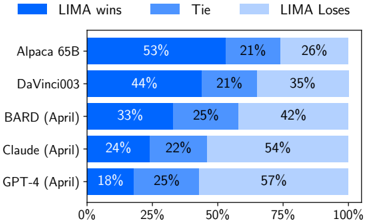
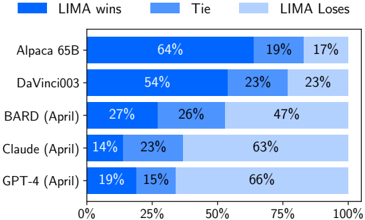
Large language models are trained in two stages: (1) unsupervised pretraining from raw text, to learn general-purpose representations, and (2) large scale instruction tuning and reinforcement learning, to better align to end tasks and user preferences. We measure the relative importance of these two stages by training LIMA, a 65B parameter LLaMa language model fine-tuned with the standard supervised loss on only 1,000 carefully curated prompts and responses, without any reinforcement learning or human preference modeling. LIMA demonstrates remarkably strong performance, learning to follow specific response formats from only a handful of examples in the training data, including complex queries that range from planning trip itineraries to speculating about alternate history. Moreover, the model tends to generalize well to unseen tasks that did not appear in the training data. In a controlled human study, responses from LIMA are either equivalent or strictly preferred to GPT-4 in 43% of cases; this statistic is as high as 58% when compared to Bard and 65% versus DaVinci003, which was trained with human feedback. Taken together, these results strongly suggest that almost all knowledge in large language models is learned during pretraining, and only limited instruction tuning data is necessary to teach models to produce high quality output.
Overview
The claims and statistics of this paper haven’t been checked yet.
Free: it reads the open-access text and checks the first 5 claims that cite a source we can check. Create a free account to check every claim.
Integrity signals
Registry
Cites
Statistics
Figures
Verification
Claims the paper makes
The claims and statistics of this paper haven’t been checked yet.
Free: it reads the open-access text and checks the first 5 claims that cite a source we can check. Create a free account to check every claim.
Claims other papers make about this one
Each is checked against this paper’s own text: does it say what the citing paper says it does?
The source backs part of the claim, not all of it — or backs it for a different population, condition or comparison.
In the citing paper
“However, when focusing specifically on a single task or narrow set of tasks, far fewer instruction instances may suffice.”
From A Survey of Large Language Models (2026) · cites this paper as [195]
Experimental — accuracy not yet measuredThe source backs part of the claim, not all of it — or backs it for a different population, condition or comparison.
In the citing paper
“Recent studies [323] show that the knowledge within LLMs is almost entirely acquired during pretraining.”
From Survey of Hallucination in Natural Language Generation (2023) · cites this paper as [323]
Experimental — accuracy not yet measuredThe source backs part of the claim, not all of it — or backs it for a different population, condition or comparison.
In the citing paper
“Redundancy and Inefficient Use of Information: Treating all N training samples ( x i , y i ) in D train as equally informative is inefficient, as the number of truly effective samples N eff is often much smaller than N (i.e., N eff ≪ N ) (Zhou et al., 2023).”
From TT-SI: Self-Improving LLM Agents with Test-Time Training (2026) · cites this paper as Zhou et al., 2023
Experimental — accuracy not yet measuredThe source backs part of the claim, not all of it — or backs it for a different population, condition or comparison.
In the citing paper
“Nevertheless, smaller datasets can be vital in enabling key post -training techniques such as fine-tuning, in-context learning, and prompt engineering (cf. [86, 122]).”
From Engaging Communities Meaningfully in Defining Disability Representation for AI Image Generation (2026) · cites this paper as [122]
Experimental — accuracy not yet measuredThe cited source says what the claim attributes to it.
In the citing paper
“For example, the authors of LIMA collected a diverse dataset of 1,000 carefully curated prompts and responses which are aligned with each other [323].”
From Survey of Hallucination in Natural Language Generation (2023) · cites this paper as [323]
3 more claims about this paper
Create a free account to see every claim other papers make about this one.
Self-check
Percentages, sums and reported differences re-computed from the paper’s own numbers.
The self-check needs the paper’s full text.
Citations
Cites
The publisher hasn’t deposited this paper’s reference list.
Research works printed but not linked: 7
- Yuntao Bai, Saurav Kadavath, Sandipan Kundu, Amanda Askell, Jackson Kernion, Andy Jones, Anna Chen, Anna Goldie, Azalia Mirhoseini, Cameron McKinnon, et al. Constitutional ai: Harmlessness from ai feedback. arXiv preprint arXiv:2212.08073, 2022b. · arXiv
- Ari Holtzman, Jan Buys, Li Du, Maxwell Forbes, and Yejin Choi. The curious case of neural text degeneration. In International Conference on Learning Representations, 2019.
- Yuval Kirstain, Patrick Lewis, Sebastian Riedel, and Omer Levy. A few more examples may be worth billions of parameters. arXiv preprint arXiv:2110.04374, 2021. · arXiv
- Long Ouyang, Jeffrey Wu, Xu Jiang, Diogo Almeida, Carroll Wainwright, Pamela Mishkin, Chong Zhang, Sandhini Agarwal, Katarina Slama, Alex Ray, et al. Training language models to follow instructions with human feedback. Advances in Neural Information Processing Systems, 35: 27730-27744, 2022.
- Victor Sanh, Albert Webson, Colin Raffel, Stephen Bach, Lintang Sutawika, Zaid Alyafeai, Antoine Chaffin, Arnaud Stiegler, Teven Le Scao, Arun Raja, et al. Multitask prompted training enables zero-shot task generalization. In The Tenth International Conference on Learning Representations, 2022.
- Yizhong Wang, Swaroop Mishra, Pegah Alipoormolabashi, Yeganeh Kordi, Amirreza Mirzaei, Anjana Arunkumar, Arjun Ashok, Arut Selvan Dhanasekaran, Atharva Naik, David Stap, et al. Super-naturalinstructions:generalization via declarative instructions on 1600+ tasks. In EMNLP, 2022b.
- Jason Wei, Maarten Bosma, Vincent Zhao, Kelvin Guu, Adams Wei Yu, Brian Lester, Nan Du, Andrew M Dai, and Quoc V Le. Finetuned language models are zero-shot learners. In International Conference on Learning Representations, 2022a.
Cited by
Items 801–900 of 938
Leveraging Large Language Models (LLMs) for Service Optimization in Beyond 5G (B5G) Networks
Muralidharan, S., Woo, W., & Lee, N. (2025) · Springer eBooks · doi:10.1007/978-3-032-06418-9_15
RePO: Bridging On-Policy Learning and Off-Policy Knowledge through Rephrasing Policy OptimizationPreprint
Xia, L., Yang, X., Chen, Y., Zhao, E., Cai, D., Wang, Y., & Wu, B. (2026) · arXiv (Cornell University) · doi:10.48550/arxiv.2602.10819
Tutoring Large Language Models to be Domain-adaptive, Precise and SafePreprint
Banerjee, S. (2026) · arXiv (Cornell University) · doi:10.48550/arxiv.2602.13860
AI Hallucinations as an Existential Risk to Human Society: Mitigating the Risks
Goltz, N., & Yuxin, Z. (2026) · BENTHAM SCIENCE PUBLISHERS eBooks · doi:10.2174/9798898812256126040007
Nagy nyelvi modellek és zárt információs rendszerek a védelmi szférában
Karsa, R., & Négyesi, I. (2025) · Hadmérnök · doi:10.32567/hm.2025.2.5
Proceedings of the Seventh Workshop on e-Commerce and NLP @ LREC-COLING 2024
(2024) · Language Resources and Evaluation Conference (LREC) · doi:10.63317/4upp3i6m57nt · Cited by 1
Report on scipost_202507_00080v1
(2025) · SciPost Physics · doi:10.21468/scipost.report.12045
Cognitively Layered Data Synthesis for Domain Adaptation of LLMs to Space Situational AwarenessPreprint
Linghu, D., Wang, C., Fan, D., Shi, W., Yin, K., Xue, X., Yang, F., Ren, H., & Zhang, C. (2026) · arXiv · doi:10.48550/arxiv.2603.09231
Harada, Y., & Yamauchi, Y. (2026) · Journal of Natural Language Processing · doi:10.5715/jnlp.33.388 · Cited by 1
CLAIM: Mitigating Catastrophic Forgetting in Continual Instruction Fine-Tuning Large Language Models
Qiu, X., Shi, S., Hao, T., & Tan, X. (2026) · IEEE Transactions on Cognitive and Developmental Systems · doi:10.1109/tcds.2026.3674105
“This evaluation method is widely recognized in various studies [62] and has been shown to correlate strongly with human evaluations.”
Scaling Towards the Information Boundary of Instructions through Data Synthesizing
Du, L., Zhao, H., Ju, Y., & Pan, T. (2026) · Proceedings of the AAAI Conference on Artificial Intelligence · doi:10.1609/aaai.v40i36.40311
“Manual datasets such as LIMA (Zhou et al. 2023) and Dolly (Ding et al. 2023) provide high-quality expert-written instructions but are costly to scale, while semi-automatic approaches (e.g., Self-Instruct (Wang et al. 2023), Alpaca (Taori et al. 2023), Evol-Instruct (Muen-nighoff et al. 2023))…”
Update processing in polystores
Silva, L. M. P. (2025) · Portuguese National Funding Agency for Science, Research and Technology (RCAAP Project by FCT)
A Comprehensive Survey of LLM Fine-Tuning: From Foundations to Frontier Techniques
k, P. M. (2026) · International Journal Of Scientific Research In Engineering & Technology · doi:10.59256/ijsreat.20260602006
Vinclat: Evaluating Reasoning, Cognition and Culture in One Game
Pàmies, M., Aula-Blasco, J., González-Agirre, A., & Villegas, M. (2026) · doi:10.18653/v1/2026.mme-main.4 · Cited by 1
“Recent findings suggest that base models (i.e., pre-trained solely via next-token prediction) often fail on instruction-heavy datasets, particularly when answers must conform to specific formats or require tool-like reasoning behaviors (Liang et al., 2023; Zhou et al., 2023).”
Plasticity vs. Rigidity: The Impact of Low-Rank Adapters on Reasoning on a Micro-Budget
Khan, Z., Tafveez, O., & Bhatti, Z. H. (2026) · Conference of the European Chapter of the Association for Computational Linguistics · doi:10.18653/v1/2026.eacl-srw.37
ELO: Efficient Layer-Specific Optimization for Continual Pretraining of Multilingual LLMs
Yoo, H., Choi, C.-S., Kim, M., Song, S., Song, S., Won, I., Park, J., Park, C., & Lim, K. (2026) · Conference of the European Chapter of the Association for Computational Linguistics · doi:10.18653/v1/2026.eacl-industry.55
Research on Large-Scale Model Inference Based on Multi-Policy Fine-Tuning
Qin, Z., & Ma, N. (2025) · International Symposium on Artificial Intelligence and Big Data (AIBDF) · doi:10.1109/aibdf67964.2025.11440743
“Such approaches are particularly crucial for computational resource-constrained application tasks [6].”
Narrative Diffusion in Social Topologies: A Comparative Study of LLM-Driven Dynamics
Gurung, M. I., & Agarwal, N. (2026) · Studies in computational intelligence · doi:10.1007/978-3-032-16645-6_25
PLOT: Enhancing Preference Learning via Optimal TransportPreprint
Zhu, L., Bai, Y., Ren, X., Yang, J., Zhang, L., Fang, F., Alinejad-Rokny, H., Tan, M., & Yang, M. (2026) · arXiv (Cornell University) · doi:10.48550/arxiv.2604.01837
Guo, K. (2024) · theses.fr (ABES) · doi:10.70675/6f060e87zedd7z4d27zbc20zee2fa5ac8f4d · Cited by 2
Proactive models for open-domain conversational search
Erbacher, P. (2024) · theses.fr (ABES) · doi:10.70675/f7d68861zc694z49f1zb130z675cbf38ed1c · Cited by 1
Automatic evaluation of human-written and machine-generated text
Guo, Y. (2025) · theses.fr (ABES) · doi:10.70675/222da373z9601z4573z8050z15adb4c4a3ff
Foundation Vision-Language models
Laurençon, H. (2025) · theses.fr (ABES) · doi:10.70675/ec0311a0zb6a4z4249zb9fbz01bf51a02c7c · Cited by 1
LIFT: A Quality-Aware Data Selection Framework for Low-Resource Machine Translation
Wang, L., Yang, J., Chen, X., Li, X., & Lin, X. (2026) · IEEE International Conference on Acoustics Speech and Signal Processing · doi:10.1109/icassp55912.2026.11463652
Hu, R., Guan, R., Di, Y., Bao, J., & Liu, Y. (2026) · IEEE International Conference on Acoustics Speech and Signal Processing · doi:10.1109/icassp55912.2026.11462754
“Instead of a deep assessment of the visual content, many systems, including agentic frameworks, rely on fragile, heuristic checks for internal validation [20].”
Guiding Efficient LLM Instruction-Tuning via Gradient Flow Matching
Zhang, H., Yu, W., Gong, Y., Huang, W., Zhang, H., & Huang, J. (2026) · IEEE International Conference on Acoustics Speech and Signal Processing · doi:10.1109/icassp55912.2026.11463758
Stratified Geometry-Aware Data Selection: A Task-Dependent Analysis for Instruction Tuning
Alshamrani, S. (2026) · IEEE Access · doi:10.1109/access.2026.3689220
“The rapid advancement of large language models (LLMs) has fundamentally transformed natural language processing (NLP), with instruction-tuning emerging as a critical technique for aligning model behavior with human intentions [1], [2].”
A survey of large language models: techniques, applications, and challenges
Ji, J., Zhao, X., & Shi, X. (2026) · Multimedia Systems · doi:10.1007/s00530-026-02288-9
“Most critically, RAG does not adequately address the reasoning verification problem, as models may generate plausible but incorrect conclusions even when pro - vided with contradictory evidence [98].”
Reasoning Trace Length is an Important Factor in Training Reasoning Models
Shen, S., Huang, F., Zhao, Z., Liu, C., Zheng, T., Liu, Y., Ma, Y., & Zhu, D. (2026) · IEEE Transactions on Audio Speech and Language Processing · doi:10.1109/taslpro.2026.3692293
“Throughout this process, we maintain attention to both data quality and diversity [39], [40], ensuring that Long1K provides coherent, correct, and instructively valuable reasoning sequences.”
Albright, R., Muktadir, G., Ikram, Z., Jubaer, S. M., Hossain, M., & Liu, D. (2026) · arXiv (Cornell University) · doi:10.48550/arxiv.2605.09678
“Instruction-following studies show that RLHF improves compliance yet breaks down when instructions contradict dominant train-ing patterns [14, 23], while related benchmarks show that models can state rules correctly but violate them during execution [5] or deviate from task requirements due to…”
I CAN Debias: Uncovering and Enhancing Self-debiasing Mechanisms of Social Bias in LLMsPreprint
Zhang, J., Wang, B., Fu, Y., Dang, Y., Zhao, D., Hou, Y., & Yu, Z. (2026) · arXiv (Cornell University) · doi:10.48550/arxiv.2605.09647
A Coreset Perspective for Machine Unlearning
Pal, S. (2026) · Synthesis lectures on computer vision · doi:10.1007/978-3-032-17282-2_5
Dynamic Normativity: Learning Human Preferences
Corrêa, N. K. (2026) · The International library of ethics, law and technology · doi:10.1007/978-3-032-22150-6_5
Efficient 3D Content Reconstruction and GenerationPreprint
Li, J. (2026) · arXiv · doi:10.48550/arxiv.2605.18052
Be Kind, Rewrite: Benign Projections via Rewriting Defend Against LLM Data Poisoning AttacksPreprint
Halloran, J. T., & Bhatt, N. (2026) · arXiv (Cornell University) · doi:10.48550/arxiv.2605.19147
Teach the Way It Thinks: Guiding LLM Post-training Data Engineering with Sparse AutoencodersPreprint
Jing, Y., Dai, Z., Hu, J., Yao, Z., Hou, L., Li, J., & Wang, X. (2026) · arXiv (Cornell University) · doi:10.48550/arxiv.2605.27354 · Cited by 2
“Post-training data engineering controls which examples are used, when they appear, and how training budget is allocated, which strongly shapes final model behavior (Ouyang et al., 2022; Zhou et al., 2023; Lambert et al., 2024; DeepSeek-AI et al., 2025).”
Boundary Suppression Asymmetry in Post-trained Assistants: Over-expansion as a Controllability CostPreprint
Han, J. (2026) · arXiv (Cornell University) · doi:10.48550/arxiv.2605.27969
“…et al., 2020; Krause et al., 2021; Yang et al., 2021; Li and Liang, 2021; Dong et al., 2023; Zhang et al., 2024), and sequential post-training work studies how later stages preserve, overwrite, or interfere with earlier signals (Zhou et al., 2023a; Prakash et al., 2024; Fernando et al., 2024).”
Ni, L., & Xu, X. (2026) · International Conference on Intelligent Computing and Signal Processing (ICSP) · doi:10.1109/icsp69961.2026.11540917
FROM DEFENSE TO DEVELOPMENT: THE AI ECOSYSTEM FOR INFORMATION SECURITY AND ECONOMIC GROWTH
Череп, О., KALYUZHNA, Y. V., & Markova, S. (2025) · Izdevniecība “Baltija Publishing” eBooks · doi:10.30525/978-9934-26-681-2
Unifying Data, Memory, and Compute Efficiency in LLM Training: A Survey
Schmidt, V., Nguyen, H. H., Jung, C., Salehi, S., & Schmeink, A. (2026) · IEEE Transactions on Artificial Intelligence · doi:10.1109/tai.2026.3702625
“1) Superficial Alignment Hypothesis (LIMA): Challenging the assumption that alignment requires massive datasets, less is more for alignment (LIMA) [45] demonstrates that a strong pretrained model can achieve competitive performance using only 1000 carefully curated examples.”
Generalizable multilingual medical text anonymization using generative instruction tuning
Xiao, C., Hudson, G. T., Watson, M., Jones, B., Farrell, S., King, J. H., & Moubayed, N. A. (2026) · Communications Medicine · doi:10.1038/s43856-026-01682-8
Agentic llms for psycholinguistic marker extraction and conspiracy endorsement detection
Spanakis, P. A. (2026) · DSpace - NTUA (National Technical University of Athens) · doi:10.26240/heal.ntua.32682
Yin, Z., Wang, J., Jiang, H., Mo, Y., Pan, H., Yang, Z., Wu, Y., Li, Y., & Liang, C. (2026) · Chinese Control and Decision Conference (CCDC) · doi:10.1109/ccdc69976.2026.11560061
Zhong, Q., Gong, J., Zhu, K., Liao, F., Liu, J., & Du, B. (2026) · Knowledge-Based Systems · doi:10.1016/j.knosys.2026.116524
Kouhoué, A. W., & Bouetou, T. B. (2026) · Journal of Computer and Communications · doi:10.4236/jcc.2026.146007
Learning Marine Spatial Information Data Using a Korean Speech-based Large Language Model
Tak, J. H., Choi, Y. S., Kim, M. S., & Lee, C. W. (2026) · Sensors and Materials · doi:10.18494/sam6189
Kurshan, E. (2026) · ACM International Conference on Computing Frontiers (CF) · doi:10.1145/3801487.3802805
Beyond Price: A Technical Quality Framework for AI Antitrust
Wu, P. Y. (2026) · ACM Conference on Fairness, Accountability, and Transparency (FAccT) · doi:10.1145/3805689.3812338
Awan, A. T., Zehra, H., & Daud, A. (2026) · International Conference on IT and Industrial Technologies (ICIT) · doi:10.1109/icit68548.2026.11577712
“A. Quality-Driven Data Selection LIMA [7] showed that around 1,000 carefully selected samples can reach performance close to GPT-4, suggesting that instruction tuning mainly transfers stylistic behavior rather than adding new knowledge.”
CoSy: Conversational Synthesis for Grounded Question Answering
Huber, P., Einolghozati, A., Conway, R., Narang, K., Smith, M., Nayyar, W., Sagar, A., Aly, A. A., & Shrivastava, A. (2026) · Workshop on Generation, Evaluation and Metrics (GEM) · doi:10.18653/v1/2026.gem-main.2
Zhang, X., Wang, J., & Zhang, X. (2026) · International Workshop on Semantic Evaluation (SemEval) · doi:10.18653/v1/2026.semeval-1.96 · Cited by 1
“The generation of high-quality humorous text is heavily dependent on the scale and diversity of the training data (Zhou et al., 2023).”
Dictionary Guided Sparse Logit Editing for Reliable Jailbreak Attacks
Han, S., Ni, R., Yi, Z., Li, C., Xu, P., & Ruan, W. (2026) · Findings of the Association for Computational Linguistics: ACL (Findings of ACL) · doi:10.18653/v1/2026.findings-acl.2137
“…interpretability research showing that refusal is often mediated by a single, low-rank direction (Arditi et al., 2024; Bricken et al., 2023a), suggesting that alignment is a “shallow” phenomenon (Zhou et al., 2023) that manifests by shifting probability mass onto sparse semantic indices.”
Self-citationEfficient Summarization with Small Language Models via Direct Preference Optimization
Tamer, Y., Badawi, A., & Bahgat, M. (2026) · ICEENG International Conference for Innovations in Intelligent Computing and Cybersecurity (IICC) · doi:10.1109/iicc69623.2026.11581993
“Notably, SFT reduces win-rate below the base model (55.00% vs. 59.67%), consistent with the known tendency of SFT to reduce prompt responsiveness [11], [14].”
InfluentialStochasT: Learning with Stochastic Turn Depth for Visual Instruction Tuning
Qing, Y., Mao, C., & Gong, B. D. (2026) · Lecture notes in computer science · doi:10.1007/978-3-032-37152-2_30
AID‐VLM: The Vision‐Language Model for Traffic Incident Understanding
Zhu, S., Du, Y., Li, Y., Liu, C. X., Wan, J., & Wu, D. (2026) · IET Intelligent Transport Systems · doi:10.1049/itr2.70271
Implementasi Fine Tuning Menggunakan Metode QLoRA Pada Sistem Tanya Jawab Hadits
Azmi, M., Kurnia, F., Harahap, N. S., Irsyad, M., Pizaini, & Marsal, A. (2026) · Jurnal Pengembangan Teknologi Informasi dan Komunikasi (JUPTIK) · doi:10.52060/juptik.v4i1.4349
KnowFrame: Building Domain-specific Post-train Data with Agentic Flows
Wang, Z., Zhao, L., & Xu, W. (2026) · International Conference on Computer Supported Cooperative Work in Design (CSCWD) · doi:10.1109/cscwd68734.2026.11582492
“It is well known that the quality is more important than quantity for SFT data [24].”
Liang, J., Hou, S., Chen, W., Qing, Y., Zhang, X., Liu, Z., Jiao, H., Xiang, L., & Wu, H. (2026) · Big Earth Data · doi:10.1080/20964471.2026.2689760
“The design of GeoModeling-SFT draws on the “Less Is More for Alignment (LIMA)” concept proposed by Zhou et al. (2023), which posits that language models have already learned general linguistic and task structures during pre-training, and that the key to effective alignment lies in using a small…”
Chen, Y., Ping, Y., Shuhang, Z., & Jojo, C. (2026) · PLoS ONE · doi:10.1371/journal.pone.0352988
“During the model fine-tuning phase, we employed the LoRA fine-tuning method [20], updating only partial parameters during fine-tuning, with LoRARank set to 64 and LoRAAlpha = LoRARank.”
Synthetic Sonar Image Augmentation Using GANs for Improved Mine Detection
Borzyszkowski, A., Zelioli, L., Vasankari, L., & Heikkonen, J. (2026) · IFIP advances in information and communication technology · doi:10.1007/978-3-032-30801-6_22
Semantic Feature Sensitivity-Aware Data Pruning via Model Pre-Scaling
Nie, J., Li, P., & Xiao, J. (2026) · Lecture notes in computer science · doi:10.1007/978-981-92-3426-4_11
Liu, X., Garg, M., Jeon, E., Jia, H., Crowson, C. S., Sauver, J. L. S., Pagali, S. R., & Sohn, S. (2026) · JAMIA Open · doi:10.1093/jamiaopen/ooag139 · Cited by 1
Tran, Q.-D. L., & Nguyen, H. T. (2026) · IEEE Access · doi:10.1109/access.2026.3715578
“The decision to limit the dataset to 10,000 samples is supported by recent studies on language model alignment, notably the ‘‘Less Is More for Alignment’’ (LIMA) principle [64].”
Brunet, L. (2026) · Journal International de Technologie de l Innovation de la Physique de l Energie et de l Environnement · doi:10.52497/jitipee.v10i1.416
“Le fine-tuning d'instruction [21] apprend au modèle à suivre un format de tâche, et LIMA [22] a montré qu'un millier d'exemples soigneusement choisis suffit à transférer format et style — résultat qui fonde notre hypothèse de frugalité (Q3).”
Zhang, X., Wilson, C. L., Eyre, H., Reed, D. E., Wai, T. H., Kloehn, A. T., Rosser, E. W., Luo, G., & Zeliadt, S. B. (2026) · JMIR Research Protocols · doi:10.2196/96346
A Comparative Study on LLM-enabled HPC User Support
Zheng, M.-K., Linghu, F.-R., Li, S., Kandes, M., Gaffney, N., Foster, I., & Zhang, Z. (2026) · Practice and Experience in Advanced Research Computing · doi:10.1145/3785462.3815796 · Cited by 2
Structured Synthetic Reasoning Data for Arithmetic Fine-Tuning of Small Language ModelsPreprint
O'Grady, J., & Ramlan, E. (2026) · arXiv · doi:10.48550/arxiv.2607.18266
Shared SFT Lessons Across Alignment, Model Organisms, and Toy ModelsPreprint
de la Fuente, A., & Conmy, A. (2026) · arXiv · doi:10.48550/arxiv.2607.26173
Partial-Correlation Learning for Large Language Models with Skip-Tuning
Lu, Y., Song, Z., Yuan, C., & Wang, X. (2026) · Lecture notes in computer science · doi:10.1007/978-3-032-31933-3_6
Luo, J., Liu, M., Huang, Z., Ke, Z., & Wang, Q. (2026) · Electronics · doi:10.3390/electronics15153452
R-Select: A Robust Multi-Metric Data Selection Approach for Fine-Tuning Large Language Models
Gao, X., Wang, X., Zhu, Y., Liu, Z., He, C., & Wu, L. (2026) · ACM SIGKDD Conference on Knowledge Discovery and Data Mining (KDD) · doi:10.1145/3770855.3817656 · Cited by 1
“Prior studies including LIMA [93], LIMO [82], ODA-Mixture[ 24] consistently show that carefully filtered small subsets can outperform much larger but less refined corpora.”
InfluentialReinforcement Learning in the Era of Large Language Models: Challenges and Opportunities
Hao, Q., Chen, L., Qi, X.-Q., Yuan, Y., Zong, Z.-F., Chen, H.-Y., Zhao, K.-Y., Wang, S.-Y., Zhang, Y.-K., Yuan, J., et al. (2026) · ACM Computing Surveys · doi:10.1145/3837057 · Cited by 2
“A significant issue is the inadequate data collection methods used in current fine-tuning practices [209].”
Dependency-Aware Reliable Orchestration for Smart-IoT Control with Reasoning-Aligned LLMs
Sarowar, M. S., Islam, M. T., Nuruzzaman, M., & Mozumder, M. A. I. (2026) · International Conference on Electrical, Computer and Energy Technologies (ICECET) · doi:10.1109/icecet65726.2026.11632566
“Instruction-tuned models improve command following but still optimize surrogate token or preference objectives rather than executable controller validity [3]–[10].”
The role of data quality and alignment in cross-tokamak disruption prediction
Shen, C., Zheng, W., Xue, F., Ai, X., Guo, B., Chen, D., Chen, Z., Ding, Y. H., & the J-TEXT team (2026) · Plasma Physics and Controlled Fusion · doi:10.1088/1361-6587/ae9985
LittleLearner: Language Models Under Pedagogically Controlled Knowledge ExposurePreprint
Li, F., Zeller, J., Prada-Corral, M., Wiedemer, T., Mayilvahanan, P., Cotterell, R., & Brendel, W. (2026) · arXiv · doi:10.48550/arxiv.2608.13545 · Cited by 1
“When prior exposure is unknown, it is difficult to determine whether methods like in-context learning or post-training lead to genuine capability growth or merely elicit knowledge or skills already present in the training data [cf. 11–15].”
Alqahtani, M. Q., & Abumelha, M. (2026) · Journal of King Saud University - Computer and Information Sciences · doi:10.1007/s44443-026-01068-9
“Instruction tuning has evolved to enable models to perform multiple tasks, leading to improved model generalization (Chung et al. 2024; Zhou et al. 2023).”
Safarnejad, A., & Lefebvre, H. (2026) · American Journal of Evaluation · doi:10.1177/10982140261476953
Quality-Aware Selection for Retrieval-Augmented Fine-Tuning of Small Language Models
Cho, S., & Jung, H. (2026) · Mathematics · doi:10.3390/math14173026
Wu, D., & Ma, T. (2026) · Lecture notes in computer science · doi:10.1007/978-3-032-37242-0_31
Aligning Human Sense: Calibrated Distributional Reward Learning for Video Generation
Zhai, N.-X., Cheng, W., Yu, D., Gu, Y., Du, H., Fu, J., Huang, C., Song, Y., Ma, L. L., Ran, Y., et al. (2026) · Lecture notes in computer science · doi:10.1007/978-3-032-37013-6_11
“Automated surrogates, such as reward models (e.g., the helpful–harmless ob-jective [1]) and lightweight alignment strategies [42], reduce reliance on costly human feedback by capturing alignment signals at scale.”
Ünaldı, A. O., Yılmaz, M., & Clarke, P. M. (2026) · Communications in computer and information science · doi:10.1007/978-3-032-36816-4_17
Zhao, J., Ju, M., Dong, M., Zhang, Y., Tang, K., Liu, X., Yang, K., Luo, H., Zhang, C., & Liu, G. (2026) · Journal of Cleaner Production · doi:10.1016/j.jclepro.2026.149322
Application-Aware I/O Prediction and Optimization for HPC and AI Workloads
Yazdani, A. H. (2026) · VTechWorks (Virginia Tech)
Design and Implementation of Large Language Model-Based Inference Pipeline for Fire Investigation
Choi, J. J., & Cho, H.-S. (2026) · Fire science and engineering · doi:10.7731/kifse.f0cc8ac9
Liu, J., Yuan, C., Xu, S., Xing, B., Huang, X., Xu, Y., Liu, H., Teng, W., Liao, X., Cao, P., et al. (2026) · Findings of the Association for Computational Linguistics: EMNLP (Findings of EMNLP) · doi:10.18653/2026.findings-emnlp.179
Generative large language models in medicine: a scoping review of recent methodological advances
Li, F., Li, J., Cao, W., Li, H., Li, Y., Sun, Z., Chen, D., Duan, T., Li, P., Tizhoosh, H. R., et al. (2026) · npj Health Systems · doi:10.1038/s44401-026-00137-5 · Cited by 1
Liu, Y., Ji, Q., Lu, S., & Chen, J. (2026) · Mathematics · doi:10.3390/math14173168
RoleCraft: Aligning Persona Stance and Style for Robust Role-Playing Agents
Gao, Y., Dang, C., He, Y., Hu, J., Luo, Y., & Yang, J. (2026) · Lecture notes in computer science · doi:10.1007/978-3-032-37667-1_9
FTAKG: An Adaptive Fine-Tuning Multi-Agent System for Domain-Specific LLM Based on Knowledge Graph
Zhang, L., Shu, Y., Xu, H., Nie, H., Xu, H., Zuo, D., Feng, Y., & Wen, D. (2026) · IEEE International Conference on Web Services (ICWS) · doi:10.1109/icws72778.2026.00180
“Recently, theories represented by Loss Trajectories [28] and LIMA (Less Is More for Alignment) [29] suggest that model improvement relies more on a small subset of high-information, distributionally diverse “skeleton data”.”
Explainable Political Bias Classification in Indian Media Using Rationale-Guided Distillation
Mandavkar, V., & Kumar, M. (2026) · Lecture notes in networks and systems · doi:10.1007/978-3-032-30438-4_32
The impact of GenAI on the future of requirements engineering
Breaux, T. D., & Singhal, A. (2026) · Requirements Engineering · doi:10.1007/s00766-026-00477-6
SalamandraTA at WMT 2026 Terminology Shared Task: Hard Examples Are Better Teachers
Liao, X., & Melero, M. (2026) · Conference on Machine Translation (WMT) · doi:10.18653/2026.wmt-main.116
Fonseka, T., & Jha, N. K. (2026) · arXiv · doi:10.48550/arxiv.2609.12230
Measuring Reproducibility in LLM Research: A Rubric and Cross-Topic Corpus Study
Chong, C. J., Hou, C., Liu, S., & Yao, Z. (2026) · ACM Conference on Reproducibility and Replicability (ACM REP) · doi:10.1145/3820002.3828584
“[21];InstructGPT[80];Alpaca[100];Tulu2[44];DPO[86];LIMA[125];OpenAssistantConversations[54];Orca2[75];Orca[76];RRHF[118];Lietal.”
Small Language Models for Pay Equity Compliance: A Fine-Tuning and Evaluation Study
Kuna, M., & Kowalczyk, M. (2026) · Annals of Computer Science and Information Systems · doi:10.15439/2026f1202
“First, fine-tuning on 60 domain-specific examples per task is sufficient for TC1 and TC3, but does not uniformly dominate RAG on TC2, consistent with the LIMA hypothesis that data quality determines adaptation ceiling [9].”
InfluentialSelecting Diverse SFT Traces Improves Post-RL GeneralizationPreprint
Zhang, D., Wu, M.-Y., & Li, J.-N. (2026) · arXiv.org · doi:10.48550/arxiv.2609.33780
Rethinking Token Reweighting for SFT: Suppress, Reverse, and Extrapolate Learned FeaturesPreprint
Li, C., He, H., Gao, Y., Li, M., Ye, J., Yang, Q., & Ye, P. (2026) · arXiv (Cornell University) · doi:10.48550/arxiv.2609.33463
IndustryLLM: Failure-Driven LLM Training for Industrial ProcurementPreprint
Ding, L., Xu, Z., Sheng, Y., Chen, B., Bai, S., Zhu, R., Wu, D., Xu, H., Wang, Y., Shi, F., et al. (2026) · arXiv · doi:10.48550/arxiv.2609.31871
Self-citationA dataset of Chinese tourism service defect quintuples for large language model fine-tuning
Ailin, L. I., Wenlong, Y., Zhaozhao, D. O. N. G., Zhu, W., & Wang, Z. (2026) · China Scientific Data · doi:10.11922/11-6035.csd.2026.0118.zh
Metadata
- Authors
- Zhou, C., Liu, P., Xu, P., Iyer, S., Sun, J., Mao, Y., Ma, X., Efrat, A., Yu, P., Yu, L., Zhang, S., Ghosh, G., Lewis, M., Zettlemoyer, L., & Levy, O.
- Venue
- Advances in Neural Information Processing Systems 36
- Published
- 2023
- Pages
- 55006-55021
- ISSN
- 1049-5258 (ISSN-L)
- OpenAlex
- W7133189643
- Semantic Scholar
- 546d0624adfc6e18fb87d8cc77e7705bb9ea7445
- Cited by
- 275
- References
- 0
- Citations by year
- 2026: 80 · 2025: 67 · 2024: 85 · 2023: 43
- FWCI
- 48.72
- Type
- conference paper
- Language
- en
- Open access
- green
- arxiv.org
- Licence
- cc-by
- Locations
- neural information processing systems (publishedVersion)
- arXiv (Cornell University) (submittedVersion, cc-by)
- arXiv (Cornell University) (cc-by)
- Topics
- Physical Sciences › Computer Science › Artificial Intelligence › Domain Adaptation and Few-Shot Learning
- Social Sciences › Education › Educational Assessment and Pedagogy
- Physical Sciences › Computer Science › Artificial Intelligence › Topic Modeling
- Keywords
- Lima, less is more, alignment, efficient large language models
About these checks
Registry, retraction, Cites and statistics results are computed, not judged, with one exception: a printed reference that no index lists is read once by a model before it counts as a citation error. Claims are extracted by a model and kept only when their quote appears verbatim in the text; each cited source is then checked, with a model’s help, for whether it says what the claim relies on. Those verdicts can be wrong — read the claim’s quote and the cited source before relying on one.
Statistics and arithmetic are recomputed, not judged.
Confidence bands are shown only for fields calibrated on our annotated test set. None is calibrated yet, so no band is shown.
What counts as a claim ›How we measure confidence ›How we check this ›
Are you an author, or do you see a problem with this page? Request a review
Data sources
Bibliographic data: Semantic Scholar, OpenAlex, Crossref.
Contains information from the Semantic Scholar Academic Graph Datasets, made available under the ODC Attribution License (ODC-BY 1.0).
Semantic Scholar’s data is described in: Kinney, R., et al. (2023). The Semantic Scholar Open Data Platform. arXiv:2301.10140.
