

LIMA: Less Is More for Alignment
Open accessThe DOI matches its Crossref record; 12 of the 12 references it cites were found in a registry or an index.
Abstract
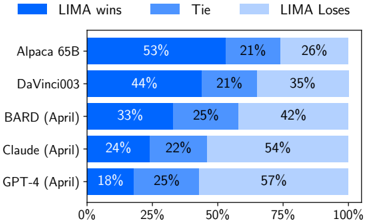
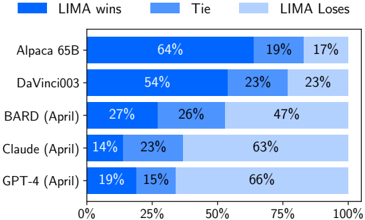
Large language models are trained in two stages: (1) unsupervised pretraining from raw text, to learn general-purpose representations, and (2) large scale instruction tuning and reinforcement learning, to better align to end tasks and user preferences. We measure the relative importance of these two stages by training LIMA, a 65B parameter LLaMa language model fine-tuned with the standard supervised loss on only 1,000 carefully curated prompts and responses, without any reinforcement learning or human preference modeling. LIMA demonstrates remarkably strong performance, learning to follow specific response formats from only a handful of examples in the training data, including complex queries that range from planning trip itineraries to speculating about alternate history. Moreover, the model tends to generalize well to unseen tasks that did not appear in the training data. In a controlled human study, responses from LIMA are either equivalent or strictly preferred to GPT-4 in 43% of cases; this statistic is as high as 58% when compared to Bard and 65% versus DaVinci003, which was trained with human feedback. Taken together, these results strongly suggest that almost all knowledge in large language models is learned during pretraining, and only limited instruction tuning data is necessary to teach models to produce high quality output.
Overview
The claims and statistics of this paper haven’t been checked yet.
Free: it reads the open-access text and checks the first 5 claims that cite a source we can check. Create a free account to check every claim.
Integrity signals
Registry
Cites
Statistics
Figures
Verification
Claims the paper makes
The claims and statistics of this paper haven’t been checked yet.
Free: it reads the open-access text and checks the first 5 claims that cite a source we can check. Create a free account to check every claim.
Claims other papers make about this one
Each is checked against this paper’s own text: does it say what the citing paper says it does?
The source backs part of the claim, not all of it — or backs it for a different population, condition or comparison.
In the citing paper
“However, when focusing specifically on a single task or narrow set of tasks, far fewer instruction instances may suffice.”
From A Survey of Large Language Models (2026) · cites this paper as [195]
Experimental — accuracy not yet measuredThe source backs part of the claim, not all of it — or backs it for a different population, condition or comparison.
In the citing paper
“Recent studies [323] show that the knowledge within LLMs is almost entirely acquired during pretraining.”
From Survey of Hallucination in Natural Language Generation (2023) · cites this paper as [323]
Experimental — accuracy not yet measuredThe source backs part of the claim, not all of it — or backs it for a different population, condition or comparison.
In the citing paper
“Redundancy and Inefficient Use of Information: Treating all N training samples ( x i , y i ) in D train as equally informative is inefficient, as the number of truly effective samples N eff is often much smaller than N (i.e., N eff ≪ N ) (Zhou et al., 2023).”
From TT-SI: Self-Improving LLM Agents with Test-Time Training (2026) · cites this paper as Zhou et al., 2023
Experimental — accuracy not yet measuredThe source backs part of the claim, not all of it — or backs it for a different population, condition or comparison.
In the citing paper
“Nevertheless, smaller datasets can be vital in enabling key post -training techniques such as fine-tuning, in-context learning, and prompt engineering (cf. [86, 122]).”
From Engaging Communities Meaningfully in Defining Disability Representation for AI Image Generation (2026) · cites this paper as [122]
Experimental — accuracy not yet measuredThe cited source says what the claim attributes to it.
In the citing paper
“For example, the authors of LIMA collected a diverse dataset of 1,000 carefully curated prompts and responses which are aligned with each other [323].”
From Survey of Hallucination in Natural Language Generation (2023) · cites this paper as [323]
3 more claims about this paper
Create a free account to see every claim other papers make about this one.
Self-check
Percentages, sums and reported differences re-computed from the paper’s own numbers.
The self-check needs the paper’s full text.
Citations
Cites
The publisher hasn’t deposited this paper’s reference list.
Research works printed but not linked: 7
- Yuntao Bai, Saurav Kadavath, Sandipan Kundu, Amanda Askell, Jackson Kernion, Andy Jones, Anna Chen, Anna Goldie, Azalia Mirhoseini, Cameron McKinnon, et al. Constitutional ai: Harmlessness from ai feedback. arXiv preprint arXiv:2212.08073, 2022b. · arXiv
- Ari Holtzman, Jan Buys, Li Du, Maxwell Forbes, and Yejin Choi. The curious case of neural text degeneration. In International Conference on Learning Representations, 2019.
- Yuval Kirstain, Patrick Lewis, Sebastian Riedel, and Omer Levy. A few more examples may be worth billions of parameters. arXiv preprint arXiv:2110.04374, 2021. · arXiv
- Long Ouyang, Jeffrey Wu, Xu Jiang, Diogo Almeida, Carroll Wainwright, Pamela Mishkin, Chong Zhang, Sandhini Agarwal, Katarina Slama, Alex Ray, et al. Training language models to follow instructions with human feedback. Advances in Neural Information Processing Systems, 35: 27730-27744, 2022.
- Victor Sanh, Albert Webson, Colin Raffel, Stephen Bach, Lintang Sutawika, Zaid Alyafeai, Antoine Chaffin, Arnaud Stiegler, Teven Le Scao, Arun Raja, et al. Multitask prompted training enables zero-shot task generalization. In The Tenth International Conference on Learning Representations, 2022.
- Yizhong Wang, Swaroop Mishra, Pegah Alipoormolabashi, Yeganeh Kordi, Amirreza Mirzaei, Anjana Arunkumar, Arjun Ashok, Arut Selvan Dhanasekaran, Atharva Naik, David Stap, et al. Super-naturalinstructions:generalization via declarative instructions on 1600+ tasks. In EMNLP, 2022b.
- Jason Wei, Maarten Bosma, Vincent Zhao, Kelvin Guu, Adams Wei Yu, Brian Lester, Nan Du, Andrew M Dai, and Quoc V Le. Finetuned language models are zero-shot learners. In International Conference on Learning Representations, 2022a.
Cited by
Items 501–600 of 938
SHARP: Unlocking Interactive Hallucination via Stance Transfer in Role-Playing LLMs
Kong, C., Luo, Z., Lin, H., Fan, Z., Fan, Y., Sun, Y., & Ma, J. (2025) · Findings of the Association for Computational Linguistics: ACL (Findings of ACL) · doi:10.18653/v1/2025.findings-acl.47 · Cited by 12
“In particular, since the emergence of LIMA (Zhou et al., 2023a), overfitting during model training has become alarmingly common, leading to more monotonous behavioral patterns of roles.”
Improving the robustness of large language models via consistency alignment
Zhao, Y., Yan, L., Sun, W., Xing, G., Wang, S., Meng, C., Cheng, Z., Ren, Z., & Yin, D. (2024) · Leiden Repository (Leiden University) · Cited by 9
SAFER: Advancing Safety Alignment via Efficient Ex-Ante Reasoning
Feng, K., Ding, K., Wang, Y., Li, M., Wei, F., Wang, X., & Chen, H. (2026) · Findings of the Association for Computational Linguistics: ACL (Findings of ACL) · doi:10.18653/v1/2026.findings-acl.1808 · Cited by 5
“…remain susceptible to red-teaming and jailbreak attacks (Wei et al., 2024a; Zou et al., 2023), often reflecting the Superficial Alignment Hypothesis (SAH) where models follow unsafe trajectories after innocuous prefixes, e.g ., "Sure, here’s how to..." (Zhou et al., 2023; Qi et al., 2024).”
InfluentialFrom Base to Conversational: Japanese Instruction Dataset and Tuning Large Language Models
Suzuki, M., Hirano, M., & Sakaji, H. (2023) · IEEE International Conference on Big Data (BigData) · doi:10.1109/bigdata59044.2023.10386605 · Cited by 8
“In addition, it will be necessary in the future to evaluate from the perspective of human preference [39], [40], not just focusing on the task’s correctness.”
BackgroundMitigating Hallucination Issues in Small-Parameter LLMs through Inter-Layer Contrastive Decoding
Li, F., zhang, X., & Zhang, P. (2024) · International Joint Conference on Neural Networks (IJCNN) · doi:10.1109/ijcnn60899.2024.10650644 · Cited by 5
“Reference [29], [30] underscored the influence of pre-training data quality on LLMs’ knowledge and hallucinations.”
BackgroundShen, A., Lai, Z., Wang, Q., Li, X., Zhang, L., Li, D., & Li, J. (2025) · Transactions of the Association for Computational Linguistics · doi:10.1162/tacl.a.23 · Cited by 9
“For evaluation, we utilize the Massively Multitask Language Understanding (MMLU) (Hendrycks et al., 2020), the zero-shot CommonsenseQA benchmarks—e.g., HellaSwag (Zellers et al., 2019 WinoGrande (Sakaguchi et al., 2021), ARC (Clark et al., 2018), BoolQ (Clark et al., 2019), and OpenBookQA (Mihaylov et al., 2018)—and e…”
Exploring Learning Complexity for Efficient Downstream Dataset Pruning
Jiang, W., Liu, Z., Xie, Z., Zhang, S., Jing, B., & Wei, H. (2025) · International Conference on Learning Representations · doi:10.48550/arxiv.2402.05356 · Cited by 7
Self-citationEnhancing Data Quality in Federated Fine-Tuning of Foundation ModelsPreprint
Zhao, W., Du, Y., Lane, N. D., Chen, S., & Wang, Y. (2024) · arXiv · doi:10.48550/arxiv.2403.04529 · Cited by 9
The Power of Words: Generating PowerShell Attacks from Natural LanguagePreprint
Liguori, P., Marescalco, C., Natella, R., Orbinato, V., & Pianese, L. (2024) · WOOT @ USENIX Security Symposium · doi:10.48550/arxiv.2404.12893 · Cited by 12
“In fact, in state-of-the-art code generation, the datasets for fine-tuning are relatively limited, in the order of one thousand samples [52].”
BackgroundResultSLM as Guardian: Pioneering AI Safety with Small Language ModelsPreprint
Kwon, O., Jeon, D., Choi, N., Cho, G.-H., Kim, C.-B., Lee, H., Kang, I.-H., Kim, S., & Park, T. (2024) · arXiv (Cornell University) · doi:10.48550/arxiv.2405.19795 · Cited by 5
“This is with 110K instruction and answer pairs that we built following the methodology of Zhou et al. (2023) and Longpre et al. (2023).”
BackgroundMethodThe PLLuM Instruction CorpusPreprint
Pęzik, P., Żarnecki, F., Kaczyński, K., Cichosz, A., Deckert, Z., Garnys, M., Grabarczyk, I., Janowski, W., Karasińska, S., Kujawiak, A., et al. (2025) · arXiv · doi:10.48550/arxiv.2511.17161 · Cited by 7
“Other frequently utilized datasets include Databrick’s Dolly (Conover et al., 2023) 15k and LIMA (Zhou et al., 2023a) 1k dataset both consisting of curated and hand-written examples, LMSYS-Chat-1M (Zheng et al., 2023) with 1 million human-LLM conversations, WebInstruct (Yue et al., 2024) with 10 million instruction pa…”
InfluentialDistilling Game Code World Model Generation into Lightweight Large Language ModelsPreprint
Serapio, T., Prakash, A., Xu, H., Wang, K., & Greenwald, A. (2026) · arXiv (Cornell University) · doi:10.48550/arxiv.2605.24375 · Cited by 5
“Work by Zhou et al. [36] shows that SFT primarily aligns a model to a desired format or style; it does not teach it complex or novel reasoning skills.”
Automatic Analysis of Substantiation in Scientific Peer Reviews
Guo, Y., Shang, G., Rennard, V., Vazirgiannis, M., & Clavel, C. (2023) · arXiv · doi:10.48550/arxiv.2311.11967 · Cited by 5
“In future work, our dataset could also be used for instruction tuning and in-context learning, where only a small amount of high-quality human curated data is required (Zhou et al., 2023).”
BackgroundLIMO: Less is More for Reasoning
Ye, Y., Huang, Z., Xiao, Y., Chern, E., Xia, S., & Liu, P. (2025) · arXiv · doi:10.48550/arxiv.2502.03387 · Cited by 627
Self-citationZhang, C., Zhu, S., Yang, X., Tseng, Y.-C., Jiang, S., & Rzeszotarski, J. M. (2025) · Proceedings of the 7th ACM Conference on Conversational User Interfaces · doi:10.1145/3719160.3736618 · Cited by 4
Alphazero-like Tree-Search can Guide Large Language Model Decoding and Training
Feng, X., Wan, Z., Wen, M., McAleer, S. M., Wen, Y., Zhang, W., & Wang, J. (2023) · arXiv · doi:10.48550/arxiv.2309.17179 · Cited by 4
“…on improving LLMs task-solving capability, including curation of larger and higher-quality general or domain-specific data (Touvron et al., 2023a; Zhou et al., 2023; Gunasekar et al., 2023; Feng et al., 2023; Taylor et al., 2022), more sophisticated prompt design (Wei et al., 2022; Zhou et al.,…”
BackgroundExplaining Length Bias in LLM-Based Preference Evaluations
Hu, Z., Song, L., Zhang, J., Xiao, Z., Wang, T., Chen, Z., Yuan, N. J., Lian, J., Ding, K., & Xiong, H. (2025) · Findings of the Association for Computational Linguistics: EMNLP 2025 · doi:10.18653/v1/2025.findings-emnlp.358 · Cited by 24
Han, J., Liu, H., Fang, J., Tan, N., & Xiong, H. (2025) · International World Wide Web Conference (WWW) · doi:10.1145/3696410.3714817 · Cited by 8
“Overall, our method consistently outperforms baseline methods across different model scales and evaluation datasets, indicating the effectiveness of selecting both influential and difficult examples for instruction tuning.”
Ubiquity of LLM Hallucinations Across Critical Domains: A Survey
Singh, D., & Singh, A. (2025) · Lecture notes in computer science · doi:10.1007/978-981-96-8197-6_9 · Cited by 8
On the Effectiveness of Training Data Optimization for LLM-based Code Generation: An Empirical Study
Kuang, S., Tian, Z., Xiao, T., Wang, D., & Chen, J. (2026) · ACM Transactions on Software Engineering and Methodology · doi:10.1145/3844732 · Cited by 4
“High-quality training data enables LLMs to better align natu-ral language requirements with corresponding code implementations, thereby improving both functional correctness and static code quality.”
AntiDote: Bi-level Adversarial Training for Tamper-Resistant LLMs
Sanyal, D., Ray, M., & Mandal, M. (2026) · Proceedings of the AAAI Conference on Artificial Intelligence · doi:10.1609/aaai.v40i39.40570 · Cited by 6
Using Large Language Models for the Enforcement of Consumer Rights in Germany
Waidelich, L., Lambert, M., Al-Washash, Z., Kroschwald, S., Schuster, T., & Döring, N. (2023) · Lecture notes in business information processing · doi:10.1007/978-3-031-43590-4_1 · Cited by 4
Large Vision-Language Model Security: A Survey
Wang, T., Fang, Z., Xue, H., Zhang, C., Jin, M., Xu, W., Shu, D., Yang, S. J., Wang, Z. G., & Liu, D. (2024) · Communications in computer and information science · doi:10.1007/978-981-96-0151-6_1 · Cited by 13
Jailbreaking large language models: models, origins, and evolution of attacks and defenses
Li, X. H., Wu, J., Zheng, Q., Wang, H., Fan, M. Y., Hu, S., Guo, J., & Ting, L. I. U. (2025) · Scientia Sinica Informationis · doi:10.1360/ssi-2024-0196 · Cited by 3
FiNE: Filtering and Improving Noisy Data Elaborately with Large Language Models
He, J., Fan, Z., Kuang, S., Li, X., Song, K., Zhou, Y., & Qiu, X. (2025) · Conference of the North American Chapter of the Association for Computational Linguistics: Human Language Technologies (NAACL-HLT) · doi:10.18653/v1/2025.naacl-long.437 · Cited by 11
TituLLMs: A Family of Bangla LLMs with Comprehensive Benchmarking
Nahin, S. K., Nandi, R. N., Sarker, S., Muhtaseem, Q. S., Kowsher, M., Shill, A. C., Ibrahim, M., Menon, M. H., Muntasir, T. A., & Alam, F. (2025) · Findings of the Association for Computational Linguistics: ACL (Findings of ACL) · doi:10.18653/v1/2025.findings-acl.1279 · Cited by 20
Custom training data: Aligning model distribution via Prefix-Guided Preference Data Synthesis
Chen, Z., Qiao, F., Chen, H., Zhang, W., Ren, P., Lin, S., Sun, J., & Li, Y. (2025) · Information Processing & Management · doi:10.1016/j.ipm.2025.104337 · Cited by 5
Self-citationPost-Hoc Reversal: Are We Selecting Models Prematurely?
Ranjan, R., Garg, S., Raman, M., Guestrin, C., & Lipton, Z. C. (2024) · neural information processing systems · doi:10.52202/079017-2903 · Cited by 12
We Need to Measure Data Diversity in NLP — Better and Broader
Nguyen, D., & Ploeger, E. (2025) · Conference on Empirical Methods in Natural Language Processing (EMNLP) · doi:10.18653/v1/2025.emnlp-main.445 · Cited by 6
Multi-Objective Linguistic Control of Large Language Models
Nguyen, D., Chen, J., & Zhou, T. (2024) · Findings of the Association for Computational Linguistics: ACL (Findings of ACL) · doi:10.18653/v1/2024.findings-acl.257 · Cited by 12
Zhao, X., Feng, C., Huang, S., Wang, J., & Xu, H. (2025) · Communications in computer and information science · doi:10.1007/978-981-96-2292-4_6 · Cited by 7
VCR: A “Cone of Experience” Driven Synthetic Data Generation Framework for Mathematical Reasoning
Liu, S., Feng, J., Shen, X., Liu, S., Wan, Q., & Sun, J. (2025) · Proceedings of the AAAI Conference on Artificial Intelligence · doi:10.1609/aaai.v39i23.34645 · Cited by 6
“Diversity is one indicator of data quality (Li et al. 2024c; Zhou et al. 2023; Zhang et al. 2024a), and SFT data with higher diversity can bring greater performance improvements to models.”
Self-citationTowards Adapting Open-Source Large Language Models for Expert-Level Clinical Note Generation
Wang, H.-Y., Gao, C.-F., Liu, B.-L., Xu, Q., Hussein, G., Labban, M. E., Iheasirim, K., Korsapati, H., Outcalt, C., & Sun, J.-M. (2024) · Annual Meeting of the Association for Computational Linguistics · doi:10.18653/v1/2025.findings-acl.626 · Cited by 15
“This phase is considered a knowledge injection process, given that LLMs acquire the vast majority of their knowledge during the pre-training phase (Ovadia et al., 2023; Zhou et al., 2023a).”
Self-citationXATU: A Fine-grained Instruction-based Benchmark for Explainable Text Updates
Zhang, H., Iso, H., Gurajada, S., & Bhutani, N. (2024) · Language Resources and Evaluation Conference (LREC) · doi:10.63317/4dv8zh7zvz9v · Cited by 9
Applying Standards to Advance Upstream & Downstream Ethics in Large Language ModelsPreprint
Berengueres, J. O. L., & Sandell, M. (2023) · arXiv (Cornell University) · doi:10.48550/arxiv.2306.03503 · Cited by 4
“This process is a computationally smaller [30], more focused training regime where the model is further refined, usually using a carefully curated dataset comprised of human feedback on the answers received to prompts [33].”
BackgroundFrom Base to Conversational: Japanese Instruction Dataset and Tuning Large Language ModelsPreprint
Suzuki, M., Hirano, M., & Sakaji, H. (2023) · arXiv (Cornell University) · doi:10.48550/arxiv.2309.03412 · Cited by 8
“In addition, it will be necessary in the future to evaluate from the perspective of human preference [39], [40], not just focusing on the task’s correctness.”
BackgroundCorrection with Backtracking Reduces Hallucination in Summarization
Liu, Z., Wan, C., Kishore, V., Zhou, J., Chen, M., & Weinberger, K. Q. (2023) · arXiv · doi:10.48550/arxiv.2310.16176 · Cited by 5
“Noise in the pre-training corpus is shown to be a significant source of hallucination for language models (Zhou et al., 2023).”
BackgroundPost Turing: Mapping the landscape of LLM EvaluationPreprint
Tikhonov, A., & Yamshchikov, I. P. (2023) · arXiv (Cornell University) · doi:10.48550/arxiv.2311.02049 · Cited by 5
“…issues, including: • GPT-4 is also known to have a specific vocabulary bias, particularly it prefers its own generations more than humans do (Zhou et al., 2023), • GPT-4 seems to have specific positional biases 21 , • Some systematic contradictions between GPT-4 and human assessment are…”
BackgroundTowards Robust Instruction Tuning on Multimodal Large Language ModelsPreprint
Han, W., Chen, H., & Poria, S. (2024) · arXiv (Cornell University) · doi:10.48550/arxiv.2402.14492 · Cited by 4
Testing and Evaluation of Large Language Models: Correctness, Non-Toxicity, and FairnessPreprint
Wang, W. (2024) · arXiv · doi:10.48550/arxiv.2409.00551 · Cited by 4
Pralekha: Cross-Lingual Document Alignment for Indic LanguagesPreprint
Suryanarayanan, S., Song, H., Khan, M. S. U. R., Kunchukuttan, A., & Dabre, R. (2024) · arXiv (Cornell University) · doi:10.48550/arxiv.2411.19096 · Cited by 4
“In this section, we evaluate their extrinsic performance us-ing the experimental setup described in Section 5.2, to examine whether the intrinsic alignment trends translate into measurable downstream gains.”
InfluentialBridging Today and the Future of Humanity: AI Safety in 2024 and BeyondPreprint
Han, S. (2025) · Qeios · doi:10.32388/zhm9uq · Cited by 5
Unnatural Languages Are Not Bugs but Features for LLMsPreprint
Duan, K., Zhao, Y., Feng, Z., Ni, J., Pang, T., Liu, Q., Cai, T., Dou, L., Kawaguchi, K., Goyal, A., et al. (2025) · arXiv (Cornell University) · doi:10.48550/arxiv.2503.01926 · Cited by 5
ToReMi: Topic-Aware Data Reweighting for Dynamic Pre-Training Data SelectionPreprint
Zhu, X., Gu, Z., Wu, B., Zheng, S., Wang, T., Li, T., Feng, H., & Xiao, Y. (2025) · arXiv (Cornell University) · doi:10.48550/arxiv.2504.00695 · Cited by 6
“As model parameters and pre-training datasets continue to scale (Kaplan et al., 2020; Hoffmann et al., 2022), the pre-training phase has emerged as the critical determinant of an LLM’s foundational knowledge acquisition and reasoning capabilities (Zhou et al., 2023).”
JT-Math: A Multi-Stage Framework for Advanced Mathematical Reasoning in Large Language ModelsPreprint
Hao, Y.-F., Chao, F.-N., Hao, Y.-Q., Cui, Z.-J., Bai, H., Zhang, H.-Y., Liu, Y.-K., Deng, C., & Feng, J.-L. (2025) · arXiv.org · doi:10.48550/arxiv.2507.19748 · Cited by 2
Policy-Driven AI in Dataspaces: Taxonomy, Explainability, and Pathways for Compliant InnovationPreprint
Chandra, J., & Navneet, S. K. (2025) · arXiv.org · doi:10.48550/arxiv.2507.20014 · Cited by 3
“[27] Rule-based engines combined with AI were utilized for enforcing governance in predictions and overall AI operations.”
InfluentialExeSQL: Self-Taught Text-to-SQL Models with Execution-Driven Bootstrapping for SQL DialectsPreprint
Zhang, J., Yang, H., Miao, K., Zhang, R.-Y., Pi, R.-J., Gao, J.-H., & Zhou, X.-F. (2025) · Conference on Empirical Methods in Natural Language Processing · doi:10.48550/arxiv.2505.17231 · Cited by 16
When Silence Is Golden: Can LLMs Learn to Abstain in Temporal QA and Beyond?
Zhou, X., Jin, C., Eickhoff, C., Guo, Z., & Bahrainian, S. A. (2026) · International Conference on Learning Representations · doi:10.48550/arxiv.2602.04755 · Cited by 8
(2023) · doi:10.48550/arxiv.2311.09735 · Cited by 4
“LIMA (Zhou et al., 2023) contains carefully crafted queries and responses for training pretrained language models for instruction following.”
BackgroundDrift No More? Context Equilibria in Multi-Turn LLM Interactions
Dongre, V., Rossi, R. A., Lai, V. D., Yoon, D. S., Hakkani-Tür, D., & Bui, T. (2025) · arXiv · doi:10.48550/arxiv.2510.07777 · Cited by 3
“Critically, most current benchmarks and evaluations are blind to this degradation, focusing either on end-task success (Thoppilan et al. 2022; Zhou et al. 2023) or per-turn quality (Guan et al. 2025; Kwan et al. 2024; Dongre et al. 2025; Wang et al. 2023b; Chang et al. 2024; Duan et al. 2023),…”
MathPile: A Billion-Token-Scale Pretraining Corpus for Math
Wang, Z., Li, X., Xia, R., & Liu, P. (2024) · Advances in Neural Information Processing Systems 37 · doi:10.52202/079017-0801 · Cited by 3
Self-citationLLark: A Multimodal Instruction-Following Language Model for Music
Gardner, J., Durand, S., Stoller, D., & Bittner, R. M. (2023) · arXiv · doi:10.48550/arxiv.2310.07160 · Cited by 3
“are sufficient when fine-tuning high-quality encoders pretrained on large pretraining datasets (Zhou et al., 2023; Taori et al., 2023).”
BackgroundInfluentialAgent Alignment in Evolving Social Norms
Li, S., Sun, T., Cheng, Q., & Qiu, X. (2024) · arXiv · doi:10.48550/arxiv.2401.04620 · Cited by 3
Open technical problems in open-weight ai model risk management
Casper, S., O'Brien, K., Longpre, S., Seger, E., Klyman, K., Bommasani, R., Nrusimha, A., Shumailov, I., Mindermann, S., Basart, S., et al. (2025) · doi:10.2139/ssrn.5705186 · Cited by 3
Xinyu: An Efficient LLM-based System for Commentary Generation
Wu, Y., Tang, B., Xi, C., Yu, Y., Wang, P., Liu, Y., Kuang, K., Deng, H., Li, Z., Xiong, F., et al. (2024) · ACM SIGKDD Conference on Knowledge Discovery and Data Mining (KDD) · doi:10.1145/3637528.3671537 · Cited by 6
“Zhou et al. [41] compiled a dataset of merely 1K examples for SFT, demonstrating that the success of SFT depends on the quality and diversity of data.”
Integrating INCEpTION into larger annotation processes
de Castilho, R. E., Klie, J.-C., & Gurevych, I. (2024) · Conference on Empirical Methods in Natural Language Processing: System Demonstrations (EMNLP) · doi:10.18653/v1/2024.emnlp-demo.12 · Cited by 11
“Large language models often require high-quality annotated data, be it for (instruction) fine-tuning or their evaluation (Chen et al., 2023; Zhang et al., 2023; Zhou et al., 2023).”
BackgroundYu, Z., Li, C., Zhang, Y., Liu, M., Pinckney, N., Zhou, W., Yang, H., Liang, R., Ren, H. M., & Lin, Y. (2024) · doi:10.1145/3676536.3689909 · Cited by 3
“As demonstrated in prior LLM studies, the scale and quality of datasets are critical determinants of model performance [10, 13, 15].”
Linguistic Blind Spots of Large Language Models
Cheng, J., & Amiri, H. (2025) · Workshop on Cognitive Modeling and Computational Linguistics (CMCL) · doi:10.18653/v1/2025.cmcl-1.3 · Cited by 7
Selective fine-tuning for large language models via matrix nuclear norm
Xia, T., Li, Y., Wu, Y., & Chang, Y. (2025) · Information Processing & Management · doi:10.1016/j.ipm.2025.104259 · Cited by 4
Zheng, M., Feng, Z., Wang, J., Wang, L., Lin, Z., Yang, H., & Wang, W. (2025) · Findings of the Association for Computational Linguistics: ACL (Findings of ACL) · doi:10.18653/v1/2025.findings-acl.381 · Cited by 6
Diversification Catalyzes Language Models’ Instruction Generalization To Unseen Semantics
Zhang, D., Wang, J. L., & Charton, F. (2025) · Findings of the Association for Computational Linguistics: ACL (Findings of ACL) · doi:10.18653/v1/2025.findings-acl.1193 · Cited by 4
Li, F., Zhong, J., Liang, B., Guo, Z., & Wang, X. (2025) · International Workshop on Quality of Service · doi:10.1109/iwqos65803.2025.11143399 · Cited by 5
“The LIMA framework [22] further illustrates that LLMs acquire most of their knowledge during pre-training, with instruction tuning serving as a lightweight adaptation mechanism.”
ImageChain: Advancing Sequential Image-to-Text Reasoning in Multimodal Large Language Models
Villegas, D. S., Ziegler, I., & Elliott, D. (2026) · IEEE Winter Conference on Applications of Computer Vision · doi:10.1109/wacv61042.2026.00498 · Cited by 6
“Many existing models are trained on short or fixed-length sequences and thus struggle when presented with complex temporal spans or variable length contexts [48].”
Zhong, Q., Ding, L., Liao, F., Liu, J., Du, B., & Tao, D. (2026) · IEEE Transactions on Knowledge and Data Engineering · doi:10.1109/tkde.2026.3720785 · Cited by 7
“Different from traditional task-specific fine-tuning that relies on numerous training data, instruction-tuning only requires a relatively small dataset, as its goal is to align the LLMs’ pretrained abilities in a desired direction [8].”
CEM: A Data-Efficient Method for Large Language Models to Continue Evolving From Mistakes
Zhao, H., Han, J., Shi, J., Du, C., Liang, J., Xiao, Y., Zhou, W., Sun, Z., & Yu, F. (2025) · ACM International Conference on Information and Knowledge Management (CIKM) · doi:10.1145/3746252.3761096 · Cited by 3
“Consequently, it is prone to overfitting and generalization issues, rendering it unsuitable for large-scale knowledge supplementation [11, 41, 44].”
Constructing Custom AI Simulations for Counselor Education Using Feedback-Guided Principles
Mitra, M. (2025) · Advances in intelligent systems research/Advances in Intelligent Systems Research · doi:10.2991/978-94-6463-950-6_6 · Cited by 3
Detection, Diagnosis, and Explanation: A Benchmark for Chinese Medical Hallucination Evaluation
Dou, C., Zhang, Y., Chen, Y., Jin, Z., Jiao, W., Zhao, H., Zhao, Y., Tao, Z., & Huang, Y. (2024) · Language Resources and Evaluation Conference (LREC) · doi:10.63317/3jpikqxueoo2 · Cited by 13
Tree-Instruct: A Preliminary Study of the Intrinsic Relationship between Complexity and Alignment
Zhao, Y., Yu, B., Hui, B., Yu, H., Li, M., Huang, F., Zhang, N. L., & Li, Y. (2024) · Language Resources and Evaluation Conference (LREC) · doi:10.63317/3cft4npm9kpq · Cited by 27
Pioneer Agent: Continual Improvement of Small Language Models in Production
Atreja, D., White, J., Nayak, N., Zhang, K., Princis, H., Hurn-Maloney, G., Lewis, A., & Zaratiana, U. (2026) · Conference on Empirical Methods in Natural Language Processing (EMNLP) · doi:10.18653/2026.emnlp-industry.12 · Cited by 4
A Layer-wise Analysis of Supervised Fine-Tuning
Zhao, Q., Gong, X., Chen, X., Kang, Z., & Li, X. (2026) · Proceedings of the conference - Association for Computational Linguistics. Meeting · doi:10.18653/v1/2026.acl-long.453 · Cited by 3
RAVEN: Mining Defensive Patterns in Ethereum via Semantic Transaction Revert Invariants Categories
Eshghie, M., Mazura, M., & Bartel, A. (2026) · IEEE International Conference on Software Testing, Verification and Validation (ICST) · doi:10.1109/icst69053.2026.00076 · Cited by 4
“Furthermore, this shows task-specific fine-tuning is effective even with small but high-quality datasets (1932 unique invariants), suggesting invariant analysis should prioritize specialized training over sole reliance on pre-trained models [53].”
Is Convergence Inevitable? Tracing Output Homogeneity Back to Base Models
Fortier, A., Chen, H., & West, P. (2026) · Conference on Empirical Methods in Natural Language Processing (EMNLP) · doi:10.18653/2026.emnlp-main.1621 · Cited by 3
Boceck, D., Laugwitz, L., Sturm, M., Bezdan, D., Gschwind, A., Haack, T. B., & Ossowski, S. (2026) · npj Genomic Medicine · doi:10.1038/s41525-026-00611-x · Cited by 3
Can only LLMs do Reasoning?: Potential of Small Language Models in Task Planning
Choi, G., Chong, H., Kim, S., & Ahn, H. (2026) · IEEE Workshop on Advanced Robotics and its Social Impacts (ARSO) · doi:10.1109/arso68304.2026.11536123 · Cited by 4
“In the comparison, we use Lima [33] as a representative of LLMs’ instruction following dataset, and RT-1 [34], RoboVQA [35], BridgeData V1 and V2 [36], [37], and the Language Table dataset for simulator [38] as the robotics datasets.”
VickreyFeedback: Cost-Efficient Data Construction for Reinforcement Learning from Human Feedback
Zhang, G., & Duan, J. (2024) · Lecture notes in computer science · doi:10.1007/978-3-031-77367-9_27 · Cited by 3
Improving Multilingual Instruction Finetuning via Linguistically Natural and Diverse Datasets
Indurthi, S. R., Zhou, W., Chollampatt, S., Agrawal, R., Song, K., Zhao, L., & Zhu, C. (2024) · Findings of the Association for Computational Linguistics: EMNLP (Findings of EMNLP) · doi:10.18653/v1/2024.findings-emnlp.128 · Cited by 5
Enhance Large Language Models for Scientific Paper Question Answering
Chen, Z., Jiang, Y., Yang, Y. T., Jiang, X., & Zhang, Q. (2024) · IEEE International Conference on Pattern Recognition and Machine Learning (PRML) · doi:10.1109/prml62565.2024.10779743 · Cited by 5
“3 [8] and SciMRC[9], Chinese and English table question-answering data from the constructed TableQA[21] and WikiSQL[22], as well as general domain datasets Alpaca[23-25], Dolly[26], Guanaco[27] and Lima[28].”
BiTA: Bi-directional tuning for lossless acceleration in large language models
Lin, F., Yi, H., Yang, Y., Li, H., Yu, X., Lu, G., & Xiao, R. (2025) · Expert Systems with Applications · doi:10.1016/j.eswa.2025.127305 · Cited by 18
The Risk of Federated Learning to Skew Fine-Tuning Features and Underperform Robustness
Du, M., Zhang, M., Pu, Y., Li, Q., Ji, S., & Yin, Q. (2025) · IEEE Transactions on Neural Networks and Learning Systems · doi:10.1109/tnnls.2025.3585063 · Cited by 4
“Additionally, some studies explored strategies for augmenting either the sizes [18] or diversity [19] of datasets to improve model performance.”
Tag-Instruct: Controlled Instruction Complexity Enhancement through Structure-based Augmentation
Zhu, H., Ruan, Z., Su, J., He, X., Chen, Y., Zhang, W., & Chen, G. (2025) · Findings of the Association for Computational Linguistics: ACL (Findings of ACL) · doi:10.18653/v1/2025.findings-acl.911 · Cited by 5
Ardanuy, M. C., Berganzo‐Besga, I., Huesca, R. S., & Cuadrada, C. (2025) · Lecture notes in computer science · doi:10.1007/978-3-032-04624-6_20 · Cited by 3
HeQ: a Large and Diverse Hebrew Reading Comprehension Benchmark
Cohen, A., Merhav, H., Goldberg, Y., & Tsarfaty, R. (2023) · Findings of the Association for Computational Linguistics: EMNLP (Findings of EMNLP) · doi:10.18653/v1/2023.findings-emnlp.915 · Cited by 14
“There is evidence that the quality of the model (in both pre-training and fine-tuning) is based on the diversity of the datasets (Zhou et al., 2023).”
MODE: a multimodal open-domain dialogue dataset with explanation
Yin, H., Lu, P., Li, Z., Sun, B., & Li, K. (2024) · Applied Intelligence · doi:10.1007/s10489-024-05479-x · Cited by 4
“Moreover, datasets containing toxic or biased content can inadvertently lead models to propagate these harmful biases [2, 42, 43].”
Aversion to external feedback suffices to ensure agent alignment
Garcia, P. (2024) · Scientific Reports · doi:10.1038/s41598-024-72072-0 · Cited by 5
Enhanced Fine-Tuning of Lightweight Domain-Specific Q&A Model Based on Large Language Models
Zhang, S., Zhu, P., Ma, M., Wang, J., Sun, Y., Li, D., Wang, J., Guo, Q., Hua, X., Zhu, L., et al. (2024) · IEEE International Symposium on Software Reliability Engineering Workshops (ISSREW) · doi:10.1109/issrew63542.2024.00048 · Cited by 7
“However, LIMA [19] proposed that “less alignment is more” showing that fine-tuning the model with only 1,000 high-quality samples can achieve a performance comparable to GPT-4.”
Self-citationMitigating Hallucination in Large Language Model by Leveraging Decoder Layer Contrasting
Liu, G., Ai, X., Luo, W., & Li, A. (2024) · Lecture notes in computer science · doi:10.1007/978-3-031-78498-9_4 · Cited by 3
The Hitchhikers Guide to Production-ready Trustworthy Foundation Model Powered Software (FMware)
Vasilevski, K., Rajbahadur, G. K., Oliva, G. A., Rombaut, B., Gallaba, K., Cogo, F. R., Lin, J., Lin, D., Zhang, H., Chen, B., et al. (2025) · ACM SIGKDD Conference on Knowledge Discovery and Data Mining (KDD) · doi:10.1145/3711896.3736572 · Cited by 3
Iterative improvements from feedback for language modelsPreprint
Li, Y. (2023) · doi:10.14293/pr2199.000220.v1 · Cited by 5
On the Evaluation and Refinement of Vision-Language Instruction Tuning DatasetsPreprint
Liao, N., Zhang, S., Xia, R., Cao, M., Qiao, Y., & Yan, J. (2023) · arXiv (Cornell University) · doi:10.48550/arxiv.2310.06594 · Cited by 3
Self-citationA Self-enhancement Approach for Domain-specific Chatbot Training via Knowledge Mining and DigestPreprint
Zhang, R., Gao, L., Chen, Z., Fan, Z., Lai, G., Zhang, Z., Ai, F., Yang, Y., & Yang, H. (2023) · arXiv (Cornell University) · doi:10.48550/arxiv.2311.10614 · Cited by 5
Hirano, M., & Imajo, K. (2024) · SSRN Electronic Journal · doi:10.2139/ssrn.4796245 · Cited by 3
When Life gives you LLMs, make LLM-ADE: Large Language Models with Adaptive Data EngineeringPreprint
Choi, S. J., & Gazeley, W. (2024) · arXiv (Cornell University) · doi:10.48550/arxiv.2404.13028 · Cited by 7
“…like InvestLM (Yang et al., 2023) and MedAlpaca (Han et al., 2023) have shown improvements in domain-specific generalization and adaptation with Low Rank Adaptation (LoRA, Hu et al, 2021) fine-tuning but fall short in facilitating extended context reasoning (Anil et al., 2022; Zhou et al., 2023).”
BackgroundLiang, X., Zhang, H., hu, H., Li, J., Xu, J., & Zhang, M. (2024) · arXiv (Cornell University) · doi:10.48550/arxiv.2405.12163 · Cited by 4
“In this paper, we focus on the evaluation of the conversational ability of an LLM assistant (Bai et al., 2022; Zhou et al., 2023), specifically scenarios involving a human intent query and the response provided by AI.”
Small Language Model as Data Prospector for Large Language ModelPreprint
Ni, S., Wu, H., Yang, D., Qu, Q., Alinejad‐Rokny, H., & Yang, M. (2024) · arXiv (Cornell University) · doi:10.48550/arxiv.2412.09990 · Cited by 3
Jeoung, S., Ge, Y., Wang, H., & Diesner, J. (2025) · International Conference on Learning Representations · doi:10.48550/arxiv.2501.14294 · Cited by 6
Raja, R., Vats, A., & Roy, S. S. (2025) · Preprints.org · doi:10.20944/preprints202509.1959.v1 · Cited by 3
Self-Error-Instruct: Generalizing from Errors for LLMs Mathematical ReasoningPreprint
Yu, E., Li, J., Liao, M., Zhu, Q., Xue, B., Xu, M., Wang, B., Hong, L., Mi, F., & Shang, L. (2025) · arXiv (Cornell University) · doi:10.48550/arxiv.2505.22591 · Cited by 3
AntiDote: Bi-level Adversarial Training for Tamper-Resistant LLMsPreprint
Sanyal, D., Ray, M., & Mandal, M. (2025) · AAAI Publications (The Association for the Advancement of Artificial Intelligence (AAAI)) · doi:10.48550/arxiv.2509.08000 · Cited by 3
“To preserve utility ( D cap ), we curate a diverse mix from LIMA (Zhou et al. 2023), Unnatural Instructions (Honovich et al. 2022), and the MATH dataset (Hendrycks”
D-STEER: Two-Way Control of DPO-Induced Safety Behavior in Activation SpacePreprint
Raina, S., Aggarwal, S., Dhanda, A., Jain, V., Chadha, A., & Das, A. (2025) · arXiv (Cornell University) · doi:10.48550/arxiv.2512.11838 · Cited by 3
“Superficial-alignment results likewise motivate distinguishing behavioral change from changes to underlying capabilities (Zhou et al. 2023; Lin et al. 2023; Qi et al. 2024).”
Research Superalignment Should Advance Now with Alternating Competence and Conformity OptimizationPreprint
Kim, H., Yi, X., Yao, J., Huang, M., Bak, J., Evans, J. A., & Xie, X. (2025) · arXiv · doi:10.48550/arxiv.2503.07660 · Cited by 3
Metadata
- Authors
- Zhou, C., Liu, P., Xu, P., Iyer, S., Sun, J., Mao, Y., Ma, X., Efrat, A., Yu, P., Yu, L., Zhang, S., Ghosh, G., Lewis, M., Zettlemoyer, L., & Levy, O.
- Venue
- Advances in Neural Information Processing Systems 36
- Published
- 2023
- Pages
- 55006-55021
- ISSN
- 1049-5258 (ISSN-L)
- OpenAlex
- W7133189643
- Semantic Scholar
- 546d0624adfc6e18fb87d8cc77e7705bb9ea7445
- Cited by
- 275
- References
- 0
- Citations by year
- 2026: 80 · 2025: 67 · 2024: 85 · 2023: 43
- FWCI
- 48.72
- Type
- conference paper
- Language
- en
- Open access
- green
- arxiv.org
- Licence
- cc-by
- Locations
- neural information processing systems (publishedVersion)
- arXiv (Cornell University) (submittedVersion, cc-by)
- arXiv (Cornell University) (cc-by)
- Topics
- Physical Sciences › Computer Science › Artificial Intelligence › Domain Adaptation and Few-Shot Learning
- Social Sciences › Education › Educational Assessment and Pedagogy
- Physical Sciences › Computer Science › Artificial Intelligence › Topic Modeling
- Keywords
- Lima, less is more, alignment, efficient large language models
About these checks
Registry, retraction, Cites and statistics results are computed, not judged, with one exception: a printed reference that no index lists is read once by a model before it counts as a citation error. Claims are extracted by a model and kept only when their quote appears verbatim in the text; each cited source is then checked, with a model’s help, for whether it says what the claim relies on. Those verdicts can be wrong — read the claim’s quote and the cited source before relying on one.
Statistics and arithmetic are recomputed, not judged.
Confidence bands are shown only for fields calibrated on our annotated test set. None is calibrated yet, so no band is shown.
What counts as a claim ›How we measure confidence ›How we check this ›
Are you an author, or do you see a problem with this page? Request a review
Data sources
Bibliographic data: Semantic Scholar, OpenAlex, Crossref.
Contains information from the Semantic Scholar Academic Graph Datasets, made available under the ODC Attribution License (ODC-BY 1.0).
Semantic Scholar’s data is described in: Kinney, R., et al. (2023). The Semantic Scholar Open Data Platform. arXiv:2301.10140.
