

LIMA: Less Is More for Alignment
Open accessThe DOI matches its Crossref record; 12 of the 12 references it cites were found in a registry or an index.
Abstract
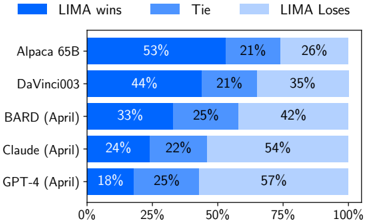
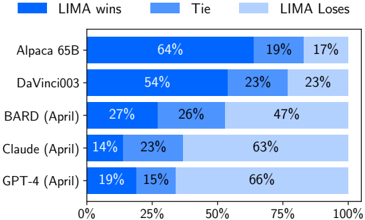
Large language models are trained in two stages: (1) unsupervised pretraining from raw text, to learn general-purpose representations, and (2) large scale instruction tuning and reinforcement learning, to better align to end tasks and user preferences. We measure the relative importance of these two stages by training LIMA, a 65B parameter LLaMa language model fine-tuned with the standard supervised loss on only 1,000 carefully curated prompts and responses, without any reinforcement learning or human preference modeling. LIMA demonstrates remarkably strong performance, learning to follow specific response formats from only a handful of examples in the training data, including complex queries that range from planning trip itineraries to speculating about alternate history. Moreover, the model tends to generalize well to unseen tasks that did not appear in the training data. In a controlled human study, responses from LIMA are either equivalent or strictly preferred to GPT-4 in 43% of cases; this statistic is as high as 58% when compared to Bard and 65% versus DaVinci003, which was trained with human feedback. Taken together, these results strongly suggest that almost all knowledge in large language models is learned during pretraining, and only limited instruction tuning data is necessary to teach models to produce high quality output.
Overview
The claims and statistics of this paper haven’t been checked yet.
Free: it reads the open-access text and checks the first 5 claims that cite a source we can check. Create a free account to check every claim.
Integrity signals
Registry
Cites
Statistics
Figures
Verification
Claims the paper makes
The claims and statistics of this paper haven’t been checked yet.
Free: it reads the open-access text and checks the first 5 claims that cite a source we can check. Create a free account to check every claim.
Claims other papers make about this one
Each is checked against this paper’s own text: does it say what the citing paper says it does?
The source backs part of the claim, not all of it — or backs it for a different population, condition or comparison.
In the citing paper
“However, when focusing specifically on a single task or narrow set of tasks, far fewer instruction instances may suffice.”
From A Survey of Large Language Models (2026) · cites this paper as [195]
Experimental — accuracy not yet measuredThe source backs part of the claim, not all of it — or backs it for a different population, condition or comparison.
In the citing paper
“Recent studies [323] show that the knowledge within LLMs is almost entirely acquired during pretraining.”
From Survey of Hallucination in Natural Language Generation (2023) · cites this paper as [323]
Experimental — accuracy not yet measuredThe source backs part of the claim, not all of it — or backs it for a different population, condition or comparison.
In the citing paper
“Redundancy and Inefficient Use of Information: Treating all N training samples ( x i , y i ) in D train as equally informative is inefficient, as the number of truly effective samples N eff is often much smaller than N (i.e., N eff ≪ N ) (Zhou et al., 2023).”
From TT-SI: Self-Improving LLM Agents with Test-Time Training (2026) · cites this paper as Zhou et al., 2023
Experimental — accuracy not yet measuredThe source backs part of the claim, not all of it — or backs it for a different population, condition or comparison.
In the citing paper
“Nevertheless, smaller datasets can be vital in enabling key post -training techniques such as fine-tuning, in-context learning, and prompt engineering (cf. [86, 122]).”
From Engaging Communities Meaningfully in Defining Disability Representation for AI Image Generation (2026) · cites this paper as [122]
Experimental — accuracy not yet measuredThe cited source says what the claim attributes to it.
In the citing paper
“For example, the authors of LIMA collected a diverse dataset of 1,000 carefully curated prompts and responses which are aligned with each other [323].”
From Survey of Hallucination in Natural Language Generation (2023) · cites this paper as [323]
3 more claims about this paper
Create a free account to see every claim other papers make about this one.
Self-check
Percentages, sums and reported differences re-computed from the paper’s own numbers.
The self-check needs the paper’s full text.
Citations
Cites
The publisher hasn’t deposited this paper’s reference list.
Research works printed but not linked: 7
- Yuntao Bai, Saurav Kadavath, Sandipan Kundu, Amanda Askell, Jackson Kernion, Andy Jones, Anna Chen, Anna Goldie, Azalia Mirhoseini, Cameron McKinnon, et al. Constitutional ai: Harmlessness from ai feedback. arXiv preprint arXiv:2212.08073, 2022b. · arXiv
- Ari Holtzman, Jan Buys, Li Du, Maxwell Forbes, and Yejin Choi. The curious case of neural text degeneration. In International Conference on Learning Representations, 2019.
- Yuval Kirstain, Patrick Lewis, Sebastian Riedel, and Omer Levy. A few more examples may be worth billions of parameters. arXiv preprint arXiv:2110.04374, 2021. · arXiv
- Long Ouyang, Jeffrey Wu, Xu Jiang, Diogo Almeida, Carroll Wainwright, Pamela Mishkin, Chong Zhang, Sandhini Agarwal, Katarina Slama, Alex Ray, et al. Training language models to follow instructions with human feedback. Advances in Neural Information Processing Systems, 35: 27730-27744, 2022.
- Victor Sanh, Albert Webson, Colin Raffel, Stephen Bach, Lintang Sutawika, Zaid Alyafeai, Antoine Chaffin, Arnaud Stiegler, Teven Le Scao, Arun Raja, et al. Multitask prompted training enables zero-shot task generalization. In The Tenth International Conference on Learning Representations, 2022.
- Yizhong Wang, Swaroop Mishra, Pegah Alipoormolabashi, Yeganeh Kordi, Amirreza Mirzaei, Anjana Arunkumar, Arjun Ashok, Arut Selvan Dhanasekaran, Atharva Naik, David Stap, et al. Super-naturalinstructions:generalization via declarative instructions on 1600+ tasks. In EMNLP, 2022b.
- Jason Wei, Maarten Bosma, Vincent Zhao, Kelvin Guu, Adams Wei Yu, Brian Lester, Nan Du, Andrew M Dai, and Quoc V Le. Finetuned language models are zero-shot learners. In International Conference on Learning Representations, 2022a.
Cited by
Items 401–500 of 938
Wang, H.-Y., Gao, C.-F., Liu, B.-L., Xu, Q., Hussein, G., Labban, M. E., Iheasirim, K., Korsapati, H., Outcalt, C., & Sun, J.-M. (2024) · arXiv.org · doi:10.48550/arxiv.2405.00715 · Cited by 3
“This phase is considered a knowledge injection process, given that LLMs acquire the vast majority of their knowledge during the pre-training phase (Ovadia et al., 2023; Zhou et al., 2023a).”
Self-citationA Comprehensive Review on Harnessing Large Language Models to Overcome Recommender System ChallengesPreprint
Raja, R., Vats, A., Vats, A., & Majumder, A. (2025) · SSRN Electronic Journal · doi:10.2139/ssrn.5359269 · Cited by 13
Towards Safeguarding LLM Fine-tuning APIs against Cipher AttacksPreprint
Youstra, J., Mahfoud, M., Yan, Y., Sleight, H., Perez, E., & Sharma, M. (2025) · arXiv.org · doi:10.48550/arxiv.2508.17158 · Cited by 13
FireAct: Toward Language Agent Fine-tuning
Chen, B., Shu, C., Shareghi, E., Collier, N., Narasimhan, K., & Yao, S. (2023) · arXiv · doi:10.48550/arxiv.2310.05915 · Cited by 9
“…et al., 2023; Xu et al., 2023; Muennighoff et al., 2023; Ouyang et al., 2022), parameter-efficient fine-tuning methods (Hu et al., 2022; Ding et al., 2023; Lv et al., 2023; Dettmers et al., 2023; Ivison et al., 2023), and data selection principles (Zhou et al., 2023a; Gunasekar et al., 2023).”
DeliLaw: A Chinese Legal Counselling System Based on a Large Language Model
Xie, N., Bai, Y., Gao, H., Xue, Z., Fang, F., Zhao, Q., Li, Z., Zhu, L., Ni, S., & Yang, M. (2024) · ACM International Conference on Information and Knowledge Management (CIKM) · doi:10.1145/3627673.3679219 · Cited by 17
“Some work [20] [2] has shown that when small samples of high-quality data are incorporated into the fine-tuning process, the performance and generalisation of the model can be significantly improved.”
Aligning large language models with human preferences using historical text edits
Majkutewicz, J., & Szymański, J. (2025) · Knowledge-Based Systems · doi:10.1016/j.knosys.2025.113566 · Cited by 9
TAGCOS: Task-agnostic Gradient Clustered Coreset Selection for Instruction Tuning Data
Zhang, J., Qin, Y., Pi, R., Zhang, W., Pan, R. N., & Zhang, T. (2025) · Findings of the Association for Computational Linguistics: NAACL · doi:10.18653/v1/2025.findings-naacl.264 · Cited by 20
Revisiting Instruction Fine-tuned Model Evaluation to Guide Industrial Applications
Faysse, M., Viaud, G., Hudelot, C., & Colombo, P. (2023) · Conference on Empirical Methods in Natural Language Processing (EMNLP) · doi:10.18653/v1/2023.emnlp-main.559 · Cited by 20
“Researchers primarily concentrate on improving general-purpose IFT models to be used as versatile agents capable of executing instructions expressed in natural language (Li et al., 2023; Zhou et al., 2023; Xu et al., 2023a).”
BackgroundPILLOW: Enhancing Efficient Instruction Fine-tuning via Prompt Matching
Qi, Z., Tan, X., Shi, S., Qu, C. Y., Xu, Y., & Qi, Y. (2023) · Conference on Empirical Methods in Natural Language Processing (EMNLP) · doi:10.18653/v1/2023.emnlp-industry.45 · Cited by 17
Li, C., Yang, W. T., Zhang, J., Lu, J., Wang, S., & Zong, C. (2024) · Findings of the Association for Computational Linguistics: ACL (Findings of ACL) · doi:10.18653/v1/2024.findings-acl.30 · Cited by 34
WIBA: What Is Being Argued? A Comprehensive Approach to Argument Mining
Irani, A., Park, J. Y., Esterling, K., & Faloutsos, M. (2025) · Lecture notes in computer science · doi:10.1007/978-3-031-78541-2_21 · Cited by 11
RuleR: Improving LLM Controllability by Rule-based Data Recycling
Li, M., Chen, H., Wang, C., Nguyen, D. T., Li, D., & Zhou, T. (2025) · Conference of the North American Chapter of the Association for Computational Linguistics: Human Language Technologies (NAACL-HLT) · doi:10.18653/v1/2025.naacl-short.78 · Cited by 15
Exploring Format Consistency for Instruction Tuning
Liang, S., Tian, R., Zhu, K., Qin, Y., Wang, H., Cong, X., Liu, Z., Liu, X., & Sun, M. (2024) · Transactions on machine learning research · doi:10.48550/arxiv.2307.15504 · Cited by 16
Dynamics of Instruction Fine-Tuning for Chinese Large Language ModelsPreprint
Song, C., Zhou, Z., Yan, J., Fei, Y., Lan, Z., & Zhang, Y. (2023) · arXiv · doi:10.48550/arxiv.2310.19651 · Cited by 9
Kim, T., Kim, J., Lee, G., & Yun, S.-Y. (2024) · International Conference on Learning Representations · doi:10.48550/arxiv.2311.00233 · Cited by 28
Learning Beyond Pattern Matching? Assaying Mathematical Understanding in LLMsPreprint
Guo, S., Didolkar, A., Ke, N. R., Goyal, A., Huszár, F., & Schölkopf, B. (2024) · arXiv (Cornell University) · doi:10.48550/arxiv.2405.15485 · Cited by 10
Multitask Mayhem: Unveiling and Mitigating Safety Gaps in LLMs Fine-tuningPreprint
Jan, E., AlDahoul, N., Ali, M., Ahmad, F., Zaffar, F., & Zaki, Y. (2024) · arXiv (Cornell University) · doi:10.48550/arxiv.2409.15361 · Cited by 11
“To evaluate the guardrails of the LLM models, and inspired by the work of Zhou et al. (2023) and Qi et al. (2023), we developed a GPT-4o judge that evaluates a given query-response pair to determine whether the LLM has answered or rejected the prompt.”
MethodMSR-Align: Policy-Grounded Multimodal Alignment for Safety-Aware Reasoning in Vision-Language ModelsPreprint
Xia, Y., Jiang, Y., Tan, Y. H., Zhu, X., Yue, X., & Zheng, B. (2025) · arXiv (Cornell University) · doi:10.48550/arxiv.2506.19257 · Cited by 11
Yang, X., Yu, E., Duan, W., & Lü, J. (2026) · International Conference on Machine Learning · doi:10.48550/arxiv.2510.04142 · Cited by 14
Beyond Scaling Law: A Data-Efficient Distillation Framework for ReasoningPreprint
Wu, X., Jiang, X., Li, H., Zhai, J., Liu, D., Hao, Q., Liu, H., Yang, Z., Xie, J., Gu, N., et al. (2025) · arXiv (Cornell University) · doi:10.48550/arxiv.2508.09883 · Cited by 15
Agent2World: Learning to Generate Symbolic World Models via Adaptive Multi-Agent FeedbackPreprint
Hu, M., Xia, B., Wu, Y., Yu, A., Zou, Y., Chen, Q., Wang, S., Jin, J., Li, K., Jiao, W., et al. (2025) · arXiv · doi:10.48550/arxiv.2512.22336 · Cited by 11
Camels in a Changing Climate: Enhancing LM Adaptation with Tulu 2
Ivison, H., Wang, Y., Pyatkin, V., Lambert, N., Peters, M., Dasigi, P., Jang, J., Wadden, D., Smith, N. A., Beltagy, I., et al. (2023) · arXiv · doi:10.48550/arxiv.2311.10702 · Cited by 8
Physics of Language Models: Part 3.2, Knowledge Manipulation
Allen-Zhu, Z., & Li, Y. (2025) · doi:10.2139/ssrn.5250621 · Cited by 8
Understanding Misunderstandings: Evaluating LLMs on Networking Questions
Anwar, M., & Caesar, M. (2024) · ACM SIGCOMM Computer Communication Review · doi:10.1145/3717512.3717515 · Cited by 11
Optical image processing and applications empowered by vision-language models
Xiao, J., Sun, Z., An, H., Zhao, H., Qiu, M., & Li, X. (2025) · iOptics · doi:10.1016/j.iopt.2025.100003 · Cited by 10
Uncensored AI in the Wild: Tracking Publicly Available and Locally Deployable LLMs
Sokhansanj, B. A. (2025) · Future Internet · doi:10.3390/fi17100477 · Cited by 13
Wu, J., Chen, C., Hou, C., & Yuan, X. (2025) · Findings of the Association for Computational Linguistics: EMNLP (Findings of EMNLP) · doi:10.18653/v1/2025.findings-emnlp.450 · Cited by 10
Knowledge graph construction for intelligent cockpits based on large language models
Dong, H., Wang, W., Sun, Z., Kang, Z., Ge, X., Gao, F., & Wang, J. (2025) · Scientific Reports · doi:10.1038/s41598-025-92002-y · Cited by 10
IterSelectTune: An Iterative Data Selection Framework for Efficient Instruction Tuning
Song, J., Liu, S., Zhu, B., & Rao, Y. (2025) · Lecture notes in computer science · doi:10.1007/978-981-95-0014-7_28 · Cited by 8
Rethinking Pruning for Vision-Language Models: Strategies for Effective Sparsity
He, S., Li, A., & Chen, T. (2025) · ACM SIGMETRICS Performance Evaluation Review · doi:10.1145/3764944.3764948 · Cited by 12
“This suggests that a small amount of data is sufficient to restoration the pruned vision-language models, leveraging the knowledge and capabilities acquired during pretraining (Zhou et al., 2023).”
Unveiling the Learning Mind of Language Models: A Cognitive Framework and Empirical Study
Hu, Z., Lian, J., Xiao, Z., Zhang, S., Wang, T., Yuan, N. J., Xie, X., & Xiong, H. (2025) · neural information processing systems · doi:10.52202/085713-5760 · Cited by 9
Self-citationCan Language Model Moderators Improve the Health of Online Discourse?
Cho, H. J., Liu, S., Shi, T., Jain, D., Rizk, B., Huang, Y., Lu, Z., Wen, N., Gratch, J. S., Ferrara, E., et al. (2024) · Conference of the North American Chapter of the Association for Computational Linguistics: Human Language Technologies (NAACL-HLT) · doi:10.18653/v1/2024.naacl-long.415 · Cited by 23
Hirano, M., & Imajo, K. (2024) · IIAI International Conference on Advanced Applied Informatics · doi:10.1109/iiai-aai63651.2024.00059 · Cited by 5
“However, according to superficial alignment hypothesis [41], those tuning methods might not be effective for domain-specific tuning because the tuning focusing on the alignment cannot learn new knowledge.”
BackgroundLeveraging Unstructured Text Data for Federated Instruction Tuning of Large Language Models
Ye, R., Ge, R., Yuchi, F., Chai, J., Wang, Y., & Chen, S. (2025) · Lecture notes in computer science · doi:10.1007/978-3-031-82240-7_9 · Cited by 14
Untangle the KNOT: Interweaving Conflicting Knowledge and Reasoning Skills in Large Language Models
Liu, Y., Yao, Z., Lv, X., Fan, Y., Cao, S., Yu, J., Hou, L., & Li, J. (2024) · Language Resources and Evaluation Conference (LREC) · doi:10.63317/2ijvxpd8x2eu · Cited by 19
Seeking Neural Nuggets: Knowledge Transfer in Large Language Models from a Parametric Perspective
Zhong, M., An, C., Chen, W., Han, J., & He, P. (2024) · International Conference on Learning Representations · doi:10.48550/arxiv.2310.11451 · Cited by 13
Quokka: An Open-source Large Language Model ChatBot for Material SciencePreprint
Yang, X., Wilson, S. D., & Petzold, L. R. (2024) · arXiv (Cornell University) · doi:10.48550/arxiv.2401.01089 · Cited by 11
Redefining Information Retrieval of Structured Database via Large Language ModelsPreprint
Wang, M., Zhang, Y., Zhao, Q., Yang, J., & Zhang, H. (2024) · arXiv (Cornell University) · doi:10.48550/arxiv.2405.05508 · Cited by 10
“Prior research has highlighted the significance of sample quality over quantity in fine-tuning LLMs [42].”
Lee, S., Seo, G., Lee, D., Ko, B., Jung, S., & Shin, M. (2024) · arXiv (Cornell University) · doi:10.48550/arxiv.2411.14054 · Cited by 10
FILA: Fine-Grained Vision Language ModelsPreprint
Zhu, S., Dong, W., Song, J., Wang, Y., Guo, Y., & Zheng, B. (2024) · arXiv (Cornell University) · doi:10.48550/arxiv.2412.08378 · Cited by 8
Dynamic Normativity: Necessary and Sufficient Conditions for Value Alignment
Corrêa, N. K. (2024) · LA Referencia (Red Federada de Repositorios Institucionales de Publicaciones Científicas) · doi:10.48550/arxiv.2406.11039 · Cited by 8
A Brief Overview: On-Policy Self-Distillation In Large Language ModelsPreprint
Cui, F.-M., Li, S., & Li, J.-H. (2026) · arXiv.org · doi:10.48550/arxiv.2605.18141 · Cited by 8
“SFT (Supervised Fine-Tuning) involves directly mimicking expert trajectories, which is straightforward and efficient [19, 33, 46, 63].”
MetaTool Benchmark for Large Language Models: Deciding Whether to Use Tools and Which to Use
Huang, Y., Shi, J., Li, Y., Fan, C., Wu, S., Zhang, Q., Liu, Y., Zhou, P., Wan, Y., Gong, N. Z., et al. (2023) · arXiv · doi:10.48550/arxiv.2310.03128 · Cited by 7
“As for negative samples, we select three recent instruction datasets, including instructions about downstream tasks (Wang et al., 2022), common-sense questions (Talmor et al., 2019), and high-quality instructions used in LIMA (Zhou et al., 2023b).”
InfluentialWhen does In-context Learning Fall Short and Why? A Study on Specification-Heavy Tasks
Peng, H., Wang, X., Chen, J., Li, W., Qi, Y., Wang, Z., Wu, Z., Zeng, K., Xu, B., Hou, L., et al. (2023) · arXiv · doi:10.48550/arxiv.2311.08993 · Cited by 7
Mehta, S., Deichler, A., O’Regan, J., Moëll, B., Beskow, J., Henter, G. E., & Alexanderson, S. (2024) · 2024 IEEE/CVF Conference on Computer Vision and Pattern Recognition Workshops (CVPRW) · doi:10.1109/cvprw63382.2024.00201 · Cited by 7
Refining medical large language models: key insights from instruction tuning
Alqahtani, M. Q., Al-Barakati, A. A., & Alotaibi, F. S. (2025) · PeerJ Computer Science · doi:10.7717/peerj-cs.3216 · Cited by 7
LIRE: listwise reward enhancement for preference alignment
Zhu, M., Liu, Y., Zhang, L., Guo, J., & Mao, Z. (2024) · Findings of the Association for Computational Linguistics: ACL (Findings of ACL) · doi:10.18653/v1/2024.findings-acl.201 · Cited by 11
Jiao, T., Zhang, J., Xu, K., Li, R., Du, X., Wang, S., & Song, Z.-B. (2024) · AAAI Fall Symposia · doi:10.1609/aaaiss.v4i1.31771 · Cited by 18
“The capabilities of Large Language Model (LLM) based chat assistants to follow instructions and learn to align with human preferences have gained significant interest (Ouyang et al. 2022; Zhou et al. 2023).”
Beyond Facts: Evaluating Intent Hallucination in Large Language Models
Hao, Y., Yu, H., & You, J. (2025) · Proceedings of the conference - Association for Computational Linguistics. Meeting · doi:10.18653/v1/2025.acl-long.349 · Cited by 15
PiSA: A Self-Augmented Data Engine and Training Strategy for 3D Understanding with Large Models
Guo, Z., Lin, H., Yuan, Z., Zheng, C., Qiu, P., Jiang, D., Zhang, R., Feng, C.-M., & Li, Z. (2026) · IEEE Winter Conference on Applications of Computer Vision · doi:10.1109/wacv61042.2026.00130 · Cited by 9
Towards efficient large language models for scientific data: a review
To, H. Q., Huang, G., Wang, J., & Liu, M. (2026) · Artificial Intelligence Review · doi:10.1007/s10462-026-11727-y · Cited by 8
Analyzing Pre-trained and Fine-tuned Language Models
Mosbach, M. (2023) · BIGPICTURE · doi:10.18653/v1/2023.bigpicture-1.10 · Cited by 11
“Recently however, driven by work on instruction fine-tuning (Sanh et al., 2022; Wang et al., 2022, inter alia ) and alignment to human preferences (Ouyang et al., 2022; Zhou et al., 2023, inter alia ), fine-tuning 1 is again gaining significant interest from the NLP research community.”
BackgroundChen, D.-W., Wang, S., Fan, Z., Hu, X.-P., & Li, C.-M. (2024) · International Conferences on Smart Internet of Things · doi:10.1109/smartiot62235.2024.00056 · Cited by 5
“Various methods for supporting hallucination alleviation have been proposed so far, focusing on data, model training, etc. Zhou et al. [13] and Tian et al. [14] utilize novel strategie of filter to select high-quality data for training models with less hallucination.”
AdGPT: Explore Meaningful Advertising with ChatGPT
Huang, J., Qu, M., Li, L., & Wei, Y. (2025) · ACM Transactions on Multimedia Computing Communications and Applications · doi:10.1145/3720546 · Cited by 9
“ChatGPT rating is a widely used method for evaluating LLMs [Peng et al., 2023; Sun et al., 2023; Wang et al., 2023d; Zhou et al., 2023].”
MM‐LIMA: Less Is More for Alignment in Multi‐Modal Datasets
Wei, L., Li, X., Jiang, Z., Huang, W., & Sun, L. (2025) · Artificial Intelligence for Engineering · doi:10.1049/aie2.70001 · Cited by 8
covLLM: Large Language Models for COVID-19 Biomedical Literature
Khan, Y. A., Hokia, C., Xu, J., & Ehlert, B. (2023) · arXiv · doi:10.48550/arxiv.2306.04926 · Cited by 7
Wang, Y., Wang, X., Li, J., Chang, J., Zhang, Q., Liu, Z., Zhang, G., & Zhang, M. (2023) · arXiv (Cornell University) · doi:10.48550/arxiv.2308.12711 · Cited by 9
TechGPT-2.0: A large language model project to solve the task of knowledge graph constructionPreprint
Wang, J., Chang, Y., Li, Z., An, N., Qi, M., Hei, L., Luo, H., Lu, Y., & Ren, F. (2024) · arXiv (Cornell University) · doi:10.48550/arxiv.2401.04507 · Cited by 13
Optimizing Instruction Synthesis: Effective Exploration of Evolutionary Space with Tree SearchPreprint
Li, C., Chen, Q., Li, Z., Tao, F., Li, Y., Chen, H., Yu, F., & Zhang, Y. (2024) · arXiv (Cornell University) · doi:10.48550/arxiv.2410.10392 · Cited by 7
“Recent efforts have extended into open-domain IT, characterized by a wide range of formats and task types, driven by crowdsourced human-generated instruction-response pairs (Köpf et al.; Conover et al., 2023; Zhang et al., 2023a; Peng et al., 2023; Zhou et al., 2023b).”
BackgroundInfluentialRNR: Teaching Large Language Models to Follow Roles and RulesPreprint
Wang, K., Bukharin, A., Jiang, H., Yin, Q., Wang, Z., Zhao, T., Shang, J., Zhang, C., Yin, B., Li, X., et al. (2024) · arXiv (Cornell University) · doi:10.48550/arxiv.2409.13733 · Cited by 7
Zhang, Y., Chang, Z., Cai, W., Ren, M., Yuan, K., Sun, Y., & Ding, Z. (2025) · arXiv (Cornell University) · doi:10.48550/arxiv.2501.02869 · Cited by 7
Aligning Instruction Tuning with Pre-trainingPreprint
Liang, Y., Zheng, T., Du, X., Zhang, G., Liu, J., Qu, X., Zu, W., Xing, X., Zheng, C., Ma, L., et al. (2025) · arXiv (Cornell University) · doi:10.48550/arxiv.2501.09368 · Cited by 8
Balancing Truthfulness and Informativeness with Uncertainty-Aware Instruction Fine-TuningPreprint
Wu, T., Ni, J., Hooi, B., Zhang, J., Ash, E., Ng, S.-K., Sachan, M., & Leippold, M. (2025) · arXiv (Cornell University) · doi:10.48550/arxiv.2502.11962 · Cited by 8
“To facilitate informativeness measurement on FactScore and WildFactScore’s benchmark prompts, we adapt the MT-Bench (Zhou et al., 2023) pairwise LLM-judge format, which, although originally designed to assess general helpfulness, is well-suited for our needs.”
InfluentialUQ: Assessing Language Models on Unsolved QuestionsPreprint
Nie, F., Liu, K. Z., Wang, Z., Sun, R., Liu, W., Shi, W., Yao, H., Zhang, L., Ng, A. Y., Zou, J., et al. (2025) · arXiv (Cornell University) · doi:10.48550/arxiv.2508.17580 · Cited by 13
MARCH: Multi-Agent Reinforced Self-Check for LLM HallucinationPreprint
Li, Z., Zhang, Y., Cheng, P., Song, J., Zhou, M., Li, H., Hu, S., Qin, Y., Zhao, E., Jiang, X., et al. (2026) · arXiv · doi:10.48550/arxiv.2603.24579 · Cited by 11
From Chatbot to Digital Colleague: The Paradigm Shift Toward Persistent Autonomous AIPreprint
Zhang, Y., Liu, Z., Zhu, J., Wang, S., Chen, X., Huang, H., Kuang, J., Chen, S., Shen, A., Wu, H., et al. (2026) · arXiv · doi:10.48550/arxiv.2606.14502 · Cited by 9
Self-citationA Framework for Evaluating AI Agents in Open-Ended Conversations via Scripted Simulation
Wang, C., Shi, Y., & Xiao, X. (2025) · ACM SIGKDD Conference on Knowledge Discovery and Data Mining (KDD) · doi:10.1145/3711896.3737390 · Cited by 8
Koutcheme, C., Woodrow, J., & Piech, C. (2026) · ACM Technical Symposium on Computer Science Education (SIGCSE) · doi:10.1145/3770762.3772539 · Cited by 6
“Zhou et al. [36] posits that fine-tuning reorganizes existing knowledge to match task expectations, but that most of a model’s core capabilities come from pretraining.”
PEAR: Pixel-aligned Expressive humAn mesh Recovery
Wu, J., Liu, Y., Lin, L., Zhu, Y. P., Zhu, L., Li, J., & Li, Y. (2026) · ACM SIGGRAPH Conference (SIGGRAPH) · doi:10.1145/3799902.3811096 · Cited by 8
Test-Time Self-Adaptive Small Language Models for Question Answering
Jeong, S., Baek, J., Cho, S., Hwang, S., & Park, J. (2023) · Findings of the Association for Computational Linguistics: EMNLP (Findings of EMNLP) · doi:10.18653/v1/2023.findings-emnlp.1033 · Cited by 11
CQuAE: A new Contextualized QUestion Answering corpus on Education domain
Gerald, T., Tamames, L., Ettayeb, S., Le, H.-Q., Paroubek, P., & Vilnat, A. (2024) · Data & Knowledge Engineering · doi:10.1016/j.datak.2024.102305 · Cited by 7
Seed-Free Synthetic Data Generation Framework for Instruction-Tuning LLMs: A Case Study in Thai
Pengpun, P., Udomcharoenchaikit, C., Buaphet, W., & Limkonchotiwat, P. (2024) · Proceedings of the conference - Association for Computational Linguistics. Meeting · doi:10.18653/v1/2024.acl-srw.38 · Cited by 15
“Zhou et al. (2023) explored constructing a high-quality 1000 sample instruction-tuning data using data from StackExchange, Wikihow, and other on-line sources.”
InfluentialEnhancing AI-based Generation of Software Exploits with Contextual Information
Liguori, P., Improta, C., Natella, R., Čukić, B., & Cotroneo, D. (2024) · Proceedings/Proceedings - International Symposium on Software Reliability Engineering · doi:10.1109/issre62328.2024.00027 · Cited by 9
“Finally, we note that the size of the data used for the experiments is in line with other state-of-the-art corpora used to fine-tune models, which are relatively limited, i.e., in the order of one thousand samples [39].”
EduChat: A Large Language Model-Based Conversational Agent for Intelligent Education
Dan, Y., Lei, Z., Gu, Y., Li, Y., Yin, J., Lin, J., Ye, L., Tie, Z., Zhou, Y., Wang, Y., et al. (2025) · Communications in computer and information science · doi:10.1007/978-981-96-1809-5_22 · Cited by 15
Pei, F., Lin, Y., Liu, J., Zhuang, C., & Zhai, S. (2025) · Chinese Journal of Mechanical Engineering · doi:10.1186/s10033-025-01275-x · Cited by 7
Li, Z., Du, Y. P., Jiao, X., Guo, S. Y., Feng, Y., Wan, X., Gao, A., & Hu, J. (2025) · Conference on Empirical Methods in Natural Language Processing (EMNLP) · doi:10.18653/v1/2025.emnlp-main.270 · Cited by 11
The Vault: A Comprehensive Multilingual Dataset for Advancing Code Understanding and Generation
Manh, D. N., Hai, N. L., Dau, A. T. V., Nguyen, A. M., Nghiem, K., Guo, J., & Bui, N. D. Q. (2023) · Workshop for NLP Open Source Software (NLP-OSS) · doi:10.18653/v1/2023.nlposs-1.25 · Cited by 9
Bridging the Language Gap: Domain-Specific Dataset Construction for Medical LLMs
Kim, C., Kim, S. Y., Cho, S. H., & Kim, Y.-M. (2024) · Communications in computer and information science · doi:10.1007/978-981-97-6125-8_11 · Cited by 7
LIONs: An Empirically Optimized Approach to Align Language Models
Yu, X., Wu, Q., Li, Y., & Yu, Z. (2024) · Conference on Empirical Methods in Natural Language Processing (EMNLP) · doi:10.18653/v1/2024.emnlp-main.496 · Cited by 9
SLM as Guardian: Pioneering AI Safety with Small Language Model
Kwon, O., Jeon, D., Choi, N., Cho, G.-H., Jo, H., Kim, C., Lee, H., Kang, I., Kim, S., & Park, T. (2024) · Conference on Empirical Methods in Natural Language Processing · doi:10.18653/v1/2024.emnlp-industry.99 · Cited by 11
“This is with 110K instruction and answer pairs that we built following the methodology of Zhou et al. (2023) and Longpre et al. (2023).”
BackgroundMethodKwaiYiiMath: Technical ReportPreprint
Fu, J., Lin, L., Gao, X., Liu, P., Chen, Z., Yang, Z., Zhang, S., Zheng, X., Li, Y., Liu, Y., et al. (2023) · arXiv (Cornell University) · doi:10.48550/arxiv.2310.07488 · Cited by 8
“Previous work has shown that the diversity and quality of instruction data poses an important impact on the SFT performance Zhou et al. (2023); Peng et al. (2023); Chen et al. (2023), a conclusion that also holds true in LLMs’ mathematical reasoning ability Yuan et al. (2023); Luo et al. (2023a);…”
BackgroundSelf-citationInducing Political Bias Allows Language Models Anticipate Partisan Reactions to ControversiesPreprint
He, Z., Guo, S., Rao, A., & Lerman, K. (2023) · arXiv (Cornell University) · doi:10.48550/arxiv.2311.09687 · Cited by 9
Teaching Specific Scientific Knowledge into Large Language Models through Additional TrainingPreprint
Hatakeyama‐Sato, K., Igarashi, Y., Katakami, S., Nabae, Y., & Hayakawa, T. (2023) · arXiv (Cornell University) · doi:10.48550/arxiv.2312.03360 · Cited by 8
GUARD-D-LLM: An LLM-Based Risk Assessment Engine for the Downstream uses of LLMsPreprint
Narayanan, S., & Vishwakarma, S. (2024) · arXiv (Cornell University) · doi:10.48550/arxiv.2406.11851 · Cited by 10
“In the area of adaption of LLMs, advanced techniques such as leveraging large context length [9] [18] [37], and fine-tuning methods like instruction tuning [54], alignment tuning, & memory-efficient model adaptation [1] [20] [25] have emerged.”
MethodHarbola, C., & Purwar, A. (2025) · arXiv (Cornell University) · doi:10.48550/arxiv.2504.04569 · Cited by 6
“In their study on instruction fine-tuning, Zhou et al. [20] present LIMA, a large language model trained with just 1,000 carefully curated prompts and responses.”
Du, L. Z., Zhao, H., Ju, Y., & Pan, T. (2025) · arXiv (Cornell University) · doi:10.48550/arxiv.2507.06968 · Cited by 6
TailorSQL: An NL2SQL System Tailored to Your Query WorkloadPreprint
Vaidya, K., Ding, J., Kosak, S., Kernert, D., Lei, C., Qin, X., Tripathy, A., Balan, R., Narayanaswamy, B. M., & Kraska, T. (2025) · arXiv · doi:10.48550/arxiv.2505.23039 · Cited by 10
AssistanceZero: Scalably Solving Assistance GamesPreprint
Laidlaw, C., Bronstein, E., Guo, T., Feng, D., Berglund, L., Svegliato, J., Russell, S., & Dragan, A. D. (2025) · arXiv (Cornell University) · doi:10.48550/arxiv.2504.07091 · Cited by 12
Revealing the Power of Post-Training for Small Language Models via Knowledge DistillationPreprint
Rang, M., Bi, Z., Zhou, H., Chen, H., Xiao, A., Guo, T., Han, K., Chen, X., & Wang, Y. (2025) · arXiv (Cornell University) · doi:10.48550/arxiv.2509.26497 · Cited by 7
SkillCorpus: Consolidating and Evaluating the Open Skill Ecosystem for Real-World LLM AgentsPreprint
Wang, Y.-Z., Yao, P.-F., Sun, T.-Y., Hu, C.-R., Xiao, Y., Luo, X., Han, Y.-Y., Chen, Y.-F., Sun, J., & Deng, Y.-F. (2026) · arXiv.org · doi:10.48550/arxiv.2607.15557 · Cited by 6
Self-citationFLAME: Factuality-Aware Alignment for Large Language Models
Lin, S.-C., Gao, L., Oguz, B., Xiong, W., Lin, J., Yih, W.-T., & Chen, X. (2024) · arXiv · doi:10.48550/arxiv.2405.01525 · Cited by 6
“While this leads to strong instruction following capability (Zhou et al., 2023), our study shows that such human labeled responses may present new or unknown information to the LLM.”
InfluentialShepherd: A Critic for Language Model Generation
Wang, T., Yu, P., Tan, X. E., O'Brien, S., Pasunuru, R., Dwivedi-Yu, J., Golovneva, O., Zettlemoyer, L., Fazel-Zarandi, M., & Celikyilmaz, A. (2023) · arXiv · doi:10.48550/arxiv.2308.04592 · Cited by 5
Self-citationExeSQL: Self-Taught Text-to-SQL Models with Execution-Driven Bootstrapping for SQL Dialects
Zhang, J., Yang, H., Miao, K., Zhang, R., Pi, R., Gao, J., & Zhou, X. (2025) · Findings of the Association for Computational Linguistics: EMNLP (Findings of EMNLP) · doi:10.18653/v1/2025.findings-emnlp.1320 · Cited by 14
Yan, J., Liu, L., Pan, Y., Chen, S., Xiang, Y., & Tang, B. (2025) · Findings of the Association for Computational Linguistics: EMNLP (Findings of EMNLP) · doi:10.18653/v1/2025.findings-emnlp.413 · Cited by 6
Sebastian, J. L., Moon, J.-M., & Camburn, E. M. (2025) · AERA Open · doi:10.1177/23328584251389621 · Cited by 5
“While these smaller models may struggle with broad, general-purpose tasks, they can perform remarkably well on narrowly defined, specialized tasks (Hu et al., 2021; Zhou et al., 2023).”
Expert Evaluation and the Limits of Human Feedback in Mental Health AI Safety Testing
Meimandi, K. J., Rust, P. U. N., Eddy, D., Fraser, R., Vasan, N., Djordjevic, D., Dadlani, A., Lamparth, M., Kim, E., & Kochenderfer, M. J. (2026) · ACM Conference on Fairness, Accountability, and Transparency (FAccT) · doi:10.1145/3805689.3812332 · Cited by 13
Applying large language models to travel satisfaction analysis
Xu, P., & Wang, D. (2026) · Artificial Intelligence for Transportation · doi:10.1016/j.ait.2026.100079 · Cited by 6
Self-citationCRaSh: Clustering, Removing, and Sharing Enhance Fine-tuning without Full Large Language Model
Zhang, K., Ding, N., Qi, B., Zhu, X., Long, X., & Zhou, B. (2023) · Conference on Empirical Methods in Natural Language Processing (EMNLP) · doi:10.18653/v1/2023.emnlp-main.597 · Cited by 21
InfectA-Chat, an Arabic Large Language Model for Infectious Diseases: Comparative Analysis
Selcuk, Y., Kim, E., & Ahn, I. (2025) · JMIR Medical Informatics · doi:10.2196/63881 · Cited by 5
Sheik, R., Reji, S. A., Sharon, A., Avisha, M., & Nirmala, S. J. (2025) · Artificial Intelligence and Law · doi:10.1007/s10506-025-09459-5 · Cited by 5
Metadata
- Authors
- Zhou, C., Liu, P., Xu, P., Iyer, S., Sun, J., Mao, Y., Ma, X., Efrat, A., Yu, P., Yu, L., Zhang, S., Ghosh, G., Lewis, M., Zettlemoyer, L., & Levy, O.
- Venue
- Advances in Neural Information Processing Systems 36
- Published
- 2023
- Pages
- 55006-55021
- ISSN
- 1049-5258 (ISSN-L)
- OpenAlex
- W7133189643
- Semantic Scholar
- 546d0624adfc6e18fb87d8cc77e7705bb9ea7445
- Cited by
- 275
- References
- 0
- Citations by year
- 2026: 80 · 2025: 67 · 2024: 85 · 2023: 43
- FWCI
- 48.72
- Type
- conference paper
- Language
- en
- Open access
- green
- arxiv.org
- Licence
- cc-by
- Locations
- neural information processing systems (publishedVersion)
- arXiv (Cornell University) (submittedVersion, cc-by)
- arXiv (Cornell University) (cc-by)
- Topics
- Physical Sciences › Computer Science › Artificial Intelligence › Domain Adaptation and Few-Shot Learning
- Social Sciences › Education › Educational Assessment and Pedagogy
- Physical Sciences › Computer Science › Artificial Intelligence › Topic Modeling
- Keywords
- Lima, less is more, alignment, efficient large language models
About these checks
Registry, retraction, Cites and statistics results are computed, not judged, with one exception: a printed reference that no index lists is read once by a model before it counts as a citation error. Claims are extracted by a model and kept only when their quote appears verbatim in the text; each cited source is then checked, with a model’s help, for whether it says what the claim relies on. Those verdicts can be wrong — read the claim’s quote and the cited source before relying on one.
Statistics and arithmetic are recomputed, not judged.
Confidence bands are shown only for fields calibrated on our annotated test set. None is calibrated yet, so no band is shown.
What counts as a claim ›How we measure confidence ›How we check this ›
Are you an author, or do you see a problem with this page? Request a review
Data sources
Bibliographic data: Semantic Scholar, OpenAlex, Crossref.
Contains information from the Semantic Scholar Academic Graph Datasets, made available under the ODC Attribution License (ODC-BY 1.0).
Semantic Scholar’s data is described in: Kinney, R., et al. (2023). The Semantic Scholar Open Data Platform. arXiv:2301.10140.
