

LIMA: Less Is More for Alignment
Open accessThe DOI matches its Crossref record; 12 of the 12 references it cites were found in a registry or an index.
Abstract
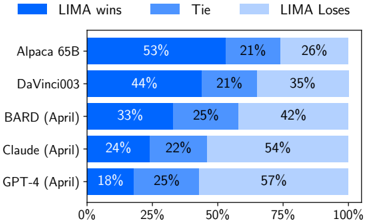
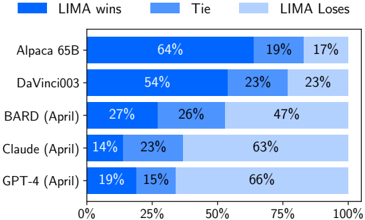
Large language models are trained in two stages: (1) unsupervised pretraining from raw text, to learn general-purpose representations, and (2) large scale instruction tuning and reinforcement learning, to better align to end tasks and user preferences. We measure the relative importance of these two stages by training LIMA, a 65B parameter LLaMa language model fine-tuned with the standard supervised loss on only 1,000 carefully curated prompts and responses, without any reinforcement learning or human preference modeling. LIMA demonstrates remarkably strong performance, learning to follow specific response formats from only a handful of examples in the training data, including complex queries that range from planning trip itineraries to speculating about alternate history. Moreover, the model tends to generalize well to unseen tasks that did not appear in the training data. In a controlled human study, responses from LIMA are either equivalent or strictly preferred to GPT-4 in 43% of cases; this statistic is as high as 58% when compared to Bard and 65% versus DaVinci003, which was trained with human feedback. Taken together, these results strongly suggest that almost all knowledge in large language models is learned during pretraining, and only limited instruction tuning data is necessary to teach models to produce high quality output.
Overview
The claims and statistics of this paper haven’t been checked yet.
Free: it reads the open-access text and checks the first 5 claims that cite a source we can check. Create a free account to check every claim.
Integrity signals
Registry
Cites
Statistics
Figures
Verification
Claims the paper makes
The claims and statistics of this paper haven’t been checked yet.
Free: it reads the open-access text and checks the first 5 claims that cite a source we can check. Create a free account to check every claim.
Claims other papers make about this one
Each is checked against this paper’s own text: does it say what the citing paper says it does?
The source backs part of the claim, not all of it — or backs it for a different population, condition or comparison.
In the citing paper
“However, when focusing specifically on a single task or narrow set of tasks, far fewer instruction instances may suffice.”
From A Survey of Large Language Models (2026) · cites this paper as [195]
Experimental — accuracy not yet measuredThe source backs part of the claim, not all of it — or backs it for a different population, condition or comparison.
In the citing paper
“Recent studies [323] show that the knowledge within LLMs is almost entirely acquired during pretraining.”
From Survey of Hallucination in Natural Language Generation (2023) · cites this paper as [323]
Experimental — accuracy not yet measuredThe source backs part of the claim, not all of it — or backs it for a different population, condition or comparison.
In the citing paper
“Redundancy and Inefficient Use of Information: Treating all N training samples ( x i , y i ) in D train as equally informative is inefficient, as the number of truly effective samples N eff is often much smaller than N (i.e., N eff ≪ N ) (Zhou et al., 2023).”
From TT-SI: Self-Improving LLM Agents with Test-Time Training (2026) · cites this paper as Zhou et al., 2023
Experimental — accuracy not yet measuredThe source backs part of the claim, not all of it — or backs it for a different population, condition or comparison.
In the citing paper
“Nevertheless, smaller datasets can be vital in enabling key post -training techniques such as fine-tuning, in-context learning, and prompt engineering (cf. [86, 122]).”
From Engaging Communities Meaningfully in Defining Disability Representation for AI Image Generation (2026) · cites this paper as [122]
Experimental — accuracy not yet measuredThe cited source says what the claim attributes to it.
In the citing paper
“For example, the authors of LIMA collected a diverse dataset of 1,000 carefully curated prompts and responses which are aligned with each other [323].”
From Survey of Hallucination in Natural Language Generation (2023) · cites this paper as [323]
3 more claims about this paper
Create a free account to see every claim other papers make about this one.
Self-check
Percentages, sums and reported differences re-computed from the paper’s own numbers.
The self-check needs the paper’s full text.
Citations
Cites
The publisher hasn’t deposited this paper’s reference list.
Research works printed but not linked: 7
- Yuntao Bai, Saurav Kadavath, Sandipan Kundu, Amanda Askell, Jackson Kernion, Andy Jones, Anna Chen, Anna Goldie, Azalia Mirhoseini, Cameron McKinnon, et al. Constitutional ai: Harmlessness from ai feedback. arXiv preprint arXiv:2212.08073, 2022b. · arXiv
- Ari Holtzman, Jan Buys, Li Du, Maxwell Forbes, and Yejin Choi. The curious case of neural text degeneration. In International Conference on Learning Representations, 2019.
- Yuval Kirstain, Patrick Lewis, Sebastian Riedel, and Omer Levy. A few more examples may be worth billions of parameters. arXiv preprint arXiv:2110.04374, 2021. · arXiv
- Long Ouyang, Jeffrey Wu, Xu Jiang, Diogo Almeida, Carroll Wainwright, Pamela Mishkin, Chong Zhang, Sandhini Agarwal, Katarina Slama, Alex Ray, et al. Training language models to follow instructions with human feedback. Advances in Neural Information Processing Systems, 35: 27730-27744, 2022.
- Victor Sanh, Albert Webson, Colin Raffel, Stephen Bach, Lintang Sutawika, Zaid Alyafeai, Antoine Chaffin, Arnaud Stiegler, Teven Le Scao, Arun Raja, et al. Multitask prompted training enables zero-shot task generalization. In The Tenth International Conference on Learning Representations, 2022.
- Yizhong Wang, Swaroop Mishra, Pegah Alipoormolabashi, Yeganeh Kordi, Amirreza Mirzaei, Anjana Arunkumar, Arjun Ashok, Arut Selvan Dhanasekaran, Atharva Naik, David Stap, et al. Super-naturalinstructions:generalization via declarative instructions on 1600+ tasks. In EMNLP, 2022b.
- Jason Wei, Maarten Bosma, Vincent Zhao, Kelvin Guu, Adams Wei Yu, Brian Lester, Nan Du, Andrew M Dai, and Quoc V Le. Finetuned language models are zero-shot learners. In International Conference on Learning Representations, 2022a.
Cited by
Huang, L., Yu, W., Ma, W., Zhong, W., Feng, Z., Wang, H., Chen, Q., Peng, W., Feng, X., Qin, B., et al. (2025) · ACM Transactions on Information Systems · doi:10.1145/3703155 · Cited by 4,688
“Pre-training is generally considered a crucial stage for LLM to acquire knowledge and skills (Zhou et al., 2023a).”
Survey of Hallucination in Natural Language Generation
Ji, Z., Lee, N., Frieske, R., Yu, T., Su, D., Xu, Y., Ishii, E., Bang, Y. J., Madotto, A., & Fung, P. (2023) · ACM Computing Surveys · doi:10.1145/3571730 · Cited by 5,025
Llama 2: Open Foundation and Fine-Tuned Chat Models
Touvron, H., Martin, L., Stone, K., Albert, P., Almahairi, A., Babaei, Y., Bashlykov, N., Batra, S., Bhargava, P., Bhosale, S., et al. (2023) · arXiv · doi:10.48550/arxiv.2307.09288 · Cited by 2,604
Self-citationChen, Z., Wang, W., Cao, Y., Liu, Y., Gao, Z., Cui, E., Zhu, J., Ye, S., Tian, H., Liu, Z., et al. (2024) · arXiv · doi:10.48550/arxiv.2412.05271 · Cited by 2,204
A Survey of Large Language Models
Zhao, W. X., Zhou, K., Li, J., Tang, T., Dong, Z., Hou, Y., Zhang, B., Min, Y., Zhang, J., Liu, P., et al. (2026) · Frontiers of Computer Science · doi:10.1007/s11704-026-60308-3 · Cited by 2,093
Self-citationJudging LLM-as-a-Judge with MT-Bench and Chatbot Arena
Zheng, L., Chiang, W.-L., Sheng, Y., Zhuang, S., Wu, Z., Zhuang, Y., Lin, Z., Li, Z., Li, D., Xing, E. P., et al. (2023) · arXiv · doi:10.48550/arxiv.2306.05685 · Cited by 1,888
Improved Baselines with Visual Instruction Tuning
Liu, H., Li, C., Li, Y., & Lee, Y. J. (2024) · 2024 IEEE/CVF Conference on Computer Vision and Pattern Recognition (CVPR) · doi:10.1109/cvpr52733.2024.02484 · Cited by 1,748
“In NLP, studies show that the quality of instruction-following data largely affects the capability of the resulting instruction-following models [48].”
BackgroundImproved Baselines with Visual Instruction Tuning
Liu, H., Li, C., Li, Y., & Lee, Y. J. (2023) · arXiv · doi:10.48550/arxiv.2310.03744 · Cited by 1,733
“In NLP, studies show that the quality of instruction-following data largely affects the capability of the resulting instruction-following models [48].”
BackgroundInstruction Tuning for Large Language Models: A Survey
Zhang, S., Dong, L., Li, X., Zhang, S., Sun, X., Wang, S., Li, J., Hu, R., Zhang, T., Wang, G., et al. (2026) · ACM Computing Surveys · doi:10.1145/3777411 · Cited by 182
“For automatic evaluation, which is conducted by asking GPT-4 to rate responses and a higher rate score denotes better performance, LIMA outperforms InstructGPT and Alpaca by 20% and 36%, respectively, achieving comparable results to BARD, while underperforming Claude and GPT-4.”
InfluentialSelf-citationA Comprehensive Overview of Large Language Models
Naveed, H., Khan, A. U., Qiu, S., Saqib, M., Anwar, S., Usman, M., Akhtar, N., Barnes, N., & Mian, A. (2025) · ACM Transactions on Intelligent Systems and Technology · doi:10.1145/3744746 · Cited by 1,257
“Less is more for alignment (LIMA) [166] uses only 1000 carefully created demonstrations to fine-tune the model and has achieved comparable performance to GPT-4.”
InfluentialA survey on large language model (LLM) security and privacy: The Good, The Bad, and The Ugly
Yao, Y., Duan, J., Xu, K., Cai, Y., Sun, Z., & Zhang, Y. (2024) · High-Confidence Computing · doi:10.1016/j.hcc.2024.100211 · Cited by 1,083
Explainability for Large Language Models: A Survey
Zhao, H., Chen, H., Yang, F., Liu, N., Deng, H., Cai, H., Wang, S., Yin, D., & Du, M. (2024) · ACM Transactions on Intelligent Systems and Technology · doi:10.1145/3639372 · Cited by 681
“(Zhou et al., 2023) investigated the relative importance of pre-training versus instruction fine-tuning in language models.”
BackgroundHallucination of Multimodal Large Language Models: A SurveyPreprint
Bai, Z., Wang, P., Xiao, T., He, T., Han, Z., Zhang, Z., & Shou, Z. (2024) · arXiv · doi:10.13140/rg.2.2.27797.13280 · Cited by 858
SpeechGPT: Empowering Large Language Models with Intrinsic Cross-Modal Conversational Abilities
Zhang, D., Li, S., Zhang, X., Zhan, J., Wang, P., Zhou, Y., & Qiu, X. (2023) · Findings of the Association for Computational Linguistics: EMNLP 2023 · doi:10.18653/v1/2023.findings-emnlp.1055 · Cited by 187
Siren's Song in the AI Ocean: A Survey on Hallucination in Large Language Models
Zhang, Y., Li, Y., Cui, L., Cai, D., Liu, L., Fu, T., Huang, X., Zhao, E., Zhang, Y., Xu, C., et al. (2023) · arXiv · doi:10.48550/arxiv.2309.01219 · Cited by 544
Siren's Song in the AI Ocean: A Survey on Hallucination in Large Language Models
Zhang, Y., Li, Y., Cui, L., Cai, D., Liu, L., Fu, T., Huang, X., Zhao, E., Zhang, Y., Chen, Y., et al. (2025) · Computational Linguistics · doi:10.1162/coli.a.16 · Cited by 534
Aligning Large Multimodal Models with Factually Augmented RLHFPreprint
Sun, Z., Shen, S., Cao, S., Liu, H., Li, C., Shen, Y., Gan, C., Gui, L.-Y., Wang, Y.-X., Yang, Y., et al. (2023) · arXiv · doi:10.48550/arxiv.2309.14525 · Cited by 669
Objaverse-XL: A Universe of 10M+ 3D Objects
Deitke, M., Liu, R., Wallingford, M., Ngo, H., Michel, O., Kusupati, A., Fan, A., Laforte, C., Voleti, V., Gadre, S. Y., et al. (2023) · Advances in Neural Information Processing Systems 36 · doi:10.52202/075280-1554 · Cited by 206
VideoPoet: A Large Language Model for Zero-Shot Video Generation
Kondratyuk, D., Yu, L., Gu, X., Lezama, J., Huang, J., Schindler, G., Hornung, R., Birodkar, V., Yan, J., Chiu, M.-C., et al. (2024) · International Conference on Machine Learning · doi:10.48550/arxiv.2312.14125 · Cited by 504
Self-citationBenchmarking and Defending against Indirect Prompt Injection Attacks on Large Language Models
Yi, J.-W., Xie, Y., Zhu, B., Hines, K. E., Kıcıman, E., Sun, G.-Z., Xie, X., & Wu, F.-Z. (2023) · Knowledge Discovery and Data Mining · doi:10.1145/3690624.3709179 · Cited by 470
“: data formats, such as dialogue structures, during the supervised fine-tuning stage [61].”
Large Language Model Alignment: A Survey
Shen, T., Jin, R., Huang, Y., Liu, C., Dong, W., Guo, Z., Wu, X., Liu, Y., & Xiong, D. (2023) · arXiv (Cornell University) · doi:10.48550/arxiv.2309.15025 · Cited by 36
Survey on Factuality in Large Language Models
Wang, C., Liu, X., Yue, Y., Guo, Q., Hu, X., Tang, X., Zhang, T., Cheng, J., Yao, Y., Hu, X., et al. (2025) · ACM Computing Surveys · doi:10.1145/3742420 · Cited by 396
“(2) Enhancing Factual Knowledge from Supervised Data (Sec 5.1.2): Examples in this category include supervised inetuning strategies [23, 215] focus on inetuning with labelled data or integrating structured knowledge such as knowledge graphs (KGs) or making precise adjustments to model parameters…”
InfluentialCatastrophic Jailbreak of Open-source LLMs via Exploiting Generation
Huang, Y., Gupta, S., Xia, M., Li, K., & Chen, D. (2023) · International Conference on Learning Representations · doi:10.48550/arxiv.2310.06987 · Cited by 602
“In response to this challenge, LLM providers have implemented a range of training techniques aimed at “align-ing” these models with human values before releasing them (Ouyang et al., 2022; Bai et al., 2022a; Korbak et al., 2023; Zhou et al., 2023).”
BackgroundMethodRSGPT: A remote sensing vision language model and benchmark
Hu, Y., Yuan, J., Wen, C., Lu, X., Liu, Y., & Li, X. (2025) · ISPRS Journal of Photogrammetry and Remote Sensing · doi:10.1016/j.isprsjprs.2025.03.028 · Cited by 187
Zhou, H., Hu, C., Yuan, Y., Cui, Y., Jin, Y., Chen, C., Wu, H., Yuan, D., Jiang, L., Wu, D., et al. (2025) · IEEE Communications Surveys & Tutorials · doi:10.1109/comst.2024.3465447 · Cited by 244
“Although less resource-intensive than RLHF, this approach requires careful dataset construction and may not capture the full range of human values and preferences as effectively as RLHF [67].”
BackgroundCan large language models reason about medical questions?
Liévin, V., Hother, C. E., Motzfeldt, A. G., & Winther, O. (2024) · Patterns · doi:10.1016/j.patter.2024.100943 · Cited by 343
“31”
Can large language models reason about medical questions?
Liévin, V., Hother, C. E., Motzfeldt, A. G., & Winther, O. (2022) · arXiv · doi:10.48550/arxiv.2207.08143 · Cited by 343
“31”
Fine-Tuning or Retrieval? Comparing Knowledge Injection in LLMs
Ovadia, O., Brief, M., Mishaeli, M., & Elisha, O. (2024) · Proceedings of the 2024 Conference on Empirical Methods in Natural Language Processing · doi:10.18653/v1/2024.emnlp-main.15 · Cited by 137
Multimodal Foundation Models: From Specialists to General-Purpose Assistants
Li, C., Gan, Z., Yang, Z., Yang, J., Li, L., Wang, L., & Gao, J. (2024) · Foundations and Trends® in Computer Graphics and Vision · doi:10.1561/0600000110 · Cited by 128
AlpaGasus: Training A Better Alpaca with Fewer Data
Chen, L., Li, S.-Y., Yan, J., Wang, H., Gunaratna, K., Yadav, V., Tang, Z., Srinivasan, V., Zhou, T.-Y., Huang, H., et al. (2023) · International Conference on Learning Representations · doi:10.48550/arxiv.2307.08701 · Cited by 366
“2.1 O VERVIEW Unlike the recent work (Zhou et al., 2023), which relies on human labor to curate 1k high-quality instruction data that leads to a better finetuned model, we aim to avoid the expensive and time-consuming human annotations.”
InfluentialAya Model: An Instruction Finetuned Open-Access Multilingual Language Model
Üstün, A., Aryabumi, V., Yong, Z., Ko, W.-Y., D’souza, D., Onilude, G., Bhandari, N., Singh, S., Ooi, H.-L., Kayid, A., et al. (2024) · Proceedings of the conference - Association for Computational Linguistics. Meeting · doi:10.18653/v1/2024.acl-long.845 · Cited by 582
Foundational Challenges in Assuring Alignment and Safety of Large Language Models
Anwar, U., Saparov, A., Ramírez, J. R., Paleka, D., Turpin, M., Hase, P., Lubana, E. S., Jenner, E., Casper, S., Sourbut, O., et al. (2024) · arXiv (Cornell University) · doi:10.3929/ethz-b-000706962 · Cited by 17
Shadow Alignment: The Ease of Subverting Safely-Aligned Language ModelsPreprint
Yang, X., Wang, X., Zhang, Q., Petzold, L., Wang, W. Y., Zhao, X., & Lin, D.-H. (2023) · arXiv.org · doi:10.48550/arxiv.2310.02949 · Cited by 369
“We first compare our human annotator’s preference with GPT-4 on LIMA and find a good agreement of 95% .”
BackgroundInfluentialRAFT: Adapting Language Model to Domain Specific RAG
Zhang, T., Patil, S. G., Jain, N., Shen, S., Zaharia, M., Stoica, I., & Gonzalez, J. E. (2024) · arXiv · doi:10.48550/arxiv.2403.10131 · Cited by 286
Datasets for large language models: a comprehensive survey
Liu, Y., Cao, J., Liu, C., Ding, K., & Jin, L. (2025) · Artificial Intelligence Review · doi:10.1007/s10462-025-11403-7 · Cited by 113
CRISPR-GPT for agentic automation of gene-editing experiments
Qu, Y., Huang, K., Yin, M., Zhan, K., Liu, D., Yin, D., Cousins, H. C., Johnson, W. A., Wang, X., Shah, M., et al. (2025) · Nature Biomedical Engineering · doi:10.1038/s41551-025-01463-z · Cited by 140
OpenChat: Advancing Open-source Language Models with Mixed-Quality Data
Wang, G., Cheng, S., Zhan, X., Li, X., Song, S., & Liu, Y. (2023) · International Conference on Learning Representations · doi:10.13140/rg.2.2.32119.80804 · Cited by 335
Instant3D: Fast Text-to-3D with Sparse-View Generation and Large Reconstruction Model
Li, J., Tan, H., Zhang, K., Xu, Z., Luan, F., Xu, Y., Hong, Y., Sunkavalli, K., Shakhnarovich, G., & Bi, S. (2024) · International Conference on Learning Representations · doi:10.48550/arxiv.2311.06214 · Cited by 309
LoRAMoE: Alleviating World Knowledge Forgetting in Large Language Models via MoE-Style Plugin
Dou, S., Zhou, E., Liu, Y., Gao, S., Shen, W., Xiong, L., Zhou, Y., Wang, X., Xi, Z., Fan, X., et al. (2024) · Proceedings of the conference - Association for Computational Linguistics. Meeting · doi:10.18653/v1/2024.acl-long.106 · Cited by 440
“Although some studies (Zhou et al., 2023; Cao et al., 2023) indicate that LLMs trained on a little data can follow instructions well, increasing the amount of data is a straightforward With the amount of instruction data increasing, fine-tuning the language models results in a decline in…”
BackgroundA large-scale audit of dataset licensing and attribution in AI
Longpre, S., Mahari, R., Chen, A., Obeng-Marnu, N., Sileo, D., Brannon, W., Muennighoff, N., Khazam, N., Kabbara, J., Perisetla, K., et al. (2024) · Nature Machine Intelligence · doi:10.1038/s42256-024-00878-8 · Cited by 86
OctoPack: Instruction Tuning Code Large Language Models
Muennighoff, N., Liu, Q., Zebaze, A., Zheng, Q., Hui, B., Zhuo, T. Y., Singh, S., Tang, X., von Werra, L., & Longpre, S. (2023) · arXiv · doi:10.48550/arxiv.2308.07124 · Cited by 245
“As instruction tuning does not require so much data (Zhou et al., 2023a; Touvron et al., 2023), we apply several strict filters to reduce the dataset to 2 gigabytes and 277 languages (C OMMIT P ACK FT).”
MethodHow Can Recommender Systems Benefit from Large Language Models: A Survey
Lin, J., Dai, X., Xi, Y., Liu, W., Chen, B., Zhang, H., Liu, Y., Wu, C., Li, X., Zhu, C., et al. (2025) · ACM Transactions on Information Systems · doi:10.1145/3678004 · Cited by 242
La nueva realidad de la educación ante los avances de la inteligencia artificial generativa
García Peñalvo, F. J., Llorens-Largo, F., & Vidal, J. (2023) · RIED-Revista Iberoamericana de Educación a Distancia · doi:10.5944/ried.27.1.37716 · Cited by 238
When Scaling Meets LLM Finetuning: The Effect of Data, Model and Finetuning Method
Zhang, B., Liu, Z., Cherry, C., & Firat, O. (2024) · International Conference on Learning Representations · doi:10.48550/arxiv.2402.17193 · Cited by 325
How Abilities in Large Language Models are Affected by Supervised Fine-tuning Data Composition
Dong, G., Yuan, H., Lu, K., Li, C., Xue, M., Liu, D., Wang, W., Yuan, Z., Zhou, C., & Zhou, J. (2024) · Proceedings of the conference - Association for Computational Linguistics. Meeting · doi:10.18653/v1/2024.acl-long.12 · Cited by 364
Self-citationKirk, H., Whitefield, A., Röttger, P., Bean, A., Margatina, K., Ciro, J., Mosquera, R., Bartolo, M., Williams, A., He, H., et al. (2024) · Advances in Neural Information Processing Systems 37 · doi:10.52202/079017-3342 · Cited by 21
Self-Alignment with Instruction Backtranslation
Li, X., Yu, P., Zhou, C., Schick, T., Levy, O., Zettlemoyer, L., Weston, J., & Lewis, M. (2023) · arXiv · doi:10.48550/arxiv.2308.06259
“Similar to observations in LIMA using human-annotated data [Zhou et al., 2023], improving the quality of the training data dramatically improves the quality of the model, despite the smaller dataset size.”
BackgroundMethodResultInfluentialSelf-citationHow Far Can Camels Go? Exploring the State of Instruction Tuning on Open Resources
Wang, Y., Ivison, H., Dasigi, P., Hessel, J., Khot, T., Chandu, K., Wadden, D., MacMillan, K., Smith, N., Beltagy, I., et al. (2023) · neural information processing systems · doi:10.52202/075280-3268 · Cited by 539
RSGPT: A Remote Sensing Vision Language Model and Benchmark
Hu, Y., Yuan, J., Wen, C., Lu, X., & Li, X. (2023) · arXiv · doi:10.48550/arxiv.2307.15266 · Cited by 219
Huang, L., Yu, W., Ma, W., Zhong, W., Feng, Z., Wang, H., Chen, Q., Peng, W., Feng, X., Qin, B., et al. (2023) · arXiv · doi:10.48550/arxiv.2311.05232 · Cited by 2,516
“Pre-training is generally considered a crucial stage for LLM to acquire knowledge and skills (Zhou et al., 2023a).”
Foundation metrics for evaluating effectiveness of healthcare conversations powered by generative AI
Abbasian, M., Khatibi, E., Azimi, I., Oniani, D., Shakeri Hossein Abad, Z., Thieme, A., Sriram, R., Yang, Z., Wang, Y., Lin, B., et al. (2024) · npj Digital Medicine · doi:10.1038/s41746-024-01074-z · Cited by 213
Physics of Language Models: Part 3.1, Knowledge Storage and ExtractionPreprint
Allen-Zhu, Z., & Li, Y. (2025) · SSRN Electronic Journal · doi:10.2139/ssrn.5250633 · Cited by 240
Generative Judge for Evaluating Alignment
Li, J., Sun, S., Yuan, W., Fan, R.-Z., Zhao, H. J., & Liu, P. (2024) · International Conference on Learning Representations · doi:10.48550/arxiv.2310.05470 · Cited by 247
“For example, Zheng et al. (2023); Zhou et al. (2023); Dubois et al. (2023); Wang et al. (2023a) employ proprietary LLMs (e.g., ChatGPT, Claude or GPT-4) through API calls to perform various evaluation protocols.”
BackgroundMethodInfluentialSelf-citationOpenFedLLM: Training Large Language Models on Decentralized Private Data via Federated Learning
Ye, R., Wang, W., Chai, J., Li, D., Li, Z., Xu, Y., Du, Y., Wang, Y., & Chen, S. (2024) · ACM SIGKDD Conference on Knowledge Discovery and Data Mining (KDD) · doi:10.1145/3637528.3671582 · Cited by 340
Challenges and Applications of Large Language Models
Kaddour, J., Harris, J., Mozes, M., Bradley, H., Raileanu, R., & McHardy, R. (2023) · arXiv · doi:10.48550/arxiv.2307.10169 · Cited by 196
Table-GPT: Table Fine-tuned GPT for Diverse Table Tasks
Li, P., He, Y., Yashar, D., Cui, W., Song, G., Zhang, H., Fainman, D. R., Zhang, D., & Chaudhuri, S. (2024) · Proceedings of the ACM on Management of Data · doi:10.1145/3654979 · Cited by 284
Zhou, B., Li, X., Liu, T., Xu, K., Liu, W., & Bao, J. (2024) · Advanced Engineering Informatics · doi:10.1016/j.aei.2023.102333 · Cited by 169
Aligning Large Multimodal Models with Factually Augmented RLHF
Sun, Z., Shen, S., Cao, S., Liu, H., Li, C., Shen, Y., Gan, C., Gui, L., Wang, Y.-X., Yang, Y., et al. (2024) · Findings of the Association for Computational Linguistics ACL 2024 · doi:10.18653/v1/2024.findings-acl.775 · Cited by 134
SpeechGPT: Empowering Large Language Models with Intrinsic Cross-Modal Conversational Abilities
Zhang, D., Li, S., Zhang, X., Zhan, J., Wang, P., Zhou, Y., & Qiu, X. (2023) · arXiv · doi:10.48550/arxiv.2305.11000 · Cited by 189
“Inspired from (Zhou et al., 2023), we feed the prompt in appendix F to ChatGPT to score the model’s outputs based on response quality, with scores ranging from 1 to 5.”
MethodA Paradigm Shift in Machine Translation: Boosting Translation Performance of Large Language Models
Xu, H., Kim, Y. J., Sharaf, A., & Awadalla, H. (2023) · International Conference on Learning Representations · doi:10.48550/arxiv.2309.11674 · Cited by 146
“2 that LLMs may require only small parallel data, coupled with previous research emphasizing training data quality (Zhou et al., 2023; Maillard et al., 2023; Gunasekar et al., 2023), we fine-tune the model using a small, yet high-quality parallel dataset in this stage.”
MethodInfluentialOrca-Math: Unlocking the potential of SLMs in Grade School MathPreprint
Mitra, A., Khanpour, H., Rosset, C., & Awadallah, A. H. (2024) · arXiv (Cornell University) · doi:10.48550/arxiv.2402.14830 · Cited by 254
Yang, S., Zhao, H., Zhu, S., Zhou, G., Xu, H., Jia, Y., & Zan, H. (2024) · Proceedings of the AAAI Conference on Artificial Intelligence · doi:10.1609/aaai.v38i17.29907 · Cited by 120
From text to insight: large language models for chemical data extraction
Schilling-Wilhelmi, M., Ríos-García, M., Shabih, S., Gil, M. V., Miret, S., Koch, C. T., Márquez, J. A., & Jablonka, K. M. (2025) · Chemical Society Reviews · doi:10.1039/d4cs00913d · Cited by 142
From Matching to Generation: A Survey on Generative Information Retrieval
Li, X., Jin, J., Zhou, Y., Zhang, Y., Zhang, P., Zhu, Y., & Dou, Z. (2025) · ACM Transactions on Information Systems · doi:10.1145/3722552 · Cited by 172
“There are four categories of tools that can be utilized to construct a more reliable information retrieval system: (1) Search Engine: Common search engine tools like Google Search and Bing Search help answer frequent and time-sensitive queries effectively.”
Aya Dataset: An Open-Access Collection for Multilingual Instruction Tuning
Singh, S., Vargus, F., Dsouza, D., Karlsson, B. F., Mahendiran, A., Ko, W.-Y., Shandilya, H., Patel, J., Mataciunas, D., O'Mahony, L., et al. (2024) · Annual Meeting of the Association for Computational Linguistics · doi:10.48550/arxiv.2402.06619 · Cited by 259
“In particular, for instruction-tuning datasets, a small subset of higher-quality instructions can greatly outperform a larger volume of lower-quality instructions (AlShikh et al., 2023; Zhou et al., 2023; Chen et al., 2023a).”
BackgroundMethodOpenAgents: An Open Platform for Language Agents in the Wild
Xie, T., Zhou, F., Cheng, Z., Shi, P., Weng, L., Liu, Y., Hua, T. J., Zhao, J., Liu, Q., Liu, C., et al. (2023) · arXiv · doi:10.48550/arxiv.2310.10634
“On this basis, some improved and updated conceptual frameworks (Xu et al., 2023a; Zhou et al., 2023c) have been proposed.”
BackgroundInfluentialA comprehensive survey of large language models and multimodal large language models in medicine
Xiao, H., Zhou, F., Liu, X., Liu, T., Li, Z., Liu, X., & Huang, X. (2025) · Information Fusion · doi:10.1016/j.inffus.2024.102888 · Cited by 113
“However, much of this training data comes from web sources like WebText [47] and Common Crawl, and it is inevitable that there are some toxicities and biases in these large amounts of web data, which are also carried over to LLMs and MLLMs [25].”
InfluentialMART: Improving LLM Safety with Multi-round Automatic Red-Teaming
Ge, S., Zhou, C., Hou, R., Khabsa, M., Wang, Y.-C., Wang, Q., Han, J., & Mao, Y. (2024) · Conference of the North American Chapter of the Association for Computational Linguistics: Human Language Technologies (NAACL-HLT) · doi:10.18653/v1/2024.naacl-long.107 · Cited by 218
Self-citationHuatuoGPT-II, One-stage Training for Medical Adaption of LLMsPreprint
Chen, J., Wang, X.-D., Ji, K., Gao, A., Jiang, F., Chen, S.-N., Zhang, H., Song, D., Xie, W.-Y., Kong, C., et al. (2023) · arXiv.org · doi:10.48550/arxiv.2311.09774 · Cited by 149
Some things are more CRINGE than others: Preference Optimization with the Pairwise Cringe LossPreprint
Xu, J., Lee, A., Sukhbaatar, S., & Weston, J. E. (2023) · arXiv.org · doi:10.48550/arxiv.2312.16682 · Cited by 109
Combating misinformation in the age of LLMs: Opportunities and challenges
Chen, C., & Shu, K. (2024) · AI Magazine · doi:10.1002/aaai.12188 · Cited by 148
Learning Performance-Improving Code Edits
Shypula, A., Madaan, A., Zeng, Y., Alon, U., Gardner, J., Hashemi, M., Neubig, G., Ranganathan, P., Bastani, O., & Yazdanbakhsh, A. (2023) · arXiv · doi:10.48550/arxiv.2302.07867 · Cited by 146
Transformers are Multi-State RNNs
Oren, M., Hassid, M., Yarden, N., Adi, Y., & Schwartz, R. (2024) · Conference on Empirical Methods in Natural Language Processing (EMNLP) · doi:10.18653/v1/2024.emnlp-main.1043 · Cited by 209
Platypus: Quick, Cheap, and Powerful Refinement of LLMs
Lee, A. N., Hunter, C. J., & Ruiz, N. (2023) · arXiv · doi:10.48550/arxiv.2308.07317
“Our decisions regarding data selection for fine-tuning the LLaMa-2 models were influenced by (1) the Superficial Alignment Hypothesis presented by [50], which states that model knowledge is almost entirely learned during pre-training, and that with minimal training data it is possible to achieve…”
BackgroundMethodLarge Language Model Instruction Following: A Survey of Progresses and Challenges
Lou, R., Zhang, K., & Yin, W. (2024) · Computational Linguistics · doi:10.1162/coli_a_00523 · Cited by 203
“Therefore, the instruction-tuning dataset (high-quality instruction-output pairs) is the critical part (Wang et al., 2023c; Zhou et al., 2023a).”
BackgroundHow to Train Data-Efficient LLMs
Sachdeva, N., Coleman, B., Kang, W.-C., Ni, J., Hong, L., Ed, H., Caverlee, J., McAuley, J., & Cheng, D. Z. (2026) · International Conference on Learning Representations · doi:10.48550/arxiv.2402.09668 · Cited by 171
Leveraging large language models for generating responses to patient messages—a subjective analysis
Liu, S., McCoy, A. B., Wright, A. P., Carew, B., Genkins, J. Z., Huang, S. S., Peterson, J. F., Steitz, B., & Wright, A. (2024) · Journal of the American Medical Informatics Association · doi:10.1093/jamia/ocae052 · Cited by 86
“34 In this study, the ratings for responses generated by our CLAIR-Short, which was fine-tuned solely on local data, were not significantly different from the ratings of the original physician responses across all items: empathy, responsiveness, accuracy, and usefulness.”
MethodMixture of Cluster-Conditional LoRA Experts for Vision-Language Instruction Tuning
Gou, Y., Liu, Z., Chen, K., Hong, L., Xu, H., Li, Z., Yeung, D., Kwok, J. T.-Y., & Zhang, Y. (2026) · IEEE Transactions on Image Processing · doi:10.1109/tip.2026.3678087 · Cited by 143
“Increasing the number of diverse instructions [45], the number of tasks [10, 53], and diversity of data [66] have been shown to improve the performance.”
BackgroundEnhancing Chat Language Models by Scaling High-quality Instructional Conversations
Ding, N., Chen, Y., Xu, B., Qin, Y., Hu, S., Liu, Z., Sun, M., & Zhou, B. (2023) · Proceedings of the 2023 Conference on Empirical Methods in Natural Language Processing · doi:10.18653/v1/2023.emnlp-main.183 · Cited by 130
RAIN: Your Language Models Can Align Themselves without Finetuning
Li, Y., Wei, F.-Y., Zhao, J.-J., Zhang, C., & Zhang, H. (2023) · International Conference on Learning Representations · doi:10.48550/arxiv.2309.07124 · Cited by 193
“To justify the feasibility, our inspiration stems from the concept of superficial alignment hypothesis (Zhou et al., 2023): a model’s knowledge and capabilities are learnt almost entirely during pre-training, while alignment teaches it which sub-distribution of formats should be used.”
BackgroundMathCoder: Seamless Code Integration in LLMs for Enhanced Mathematical Reasoning
Wang, K., Ren, H., Zhou, A., Lu, Z., Luo, S., Shi, W., Zhang, R., Song, L., Zhan, M., & Li, H. (2024) · International Conference on Learning Representations · doi:10.48550/arxiv.2310.03731 · Cited by 245
“5 Brown et al. (2020), GPT-4 (OpenAI, 2023), GPT-4 Code Interpreter (Zhou et al., 2023a), and PaLM-2 (Anil et al., 2023).”
BackgroundMethodInfluentialEvolution and Prospects of Foundation Models: From Large Language Models to Large Multimodal Models
Chen, Z., Xu, L., Zheng, H., Chen, L., Tolba, A. K. R., Zhao, L., Yu, K., & Feng, H. (2024) · Computers, materials & continua/Computers, materials & continua (Print) · doi:10.32604/cmc.2024.052618 · Cited by 181
Common 7B Language Models Already Possess Strong Math CapabilitiesPreprint
Li, C., Wang, W.-Q., Hu, J., Wei, Y., Zheng, N., Hu, H., Zhang, Z., & Peng, H.-W. (2024) · arXiv.org · doi:10.48550/arxiv.2403.04706 · Cited by 132
“For instance, LIMA (Zhou et al., 2023) mentions that fine-tuning with 1,000 high-quality instructions can yield impressive results in various general tasks.”
BackgroundMoDS: Model-oriented Data Selection for Instruction TuningPreprint
Du, Q., Zong, C., & Zhang, J. (2023) · arXiv (Cornell University) · doi:10.48550/arxiv.2311.15653 · Cited by 144
LLaMA Pro: Progressive LLaMA with Block Expansion
Wu, C., Gan, Y., Ge, Y., Lu, Z., Wang, J., Ye, F., Shan, Y., & Luo, P. (2024) · Proceedings of the conference - Association for Computational Linguistics. Meeting · doi:10.18653/v1/2024.acl-long.352 · Cited by 163
Synthetic Data (Almost) from Scratch: Generalized Instruction Tuning for Language Models
Li, H., Dong, Q., Tang, Z.-Y., Wang, C., Zhang, X., Huang, H.-Y., Huang, S.-H., Huang, X.-L., Huang, Z., Zhang, D.-D., et al. (2024) · Trans. Mach. Learn. Res. · doi:10.48550/arxiv.2402.13064 · Cited by 127
Large Language Models are not Fair Evaluators
Wang, P., Li, L., Chen, L., Cai, Z., Zhu, D., Lin, B., Cao, Y., Kong, L., Liu, Q., Liu, T., et al. (2024) · Proceedings of the 62nd Annual Meeting of the Association for Computational Linguistics (Volume 1: Long Papers) · doi:10.18653/v1/2024.acl-long.511 · Cited by 138
MAS-GPT: Training LLMs to Build LLM-based Multi-Agent Systems
Ye, R., Tang, S., Ge, R., Du, Y., Yin, Z., Chen, S., & Shao, J. (2025) · arXiv · doi:10.48550/arxiv.2503.03686 · Cited by 112
PRD: Peer Rank and Discussion Improve Large Language Model based Evaluations
Li, R., Patel, T., & Du, X. (2023) · arXiv · doi:10.48550/arxiv.2307.02762 · Cited by 110
“People mostly use the recently recognized strongest LLM such as GPT-4 (Liu et al., 2023; OpenAI, 2023) as an evaluator for either generating scores or pairwise comparisons (Dettmers et al., 2023; Wang et al., 2023b; Zhou et al., 2023).”
MethodTRACE: A Comprehensive Benchmark for Continual Learning in Large Language ModelsPreprint
Wang, X., Zhang, Y., Chen, T., Gao, S., Jin, S.-J., Yang, X.-J., Xi, Z., Zheng, R., Zou, Y., Gui, T., et al. (2023) · arXiv.org · doi:10.48550/arxiv.2310.06762 · Cited by 81
“We also employ LIMA dataset (Zhou et al., 2023) LIMA assembles 300 prompts, primarily sourced from community Q&A forums and supplemented by manually authored examples.”
MethodOpen Problems and Fundamental Limitations of Reinforcement Learning from Human Feedback
Casper, S., Davies, X., Shi, C., Gilbert, T. K., Scheurer, J., Rando, J., Freedman, R., Korbak, T., Lindner, D., Freire, P., et al. (2023) · arXiv · doi:10.48550/arxiv.2307.15217 · Cited by 101
“…demonstrations [Solaiman and Dennison, 2021, Sanh et al., 2022, Ibarz et al., 2018, Stiennon et al., 2020, Chung et al., 2022, Bıyık et al., 2022, Zhou et al., 2023], or generating good demonstrations using an LLM, e.g., after conditioning human feedback provided in natural language [Scheurer…”
BackgroundMethodInfluentialChatQA: Surpassing GPT-4 on Conversational QA and RAG
Liu, Z.-H., Ping, W., Roy, R., Xu, P., Lee, C., Shoeybi, M., & Catanzaro, B. (2024) · Neural Information Processing Systems · doi:10.52202/079017-0493 · Cited by 126
Self-citationChen, S., Gao, M., Sasse, K., Hartvigsen, T., Anthony, B., Fan, L., Aerts, H., Gallifant, J., & Bitterman, D. S. (2025) · npj Digital Medicine · doi:10.1038/s41746-025-02008-z · Cited by 112
VisIT-Bench: A Benchmark for Vision-Language Instruction Following Inspired by Real-World UsePreprint
Bitton, Y., Bansal, H., Hessel, J., Shao, R., Zhu, W., Awadalla, A., Gardner, J., Taori, R., & Schmidt, L. (2023) · arXiv (Cornell University) · doi:10.48550/arxiv.2308.06595 · Cited by 119
“As the downstream capabilities of these models are influenced by the quality of the training dataset, there has also been extensive work on developing instruction-following datasets [39, 56, 57, 13, 58] .”
BackgroundBridging the Gap: A Survey on Integrating (Human) Feedback for Natural Language Generation
Fernandes, P., Madaan, A., Liu, E., Farinhas, A., Martins, P. H., Bertsch, A., de Souza, J. G. C., Zhou, S., Wu, T., Neubig, G., et al. (2023) · Transactions of the Association for Computational Linguistics · doi:10.1162/tacl_a_00626 · Cited by 44
RLHF Deciphered: A Critical Analysis of Reinforcement Learning from Human Feedback for LLMs
Chaudhari, S., Aggarwal, P., Murahari, V., Rajpurohit, T., Kalyan, A., Narasimhan, K., Deshpande, A., & Castro da Silva, B. (2026) · ACM Computing Surveys · doi:10.1145/3743127 · Cited by 92
“A straightforward approach is SFT on positive demonstrations from human feedback, such as instruction-finetuned models [27, 136, 217].”
Branch-Solve-Merge Improves Large Language Model Evaluation and Generation
Saha, S., Levy, O., Çelikyılmaz, A., Bansal, M., Weston, J., & Li, X. (2024) · Conference of the North American Chapter of the Association for Computational Linguistics: Human Language Technologies (NAACL-HLT) · doi:10.18653/v1/2024.naacl-long.462 · Cited by 150
Self-citationVeselovsky, V., Ribeiro, M. H., Arora, A., Josifoski, M., Anderson, A., & West, R. (2023) · arXiv (Cornell University) · doi:10.48550/arxiv.2305.15041 · Cited by 109
“…shown that smaller language models fine-tuned using well-curated samples from a constrained domain can outperform larger models on specific tasks (Zhou et al., 2023), and with our prompting strategies, this fine-tuning process could be bootstrapped with another language model, i.e., one could…”
BackgroundKoutcheme, C., Dainese, N., Sarsa, S., Hellas, A., Leinonen, J., & Denny, P. (2024) · Proceedings of the 2024 on Innovation and Technology in Computer Science Education V. 1 · doi:10.1145/3649217.3653612 · Cited by 47
“While recent work [32, 45] has already used GPT-4 as part of their evaluation strategies, also in educational settings [8, 21], the question of how effective LLMs (or in particular GPT-4) can be in assessing the quality of the feedback generated by other LLMs has not been studied explicitly.”
BackgroundZhang, J., Zhang, C., Lu, J., & Zhao, Y. (2024) · Applied Energy · doi:10.1016/j.apenergy.2024.124378 · Cited by 162
Metadata
- Authors
- Zhou, C., Liu, P., Xu, P., Iyer, S., Sun, J., Mao, Y., Ma, X., Efrat, A., Yu, P., Yu, L., Zhang, S., Ghosh, G., Lewis, M., Zettlemoyer, L., & Levy, O.
- Venue
- Advances in Neural Information Processing Systems 36
- Published
- 2023
- Pages
- 55006-55021
- ISSN
- 1049-5258 (ISSN-L)
- OpenAlex
- W7133189643
- Semantic Scholar
- 546d0624adfc6e18fb87d8cc77e7705bb9ea7445
- Cited by
- 275
- References
- 0
- Citations by year
- 2026: 80 · 2025: 67 · 2024: 85 · 2023: 43
- FWCI
- 48.72
- Type
- conference paper
- Language
- en
- Open access
- green
- arxiv.org
- Licence
- cc-by
- Locations
- neural information processing systems (publishedVersion)
- arXiv (Cornell University) (submittedVersion, cc-by)
- arXiv (Cornell University) (cc-by)
- Topics
- Physical Sciences › Computer Science › Artificial Intelligence › Domain Adaptation and Few-Shot Learning
- Social Sciences › Education › Educational Assessment and Pedagogy
- Physical Sciences › Computer Science › Artificial Intelligence › Topic Modeling
- Keywords
- Lima, less is more, alignment, efficient large language models
About these checks
Registry, retraction, Cites and statistics results are computed, not judged, with one exception: a printed reference that no index lists is read once by a model before it counts as a citation error. Claims are extracted by a model and kept only when their quote appears verbatim in the text; each cited source is then checked, with a model’s help, for whether it says what the claim relies on. Those verdicts can be wrong — read the claim’s quote and the cited source before relying on one.
Statistics and arithmetic are recomputed, not judged.
Confidence bands are shown only for fields calibrated on our annotated test set. None is calibrated yet, so no band is shown.
What counts as a claim ›How we measure confidence ›How we check this ›
Are you an author, or do you see a problem with this page? Request a review
Data sources
Bibliographic data: Semantic Scholar, OpenAlex, Crossref.
Contains information from the Semantic Scholar Academic Graph Datasets, made available under the ODC Attribution License (ODC-BY 1.0).
Semantic Scholar’s data is described in: Kinney, R., et al. (2023). The Semantic Scholar Open Data Platform. arXiv:2301.10140.
