

LIMA: Less Is More for Alignment
Open accessThe DOI matches its Crossref record; 12 of the 12 references it cites were found in a registry or an index.
Abstract
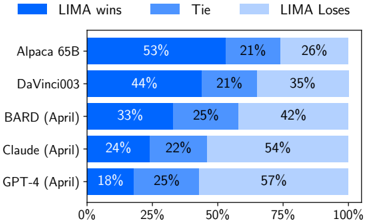
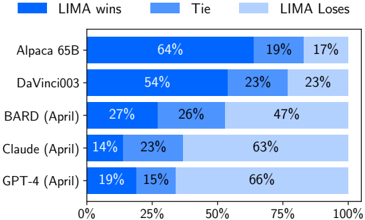
Large language models are trained in two stages: (1) unsupervised pretraining from raw text, to learn general-purpose representations, and (2) large scale instruction tuning and reinforcement learning, to better align to end tasks and user preferences. We measure the relative importance of these two stages by training LIMA, a 65B parameter LLaMa language model fine-tuned with the standard supervised loss on only 1,000 carefully curated prompts and responses, without any reinforcement learning or human preference modeling. LIMA demonstrates remarkably strong performance, learning to follow specific response formats from only a handful of examples in the training data, including complex queries that range from planning trip itineraries to speculating about alternate history. Moreover, the model tends to generalize well to unseen tasks that did not appear in the training data. In a controlled human study, responses from LIMA are either equivalent or strictly preferred to GPT-4 in 43% of cases; this statistic is as high as 58% when compared to Bard and 65% versus DaVinci003, which was trained with human feedback. Taken together, these results strongly suggest that almost all knowledge in large language models is learned during pretraining, and only limited instruction tuning data is necessary to teach models to produce high quality output.
Overview
The claims and statistics of this paper haven’t been checked yet.
Free: it reads the open-access text and checks the first 5 claims that cite a source we can check. Create a free account to check every claim.
Integrity signals
Registry
Cites
Statistics
Figures
Verification
Claims the paper makes
The claims and statistics of this paper haven’t been checked yet.
Free: it reads the open-access text and checks the first 5 claims that cite a source we can check. Create a free account to check every claim.
Claims other papers make about this one
Each is checked against this paper’s own text: does it say what the citing paper says it does?
The source backs part of the claim, not all of it — or backs it for a different population, condition or comparison.
In the citing paper
“However, when focusing specifically on a single task or narrow set of tasks, far fewer instruction instances may suffice.”
From A Survey of Large Language Models (2026) · cites this paper as [195]
Experimental — accuracy not yet measuredThe source backs part of the claim, not all of it — or backs it for a different population, condition or comparison.
In the citing paper
“Recent studies [323] show that the knowledge within LLMs is almost entirely acquired during pretraining.”
From Survey of Hallucination in Natural Language Generation (2023) · cites this paper as [323]
Experimental — accuracy not yet measuredThe source backs part of the claim, not all of it — or backs it for a different population, condition or comparison.
In the citing paper
“Redundancy and Inefficient Use of Information: Treating all N training samples ( x i , y i ) in D train as equally informative is inefficient, as the number of truly effective samples N eff is often much smaller than N (i.e., N eff ≪ N ) (Zhou et al., 2023).”
From TT-SI: Self-Improving LLM Agents with Test-Time Training (2026) · cites this paper as Zhou et al., 2023
Experimental — accuracy not yet measuredThe source backs part of the claim, not all of it — or backs it for a different population, condition or comparison.
In the citing paper
“Nevertheless, smaller datasets can be vital in enabling key post -training techniques such as fine-tuning, in-context learning, and prompt engineering (cf. [86, 122]).”
From Engaging Communities Meaningfully in Defining Disability Representation for AI Image Generation (2026) · cites this paper as [122]
Experimental — accuracy not yet measuredThe cited source says what the claim attributes to it.
In the citing paper
“For example, the authors of LIMA collected a diverse dataset of 1,000 carefully curated prompts and responses which are aligned with each other [323].”
From Survey of Hallucination in Natural Language Generation (2023) · cites this paper as [323]
3 more claims about this paper
Create a free account to see every claim other papers make about this one.
Self-check
Percentages, sums and reported differences re-computed from the paper’s own numbers.
The self-check needs the paper’s full text.
Citations
Cites
The publisher hasn’t deposited this paper’s reference list.
Research works printed but not linked: 7
- Yuntao Bai, Saurav Kadavath, Sandipan Kundu, Amanda Askell, Jackson Kernion, Andy Jones, Anna Chen, Anna Goldie, Azalia Mirhoseini, Cameron McKinnon, et al. Constitutional ai: Harmlessness from ai feedback. arXiv preprint arXiv:2212.08073, 2022b. · arXiv
- Ari Holtzman, Jan Buys, Li Du, Maxwell Forbes, and Yejin Choi. The curious case of neural text degeneration. In International Conference on Learning Representations, 2019.
- Yuval Kirstain, Patrick Lewis, Sebastian Riedel, and Omer Levy. A few more examples may be worth billions of parameters. arXiv preprint arXiv:2110.04374, 2021. · arXiv
- Long Ouyang, Jeffrey Wu, Xu Jiang, Diogo Almeida, Carroll Wainwright, Pamela Mishkin, Chong Zhang, Sandhini Agarwal, Katarina Slama, Alex Ray, et al. Training language models to follow instructions with human feedback. Advances in Neural Information Processing Systems, 35: 27730-27744, 2022.
- Victor Sanh, Albert Webson, Colin Raffel, Stephen Bach, Lintang Sutawika, Zaid Alyafeai, Antoine Chaffin, Arnaud Stiegler, Teven Le Scao, Arun Raja, et al. Multitask prompted training enables zero-shot task generalization. In The Tenth International Conference on Learning Representations, 2022.
- Yizhong Wang, Swaroop Mishra, Pegah Alipoormolabashi, Yeganeh Kordi, Amirreza Mirzaei, Anjana Arunkumar, Arjun Ashok, Arut Selvan Dhanasekaran, Atharva Naik, David Stap, et al. Super-naturalinstructions:generalization via declarative instructions on 1600+ tasks. In EMNLP, 2022b.
- Jason Wei, Maarten Bosma, Vincent Zhao, Kelvin Guu, Adams Wei Yu, Brian Lester, Nan Du, Andrew M Dai, and Quoc V Le. Finetuned language models are zero-shot learners. In International Conference on Learning Representations, 2022a.
Cited by
Items 301–400 of 938
SH2: Self-Highlighted Hesitation Helps You Decode More Truthfully
Kai, J., Zhang, T., Hu, H., & Lin, Z. (2024) · Findings of the Association for Computational Linguistics: EMNLP (Findings of EMNLP) · doi:10.18653/v1/2024.findings-emnlp.260 · Cited by 33
Duan, S., Yi, X., Zhang, P., Liu, Y., Liu, Z., Lu, T., Xie, X., & Gu, N. (2024) · Findings of the Association for Computational Linguistics: EMNLP (Findings of EMNLP) · doi:10.18653/v1/2024.findings-emnlp.56 · Cited by 26
Stabilizing RLHF through Advantage Model and Selective RehearsalPreprint
Peng, B., Song, L., Tian, Y., Jin, L., Mi, H., & Dong, Y. (2023) · arXiv (Cornell University) · doi:10.48550/arxiv.2309.10202 · Cited by 27
“For instance, the study by LIMA (Zhou et al., 2023) underscores that even a limited set of carefully curated and high-quality examples can be utilized to fine-tune a strong pre-trained language model, enabling it to deliver competitive results across a diverse array of prompts.”
BackgroundBeyond Imitation: Leveraging Fine-grained Quality Signals for Alignment
Guo, G., Zhao, R., Tang, T., Zhao, W. X., & Wen, J.-R. (2024) · International Conference on Learning Representations · doi:10.48550/arxiv.2311.04072 · Cited by 34
Vision-Language Instruction Tuning: A Review and Analysis
Li, C., Ge, Y., Li, D., & Shan, Y. (2024) · Transactions on machine learning research · doi:10.48550/arxiv.2311.08172 · Cited by 28
Efficient Compression of Large Language Models: A Case Study on Llama 2 with 13B ParametersPreprint
Konishi, M., Nakano, K., & Tomoda, Y. (2024) · Research Square · doi:10.21203/rs.3.rs-4407954/v1 · Cited by 73
Badllama 3: removing safety finetuning from Llama 3 in minutesPreprint
Volkov, D. (2024) · arXiv (Cornell University) · doi:10.48550/arxiv.2407.01376 · Cited by 23
“We follow [ZLX + 23] in assuming a modest dataset suffices to either align or misalign a model.”
BackgroundPivotRL: High Accuracy Agentic Post-Training at Low Compute CostPreprint
Yi, J., Mosk-Aoyama, D., Huang, B., Gala, R., Wang, C., Devare, S. D., Bhardwaj, K., Gupta, A., Kuchaiev, O., Jiao, J., et al. (2026) · arXiv (Cornell University) · doi:10.48550/arxiv.2603.21383 · Cited by 20
SaulLM-7B: A pioneering Large Language Model for Law
Colombo, P., Pires, T. P., Boudiaf, M., Culver, D., Melo, R., Corro, C., Martins, A. F. T., Esposito, F., Raposo, V. L., Morgado, S., et al. (2024) · arXiv · doi:10.48550/arxiv.2403.03883 · Cited by 18
“For general-purpose language models, diversity and quality of instruction are crucial (Cao et al., 2023; Zhou et al., 2023).”
BackgroundTraining Socially Aligned Language Models on Simulated Social Interactions
Liu, R., Yang, R., Jia, C., Zhang, G., Zhou, D., Dai, A. M., Yang, D., & Vosoughi, S. (2023) · arXiv · doi:10.48550/arxiv.2305.16960 · Cited by 18
“They are uncultured”: Unveiling Covert Harms and Social Threats in LLM Generated Conversations
Dammu, P. P. S., Jung, H., Singh, A. A. K., Choudhury, M., & Mitra, T. (2024) · Conference on Empirical Methods in Natural Language Processing (EMNLP) · doi:10.18653/v1/2024.emnlp-main.1134 · Cited by 47
Si, S., Zhao, H., Chen, G., Gao, C., Bai, Y., Wang, Z., An, K., Luo, K., Chen, Q., Qi, F., et al. (2025) · Proceedings of the conference - Association for Computational Linguistics. Meeting · doi:10.18653/v1/2025.acl-long.804 · Cited by 33
Aligning Crowd Feedback via Distributional Preference Reward ModelingPreprint
Li, D., Zhang, C., Dong, K., Deik, D. G. X., Tang, R., & Liu, Y. (2024) · arXiv (Cornell University) · doi:10.48550/arxiv.2402.09764 · Cited by 23
Towards detecting unanticipated bias in Large Language ModelsPreprint
Kruspe, A. (2024) · arXiv · doi:10.48550/arxiv.2404.02650 · Cited by 28
“For assistant models, research is mostly focused on alignment [65] and Uncertainty Quantification [63] (see section 4).”
MethodDesign2Code: Benchmarking Multimodal Code Generation for Automated Front-End Engineering
Si, C., Zhang, Y., Li, R., Yang, Z., Liu, R., & Yang, D. (2025) · Proceedings of the 2025 Conference of the Nations of the Americas Chapter of the Association for Computational Linguistics: Human Language Technologies (Volume 1: Long Papers) · doi:10.18653/v1/2025.naacl-long.199 · Cited by 17
“Pairwise Model Comparison Following the conventional practice of evaluating instruction-following LLMs (e.g., (Zhou et al., 2023; Dubois et al., 2023)), we ask human annotators to rank a pair of generated webpages (one from the baseline, the other from the tested method) to decide which one is more…”
Model-contrastive explanations through symbolic reasoning
Malandri, L., Mercorio, F., Mezzanzanica, M., & Seveso, A. (2023) · Decision Support Systems · doi:10.1016/j.dss.2023.114040 · Cited by 23
Towards Acyclic Preference Evaluation of Language Models via Multiple Evaluators
Hu, Z., Zhang, J., Xiong, Z., Ratner, A., Ding, K., & Krishna, R. (2026) · Proceedings of the AAAI Conference on Artificial Intelligence · doi:10.1609/aaai.v40i26.39343 · Cited by 23
“…we further evaluated the models—using the Llama-2-7B backbone—on additional benchmarks, including AlpacaEval 2.0 (Li et al. 2023b), LIMA (Zhou et al. 2023), Koala (Vu et al. 2023), and Self-Instruct (Wang et al. 2022), in accordance with recent studies (Chen et al. 2023b; Zhang et al.…”
InfluentialTowards Better Evaluation of Instruction-Following: A Case-Study in Summarization
Skopek, O., Aralikatte, R., Gooding, S., & Cărbune, V. (2023) · Conference on Computational Natural Language Learning · doi:10.18653/v1/2023.conll-1.16 · Cited by 28
You Know What I'm Saying: Jailbreak Attack via Implicit ReferencePreprint
Wu, T.-Y., Mei, L., Yuan, R.-B., Li, L.-J., Xue, W., & Guo, Y.-K. (2024) · arXiv.org · doi:10.48550/arxiv.2410.03857 · Cited by 20
ToolAlpaca: Generalized Tool Learning for Language Models with 3000 Simulated Cases
Tang, Q., Deng, Z., Lin, H., Han, X., Liang, Q., Cao, B., & Sun, L. (2023) · arXiv · doi:10.48550/arxiv.2306.05301 · Cited by 16
“Intuitively, previous studies have demonstrated the possibility of equipping compact language models with generalized instruction-following abilities by fine-tuning them on diversified instruction datasets (Taori et al. 2023; Zhou et al. 2023).”
BackgroundInfluentialToolACE-R: Model-aware Iterative Training and Adaptive Refinement for Tool learning
Zeng, X., Liu, W., Huang, X., Wang, Z., Wang, L., Li, L., Wang, Y., Shang, L., Jiang, X., Tang, R., et al. (2026) · Proceedings of the AAAI Conference on Artificial Intelligence · doi:10.1609/aaai.v40i41.40759 · Cited by 19
“A small set of high-quality data can effectively harness the model’s potential, rather than relying on large quantities of data [42, 18].”
Teaching Llama a New Language Through Cross-Lingual Knowledge Transfer
Kuulmets, H.-A., Purason, T., Luhtaru, A., & Fishel, M. (2024) · Findings of the Association for Computational Linguistics: NAACL · doi:10.18653/v1/2024.findings-naacl.210 · Cited by 37
Bartl, M., & Leavy, S. (2024) · Workshop on Gender Bias in Natural Language Processing (GeBNLP) · doi:10.18653/v1/2024.gebnlp-1.18 · Cited by 37
Control Barrier Function for Aligning Large Language Models
Miyaoka, Y., & Inoue, M. (2026) · IEEE Transactions on Control Systems Technology · doi:10.1109/tcst.2026.3675329 · Cited by 17
“…(RLHF, [4]), where a reward model is constructed by human feedback and then used for the training of LLMs. Variants of RLHF methods are also proposed, such as Safe-RLHF by [5], SENSEI by [6], and f-DPG by [7], and their implementations are presented, such as training pretrained LLMs [8], [9].”
CoLE: A collaborative legal expert prompting framework for large language models in law
Li, B., Fan, S., Zhu, S., & Wen, L. (2025) · Knowledge-Based Systems · doi:10.1016/j.knosys.2025.113052 · Cited by 21
Loong: Synthesize Long Chain-of-Thoughts at Scale through Verifiers
Huang, X., Rishabh, Franke, G., Yang, Z., Bai, J., Bai, W., Bi, J., Ding, Z., Duan, Y., Fan, C., et al. (2025) · Oxford University Research Archive (ORA) (University of Oxford) · doi:10.48550/arxiv.2509.03059 · Cited by 23
Becoming self-instruct: introducing early stopping criteria for minimal instruct tuningPreprint
AlShikh, W., Daaboul, M., Goddard, K., Imel, B. A., Kamble, K., Kulkarni, P., & Russak, M. (2023) · arXiv (Cornell University) · doi:10.13140/rg.2.2.34295.19364 · Cited by 19
Transformers are Multi-State RNNs
Oren, M., Hassid, M., Yarden, N., Adi, Y., & Schwartz, R. (2024) · arXiv · doi:10.48550/arxiv.2401.06104 · Cited by 16
SteerLM: Attribute Conditioned SFT as an (User-Steerable) Alternative to RLHF
Dong, Y., Wang, Z., Sreedhar, M., Wu, X., & Kuchaiev, O. (2023) · Findings of the Association for Computational Linguistics: EMNLP 2023 · doi:10.18653/v1/2023.findings-emnlp.754 · Cited by 15
Gender, Age, and Technology Education Influence the Adoption and Appropriation of LLMs
Draxler, F., Buschek, D., Tavast, M., Hämäläinen, P., Schmidt, A., Kulshrestha, J., & Welsch, R. (2023) · arXiv · doi:10.48550/arxiv.2310.06556 · Cited by 15
“These diverse abilities emerge from one main training objective: Predict the next token—a word piece—in a large and diverse text corpus [2, 46], although performance can be further improved by reinforcement learning from human feedback and/or finetuning using curated examples of desired human-AI interactions [29, 51].”
A Hybrid Multi-Agent Conversational Recommender System with LLM and Search Engine in E-commerce
Nie, G., Zhi, R., Yan, X., Du, Y., Zhang, X., Chen, J., Zhou, M., Chen, H., Li, T., Cheng, Z., et al. (2024) · 18th ACM Conference on Recommender Systems · doi:10.1145/3640457.3688061 · Cited by 15
“The training dataset was collected from multi-round real-world user inputs collected from the baseline CRS. Responses to these inputs are generated by GPT-4 using few-shot learning with hand crafted cases [13].”
Automatic Analysis of Substantiation in Scientific Peer Reviews
Guo, Y., Shang, G., Rennard, V., Vazirgiannis, M., & Clavel, C. (2023) · Findings of the Association for Computational Linguistics: EMNLP (Findings of EMNLP) · doi:10.18653/v1/2023.findings-emnlp.684 · Cited by 34
OpenROAD-Assistant: An Open-Source Large Language Model for Physical Design Tasks
Sharma, U., Wu, B.-Y., Kankipati, S. R. D., Chhabria, V. A., & Rovinski, A. (2024) · ACM/IEEE Workshop on Machine Learning for CAD (MLCAD) · doi:10.1109/mlcad62225.2024.10740242 · Cited by 18
Dammu, P. P. S., Naidu, H., Dewan, M., Kim, Y., Roosta, T. G., Chadha, A. R., & Shah, C. S. (2024) · Findings of the Association for Computational Linguistics: EMNLP (Findings of EMNLP) · doi:10.18653/v1/2024.findings-emnlp.795 · Cited by 29
Multilingual Arbitration: Optimizing Data Pools to Accelerate Multilingual Progress
Odumakinde, A., D’souza, D., Verga, P., Ermiş, B., & Hooker, S. (2025) · Proceedings of the conference - Association for Computational Linguistics. Meeting · doi:10.18653/v1/2025.acl-long.939 · Cited by 18
“…(Sanh et al., 2021; Wei et al., 2021; Mishra et al., 2021; Min et al., 2021; Ouyang et al., 2022), relying on task diversity (Longpre et al., 2023; Wang et al., 2023b; Chung et al., 2022), complexity (Xu et al., 2023; Luo et al., 2023), and quality (Zhou et al., 2023; Taori et al., 2023).”
Standardizing Intelligence: Aligning Generative AI for Regulatory and Operational Compliance
Imperial, J. M., Jones, M. D., & Madabushi, H. T. (2025) · SuperIntelligence - Robotics - Safety & Alignment · doi:10.70777/si.v2i5.16189 · Cited by 16
DavIR: Data Selection via Implicit Reward for Large Language Models
Zhou, H., Liu, T.-K., Ma, Q.-L., Zhang, Y.-F., Yuan, J.-B., Liu, P., You, Y., & Yang, H.-X. (2023) · Annual Meeting of the Association for Computational Linguistics · doi:10.18653/v1/2025.acl-long.452 · Cited by 12
“We demonstrate the effectiveness of DavIR across model families (LLaMA (Touvron et al., 2023), Gemma (Team et al., 2024a,b)) and across data domains (Alpaca (Taori et al., 2023), LIMA (Zhou et al., 2023), GSM8K (Cobbe et al., 2021)) and across benchmarks benchmarks (Self-Instruct (Wang et al., 2022), Vicuna (Zheng et…”
InfluentialSelf-citationJMedLoRA:Medical Domain Adaptation on Japanese Large Language Models using Instruction-tuningPreprint
Sukeda, I., Suzuki, M., Sakaji, H., & Kodera, S. (2023) · arXiv · doi:10.48550/arxiv.2310.10083 · Cited by 21
LIMIT: Less Is More for Instruction Tuning Across Evaluation ParadigmsPreprint
Jha, A., Havens, S., Dohmann, J., Trott, A., & Portes, J. (2023) · arXiv (Cornell University) · doi:10.48550/arxiv.2311.13133 · Cited by 25
“2A, B. LIMA Dataset : The LIMA training set [66] contains 1,000 samples (750,000 tokens) curated from Reddit, Stack Overflow, wikiHow, Super-Natural-Instructions [60], and examples manually written by the paper authors.”
BackgroundMethodResultInfluentialWang, W., Chan, Y.-K., Ling, Z., Shi, J., Yuan, Y., Huang, J.-T., Zhang, Y., Jiao, W., Tu, Z., & Lyu, M. R.-T. (2024) · arXiv (Cornell University) · doi:10.48550/arxiv.2401.00761 · Cited by 15
“For the training set used for fine-tuning, we augmented it with the LIMA (Zhou et al., 2023) instruction tuning dataset so the model is able to answer questions in the expected format.”
Improving Domain Adaptation through Extended-Text Reading ComprehensionPreprint
Jiang, T., Huang, S.-H., Luo, S., Zhang, Z.-H., Huang, H.-Z., Wei, F.-R., Deng, W.-W., Sun, F., Zhang, Q., Wang, D.-Q., et al. (2024) · arXiv.org · doi:10.48550/arxiv.2401.07284 · Cited by 17
Knowledge Editing on Black-box Large Language ModelsPreprint
Song, X., Wang, Z., He, K., Dong, G., Mou, Y., Zhao, J., & Xu, W. (2024) · arXiv (Cornell University) · doi:10.48550/arxiv.2402.08631 · Cited by 23
Explore-Instruct: Enhancing Domain-Specific Instruction Coverage through Active Exploration
Wan, F., Huang, X., Yang, T., Quan, X., Bi, W., & Shi, S. (2023) · Conference on Empirical Methods in Natural Language Processing (EMNLP) · doi:10.18653/v1/2023.emnlp-main.587 · Cited by 29
Walking a Tightrope – Evaluating Large Language Models in High-Risk Domains
Hung, C.-C., Rim, W. B., Frost, L., Bruckner, L., & Lawrence, C. (2023) · GenBench Workshop on Generalisation (Benchmarking) in NLP (GenBench) · doi:10.18653/v1/2023.genbench-1.8 · Cited by 27
Das, D., & Khetan, V. (2024) · Conference on Empirical Methods in Natural Language Processing (EMNLP) · doi:10.18653/v1/2024.emnlp-main.1132 · Cited by 21
“We also compare DEFT-UCS to the LIMA approach (Zhou et al., 2023a).”
BackgroundMethodResultInfluentialCOIG-CQIA: Quality is All You Need for Chinese Instruction Fine-tuning
Bai, Y., Du, X., Liang, Y., Jin, L., Zhou, J., Liu, Z., Fang, F., Chang, M., Zheng, T., Zhang, X., et al. (2025) · Findings of the Association for Computational Linguistics: NAACL · doi:10.18653/v1/2025.findings-naacl.457 · Cited by 19
Tuna: Instruction Tuning using Feedback from Large Language Models
Li, H., Liu, Y., Zhang, X., Lu, W., & Wei, F. (2023) · Findings of the Association for Computational Linguistics: EMNLP (Findings of EMNLP) · doi:10.18653/v1/2023.findings-emnlp.1011 · Cited by 22
Lee, K., Hwang, D., Park, S., Jang, Y., & Lee, M. (2024) · arXiv (Cornell University) · doi:10.48550/arxiv.2403.14238 · Cited by 15
“This benchmark consists of 1,000 instructions from diverse datasets including AlpacaE-val (Li et al., 2023b), MT-bench (Zheng et al., 2023a), LIMA (Zhou et al., 2023), HH-RLHF-redteam (Ganguli et al., 2022), and MaliciousIn-struct (Huang et al., 2023).”
BackgroundProCyon: A multimodal foundation model for protein phenotypesPreprint
Queen, O., Huang, Y., Calef, R., Giunchiglia, V., Chen, T., Dasoulas, G., Tai, L., Abbadessa, G., Howell, O. W., Li, M. M., et al. (2024) · bioRxiv (Cold Spring Harbor Laboratory) · doi:10.1101/2024.12.10.627665 · Cited by 22
TAGCOS: Task-agnostic Gradient Clustered Coreset Selection for Instruction Tuning DataPreprint
Zhang, J., Qin, Y., Pi, R., Zhang, W., Pan, R. N., & Zhang, T. (2024) · arXiv (Cornell University) · doi:10.48550/arxiv.2407.15235 · Cited by 17
“Also, several works (Zhou et al., 2023; Gunasekar et al., 2023) stress the importance of high-quality data and thus triggered more research works focus on data selection.”
Model Tells You What to Discard: Adaptive KV Cache Compression for LLMs
Ge, S., Zhang, Y., Liu, L., Zhang, M., Han, J., & Gao, J. (2023) · arXiv · doi:10.48550/arxiv.2310.01801 · Cited by 13
Evaluating Large Language Models at Evaluating Instruction Following
Zeng, Z., Yu, J., Gao, T., Meng, Y., Goyal, T., & Chen, D. (2023) · arXiv · doi:10.48550/arxiv.2310.07641 · Cited by 13
“…2023a), many recent works take prompted LLMs as evaluators to compare model outputs (Chiang et al., 2023; Peng et al., 2023; Dubois et al., 2023; Zhou et al., 2023; Rafailov et al., 2023; Wang et al., 2023c; Xu et al., 2023; Song et al., 2023; Chen et al., 2023a; Li et al., 2023d, etc ), or to…”
Using In-Context Learning to Improve Dialogue Safety
Meade, N., Gella, S., Hazarika, D., Gupta, P., Jin, D., Reddy, S., Liu, Y., & Hakkani-Tur, D. (2023) · Findings of the Association for Computational Linguistics: EMNLP 2023 · doi:10.18653/v1/2023.findings-emnlp.796 · Cited by 13
Multi-view fusion for instruction mining of large language model
Huang, H., Xu, B., Liang, X., Chen, K., Yang, M., Zhao, T., & Zhu, C. (2024) · Information Fusion · doi:10.1016/j.inffus.2024.102480 · Cited by 21
A Preference-driven Paradigm for Enhanced Translation with Large Language Models
Zhu, D., Trenous, S., Shen, X., Klakow, D., Byrne, B., & Hasler, E. (2024) · Conference of the North American Chapter of the Association for Computational Linguistics: Human Language Technologies (NAACL-HLT) · doi:10.18653/v1/2024.naacl-long.186 · Cited by 24
Model Balancing Helps Low-data Training and Fine-tuning
Liu, Z., Hu, Y., Pang, T., Zhou, Y., Ren, P., & Yang, Y. L. (2024) · Conference on Empirical Methods in Natural Language Processing (EMNLP) · doi:10.18653/v1/2024.emnlp-main.78 · Cited by 22
SEAS: Self-Evolving Adversarial Safety Optimization for Large Language Models
Diao, M., Li, R., Liu, S., Liao, G., Wang, J., Cai, X., & Xu, W. (2025) · Proceedings of the AAAI Conference on Artificial Intelligence · doi:10.1609/aaai.v39i22.34549 · Cited by 19
Cost-effective instruction learning for pathology vision and language analysis
Chen, K., Liu, M., Yan, F., Ма, Л., Shi, X., Wang, L., Wang, X., Zhu, L., Wang, Z., Zhou, M., et al. (2025) · Nature Computational Science · doi:10.1038/s43588-025-00818-5 · Cited by 19
“This is a common way to represent the flow of heat in a system and it helps visualize how the system is operating and how it can be optimized for better performance.”
Self-citationLarge language models – the future of fundamental physics?
Heneka, C. S., Nieser, F., Ore, A., Plehn, T., & Schiller, D. (2026) · SciPost Physics · doi:10.21468/scipostphys.20.3.070 · Cited by 14
Delmas, M., Wysocka, M., & Freitas, A. (2024) · Computational Linguistics · doi:10.1162/coli_a_00520 · Cited by 17
BiTA: Bi-Directional Tuning for Lossless Acceleration in Large Language ModelsPreprint
Lin, F., Yi, H., Li, H., Yang, Y., Yu, X., Lu, G., & Xiao, R. (2024) · arXiv (Cornell University) · doi:10.48550/arxiv.2401.12522 · Cited by 15
Muennighoff, N., Yang, Z., Shi, W., Li, X. L., Fei-Fei, L., Hajishirzi, H., Zettlemoyer, L., Liang, P., Candès, E., & Hashimoto, T. (2025) · arXiv · doi:10.48550/arxiv.2501.19393 · Cited by 12
“For (b) , we define desiderata for test-time scaling methods to compare different approaches.”
Self-citationTowards Tracing Trustworthiness Dynamics: Revisiting Pre-training Period of Large Language Models
Qian, C., Zhang, J., Yao, W., Liu, D., Yin, Z., Qiao, Y., Liu, Y., & Shao, J. (2024) · Findings of the Association for Computational Linguistics ACL 2024 · doi:10.18653/v1/2024.findings-acl.290 · Cited by 12
OpenROAD-Assistant: An Open-Source Large Language Model for Physical Design Tasks
Sharma, U., Wu, B.-Y., Kankipati, S. R. D., Chhabria, V. A., & Rovinski, A. (2024) · ACM/IEEE Workshop on Machine Learning for CAD (MLCAD) · doi:10.1145/3670474.3685960 · Cited by 18
Towards an End-to-End Personal Fine-Tuning Framework for AI Value Alignment
Watson, E. ‘., Viana, T., Zhang, S., Sturgeon, B., & Petersson, L. (2024) · Electronics · doi:10.3390/electronics13204044 · Cited by 17
Self-citationAttributive Reasoning for Hallucination Diagnosis of Large Language Models
Chen, Y., Li, Z., You, S., Chen, Z., Chang, J., Zhang, Y., Dai, W., Guo, Q., & Xiao, Y. (2025) · Proceedings of the AAAI Conference on Artificial Intelligence · doi:10.1609/aaai.v39i22.34536 · Cited by 35
Scaling Data Diversity for Fine-Tuning Language Models in Human Alignment
Song, F., Yu, B., Lang, H., Yu, H., Huang, F., Wang, H., & Li, Y. (2024) · Language Resources and Evaluation Conference (LREC) · doi:10.63317/2do58nv6r7wc · Cited by 37
Marwitz, T., Colsmann, A., Breitung, B., Brabec, C. J., Kirchlechner, C., Blasco, E., Marques, G. C., Hahn, H., Hirtz, M., Levkin, P. A., et al. (2026) · Nature Machine Intelligence · doi:10.1038/s42256-026-01206-y · Cited by 24
Xue, C., Wang, Y., Liu, M., Liang, D., Han, X., Liu, P., Wu, X., Lu, C., Jiang, L., Lu, Y., et al. (2026) · Proceedings of the conference - Association for Computational Linguistics. Meeting · doi:10.18653/v1/2026.acl-long.1393 · Cited by 29
Self-citationX-LLaVA: Optimizing Bilingual Large Vision-Language Alignment
Shin, D., Lim, H., Won, I., Choi, C.-S., Kim, M.-J., Song, S., Yoo, H., Kim, S., & Lim, K. (2024) · Findings of the Association for Computational Linguistics: NAACL · doi:10.18653/v1/2024.findings-naacl.158 · Cited by 16
Exploring the Relationship between In-Context Learning and Instruction Tuning
Duan, H., Tang, Y., Yang, Y., Abbasi, A., & Tam, K. Y. (2024) · Findings of the Association for Computational Linguistics: EMNLP (Findings of EMNLP) · doi:10.18653/v1/2024.findings-emnlp.182 · Cited by 22
Generalization Analogies: A Testbed for Generalizing AI Oversight to Hard-To-Measure DomainsPreprint
Clymer, J., Baker, G., Subramani, R., & Wang, S. C. (2023) · arXiv (Cornell University) · doi:10.48550/arxiv.2311.07723 · Cited by 15
Step-On-Feet Tuning: Scaling Self-Alignment of LLMs via BootstrappingPreprint
Wang, H., Ma, G., Meng, Z., Qin, Z., Li, S., Zhang, Z., Wu, B., Liu, L., Bian, Y., Xu, T., et al. (2024) · arXiv (Cornell University) · doi:10.48550/arxiv.2402.07610 · Cited by 16
Knowing When to Ask -- Bridging Large Language Models and DataPreprint
Radhakrishnan, P., Chen, J. H., Xu, B., Ramaswami, P., Pho, H., Olmos, A., Manyika, J., & Guha, R. V. (2024) · arXiv (Cornell University) · doi:10.48550/arxiv.2409.13741 · Cited by 18
TituLLMs: A Family of Bangla LLMs with Comprehensive BenchmarkingPreprint
Nahin, S. K., Nandi, R. N., Sarker, S., Muhtaseem, Q. S., Kowsher, M., Shill, A. C., Ibrahim, M. N. M., Menon, M. H., Muntasir, T. A., & Alam, F. (2025) · arXiv (Cornell University) · doi:10.48550/arxiv.2502.11187 · Cited by 13
Perovskite-LLM: Knowledge-Enhanced Large Language Models for Perovskite Solar Cell ResearchPreprint
Liu, X., Sun, P., Chen, S., Zhang, L., Dong, P., You, H., Zhang, Y., Yan, C., Chu, X., & Zhang, T. (2025) · arXiv · doi:10.48550/arxiv.2502.12669 · Cited by 14
“In particular, S1 (Muennighoff et al., 2025) and LIMO (Ye et al., 2025) operationalize the Superficial Alignment Hypothesis (Zhou et al., 2023a) through curriculum-based sparse fine-tuning, achieving comparable reasoning capabilities with merely 1,000-2,000 care-fully curated examples, a 92% reduction in annotation co…”
PanGu-Coder2: Boosting Large Language Models for Code with Ranking Feedback
Shen, B., Zhang, J., Chen, T., Zan, D., Geng, B., Fu, A., Zeng, M., Yu, A., Ji, J., Zhao, J., et al. (2023) · arXiv · doi:10.48550/arxiv.2307.14936 · Cited by 11
BEADS: Bias Evaluation Across Domains
Raza, S., Rahman, S. M. M., & Zhang, M. R. (2026) · Lecture notes in computer science · doi:10.1007/978-3-032-29532-3_10 · Cited by 12
AstroMLab 2: AstroLLaMA-2-70B Model and Benchmarking Specialised LLMs for Astronomy
Pan, R., Nguyen, T. D., Arora, H., Accomazzi, A., Ghosal, T., & Ting, Y.-S. (2024) · International Conference for High Performance Computing, Networking, Storage and Analysis (SC) · doi:10.1109/scw63240.2024.00019 · Cited by 20
“We used the same conversation dataset as AstroLLaMA-Chat [28], which includes 10,356 astronomy-centered conversations generated from arXiv abstracts by GPT-4, the full content of LIMA [36], 10,000 samples from Open Orca [37]–[39], and 10,000 samples from UltraChat [40].”
MethodA Survey on Quality Evaluation of Instruction Fine-tuning Datasets for Large Language Models
Luo, Y., Liu, Y., Zhang, L., Gao, F., & Gu, J. (2025) · Data Intelligence · doi:10.3724/2096-7004.di.2025.0021 · Cited by 19
On convex decision regions in deep network representations
Tětková, L., Brüsch, T., Dorszewski, T., Mager, F. M., Aagaard, R. Ø., Foldager, J., Alstrøm, T. S., & Hansen, L. K. (2025) · Nature Communications · doi:10.1038/s41467-025-60809-y · Cited by 18
Self-Improving Customer Review Response Generation Based on LLMs
Azov, G., Pelc, T., Alon, A. F., & Kamhi, G. (2024) · Language Resources and Evaluation Conference (LREC) · doi:10.63317/2przze2uzjqk · Cited by 16
Liu, G., Mao, H., Tang, J., & Johnson, K. (2024) · Conference on Empirical Methods in Natural Language Processing (EMNLP) · doi:10.18653/v1/2024.emnlp-main.918 · Cited by 32
Fine-tuning Language Models with Generative Adversarial Reward ModellingPreprint
Zhang, Z.-Y., Jaw, L. J., Zhang, H., & Low, B. (2023) · arXiv (Cornell University) · doi:10.48550/arxiv.2305.06176 · Cited by 10
The Poison of AlignmentPreprint
Bekbayev, A., Chun, S., Dulat, Y., & Yamazaki, J. (2023) · arXiv (Cornell University) · doi:10.48550/arxiv.2308.13449 · Cited by 18
“Results have shown that dataset cleaning takes a vital part in performance of LLMs. Recent paper by Zhou et al. [20] that focuses on importance of data for supervised instruction fine-tuning claims that data quality is of greater importance rather than data quantity.”
BackgroundResultFarzi Data: Autoregressive Data DistillationPreprint
Sachdeva, N., He, Z., Kang, W.-C., Ni, J., Cheng, D. Z., & McAuley, J. (2023) · arXiv (Cornell University) · doi:10.48550/arxiv.2310.09983 · Cited by 12
“This observation acts as further evidence for the intuitive yet under-explored idea that less but high-quality data can be more important for model training than a very large but noisy dataset (Sachdeva et al., 2022a; Zhou et al., 2023).”
PMoE: Progressive Mixture of Experts with Asymmetric Transformer for Continual LearningPreprint
Jung, M. J., & Kim, J. (2024) · arXiv (Cornell University) · doi:10.48550/arxiv.2407.21571 · Cited by 12
“Following the settings of previous studies (Wang et al., 2023c), we incorporate alignment data from LIMA (Zhou et al., 2023) into the replay memory, replaying only 1% of historical data.”
MethodSemantically-Aware Rewards for Open-Ended R1 Training in Free-Form GenerationPreprint
Li, Z.-X., Chang, Y.-P., Zhou, Y., Wu, X.-Y., Liang, Z., Yoo, Y. S., & Boyd-Graber, J. (2025) · arXiv.org · doi:10.48550/arxiv.2506.15068 · Cited by 9
“When high-quality, human-annotated datasets are available, SFT remains a valuable strategy—particularly in domains like code generation (Zhou et al., 2023), where reference outputs are well-defined and reliable.”
Jhandi, P., Kazi, O., Subramanian, S., & Sendas, N. (2025) · arXiv (Cornell University) · doi:10.48550/arxiv.2512.15943 · Cited by 13
Positive Alignment: Artificial Intelligence for Human FlourishingPreprint
Laukkonen, R., Krier, S., Bakalar, C., Chandaria, S., Kringelbach, M. L., Elwood, A., Ford, D., Rosas, F. E., Boháček, M., Franklin, M., et al. (2026) · arXiv · doi:10.48550/arxiv.2605.10310 · Cited by 16
Perovskite-LLM: Knowledge-Enhanced Large Language Models for Perovskite Solar Cell Research
Liu, X., Sun, P., Chen, S., Zhang, L., Dong, P., You, H., Zhang, Y., Yan, C., Chu, X., & Zhang, T. (2025) · Findings of the Association for Computational Linguistics: EMNLP (Findings of EMNLP) · doi:10.18653/v1/2025.findings-emnlp.27 · Cited by 11
Li, M., Li, Y., Li, Z., & Zhou, T. (2026) · Proceedings of the conference - Association for Computational Linguistics. Meeting · doi:10.18653/v1/2026.acl-long.1536 · Cited by 13
Real-GPT: Efficiently Tailoring LLMs for Informed Decision-Making in the Real Estate Industry
Gloria, B., Melsbach, J. W., Bienert, S., & Schoder, D. (2024) · Journal of Real Estate Portfolio Management · doi:10.1080/10835547.2024.2372748 · Cited by 13
Wang, Z., Fan, W., Zong, Q., Zhang, H., Choi, S.-H., Fang, T., Liu, X., Song, Y., Wong, G. Y., & See, S. C. W. (2024) · Proceedings of the conference - Association for Computational Linguistics. Meeting · doi:10.18653/v1/2024.acl-long.55 · Cited by 23
Wang, Y., He, K., Dong, G., Wang, P., Zeng, W., Diao, M., Xu, W., Wang, J., Zhang, M., & Cai, X. (2024) · Proceedings of the conference - Association for Computational Linguistics. Meeting · doi:10.18653/v1/2024.acl-long.259 · Cited by 21
SMART: Submodular Data Mixture Strategy for Instruction Tuning
Renduchintala, H. S. V. N. S. K., Bhatia, S., & Ramakrishnan, G. (2024) · Findings of the Association for Computational Linguistics: ACL (Findings of ACL) · doi:10.18653/v1/2024.findings-acl.766 · Cited by 26
FANNO: Augmenting High-Quality Instruction Data with Open-Sourced LLMs Only
Zhu, H., Ding, Y., Tao, Y., Ruan, Z., Li, Y., Zhang, W., Chen, Y., & Chen, G. (2025) · Findings of the Association for Computational Linguistics: ACL (Findings of ACL) · doi:10.18653/v1/2025.findings-acl.906 · Cited by 18
OpenBA: an open-sourced 15B bilingual asymmetric Seq2Seq model pre-trained from scratch
Li, J., Tang, Z., Ding, Y., Wang, P., Guo, P., You, W., Qiao, D., Wang, C., Chen, W., Fu, G., et al. (2025) · Science China Information Sciences · doi:10.1007/s11432-023-4128-3 · Cited by 11
“, 2023b), Lima (Zhou et al., 2023) and its corresponding Chinese version Lima-Chinese20.”
Ni, J., Bingler, J., Senni, C. C., Kraus, M., Gostlow, G., Schimanski, T., Stammbach, D., Vaghefi, S. A., Wang, Q., Webersinke, N., et al. (2023) · arXiv (Cornell University) · doi:10.48550/arxiv.2306.15518 · Cited by 18
From Instructions to Constraints: Language Model Alignment with Automatic Constraint VerificationPreprint
Fei, W., Shang, C., Jain, S., Wang, S., Ning, Q., Min, B., Castelli, V., Benajiba, Y., & Roth, D. (2024) · arXiv (Cornell University) · doi:10.48550/arxiv.2403.06326 · Cited by 10
Metadata
- Authors
- Zhou, C., Liu, P., Xu, P., Iyer, S., Sun, J., Mao, Y., Ma, X., Efrat, A., Yu, P., Yu, L., Zhang, S., Ghosh, G., Lewis, M., Zettlemoyer, L., & Levy, O.
- Venue
- Advances in Neural Information Processing Systems 36
- Published
- 2023
- Pages
- 55006-55021
- ISSN
- 1049-5258 (ISSN-L)
- OpenAlex
- W7133189643
- Semantic Scholar
- 546d0624adfc6e18fb87d8cc77e7705bb9ea7445
- Cited by
- 275
- References
- 0
- Citations by year
- 2026: 80 · 2025: 67 · 2024: 85 · 2023: 43
- FWCI
- 48.72
- Type
- conference paper
- Language
- en
- Open access
- green
- arxiv.org
- Licence
- cc-by
- Locations
- neural information processing systems (publishedVersion)
- arXiv (Cornell University) (submittedVersion, cc-by)
- arXiv (Cornell University) (cc-by)
- Topics
- Physical Sciences › Computer Science › Artificial Intelligence › Domain Adaptation and Few-Shot Learning
- Social Sciences › Education › Educational Assessment and Pedagogy
- Physical Sciences › Computer Science › Artificial Intelligence › Topic Modeling
- Keywords
- Lima, less is more, alignment, efficient large language models
About these checks
Registry, retraction, Cites and statistics results are computed, not judged, with one exception: a printed reference that no index lists is read once by a model before it counts as a citation error. Claims are extracted by a model and kept only when their quote appears verbatim in the text; each cited source is then checked, with a model’s help, for whether it says what the claim relies on. Those verdicts can be wrong — read the claim’s quote and the cited source before relying on one.
Statistics and arithmetic are recomputed, not judged.
Confidence bands are shown only for fields calibrated on our annotated test set. None is calibrated yet, so no band is shown.
What counts as a claim ›How we measure confidence ›How we check this ›
Are you an author, or do you see a problem with this page? Request a review
Data sources
Bibliographic data: Semantic Scholar, OpenAlex, Crossref.
Contains information from the Semantic Scholar Academic Graph Datasets, made available under the ODC Attribution License (ODC-BY 1.0).
Semantic Scholar’s data is described in: Kinney, R., et al. (2023). The Semantic Scholar Open Data Platform. arXiv:2301.10140.
