

The DOI matches its Crossref record; 51 of the 51 references it cites were found in a registry or an index.
Chemoselective Polymerization Control: From Mixed‐Monomer Feedstock to Copolymers
Open accessAbstract
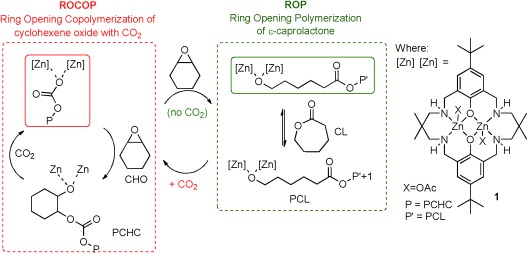
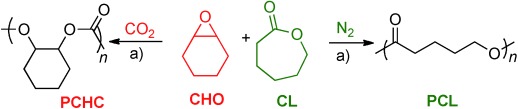
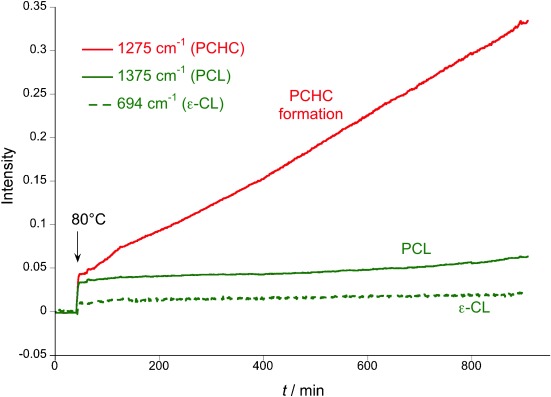
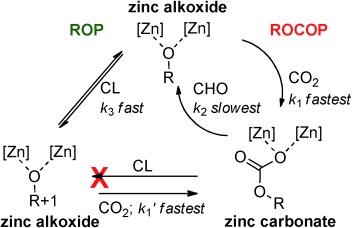
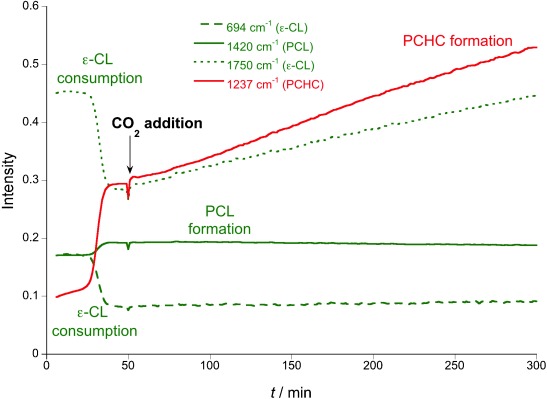
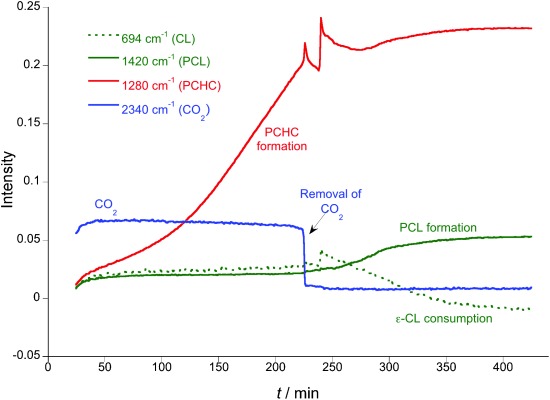
A novel chemoselective polymerization control yields predictable (co)polymer compositions from a mixture of monomers. Using a dizinc catalyst and a mixture of caprolactone, cyclohexene oxide, and carbon dioxide enables the selective preparation of either polyesters or polycarbonates or copoly(ester‐carbonates). The selectivity depends on the nature of the zinc–oxygen functionality at the growing polymer chain end, and can be controlled by the addition of exogeneous switch reagents.
Overview
The claims and statistics of this paper haven’t been checked yet.
Run the check — free, no account needed. It reads the open-access text and checks the sources it cites.
Integrity signals
Registry
Cites
Statistics
Figures
Verification
Claims the paper makes
The claims and statistics of this paper haven’t been checked yet.
Run the check — free, no account needed. It reads the open-access text and checks the sources it cites.
Claims other papers make about this one
Each is checked against this paper’s own text: does it say what the citing paper says it does?
In the citing paper
“But as soon as CO2 was removed, the catalyst turned on the ROP of CL with no incorporation of epoxide.”
From Catalysis as an Enabling Science for Sustainable Polymers (2018) · cites this paper as [322]
In the citing paper
“They found that the dizinc acetate catalyst (Zn-OAc) was an excellent catalyst for the ring-opening copolymerization of epoxide and CO2 but not for the ROP of CL.”
From Catalysis as an Enabling Science for Sustainable Polymers (2018) · cites this paper as [322]
In the citing paper
“Thus, repetitive introduction and removal of CO2 resulted in the formation of multiblock poly(carbonateblock-ester).”
From Catalysis as an Enabling Science for Sustainable Polymers (2018) · cites this paper as [322]
In the citing paper
“Williams developed a strategy using CO2 as a chemical switch as well as a co-monomer for the one-pot chemoselective polymerization of epoxide and CL (Scheme 8C).322”
From Catalysis as an Enabling Science for Sustainable Polymers (2018) · cites this paper as [322]
Self-check
Percentages, sums and reported differences re-computed from the paper’s own numbers.
The self-check needs the paper’s full text.
Citations
Cites
Controlled Ring-Opening Polymerization of Lactide and Glycolide
Dechy-Cabaret, O., Martin-Vaca, B., & Bourissou, D. (2004) · Chemical Reviews · doi:10.1021/cr040002s · Cited by 2,257
Mayo, F. R., & Lewis, F. M. (1944) · Journal of the American Chemical Society · doi:10.1021/ja01237a052 · Cited by 1,952
Darensbourg, D. J. (2007) · Chemical Reviews · doi:10.1021/cr068363q · Cited by 1,593
Chemical syntheses of biodegradable polymers
Okada, M. (2002) · Progress in Polymer Science · doi:10.1016/s0079-6700(01)00039-9 · Cited by 1,239
Polymerization of Lactide with Zinc and Magnesium β-Diiminate Complexes: Stereocontrol and Mechanism
Chamberlain, B. M., Cheng, M., Moore, D. R., Ovitt, T. M., Lobkovsky, E. B., & Coates, G. W. (2001) · Journal of the American Chemical Society · doi:10.1021/ja003851f · Cited by 1,207
Coates, G. W., & Moore, D. R. (2004) · Angewandte Chemie International Edition · doi:10.1002/anie.200460442 · Cited by 1,154
Lu, X., & Darensbourg, D. J. (2011) · Chemical Society Reviews · doi:10.1039/c1cs15142h · Cited by 1,127
Polymers from Renewable Resources: A Perspective for a Special Issue of Polymer Reviews
Williams, C. K., & Hillmyer, M. A. (2008) · Journal of macromolecular science. Part C, Reviews in macromolecular chemistry and physics/Journal of macromolecular science. Reviews in macromolecular chemistry and physics · doi:10.1080/15583720701834133 · Cited by 992
Self-citationCatalysts for CO 2 /epoxide copolymerisation
Kember, M. R., Buchard, A., & Williams, C. K. (2011) · Chem. Commun. · doi:10.1039/c0cc02207a · Cited by 797
Self-citationRecent advances in CO2/epoxide copolymerization—New strategies and cooperative mechanisms
Klaus, S., Lehenmeier, M. W., Anderson, C. E., & Rieger, B. (2010) · Coordination Chemistry Reviews · doi:10.1016/j.ccr.2010.12.002 · Cited by 712
Research works printed but not linked: 2
- Darensbourg D. J., 2012, Synthetic Biodegradable Polymers, Adv. Polym. Sci., 1
- 10.1021/ma051859 · DOI
Cited by
Sorted by citations
Catalysis as an Enabling Science for Sustainable Polymers
Zhang, X., Fevre, M., Jones, G. O., & Waymouth, R. M. (2018) · Chemical Reviews · doi:10.1021/acs.chemrev.7b00329 · Cited by 936
Advances in the use of CO 2 as a renewable feedstock for the synthesis of polymers
Grignard, B., Gennen, S., Jérôme, C., Kleij, A. W., & Detrembleur, C. (2019) · Chemical Society Reviews · doi:10.1039/c9cs00047j · Cited by 739
Artificial switchable catalysts
Blanco, V., Leigh, D. A., & Marcos, V. (2015) · Chemical Society Reviews · doi:10.1039/c5cs00096c · Cited by 682
Ring-opening copolymerization (ROCOP): synthesis and properties of polyesters and polycarbonates
Paul, S., Zhu, Y., Romain, C., Brooks, R., Saini, P. K., & Williams, C. K. (2015) · Chemical Communications · doi:10.1039/c4cc10113h · Cited by 593
Self-citationMohanty, A. K., Wu, F., Mincheva, R., Hakkarainen, M., Raquez, J., Mielewski, D. F., Narayan, R., Netravali, A. N., & Misra, M. (2022) · Nature Reviews Methods Primers · doi:10.1038/s43586-022-00124-8 · Cited by 393
Sulley, G. S., Gregory, G. L., Chen, T. T. D., Carrodeguas, L. P., Trott, G., Santmartí, A., Lee, K., Terrill, N. J., & Williams, C. K. (2020) · Journal of the American Chemical Society · doi:10.1021/jacs.9b13106 · Cited by 286
Self-citationChemoselective Polymerizations from Mixtures of Epoxide, Lactone, Anhydride, and Carbon Dioxide
Romain, C., Zhu, Y., Dingwall, P., Paul, S., Rzepa, H. S., Buchard, A., & Williams, C. K. (2016) · Journal of the American Chemical Society · doi:10.1021/jacs.5b13070 · Cited by 258
Self-citationGuillaume, S. M., Kirillov, E., Sarazin, Y., & Carpentier, J. (2015) · Chemistry – A European Journal · doi:10.1002/chem.201500613 · Cited by 251
Xu, Y., Lin, L., Xiao, M., Wang, S., Smith, A. T., Sun, L., & Meng, Y. (2018) · Progress in Polymer Science · doi:10.1016/j.progpolymsci.2018.01.006 · Cited by 229
Deacy, A. C., Gregory, G. L., Sulley, G. S., Chen, T. T. D., & Williams, C. K. (2021) · Journal of the American Chemical Society · doi:10.1021/jacs.1c03250 · Cited by 229
Self-citationRole of External Field in Polymerization: Mechanism and Kinetics
Zhou, Y., Li, J., Wu, Y., & Luo, Z. (2020) · Chemical Reviews · doi:10.1021/acs.chemrev.9b00744 · Cited by 223
Scharfenberg, M., Hilf, J., & Frey, H. (2018) · Advanced Functional Materials · doi:10.1002/adfm.201704302 · Cited by 216
Renewable polycarbonates and polyesters from 1,4-cyclohexadiene
Winkler, M., Romain, C., Meier, M. A. R., & Williams, C. K. (2014) · Green Chemistry · doi:10.1039/c4gc01353k · Cited by 205
Self-citationCatalysts for CO 2 /epoxide ring-opening copolymerization
Trott, G., Saini, P. K., & Williams, C. K. (2016) · Philosophical Transactions of the Royal Society A: Mathematical, Physical and Engineering Sciences · doi:10.1098/rsta.2015.0085 · Cited by 201
Self-citationUpdate and Challenges in Carbon Dioxide‐Based Polycarbonate Synthesis
Huang, J., Worch, J. C., Dove, A. P., & Coulembier, O. (2019) · ChemSusChem · doi:10.1002/cssc.201902719 · Cited by 202
Zhu, Y., Romain, C., & Williams, C. K. (2015) · Journal of the American Chemical Society · doi:10.1021/jacs.5b04541 · Cited by 178
Self-citationCarbon dioxide-based copolymers with various architectures
Li, Y., Zhang, Y.-Y., Hu, L., Zhang, X., Du, B., & Xu, J. (2018) · Progress in Polymer Science · doi:10.1016/j.progpolymsci.2018.02.001 · Cited by 171
Kernbichl, S., Reiter, M., Adams, F., Vagin, S. I., & Rieger, B. (2017) · Journal of the American Chemical Society · doi:10.1021/jacs.7b01295 · Cited by 166
Bhat, G. A., & Darensbourg, D. J. (2022) · Green Chemistry · doi:10.1039/d2gc01422j · Cited by 157
Chapman, A. M., Keyworth, C. W., Kember, M. R., Lennox, A. J. J., & Williams, C. K. (2015) · ACS Catalysis · doi:10.1021/cs501798s · Cited by 159
Self-citationDi-magnesium and zinc catalysts for the copolymerization of phthalic anhydride and cyclohexene oxide
Saini, P. K., Romain, C., Zhu, Y., & Williams, C. K. (2014) · Polym. Chem. · doi:10.1039/c4py00748d · Cited by 153
Self-citationRedox-Switchable Ring-Opening Polymerization with Ferrocene Derivatives
Wei, J., & Diaconescu, P. L. (2019) · Accounts of Chemical Research · doi:10.1021/acs.accounts.8b00523 · Cited by 146
Evolution of Copolymers of Epoxides and CO 2 : Catalysts, Monomers, Architectures, and Applications
Yang, G., Xie, R. J., Zhang, Y., Xu, C., & Wu, G. (2024) · Chemical Reviews · doi:10.1021/acs.chemrev.4c00517 · Cited by 147
Ji, H., Wang, B., Pan, L., & Li, Y. (2018) · Angewandte Chemie International Edition · doi:10.1002/anie.201810083 · Cited by 139
Paul, S., Romain, C., Shaw, J. S., & Williams, C. K. (2015) · Macromolecules · doi:10.1021/acs.macromol.5b01293 · Cited by 137
Self-citationSaini, P. K., Romain, C., & Williams, C. K. (2014) · Chemical Communications · doi:10.1039/c3cc49158g · Cited by 135
Self-citationStößer, T., & Williams, C. K. (2018) · Angewandte Chemie International Edition · doi:10.1002/anie.201801400 · Cited by 126
Self-citationLiu, Y., Ren, W., Liu, C., Fu, S., Wang, M., He, K.-K., Li, R., Zhang, R., & Lu, X. (2014) · Macromolecules · doi:10.1021/ma5019186 · Cited by 123
Direct Copolymerization of CO2 and Diols
Tamura, M., Ito, K., Honda, M., Nakagawa, Y., Sugimoto, H., & Tomishige, K. (2016) · Scientific Reports · doi:10.1038/srep24038 · Cited by 122
Easy access to oxygenated block polymers via switchable catalysis
Stößer, T., Sulley, G. S., Gregory, G. L., & Williams, C. K. (2019) · Nature Communications · doi:10.1038/s41467-019-10481-w · Cited by 118
Self-citationGregory, G. L., Sulley, G. S., Carrodeguas, L. P., Chen, T. T. D., Santmartí, A., Terrill, N. J., Lee, K., & Williams, C. K. (2020) · Chemical Science · doi:10.1039/d0sc00463d · Cited by 118
Self-citationAdvances in Polymerizations Modulated by External Stimuli
Doerr, A. M., Burroughs, J. M., Gitter, S. R., Yang, X., Boydston, A. J., & Long, B. K. (2020) · ACS Catalysis · doi:10.1021/acscatal.0c03802 · Cited by 117
CO2-Based Block Copolymers: Present and Future Designs
Zhang, Y., Wu, G., & Darensbourg, D. J. (2020) · Trends in Chemistry · doi:10.1016/j.trechm.2020.05.002 · Cited by 112
Zhang, J., Wang, L., Liu, S., Kang, X., & Li, Z. (2021) · Macromolecules · doi:10.1021/acs.macromol.0c02647 · Cited by 115
Pentablock Copolymer from Tetracomponent Monomer Mixture Using a Switchable Dizinc Catalyst
Chen, T. T. D., Zhu, Y., & Williams, C. K. (2018) · Macromolecules · doi:10.1021/acs.macromol.8b01224 · Cited by 109
Self-citationStößer, T., Mulryan, D., & Williams, C. K. (2018) · Angewandte Chemie International Edition · doi:10.1002/anie.201810245 · Cited by 108
Self-citationEnantiopure Isotactic PCHC Synthesized by Ring-Opening Polymerization of Cyclohexene Carbonate
Guerin, W., Diallo, A. K., Kirillov, E., Hélou, M., Slawinski, M., Brusson, J., Carpentier, J., & Guillaume, S. M. (2014) · Macromolecules · doi:10.1021/ma5009397 · Cited by 105
Li, H., Luo, H., Zhao, J., & Zhang, G. (2018) · Macromolecules · doi:10.1021/acs.macromol.8b00159 · Cited by 102
Using carbon dioxide and its sulfur analogues as monomers in polymer synthesis
Luo, M. L., Yang, L., Zhang, Y., & Zhang, X. (2015) · Polymer · doi:10.1016/j.polymer.2015.11.011 · Cited by 100
Zhang, D., Feng, X., Gnanou, Y., & Huang, K. (2018) · Macromolecules · doi:10.1021/acs.macromol.8b00471 · Cited by 96
Redox Switchable Copolymerization of Cyclic Esters and Epoxides by a Zirconium Complex
Quan, S. M., Wang, X., Zhang, R., & Diaconescu, P. L. (2016) · Macromolecules · doi:10.1021/acs.macromol.6b00997 · Cited by 93
Self-Switchable Polymerization: A Smart Approach to Sequence-Controlled Degradable Copolymers
Hu, C., Pang, X., & Chen, X. (2022) · Macromolecules · doi:10.1021/acs.macromol.2c00085 · Cited by 87
Carrodeguas, L. P., Chen, T. T. D., Gregory, G. L., Sulley, G. S., & Williams, C. K. (2020) · Green Chemistry · doi:10.1039/d0gc02295k · Cited by 87
Self-citationDiment, W. T., Gregory, G. L., Kerr, R. W. F., Phanopoulos, A., Buchard, A., & Williams, C. K. (2021) · ACS Catalysis · doi:10.1021/acscatal.1c04020 · Cited by 80
Self-citation‘Switch’ catalysis: from monomer mixtures to sequence-controlled block copolymers
Stößer, T., Chen, T. T. D., Zhu, Y., & Williams, C. K. (2017) · Philosophical Transactions of the Royal Society A Mathematical Physical and Engineering Sciences · doi:10.1098/rsta.2017.0066 · Cited by 79
Self-citationKernbichl, S., Reiter, M., Mock, J., & Rieger, B. (2019) · Macromolecules · doi:10.1021/acs.macromol.9b01777 · Cited by 78
Redox Control of Aluminum Ring-Opening Polymerization: A Combined Experimental and DFT Investigation
Wei, J., Riffel, M. N., & Diaconescu, P. L. (2017) · Macromolecules · doi:10.1021/acs.macromol.6b02402 · Cited by 76
Strategies for the synthesis of block copolymers with biodegradable polyester segments
Diaz, C., & Mehrkhodavandi, P. (2021) · Polymer Chemistry · doi:10.1039/d0py01534b · Cited by 74
Qin, J., Xu, B., Zhang, Y., Yuan, D., & Yao, Y. (2016) · Green Chemistry · doi:10.1039/c6gc00511j · Cited by 73
Liang, J., Ye, S., Wang, W., Fan, C., Wang, S., Han, D., Liu, W., Cui, Y. Q., Hao, L., Xiao, M., et al. (2021) · Journal of CO2 Utilization · doi:10.1016/j.jcou.2021.101558 · Cited by 70
CO2 Controlled Catalysis: Switchable Homopolymerization and Copolymerization
Hu, C., Duan, R., Yang, S., Pang, X., & Chen, X. (2018) · Macromolecules · doi:10.1021/acs.macromol.8b00696 · Cited by 70
Xia, X., Suzuki, R., Gao, T., Isono, T., & Satoh, T. (2022) · Nature Communications · doi:10.1038/s41467-021-27830-3 · Cited by 71
Xia, X., Gao, T., Li, F., Suzuki, R., Isono, T., & Satoh, T. (2022) · Journal of the American Chemical Society · doi:10.1021/jacs.2c06860 · Cited by 66
Zee, N. J. V., & Coates, G. W. (2014) · Chemical Communications · doi:10.1039/c4cc01566e · Cited by 64
Li, Y., Hong, J., Wei, R., Zhang, Y., Tong, Z., Zhang, X., Du, B., Xu, J., & Fan, Z. (2014) · Chemical Science · doi:10.1039/c4sc03593c · Cited by 64
Switch in Catalyst State: Single Bifunctional Bi‐state Catalyst for Two Different Reactions
Semwal, S., & Choudhury, J. (2017) · Angewandte Chemie International Edition · doi:10.1002/anie.201702142 · Cited by 69
Garden, J. A., White, A. J. P., & Williams, C. K. (2017) · Dalton Transactions · doi:10.1039/c6dt04193k · Cited by 63
Self-citationZhao, Y., Wang, Y., Zhou, X., Xue, Z., Wang, X., Xie, X., & Poli, R. (2019) · Angewandte Chemie International Edition · doi:10.1002/anie.201906140 · Cited by 61
Santulli, F., D’Auria, I., Boggioni, L., Losio, S., Proverbio, M., Costabile, C., & Mazzeo, M. (2020) · Organometallics · doi:10.1021/acs.organomet.0c00016 · Cited by 56
Switchable Ring‐Opening Polymerization by a Ferrocene Supported Aluminum Complex
Lai, A. J., Hern, Z. C., & Diaconescu, P. L. (2019) · ChemCatChem · doi:10.1002/cctc.201900747 · Cited by 53
Redox-Switchable Hydroelementation of a Cobalt Complex Supported by a Ferrocene-Based Ligand
Shepard, S. M., & Diaconescu, P. L. (2016) · Organometallics · doi:10.1021/acs.organomet.6b00317 · Cited by 56
Holmberg, A. L., Karavolias, M. G., & Epps, T. H. I. (2015) · Polymer Chemistry · doi:10.1039/c5py00291e · Cited by 59
Switchable Polymerization Organocatalysis: From Monomer Mixtures to Block Copolymers
Tang, J., Li, M., Wang, X., & Tao, Y. (2022) · Angewandte Chemie International Edition · doi:10.1002/anie.202115465 · Cited by 53
One‐Pot Precision Synthesis of AB, ABA and ABC Block Copolymers via Switchable Catalysis
Yang, Z., Hu, C., Cui, F., Pang, X., Huang, Y., Zhou, Y., & Chen, X. (2022) · Angewandte Chemie International Edition · doi:10.1002/anie.202117533 · Cited by 53
Quan, S. M., Wei, J., & Diaconescu, P. L. (2017) · Organometallics · doi:10.1021/acs.organomet.7b00672 · Cited by 50
Isnard, F., Carratù, M., Lamberti, M., Venditto, V., & Mazzeo, M. (2018) · Catalysis Science & Technology · doi:10.1039/c8cy01174e · Cited by 49
Lindeboom, W., Fraser, D. A. X., Durr, C. B., & Williams, C. K. (2021) · Chemistry - A European Journal · doi:10.1002/chem.202101140 · Cited by 52
Self-citationDelle Chiaie, K. R., Biernesser, A. B., Ortuño, M. A., Dereli, B., Iovan, D. A., Wilding, M. J. T., Li, B., Cramer, C. J., & Byers, J. A. (2017) · Dalton Transactions · doi:10.1039/c7dt03067c · Cited by 48
Li, C., Dang, Y., Wang, B., Pan, L., & Li, Y. (2021) · Macromolecules · doi:10.1021/acs.macromol.1c00767 · Cited by 48
Di‐Zinc–Aryl Complexes: CO2 Insertions and Applications in Polymerisation Catalysis
Romain, C., Garden, J. A., Trott, G., Buchard, A., White, A. J. P., & Williams, C. K. (2017) · Chemistry - A European Journal · doi:10.1002/chem.201701013 · Cited by 48
Self-citationXue, L., Tan, F., & Zhu, Y. (2021) · Frontiers in Chemistry · doi:10.3389/fchem.2021.647245 · Cited by 48
Chen, X.-L., Wang, B., Song, D., Pan, L., & Li, Y. (2022) · Macromolecules · doi:10.1021/acs.macromol.1c02303 · Cited by 48
Lowe, M. Y., Shu, S., Quan, S. M., & Diaconescu, P. L. (2017) · Inorganic Chemistry Frontiers · doi:10.1039/c7qi00227k · Cited by 46
Redox-triggered crosslinking of a degradable polymer
Chiaie, K. R. D., Yablon, L. M., Biernesser, A. B., Michalowski, G. R., Sudyn, A. W., & Byers, J. A. (2016) · Polymer Chemistry · doi:10.1039/c6py00975a · Cited by 45
Petersen, S. R., Wilson, J. A., & Becker, M. L. (2018) · Macromolecules · doi:10.1021/acs.macromol.8b01372 · Cited by 45
Zhang, Y., Yang, G., Xie, R. J., Zhu, X., & Wu, G. (2022) · Journal of the American Chemical Society · doi:10.1021/jacs.2c07857 · Cited by 45
Rupf, S. M., Pröhm, P., & Plajer, A. J. (2022) · Chemical Science · doi:10.1039/d2sc01776h · Cited by 42
Photoswitchable ring-opening polymerization of lactide catalyzed by azobenzene-based thiourea
Dai, Z., Cui, Y., Chen, C., & Wu, J. (2016) · Chemical Communications · doi:10.1039/c6cc04090j · Cited by 45
Ren, W., Yue, T., Zhang, X., Gu, G., Liu, Y., & Lu, X. (2017) · Macromolecules · doi:10.1021/acs.macromol.7b01317 · Cited by 43
Diment, W. T., Stößer, T., Kerr, R. W. F., Phanopoulos, A., Durr, C. B., & Williams, C. K. (2021) · Catalysis Science & Technology · doi:10.1039/d0cy02164d · Cited by 42
Self-citationMa, Y., You, X.-X., Zhang, J., Wang, X., Kou, X., Liu, S., Zhong, R., & Li, Z. (2023) · Angewandte Chemie International Edition · doi:10.1002/anie.202303315 · Cited by 44
Diallo, A. K., Guerin, W., Slawinski, M., Brusson, J., Carpentier, J., & Guillaume, S. M. (2015) · Macromolecules · doi:10.1021/acs.macromol.5b00548 · Cited by 41
Liang, J., Ye, S., Wang, S., Xiao, M., & Meng, Y. (2020) · Polymer Journal · doi:10.1038/s41428-020-0374-1 · Cited by 40
Mg( ii ) heterodinuclear catalysts delivering carbon dioxide derived multi-block polymers
Rosetto, G., Deacy, A. C., & Williams, C. K. (2021) · Chemical Science · doi:10.1039/d1sc03856g · Cited by 41
Self-citationSpatiotemporal control for integrated catalysis
Deng, S., Jolly, B. J., Wilkes, J. R., Mu, Y., Byers, J. A., Do, L. H., Miller, A. J. M., Wang, D., Liu, C., & Diaconescu, P. L. (2023) · Nature Reviews Methods Primers · doi:10.1038/s43586-023-00207-0 · Cited by 39
Investigation of a zirconium compound for redox switchable ring opening polymerization
Dai, R., & Diaconescu, P. L. (2019) · Dalton Transactions · doi:10.1039/c9dt00212j · Cited by 39
One-pot copolymerization of epoxides/carbon dioxide and lactide using a ternary catalyst system
Li, X., Hu, C., Pang, X., Duan, R., & Chen, X. (2018) · Catalysis Science & Technology · doi:10.1039/c8cy01856a · Cited by 37
Lee, C.-L., Lin, Y., Jiang, M.-T., Lu, W., Vandavasi, J. K., Wang, L., Lai, Y., Chiang, M. Y.-N., & Chen, H. (2017) · Organometallics · doi:10.1021/acs.organomet.7b00068 · Cited by 36
Li, X., Duan, R., Hu, C., Pang, X., & Deng, M. (2021) · Polymer Chemistry · doi:10.1039/d0py01592j · Cited by 35
Han, B., Liu, B., Ding, H., Duan, Z., Wang, X., & Théato, P. (2017) · Macromolecules · doi:10.1021/acs.macromol.7b01905 · Cited by 36
Xu, Y., Wang, S., Lin, L., Xiao, M., & Meng, Y. (2014) · Polymer Chemistry · doi:10.1039/c4py01587h · Cited by 35
PLA Block Polymers: Versatile Materials for a Sustainable Future
Krajovic, D. M., Kumler, M. S., & Hillmyer, M. A. (2025) · Biomacromolecules · doi:10.1021/acs.biomac.5c00161 · Cited by 35
Molecularly Controlled Catalysis – Targeting Synergies Between Local and Non‐local Environments
Chatterjee, B., Chang, W., & Werlé, C. (2020) · ChemCatChem · doi:10.1002/cctc.202001431 · Cited by 34
Recent Advances in Sequence‐Controlled Ring‐Opening Copolymerizations of Monomer Mixtures
Wang, X., Huo, Z., Xie, X., Shanaiah, N., & Tong, R. (2022) · Chemistry - An Asian Journal · doi:10.1002/asia.202201147 · Cited by 34
Zhang, D., Zhang, H., Hadjichristidis, N., Gnanou, Y., & Feng, X. (2016) · Macromolecules · doi:10.1021/acs.macromol.6b00203 · Cited by 34
Darensbourg, D. J. (2017) · Inorganic Chemistry Frontiers · doi:10.1039/c7qi00013h · Cited by 33
Abubekerov, M., Khan, S. I., & Diaconescu, P. L. (2017) · Organometallics · doi:10.1021/acs.organomet.7b00626 · Cited by 33
Ji, H., Wang, B., Pan, L., & Li, Y. (2018) · Angewandte Chemie · doi:10.1002/ange.201810083 · Cited by 35
Zhu, Y., Romain, C., Poirier, V., & Williams, C. K. (2015) · Macromolecules · doi:10.1021/acs.macromol.5b00225 · Cited by 35
Self-citationLiu, J., Blosch, S. E., Volokhova, A. S., Crater, E. R., Gallin, C. F., Moore, R. B., Matson, J. B., & Byers, J. A. (2024) · Angewandte Chemie International Edition · doi:10.1002/anie.202317699 · Cited by 31
Metadata
- Authors
- Romain, C., & Williams, C. K.
- Affiliations
- Imperial College London (GB)
- Corresponding author
- Williams, Charlotte K.
- Venue
- Angewandte Chemie International Edition
- Publisher
- Wiley
- Published
- 2014-01-22
- Volume
- 53
- Issue
- 6
- Pages
- 1607-1610
- ISSN
- 1433-7851 (ISSN-L)
- 1521-3773
- PMC
- PMC4232277
- OpenAlex
- W1995353352
- Cited by
- 238
- References
- 51
- Citations by year
- 2026: 11 · 2025: 19 · 2024: 21 · 2023: 25 · 2022: 31 · 2021: 28 · 2020: 15 · 2019: 15 · 2018: 22 · 2017: 18 · 2016: 11 · 2015: 13 · 2014: 9
- FWCI
- 6.43
- Type
- journal article
- Language
- en
- Open access
- bronze
- doi.org
- Locations
- Angewandte Chemie International Edition (publishedVersion)
- PubMed Central (publishedVersion, cc-by)
- PubMed (publishedVersion)
- Funders
- Engineering and Physical Sciences Research Council (EP/C544838/1, EP/K035274/1, EP/C544846/1, EP/K014676/1)
- Topics
- Physical Sciences › Materials Science › Biomaterials › biodegradable polymer synthesis and properties
- Physical Sciences › Chemical Engineering › Process Chemistry and Technology › Carbon dioxide utilization in catalysis
- Physical Sciences › Chemistry › Organic Chemistry › Advanced Polymer Synthesis and Characterization
- Keywords
- ε-caprolactone, cyclohexene oxide, carbon dioxide, polyesters, polycarbonate, copolymer composition control
About these checks
Registry, retraction, Cites and statistics results are computed, not judged, with one exception: a printed reference that no index lists is read once by a model before it counts as a citation error. Claims are extracted by a model and kept only when their quote appears verbatim in the text; each cited source is then checked, with a model’s help, for whether it says what the claim relies on. Those verdicts can be wrong — read the claim’s quote and the cited source before relying on one.
Statistics and arithmetic are recomputed, not judged.
Confidence bands are shown only for fields calibrated on our annotated test set. None is calibrated yet, so no band is shown.
What counts as a claim ›How we measure confidence ›How we check this ›
Are you an author, or do you see a problem with this page? Request a review
