

The DOI matches its Crossref record; 53 of the 53 references it cites were found in a registry or an index.
Ayahuasca enhances creative divergent thinking while decreasing conventional convergent thinking
Open accessAbstract
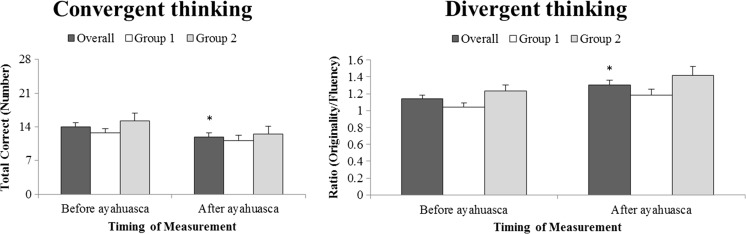
INTRODUCTION: Ayahuasca is a South American psychotropic plant tea traditionally used in Amazonian shamanism. The tea contains the psychedelic 5-HT2A receptor agonist N,N-dimethyltryptamine (DMT), plus β-carboline alkaloids with monoamine oxidase-inhibiting properties. Increasing evidence from anecdotal reports and open-label studies indicates that ayahuasca may have therapeutic effects in treatment of substance use disorders and depression. A recent study on the psychological effects of ayahuasca found that the tea reduces judgmental processing and inner reactivity, classic goals of mindfulness psychotherapy. Another psychological facet that could potentially be targeted by ayahuasca is creative divergent thinking. This mode of thinking can enhance and strengthen psychological flexibility by allowing individuals to generate new and effective cognitive, emotional, and behavioral strategies. The present study aimed to assess the potential effects of ayahuasca on creative thinking. METHODS: We visited two spiritual ayahuasca workshops and invited participants to conduct creativity tests before and during the acute effects of ayahuasca. In total, 26 participants consented. Creativity tests included the "pattern/line meanings test" (PLMT) and the "picture concept test" (PCT), both assessing divergent thinking and the latter also assessing convergent thinking. RESULTS: While no significant effects were found for the PLMT, ayahuasca intake significantly modified divergent and convergent thinking as measured by the PCT. While convergent thinking decreased after intake, divergent thinking increased. CONCLUSIONS: The present data indicate that ayahuasca enhances creative divergent thinking. They suggest that ayahuasca increases psychological flexibility, which may facilitate psychotherapeutic interventions and support clinical trial initiatives.
Overview
The claims and statistics of this paper haven’t been checked yet.
Run the check — free, no account needed. It reads the open-access text and checks the sources it cites.
Integrity signals
Registry
Cites
Statistics
Figures
Verification
Claims the paper makes
The claims and statistics of this paper haven’t been checked yet.
Run the check — free, no account needed. It reads the open-access text and checks the sources it cites.
Claims other papers make about this one
Each is checked against this paper’s own text: does it say what the citing paper says it does?
The source backs part of the claim, not all of it — or backs it for a different population, condition or comparison.
In the citing paper
“improved creativity (Frecska et al., 2012; Kuypers et al., 2016)”
From Psychological variables implied in the therapeutic effect of ayahuasca: A contextual approach (2018) · cites this paper as Kuypers et al., 2016
Experimental — accuracy not yet measuredThe cited source says what the claim attributes to it.
In the citing paper
“Previous studies described increases in divergent thinking during the ayahuasca intake (Kuypers 2016) and visual creativity after ritual use of ayahuasca (Frecska 2012).”
From Psychological variables implied in the therapeutic effect of ayahuasca: A contextual approach (2018) · cites this paper as Kuypers 2016
Self-check
Percentages, sums and reported differences re-computed from the paper’s own numbers.
The self-check needs the paper’s full text.
Citations
Cites
The Nature of Human Intelligence
Carroll, J. B., & Guilford, J. P. (1968) · American Educational Research Journal · doi:10.2307/1161820 · Cited by 4,657
The nature of human intelligence
Fuilford, J. P. (1967) · McGraw-Hill eBooks · Cited by 3,864
Salience processing and insular cortical function and dysfunction
Uddin, L. Q. (2015) · Nature Reviews Neuroscience · doi:10.1038/nrn3857 · Cited by 2,083
Wallas, G. (1926) · Medical Entomology and Zoology · Cited by 1,973
Baas, M., Dreu, C. K. W. D., & Nijstad, B. A. (2008) · Psychological Bulletin · doi:10.1037/a0012815 · Cited by 1,800
Griffiths, R. R., Richards, W. A., McCann, U., & Jesse, R. (2006) · Psychopharmacology · doi:10.1007/s00213-006-0457-5 · Cited by 1,684
Hennessey, B. A., & Amabile, T. M. (2010) · Annual Review of Psychology · doi:10.1146/annurev.psych.093008.100416 · Cited by 1,475
Creative Cognition and Brain Network Dynamics
Beaty, R. E., Benedek, M., Silvia, P. J., & Schacter, D. L. (2016) · Trends in Cognitive Sciences · doi:10.1016/j.tics.2015.10.004 · Cited by 1,105 · cited 1×
“The thalamus feeds information into the SN which in turn coordinates the other mentioned networks (Beaty et al. 2016; Uddin 2015).”
BackgroundUnderstanding the relationship between mood and creativity: A meta-analysis
Davis, M. A. (2008) · Organizational Behavior and Human Decision Processes · doi:10.1016/j.obhdp.2008.04.001 · Cited by 692
Homological scaffolds of brain functional networks
Petri, G., Expert, P., Turkheimer, F., Carhart-Harris, R., Nutt, D., Hellyer, P. J., & Vaccarino, F. (2014) · Journal of The Royal Society Interface · doi:10.1098/rsif.2014.0873 · Cited by 675
Correlates of alpha rhythm in functional magnetic resonance imaging and near infrared spectroscopy
Moosmann, M., Ritter, P., Krastel, I., den Brink, A. M.-V., Thees, S., Blankenburg, F., Taskin, B., Obrig, H., & Villringer, A. (2003) · NeuroImage · doi:10.1016/s1053-8119(03)00344-6 · Cited by 595
Beaty, R. E., & Silvia, P. J. (2012) · Psychology of Aesthetics, Creativity, and the Arts · doi:10.1037/a0029171 · Cited by 551
Fink, A., Grabner, R. H., Benedek, M., Reishofer, G., Hauswirth, V., Fally, M., Neuper, C., Ebner, F., & Neubauer, A. C. (2009) · Human Brain Mapping · doi:10.1002/hbm.20538 · Cited by 505
Palhano-Fontes, F., Andrade, K. C., Tofoli, L. F., Santos, A. C., Crippa, J. A. S., Hallak, J. E. C., Ribeiro, S., & de Araujo, D. B. (2015) · PLOS ONE · doi:10.1371/journal.pone.0118143 · Cited by 454
Hasler, F., Grimberg, U., Benz, M. A., Huber, T., & Vollenweider, F. X. (2004) · Psychopharmacology · doi:10.1007/s00213-003-1640-6 · Cited by 451
Vollenweider, F. (1997) · Neuropsychopharmacology · doi:10.1016/s0893-133x(96)00246-1 · Cited by 444
Serotonin research: contributions to understanding psychoses
GEYER, M., & VOLLENWEIDER, F. (2008) · Trends in Pharmacological Sciences · doi:10.1016/j.tips.2008.06.006 · Cited by 427
The shifting sands of creative thinking: Connections to dual-process theory
Sowden, P. T., Pringle, A., & Gabora, L. M. (2014) · Thinking & Reasoning · doi:10.1080/13546783.2014.885464 · Cited by 425
Hendricks, P. S., Thorne, C. B., Clark, C. B., Coombs, D. W., & Johnson, M. W. (2015) · Journal of Psychopharmacology · doi:10.1177/0269881114565653 · Cited by 410
The structure of creative cognition in the human brain
Jung, R. E. (2013) · Frontiers in Human Neuroscience · doi:10.3389/fnhum.2013.00330 · Cited by 391
Riba, J., Valle, M., Urbano, G., Yritia, M., Morte, A., & Barbanoj, M. J. (2003) · The Journal of Pharmacology and Experimental Therapeutics · doi:10.1124/jpet.103.049882 · Cited by 390
An exploratory study into the effects of extraordinary nature on emotions, mood, and prosociality
Joye, Y., & Bolderdijk, J. W. (2015) · Frontiers in Psychology · doi:10.3389/fpsyg.2014.01577 · Cited by 328
McKenna, D. J. (2004) · Pharmacology & Therapeutics · doi:10.1016/j.pharmthera.2004.03.002 · Cited by 321
dos Santos, R. G., Osório, F. L., Crippa, J. A. S., Riba, J., Zuardi, A. W., & Hallak, J. E. C. (2016) · Therapeutic Advances in Psychopharmacology · doi:10.1177/2045125316638008 · Cited by 306
Riba, J., Rodríguez-Fornells, A., Urbano, G., Morte, A., Antonijoan, R., Montero, M., Callaway, J. C., & Barbanoj, M. J. (2001) · Psychopharmacology · doi:10.1007/s002130000606 · Cited by 303
Self-citationRoseman, L., Leech, R., Feilding, A., Nutt, D., & Carhart-Harris, R. L. (2014) · Frontiers in Human Neuroscience · doi:10.3389/fnhum.2014.00204 · Cited by 285
Mind full of ideas: A meta-analysis of the mindfulness–creativity link
Lebuda, I., Zabelina, D. L., & Karwowski, M. (2015) · Personality and Individual Differences · doi:10.1016/j.paid.2015.09.040 · Cited by 268
Functional Connectivity Measures After Psilocybin Inform a Novel Hypothesis of Early Psychosis
Carhart-Harris, R. L., Leech, R., Erritzoe, D., Williams, T. M., Stone, J. M., Evans, J., Sharp, D. J., Feilding, A., Wise, R. G., & Nutt, D. J. (2013) · Schizophrenia Bulletin · doi:10.1093/schbul/sbs117 · Cited by 256
The therapeutic potentials of Ayahuasca: possible effects against various diseases of civilization
Frecska, E., Bokor, P., & Winkelman, M. (2016) · Frontiers in Pharmacology · doi:10.3389/fphar.2016.00035 · Cited by 242
Increased frontal and paralimbic activation following ayahuasca, the pan-amazonian inebriant
Riba, J., Romero, S., Grasa, E., Mena, E., Carrió, I., & Barbanoj, M. J. (2006) · Psychopharmacology · doi:10.1007/s00213-006-0358-7 · Cited by 241
Ayahuasca: pharmacology, neuroscience and therapeutic potential
Domínguez-Clavé, E., Soler, J., Elices, M., Pascual, J. C., Álvarez, E., de la Fuente Revenga, M., Friedlander, P., Feilding, A., & Riba, J. (2016) · Brain Research Bulletin · doi:10.1016/j.brainresbull.2016.03.002 · Cited by 226
Gouzoulis-Mayfrank, E. (1999) · Neuropsychopharmacology · doi:10.1016/s0893-133x(98)00089-x · Cited by 219
Bouso, J. C., Palhano-Fontes, F., Rodríguez-Fornells, A., Ribeiro, S., Sanches, R., Crippa, J. A. S., Hallak, J. E. C., de Araujo, D. B., & Riba, J. (2015) · European Neuropsychopharmacology · doi:10.1016/j.euroneuro.2015.01.008 · Cited by 218
The Shifting Sands of Creative Thinking: Connections to Dual Process Theory
Sowden, P. T., Pringle, A., & Gabora, L. M. (2014) · Surrey Research Insight Open Access (The University of Surrey) · Cited by 212
Soler, J., Elices, M., Franquesa, A., Barker, S., Friedlander, P., Feilding, A., Pascual, J. C., & Riba, J. (2016) · Psychopharmacology · doi:10.1007/s00213-015-4162-0 · Cited by 209
Self-citationBouso, J. C., Doblin, R., Farré, M., Alcázar‐Córcoles, M. Á., & Gómez-Jarabo, G. (2008) · Journal of Psychoactive Drugs · doi:10.1080/02791072.2008.10400637 · Cited by 205
Hermle, L., Fünfgeld, M., Oepen, G., Botsch, H., Borchardt, D., Gouzoulis, E., Fehrenbach, R. A., & Spitzer, M. (1992) · Biological Psychiatry · doi:10.1016/0006-3223(92)90059-9 · Cited by 183
Valle, M., Maqueda, A. E., Rabella, M., Rodríguez-Pujadas, A., Antonijoan, R. M., Romero, S., Alonso, J. F., Mañanas, M. À., Barker, S., Friedlander, P., et al. (2016) · European Neuropsychopharmacology · doi:10.1016/j.euroneuro.2016.03.012 · Cited by 173
Self-citationCerebral blood flow associated with creative performance: A comparative study
Chávez-Eakle, R. A., Graff‐Guerrero, A., Garcı́a-Reyna, J. C., Vaugier, V., & Cruz-Fuentes, C. S. (2007) · NeuroImage · doi:10.1016/j.neuroimage.2007.07.059 · Cited by 169
de Manzano, Ö., Červenka, S., Karabanov, A. N., Farde, L., & Ullén, F. (2010) · PLoS ONE · doi:10.1371/journal.pone.0010670 · Cited by 148
Pinho, A. L., Ullén, F., Castelo-Branco, M., Fransson, P., & de Manzano, Ö. (2015) · Cerebral Cortex · doi:10.1093/cercor/bhv130 · Cited by 147
Gouzoulis‐Mayfrank, E., Thelen, B., Habermeyer, E., Kunert, H. J., Kovar, K. ‐., Lindenblatt, H., Hermle, L., Spitzer, M., & Sass, H. (1999) · Psychopharmacology · doi:10.1007/s002130050860 · Cited by 145
Acute biphasic effects of ayahuasca.
Schenberg, E. E., Alexandre, J. F. M., Filev, R., Cravo, A. M., Sato, J. R., Muthukumaraswamy, S. D., Yonamine, M., Waguespack, M., Lomnicka, I., Barker, S. A., et al. (2015) · PLoS ONE · doi:10.1371/journal.pone.0137202 · Cited by 111
Serotonergic psychedelics temporarily modify information transfer in humans.
Alonso, J. F., Romero, S., Mañanas, M. À., & Riba, J. (2015) · International Journal of Neuropsychopharmacology · doi:10.1093/ijnp/pyv039 · Cited by 101
Advancing the clinical science of creativity
Forgeard, M. J. C., & Elstein, J. G. (2014) · Frontiers in Psychology · doi:10.3389/fpsyg.2014.00613 · Cited by 97
Bouso, J. C., Fábregas, J. M., Antonijoan, R. M., Rodríguez-Fornells, A., & Riba, J. (2013) · Psychopharmacology · doi:10.1007/s00213-013-3167-9 · Cited by 96
Frecska, E., Móré, C. E., Vargha, A., & Luna, L. E. (2012) · Journal of Psychoactive Drugs · doi:10.1080/02791072.2012.703099 · Cited by 87
Riba, J., Rodríguez‐Fornells, A., & Barbanoj, M. J. (2002) · Psychopharmacology · doi:10.1007/s00213-002-1237-5 · Cited by 70
CLARIDGE, G. S., & McDonald, A. (2009) · Personality and Individual Differences · doi:10.1016/j.paid.2009.01.018 · Cited by 67
Can psychedelic compounds play a part in drug dependence therapy?
Sessa, B., & Johnson, M. W. (2015) · The British Journal of Psychiatry · doi:10.1192/bjp.bp.114.148031 · Cited by 58
McIlhenny, E. H., Pipkin, K. E., Standish, L. J., Wechkin, H. A., Strassman, R. J., & Barker, S. A. (2009) · Journal of Chromatography A · doi:10.1016/j.chroma.2009.10.088 · Cited by 58
Self-citationThe Drive for Creativity and the Escape from Creativity: Neurocognitive Mechanisms
PERLOVSKY, L. I., & Levine, D. S. (2012) · Cognitive Computation · doi:10.1007/s12559-012-9154-3 · Cited by 31
Ayahuasca as Antidepressant? Psychedelics and Styles of Reasoning in Psychiatry
Anderson, B. T. (2012) · Anthropology of Consciousness · doi:10.1111/j.1556-3537.2012.01056.x · Cited by 30
Research works printed but not linked: 1
- Carhart-Harris RL, Kaelen M, Nutt D (2014) How do hallucinogens work on the brain? Psychol 27(9):662–665
Cited by
Sorted by citations
REBUS and the anarchic brain: Toward a unified model of the brain action of psychedelics
Carhart-Harris, R. L., & Friston, K. J. (2019) · Pharmacological Reviews · doi:10.1124/pr.118.017160 · Cited by 1,180
Serotonin and brain function: a tale of two receptors
Carhart-Harris, R., & Nutt, D. (2017) · Journal of Psychopharmacology · doi:10.1177/0269881117725915 · Cited by 739
Watts, R., Day, C., Krzanowski, J., Nutt, D., & Carhart-Harris, R. (2017) · Journal of Humanistic Psychology · doi:10.1177/0022167817709585 · Cited by 589
The entropic brain - revisited
Carhart-Harris, R. L. (2018) · Neuropharmacology · doi:10.1016/j.neuropharm.2018.03.010 · Cited by 522
Davis, A. K., Barrett, F. S., & Griffiths, R. R. (2020) · Journal of Contextual Behavioral Science · doi:10.1016/j.jcbs.2019.11.004 · Cited by 375
Metadata
- Authors
- Kuypers, K. P. C., Riba, J., de la Fuente Revenga, M., Barker, S., Theunissen, E. L., & Ramaekers, J. G.
- Affiliations
- Maastricht University (NL)
- Louisiana State University (US)
- Corresponding author
- Kuypers, K. P. C.
- Venue
- Psychopharmacology
- Published
- 2016-07-19
- Volume
- 233
- Issue
- 18
- Pages
- 3395-3403
- ISSN
- 0033-3158 (ISSN-L)
- 1432-2072
- PMC
- PMC4989012
- OpenAlex
- W2492489237
- Cited by
- 201
- References
- 53
- Citations by year
- 2026: 9 · 2025: 23 · 2024: 19 · 2023: 35 · 2022: 18 · 2021: 31 · 2020: 23 · 2019: 22 · 2018: 15 · 2017: 5 · 2016: 1
- FWCI
- 19.16
- Type
- journal article
- Language
- en
- Open access
- hybrid
- doi.org
- Locations
- Psychopharmacology (publishedVersion, cc-by)
- PubMed Central (publishedVersion, cc-by)
- PubMed (publishedVersion)
- Research Publications (Maastricht University) (publishedVersion, cc-by)
- Research Publications (Maastricht University) (submittedVersion, other-oa)
- Topics
- Social Sciences › Psychology › Clinical Psychology › Psychedelics and Drug Studies
- Social Sciences › Psychology › Experimental and Cognitive Psychology › Creativity in Education and Neuroscience
- Social Sciences › Psychology › Social Psychology › Paranormal Experiences and Beliefs
- Keywords
- ayahuasca, divergent thinking, convergent thinking, creativity, N,N-dimethyltryptamine, 5-HT2A receptor agonists, psychological flexibility, psychedelic effects
- MeSH terms
- Adult, Aged, Alkaloids, Carbolines, Cognition, Creativity, N,N-Dimethyltryptamine, Female, Hallucinogens, Humans, Judgment, Male, Middle Aged, Monoamine Oxidase Inhibitors, Plant Extracts, Psychotropic Drugs, Thinking, Banisteriopsis, Receptor, Serotonin, 5-HT2A, Serotonin 5-HT2 Receptor Agonists, Mindfulness
About these checks
Registry, retraction, Cites and statistics results are computed, not judged, with one exception: a printed reference that no index lists is read once by a model before it counts as a citation error. Claims are extracted by a model and kept only when their quote appears verbatim in the text; each cited source is then checked, with a model’s help, for whether it says what the claim relies on. Those verdicts can be wrong — read the claim’s quote and the cited source before relying on one.
Statistics and arithmetic are recomputed, not judged.
Confidence bands are shown only for fields calibrated on our annotated test set. None is calibrated yet, so no band is shown.
What counts as a claim ›How we measure confidence ›How we check this ›
Are you an author, or do you see a problem with this page? Request a review
