

Olive pomace oil can improve blood lipid profile: a randomized, blind, crossover, controlled clinical trial in healthy and at-risk volunteers
Open accessThe DOI matches its Crossref record; 45 of the 45 references it cites were found in a registry or an index; 24 of the 55 sources its claims cite were checked for support.
Abstract
Randomized, blind, crossover controlled clinical trial assessing olive pomace oil versus high-oleic sunflower oil on blood lipids and other cardiovascular risk markers.
Overview
CoChat Summary
## TL;DR
In a randomized, blind, crossover trial, 4 weeks of daily olive pomace oil (45 g/day) improved the blood lipid profile of healthy and hypercholesterolemic volunteers more than high-oleic sunflower oil. It lowered LDL-C, Apo B, and the LDL/HDL ratio, but did not change blood pressure, endothelial function, or inflammatory markers.
## Key findings
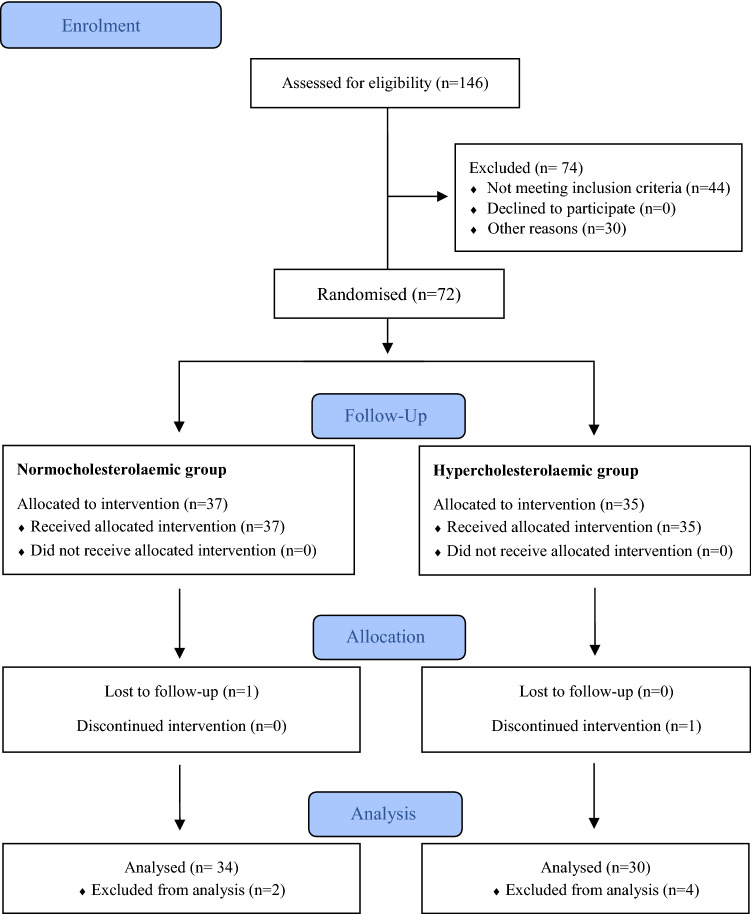
- Among 64 analyzed volunteers (36 normocholesterolemic [NC], 34 hypercholesterolemic [HC] initially completed, with exclusions before analysis), OPO for 4 weeks reduced LDL-C by 2.7% in NC and 4.3% in HC; the overall effect was significant (P = 0.003).
- Apo B decreased after OPO in both groups (NC: −2.9 ± 9.6%; HC: −6.5 ± 8.6%), with a significant overall effect (P = 0.022).
- LDL/HDL ratio decreased significantly after OPO (P = 0.027). By contrast, HOSO increased LDL-C by around 4% in both groups.
- No significant effects were seen for blood pressure, PAT/endothelial function, or inflammatory biomarkers; the paper also notes no adverse events were reported.
## Methods
- Design: randomized, blind, controlled, crossover clinical trial with two 4-week interventions (OPO vs HOSO), each preceded by a 3-week run-in/wash-out period.
- Sample: free-living men and women aged 18–55 years with BMI 18–25 kg/m²; recruited into normocholesterolemic (NC) and hypercholesterolemic (HC) groups. The paper states 72 volunteers were recruited, and 64 were analyzed.
- Analysis: repeated-measures and linear mixed models with group, treatment, and group*treatment terms; order of oil intake modeled as a random effect. Outcomes included serum lipids, blood pressure, endothelial biomarkers, PAT (in HC only), and inflammatory markers.
## Limitations
- The paper states that run-in/wash-out with sunflower oil (SO) changed lipid intake profiles (MUFA/PUFA/SFA) relative to the intervention oils; however, it says the crossover design partially addressed this by keeping starting conditions consistent.
- The paper states that nitric oxide (NO) could not be determined in blood samples and that physical activity was not surveyed.
- The paper notes that PAT has more variability than FMD, which limits interpretation of the endothelial function results.
Model-written summary. Check it against the paper before relying on it.
Integrity signals
Registry
Cites
Statistics
Figures
Verification
Claims the paper makes
16 Valid · 2 Not valid · 11 Not checked · 56 Own results and interpretations
The cited sources support only part of this claim — read each source’s verdict below.
In the paper
“Numerous in vitro and preclinical studies have been conducted with one or more of these so-called minor components of OPO, offering promising results on different cardiometabolic traits [7–9].”
§ Olive pomace oil can improve blood lipid profile: a randomized, blind, crossover, controlled clinical trial in healthy and at-risk volunteers > Introduction
What the sources say
- Not checked — no full text of the sourcecites [7] Valero-Muñoz M Martín-Fernández B Ballesteros S Protective effect of a pomace olive oil concentrated in triterpenic acids in alterations related to hypertension in rats: mechanisms involved Mol Nutr Food Res 2014 58 376 383 10.1002/mnfr.201300256 24039161 source
- Supportedcites [8] Claro-Cala CM Quintela JC Pérez-Montero M Pomace olive oil concentrated in triterpenic acids restores vascular function, glucose tolerance and obesity progression in mice Nutrients 2020 12 323 10.3390/nu12020323 31991894 PMC7071211 source
The Introduction (page not available) describes multiple in vitro and animal studies of oleanolic and maslinic acids, minor olive-oil components, reporting effects on vasodilation, adiposity and glucose tolerance. The Discussion (page not available) also reports effects of maslinic acid in cell lines and obese mice. Together, these support the broad claim of promising preclinical results across cardiometabolic traits. (LLM, conf=0.94)
- Partly supportedcites [9] Carmo J Cavalcante-Araújo P Silva J Uvaol improves the functioning of fibroblasts and endothelial cells and accelerates the healing of cutaneous wounds in mice Molecules 2020 25 4982 10.3390/molecules25214982 33126422 PMC7662923 sourceExperimental — accuracy not yet measured
The Introduction identifies uvaol as a triterpene found in olives, and the Discussion reports its beneficial effects in cell experiments and a mouse wound-healing model (no page numbers provided). This supports the cited paper as an example of in vitro and preclinical work on an olive component, but its reported outcomes concern cutaneous healing, not cardiometabolic traits. (LLM, conf=0.84)
plainstates an association- Asserted: passes — The authors put it forward as true.
- Checkable: passes — It can be checked against evidence.
- Load-bearing: passes — The paper’s conclusions depend on it.
- Based: passes — The paper gives a reason why it holds.
The cited sources support only part of this claim — read each source’s verdict below.
In the paper
“However, research on the health effects of OPO in humans is limited to the assessment of some pure minor components administered as drugs or food supplements [10–12] or as functional VOO enriched in some triterpenes [13, 14], yet to this date the effect of consuming OPO in the diet has not been studied.”
§ Olive pomace oil can improve blood lipid profile: a randomized, blind, crossover, controlled clinical trial in healthy and at-risk volunteers > Introduction
What the sources say
- Partly supportedcites [10] Fukumitsu S Kinoshita T Villareal MO Maslinic acid improves quality of life by alleviating joint knee pain in the elderly: results from a community-based pilot study J Clin Biochem Nutr 2017 61 67 73 10.3164/jcbn.16-119 28751812 PMC5525013 sourceExperimental — accuracy not yet measured
The Materials and Methods sections describe a human study of a daily maslinic-acid-containing jelly supplement, so the paper supports an example of research on a minor olive component. But the supplement contained olive fruit extract with 10.4% maslinic acid, not a pure component; the paper also does not establish that human research on OPO is limited to such studies. (LLM, conf=0.87)
- Not checked — no full text of the sourcecites [11] Luo HQ Shen J Chen CP Lipid-lowering effects of oleanolic acid in hyperlipidemic patients Chin J Nat Med 2018 6 339 346 10.1016/S1875-5364(18)30065-7 29860994 source
- Not checked — no full text of the sourcecites [12] Ramirez-Rodriguez AM Gonzalez-Ortiz M Martinez-Abundis E Acuña-Ortega N Effect of ursolic acid on metabolic syndrome, insulin sensitivity and inflammation J Med Food 2017 20 882 886 10.1089/jmf.2017.0003 28598231 source
- Supportedcites [13] Sánchez-Rodríguez E Lima-Cabello E Biel-Glesson S Effects of virgin olive oils differing in their bioactive compound contents on metabolic syndrome and endothelial functional risk biomarkers in healthy adults: A randomized double-blind controlled trial Nutrients 2018 10 626 10.3390/nu10050626 29772657 PMC5986505 source
The citation to this paper supports the sentence’s example of human research using functional virgin olive oil enriched with triterpenes. The Study Design section describes a randomized human trial that included such an oil; the claims about pure components and the absence of dietary OPO studies are not attributed to this citation. (LLM, conf=0.93)
- Partly supportedcites [14] Santos-Lozano JM Rada M Lapetra J Prevention of type 2 diabetes in prediabetic patients by using functional olive oil enriched in oleanolic acid: the PREDIABOLE study, a randomized controlled trial Diabetes Obes Metab 2019 21 2526 2534 10.1111/dom.13838 31364228 sourceExperimental — accuracy not yet measured
The Elaboration and characteristics of the functional olive oil section (page unavailable) describes a human trial using olive oil enriched with oleanolic acid, a triterpene. But it specifies that the oil was a blend of virgin and refined olive oils, not virgin olive oil (VOO) alone. (LLM, conf=0.87)
plain- Asserted: passes — The authors put it forward as true.
- Checkable: passes — It can be checked against evidence.
- Load-bearing: passes — The paper’s conclusions depend on it.
- Based: passes — The paper gives a reason why it holds.
- Partly supported
The cited sources support only part of this claim — read each source’s verdict below.
In the paper
“However, research on the health effects of OPO in humans is limited to the assessment of some pure minor components administered as drugs or food supplements [10–12] or as functional VOO enriched in some triterpenes [13, 14], yet to this date the effect of consuming OPO in the diet has not been studied.”
§ Olive pomace oil can improve blood lipid profile: a randomized, blind, crossover, controlled clinical trial in healthy and at-risk volunteers > Introduction
What the sources say
- Could not verifycites [10] Fukumitsu S Kinoshita T Villareal MO Maslinic acid improves quality of life by alleviating joint knee pain in the elderly: results from a community-based pilot study J Clin Biochem Nutr 2017 61 67 73 10.3164/jcbn.16-119 28751812 PMC5525013 sourceExperimental — accuracy not yet measured
The Materials and Methods section describes daily consumption of a jelly containing maslinic-acid-rich olive fruit extract, not OPO consumed as part of the diet. Neither that passage nor the Introduction and Discussion passages address whether dietary OPO had been studied elsewhere, so our copy cannot verify the claim that it had not been studied. (LLM, conf=0.76)
- Not checked — no full text of the sourcecites [11] Luo HQ Shen J Chen CP Lipid-lowering effects of oleanolic acid in hyperlipidemic patients Chin J Nat Med 2018 6 339 346 10.1016/S1875-5364(18)30065-7 29860994 source
- Not checked — no full text of the sourcecites [12] Ramirez-Rodriguez AM Gonzalez-Ortiz M Martinez-Abundis E Acuña-Ortega N Effect of ursolic acid on metabolic syndrome, insulin sensitivity and inflammation J Med Food 2017 20 882 886 10.1089/jmf.2017.0003 28598231 source
- Supportedcites [13] Sánchez-Rodríguez E Lima-Cabello E Biel-Glesson S Effects of virgin olive oils differing in their bioactive compound contents on metabolic syndrome and endothelial functional risk biomarkers in healthy adults: A randomized double-blind controlled trial Nutrients 2018 10 626 10.3390/nu10050626 29772657 PMC5986505 source
The citation is attached to the example of functional virgin olive oil enriched with triterpenes, not to the citing authors’ subsequent statement about OPO. Section 2.2 (Study Design; page unavailable) describes this trial’s triterpene-enriched functional olive oil. The source does not establish whether dietary OPO had previously been studied. (LLM, conf=0.88)
- Partly supportedcites [14] Santos-Lozano JM Rada M Lapetra J Prevention of type 2 diabetes in prediabetic patients by using functional olive oil enriched in oleanolic acid: the PREDIABOLE study, a randomized controlled trial Diabetes Obes Metab 2019 21 2526 2534 10.1111/dom.13838 31364228 sourceExperimental — accuracy not yet measured
The Methods section (‘Elaboration and characteristics of the functional olive oil’; page unavailable) identifies this study’s oil as enriched with oleanolic acid, a triterpene, supporting the identification to which the citation is attached. It describes the oil as a blend of virgin and refined olive oils, however, not virgin olive oil (VOO) alone. The subsequent statement that dietary OPO has not been studied is not directly attributed to this citation. (LLM, conf=0.84)
plain- Asserted: passes — The authors put it forward as true.
- Checkable: passes — It can be checked against evidence.
- Load-bearing: passes — The paper’s conclusions depend on it.
- Based: passes — The paper gives a reason why it holds.
- Could not verify
A result the paper reports from its own data — it cites no other source for it, so there is none to check. The quote shows it is in the paper.
In the paper
“OPO significantly reduced low-density lipoprotein cholesterol (LDL-C; P = 0.003) and apolipoprotein B (Apo B; P = 0.022) serum concentrations, and LDL/HDL ratio (P = 0.027) in healthy and at-risk volunteers.”
§ Olive pomace oil can improve blood lipid profile: a randomized, blind, crossover, controlled clinical trial in healthy and at-risk volunteers > Abstract > Results
plainstates a cause- Asserted: passes — The authors put it forward as true.
- Checkable: passes — It can be checked against evidence.
- Load-bearing: passes — The paper’s conclusions depend on it.
- Based: passes — The paper gives a reason why it holds.
A result the paper reports from its own data — it cites no other source for it, so there is none to check. The quote shows it is in the paper.
In the paper
“Blood pressure, peripheral artery tonometry (PAT), endothelial function and inflammation biomarkers were not affected.”
§ Olive pomace oil can improve blood lipid profile: a randomized, blind, crossover, controlled clinical trial in healthy and at-risk volunteers > Abstract > Results
plain- Asserted: passes — The authors put it forward as true.
- Checkable: passes — It can be checked against evidence.
- Load-bearing: unclear — It is unclear whether the paper’s conclusions depend on it.
- Based: passes — The paper gives a reason why it holds.
23 more claims
Create a free account to see all 85 claims and every source verdict.
- Probably not a substantial claim. 44
- It may state two separate claims as one. 27
Citations
Cites
Friedewald, W. T., Levy, R. I., & Fredrickson, D. S. (1972) · Clinical Chemistry · doi:10.1093/clinchem/18.6.499 · Cited by 32,423 · cited 1×
“(very low-density lipoprotein) were calculated according to Friedewald formula, and Apo B/Apo A1, LDL/HDL and TC/ HDL ratios were calculated [15].”
MethodAntihyperlipidemic and Biochemical Activities of Mcy Protein in Streptozotocin Induced Diabetic Rats
Marella, S., Maddirela, D. R., Badri, K. R., Jyothi Kumar, M. V., & Chippada, A. (2015) · Cellular Physiology and Biochemistry · doi:10.1159/000373954 · Cited by 5,938
Benefits of the Mediterranean Diet: Insights From the PREDIMED Study
Martínez-González, M. A., Salas-Salvadó, J., Estruch, R., Corella, D., Fitó, M., & Ros, E. (2015) · Progress in Cardiovascular Diseases · doi:10.1016/j.pcad.2015.04.003 · Cited by 779 · cited 3×
“Olive oil is an essential component of the MD, being its primary fat source [3].”
BackgroundAssessment of peripheral vascular endothelial function with finger arterial pulse wave amplitude
Kuvin, J. T., Patel, A. R., Sliney, K. A., Pandian, N. G., Sheffy, J., Schnall, R. P., Karas, R. H., & Udelson, J. E. (2003) · American Heart Journal · doi:10.1016/s0002-8703(03)00094-2 · Cited by 773 · cited 1×
“The reactive hyperaemia index (RHI) was calculated as the ratio of PWA during reactive hyperaemia vs baseline [17].”
MethodApolipoprotein B Particles and Cardiovascular Disease: A Narrative Review
Sniderman, A. D., Thanassoulis, G., Glavinovic, T., Navar, A. M., Pencina, M., Catapano, A., & Ference, B. A. (2019) · JAMA Cardiology · doi:10.1001/jamacardio.2019.3780 · Cited by 593
Mateos, R., Espartero, J. L., Trujillo, M., Ríos, J. J., León-Camacho, M., Alcudia, F., & Cert, A. (2001) · Journal of Agricultural and Food Chemistry · doi:10.1021/jf0013205 · Cited by 472
Self-citationManagement of Measurable Variable Cardiovascular Disease' Risk Factors
Francula-Zaninovic, S., & Nola, I. A. (2018) · Current Cardiology Reviews · doi:10.2174/1573403x14666180222102312 · Cited by 369 · cited 7×
“It is known that a healthy diet and physical exercise can modulate the risk of CVD [1, 2].”
BackgroundInfluentialSchwingshackl, L., Christoph, M., & Hoffmann, G. (2015) · Nutrients · doi:10.3390/nu7095356 · Cited by 252
Senior, J. R. (2012) · Clinical Pharmacology & Therapeutics · doi:10.1038/clpt.2012.108 · Cited by 247 · cited 1×
“Alanine aminotransferase (ALAT) and aspartate aminotransferase (ASAT) were analysed according to standard spectrophotometric procedures [16].”
MethodQuantitative Determination of Hydroxy Pentacyclic Triterpene Acids in Vegetable Oils
Pérez-Camino, M. C., & Cert, A. (1999) · Journal of Agricultural and Food Chemistry · doi:10.1021/jf980881h · Cited by 205 · cited 1×
“Triterpenic acids were analysed following the method of Pérez-Camino & Cert [18], and squalene was determined by gas chromatography [19].”
Method
Cited by
Schmidt, L., Prestes, O. D., Augusti, P. R., & Moreira, J. C. F. (2023) · Food Bioscience · doi:10.1016/j.fbio.2023.102626 · Cited by 64
Antonopoulou, S., & Demopoulos, C. A. (2023) · Biomolecules · doi:10.3390/biom13040700 · Cited by 40
Rivero‐Pino, F., Millán-Linares, M. C., Villanueva-Lazo, A., Fernández‐Prior, Á., & la Paz, S. M. (2023) · Critical Reviews in Food Science and Nutrition · doi:10.1080/10408398.2023.2203229 · Cited by 29
“Similarly, Gonzalez-Ramila et al. (2022) aimed to unravel how dietary consumption of olive-pomace oil would have an impact on cardiovascular disease risk factors (endpoints: blood lipids, blood pressure, inflammation, and endothelial function).”
Effect of Olive Pomace Oil on Cardiovascular Health and Associated Pathologies
González-Rámila, S., Sarriá, B., Seguido, M. Á., García-Cordero, J., Bravo, L., & Mateos, R. (2022) · Nutrients · doi:10.3390/nu14193927 · Cited by 20
“However, in countries such as Spain, where the olive oil consumption is deeply rooted, the main competitors in the olive market are seed oils (high oleic sunflower oil (HOSO), sunflower oil (SO), etc.) [6].”
MethodSelf-citationÁlvarez, M. D., Cofrades, S., Pérez-Mateos, M., Saiz, A., & Herranz, B. (2022) · Foods · doi:10.3390/foods11244054 · Cited by 18
“Therefore, the regular consumption of OPO in the diet presents hypolipidemic effects in healthy consumers and in subjects with high blood cholesterol, contributing to the prevention of cardiovascular disease [18].”
Background
Metadata
- Authors
- González-Rámila, S., Sarriá, B., Seguido, M. A., García-Cordero, J., Mateos, R., & Bravo, L.
- Affiliations
- Consejo Superior de Investigaciones Científicas (ES)
- Corresponding author
- Bravo, Laura
- Venue
- European Journal of Nutrition
- Published
- 2022-09-24
- Volume
- 62
- Issue
- 2
- Pages
- 589-603
- ISSN
- 1436-6207 (ISSN-L)
- 1436-6215
- PMC
- PMC9941261
- OpenAlex
- W4296953847
- Cited by
- 24
- References
- 45
- Citations by year
- 2026: 1 · 2025: 5 · 2024: 9 · 2023: 7 · 2022: 2
- FWCI
- 2.19
- Type
- journal article
- Language
- en
- Open access
- hybrid
- doi.org
- Licence
- cc-by
- creativecommons.org/licenses/by/4.0 (tdm)
- creativecommons.org/licenses/by/4.0 (vor)
- Locations
- European Journal of Nutrition (publishedVersion, cc-by)
- PubMed Central (publishedVersion, cc-by)
- PubMed (publishedVersion)
- DIGITAL.CSIC (Spanish National Research Council (CSIC)) (submittedVersion, cc-by)
- Funders
- Interprofesional del Aceite de Orujo de Oliva
- Comunidad de Madrid (PEJD-2018-PRE/SAL-9104, PEJD-2017-PRE/BIO-4225)
- Consejo Superior de Investigaciones Cientificas
- Topics
- Physical Sciences › Chemistry › Organic Chemistry › Edible Oils Quality and Analysis
- Health Sciences › Nursing › Nutrition and Dietetics › Fatty Acid Research and Health
- Health Sciences › Nursing › Nutrition and Dietetics › Nuts composition and effects
- Keywords
- olive pomace oil, lipid profile, LDL cholesterol, apolipoprotein B, LDL/HDL ratio, hypercholesterolemia, cardiovascular risk, high oleic sunflower oil, endothelial function, blood pressure, inflammation
- MeSH terms
- Olive Oil, Sunflower Oil, Apolipoproteins B, Cardiovascular Diseases, Cholesterol, Humans, Inflammation, Plant Oils, Cross-Over Studies, Oleic Acid
About these checks
Registry, retraction, Cites and statistics results are computed, not judged, with one exception: a printed reference that no index lists is read once by a model before it counts as a citation error. Claims are extracted by a model and kept only when their quote appears verbatim in the text; each cited source is then checked, with a model’s help, for whether it says what the claim relies on. Those verdicts can be wrong — read the claim’s quote and the cited source before relying on one.
The claim verdicts this report counts are experimental: their accuracy is not yet measured.
A language model drew the claims from the paper on 2026-10-10, under version 3 of the claim definition (model deepseek-v4.1-flash, prompt extract-v3).
A second model labelled each claim on 2026-10-10 (model jev-1.13-20260917, definition revision gold-guideline-v0.2).
Cited sources are checked with a language model’s help (gpt-6-sol).
Statistics and arithmetic are recomputed, not judged.
Confidence bands are shown only for fields calibrated on our annotated test set. None is calibrated yet, so no band is shown.
What counts as a claim ›How we measure confidence ›How we check this ›
Are you an author, or do you see a problem with this page? Request a review
How to cite
Cite CoChat for the checks on this page, and the paper for its own findings.
- This page
- CoChat. (2026). Citation check: Olive pomace oil can improve blood lipid profile: a randomized, blind, crossover, controlled clinical trial in healthy and at-risk volunteers. https://app.cochat.ai/papers/10.1007/s00394-022-03001-y
- The paper
- González-Rámila, S., Sarriá, B., Seguido, M. A., García-Cordero, J., Mateos, R., & Bravo, L. (2022). Olive pomace oil can improve blood lipid profile: a randomized, blind, crossover, controlled clinical trial in healthy and at-risk volunteers. European Journal of Nutrition. https://doi.org/10.1007/s00394-022-03001-y
Data sources
Bibliographic data: Semantic Scholar, OpenAlex, Crossref.
Contains information from the Semantic Scholar Academic Graph Datasets, made available under the ODC Attribution License (ODC-BY 1.0).
Semantic Scholar’s data is described in: Kinney, R., et al. (2023). The Semantic Scholar Open Data Platform. arXiv:2301.10140.
