

Stability of Persistence Diagrams
Open accessThe DOI matches its Crossref record; 32 of the 32 references it cites were found in a registry or an index; 1 of the 21 sources its claims cite were checked for support.
Overview
CoChat Summary
TL;DR
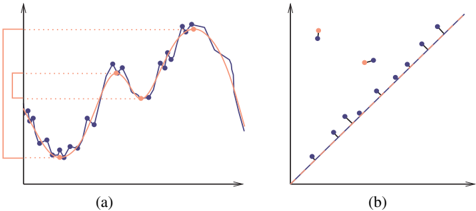
The paper proves that persistence diagrams of real-valued functions on topological spaces are stable: small changes in the function imply small changes in the diagram under the bottleneck distance. It applies this stability to homology estimation from point samples and to comparing/classifying geometric shapes.
Key findings
- The Main Theorem states that for a triangulable space \(X\) with continuous tame functions \(f,g:X\to\mathbb R\), the persistence diagrams satisfy \(d_B(D(f),D(g)) \le \|f-g\|_\infty\).
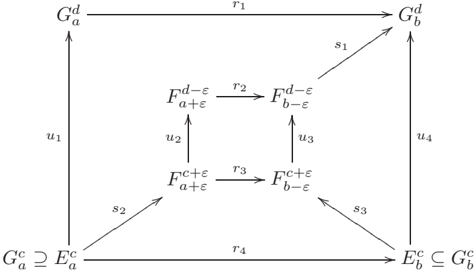
- The proof first establishes stability for the Hausdorff distance using the Box Lemma, then strengthens it to the bottleneck distance using the Easy Bijection Lemma and an Interpolation Lemma for piecewise linear functions.
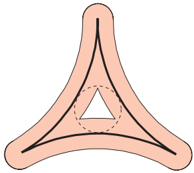
- The Homology Inference Theorem states that for all real \(\varepsilon\) with \(d_H(X,P) < \varepsilon < \mathrm{hfs}_X/4\) and all sufficiently small \(\delta>0\), the dimensions of the homology group of \(X+\delta\) and \(P^\varepsilon_{3\varepsilon}\) are either both infinite or both finite and equal.
- The Barcode Theorem states that if a diffeomorphism \(\Phi:\mathbb R^d\to\mathbb R^d\) has derivatives up to second order close to those of a rigid motion, then the bottleneck distance between the barcodes of a hypersurface \(S\subseteq\mathbb R^d\) and its perturbation \(\Phi(S)\) is small.
Methods
- Theoretical study of real-valued functions on topological spaces, using homology with \(\mathbb Z_2\) coefficients, homological critical values, tame functions, persistent homology groups, and persistence diagrams.
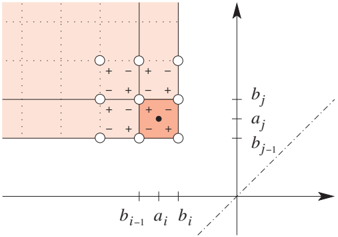
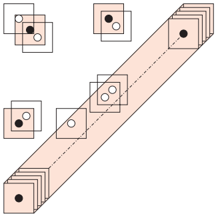
- Stability is proved by algebraic-topological diagram chasing: the Quadrant Lemma and Box Lemma bound multiplicities in nested quadrants/boxes, and the bottleneck case is handled by composing bijections for very close functions and interpolating between piecewise linear functions.
- Applications are derived as corollaries; the paper reports no empirical data, experiments, or numerical evaluations.
Limitations
- The paper explicitly leaves open whether the Main Theorem extends to non-tame functions, whether other metrics on functions and persistence diagrams admit similar inequalities, and how to exploit the result algorithmically.
- Evident from the text: the main theorem assumes a triangulable space and continuous tame functions, and the proof uses compactness, finite simplicial complexes, and finite-dimensional homology groups.
- Evident from the text: the applications are theoretical corollaries, and the Barcode Theorem states only that the bottleneck distance is “small” under \(C^2\)-closeness to a rigid motion, without a quantitative bound.
Model-written summary. Check it against the paper before relying on it.
Integrity signals
Registry
Cites
Statistics
Figures
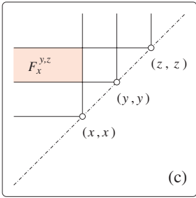
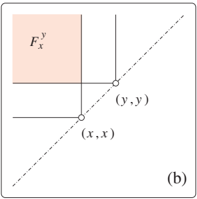
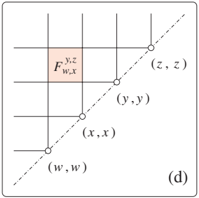
![Fig. 3 (a) Homology group of the sub-level set f -1 ( -∞ , x ]. (b) Image of Fx in Fy . (c) Kernel of surjection F y x → F z x . (d) Quotient of F y , z x and F y , z w .](https://figures.cochat.ai/paper-figures/e3fbb536dd354c4daa1aeec1692fa302/stability-of-persistence-diagrams-figure-3.png)
Verification
Claims the paper makes
1 Valid · 7 Not valid · 19 Not checked · 31 Own results and interpretations
The cited sources support only part of this claim — read each source’s verdict below.
In the paper
“Indeed, the dimensions of the persistent homology groups that appear in the theorem are efficiently computable using the persistence algorithm on the filtration of alpha complexes [11], [12].”
What the sources say
- Not matchedcites [11] 11. H. Edelsbrunner, D. Letscher, and A. Zomorodian. Topological persistence and simplification. Discrete Comput . Geom . 28 (2002), 511-533.
More than one paper fits this citation.
- Partly supportedcites [12] 12. H. Edelsbrunner and E. P. M¨ ucke. Three-dimensional alpha shapes. ACM Trans . Comput . Graphics 13 (1994), 43-72. sourceExperimental — accuracy not yet measured
Section 3.3, “Alpha Complexes” (page unavailable), defines alpha complexes and states that each is a subcomplex of those at larger alpha values, supporting the filtration part. “Features and Signatures” (page unavailable) describes an efficient way to track connected components, but calls higher-order homology signatures more challenging; it does not describe a persistence algorithm or establish efficient computation of the claimed persistent-homology dimensions. (LLM, conf=0.86)
plainstates a cause- Asserted: passes — The authors put it forward as true.
- Checkable: passes — It can be checked against evidence.
- Load-bearing: passes — The paper’s conclusions depend on it.
- Based: passes — The paper gives a reason why it holds.
- Not matched
A result the paper states — it cites no source for it, so there is none to check. The quote shows it is in the paper.
In the paper
“Easy Bijection Lemma. Let f , g : X → R be tame functions and let g be very close to f . Then the persistence diagrams satisfy d B ( D ( f ), D ( g )) ≤ ‖ f -g ‖∞ .”
plainstates an association- Asserted: passes — The authors put it forward as true.
- Checkable: passes — It can be checked against evidence.
- Load-bearing: passes — The paper’s conclusions depend on it.
- Based: passes — The paper gives a reason why it holds.
A result the paper states — it cites no source for it, so there is none to check. The quote shows it is in the paper.
In the paper
“Critical Value Lemma. If some closed interval [ x , y ] contains no homological critical value of f , then f y x is an isomorphism for every integer k .”
plainstates a cause- Asserted: passes — The authors put it forward as true.
- Checkable: passes — It can be checked against evidence.
- Load-bearing: passes — The paper’s conclusions depend on it.
- Based: passes — The paper gives a reason why it holds.
A result the paper states — it cites no source for it, so there is none to check. The quote shows it is in the paper.
In the paper
“Writing ε = ‖ f -g ‖∞ , we have f -1 ( -∞ , x ] ⊆ g -1 ( -∞ , x + ε ] for all x ∈ R .”
plainstates a cause- Asserted: passes — The authors put it forward as true.
- Checkable: passes — It can be checked against evidence.
- Load-bearing: passes — The paper’s conclusions depend on it.
- Based: passes — The paper gives a reason why it holds.
A result the paper states — it cites no source for it, so there is none to check. The quote shows it is in the paper.
In the paper
“Interpolation Lemma.”
- Also stated in: § Interpolation Lemma. · p. 13 · boosted
“However, since the h λ i sample the linear interpolation from ˆ f to ˆ g , the latter sum equals ‖ ˆ f - ˆ g ‖∞ , which concludes the proof.”
boostedstates an association- Asserted: passes — The authors put it forward as true.
- Checkable: passes — It can be checked against evidence.
- Load-bearing: passes — The paper’s conclusions depend on it.
- Based: passes — The paper gives a reason why it holds.
- Also stated in: § Interpolation Lemma. · p. 13 · boosted
21 more claims
Create a free account to see all 58 claims and every source verdict.
- Probably not a substantial claim. 28
- It may state two separate claims as one. 13
Claims other papers make about this one
Each is checked against this paper’s own text: does it say what the citing paper says it does?
The source backs part of the claim, not all of it — or backs it for a different population, condition or comparison.
In the citing paper
“Let X be any space which is homeomorphic to a simplicial complex, and suppose f, g : X → R are continuous tame functions. Then the persistence vector spaces { H k ( f -1 (( -∞ , r ]) } r and { H k ( g -1 (( -∞ , r ]) } r are finitely presented, and therefore admit barcode descriptions for each k ∈ N”
From Topological pattern recognition for point cloud data (2014) · cites this paper as Cohen-Steiner et al. (2007)
Experimental — accuracy not yet measuredThe cited source says what the claim attributes to it.
In the citing paper
“Also, results about barcodes under the general heading have now begun to appear (see [15] and [16]).”
From Topology and data (2009) · cites this paper as [15]
Citations
Cites
Rayward-Smith, V. J. (1991) · Journal of the Operational Research Society · doi:10.1057/jors.1991.155 · Cited by 16,821
Spanier, E. H. (1990) · Cited by 3,014
Three-dimensional alpha shapes
Edelsbrunner, H., & Mücke, E. P. (1994) · ACM Transactions on Graphics · doi:10.1145/174462.156635 · Cited by 2,488
Self-citationElements of Algebraic Topology
Munkres, J. R. (2018) · CRC Press eBooks · doi:10.1201/9780429493911 · Cited by 2,102
Introduction to Algorithms, Second Edition
Rivest, R. L., Leiserson, C. E., Cormen, T. H., & Stein, C. (2001) · Cited by 1,984
Topological Persistence and Simplification
Edelsbrunner, Letscher, & Zomorodian (2002) · Discrete & Computational Geometry · doi:10.1007/s00454-002-2885-2 · Cited by 1,779
Introduction to linear algebra
(2016) · Cybersecurity and Applied Mathematics · doi:10.1016/b978-0-12-804452-0.09998-x · Cited by 1,646
Zomorodian, A., & Carlsson, G. (2005) · Discrete & Computational Geometry · doi:10.1007/s00454-004-1146-y · Cited by 1,591
Milnor, J. (1963) · doi:10.1515/9781400881802 · Cited by 1,390
Morphometric Tools for Landmark Data.
Bookstein, F. (1998) · Biometrics · doi:10.2307/2534038 · Cited by 1,378
Research works printed but not linked: 2
- [16]16. J. Milnor. Morse Theory . Princeton University Press, New Jersey, 1963.
- [19]19. V. Robins. Toward computing homology from finite approximations. Topology Proceedings 24 (1999), 503-532.
Cited by
Items 901–1,000 of 1,300
Group detection in energy commodity markets through manifold-informed Wasserstein barycenter
Mari, C., Laureti, T., & Baldassari, C. (2025) · Quality & Quantity · doi:10.1007/s11135-025-02147-1 · Cited by 1
A statistical framework for analyzing shape in a time series of random geometric objects
van Delft, A., & Blumberg, A. J. (2025) · The Annals of Statistics · doi:10.1214/24-aos2465 · Cited by 7
Topological Data Analysis and Graph-Based Learning for Multimodal Recommendation
Bachiri, K., Yahyaouy, A., Malek, M., & Rogovschi, N. (2025) · IEEE Access · doi:10.1109/access.2025.3582480 · Cited by 3
Strategic Interplay: Game-Theoretic Frameworks for Topological Robustness Against Data Poisoning
Феррара, М. (2025) · WSEAS Transactions on Information Science and Applications archive · doi:10.37394/23209.2025.22.44 · Cited by 1
Lü, C., Wei, Z., Huang, Z., et al. (2025) · Chaos An Interdisciplinary Journal of Nonlinear Science · doi:10.1063/5.0285335 · Cited by 1
Efficient Computation of Image Persistence
Bauer, U., & Schmahl, M. (2025) · Discrete & Computational Geometry · doi:10.1007/s00454-025-00769-8 · Cited by 1
Explorative Analysis of Dynamic Force Networks in 2D Photoelastic Disks Ensembles
Rasheed, F., Naseer, A., Masood, T. B., Murthy, T. G., Natarajan, V., & Hotz, I. (2026) · IEEE Transactions on Visualization and Computer Graphics · doi:10.1109/tvcg.2026.3660683 · Cited by 1
Hierarchical topological clustering and meaningful outliers
Carpio, A., & Duro, G. (2026) · Soft Computing · doi:10.1007/s00500-025-11028-6 · Cited by 1
The stability of persistent homology of hypergraphs
Ren, S., & Wu, J. (2026) · Journal of Homotopy and Related Structures · doi:10.1007/s40062-026-00400-4 · Cited by 18
Vagus, S., Casey, T. M., & George, U. Z. (2026) · PLoS ONE · doi:10.1371/journal.pone.0342509 · Cited by 2
Bizana, G. B., Kalidindi, S. R., & Barrales-Mora, L. A. (2026) · Acta Materialia · doi:10.1016/j.actamat.2026.122403 · Cited by 4
Kaabi, F., & Betti, G. (2026) · Fuzzy Sets and Systems · doi:10.1016/j.fss.2026.110020 · Cited by 3
Estimating Multidimensional Persistent Homology Through a Finite Sampling
Cavazza, N., Ferri, M., & Landi, C. (2015) · International Journal of Computational Geometry & Applications · doi:10.1142/s0218195915500119 · Cited by 2
On the distribution of local extrema in Quantum Chaos
Pausinger, F., & Steinerberger, S. (2014) · Physics Letters A · doi:10.1016/j.physleta.2014.12.010 · Cited by 1
Versions of Intersection and Local Homology
Bendich, P. L., Harer, J., Saper, L., & Cohen‐Steiner, D. (2008) · Cited by 1
Self-citationGeometric Topology & Visualizing 1-Manifolds
Jordan, K. E., Miller, L. E., Peters, T., et al. (2010) · Mathematics and visualization · doi:10.1007/978-3-642-15014-2_1 · Cited by 1
echet Means and Statistics on Vineyards
Munch, E., Bendich, P. L., Turner, K., Mukherjee, S., Mattingly, J. C., & Harer, J. (2013) · Cited by 1
Self-citationDiscovering Metrics and Scale Space
Fasy, B. T. (2010) · Cited by 1
A method deciding topological relationship for self-organizing maps by persistent homology analysis
Futagami, R., & Shibuya, T. (2016) · Annual Conference of the Society of Instrument and Control Engineers of Japan (SICE) · doi:10.1109/sice.2016.7749253 · Cited by 1
Geometric cross-modal comparison of heterogeneous sensor data
Tralie, C. J., Smith, A. D., Borggren, N., et al. (2018) · Proceedings - IEEE Aerospace Conference · doi:10.1109/aero.2018.8396789 · Cited by 1
Self-citationFréchet-Stable Signatures Using Persistence Homology
Sheehy, D. R. (2018) · Society for Industrial and Applied Mathematics eBooks · doi:10.1137/1.9781611975031.71 · Cited by 1
Blaser, N., & Brun, M. (2018) · Mathematics in Computer Science · doi:10.1007/s11786-018-0352-6 · Cited by 1
Sinkhorn Divergence of Topological Signature Estimates for Time Series Classification
Stephen, C. (2018) · International Conference on Machine Learning and Applications · doi:10.1109/icmla.2018.00113
Efficient and Robust Persistent Homology for Measures
Buchet, M., Chazal, F., Oudot, S., & Sheehy, D. R. (2014) · ACM-SIAM Symposium on Discrete Algorithms (SODA) · doi:10.1137/1.9781611973730.13 · Cited by 49
Comparison of Persistent Homologies for Vector Functions: from continuous to discrete and back
Cavazza, N., Ethier, M., Frosini, P., et al. (2012) · AMS Acta (University of Bologna) · doi:10.48550/arxiv.1201.3217 · Cited by 1
Field Choice Problem in Persistent Homology
Obayashi, I., & Yoshiwaki, M. (2023) · Discrete & Computational Geometry · doi:10.1007/s00454-023-00544-7 · Cited by 17
2D+t track detection via relative persistent homology
Assaf, R., Goupil, A., Rammal, A., et al. (2020) · International Journal of Imaging Systems and Technology · doi:10.1002/ima.22503 · Cited by 1
The Maximum Distance Problem and Minimum Spanning Trees
Alvarado, E., Krishnamoorthy, B., & Vixie, K. R. (2021) · International Journal of Analysis and Applications · doi:10.28924/2291-8639-19-2021-633 · Cited by 1
Persistent homology in ℓ∞ metric
Beltramo, G., & Škraba, P. (2021) · Computational Geometry · doi:10.1016/j.comgeo.2021.101821 · Cited by 1
Algorithmic reconstruction of the fiber of persistent homology on cell complexes
Leygonie, J., & Henselman‐Petrusek, G. (2024) · Journal of Applied and Computational Topology · doi:10.1007/s41468-024-00165-w · Cited by 9
Medical Image Segmentation for Skin Lesion Detection via Topological Data Analysis
Jazayeri, N., Jazayeri, F., & Sajedi, H. (2022) · International Conference on Ubiquitous Information Management and Communication (IMCOM) · doi:10.1109/imcom53663.2022.9721758 · Cited by 1
Topological Dynamics and Topological Data Analysis
(2021) · Springer proceedings in mathematics & statistics · doi:10.1007/978-981-16-0174-3 · Cited by 1
Edelsbrunner, H. (2014) · SpringerBriefs in applied sciences and technology · doi:10.1007/978-3-319-05957-0_12 · Cited by 1
Self-citationRobinson, M. (2014) · Mathematical engineering · doi:10.1007/978-3-642-36104-3_6 · Cited by 1
Topological phase estimation method for reparameterized periodic functions
Bonis, T., Chazal, F., Michel, B., & Reise, W. (2024) · Advances in Computational Mathematics · doi:10.1007/s10444-024-10157-0 · Cited by 5
Persistence landscapes of affine fractals
Catanzaro, M. J., Przybylski, L., & Weber, E. (2022) · Demonstratio Mathematica · doi:10.1515/dema-2022-0015 · Cited by 1
Topological Data Analysis of Domain Pattern Formation in Materials
Mototake, Y.-I., Mizumaki, M., Kudo, K., et al. (2021) · Journal of Smart Processing · doi:10.7791/jspmee.10.108 · Cited by 1
Canonical sphere bases for simplicial and cubical complexes
Kainen, P. C. (2023) · Journal of Knot Theory and Its Ramifications · doi:10.1142/s0218216523500190 · Cited by 1
Stable Topological Feature Vectors via Hermite Function Expansion on Persistence Curves
Chung, Y.-M. (2022) · IEEE International Conference on Big Data (BigData) · doi:10.1109/bigdata55660.2022.10020423 · Cited by 3
Topological Shape Matching using Multi-Dimensional Reeb Graphs
Ramamurthi, Y., & Chattopadhyay, A. (2022) · doi:10.1145/3571600.3571606 · Cited by 1
Sensitivity analysis of discrete preference functions using Koszul simplicial complexes
Divasón, J., Mohammadi, F., Sáenz‐de‐Cabezón, E., & Wynn, H. P. (2023) · International Symposium on Symbolic and Algebraic Computation · doi:10.1145/3597066.3597095 · Cited by 1
Maximal persistence in random clique complexes
Ababneh, A., & Kahle, M. (2023) · Journal of Applied and Computational Topology · doi:10.1007/s41468-023-00131-y · Cited by 1
Density Approximation for Moving Groups
van Mulken, M., Speckmann, B., & Verbeek, K. (2023) · Lecture notes in computer science · doi:10.1007/978-3-031-38906-1_45 · Cited by 1
Boissonnat, J., Chazal, F., & Yvinec, M. (2018) · Cambridge University Press eBooks · doi:10.1017/9781108297806.002 · Cited by 1
Significance of modes in the torus by topological data analysis
Yu, C., Jung, S., & Kim, J. (2023) · Stat · doi:10.1002/sta4.636 · Cited by 1
Islambekov, U., Pathirana, H., Khormali, O., Akçora, C. G., & Smirnova, E. (2024) · Foundations of Data Science · doi:10.3934/fods.2024024 · Cited by 2
From samples to persistent stratified homotopy types
Mäder, T., & Waas, L. (2024) · Journal of Applied and Computational Topology · doi:10.1007/s41468-024-00170-z · Cited by 5
The shift-dimension of multipersistence modules
Chachólski, W., Corbet, R., & Sattelberger, A.-L. (2024) · Journal of Applied and Computational Topology · doi:10.1007/s41468-024-00169-6 · Cited by 1
Persistent homology with k-nearest-neighbor filtrations reveals topological convergence of PageRank
Le, M., & Taylor, D. (2024) · Foundations of Data Science · doi:10.3934/fods.2024038 · Cited by 7
Generalized Morse theory of distance functions to surfaces for persistent homology
Song, A., Yim, K. M., & Monod, A. (2025) · Advances in Applied Mathematics · doi:10.1016/j.aam.2025.102857 · Cited by 15
Tang, K., Niu, Y., Wang, Y. D., Robins, V., Mostaghimi, P., Lindsay, M., & Armstrong, R. T. (2025) · Journal of Geophysical Research Machine Learning and Computation · doi:10.1029/2024jh000557 · Cited by 4
A Stability Theorem for Bigraded Persistence Barcodes
Bahri, A. P., Limonchenko, I. Y., Panov, T. E., Song, J., & Stanley, D. (2025) · Discrete & Computational Geometry · doi:10.1007/s00454-025-00771-0 · Cited by 1
Toscano-Durán, V., Narteni, S., Carlevaro, A., Guzzi, J., González-Díaz, R., & Mongelli, M. (2025) · Communications in computer and information science · doi:10.1007/978-3-032-08324-1_18 · Cited by 1
Interleaved Filtrations: Theory and Applications in Point Cloud Data Analysis
Chazal, F., & Oudot, S. (2013) · International Conference on Geometric Science of Information · doi:10.1007/978-3-642-40020-9_65 · Cited by 3
Ventricular blood flow analysis using topological methods
Kulp, S., Chen, C., Metaxas, D., et al. (2015) · IEEE International Symposium on Biomedical Imaging (ISBI) · doi:10.1109/isbi.2015.7163960 · Cited by 1
Suspension models for testing shape similarity methods
Ethier, M., & Kaczyński, T. (2014) · Computer Vision and Image Understanding · doi:10.1016/j.cviu.2013.12.007 · Cited by 2
Measuring the Error in Approximating the Sub-Level Set Topology of Sampled Scalar Data
Beketayev, K., Yeliussizov, D., Morozov, D., et al. (2018) · International Journal of Computational Geometry & Applications · doi:10.1142/s0218195918500036 · Cited by 1
Chung, M. K. (2019) · Cambridge University Press eBooks · doi:10.1017/9781316882610.003 · Cited by 1
Homological Time Series Analysis of Sensor Signals from Power Plants
Melodia, L., & Lenz, R. (2021) · Communications in computer and information science · doi:10.1007/978-3-030-93736-2_22 · Cited by 2
Spontaneous Symmetry Breaking in Data Visualization
Feldager, C. W., Hauberg, S., & Hansen, L. K. (2021) · Lecture notes in computer science · doi:10.1007/978-3-030-86340-1_35 · Cited by 1
A Brief Introduction to Multidimensional Persistent Betti Numbers
Cerri, A., & Frosini, P. (2021) · Springer proceedings in mathematics & statistics · doi:10.1007/978-981-16-0174-3_18 · Cited by 1
Polyhedral expansions of compacta associated to finite approximations
Ruiz, D. M. (2022) · Revista de la Real Academia de Ciencias Exactas Físicas y Naturales Serie A Matemáticas · doi:10.1007/s13398-022-01236-2 · Cited by 1
Learning Topology: Bridging Computational Topology and Machine Learning
Moroni, D., & Pascali, M. A. (2021) · Lecture notes in computer science · doi:10.1007/978-3-030-68821-9_20 · Cited by 1
Generalized Persistence for Equivariant Operators in Machine Learning
Bergomi, M. G., Ferri, M., Mella, A., & Vertechi, P. (2023) · Machine Learning and Knowledge Extraction · doi:10.3390/make5020021 · Cited by 1
Topological Simplification of Signals for Inference and Approximate Reconstruction
Koplik, G., Borggren, N., Voisin, S., et al. (2023) · Proceedings - IEEE Aerospace Conference · doi:10.1109/aero55745.2023.10115654 · Cited by 1
Investigation of Computational Topology for Data Analysis and Visualization Applications
Robin, K. (2021) · Mathematical Statistician and Engineering Applications · doi:10.17762/msea.v70i1.2517
Persistent homology for functionals
Bauer, U., Medina-Mardones, A. M., & Schmahl, M. (2023) · Communications in Contemporary Mathematics · doi:10.1142/s0219199723500554 · Cited by 9
Barcodes as Summary of Loss Function Topology
Barannikov, S., Korotin, A. A., Oganesyan, D., Emtsev, D., & Burnaev, E. V. (2023) · Doklady Mathematics · doi:10.1134/s1064562423701570 · Cited by 6
Persistence Diagrams and the Heat Equation HomotopyPreprint
Fasy, B. T. (2010) · arXiv (Cornell University) · doi:10.48550/arxiv.1002.1937 · Cited by 1
A Continuous Theory of Persistence for Mappings Between ManifoldsPreprint
Patel, A. (2011) · arXiv (Cornell University) · doi:10.48550/arxiv.1102.3395 · Cited by 2
Stabilizing the output of persistent homology computations.Preprint
Bendich, P. L., & Bubenik, P. (2015) · arXiv (Cornell University) · Cited by 1
Idaho National Lab. (INL), I. F., Maljovec, D., USDOE, Wang, B., Pascucci, V., Bremer, P., Mandelli, D., Pernice, M., & Nourgaliev, R. R. (2013) · OSTI OAI (U.S. Department of Energy Office of Scientific and Technical Information) · doi:10.2172/1117729 · Cited by 1
A Note on Community Trees in NetworksPreprint
Chen, R., Chen, Y., Guo, W., et al. (2017) · arXiv (Cornell University) · doi:10.48550/arxiv.1710.03924 · Cited by 1
Li, M., Klein, L. L., Duncan, K. E., et al. (2019) · bioRxiv (Cold Spring Harbor Laboratory) · doi:10.1101/557819 · Cited by 1
Distributed computation of persistent homologyPreprint
Bauer, U., Kerber, M., & Reininghaus, J. (2013) · arXiv (Cornell University) · doi:10.48550/arxiv.1310.0710 · Cited by 1
The Offset Filtration of Convex ObjectsPreprint
Halperin, D., Kerber, M., & Shaharabani, D. (2014) · arXiv (Cornell University) · doi:10.48550/arxiv.1407.6132 · Cited by 1
Topological Machine Learning for Multivariate Time SeriesPreprint
Wu, C., & Hargreaves, C. A. (2019) · arXiv (Cornell University) · doi:10.48550/arxiv.1911.12082 · Cited by 1
Uncertainty Visualization of 2D Morse Complex Ensembles Using Statistical Summary MapsPreprint
Athawale, T. M., Maljovec, D., Johnson, C. R., et al. (2019) · arXiv (Cornell University) · doi:10.48550/arxiv.1912.06341 · Cited by 1
An algebraic geometry perspective on topological data analysisPreprint
Breiding, P. (2020) · arXiv (Cornell University) · doi:10.48550/arxiv.2001.02098 · Cited by 1
Hang, H., & Mio, W. (2020) · arXiv (Cornell University) · Cited by 1
Robust Persistence Diagrams using Reproducing KernelsPreprint
Vishwanath, S., Fukumizu, K., Kuriki, S., & Sriperumbudur, B. K. (2020) · arXiv (Cornell University) · doi:10.48550/arxiv.2006.10012 · Cited by 1
Towards Interaction Detection Using Topological Analysis on Neural NetworksPreprint
Liu, Z., Song, Q., Zhou, K., Wang, T.-H., Shan, Y., & Hu, X. (2020) · arXiv (Cornell University) · doi:10.48550/arxiv.2010.13015 · Cited by 7
Topological Data Analysis of copy number alterations in cancerPreprint
Groha, S., Weis, C., Gusev, A., & Rieck, B. (2020) · arXiv (Cornell University) · doi:10.48550/arxiv.2011.11070 · Cited by 1
The self-similar evolution of stationary point processes via persistent homologyPreprint
Spitz, D., & Wienhard, A. (2020) · arXiv (Cornell University) · doi:10.48550/arxiv.2012.05751 · Cited by 5
The growing topology of the C. elegans connectomePreprint
Helm, A., Blevins, A. S., & Bassett, D. S. (2021) · arXiv (Cornell University) · doi:10.48550/arxiv.2101.00065 · Cited by 14
Interleaving by parts for persistence in a posetPreprint
Kim, W., Mémoli, F., & Stefanou, A. (2019) · arXiv (Cornell University) · Cited by 1
Move Schedules: Fast persistence computations in sparse dynamic settings.Preprint
Piekenbrock, M., & Perea, J. A. (2021) · arXiv (Cornell University) · Cited by 1
Computing Optimal Persistent Cycles for Levelset Zigzag on Manifold-like ComplexesPreprint
Dey, T. K., Hou, T., & Pulavarthy, A. (2021) · arXiv (Cornell University) · doi:10.48550/arxiv.2105.00518 · Cited by 1
A New Non-archimedan Metric on Persistent HomologyPreprint
Güzel, İ., & Kaygun, A. (2020) · arXiv (Cornell University) · Cited by 1
Improving Metric Dimensionality Reduction with Distributed TopologyPreprint
Wagner, A., Solomon, E., & Bendich, P. L. (2021) · arXiv (Cornell University) · doi:10.48550/arxiv.2106.07613 · Cited by 2
Structure and Interleavings of Relative Interlevel Set CohomologyPreprint
Bauer, U., Botnan, M. B., & Fluhr, B. (2021) · arXiv (Cornell University) · doi:10.48550/arxiv.2108.09298 · Cited by 2
Noise robustness of persistent homology on greyscale images, across filtrations and signaturesPreprint
s, R. T. V., Nys, J., Verdonck, T., & e, S. L. '. (2021) · arXiv (Cornell University) · Cited by 1
A Metric for Tree-Like Topological SummariesPreprint
Pegoraro, M. (2021) · arXiv (Cornell University) · Cited by 1
Topologically penalized regression on manifoldsPreprint
Hacquard, O., Balasubramanian, K., Blanchard, G., Levrard, C., & Polonik, W. (2021) · arXiv (Cornell University) · doi:10.48550/arxiv.2110.13749 · Cited by 10
Robins, V. (2015) · digital Encyclopedia of Applied Physics · doi:10.1002/3527600434.eap727 · Cited by 1
Topological Data Analysis for Directed Dependence Networks of Multivariate Time Series DataPreprint
El-Yaagoubi, A. B., & Ombao, H. (2023) · arXiv (Cornell University) · doi:10.48550/arxiv.2306.07912 · Cited by 1
Boissonnat, J., Chazal, F., & Yvinec, M. (2018) · Cambridge University Press eBooks · doi:10.1017/9781108297806.014 · Cited by 1
Topological Data Analysis of Human Vowels: Persistent Homologies Across Representation SpacesPreprint
Bonafos, G., Pudlo, P., Freyermuth, J., et al. (2024) · SSRN Electronic Journal · doi:10.2139/ssrn.5007713 · Cited by 1
Interpreting topology in the context of social science
Feng, M. (2025) · Proceedings of symposia in applied mathematics · doi:10.1090/psapm/080/00731 · Cited by 1
Topological Data Analysis of Protein Structure Manifolds from Molecular Dynamics Computer SimulationPreprint
Sino, M., & Kamberaj, H. (2025) · bioRxiv (Cold Spring Harbor Laboratory) · doi:10.1101/2025.07.12.664527 · Cited by 1
Metadata
- Authors
- Cohen-Steiner, D., Edelsbrunner, H., & Harer, J.
- Affiliations
- Duke University (US)
- Corresponding author
- Edelsbrunner, Herbert
- Harer, John
- Venue
- Discrete & Computational Geometry
- Published
- 2006-12-12
- Volume
- 37
- Issue
- 1
- Pages
- 103-120
- ISSN
- 0179-5376 (ISSN-L)
- 1432-0444
- OpenAlex
- W2037613900
- Cited by
- 1,280
- References
- 30
- Citations by year
- 2026: 102 · 2025: 89 · 2024: 69 · 2023: 97 · 2022: 78 · 2021: 132 · 2020: 109 · 2019: 89 · 2018: 92 · 2017: 50 · 2016: 60 · 2015: 54 · 2014: 58 · 2013: 48 · 2012: 29
- FWCI
- 18.03
- Type
- journal article
- Language
- en
- Open access
- bronze
- doi.org
- Licence
- www.springer.com/tdm (tdm)
- Locations
- Discrete & Computational Geometry (publishedVersion)
- Funders
- National Science Foundation (0086013)
- Defense Advanced Research Projects Agency (HR0011, HR0011-05-1-0007)
- Topics
- Physical Sciences › Computer Science › Computational Theory and Mathematics › Topological and Geometric Data Analysis
- Physical Sciences › Mathematics › Geometry and Topology › Geometric and Algebraic Topology
- Physical Sciences › Mathematics › Applied Mathematics › Geometric Analysis and Curvature Flows
- Keywords
- persistence diagrams, stability, topological data analysis, metric spaces, shape comparison, real functions, simplicial complexes
About these checks
Registry, retraction, Cites and statistics results are computed, not judged, with one exception: a printed reference that no index lists is read once by a model before it counts as a citation error. Claims are extracted by a model and kept only when their quote appears verbatim in the text; each cited source is then checked, with a model’s help, for whether it says what the claim relies on. Those verdicts can be wrong — read the claim’s quote and the cited source before relying on one.
The claim verdicts this report counts are experimental: their accuracy is not yet measured.
A language model drew the claims from the paper on 2026-10-10, under version 3 of the claim definition (model deepseek-v4.1-flash, prompt extract-v3).
A second model labelled each claim on 2026-10-10 (model jev-1.13-20260917, definition revision gold-guideline-v0.2).
Cited sources are checked with a language model’s help (gpt-6-sol).
Statistics and arithmetic are recomputed, not judged.
Confidence bands are shown only for fields calibrated on our annotated test set. None is calibrated yet, so no band is shown.
What counts as a claim ›How we measure confidence ›How we check this ›
Are you an author, or do you see a problem with this page? Request a review
Data sources
Bibliographic data: Semantic Scholar, OpenAlex, Crossref.
Contains information from the Semantic Scholar Academic Graph Datasets, made available under the ODC Attribution License (ODC-BY 1.0).
Semantic Scholar’s data is described in: Kinney, R., et al. (2023). The Semantic Scholar Open Data Platform. arXiv:2301.10140.
