

Stability of Persistence Diagrams
Open accessThe DOI matches its Crossref record; 32 of the 32 references it cites were found in a registry or an index; 1 of the 21 sources its claims cite were checked for support.
Overview
CoChat Summary
TL;DR
The paper proves that persistence diagrams of real-valued functions on topological spaces are stable: small changes in the function imply small changes in the diagram under the bottleneck distance. It applies this stability to homology estimation from point samples and to comparing/classifying geometric shapes.
Key findings
- The Main Theorem states that for a triangulable space \(X\) with continuous tame functions \(f,g:X\to\mathbb R\), the persistence diagrams satisfy \(d_B(D(f),D(g)) \le \|f-g\|_\infty\).
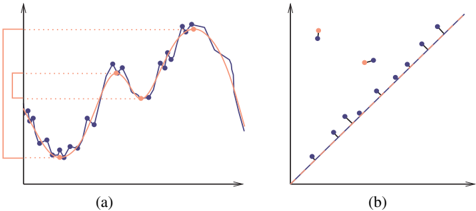
- The proof first establishes stability for the Hausdorff distance using the Box Lemma, then strengthens it to the bottleneck distance using the Easy Bijection Lemma and an Interpolation Lemma for piecewise linear functions.
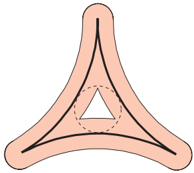
- The Homology Inference Theorem states that for all real \(\varepsilon\) with \(d_H(X,P) < \varepsilon < \mathrm{hfs}_X/4\) and all sufficiently small \(\delta>0\), the dimensions of the homology group of \(X+\delta\) and \(P^\varepsilon_{3\varepsilon}\) are either both infinite or both finite and equal.
- The Barcode Theorem states that if a diffeomorphism \(\Phi:\mathbb R^d\to\mathbb R^d\) has derivatives up to second order close to those of a rigid motion, then the bottleneck distance between the barcodes of a hypersurface \(S\subseteq\mathbb R^d\) and its perturbation \(\Phi(S)\) is small.
Methods
- Theoretical study of real-valued functions on topological spaces, using homology with \(\mathbb Z_2\) coefficients, homological critical values, tame functions, persistent homology groups, and persistence diagrams.
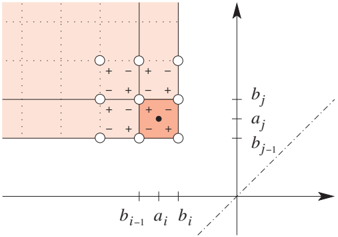
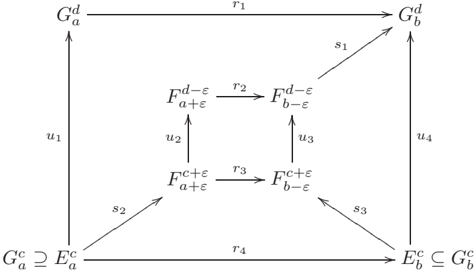
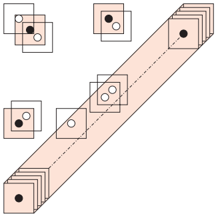
- Stability is proved by algebraic-topological diagram chasing: the Quadrant Lemma and Box Lemma bound multiplicities in nested quadrants/boxes, and the bottleneck case is handled by composing bijections for very close functions and interpolating between piecewise linear functions.
- Applications are derived as corollaries; the paper reports no empirical data, experiments, or numerical evaluations.
Limitations
- The paper explicitly leaves open whether the Main Theorem extends to non-tame functions, whether other metrics on functions and persistence diagrams admit similar inequalities, and how to exploit the result algorithmically.
- Evident from the text: the main theorem assumes a triangulable space and continuous tame functions, and the proof uses compactness, finite simplicial complexes, and finite-dimensional homology groups.
- Evident from the text: the applications are theoretical corollaries, and the Barcode Theorem states only that the bottleneck distance is “small” under \(C^2\)-closeness to a rigid motion, without a quantitative bound.
Model-written summary. Check it against the paper before relying on it.
Integrity signals
Registry
Cites
Statistics
Figures
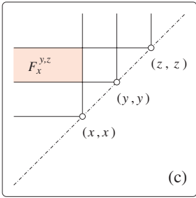
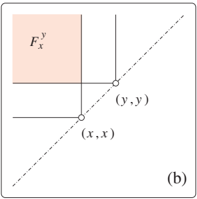
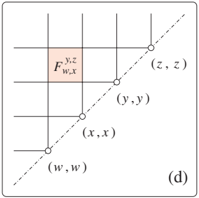
![Fig. 3 (a) Homology group of the sub-level set f -1 ( -∞ , x ]. (b) Image of Fx in Fy . (c) Kernel of surjection F y x → F z x . (d) Quotient of F y , z x and F y , z w .](https://figures.cochat.ai/paper-figures/e3fbb536dd354c4daa1aeec1692fa302/stability-of-persistence-diagrams-figure-3.png)
Verification
Claims the paper makes
1 Valid · 7 Not valid · 19 Not checked · 31 Own results and interpretations
The cited sources support only part of this claim — read each source’s verdict below.
In the paper
“Indeed, the dimensions of the persistent homology groups that appear in the theorem are efficiently computable using the persistence algorithm on the filtration of alpha complexes [11], [12].”
What the sources say
- Not matchedcites [11] 11. H. Edelsbrunner, D. Letscher, and A. Zomorodian. Topological persistence and simplification. Discrete Comput . Geom . 28 (2002), 511-533.
More than one paper fits this citation.
- Partly supportedcites [12] 12. H. Edelsbrunner and E. P. M¨ ucke. Three-dimensional alpha shapes. ACM Trans . Comput . Graphics 13 (1994), 43-72. sourceExperimental — accuracy not yet measured
Section 3.3, “Alpha Complexes” (page unavailable), defines alpha complexes and states that each is a subcomplex of those at larger alpha values, supporting the filtration part. “Features and Signatures” (page unavailable) describes an efficient way to track connected components, but calls higher-order homology signatures more challenging; it does not describe a persistence algorithm or establish efficient computation of the claimed persistent-homology dimensions. (LLM, conf=0.86)
plainstates a cause- Asserted: passes — The authors put it forward as true.
- Checkable: passes — It can be checked against evidence.
- Load-bearing: passes — The paper’s conclusions depend on it.
- Based: passes — The paper gives a reason why it holds.
- Not matched
A result the paper states — it cites no source for it, so there is none to check. The quote shows it is in the paper.
In the paper
“Easy Bijection Lemma. Let f , g : X → R be tame functions and let g be very close to f . Then the persistence diagrams satisfy d B ( D ( f ), D ( g )) ≤ ‖ f -g ‖∞ .”
plainstates an association- Asserted: passes — The authors put it forward as true.
- Checkable: passes — It can be checked against evidence.
- Load-bearing: passes — The paper’s conclusions depend on it.
- Based: passes — The paper gives a reason why it holds.
A result the paper states — it cites no source for it, so there is none to check. The quote shows it is in the paper.
In the paper
“Critical Value Lemma. If some closed interval [ x , y ] contains no homological critical value of f , then f y x is an isomorphism for every integer k .”
plainstates a cause- Asserted: passes — The authors put it forward as true.
- Checkable: passes — It can be checked against evidence.
- Load-bearing: passes — The paper’s conclusions depend on it.
- Based: passes — The paper gives a reason why it holds.
A result the paper states — it cites no source for it, so there is none to check. The quote shows it is in the paper.
In the paper
“Writing ε = ‖ f -g ‖∞ , we have f -1 ( -∞ , x ] ⊆ g -1 ( -∞ , x + ε ] for all x ∈ R .”
plainstates a cause- Asserted: passes — The authors put it forward as true.
- Checkable: passes — It can be checked against evidence.
- Load-bearing: passes — The paper’s conclusions depend on it.
- Based: passes — The paper gives a reason why it holds.
A result the paper states — it cites no source for it, so there is none to check. The quote shows it is in the paper.
In the paper
“Interpolation Lemma.”
- Also stated in: § Interpolation Lemma. · p. 13 · boosted
“However, since the h λ i sample the linear interpolation from ˆ f to ˆ g , the latter sum equals ‖ ˆ f - ˆ g ‖∞ , which concludes the proof.”
boostedstates an association- Asserted: passes — The authors put it forward as true.
- Checkable: passes — It can be checked against evidence.
- Load-bearing: passes — The paper’s conclusions depend on it.
- Based: passes — The paper gives a reason why it holds.
- Also stated in: § Interpolation Lemma. · p. 13 · boosted
21 more claims
Create a free account to see all 58 claims and every source verdict.
- Probably not a substantial claim. 28
- It may state two separate claims as one. 13
Claims other papers make about this one
Each is checked against this paper’s own text: does it say what the citing paper says it does?
The source backs part of the claim, not all of it — or backs it for a different population, condition or comparison.
In the citing paper
“Let X be any space which is homeomorphic to a simplicial complex, and suppose f, g : X → R are continuous tame functions. Then the persistence vector spaces { H k ( f -1 (( -∞ , r ]) } r and { H k ( g -1 (( -∞ , r ]) } r are finitely presented, and therefore admit barcode descriptions for each k ∈ N”
From Topological pattern recognition for point cloud data (2014) · cites this paper as Cohen-Steiner et al. (2007)
Experimental — accuracy not yet measuredThe cited source says what the claim attributes to it.
In the citing paper
“Also, results about barcodes under the general heading have now begun to appear (see [15] and [16]).”
From Topology and data (2009) · cites this paper as [15]
Citations
Cites
Rayward-Smith, V. J. (1991) · Journal of the Operational Research Society · doi:10.1057/jors.1991.155 · Cited by 16,821
Spanier, E. H. (1990) · Cited by 3,014
Three-dimensional alpha shapes
Edelsbrunner, H., & Mücke, E. P. (1994) · ACM Transactions on Graphics · doi:10.1145/174462.156635 · Cited by 2,488
Self-citationElements of Algebraic Topology
Munkres, J. R. (2018) · CRC Press eBooks · doi:10.1201/9780429493911 · Cited by 2,102
Introduction to Algorithms, Second Edition
Rivest, R. L., Leiserson, C. E., Cormen, T. H., & Stein, C. (2001) · Cited by 1,984
Topological Persistence and Simplification
Edelsbrunner, Letscher, & Zomorodian (2002) · Discrete & Computational Geometry · doi:10.1007/s00454-002-2885-2 · Cited by 1,779
Introduction to linear algebra
(2016) · Cybersecurity and Applied Mathematics · doi:10.1016/b978-0-12-804452-0.09998-x · Cited by 1,646
Zomorodian, A., & Carlsson, G. (2005) · Discrete & Computational Geometry · doi:10.1007/s00454-004-1146-y · Cited by 1,591
Milnor, J. (1963) · doi:10.1515/9781400881802 · Cited by 1,390
Morphometric Tools for Landmark Data.
Bookstein, F. (1998) · Biometrics · doi:10.2307/2534038 · Cited by 1,378
Research works printed but not linked: 2
- [16]16. J. Milnor. Morse Theory . Princeton University Press, New Jersey, 1963.
- [19]19. V. Robins. Toward computing homology from finite approximations. Topology Proceedings 24 (1999), 503-532.
Cited by
Items 1,201–1,300 of 1,300
Ocean Digital Twins, Hybrid Architectures, and Reproducible Frameworks for Marine Ecosystems
Aguilar-Ortíz, J., Díaz-Parra, O., Ruíz-Vanoye, J. A., Vera-Jiménez, M. A., Zamudio-García, V. M., & Domínguez-Mayorga, C. R. (2026) · IGI Global eBooks · doi:10.4018/979-8-3373-5881-9.ch007
Persistence Module and Schubert Calculus
Hiraoka, Y., Yahiro, K., & Xu, C. (2026) · Springer eBooks · doi:10.1007/978-981-95-1446-5_12
Patel, A., & Škraba, P. (2026) · Transactions of the American Mathematical Society · doi:10.1090/tran/9549
Robust Barycenters of Persistence Diagrams
Sisouk, K., Tanguy, E., Delon, J., & Tierny, J. (2026) · IEEE Transactions on Visualization and Computer Graphics · doi:10.1109/tvcg.2026.3657210 · Cited by 1
Unitary similarity comparison of persistent homology groups
He, J., Hou, B., Wu, T., & Cao, Y. (2026) · Japan Journal of Industrial and Applied Mathematics · doi:10.1007/s13160-025-00753-y · Cited by 1
Singh, P., & Raman, B. (2025) · Springer eBooks · doi:10.1007/978-981-95-4080-8_11
Robinson, M. (2026) · Mathematical engineering · doi:10.1007/978-3-032-08634-1_2
Malczewski, K., Kozera, R., Gajewski, Z., et al. (2026) · Diagnostics · doi:10.3390/diagnostics16040615
Cao, N. M.-C., Zhu, H., Grime, G. C., et al. (2026) · Journal of Plasma Physics · doi:10.1017/s0022377826101305
Garví-Gualda, J. (2026) · SSRN Electronic Journal · doi:10.2139/ssrn.6390762
Glavchev, M., Hlavcheva, Y., Липчанский, М. В., & Balenko, O. (2026) · Системи управління навігації та зв’язку Збірник наукових праць · doi:10.26906/sunz.2026.1.051
Ayariga, S. A. (2026) · Research Square · doi:10.21203/rs.3.rs-9125450/v1
Risk Identification of Oil Futures Based on Persistent Homology
Gao, H., Pan, Y., Li, X., & Zhou, Y. (2025) · International Conference on Information Economy, Data Modeling and Cloud Computing (ICIDC) · doi:10.1145/3772900.3772946
Stability of bipath persistence diagrams
Tada, S. (2026) · Japan Journal of Industrial and Applied Mathematics · doi:10.1007/s13160-026-00784-z
Persistent homology-based segmentation tool for membrane images
Oda, H., & Imoto, Y. (2026) · Cell Reports Methods · doi:10.1016/j.crmeth.2026.101366
Computational homology applied to discrete objects
Gonzalez-Lorenzo, A. (2016) · theses.fr (ABES) · doi:10.70675/a95fcb81ze808z4eafz9f6dz26764b15c6b2 · Cited by 2
Vers une vision robuste de l'inférence géométrique
Brécheteau, C. (2018) · theses.fr (ABES) · doi:10.70675/a6985fd8zfad3z40f9zbc12z4302e955e5bc
Structures for deep learning and topology optimization of functions on 3D shapes
Poulenard, A. (2020) · theses.fr (ABES) · doi:10.70675/6044d6a1zfadbz445fzbedezf0da1fdd6ec8
Mixed sequence-structure based analysis of proteins, with applications to functional annotations
Tetley, R. (2018) · theses.fr (ABES) · doi:10.70675/4fb1ffd2z8125z4a03z99b0za6b6608a5a76
Decomposability and stability of multidimensional persistence
Cochoy, J. (2018) · theses.fr (ABES) · doi:10.70675/aba3b5f0z64a3z4d5fza4bdz6f3e4201c37b
Collapses and persistent homology
Pritam, S. (2020) · theses.fr (ABES) · doi:10.70675/98823732ze3cbz4b88zad47z3ba662334cac
Beaufils, B. (2020) · theses.fr (ABES) · doi:10.70675/803ee8dbzbb85z4d09za979z798c923c9cb9
Statistics for Topological Descriptors using optimal transport
Lacombe, T. (2020) · theses.fr (ABES) · doi:10.70675/2a0c608fz69d5z439ez91c3z1556ded8d944
Topological inference from measures and vector bundles
Tinarrage, R. (2020) · theses.fr (ABES) · doi:10.70675/6e66a5b3z881az44a9zbb0dzeb3c1459841f · Cited by 1
Divol, V. (2021) · theses.fr (ABES) · doi:10.70675/7061c574z4e43z40a8zb069za102a26cd652
In search of invariants in electroencephalography signals for brain-computer interfaces
Xu, X. (2023) · theses.fr (ABES) · doi:10.70675/a10e24bbz2b86z4604z87e0zec83c09a8f17
Lebovici, V. (2023) · theses.fr (ABES) · doi:10.70675/73b3f02fz6061z4912zbceeze596d4068b3d
From topological features to machine learning models : a journey through persistence diagrams
Hacquard, O. (2023) · theses.fr (ABES) · doi:10.70675/3eaa71cdz2842z40dbz8ac5z8f6f2e1d6766 · Cited by 1
Topology enhances classical figure detection
Oda, H. (2025) · International Conference on Electrical, Computer and Energy Technologies (ICECET) · doi:10.1109/icecet63943.2025.11472121
Analyse biogéométrique de l'évolution des protéines et des traits d'histoire de vie
Dagher, L. B. (2024) · theses.fr (ABES) · doi:10.70675/3a39f4f2zb57dz4fb3z8990zbd5d3fe1a6bf
Estimation of persistence diagrams via the three-gap theorem
Salas, L. S., & Perea, J. A. (2026) · Orbita Mathematicae · doi:10.2140/om.2026.3.1 · Cited by 1
Bajracharya, E. (2026) · Research Square · doi:10.21203/rs.3.rs-9408940/v1
Hu, C., Czajkowsky, D. M., Liang, J., & Shao, Z. (2026) · Biophysical Journal · doi:10.1016/j.bpj.2026.04.010 · Cited by 1
Topological Data Analysis for Breast Pathology Classification
Pakhomov, A., & Khamukhin, A. (2026) · 2026 28th International Conference on Digital Signal Processing and its Applications (DSPA) · doi:10.1109/dspa69176.2026.11476738
Topological Data Analysis for Neural Time Series: Persistent Homology and Brain Dynamics
Bush, J. (2026) · Springer eBooks · doi:10.1007/978-3-030-93954-0_90-1
Optimizing Social Media Campaigns Through Engagement Topology and Behavioral Clustering
Chikore, T., Zhangazha, M., & Nyabadza, F. (2026) · Mathematics · doi:10.3390/math14091466
The Metric Decay of Financial Manifolds: Topological Phase Transitions in Algorithmic MarketsPreprint
Choe, W., & Wangsanata, C. (2026) · SSRN Electronic Journal · doi:10.2139/ssrn.6668600
Iagufarov, R. (2026) · SSRN Electronic Journal · doi:10.2139/ssrn.6674339
Lin, Z., Zulkepli, N. F. S., Kasihmuddin, M. S. M., & Gobithaasan, R. U. (2026) · Complex & Intelligent Systems · doi:10.1007/s40747-026-02315-2 · Cited by 2
Constraint Generative Theory: Typed Constraint Effects and Scientific AvailabilityPreprint
Takahashi, K. (2026) · Zenodo (CERN European Organization for Nuclear Research) · doi:10.5281/zenodo.20199440
Topological Pharmacokinetics: Reading the Shape of Drug Disposition from DataPreprint
Ren, H., & Gu, Y.-X. (2026) · bioRxiv (Cold Spring Harbor Laboratory) · doi:10.64898/2026.05.13.724751
Lee, R., O’Boyle, M., & Garrett, A. S. (2026) · NeuroImage · doi:10.1016/j.neuroimage.2026.122008
Cho, S. (2026) · IEEE International Symposium on Biomedical Imaging (ISBI) · doi:10.1109/isbi61048.2026.11515476
A Topology-Preserving Coreset for Kernel Regression in Scientific Visualization
Lyu, W., Gorski, N., Phillips, J. M., & Wang, B. (2026) · IEEE Transactions on Visualization and Computer Graphics · doi:10.1109/tvcg.2026.3694452
GRAVITAS: A Dynamic Semantic Geometry for Information Retrieval -- Theoretical StudyPreprint
Chraiti, M. (2026) · SSRN Electronic Journal · doi:10.2139/ssrn.6866810
Topological Data Analysis for Financial Time Series Forecasting: A Persistent Homology Approach
Rachid, T., Kamal, M., Abarda, A., Azdine, B., & Zaaloul, A. (2026) · Procedia Computer Science · doi:10.1016/j.procs.2026.04.173
Opue, J. A., Okorie, U. E., & Itita, V. E. (2026) · PLoS ONE · doi:10.1371/journal.pone.0350644
A Topological Robustness and Anti-Fragility Framework for LLM AgentsPreprint
Shirbint, E., & Alexander, R. (2026) · Research Square · doi:10.21203/rs.3.rs-9932131/v1
Geometry‐Aware Alignment and Comparison of Hierarchical Morse Complexes with Applications
Venkat, A., Gyulassy, A., Bremer, P., et al. (2026) · Computer Graphics Forum · doi:10.1111/cgf.70449
Scalable Computation of Topological Abstractions for Scalar Data
Will, M. R., Lukasczyk, J., Tierny, J., Gyulassy, A. G., Weber, G. H., Carr, H. A., & Garth, C. (2026) · Computer Graphics Forum · doi:10.1111/cgf.70497 · Cited by 1
Persistent homology as efficient phase descriptor for 2D skyrmion lattices
Taniwaki, M., Winkler, T., Rothörl, J., Gruber, R. S., Mitsumata, C., Kotsugi, M., & Kläui, M. (2026) · APL Machine Learning · doi:10.1063/5.0331214 · Cited by 2
Persistent Homology on Pointed Chord Spaces
Casali, A. (2026) · Lecture notes in computer science · doi:10.1007/978-3-032-27827-2_19
Homology-Preserving Dimensionality Reduction via Adaptive Mapper and Landmark Isomap
Khourashahi, S., Jahanshahi, I., Wang, B., & Yan, L. (2026) · IEEE Transactions on Visualization and Computer Graphics · doi:10.1109/tvcg.2026.3703433
Diankatu, M., Duque, J., de Vasconcelos, J. B., & Filipe, V. M. D. J. (2026) · IFIP advances in information and communication technology · doi:10.1007/978-3-032-28939-1_5
Furuya, K., Umeno, Y., Ikura, M., Ikura, Y., Nishikawa, S., & Ikura, T. (2026) · Genes to Cells · doi:10.1111/gtc.70127
Toribe, Y., & Miyazaki, S. (2026) · Journal of the Physical Society of Japan · doi:10.7566/jpsj.95.074004
Topological characterization of ecological dynamics via persistent homology
ariman, M. K. (2026) · AIMS Mathematics · doi:10.3934/math.2026737
Iagufarov, R. (2026) · SSRN Electronic Journal · doi:10.2139/ssrn.6856740
Geodesic Execution Slippage: A Statistical Physics Framework for Cryptocurrency Liquidity Risk
Moroke, N. D., & Metsileng, L. D. (2026) · Entropy · doi:10.3390/e28060705
Topology enhanced DeepSDF with applications
Dong, W., & Lin, H. (2026) · Computer-Aided Design · doi:10.1016/j.cad.2026.104130
Feged-Rivadeneira, A., González-Casabianca, F., Cárdenas, P., Ángel, A., & Corredor, V. (2026) · bioRxiv (Cold Spring Harbor Laboratory) · doi:10.64898/2026.06.18.733071
EVALUATE ROAD NETWORK CONNECTIVITY DURING DISASTERS USING TOPOLOGICAL DATA ANALYSIS
OKADA, D., & Hiroyuki, G. O. T. O. (2026) · Japanese Journal of JSCE · doi:10.2208/jscejj.25-13323
Malczewski, K. (2026) · Lecture notes in computer science · doi:10.1007/978-3-032-29918-5_27
Learning Topology-Aware Representations via Test-Time Adaptation for Anomaly Segmentation
Zia, A., Ali, U., Rehman, A., Ramzan, U., Han, K., Faheem, M., Qureshi, S., & Xiang, W. (2026) · IEEE Transactions on Pattern Analysis and Machine Intelligence · doi:10.1109/tpami.2026.3710196
Bhandari, D. (2026) · SSRN Electronic Journal · doi:10.2139/ssrn.7075253
Persistence partitions of real and synthetic networks
Jenkins, A., Callor, N., Boyd, Z. M., Gledhill, T., Wonnacott, R., & Webb, B. Z. (2026) · PLOS complex systems. · doi:10.1371/journal.pcsy.0000109
Suay‐García, B., & Falcó, A. (2026) · Briefings in Bioinformatics · doi:10.1093/bib/bbag370 · Cited by 3
Hamzi, B., & Hütter, M. (2026) · Entropy · doi:10.3390/e28091005 · Cited by 2
Topological Data Analysis for Neural Time Series: Persistent Homology and Brain Dynamics
Bush, J. (2026) · Springer eBooks · doi:10.1007/978-3-032-16368-4_90
Deneko, E., Hysenlliu, M., Dhoska, K., & Annuk, A. (2026) · Buildings · doi:10.3390/buildings16152963 · Cited by 1
Li, Y., Fu, X., Liu, L., Ding, J., & Peng, W. (2026) · Neurocomputing · doi:10.1016/j.neucom.2026.134639
Bisht, Y., Chitransh, S., & Sahoo, S. K. (2026) · SSRN Electronic Journal · doi:10.2139/ssrn.7133498
Lv, X., Qiao, G., & Li, X. (2026) · Applied Economics · doi:10.1080/00036846.2026.2704614
Unsupervised Learning of Density Estimates with Topological Optimization
Tanweer, S., & Khasawneh, F. A. (2026) · Lecture notes in computer science · doi:10.1007/978-3-032-31654-7_23
Research on Network Intrusion Detection Method Based on Topological Data Analysis
Chen, X., Zhang, Q., & Zhao, Y. (2026) · International Symposium on System Security, Safety, and Reliability (ISSSR) · doi:10.1109/isssr69973.2026.00015
Alsaadawi, R., & Mukhopadhyay, N. D. (2026) · Statistical Analysis and Data Mining The ASA Data Science Journal · doi:10.1002/sam.70105
A COMPARATIVE STUDY OF PERSISTENCE AND MAPPER IN TOPOLOGICAL DATA ANALYSIS
Nizegha, K. M. M., Rathilal, C., & Visaya, M. V. (2026) · Advances in Complex Systems · doi:10.1142/s0219525926500049
MSF-Fingerprint: Multi-Level Stability Framework for Partial Fingerprint Recognition
Houari, K., & Chıkhı, S. (2026) · International Conference on Control, Decision and Information Technologies (CoDIT) · doi:10.1109/codit70676.2026.11630986
Ghoddusifar, S. H. (2026) · Nexus Network Journal · doi:10.1007/s00004-026-00916-5
Persistent Homology in Topological Data Analysis: Theory and Applications
Julie, E. (2026) · International Journal of Pure Science Research Studies (IJPSRS) · doi:10.63090/ijpsrs/3139.8995.0020
Application of the Morse theory-based Persistent homology method in protein analysis
Qin, Y. (2026) · International Symposium on Bioinformatics and Computational Biology (BCB) · doi:10.1145/3820664.3820675
Du, H., Meng, C., & Huang, S. (2026) · SSRN Electronic Journal · doi:10.2139/ssrn.7322619
Topological Data Analysis for Anomaly Detection in Video Surveillance
Aguilar-Ortíz, J., Díaz-Parra, O., Trejo-Macotela, F. R., Ruíz-Vanoye, J. A., Vera-Jiménez, M. A., Zamudio-García, V. M., & Domínguez-Mayorga, C. R. (2026) · Advances in computational intelligence and robotics book series · doi:10.4018/979-8-2600-0965-9.ch012
Enhancing Time Series Forecasting Using Persistent Homology
Sebes, P., Drozda, M., & Čavojský, M. (2026) · EAI/Springer Innovations in Communication and Computing · doi:10.1007/978-3-032-32104-6_54
Bailey, M. M. (2026) · Chaos An Interdisciplinary Journal of Nonlinear Science · doi:10.1063/5.0337419 · Cited by 1
Topology-aware GNNs under structural perturbations: Empirical robustness across domains
Losic, J., & Fanning, C. (2026) · PLOS Complex Systems · doi:10.1371/journal.pcsy.0000125
Martinez, D. A. S., Razmarashooli, A., Yang, K.-C., Panthi, A., Okumu, M., Hu, C., Schrader, P. T., Downey, A. R. J., Comert, G., Begashaw, N., et al. (2026) · Measurement science and technology · doi:10.1088/1361-6501/aea4d7
Alsulami, S. (2026) · AIMS Mathematics · doi:10.3934/math.20261180
Al-Khalayleh, N., Jouini, M. S., Kirane, M., Najman, L. A., & Bouchaala, F. (2026) · Research Square · doi:10.21203/rs.3.rs-10592448/v1
Garví-Gualda, J. (2026) · Expert Systems with Applications · doi:10.1016/j.eswa.2026.134547
Shymkovych, V., & Hryshyn, O. (2026) · International Journal of Data Science and Analytics · doi:10.1007/s41060-026-01304-5
Park, H., Yoo, N., & Yang, J. (2026) · IEEE Access · doi:10.1109/access.2026.3737981
Choi, I. (2026) · Communications in Nonlinear Science and Numerical Simulation · doi:10.1016/j.cnsns.2026.110903
Metadata
- Authors
- Cohen-Steiner, D., Edelsbrunner, H., & Harer, J.
- Affiliations
- Duke University (US)
- Corresponding author
- Edelsbrunner, Herbert
- Harer, John
- Venue
- Discrete & Computational Geometry
- Published
- 2006-12-12
- Volume
- 37
- Issue
- 1
- Pages
- 103-120
- ISSN
- 0179-5376 (ISSN-L)
- 1432-0444
- OpenAlex
- W2037613900
- Cited by
- 1,280
- References
- 30
- Citations by year
- 2026: 102 · 2025: 89 · 2024: 69 · 2023: 97 · 2022: 78 · 2021: 132 · 2020: 109 · 2019: 89 · 2018: 92 · 2017: 50 · 2016: 60 · 2015: 54 · 2014: 58 · 2013: 48 · 2012: 29
- FWCI
- 18.03
- Type
- journal article
- Language
- en
- Open access
- bronze
- doi.org
- Licence
- www.springer.com/tdm (tdm)
- Locations
- Discrete & Computational Geometry (publishedVersion)
- Funders
- National Science Foundation (0086013)
- Defense Advanced Research Projects Agency (HR0011, HR0011-05-1-0007)
- Topics
- Physical Sciences › Computer Science › Computational Theory and Mathematics › Topological and Geometric Data Analysis
- Physical Sciences › Mathematics › Geometry and Topology › Geometric and Algebraic Topology
- Physical Sciences › Mathematics › Applied Mathematics › Geometric Analysis and Curvature Flows
- Keywords
- persistence diagrams, stability, topological data analysis, metric spaces, shape comparison, real functions, simplicial complexes
About these checks
Registry, retraction, Cites and statistics results are computed, not judged, with one exception: a printed reference that no index lists is read once by a model before it counts as a citation error. Claims are extracted by a model and kept only when their quote appears verbatim in the text; each cited source is then checked, with a model’s help, for whether it says what the claim relies on. Those verdicts can be wrong — read the claim’s quote and the cited source before relying on one.
The claim verdicts this report counts are experimental: their accuracy is not yet measured.
A language model drew the claims from the paper on 2026-10-10, under version 3 of the claim definition (model deepseek-v4.1-flash, prompt extract-v3).
A second model labelled each claim on 2026-10-10 (model jev-1.13-20260917, definition revision gold-guideline-v0.2).
Cited sources are checked with a language model’s help (gpt-6-sol).
Statistics and arithmetic are recomputed, not judged.
Confidence bands are shown only for fields calibrated on our annotated test set. None is calibrated yet, so no band is shown.
What counts as a claim ›How we measure confidence ›How we check this ›
Are you an author, or do you see a problem with this page? Request a review
Data sources
Bibliographic data: Semantic Scholar, OpenAlex, Crossref.
Contains information from the Semantic Scholar Academic Graph Datasets, made available under the ODC Attribution License (ODC-BY 1.0).
Semantic Scholar’s data is described in: Kinney, R., et al. (2023). The Semantic Scholar Open Data Platform. arXiv:2301.10140.
