

Stability of Persistence Diagrams
Open accessThe DOI matches its Crossref record; 32 of the 32 references it cites were found in a registry or an index; 1 of the 21 sources its claims cite were checked for support.
Overview
CoChat Summary
TL;DR
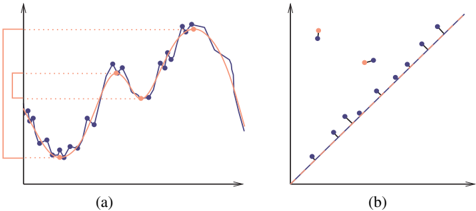
The paper proves that persistence diagrams of real-valued functions on topological spaces are stable: small changes in the function imply small changes in the diagram under the bottleneck distance. It applies this stability to homology estimation from point samples and to comparing/classifying geometric shapes.
Key findings
- The Main Theorem states that for a triangulable space \(X\) with continuous tame functions \(f,g:X\to\mathbb R\), the persistence diagrams satisfy \(d_B(D(f),D(g)) \le \|f-g\|_\infty\).
- The proof first establishes stability for the Hausdorff distance using the Box Lemma, then strengthens it to the bottleneck distance using the Easy Bijection Lemma and an Interpolation Lemma for piecewise linear functions.
- The Homology Inference Theorem states that for all real \(\varepsilon\) with \(d_H(X,P) < \varepsilon < \mathrm{hfs}_X/4\) and all sufficiently small \(\delta>0\), the dimensions of the homology group of \(X+\delta\) and \(P^\varepsilon_{3\varepsilon}\) are either both infinite or both finite and equal.
- The Barcode Theorem states that if a diffeomorphism \(\Phi:\mathbb R^d\to\mathbb R^d\) has derivatives up to second order close to those of a rigid motion, then the bottleneck distance between the barcodes of a hypersurface \(S\subseteq\mathbb R^d\) and its perturbation \(\Phi(S)\) is small.
Methods
- Theoretical study of real-valued functions on topological spaces, using homology with \(\mathbb Z_2\) coefficients, homological critical values, tame functions, persistent homology groups, and persistence diagrams.
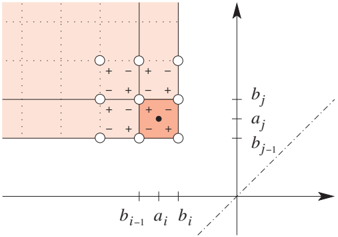
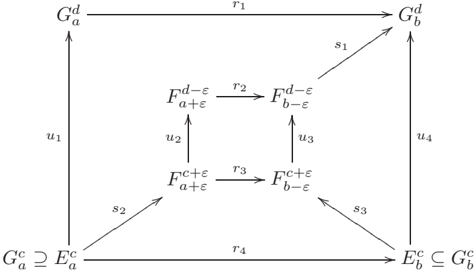
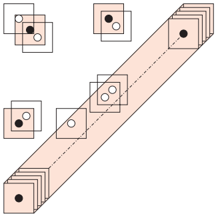
- Stability is proved by algebraic-topological diagram chasing: the Quadrant Lemma and Box Lemma bound multiplicities in nested quadrants/boxes, and the bottleneck case is handled by composing bijections for very close functions and interpolating between piecewise linear functions.
- Applications are derived as corollaries; the paper reports no empirical data, experiments, or numerical evaluations.
Limitations
- The paper explicitly leaves open whether the Main Theorem extends to non-tame functions, whether other metrics on functions and persistence diagrams admit similar inequalities, and how to exploit the result algorithmically.
- Evident from the text: the main theorem assumes a triangulable space and continuous tame functions, and the proof uses compactness, finite simplicial complexes, and finite-dimensional homology groups.
- Evident from the text: the applications are theoretical corollaries, and the Barcode Theorem states only that the bottleneck distance is “small” under \(C^2\)-closeness to a rigid motion, without a quantitative bound.
Model-written summary. Check it against the paper before relying on it.
Integrity signals
Registry
Cites
Statistics
Figures
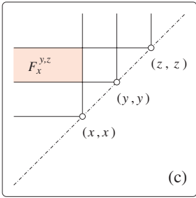
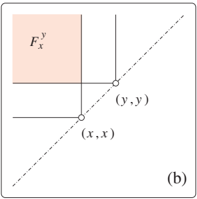
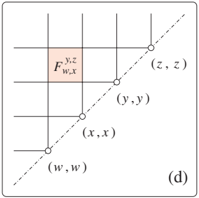
![Fig. 3 (a) Homology group of the sub-level set f -1 ( -∞ , x ]. (b) Image of Fx in Fy . (c) Kernel of surjection F y x → F z x . (d) Quotient of F y , z x and F y , z w .](https://figures.cochat.ai/paper-figures/e3fbb536dd354c4daa1aeec1692fa302/stability-of-persistence-diagrams-figure-3.png)
Verification
Claims the paper makes
1 Valid · 7 Not valid · 19 Not checked · 31 Own results and interpretations
The cited sources support only part of this claim — read each source’s verdict below.
In the paper
“Indeed, the dimensions of the persistent homology groups that appear in the theorem are efficiently computable using the persistence algorithm on the filtration of alpha complexes [11], [12].”
What the sources say
- Not matchedcites [11] 11. H. Edelsbrunner, D. Letscher, and A. Zomorodian. Topological persistence and simplification. Discrete Comput . Geom . 28 (2002), 511-533.
More than one paper fits this citation.
- Partly supportedcites [12] 12. H. Edelsbrunner and E. P. M¨ ucke. Three-dimensional alpha shapes. ACM Trans . Comput . Graphics 13 (1994), 43-72. sourceExperimental — accuracy not yet measured
Section 3.3, “Alpha Complexes” (page unavailable), defines alpha complexes and states that each is a subcomplex of those at larger alpha values, supporting the filtration part. “Features and Signatures” (page unavailable) describes an efficient way to track connected components, but calls higher-order homology signatures more challenging; it does not describe a persistence algorithm or establish efficient computation of the claimed persistent-homology dimensions. (LLM, conf=0.86)
plainstates a cause- Asserted: passes — The authors put it forward as true.
- Checkable: passes — It can be checked against evidence.
- Load-bearing: passes — The paper’s conclusions depend on it.
- Based: passes — The paper gives a reason why it holds.
- Not matched
A result the paper states — it cites no source for it, so there is none to check. The quote shows it is in the paper.
In the paper
“Easy Bijection Lemma. Let f , g : X → R be tame functions and let g be very close to f . Then the persistence diagrams satisfy d B ( D ( f ), D ( g )) ≤ ‖ f -g ‖∞ .”
plainstates an association- Asserted: passes — The authors put it forward as true.
- Checkable: passes — It can be checked against evidence.
- Load-bearing: passes — The paper’s conclusions depend on it.
- Based: passes — The paper gives a reason why it holds.
A result the paper states — it cites no source for it, so there is none to check. The quote shows it is in the paper.
In the paper
“Critical Value Lemma. If some closed interval [ x , y ] contains no homological critical value of f , then f y x is an isomorphism for every integer k .”
plainstates a cause- Asserted: passes — The authors put it forward as true.
- Checkable: passes — It can be checked against evidence.
- Load-bearing: passes — The paper’s conclusions depend on it.
- Based: passes — The paper gives a reason why it holds.
A result the paper states — it cites no source for it, so there is none to check. The quote shows it is in the paper.
In the paper
“Writing ε = ‖ f -g ‖∞ , we have f -1 ( -∞ , x ] ⊆ g -1 ( -∞ , x + ε ] for all x ∈ R .”
plainstates a cause- Asserted: passes — The authors put it forward as true.
- Checkable: passes — It can be checked against evidence.
- Load-bearing: passes — The paper’s conclusions depend on it.
- Based: passes — The paper gives a reason why it holds.
A result the paper states — it cites no source for it, so there is none to check. The quote shows it is in the paper.
In the paper
“Interpolation Lemma.”
- Also stated in: § Interpolation Lemma. · p. 13 · boosted
“However, since the h λ i sample the linear interpolation from ˆ f to ˆ g , the latter sum equals ‖ ˆ f - ˆ g ‖∞ , which concludes the proof.”
boostedstates an association- Asserted: passes — The authors put it forward as true.
- Checkable: passes — It can be checked against evidence.
- Load-bearing: passes — The paper’s conclusions depend on it.
- Based: passes — The paper gives a reason why it holds.
- Also stated in: § Interpolation Lemma. · p. 13 · boosted
21 more claims
Create a free account to see all 58 claims and every source verdict.
- Probably not a substantial claim. 28
- It may state two separate claims as one. 13
Claims other papers make about this one
Each is checked against this paper’s own text: does it say what the citing paper says it does?
The source backs part of the claim, not all of it — or backs it for a different population, condition or comparison.
In the citing paper
“Let X be any space which is homeomorphic to a simplicial complex, and suppose f, g : X → R are continuous tame functions. Then the persistence vector spaces { H k ( f -1 (( -∞ , r ]) } r and { H k ( g -1 (( -∞ , r ]) } r are finitely presented, and therefore admit barcode descriptions for each k ∈ N”
From Topological pattern recognition for point cloud data (2014) · cites this paper as Cohen-Steiner et al. (2007)
Experimental — accuracy not yet measuredThe cited source says what the claim attributes to it.
In the citing paper
“Also, results about barcodes under the general heading have now begun to appear (see [15] and [16]).”
From Topology and data (2009) · cites this paper as [15]
Citations
Cites
Rayward-Smith, V. J. (1991) · Journal of the Operational Research Society · doi:10.1057/jors.1991.155 · Cited by 16,821
Spanier, E. H. (1990) · Cited by 3,014
Three-dimensional alpha shapes
Edelsbrunner, H., & Mücke, E. P. (1994) · ACM Transactions on Graphics · doi:10.1145/174462.156635 · Cited by 2,488
Self-citationElements of Algebraic Topology
Munkres, J. R. (2018) · CRC Press eBooks · doi:10.1201/9780429493911 · Cited by 2,102
Introduction to Algorithms, Second Edition
Rivest, R. L., Leiserson, C. E., Cormen, T. H., & Stein, C. (2001) · Cited by 1,984
Topological Persistence and Simplification
Edelsbrunner, Letscher, & Zomorodian (2002) · Discrete & Computational Geometry · doi:10.1007/s00454-002-2885-2 · Cited by 1,779
Introduction to linear algebra
(2016) · Cybersecurity and Applied Mathematics · doi:10.1016/b978-0-12-804452-0.09998-x · Cited by 1,646
Zomorodian, A., & Carlsson, G. (2005) · Discrete & Computational Geometry · doi:10.1007/s00454-004-1146-y · Cited by 1,591
Milnor, J. (1963) · doi:10.1515/9781400881802 · Cited by 1,390
Morphometric Tools for Landmark Data.
Bookstein, F. (1998) · Biometrics · doi:10.2307/2534038 · Cited by 1,378
Research works printed but not linked: 2
- [16]16. J. Milnor. Morse Theory . Princeton University Press, New Jersey, 1963.
- [19]19. V. Robins. Toward computing homology from finite approximations. Topology Proceedings 24 (1999), 503-532.
Cited by
Items 701–800 of 1,300
The reflection distance between zigzag persistence modules
Elchesen, A., & Mémoli, F. (2019) · Journal of Applied and Computational Topology · doi:10.1007/s41468-019-00031-0 · Cited by 5
Signature of Topologically Persistent Points for 3D Point Cloud Description
Beksi, W. J., & Papanikolopoulos, N. P. (2018) · Proceedings - IEEE International Conference on Robotics and Automation/Proceedings · doi:10.1109/icra.2018.8460605 · Cited by 4
A Persistence-Based Approach to Automatic Detection of Line Segments in Images
Kurlin, V. A., & Muszyński, G. (2018) · Lecture notes in computer science · doi:10.1007/978-3-030-10828-1_11 · Cited by 4
Discrete Morse theory, persistent homology and Forman–Ricci curvature
Saucan, E. (2021) · Mathematics Computation and Geometry of Data · doi:10.4310/mcgd.2021.v1.n2.a1 · Cited by 9
Persistent Homology under Non-uniform Error
Bendich, P. L., Edelsbrunner, H., Kerber, M., & Patel, A. (2010) · Lecture notes in computer science · doi:10.1007/978-3-642-15155-2_2 · Cited by 4
Self-citationPersistence Barcodes Versus Kolmogorov Signatures: Detecting Modes of One-Dimensional Signals
Bauer, U., Munk, A., Sieling, H., & Wardetzky, M. (2015) · Foundations of Computational Mathematics · doi:10.1007/s10208-015-9281-9 · Cited by 15
Optimal Reconstruction Might be Hard
Attali, D., & Lieutier, A. (2013) · Discrete & Computational Geometry · doi:10.1007/s00454-012-9475-8 · Cited by 4
Invariance properties of the Multidimensional matching distance in Persistent Topology and HomologyPreprint
Cerri, A., & Frosini, P. (2010) · arXiv (Cornell University) · doi:10.6092/unibo/amsacta/2765 · Cited by 5
Geometry in the space of persistence modules
de Silva, V., & Nanda, V. (2013) · Annual Symposium on Computational Geometry (SoCG) · doi:10.1145/2462356.2462402 · Cited by 4
Computing the Shift-Invariant Bottleneck Distance for Persistence Diagrams.
Sheehy, D. R., Kisielius, O., & Cavanna, N. J. (2018) · Canadian Conference on Computational Geometry · Cited by 4
Inferring Local Homology from Sampled Stratified Spaces
Bendich, P., Cohen‐Steiner, D., Edelsbrunner, H., et al. (2007) · Annual Symposium on Foundations of Computer Science · doi:10.1109/focs.2007.4389523 · Cited by 4
Self-citationDetection de structure geometrique dans les nuages de points
Mérigot, Q., Chazal, F., & Cohen‐Steiner, D. (2009) · Cited by 4
Self-citationProvably Robust Simplification of Component Trees of Multidimensional Images
Herman, G. T., Kong, T. Y., & de Oliveira, L. M. (2012) · Lecture notes in computational vision and biomechanics · doi:10.1007/978-94-007-4174-4_2 · Cited by 4
Persistent Homology of Asymmetric Networks: An Approach based on Dowker FiltrationsPreprint
Chowdhury, S., & Mémoli, F. (2016) · arXiv (Cornell University) · Cited by 7
Computing Zigzag Persistent CohomologyPreprint
Maria, C., & Oudot, S. (2016) · arXiv (Cornell University) · doi:10.48550/arxiv.1608.06039 · Cited by 4
Topological Distances between Networks and Its Application to Brain ImagingPreprint
Lee, H., Ma, Z., Wang, Y., & Chung, M. K. (2017) · arXiv (Cornell University) · doi:10.48550/arxiv.1701.04171 · Cited by 10
Persistent Betti numbers of random Čech complexesPreprint
Bauer, U., & Pausinger, F. (2018) · arXiv (Cornell University) · doi:10.48550/arxiv.1801.08376 · Cited by 4
Riemannian Manifold Kernel for Persistence DiagramsPreprint
Le, T., & Yamada, M. (2018) · arXiv (Cornell University) · Cited by 4
Nonparametric Estimation of Probability Density Functions of Random Persistence DiagramsPreprint
Mike, J. L., & Maroulas, V. (2018) · arXiv (Cornell University) · doi:10.48550/arxiv.1803.02739 · Cited by 28
Multiscale analysis of structurally conserved motifsPreprint
Cazals, F., & Tetley, R. (2018) · bioRxiv (Cold Spring Harbor Laboratory) · doi:10.1101/379768 · Cited by 4
Kim, K. H., Kim, J., & Rinaldo, A. (2018) · arXiv (Cornell University) · Cited by 4
Topological Persistence in Geometry and AnalysisPreprint
Polterovich, L., Rosen, D., Samvelyan, K., et al. (2019) · arXiv (Cornell University) · doi:10.48550/arxiv.1904.04044 · Cited by 4
The Compressed Annotation Matrix: an Efficient Data Structure for Computing Persistent CohomologyPreprint
Boissonnat, J., Dey, T. K., & Maria, C. (2013) · arXiv (Cornell University) · doi:10.48550/arxiv.1304.6813 · Cited by 4
Sliding Windows and Persistence: An Application of Topological Methods to Signal AnalysisPreprint
Perea, J. A., & Harer, J. (2013) · arXiv (Cornell University) · doi:10.48550/arxiv.1307.6188 · Cited by 4
Self-citationUnderstanding the Power of Persistence Pairing via Permutation TestPreprint
Cai, C., & Wang, Y. (2020) · arXiv (Cornell University) · doi:10.48550/arxiv.2001.06058 · Cited by 11
The Emergence of Higher-Order Structure in Scientific and Technological Knowledge Networks
Gebhart, T., & Funk, R. J. (2023) · Academy of Management Proceedings · doi:10.5465/amproc.2023.240bp · Cited by 7
Euler Characteristic Tools For Topological Data AnalysisPreprint
Hacquard, O., & Lebovici, V. (2023) · arXiv (Cornell University) · doi:10.48550/arxiv.2303.14040 · Cited by 23
Change Points Detection in Financial Market Using Topological Data AnalysisPreprint
Yao, J. Q., Li, J., Wu, J., Yang, M., & Wang, X. (2025) · SSRN Electronic Journal · doi:10.2139/ssrn.5196633 · Cited by 4
Bergomi, M. G., Ferri, M., & Zuffi, L. (2020) · Communications in Applied and Industrial Mathematics · doi:10.2478/caim-2020-0005 · Cited by 13
Angulo, J. (2021) · Lecture notes in computer science · doi:10.1007/978-3-030-76657-3_1 · Cited by 17
A topological data analysis study on murine pulmonary arterial trees with pulmonary hypertension
Miller, M., Johnston, N., Livengood, I., et al. (2023) · Mathematical Biosciences · doi:10.1016/j.mbs.2023.109056 · Cited by 3
Topological data analysis for roughness surfaces of bonding assembly
Canot, H., Durand, P., Frénod, E., Hassoune‐Rhabbour, B., Nassiet, V., & Tramis, O. (2024) · Discrete and Continuous Dynamical Systems - S · doi:10.3934/dcdss.2024144 · Cited by 3
Procedure to reveal the mechanism of pattern formation process by topological data analysis
Mototake, Y.-I., Mizumaki, M., Kudo, K., et al. (2024) · Physica D Nonlinear Phenomena · doi:10.1016/j.physd.2024.134359 · Cited by 3
Zhu, J., Gao, S., Tao, C., Liu, Y., & Li, H. (2025) · Transactions in GIS · doi:10.1111/tgis.70081 · Cited by 3
Some Geometrical and Topological Aspects of Dimensionality Reduction in Signal Analysis
Guillemard, M. (2012) · Cited by 3
Geometric models with weigthed topology
Attene, M., & Biasotti, S. (2011) · Computers & Graphics · doi:10.1016/j.cag.2011.03.013 · Cited by 3
Similarity Assessment for the Analysis of 3D Artefacts
Biasotti, S., Cerri, A., Falcidieno, B., et al. (2014) · Eurographics · doi:10.2312/gch.20141313 · Cited by 3
Consensus-Based Image Segmentation via Topological Persistence
Ge, Q., & Lobaton, E. J. (2016) · IEEE Conference on Computer Vision and Pattern Recognition Workshops (CVPRW) · doi:10.1109/cvprw.2016.135 · Cited by 3
Geometric and probabilistic limit theorems in topological data analysis
Kališnik, S., Lehn, C., & Limic, V. (2021) · Advances in Applied Mathematics · doi:10.1016/j.aam.2021.102244 · Cited by 4
Topological Analysis of Scalar Fields with Outliers
Buchet, M., Chazal, F., Dey, T. K., et al. (2015) · DROPS (Schloss Dagstuhl – Leibniz Center for Informatics) · doi:10.4230/lipics.socg.2015.827 · Cited by 3
PL Morse theory in low dimensions
Grunert, R., Kühnel, W., & Rote, G. (2023) · Advances in Geometry · doi:10.1515/advgeom-2022-0027 · Cited by 3
Learning from the Shape of Data
Rosenstock, S. (2021) · Philosophia Scientiæ · doi:10.1086/715078 · Cited by 3
Rectification of interleavings and a persistent Whitehead theorem
Lanari, E., & Scoccola, L. (2023) · Algebraic & Geometric Topology · doi:10.2140/agt.2023.23.803 · Cited by 12
Elkin, Y., & Kurlin, V. A. (2021) · Mathematics · doi:10.3390/math9172121 · Cited by 3
TAaCGH Suite for Detecting Cancer—Specific Copy Number Changes Using Topological Signatures
Aslam, J., Ardanza-Trevijano, S., Xiong, J., Arsuaga, J., & Sazdanović, R. (2022) · Entropy · doi:10.3390/e24070896 · Cited by 4
Characterizing emerging features in cell dynamics using topological data analysis methods
Dawson, M., Dudley, C., Omoma, S., Tung, H.-R., & Ciocanel, M.-V. (2022) · Mathematical Biosciences & Engineering · doi:10.3934/mbe.2023143 · Cited by 3
Representing the Topology of Complex Networks Based on Graph Embedding
Li, R., Liu, Z., Zeng, Y., et al. (2022) · International Conference on Networking and Network Applications (NaNA) · doi:10.1109/nana56854.2022.00062 · Cited by 3
The persistent homology of genealogical networks
Boyd, Z. M., Callor, N., Gledhill, T., Jenkins, A., Snellman, R., Webb, B. Z., & Wonnacott, R. (2023) · Applied Network Science · doi:10.1007/s41109-023-00538-7 · Cited by 7
Chumley, M. M., Yesilli, M. C., Chen, J., Khasawneh, F. A., & Guo, Y. (2023) · Precision Engineering · doi:10.1016/j.precisioneng.2023.05.005 · Cited by 3
Time-Inhomogeneous Diffusion Geometry and Topology
Huguet, G., Tong, A., Rieck, B., Huang, J., Kuchroo, M. R., Hirn, M., Wolf, G., & Krishnaswamy, S. (2023) · SIAM Journal on Mathematics of Data Science · doi:10.1137/21m1462945 · Cited by 10
Athawale, T. M., Triana, B., Kotha, T., Pugmire, D., & Rosen, P. (2023) · IEEE Transactions on Visualization and Computer Graphics · doi:10.1109/tvcg.2023.3326592 · Cited by 4
Large deviation principle for persistence diagrams of random cubical filtrations
Kanazawa, S., Hiraoka, Y., Miyanaga, J., et al. (2024) · Journal of Applied and Computational Topology · doi:10.1007/s41468-023-00161-6 · Cited by 3
Convolutional persistence transforms
Solomon, E., & Bendich, P. L. (2024) · Journal of Applied and Computational Topology · doi:10.1007/s41468-024-00164-x · Cited by 3
Stabilizing Decomposition of Multiparameter Persistence Modules
Bjerkevik, H. B. (2025) · Foundations of Computational Mathematics · doi:10.1007/s10208-025-09695-w · Cited by 3
Classification of COVID-19 via Homology of CT-SCAN
Iqbal, S., Ahmed, H. M., Qaiser, T., Qureshi, M. I., & Rajpoot, N. (2025) · Computers in Biology and Medicine · doi:10.1016/j.compbiomed.2025.110226 · Cited by 15
Stratification Learning through Homology Inference
Bendich, P. L., Mukherjee, S., & Wang, B. (2010) · National Conference on Artificial Intelligence · Cited by 3
On the Structural Theorem of Persistent Homology
Meehan, K., Pavlichenko, A., & Segert, J. (2018) · Discrete & Computational Geometry · doi:10.1007/s00454-018-0042-9 · Cited by 5
On the expectation of a persistence diagram by the persistence weighted kernel
Kusano, G. (2019) · Japan Journal of Industrial and Applied Mathematics · doi:10.1007/s13160-019-00374-2 · Cited by 3
Geometric Metrics for Topological Representations
Som, A., Ramamurthy, K. N., & Turaga, P. K. (2020) · Springer eBooks · doi:10.1007/978-3-030-31351-7_15 · Cited by 3
Li, J., Bian, C., Luo, H., Chen, D., Cao, L., Liang, H., & Initiative, A. D. N. (2021) · Journal of Neural Engineering · doi:10.1088/1741-2552/abc7ef · Cited by 5
A new non-archimedean metric on persistent homology
Güzel, İ., & Kaygun, A. (2022) · Computational Statistics · doi:10.1007/s00180-021-01187-z · Cited by 3
Extracting Persistent Clusters in Dynamic Data via Möbius Inversion
Kim, W., & Mémoli, F. (2023) · Discrete & Computational Geometry · doi:10.1007/s00454-023-00590-1 · Cited by 31
Approximating the Pathway Axis and the Persistence Diagrams for a Collection of Balls in 3-Space
Yaffe, E., & Halperin, D. (2010) · Discrete & Computational Geometry · doi:10.1007/s00454-009-9240-9 · Cited by 3
Chattopadhyay, S., Ge, Q., Wei, C., & Lobaton, E. J. (2015) · IEEE Global Conference on Signal and Information Processing · doi:10.1109/globalsip.2015.7418308 · Cited by 3
Burghelea, D. (2018) · Algebraic & Geometric Topology · doi:10.2140/agt.2018.18.3037 · Cited by 3
Metric Spaces with Expensive Distances
Kerber, M., & Nigmetov, A. (2020) · International Journal of Computational Geometry & Applications · doi:10.1142/s0218195920500077 · Cited by 3
Bergomi, M. G., & Vertechi, P. (2020) · Theory and applications of categories · doi:10.70930/tac/rqcp3ycf · Cited by 6
Persistence-based resolution-independent meshes of superpixels
Kurlin, V. A., & Muszyński, G. (2020) · Pattern Recognition Letters · doi:10.1016/j.patrec.2020.01.014 · Cited by 3
A Topological Data Analysis approach for retrieving Local Climate Zones patterns in satellite data
Sena, C. Á. P., da Paixão, J. A. R., & França, J. R. D. A. (2021) · Environmental Challenges · doi:10.1016/j.envc.2021.100359 · Cited by 8
Mesh Enhanced Persistent Homology
Hudson, B., Miller, G. L., Oudot, S., et al. (2018) · doi:10.1184/r1/6607232 · Cited by 3
Qin, Y. C., Fasy, B. T., Wenk, C., & Summa, B. (2021) · Montana State University ScholarWorks (Montana State University) · Cited by 3
Approximate Cech Complexes in Low and High DimensionsPreprint
Kerber, M., & Sharathkumar, R. (2013) · arXiv.org · doi:10.48550/arxiv.1307.3272 · Cited by 47
Measuring and Localing Homology ClassesPreprint
Freedman, D., & Chen, C. (2007) · arXiv (Cornell University) · doi:10.48550/arxiv.0705.3061 · Cited by 9
Kusano, G. (2018) · arXiv (Cornell University) · Cited by 3
Weighted Persistent Homology Sums of Random \v{C}ech ComplexesPreprint
Schweinhart, B. (2018) · arXiv (Cornell University) · Cited by 3
The Persistent Homology of Random Geometric Complexes on Fractals.Preprint
Schweinhart, B. (2018) · arXiv (Cornell University) · Cited by 3
Wasserstein distance for generalized persistence modules and abelian categoriesPreprint
Bubenik, P., Scott, J., & Stanley, D. (2018) · arXiv (Cornell University) · Cited by 3
TopoResNet: A hybrid deep learning architecture and its application to skin lesion classificationPreprint
Chung, Y.-M., Hu, C.-S., Lawson, A., & Smyth, C. (2019) · arXiv (Cornell University) · doi:10.48550/arxiv.1905.08607 · Cited by 8
Topological AutoencodersPreprint
Moor, M., Horn, M., Rieck, B., & Borgwardt, K. M. (2019) · arXiv (Cornell University) · doi:10.3929/ethz-b-000462046 · Cited by 101
The Fiber of the Persistence Map for Functions on the IntervalPreprint
Curry, J. M. (2017) · arXiv (Cornell University) · doi:10.48550/arxiv.1706.06059 · Cited by 3
Modules over posets: commutative and homological algebraPreprint
Miller, E. (2019) · arXiv (Cornell University) · doi:10.48550/arxiv.1908.09750 · Cited by 3
Dong, Z., Lin, H., & Zhou, C. (2019) · arXiv (Cornell University) · doi:10.48550/arxiv.1909.08417 · Cited by 3
The mergegram of a dendrogram and its stabilityPreprint
Elkin, Y., & Kurlin, V. A. (2020) · arXiv (Cornell University) · doi:10.48550/arxiv.2007.11278 · Cited by 3
Separating Persistent Homology of Noise from Time Series Data Using Topological Signal Processing.Preprint
Myers, A., Khasawneh, F. A., & Fasy, B. T. (2020) · arXiv (Cornell University) · Cited by 4
Kuchroo, M. R., DiStasio, M., Calapkulu, E., Ige, M., Zhang, L., Sheth, A. H., Menon, M., Xing, Y., Gigante, S., Huang, J., et al. (2021) · bioRxiv (Cold Spring Harbor Laboratory) · doi:10.1101/2021.01.19.427286 · Cited by 6
Classification of COVID-19 via Homology of CT-SCANPreprint
Iqbal, S., Ahmed, H., Qaiser, T., Qureshi, M. I., & Rajpoot, N. (2021) · arXiv (Cornell University) · doi:10.48550/arxiv.2102.10593 · Cited by 3
Outlier-Robust Subsampling Techniques for Persistent HomologyPreprint
Stolz, B. J. (2021) · Journal of machine learning research · doi:10.48550/arxiv.2103.14743 · Cited by 17
Searching and reconstruction: algorithms with topological descriptors
Micka, S. (2020) · Montana State University ScholarWorks (Montana State University) · Cited by 11
Ultrafast topological data analysis reveals pandemic-scale dynamics of convergent evolutionPreprint
Bleher, M., Hahn, L., Neumann, M., Ardern, Z., Patiño-Galindo, J. Á., Carrière, M., Bauer, U., Rabadán, R., & Ott, A. (2021) · medRxiv · doi:10.1101/2021.06.10.21258550 · Cited by 3
Hang, H., & Mio, W. (2022) · Japan Journal of Industrial and Applied Mathematics · doi:10.1007/s13160-022-00517-y · Cited by 5
Stable Volumes for Persistent HomologyPreprint
Obayashi, I. (2021) · arXiv (Cornell University) · doi:10.48550/arxiv.2109.11711 · Cited by 3
Discussion of ‘Event history and topological data analysis’
Chung, M. K., & Ombao, H. (2021) · Biometrika · doi:10.1093/biomet/asab023 · Cited by 3
Sparse Portfolio Selection via Topological Data Analysis-Based ClusteringPreprint
Goel, A., Filipović, D., & Pasricha, P. (2024) · SSRN Electronic Journal · doi:10.2139/ssrn.4711887 · Cited by 3
Topological data analysis of Chinese stocks’ dynamic correlations under major public events
Guo, H., Ming, Z., & Xing, B. (2023) · Frontiers in Physics · doi:10.3389/fphy.2023.1253953 · Cited by 2
Persistence Symmetric Kernels for Classification: A Comparative Study
Bandiziol, C., & Marchı, S. D. (2024) · Symmetry · doi:10.3390/sym16091236 · Cited by 2
Effective data reduction algorithm for topological data analysis
Choi, S., Oh, J., Park, J. R., Yang, S. Y., & Yun, H. (2025) · Applied Mathematics and Computation · doi:10.1016/j.amc.2025.129302 · Cited by 5
Sathyanarayana, A., Manjunath, S., & Perea, J. A. (2025) · Journal of Sleep Research · doi:10.1111/jsr.70017 · Cited by 5
Topological signatures of periodic-like signals
Chazal, F., Michel, B., & Reise, W. (2025) · Bernoulli · doi:10.3150/24-bej1793 · Cited by 3
Jie, O. C., Zulkepli, N. F. S., Gobithaasan, R. U., Kasihmuddin, M. S. M., Naeeim, N. S. A., Noorani, M. S. M., & Musa, K. I. (2025) · Acta Tropica · doi:10.1016/j.actatropica.2025.107769 · Cited by 3
Dey, A. K., & Kundu, S. (2025) · Statistics in Medicine · doi:10.1002/sim.70109 · Cited by 3
Metadata
- Authors
- Cohen-Steiner, D., Edelsbrunner, H., & Harer, J.
- Affiliations
- Duke University (US)
- Corresponding author
- Edelsbrunner, Herbert
- Harer, John
- Venue
- Discrete & Computational Geometry
- Published
- 2006-12-12
- Volume
- 37
- Issue
- 1
- Pages
- 103-120
- ISSN
- 0179-5376 (ISSN-L)
- 1432-0444
- OpenAlex
- W2037613900
- Cited by
- 1,280
- References
- 30
- Citations by year
- 2026: 102 · 2025: 89 · 2024: 69 · 2023: 97 · 2022: 78 · 2021: 132 · 2020: 109 · 2019: 89 · 2018: 92 · 2017: 50 · 2016: 60 · 2015: 54 · 2014: 58 · 2013: 48 · 2012: 29
- FWCI
- 18.03
- Type
- journal article
- Language
- en
- Open access
- bronze
- doi.org
- Licence
- www.springer.com/tdm (tdm)
- Locations
- Discrete & Computational Geometry (publishedVersion)
- Funders
- National Science Foundation (0086013)
- Defense Advanced Research Projects Agency (HR0011, HR0011-05-1-0007)
- Topics
- Physical Sciences › Computer Science › Computational Theory and Mathematics › Topological and Geometric Data Analysis
- Physical Sciences › Mathematics › Geometry and Topology › Geometric and Algebraic Topology
- Physical Sciences › Mathematics › Applied Mathematics › Geometric Analysis and Curvature Flows
- Keywords
- persistence diagrams, stability, topological data analysis, metric spaces, shape comparison, real functions, simplicial complexes
About these checks
Registry, retraction, Cites and statistics results are computed, not judged, with one exception: a printed reference that no index lists is read once by a model before it counts as a citation error. Claims are extracted by a model and kept only when their quote appears verbatim in the text; each cited source is then checked, with a model’s help, for whether it says what the claim relies on. Those verdicts can be wrong — read the claim’s quote and the cited source before relying on one.
The claim verdicts this report counts are experimental: their accuracy is not yet measured.
A language model drew the claims from the paper on 2026-10-10, under version 3 of the claim definition (model deepseek-v4.1-flash, prompt extract-v3).
A second model labelled each claim on 2026-10-10 (model jev-1.13-20260917, definition revision gold-guideline-v0.2).
Cited sources are checked with a language model’s help (gpt-6-sol).
Statistics and arithmetic are recomputed, not judged.
Confidence bands are shown only for fields calibrated on our annotated test set. None is calibrated yet, so no band is shown.
What counts as a claim ›How we measure confidence ›How we check this ›
Are you an author, or do you see a problem with this page? Request a review
Data sources
Bibliographic data: Semantic Scholar, OpenAlex, Crossref.
Contains information from the Semantic Scholar Academic Graph Datasets, made available under the ODC Attribution License (ODC-BY 1.0).
Semantic Scholar’s data is described in: Kinney, R., et al. (2023). The Semantic Scholar Open Data Platform. arXiv:2301.10140.
