

Stability of Persistence Diagrams
Open accessThe DOI matches its Crossref record; 32 of the 32 references it cites were found in a registry or an index; 1 of the 21 sources its claims cite were checked for support.
Overview
CoChat Summary
TL;DR
The paper proves that persistence diagrams of real-valued functions on topological spaces are stable: small changes in the function imply small changes in the diagram under the bottleneck distance. It applies this stability to homology estimation from point samples and to comparing/classifying geometric shapes.
Key findings
- The Main Theorem states that for a triangulable space \(X\) with continuous tame functions \(f,g:X\to\mathbb R\), the persistence diagrams satisfy \(d_B(D(f),D(g)) \le \|f-g\|_\infty\).
- The proof first establishes stability for the Hausdorff distance using the Box Lemma, then strengthens it to the bottleneck distance using the Easy Bijection Lemma and an Interpolation Lemma for piecewise linear functions.
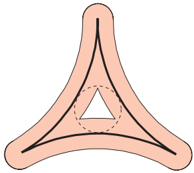
- The Homology Inference Theorem states that for all real \(\varepsilon\) with \(d_H(X,P) < \varepsilon < \mathrm{hfs}_X/4\) and all sufficiently small \(\delta>0\), the dimensions of the homology group of \(X+\delta\) and \(P^\varepsilon_{3\varepsilon}\) are either both infinite or both finite and equal.
- The Barcode Theorem states that if a diffeomorphism \(\Phi:\mathbb R^d\to\mathbb R^d\) has derivatives up to second order close to those of a rigid motion, then the bottleneck distance between the barcodes of a hypersurface \(S\subseteq\mathbb R^d\) and its perturbation \(\Phi(S)\) is small.
Methods
- Theoretical study of real-valued functions on topological spaces, using homology with \(\mathbb Z_2\) coefficients, homological critical values, tame functions, persistent homology groups, and persistence diagrams.
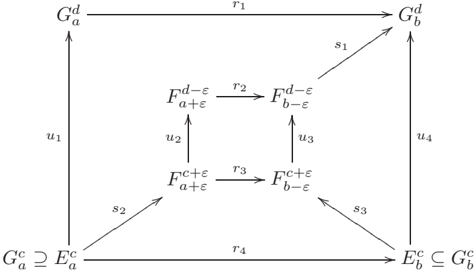
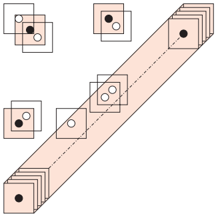
- Stability is proved by algebraic-topological diagram chasing: the Quadrant Lemma and Box Lemma bound multiplicities in nested quadrants/boxes, and the bottleneck case is handled by composing bijections for very close functions and interpolating between piecewise linear functions.
- Applications are derived as corollaries; the paper reports no empirical data, experiments, or numerical evaluations.
Limitations
- The paper explicitly leaves open whether the Main Theorem extends to non-tame functions, whether other metrics on functions and persistence diagrams admit similar inequalities, and how to exploit the result algorithmically.
- Evident from the text: the main theorem assumes a triangulable space and continuous tame functions, and the proof uses compactness, finite simplicial complexes, and finite-dimensional homology groups.
- Evident from the text: the applications are theoretical corollaries, and the Barcode Theorem states only that the bottleneck distance is “small” under \(C^2\)-closeness to a rigid motion, without a quantitative bound.
Model-written summary. Check it against the paper before relying on it.
Integrity signals
Registry
Cites
Statistics
Figures
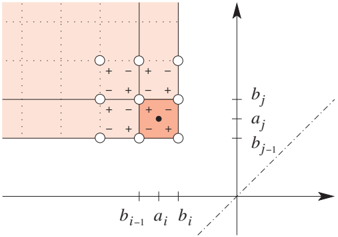
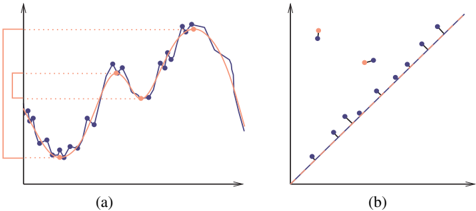
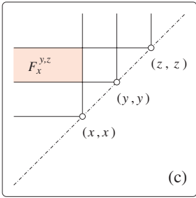
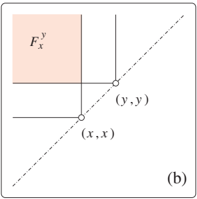
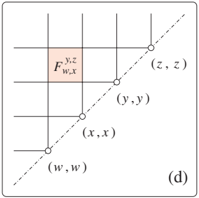
![Fig. 3 (a) Homology group of the sub-level set f -1 ( -∞ , x ]. (b) Image of Fx in Fy . (c) Kernel of surjection F y x → F z x . (d) Quotient of F y , z x and F y , z w .](https://figures.cochat.ai/paper-figures/e3fbb536dd354c4daa1aeec1692fa302/stability-of-persistence-diagrams-figure-3.png)
Verification
Claims the paper makes
1 Valid · 7 Not valid · 19 Not checked · 31 Own results and interpretations
The cited sources support only part of this claim — read each source’s verdict below.
In the paper
“Indeed, the dimensions of the persistent homology groups that appear in the theorem are efficiently computable using the persistence algorithm on the filtration of alpha complexes [11], [12].”
What the sources say
- Not matchedcites [11] 11. H. Edelsbrunner, D. Letscher, and A. Zomorodian. Topological persistence and simplification. Discrete Comput . Geom . 28 (2002), 511-533.
More than one paper fits this citation.
- Partly supportedcites [12] 12. H. Edelsbrunner and E. P. M¨ ucke. Three-dimensional alpha shapes. ACM Trans . Comput . Graphics 13 (1994), 43-72. sourceExperimental — accuracy not yet measured
Section 3.3, “Alpha Complexes” (page unavailable), defines alpha complexes and states that each is a subcomplex of those at larger alpha values, supporting the filtration part. “Features and Signatures” (page unavailable) describes an efficient way to track connected components, but calls higher-order homology signatures more challenging; it does not describe a persistence algorithm or establish efficient computation of the claimed persistent-homology dimensions. (LLM, conf=0.86)
plainstates a cause- Asserted: passes — The authors put it forward as true.
- Checkable: passes — It can be checked against evidence.
- Load-bearing: passes — The paper’s conclusions depend on it.
- Based: passes — The paper gives a reason why it holds.
- Not matched
A result the paper states — it cites no source for it, so there is none to check. The quote shows it is in the paper.
In the paper
“Easy Bijection Lemma. Let f , g : X → R be tame functions and let g be very close to f . Then the persistence diagrams satisfy d B ( D ( f ), D ( g )) ≤ ‖ f -g ‖∞ .”
plainstates an association- Asserted: passes — The authors put it forward as true.
- Checkable: passes — It can be checked against evidence.
- Load-bearing: passes — The paper’s conclusions depend on it.
- Based: passes — The paper gives a reason why it holds.
A result the paper states — it cites no source for it, so there is none to check. The quote shows it is in the paper.
In the paper
“Critical Value Lemma. If some closed interval [ x , y ] contains no homological critical value of f , then f y x is an isomorphism for every integer k .”
plainstates a cause- Asserted: passes — The authors put it forward as true.
- Checkable: passes — It can be checked against evidence.
- Load-bearing: passes — The paper’s conclusions depend on it.
- Based: passes — The paper gives a reason why it holds.
A result the paper states — it cites no source for it, so there is none to check. The quote shows it is in the paper.
In the paper
“Writing ε = ‖ f -g ‖∞ , we have f -1 ( -∞ , x ] ⊆ g -1 ( -∞ , x + ε ] for all x ∈ R .”
plainstates a cause- Asserted: passes — The authors put it forward as true.
- Checkable: passes — It can be checked against evidence.
- Load-bearing: passes — The paper’s conclusions depend on it.
- Based: passes — The paper gives a reason why it holds.
A result the paper states — it cites no source for it, so there is none to check. The quote shows it is in the paper.
In the paper
“Interpolation Lemma.”
- Also stated in: § Interpolation Lemma. · p. 13 · boosted
“However, since the h λ i sample the linear interpolation from ˆ f to ˆ g , the latter sum equals ‖ ˆ f - ˆ g ‖∞ , which concludes the proof.”
boostedstates an association- Asserted: passes — The authors put it forward as true.
- Checkable: passes — It can be checked against evidence.
- Load-bearing: passes — The paper’s conclusions depend on it.
- Based: passes — The paper gives a reason why it holds.
- Also stated in: § Interpolation Lemma. · p. 13 · boosted
21 more claims
Create a free account to see all 58 claims and every source verdict.
- Probably not a substantial claim. 28
- It may state two separate claims as one. 13
Claims other papers make about this one
Each is checked against this paper’s own text: does it say what the citing paper says it does?
The source backs part of the claim, not all of it — or backs it for a different population, condition or comparison.
In the citing paper
“Let X be any space which is homeomorphic to a simplicial complex, and suppose f, g : X → R are continuous tame functions. Then the persistence vector spaces { H k ( f -1 (( -∞ , r ]) } r and { H k ( g -1 (( -∞ , r ]) } r are finitely presented, and therefore admit barcode descriptions for each k ∈ N”
From Topological pattern recognition for point cloud data (2014) · cites this paper as Cohen-Steiner et al. (2007)
Experimental — accuracy not yet measuredThe cited source says what the claim attributes to it.
In the citing paper
“Also, results about barcodes under the general heading have now begun to appear (see [15] and [16]).”
From Topology and data (2009) · cites this paper as [15]
Citations
Cites
Rayward-Smith, V. J. (1991) · Journal of the Operational Research Society · doi:10.1057/jors.1991.155 · Cited by 16,821
Spanier, E. H. (1990) · Cited by 3,014
Three-dimensional alpha shapes
Edelsbrunner, H., & Mücke, E. P. (1994) · ACM Transactions on Graphics · doi:10.1145/174462.156635 · Cited by 2,488
Self-citationElements of Algebraic Topology
Munkres, J. R. (2018) · CRC Press eBooks · doi:10.1201/9780429493911 · Cited by 2,102
Introduction to Algorithms, Second Edition
Rivest, R. L., Leiserson, C. E., Cormen, T. H., & Stein, C. (2001) · Cited by 1,984
Topological Persistence and Simplification
Edelsbrunner, Letscher, & Zomorodian (2002) · Discrete & Computational Geometry · doi:10.1007/s00454-002-2885-2 · Cited by 1,779
Introduction to linear algebra
(2016) · Cybersecurity and Applied Mathematics · doi:10.1016/b978-0-12-804452-0.09998-x · Cited by 1,646
Zomorodian, A., & Carlsson, G. (2005) · Discrete & Computational Geometry · doi:10.1007/s00454-004-1146-y · Cited by 1,591
Milnor, J. (1963) · doi:10.1515/9781400881802 · Cited by 1,390
Morphometric Tools for Landmark Data.
Bookstein, F. (1998) · Biometrics · doi:10.2307/2534038 · Cited by 1,378
Research works printed but not linked: 2
- [16]16. J. Milnor. Morse Theory . Princeton University Press, New Jersey, 1963.
- [19]19. V. Robins. Toward computing homology from finite approximations. Topology Proceedings 24 (1999), 503-532.
Cited by
Items 301–400 of 1,300
Persistent homology of unweighted complex networks via discrete Morse theory
Kannan, H., Saucan, E., Roy, I., & Samal, A. (2019) · Scientific Reports · doi:10.1038/s41598-019-50202-3 · Cited by 49
The density of expected persistence diagrams and its kernel based estimationPreprint
Chazal, F., & Divol, V. (2018) · arXiv (Cornell University) · doi:10.48550/arxiv.1802.10457 · Cited by 23
Szemer, M., Buchaniec, S., Prokop, T. A., & Brus, G. A. (2025) · Energy and AI · doi:10.1016/j.egyai.2025.100495 · Cited by 26
Persistent homology for object segmentation in multidimensional grayscale images
Assaf, R., Goupil, A., Vrabie, V. D., Boudier, T., & Kacim, M. (2018) · Pattern Recognition Letters · doi:10.1016/j.patrec.2018.08.007 · Cited by 23
Topological Descriptors for Parkinson’s Disease Classification and Regression Analysis
Nawar, A., Rahman, F. N., Krishnamurthi, N., Som, A., & Turaga, P. K. (2020) · Annual International Conference of the IEEE Engineering in Medicine and Biology Society (EMBC) · doi:10.1109/embc44109.2020.9176285 · Cited by 21
Empirical study of financial crises based on topological data analysis
Guo, H., Xia, S., An, Q., Zhang, X., Sun, W., & Zhao, X. (2020) · Physica A Statistical Mechanics and its Applications · doi:10.1016/j.physa.2020.124956 · Cited by 22
Flow-complex-based shape reconstruction from 3D curves
Sadri, B., & Singh, K. S. (2014) · ACM Transactions on Graphics · doi:10.1145/2560328 · Cited by 21
Exploring and Comparing Clusterings of Multivariate Data Sets Using Persistent Homology
Rieck, B., & Leitte, H. (2016) · Computer Graphics Forum · doi:10.1111/cgf.12884 · Cited by 24
Detecting Early Warning Signals of Major Financial Crashes in Bitcoin Using Persistent Homology
Ismail, M. S., Hussain, S. I., & Noorani, M. S. M. (2020) · IEEE Access · doi:10.1109/access.2020.3036370 · Cited by 27
Topological data analysis and cosheaves
Curry, J. M. (2015) · Japan Journal of Industrial and Applied Mathematics · doi:10.1007/s13160-015-0173-9 · Cited by 30
Computing Bottleneck Distance for Multi-parameter Interval Decomposable Persistence ModulesPreprint
Dey, T. K., & Xin, C. (2018) · arXiv (Cornell University) · doi:10.48550/arxiv.1803.02869 · Cited by 19
Extracting Knowledge from the Geometric Shape of Social Network Data Using Topological Data Analysis
Almgren, K., Kim, M., & Lee, J. (2017) · Entropy · doi:10.3390/e19070360 · Cited by 25
Capturing dynamics of time-varying data via topology
Xian, L., Adams, H., Topaz, C. M., & Ziegelmeier, L. (2021) · Foundations of Data Science · doi:10.3934/fods.2021033 · Cited by 48
A Topological Machine Learning Pipeline for Classification
Conti, F., Moroni, D., & Pascali, M. A. (2022) · Mathematics · doi:10.3390/math10173086 · Cited by 26
Weidner, J., Neitzel, C., Gote, M. J., Deck, J., Küntzelmann, K., Pilarczyk, G., Falk, M., & Hausmann, M. (2023) · Computational and Structural Biotechnology Journal · doi:10.1016/j.csbj.2023.03.009 · Cited by 26
Relation-Aware Isosurface Extraction in Multifield Data
Nagaraj, S., & Natarajan, V. (2010) · IEEE Transactions on Visualization and Computer Graphics · doi:10.1109/tvcg.2010.64 · Cited by 20
The Compressed Annotation Matrix: An Efficient Data Structure for Computing Persistent Cohomology
Boissonnat, J., Dey, T. K., & Maria, C. (2015) · Algorithmica · doi:10.1007/s00453-015-9999-4 · Cited by 30
Persistence Diagrams as Diagrams: A Categorification of the Stability Theorem
Bauer, U., & Lesnick, M. (2020) · Abel symposia · doi:10.1007/978-3-030-43408-3_3 · Cited by 20
Using Contour Trees in the Analysis and Visualization of Radio Astronomy Data Cubes
Rosen, P., Seth, A. C., Mills, E. A. C., et al. (2021) · Mathematics and visualization · doi:10.1007/978-3-030-83500-2_6 · Cited by 20
On the choice of weight functions for linear representations of persistence diagrams
Divol, V., & Polonik, W. (2019) · Journal of Applied and Computational Topology · doi:10.1007/s41468-019-00032-z · Cited by 52
Perturbation Robust Representations of Topological Persistence Diagrams
Som, A., Thopalli, K., Ramamurthy, K. N., Venkataraman, V., Shukla, A., & Turaga, P. K. (2018) · Lecture notes in computer science · doi:10.1007/978-3-030-01234-2_38 · Cited by 23
Representations of energy landscapes by sublevelset persistent homology: An example with n -alkanes
Mirth, J., Zhai, Y., Bush, J., Alvarado, E., Jordan, H., Heim, M., Krishnamoorthy, B., Pflaum, M. J., Clark, A. E., Zhang, Y., et al. (2021) · The Journal of Chemical Physics · doi:10.1063/5.0036747 · Cited by 24
Persistent Homology in Data Science
Huber, S. (2021) · Springer eBooks · doi:10.1007/978-3-658-32182-6_13 · Cited by 24
3D Shape Description and Matching Based on Properties of Real Functions
Biasotti, S., Falcidieno, B., Frosini, P., Giorgi, D., Landi, C., Marini, S., Patanè, G., & Spagnuolo, M. (2007) · CINECA IRIS Institutial research information system (University of Pisa) · doi:10.2312/egt.20071071 · Cited by 22
Persistent Homology and the Upper Box Dimension
Schweinhart, B. (2019) · Discrete & Computational Geometry · doi:10.1007/s00454-019-00145-3 · Cited by 19
Cut locus and topology from surface point data
Dey, T., & Li, K.-Y. (2009) · SCG '09 · doi:10.1145/1542362.1542390 · Cited by 19
Isotopic Reconstruction of Surfaces with Boundaries
Dey, T. K., Li, K., Ramos, E. A., & Wenger, R. (2009) · Computer Graphics Forum · doi:10.1111/j.1467-8659.2009.01514.x · Cited by 20
A Brief History of PersistencePreprint
Perea, J. A. (2018) · arXiv (Cornell University) · doi:10.48550/arxiv.1809.03624 · Cited by 34
Wasserstein Stability for Persistence DiagramsPreprint
Škraba, P., & Turner, K. (2020) · arXiv (Cornell University) · doi:10.48550/arxiv.2006.16824 · Cited by 135
Topological Recognition of Critical Transitions in Time Series of Cryptocurrencies
Gidea, M., Goldsmith, D., Katz, Y. A., Roldan, P., & Shmalo, Y. (2018) · Physica A Statistical Mechanics and its Applications · doi:10.1016/j.physa.2019.123843 · Cited by 102
Elhamdadi, H., Canavan, S. J., & Rosen, P. (2021) · IEEE Transactions on Visualization and Computer Graphics · doi:10.1109/tvcg.2021.3114784 · Cited by 27
la Peña, N. D., & Granados, O. M. (2023) · Information Processing in Agriculture · doi:10.1016/j.inpa.2023.03.001 · Cited by 20
A novel approach for wafer defect pattern classification based on topological data analysis
Ko, S., & Koo, D. (2023) · Expert Systems with Applications · doi:10.1016/j.eswa.2023.120765 · Cited by 19
TopoSZ: Preserving Topology in Error-Bounded Lossy Compression
Yan, L., Liang, X., Guo, H., et al. (2023) · IEEE Transactions on Visualization and Computer Graphics · doi:10.1109/tvcg.2023.3326920 · Cited by 19
Approximations of 1-dimensional intrinsic persistence of geodesic spaces and their stability
Virk, Ž. (2018) · Revista Matemática Complutense · doi:10.1007/s13163-018-0275-4 · Cited by 19
Bottleneck stability for generalized persistence diagrams
McCleary, A., & Patel, A. (2019) · Proceedings of the American Mathematical Society · doi:10.1090/proc/14929 · Cited by 26
Huckemann, S., Kim, K., Munk, A., et al. (2016) · MPG.PuRe (Max Planck Society) · Cited by 19
Cycle Registration in Persistent Homology With Applications in Topological Bootstrap
Reani, Y., & Bobrowski, O. (2021) · IEEE Transactions on Pattern Analysis and Machine Intelligence · doi:10.1109/tpami.2022.3217443 · Cited by 30
Finding self-similar behavior in quantum many-body dynamics via persistent homology
Spitz, D., Berges, J., Oberthaler, M. K., & Wienhard, A. (2021) · SciPost Physics · doi:10.21468/scipostphys.11.3.060 · Cited by 30
Visualizing nD Point Clouds as Topological Landscape Profiles to Guide Local Data Analysis
Oesterling, P., Heine, C., Weber, G. H., & Scheuermann, G. (2013) · IEEE Transactions on Visualization and Computer Graphics · doi:10.1109/tvcg.2012.120 · Cited by 19
Huckemann, S., Kim, K.-R., Munk, A., et al. (2016) · Bernoulli · doi:10.3150/15-bej722 · Cited by 19
Algebraic topology for computer vision
Freedman, D. Z., Chen, C., & Freedman, D. Z. (2009) · Cited by 24
Multidimensional Interleavings and Applications to Topological InferencePreprint
Lesnick, M. (2012) · arXiv (Cornell University) · doi:10.48550/arxiv.1206.1365 · Cited by 28
Homological persistence in time series: an application to music classification
Bergomi, M. G., & Baratè, A. (2020) · Journal of Mathematics and Music · doi:10.1080/17459737.2020.1786745 · Cited by 17
Evolutionary homology on coupled dynamical systems with applications to protein flexibility analysis
Cang, Z., Munch, E., & Wei, G. (2020) · Journal of Applied and Computational Topology · doi:10.1007/s41468-020-00057-9 · Cited by 22
Topological machine learning for multivariate time series
Wu, C., & Hargreaves, C. A. (2021) · Journal of Experimental & Theoretical Artificial Intelligence · doi:10.1080/0952813x.2021.1871971 · Cited by 19
Dhakal, K., Zhu, Q., Zhang, B., Li, M., & Li, S. (2021) · Frontiers in Plant Science · doi:10.3389/fpls.2021.614926 · Cited by 18
Topological data analysis of human brain networks through order statistics
Das, S., Anand, D. V., & Chung, M. K. (2023) · PLoS ONE · doi:10.1371/journal.pone.0276419 · Cited by 29
Simplicial Homology of Random Configurations
Decreusefond, L., Ferraz, E., Randriambololona, H., & Vergne, A. (2014) · Advances in Applied Probability · doi:10.1017/s0001867800007114 · Cited by 50
Computing Minimal Persistent Cycles: Polynomial and Hard Cases
Dey, T. K., Hou, T., & Mandal, S. (2019) · Society for Industrial and Applied Mathematics eBooks · doi:10.1137/1.9781611975994.158 · Cited by 18
On Rectangle-Decomposable 2-Parameter Persistence Modules
Botnan, M. B., Lebovici, V., & Oudot, S. (2022) · Discrete & Computational Geometry · doi:10.1007/s00454-022-00383-y · Cited by 26
Multivariate topology simplification
Chattopadhyay, A., Carr, H. A., Duke, D. J., Geng, Z., & Saeki, O. (2016) · Computational Geometry · doi:10.1016/j.comgeo.2016.05.006 · Cited by 19
Classification of Single-Lead Electrocardiograms: TDA Informed Machine Learning
Ignacio, P. S., Dunstan, C., Escobar, E., Trujillo, L., & Uminsky, D. (2019) · International Conference on Machine Learning and Applications · doi:10.1109/icmla.2019.00204 · Cited by 25
Reconstructing embedded graphs from persistence diagrams
Belton, R., Fasy, B. T., Mertz, R., Micka, S., Millman, D. L., Salinas, D., Schenfisch, A., Schupbach, J., & Williams, L. (2020) · Computational Geometry · doi:10.1016/j.comgeo.2020.101658 · Cited by 27
Randomly Weighted $d$-Complexes: Minimal Spanning Acycles and Persistence Diagrams
Škraba, P., Thoppe, G., & Yogeshwaran, D. (2020) · The Electronic Journal of Combinatorics · doi:10.37236/8679 · Cited by 38
Applications of Artificial Intelligence and Big Data in Industry 4.0 Technologies
Rezazadegan, R., & Sharifzadeh, M. (2022) · Wiley eBooks · doi:10.1002/9781119695868.ch5 · Cited by 22
Noise robustness of persistent homology on greyscale images, across filtrations and signatures
Turkeš, R., Nys, J., Verdonck, T., & Latré, S. (2021) · PLoS ONE · doi:10.1371/journal.pone.0257215 · Cited by 28
Topological Simplifications of Hypergraphs
Zhou, Y., Rathore, A., Purvine, E., & Wang, B. (2022) · IEEE Transactions on Visualization and Computer Graphics · doi:10.1109/tvcg.2022.3153895 · Cited by 24
Stable volumes for persistent homology
Obayashi, I. (2023) · Journal of Applied and Computational Topology · doi:10.1007/s41468-023-00119-8 · Cited by 27
3D Artifacts Similarity Based on the Concurrent Evaluation of Heterogeneous Properties
Biasotti, S., Cerri, A., Falcidieno, B., et al. (2015) · Journal on Computing and Cultural Heritage · doi:10.1145/2747882 · Cited by 17
A fast persistence-based segmentation of noisy 2D clouds with provable guarantees
Kurlin, V. A. (2015) · Pattern Recognition Letters · doi:10.1016/j.patrec.2015.11.025 · Cited by 21
Topological spaces of persistence modules and their properties
Bubenik, P., & Vergili, T. (2018) · Journal of Applied and Computational Topology · doi:10.1007/s41468-018-0022-4 · Cited by 32
Topological Fidelity and Image Thresholding: A Persistent Homology Approach
Chung, Y.-M., & Day, S. (2018) · Journal of Mathematical Imaging and Vision · doi:10.1007/s10851-018-0802-4 · Cited by 17
Topological Data Analysis of Single-Cell Hi-C Contact Maps
Carrière, M., & Rabadán, R. (2020) · Abel symposia · doi:10.1007/978-3-030-43408-3_6 · Cited by 22
A topology-based descriptor for 3D point cloud modeling: Theory and experiments
Beksi, W. J., & Papanikolopoulos, N. P. (2019) · Image and Vision Computing · doi:10.1016/j.imavis.2019.05.004 · Cited by 16
Characterizing the Shape of Activation Space in Deep Neural Networks
Gebhart, T., Schrater, P., & Hylton, A. (2019) · International Conference on Machine Learning and Applications · doi:10.1109/icmla.2019.00254 · Cited by 32
Polynomial Representation for Persistence Diagram
Wang, Z., Li, Q., Li, G., & Xu, G. (2019) · IEEE Computer Society Conference on Computer Vision and Pattern Recognition/Proceedings - IEEE Computer Society Conference on Computer Vision and Pattern Recognition/Proceedings · doi:10.1109/cvpr.2019.00628 · Cited by 17
Tropical Sufficient Statistics for Persistent Homology
Monod, A., Kališnik, S., Patiño-Galindo, J. Á., & Crawford, L. A. (2019) · SIAM Journal on Applied Algebra and Geometry · doi:10.1137/17m1148037 · Cited by 23
Fractal dimension and the persistent homology of random geometric complexes
Schweinhart, B. (2020) · Advances in Mathematics · doi:10.1016/j.aim.2020.107291 · Cited by 20
Graded Persistence Diagrams and Persistence Landscapes
Betthauser, L., Bubenik, P., & Edwards, P. B. (2021) · Discrete & Computational Geometry · doi:10.1007/s00454-021-00316-1 · Cited by 33
Challenges in Topological Object Data Analysis
Patrangenaru, V., Bubenik, P., Paige, R. L., & Osborne, D. E. (2018) · Sankhya A · doi:10.1007/s13171-018-0137-7 · Cited by 25
Learning Topology: Bridging Computational Topology and Machine Learning
Moroni, D., & Pascali, M. A. (2021) · Pattern Recognition and Image Analysis · doi:10.1134/s1054661821030184 · Cited by 16
Multi-scale local shape analysis and feature selection in machine learning applications
Bendich, P. L., Gasparovic, E., Harer, J., Izmailov, R., & Ness, L. A. (2015) · International Joint Conference on Neural Networks (IJCNN) · doi:10.1109/ijcnn.2015.7280428 · Cited by 19
Self-citationAn output-sensitive algorithm for persistent homology
Chen, C., & Kerber, M. (2011) · International Symposium on Computational Geometry · doi:10.1145/1998196.1998228 · Cited by 59
Govc, D., & Skraba, P. (2016) · Foundations of Computational Mathematics · doi:10.1007/s10208-017-9368-6 · Cited by 23
Chung, M. K. (2019) · Cambridge University Press eBooks · doi:10.1017/9781316882610 · Cited by 22
Inferring symbolic dynamics of chaotic flows from persistence
Yalnız, G., & Budanur, N. B. (2020) · Chaos An Interdisciplinary Journal of Nonlinear Science · doi:10.1063/1.5122969 · Cited by 18
Analyzing collective motion with machine learning and topology
Bhaskar, D., Manhart, A., Milzman, J., Nardini, J., Storey, K., Topaz, C., & Ziegelmeier, L. (2019) · UCL Discovery (University College London) · Cited by 16
Comparative Analysis of Merge Trees Using Local Tree Edit Distance
Sridharamurthy, R., & Natarajan, V. (2021) · IEEE Transactions on Visualization and Computer Graphics · doi:10.1109/tvcg.2021.3122176 · Cited by 21
An Edit Distance for Reeb Graphs
Bauer, U., Fabio, B. D., & Landi, C. (2016) · AMS Acta (University of Bologna) · doi:10.2312/3dor.20161084 · Cited by 16
Action classification from motion capture data using topological data analysis
Dirafzoon, A., Lokare, N., & Lobaton, E. J. (2016) · IEEE Global Conference on Signal and Information Processing · doi:10.1109/globalsip.2016.7906043 · Cited by 20
Parametrized homology via zigzag persistence
Carlsson, G., de Silva, V., Kališnik, S., & Morozov, D. (2019) · eScholarship (California Digital Library) · Cited by 16
Exact Topology of the Dynamic Probability Surface of an Activated Process by Persistent Homology
Manuchehrfar, F., Li, H., Tian, W., Ma, A., & Liang, J. (2021) · The Journal of Physical Chemistry B · doi:10.1021/acs.jpcb.1c00904 · Cited by 17
Finding the Homology of Submanifolds with High Confidence from Random Samples
Niyogi, P., Smale, S., & Weinberger, S. (2006) · Discrete & Computational Geometry · doi:10.1007/s00454-006-1250-7 · Cited by 27
Persistence for Circle Valued MapsPreprint
Burghelea, D., & Dey, T. K. (2011) · arXiv (Cornell University) · doi:10.48550/arxiv.1104.5646 · Cited by 13
Topological Data Analysis of Financial Time Series: Landscapes of CrashesPreprint
Gidea, M., & Katz, Y. A. (2017) · SSRN Electronic Journal · doi:10.2139/ssrn.2931836 · Cited by 25
The Reeb Graph Edit Distance is Universal
Bauer, U., Landi, C., & Mémoli, F. (2020) · Foundations of Computational Mathematics · doi:10.1007/s10208-020-09488-3 · Cited by 56
Signed Barcodes for Multi-parameter Persistence via Rank Decompositions and Rank-Exact Resolutions
Botnan, M. B., Oppermann, S., & Oudot, S. (2024) · Foundations of Computational Mathematics · doi:10.1007/s10208-024-09672-9 · Cited by 15
Pritchard, Y., Sharma, A., Clarkin, C., Ogden, H. E., Mahajan, S., & Sánchez-García, R. J. (2023) · Scientific Reports · doi:10.1038/s41598-023-28985-3 · Cited by 26
Bendich, P., Gasparovic, E., Harer, J., et al. (2018) · Association for Women in Mathematics series · doi:10.1007/978-3-319-89593-2_6 · Cited by 15
Self-citationReorderability of node-filtered order complexes
Sizemore, A. E., & Bassett, D. S. (2020) · Physical review. E · doi:10.1103/physreve.101.052311 · Cited by 15
Persistence modules, symplectic Banach–Mazur distance and Riemannian metrics
Stojisavljević, V., & Zhang, J. (2021) · International Journal of Mathematics · doi:10.1142/s0129167x21500403 · Cited by 30
A derived isometry theorem for sheaves
Berkouk, N., & GINOT, G. (2021) · Advances in Mathematics · doi:10.1016/j.aim.2021.108033 · Cited by 15
Generalized persistence algorithm for decomposing multiparameter persistence modules
Dey, T. K., & Xin, C. (2022) · Journal of Applied and Computational Topology · doi:10.1007/s41468-022-00087-5 · Cited by 24
Auto-completion of Contours in Sketches, Maps, and Sparse 2D Images Based on Topological Persistence
Kurlin, V. A. (2014) · International Symposium on Symbolic and Numeric Algorithms for Scientific Computing (SYNASC) · doi:10.1109/synasc.2014.85 · Cited by 16
A Fast and Robust Algorithm to Count Topologically Persistent Holes in Noisy Clouds
Kurlin, V. A. (2014) · IEEE Computer Society Conference on Computer Vision and Pattern Recognition/Proceedings - IEEE Computer Society Conference on Computer Vision and Pattern Recognition/Proceedings · doi:10.1109/cvpr.2014.189 · Cited by 15
A study on topological descriptors for the analysis of 3D surface texture
Zeppelzauer, M., Zieliński, B., Juda, M., & Seidl, M. (2017) · Computer Vision and Image Understanding · doi:10.1016/j.cviu.2017.10.012 · Cited by 14
Lesnick, M., Rabadán, R., & Rosenbloom, D. I. S. (2020) · SIAM Journal on Applied Algebra and Geometry · doi:10.1137/18m118150x · Cited by 17
Barcodes and area-preserving homeomorphisms
Roux, F. L., Seyfaddini, S., & Viterbo, C. (2021) · Geometry & Topology · doi:10.2140/gt.2021.25.2713 · Cited by 15
Reeb graphs of curves are stable under function perturbations
Fabio, B. D., & Landi, C. (2012) · Mathematical Methods in the Applied Sciences · doi:10.1002/mma.2533 · Cited by 15
Metadata
- Authors
- Cohen-Steiner, D., Edelsbrunner, H., & Harer, J.
- Affiliations
- Duke University (US)
- Corresponding author
- Edelsbrunner, Herbert
- Harer, John
- Venue
- Discrete & Computational Geometry
- Published
- 2006-12-12
- Volume
- 37
- Issue
- 1
- Pages
- 103-120
- ISSN
- 0179-5376 (ISSN-L)
- 1432-0444
- OpenAlex
- W2037613900
- Cited by
- 1,280
- References
- 30
- Citations by year
- 2026: 102 · 2025: 89 · 2024: 69 · 2023: 97 · 2022: 78 · 2021: 132 · 2020: 109 · 2019: 89 · 2018: 92 · 2017: 50 · 2016: 60 · 2015: 54 · 2014: 58 · 2013: 48 · 2012: 29
- FWCI
- 18.03
- Type
- journal article
- Language
- en
- Open access
- bronze
- doi.org
- Licence
- www.springer.com/tdm (tdm)
- Locations
- Discrete & Computational Geometry (publishedVersion)
- Funders
- National Science Foundation (0086013)
- Defense Advanced Research Projects Agency (HR0011, HR0011-05-1-0007)
- Topics
- Physical Sciences › Computer Science › Computational Theory and Mathematics › Topological and Geometric Data Analysis
- Physical Sciences › Mathematics › Geometry and Topology › Geometric and Algebraic Topology
- Physical Sciences › Mathematics › Applied Mathematics › Geometric Analysis and Curvature Flows
- Keywords
- persistence diagrams, stability, topological data analysis, metric spaces, shape comparison, real functions, simplicial complexes
About these checks
Registry, retraction, Cites and statistics results are computed, not judged, with one exception: a printed reference that no index lists is read once by a model before it counts as a citation error. Claims are extracted by a model and kept only when their quote appears verbatim in the text; each cited source is then checked, with a model’s help, for whether it says what the claim relies on. Those verdicts can be wrong — read the claim’s quote and the cited source before relying on one.
The claim verdicts this report counts are experimental: their accuracy is not yet measured.
A language model drew the claims from the paper on 2026-10-10, under version 3 of the claim definition (model deepseek-v4.1-flash, prompt extract-v3).
A second model labelled each claim on 2026-10-10 (model jev-1.13-20260917, definition revision gold-guideline-v0.2).
Cited sources are checked with a language model’s help (gpt-6-sol).
Statistics and arithmetic are recomputed, not judged.
Confidence bands are shown only for fields calibrated on our annotated test set. None is calibrated yet, so no band is shown.
What counts as a claim ›How we measure confidence ›How we check this ›
Are you an author, or do you see a problem with this page? Request a review
Data sources
Bibliographic data: Semantic Scholar, OpenAlex, Crossref.
Contains information from the Semantic Scholar Academic Graph Datasets, made available under the ODC Attribution License (ODC-BY 1.0).
Semantic Scholar’s data is described in: Kinney, R., et al. (2023). The Semantic Scholar Open Data Platform. arXiv:2301.10140.
