

Stability of Persistence Diagrams
Open accessThe DOI matches its Crossref record; 32 of the 32 references it cites were found in a registry or an index; 1 of the 21 sources its claims cite were checked for support.
Overview
CoChat Summary
TL;DR
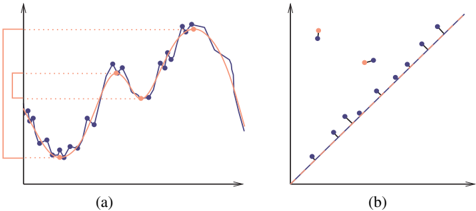
The paper proves that persistence diagrams of real-valued functions on topological spaces are stable: small changes in the function imply small changes in the diagram under the bottleneck distance. It applies this stability to homology estimation from point samples and to comparing/classifying geometric shapes.
Key findings
- The Main Theorem states that for a triangulable space \(X\) with continuous tame functions \(f,g:X\to\mathbb R\), the persistence diagrams satisfy \(d_B(D(f),D(g)) \le \|f-g\|_\infty\).
- The proof first establishes stability for the Hausdorff distance using the Box Lemma, then strengthens it to the bottleneck distance using the Easy Bijection Lemma and an Interpolation Lemma for piecewise linear functions.
- The Homology Inference Theorem states that for all real \(\varepsilon\) with \(d_H(X,P) < \varepsilon < \mathrm{hfs}_X/4\) and all sufficiently small \(\delta>0\), the dimensions of the homology group of \(X+\delta\) and \(P^\varepsilon_{3\varepsilon}\) are either both infinite or both finite and equal.
- The Barcode Theorem states that if a diffeomorphism \(\Phi:\mathbb R^d\to\mathbb R^d\) has derivatives up to second order close to those of a rigid motion, then the bottleneck distance between the barcodes of a hypersurface \(S\subseteq\mathbb R^d\) and its perturbation \(\Phi(S)\) is small.
Methods
- Theoretical study of real-valued functions on topological spaces, using homology with \(\mathbb Z_2\) coefficients, homological critical values, tame functions, persistent homology groups, and persistence diagrams.
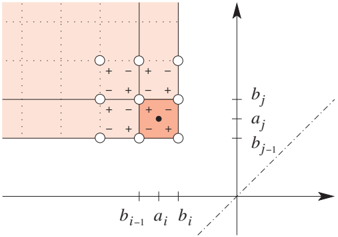
- Stability is proved by algebraic-topological diagram chasing: the Quadrant Lemma and Box Lemma bound multiplicities in nested quadrants/boxes, and the bottleneck case is handled by composing bijections for very close functions and interpolating between piecewise linear functions.
- Applications are derived as corollaries; the paper reports no empirical data, experiments, or numerical evaluations.
Limitations
- The paper explicitly leaves open whether the Main Theorem extends to non-tame functions, whether other metrics on functions and persistence diagrams admit similar inequalities, and how to exploit the result algorithmically.
- Evident from the text: the main theorem assumes a triangulable space and continuous tame functions, and the proof uses compactness, finite simplicial complexes, and finite-dimensional homology groups.
- Evident from the text: the applications are theoretical corollaries, and the Barcode Theorem states only that the bottleneck distance is “small” under \(C^2\)-closeness to a rigid motion, without a quantitative bound.
Model-written summary. Check it against the paper before relying on it.
Integrity signals
Registry
Cites
Statistics
Figures
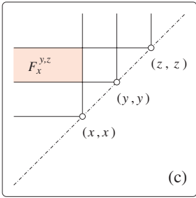
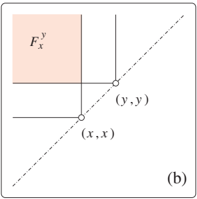
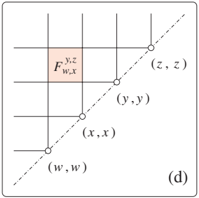
![Fig. 3 (a) Homology group of the sub-level set f -1 ( -∞ , x ]. (b) Image of Fx in Fy . (c) Kernel of surjection F y x → F z x . (d) Quotient of F y , z x and F y , z w .](https://figures.cochat.ai/paper-figures/e3fbb536dd354c4daa1aeec1692fa302/stability-of-persistence-diagrams-figure-3.png)
Verification
Claims the paper makes
1 Valid · 7 Not valid · 19 Not checked · 31 Own results and interpretations
The cited sources support only part of this claim — read each source’s verdict below.
In the paper
“Indeed, the dimensions of the persistent homology groups that appear in the theorem are efficiently computable using the persistence algorithm on the filtration of alpha complexes [11], [12].”
What the sources say
- Not matchedcites [11] 11. H. Edelsbrunner, D. Letscher, and A. Zomorodian. Topological persistence and simplification. Discrete Comput . Geom . 28 (2002), 511-533.
More than one paper fits this citation.
- Partly supportedcites [12] 12. H. Edelsbrunner and E. P. M¨ ucke. Three-dimensional alpha shapes. ACM Trans . Comput . Graphics 13 (1994), 43-72. sourceExperimental — accuracy not yet measured
Section 3.3, “Alpha Complexes” (page unavailable), defines alpha complexes and states that each is a subcomplex of those at larger alpha values, supporting the filtration part. “Features and Signatures” (page unavailable) describes an efficient way to track connected components, but calls higher-order homology signatures more challenging; it does not describe a persistence algorithm or establish efficient computation of the claimed persistent-homology dimensions. (LLM, conf=0.86)
plainstates a cause- Asserted: passes — The authors put it forward as true.
- Checkable: passes — It can be checked against evidence.
- Load-bearing: passes — The paper’s conclusions depend on it.
- Based: passes — The paper gives a reason why it holds.
- Not matched
A result the paper states — it cites no source for it, so there is none to check. The quote shows it is in the paper.
In the paper
“Easy Bijection Lemma. Let f , g : X → R be tame functions and let g be very close to f . Then the persistence diagrams satisfy d B ( D ( f ), D ( g )) ≤ ‖ f -g ‖∞ .”
plainstates an association- Asserted: passes — The authors put it forward as true.
- Checkable: passes — It can be checked against evidence.
- Load-bearing: passes — The paper’s conclusions depend on it.
- Based: passes — The paper gives a reason why it holds.
A result the paper states — it cites no source for it, so there is none to check. The quote shows it is in the paper.
In the paper
“Critical Value Lemma. If some closed interval [ x , y ] contains no homological critical value of f , then f y x is an isomorphism for every integer k .”
plainstates a cause- Asserted: passes — The authors put it forward as true.
- Checkable: passes — It can be checked against evidence.
- Load-bearing: passes — The paper’s conclusions depend on it.
- Based: passes — The paper gives a reason why it holds.
A result the paper states — it cites no source for it, so there is none to check. The quote shows it is in the paper.
In the paper
“Writing ε = ‖ f -g ‖∞ , we have f -1 ( -∞ , x ] ⊆ g -1 ( -∞ , x + ε ] for all x ∈ R .”
plainstates a cause- Asserted: passes — The authors put it forward as true.
- Checkable: passes — It can be checked against evidence.
- Load-bearing: passes — The paper’s conclusions depend on it.
- Based: passes — The paper gives a reason why it holds.
A result the paper states — it cites no source for it, so there is none to check. The quote shows it is in the paper.
In the paper
“Interpolation Lemma.”
- Also stated in: § Interpolation Lemma. · p. 13 · boosted
“However, since the h λ i sample the linear interpolation from ˆ f to ˆ g , the latter sum equals ‖ ˆ f - ˆ g ‖∞ , which concludes the proof.”
boostedstates an association- Asserted: passes — The authors put it forward as true.
- Checkable: passes — It can be checked against evidence.
- Load-bearing: passes — The paper’s conclusions depend on it.
- Based: passes — The paper gives a reason why it holds.
- Also stated in: § Interpolation Lemma. · p. 13 · boosted
21 more claims
Create a free account to see all 58 claims and every source verdict.
- Probably not a substantial claim. 28
- It may state two separate claims as one. 13
Claims other papers make about this one
Each is checked against this paper’s own text: does it say what the citing paper says it does?
The source backs part of the claim, not all of it — or backs it for a different population, condition or comparison.
In the citing paper
“Let X be any space which is homeomorphic to a simplicial complex, and suppose f, g : X → R are continuous tame functions. Then the persistence vector spaces { H k ( f -1 (( -∞ , r ]) } r and { H k ( g -1 (( -∞ , r ]) } r are finitely presented, and therefore admit barcode descriptions for each k ∈ N”
From Topological pattern recognition for point cloud data (2014) · cites this paper as Cohen-Steiner et al. (2007)
Experimental — accuracy not yet measuredThe cited source says what the claim attributes to it.
In the citing paper
“Also, results about barcodes under the general heading have now begun to appear (see [15] and [16]).”
From Topology and data (2009) · cites this paper as [15]
Citations
Cites
Rayward-Smith, V. J. (1991) · Journal of the Operational Research Society · doi:10.1057/jors.1991.155 · Cited by 16,821
Spanier, E. H. (1990) · Cited by 3,014
Three-dimensional alpha shapes
Edelsbrunner, H., & Mücke, E. P. (1994) · ACM Transactions on Graphics · doi:10.1145/174462.156635 · Cited by 2,488
Self-citationElements of Algebraic Topology
Munkres, J. R. (2018) · CRC Press eBooks · doi:10.1201/9780429493911 · Cited by 2,102
Introduction to Algorithms, Second Edition
Rivest, R. L., Leiserson, C. E., Cormen, T. H., & Stein, C. (2001) · Cited by 1,984
Topological Persistence and Simplification
Edelsbrunner, Letscher, & Zomorodian (2002) · Discrete & Computational Geometry · doi:10.1007/s00454-002-2885-2 · Cited by 1,779
Introduction to linear algebra
(2016) · Cybersecurity and Applied Mathematics · doi:10.1016/b978-0-12-804452-0.09998-x · Cited by 1,646
Zomorodian, A., & Carlsson, G. (2005) · Discrete & Computational Geometry · doi:10.1007/s00454-004-1146-y · Cited by 1,591
Milnor, J. (1963) · doi:10.1515/9781400881802 · Cited by 1,390
Morphometric Tools for Landmark Data.
Bookstein, F. (1998) · Biometrics · doi:10.2307/2534038 · Cited by 1,378
Research works printed but not linked: 2
- [16]16. J. Milnor. Morse Theory . Princeton University Press, New Jersey, 1963.
- [19]19. V. Robins. Toward computing homology from finite approximations. Topology Proceedings 24 (1999), 503-532.
Cited by
Items 1,001–1,100 of 1,300
Optimisation de la couverture de communication et de mesure dans les réseaux de capteurs
Zhang, M. (2015) · theses.fr (ABES) · doi:10.70675/12fc1af4zc66ez43b3z8b0dzb81ae83b232f · Cited by 1
Shape Analysis and Description Using Real Functions
Biasotti, S., Cerri, A., Spagnuolo, M., et al. (2014) · Mathematics and visualization · doi:10.1007/978-3-662-44900-4_6
Persistent homotopy types of noisy images.Preprint
Kurlin, V. A. (2013) · arXiv (Cornell University)
Homology groups of filtrationsPreprint
Saveliev, P. (2011) · arXiv (Cornell University) · doi:10.48550/arxiv.1101.2008
Enhancing the Reconstruction from Non-uniform Point Sets Using Persistence Information
Vuçını, E. (2012) · Lecture notes in computer science · doi:10.1007/978-3-642-30238-1_4
Statistical Inference using the Morse-Smale ComplexPreprint
Chen, Y., Genovese, C. R., & Wasserman, L. (2015) · arXiv (Cornell University) · doi:10.48550/arxiv.1506.08826
Estimating persistent Betti numbers for discrete shape analysis
Cavazza, N. (2011) · AMS Dottorato Institutional Doctoral Theses Repository (University of Bologna) · doi:10.6092/unibo/amsdottorato/3468
Shape from Functions:Enhancing Geometrical-Topological Descriptors
Fabio, D. C. (2009) · AMS Dottorato Institutional Doctoral Theses Repository (University of Bologna) · doi:10.6092/unibo/amsdottorato/1961
Visualization of Bottleneck Distances for Persistence Diagram
Cho, K., Lee, E., Seo, T. H., et al. (2012) · Korean Journal of Applied Statistics · doi:10.5351/kjas.2012.25.6.1009
Contributions to Persistence TheoryPreprint
Du, D. (2012) · arXiv (Cornell University) · doi:10.48550/arxiv.1210.3092
Geometrical shape comparison by size theory
Frosini, P. (2007) · PAMM · doi:10.1002/pamm.200700636
Separating features from noise with persistence and statistics
Wang, B. (2010) · DukeSpace (Duke University)
Computing elevation maxima by searching the gauss sphere
Wang, B., Edelsbrunner, H., & Morozov, D. (2011) · ACM Journal of Experimental Algorithmics · doi:10.1145/1963190.1970375
Self-citationComputing Elevation Maxima by Searching the Gauss Sphere
Wang, B., Edelsbrunner, H., & Morozov, D. (2009) · Lecture notes in computer science · doi:10.1007/978-3-642-02011-7_26
Self-citationAn Information Theoretic Persistent Barcode
Chintakunta, H., Gentimis, T., González-Díaz, R., Jiménez, M.-J., & Krim, H. (2014)
Computing Persistent Homology via Discrete Morse Theory
Mller, J. M., & Winter, P. (2013) · Cited by 1
Stable shape comparison by persistent homology
Ferri, M., Frosini, P., & Landi, C. (2011) · CINECA IRIS Institutial research information system (University of Pisa)
Algorithms and hardness results in computational homology
Freedman, D. Z., & Chen, C. (2009)
Refinement of Novikov - Betti numbers and of Novikov homology provided by an angle valued mapPreprint
Burghelea, D. (2015) · arXiv (Cornell University) · doi:10.48550/arxiv.1509.07734
Towards the theory and practice of verifying visualizations
Queiroz, T. E. (2013) · J. Willard Marriott Library · doi:10.26053/0h-463y-pr00
On Computing and Tracking Geometrical and Topological Features
Busaryev, O. (2012) · OhioLink ETD Center (Ohio Library and Information Network)
Report on shape analysis and matching and on semantic matching
Biasotti, S., Cerri, A., Catalano, C. E., Falcidieno, B., Torrente, M., Middleton, S. E., Dorst, L., Shimshoni, I., Tal, A., & Oldman, D. (2016) · ePrints Soton (University of Southampton)
SHREC15 Track: Retrieval of non-rigid (textured) shapes using low quality 3D models
Giachetti, A., Farina, F., Fornasa, F., et al. (2015)
degree in the School of Computer Science, Tel-Aviv University
Sackler, B. (2013)
Assessing the Reconstruction of Macro-molecular Assemblies: the Example of the Nuclear Pore Complex
Cazals, F., & Dreyfus, T. (2011) · HAL
Persistent homology for low-complexity models
Lotz, M. (2017) · Proceedings of the Royal Society A · doi:10.1098/rspa.2019.0081 · Cited by 7
Robust trajectory-based density estimation for geometric structure recovery
Richmond, T., Lokare, N., & Lobaton, E. (2017) · European Signal Processing Conference · doi:10.23919/eusipco.2017.8081400 · Cited by 2
Reconstruction of compacta by finite approximations and inverse persistence
Ruiz, D. M., & Morón, M. A. (2020) · Revista Matemática Complutense · doi:10.1007/s13163-020-00356-w · Cited by 3
Piecewise linear sheavesPreprint
Kashiwara, M., & Schapira, P. (2018) · arXiv (Cornell University) · doi:10.48550/arxiv.1805.00349
Dan Burghelea: “New Topological Invariants for Real- and Angle-Valued Maps”
Usher, M. (2018) · Jahresbericht der Deutschen Mathematiker-Vereinigung · doi:10.1365/s13291-018-0188-7
Vejdemo-Johansson, M. (2018) · Georgian Mathematical Journal · doi:10.1515/gmj-2018-0057
Feasibility of Topological Data Analysis for event-related fMRIPreprint
Ellis, C. T., Lesnick, M., Henselman‐Petrusek, G., Keller, B., & Cohen, J. D. (2018) · bioRxiv (Cold Spring Harbor Laboratory) · doi:10.1101/457747 · Cited by 2
A Topological Study of Functional Data and Fréchet Functions of Metric Measure SpacesPreprint
Hang, H., Mémoli, F., & Mio, W. (2018) · arXiv (Cornell University) · doi:10.48550/arxiv.1811.06613
Stable Persistent Homology Features of Dynamic Metric Spaces.Preprint
Kim, W., & Mémoli, F. (2018) · arXiv (Cornell University)
Canonical Stratifications Along Bisheaves
Nanda, V., & Patel, A. (2020) · Abel symposia · doi:10.1007/978-3-030-43408-3_15
Local Versus Global Distances for Zigzag Persistence ModulesPreprint
Gasparovic, E., Gommel, M., Purvine, E., Sazdanović, R., Wang, B., Wang, Y., & Ziegelmeier, L. (2019) · arXiv (Cornell University) · doi:10.48550/arxiv.1903.08298 · Cited by 2
Cavanna, N. J. (2019) · OpenCommons - UConn (University of Connecticut) · Cited by 2
Coordinate-Free Quantification of Coverage in Dynamic Sensor NetworksPreprint
Gamble, J., Chintakunta, H., & Krim, H. (2014) · arXiv (Cornell University) · doi:10.48550/arxiv.1411.7337
Combining persistent homology and invariance groups for shape comparisonPreprint
Frosini, P., & Jabłoński, G. (2013) · AMS Acta (University of Bologna) · doi:10.48550/arxiv.1312.7219 · Cited by 1
EmT: Locating empty territories of homology group generators in a dataset
Xu, X., & Cisewski-Kehe, J. (2019) · Foundations of Data Science · doi:10.3934/fods.2019010
Quantifying Homology ClassesPreprint
Chen, C., & Freedman, D. (2008) · arXiv (Cornell University) · doi:10.4230/lipics.socg.2020.32
Self-citationApproximating Loops in a Shortest Homology Basis from Point DataPreprint
Dey, T. K., Sun, J. Z., & Wang, Y. (2009) · arXiv (Cornell University) · doi:10.48550/arxiv.0909.5654
Stable comparison of multidimensional persistent homology groups with torsionPreprint
Frosini, P. (2010) · AMS Acta (University of Bologna) · doi:10.48550/arxiv.1012.4169 · Cited by 1
Multiscale Projective Coordinates via Persistent Cohomology of Sparse FiltrationsPreprint
Perea, J. A. (2016) · arXiv (Cornell University) · doi:10.48550/arxiv.1612.02861
A topological approach for protein classificationPreprint
Cang, Z., Mu, L., Wu, K., et al. (2015) · arXiv (Cornell University) · doi:10.48550/arxiv.1510.00953
Guibas, L. J., Mérigot, Q., & Morozov, D. (2011) · eScholarship (California Digital Library) · doi:10.48550/arxiv.1102.4972
Refinement of Novikov–Betti Numbers and of Novikov Homology Provided by an Angle Valued Map
Burghelea, D. (2020) · Journal of Mathematical Sciences · doi:10.1007/s10958-020-04908-9
Topologically-Guided Color Image EnhancementPreprint
Tu, J., & Rosen, P. (2019) · arXiv (Cornell University) · doi:10.48550/arxiv.1909.01456
Mathematical Foundations in VisualizationPreprint
Hotz, I., Bujack, R., Garth, C., et al. (2019) · arXiv (Cornell University) · doi:10.48550/arxiv.1909.04835
Topologically-Guided Color Image Enhancement
Tu, J., & Rosen, P. (2019) · Lecture notes in computer science · doi:10.1007/978-3-030-33723-0_22
Persistent Homology as Stopping-Criterion for Natural Neighbor Interpolation.Preprint
Melodia, L., & Lenz, R. (2019) · arXiv (Cornell University)
Coarse-refinement dilemma: on generalization bounds for data clustering
Vaz, Y. (2020) · Digital Library of Theses and Dissertations (Universidade de São Paulo) · doi:10.11606/t.55.2020.tde-18112020-130229
Hardware Acceleration of Persistent Homology Computation
Wang, F., Deng, C., Yuan, B., & Chen, C. (2019) · Lecture notes in computer science · doi:10.1007/978-3-030-33642-4_9 · Cited by 1
Efficient Approximation of the Matching Distance for 2-Parameter PersistencePreprint
Kerber, M., & Nigmetov, A. (2019) · arXiv (Cornell University) · doi:10.4230/lipics.socg.2020.53 · Cited by 8
Statistical Invariance of Betti Numbers in the Thermodynamic RegimePreprint
Vishwanath, S., Fukumizu, K., Kuriki, S., & Sriperumbudur, B. K. (2020) · arXiv (Cornell University)
Persistence and Stability of the $\mathbb{A}_n$ QuiverPreprint
Meehan, K., & Meyer, D. (2020) · arXiv (Cornell University) · doi:10.48550/arxiv.2001.06172
Computational Geometry Column 70: Processing Persistence Diagrams as Purely Geometric Objects
Zhu, B. (2020) · ACM SIGACT News · doi:10.1145/3388392.3388404
The Maximum Distance Problem and Minimal Spanning TreesPreprint
Alvarado, E., Krishnamoorthy, B., & Vixie, K. R. (2020) · arXiv (Cornell University) · doi:10.48550/arxiv.2004.07323
SARS-COV-2 THREE FORCING SEASONALITIES: POLICIES, ENVIRONMENT AND URBAN SPACESPreprint
Telles, C. R. (2020) · medRxiv · doi:10.1101/2020.07.15.20154823
Persistent Homology in $\ell_{\infty}$ MetricPreprint
Beltramo, G., & Škraba, P. (2020) · arXiv (Cornell University) · doi:10.48550/arxiv.2008.02071
Geradores de homologia persistente e aplicações
Ronchi, C. H. V. (2020) · Digital Library of Theses and Dissertations (Universidade de São Paulo) · doi:10.11606/d.55.2020.tde-04022020-165648
Morse-Based Fibering of the Persistence Rank Invariant
Bapat, A., Brooks, R., Hacker, C., Landi, C., & Mahler, B. I. (2022) · Association for Women in Mathematics series · doi:10.1007/978-3-030-95519-9_2
Hernández, A., Solís, M., & Zúñiga-Rojas, R. A. (2020) · arXiv (Cornell University) · doi:10.48550/arxiv.2012.05351
The Structure of Morphisms in Persistent Homology, I. Functorial Dualities.Preprint
Bauer, U., & Schmahl, M. (2020) · arXiv (Cornell University)
Persistent Homology for Dimensionality Reduction
Williamson, L. (2021) · Studies in computational intelligence · doi:10.1007/978-3-030-41188-6_9
Online High-Dimensional Change-Point Detection using Topological Data AnalysisPreprint
Zheng, X., Mak, S., & Xie, Y. (2021) · arXiv (Cornell University) · doi:10.48550/arxiv.2103.00117
Cole, A., & Shiu, G. (2021) · Signals and communication technology · doi:10.1007/978-3-030-65459-7_9
Topological Simplifications of HypergraphsPreprint
Zhou, Y., Rathore, A., Purvine, E., et al. (2021) · arXiv (Cornell University) · doi:10.48550/arxiv.2104.11214
Estimation and Quantization of Expected Persistence DiagramsPreprint
Divol, V., & Lacombe, T. (2021) · arXiv (Cornell University) · doi:10.48550/arxiv.2105.04852 · Cited by 2
Chung, M. K. (2019) · Cambridge University Press eBooks · doi:10.1017/9781316882610.006
Shape-Preserving Dimensionality Reduction : An Algorithm and Measures of Topological EquivalencePreprint
Yu, B., & You, K. (2021) · arXiv (Cornell University) · doi:10.48550/arxiv.2106.02096
Solis, I. M., Orlova, T., Bednarska, K., et al. (2021) · arXiv (Cornell University) · doi:10.48550/arxiv.2106.13169
$\ell^p$-Distances on Multiparameter Persistence ModulesPreprint
Bjerkevik, H. B., & Lesnick, M. (2021) · arXiv (Cornell University) · doi:10.48550/arxiv.2106.13589 · Cited by 21
Realizable Piecewise Linear Paths of Persistence Diagrams with Reeb GraphsPreprint
Alharbi, R., Chambers, E. W., & Munch, E. (2021) · arXiv (Cornell University) · doi:10.57717/cgt.v3i1.38
Jung, W. (2021) · arXiv.org · doi:10.48550/arxiv.2108.01625
Persistence in functional topology and a correction to a theorem of Morse
Bauer, U., Medina-Mardones, A. M., & Schmahl, M. (2021) · arXiv (Cornell University)
Dong, L., Hang, H., Park, J. G., Mio, W., & Liang, R. (2021) · arXiv (Cornell University) · doi:10.48550/arxiv.2108.04375
APPLICATION OF PERSISTENT HOMOLOGY ON BIO-MEDICAL DATA – A CASE STUDY
Sekuloski, P., & Ristovska, V. (2019) · Mathematical Modelling
Reeb Graph Metrics from the Ground UpPreprint
Bollen, B., Chambers, E. W., Levine, J. A., & Munch, E. (2021) · arXiv (Cornell University) · doi:10.48550/arxiv.2110.05631 · Cited by 24
Biparametric persistence for smooth filtrationsPreprint
K, M. A. P., & Baryshnikov, Y. M. (2021) · arXiv (Cornell University) · doi:10.48550/arxiv.2110.09602
The Generalized Persistence Diagram Encodes the Bigraded Betti NumbersPreprint
Kim, W., & Moore, S. (2021) · arXiv (Cornell University)
Topological Regularization for Dense PredictionPreprint
Fu, D., & Nelson, B. J. (2021) · arXiv (Cornell University) · doi:10.48550/arxiv.2111.10984
Asymptotic Improvements on the Exact Matching Distance for 2-parameter Persistence
Bjerkevik, H. B., & Kerber, M. (2021) · Journal of computational geometry · doi:10.20382/jocg.v14i1a12 · Cited by 1
Dreyfus, T. (2011) · OpenGrey (Institut de l'Information Scientifique et Technique)
Report on scipost_202102_00007v2
Spitz, D., Berges, J., Oberthaler, M. K., et al. (2021) · SciPost Physics · doi:10.21468/scipost.report.3454
Chung, M. K. (2019) · Cambridge University Press eBooks · doi:10.1017/9781316882610.002
Series Expansion of Connectivity Matrices
Chung, M. K. (2019) · Cambridge University Press eBooks · doi:10.1017/9781316882610.013
Chung, M. K. (2019) · Cambridge University Press eBooks · doi:10.1017/9781316882610.009
Chung, M. K. (2019) · Cambridge University Press eBooks · doi:10.1017/9781316882610.014
Chung, M. K. (2019) · Cambridge University Press eBooks · doi:10.1017/9781316882610.015
Chung, M. K. (2019) · Cambridge University Press eBooks · doi:10.1017/9781316882610.001
Chung, M. K. (2019) · Cambridge University Press eBooks · doi:10.1017/9781316882610.007
Chung, M. K. (2019) · Cambridge University Press eBooks · doi:10.1017/9781316882610.004
Chung, M. K. (2019) · Cambridge University Press eBooks · doi:10.1017/9781316882610.010
(2015) · BENTHAM SCIENCE PUBLISHERS eBooks · doi:10.2174/9781681080444115010014
Chung, M. K. (2019) · Cambridge University Press eBooks · doi:10.1017/9781316882610.008
Chung, M. K. (2019) · Cambridge University Press eBooks · doi:10.1017/9781316882610.011
Chung, M. K. (2019) · Cambridge University Press eBooks · doi:10.1017/9781316882610.005
Combinatorial Inferences for Networks
Chung, M. K. (2019) · Cambridge University Press eBooks · doi:10.1017/9781316882610.012
The evolution pattern of world trade network based on topological data analysis
Gu, Y. S., Guo, J., He, C., et al. (2022) · International Conference on Measuring Technology and Mechatronics Automation (ICMTMA) · doi:10.1109/icmtma54903.2022.00225
Metadata
- Authors
- Cohen-Steiner, D., Edelsbrunner, H., & Harer, J.
- Affiliations
- Duke University (US)
- Corresponding author
- Edelsbrunner, Herbert
- Harer, John
- Venue
- Discrete & Computational Geometry
- Published
- 2006-12-12
- Volume
- 37
- Issue
- 1
- Pages
- 103-120
- ISSN
- 0179-5376 (ISSN-L)
- 1432-0444
- OpenAlex
- W2037613900
- Cited by
- 1,280
- References
- 30
- Citations by year
- 2026: 102 · 2025: 89 · 2024: 69 · 2023: 97 · 2022: 78 · 2021: 132 · 2020: 109 · 2019: 89 · 2018: 92 · 2017: 50 · 2016: 60 · 2015: 54 · 2014: 58 · 2013: 48 · 2012: 29
- FWCI
- 18.03
- Type
- journal article
- Language
- en
- Open access
- bronze
- doi.org
- Licence
- www.springer.com/tdm (tdm)
- Locations
- Discrete & Computational Geometry (publishedVersion)
- Funders
- National Science Foundation (0086013)
- Defense Advanced Research Projects Agency (HR0011, HR0011-05-1-0007)
- Topics
- Physical Sciences › Computer Science › Computational Theory and Mathematics › Topological and Geometric Data Analysis
- Physical Sciences › Mathematics › Geometry and Topology › Geometric and Algebraic Topology
- Physical Sciences › Mathematics › Applied Mathematics › Geometric Analysis and Curvature Flows
- Keywords
- persistence diagrams, stability, topological data analysis, metric spaces, shape comparison, real functions, simplicial complexes
About these checks
Registry, retraction, Cites and statistics results are computed, not judged, with one exception: a printed reference that no index lists is read once by a model before it counts as a citation error. Claims are extracted by a model and kept only when their quote appears verbatim in the text; each cited source is then checked, with a model’s help, for whether it says what the claim relies on. Those verdicts can be wrong — read the claim’s quote and the cited source before relying on one.
The claim verdicts this report counts are experimental: their accuracy is not yet measured.
A language model drew the claims from the paper on 2026-10-10, under version 3 of the claim definition (model deepseek-v4.1-flash, prompt extract-v3).
A second model labelled each claim on 2026-10-10 (model jev-1.13-20260917, definition revision gold-guideline-v0.2).
Cited sources are checked with a language model’s help (gpt-6-sol).
Statistics and arithmetic are recomputed, not judged.
Confidence bands are shown only for fields calibrated on our annotated test set. None is calibrated yet, so no band is shown.
What counts as a claim ›How we measure confidence ›How we check this ›
Are you an author, or do you see a problem with this page? Request a review
Data sources
Bibliographic data: Semantic Scholar, OpenAlex, Crossref.
Contains information from the Semantic Scholar Academic Graph Datasets, made available under the ODC Attribution License (ODC-BY 1.0).
Semantic Scholar’s data is described in: Kinney, R., et al. (2023). The Semantic Scholar Open Data Platform. arXiv:2301.10140.
