

Stability of Persistence Diagrams
Open accessThe DOI matches its Crossref record; 32 of the 32 references it cites were found in a registry or an index; 1 of the 21 sources its claims cite were checked for support.
Overview
CoChat Summary
TL;DR
The paper proves that persistence diagrams of real-valued functions on topological spaces are stable: small changes in the function imply small changes in the diagram under the bottleneck distance. It applies this stability to homology estimation from point samples and to comparing/classifying geometric shapes.
Key findings
- The Main Theorem states that for a triangulable space \(X\) with continuous tame functions \(f,g:X\to\mathbb R\), the persistence diagrams satisfy \(d_B(D(f),D(g)) \le \|f-g\|_\infty\).
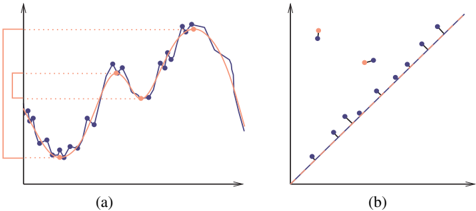
- The proof first establishes stability for the Hausdorff distance using the Box Lemma, then strengthens it to the bottleneck distance using the Easy Bijection Lemma and an Interpolation Lemma for piecewise linear functions.
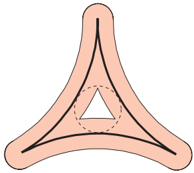
- The Homology Inference Theorem states that for all real \(\varepsilon\) with \(d_H(X,P) < \varepsilon < \mathrm{hfs}_X/4\) and all sufficiently small \(\delta>0\), the dimensions of the homology group of \(X+\delta\) and \(P^\varepsilon_{3\varepsilon}\) are either both infinite or both finite and equal.
- The Barcode Theorem states that if a diffeomorphism \(\Phi:\mathbb R^d\to\mathbb R^d\) has derivatives up to second order close to those of a rigid motion, then the bottleneck distance between the barcodes of a hypersurface \(S\subseteq\mathbb R^d\) and its perturbation \(\Phi(S)\) is small.
Methods
- Theoretical study of real-valued functions on topological spaces, using homology with \(\mathbb Z_2\) coefficients, homological critical values, tame functions, persistent homology groups, and persistence diagrams.
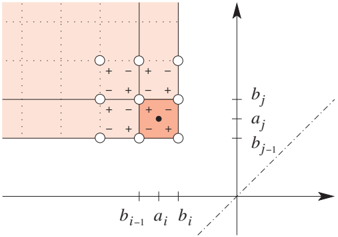
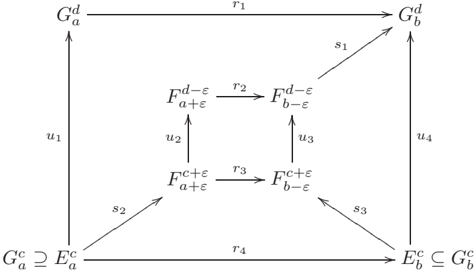
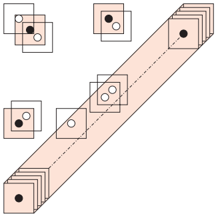
- Stability is proved by algebraic-topological diagram chasing: the Quadrant Lemma and Box Lemma bound multiplicities in nested quadrants/boxes, and the bottleneck case is handled by composing bijections for very close functions and interpolating between piecewise linear functions.
- Applications are derived as corollaries; the paper reports no empirical data, experiments, or numerical evaluations.
Limitations
- The paper explicitly leaves open whether the Main Theorem extends to non-tame functions, whether other metrics on functions and persistence diagrams admit similar inequalities, and how to exploit the result algorithmically.
- Evident from the text: the main theorem assumes a triangulable space and continuous tame functions, and the proof uses compactness, finite simplicial complexes, and finite-dimensional homology groups.
- Evident from the text: the applications are theoretical corollaries, and the Barcode Theorem states only that the bottleneck distance is “small” under \(C^2\)-closeness to a rigid motion, without a quantitative bound.
Model-written summary. Check it against the paper before relying on it.
Integrity signals
Registry
Cites
Statistics
Figures
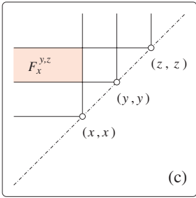
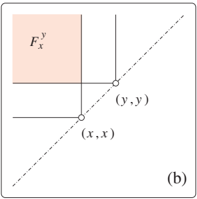
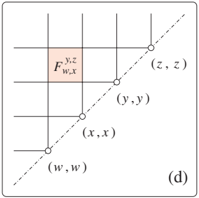
![Fig. 3 (a) Homology group of the sub-level set f -1 ( -∞ , x ]. (b) Image of Fx in Fy . (c) Kernel of surjection F y x → F z x . (d) Quotient of F y , z x and F y , z w .](https://figures.cochat.ai/paper-figures/e3fbb536dd354c4daa1aeec1692fa302/stability-of-persistence-diagrams-figure-3.png)
Verification
Claims the paper makes
1 Valid · 7 Not valid · 19 Not checked · 31 Own results and interpretations
The cited sources support only part of this claim — read each source’s verdict below.
In the paper
“Indeed, the dimensions of the persistent homology groups that appear in the theorem are efficiently computable using the persistence algorithm on the filtration of alpha complexes [11], [12].”
What the sources say
- Not matchedcites [11] 11. H. Edelsbrunner, D. Letscher, and A. Zomorodian. Topological persistence and simplification. Discrete Comput . Geom . 28 (2002), 511-533.
More than one paper fits this citation.
- Partly supportedcites [12] 12. H. Edelsbrunner and E. P. M¨ ucke. Three-dimensional alpha shapes. ACM Trans . Comput . Graphics 13 (1994), 43-72. sourceExperimental — accuracy not yet measured
Section 3.3, “Alpha Complexes” (page unavailable), defines alpha complexes and states that each is a subcomplex of those at larger alpha values, supporting the filtration part. “Features and Signatures” (page unavailable) describes an efficient way to track connected components, but calls higher-order homology signatures more challenging; it does not describe a persistence algorithm or establish efficient computation of the claimed persistent-homology dimensions. (LLM, conf=0.86)
plainstates a cause- Asserted: passes — The authors put it forward as true.
- Checkable: passes — It can be checked against evidence.
- Load-bearing: passes — The paper’s conclusions depend on it.
- Based: passes — The paper gives a reason why it holds.
- Not matched
A result the paper states — it cites no source for it, so there is none to check. The quote shows it is in the paper.
In the paper
“Easy Bijection Lemma. Let f , g : X → R be tame functions and let g be very close to f . Then the persistence diagrams satisfy d B ( D ( f ), D ( g )) ≤ ‖ f -g ‖∞ .”
plainstates an association- Asserted: passes — The authors put it forward as true.
- Checkable: passes — It can be checked against evidence.
- Load-bearing: passes — The paper’s conclusions depend on it.
- Based: passes — The paper gives a reason why it holds.
A result the paper states — it cites no source for it, so there is none to check. The quote shows it is in the paper.
In the paper
“Critical Value Lemma. If some closed interval [ x , y ] contains no homological critical value of f , then f y x is an isomorphism for every integer k .”
plainstates a cause- Asserted: passes — The authors put it forward as true.
- Checkable: passes — It can be checked against evidence.
- Load-bearing: passes — The paper’s conclusions depend on it.
- Based: passes — The paper gives a reason why it holds.
A result the paper states — it cites no source for it, so there is none to check. The quote shows it is in the paper.
In the paper
“Writing ε = ‖ f -g ‖∞ , we have f -1 ( -∞ , x ] ⊆ g -1 ( -∞ , x + ε ] for all x ∈ R .”
plainstates a cause- Asserted: passes — The authors put it forward as true.
- Checkable: passes — It can be checked against evidence.
- Load-bearing: passes — The paper’s conclusions depend on it.
- Based: passes — The paper gives a reason why it holds.
A result the paper states — it cites no source for it, so there is none to check. The quote shows it is in the paper.
In the paper
“Interpolation Lemma.”
- Also stated in: § Interpolation Lemma. · p. 13 · boosted
“However, since the h λ i sample the linear interpolation from ˆ f to ˆ g , the latter sum equals ‖ ˆ f - ˆ g ‖∞ , which concludes the proof.”
boostedstates an association- Asserted: passes — The authors put it forward as true.
- Checkable: passes — It can be checked against evidence.
- Load-bearing: passes — The paper’s conclusions depend on it.
- Based: passes — The paper gives a reason why it holds.
- Also stated in: § Interpolation Lemma. · p. 13 · boosted
21 more claims
Create a free account to see all 58 claims and every source verdict.
- Probably not a substantial claim. 28
- It may state two separate claims as one. 13
Claims other papers make about this one
Each is checked against this paper’s own text: does it say what the citing paper says it does?
The source backs part of the claim, not all of it — or backs it for a different population, condition or comparison.
In the citing paper
“Let X be any space which is homeomorphic to a simplicial complex, and suppose f, g : X → R are continuous tame functions. Then the persistence vector spaces { H k ( f -1 (( -∞ , r ]) } r and { H k ( g -1 (( -∞ , r ]) } r are finitely presented, and therefore admit barcode descriptions for each k ∈ N”
From Topological pattern recognition for point cloud data (2014) · cites this paper as Cohen-Steiner et al. (2007)
Experimental — accuracy not yet measuredThe cited source says what the claim attributes to it.
In the citing paper
“Also, results about barcodes under the general heading have now begun to appear (see [15] and [16]).”
From Topology and data (2009) · cites this paper as [15]
Citations
Cites
Rayward-Smith, V. J. (1991) · Journal of the Operational Research Society · doi:10.1057/jors.1991.155 · Cited by 16,821
Spanier, E. H. (1990) · Cited by 3,014
Three-dimensional alpha shapes
Edelsbrunner, H., & Mücke, E. P. (1994) · ACM Transactions on Graphics · doi:10.1145/174462.156635 · Cited by 2,488
Self-citationElements of Algebraic Topology
Munkres, J. R. (2018) · CRC Press eBooks · doi:10.1201/9780429493911 · Cited by 2,102
Introduction to Algorithms, Second Edition
Rivest, R. L., Leiserson, C. E., Cormen, T. H., & Stein, C. (2001) · Cited by 1,984
Topological Persistence and Simplification
Edelsbrunner, Letscher, & Zomorodian (2002) · Discrete & Computational Geometry · doi:10.1007/s00454-002-2885-2 · Cited by 1,779
Introduction to linear algebra
(2016) · Cybersecurity and Applied Mathematics · doi:10.1016/b978-0-12-804452-0.09998-x · Cited by 1,646
Zomorodian, A., & Carlsson, G. (2005) · Discrete & Computational Geometry · doi:10.1007/s00454-004-1146-y · Cited by 1,591
Milnor, J. (1963) · doi:10.1515/9781400881802 · Cited by 1,390
Morphometric Tools for Landmark Data.
Bookstein, F. (1998) · Biometrics · doi:10.2307/2534038 · Cited by 1,378
Research works printed but not linked: 2
- [16]16. J. Milnor. Morse Theory . Princeton University Press, New Jersey, 1963.
- [19]19. V. Robins. Toward computing homology from finite approximations. Topology Proceedings 24 (1999), 503-532.
Cited by
Items 401–500 of 1,300
Xia, K., & Wei, G. (2016) · arXiv (Cornell University) · doi:10.48550/arxiv.1612.01735 · Cited by 26
Comparing Graphs via Persistence DistortionPreprint
Dey, T. K., Shi, D., & Wang, Y. (2015) · arXiv (Cornell University) · doi:10.48550/arxiv.1503.07414 · Cited by 15
Comparison of persistence diagrams
Agami, S. (2021) · Communications in Statistics - Simulation and Computation · doi:10.1080/03610918.2021.1894335 · Cited by 14
Persistent Homology for Breast Tumor Classification Using Mammogram Scans
Asaad, A., Ali, D., Majeed, T. F., & Rashid, R. D. (2022) · Mathematics · doi:10.3390/math10214039 · Cited by 20
Chulián, S., Stolz, B. J., Martínez-Rubio, Á., Blázquez-Goñi, C., Rodríguez-Gutiérrez, J. F., Caballero-Velázquez, T., Molinos-Quintana, Á., Ramírez-Orellana, M., Castillo-Robleda, A., Fuster-Soler, J., et al. (2021) · medRxiv · doi:10.1371/journal.pcbi.1011329 · Cited by 15
Persistent Homology: a Step-by-step Introduction for Newcomers
Fugacci, U., Scaramuccia, S., Iuricich, F., & Floriani, L. D. (2016) · Smart Tools and Applications in Graphics · doi:10.2312/stag.20161358 · Cited by 38
On the Stability of Functional Maps and Shape Difference Operators
Huang, R., Chazal, F., & Ovsjanikov, M. (2017) · Computer Graphics Forum · doi:10.1111/cgf.13238 · Cited by 14
On the geometrical properties of the coherent matching distance in 2D persistent homology
Cerri, A., Ethier, M., & Frosini, P. (2019) · Journal of Applied and Computational Topology · doi:10.1007/s41468-019-00041-y · Cited by 13
Topological data analysis for true step detection in periodic piecewise constant signals
Khasawneh, F. A., & Munch, E. (2018) · Proceedings of the Royal Society A Mathematical Physical and Engineering Sciences · doi:10.1098/rspa.2018.0027 · Cited by 28
Govc, D., & Hepworth, R. C. (2019) · Journal of Pure and Applied Algebra · doi:10.1016/j.jpaa.2020.106517 · Cited by 29
Analysis of Dynamic Graphs and Dynamic Metric Spaces via Zigzag Persistence
Kim, W., Mémoli, F., & Smith, Z. (2020) · Abel symposia · doi:10.1007/978-3-030-43408-3_14 · Cited by 22
Persistence Enhanced Graph Neural Network
Zhao, Q., Ye, Z., Chen, C., & Wang, Y. (2020) · International Conference on Artificial Intelligence and Statistics · Cited by 100
Homological Algebra of Modules over Posets
Miller, E. (2025) · SIAM Journal on Applied Algebra and Geometry · doi:10.1137/22m1516361 · Cited by 15
Virtual persistence diagrams, signed measures, Wasserstein distances, and Banach spaces
Bubenik, P., & Elchesen, A. (2022) · Journal of Applied and Computational Topology · doi:10.1007/s41468-022-00091-9 · Cited by 36
Comparing Graphs via Persistence Distortion
Dey, T. K., Shi, D., & Wang, Y. (2015) · DROPS (Schloss Dagstuhl – Leibniz Center for Informatics) · doi:10.4230/lipics.socg.2015.491 · Cited by 36
ADAPTIVE SAMPLING WITH TOPOLOGICAL SCORES
Maljovec, D., Wang, B., Kupresanin, A., Johannesson, G., Pascucci, V., & Bremer, P. (2012) · International Journal for Uncertainty Quantification · doi:10.1615/int.j.uncertaintyquantification.2012003955 · Cited by 26
Parametrized homology via zigzag persistence
Carlsson, G., de Silva, V., Kališnik, S., & Morozov, D. (2019) · Algebraic & Geometric Topology · doi:10.2140/agt.2019.19.657 · Cited by 23
Rethinking sensitivity analysis of nuclear simulations with topology
Maljovec, D., Wang, B., Rosen, P., Alfonsi, A., Pastore, G., Rabiti, C., & Pascucci, V. (2016) · IEEE Pacific Visualization Symposium · doi:10.1109/pacificvis.2016.7465252 · Cited by 22
Inequalities for the Curvature of Curves and Surfaces
Narcowich, C.-S., & Edelsbrunner, H. (2006) · Foundations of Computational Mathematics · doi:10.1007/s10208-005-0200-3 · Cited by 14
Self-citationUsing persistent homology to reveal hidden information in neural dataPreprint
Spreemann, G., Dunn, B. A., Botnan, M. B., & Baas, N. A. (2015) · arXiv (Cornell University) · doi:10.48550/arxiv.1510.06629 · Cited by 20
Structural Analysis of Multivariate Point Clouds Using Simplicial Chains
Rieck, B., & Leitte, H. (2014) · Computer Graphics Forum · doi:10.1111/cgf.12398 · Cited by 12
A Novel Framework for Pulse Pressure Wave Analysis Using Persistent Homology
Emrani, S., Saponas, T. S., Morris, D., & Krim, H. (2015) · IEEE Signal Processing Letters · doi:10.1109/lsp.2015.2441068 · Cited by 18
Extraction of Dominant Extremal Structures in Volumetric Data Using Separatrix Persistence
Günther, D., Seidel, H., & Weinkauf, T. (2012) · Computer Graphics Forum · doi:10.1111/j.1467-8659.2012.03222.x · Cited by 13
Graph induced complex on point data
Dey, T. K., Fan, F., & Wang, Y. (2015) · Computational Geometry · doi:10.1016/j.comgeo.2015.04.003 · Cited by 13
Computing the Gromov-Hausdorff Distance for Metric Trees
Agarwal, P. K., Fox, K., Nath, A., Sidiropoulos, A., & Wang, Y. (2015) · Lecture notes in computer science · doi:10.1007/978-3-662-48971-0_45 · Cited by 25
Universality of persistence diagrams and the bottleneck and Wasserstein distances
Bubenik, P., & Elchesen, A. (2022) · Computational Geometry · doi:10.1016/j.comgeo.2022.101882 · Cited by 20
Bois, A., Tervil, B., Moreau, A., Vienne-Jumeau, A., Ricard, D., & Oudre, L. (2022) · PLoS ONE · doi:10.1371/journal.pone.0268475 · Cited by 13
Mjahad, A., Francés-Víllora, J. V., Bataller‐Mompeán, M., & Rosado-Muñoz, A. (2022) · Applied Sciences · doi:10.3390/app12147248 · Cited by 13
Gene Coexpression Network Comparison via Persistent Homology
Duman, A. N., & Pirim, H. (2018) · International Journal of Genomics · doi:10.1155/2018/7329576 · Cited by 13
Computing Persistent Homology with Various Coefficient Fields in a Single Pass
Boissonnat, J., & Maria, C. (2014) · Lecture notes in computer science · doi:10.1007/978-3-662-44777-2_16 · Cited by 23
Dong, Z., Hu, C., Zhou, C., & Lin, H. (2020) · Computers & Graphics · doi:10.1016/j.cag.2020.05.029 · Cited by 14
Gait-Based Gender Classification Using Persistent Homology
León, J. L., Cerri, A., García-Reyes, E. B., et al. (2013) · Lecture notes in computer science · doi:10.1007/978-3-642-41827-3_46 · Cited by 13
Multidimensional persistent homology is stable
Cerri, A., Fabio, B. D., Ferri, M., Frosini, P., & Landi, C. (2009) · AMS Acta (University of Bologna) · doi:10.6092/unibo/amsacta/2603 · Cited by 14
Composing Tree Graphical Models with Persistent Homology Features for Clustering Mixed-Type Data
Ni, X., Quadrianto, N., Wang, Y., & Chen, C. (2017) · Sussex Research Online (University of Sussex) · Cited by 16
Damping parameter estimation using topological signal processing
Myers, A., & Khasawneh, F. A. (2022) · Mechanical Systems and Signal Processing · doi:10.1016/j.ymssp.2022.109042 · Cited by 16
A New Approximation Algorithm for the Matching Distance in Multidimensional Persistence
Cerri, A., & Frosini, P. (2020) · Journal of Computational Mathematics · doi:10.4208/jcm.1809-m2018-0043 · Cited by 11
Towards topological analysis of high-dimensional feature spaces
Wagner, H., & Dłotko, P. (2014) · Computer Vision and Image Understanding · doi:10.1016/j.cviu.2014.01.005 · Cited by 12
Hausdorff Stability of Persistence Spaces
Cerri, A., & Landi, C. (2015) · Foundations of Computational Mathematics · doi:10.1007/s10208-015-9244-1 · Cited by 12
Persistent Homology in Image Processing
Edelsbrunner, H. (2013) · Lecture notes in computer science · doi:10.1007/978-3-642-38221-5_19 · Cited by 12
Self-citationGeometric Learning and Topological Inference With Biobotic Networks
Dirafzoon, A., Bozkurt, A. Y., & Lobaton, E. J. (2016) · IEEE Transactions on Signal and Information Processing over Networks · doi:10.1109/tsipn.2016.2623093 · Cited by 15
Tuning the performance of a computational persistent homology package
Hylton, A., Henselman‐Petrusek, G., Sang, J., & Short, R. (2019) · Software Practice and Experience · doi:10.1002/spe.2678 · Cited by 12
Homological scaffold via minimal homology bases
Guerra, M., Gregorio, A. D., Fugacci, U., Petri, G., & Vaccarino, F. (2021) · Scientific Reports · doi:10.1038/s41598-021-84486-1 · Cited by 17
Topological data analysis of vascular disease: A theoretical framework
Nicponski, J., & Jung, J.-H. (2019) · bioRxiv · doi:10.3389/fams.2020.00034 · Cited by 15
Bot Detection on Social Networks Using Persistent Homology
Nguyen, M., Aktas, M. E., & Akbaş, E. (2020) · Mathematical and Computational Applications · doi:10.3390/mca25030058 · Cited by 20
A Survey on the High-Performance Computation of Persistent Homology
Malott, N. O., Chen, S., & Wilsey, P. (2023) · IEEE Transactions on Knowledge and Data Engineering · doi:10.1109/tkde.2022.3147070 · Cited by 13
Stabilizing the unstable output of persistent homology computations
Bendich, P., Bubenik, P., & Wagner, A. (2015) · Journal of Applied and Computational Topology · doi:10.1007/s41468-019-00044-9 · Cited by 14
Time-Series Data Analysis for Classification of Noisy and Incomplete Internet-of-Things Datasets
Postol, M., Diaz, C., Simon, R., et al. (2019) · IEEE International Conference on Machine Learning and Applications (ICMLA) · doi:10.1109/icmla.2019.00255 · Cited by 12
Barcodes and area-preserving homeomorphismsPreprint
Roux, F. L., Seyfaddini, S., & Viterbo, C. (2018) · arXiv (Cornell University) · doi:10.48550/arxiv.1810.03139 · Cited by 12
Stability and machine learning applications of persistent homology using the Delaunay-Rips complex
Mishra, A., & Motta, F. C. (2023) · Frontiers in Applied Mathematics and Statistics · doi:10.3389/fams.2023.1179301 · Cited by 15
Topological Neuroscience: Linking Circuits to Function
Curto, C., & Sanderson, N. (2025) · Annual Review of Neuroscience · doi:10.1146/annurev-neuro-112723-034315 · Cited by 23
Blumberg, A. J., Gal, I., Mandell, M. A., & Pancia, M. (2012) · Cited by 11
Utilizing Topological Data Analysis for Studying Signals of Time-Delay Systems
Khasawneh, F. A., & Munch, E. (2017) · Advances in delays and dynamics · doi:10.1007/978-3-319-53426-8_7 · Cited by 18
Mao, X., Xue, X., Wang, L., Wang, L., Li, L., & Zhang, X. (2019) · Cellular and Molecular Neurobiology · doi:10.1007/s10571-019-00704-5 · Cited by 13
The persistent homotopy type distance
Landi, C. (2019) · IRIS UNIMORE (University of Modena and Reggio Emilia) · doi:10.4310/hha.2019.v21.n2.a13 · Cited by 11
Grain analysis of atomic force microscopy images via persistent homology
Duman, A. N. (2020) · Ultramicroscopy · doi:10.1016/j.ultramic.2020.113176 · Cited by 11
Homology of homologous knotted proteins
Benjamin, K. S., Mukta, L., Moryoussef, G., Uren, C., Harrington, H. A., Tillmann, U., & Barbensi, A. (2023) · Journal of The Royal Society Interface · doi:10.1098/rsif.2022.0727 · Cited by 19
Persistent Homology over Directed Acyclic Graphs
Chambers, E. W., & Letscher, D. (2018) · Association for Women in Mathematics series · doi:10.1007/978-3-319-89593-2_2 · Cited by 25
Improving homology estimates with random walks
Bendich, P. L., Galkovskyi, T., & Harer, J. (2011) · Inverse Problems · doi:10.1088/0266-5611/27/12/124002 · Cited by 10
Self-citationGuibas, L. J., Mérigot, Q., & Morozov, D. (2011) · Annual Symposium on Computational Geometry (SoCG) · doi:10.1145/1998196.1998205 · Cited by 10
A Homologically Persistent Skeleton is a Fast and Robust Descriptor of Interest Points in 2D Images
Kurlin, V. A. (2015) · Lecture notes in computer science · doi:10.1007/978-3-319-23192-1_51 · Cited by 11
Towards a Topological Fingerprint of Music
Bergomi, M. G., Baratè, A., & Fabio, B. D. (2016) · Lecture notes in computer science · doi:10.1007/978-3-319-39441-1_9 · Cited by 11
Topological data analysis and diagnostics of compressible magnetohydrodynamic turbulence
Makarenko, I., Bushby, P. J., Fletcher, A., Henderson, R., Makarenko, N., & Shukurov, A. (2018) · Journal of Plasma Physics · doi:10.1017/s0022377818000752 · Cited by 11
Akai, N., Hirayama, T., & Murase, H. (2021) · Neural Networks · doi:10.1016/j.neunet.2021.05.007 · Cited by 16
Persistence Cycles for Visual Exploration of Persistent Homology
Iuricich, F. (2021) · IEEE Transactions on Visualization and Computer Graphics · doi:10.1109/tvcg.2021.3110663 · Cited by 14
Uniqueness of models in persistent homology: the case of curves
Frosini, P., & Landi, C. (2011) · Inverse Problems · doi:10.1088/0266-5611/27/12/124005 · Cited by 10
Topological Characterization of Haze Episodes Using Persistent Homology
Zulkepli, N. F. S., Noorani, M. S. M., Razak, F. A., Ismail, M., & Alias, M. A. (2019) · Aerosol and Air Quality Research · doi:10.4209/aaqr.2018.08.0315 · Cited by 13
Persistence Images: An Alternative Persistent Homology Representation.Preprint
Chepushtanova, S., Emerson, T., Hanson, E., Kirby, M. J. L., Motta, F. C., Neville, R., Peterson, C., Shipman, P. D., & Ziegelmeier, L. (2015) · arXiv (Cornell University) · Cited by 17
Bazaikin, Y., Байков, В. А., Taimanov, I. A., & Yakovlev, A. A. (2013) · arXiv (Cornell University) · doi:10.48550/arxiv.1302.6885 · Cited by 10
Persistence modules: Algebra and algorithmsPreprint
Skraba, P., & Vejdemo-Johansson, M. (2013) · arXiv.org · doi:10.48550/arxiv.1302.2015 · Cited by 19
Randomly Weighted $d-$complexes: Minimal Spanning Acycles and Persistence DiagramsPreprint
Škraba, P., Thoppe, G., & Yogeshwaran, D. (2017) · arXiv (Cornell University) · doi:10.48550/arxiv.1701.00239 · Cited by 11
Generalized Persistence Algorithm for Decomposing Multi-parameter Persistence ModulesPreprint
Dey, T. K., & Xin, C. (2019) · arXiv (Cornell University) · doi:10.48550/arxiv.1904.03766 · Cited by 11
Time Series Featurization via Topological Data AnalysisPreprint
Kim, K., Kim, J., & Rinaldo, A. (2018) · arXiv (Cornell University) · doi:10.48550/arxiv.1812.02987 · Cited by 30
Comparing shapes through multi-scale approximations of the matching distance
Cerri, A., Fabio, B. D., Jabłoński, G., & Medri, F. (2014) · Computer Vision and Image Understanding · doi:10.1016/j.cviu.2013.11.004 · Cited by 10
Computing the Multicover Bifiltration
Corbet, R., Kerber, M., Lesnick, M., & Osang, G. (2023) · Discrete & Computational Geometry · doi:10.1007/s00454-022-00476-8 · Cited by 10
Comparison of persistent homologies for vector functions: From continuous to discrete and back
Cavazza, N., Ethier, M., Frosini, P., Kaczyński, T., & Landi, C. (2013) · Computers & Mathematics with Applications · doi:10.1016/j.camwa.2013.06.004 · Cited by 11
Smooth Summaries of Persistence Diagrams and Texture Classification
Chung, Y.-M., Hull, M., & Lawson, A. (2020) · IEEE/CVF Conference on Computer Vision and Pattern Recognition Workshops (CVPRW) · doi:10.1109/cvprw50498.2020.00428 · Cited by 10
A comparison framework for interleaved persistence modules
Harker, S., Kramár, M., Levanger, R., et al. (2019) · Journal of Applied and Computational Topology · doi:10.1007/s41468-019-00026-x · Cited by 10
Comparing persistence diagrams through complex vectors
Fabio, B. D., & Ferri, M. (2015) · AMS Acta (University of Bologna) · doi:10.48550/arxiv.1505.01335 · Cited by 10
Blevins, A. S., & Bassett, D. S. (2020) · Springer eBooks · doi:10.1007/978-3-319-70658-0_87-1 · Cited by 11
Towards Stratification Learning through Homology InferencePreprint
Bendich, P. L., Mukherjee, S., & Wang, B. (2010) · arXiv (Cornell University) · doi:10.48550/arxiv.1008.3572 · Cited by 16
Geometry Helps to Compare Persistence DiagramsPreprint
Kerber, M., Morozov, D., & Nigmetov, A. (2016) · arXiv (Cornell University) · doi:10.48550/arxiv.1606.03357 · Cited by 10
An algebraic Wasserstein distance for generalized persistence modulesPreprint
Bubenik, P., Scott, J., & Stanley, D. (2018) · arXiv (Cornell University) · Cited by 11
Topological and statistical behavior classifiers for tracking applications
Bendich, P. L., Chin, P. S., Clarke, J. C., DeSena, J. T., Harer, J., Munch, E., Newman, A., Porter, D. W., Rouse, D., Strawn, N., et al. (2016) · IEEE Transactions on Aerospace and Electronic Systems · doi:10.1109/taes.2016.160405 · Cited by 35
Self-citationAugmenting Molecular Deep Generative Models with Topological Data Analysis Representations
Schiff, Y., Chenthamarakshan, V., Hoffman, S. C., Ramamurthy, K. N., & Das, P. (2022) · IEEE International Conference on Acoustics Speech and Signal Processing · doi:10.1109/icassp43922.2022.9747088 · Cited by 13
Thomas, A. M., Crozier, P. A., Xu, Y., & Matteson, D. S. (2023) · Technometrics · doi:10.1080/00401706.2023.2203744 · Cited by 13
Topology of angle valued maps, bar codes and Jordan blocks
Burghelea, D., & Haller, S. (2017) · Journal of Applied and Computational Topology · doi:10.1007/s41468-017-0005-x · Cited by 28
Kappe, C. P., Böttinger, M., & Leitte, H. (2022) · Computers & graphics · doi:10.1016/j.cag.2022.03.004 · Cited by 11
Persistent Homology: A Topological Tool for Higher-Interaction Systems
Vaccarino, F., Fugacci, U., & Scaramuccia, S. (2022) · Understanding complex systems · doi:10.1007/978-3-030-91374-8_3 · Cited by 13
Dong, Z., Lin, H., Zhou, C., Zhang, B., & Li, G. (2024) · Machine Learning · doi:10.1007/s10994-023-06492-w · Cited by 16
Bell, G., Lawson, A., Martin, J., Rudzinski, J., & Smyth, C. (2019) · Involve a Journal of Mathematics · doi:10.2140/involve.2019.12.823 · Cited by 15
Topological Characteristics of Oil and Gas Reservoirs and Their Applications
Байков, В. А., Gilmanov, R., Taimanov, I. A., & Yakovlev, A. A. (2017) · Lecture notes in computer science · doi:10.1007/978-3-319-69775-8_11 · Cited by 9
Generalized cluster trees and singular measures
Chen, Y. (2019) · The Annals of Statistics · doi:10.1214/18-aos1744 · Cited by 9
A topological study of functional data and Fréchet functions of metric measure spaces
Hang, H., Mémoli, F., & Mio, W. (2019) · Journal of Applied and Computational Topology · doi:10.1007/s41468-019-00037-8 · Cited by 9
The (homological) persistence of gerrymandering
Duchin, M., Needham, T., & Weighill, T. (2021) · Foundations of Data Science · doi:10.3934/fods.2021007 · Cited by 17
Digital image reduction for the analysis of topological changes in the pore space of rock matrix
Prokhorov, D. I., Lisitsa, V. V., & Bazaikin, Y. (2021) · Computers and Geotechnics · doi:10.1016/j.compgeo.2021.104171 · Cited by 9
Chung, M. K., Garcia‐Ramos, C., de Paiva, F. B., Mathis, J. R., Prabhakaran, V., Nair, V. A., Meyerand, M. E., Hermann, B. P., Binder, J. R., & Struck, A. F. (2023) · NeuroImage · doi:10.1016/j.neuroimage.2023.120436 · Cited by 20
Persistent extensions and analogous bars: data-induced relations between persistence barcodes
Yoon, H. R., Ghrist, R., & Giusti, C. (2022) · Journal of Applied and Computational Topology · doi:10.1007/s41468-023-00115-y · Cited by 13
Analyzing wireless communication network vulnerability with homological invariants
Robinson, M. (2014) · IEEE Global Conference on Signal and Information Processing · doi:10.1109/globalsip.2014.7032250 · Cited by 9
Higher Interpolation and Extension for Persistence Modules
Bubenik, P., de Silva, V., & Nanda, V. (2017) · SIAM Journal on Applied Algebra and Geometry · doi:10.1137/16m1100472 · Cited by 9
Topological Data Analysis: Developments and Applications
Motta, F. C. (2017) · Springer eBooks · doi:10.1007/978-3-319-58895-7_19 · Cited by 12
Metadata
- Authors
- Cohen-Steiner, D., Edelsbrunner, H., & Harer, J.
- Affiliations
- Duke University (US)
- Corresponding author
- Edelsbrunner, Herbert
- Harer, John
- Venue
- Discrete & Computational Geometry
- Published
- 2006-12-12
- Volume
- 37
- Issue
- 1
- Pages
- 103-120
- ISSN
- 0179-5376 (ISSN-L)
- 1432-0444
- OpenAlex
- W2037613900
- Cited by
- 1,280
- References
- 30
- Citations by year
- 2026: 102 · 2025: 89 · 2024: 69 · 2023: 97 · 2022: 78 · 2021: 132 · 2020: 109 · 2019: 89 · 2018: 92 · 2017: 50 · 2016: 60 · 2015: 54 · 2014: 58 · 2013: 48 · 2012: 29
- FWCI
- 18.03
- Type
- journal article
- Language
- en
- Open access
- bronze
- doi.org
- Licence
- www.springer.com/tdm (tdm)
- Locations
- Discrete & Computational Geometry (publishedVersion)
- Funders
- National Science Foundation (0086013)
- Defense Advanced Research Projects Agency (HR0011, HR0011-05-1-0007)
- Topics
- Physical Sciences › Computer Science › Computational Theory and Mathematics › Topological and Geometric Data Analysis
- Physical Sciences › Mathematics › Geometry and Topology › Geometric and Algebraic Topology
- Physical Sciences › Mathematics › Applied Mathematics › Geometric Analysis and Curvature Flows
- Keywords
- persistence diagrams, stability, topological data analysis, metric spaces, shape comparison, real functions, simplicial complexes
About these checks
Registry, retraction, Cites and statistics results are computed, not judged, with one exception: a printed reference that no index lists is read once by a model before it counts as a citation error. Claims are extracted by a model and kept only when their quote appears verbatim in the text; each cited source is then checked, with a model’s help, for whether it says what the claim relies on. Those verdicts can be wrong — read the claim’s quote and the cited source before relying on one.
The claim verdicts this report counts are experimental: their accuracy is not yet measured.
A language model drew the claims from the paper on 2026-10-10, under version 3 of the claim definition (model deepseek-v4.1-flash, prompt extract-v3).
A second model labelled each claim on 2026-10-10 (model jev-1.13-20260917, definition revision gold-guideline-v0.2).
Cited sources are checked with a language model’s help (gpt-6-sol).
Statistics and arithmetic are recomputed, not judged.
Confidence bands are shown only for fields calibrated on our annotated test set. None is calibrated yet, so no band is shown.
What counts as a claim ›How we measure confidence ›How we check this ›
Are you an author, or do you see a problem with this page? Request a review
Data sources
Bibliographic data: Semantic Scholar, OpenAlex, Crossref.
Contains information from the Semantic Scholar Academic Graph Datasets, made available under the ODC Attribution License (ODC-BY 1.0).
Semantic Scholar’s data is described in: Kinney, R., et al. (2023). The Semantic Scholar Open Data Platform. arXiv:2301.10140.
