

Stability of Persistence Diagrams
Open accessThe DOI matches its Crossref record; 32 of the 32 references it cites were found in a registry or an index; 1 of the 21 sources its claims cite were checked for support.
Overview
CoChat Summary
TL;DR
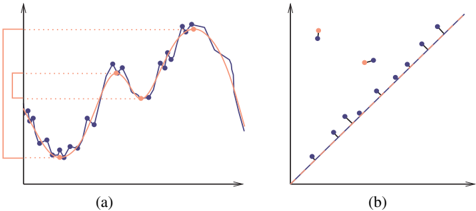
The paper proves that persistence diagrams of real-valued functions on topological spaces are stable: small changes in the function imply small changes in the diagram under the bottleneck distance. It applies this stability to homology estimation from point samples and to comparing/classifying geometric shapes.
Key findings
- The Main Theorem states that for a triangulable space \(X\) with continuous tame functions \(f,g:X\to\mathbb R\), the persistence diagrams satisfy \(d_B(D(f),D(g)) \le \|f-g\|_\infty\).
- The proof first establishes stability for the Hausdorff distance using the Box Lemma, then strengthens it to the bottleneck distance using the Easy Bijection Lemma and an Interpolation Lemma for piecewise linear functions.
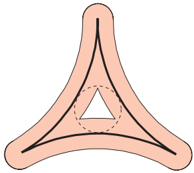
- The Homology Inference Theorem states that for all real \(\varepsilon\) with \(d_H(X,P) < \varepsilon < \mathrm{hfs}_X/4\) and all sufficiently small \(\delta>0\), the dimensions of the homology group of \(X+\delta\) and \(P^\varepsilon_{3\varepsilon}\) are either both infinite or both finite and equal.
- The Barcode Theorem states that if a diffeomorphism \(\Phi:\mathbb R^d\to\mathbb R^d\) has derivatives up to second order close to those of a rigid motion, then the bottleneck distance between the barcodes of a hypersurface \(S\subseteq\mathbb R^d\) and its perturbation \(\Phi(S)\) is small.
Methods
- Theoretical study of real-valued functions on topological spaces, using homology with \(\mathbb Z_2\) coefficients, homological critical values, tame functions, persistent homology groups, and persistence diagrams.
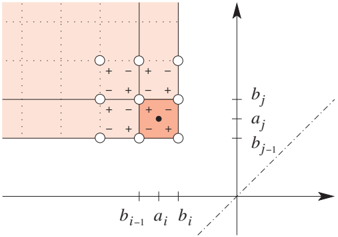
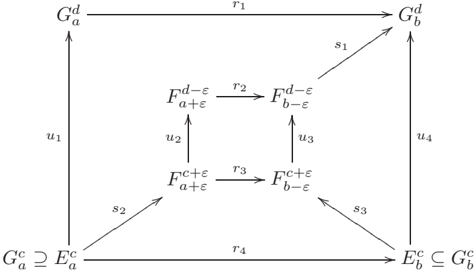
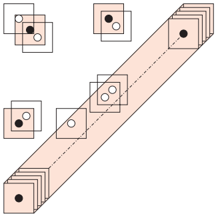
- Stability is proved by algebraic-topological diagram chasing: the Quadrant Lemma and Box Lemma bound multiplicities in nested quadrants/boxes, and the bottleneck case is handled by composing bijections for very close functions and interpolating between piecewise linear functions.
- Applications are derived as corollaries; the paper reports no empirical data, experiments, or numerical evaluations.
Limitations
- The paper explicitly leaves open whether the Main Theorem extends to non-tame functions, whether other metrics on functions and persistence diagrams admit similar inequalities, and how to exploit the result algorithmically.
- Evident from the text: the main theorem assumes a triangulable space and continuous tame functions, and the proof uses compactness, finite simplicial complexes, and finite-dimensional homology groups.
- Evident from the text: the applications are theoretical corollaries, and the Barcode Theorem states only that the bottleneck distance is “small” under \(C^2\)-closeness to a rigid motion, without a quantitative bound.
Model-written summary. Check it against the paper before relying on it.
Integrity signals
Registry
Cites
Statistics
Figures
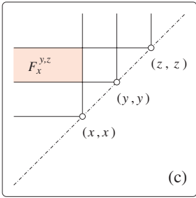
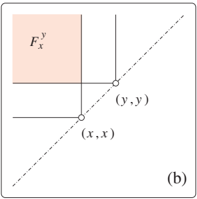
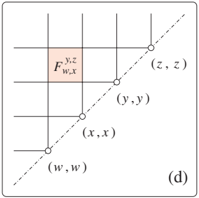
![Fig. 3 (a) Homology group of the sub-level set f -1 ( -∞ , x ]. (b) Image of Fx in Fy . (c) Kernel of surjection F y x → F z x . (d) Quotient of F y , z x and F y , z w .](https://figures.cochat.ai/paper-figures/e3fbb536dd354c4daa1aeec1692fa302/stability-of-persistence-diagrams-figure-3.png)
Verification
Claims the paper makes
1 Valid · 7 Not valid · 19 Not checked · 31 Own results and interpretations
The cited sources support only part of this claim — read each source’s verdict below.
In the paper
“Indeed, the dimensions of the persistent homology groups that appear in the theorem are efficiently computable using the persistence algorithm on the filtration of alpha complexes [11], [12].”
What the sources say
- Not matchedcites [11] 11. H. Edelsbrunner, D. Letscher, and A. Zomorodian. Topological persistence and simplification. Discrete Comput . Geom . 28 (2002), 511-533.
More than one paper fits this citation.
- Partly supportedcites [12] 12. H. Edelsbrunner and E. P. M¨ ucke. Three-dimensional alpha shapes. ACM Trans . Comput . Graphics 13 (1994), 43-72. sourceExperimental — accuracy not yet measured
Section 3.3, “Alpha Complexes” (page unavailable), defines alpha complexes and states that each is a subcomplex of those at larger alpha values, supporting the filtration part. “Features and Signatures” (page unavailable) describes an efficient way to track connected components, but calls higher-order homology signatures more challenging; it does not describe a persistence algorithm or establish efficient computation of the claimed persistent-homology dimensions. (LLM, conf=0.86)
plainstates a cause- Asserted: passes — The authors put it forward as true.
- Checkable: passes — It can be checked against evidence.
- Load-bearing: passes — The paper’s conclusions depend on it.
- Based: passes — The paper gives a reason why it holds.
- Not matched
A result the paper states — it cites no source for it, so there is none to check. The quote shows it is in the paper.
In the paper
“Easy Bijection Lemma. Let f , g : X → R be tame functions and let g be very close to f . Then the persistence diagrams satisfy d B ( D ( f ), D ( g )) ≤ ‖ f -g ‖∞ .”
plainstates an association- Asserted: passes — The authors put it forward as true.
- Checkable: passes — It can be checked against evidence.
- Load-bearing: passes — The paper’s conclusions depend on it.
- Based: passes — The paper gives a reason why it holds.
A result the paper states — it cites no source for it, so there is none to check. The quote shows it is in the paper.
In the paper
“Critical Value Lemma. If some closed interval [ x , y ] contains no homological critical value of f , then f y x is an isomorphism for every integer k .”
plainstates a cause- Asserted: passes — The authors put it forward as true.
- Checkable: passes — It can be checked against evidence.
- Load-bearing: passes — The paper’s conclusions depend on it.
- Based: passes — The paper gives a reason why it holds.
A result the paper states — it cites no source for it, so there is none to check. The quote shows it is in the paper.
In the paper
“Writing ε = ‖ f -g ‖∞ , we have f -1 ( -∞ , x ] ⊆ g -1 ( -∞ , x + ε ] for all x ∈ R .”
plainstates a cause- Asserted: passes — The authors put it forward as true.
- Checkable: passes — It can be checked against evidence.
- Load-bearing: passes — The paper’s conclusions depend on it.
- Based: passes — The paper gives a reason why it holds.
A result the paper states — it cites no source for it, so there is none to check. The quote shows it is in the paper.
In the paper
“Interpolation Lemma.”
- Also stated in: § Interpolation Lemma. · p. 13 · boosted
“However, since the h λ i sample the linear interpolation from ˆ f to ˆ g , the latter sum equals ‖ ˆ f - ˆ g ‖∞ , which concludes the proof.”
boostedstates an association- Asserted: passes — The authors put it forward as true.
- Checkable: passes — It can be checked against evidence.
- Load-bearing: passes — The paper’s conclusions depend on it.
- Based: passes — The paper gives a reason why it holds.
- Also stated in: § Interpolation Lemma. · p. 13 · boosted
21 more claims
Create a free account to see all 58 claims and every source verdict.
- Probably not a substantial claim. 28
- It may state two separate claims as one. 13
Claims other papers make about this one
Each is checked against this paper’s own text: does it say what the citing paper says it does?
The source backs part of the claim, not all of it — or backs it for a different population, condition or comparison.
In the citing paper
“Let X be any space which is homeomorphic to a simplicial complex, and suppose f, g : X → R are continuous tame functions. Then the persistence vector spaces { H k ( f -1 (( -∞ , r ]) } r and { H k ( g -1 (( -∞ , r ]) } r are finitely presented, and therefore admit barcode descriptions for each k ∈ N”
From Topological pattern recognition for point cloud data (2014) · cites this paper as Cohen-Steiner et al. (2007)
Experimental — accuracy not yet measuredThe cited source says what the claim attributes to it.
In the citing paper
“Also, results about barcodes under the general heading have now begun to appear (see [15] and [16]).”
From Topology and data (2009) · cites this paper as [15]
Citations
Cites
Rayward-Smith, V. J. (1991) · Journal of the Operational Research Society · doi:10.1057/jors.1991.155 · Cited by 16,821
Spanier, E. H. (1990) · Cited by 3,014
Three-dimensional alpha shapes
Edelsbrunner, H., & Mücke, E. P. (1994) · ACM Transactions on Graphics · doi:10.1145/174462.156635 · Cited by 2,488
Self-citationElements of Algebraic Topology
Munkres, J. R. (2018) · CRC Press eBooks · doi:10.1201/9780429493911 · Cited by 2,102
Introduction to Algorithms, Second Edition
Rivest, R. L., Leiserson, C. E., Cormen, T. H., & Stein, C. (2001) · Cited by 1,984
Topological Persistence and Simplification
Edelsbrunner, Letscher, & Zomorodian (2002) · Discrete & Computational Geometry · doi:10.1007/s00454-002-2885-2 · Cited by 1,779
Introduction to linear algebra
(2016) · Cybersecurity and Applied Mathematics · doi:10.1016/b978-0-12-804452-0.09998-x · Cited by 1,646
Zomorodian, A., & Carlsson, G. (2005) · Discrete & Computational Geometry · doi:10.1007/s00454-004-1146-y · Cited by 1,591
Milnor, J. (1963) · doi:10.1515/9781400881802 · Cited by 1,390
Morphometric Tools for Landmark Data.
Bookstein, F. (1998) · Biometrics · doi:10.2307/2534038 · Cited by 1,378
Research works printed but not linked: 2
- [16]16. J. Milnor. Morse Theory . Princeton University Press, New Jersey, 1963.
- [19]19. V. Robins. Toward computing homology from finite approximations. Topology Proceedings 24 (1999), 503-532.
Cited by
Items 1,101–1,200 of 1,300
Effects of Correlated Noise on the Performance of Persistence Based Dynamic State Detection Methods
Tempelman, J. R., Myers, A., Scruggs, J. T., et al. (2021) · doi:10.1115/1.0002214v
Attali, D., Edelsbrunner, H., Harer, J., & Mileyko, Y. (2007) · Lecture notes in computer science · doi:10.1007/978-3-540-73951-7 · Cited by 2
Self-citationChung, M. K. (2019) · Cambridge University Press eBooks · doi:10.1017/9781316882610.016
Zhang, J. (2020) · CRM short courses · doi:10.1007/978-3-030-37888-2_2
Report on scipost_202102_00007v1
Spitz, D., Berges, J., Oberthaler, M. K., et al. (2021) · SciPost Physics · doi:10.21468/scipost.report.2838
Report on scipost_202102_00007v1
Spitz, D., Berges, J., Oberthaler, M. K., et al. (2021) · SciPost Physics · doi:10.21468/scipost.report.2534
Persistent Homology Metrics Reveal Quantum Fluctuations and Reactive Atoms in Path Integral DynamicsPreprint
Hu, Y., Ounkham, P., Maršálek, O., et al. (2021) · ChemRxiv · doi:10.26434/chemrxiv.13618922
Structural features of persistent homology and their algorithmic transformations
Pavlichenko, A. (2021) · MOspace Institutional Repository (University of Missouri) · doi:10.32469/10355/90080
Homological Algebra and Its Application: A Descriptive Study
Rana, K. (2022) · Integrated Journal for Research in Arts and Humanities · doi:10.55544/ijrah.2.1.47
Local Versus Global Distances for Zigzag and Multi-Parameter Persistence Modules
Gasparovic, E., Gommel, M., Purvine, E., Sazdanović, R., Wang, B., Wang, Y., & Ziegelmeier, L. (2022) · Association for Women in Mathematics series · doi:10.1007/978-3-030-95519-9_3
Hippocampal and Medial Prefrontal Cortical Maps Represent Episodes and Rules in a Common Task SpacePreprint
Srinivasan, A., Riceberg, J. S., Goodman, M. R., Srinivasan, A., Guise, K. G., & Shapiro, M. L. (2022) · SSRN Electronic Journal · doi:10.1101/2022.07.17.500349
Magnitude, alpha magnitude, and applications.
O'Malley, M. (2022) · doi:10.14418/wes01.3.137
Applications of Topological Data Analysis to Statistical Physics and Quantum Field Theories
Sale, N. (2022) · Cronfa (Swansea University) · doi:10.23889/suthesis.61816
Autoencoder-Aided Visualization of Collections of Morse Complexes
Li, J., Boxel, D. V., & Levine, J. A. (2022) · Topological Data Analysis and Visualization (TopoInVis) · doi:10.1109/topoinvis57755.2022.00009 · Cited by 1
Schenck, H. (2022) · Mathematics of data · doi:10.1007/978-3-031-06664-1_7 · Cited by 1
Topological Regularization for Dense Prediction
Fu, D., & Nelson, B. J. (2022) · International Conference on Machine Learning and Applications · doi:10.1109/icmla55696.2022.00014
Wang, H. H. (2023) · Journal of Physics Conference Series · doi:10.1088/1742-6596/2555/1/012023
Magnitude, alpha magnitude, and applications.
O'Malley, M. (2023) · doi:10.14418/wes01.3.150 · Cited by 1
Persistence on Quotient Spaces with G-invariantCovering for Structural AnalysisPreprint
Chen, Z. (2023) · ChemRxiv · doi:10.26434/chemrxiv-2023-6c3lk-v2
A Topological Distance Between Multi-Fields Based on Multi-Dimensional Persistence Diagrams
Ramamurthi, Y., & Chattopadhyay, A. (2023) · IEEE Transactions on Visualization and Computer Graphics · doi:10.1109/tvcg.2023.3314763
Boissonnat, J., Chazal, F., & Yvinec, M. (2018) · Cambridge University Press eBooks · doi:10.1017/9781108297806.008
Good Triangulations: Augustus and Julius Caesar as Rival Founders of the Principate
Boissonnat, J., Chazal, F., & Yvinec, M. (2018) · Cambridge University Press eBooks · doi:10.1017/9781108297806.006
Boissonnat, J., Chazal, F., & Yvinec, M. (2018) · Cambridge University Press eBooks · doi:10.1017/9781108297806.005
Stability of Distance Functions
Boissonnat, J., Chazal, F., & Yvinec, M. (2018) · Cambridge University Press eBooks · doi:10.1017/9781108297806.010
Boissonnat, J., Chazal, F., & Yvinec, M. (2018) · Cambridge University Press eBooks · doi:10.1017/9781108297806.007
Boissonnat, J., Chazal, F., & Yvinec, M. (2018) · Cambridge University Press eBooks · doi:10.1017/9781108297806.003
Boissonnat, J., Chazal, F., & Yvinec, M. (2018) · Cambridge University Press eBooks · doi:10.1017/9781108297806.012
Boissonnat, J., Chazal, F., & Yvinec, M. (2018) · Cambridge University Press eBooks · doi:10.1017/9781108297806.013
Reconstruction of Submanifolds
Boissonnat, J., Chazal, F., & Yvinec, M. (2018) · Cambridge University Press eBooks · doi:10.1017/9781108297806.009
Boissonnat, J., Chazal, F., & Yvinec, M. (2018) · Cambridge University Press eBooks · doi:10.1017/9781108297806.001
Boissonnat, J., Chazal, F., & Yvinec, M. (2018) · Cambridge University Press eBooks · doi:10.1017/9781108297806.004
Distance to Probability Measures
Boissonnat, J., Chazal, F., & Yvinec, M. (2018) · Cambridge University Press eBooks · doi:10.1017/9781108297806.011
Topological data analysis of human vowels: Persistent homologies across representation spaces
Bonafos, G., Pudlo, P., Freyermuth, J., Tronçon, S., & Rey, A. (2026) · Speech Communication · doi:10.1016/j.specom.2026.103363 · Cited by 1
Unified description over time of heterogeneous condensation with quenched disorder
Urbina, R., & González−Viñas, W. (2023) · Physical review. E · doi:10.1103/physreve.108.065107
Learning Topological Representation of Sensor Network with Persistent Homology in HCI Systems
Yan, Y., Li, C., Xiong, J., & Wang, L. (2023) · IEEE International Conference on Bioinformatics and Biomedicine (BIBM) · doi:10.1109/bibm58861.2023.10385451
Move schedules: fast persistence computations in coarse dynamic settings
Piekenbrock, M., & Perea, J. A. (2024) · Journal of Applied and Computational Topology · doi:10.1007/s41468-023-00156-3 · Cited by 8
Poincaré duality for generalized persistence diagrams of (co)filtrations
Patel, A., & Rask, T. (2024) · Journal of Applied and Computational Topology · doi:10.1007/s41468-023-00159-0
Oda, H., Ng, C. F. S., & Hashizume, M. (2024) · Research Square · doi:10.21203/rs.3.rs-3980735/v1
The Internal Topology of Rocks
Korvin, G. (2024) · Earth and environmental sciences library · doi:10.1007/978-3-031-46700-4_3
Topological Data Analysis Applied to Wind Turbine Vibration Spectra for Blade Icing DetectionPreprint
Gómez, Á. M., Haugaard, T., Torres, O. A. D., et al. (2024) · doi:10.36227/techrxiv.171340655.57182875/v1
Bigraded Betti numbers and generalized persistence diagrams
Kim, W., & Moore, S. (2024) · Journal of Applied and Computational Topology · doi:10.1007/s41468-024-00180-x · Cited by 7
Topological regularization on numerical simulations of the advection equation
Takeda, K., Kaji, S., & Miyoshi, T. (2024) · JSIAM Letters · doi:10.14495/jsiaml.16.53
Comparison of persistent singular and Čech homology for locally connected filtrationsPreprint
Schmahl, M. (2024) · Proceedings of the American Mathematical Society · doi:10.1090/proc/17008
Research on Clothing Image Retrieval Combining Topology Features with Color Texture Features
Zhang, X., Sun, H., & Ma, J. (2024) · Mathematics · doi:10.3390/math12152363
Topological Elastic Graph Convolutional Networks for Spatial-Temporal Sequence Forecasting
Wang, Y., Xu, M., & Tang, L. (2024) · IEEE Transactions on Emerging Topics in Computational Intelligence · doi:10.1109/tetci.2024.3449900 · Cited by 1
Bow echo alarm system using Topological Data Analysis
Canot, H., Durand, P., & Frénod, E. (2025) · Applied Mathematics for Modern Challenges · doi:10.3934/ammc.2025002
The more polypersonal the better -- a short look on space geometry of fine-tuned layers
Kudriashov, S., Zykova, V., Stepanova, A., et al. (2024) · Springer eBooks · doi:10.1007/978-3-031-73691-9_2
Visualizing radiological data bias through persistence images
Singh, Y., Farrelly, C., Hathaway, Q. A., & Carlsson, G. (2024) · Oncotarget · doi:10.18632/oncotarget.28670
Topological Analysis of U.S. City Demographics
Kauba, J. A., & Weighill, T. (2024) · La Matematica · doi:10.1007/s44007-024-00141-x
Measures of string similarities based on the Hamming distance
Nikolić, B., & Šobot, B. (2024) · Publications de l Institut Mathematique · doi:10.2298/pim2430013n
SING: Stability-Incorporated Neighborhood Graph
Marin, D., Parakkat, A. D., Ohrhallinger, S., Wimmer, M. H., Oudot, S., & Memari, P. (2024) · SIGGRAPH Asia Conference Papers · doi:10.1145/3680528.3687674
Tozzi, A. (2025) · bioRxiv (Cold Spring Harbor Laboratory) · doi:10.1101/2025.02.04.636494
Leveraging persistent homology for liver tumour classification
Ali, D., Peoples, J., Mojtahedi, R., et al. (2025) · SPIE Medical Imaging: Computer-Aided Diagnosis · doi:10.1117/12.3045640
An image classification algorithm based on the topological features
Tang, X.-H., & Zhang, W. (2025) · International Conference on Graphics and Image Processing (ICGIP) · doi:10.1117/12.3057843
The More Polypersonal the Better - A Short Look on Space Geometry of Fine-Tuned Layers
Kudriashov, S., Zykova, V., Stepanova, A., et al. (2025) · Studies in computational intelligence · doi:10.1007/978-3-031-80463-2_2
A Quick Trip Through Group-equivariant Non-expansive Operators
Ahmad, F., & Frosini, P. (2025) · Springer proceedings in mathematics & statistics · doi:10.1007/978-981-96-1505-6_30
Classification of Some Cosmological Images Using Deep Learning and Persistent Homology
Sekuloski, P., & Ristovska, V. D. (2025) · Communications in computer and information science · doi:10.1007/978-3-031-86162-8_11
Mestiri, M., Fergombé, A., & Huftier, A. (2025) · Lecture notes on data engineering and communications technologies · doi:10.1007/978-3-031-87763-6_36
Topology-Preserving Scaling in Data Augmentation
Le, V.-A., & Dık, M. (2025) · Maltepe Journal of Mathematics · doi:10.47087/mjm.1615296
Topological Data Analysis for Distinguishing Human Written and AI Generated AbstractsPreprint
Guilinger, A., Best, E., & Awasthi, V. (2025) · Preprints.org · doi:10.20944/preprints202505.0097.v1 · Cited by 1
A Feature Engineering Framework for Computer Vision Based on Topological Data AnalysisPreprint
Abramov, A., Чернышев, В. Л., Mikhaylets, E., et al. (2025) · SSRN Electronic Journal · doi:10.2139/ssrn.5253718
Topological data analysis of coda waves to classify microstructural variability
Sharma, S., Khasawneh, F. A., Wall, J. J., Seuaciuc-Osório, T., & Chakrapani, S. K. (2025) · NDT & E International · doi:10.1016/j.ndteint.2025.103437
Curse of dimensionality on persistence diagrams
Hiraoka, Y., Imoto, Y., Kanazawa, S., & Liu, E. (2025) · Foundations of Data Science · doi:10.3934/fods.2025008 · Cited by 3
Topological Persistent Homology for AI-Powered Retinal Image Classification
Hefny, M. S., & Shalan, A. M. (2025) · International Conference on Artificial Intelligence, Robotics and Control (AIRC) · doi:10.1109/airc64931.2025.11077499
A finitely stable edit distance for merge trees
Pegoraro, M. (2025) · AIMS Mathematics · doi:10.3934/math.2025769 · Cited by 6
Topology-based analysis and optimization for agent fleet behavior
Perera-Lago, J., Toscano-Durán, V., Torras-Casas, Á., & González-Dı́az, R. (2025) · Open Research Europe · doi:10.12688/openreseurope.20760.1 · Cited by 1
Matching Distance via the Extended Pareto Grid
Frosini, P., García, E. M., Quercioli, N., et al. (2025) · SIAM Journal on Applied Algebra and Geometry · doi:10.1137/24m1680398
The fiber of persistent homology for trees
Beers, D., & Leygonie, J. (2025) · Journal of Applied and Computational Topology · doi:10.1007/s41468-025-00213-z · Cited by 6
From Darwin to Teleology: A Categorical Final--Cause Calculus for EvolutionPreprint
Patrascu, A. T. (2025) · SSRN Electronic Journal · doi:10.2139/ssrn.5448115
Gao, T., Neusypin, K. A., Dmitriev, D. D., Yang, B., & Rao, S. K. M. (2025) · Mathematics · doi:10.3390/math13193057 · Cited by 1
Differential calculus for free algebra and constrained homology
Ren, S. (2025) · Communications in Algebra · doi:10.1080/00927872.2025.2563059
Peak Persistence Diagrams for Shape-Based Signal Estimation
Kim, W., Dasgupta, S., Turaga, P. K., et al. (2025) · IEEE Transactions on Signal Processing · doi:10.1109/tsp.2025.3613678
Nested Ensemble Learning with Topological Data Analysis for Graph Classification and Regression
Abaa, I., & Islambekov, U. (2025) · International Journal of Topology · doi:10.3390/ijt2040017
Topology across scales on heterogeneous cell data
Torras-Pérez, M., Yoon, I., Weeratunga, P., Ho, L.-P., Byrne, H., Tillmann, U., & Harrington, H. (2025) · PLoS Comput. Biol. · doi:10.1371/journal.pcbi.1013460 · Cited by 2
Topological Feature Extraction for Interpretable Cancer Tissue Classification
Fadli, I., & Dabounou, J. (2025) · doi:10.3390/engproc2025112043
Malignant Vs Benign Skin Cancer Classification Using Topological Data Analysis and Machine Learning
Oumar, M., Abbas, R., Mohammad, K., et al. (2025) · doi:10.1109/rtsi64020.2025.11212537
The Mid-sphere Cousin of the Medial Axis Transform
Edelsbrunner, H., Stephenson, E., & Thoresen, M. H. (2025) · Lecture notes in computer science · doi:10.1007/978-3-032-09544-2_10
Self-citationPersistent homology of music network with three different distances
Heo, E., Choi, B., Kim, M. O., et al. (2025) · Journal of Mathematics and Music · doi:10.1080/17459737.2025.2568844
Toward a topological data analysis for heavy-ion collisions
Capellino, F., Dubla, A., Masciocchi, S., Nijs, G., & Spitz, D. (2025) · Physical Review C · doi:10.1103/w5pw-prkv
H-VIP: quantifying regional topological contributions of the brain network to cognition
Garai, S., Vo, S., Blank, L., Xu, F., Chen, J., Duong-Tran, D. A., Zhao, Y., Brown, B. C., & Shen, L. (2025) · Frontiers in Radiology · doi:10.3389/fradi.2025.1686780 · Cited by 2
Clustering Problem of Stock Price Time Series Based on Topological Data Analysis
Li, X., & Zhang, H. (2025) · International Conference on Economic Management and Big Data Application (ICEMBDA) · doi:10.1145/3770177.3770248
BondMatcher: H-Bond Stability Analysis in Molecular Systems
Daniel, T., Olejniczak, M., & Tierny, J. (2025) · IEEE Transactions on Visualization and Computer Graphics · doi:10.1109/tvcg.2025.3634636 · Cited by 2
Stability and extension of steady and ranging persistence
Gazull, Y.-S. (2025) · Journal of Applied and Computational Topology · doi:10.1007/s41468-025-00228-6
Klaila, G., Vutov, V., & Stefanou, A. (2024) · Figshare · doi:10.6084/m9.figshare.26603416
Klaila, G., Vutov, V., & Stefanou, A. (2024) · Figshare · doi:10.6084/m9.figshare.26603419
Redundancy analysis using lcm-filtrations: networks, system signature and sensitivity evaluation
Mohammadi, F., Sáenz-de-Cabezón, E., & Wynn, H. (2025) · International Symposium on Symbolic and Algebraic Computation · doi:10.1145/3747199.3747573
Sıngh, R., Nishad, D., Bhardwaj, N., & Khalid, S. (2025) · Chaos Theory and Applications · doi:10.51537/chaos.1705535
Noise-Robust Topology Estimation of 2D Image Data via Neural Networks and Persistent Homology
Peek, D., Skerritt, M. P., & Chalup, S. (2025) · Lecture notes in computer science · doi:10.1007/978-981-95-4969-6_30
Toward structure-preserving quantum encodings
Parzygnat, A. J., Bradley, T.-D., Vlasic, A., & Pham, A. (2025) · Physical Review Research · doi:10.1103/rph8-g15q · Cited by 6
Reproducing kernel Hilbert spaces for virtual persistence diagrams
Fanning, C., & Aktas, M. E. (2026) · Journal of Applied and Computational Topology · doi:10.1007/s41468-026-00253-z
On intrinsic dimension of point clouds by a persistent homology approach: computational tips
Bandiziol, C., Marchi, S. D., & Allegra, M. (2025) · Modern Mathematical Methods · doi:10.64700/mmm.89
Ballester, R., Casacuberta, C., & Escalera, S. (2026) · SpringerBriefs in computer science · doi:10.1007/978-3-032-08283-1_5
Computing a Connection Matrix and Persistence Efficiently from a Morse Decomposition
Dey, T. K., Haas, A., & Lipiński, M. (2026) · SIAM Journal on Applied Dynamical Systems · doi:10.1137/25m1739406
Ballester, R., Casacuberta, C., & Escalera, S. (2026) · SpringerBriefs in computer science · doi:10.1007/978-3-032-08283-1_3
From Darwin to teleonomy: A categorical final-cause calculus for evolution
Patrascu, A. T. (2026) · Biosystems · doi:10.1016/j.biosystems.2025.105687
Topological Deep Learning for Coral Reefs
Aguilar-Ortíz, J., Díaz-Parra, O., Ruíz-Vanoye, J. A., et al. (2026) · IGI Global eBooks · doi:10.4018/979-8-3373-5881-9.ch008
Metadata
- Authors
- Cohen-Steiner, D., Edelsbrunner, H., & Harer, J.
- Affiliations
- Duke University (US)
- Corresponding author
- Edelsbrunner, Herbert
- Harer, John
- Venue
- Discrete & Computational Geometry
- Published
- 2006-12-12
- Volume
- 37
- Issue
- 1
- Pages
- 103-120
- ISSN
- 0179-5376 (ISSN-L)
- 1432-0444
- OpenAlex
- W2037613900
- Cited by
- 1,280
- References
- 30
- Citations by year
- 2026: 102 · 2025: 89 · 2024: 69 · 2023: 97 · 2022: 78 · 2021: 132 · 2020: 109 · 2019: 89 · 2018: 92 · 2017: 50 · 2016: 60 · 2015: 54 · 2014: 58 · 2013: 48 · 2012: 29
- FWCI
- 18.03
- Type
- journal article
- Language
- en
- Open access
- bronze
- doi.org
- Licence
- www.springer.com/tdm (tdm)
- Locations
- Discrete & Computational Geometry (publishedVersion)
- Funders
- National Science Foundation (0086013)
- Defense Advanced Research Projects Agency (HR0011, HR0011-05-1-0007)
- Topics
- Physical Sciences › Computer Science › Computational Theory and Mathematics › Topological and Geometric Data Analysis
- Physical Sciences › Mathematics › Geometry and Topology › Geometric and Algebraic Topology
- Physical Sciences › Mathematics › Applied Mathematics › Geometric Analysis and Curvature Flows
- Keywords
- persistence diagrams, stability, topological data analysis, metric spaces, shape comparison, real functions, simplicial complexes
About these checks
Registry, retraction, Cites and statistics results are computed, not judged, with one exception: a printed reference that no index lists is read once by a model before it counts as a citation error. Claims are extracted by a model and kept only when their quote appears verbatim in the text; each cited source is then checked, with a model’s help, for whether it says what the claim relies on. Those verdicts can be wrong — read the claim’s quote and the cited source before relying on one.
The claim verdicts this report counts are experimental: their accuracy is not yet measured.
A language model drew the claims from the paper on 2026-10-10, under version 3 of the claim definition (model deepseek-v4.1-flash, prompt extract-v3).
A second model labelled each claim on 2026-10-10 (model jev-1.13-20260917, definition revision gold-guideline-v0.2).
Cited sources are checked with a language model’s help (gpt-6-sol).
Statistics and arithmetic are recomputed, not judged.
Confidence bands are shown only for fields calibrated on our annotated test set. None is calibrated yet, so no band is shown.
What counts as a claim ›How we measure confidence ›How we check this ›
Are you an author, or do you see a problem with this page? Request a review
Data sources
Bibliographic data: Semantic Scholar, OpenAlex, Crossref.
Contains information from the Semantic Scholar Academic Graph Datasets, made available under the ODC Attribution License (ODC-BY 1.0).
Semantic Scholar’s data is described in: Kinney, R., et al. (2023). The Semantic Scholar Open Data Platform. arXiv:2301.10140.
