

Stability of Persistence Diagrams
Open accessThe DOI matches its Crossref record; 32 of the 32 references it cites were found in a registry or an index; 1 of the 21 sources its claims cite were checked for support.
Overview
CoChat Summary
TL;DR
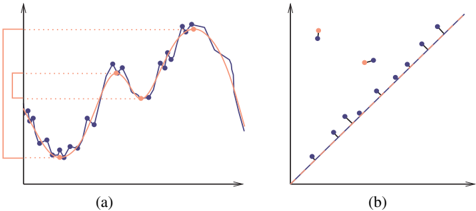
The paper proves that persistence diagrams of real-valued functions on topological spaces are stable: small changes in the function imply small changes in the diagram under the bottleneck distance. It applies this stability to homology estimation from point samples and to comparing/classifying geometric shapes.
Key findings
- The Main Theorem states that for a triangulable space \(X\) with continuous tame functions \(f,g:X\to\mathbb R\), the persistence diagrams satisfy \(d_B(D(f),D(g)) \le \|f-g\|_\infty\).
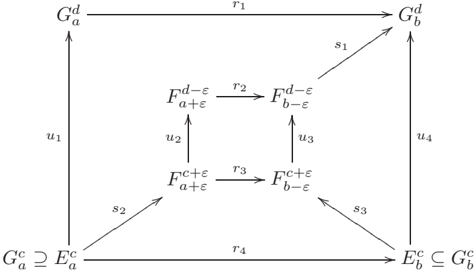
- The proof first establishes stability for the Hausdorff distance using the Box Lemma, then strengthens it to the bottleneck distance using the Easy Bijection Lemma and an Interpolation Lemma for piecewise linear functions.
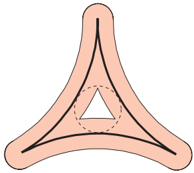
- The Homology Inference Theorem states that for all real \(\varepsilon\) with \(d_H(X,P) < \varepsilon < \mathrm{hfs}_X/4\) and all sufficiently small \(\delta>0\), the dimensions of the homology group of \(X+\delta\) and \(P^\varepsilon_{3\varepsilon}\) are either both infinite or both finite and equal.
- The Barcode Theorem states that if a diffeomorphism \(\Phi:\mathbb R^d\to\mathbb R^d\) has derivatives up to second order close to those of a rigid motion, then the bottleneck distance between the barcodes of a hypersurface \(S\subseteq\mathbb R^d\) and its perturbation \(\Phi(S)\) is small.
Methods
- Theoretical study of real-valued functions on topological spaces, using homology with \(\mathbb Z_2\) coefficients, homological critical values, tame functions, persistent homology groups, and persistence diagrams.
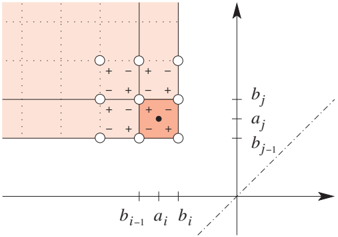
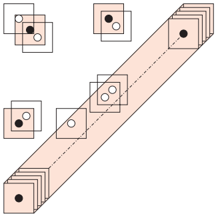
- Stability is proved by algebraic-topological diagram chasing: the Quadrant Lemma and Box Lemma bound multiplicities in nested quadrants/boxes, and the bottleneck case is handled by composing bijections for very close functions and interpolating between piecewise linear functions.
- Applications are derived as corollaries; the paper reports no empirical data, experiments, or numerical evaluations.
Limitations
- The paper explicitly leaves open whether the Main Theorem extends to non-tame functions, whether other metrics on functions and persistence diagrams admit similar inequalities, and how to exploit the result algorithmically.
- Evident from the text: the main theorem assumes a triangulable space and continuous tame functions, and the proof uses compactness, finite simplicial complexes, and finite-dimensional homology groups.
- Evident from the text: the applications are theoretical corollaries, and the Barcode Theorem states only that the bottleneck distance is “small” under \(C^2\)-closeness to a rigid motion, without a quantitative bound.
Model-written summary. Check it against the paper before relying on it.
Integrity signals
Registry
Cites
Statistics
Figures
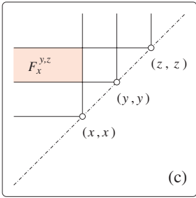
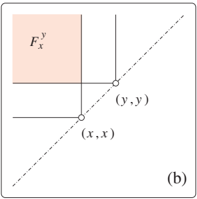
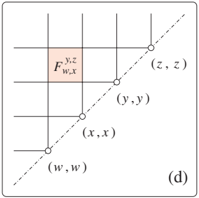
![Fig. 3 (a) Homology group of the sub-level set f -1 ( -∞ , x ]. (b) Image of Fx in Fy . (c) Kernel of surjection F y x → F z x . (d) Quotient of F y , z x and F y , z w .](https://figures.cochat.ai/paper-figures/e3fbb536dd354c4daa1aeec1692fa302/stability-of-persistence-diagrams-figure-3.png)
Verification
Claims the paper makes
1 Valid · 7 Not valid · 19 Not checked · 31 Own results and interpretations
The cited sources support only part of this claim — read each source’s verdict below.
In the paper
“Indeed, the dimensions of the persistent homology groups that appear in the theorem are efficiently computable using the persistence algorithm on the filtration of alpha complexes [11], [12].”
What the sources say
- Not matchedcites [11] 11. H. Edelsbrunner, D. Letscher, and A. Zomorodian. Topological persistence and simplification. Discrete Comput . Geom . 28 (2002), 511-533.
More than one paper fits this citation.
- Partly supportedcites [12] 12. H. Edelsbrunner and E. P. M¨ ucke. Three-dimensional alpha shapes. ACM Trans . Comput . Graphics 13 (1994), 43-72. sourceExperimental — accuracy not yet measured
Section 3.3, “Alpha Complexes” (page unavailable), defines alpha complexes and states that each is a subcomplex of those at larger alpha values, supporting the filtration part. “Features and Signatures” (page unavailable) describes an efficient way to track connected components, but calls higher-order homology signatures more challenging; it does not describe a persistence algorithm or establish efficient computation of the claimed persistent-homology dimensions. (LLM, conf=0.86)
plainstates a cause- Asserted: passes — The authors put it forward as true.
- Checkable: passes — It can be checked against evidence.
- Load-bearing: passes — The paper’s conclusions depend on it.
- Based: passes — The paper gives a reason why it holds.
- Not matched
A result the paper states — it cites no source for it, so there is none to check. The quote shows it is in the paper.
In the paper
“Easy Bijection Lemma. Let f , g : X → R be tame functions and let g be very close to f . Then the persistence diagrams satisfy d B ( D ( f ), D ( g )) ≤ ‖ f -g ‖∞ .”
plainstates an association- Asserted: passes — The authors put it forward as true.
- Checkable: passes — It can be checked against evidence.
- Load-bearing: passes — The paper’s conclusions depend on it.
- Based: passes — The paper gives a reason why it holds.
A result the paper states — it cites no source for it, so there is none to check. The quote shows it is in the paper.
In the paper
“Critical Value Lemma. If some closed interval [ x , y ] contains no homological critical value of f , then f y x is an isomorphism for every integer k .”
plainstates a cause- Asserted: passes — The authors put it forward as true.
- Checkable: passes — It can be checked against evidence.
- Load-bearing: passes — The paper’s conclusions depend on it.
- Based: passes — The paper gives a reason why it holds.
A result the paper states — it cites no source for it, so there is none to check. The quote shows it is in the paper.
In the paper
“Writing ε = ‖ f -g ‖∞ , we have f -1 ( -∞ , x ] ⊆ g -1 ( -∞ , x + ε ] for all x ∈ R .”
plainstates a cause- Asserted: passes — The authors put it forward as true.
- Checkable: passes — It can be checked against evidence.
- Load-bearing: passes — The paper’s conclusions depend on it.
- Based: passes — The paper gives a reason why it holds.
A result the paper states — it cites no source for it, so there is none to check. The quote shows it is in the paper.
In the paper
“Interpolation Lemma.”
- Also stated in: § Interpolation Lemma. · p. 13 · boosted
“However, since the h λ i sample the linear interpolation from ˆ f to ˆ g , the latter sum equals ‖ ˆ f - ˆ g ‖∞ , which concludes the proof.”
boostedstates an association- Asserted: passes — The authors put it forward as true.
- Checkable: passes — It can be checked against evidence.
- Load-bearing: passes — The paper’s conclusions depend on it.
- Based: passes — The paper gives a reason why it holds.
- Also stated in: § Interpolation Lemma. · p. 13 · boosted
21 more claims
Create a free account to see all 58 claims and every source verdict.
- Probably not a substantial claim. 28
- It may state two separate claims as one. 13
Claims other papers make about this one
Each is checked against this paper’s own text: does it say what the citing paper says it does?
The source backs part of the claim, not all of it — or backs it for a different population, condition or comparison.
In the citing paper
“Let X be any space which is homeomorphic to a simplicial complex, and suppose f, g : X → R are continuous tame functions. Then the persistence vector spaces { H k ( f -1 (( -∞ , r ]) } r and { H k ( g -1 (( -∞ , r ]) } r are finitely presented, and therefore admit barcode descriptions for each k ∈ N”
From Topological pattern recognition for point cloud data (2014) · cites this paper as Cohen-Steiner et al. (2007)
Experimental — accuracy not yet measuredThe cited source says what the claim attributes to it.
In the citing paper
“Also, results about barcodes under the general heading have now begun to appear (see [15] and [16]).”
From Topology and data (2009) · cites this paper as [15]
Citations
Cites
Rayward-Smith, V. J. (1991) · Journal of the Operational Research Society · doi:10.1057/jors.1991.155 · Cited by 16,821
Spanier, E. H. (1990) · Cited by 3,014
Three-dimensional alpha shapes
Edelsbrunner, H., & Mücke, E. P. (1994) · ACM Transactions on Graphics · doi:10.1145/174462.156635 · Cited by 2,488
Self-citationElements of Algebraic Topology
Munkres, J. R. (2018) · CRC Press eBooks · doi:10.1201/9780429493911 · Cited by 2,102
Introduction to Algorithms, Second Edition
Rivest, R. L., Leiserson, C. E., Cormen, T. H., & Stein, C. (2001) · Cited by 1,984
Topological Persistence and Simplification
Edelsbrunner, Letscher, & Zomorodian (2002) · Discrete & Computational Geometry · doi:10.1007/s00454-002-2885-2 · Cited by 1,779
Introduction to linear algebra
(2016) · Cybersecurity and Applied Mathematics · doi:10.1016/b978-0-12-804452-0.09998-x · Cited by 1,646
Zomorodian, A., & Carlsson, G. (2005) · Discrete & Computational Geometry · doi:10.1007/s00454-004-1146-y · Cited by 1,591
Milnor, J. (1963) · doi:10.1515/9781400881802 · Cited by 1,390
Morphometric Tools for Landmark Data.
Bookstein, F. (1998) · Biometrics · doi:10.2307/2534038 · Cited by 1,378
Research works printed but not linked: 2
- [16]16. J. Milnor. Morse Theory . Princeton University Press, New Jersey, 1963.
- [19]19. V. Robins. Toward computing homology from finite approximations. Topology Proceedings 24 (1999), 503-532.
Cited by
Items 801–900 of 1,300
Change Point Detection in Financial Market Using Topological Data Analysis
Yao, J. X., Li, J., Wu, J., Yang, M., & Wang, X. (2025) · Systems · doi:10.3390/systems13100875 · Cited by 12
Hermans, R. M., Li, M., Brightly, W. H., Gallaher, T. J., Smagghe, W., Lee, H., Arco, L., Stas, L., Savieri, P., Vrydaghs, L., et al. (2025) · Frontiers in Plant Science · doi:10.3389/fpls.2025.1643447 · Cited by 5
Persistent Homology Classifies Parameter Dependence of Patterns in Turing Systems
Spector, R., Harrington, H. A., & Gaffney, E. A. (2025) · Bulletin of Mathematical Biology · doi:10.1007/s11538-025-01552-9 · Cited by 6
Improved FTIR-based classification for food authentication using a topological ensemble framework
Yu, H.-C., & Chen, Y. (2026) · Current Research in Food Science · doi:10.1016/j.crfs.2026.101441 · Cited by 5
Homological persistence for shape based change detection between Digital Elevation Models
Vallet, B. (2013) · ISPRS annals of the photogrammetry, remote sensing and spatial information sciences · doi:10.5194/isprsannals-ii-3-w2-49-2013 · Cited by 2
WITHDRAWN: Video-based descriptors for object recognition
Lee, T., & Soatto, S. (2012) · Image and Vision Computing · doi:10.1016/j.imavis.2012.08.004 · Cited by 2
A density-based approach to feature detection in persistence diagrams for firn data
Lawson, A., Hoffman, T., Chung, Y., Keegan, K., & Day, S. (2021) · Foundations of Data Science · doi:10.3934/fods.2021012 · Cited by 4
Approximation algorithms for 1-Wasserstein distance between persistence diagrams
Chen, S., & Wang, Y. (2025) · Computational Geometry · doi:10.1016/j.comgeo.2025.102190 · Cited by 10
A gradient sampling algorithm for stratified maps with applications to topological data analysis
Leygonie, J., Carrière, M., Lacombe, T., & Oudot, S. (2023) · Mathematical Programming · doi:10.1007/s10107-023-01931-x · Cited by 14
Distributed Computation of Persistent Homology from Partitioned Big Data
Malott, N. O., Verma, R. R., Singh, R. P., & Wilsey, P. A. (2021) · IEEE International Conference on Cluster Computing (CLUSTER) · doi:10.1109/cluster48925.2021.00050 · Cited by 2
Approximating 1-Wasserstein Distance between Persistence Diagrams by Graph Sparsification
Dey, T. K., & Zhang, S. (2022) · Society for Industrial and Applied Mathematics eBooks · doi:10.1137/1.9781611977042.14 · Cited by 5
Topological data analysis for the energy and stability of endohedral metallofullerenes
Zhao, Y., Wang, Y.-Y., Ding, Y.-H., & Han, H.-J. (2021) · Journal of Mathematical Chemistry · doi:10.1007/s10910-021-01309-4 · Cited by 2
Algar, S. D., Corrêa, D., & Walker, D. M. (2021) · Chaos An Interdisciplinary Journal of Nonlinear Science · doi:10.1063/5.0073247 · Cited by 8
Boissonnat, J., Chazal, F., & Michel, B. (2022) · Mathematics in industry · doi:10.1007/978-3-030-96173-2_9 · Cited by 8
Topological Feature Tracking for Submesoscale Eddies
Voisin, S., Hineman, J. L., Polly, J. B., Koplik, G., Ball, K., Bendich, P. L., D’Addezio, J. M., Jacobs, G. A., & Özgökmen, T. M. (2022) · Geophysical Research Letters · doi:10.1029/2022gl099416 · Cited by 2
Central limit theorem for euclidean minimal spanning acycles
Škraba, P., & Yogeshwaran, D. (2023) · Journal of Topology and Analysis · doi:10.1142/s1793525323500590 · Cited by 2
Characterization of stability of dynamic particle ensemble systems using topological data analysis
Kumar, H. S. (2024) · Chaos An Interdisciplinary Journal of Nonlinear Science · doi:10.1063/5.0177180 · Cited by 2
Nguyen, N., Hou, T., Amico, E., Zheng, J., Huang, H., Kaplan, A. D., Petri, G., Goñi, J., Kaufmann, R., Zhao, Y., et al. (2024) · Lecture notes in computer science · doi:10.1007/978-3-031-72384-1_49 · Cited by 6
A distributed approach for persistent homology computation on a large scale
Ceccaroni, R., Rocco, L. D., Petrillo, U. F., et al. (2024) · The Journal of Supercomputing · doi:10.1007/s11227-024-06374-5 · Cited by 2
Persistence landscapes: Charting a path to unbiased radiological interpretation
Singh, Y., Farrelly, C., Hathaway, Q. A., & Carlsson, G. (2024) · Oncotarget · doi:10.18632/oncotarget.28671 · Cited by 2
Topological data analysis of the deconfinement transition in SU(3) lattice gauge theory
Spitz, D., Urban, J. M., & Pawlowski, J. M. (2025) · Physical review. D/Physical review. D. · doi:10.1103/k2xs-4y67 · Cited by 2
Tight quasi-universality of Reeb graph distances
Bauer, U., Bjerkevik, H. B., & Fluhr, B. (2025) · Journal of Applied and Computational Topology · doi:10.1007/s41468-025-00203-1 · Cited by 2
The connectivity of Vietoris–Rips complexes of spheres
Adams, H., Bush, J., & Virk, Ž. (2025) · Journal of Applied and Computational Topology · doi:10.1007/s41468-025-00214-y · Cited by 6
Modeling by topological data analysis and game theory for analyzing data poisoning phenomena
Феррара, М. (2025) · AIMS Mathematics · doi:10.3934/math.2025693 · Cited by 2
Bhattacharya, D., Sinha, N., Yashwanth, R., & Chattopadhyay, A. (2025) · Scientific Reports · doi:10.1038/s41598-025-20635-0 · Cited by 10
Tracking a Generator by Persistence
Busaryev, O., Dey, T. K., & Wang, Y. (2010) · Lecture notes in computer science · doi:10.1007/978-3-642-14031-0_31 · Cited by 2
Interpolation, the Rudimentary Geometry of Spaces of Lipschitz Functions, and Geometric Complexity
Weinberger, S. (2019) · Foundations of Computational Mathematics · doi:10.1007/s10208-019-09416-0 · Cited by 2
Persistent Homology as Stopping-Criterion for Voronoi Interpolation
Melodia, L., & Lenz, R. (2019) · International Workshop on Computational Intelligence and Applications · doi:10.1007/978-3-030-51002-2_3 · Cited by 6
Discrete-to-Continuous Extensions: Lovász Extension and Morse Theory
Jost, J., & Zhang, D. (2023) · Discrete & Computational Geometry · doi:10.1007/s00454-022-00461-1 · Cited by 2
Stability of Reeb Graphs under function perturbations: the case of closed curves
Fabio, B. D., & Landi, C. (2010) · AMS Acta (University of Bologna) · doi:10.6092/unibo/amsacta/2759 · Cited by 2
Optimal Reconstruction Might be Hard
Attali, D., & Lieutier, A. (2010) · Discrete & Computational Geometry · doi:10.1145/1810959.1811014 · Cited by 6
Relative interleavings and applications to sensor networks
Hiraoka, Y., & Kusano, G. (2016) · Japan Journal of Industrial and Applied Mathematics · doi:10.1007/s13160-016-0208-x · Cited by 2
Discrete Morse Theory for Computing Zigzag Persistence
Maria, C., & Schreiber, H. (2023) · Discrete & Computational Geometry · doi:10.1007/s00454-023-00594-x · Cited by 4
Another look at recovering local homology from samples of stratified sets
Mileyko, Y. (2020) · Journal of Applied and Computational Topology · doi:10.1007/s41468-020-00062-y · Cited by 2
Topology-Preserving Terrain Simplification
Fugacci, U., Kerber, M., & Manet, H. (2020) · ACM SIGSPATIAL International Conference on Advances in Geographic Information Systems (SIGSPATIAL GIS) · doi:10.1145/3397536.3422237 · Cited by 2
Algebraic stability theorem for derived categories of zigzag persistence modules
Hiraoka, Y., Ike, Y., & Yoshiwaki, M. (2022) · Journal of Topology and Analysis · doi:10.1142/s1793525322500091 · Cited by 2
Multiview topological data analysis for crowdsourced service supply-demand gap prediction
Said, A. B., & Erradi, A. (2020) · International Wireless Communications and Mobile Computing Conference (IWCMC) · doi:10.1109/iwcmc48107.2020.9148097 · Cited by 2
Disordered Complex Networks: Energy Optimal Lattices and Persistent Homology
Ghosh, S., Miyoshi, N., & Shirai, T. (2022) · IEEE Transactions on Information Theory · doi:10.1109/tit.2022.3163604 · Cited by 7
Intrinsic persistent homology via density-based metric learningPreprint
Borghini, E., Fernández, X., Groisman, P., & Mindlin, B. G. (2020) · arXiv (Cornell University) · Cited by 2
Combining Geometric and Topological Information for Boundary Estimation
Luo, H., & Strait, J. (2021) · IEEE International Conference on Big Data (BigData) · doi:10.1109/bigdata52589.2021.9672024 · Cited by 2
Coarse-refinement dilemma: On generalization bounds for data clustering
Vaz, Y., de Mello, R. F., & Grossi, C. H. (2021) · Expert Systems with Applications · doi:10.1016/j.eswa.2021.115399 · Cited by 2
Denoising with discrete Morse theory
Mukherjee, S. (2021) · The Visual Computer · doi:10.1007/s00371-021-02255-7 · Cited by 5
$$A_\infty $$ Persistent Homology Estimates Detailed Topology from Pointcloud Datasets
Guillamon, F. B., & Stefanou, A. (2021) · Discrete & Computational Geometry · doi:10.1007/s00454-021-00319-y · Cited by 10
Computational Topology and its Applications in Geometric Design
Lin, H., Dong, Z., & Chen, J. (2021) · Recent Patents on Engineering · doi:10.2174/1872212115666210901124742 · Cited by 2
Functional Data Representation with Merge Trees
Pegoraro, M., & Secchi, P. (2026) · Journal of Computational and Graphical Statistics · doi:10.1080/10618600.2026.2654769 · Cited by 10
Natural Hydrocarbon Samples Classification by Topological Analysis Method
Fedotov, A., Grishin, P. A., Ivonin, D., et al. (2021) · Applied Sciences · doi:10.3390/app12010050 · Cited by 2
People search via deep compressed sensing techniques
Lu, B.-X., Tsai, Y.-C., & Tseng, K.-S. (2022) · Robotica · doi:10.1017/s0263574721001661 · Cited by 2
Extremal event graphs: A (stable) tool for analyzing noisy time series data
Belton, R., Cummins, B., Gedeon, T., & Fasy, B. T. (2022) · Foundations of Data Science · doi:10.3934/fods.2022019 · Cited by 4
Research Papers in Statistical Inference for Time Series and Related Models
Liu, Y., Hirukawa, J., & Kakizawa, Y. (2023) · Springer eBooks · doi:10.1007/978-981-99-0803-5 · Cited by 2
Topological Data Analysis for Directed Dependence Networks of Multivariate Time Series Data
Yaagoubi, A. E., & Ombao, H. (2023) · Springer eBooks · doi:10.1007/978-981-99-0803-5_17 · Cited by 3
Geometric characterization of the persistence of 1D maps
Biswas, R., di Montesano, S. C., Edelsbrunner, H., et al. (2023) · Journal of Applied and Computational Topology · doi:10.1007/s41468-023-00126-9 · Cited by 2
Self-citationTopological and metric properties of spaces of generalized persistence diagrams
Bubenik, P., & Hartsock, I. (2024) · Journal of Applied and Computational Topology · doi:10.1007/s41468-023-00157-2 · Cited by 2
Automated Earthwork Detection Using Topological Persistence
Lapides, D. A., Grindstaff, G., & Nichols, M. H. (2024) · Water Resources Research · doi:10.1029/2023wr035990 · Cited by 3
A Class of Topological Pseudodistances for Fast Comparison of Persistence Diagrams
Kindelan, R., Petrache, M., Cerda, M., & Hitschfeld, N. (2024) · Proceedings of the AAAI Conference on Artificial Intelligence · doi:10.1609/aaai.v38i12.29220 · Cited by 2
Tracking the Evolution of Rainfall Precipitation Fields Using Persistent Maxima
Biasotti, S., Cerri, A., Pittaluga, S., Sobrero, D., & Spagnuolo, M. (2016) · Eurographics · doi:10.2312/stag.20161361 · Cited by 2
Inferring Underlying Manifold of Data by the Use of Persistent Homology Analysis
Futagami, R., Yamada, N., & Shibuya, T. (2018) · Lecture notes in computer science · doi:10.1007/978-3-030-10828-1_4 · Cited by 2
Approximating lower-star persistence via 2D combinatorial map simplification
Damiand, G., Paluzo-Hidalgo, E., Slechta, R., et al. (2020) · Pattern Recognition Letters · doi:10.1016/j.patrec.2020.01.018 · Cited by 2
Blevins, A. S., & Bassett, D. S. (2021) · Springer eBooks · doi:10.1007/978-3-319-57072-3_87 · Cited by 3
Necessary conditions for discontinuities of multidimensional size functions
Cerri, A., & Frosini, P. (2009) · AMS Acta (University of Bologna) · doi:10.6092/unibo/amsacta/2625 · Cited by 2
Clique topology of real symmetric matricesPreprint
Curto, C., Giusti, C., & Itskov, V. (2015) · arXiv (Cornell University) · doi:10.48550/arxiv.1502.06173 · Cited by 2
Application of Persistent Homology in Signal and Image Denoising
Zheng, Y. (2015) · eDiss (Georg-August-Universität Göttingen) · doi:10.53846/goediss-5200 · Cited by 5
Varilets: Additive Decomposition, Topological Total Variation, and Filtering of Scalar FieldsPreprint
Brooks, M. (2015) · arXiv (Cornell University) · doi:10.48550/arxiv.1503.04867 · Cited by 2
Semicontinuity of Persistence DiagramsPreprint
Patel, A. (2016) · arXiv (Cornell University) · Cited by 2
Bauer, U., Munk, A., Sieling, H., & Wardetzky, M. (2014) · arXiv (Cornell University) · Cited by 2
Interleaving Distance as a LimitPreprint
Meehan, K., & Meyer, D. (2017) · arXiv (Cornell University) · doi:10.48550/arxiv.1710.11489 · Cited by 3
Evolutionary homology on coupled dynamical systemsPreprint
Cang, Z., Munch, E., & Wei, G. (2018) · arXiv (Cornell University) · doi:10.48550/arxiv.1802.04677 · Cited by 1
Generalized persistence analysis based on stable rank invariantPreprint
Riihimäki, H., & Chachólski, W. (2018) · arXiv (Cornell University) · doi:10.48550/arxiv.1807.01217 · Cited by 2
Persistence modules, symplectic Banach-Mazur distance and Riemannian metricsPreprint
Stojisavljević, V., & Zhang, J. (2018) · arXiv (Cornell University) · doi:10.48550/arxiv.1810.11151 · Cited by 2
Metric Limits in Categories with a FlowPreprint
Cruz, J. (2019) · arXiv (Cornell University) · doi:10.48550/arxiv.1901.04828 · Cited by 10
$A_\infty$ persistent homology estimates the topology from pointcloud datasetsPreprint
Belchí, F., & Stefanou, A. (2019) · arXiv (Cornell University) · doi:10.48550/arxiv.1902.09138 · Cited by 2
Multiplicative persistent distancesPreprint
GINOT, G., & Leray, J. (2019) · arXiv (Cornell University) · doi:10.48550/arxiv.1905.12307 · Cited by 2
Quantifying Transversality by Measuring the Robustness of IntersectionsPreprint
Edelsbrunner, H., Morozov, D., & Patel, A. (2009) · arXiv (Cornell University) · doi:10.48550/arxiv.0911.2142 · Cited by 2
Self-citationMultivariate Topology SimplificationPreprint
Chattopadhyay, A., Carr, H. A., Duke, D. J., et al. (2015) · arXiv (Cornell University) · doi:10.48550/arxiv.1509.04465 · Cited by 2
Topological Data Analysis and CosheavesPreprint
Curry, J. M. (2014) · arXiv (Cornell University) · doi:10.48550/arxiv.1411.0613 · Cited by 2
Persistence Modules on Commutative Ladders of Finite TypePreprint
Escolar, E. G., & Hiraoka, Y. (2014) · arXiv (Cornell University) · doi:10.48550/arxiv.1404.7588 · Cited by 2
Linear-Size Approximations to the Vietoris-Rips FiltrationPreprint
Sheehy, D. R. (2012) · arXiv (Cornell University) · doi:10.48550/arxiv.1203.6786 · Cited by 2
The coherent matching distance in 2D persistent homologyPreprint
Cerri, A., Ethier, M., & Frosini, P. (2016) · arXiv (Cornell University) · doi:10.48550/arxiv.1603.03886 · Cited by 2
Persistent homology analysis of brain artery treesPreprint
Bendich, P. L., Marron, J. S., Miller, E., Pieloch, A., & Skwerer, S. (2014) · arXiv (Cornell University) · doi:10.48550/arxiv.1411.6652 · Cited by 9
Topological Data Analysis of Single-cell Hi-C Contact MapsPreprint
Carrière, M., & Rabadán, R. (2018) · bioRxiv (Cold Spring Harbor Laboratory) · doi:10.1101/486936 · Cited by 5
A Persistent Homology Approach to Time Series ClassificationPreprint
Chung, Y.-M., Cruse, W., & Lawson, A. (2020) · arXiv (Cornell University) · doi:10.48550/arxiv.2003.06462 · Cited by 2
Zigzag PersistencePreprint
Carlsson, G., & de Silva, V. (2008) · arXiv (Cornell University) · Cited by 2
Algebraic TopologyPreprint
Robins, V. (2013) · arXiv (Cornell University) · Cited by 2
Universality of the Bottleneck Distance for Extended Persistence Diagrams.Preprint
Bauer, U., Botnan, M. B., & Fluhr, B. (2020) · arXiv (Cornell University) · Cited by 2
Learning Hyperbolic Representations of Topological FeaturesPreprint
Kyriakis, P., Fostiropoulos, I., & Bogdan, P. (2021) · arXiv (Cornell University) · doi:10.48550/arxiv.2103.09273 · Cited by 7
Reviews: Topological Distances and Losses for Brain NetworksPreprint
Chung, M. K., Smith, A. D. S., & Shiu, G. (2021) · arXiv (Cornell University) · doi:10.48550/arxiv.2102.08623 · Cited by 8
Topological Detection of Trojaned Neural NetworksPreprint
Zheng, S., Zhang, Y., Wagner, H., Goswami, M., & Chen, C. (2021) · arXiv (Cornell University) · doi:10.48550/arxiv.2106.06469 · Cited by 31
Persistent Cup-LengthPreprint
Contessoto, M., Mémoli, F., Stefanou, A., & Zhou, L. (2021) · arXiv (Cornell University) · doi:10.26092/elib/4278 · Cited by 2
Rectangular Approximation and Stability of $2$-parameter Persistence ModulesPreprint
Dey, T. K., & Xin, C. (2021) · arXiv (Cornell University) · doi:10.48550/arxiv.2108.07429 · Cited by 2
Data Analysis Approaches for the Risk-Informed Safety Margins Characterization Toolkit
Mandelli, D., USDOE Office of Nuclear Energy (NE), Alfonsi, A., et al. (2016) · doi:10.2172/1364493 · Cited by 2
Persistent Homology as Stopping-Criterion for Voronoi InterpolationPreprint
Melodia, L. (2020) · doi:10.31219/osf.io/ad3qf · Cited by 2
Yoon, I. H. R., Jenkins, R. P., Colliver, E., Zhang, H., Novo, D., Moore, D. A., Ramsden, Z., Rullan, A., Fu, X., Yuan, Y., et al. (2024) · bioRxiv (Cold Spring Harbor Laboratory) · doi:10.1101/2024.01.05.574362 · Cited by 6
Ciocanel, M.-V., Juenemann, R., Dawes, A. T., & McKinley, S. A. (2021) · Bulletin of Mathematical Biology · doi:10.1007/s11538-020-00847-3 · Cited by 13
Persistent Intersection Homology for the Analysis of Discrete Data
Rieck, B., Banagl, M., Sadlo, F., & Leitte, H. (2020) · Mathematics and visualization · doi:10.1007/978-3-030-43036-8_3 · Cited by 3
Lee, D., Bresten, C., Youm, K., Seo, K., & Jung, J.-H. (2020) · International Journal of Modern Physics C · doi:10.1142/s012918312050117x · Cited by 1
Harmonic Persistent Homology (extended abstract)
Basu, S., & Cox, N. (2022) · Annual Symposium on Foundations of Computer Science · doi:10.1109/focs52979.2021.00110 · Cited by 1
Stability for Inference with Persistent Homology Rank Functions
Wang, Q., García‐Redondo, I., Faugère, P., Henselman‐Petrusek, G., & Monod, A. (2024) · Computer Graphics Forum · doi:10.1111/cgf.15142 · Cited by 2
Mari, C., & Baldassari, C. (2024) · Neural Computing and Applications · doi:10.1007/s00521-024-10202-5 · Cited by 1
On the Reach of Isometric Embeddings into Wasserstein Type Spaces
Casado, J., Cuerno, M., & Santos-Rodríguez, J. (2024) · Journal of Geometric Analysis · doi:10.1007/s12220-024-01821-4 · Cited by 1
Who is WithMe? EEG features for attention in a visual task, with auditory and rhythmic support
Turkeš, R., Mortier, S., Winne, J. D., Botteldooren, D. B., Devos, P., Latré, S., & Verdonck, T. (2025) · Frontiers in Neuroscience · doi:10.3389/fnins.2024.1434444 · Cited by 4
Automatic classification of magnetic field line topology by persistent homology
Bohlsen, N., Robins, V., & Hole, M. (2025) · Physica D Nonlinear Phenomena · doi:10.1016/j.physd.2025.134595 · Cited by 1
Metadata
- Authors
- Cohen-Steiner, D., Edelsbrunner, H., & Harer, J.
- Affiliations
- Duke University (US)
- Corresponding author
- Edelsbrunner, Herbert
- Harer, John
- Venue
- Discrete & Computational Geometry
- Published
- 2006-12-12
- Volume
- 37
- Issue
- 1
- Pages
- 103-120
- ISSN
- 0179-5376 (ISSN-L)
- 1432-0444
- OpenAlex
- W2037613900
- Cited by
- 1,280
- References
- 30
- Citations by year
- 2026: 102 · 2025: 89 · 2024: 69 · 2023: 97 · 2022: 78 · 2021: 132 · 2020: 109 · 2019: 89 · 2018: 92 · 2017: 50 · 2016: 60 · 2015: 54 · 2014: 58 · 2013: 48 · 2012: 29
- FWCI
- 18.03
- Type
- journal article
- Language
- en
- Open access
- bronze
- doi.org
- Licence
- www.springer.com/tdm (tdm)
- Locations
- Discrete & Computational Geometry (publishedVersion)
- Funders
- National Science Foundation (0086013)
- Defense Advanced Research Projects Agency (HR0011, HR0011-05-1-0007)
- Topics
- Physical Sciences › Computer Science › Computational Theory and Mathematics › Topological and Geometric Data Analysis
- Physical Sciences › Mathematics › Geometry and Topology › Geometric and Algebraic Topology
- Physical Sciences › Mathematics › Applied Mathematics › Geometric Analysis and Curvature Flows
- Keywords
- persistence diagrams, stability, topological data analysis, metric spaces, shape comparison, real functions, simplicial complexes
About these checks
Registry, retraction, Cites and statistics results are computed, not judged, with one exception: a printed reference that no index lists is read once by a model before it counts as a citation error. Claims are extracted by a model and kept only when their quote appears verbatim in the text; each cited source is then checked, with a model’s help, for whether it says what the claim relies on. Those verdicts can be wrong — read the claim’s quote and the cited source before relying on one.
The claim verdicts this report counts are experimental: their accuracy is not yet measured.
A language model drew the claims from the paper on 2026-10-10, under version 3 of the claim definition (model deepseek-v4.1-flash, prompt extract-v3).
A second model labelled each claim on 2026-10-10 (model jev-1.13-20260917, definition revision gold-guideline-v0.2).
Cited sources are checked with a language model’s help (gpt-6-sol).
Statistics and arithmetic are recomputed, not judged.
Confidence bands are shown only for fields calibrated on our annotated test set. None is calibrated yet, so no band is shown.
What counts as a claim ›How we measure confidence ›How we check this ›
Are you an author, or do you see a problem with this page? Request a review
Data sources
Bibliographic data: Semantic Scholar, OpenAlex, Crossref.
Contains information from the Semantic Scholar Academic Graph Datasets, made available under the ODC Attribution License (ODC-BY 1.0).
Semantic Scholar’s data is described in: Kinney, R., et al. (2023). The Semantic Scholar Open Data Platform. arXiv:2301.10140.
