

Stability of Persistence Diagrams
Open accessThe DOI matches its Crossref record; 32 of the 32 references it cites were found in a registry or an index; 1 of the 21 sources its claims cite were checked for support.
Overview
CoChat Summary
TL;DR
The paper proves that persistence diagrams of real-valued functions on topological spaces are stable: small changes in the function imply small changes in the diagram under the bottleneck distance. It applies this stability to homology estimation from point samples and to comparing/classifying geometric shapes.
Key findings
- The Main Theorem states that for a triangulable space \(X\) with continuous tame functions \(f,g:X\to\mathbb R\), the persistence diagrams satisfy \(d_B(D(f),D(g)) \le \|f-g\|_\infty\).
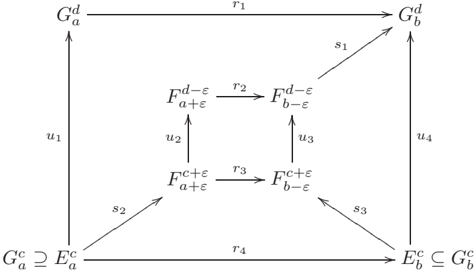
- The proof first establishes stability for the Hausdorff distance using the Box Lemma, then strengthens it to the bottleneck distance using the Easy Bijection Lemma and an Interpolation Lemma for piecewise linear functions.
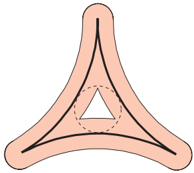
- The Homology Inference Theorem states that for all real \(\varepsilon\) with \(d_H(X,P) < \varepsilon < \mathrm{hfs}_X/4\) and all sufficiently small \(\delta>0\), the dimensions of the homology group of \(X+\delta\) and \(P^\varepsilon_{3\varepsilon}\) are either both infinite or both finite and equal.
- The Barcode Theorem states that if a diffeomorphism \(\Phi:\mathbb R^d\to\mathbb R^d\) has derivatives up to second order close to those of a rigid motion, then the bottleneck distance between the barcodes of a hypersurface \(S\subseteq\mathbb R^d\) and its perturbation \(\Phi(S)\) is small.
Methods
- Theoretical study of real-valued functions on topological spaces, using homology with \(\mathbb Z_2\) coefficients, homological critical values, tame functions, persistent homology groups, and persistence diagrams.
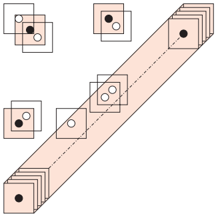
- Stability is proved by algebraic-topological diagram chasing: the Quadrant Lemma and Box Lemma bound multiplicities in nested quadrants/boxes, and the bottleneck case is handled by composing bijections for very close functions and interpolating between piecewise linear functions.
- Applications are derived as corollaries; the paper reports no empirical data, experiments, or numerical evaluations.
Limitations
- The paper explicitly leaves open whether the Main Theorem extends to non-tame functions, whether other metrics on functions and persistence diagrams admit similar inequalities, and how to exploit the result algorithmically.
- Evident from the text: the main theorem assumes a triangulable space and continuous tame functions, and the proof uses compactness, finite simplicial complexes, and finite-dimensional homology groups.
- Evident from the text: the applications are theoretical corollaries, and the Barcode Theorem states only that the bottleneck distance is “small” under \(C^2\)-closeness to a rigid motion, without a quantitative bound.
Model-written summary. Check it against the paper before relying on it.
Integrity signals
Registry
Cites
Statistics
Figures
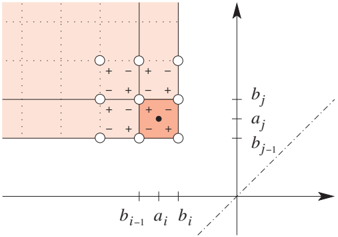
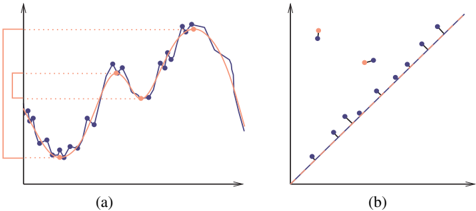
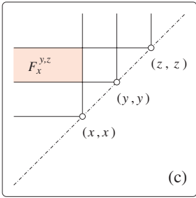
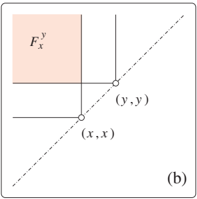
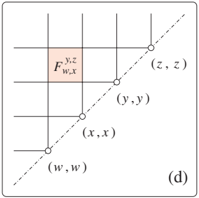
![Fig. 3 (a) Homology group of the sub-level set f -1 ( -∞ , x ]. (b) Image of Fx in Fy . (c) Kernel of surjection F y x → F z x . (d) Quotient of F y , z x and F y , z w .](https://figures.cochat.ai/paper-figures/e3fbb536dd354c4daa1aeec1692fa302/stability-of-persistence-diagrams-figure-3.png)
Verification
Claims the paper makes
1 Valid · 7 Not valid · 19 Not checked · 31 Own results and interpretations
The cited sources support only part of this claim — read each source’s verdict below.
In the paper
“Indeed, the dimensions of the persistent homology groups that appear in the theorem are efficiently computable using the persistence algorithm on the filtration of alpha complexes [11], [12].”
What the sources say
- Not matchedcites [11] 11. H. Edelsbrunner, D. Letscher, and A. Zomorodian. Topological persistence and simplification. Discrete Comput . Geom . 28 (2002), 511-533.
More than one paper fits this citation.
- Partly supportedcites [12] 12. H. Edelsbrunner and E. P. M¨ ucke. Three-dimensional alpha shapes. ACM Trans . Comput . Graphics 13 (1994), 43-72. sourceExperimental — accuracy not yet measured
Section 3.3, “Alpha Complexes” (page unavailable), defines alpha complexes and states that each is a subcomplex of those at larger alpha values, supporting the filtration part. “Features and Signatures” (page unavailable) describes an efficient way to track connected components, but calls higher-order homology signatures more challenging; it does not describe a persistence algorithm or establish efficient computation of the claimed persistent-homology dimensions. (LLM, conf=0.86)
plainstates a cause- Asserted: passes — The authors put it forward as true.
- Checkable: passes — It can be checked against evidence.
- Load-bearing: passes — The paper’s conclusions depend on it.
- Based: passes — The paper gives a reason why it holds.
- Not matched
A result the paper states — it cites no source for it, so there is none to check. The quote shows it is in the paper.
In the paper
“Easy Bijection Lemma. Let f , g : X → R be tame functions and let g be very close to f . Then the persistence diagrams satisfy d B ( D ( f ), D ( g )) ≤ ‖ f -g ‖∞ .”
plainstates an association- Asserted: passes — The authors put it forward as true.
- Checkable: passes — It can be checked against evidence.
- Load-bearing: passes — The paper’s conclusions depend on it.
- Based: passes — The paper gives a reason why it holds.
A result the paper states — it cites no source for it, so there is none to check. The quote shows it is in the paper.
In the paper
“Critical Value Lemma. If some closed interval [ x , y ] contains no homological critical value of f , then f y x is an isomorphism for every integer k .”
plainstates a cause- Asserted: passes — The authors put it forward as true.
- Checkable: passes — It can be checked against evidence.
- Load-bearing: passes — The paper’s conclusions depend on it.
- Based: passes — The paper gives a reason why it holds.
A result the paper states — it cites no source for it, so there is none to check. The quote shows it is in the paper.
In the paper
“Writing ε = ‖ f -g ‖∞ , we have f -1 ( -∞ , x ] ⊆ g -1 ( -∞ , x + ε ] for all x ∈ R .”
plainstates a cause- Asserted: passes — The authors put it forward as true.
- Checkable: passes — It can be checked against evidence.
- Load-bearing: passes — The paper’s conclusions depend on it.
- Based: passes — The paper gives a reason why it holds.
A result the paper states — it cites no source for it, so there is none to check. The quote shows it is in the paper.
In the paper
“Interpolation Lemma.”
- Also stated in: § Interpolation Lemma. · p. 13 · boosted
“However, since the h λ i sample the linear interpolation from ˆ f to ˆ g , the latter sum equals ‖ ˆ f - ˆ g ‖∞ , which concludes the proof.”
boostedstates an association- Asserted: passes — The authors put it forward as true.
- Checkable: passes — It can be checked against evidence.
- Load-bearing: passes — The paper’s conclusions depend on it.
- Based: passes — The paper gives a reason why it holds.
- Also stated in: § Interpolation Lemma. · p. 13 · boosted
21 more claims
Create a free account to see all 58 claims and every source verdict.
- Probably not a substantial claim. 28
- It may state two separate claims as one. 13
Claims other papers make about this one
Each is checked against this paper’s own text: does it say what the citing paper says it does?
The source backs part of the claim, not all of it — or backs it for a different population, condition or comparison.
In the citing paper
“Let X be any space which is homeomorphic to a simplicial complex, and suppose f, g : X → R are continuous tame functions. Then the persistence vector spaces { H k ( f -1 (( -∞ , r ]) } r and { H k ( g -1 (( -∞ , r ]) } r are finitely presented, and therefore admit barcode descriptions for each k ∈ N”
From Topological pattern recognition for point cloud data (2014) · cites this paper as Cohen-Steiner et al. (2007)
Experimental — accuracy not yet measuredThe cited source says what the claim attributes to it.
In the citing paper
“Also, results about barcodes under the general heading have now begun to appear (see [15] and [16]).”
From Topology and data (2009) · cites this paper as [15]
Citations
Cites
Rayward-Smith, V. J. (1991) · Journal of the Operational Research Society · doi:10.1057/jors.1991.155 · Cited by 16,821
Spanier, E. H. (1990) · Cited by 3,014
Three-dimensional alpha shapes
Edelsbrunner, H., & Mücke, E. P. (1994) · ACM Transactions on Graphics · doi:10.1145/174462.156635 · Cited by 2,488
Self-citationElements of Algebraic Topology
Munkres, J. R. (2018) · CRC Press eBooks · doi:10.1201/9780429493911 · Cited by 2,102
Introduction to Algorithms, Second Edition
Rivest, R. L., Leiserson, C. E., Cormen, T. H., & Stein, C. (2001) · Cited by 1,984
Topological Persistence and Simplification
Edelsbrunner, Letscher, & Zomorodian (2002) · Discrete & Computational Geometry · doi:10.1007/s00454-002-2885-2 · Cited by 1,779
Introduction to linear algebra
(2016) · Cybersecurity and Applied Mathematics · doi:10.1016/b978-0-12-804452-0.09998-x · Cited by 1,646
Zomorodian, A., & Carlsson, G. (2005) · Discrete & Computational Geometry · doi:10.1007/s00454-004-1146-y · Cited by 1,591
Milnor, J. (1963) · doi:10.1515/9781400881802 · Cited by 1,390
Morphometric Tools for Landmark Data.
Bookstein, F. (1998) · Biometrics · doi:10.2307/2534038 · Cited by 1,378
Research works printed but not linked: 2
- [16]16. J. Milnor. Morse Theory . Princeton University Press, New Jersey, 1963.
- [19]19. V. Robins. Toward computing homology from finite approximations. Topology Proceedings 24 (1999), 503-532.
Cited by
Carlsson, G. (2009) · Bulletin of the American Mathematical Society · doi:10.1090/s0273-0979-09-01249-x · Cited by 2,302
Barcodes: the persistent topology of data
Ghrist, R. (2007) · Bulletin of the American Mathematical Society · doi:10.1090/s0273-0979-07-01191-3 · Cited by 1,236
A tutorial on kernel density estimation and recent advances
Chen, Y.-C. (2017) · Biostatistics & Epidemiology · doi:10.1080/24709360.2017.1396742 · Cited by 830
A roadmap for the computation of persistent homology
Otter, N., Porter, M. A., Tillmann, U., Grindrod, P., & Harrington, H. A. (2017) · EPJ Data Science · doi:10.1140/epjds/s13688-017-0109-5 · Cited by 760
Homological scaffolds of brain functional networks
Petri, G., Expert, P., Turkheimer, F., Carhart-Harris, R., Nutt, D., Hellyer, P. J., & Vaccarino, F. (2014) · Journal of The Royal Society Interface · doi:10.1098/rsif.2014.0873 · Cited by 675
Statistical topological data analysis using persistence landscapes
Bubenik, P. (2012) · arXiv (Cornell University) · doi:10.48550/arxiv.1207.6437 · Cited by 476
Visualizing high-dimensional data: advances in the past decade
Liu, S., Maljovec, D., Wang, B., Bremer, P.-T., & Pascucci, V. (2017) · IEEE Transactions on Visualization and Computer Graphics · doi:10.1109/tvcg.2016.2640960 · Cited by 427
What are higher-order networks?
Bick, C., Gross, E., Harrington, H. A., & Schaub, M. T. (2023) · SIAM Review · doi:10.1137/21m1414024 · Cited by 420
The Structure and Stability of Persistence Modules
Chazal, F., de Silva, V., Glisse, M., & Oudot, S. (2016) · SpringerBriefs in Mathematics · doi:10.1007/978-3-319-42545-0 · Cited by 393
Clique topology reveals intrinsic geometric structure in neural correlations
Giusti, C., Pastalkova, E., Curto, C., & Itskov, V. (2015) · Proceedings of the National Academy of Sciences · doi:10.1073/pnas.1506407112 · Cited by 381
Cliques and cavities in the human connectome
Sizemore, A. E., Giusti, C., Kahn, A., Vettel, J. M., Betzel, R. F., & Bassett, D. S. (2018) · Journal of Computational Neuroscience · doi:10.1007/s10827-017-0672-6 · Cited by 372
Cang, Z., & Wei, G.-W. (2017) · PLOS Computational Biology · doi:10.1371/journal.pcbi.1005690 · Cited by 330
Sliding Windows and Persistence: An Application of Topological Methods to Signal Analysis
Perea, J. A., & Harer, J. (2015) · Foundations of Computational Mathematics · doi:10.1007/s10208-014-9206-z · Cited by 306
Self-citationA stable multi-scale kernel for topological machine learning
Reininghaus, J., Huber, S., Bauer, U., & Kwitt, R. (2015) · 2015 IEEE Conference on Computer Vision and Pattern Recognition (CVPR) · doi:10.1109/cvpr.2015.7299106 · Cited by 299
Sousbie, T., Pichon, C., & Kawahara, H. (2011) · Monthly Notices of the Royal Astronomical Society · doi:10.1111/j.1365-2966.2011.18395.x · Cited by 302
Lipschitz Functions Have L p -Stable Persistence
Cohen-Steiner, D., Edelsbrunner, H., Harer, J., & Mileyko, Y. (2010) · Foundations of Computational Mathematics · doi:10.1007/s10208-010-9060-6 · Cited by 284
Self-citationPersistent Brain Network Homology From the Perspective of Dendrogram
Lee, H., Kang, H., Chung, M. K., Kim, B.-N., & Lee, D. S. (2012) · IEEE Transactions on Medical Imaging · doi:10.1109/tmi.2012.2219590 · Cited by 258
Zigzag persistent homology and real-valued functions
Carlsson, G., de Silva, V., & Morozov, D. (2009) · Proceedings of the twenty-fifth annual symposium on Computational geometry · doi:10.1145/1542362.1542408 · Cited by 272
Topological data analysis of financial time series: Landscapes of crashes
Gidea, M., & Katz, Y. (2018) · Physica A: Statistical Mechanics and its Applications · doi:10.1016/j.physa.2017.09.028 · Cited by 263
Persistent homology analysis of brain artery trees
Bendich, P., Marron, J. S., Miller, E., Pieloch, A., & Skwerer, S. (2016) · The Annals of Applied Statistics · doi:10.1214/15-aoas886 · Cited by 261
Carlsson, G., & de Silva, V. (2010) · Foundations of Computational Mathematics · doi:10.1007/s10208-010-9066-0 · Cited by 263
Morse Theory for Filtrations and Efficient Computation of Persistent Homology
Mischaikow, K., & Nanda, V. (2013) · Discrete & Computational Geometry · doi:10.1007/s00454-013-9529-6 · Cited by 252
Cang, Z., Mu, L., & Wei, G.-W. (2018) · PLOS Computational Biology · doi:10.1371/journal.pcbi.1005929 · Cited by 257
The Gudhi Library: Simplicial Complexes and Persistent Homology
Maria, C., Boissonnat, J.-D., Glisse, M., & Yvinec, M. (2014) · Lecture Notes in Computer Science · doi:10.1007/978-3-662-44199-2_28 · Cited by 244
Confidence sets for persistence diagrams
Fasy, B. T., Lecci, F., Rinaldo, A., Wasserman, L., Balakrishnan, S., & Singh, A. (2014) · The Annals of Statistics · doi:10.1214/14-aos1252 · Cited by 243
Quantum algorithms for topological and geometric analysis of data
Lloyd, S., Garnerone, S., & Zanardi, P. (2016) · Nature Communications · doi:10.1038/ncomms10138 · Cited by 241
Topological pattern recognition for point cloud data
Carlsson, G. (2014) · Acta Numerica · doi:10.1017/s0962492914000051 · Cited by 230
Gromov‐Hausdorff Stable Signatures for Shapes using Persistence
Chazal, F., Cohen‐Steiner, D., Guibas, L. J., Mémoli, F., & Oudot, S. Y. (2009) · Computer Graphics Forum · doi:10.1111/j.1467-8659.2009.01516.x · Cited by 225
Self-citationTopological Strata of Weighted Complex Networks
Petri, G., Scolamiero, M., Donato, I., & Vaccarino, F. (2013) · PLoS ONE · doi:10.1371/journal.pone.0066506 · Cited by 214
Persistence-Based Clustering in Riemannian Manifolds
Chazal, F., Guibas, L. J., Oudot, S. Y., & Skraba, P. (2013) · Journal of the ACM · doi:10.1145/2535927 · Cited by 217
Describing shapes by geometrical-topological properties of real functions
Biasotti, S., De Floriani, L., Falcidieno, B., Frosini, P., Giorgi, D., Landi, C., Papaleo, L., & Spagnuolo, M. (2008) · ACM Computing Surveys · doi:10.1145/1391729.1391731 · Cited by 213
The importance of the whole: Topological data analysis for the network neuroscientist
Sizemore, A. E., Phillips-Cremins, J. E., Ghrist, R., & Bassett, D. S. (2019) · Network Neuroscience · doi:10.1162/netn_a_00073 · Cited by 212
Geometric Inference for Probability Measures
Chazal, F., Cohen-Steiner, D., & Mérigot, Q. (2011) · Foundations of Computational Mathematics · doi:10.1007/s10208-011-9098-0 · Cited by 213
Self-citationThe Theory of the Interleaving Distance on Multidimensional Persistence Modules
Lesnick, M. (2015) · Foundations of Computational Mathematics · doi:10.1007/s10208-015-9255-y · Cited by 203
A Survey of Topological Machine Learning Methods
Hensel, F., Moor, M., & Rieck, B. (2021) · Frontiers in Artificial Intelligence · doi:10.3389/frai.2021.681108 · Cited by 207
Armstrong, R. T., McClure, J. E., Robins, V., Liu, Z., Arns, C. H., Schlüter, S., & Berg, S. (2019) · Transport in Porous Media · doi:10.1007/s11242-018-1201-4 · Cited by 203
Topological Data Analysis of Biological Aggregation Models
Topaz, C. M., Ziegelmeier, L., & Halverson, T. (2015) · PLOS ONE · doi:10.1371/journal.pone.0126383 · Cited by 196
Towards persistence-based reconstruction in euclidean spaces
Chazal, F., & Oudot, S. Y. (2008) · Proceedings of the twenty-fourth annual symposium on Computational geometry · doi:10.1145/1377676.1377719 · Cited by 173
Cang, Z., & Wei, G. (2018) · International Journal for Numerical Methods in Biomedical Engineering · doi:10.1002/cnm.2914 · Cited by 172
Kahle, M. (2011) · Discrete & Computational Geometry · doi:10.1007/s00454-010-9319-3 · Cited by 165
A persistence landscapes toolbox for topological statistics
Bubenik, P., & Dłotko, P. (2017) · Journal of Symbolic Computation · doi:10.1016/j.jsc.2016.03.009 · Cited by 166
Topological data analysis in biomedicine: A review
Skaf, Y., & Laubenbacher, R. (2022) · Journal of Biomedical Informatics · doi:10.1016/j.jbi.2022.104082 · Cited by 165
Persistence Images: A Stable Vector Representation of Persistent Homology
Adams, H., Chepushtanova, S., Emerson, T., Hanson, E., Kirby, M. J. L., Motta, F. C., Neville, R., Peterson, C., Shipman, P. D., & Ziegelmeier, L. (2015) · arXiv (Cornell University) · doi:10.48550/arxiv.1507.06217 · Cited by 165
Stochastic Convergence of Persistence Landscapes and Silhouettes
Chazal, F., Fasy, B. T., Lecci, F., Rinaldo, A., & Wasserman, L. (2014) · Proceedings of the thirtieth annual symposium on Computational geometry · doi:10.1145/2582112.2582128 · Cited by 160
A User’s Guide to Topological Data Analysis
Munch, E. (2017) · Journal of Learning Analytics · doi:10.18608/jla.2017.42.6 · Cited by 162
A Topological View of Unsupervised Learning from Noisy Data
Niyogi, P., Smale, S., & Weinberger, S. (2011) · SIAM Journal on Computing · doi:10.1137/090762932 · Cited by 150
Persistent homology transform for modeling shapes and surfaces
Turner, K., Mukherjee, S., & Boyer, D. (2014) · Information and Inference A Journal of the IMA · doi:10.1093/imaiai/iau011 · Cited by 174
Geometry Helps to Compare Persistence Diagrams
Kerber, M., Morozov, D., & Nigmetov, A. (2017) · ACM Journal of Experimental Algorithmics · doi:10.1145/3064175 · Cited by 160
Dualities in persistent (co)homology
de Silva, V., Morozov, D., & Vejdemo‐Johansson, M. (2011) · Inverse Problems · doi:10.1088/0266-5611/27/12/124003 · Cited by 206
Persistent Homology: Theory and Practice
Edelsbrunner, H., & Morozov, D. (2013) · doi:10.4171/120-1/3 · Cited by 185
Self-citationSliced Wasserstein Kernel for Persistence DiagramsPreprint
Carrière, M., Cuturi, M., & Oudot, S. (2017) · arXiv (Cornell University) · doi:10.48550/arxiv.1706.03358 · Cited by 170
Persistent Homology Analysis for Materials Research and Persistent Homology Software: HomCloud
Obayashi, I., Nakamura, T., & Hiraoka, Y. (2022) · Journal of the Physical Society of Japan · doi:10.7566/jpsj.91.091013 · Cited by 182
Betti numbers in multidimensional persistent homology are stable functions
Cerri, A., Fabio, B. D., Ferri, M., Frosini, P., & Landi, C. (2013) · Mathematical Methods in the Applied Sciences · doi:10.1002/mma.2704 · Cited by 138
Chatter detection in turning using persistent homology
Khasawneh, F. A., & Munch, E. (2015) · Mechanical Systems and Signal Processing · doi:10.1016/j.ymssp.2015.09.046 · Cited by 163
Zigzag persistent homology in matrix multiplication time
Milosavljević, N., Morozov, D., & Skraba, P. (2011) · Proceedings of the twenty-seventh annual symposium on Computational geometry · doi:10.1145/1998196.1998229 · Cited by 134
A topological measurement of protein compressibility
Gameiro, M., Hiraoka, Y., Izumi, S., Kramár, M., Mischaikow, K., & Nanda, V. (2014) · Japan Journal of Industrial and Applied Mathematics · doi:10.1007/s13160-014-0153-5 · Cited by 155
Pore configuration landscape of granular crystallization
Saadatfar, M., Takeuchi, H., Robins, V., Francois, N., & Hiraoka, Y. (2017) · Nature Communications · doi:10.1038/ncomms15082 · Cited by 152
Recent Trends, Applications, and Perspectives in 3D Shape Similarity Assessment
Biasotti, S., Cerri, A., Bronstein, A. M., & Bronstein, M. M. (2015) · Computer Graphics Forum · doi:10.1111/cgf.12734 · Cited by 149
On Time-Series Topological Data Analysis: New Data and Opportunities
Seversky, L. M., Davis, S. R., & Berger, M. (2016) · IEEE/CVF Conference on Computer Vision and Pattern Recognition Workshops (CVPRW) · doi:10.1109/cvprw.2016.131 · Cited by 174
Extending Persistence Using Poincaré and Lefschetz Duality
Cohen‐Steiner, D., Edelsbrunner, H., & Harer, J. (2009) · Foundations of Computational Mathematics · doi:10.1007/s10208-008-9038-9 · Cited by 124
Self-citationA statistical approach to persistent homology
Bubenik, P., & Kim, P. T. (2007) · Homology, Homotopy and Applications · doi:10.4310/hha.2007.v9.n2.a12 · Cited by 117
Persistence diagrams with linear machine learning models
Obayashi, I., Hiraoka, Y., & Kimura, M. (2018) · Journal of Applied and Computational Topology · doi:10.1007/s41468-018-0013-5 · Cited by 125
Persistence Diagrams of Cortical Surface Data
Chung, M., Bubenik, P., & Kim, P. T. (2009) · Information Processing in Medical Imaging · doi:10.1007/978-3-642-02498-6_32 · Cited by 146
Metrics for Generalized Persistence Modules
Bubenik, P., de Silva, V., & Scott, J. (2014) · Foundations of Computational Mathematics · doi:10.1007/s10208-014-9229-5 · Cited by 133
The topology of the cosmic web in terms of persistent Betti numbers
Pranav, P., Edelsbrunner, H., van de Weygaert, R., Vegter, G., Kerber, M., Jones, B. J. T., & Wintraecken, M. (2016) · Monthly Notices of the Royal Astronomical Society · doi:10.1093/mnras/stw2862 · Cited by 155
Self-citationTopology-Preserving Deep Image Segmentation
Hu, X., Li, F., Samaras, D., & Chen, C. (2019) · arXiv (Cornell University) · doi:10.48550/arxiv.1906.05404 · Cited by 114
Categorification of Persistent HomologyPreprint
Bubenik, P., Jonathan, & Scott, A. (2016) · Cited by 123
Persistence weighted Gaussian kernel for topological data analysisPreprint
Kusano, G., Fukumizu, K., & Hiraoka, Y. (2016) · arXiv (Cornell University) · doi:10.48550/arxiv.1601.01741 · Cited by 191
Efficient Computation of Persistent Homology for Cubical Data
Wagner, H., Chen, C., & Vuçını, E. (2011) · Mathematics and visualization · doi:10.1007/978-3-642-23175-9_7 · Cited by 112
Distributed Computation of Persistent Homology
Bauer, U., Kerber, M., & Reininghaus, J. (2014) · 2014 Proceedings of the Sixteenth Workshop on Algorithm Engineering and Experiments (ALENEX) · doi:10.1137/1.9781611973198.4 · Cited by 105
Extending Persistence Using Poincaré and Lefschetz Duality
Cohen‐Steiner, D., Edelsbrunner, H., & Harer, J. (2008) · Foundations of Computational Mathematics · doi:10.1007/s10208-008-9027-z · Cited by 124
Self-citationGeometric and Topological Inference
Boissonnat, J., Chazal, F., & Yvinec, M. (2017) · HAL · Cited by 109
Topological Data Analysis with Applications
Carlsson, G., & Vejdemo‐Johansson, M. (2021) · Cambridge University Press eBooks · doi:10.1017/9781108975704 · Cited by 212
Sheaves, Cosheaves and ApplicationsPreprint
Curry, J. M. (2013) · arXiv (Cornell University) · doi:10.48550/arxiv.1303.3255 · Cited by 208
Patania, A., Vaccarino, F., & Petri, G. (2017) · EPJ Data Science · doi:10.1140/epjds/s13688-017-0104-x · Cited by 117
Computing Topological Persistence for Simplicial Maps
Dey, T. K., Fan, F., & Wang, Y. (2014) · Proceedings of the thirtieth annual symposium on Computational geometry · doi:10.1145/2582112.2582165 · Cited by 107
Topology-Based Kernels With Application to Inference Problems in Alzheimer's Disease
Pachauri, D., Hinrichs, C., Chung, M. K., Johnson, S. C., & Singh, V. (2011) · IEEE Transactions on Medical Imaging · doi:10.1109/tmi.2011.2147327 · Cited by 95
Robust Topological Inference: Distance To a Measure and Kernel DistancePreprint
Chazal, F., Fasy, B. T., Lecci, F., Michel, B., Rinaldo, A., & Wasserman, L. (2014) · arXiv (Cornell University) · doi:10.48550/arxiv.1412.7197 · Cited by 152
An entropy-based persistence barcode
Chintakunta, H., Gentimis, T., González-Díaz, R., Jiménez, M.-J., & Krim, H. (2014) · Pattern Recognition · doi:10.1016/j.patcog.2014.06.023 · Cited by 133
Persistent Homology of Collaboration Networks
Carstens, C. J., & Horadam, K. J. (2013) · Mathematical Problems in Engineering · doi:10.1155/2013/815035 · Cited by 100
Majumdar, S., & Laha, A. K. (2020) · Expert Systems with Applications · doi:10.1016/j.eswa.2020.113868 · Cited by 125
Persistence-Based Structural Recognition
Li, C., Ovsjanikov, M., & Chazal, F. (2014) · IEEE Computer Society Conference on Computer Vision and Pattern Recognition/Proceedings - IEEE Computer Society Conference on Computer Vision and Pattern Recognition/Proceedings · doi:10.1109/cvpr.2014.257 · Cited by 106
Visual Exploration of High Dimensional Scalar Functions
Gerber, S., Bremer, P., Pascucci, V., & Whitaker, R. (2010) · IEEE Transactions on Visualization and Computer Graphics · doi:10.1109/tvcg.2010.213 · Cited by 117
Measuring Distance between Reeb Graphs
Bauer, U., Ge, X., & Wang, Y. (2014) · Annual Symposium on Computational Geometry (SoCG) · doi:10.1145/2582112.2582169 · Cited by 129
Deep Learning with Topological SignaturesPreprint
Hofer, C. D., Kwitt, R., Niethammer, M., & Uhl, A. (2017) · arXiv (Cornell University) · doi:10.48550/arxiv.1707.04041 · Cited by 182
Interactive Visualization of 2-D Persistence ModulesPreprint
Lesnick, M., & Wright, M. (2015) · arXiv (Cornell University) · doi:10.48550/arxiv.1512.00180 · Cited by 215
Categorification of Persistent Homology
Bubenik, P., & Scott, J. A. (2014) · Discrete & Computational Geometry · doi:10.1007/s00454-014-9573-x · Cited by 139
A topological approach for protein classification
Cang, Z., Mu, L., Wu, K., Opron, K., Xia, K., & Wei, G.-W. (2015) · Computational and Mathematical Biophysics · doi:10.1515/mlbmb-2015-0009 · Cited by 93
Topological Data Analysis of Single-Trial Electroencephalographic Signals
Wang, Y., Ombao, H., & Chung, M. (2018) · Annals of Applied Statistics · doi:10.1214/17-aoas1119 · Cited by 79
The shape of things to come: Topological data analysis and biology, from molecules to organisms
Amézquita, E. J., Quigley, M., Ophelders, T., Munch, E., & Chitwood, D. H. (2020) · Developmental Dynamics · doi:10.1002/dvdy.175 · Cited by 108
Toroidal topology of population activity in grid cellsPreprint
Gardner, R. J., Hermansen, E., Pachitariu, M., Burak, Y., Baas, N. A., Dunn, B. A., Moser, M., & Moser, E. I. (2021) · bioRxiv (Cold Spring Harbor Laboratory) · doi:10.1101/2021.02.25.432776 · Cited by 97
Digital Topology and Geometry in Medical Imaging: A Survey
Saha, P. K., Strand, R., & Borgefors, G. (2015) · IEEE Transactions on Medical Imaging · doi:10.1109/tmi.2015.2417112 · Cited by 106
Multidimensional Size Functions for Shape Comparison
Biasotti, S., Cerri, A., Frosini, P., Giorgi, D., & Landi, C. (2008) · Journal of Mathematical Imaging and Vision · doi:10.1007/s10851-008-0096-z · Cited by 86
Linear-Size Approximations to the Vietoris–Rips Filtration
Sheehy, D. R. (2013) · Discrete & Computational Geometry · doi:10.1007/s00454-013-9513-1 · Cited by 102
Functional summaries of persistence diagrams
Berry, E., Chen, Y., Cisewski-Kehe, J., & Fasy, B. T. (2020) · Journal of Applied and Computational Topology · doi:10.1007/s41468-020-00048-w · Cited by 116
Natural Pseudo-Distance and Optimal Matching between Reduced Size Functions
d’Amico, M., Frosini, P., & Landi, C. (2008) · Acta Applicandae Mathematicae · doi:10.1007/s10440-008-9332-1 · Cited by 96
Topological data analysis: Concepts, computation, and applications in chemical engineering
Smith, A. D. S., Dłotko, P., & Zavala, V. M. (2020) · Computers & Chemical Engineering · doi:10.1016/j.compchemeng.2020.107202 · Cited by 89
Yan, L., Masood, T. B., Sridharamurthy, R., Rasheed, F., Natarajan, V., Hotz, I., & Wang, B. (2021) · Computer Graphics Forum · doi:10.1111/cgf.14331 · Cited by 118
Limit theorems for persistence diagrams
Hiraoka, Y., Shirai, T., & Trinh, K. D. (2018) · The Annals of Applied Probability · doi:10.1214/17-aap1371 · Cited by 119
Blumberg, A., Gal, I., Mandell, M. A., & Pancia, M. (2012) · Foundations of Computational Mathematics · doi:10.1007/s10208-014-9201-4 · Cited by 100
Metadata
- Authors
- Cohen-Steiner, D., Edelsbrunner, H., & Harer, J.
- Affiliations
- Duke University (US)
- Corresponding author
- Edelsbrunner, Herbert
- Harer, John
- Venue
- Discrete & Computational Geometry
- Published
- 2006-12-12
- Volume
- 37
- Issue
- 1
- Pages
- 103-120
- ISSN
- 0179-5376 (ISSN-L)
- 1432-0444
- OpenAlex
- W2037613900
- Cited by
- 1,280
- References
- 30
- Citations by year
- 2026: 102 · 2025: 89 · 2024: 69 · 2023: 97 · 2022: 78 · 2021: 132 · 2020: 109 · 2019: 89 · 2018: 92 · 2017: 50 · 2016: 60 · 2015: 54 · 2014: 58 · 2013: 48 · 2012: 29
- FWCI
- 18.03
- Type
- journal article
- Language
- en
- Open access
- bronze
- doi.org
- Licence
- www.springer.com/tdm (tdm)
- Locations
- Discrete & Computational Geometry (publishedVersion)
- Funders
- National Science Foundation (0086013)
- Defense Advanced Research Projects Agency (HR0011, HR0011-05-1-0007)
- Topics
- Physical Sciences › Computer Science › Computational Theory and Mathematics › Topological and Geometric Data Analysis
- Physical Sciences › Mathematics › Geometry and Topology › Geometric and Algebraic Topology
- Physical Sciences › Mathematics › Applied Mathematics › Geometric Analysis and Curvature Flows
- Keywords
- persistence diagrams, stability, topological data analysis, metric spaces, shape comparison, real functions, simplicial complexes
About these checks
Registry, retraction, Cites and statistics results are computed, not judged, with one exception: a printed reference that no index lists is read once by a model before it counts as a citation error. Claims are extracted by a model and kept only when their quote appears verbatim in the text; each cited source is then checked, with a model’s help, for whether it says what the claim relies on. Those verdicts can be wrong — read the claim’s quote and the cited source before relying on one.
The claim verdicts this report counts are experimental: their accuracy is not yet measured.
A language model drew the claims from the paper on 2026-10-10, under version 3 of the claim definition (model deepseek-v4.1-flash, prompt extract-v3).
A second model labelled each claim on 2026-10-10 (model jev-1.13-20260917, definition revision gold-guideline-v0.2).
Cited sources are checked with a language model’s help (gpt-6-sol).
Statistics and arithmetic are recomputed, not judged.
Confidence bands are shown only for fields calibrated on our annotated test set. None is calibrated yet, so no band is shown.
What counts as a claim ›How we measure confidence ›How we check this ›
Are you an author, or do you see a problem with this page? Request a review
Data sources
Bibliographic data: Semantic Scholar, OpenAlex, Crossref.
Contains information from the Semantic Scholar Academic Graph Datasets, made available under the ODC Attribution License (ODC-BY 1.0).
Semantic Scholar’s data is described in: Kinney, R., et al. (2023). The Semantic Scholar Open Data Platform. arXiv:2301.10140.
