

Stability of Persistence Diagrams
Open accessThe DOI matches its Crossref record; 32 of the 32 references it cites were found in a registry or an index; 1 of the 21 sources its claims cite were checked for support.
Overview
CoChat Summary
TL;DR
The paper proves that persistence diagrams of real-valued functions on topological spaces are stable: small changes in the function imply small changes in the diagram under the bottleneck distance. It applies this stability to homology estimation from point samples and to comparing/classifying geometric shapes.
Key findings
- The Main Theorem states that for a triangulable space \(X\) with continuous tame functions \(f,g:X\to\mathbb R\), the persistence diagrams satisfy \(d_B(D(f),D(g)) \le \|f-g\|_\infty\).
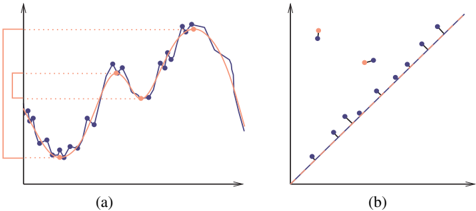
- The proof first establishes stability for the Hausdorff distance using the Box Lemma, then strengthens it to the bottleneck distance using the Easy Bijection Lemma and an Interpolation Lemma for piecewise linear functions.
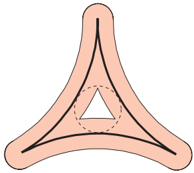
- The Homology Inference Theorem states that for all real \(\varepsilon\) with \(d_H(X,P) < \varepsilon < \mathrm{hfs}_X/4\) and all sufficiently small \(\delta>0\), the dimensions of the homology group of \(X+\delta\) and \(P^\varepsilon_{3\varepsilon}\) are either both infinite or both finite and equal.
- The Barcode Theorem states that if a diffeomorphism \(\Phi:\mathbb R^d\to\mathbb R^d\) has derivatives up to second order close to those of a rigid motion, then the bottleneck distance between the barcodes of a hypersurface \(S\subseteq\mathbb R^d\) and its perturbation \(\Phi(S)\) is small.
Methods
- Theoretical study of real-valued functions on topological spaces, using homology with \(\mathbb Z_2\) coefficients, homological critical values, tame functions, persistent homology groups, and persistence diagrams.
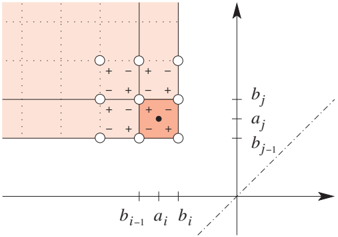
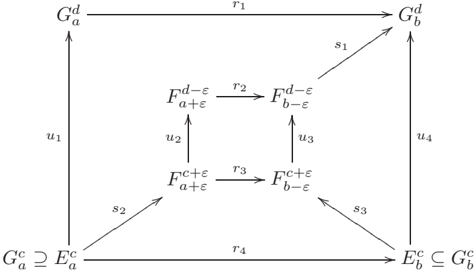
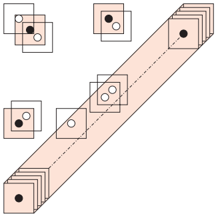
- Stability is proved by algebraic-topological diagram chasing: the Quadrant Lemma and Box Lemma bound multiplicities in nested quadrants/boxes, and the bottleneck case is handled by composing bijections for very close functions and interpolating between piecewise linear functions.
- Applications are derived as corollaries; the paper reports no empirical data, experiments, or numerical evaluations.
Limitations
- The paper explicitly leaves open whether the Main Theorem extends to non-tame functions, whether other metrics on functions and persistence diagrams admit similar inequalities, and how to exploit the result algorithmically.
- Evident from the text: the main theorem assumes a triangulable space and continuous tame functions, and the proof uses compactness, finite simplicial complexes, and finite-dimensional homology groups.
- Evident from the text: the applications are theoretical corollaries, and the Barcode Theorem states only that the bottleneck distance is “small” under \(C^2\)-closeness to a rigid motion, without a quantitative bound.
Model-written summary. Check it against the paper before relying on it.
Integrity signals
Registry
Cites
Statistics
Figures
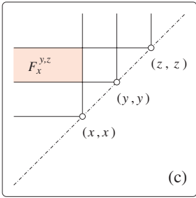
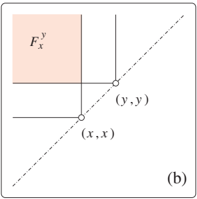
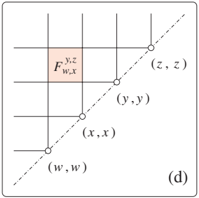
![Fig. 3 (a) Homology group of the sub-level set f -1 ( -∞ , x ]. (b) Image of Fx in Fy . (c) Kernel of surjection F y x → F z x . (d) Quotient of F y , z x and F y , z w .](https://figures.cochat.ai/paper-figures/e3fbb536dd354c4daa1aeec1692fa302/stability-of-persistence-diagrams-figure-3.png)
Verification
Claims the paper makes
1 Valid · 7 Not valid · 19 Not checked · 31 Own results and interpretations
The cited sources support only part of this claim — read each source’s verdict below.
In the paper
“Indeed, the dimensions of the persistent homology groups that appear in the theorem are efficiently computable using the persistence algorithm on the filtration of alpha complexes [11], [12].”
What the sources say
- Not matchedcites [11] 11. H. Edelsbrunner, D. Letscher, and A. Zomorodian. Topological persistence and simplification. Discrete Comput . Geom . 28 (2002), 511-533.
More than one paper fits this citation.
- Partly supportedcites [12] 12. H. Edelsbrunner and E. P. M¨ ucke. Three-dimensional alpha shapes. ACM Trans . Comput . Graphics 13 (1994), 43-72. sourceExperimental — accuracy not yet measured
Section 3.3, “Alpha Complexes” (page unavailable), defines alpha complexes and states that each is a subcomplex of those at larger alpha values, supporting the filtration part. “Features and Signatures” (page unavailable) describes an efficient way to track connected components, but calls higher-order homology signatures more challenging; it does not describe a persistence algorithm or establish efficient computation of the claimed persistent-homology dimensions. (LLM, conf=0.86)
plainstates a cause- Asserted: passes — The authors put it forward as true.
- Checkable: passes — It can be checked against evidence.
- Load-bearing: passes — The paper’s conclusions depend on it.
- Based: passes — The paper gives a reason why it holds.
- Not matched
A result the paper states — it cites no source for it, so there is none to check. The quote shows it is in the paper.
In the paper
“Easy Bijection Lemma. Let f , g : X → R be tame functions and let g be very close to f . Then the persistence diagrams satisfy d B ( D ( f ), D ( g )) ≤ ‖ f -g ‖∞ .”
plainstates an association- Asserted: passes — The authors put it forward as true.
- Checkable: passes — It can be checked against evidence.
- Load-bearing: passes — The paper’s conclusions depend on it.
- Based: passes — The paper gives a reason why it holds.
A result the paper states — it cites no source for it, so there is none to check. The quote shows it is in the paper.
In the paper
“Critical Value Lemma. If some closed interval [ x , y ] contains no homological critical value of f , then f y x is an isomorphism for every integer k .”
plainstates a cause- Asserted: passes — The authors put it forward as true.
- Checkable: passes — It can be checked against evidence.
- Load-bearing: passes — The paper’s conclusions depend on it.
- Based: passes — The paper gives a reason why it holds.
A result the paper states — it cites no source for it, so there is none to check. The quote shows it is in the paper.
In the paper
“Writing ε = ‖ f -g ‖∞ , we have f -1 ( -∞ , x ] ⊆ g -1 ( -∞ , x + ε ] for all x ∈ R .”
plainstates a cause- Asserted: passes — The authors put it forward as true.
- Checkable: passes — It can be checked against evidence.
- Load-bearing: passes — The paper’s conclusions depend on it.
- Based: passes — The paper gives a reason why it holds.
A result the paper states — it cites no source for it, so there is none to check. The quote shows it is in the paper.
In the paper
“Interpolation Lemma.”
- Also stated in: § Interpolation Lemma. · p. 13 · boosted
“However, since the h λ i sample the linear interpolation from ˆ f to ˆ g , the latter sum equals ‖ ˆ f - ˆ g ‖∞ , which concludes the proof.”
boostedstates an association- Asserted: passes — The authors put it forward as true.
- Checkable: passes — It can be checked against evidence.
- Load-bearing: passes — The paper’s conclusions depend on it.
- Based: passes — The paper gives a reason why it holds.
- Also stated in: § Interpolation Lemma. · p. 13 · boosted
21 more claims
Create a free account to see all 58 claims and every source verdict.
- Probably not a substantial claim. 28
- It may state two separate claims as one. 13
Claims other papers make about this one
Each is checked against this paper’s own text: does it say what the citing paper says it does?
The source backs part of the claim, not all of it — or backs it for a different population, condition or comparison.
In the citing paper
“Let X be any space which is homeomorphic to a simplicial complex, and suppose f, g : X → R are continuous tame functions. Then the persistence vector spaces { H k ( f -1 (( -∞ , r ]) } r and { H k ( g -1 (( -∞ , r ]) } r are finitely presented, and therefore admit barcode descriptions for each k ∈ N”
From Topological pattern recognition for point cloud data (2014) · cites this paper as Cohen-Steiner et al. (2007)
Experimental — accuracy not yet measuredThe cited source says what the claim attributes to it.
In the citing paper
“Also, results about barcodes under the general heading have now begun to appear (see [15] and [16]).”
From Topology and data (2009) · cites this paper as [15]
Citations
Cites
Rayward-Smith, V. J. (1991) · Journal of the Operational Research Society · doi:10.1057/jors.1991.155 · Cited by 16,821
Spanier, E. H. (1990) · Cited by 3,014
Three-dimensional alpha shapes
Edelsbrunner, H., & Mücke, E. P. (1994) · ACM Transactions on Graphics · doi:10.1145/174462.156635 · Cited by 2,488
Self-citationElements of Algebraic Topology
Munkres, J. R. (2018) · CRC Press eBooks · doi:10.1201/9780429493911 · Cited by 2,102
Introduction to Algorithms, Second Edition
Rivest, R. L., Leiserson, C. E., Cormen, T. H., & Stein, C. (2001) · Cited by 1,984
Topological Persistence and Simplification
Edelsbrunner, Letscher, & Zomorodian (2002) · Discrete & Computational Geometry · doi:10.1007/s00454-002-2885-2 · Cited by 1,779
Introduction to linear algebra
(2016) · Cybersecurity and Applied Mathematics · doi:10.1016/b978-0-12-804452-0.09998-x · Cited by 1,646
Zomorodian, A., & Carlsson, G. (2005) · Discrete & Computational Geometry · doi:10.1007/s00454-004-1146-y · Cited by 1,591
Milnor, J. (1963) · doi:10.1515/9781400881802 · Cited by 1,390
Morphometric Tools for Landmark Data.
Bookstein, F. (1998) · Biometrics · doi:10.2307/2534038 · Cited by 1,378
Research works printed but not linked: 2
- [16]16. J. Milnor. Morse Theory . Princeton University Press, New Jersey, 1963.
- [19]19. V. Robins. Toward computing homology from finite approximations. Topology Proceedings 24 (1999), 503-532.
Cited by
Items 601–700 of 1,300
Stability and Statistical Inferences in the Space of Topological Spatial Relationships
Corcoran, P., & Jones, C. B. (2018) · IEEE Access · doi:10.1109/access.2018.2817493 · Cited by 7
Hierarchies and Ranks for Persistence Pairs
Rieck, B., Sadlo, F., & Leitte, H. (2020) · Mathematics and visualization · doi:10.1007/978-3-030-43036-8_1 · Cited by 7
Approximating the pathway axis and the persistence diagram of a collection of balls in 3-space
Yaffe, E., & Halperin, D. (2008) · Annual Symposium on Computational Geometry (SoCG) · doi:10.1145/1377676.1377722 · Cited by 8
Contributions to Persistence Theory
Du, D. (2014) · Annals of West University of Timisoara - Mathematics and Computer Science · doi:10.2478/awutm-2014-0012 · Cited by 6
Probabilistic Fréchet Means and Statistics on Vineyards.Preprint
Munch, E., Bendich, P. L., Turner, K., Mukherjee, S., Mattingly, J. C., & Harer, J. (2013) · arXiv (Cornell University) · Cited by 7
Self-citationMeasuring Distance between Reeb GraphsPreprint
Bauer, U., Ge, X., & Wang, Y. (2013) · arXiv (Cornell University) · doi:10.48550/arxiv.1307.2839 · Cited by 6
An Isometry Theorem for Generalized Persistence ModulesPreprint
Meehan, K., & Meyer, D. (2017) · arXiv (Cornell University) · doi:10.48550/arxiv.1710.02858 · Cited by 6
A Stable Multi-Scale Kernel for Topological Machine LearningPreprint
Reininghaus, J., Huber, S., Bauer, U., & Kwitt, R. (2014) · arXiv (Cornell University) · doi:10.48550/arxiv.1412.6821 · Cited by 7
Blumberg, A., Gal, I., Mandell, M. A., & Pancia, M. (2012) · arXiv.org · doi:10.48550/arxiv.1206.4581 · Cited by 15
Persistence Landscape based Topological Data Analysis for Personalized Arrhythmia ClassificationPreprint
Yan, Y., Ivanov, K., Cen, J., Liu, Q.-H., & Wang, L. (2019) · Preprints.org · doi:10.20944/preprints201908.0320.v1 · Cited by 5
The stability of persistent homology of hypergraphsPreprint
Ren, S., & Wu, J. (2020) · arXiv (Cornell University) · doi:10.48550/arxiv.2002.02237 · Cited by 6
Positivity of Multiparameter Persistence Diagrams and Bottleneck StabilityPreprint
McCleary, A., & Patel, A. (2019) · arXiv (Cornell University) · doi:10.48550/arxiv.1905.13220 · Cited by 6
Approximation algorithms for 1-Wasserstein distance between persistence diagramsPreprint
Chen, S., & Wang, Y. (2021) · arXiv (Cornell University) · doi:10.48550/arxiv.2104.07710 · Cited by 6
Persistence in discrete Morse theory
Bauer, U. (2011) · eDiss (Georg-August-Universität Göttingen) · doi:10.53846/goediss-2536 · Cited by 18
The topological properties of the protein universe
Madsen, C. D., Barbensi, A., Zhang, S. Y., Ham, L., David, A., Pires, D. E. V., & Stumpf, M. P. H. (2025) · Nature Communications · doi:10.1038/s41467-025-61108-2 · Cited by 7
Topological classification of tumour-immune interactions and dynamics
Yang, J., Fang, H., Dhesi, J., Yoon, I. H. R., Bull, J. A., Byrne, H. M., Harrington, H. A., & Grindstaff, G. (2025) · Journal of Mathematical Biology · doi:10.1007/s00285-025-02253-6 · Cited by 14
Sparse portfolio selection via topological data analysis based clustering
Goel, A., Filipović, D., & Pasricha, P. (2025) · Quantitative Finance · doi:10.1080/14697688.2025.2544762 · Cited by 6
Catanzaro, M. J., Rizzo, S., Kopchick, J. J., Chowdury, A., Rosenberg, D. R., Bubenik, P., & Diwadkar, V. A. (2023) · Neuroinformatics · doi:10.1007/s12021-023-09645-3 · Cited by 10
Théorie de la persistance (2/2) : stabilité
Carrière, M. (2025) · Journées mathématiques X-UPS · doi:10.5802/xups.2024-04 · Cited by 5
Mathematical Foundations in Visualization
Hotz, I., Bujack, R., Garth, C., & Wang, B. (2020) · Springer eBooks · doi:10.1007/978-3-030-34444-3_5 · Cited by 7
Persistent Homology Metrics Reveal Quantum Fluctuations and Reactive Atoms in Path Integral Dynamics
Hu, Y., Ounkham, P., Maršálek, O., Markland, T. E., Krishmoorthy, B., & Clark, A. E. (2021) · Frontiers in Chemistry · doi:10.3389/fchem.2021.624937 · Cited by 5
Basu, S., & Cox, N. (2024) · SIAM Journal on Applied Algebra and Geometry · doi:10.1137/22m1518761 · Cited by 6
A Topological Similarity Measure Between Multi-Resolution Reeb Spaces
Ramamurthi, Y., Agarwal, T., & Chattopadhyay, A. (2021) · IEEE Transactions on Visualization and Computer Graphics · doi:10.1109/tvcg.2021.3087273 · Cited by 5
Manuchehrfar, F., Li, H., Ma, A., & Liang, J. (2022) · The Journal of Physical Chemistry B · doi:10.1021/acs.jpcb.2c07015 · Cited by 5
Persistent Homology for RNA Data Analysis
Xia, K., Liu, X., & Wee, J. (2023) · Methods in molecular biology · doi:10.1007/978-1-0716-2974-1_12 · Cited by 6
Machine composition of Korean music via topological data analysis and artificial neural network
Tran, M. L., Lee, D., & Jung, J.-H. (2023) · Journal of Mathematics and Music · doi:10.1080/17459737.2023.2197905 · Cited by 5
Kim, W., & Mémoli, F. (2023) · Notices of the American Mathematical Society · doi:10.1090/noti2761 · Cited by 4
Vector summaries of persistence diagrams for permutation-based hypothesis testing
Islambekov, U., & Pathirana, H. (2024) · Foundations of Data Science · doi:10.3934/fods.2024002 · Cited by 6
Hodge-Decomposition of Brain Networks
Anand, D. V., & Chung, M. K. (2024) · IEEE International Symposium on Biomedical Imaging (ISBI) · doi:10.1109/isbi56570.2024.10635590 · Cited by 13
Persistent Homology in Medical Image Processing: A Literature Review
Brito-Pacheco, D., Giannopoulos, P., & Reyes‐Aldasoro, C. C. (2026) · ACM Transactions on Computing for Healthcare · doi:10.1145/3820762 · Cited by 10
Accelerating Computation of Stable Merge Tree Edit Distances Using Parameterized Heuristics
Wetzels, F., Leitte, H., & Garth, C. (2025) · IEEE Transactions on Visualization and Computer Graphics · doi:10.1109/tvcg.2025.3567120 · Cited by 6
The Offset Filtration of Convex Objects
Halperin, D., Kerber, M., & Shaharabani, D. (2014) · Embedded Systems and Applications · doi:10.1007/978-3-662-48350-3_59 · Cited by 7
Coordinate-free quantification of coverage in dynamic sensor networks
Gamble, J., Chintakunta, H., & Krim, H. (2015) · Signal Processing · doi:10.1016/j.sigpro.2015.02.013 · Cited by 5
Reeb Spaces and the Robustness of Preimages
Patel, A. (2010) · Cited by 5
Retrieval of Non-rigid (textured) Shapes Using Low Quality 3D Models
Giachetti, A., Farina, F., Fornasa, F., et al. (2015) · Eurographics · doi:10.2312/3dor.20151067 · Cited by 5
Using Persistent Homology to Represent Online Social Network Graphs
Lee, C. S. G., Gao, T., & Li, F. (2017) · IEEE International Conference on Mobile Ad-Hoc and Sensor Systems (MASS) · doi:10.1109/mass.2017.98 · Cited by 5
Bump hunting by topological data analysis
Sommerfeld, M., Heo, G., Kim, P., Rush, S. T. A., & Marron, J. S. (2017) · Stat · doi:10.1002/sta4.167 · Cited by 5
Unsupervised Environmental Sound Classification Based On Topological Persistence
Cao, Y., Zhang, S., Yan, F.-J., Li, W., Sun, F., & Sun, H. (2019) · IEEE International Conference on Signal, Information and Data Processing (ICSIDP) · doi:10.1109/icsidp47821.2019.9173135 · Cited by 8
TopoMap: A 0-dimensional Homology Preserving Projection of High-Dimensional Data
Doraiswamy, H., Tierny, J., Silva, P. J. S., Nonato, L. G., & Silva, C. (2020) · IEEE Transactions on Visualization and Computer Graphics · doi:10.1109/tvcg.2020.3030441 · Cited by 44
Forman-Ricci curvature and persistent homology of unweighted complex networks
Roy, I., Vijayaraghavan, S., Ramaia, S. J., & Samal, A. (2020) · Chaos Solitons & Fractals · doi:10.1016/j.chaos.2020.110260 · Cited by 10
Ignacio, P. S., Bulauan, J.-A., & Uminsky, D. (2020) · Algorithms · doi:10.3390/a13110291 · Cited by 5
Topological data analysis of Korean music in Jeongganbo: a cycle structure
Tran, M. L., Park, C., & Jung, J.-H. (2023) · Journal of Mathematics and Music · doi:10.1080/17459737.2022.2164626 · Cited by 5
Clustering of measures via mean measure quantization
Chazal, F., Levrard, C., & Royer, M. (2021) · Electronic Journal of Statistics · doi:10.1214/21-ejs1834 · Cited by 8
Introduction to Persistent Homology
Virk, Ž. (2022) · doi:10.51939/0002 · Cited by 5
Statistical and topological summaries aid disease detection for segmented retinal vascular images
Nardini, J. T., Pugh, C. W. J., & Byrne, H. M. (2023) · Microcirculation · doi:10.1111/micc.12799 · Cited by 8
Hippocampal and Medial Prefrontal Cortex Fractal Spiking Patterns Encode Episodes and Rules
Srinivasan, A., Srinivasan, A., Goodman, M. R., Riceberg, J. S., Guise, K. G., & Shapiro, M. L. (2023) · Chaos Solitons & Fractals · doi:10.1016/j.chaos.2023.113508 · Cited by 5
Computing persistent homology with various coefficient fields in a single pass
Boissonnat, J.-D., & Maria, C. (2019) · Journal of Applied and Computational Topology · doi:10.1007/s41468-019-00025-y · Cited by 5
Genovese, C. R., Perone-Pacifico, M., Verdinelli, I., & Wasserman, L. (2016) · Journal of Computational and Graphical Statistics · doi:10.1080/10618600.2016.1260472 · Cited by 5
Computing Bottleneck Distance for 2-D Interval Decomposable Modules
Dey, T. K., & Xin, C. (2018) · DROPS (Schloss Dagstuhl – Leibniz Center for Informatics) · doi:10.4230/lipics.socg.2018.32 · Cited by 5
The persistent homology of a sampled map: from a viewpoint of quiver representations
Takeuchi, H. (2021) · Journal of Applied and Computational Topology · doi:10.1007/s41468-021-00065-3 · Cited by 7
A stable cardinality distance for topological classification
Maroulas, V., Micucci, C. P., & Spannaus, A. (2019) · Advances in Data Analysis and Classification · doi:10.1007/s11634-019-00378-3 · Cited by 5
Persistent Betti Numbers for a Noise Tolerant Shape-Based Approach to Image Retrieval
Frosini, P., & Landi, C. (2011) · Lecture notes in computer science · doi:10.1007/978-3-642-23672-3_36 · Cited by 5
The Complexity of Some Topological Inference Problems
Weinberger, S. (2013) · Foundations of Computational Mathematics · doi:10.1007/s10208-013-9152-1 · Cited by 5
ADVANCES IN MULTIDIMENSIONAL SIZE THEORY
Cerri, A., & Frosini, P. (2011) · Image Analysis & Stereology · doi:10.5566/ias.v29.p19-26 · Cited by 4
Defining and Computing Topological Persistence for 1-cocyclesPreprint
Burghelea, D., Dey, T. K., & Dong, D. (2010) · arXiv (Cornell University) · doi:10.48550/arxiv.1012.3763 · Cited by 4
Constructive Mayer-Vietoris Algorithm: Computing the Homology of Unions of Simplicial Complexes
Boltcheva, D., Aceitunos, S. M., Léon, J.-C., & Hétroy, F. (2010) · HAL · Cited by 5
Stability of multidimensional persistent homology with respect to domain perturbationsPreprint
Frosini, P., & Landi, C. (2010) · arXiv (Cornell University) · doi:10.48550/arxiv.1001.1078 · Cited by 5
Generalized Cluster Trees and Singular MeasuresPreprint
Chen, Y. (2016) · arXiv (Cornell University) · doi:10.48550/arxiv.1611.02762 · Cited by 5
Jeitziner, R., Carrière, M., Rougemont, J., Oudot, S., Hess, K. P., & Brisken, C. (2017) · arXiv (Cornell University) · doi:10.48550/arxiv.1801.01841 · Cited by 5
A derived isometry theorem for constructible sheaves on $\mathbb{R}$Preprint
Berkouk, N., & GINOT, G. (2018) · arXiv (Cornell University) · doi:10.48550/arxiv.1805.09694 · Cited by 5
Bar codes of persistent cohomology and Arrhenius law for p-formsPreprint
Peutrec, D. L., Nier, F., & Viterbo, C. (2020) · arXiv (Cornell University) · doi:10.48550/arxiv.2002.06949 · Cited by 5
Fuzzy c-Means Clustering for Persistence DiagramsPreprint
Davies, T., Aspinall, J., Wilder, B., & Tran-Thanh, L. (2020) · arXiv (Cornell University) · doi:10.48550/arxiv.2006.02796 · Cited by 7
Optimal quantization of the mean measure and applications to statistical learningPreprint
Chazal, F., Levrard, C., & Royer, M. (2020) · arXiv (Cornell University) · doi:10.48550/arxiv.2002.01216 · Cited by 6
Finiteness of rank invariants of multidimensional persistent homology groups
Cagliari, F., & Landi, C. (2010) · Applied Mathematics Letters · doi:10.1016/j.aml.2010.11.004 · Cited by 4
Algorithm for Interpretable Graph Features via Motivic Persistent Cohomology
Maruyama, Y. (2026) · Lecture notes in computer science · doi:10.1007/978-3-032-15621-1_8 · Cited by 4
Top-K Exterior Power Persistent Homology: Algorithm, Structure, and Stability
Maruyama, Y. (2026) · Lecture notes in computer science · doi:10.1007/978-3-032-15621-1_7 · Cited by 4
Hippocampal and Medial Prefrontal Cortical Maps Represent Episodes and Rules in a Common Task Space
Srinivasan, A., Srinivasan, A., Riceberg, J. S., Goodman, M. R., Guise, K. G., & Shapiro, M. L. (2022) · Cell Reports · doi:10.1016/j.celrep.2023.113296 · Cited by 5
Topological Learning Approach to Characterizing Biological Membranes
Arango, A. S., Park, H., & Tajkhorshid, E. (2024) · Journal of Chemical Information and Modeling · doi:10.1021/acs.jcim.4c00552 · Cited by 5
Implications of data topology for deep generative models
Jin, Y., McDaniel, R., Tatro, N. J., Catanzaro, M. J., Smith, A. D., Bendich, P. L., Dwyer, M. B., & Fletcher, P. T. (2024) · Frontiers in Computer Science · doi:10.3389/fcomp.2024.1260604 · Cited by 9
Optimal General Simplification of Scalar Fields on Surfaces
Tierny, J., Günther, D., & Pascucci, V. (2014) · Mathematics and visualization · doi:10.1007/978-3-662-44900-4_4 · Cited by 6
Steady and ranging sets in graph persistence
Bergomi, M. G., Ferri, M., & Tavaglione, A. (2022) · Journal of Applied and Computational Topology · doi:10.1007/s41468-022-00099-1 · Cited by 9
Curvature Sets Over Persistence Diagrams
Gómez, M., & Mémoli, F. (2024) · Discrete & Computational Geometry · doi:10.1007/s00454-024-00634-0 · Cited by 16
Topological information retrieval with dilation-invariant bottleneck comparative measures
Cao, Y., Monod, A., Vlontzos, A., Schmidtke, L., & Kainz, B. (2023) · Information and Inference A Journal of the IMA · doi:10.1093/imaiai/iaad022 · Cited by 7
Lifespan functors and natural dualities in persistent homology
Bauer, U., & Schmahl, M. (2023) · Homology Homotopy and Applications · doi:10.4310/hha.2023.v25.n2.a13 · Cited by 4
The Impact of Changes in Resolution on the Persistent Homology of Images
Heiss, T., Tymochko, S., Story, B., Garin, A., Bùi, H. T., Bleile, B., & Robins, V. (2021) · IEEE International Conference on Big Data (BigData) · doi:10.1109/bigdata52589.2021.9671483 · Cited by 4
Severe slugging flow identification from topological indicators
Casolo, S. (2022) · Digital Chemical Engineering · doi:10.1016/j.dche.2022.100045 · Cited by 5
Homological eigenvalues of graph p-Laplacians
Zhang, D. (2023) · Journal of Topology and Analysis · doi:10.1142/s1793525323500346 · Cited by 4
Frosini, P., Gridelli, I., & Pascucci, A. (2023) · Entropy · doi:10.3390/e25081150 · Cited by 4
Persistent homotopy groups of metric spaces
Mémoli, F., & Zhou, L. (2024) · Journal of Topology and Analysis · doi:10.1142/s1793525324500018 · Cited by 26
Universal distances for extended persistence
Bauer, U., Botnan, M. B., & Fluhr, B. (2024) · Journal of Applied and Computational Topology · doi:10.1007/s41468-024-00184-7 · Cited by 4
Acoustic tags versus camera—a case study on feeding behaviour of European seabass in sea cages
Chen, I.-H., Georgopoulou, D. G., Ebbesson, L. O. E., et al. (2025) · Frontiers in Marine Science · doi:10.3389/fmars.2024.1497336 · Cited by 4
Stable Comparison of Multidimensional Persistent Homology Groups with Torsion
Frosini, P. (2012) · Acta Applicandae Mathematicae · doi:10.1007/s10440-012-9769-0 · Cited by 4
Approximation and convergence of the intrinsic volume
Edelsbrunner, H., & Pausinger, F. (2015) · Advances in Mathematics · doi:10.1016/j.aim.2015.10.004 · Cited by 4
Self-citationNetwork Topology vs. Geometry: From persistent Homology to Curvature
Saucan, E., & Jost, J. (2017) · Cited by 6
Interactions Between Kernels, Frames, and Persistent Homology
Guillemard, M., & Iske, A. (2017) · Applied and numerical harmonic analysis · doi:10.1007/978-3-319-55556-0_14 · Cited by 9
A Hybrid Metric based on Persistent Homology and its Application to Signal Classification
Lawson, A., Chung, Y.-M., & Cruse, W. (2021) · Proceedings - International Conference on Pattern Recognition/Proceedings/International Conference on Pattern Recognition · doi:10.1109/icpr48806.2021.9412768 · Cited by 4
Fiber of persistent homology on morse functions
Leygonie, J., & Beers, D. (2022) · Journal of Applied and Computational Topology · doi:10.1007/s41468-022-00100-x · Cited by 4
Qin, Y. C., Fasy, B. T., Wenk, C., & Summa, B. (2021) · IEEE Transactions on Visualization and Computer Graphics · doi:10.1109/tvcg.2021.3114872 · Cited by 6
3D Map Exploration Using Topological Fourier Sparse Set
Lu, B.-X., & Tseng, K.-S. (2022) · Journal of Intelligent & Robotic Systems · doi:10.1007/s10846-021-01565-1 · Cited by 4
Variably Scaled Persistence Kernels (VSPKs) for persistent homology applications
Marchı, S. D., Lot, F., Marchetti, F., et al. (2022) · Journal of Computational Mathematics and Data Science · doi:10.1016/j.jcmds.2022.100050 · Cited by 4
Persistence of Weighted Ordinal Partition Networks for Dynamic State Detection
Myers, A., Khasawneh, F. A., & Munch, E. (2023) · SIAM Journal on Applied Dynamical Systems · doi:10.1137/22m1476848 · Cited by 11
Topological data analysis of noise: Uniform unimodal distributions
Gluzberg, V. E., & Katz, Y. A. (2023) · Communications in Nonlinear Science and Numerical Simulation · doi:10.1016/j.cnsns.2023.107216 · Cited by 4
Mari, C., & Baldassari, C. (2023) · Neural Computing and Applications · doi:10.1007/s00521-023-08468-2 · Cited by 4
Topological Data Analysis in Automotive Industry
Beutenmüller, F., Dierolf, B., Keckeisen, M., Pausinger, F., & Vaudrevange, P. K. S. (2023) · Proceedings · doi:10.1007/978-3-658-42048-2_4 · Cited by 6
A topological classifier to characterize brain states: When shape matters more than variance
Ferrà, A., Cecchini, G., Fisas, F.-P. N., Casacuberta, C., & Cos, I. (2023) · PLoS ONE · doi:10.1371/journal.pone.0292049 · Cited by 5
Persistent cup product structures and related invariants
Mémoli, F., Stefanou, A., & Zhou, L. (2023) · Journal of Applied and Computational Topology · doi:10.1007/s41468-023-00138-5 · Cited by 24
Merge Tree Geodesics and Barycenters with Path Mappings
Wetzels, F., Pont, M., Tierny, J., & Garth, C. (2023) · IEEE Transactions on Visualization and Computer Graphics · doi:10.1109/tvcg.2023.3326601 · Cited by 4
Computing Geometric Feature Sizes for Algebraic Manifolds
Rocco, S. D., Edwards, P. B., Eklund, D., Gäfvert, O., & Hauenstein, J. D. (2023) · SIAM Journal on Applied Algebra and Geometry · doi:10.1137/22m1522656 · Cited by 8
PAIRS TRADING WITH TOPOLOGICAL DATA ANALYSIS
Majumdar, S., & Laha, A. K. (2023) · International Journal of Theoretical and Applied Finance · doi:10.1142/s021902492450002x · Cited by 6
Persistent homological 3D cell detection
Oda, H. (2024) · JSIAM Letters · doi:10.14495/jsiaml.16.25 · Cited by 4
Metadata
- Authors
- Cohen-Steiner, D., Edelsbrunner, H., & Harer, J.
- Affiliations
- Duke University (US)
- Corresponding author
- Edelsbrunner, Herbert
- Harer, John
- Venue
- Discrete & Computational Geometry
- Published
- 2006-12-12
- Volume
- 37
- Issue
- 1
- Pages
- 103-120
- ISSN
- 0179-5376 (ISSN-L)
- 1432-0444
- OpenAlex
- W2037613900
- Cited by
- 1,280
- References
- 30
- Citations by year
- 2026: 102 · 2025: 89 · 2024: 69 · 2023: 97 · 2022: 78 · 2021: 132 · 2020: 109 · 2019: 89 · 2018: 92 · 2017: 50 · 2016: 60 · 2015: 54 · 2014: 58 · 2013: 48 · 2012: 29
- FWCI
- 18.03
- Type
- journal article
- Language
- en
- Open access
- bronze
- doi.org
- Licence
- www.springer.com/tdm (tdm)
- Locations
- Discrete & Computational Geometry (publishedVersion)
- Funders
- National Science Foundation (0086013)
- Defense Advanced Research Projects Agency (HR0011, HR0011-05-1-0007)
- Topics
- Physical Sciences › Computer Science › Computational Theory and Mathematics › Topological and Geometric Data Analysis
- Physical Sciences › Mathematics › Geometry and Topology › Geometric and Algebraic Topology
- Physical Sciences › Mathematics › Applied Mathematics › Geometric Analysis and Curvature Flows
- Keywords
- persistence diagrams, stability, topological data analysis, metric spaces, shape comparison, real functions, simplicial complexes
About these checks
Registry, retraction, Cites and statistics results are computed, not judged, with one exception: a printed reference that no index lists is read once by a model before it counts as a citation error. Claims are extracted by a model and kept only when their quote appears verbatim in the text; each cited source is then checked, with a model’s help, for whether it says what the claim relies on. Those verdicts can be wrong — read the claim’s quote and the cited source before relying on one.
The claim verdicts this report counts are experimental: their accuracy is not yet measured.
A language model drew the claims from the paper on 2026-10-10, under version 3 of the claim definition (model deepseek-v4.1-flash, prompt extract-v3).
A second model labelled each claim on 2026-10-10 (model jev-1.13-20260917, definition revision gold-guideline-v0.2).
Cited sources are checked with a language model’s help (gpt-6-sol).
Statistics and arithmetic are recomputed, not judged.
Confidence bands are shown only for fields calibrated on our annotated test set. None is calibrated yet, so no band is shown.
What counts as a claim ›How we measure confidence ›How we check this ›
Are you an author, or do you see a problem with this page? Request a review
Data sources
Bibliographic data: Semantic Scholar, OpenAlex, Crossref.
Contains information from the Semantic Scholar Academic Graph Datasets, made available under the ODC Attribution License (ODC-BY 1.0).
Semantic Scholar’s data is described in: Kinney, R., et al. (2023). The Semantic Scholar Open Data Platform. arXiv:2301.10140.
