

Stability of Persistence Diagrams
Open accessThe DOI matches its Crossref record; 32 of the 32 references it cites were found in a registry or an index; 1 of the 21 sources its claims cite were checked for support.
Overview
CoChat Summary
TL;DR
The paper proves that persistence diagrams of real-valued functions on topological spaces are stable: small changes in the function imply small changes in the diagram under the bottleneck distance. It applies this stability to homology estimation from point samples and to comparing/classifying geometric shapes.
Key findings
- The Main Theorem states that for a triangulable space \(X\) with continuous tame functions \(f,g:X\to\mathbb R\), the persistence diagrams satisfy \(d_B(D(f),D(g)) \le \|f-g\|_\infty\).
- The proof first establishes stability for the Hausdorff distance using the Box Lemma, then strengthens it to the bottleneck distance using the Easy Bijection Lemma and an Interpolation Lemma for piecewise linear functions.
- The Homology Inference Theorem states that for all real \(\varepsilon\) with \(d_H(X,P) < \varepsilon < \mathrm{hfs}_X/4\) and all sufficiently small \(\delta>0\), the dimensions of the homology group of \(X+\delta\) and \(P^\varepsilon_{3\varepsilon}\) are either both infinite or both finite and equal.
- The Barcode Theorem states that if a diffeomorphism \(\Phi:\mathbb R^d\to\mathbb R^d\) has derivatives up to second order close to those of a rigid motion, then the bottleneck distance between the barcodes of a hypersurface \(S\subseteq\mathbb R^d\) and its perturbation \(\Phi(S)\) is small.
Methods
- Theoretical study of real-valued functions on topological spaces, using homology with \(\mathbb Z_2\) coefficients, homological critical values, tame functions, persistent homology groups, and persistence diagrams.
- Stability is proved by algebraic-topological diagram chasing: the Quadrant Lemma and Box Lemma bound multiplicities in nested quadrants/boxes, and the bottleneck case is handled by composing bijections for very close functions and interpolating between piecewise linear functions.
- Applications are derived as corollaries; the paper reports no empirical data, experiments, or numerical evaluations.
Limitations
- The paper explicitly leaves open whether the Main Theorem extends to non-tame functions, whether other metrics on functions and persistence diagrams admit similar inequalities, and how to exploit the result algorithmically.
- Evident from the text: the main theorem assumes a triangulable space and continuous tame functions, and the proof uses compactness, finite simplicial complexes, and finite-dimensional homology groups.
- Evident from the text: the applications are theoretical corollaries, and the Barcode Theorem states only that the bottleneck distance is “small” under \(C^2\)-closeness to a rigid motion, without a quantitative bound.
Model-written summary. Check it against the paper before relying on it.
Integrity signals
Registry
Cites
Statistics
Figures
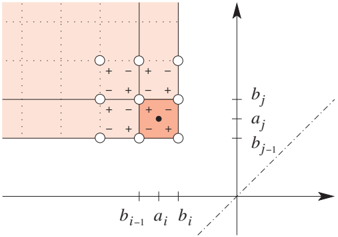
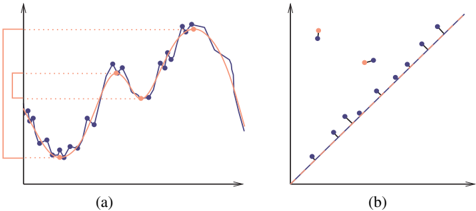
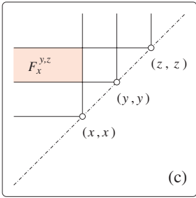
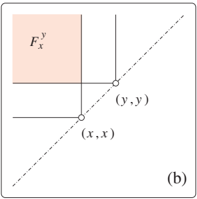
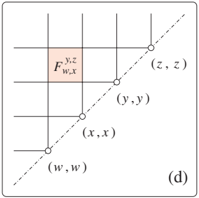
![Fig. 3 (a) Homology group of the sub-level set f -1 ( -∞ , x ]. (b) Image of Fx in Fy . (c) Kernel of surjection F y x → F z x . (d) Quotient of F y , z x and F y , z w .](https://figures.cochat.ai/paper-figures/e3fbb536dd354c4daa1aeec1692fa302/stability-of-persistence-diagrams-figure-3.png)
Verification
Claims the paper makes
1 Valid · 7 Not valid · 19 Not checked · 31 Own results and interpretations
The cited sources support only part of this claim — read each source’s verdict below.
In the paper
“Indeed, the dimensions of the persistent homology groups that appear in the theorem are efficiently computable using the persistence algorithm on the filtration of alpha complexes [11], [12].”
What the sources say
- Not matchedcites [11] 11. H. Edelsbrunner, D. Letscher, and A. Zomorodian. Topological persistence and simplification. Discrete Comput . Geom . 28 (2002), 511-533.
More than one paper fits this citation.
- Partly supportedcites [12] 12. H. Edelsbrunner and E. P. M¨ ucke. Three-dimensional alpha shapes. ACM Trans . Comput . Graphics 13 (1994), 43-72. sourceExperimental — accuracy not yet measured
Section 3.3, “Alpha Complexes” (page unavailable), defines alpha complexes and states that each is a subcomplex of those at larger alpha values, supporting the filtration part. “Features and Signatures” (page unavailable) describes an efficient way to track connected components, but calls higher-order homology signatures more challenging; it does not describe a persistence algorithm or establish efficient computation of the claimed persistent-homology dimensions. (LLM, conf=0.86)
plainstates a cause- Asserted: passes — The authors put it forward as true.
- Checkable: passes — It can be checked against evidence.
- Load-bearing: passes — The paper’s conclusions depend on it.
- Based: passes — The paper gives a reason why it holds.
- Not matched
A result the paper states — it cites no source for it, so there is none to check. The quote shows it is in the paper.
In the paper
“Easy Bijection Lemma. Let f , g : X → R be tame functions and let g be very close to f . Then the persistence diagrams satisfy d B ( D ( f ), D ( g )) ≤ ‖ f -g ‖∞ .”
plainstates an association- Asserted: passes — The authors put it forward as true.
- Checkable: passes — It can be checked against evidence.
- Load-bearing: passes — The paper’s conclusions depend on it.
- Based: passes — The paper gives a reason why it holds.
A result the paper states — it cites no source for it, so there is none to check. The quote shows it is in the paper.
In the paper
“Critical Value Lemma. If some closed interval [ x , y ] contains no homological critical value of f , then f y x is an isomorphism for every integer k .”
plainstates a cause- Asserted: passes — The authors put it forward as true.
- Checkable: passes — It can be checked against evidence.
- Load-bearing: passes — The paper’s conclusions depend on it.
- Based: passes — The paper gives a reason why it holds.
A result the paper states — it cites no source for it, so there is none to check. The quote shows it is in the paper.
In the paper
“Writing ε = ‖ f -g ‖∞ , we have f -1 ( -∞ , x ] ⊆ g -1 ( -∞ , x + ε ] for all x ∈ R .”
plainstates a cause- Asserted: passes — The authors put it forward as true.
- Checkable: passes — It can be checked against evidence.
- Load-bearing: passes — The paper’s conclusions depend on it.
- Based: passes — The paper gives a reason why it holds.
A result the paper states — it cites no source for it, so there is none to check. The quote shows it is in the paper.
In the paper
“Interpolation Lemma.”
- Also stated in: § Interpolation Lemma. · p. 13 · boosted
“However, since the h λ i sample the linear interpolation from ˆ f to ˆ g , the latter sum equals ‖ ˆ f - ˆ g ‖∞ , which concludes the proof.”
boostedstates an association- Asserted: passes — The authors put it forward as true.
- Checkable: passes — It can be checked against evidence.
- Load-bearing: passes — The paper’s conclusions depend on it.
- Based: passes — The paper gives a reason why it holds.
- Also stated in: § Interpolation Lemma. · p. 13 · boosted
21 more claims
Create a free account to see all 58 claims and every source verdict.
- Probably not a substantial claim. 28
- It may state two separate claims as one. 13
Claims other papers make about this one
Each is checked against this paper’s own text: does it say what the citing paper says it does?
The source backs part of the claim, not all of it — or backs it for a different population, condition or comparison.
In the citing paper
“Let X be any space which is homeomorphic to a simplicial complex, and suppose f, g : X → R are continuous tame functions. Then the persistence vector spaces { H k ( f -1 (( -∞ , r ]) } r and { H k ( g -1 (( -∞ , r ]) } r are finitely presented, and therefore admit barcode descriptions for each k ∈ N”
From Topological pattern recognition for point cloud data (2014) · cites this paper as Cohen-Steiner et al. (2007)
Experimental — accuracy not yet measuredThe cited source says what the claim attributes to it.
In the citing paper
“Also, results about barcodes under the general heading have now begun to appear (see [15] and [16]).”
From Topology and data (2009) · cites this paper as [15]
Citations
Cites
Rayward-Smith, V. J. (1991) · Journal of the Operational Research Society · doi:10.1057/jors.1991.155 · Cited by 16,821
Spanier, E. H. (1990) · Cited by 3,014
Three-dimensional alpha shapes
Edelsbrunner, H., & Mücke, E. P. (1994) · ACM Transactions on Graphics · doi:10.1145/174462.156635 · Cited by 2,488
Self-citationElements of Algebraic Topology
Munkres, J. R. (2018) · CRC Press eBooks · doi:10.1201/9780429493911 · Cited by 2,102
Introduction to Algorithms, Second Edition
Rivest, R. L., Leiserson, C. E., Cormen, T. H., & Stein, C. (2001) · Cited by 1,984
Topological Persistence and Simplification
Edelsbrunner, Letscher, & Zomorodian (2002) · Discrete & Computational Geometry · doi:10.1007/s00454-002-2885-2 · Cited by 1,779
Introduction to linear algebra
(2016) · Cybersecurity and Applied Mathematics · doi:10.1016/b978-0-12-804452-0.09998-x · Cited by 1,646
Zomorodian, A., & Carlsson, G. (2005) · Discrete & Computational Geometry · doi:10.1007/s00454-004-1146-y · Cited by 1,591
Milnor, J. (1963) · doi:10.1515/9781400881802 · Cited by 1,390
Morphometric Tools for Landmark Data.
Bookstein, F. (1998) · Biometrics · doi:10.2307/2534038 · Cited by 1,378
Research works printed but not linked: 2
- [16]16. J. Milnor. Morse Theory . Princeton University Press, New Jersey, 1963.
- [19]19. V. Robins. Toward computing homology from finite approximations. Topology Proceedings 24 (1999), 503-532.
Cited by
Items 501–600 of 1,300
Geometry and topology of the space of sonar target echos
Robinson, M., Fennell, S., DiZio, B., & Dumiak, J. (2018) · The Journal of the Acoustical Society of America · doi:10.1121/1.5027825 · Cited by 10
Kashiwara, M., & Schapira, P. (2019) · International Mathematics Research Notices · doi:10.1093/imrn/rnz145 · Cited by 9
Persistence barcodes versus Kolmogorov signatures: Detecting modes of one-dimensional signals.
Bauer, U., Munk, A., Sieling, H., & Wardetzky, M. (2017) · MPG.PuRe (Max Planck Society) · Cited by 9
The fiber of persistent homology for simplicial complexes
Leygonie, J., & Tillmann, U. (2022) · Journal of Pure and Applied Algebra · doi:10.1016/j.jpaa.2022.107099 · Cited by 9
Attali, D., Edelsbrunner, H., Harer, J., & Mileyko, Y. (2007) · Workshop on Algorithms and Data Structures · doi:10.1007/978-3-540-73951-7_34 · Cited by 9
Self-citationMutiscale Mapper: A Framework for Topological Summarization of Data and MapsPreprint
Dey, T. K., Mémoli, F., & Wang, Y. (2015) · arXiv (Cornell University) · doi:10.48550/arxiv.1504.03763 · Cited by 14
SimBa: An Efficient Tool for Approximating Rips-Filtration Persistence via Simplicial Batch-CollapsePreprint
Dey, T. K., Shi, D., & Wang, Y. (2016) · arXiv (Cornell University) · doi:10.4230/lipics.esa.2016.35 · Cited by 25
Persistent homology: a tool to universally measure plant morphologies across organs and scalesPreprint
Li, M., Frank, M. H., Coneva, V., Mio, W., Topp, C. N., & Chitwood, D. H. (2017) · bioRxiv (Cold Spring Harbor Laboratory) · doi:10.1101/104141 · Cited by 9
Topological Data Analysis for Object DataPreprint
Patrangenaru, V., Bubenik, P., Paige, R. L., et al. (2018) · arXiv (Cornell University) · doi:10.48550/arxiv.1804.10255 · Cited by 9
Limit theorems for persistence diagramsPreprint
Duy, T. K., Hiraoka, Y., & Shirai, T. (2016) · arXiv (Cornell University) · doi:10.48550/arxiv.1612.08371 · Cited by 9
Chung, Y.-M., Hu, C.-S., Lo, Y., et al. (2019) · arXiv (Cornell University) · doi:10.48550/arxiv.1908.06856 · Cited by 9
A Study on the Baryon Acoustic Oscillation with Topological Data AnalysisPreprint
Kono, K. T., Takeuchi, T. T., Cooray, S., Nishizawa, A. J., & Murakami, K. (2020) · arXiv (Cornell University) · doi:10.48550/arxiv.2006.02905 · Cited by 18
The growing topology of the C. elegans connectomePreprint
Helm, A., Blevins, A. S., & Bassett, D. S. (2021) · bioRxiv (Cold Spring Harbor Laboratory) · doi:10.1101/2020.12.31.424985 · Cited by 10
PERCEPT: A New Online Change-Point Detection Method using Topological Data Analysis
Zheng, X., Mak, S., Xie, L., & Xie, Y. (2022) · Technometrics · doi:10.1080/00401706.2022.2124312 · Cited by 12
Murayama, B., Kobayashi, M., Aoki, M., Ishibashi, S., Saito, T., Nakamura, T., Teramoto, H., & Taketsugu, T. (2023) · Journal of Chemical Theory and Computation · doi:10.1021/acs.jctc.2c01204 · Cited by 7
Persistent homology reveals strong phylogenetic signal in 3D protein structures
Dagher, L. B., Madern, D., Malbos, P., & Brochier‐Armanet, C. (2024) · PNAS Nexus · doi:10.1093/pnasnexus/pgae158 · Cited by 9
Probing Multipartite Entanglement Through Persistent Homology
Hamilton, G. A., & Leditzky, F. (2024) · Communications in Mathematical Physics · doi:10.1007/s00220-024-04953-4 · Cited by 11
Homotopy, homology, and persistent homology using closure spaces
Bubenik, P., & Milićević, N. (2024) · Journal of Applied and Computational Topology · doi:10.1007/s41468-024-00183-8 · Cited by 27
Relational Persistent Homology for Multispecies Data with Application to the Tumor Microenvironment
Stolz, B. J., Dhesi, J., Bull, J., Harrington, H., Byrne, H., & Yoon, I. (2023) · Bulletin of Mathematical Biology · doi:10.1007/s11538-024-01353-6 · Cited by 21
Topological Data Analysis with Bregman Divergences
Edelsbrunner, H., & Wagner, H. (2016) · Journal of computational geometry · doi:10.20382/jocg.v9i2a6 · Cited by 20
Self-citationA Study of Monodromy in the Computation of Multidimensional Persistence
Cerri, A., Ethier, M., & Frosini, P. (2013) · Lecture notes in computer science · doi:10.1007/978-3-642-37067-0_17 · Cited by 8
Quantifying 3D Shape Similarity Using Maps: Recent Trends, Applications and Perspectives
Biasotti, S., Cerri, A., Bronstein, A. M., & Bronstein, M. M. (2014) · Eurographics · doi:10.2312/egst.20141039 · Cited by 8
Vietoris thickenings and complexes have isomorphic homotopy groups
Adams, H., Frick, F., & Virk, Ž. (2022) · Journal of Applied and Computational Topology · doi:10.1007/s41468-022-00106-5 · Cited by 13
Confinement in non-Abelian lattice gauge theory via persistent homology
Spitz, D., Urban, J. M., & Pawlowski, J. M. (2023) · Physical review. D/Physical review. D. · doi:10.1103/physrevd.107.034506 · Cited by 18
Dynamic topological data analysis of functional human brain networks
Chung, M. K., Das, S. R., & Ombao, H. (2023) · Foundations of Data Science · doi:10.3934/fods.2023013 · Cited by 13
Harmonic Holes as the Submodules of Brain Network and Network Dissimilarity
Lee, H., Chung, M. K., Choi, H., Kang, H., Ha, S., Kim, Y. K., & Lee, D. S. (2018) · Lecture notes in computer science · doi:10.1007/978-3-030-10828-1_9 · Cited by 20
Elder-Rule-Staircodes for Augmented Metric Spaces
Cai, C., Kim, W., Mémoli, F., & Wang, Y. (2021) · SIAM Journal on Applied Algebra and Geometry · doi:10.1137/20m1353605 · Cited by 30
Optimization of Spectral Wavelets for Persistence-Based Graph Classification
Yim, K. M., & Leygonie, J. (2021) · Frontiers in Applied Mathematics and Statistics · doi:10.3389/fams.2021.651467 · Cited by 8
Adaptive Slicing of Implicit Porous Structure with Topology Guarantee
Yan, J., & Lin, H. (2023) · Computer-Aided Design · doi:10.1016/j.cad.2023.103557 · Cited by 8
Filtrations induced by continuous functions
Fabio, B. D., & Frosini, P. (2013) · Topology and its Applications · doi:10.1016/j.topol.2013.05.013 · Cited by 8
Homological reconstruction and simplification in R3
Attali, D., Bauer, U., Devillers, O., Glisse, M., & Lieutier, A. (2013) · International Symposium on Computational Geometry · doi:10.1145/2462356.2462373 · Cited by 16
G-invariant persistent homology
Frosini, P. (2014) · Mathematical Methods in the Applied Sciences · doi:10.1002/mma.3139 · Cited by 9
3D point cloud segmentation using topological persistence
Beksi, W. J., & Papanikolopoulos, N. P. (2016) · Proceedings - IEEE International Conference on Robotics and Automation/Proceedings · doi:10.1109/icra.2016.7487710 · Cited by 8
Signal Analysis With Frame Theory And Persistent Homology
Boche, H., Guillemard, M., Kutyniok, G., & Philipp, F. (2013) · Zenodo (CERN European Organization for Nuclear Research) · doi:10.5281/zenodo.54409 · Cited by 9
A $k$-points-based distance for robust geometric inference
Brécheteau, C., & Levrard, C. (2020) · Bernoulli · doi:10.3150/20-bej1214 · Cited by 8
A refinement of Betti numbers and homology in the presence of a continuous function, I
Burghelea, D. (2017) · Algebraic & Geometric Topology · doi:10.48550/arxiv.1501.01012 · Cited by 8
A Counter-Example to Hausmann’s Conjecture
Virk, Ž. (2021) · Foundations of Computational Mathematics · doi:10.1007/s10208-021-09510-2 · Cited by 8
Time Series Clustering with Topological and Geometric Mixed Distance
Zhang, Y., Shi, Q., Zhu, J., Peng, J., & Li, H. (2021) · Mathematics · doi:10.3390/math9091046 · Cited by 13
Computing persistent homology under random projection
Ramamurthy, K., Varshney, K., & Thiagarajan, J. J. (2014) · Symposium on Software Performance · doi:10.1109/ssp.2014.6884586 · Cited by 8
Topological analysis of scalar fields with outliersPreprint
Buchet, M., Chazal, F., Dey, T. K., et al. (2014) · arXiv (Cornell University) · doi:10.48550/arxiv.1412.1680 · Cited by 8
Topology of angle valued maps, bar codes and Jordan blocksPreprint
Burghelea, D., & Haller, S. (2013) · arXiv (Cornell University) · doi:10.48550/arxiv.1303.4328 · Cited by 8
On the Bootstrap for Persistence Diagrams and LandscapesPreprint
Chazal, F., Fasy, B. T., Lecci, F., Rinaldo, A., Singh, A., & Wasserman, L. (2013) · arXiv (Cornell University) · doi:10.48550/arxiv.1311.0376 · Cited by 35
Measuring and Localizing Homology ClassesPreprint
Freedman, D. Z., & Chen, C. (2008) · arXiv (Cornell University) · Cited by 6
Divol, V., & Lacombe, T. (2020) · Journal of Applied and Computational Topology · doi:10.1007/s41468-020-00061-z · Cited by 7
Du, G., Zhou, L., Huang, Y., Wu, Y., & Hong, Z. (2024) · Acta Materialia · doi:10.1016/j.actamat.2024.120467 · Cited by 10
Using topological data analysis and machine learning to predict customer churn
Sagming, M., Heymann, R., & Visaya, M. V. (2024) · Journal Of Big Data · doi:10.1186/s40537-024-01020-6 · Cited by 10
A General Framework for Augmenting Lossy Compressors With Topological Guarantees
Gorski, N., Liang, X., Guo, H., Yan, L., & Wang, B. (2025) · IEEE Transactions on Visualization and Computer Graphics · doi:10.1109/tvcg.2025.3567054 · Cited by 17
Rodrigues, J. A. (2025) · International Journal of Topology · doi:10.3390/ijt2020008 · Cited by 8
Delay Parameter Selection in Permutation Entropy Using Topological Data Analysis
Myers, A., Chumley, M. M., & Khasawneh, F. A. (2024) · La Matematica · doi:10.1007/s44007-024-00110-4 · Cited by 10
Exact weights, path metrics, and algebraic Wasserstein distances
Bubenik, P., Scott, J., & Stanley, D. (2022) · Journal of Applied and Computational Topology · doi:10.1007/s41468-022-00103-8 · Cited by 7
University Academic Performance Development Prediction Based on TDA
Yu, D., Zhou, X., Pan, Y. R., Niu, Z., Xu, Y., & Sun, H. (2022) · Entropy · doi:10.3390/e25010024 · Cited by 8
Supervised topological data analysis for MALDI mass spectrometry imaging applications
Klaila, G., Vutov, V., & Stefanou, A. (2023) · BMC Bioinformatics · doi:10.1186/s12859-023-05402-0 · Cited by 10
Probing universal dynamics with topological data analysis in a gluonic plasma
Spitz, D., Boguslavski, K., & Berges, J. (2023) · Physical review. D/Physical review. D. · doi:10.1103/physrevd.108.056016 · Cited by 14
Flexible and Probabilistic Topology Tracking With Partial Optimal Transport
Li, M., Yan, X., Lin, Y., Needham, T., & Wang, B. (2025) · IEEE Transactions on Visualization and Computer Graphics · doi:10.1109/tvcg.2025.3561300 · Cited by 16
Beyond Topological Persistence: Starting from Networks
Bergomi, M. G., Ferri, M., Vertechi, P., & Zuffi, L. (2021) · Mathematics · doi:10.3390/math9233079 · Cited by 8
Persistent homology for hypergraphs and computational tools — A survey for users
Ren, S. (2020) · Journal of Knot Theory and Its Ramifications · doi:10.1142/s0218216520430075 · Cited by 7
Exploring the Geometry and Topology of Neural Network Loss Landscapes
Horoi, S., Huang, J., Rieck, B., Lajoie, G., Wolf, G., & Krishnaswamy, S. (2022) · Lecture notes in computer science · doi:10.1007/978-3-031-01333-1_14 · Cited by 18
ANAPT: Additive noise analysis for persistence thresholding
Myers, A., Khasawneh, F. A., & Fasy, B. T. (2022) · Foundations of Data Science · doi:10.3934/fods.2022005 · Cited by 16
Differentiating small-scale subhalo distributions in CDM and WDM models using persistent homology
Cisewski-Kehe, J., Fasy, B. T., Hellwing, W. A., Lovell, M. R., Drozda, P., & Wu, M. (2022) · Physical review. D/Physical review. D. · doi:10.1103/physrevd.106.023521 · Cited by 12
Gromov–Hausdorff convergence of metric pairs and metric tuples
Gómez, A. A., & Che, M. (2024) · Differential Geometry and its Applications · doi:10.1016/j.difgeo.2024.102135 · Cited by 11
Topology Noise Removal for Curve and Surface Evolution
Chen, C., & Freedman, D. (2011) · Lecture notes in computer science · doi:10.1007/978-3-642-18421-5_4 · Cited by 7
Visualization Corner: Robust Topology-Based Multiscale Analysis of Scientific Data
Gyulassy, A. G., Nonato, L. G., Bremer, P., et al. (2009) · Computing in Science & Engineering · doi:10.1109/mcse.2009.152 · Cited by 7
TRACKING A GENERATOR BY PERSISTENCE
Busaryev, O., Dey, T. K., & Wang, Y. (2010) · Discrete Mathematics Algorithms and Applications · doi:10.1142/s1793830910000875 · Cited by 7
Relation between total variation and persistence distance and its application in signal processing
Plonka, G., & Zheng, Y. (2015) · Advances in Computational Mathematics · doi:10.1007/s10444-015-9438-8 · Cited by 7
The Coherent Matching Distance in 2D Persistent Homology
Cerri, A., Ethier, M., & Frosini, P. (2016) · Lecture notes in computer science · doi:10.1007/978-3-319-39441-1_20 · Cited by 7
Rigorous cubical approximation and persistent homology of continuous functions
Dłotko, P., & Wanner, T. (2017) · Computers & Mathematics with Applications · doi:10.1016/j.camwa.2017.11.027 · Cited by 6
Topological persistence based on pixels for object segmentation in biomedical images
Assaf, R., Goupil, A., Kacim, M., et al. (2017) · International Conference on Advances in Biomedical Engineering (ICABME) · doi:10.1109/icabme.2017.8167531 · Cited by 7
Sampling Real Algebraic Varieties for Topological Data Analysis
Dufresne, E., Edwards, P. B., Harrington, H. A., & Hauenstein, J. D. (2019) · International Conference on Machine Learning and Applications · doi:10.1109/icmla.2019.00253 · Cited by 27
Adaptive Template Systems: Data-Driven Feature Selection for Learning with Persistence Diagrams
Vásquez, L. O. P., & Perea, J. A. (2019) · International Conference on Machine Learning and Applications · doi:10.1109/icmla.2019.00186 · Cited by 11
Necessary conditions for discontinuities of multidimensional persistent Betti numbers
Cerri, A., & Frosini, P. (2014) · Mathematical Methods in the Applied Sciences · doi:10.1002/mma.3093 · Cited by 9
Discrete Morse Theory for Computing Zigzag Persistence
Maria, C., & Schreiber, H. (2019) · Lecture notes in computer science · doi:10.1007/978-3-030-24766-9_39 · Cited by 9
Computing the Gromov-Hausdorff Distance for Metric TreesPreprint
Agarwal, P. K., Fox, K., Nath, A., et al. (2015) · arXiv (Cornell University) · doi:10.48550/arxiv.1509.05751 · Cited by 7
Sampling random graph homomorphisms and applications to network data analysisPreprint
Lyu, H., Mémoli, F., & Sivakoff, D. J. (2019) · arXiv (Cornell University) · doi:10.48550/arxiv.1910.09483 · Cited by 11
Pérez, J. B., Hauke, S., Lupo, U., Caorsi, M., & Dassatti, A. (2021) · arXiv (Cornell University) · doi:10.48550/arxiv.2107.05412 · Cited by 41
Discrete Morse theory for filtrations
Nanda, V. (2012) · Rutgers University Community Repository (Rutgers University) · doi:10.7282/t3q52n6n · Cited by 8
Li, M., Liu, Z., Jiang, N., et al. (2024) · Frontiers in Plant Science · doi:10.3389/fpls.2023.1260005 · Cited by 6
Basic metric geometry of the bottleneck distance
Che, M., Galaz‐García, F., Guijarro, L., Solis, I. M., & Valiunas, M. (2024) · Proceedings of the American Mathematical Society · doi:10.1090/proc/16776 · Cited by 5
The persistent topology of optimal transport based metric thickenings
Adams, H., Mémoli, F., Moy, M., & Wang, Q. (2024) · Algebraic & Geometric Topology · doi:10.2140/agt.2024.24.393 · Cited by 20
Metric geometry of spaces of persistence diagrams
Che, M., Galaz‐García, F., Guijarro, L., & Solis, I. M. (2024) · Journal of Applied and Computational Topology · doi:10.1007/s41468-024-00189-2 · Cited by 27
Topological data analysis and machine learning for COVID-19 detection in CT scan lung images
Assaf, R., Rammal, A., Goupil, A., et al. (2025) · BMC Biomedical Engineering · doi:10.1186/s42490-025-00089-1 · Cited by 6
On the definition of the homological critical value
Govc, D. (2015) · Journal of Homotopy and Related Structures · doi:10.1007/s40062-015-0101-3 · Cited by 6
Zhang, Z., Xu, N., & Liu, Y. (2022) · Computer Methods in Applied Mechanics and Engineering · doi:10.1016/j.cma.2022.115110 · Cited by 6
Topological analysis of the latent geometry of a complex network
Jhun, B. (2022) · Chaos An Interdisciplinary Journal of Nonlinear Science · doi:10.1063/5.0073107 · Cited by 8
A topological based feature extraction method for the stock market
Chang, C., & Lin, H. (2023) · Data Science in Finance and Economics · doi:10.3934/dsfe.2023013 · Cited by 9
Topology-driven goodness-of-fit tests in arbitrary dimensions
Dłotko, P., Hellmer, N., Stettner, Ł., & Topolnicki, R. (2023) · Statistics and Computing · doi:10.1007/s11222-023-10333-0 · Cited by 9
Wetzels, F., Anders, M., & Garth, C. (2023) · Topological Data Analysis and Visualization (TopoInVis) · doi:10.1109/topoinvis60193.2023.00015 · Cited by 8
Meng, K., Wang, J., Crawford, L. A., & Eloyan, A. (2024) · Journal of the American Statistical Association · doi:10.1080/01621459.2024.2353947 · Cited by 25
di Montesano, S. C., Draganov, O., Edelsbrunner, H., & Saghafian, M. (2025) · Foundations of Data Science · doi:10.3934/fods.2025003 · Cited by 25
Self-citationThe observable structure of persistence modules
Chazal, F., Crawley-Boevey, W., & de Silva, V. (2016) · Homology Homotopy and Applications · doi:10.4310/hha.2016.v18.n2.a14 · Cited by 6
Approximating Local Homology from Samples
Skraba, P., & Wang, B. (2012) · ACM-SIAM Symposium on Discrete Algorithms · doi:10.1137/1.9781611973402.13 · Cited by 13
Stable Length Estimates of Tube-Like Shapes
Edelsbrunner, H., & Pausinger, F. (2013) · Journal of Mathematical Imaging and Vision · doi:10.1007/s10851-013-0468-x · Cited by 6
Self-citationHomological reconstruction and simplification in R3
Attali, D., Bauer, U., Devillers, O., Glisse, M., & Lieutier, A. (2014) · Computational Geometry · doi:10.1016/j.comgeo.2014.08.010 · Cited by 6
Using maximum topology matching to explore differences in species distribution models
Poco, J., Doraiswamy, H., Talbert, M. K., Morisette, J. T., & Silva, C. T. (2015) · Visualization · doi:10.1109/scivis.2015.7429486 · Cited by 6
Topology, Big Data and Optimization
Vejdemo‐Johansson, M., & Škraba, P. (2016) · Studies in big data · doi:10.1007/978-3-319-30265-2_7 · Cited by 6
MacPherson, R., & Patel, A. (2021) · Advances in Mathematics · doi:10.1016/j.aim.2021.107795 · Cited by 6
Contractibility of a persistence map preimage
Cyranka, J., Mischaikow, K., & Weibel, C. A. (2020) · Journal of Applied and Computational Topology · doi:10.1007/s41468-020-00059-7 · Cited by 6
Hyperparameter Optimization of Topological Features for Machine Learning Applications
Motta, F. C., Tralie, C. J., Bedini, R., Bini, F., Bini, G., Eramian, H., Gameiro, M., Haase, S. B., Haddox, H. K., Harer, J., et al. (2019) · International Conference on Machine Learning and Applications · doi:10.1109/icmla.2019.00185 · Cited by 8
Self-citationVariability in higher order structure of noise added to weighted networks
Blevins, A. S., Kim, J. Z., & Bassett, D. S. (2021) · Communications Physics · doi:10.1038/s42005-021-00725-x · Cited by 7
Bayesian topological signal processing
Oballe, C., Cherne, A., Boothe, D., Kerick, S. E., Franaszczuk, P. J., & Maroulas, V. (2021) · Discrete and Continuous Dynamical Systems - S · doi:10.3934/dcdss.2021084 · Cited by 9
Classification of stochastic processes with topological data analysis
Güzel, İ., & Kaygun, A. (2023) · Concurrency and Computation Practice and Experience · doi:10.1002/cpe.7732 · Cited by 10
Metadata
- Authors
- Cohen-Steiner, D., Edelsbrunner, H., & Harer, J.
- Affiliations
- Duke University (US)
- Corresponding author
- Edelsbrunner, Herbert
- Harer, John
- Venue
- Discrete & Computational Geometry
- Published
- 2006-12-12
- Volume
- 37
- Issue
- 1
- Pages
- 103-120
- ISSN
- 0179-5376 (ISSN-L)
- 1432-0444
- OpenAlex
- W2037613900
- Cited by
- 1,280
- References
- 30
- Citations by year
- 2026: 102 · 2025: 89 · 2024: 69 · 2023: 97 · 2022: 78 · 2021: 132 · 2020: 109 · 2019: 89 · 2018: 92 · 2017: 50 · 2016: 60 · 2015: 54 · 2014: 58 · 2013: 48 · 2012: 29
- FWCI
- 18.03
- Type
- journal article
- Language
- en
- Open access
- bronze
- doi.org
- Licence
- www.springer.com/tdm (tdm)
- Locations
- Discrete & Computational Geometry (publishedVersion)
- Funders
- National Science Foundation (0086013)
- Defense Advanced Research Projects Agency (HR0011, HR0011-05-1-0007)
- Topics
- Physical Sciences › Computer Science › Computational Theory and Mathematics › Topological and Geometric Data Analysis
- Physical Sciences › Mathematics › Geometry and Topology › Geometric and Algebraic Topology
- Physical Sciences › Mathematics › Applied Mathematics › Geometric Analysis and Curvature Flows
- Keywords
- persistence diagrams, stability, topological data analysis, metric spaces, shape comparison, real functions, simplicial complexes
About these checks
Registry, retraction, Cites and statistics results are computed, not judged, with one exception: a printed reference that no index lists is read once by a model before it counts as a citation error. Claims are extracted by a model and kept only when their quote appears verbatim in the text; each cited source is then checked, with a model’s help, for whether it says what the claim relies on. Those verdicts can be wrong — read the claim’s quote and the cited source before relying on one.
The claim verdicts this report counts are experimental: their accuracy is not yet measured.
A language model drew the claims from the paper on 2026-10-10, under version 3 of the claim definition (model deepseek-v4.1-flash, prompt extract-v3).
A second model labelled each claim on 2026-10-10 (model jev-1.13-20260917, definition revision gold-guideline-v0.2).
Cited sources are checked with a language model’s help (gpt-6-sol).
Statistics and arithmetic are recomputed, not judged.
Confidence bands are shown only for fields calibrated on our annotated test set. None is calibrated yet, so no band is shown.
What counts as a claim ›How we measure confidence ›How we check this ›
Are you an author, or do you see a problem with this page? Request a review
Data sources
Bibliographic data: Semantic Scholar, OpenAlex, Crossref.
Contains information from the Semantic Scholar Academic Graph Datasets, made available under the ODC Attribution License (ODC-BY 1.0).
Semantic Scholar’s data is described in: Kinney, R., et al. (2023). The Semantic Scholar Open Data Platform. arXiv:2301.10140.
