

Stability of Persistence Diagrams
Open accessThe DOI matches its Crossref record; 32 of the 32 references it cites were found in a registry or an index; 1 of the 21 sources its claims cite were checked for support.
Overview
CoChat Summary
TL;DR
The paper proves that persistence diagrams of real-valued functions on topological spaces are stable: small changes in the function imply small changes in the diagram under the bottleneck distance. It applies this stability to homology estimation from point samples and to comparing/classifying geometric shapes.
Key findings
- The Main Theorem states that for a triangulable space \(X\) with continuous tame functions \(f,g:X\to\mathbb R\), the persistence diagrams satisfy \(d_B(D(f),D(g)) \le \|f-g\|_\infty\).
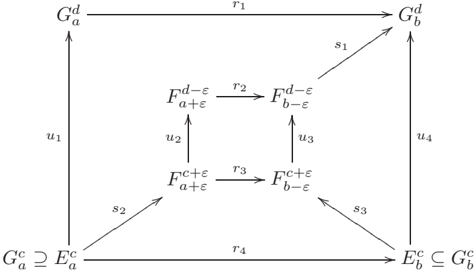
- The proof first establishes stability for the Hausdorff distance using the Box Lemma, then strengthens it to the bottleneck distance using the Easy Bijection Lemma and an Interpolation Lemma for piecewise linear functions.
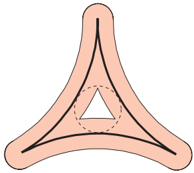
- The Homology Inference Theorem states that for all real \(\varepsilon\) with \(d_H(X,P) < \varepsilon < \mathrm{hfs}_X/4\) and all sufficiently small \(\delta>0\), the dimensions of the homology group of \(X+\delta\) and \(P^\varepsilon_{3\varepsilon}\) are either both infinite or both finite and equal.
- The Barcode Theorem states that if a diffeomorphism \(\Phi:\mathbb R^d\to\mathbb R^d\) has derivatives up to second order close to those of a rigid motion, then the bottleneck distance between the barcodes of a hypersurface \(S\subseteq\mathbb R^d\) and its perturbation \(\Phi(S)\) is small.
Methods
- Theoretical study of real-valued functions on topological spaces, using homology with \(\mathbb Z_2\) coefficients, homological critical values, tame functions, persistent homology groups, and persistence diagrams.
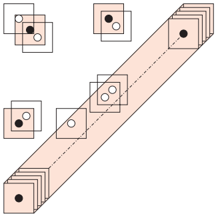
- Stability is proved by algebraic-topological diagram chasing: the Quadrant Lemma and Box Lemma bound multiplicities in nested quadrants/boxes, and the bottleneck case is handled by composing bijections for very close functions and interpolating between piecewise linear functions.
- Applications are derived as corollaries; the paper reports no empirical data, experiments, or numerical evaluations.
Limitations
- The paper explicitly leaves open whether the Main Theorem extends to non-tame functions, whether other metrics on functions and persistence diagrams admit similar inequalities, and how to exploit the result algorithmically.
- Evident from the text: the main theorem assumes a triangulable space and continuous tame functions, and the proof uses compactness, finite simplicial complexes, and finite-dimensional homology groups.
- Evident from the text: the applications are theoretical corollaries, and the Barcode Theorem states only that the bottleneck distance is “small” under \(C^2\)-closeness to a rigid motion, without a quantitative bound.
Model-written summary. Check it against the paper before relying on it.
Integrity signals
Registry
Cites
Statistics
Figures
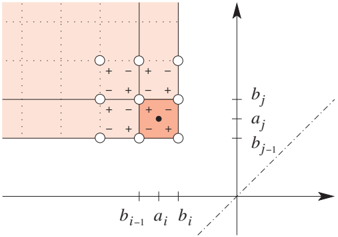
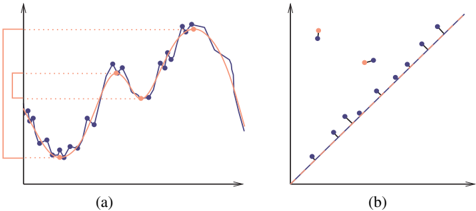
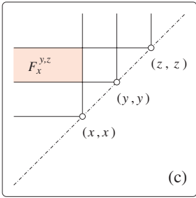
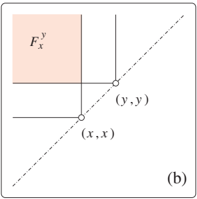
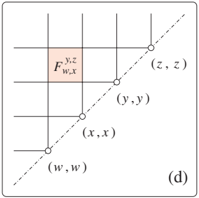
![Fig. 3 (a) Homology group of the sub-level set f -1 ( -∞ , x ]. (b) Image of Fx in Fy . (c) Kernel of surjection F y x → F z x . (d) Quotient of F y , z x and F y , z w .](https://figures.cochat.ai/paper-figures/e3fbb536dd354c4daa1aeec1692fa302/stability-of-persistence-diagrams-figure-3.png)
Verification
Claims the paper makes
1 Valid · 7 Not valid · 19 Not checked · 31 Own results and interpretations
The cited sources support only part of this claim — read each source’s verdict below.
In the paper
“Indeed, the dimensions of the persistent homology groups that appear in the theorem are efficiently computable using the persistence algorithm on the filtration of alpha complexes [11], [12].”
What the sources say
- Not matchedcites [11] 11. H. Edelsbrunner, D. Letscher, and A. Zomorodian. Topological persistence and simplification. Discrete Comput . Geom . 28 (2002), 511-533.
More than one paper fits this citation.
- Partly supportedcites [12] 12. H. Edelsbrunner and E. P. M¨ ucke. Three-dimensional alpha shapes. ACM Trans . Comput . Graphics 13 (1994), 43-72. sourceExperimental — accuracy not yet measured
Section 3.3, “Alpha Complexes” (page unavailable), defines alpha complexes and states that each is a subcomplex of those at larger alpha values, supporting the filtration part. “Features and Signatures” (page unavailable) describes an efficient way to track connected components, but calls higher-order homology signatures more challenging; it does not describe a persistence algorithm or establish efficient computation of the claimed persistent-homology dimensions. (LLM, conf=0.86)
plainstates a cause- Asserted: passes — The authors put it forward as true.
- Checkable: passes — It can be checked against evidence.
- Load-bearing: passes — The paper’s conclusions depend on it.
- Based: passes — The paper gives a reason why it holds.
- Not matched
A result the paper states — it cites no source for it, so there is none to check. The quote shows it is in the paper.
In the paper
“Easy Bijection Lemma. Let f , g : X → R be tame functions and let g be very close to f . Then the persistence diagrams satisfy d B ( D ( f ), D ( g )) ≤ ‖ f -g ‖∞ .”
plainstates an association- Asserted: passes — The authors put it forward as true.
- Checkable: passes — It can be checked against evidence.
- Load-bearing: passes — The paper’s conclusions depend on it.
- Based: passes — The paper gives a reason why it holds.
A result the paper states — it cites no source for it, so there is none to check. The quote shows it is in the paper.
In the paper
“Critical Value Lemma. If some closed interval [ x , y ] contains no homological critical value of f , then f y x is an isomorphism for every integer k .”
plainstates a cause- Asserted: passes — The authors put it forward as true.
- Checkable: passes — It can be checked against evidence.
- Load-bearing: passes — The paper’s conclusions depend on it.
- Based: passes — The paper gives a reason why it holds.
A result the paper states — it cites no source for it, so there is none to check. The quote shows it is in the paper.
In the paper
“Writing ε = ‖ f -g ‖∞ , we have f -1 ( -∞ , x ] ⊆ g -1 ( -∞ , x + ε ] for all x ∈ R .”
plainstates a cause- Asserted: passes — The authors put it forward as true.
- Checkable: passes — It can be checked against evidence.
- Load-bearing: passes — The paper’s conclusions depend on it.
- Based: passes — The paper gives a reason why it holds.
A result the paper states — it cites no source for it, so there is none to check. The quote shows it is in the paper.
In the paper
“Interpolation Lemma.”
- Also stated in: § Interpolation Lemma. · p. 13 · boosted
“However, since the h λ i sample the linear interpolation from ˆ f to ˆ g , the latter sum equals ‖ ˆ f - ˆ g ‖∞ , which concludes the proof.”
boostedstates an association- Asserted: passes — The authors put it forward as true.
- Checkable: passes — It can be checked against evidence.
- Load-bearing: passes — The paper’s conclusions depend on it.
- Based: passes — The paper gives a reason why it holds.
- Also stated in: § Interpolation Lemma. · p. 13 · boosted
21 more claims
Create a free account to see all 58 claims and every source verdict.
- Probably not a substantial claim. 28
- It may state two separate claims as one. 13
Claims other papers make about this one
Each is checked against this paper’s own text: does it say what the citing paper says it does?
The source backs part of the claim, not all of it — or backs it for a different population, condition or comparison.
In the citing paper
“Let X be any space which is homeomorphic to a simplicial complex, and suppose f, g : X → R are continuous tame functions. Then the persistence vector spaces { H k ( f -1 (( -∞ , r ]) } r and { H k ( g -1 (( -∞ , r ]) } r are finitely presented, and therefore admit barcode descriptions for each k ∈ N”
From Topological pattern recognition for point cloud data (2014) · cites this paper as Cohen-Steiner et al. (2007)
Experimental — accuracy not yet measuredThe cited source says what the claim attributes to it.
In the citing paper
“Also, results about barcodes under the general heading have now begun to appear (see [15] and [16]).”
From Topology and data (2009) · cites this paper as [15]
Citations
Cites
Rayward-Smith, V. J. (1991) · Journal of the Operational Research Society · doi:10.1057/jors.1991.155 · Cited by 16,821
Spanier, E. H. (1990) · Cited by 3,014
Three-dimensional alpha shapes
Edelsbrunner, H., & Mücke, E. P. (1994) · ACM Transactions on Graphics · doi:10.1145/174462.156635 · Cited by 2,488
Self-citationElements of Algebraic Topology
Munkres, J. R. (2018) · CRC Press eBooks · doi:10.1201/9780429493911 · Cited by 2,102
Introduction to Algorithms, Second Edition
Rivest, R. L., Leiserson, C. E., Cormen, T. H., & Stein, C. (2001) · Cited by 1,984
Topological Persistence and Simplification
Edelsbrunner, Letscher, & Zomorodian (2002) · Discrete & Computational Geometry · doi:10.1007/s00454-002-2885-2 · Cited by 1,779
Introduction to linear algebra
(2016) · Cybersecurity and Applied Mathematics · doi:10.1016/b978-0-12-804452-0.09998-x · Cited by 1,646
Zomorodian, A., & Carlsson, G. (2005) · Discrete & Computational Geometry · doi:10.1007/s00454-004-1146-y · Cited by 1,591
Milnor, J. (1963) · doi:10.1515/9781400881802 · Cited by 1,390
Morphometric Tools for Landmark Data.
Bookstein, F. (1998) · Biometrics · doi:10.2307/2534038 · Cited by 1,378
Research works printed but not linked: 2
- [16]16. J. Milnor. Morse Theory . Princeton University Press, New Jersey, 1963.
- [19]19. V. Robins. Toward computing homology from finite approximations. Topology Proceedings 24 (1999), 503-532.
Cited by
Items 101–200 of 1,300
Topological methods for data modelling
Carlsson, G. (2020) · Nature Reviews Physics · doi:10.1038/s42254-020-00249-3 · Cited by 89
Measuring the Distance Between Merge Trees
Beketayev, K., Yeliussizov, D., Morozov, D., Weber, G. H., & Hamann, B. (2014) · Mathematics and visualization · doi:10.1007/978-3-319-04099-8_10 · Cited by 90
Generalized persistence diagrams
Patel, A. (2018) · Journal of Applied and Computational Topology · doi:10.1007/s41468-018-0012-6 · Cited by 128
Topological Function Optimization for Continuous Shape Matching
Poulenard, A., Škraba, P., & Ovsjanikov, M. (2018) · Computer Graphics Forum · doi:10.1111/cgf.13487 · Cited by 116
Robins, V., Saadatfar, M., Delgado‐Friedrichs, O., et al. (2015) · Water Resources Research · doi:10.1002/2015wr017937 · Cited by 75
Günther, D., Reininghaus, J., Wagner, H., et al. (2012) · The Visual Computer · doi:10.1007/s00371-012-0726-8 · Cited by 73
Classification of weighted networks through mesoscale homological features
Sizemore, A. E., Giusti, C., & Bassett, D. S. (2016) · Journal of Complex Networks · doi:10.1093/comnet/cnw013 · Cited by 89
Metrics for comparing neuronal tree shapes based on persistent homology
Li, Y., Wang, D., Ascoli, G. A., Mitra, P., & Wang, Y. (2017) · PLOS ONE · doi:10.1371/journal.pone.0182184 · Cited by 71
Inference of Ancestral Recombination Graphs through Topological Data Analysis
Cámara, P. G., Levine, A. J., & Rabadán, R. (2016) · PLoS Computational Biology · doi:10.1371/journal.pcbi.1005071 · Cited by 77
Algebraic stability of zigzag persistence modules
Botnan, M. B., & Lesnick, M. (2018) · Algebraic & Geometric Topology · doi:10.2140/agt.2018.18.3133 · Cited by 91
Separatrix Persistence: Extraction of Salient Edges on Surfaces Using Topological Methods
Weinkauf, T., & Günther, D. (2009) · Computer Graphics Forum · doi:10.1111/j.1467-8659.2009.01528.x · Cited by 70
Insights into Brain Architectures from the Homological Scaffolds of Functional Connectivity Networks
Lord, L.-D., Expert, P., Fernandes, H. M., Petri, G., van Hartevelt, T. J., Vaccarino, F., Deco, G., Turkheimer, F., & Kringelbach, M. L. (2016) · Frontiers in Systems Neuroscience · doi:10.3389/fnsys.2016.00085 · Cited by 86
Induced Matchings of Barcodes and the Algebraic Stability of Persistence
Bauer, U., & Lesnick, M. (2014) · Annual Symposium on Computational Geometry (SoCG) · doi:10.1145/2582112.2582168 · Cited by 76
Persistent homology and Floer–Novikov theory
Usher, M., & Zhang, J. (2016) · Geometry & Topology · doi:10.2140/gt.2016.20.3333 · Cited by 69
Persistence Paths and Signature Features in Topological Data Analysis
Chevyrev, I., Nanda, V., & Oberhauser, H. (2018) · IEEE Transactions on Pattern Analysis and Machine Intelligence · doi:10.1109/tpami.2018.2885516 · Cited by 102
Computing Just What You Need: Online Data Analysis and Reduction at Extreme Scales
Foster, I. T., Ainsworth, M. A., Allen, B., et al. (2017) · Lecture notes in computer science · doi:10.1007/978-3-319-64203-1_1 · Cited by 68
Inferring Local Homology from Sampled Stratified Spaces
Bendich, P., Cohen-Steiner, D., Edelsbrunner, H., Harer, J., & Morozov, D. (2007) · IEEE Annual Symposium on Foundations of Computer Science · doi:10.1109/focs.2007.45 · Cited by 37
Self-citationTopological data analysis of task-based fMRI data from experiments on schizophrenia
Stolz, B. J., Emerson, T., Nahkuri, S., Porter, M. A., & Harrington, H. A. (2021) · Journal of Physics Complexity · doi:10.1088/2632-072x/abb4c6 · Cited by 84
Optimal topological simplification of discrete functions on surfaces
Bauer, U., Lange, C., & Wardetzky, M. (2012) · Cited by 67
Robins, V., & Turner, K. (2016) · Physica D Nonlinear Phenomena · doi:10.1016/j.physd.2016.03.007 · Cited by 83
A Topological "Reading" Lesson: Classification of MNIST using TDA
Garin, A., & Tauzin, G. (2019) · IEEE International Conference on Machine Learning and Applications (ICMLA) · doi:10.1109/icmla.2019.00256 · Cited by 66
Exact topological inference of the resting-state brain networks in twins
Chung, M. K., Lee, H., DiChristofano, A., Ombao, H., & Solo, V. (2019) · Network Neuroscience · doi:10.1162/netn_a_00091 · Cited by 72
Guibas, L. J., Morozov, D., & Mérigot, Q. (2012) · Discrete & Computational Geometry · doi:10.1007/s00454-012-9465-x · Cited by 63
Li, M., Frank, M. H., Coneva, V., Mio, W., Chitwood, D. H., & Topp, C. N. (2018) · PLANT PHYSIOLOGY · doi:10.1104/pp.18.00104 · Cited by 61
Persistent homology and microlocal sheaf theory
Kashiwara, M., & Schapira, P. (2018) · Journal of Applied and Computational Topology · doi:10.1007/s41468-018-0019-z · Cited by 64
Pike, J. A., Khan, A. O., Pallini, C., Thomas, S. G., Mund, M., Ries, J., Poulter, N. S., & Styles, I. B. (2019) · Bioinformatics · doi:10.1093/bioinformatics/btz788 · Cited by 71
Applications of Topological Data Analysis in Oncology
Bukkuri, A., Andor, N., & Darcy, I. (2021) · Frontiers in Artificial Intelligence · doi:10.3389/frai.2021.659037 · Cited by 73
Persistent Betti numbers for a noise tolerant shape-based approach to image retrieval
Frosini, P., & Landi, C. (2013) · Pattern Recognition Letters · doi:10.1016/j.patrec.2012.10.015 · Cited by 54
Topological consistency via kernel estimation
Bobrowski, O., Mukherjee, S., & Taylor, J. (2016) · Bernoulli · doi:10.3150/15-bej744 · Cited by 85
Local persistent homology based distance between maps
Ahmed, M., Fasy, B. T., & Wenk, C. (2014) · ACM SIGSPATIAL International Conference on Advances in Geographic Information Systems (SIGSPATIAL GIS) · doi:10.1145/2666310.2666390 · Cited by 62
Bergomi, M. G., Frosini, P., Giorgi, D., & Quercioli, N. (2019) · Nature Machine Intelligence · doi:10.1038/s42256-019-0087-3 · Cited by 93
de Silva, V., Munch, E., & Patel, A. (2016) · Discrete & Computational Geometry · doi:10.1007/s00454-016-9763-9 · Cited by 93
Clique Community Persistence: A Topological Visual Analysis Approach for Complex Networks
Rieck, B., Fugacci, U., Lukasczyk, J., & Leitte, H. (2017) · IEEE Transactions on Visualization and Computer Graphics · doi:10.1109/tvcg.2017.2744321 · Cited by 66
Persistence Curves: A canonical framework for summarizing persistence diagrams
Chung, Y.-M., & Lawson, A. (2022) · Advances in Computational Mathematics · doi:10.1007/s10444-021-09893-4 · Cited by 114
The Persistence Landscape and Some of Its Properties
Bubenik, P. (2018) · Topological Data Analysis · doi:10.1007/978-3-030-43408-3_4 · Cited by 93
Stability and Computation of Topological Invariants of Solids in ${\Bbb R}^n$
Chazal, F., & Lieutier, A. (2007) · Discrete & Computational Geometry · doi:10.1007/s00454-007-1309-8 · Cited by 63
Promises and pitfalls of topological data analysis for brain connectivity analysis
Caputi, L., Pidnebesna, A., & Hlinka, J. (2021) · NeuroImage · doi:10.1016/j.neuroimage.2021.118245 · Cited by 77
Visualization of High-Dimensional Point Clouds Using Their Density Distribution's Topology
Oesterling, P., Heine, C., Jänicke, H., Scheuermann, G., & Heyer, G. (2011) · IEEE Transactions on Visualization and Computer Graphics · doi:10.1109/tvcg.2011.27 · Cited by 65
A functorial Dowker theorem and persistent homology of asymmetric networks
Chowdhury, S., & Mémoli, F. (2016) · Journal of Applied and Computational Topology · doi:10.1007/s41468-018-0020-6 · Cited by 87
Edit Distance between Merge Trees
Sridharamurthy, R., Masood, T. B., Kamakshidasan, A., & Natarajan, V. (2018) · IEEE Transactions on Visualization and Computer Graphics · doi:10.1109/tvcg.2018.2873612 · Cited by 81
Subsampling Methods for Persistent HomologyPreprint
Chazal, F., Fasy, B. T., Lecci, F., Michel, B., Rinaldo, A., & Wasserman, L. (2014) · arXiv (Cornell University) · doi:10.48550/arxiv.1406.1901 · Cited by 70
Persistent Homology for the Evaluation of Dimensionality Reduction Schemes
Rieck, B., & Leitte, H. (2015) · Computer Graphics Forum · doi:10.1111/cgf.12655 · Cited by 55
Probabilistic Fréchet means for time varying persistence diagrams
Munch, E., Turner, K., Bendich, P. L., Mukherjee, S., Mattingly, J. C., & Harer, J. (2015) · Electronic Journal of Statistics · doi:10.1214/15-ejs1030 · Cited by 72
Self-citationComparing Persistence Diagrams Through Complex Vectors
Fabio, B. D., & Ferri, M. (2015) · Lecture notes in computer science · doi:10.1007/978-3-319-23231-7_27 · Cited by 56
Di Fabio, B., & Landi, C. (2011) · Foundations of Computational Mathematics · doi:10.1007/s10208-011-9100-x · Cited by 47
Chacón, J. E. (2020) · International Statistical Review · doi:10.1111/insr.12340 · Cited by 77
Structure and Stability of the One-Dimensional Mapper
Carrière, M., & Oudot, S. (2017) · HAL · Cited by 54
Statistical Analysis and Parameter Selection for MapperPreprint
Carrière, M., Michel, B., & Oudot, S. (2017) · arXiv (Cornell University) · doi:10.48550/arxiv.1706.00204 · Cited by 59
Learning metrics for persistence-based summaries and applications for graph classificationPreprint
Zhao, Q., & Wang, Y. (2019) · arXiv (Cornell University) · doi:10.48550/arxiv.1904.12189 · Cited by 119
One-dimensional reduction of multidimensional persistent homology
Cagliari, F., Fabio, B. D., & Ferri, M. (2010) · Proceedings of the American Mathematical Society · doi:10.1090/s0002-9939-10-10312-8 · Cited by 52
A weak characterisation of the Delaunay triangulation
de Silva, V. (2008) · Geometriae Dedicata · doi:10.1007/s10711-008-9261-1 · Cited by 37
Approximating loops in a shortest homology basis from point data
Dey, T. K., Sun, J. Z., & Wang, Y. (2010) · Annual Symposium on Computational Geometry (SoCG) · doi:10.1145/1810959.1810989 · Cited by 46
Homological illusions of persistence and stability
Edelsbrunner, H., & Morozov, D. (2008) · DukeSpace (Duke University) · Cited by 67
Self-citationPersistence-based clustering in riemannian manifolds
Chazal, F., Guibas, L. J., Oudot, S., & Škraba, P. (2011) · Annual Symposium on Computational Geometry (SoCG) · doi:10.1145/1998196.1998212 · Cited by 51
Measuring and computing natural generators for homology groups
Chen, C., & Freedman, D. (2009) · Computational Geometry · doi:10.1016/j.comgeo.2009.06.004 · Cited by 47
Topological Analysis of Variance and the Maxillary Complex
Heo, G., Gamble, J., & Kim, P. T. (2012) · Journal of the American Statistical Association · doi:10.1080/01621459.2011.641430 · Cited by 53
Convergence Rates for Persistence Diagram Estimation in Topological Data Analysis
Chazal, F., Glisse, M., Labruère, C., & Michel, B. (2014) · HAL · doi:10.5555/2789272.2912112 · Cited by 107
Time series classification via topological data analysis
Karan, A., & Kaygun, A. (2021) · Expert Systems with Applications · doi:10.1016/j.eswa.2021.115326 · Cited by 72
Optimal Topological Simplification of Discrete Functions on Surfaces
Bauer, U., Lange, C., & Wardetzky, M. (2011) · Discrete & Computational Geometry · doi:10.1007/s00454-011-9350-z · Cited by 93
Testing Expansion in Bounded-Degree Graphs
Czumaj, A., & Sohler, C. (2007) · Annual Symposium on Foundations of Computer Science · doi:10.1109/focs.2007.33 · Cited by 73
Efficient and robust persistent homology for measures
Buchet, M., Chazal, F., Oudot, S., & Sheehy, D. R. (2016) · Computational Geometry · doi:10.1016/j.comgeo.2016.07.001 · Cited by 66
Chung, Y.-M., Hu, C.-S., Lo, Y., & Wu, H. (2021) · Frontiers in Physiology · doi:10.3389/fphys.2021.637684 · Cited by 72
The persistence of large scale structures. Part I. Primordial non-Gaussianity
Biagetti, M., Cole, A., & Shiu, G. (2021) · Journal of Cosmology and Astroparticle Physics · doi:10.1088/1475-7516/2021/04/061 · Cited by 65
Data Polygamy: The Many-Many Relationships among Urban Spatio-Temporal Data Sets
Chirigati, F., Doraiswamy, H., Damoulas, T., & Freire, J. (2016) · ACM SIGMOD International Conference on Management of Data (SIGMOD) · doi:10.1145/2882903.2915245 · Cited by 73
Topological Data Analysis as a New Tool for EEG Processing
Xu, X., Drougard, N., & Roy, R. N. (2021) · Frontiers in Neuroscience · doi:10.3389/fnins.2021.761703 · Cited by 52
Tracking the time evolution of soft matter systems via topological structural heterogeneity
Solis, I. M., Orlova, T., Bednarska, K., et al. (2022) · Communications Materials · doi:10.1038/s43246-021-00223-1 · Cited by 46
Persistence Modules on Commutative Ladders of Finite Type
Escolar, E. G., & Hiraoka, Y. (2015) · Discrete & Computational Geometry · doi:10.1007/s00454-015-9746-2 · Cited by 52
Asymptotic theory for density ridges
Chen, Y.-C., Genovese, C. R., & Wasserman, L. (2015) · The Annals of Statistics · doi:10.1214/15-aos1329 · Cited by 46
Size functions for comparing 3D models
Biasotti, S., Giorgi, D., Spagnuolo, M., & Falcidieno, B. (2008) · Pattern Recognition · doi:10.1016/j.patcog.2008.02.003 · Cited by 46
A look into chaos detection through topological data analysis
Tempelman, J. R., & Khasawneh, F. A. (2020) · Physica D Nonlinear Phenomena · doi:10.1016/j.physd.2020.132446 · Cited by 53
Tropical Coordinates on the Space of Persistence Barcodes
Kališnik, S. (2018) · Foundations of Computational Mathematics · doi:10.1007/s10208-018-9379-y · Cited by 69
How Many Directions Determine a Shape and other Sufficiency Results for Two Topological Transforms
Curry, J. M., Mukherjee, S., & Turner, K. (2022) · Transactions of the American Mathematical Society Series B · doi:10.1090/btran/122 · Cited by 46
Bounds on spectral norms and barcodes
Kislev, A., & Shelukhin, E. (2021) · Geometry & Topology · doi:10.2140/gt.2021.25.3257 · Cited by 85
Multivariate Data Analysis Using Persistence-Based Filtering and Topological Signatures
Rieck, B., Mara, H., & Leitte, H. (2012) · IEEE Transactions on Visualization and Computer Graphics · doi:10.1109/tvcg.2012.248 · Cited by 42
Demonstration of topological data analysis on a quantum processor
Huang, H.-L., Wang, X.-L., Rohde, P. P., Luo, Y.-H., Zhao, Y.-W., Liu, C., Li, L., Liu, N.-L., Lu, C.-Y., & Pan, J.-W. (2018) · Optica · doi:10.1364/optica.5.000193 · Cited by 44
Learning Representations of Persistence Barcodes
Hofer, C. D., Kwitt, R., & Niethammer, M. (2019) · Journal of Machine Learning Research · Cited by 104
Analyzing collective motion with machine learning and topology
Bhaskar, D., Manhart, A., Milzman, J., Nardini, J. T., Storey, K. M., Topaz, C. M., & Ziegelmeier, L. (2019) · Chaos An Interdisciplinary Journal of Nonlinear Science · doi:10.1063/1.5125493 · Cited by 62
An introduction to multiparameter persistence
Botnan, M. B., & Lesnick, M. (2023) · EMS series of congress reports · doi:10.4171/ecr/19/4 · Cited by 163
Benedictis, S. G. D., Gargano, G., & Settembre, G. (2024) · Journal of Computational Mathematics and Data Science · doi:10.1016/j.jcmds.2024.100103 · Cited by 53
Connectivity in fMRI: Blind Spots and Breakthroughs
Solo, V., Poline, J., Lindquist, M. A., Simpson, S. L., Bowman, F. D., Chung, M. K., & Cassidy, B. (2018) · IEEE Transactions on Medical Imaging · doi:10.1109/tmi.2018.2831261 · Cited by 49
Persistent homology for kernels, images, and cokernels
Cohen‐Steiner, D., Edelsbrunner, H., Harer, J., & Morozov, D. (2009) · doi:10.5555/1496770.1496880 · Cited by 40
Self-citationA sampling theory for compact sets in Euclidean space
Chazal, F., Cohen‐Steiner, D., & Lieutier, A. (2006) · Annual Symposium on Computational Geometry (SoCG) · doi:10.1145/1137856.1137904 · Cited by 59
Self-citationStatistical topology via Morse theory persistence and nonparametric estimation
Bubenik, P., Carlsson, G., Kim, P. T., & Luo, Z.-M. (2010) · Contemporary Mathematics · doi:10.1090/conm/516/10167 · Cited by 43
Structure and Stability of the One-Dimensional Mapper
Carrière, M., & Oudot, S. (2017) · Foundations of Computational Mathematics · doi:10.1007/s10208-017-9370-z · Cited by 42
Topology‐Aware Surface Reconstruction for Point Clouds
Gabrielsson, R. B., Ganapathi‐Subramanian, V., Škraba, P., & Guibas, L. J. (2020) · Computer Graphics Forum · doi:10.1111/cgf.14079 · Cited by 41
Geometric anomaly detection in data
Stolz, B. J., Tanner, J., Harrington, H. A., & Nanda, V. (2020) · Proceedings of the National Academy of Sciences · doi:10.1073/pnas.2001741117 · Cited by 65
Coarse Graining the State Space of a Turbulent Flow Using Periodic Orbits
Yalnız, G., Hof, B., & Budanur, N. B. (2021) · Physical Review Letters · doi:10.1103/physrevlett.126.244502 · Cited by 41
Topological and kernel-based microbial phenotype prediction from MALDI-TOF mass spectra
Weis, C., Horn, M., Rieck, B., Cuénod, A., Egli, A., & Borgwardt, K. M. (2020) · Bioinformatics · doi:10.1093/bioinformatics/btaa429 · Cited by 39
Multiscale topology characterizes dynamic tumor vascular networks
Stolz, B. J., Kaeppler, J., Markelc, B., Braun, F., Lipsmeier, F., Muschel, R. J., Byrne, H. M., & Harrington, H. A. (2022) · Science Advances · doi:10.1126/sciadv.abm2456 · Cited by 60
Topological Measurement of Protein Compressibility via Persistence DiagramsPreprint
Gameiro, M., ガメイロ, マ., Hiraoka, Y., 平岡, 裕., ヒラオカ, ヤ., Izumi, S., 泉, 俊., イズミ, シ., Kramár, M., クラマー, ミ., et al. (2012) · Kyushu University Institutional Repository (QIR) (Kyushu University) · Cited by 30
A Comparative Study of Machine Learning Methods for Persistence Diagrams
Barnes, D., Vásquez, L. O. P., & Perea, J. A. (2021) · Frontiers in Artificial Intelligence · doi:10.3389/frai.2021.681174 · Cited by 51
Topological data analysis and machine learning
Leykam, D., & Angelakis, D. G. (2023) · Advances in Physics X · doi:10.1080/23746149.2023.2202331 · Cited by 76
The Persistent Homology of a Self-Map
Edelsbrunner, H., Jabłoński, G., & Mrożek, M. (2014) · Foundations of Computational Mathematics · doi:10.1007/s10208-014-9223-y · Cited by 41
Self-citationTopological Persistence for Circle-Valued Maps
Burghelea, D., & Dey, T. K. (2013) · Discrete & Computational Geometry · doi:10.1007/s00454-013-9497-x · Cited by 43
Generalized persistence diagrams for persistence modules over posets
Kim, W., & Mémoli, F. (2021) · Journal of Applied and Computational Topology · doi:10.1007/s41468-021-00075-1 · Cited by 75
Simplicial Models and Topological Inference in Biological Systems
Nanda, V., & Sazdanović, R. (2014) · Discrete and Topological Models in Molecular Biology · doi:10.1007/978-3-642-40193-0_6 · Cited by 61
Soatto, S. (2011) · arXiv · doi:10.48550/arxiv.1110.2053 · Cited by 40
Topology Verification for Isosurface Extraction
Etiene, T., Nonato, L. G., Scheidegger, C., Pascucci, V., Kirby, R. M., & Silva, C. T. (2011) · IEEE Transactions on Visualization and Computer Graphics · doi:10.1109/tvcg.2011.109 · Cited by 46
Optimal Topological Cycles and Their Application in Cardiac Trabeculae Restoration
Wu, P., Chen, C., Wang, Y., et al. (2017) · Lecture notes in computer science · doi:10.1007/978-3-319-59050-9_7 · Cited by 39
TopoGAN: A Topology-Aware Generative Adversarial Network
Wang, F., Liu, H., Samaras, D., & Chen, C. (2020) · Lecture notes in computer science · doi:10.1007/978-3-030-58580-8_8 · Cited by 73
Metadata
- Authors
- Cohen-Steiner, D., Edelsbrunner, H., & Harer, J.
- Affiliations
- Duke University (US)
- Corresponding author
- Edelsbrunner, Herbert
- Harer, John
- Venue
- Discrete & Computational Geometry
- Published
- 2006-12-12
- Volume
- 37
- Issue
- 1
- Pages
- 103-120
- ISSN
- 0179-5376 (ISSN-L)
- 1432-0444
- OpenAlex
- W2037613900
- Cited by
- 1,280
- References
- 30
- Citations by year
- 2026: 102 · 2025: 89 · 2024: 69 · 2023: 97 · 2022: 78 · 2021: 132 · 2020: 109 · 2019: 89 · 2018: 92 · 2017: 50 · 2016: 60 · 2015: 54 · 2014: 58 · 2013: 48 · 2012: 29
- FWCI
- 18.03
- Type
- journal article
- Language
- en
- Open access
- bronze
- doi.org
- Licence
- www.springer.com/tdm (tdm)
- Locations
- Discrete & Computational Geometry (publishedVersion)
- Funders
- National Science Foundation (0086013)
- Defense Advanced Research Projects Agency (HR0011, HR0011-05-1-0007)
- Topics
- Physical Sciences › Computer Science › Computational Theory and Mathematics › Topological and Geometric Data Analysis
- Physical Sciences › Mathematics › Geometry and Topology › Geometric and Algebraic Topology
- Physical Sciences › Mathematics › Applied Mathematics › Geometric Analysis and Curvature Flows
- Keywords
- persistence diagrams, stability, topological data analysis, metric spaces, shape comparison, real functions, simplicial complexes
About these checks
Registry, retraction, Cites and statistics results are computed, not judged, with one exception: a printed reference that no index lists is read once by a model before it counts as a citation error. Claims are extracted by a model and kept only when their quote appears verbatim in the text; each cited source is then checked, with a model’s help, for whether it says what the claim relies on. Those verdicts can be wrong — read the claim’s quote and the cited source before relying on one.
The claim verdicts this report counts are experimental: their accuracy is not yet measured.
A language model drew the claims from the paper on 2026-10-10, under version 3 of the claim definition (model deepseek-v4.1-flash, prompt extract-v3).
A second model labelled each claim on 2026-10-10 (model jev-1.13-20260917, definition revision gold-guideline-v0.2).
Cited sources are checked with a language model’s help (gpt-6-sol).
Statistics and arithmetic are recomputed, not judged.
Confidence bands are shown only for fields calibrated on our annotated test set. None is calibrated yet, so no band is shown.
What counts as a claim ›How we measure confidence ›How we check this ›
Are you an author, or do you see a problem with this page? Request a review
Data sources
Bibliographic data: Semantic Scholar, OpenAlex, Crossref.
Contains information from the Semantic Scholar Academic Graph Datasets, made available under the ODC Attribution License (ODC-BY 1.0).
Semantic Scholar’s data is described in: Kinney, R., et al. (2023). The Semantic Scholar Open Data Platform. arXiv:2301.10140.
