

Stability of Persistence Diagrams
Open accessThe DOI matches its Crossref record; 32 of the 32 references it cites were found in a registry or an index; 1 of the 21 sources its claims cite were checked for support.
Overview
CoChat Summary
TL;DR
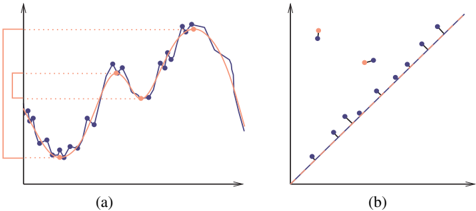
The paper proves that persistence diagrams of real-valued functions on topological spaces are stable: small changes in the function imply small changes in the diagram under the bottleneck distance. It applies this stability to homology estimation from point samples and to comparing/classifying geometric shapes.
Key findings
- The Main Theorem states that for a triangulable space \(X\) with continuous tame functions \(f,g:X\to\mathbb R\), the persistence diagrams satisfy \(d_B(D(f),D(g)) \le \|f-g\|_\infty\).
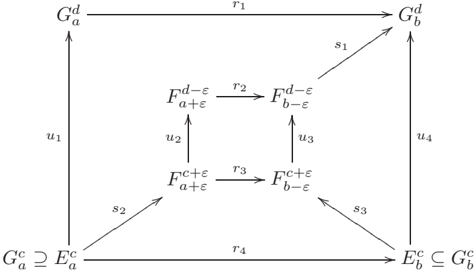
- The proof first establishes stability for the Hausdorff distance using the Box Lemma, then strengthens it to the bottleneck distance using the Easy Bijection Lemma and an Interpolation Lemma for piecewise linear functions.
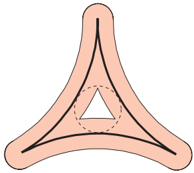
- The Homology Inference Theorem states that for all real \(\varepsilon\) with \(d_H(X,P) < \varepsilon < \mathrm{hfs}_X/4\) and all sufficiently small \(\delta>0\), the dimensions of the homology group of \(X+\delta\) and \(P^\varepsilon_{3\varepsilon}\) are either both infinite or both finite and equal.
- The Barcode Theorem states that if a diffeomorphism \(\Phi:\mathbb R^d\to\mathbb R^d\) has derivatives up to second order close to those of a rigid motion, then the bottleneck distance between the barcodes of a hypersurface \(S\subseteq\mathbb R^d\) and its perturbation \(\Phi(S)\) is small.
Methods
- Theoretical study of real-valued functions on topological spaces, using homology with \(\mathbb Z_2\) coefficients, homological critical values, tame functions, persistent homology groups, and persistence diagrams.
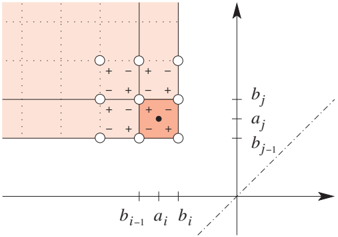
- Stability is proved by algebraic-topological diagram chasing: the Quadrant Lemma and Box Lemma bound multiplicities in nested quadrants/boxes, and the bottleneck case is handled by composing bijections for very close functions and interpolating between piecewise linear functions.
- Applications are derived as corollaries; the paper reports no empirical data, experiments, or numerical evaluations.
Limitations
- The paper explicitly leaves open whether the Main Theorem extends to non-tame functions, whether other metrics on functions and persistence diagrams admit similar inequalities, and how to exploit the result algorithmically.
- Evident from the text: the main theorem assumes a triangulable space and continuous tame functions, and the proof uses compactness, finite simplicial complexes, and finite-dimensional homology groups.
- Evident from the text: the applications are theoretical corollaries, and the Barcode Theorem states only that the bottleneck distance is “small” under \(C^2\)-closeness to a rigid motion, without a quantitative bound.
Model-written summary. Check it against the paper before relying on it.
Integrity signals
Registry
Cites
Statistics
Figures
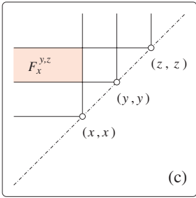
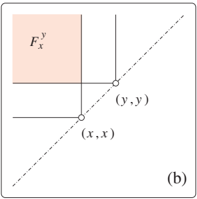
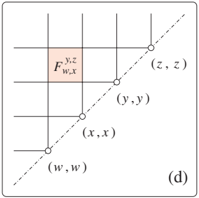
![Fig. 3 (a) Homology group of the sub-level set f -1 ( -∞ , x ]. (b) Image of Fx in Fy . (c) Kernel of surjection F y x → F z x . (d) Quotient of F y , z x and F y , z w .](https://figures.cochat.ai/paper-figures/e3fbb536dd354c4daa1aeec1692fa302/stability-of-persistence-diagrams-figure-3.png)
Verification
Claims the paper makes
1 Valid · 7 Not valid · 19 Not checked · 31 Own results and interpretations
The cited sources support only part of this claim — read each source’s verdict below.
In the paper
“Indeed, the dimensions of the persistent homology groups that appear in the theorem are efficiently computable using the persistence algorithm on the filtration of alpha complexes [11], [12].”
What the sources say
- Not matchedcites [11] 11. H. Edelsbrunner, D. Letscher, and A. Zomorodian. Topological persistence and simplification. Discrete Comput . Geom . 28 (2002), 511-533.
More than one paper fits this citation.
- Partly supportedcites [12] 12. H. Edelsbrunner and E. P. M¨ ucke. Three-dimensional alpha shapes. ACM Trans . Comput . Graphics 13 (1994), 43-72. sourceExperimental — accuracy not yet measured
Section 3.3, “Alpha Complexes” (page unavailable), defines alpha complexes and states that each is a subcomplex of those at larger alpha values, supporting the filtration part. “Features and Signatures” (page unavailable) describes an efficient way to track connected components, but calls higher-order homology signatures more challenging; it does not describe a persistence algorithm or establish efficient computation of the claimed persistent-homology dimensions. (LLM, conf=0.86)
plainstates a cause- Asserted: passes — The authors put it forward as true.
- Checkable: passes — It can be checked against evidence.
- Load-bearing: passes — The paper’s conclusions depend on it.
- Based: passes — The paper gives a reason why it holds.
- Not matched
A result the paper states — it cites no source for it, so there is none to check. The quote shows it is in the paper.
In the paper
“Easy Bijection Lemma. Let f , g : X → R be tame functions and let g be very close to f . Then the persistence diagrams satisfy d B ( D ( f ), D ( g )) ≤ ‖ f -g ‖∞ .”
plainstates an association- Asserted: passes — The authors put it forward as true.
- Checkable: passes — It can be checked against evidence.
- Load-bearing: passes — The paper’s conclusions depend on it.
- Based: passes — The paper gives a reason why it holds.
A result the paper states — it cites no source for it, so there is none to check. The quote shows it is in the paper.
In the paper
“Critical Value Lemma. If some closed interval [ x , y ] contains no homological critical value of f , then f y x is an isomorphism for every integer k .”
plainstates a cause- Asserted: passes — The authors put it forward as true.
- Checkable: passes — It can be checked against evidence.
- Load-bearing: passes — The paper’s conclusions depend on it.
- Based: passes — The paper gives a reason why it holds.
A result the paper states — it cites no source for it, so there is none to check. The quote shows it is in the paper.
In the paper
“Writing ε = ‖ f -g ‖∞ , we have f -1 ( -∞ , x ] ⊆ g -1 ( -∞ , x + ε ] for all x ∈ R .”
plainstates a cause- Asserted: passes — The authors put it forward as true.
- Checkable: passes — It can be checked against evidence.
- Load-bearing: passes — The paper’s conclusions depend on it.
- Based: passes — The paper gives a reason why it holds.
A result the paper states — it cites no source for it, so there is none to check. The quote shows it is in the paper.
In the paper
“Interpolation Lemma.”
- Also stated in: § Interpolation Lemma. · p. 13 · boosted
“However, since the h λ i sample the linear interpolation from ˆ f to ˆ g , the latter sum equals ‖ ˆ f - ˆ g ‖∞ , which concludes the proof.”
boostedstates an association- Asserted: passes — The authors put it forward as true.
- Checkable: passes — It can be checked against evidence.
- Load-bearing: passes — The paper’s conclusions depend on it.
- Based: passes — The paper gives a reason why it holds.
- Also stated in: § Interpolation Lemma. · p. 13 · boosted
21 more claims
Create a free account to see all 58 claims and every source verdict.
- Probably not a substantial claim. 28
- It may state two separate claims as one. 13
Claims other papers make about this one
Each is checked against this paper’s own text: does it say what the citing paper says it does?
The source backs part of the claim, not all of it — or backs it for a different population, condition or comparison.
In the citing paper
“Let X be any space which is homeomorphic to a simplicial complex, and suppose f, g : X → R are continuous tame functions. Then the persistence vector spaces { H k ( f -1 (( -∞ , r ]) } r and { H k ( g -1 (( -∞ , r ]) } r are finitely presented, and therefore admit barcode descriptions for each k ∈ N”
From Topological pattern recognition for point cloud data (2014) · cites this paper as Cohen-Steiner et al. (2007)
Experimental — accuracy not yet measuredThe cited source says what the claim attributes to it.
In the citing paper
“Also, results about barcodes under the general heading have now begun to appear (see [15] and [16]).”
From Topology and data (2009) · cites this paper as [15]
Citations
Cites
Rayward-Smith, V. J. (1991) · Journal of the Operational Research Society · doi:10.1057/jors.1991.155 · Cited by 16,821
Spanier, E. H. (1990) · Cited by 3,014
Three-dimensional alpha shapes
Edelsbrunner, H., & Mücke, E. P. (1994) · ACM Transactions on Graphics · doi:10.1145/174462.156635 · Cited by 2,488
Self-citationElements of Algebraic Topology
Munkres, J. R. (2018) · CRC Press eBooks · doi:10.1201/9780429493911 · Cited by 2,102
Introduction to Algorithms, Second Edition
Rivest, R. L., Leiserson, C. E., Cormen, T. H., & Stein, C. (2001) · Cited by 1,984
Topological Persistence and Simplification
Edelsbrunner, Letscher, & Zomorodian (2002) · Discrete & Computational Geometry · doi:10.1007/s00454-002-2885-2 · Cited by 1,779
Introduction to linear algebra
(2016) · Cybersecurity and Applied Mathematics · doi:10.1016/b978-0-12-804452-0.09998-x · Cited by 1,646
Zomorodian, A., & Carlsson, G. (2005) · Discrete & Computational Geometry · doi:10.1007/s00454-004-1146-y · Cited by 1,591
Milnor, J. (1963) · doi:10.1515/9781400881802 · Cited by 1,390
Morphometric Tools for Landmark Data.
Bookstein, F. (1998) · Biometrics · doi:10.2307/2534038 · Cited by 1,378
Research works printed but not linked: 2
- [16]16. J. Milnor. Morse Theory . Princeton University Press, New Jersey, 1963.
- [19]19. V. Robins. Toward computing homology from finite approximations. Topology Proceedings 24 (1999), 503-532.
Cited by
Items 201–300 of 1,300
The Compressed Annotation Matrix: An Efficient Data Structure for Computing Persistent Cohomology
Boissonnat, J., Dey, T. K., & Maria, C. (2013) · Lecture notes in computer science · doi:10.1007/978-3-642-40450-4_59 · Cited by 38
Universality of the homotopy interleaving distance
Blumberg, A. J., & Lesnick, M. (2022) · Transactions of the American Mathematical Society · doi:10.1090/tran/8738 · Cited by 75
An output-sensitive algorithm for persistent homology
Chen, C., & Kerber, M. (2012) · Computational Geometry · doi:10.1016/j.comgeo.2012.02.010 · Cited by 38
Boundary Measures for Geometric Inference
Chazal, F., Cohen-Steiner, D., & Mérigot, Q. (2007) · Foundations of Computational Mathematics · doi:10.1007/s10208-009-9056-2 · Cited by 45
Self-citationNormal cone approximation and offset shape isotopy
Chazal, F., Cohen‐Steiner, D., & Lieutier, A. (2008) · Computational Geometry · doi:10.1016/j.comgeo.2008.12.002 · Cited by 41
Self-citationA fast algorithm for constructing topological structure in large data
Liu, X., Xie, Z., & Yi, D.-Y. (2012) · Homology Homotopy and Applications · doi:10.4310/hha.2012.v14.n1.a11 · Cited by 31
Yoo, J., Kim, E. Y., Ahn, Y. M., & Ye, J. C. (2016) · Journal of Neuroscience Methods · doi:10.1016/j.jneumeth.2016.04.001 · Cited by 55
The fiber of the persistence map for functions on the interval
Curry, J. M. (2018) · Journal of Applied and Computational Topology · doi:10.1007/s41468-019-00024-z · Cited by 35
Early warning signals of financial crises using persistent homology
Ismail, M. S., Noorani, M. S. M., Ismail, M., Razak, F. A., & Alias, M. A. (2021) · Physica A Statistical Mechanics and its Applications · doi:10.1016/j.physa.2021.126459 · Cited by 50
The Edit Distance for Reeb Graphs of Surfaces
Fabio, B. D., & Landi, C. (2016) · Discrete & Computational Geometry · doi:10.1007/s00454-016-9758-6 · Cited by 36
Embeddings of persistence diagrams into Hilbert spaces
Bubenik, P., & Wagner, A. (2020) · Journal of Applied and Computational Topology · doi:10.1007/s41468-020-00056-w · Cited by 36
Analysis of global stock markets’ connections with emphasis on the impact of COVID-19
Guo, H., Zhao, X., Yu, H., & Zhang, X. (2021) · Physica A Statistical Mechanics and its Applications · doi:10.1016/j.physa.2021.125774 · Cited by 36
Persistence-Based Pooling for Shape Pose Recognition
Bonis, T., Ovsjanikov, M., Oudot, S., & Chazal, F. (2016) · Lecture notes in computer science · doi:10.1007/978-3-319-39441-1_3 · Cited by 45
Quantum algorithm for persistent Betti numbers and topological data analysis
Hayakawa, R. (2022) · Quantum · doi:10.22331/q-2022-12-07-873 · Cited by 76
Analysis of Scalar Fields over Point Cloud Data
Chazal, F., Guibas, L., Oudot, S., et al. (2009) · ACM-SIAM Symposium on Discrete Algorithms (SODA) · doi:10.1137/1.9781611973068.111 · Cited by 35
Quantifying Transversality by Measuring the Robustness of Intersections
Edelsbrunner, H., Morozov, D., & Patel, A. (2011) · Foundations of Computational Mathematics · doi:10.1007/s10208-011-9090-8 · Cited by 34
Self-citationTopological Data Analysis for Multivariate Time Series Data
El-Yaagoubi, A. B., Chung, M. K., & Ombao, H. (2023) · Entropy · doi:10.3390/e25111509 · Cited by 52
Simplification of complexes for persistent homology computations
Dłotko, P., & Wagner, H. (2014) · Homology Homotopy and Applications · doi:10.4310/hha.2014.v16.n1.a3 · Cited by 34
Persistent homology and non-Gaussianity
Cole, A., & Shiu, G. (2018) · Journal of Cosmology and Astroparticle Physics · doi:10.1088/1475-7516/2018/03/025 · Cited by 39
Evaluating State Space Discovery by Persistent Cohomology in the Spatial Representation System
Kang, L., Xu, B., & Morozov, D. (2021) · Frontiers in Computational Neuroscience · doi:10.3389/fncom.2021.616748 · Cited by 42
Gao, M., Chen, C., Zhang, S., et al. (2013) · Lecture notes in computer science · doi:10.1007/978-3-642-38868-2_16 · Cited by 34
On the Bootstrap for Persistence Diagrams and Landscapes
Chazal, F., Fasy, B. T., Lecci, F., Rinaldo, A., Singh, A., & Wasserman, L. (2015) · Modeling and Analysis of Information Systems · doi:10.18255/1818-1015-2013-6-111-120 · Cited by 41
Geometric and Topological Inference
Boissonnat, J., Chazal, F., & Yvinec, M. (2018) · Cambridge University Press eBooks · doi:10.1017/9781108297806 · Cited by 198
Topological Machine Learning with Persistence Indicator Functions
Rieck, B., Sadlo, F., & Leitte, H. (2020) · Mathematics and visualization · doi:10.1007/978-3-030-43036-8_6 · Cited by 39
Li, M., Klein, L. L., Duncan, K. E., Jiang, N., Chitwood, D. H., Londo, J. P., Miller, A. J., & Topp, C. N. (2019) · Journal of Experimental Botany · doi:10.1093/jxb/erz394 · Cited by 36
Retrieval and classification methods for textured 3D models: a comparative study
Biasotti, S., Cerri, A., Aono, M., Hamza, A. B., Garro, V., Giachetti, A., Giorgi, D., Godil, A., Li, C., Sanada, C., et al. (2015) · The Visual Computer · doi:10.1007/s00371-015-1146-3 · Cited by 33
Approximate Čech Complex in Low and High Dimensions
Kerber, M., & Sharathkumar, R. (2013) · Lecture notes in computer science · doi:10.1007/978-3-642-45030-3_62 · Cited by 56
Uncovering the Topology of Time-Varying fMRI Data using Cubical PersistencePreprint
Rieck, B., Yates, T. S., Bock, C., et al. (2020) · arXiv (Cornell University) · doi:10.48550/arxiv.2006.07882 · Cited by 33
Kim, D., Wang, N. C., Ravikumar, V., Raghuram, D. R., Li, J., Patel, A., Wendt, R. E., Rao, G., & Rao, A. U. K. (2019) · Frontiers in Computational Neuroscience · doi:10.3389/fncom.2019.00052 · Cited by 35
Viterbo conjecture for Zoll symmetric spaces
Shelukhin, E. (2022) · Inventiones mathematicae · doi:10.1007/s00222-022-01124-x · Cited by 63
Dey, T. K., Shi, D., & Wang, Y. (2019) · ACM Journal of Experimental Algorithmics · doi:10.1145/3284360 · Cited by 37
Computing the Gromov-Hausdorff Distance for Metric Trees
Agarwal, P. K., Fox, K., Nath, A., Sidiropoulos, A., & Wang, Y. (2018) · ACM Transactions on Algorithms · doi:10.1145/3185466 · Cited by 75
Distance between extremum graphs
Narayanan, V., Thomas, D. M., & Natarajan, V. (2015) · IEEE Pacific Visualization Symposium · doi:10.1109/pacificvis.2015.7156386 · Cited by 33
A Scale Space Based Persistence Measure for Critical Points in 2D Scalar Fields
Reininghaus, J., Kotava, N., Günther, D., Kasten, J., Hagen, H., & Hotz, I. (2011) · IEEE Transactions on Visualization and Computer Graphics · doi:10.1109/tvcg.2011.159 · Cited by 31
Persistence codebooks for topological data analysis
Zieliński, B., Lipiński, M., Juda, M., Zeppelzauer, M., & Dłotko, P. (2020) · Artificial Intelligence Review · doi:10.1007/s10462-020-09897-4 · Cited by 42
A Framework for Differential Calculus on Persistence Barcodes
Leygonie, J., Oudot, S., & Tillmann, U. (2021) · Foundations of Computational Mathematics · doi:10.1007/s10208-021-09522-y · Cited by 73
A new topological entropy-based approach for measuring similarities among piecewise linear functions
Rucco, M., González-Díaz, R., Jiménez, M.-J., Atienza, N., Cristalli, C., Concettoni, E., Ferrante, A., & Merelli, E. (2016) · Signal Processing · doi:10.1016/j.sigpro.2016.12.006 · Cited by 41
Data Polygamy: The Many-Many Relationships among Urban Spatio-Temporal Data Sets
Chirigati, F., Doraiswamy, H., Damoulas, T., et al. (2016) · Warwick Research Archive Portal (University of Warwick) · doi:10.48550/arxiv.1610.06978 · Cited by 31
Statistical Inference Over Persistent Homology Predicts Fluid Flow in Porous Media
Moon, C., Mitchell, S. A., Heath, J. E., & Andrew, M. (2019) · Water Resources Research · doi:10.1029/2019wr025171 · Cited by 31
Topological Descriptors of Histology Images
Singh, N. P., Couture, H. D., Marron, J. S., et al. (2014) · Lecture notes in computer science · doi:10.1007/978-3-319-10581-9_29 · Cited by 31
Video-based descriptors for object recognition
Lee, T., & Soatto, S. (2011) · Image and Vision Computing · doi:10.1016/j.imavis.2011.08.003 · Cited by 29
A framework for mapping with biobotic insect networks: From local to global maps
Dirafzoon, A., Bozkurt, A., & Lobaton, E. (2017) · Robotics Auton. Syst. · doi:10.1016/j.robot.2016.11.004 · Cited by 29
The observable structure of persistence modulesPreprint
Crawley-Boevey, W., Vin, & de Silva, V. (2014) · Cited by 38
Fractal dimension estimation with persistent homology: A comparative study
Jaquette, J., & Schweinhart, B. (2019) · Communications in Nonlinear Science and Numerical Simulation · doi:10.1016/j.cnsns.2019.105163 · Cited by 36
Behzadi, M. M., & Ilieş, H. (2021) · Journal of Mechanical Design · doi:10.1115/1.4052757 · Cited by 38
A kernel for multi-parameter persistent homology
Corbet, R., Fugacci, U., Kerber, M., Landi, C., & Wang, B. (2019) · Computers & Graphics X · doi:10.1016/j.cagx.2019.100005 · Cited by 42
Simplicial Homology of Random Configurations
Decreusefond, L., Ferraz, E., Randriambololona, H., et al. (2014) · Advances in Applied Probability · doi:10.1239/aap/1401369697 · Cited by 30
Persistent homology analysis of ion aggregations and hydrogen-bonding networks
Xia, K. (2018) · Physical Chemistry Chemical Physics · doi:10.1039/c8cp01552j · Cited by 34
Persistent homology for kernels, images, and cokernels
Cohen-Steiner, D., Edelsbrunner, H., Harer, J., & Morozov, D. (2009) · ACM-SIAM Symposium on Discrete Algorithms · doi:10.1137/1.9781611973068.110 · Cited by 79
Self-citationWong, E., Palande, S., Wang, B., et al. (2016) · IEEE International Symposium on Biomedical Imaging (ISBI) · doi:10.1109/isbi.2016.7493506 · Cited by 29
Approximating cycles in a shortest basis of the first homology group from point data
Dey, T. K., Sun, J. Z., & Wang, Y. (2011) · Inverse Problems · doi:10.1088/0266-5611/27/12/124004 · Cited by 27
Persistent homology and applied homotopy theory
Carlsson, G. (2020) · Chapman & Hall/CRC eBooks · doi:10.1201/9781351251624-8 · Cited by 42
Multidimensional Persistence and Noise
Scolamiero, M., Chachólski, W., Lundman, A., Ramanujam, R., & Öberg, S. (2016) · Foundations of Computational Mathematics · doi:10.1007/s10208-016-9323-y · Cited by 68
Cell cycle controls long-range calcium signaling in the regenerating epidermis
Moore, J. L., Bhaskar, D., Gao, F., Matte-Martone, C. C., Du, S., Lathrop, E., Ganesan, S., Shao, L., Norris, R. P., Sanz, N. C., et al. (2023) · The Journal of Cell Biology · doi:10.1083/jcb.202302095 · Cited by 31
Persistent Intersection Homology
Bendich, P. L., & Harer, J. (2010) · Foundations of Computational Mathematics · doi:10.1007/s10208-010-9081-1 · Cited by 33
Self-citationOn the Reliability of Individual Brain Activity Networks
Cassidy, B., Bowman, F. D., Rae, C. D., & Solo, V. (2017) · IEEE Transactions on Medical Imaging · doi:10.1109/tmi.2017.2774364 · Cited by 27
A topological data analysis based classification method for multiple measurements
Riihimäki, H., Chachólski, W., Theorell, J., Hillert, J. A., & Ramanujam, R. (2020) · BMC Bioinformatics · doi:10.1186/s12859-020-03659-3 · Cited by 27
Edit Distance and Persistence Diagrams over Lattices
McCleary, A., & Patel, A. (2022) · SIAM Journal on Applied Algebra and Geometry · doi:10.1137/20m1373700 · Cited by 57
The Middle Science: Traversing Scale In Complex Many-Body Systems
Clark, A. E., Adams, H., Hernandez, R., Krylov, A. I., Niklasson, A. M. N., Sarupria, S., Wang, Y., Wild, S. M., & Yang, Q. (2021) · ACS Central Science · doi:10.1021/acscentsci.1c00685 · Cited by 34
Chen, C., & Freedman, D. (2008) · DROPS (Schloss Dagstuhl – Leibniz Center for Informatics) · doi:10.4230/lipics.stacs.2008.1343 · Cited by 25
Scalar Field Analysis over Point Cloud Data
Chazal, F., Guibas, L. J., Oudot, S., & Škraba, P. (2011) · Discrete & Computational Geometry · doi:10.1007/s00454-011-9360-x · Cited by 50
Persistent homology of unweighted complex networks via discrete Morse theory
Kannan, H., Saucan, E., Roy, I., & Samal, A. (2019) · MPG.PuRe (Max Planck Society) · Cited by 27
Topological approaches to skin disease image analysis
Chung, Y.-M., Hu, C.-S., Lawson, A., & Smyth, C. (2018) · IEEE International Conference on Big Data (BigData) · doi:10.1109/bigdata.2018.8622175 · Cited by 37
Geometric Inference on Kernel Density Estimates
Phillips, J. M., Wang, B., & Zheng, Y. L. (2013) · DROPS (Schloss Dagstuhl – Leibniz Center for Informatics) · doi:10.4230/lipics.socg.2015.857 · Cited by 54
Atom-specific persistent homology and its application to protein flexibility analysis
Bramer, D., & Wei, G. (2020) · Computational and Mathematical Biophysics · doi:10.1515/cmb-2020-0001 · Cited by 32
Lisitsa, V. V., Bazaikin, Y., & Станиславовна, Х. Т. (2020) · Applied Mathematical Modelling · doi:10.1016/j.apm.2020.06.037 · Cited by 27
Theory of interleavings on categories with a flow
de Silva, V., Munch, E., & Stefanou, A. (2018) · Theory and applications of categories · doi:10.70930/tac/22cqkxsw · Cited by 26
The centenary of of the re-interment of John Hunter.
GORDON-TAYLOR, G. (1959) · PubMed Central · doi:10.5555/2095116.2095223 · Cited by 24
Persistence-sensitive simplication of functions on surfaces in linear timePreprint
Attali, D., Glisse, M., Hornus, S., et al. (2009) · HAL (Le Centre pour la Communication Scientifique Directe) · Cited by 27
Discovering the Whole by the Coarse: A topological paradigm for data analysis
Krim, H., Gentimis, T., & Chintakunta, H. (2016) · IEEE Signal Processing Magazine · doi:10.1109/msp.2015.2510703 · Cited by 28
Approximating Continuous Functions on Persistence Diagrams Using Template Functions
Perea, J. A., Munch, E., & Khasawneh, F. A. (2022) · Foundations of Computational Mathematics · doi:10.1007/s10208-022-09567-7 · Cited by 37
Spatiotemporal Persistent Homology for Dynamic Metric Spaces
Kim, W., & Mémoli, F. (2020) · Discrete & Computational Geometry · doi:10.1007/s00454-019-00168-w · Cited by 61
Topological learning for brain networks
Songdechakraiwut, T., & Chung, M. K. (2023) · The Annals of Applied Statistics · doi:10.1214/22-aoas1633 · Cited by 46
On the Stability of Interval Decomposable Persistence Modules
Bjerkevik, H. B. (2021) · Discrete & Computational Geometry · doi:10.1007/s00454-021-00298-0 · Cited by 26
Topological data analysis for geographical information science using persistent homology
Corcoran, P., & Jones, C. B. (2023) · International Journal of Geographical Information Systems · doi:10.1080/13658816.2022.2155654 · Cited by 28
Topological EEG-Based Functional Connectivity Analysis for Mental Workload State Recognition
Yan, Y., Ma, L., Liu, Y.-S., Ivanov, K., Wang, J., Xiong, J., Li, A., He, Y., & Wang, L. (2023) · IEEE Transactions on Instrumentation and Measurement · doi:10.1109/tim.2023.3265114 · Cited by 26
Graph induced complex on point data
Dey, T., Fan, F.-T., & Wang, Y.-S. (2013) · International Symposium on Computational Geometry · doi:10.1145/2462356.2462387 · Cited by 68
Statistical inference using the Morse-Smale complex
Chen, Y., Genovese, C. R., & Wasserman, L. (2017) · Electronic Journal of Statistics · doi:10.1214/17-ejs1271 · Cited by 37
The Stability of the Apparent Contour of an Orientable 2-Manifold
Edelsbrunner, H., Morozov, D., & Patel, A. (2010) · Mathematics and visualization · doi:10.1007/978-3-642-15014-2_3 · Cited by 26
Self-citationApplications of Persistent Homology to Time Varying Systems
Munch, E. (2013) · DukeSpace (Duke University) · Cited by 23
On the Hofer-Zehnder conjecture
Shelukhin, E. (2022) · Annals of Mathematics · doi:10.4007/annals.2022.195.3.1 · Cited by 41
SARS-COV-2: SIR Model Limitations and Predictive Constraints
Telles, C. R., Lopes, H., & Franco, D. (2021) · Symmetry · doi:10.3390/sym13040676 · Cited by 30
Salch, A., Regalski, A., Abdallah, H., Suryadevara, R., Catanzaro, M. J., & Diwadkar, V. A. (2021) · PLoS ONE · doi:10.1371/journal.pone.0255859 · Cited by 34
The Persistence Space in Multidimensional Persistent Homology
Cerri, A., & Landi, C. (2013) · Lecture notes in computer science · doi:10.1007/978-3-642-37067-0_16 · Cited by 21
Stability of 2-Parameter Persistent Homology
Blumberg, A. J., & Lesnick, M. (2022) · Foundations of Computational Mathematics · doi:10.1007/s10208-022-09576-6 · Cited by 56
Learning persistent homology of 3D point clouds
Zhou, C., Dong, Z., & Lin, H. (2021) · Computers & Graphics · doi:10.1016/j.cag.2021.10.022 · Cited by 33
Fisher forecasts for primordial non-Gaussianity from persistent homology
Biagetti, M., Calles, J., Castiblanco, L., Cole, A., & Noreña, J. (2022) · Journal of Cosmology and Astroparticle Physics · doi:10.1088/1475-7516/2022/10/002 · Cited by 35
Human Gait Identification Using Persistent Homology
León, J. L., García-Reyes, E. B., & González-Díaz, R. (2012) · Lecture notes in computer science · doi:10.1007/978-3-642-33275-3_30 · Cited by 24
Combining Persistent Homology and Invariance Groups for Shape Comparison
Frosini, P., & Jabłoński, G. (2016) · Discrete & Computational Geometry · doi:10.1007/s00454-016-9761-y · Cited by 36
The Persistent Homology of Distance Functions under Random Projection
Sheehy, D. R. (2014) · Annual Symposium on Computational Geometry (SoCG) · doi:10.1145/2582112.2582126 · Cited by 42
Persistent homology and partial similarity of shapes
Fabio, B. D., & Landi, C. (2011) · Pattern Recognition Letters · doi:10.1016/j.patrec.2011.11.003 · Cited by 23
Memory-Efficient Computation of Persistent Homology for 3D Images Using Discrete Morse Theory
Günther, D., Reininghaus, J., Hotz, I., et al. (2011) · SIBGRAPI Conference on Graphics, Patterns and Images (SIBGRAPI) · doi:10.1109/sibgrapi.2011.24 · Cited by 24
Feasibility of topological data analysis for event-related fMRI
Ellis, C. T., Lesnick, M., Henselman‐Petrusek, G., Keller, B., & Cohen, J. D. (2019) · Network Neuroscience · doi:10.1162/netn_a_00095 · Cited by 27
Statistical topology using persistence landscapesPreprint
Bubenik, P. (2012) · arXiv (Cornell University) · Cited by 24
Linear-Size Approximations to the Vietoris–Rips Filtration
Sheehy, D. (2012) · Discrete & Computational Geometry · doi:10.1145/2261250.2261286 · Cited by 180
Multiscale Projective Coordinates via Persistent Cohomology of Sparse Filtrations
Perea, J. A. (2017) · Discrete & Computational Geometry · doi:10.1007/s00454-017-9927-2 · Cited by 34
Topology Applied to Machine Learning: From Global to Local
Adams, H., & Moy, M. (2021) · Frontiers in Artificial Intelligence · doi:10.3389/frai.2021.668302 · Cited by 30
Geometric Inference on Kernel Density EstimatesPreprint
Phillips, J. M., Wang, B., & Zheng, Y. L. (2013) · arXiv (Cornell University) · doi:10.48550/arxiv.1307.7760 · Cited by 23
Geometry-Aware Merge Tree Comparisons for Time-Varying Data With Interleaving Distances
Yan, L., Masood, T. B., Rasheed, F., Hotz, I., & Wang, B. (2022) · IEEE Transactions on Visualization and Computer Graphics · doi:10.1109/tvcg.2022.3163349 · Cited by 31
Yan, Y., Liu, Y.-S., Li, C., Wang, J., Ma, L., Xiong, J., Zhao, X., & Wang, L. (2022) · IEEE Sensors Journal · doi:10.1109/jsen.2022.3142750 · Cited by 27
Metadata
- Authors
- Cohen-Steiner, D., Edelsbrunner, H., & Harer, J.
- Affiliations
- Duke University (US)
- Corresponding author
- Edelsbrunner, Herbert
- Harer, John
- Venue
- Discrete & Computational Geometry
- Published
- 2006-12-12
- Volume
- 37
- Issue
- 1
- Pages
- 103-120
- ISSN
- 0179-5376 (ISSN-L)
- 1432-0444
- OpenAlex
- W2037613900
- Cited by
- 1,280
- References
- 30
- Citations by year
- 2026: 102 · 2025: 89 · 2024: 69 · 2023: 97 · 2022: 78 · 2021: 132 · 2020: 109 · 2019: 89 · 2018: 92 · 2017: 50 · 2016: 60 · 2015: 54 · 2014: 58 · 2013: 48 · 2012: 29
- FWCI
- 18.03
- Type
- journal article
- Language
- en
- Open access
- bronze
- doi.org
- Licence
- www.springer.com/tdm (tdm)
- Locations
- Discrete & Computational Geometry (publishedVersion)
- Funders
- National Science Foundation (0086013)
- Defense Advanced Research Projects Agency (HR0011, HR0011-05-1-0007)
- Topics
- Physical Sciences › Computer Science › Computational Theory and Mathematics › Topological and Geometric Data Analysis
- Physical Sciences › Mathematics › Geometry and Topology › Geometric and Algebraic Topology
- Physical Sciences › Mathematics › Applied Mathematics › Geometric Analysis and Curvature Flows
- Keywords
- persistence diagrams, stability, topological data analysis, metric spaces, shape comparison, real functions, simplicial complexes
About these checks
Registry, retraction, Cites and statistics results are computed, not judged, with one exception: a printed reference that no index lists is read once by a model before it counts as a citation error. Claims are extracted by a model and kept only when their quote appears verbatim in the text; each cited source is then checked, with a model’s help, for whether it says what the claim relies on. Those verdicts can be wrong — read the claim’s quote and the cited source before relying on one.
The claim verdicts this report counts are experimental: their accuracy is not yet measured.
A language model drew the claims from the paper on 2026-10-10, under version 3 of the claim definition (model deepseek-v4.1-flash, prompt extract-v3).
A second model labelled each claim on 2026-10-10 (model jev-1.13-20260917, definition revision gold-guideline-v0.2).
Cited sources are checked with a language model’s help (gpt-6-sol).
Statistics and arithmetic are recomputed, not judged.
Confidence bands are shown only for fields calibrated on our annotated test set. None is calibrated yet, so no band is shown.
What counts as a claim ›How we measure confidence ›How we check this ›
Are you an author, or do you see a problem with this page? Request a review
Data sources
Bibliographic data: Semantic Scholar, OpenAlex, Crossref.
Contains information from the Semantic Scholar Academic Graph Datasets, made available under the ODC Attribution License (ODC-BY 1.0).
Semantic Scholar’s data is described in: Kinney, R., et al. (2023). The Semantic Scholar Open Data Platform. arXiv:2301.10140.
