

Generative Artificial Intelligence (GAI) in Teaching and Learning Processes at the K-12 Level: A Systematic Review
Open accessThe DOI matches its Crossref record; 158 of the 158 references it cites were found in a registry or an index.
Abstract
This systematic review aims to provide a detailed and comprehensive overview of the use of Generative Artificial Intelligence (GAI) in K-12 education. Using the PRISMA method, this research examined articles published between 2016 and 2024, selecting 197 relevant studies from 5 databases and 2 journals. The methodology included the use of the Mentefacto Map to identify keywords and define inclusion and exclusion criteria, ensuring a systematic and replicable approach. The findings of the review indicate that GAI offers significant opportunities to personalize learning experiences, motivate students, improve assessment methods, and introduce innovative and immersive teaching practices. The use of ChatGPT in educational environments is a clear example of this. There are several critical issues that need attention, such as the need for continuous teacher training on ICT and the development of ministerial guidelines that also address ethical and privacy concerns. There is a notable lack of concrete studies and specific experiments, not only focused on STEM disciplines but also open to the arts/humanities, as well as practical examples of GAI use in daily teaching practices, which should guide educators in selecting the most suitable educational technologies for their teaching objectives. An original contribution of this review lies in identifying specific gaps in the existing literature, along with the proposal of research perspectives and insights that have so far been underexplored.
Overview
The claims and statistics of this paper haven’t been checked yet.
Free: it reads the open-access text and checks the first 5 claims that cite a source we can check. Create a free account to check every claim.
Integrity signals
Registry
Cites
Statistics
Figures

Verification
Claims the paper makes
The claims and statistics of this paper haven’t been checked yet.
Free: it reads the open-access text and checks the first 5 claims that cite a source we can check. Create a free account to check every claim.
Claims other papers make about this one
Each is checked against this paper’s own text: does it say what the citing paper says it does?
The source backs part of the claim, not all of it — or backs it for a different population, condition or comparison.
In the citing paper
“AI research in k-12 continues to privilege traditional AI (e.g., ITS) [30], emphasizing tool properties [31,32] or AI literacy [31,33,34] instead of tracing how AI is pedagogically enacted to enhance learning.”
From A Systematic Review of Generative AI in K–12: Mapping Goals, Activities, Roles, and Outcomes via the 3P Model (2025) · cites this paper as [30]
Experimental — accuracy not yet measured
Self-check
Percentages, sums and reported differences re-computed from the paper’s own numbers.
The self-check needs the paper’s full text.
Citations
Cites
Assessment and Classroom Learning
Black, P., & Wiliam, D. (1998) · Assessment in Education: Principles, Policy & Practice · doi:10.1080/0969595980050102 · Cited by 8,152 · cited 1×
“…effective formative and summative assessment of students’ complex knowledge (Chen et al., 2021), in both asynchronous and synchronous online Education contexts, promoting effective student learning and performance (Black & Wiliam, 1998) and combating school dropout (Papamitsiou & Economides, 2014).”
ChatGPT for Good? On Opportunities and Challenges of Large Language Models for Education
Kasneci, E., Seßler, K., Küchemann, S., Bannert, M., Dementieva, D., Fischer, F., Gasser, U., Groh, G., Günnemann, S., Hüllermeier, E., et al. (2023) · doi:10.35542/osf.io/5er8f · Cited by 7,552
ChatGPT for good? On opportunities and challenges of large language models for education
Kasneci, E., Sessler, K., Küchemann, S., Bannert, M., Dementieva, D., Fischer, F., Gasser, U., Groh, G., Günnemann, S., Hüllermeier, E., et al. (2023) · Learning and Individual Differences · doi:10.1016/j.lindif.2023.102274 · Cited by 7,326 · cited 1×
“…Educational Technologies in teaching practice (Crompton, 2022; Dawson, 2023; Zafari, 2022), current literature lacks comprehensive guidance on access to resources, content creation and methodologies combining pedagogy with advanced educational tools (Kasneci et al., 2023; Zhang & Aslan, 2021).”
Zawacki-Richter, O., Marín, V. I., Bond, M., & Gouverneur, F. (2019) · International Journal of Educational Technology in Higher Education · doi:10.1186/s41239-019-0171-0 · Cited by 7,242 · cited 4×
“Despite the importance of these themes, the effective implementation of AI in K-12 schools has not yet realized its full potential, emphasizing the need for further empirical research for more effective integration (Hrastinski et al., 2019; Zawacki-Richter et al., 2019).”
InfluentialArtificial Intelligence in Education: A Review
Chen, L., Chen, P., & Lin, Z. (2020) · IEEE Access · doi:10.1109/access.2020.2988510 · Cited by 4,133 · cited 4×
“While higher Education requires distinctly more advanced curricula and pedagogical approaches, K-12 environments require tailored methodologies to respond to the diverse cognitive levels of primary and secondary school students (Chen et al., 2020a, 2020b; Crompton et al., 2020).”
InfluentialBAİDOO-ANU, D., & OWUSU ANSAH, L. (2023) · Journal of AI · doi:10.61969/jai.1337500 · Cited by 3,939
Baidoo-Anu, D., & Owusu Ansah, L. (2023) · doi:10.2139/ssrn.4337484 · Cited by 3,004
Conceptualizing AI literacy: An exploratory review
Ng, D. T. K., Leung, J. K. L., Chu, S. K. W., & Qiao, M. S. (2021) · Computers and Education: Artificial Intelligence · doi:10.1016/j.caeai.2021.100041 · Cited by 2,205
Exploring the impact of artificial intelligence on teaching and learning in higher education
Popenici, S. A. D., & Kerr, S. (2017) · Research and Practice in Technology Enhanced Learning · doi:10.1186/s41039-017-0062-8 · Cited by 2,019 · cited 1×
“…focus on research into AIEd , considering the crucial distinctions in AI implementation at various educational levels, as the AIEd research is predominantly limited to higher Education contexts, leaving the K-12 sector relatively unexplored (Popenici & Kerr, 2017; Zawacki-Richter et al., 2019).”
Vision, challenges, roles and research issues of Artificial Intelligence in Education
Hwang, G.-J., Xie, H., Wah, B. W., & Gašević, D. (2020) · Computers and Education: Artificial Intelligence · doi:10.1016/j.caeai.2020.100001 · Cited by 1,435 · cited 1×
“…AI assist teachers in designing the learning and teaching process by leaving more repetitive tasks to systems and allowing them more time to focus on other aspects such as individualized strategies, data analysis, and creativity (Chan & Zary, 2019; Hwang et al., 2020; Zawacki-Richter et al., 2019).”
Practical and ethical challenges of large language models in education: A systematic scoping review
Yan, L., Sha, L., Zhao, L., Li, Y., Martinez‐Maldonado, R., Chen, G., Li, X., Jin, Y., & Gašević, D. (2024) · British Journal of Educational Technology · doi:10.1111/bjet.13370 · Cited by 1,435 · cited 2×
“…Chiu (2023), Frick (2024), Gökçearslan et al. (2024), Kim and Adlof (2023), Lee et al. (2023), Su and Yang (2023), Wang et al., (2024a, 2024b) Yan et al. (2024) and Zhang and Tur (2023) examine the use of ChatGPT and GAI to improve teaching workflows, personalize learning, and increase…”
(2016) · Open Research Online (The Open University) · Cited by 1,410
Technological pedagogical content knowledge – a review of the literature
Voogt, J., Fisser, P., Pareja Roblin, N., Tondeur, J., & van Braak, J. (2013) · Journal of Computer Assisted Learning · doi:10.1111/j.1365-2729.2012.00487.x · Cited by 1,095
Grassini, S. (2023) · Education Sciences · doi:10.3390/educsci13070692 · Cited by 1,048 · cited 2×
“Cox (2024), Carabantes et al. (2023), Deck (2024), Gabriska and Pribilova (2023), Grassini (2023), Mishra and Henriksen (2024), Mao et al. (2024), Hwang and Chen (2023), Hsu and Ching (2023), Jauhiainen and Guerra (2023), Richardson et al. (2023), van den Berg and du Plessis (2023), Vartiainen et…”
Application and theory gaps during the rise of artificial intelligence in education
Chen, X., Xie, H., Zou, D., & Hwang, G.-J. (2020) · Computers and Education: Artificial Intelligence · doi:10.1016/j.caeai.2020.100002 · Cited by 1,003 · cited 4×
“While higher Education requires distinctly more advanced curricula and pedagogical approaches, K-12 environments require tailored methodologies to respond to the diverse cognitive levels of primary and secondary school students (Chen et al., 2020a, 2020b; Crompton et al., 2020).”
InfluentialArtificial Intelligence in Education: The Three Paradigms
Ouyang, F., & Jiao, P. (2021) · Computers and Education: Artificial Intelligence · doi:10.1016/j.caeai.2021.100020 · Cited by 991 · cited 1×
“Ouyang and Jiao (2021) attempted to synthesize the use of Artificial Intelligence in Education through three paradigms: • AI-Directed Learning the student is the direct recipient of the AI system, which provides opportunities for individualized learning and immediate feedback.”
AI and education: guidance for policy-makers
UNESCO (2021) · doi:10.54675/pcsp7350 · Cited by 929
AI technologies for education: Recent research & future directions
Zhang, K., & Aslan, A. B. (2021) · Computers and Education: Artificial Intelligence · doi:10.1016/j.caeai.2021.100025 · Cited by 923 · cited 3×
“Comparison with previous studies, such as those by Crompton et al. (2020) and Zhang & Aslan, (2021), confirms the benefits of AI for Education, although some studies do not show significant improvements in student outcomes.”
Chan, K. S., & Zary, N. (2019) · JMIR Medical Education · doi:10.2196/13930 · Cited by 877 · cited 1×
“…AI assist teachers in designing the learning and teaching process by leaving more repetitive tasks to systems and allowing them more time to focus on other aspects such as individualized strategies, data analysis, and creativity (Chan & Zary, 2019; Hwang et al., 2020; Zawacki-Richter et al., 2019).”
Chiu, T. K. F. (2024) · Interactive Learning Environments · doi:10.1080/10494820.2023.2253861 · Cited by 852 · cited 8×
“Chiu (2023) highlights the growing importance of new skills such as AI and digital and media literacy, which should become central educational outcomes.”
InfluentialAI literacy in K-12: a systematic literature review
Casal-Otero, L., Catala, A., Fernández-Morante, C., Taboada, M., Cebreiro, B., & Barro, S. (2023) · International Journal of STEM Education · doi:10.1186/s40594-023-00418-7 · Cited by 724 · cited 3×
“Ayyildiz and Yilmaz (2023), Casal-Otero et al. (2023), and Chiu (2021) focus on curriculum design and strategies to balance AI use, highlighting the lack of structured frameworks.”
Unlocking the Power of ChatGPT: A Framework for Applying Generative AI in Education
Su (苏嘉红), J., & Yang (杨伟鹏), W. (2023) · ECNU Review of Education · doi:10.1177/20965311231168423 · Cited by 625
ChatGPT in education: Strategies for responsible implementation
Halaweh, M. (2023) · Contemporary Educational Technology · doi:10.30935/cedtech/13036 · Cited by 607 · cited 1×
“Educators must learn to adapt to these emerging technologies by treating them as evolutions of existing teaching tools and integrating them effectively into educational strategies (Halaweh, 2023; Hwang & Chen, 2023).”
(2014) · Educational Technology & Society · Cited by 598
Nazaretsky, T., Ariely, M., Cukurova, M., & Alexandron, G. (2022) · British Journal of Educational Technology · doi:10.1111/bjet.13232 · Cited by 589 · cited 3×
“Dawson et al. (2023), Jiang et al. (2022), Nazaretsky et al. (2022) and Robert-son and Muirhead (2022) explore the impact of AI in educational systems, highlighting concerns about excessive reliance on AI its impact on fundamental human skills such as self-regulation and creativity.”
Artificial intelligence for education: Knowledge and its assessment in AI-enabled learning ecologies
Cope, B., Kalantzis, M., & Searsmith, D. (2021) · Educational Philosophy and Theory · doi:10.1080/00131857.2020.1728732 · Cited by 518 · cited 1×
“In terms of practical impact, Cope et al. (2020) and Trust et al. (2023) note that GAI, as in the case of ChatGPT, can play multiple educational roles, from providing automated feedback to differentiating teaching.”
Xia, Q., Chiu, T. K. F., Lee, M., Sanusi, I. T., Dai, Y., & Chai, C. S. (2022) · Computers & Education · doi:10.1016/j.compedu.2022.104582 · Cited by 469 · cited 2×
“Ahmad et al. (2023), Bueno-Rocha et al. (2023), Jaiswal and Arun (2021), Majid and Lakshmi (2022) and Xia et al. (2022) emphasize the various benefits of AI in improving school practice.”
Chiu, T. K. F., & Chai, C.-S. (2020) · Sustainability · doi:10.3390/su12145568 · Cited by 448 · cited 2×
“Providing guidance to teachers on how to use AI to create efficient learning environments is crucial (Chiu, 2020; Miao et al., 2021), as the technological literacy among students (Wong & Looi, 2024).”
Handbook of Technological Pedagogical Content Knowledge (TPACK) for Educators
(2016) · Routledge eBooks · doi:10.4324/9781315771328 · Cited by 446
A review on artificial intelligence in education
Huang, J., Saleh, S., & Liu, Y. (2021) · Academic Journal of Interdisciplinary Studies · doi:10.36941/ajis-2021-0077 · Cited by 439 · cited 1×
“The latest frontier in the development of ICT for teaching is the GAI, the practical implementation of AI evolution as envisioned by Huang et al. (2021).”
van den Berg, G., & du Plessis, E. (2023) · Education Sciences · doi:10.3390/educsci13100998 · Cited by 401 · cited 2×
“…and Chen (2023), Hsu and Ching (2023), Jauhiainen and Guerra (2023), Mao et al. (2024), Mishra and Henriksen (2024), Richard-son et al. (2023), van den Berg and du Plessis (2023), Vartiainen et al. (2023), Yu and Guo (2024), analyze how GAI supports creativity and educational innovation,…”
Yu, H., & Guo, Y. (2023) · Frontiers in Education · doi:10.3389/feduc.2023.1183162 · Cited by 357 · cited 2×
“…and Henriksen (2024), Mao et al. (2024), Hwang and Chen (2023), Hsu and Ching (2023), Jauhiainen and Guerra (2023), Richardson et al. (2023), van den Berg and du Plessis (2023), Vartiainen et al. (2023) and Yu and Guo (2024) explore the use of GAI to support creativity and educational innovation.”
Data-Driven Artificial Intelligence in Education: A Comprehensive Review
Ahmad, K., Iqbal, W., El-Hassan, A., Qadir, J., Benhaddou, D., Ayyash, M., & Al-Fuqaha, A. (2024) · IEEE Transactions on Learning Technologies · doi:10.1109/tlt.2023.3314610 · Cited by 347 · cited 2×
“Ahmad et al. (2023), Bueno-Rocha et al. (2023), Jaiswal and Arun (2021), Majid and Lakshmi (2022) and Xia et al. (2022) emphasize the various benefits of AI in improving school practice.”
Artificial intelligence in education
Robertson, M. (1976) · Nature · doi:10.1038/262435a0 · Cited by 310 · cited 2×
“Ahmad et al. (2023), Bueno-Rocha et al. (2023), Jaiswal and Arun (2021), Majid and Lakshmi (2022) and Xia et al. (2022) emphasize the various benefits of AI in improving school practice.”
A systematic review of ChatGPT use in K‐12 education
Zhang, P., & Tur, G. (2024) · European Journal of Education · doi:10.1111/ejed.12599 · Cited by 280 · cited 2×
“…(2024), Gökçearslan et al. (2024), Kim and Adlof (2023), Lee et al. (2023), Su and Yang (2023), Wang et al., (2024a, 2024b) Yan et al. (2024) and Zhang and Tur (2023) examine the use of ChatGPT and GAI to improve teaching workflows, personalize learning, and increase interactivity, addressing…”
Methodology for systematic literature review applied to engineering and education
Torres-Carrion, P. V., Gonzalez-Gonzalez, C. S., Aciar, S., & Rodriguez-Morales, G. (2018) · 2018 IEEE Global Engineering Education Conference (EDUCON) · doi:10.1109/educon.2018.8363388 · Cited by 275
A Holistic Approach to the Design of Artificial Intelligence (AI) Education for K-12 Schools
Chiu, T. K. F. (2021) · TechTrends · doi:10.1007/s11528-021-00637-1 · Cited by 271 · cited 3×
“Ayyildiz and Yilmaz (2023), Casal-Otero et al. (2023), and Chiu (2021) focus on curriculum design and strategies to balance AI use, highlighting the lack of structured frameworks.”
Potential of Artificial Intelligence for Transformation of the Education System in India.
Jaiswal, A., & Arun, C. J. (2021) · International journal of education and development using information and communication technology · Cited by 270
Generative Artificial Intelligence in Education and Its Implications for Assessment
Mao, J., Chen, B., & Liu, J. C. (2024) · TechTrends · doi:10.1007/s11528-023-00911-4 · Cited by 270 · cited 2×
“…Cox (2024), Deck (2024), Gabriska and Pribilova (2023), Grassini (2023), Hwang and Chen (2023), Hsu and Ching (2023), Jauhiainen and Guerra (2023), Mao et al. (2024), Mishra and Henriksen (2024), Richard-son et al. (2023), van den Berg and du Plessis (2023), Vartiainen et al. (2023), Yu and Guo…”
Artificial intelligence (AI) learning tools in K-12 education: A scoping review
Yim, I. H. Y., & Su, J. (2024) · Journal of Computers in Education · doi:10.1007/s40692-023-00304-9 · Cited by 249 · cited 2×
“Yim and Su (2024) highlight the importance of preparing teachers to adapt AI technologies to students’ different learning styles, promoting active and engaging learning.”
Generative AI and ChatGPT in School Children’s Education: Evidence from a School Lesson
Jauhiainen, J. S., & Guerra, A. G. (2023) · Sustainability · doi:10.3390/su151814025 · Cited by 234 · cited 2×
“Carabantes et al. (2023), Cox (2024), Deck (2024), Gabriska and Pribilova (2023), Grassini (2023), Hwang and Chen (2023), Hsu and Ching (2023), Jauhiainen and Guerra (2023), Mao et al. (2024), Mishra and Henriksen (2024), Richard-son et al. (2023), van den Berg and du Plessis (2023), Vartiainen et…”
Cain, W. (2024) · TechTrends · doi:10.1007/s11528-023-00896-0 · Cited by 232 · cited 1×
“…(2022), Allam et al. (2023), Bolick and Da Silva (2023), Babu and Adhithya (2023), Blake (2024), Chen et al., (2023a, 2023b, 2023c), Chiu (2023), Cain (2024), Frick (2024), Gökçearslan et al. (2024), Lee et al. (2023), Kim and Adlof (2023), Su and Yang (2023), Wang et al., (2024a, 2024b), Yan…”
Artificial intelligence (AI) literacy education in secondary schools: a review
Ng, D. T. K., Su, J., Leung, J. K. L., & Chu, S. K. W. (2024) · Interactive Learning Environments · doi:10.1080/10494820.2023.2255228 · Cited by 225 · cited 1×
“Despite the growing body of research, the literature reveals a lack of clear frameworks on how AI should be taught (Ng et al., 2023; Su et al., 2023; Van Brummelen et al., 2021).”
The use of ChatGPT in the digital era: Perspectives on chatbot implementation
(2023) · Journal of Applied Learning & Teaching · doi:10.37074/jalt.2023.6.1.32 · Cited by 216
Handbook of Technological Pedagogical Content Knowledge (TPCK) for Educators
(2014) · Routledge eBooks · doi:10.4324/9781315759630 · Cited by 214
Affordances and challenges of artificial intelligence in K-12 education: a systematic review
Crompton, H., Jones, M. V., & Burke, D. (2024) · Journal of Research on Technology in Education · doi:10.1080/15391523.2022.2121344 · Cited by 213 · cited 4×
“This implies active involvement of teachers in developing teaching activities and learning tools, supporting the adoption of participatory and student-centered design approaches in school programs (Chiu, 2020; Crompton, 2022).”
InfluentialBower, M., Torrington, J., Lai, J. W. M., Petocz, P., & Alfano, M. (2024) · Education and Information Technologies · doi:10.1007/s10639-023-12405-0 · Cited by 213
A systematic review of teaching and learning machine learning in K-12 education
Sanusi, I. T., Oyelere, S. S., Vartiainen, H., Suhonen, J., & Tukiainen, M. (2023) · Education and Information Technologies · doi:10.1007/s10639-022-11416-7 · Cited by 212 · cited 1×
“Many studies also point to the lack of ministerial guidelines or frameworks for training on AI, with AI or by AI (Casal-Otero et al., 2023; Sanusi et al., 2023; Wang et al., 2024a, 2024b; Xia & Chiu, 2023).”
The use of AI in education: Practicalities and ethical considerations
Reiss, M. J. (2021) · London Review of Education · doi:10.14324/lre.19.1.05 · Cited by 211
Velander, J., Taiye, M. A., Otero, N., & Milrad, M. (2024) · Education and Information Technologies · doi:10.1007/s10639-023-11990-4 · Cited by 208
An Operationalized Understanding of Personalized Learning
Basham, J. D., Hall, T. E., Carter, R. A., & Stahl, W. M. (2016) · Journal of Special Education Technology · doi:10.1177/0162643416660835 · Cited by 206
Understanding User Trust in Artificial Intelligence-Based Educational Systems: Evidence from China
Qin, F., Li, K., & Yan, J. (2020) · British Journal of Educational Technology · doi:10.1111/bjet.12994 · Cited by 204
Tips and tricks in performing a systematic review
Sayers, A. (2008) · British Journal of General Practice · doi:10.3399/bjgp08x277168 · Cited by 198
Artificial Intelligence Applications in K-12 Education: A Systematic Literature Review
Zafari, M., Bazargani, J. S., Sadeghi-Niaraki, A., & Choi, S.-M. (2022) · IEEE Access · doi:10.1109/access.2022.3179356 · Cited by 185 · cited 2×
“2022) highlight the need for in-depth research and a shared agenda to integrate scattered contributions and develop new pedagogical approaches.”
A Primer on Generative Artificial Intelligence
Kalota, F. (2024) · Education Sciences · doi:10.3390/educsci14020172 · Cited by 177 · cited 1×
“Regarding student perception and AI literacy, Kalota (2024), Su (2024), Vandenberg and Mott (2023) and Yetisensoy and Rapoport (2023) Fourth Answer : current literature reveals gaps in research on the practical implementation of AI in K-12 Education.”
Pedagogical Design of K-12 Artificial Intelligence Education: A Systematic Review
Yue, M., Jong, M. S.-Y., & Dai, Y. (2022) · Sustainability · doi:10.3390/su142315620 · Cited by 176
Schools, teachers, and curriculum change: A balancing act?
Priestley, M. (2011) · Journal of Educational Change · doi:10.1007/s10833-010-9140-z · Cited by 171 · cited 1×
“…et al., 2020), but the diversity of students and available resources makes designing AI curricula for K-12 Education particularly complex, requiring greater personalization and increased support for teachers in mediating curriculum policies (Chiu, 2021; Priestley, 2011; Simmons & MacLean, 2018).”
Teaching Machine Learning in School: A Systematic Mapping of the State of the Art
MARQUES, L. S., GRESSE VON WANGENHEIM, C., & HAUCK, J. C. R. (2020) · Informatics in Education · doi:10.15388/infedu.2020.14 · Cited by 170 · cited 1×
“The interest in machine learning and its social impacts has demonstrated the effectiveness of AI Education units (Marques et al., 2020), but the diversity of students and available resources makes designing AI curricula for K-12 Education particularly complex, requiring greater personalization and…”
Artificial intelligence in special education: a systematic review
Hopcan, S., Polat, E., Ozturk, M. E., & Ozturk, L. (2023) · Interactive Learning Environments · doi:10.1080/10494820.2022.2067186 · Cited by 169
Yau, K. W., CHAI, C. S., Chiu, T. K. F., Meng, H., King, I., & Yam, Y. (2023) · Education and Information Technologies · doi:10.1007/s10639-022-11161-x · Cited by 160
Integrating generative AI in knowledge building
Chen, B., Zhu, X., & Díaz del Castillo H., F. (2023) · Computers and Education: Artificial Intelligence · doi:10.1016/j.caeai.2023.100184 · Cited by 159
The key artificial intelligence technologies in early childhood education: a review
Yi, H., Liu, T., & Lan, G. (2024) · Artificial Intelligence Review · doi:10.1007/s10462-023-10637-7 · Cited by 159
Learning theories for artificial intelligence promoting learning processes
Gibson, D., Kovanovic, V., Ifenthaler, D., Dexter, S., & Feng, S. (2023) · British Journal of Educational Technology · doi:10.1111/bjet.13341 · Cited by 155
Wang, N., Wang, X., & Su, Y.-S. (2024) · Asia Pacific Journal of Education · doi:10.1080/02188791.2024.2305156 · Cited by 154 · cited 1×
“Many studies also point to the lack of ministerial guidelines or frameworks for training on AI, with AI or by AI (Casal-Otero et al., 2023; Sanusi et al., 2023; Wang et al., 2024a, 2024b; Xia & Chiu, 2023).”
Hrastinski, S., Olofsson, A. D., Arkenback, C., Ekström, S., Ericsson, E., Fransson, G., Jaldemark, J., Ryberg, T., Öberg, L.-M., Fuentes, A., et al. (2019) · Postdigital Science and Education · doi:10.1007/s42438-019-00046-x · Cited by 145 · cited 1×
“Despite the importance of these themes, the effective implementation of AI in K-12 schools has not yet realized its full potential, emphasizing the need for further empirical research for more effective integration (Hrastinski et al., 2019; Zawacki-Richter et al., 2019).”
In-service teachers’ (mis)conceptions of artificial intelligence in K-12 science education
Antonenko, P., & Abramowitz, B. (2023) · Journal of Research on Technology in Education · doi:10.1080/15391523.2022.2119450 · Cited by 143 · cited 1×
“Finally, according to Addo (2023), Antonenko and Abramowitz (2023) and Sanusi et al. (2024), teacher training should be designed to overcome misconceptions about AI, improving motivation and developing advanced digital skills.”
Rizvi, S., Waite, J., & Sentance, S. (2023) · Computers and Education: Artificial Intelligence · doi:10.1016/j.caeai.2023.100145 · Cited by 142
Wang, T., & Cheng, E. C. K. (2021) · Computers and Education: Artificial Intelligence · doi:10.1016/j.caeai.2021.100031 · Cited by 141 · cited 3×
“Experimental studies conducted by Sperling et al. (2022) in Sweden, Wu et al. (2021) in China, Wang and Cheng (2021) in Hong Kong, and Jaiswal and Arun (2021) in India show that these technologies, although not yet fully exploited, produce positive results.”
Sanusi, I. T., Ayanwale, M. A., & Tolorunleke, A. E. (2024) · Computers and Education: Artificial Intelligence · doi:10.1016/j.caeai.2024.100202 · Cited by 137 · cited 1×
“Finally, according to Addo (2023), Antonenko and Abramowitz (2023) and Sanusi et al. (2024), teacher training should be designed to overcome misconceptions about AI, improving motivation and developing advanced digital skills.”
Human and artificial cognition
Siemens, G., Marmolejo-Ramos, F., Gabriel, F., Medeiros, K., Marrone, R., Joksimovic, S., & de Laat, M. (2022) · Computers and Education: Artificial Intelligence · doi:10.1016/j.caeai.2022.100107 · Cited by 133 · cited 1×
“Furthermore, Siemens et al. (2022) suggest that the future of learning should focus on collaboration between humans and artificial agents, promoting learning modes that enhance educational experiences in meaningful and relevant ways.”
Systematic review of research on artificial intelligence in K–12 education (2017–2022)
Martin, F., Zhuang, M., & Schaefer, D. (2024) · Computers and Education: Artificial Intelligence · doi:10.1016/j.caeai.2023.100195 · Cited by 132
Van Brummelen, J., Heng, T., & Tabunshchyk, V. (2021) · Proceedings of the AAAI Conference on Artificial Intelligence · doi:10.1609/aaai.v35i17.17844 · Cited by 128
Design implications of generative AI systems for visual storytelling for young learners
Han, A., & Cai, Z. (2023) · Proceedings of the 22nd Annual ACM Interaction Design and Children Conference · doi:10.1145/3585088.3593867 · Cited by 127
Emerging Technologies in K–12 Education: A Future HCI Research Agenda
Van Mechelen, M., Smith, R. C., Schaper, M.-M., Tamashiro, M., Bilstrup, K.-E., Lunding, M., Graves Petersen, M., & Sejer Iversen, O. (2023) · ACM Transactions on Computer-Human Interaction · doi:10.1145/3569897 · Cited by 125
Chai, C. S., Rahmawati, Y., & Jong, M. S. (2020) · Sustainability · doi:10.3390/su12219050 · Cited by 122 · cited 1×
“Research highlights gaps in professional development of teachers and differentiation of AI usage across educational levels (Chai et al., 2020a, 2020b; Lee et al., 2024).”
ÜZÜMCÜ, Ö., & AÇILMIŞ, H. (2023) · Technology Knowledge and Learning · doi:10.1007/s10758-023-09687-1 · Cited by 117 · cited 3×
“Sanabria-Navarro et al. (2023), Kaban (2023) and Uzumcu and Acilmis (2024) highlight the need for further research to deepen the effectiveness of different AI models applied to Education, developing detailed guidelines to facilitate the adoption of these technologies in schools, ensuring a…”
Psychological foundations of emerging technologies for teaching and learning in higher education
Crompton, H., Bernacki, M., & Greene, J. A. (2020) · Current Opinion in Psychology · doi:10.1016/j.copsyc.2020.04.011 · Cited by 116 · cited 3×
“While higher Education requires distinctly more advanced curricula and pedagogical approaches, K-12 environments require tailored methodologies to respond to the diverse cognitive levels of primary and secondary school students (Chen et al., 2020a, 2020b; Crompton et al., 2020).”
An examination of constructivist educational technologies: Key affordances and conditions
Feyzi-Behnagh, R., & Yasrebi, S. (2020) · British Journal of Educational Technology · doi:10.1111/bjet.13036 · Cited by 114
Artificial intelligence in classroom discourse: A systematic review of the past decade
Wang, D., Yang, T., & Chen, G. (2023) · International Journal of Educational Research · doi:10.1016/j.ijer.2023.102275 · Cited by 113 · cited 2×
“Many studies also point to the lack of ministerial guidelines or frameworks for training on AI, with AI or by AI (Casal-Otero et al., 2023; Sanusi et al., 2023; Wang et al., 2024a, 2024b; Xia & Chiu, 2023).”
Gökçearslan, Ş., Tosun, C., & Erdemir, Z. G. (2024) · International Journal of Technology in Education · doi:10.46328/ijte.600 · Cited by 112 · cited 2×
“…Bolick and Da Silva (2023), Babu and Adhithya (2023), Blake (2024), Cain (2024), Chen et al., (2023a, 2023b, 2023c), Chiu (2023), Frick (2024), Gökçearslan et al. (2024), Kim and Adlof (2023), Lee et al. (2023), Su and Yang (2023), Wang et al., (2024a, 2024b) Yan et al. (2024) and Zhang and…”
Immersive Learning Frameworks: A Systematic Literature Review
Fernandes, F., Rodrigues, C. S. C., Teixeira, E. N., & Werner, C. M. L. (2023) · IEEE Transactions on Learning Technologies · doi:10.1109/tlt.2023.3242553 · Cited by 111
Incidences of artificial intelligence in contemporary education
Sanabria-Navarro, J.-R., Silveira-Pérez, Y., Pérez-Bravo, D.-D., & de-Jesús-Cortina-Núñez, M. (2023) · Comunicar · doi:10.3916/c77-2023-08 · Cited by 103 · cited 2×
“Sanabria-Navarro et al. (2023), Kaban (2023) and Uzumcu and Acilmis (2024) highlight the need for further research to deepen the effectiveness of different AI models applied to Education, developing detailed guidelines to facilitate the adoption of these technologies in schools, ensuring a…”
Computational Thinking and Educational Technology: A Scoping Review of the Literature
Acevedo-Borrega, J., Berrocoso, J. V., & Arroyo, M. D. C. G. (2022) · Education Sciences · doi:10.3390/educsci12010039 · Cited by 102
The Potential of Artificial Intelligence in Higher Education
Crompton, H., & Song, D. (2021) · Revista Virtual Universidad Católica del Norte · doi:10.35575/rvucn.n62a1 · Cited by 100 · cited 1×
“Today, like many other sectors, the Education sector has been strongly impacted by the advent of Artificial Intelligence (AI), which has shown opportunities to extend and improve learning (Chen et al., 2020a, 2020b; Crompton & Song, 2021; Crompton et al., 2020).”
Consoli, T., Désiron, J., & Cattaneo, A. (2023) · Computers & Education · doi:10.1016/j.compedu.2023.104742 · Cited by 98
Yang, W., Hu, X., Yeter, I. H., Su, J., Yang, Y., & Lee, J. C. (2024) · Journal of Computer Assisted Learning · doi:10.1111/jcal.12892 · Cited by 98 · cited 2×
“Teachers must be prepared to use assessment techniques and cur-817 riculum adaptation to respond to students’ varying needs inclusively (Yang et al. 2023).”
Hwang, G.-J., & Chen, N.-S. (2023) · DOAJ (DOAJ: Directory of Open Access Journals) · doi:10.30191/ets.202304_26(2).0014 · Cited by 98
Adapting to the Future: ChatGPT as a Means for Supporting Constructivist Learning Environments
Kim, M., & Adlof, L. (2024) · TechTrends · doi:10.1007/s11528-023-00899-x · Cited by 97 · cited 2×
“…Babu and Adhithya (2023), Blake (2024), Cain (2024), Chen et al., (2023a, 2023b, 2023c), Chiu (2023), Frick (2024), Gökçearslan et al. (2024), Kim and Adlof (2023), Lee et al. (2023), Su and Yang (2023), Wang et al., (2024a, 2024b) Yan et al. (2024) and Zhang and Tur (2023) examine the use…”
Prerequisites for teachers’ technology use in formative assessment practices: A systematic review
Børte, K., Lillejord, S., Chan, J., Wasson, B., & Greiff, S. (2023) · Educational Research Review · doi:10.1016/j.edurev.2023.100568 · Cited by 94
Getenet, S. T., Haeusler, C., Redmond, P., Cantle, R., & Crouch, V. (2024) · Technology Knowledge and Learning · doi:10.1007/s10758-023-09724-z · Cited by 92
Designs and practices using generative AI for sustainable student discourse and knowledge creation
Lee, A. V. Y., Tan, S. C., & Teo, C. L. (2023) · Smart Learning Environments · doi:10.1186/s40561-023-00279-1 · Cited by 85 · cited 2×
“…(2023), Blake (2024), Cain (2024), Chen et al., (2023a, 2023b, 2023c), Chiu (2023), Frick (2024), Gökçearslan et al. (2024), Kim and Adlof (2023), Lee et al. (2023), Su and Yang (2023), Wang et al., (2024a, 2024b) Yan et al. (2024) and Zhang and Tur (2023) examine the use of ChatGPT and GAI to…”
Are pre‐service teachers disinclined to utilise embodied humanoid social robots in the classroom?
Starčič, A. I., Bratko, I., & Rosanda, V. (2021) · British Journal of Educational Technology · doi:10.1111/bjet.13144 · Cited by 84
Teaching artificial intelligence in K–12 classrooms: a scoping review
Su, J., Guo, K., Chen, X., & Chu, S. K. W. (2024) · Interactive Learning Environments · doi:10.1080/10494820.2023.2212706 · Cited by 81 · cited 2×
“Su et al. (2023) also raises the need to adapt AI content appropriately for age.”
AI Course Design Planning Framework: Developing Domain-Specific AI Education Courses
Schleiss, J., Laupichler, M. C., Raupach, T., & Stober, S. (2023) · Education Sciences · doi:10.3390/educsci13090954 · Cited by 76 · cited 1×
“…of GAI in the educational field underscores the need to train students who not only use, but also actively build and critique knowledge, capable of identifying ethical issues and engaging in critical reflections on the social implications surrounding AI (Schleiss & Laupichler et al., 2023).”
A meta-analysis of technology-delivered literacy instruction for elementary students
Dahl‐Leonard, K., Hall, C., & Peacott, D. (2024) · Educational Technology Research and Development · doi:10.1007/s11423-024-10354-0 · Cited by 76
Co-creating digital art with generative AI in K-9 education: Socio-material insights
Vartiainen, H., Tedre, M., & Jormanainen, I. (2023) · International Journal of Education Through Art · doi:10.1386/eta_00143_1 · Cited by 73 · cited 2×
“…(2023), Jauhiainen and Guerra (2023), Mao et al. (2024), Mishra and Henriksen (2024), Richard-son et al. (2023), van den Berg and du Plessis (2023), Vartiainen et al. (2023), Yu and Guo (2024), analyze how GAI supports creativity and educational innovation, discussing ethical implications and…”
Training Digital Competencies in Future Primary School Teachers: A Systematic Review
Alférez-Pastor, M., Collado-Soler, R., Ayala, V. L., León, A. M., Aguilar-Parra, J. M., & Trigueros, R. (2023) · Education Sciences · doi:10.3390/educsci13050461 · Cited by 69
Creative AI Tools and Ethical Implications in Teaching and Learning
(2023) · Advances in educational technologies and instructional design book series · doi:10.4018/979-8-3693-0205-7 · Cited by 68
Bolick, A. D., & da Silva, R. L. (2023) · TechTrends · doi:10.1007/s11528-023-00894-2 · Cited by 63 · cited 2×
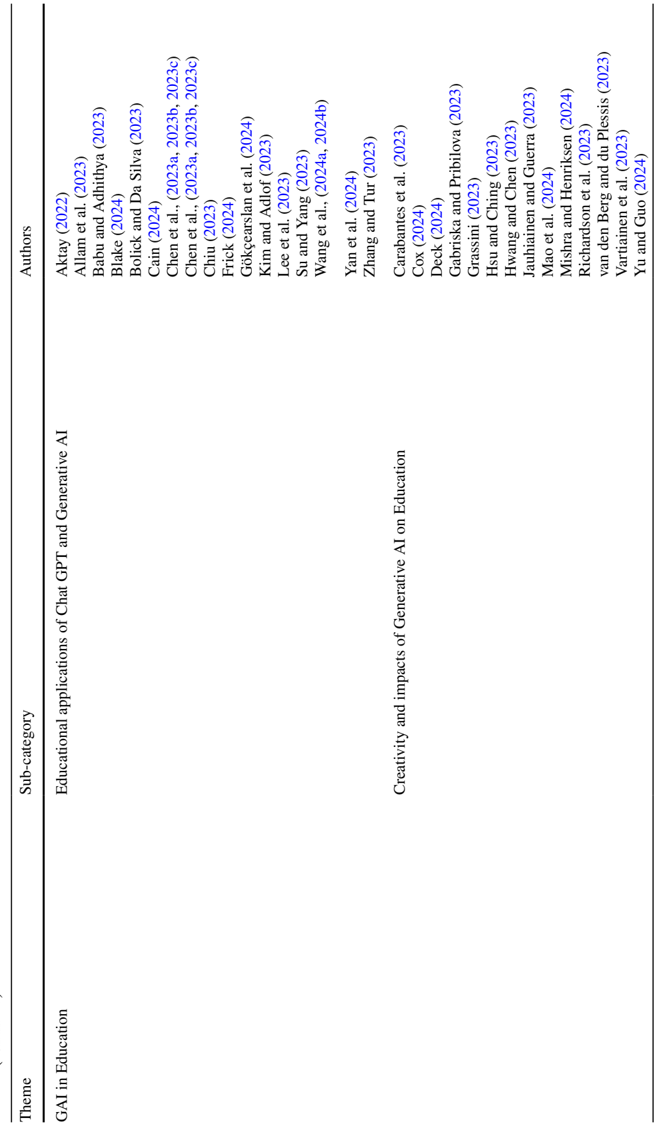
“The use of ChatGPT and other GAIs in Education has been explored by Aktay (2022), Allam et al. (2023), Bolick and Da Silva (2023), Babu and Adhithya (2023), Blake (2024), Chen et al., (2023a, 2023b, 2023c), Chiu (2023), Cain (2024), Frick (2024), Gökçearslan et al. (2024), Lee et al. (2023), Kim…”
Xie, C., & Ma, Y. (2019) · British Educational Research Journal · doi:10.1002/berj.3528 · Cited by 62 · cited 1×
“…concept of an adaptive learning system is frequently cited recently, referring to the aim of facilitating individual student learning by combining various elements of learning systems, such as user interfaces, content and learning paths, according to the status of each student (Xie et al., 2019).”
Sperling, K., Stenliden, L., Nissen, J., & Heintz, F. (2022) · European Journal of Education · doi:10.1111/ejed.12526 · Cited by 62 · cited 1×
“Experimental studies conducted by Sperling et al. (2022) in Sweden, Wu et al. (2021) in China, Wang and Cheng (2021) in Hong Kong, and Jaiswal and Arun (2021) in India show that these technologies, although not yet fully exploited, produce positive results.”
Figueroa, B. A. M., & Eaton, S. E. (2023) · RELIEVE - Revista Electrónica de Investigación y Evaluación Educativa · doi:10.30827/relieve.v29i2.29295 · Cited by 61
Artificial Intelligence in Education
Flogie, A., & Aberšek, B. (2022) · Active Learning - Theory and Practice · doi:10.5772/intechopen.96498 · Cited by 60
“EdTech Integration Framework in Schools”: Systematic Review of the Literature
Díaz, M. J. S., Daza, M. C. S., Arriazu, R., Salguero, F. L., & Rodríguez, N. D. (2022) · Frontiers in Education · doi:10.3389/feduc.2022.895042 · Cited by 60
Artificial intelligence literacy teaching in social studies education
Yetişensoy, O., & Rapoport, A. (2023) · Journal of Pedagogical Research · doi:10.33902/jpr.202320866 · Cited by 57 · cited 1×
“Regarding student perception and AI literacy, Kalota (2024), Su (2024), Vandenberg and Mott (2023) and Yetisensoy and Rapoport (2023) Fourth Answer : current literature reveals gaps in research on the practical implementation of AI in K-12 Education.”
Kindergarten Teachers’ Perceptions of AI Literacy Education for Young Children
Su, J. (2024) · International Journal of Technology and Design Education · doi:10.1007/s10798-024-09876-8 · Cited by 57 · cited 3×
“Regarding student perception and AI literacy, Kalota (2024), Su (2024), Vandenberg and Mott (2023) and Yetisensoy and Rapoport (2023) Fourth Answer : current literature reveals gaps in research on the practical implementation of AI in K-12 Education.”
A systematic review of primary school teachers’ experiences with digital technologies curricula
Stringer, L. R., Lee, K. M., Sturm, S., & Giacaman, N. (2022) · Education and Information Technologies · doi:10.1007/s10639-022-11127-z · Cited by 55
The K-12 educational technology value chain: Apps for kids, tools for teachers and levers for reform
Pierce, G. L., & Cleary, P. F. (2014) · Education and Information Technologies · doi:10.1007/s10639-014-9357-1 · Cited by 53
Yan, Z., Jong, M. S., & Chai, C. S. (2020) · International Journal of Mobile Learning and Organisation · doi:10.1504/ijmlo.2020.106181 · Cited by 52
Effectiveness of virtual reality in elementary school: A meta-analysis of controlled studies
Lara-Álvarez, C. A., Parra-González, E. F., Ortiz-Esparza, M. A., & Cardona-Reyes, H. (2023) · Contemporary Educational Technology · doi:10.30935/cedtech/13569 · Cited by 50
Inclusion of Children With Special Needs in the Educational System, Artificial Intelligence (AI)
Mehta, P. S., Chillarge, G., Sapkal, S. D., Shinde, G. R., & Kshirsagar, P. S. (2023) · Advances in educational technologies and instructional design book series · doi:10.4018/979-8-3693-0378-8.ch007 · Cited by 49
Simmons, J., & MacLean, J. (2018) · Sport, Education and Society · doi:10.1080/13573322.2016.1155444 · Cited by 47
Teaching Machine Learning in K–12 Using Robotics
Karalekas, G., Vologiannidis, S. D., & Kalomiros, J. A. (2023) · Education Sciences · doi:10.3390/educsci13010067 · Cited by 47 · cited 2×
“It is essential to develop game-based educational resources that make learning AI more engaging and understandable for students (Karalekas et al., 2023).”
Introducing Artificial Intelligence Fundamentals with LearningML: Artificial Intelligence made easy
Rodríguez-García, J. D., Moreno-León, J., Román-González, M., & Robles, G. (2020) · Eighth International Conference on Technological Ecosystems for Enhancing Multiculturality · doi:10.1145/3434780.3436705 · Cited by 46
Automated feedback on discourse moves: teachers’ perceived utility of a professional learning tool
Jacobs, J., Scornavacco, K., Clevenger, C., Suresh, A., & Sumner, T. (2024) · Educational Technology Research and Development · doi:10.1007/s11423-023-10338-6 · Cited by 46
Neural Network Construction Practices in Elementary School
Shamir, G., & Levin, I. (2021) · Künstliche Intell. · doi:10.1007/s13218-021-00729-3 · Cited by 43
Artificial Intelligence in Education: An Argument of Chat-GPT Use in Education
Allam, H., Dempere, J., Akre, V., Parakash, D., Mazher, N., & Ahamed, J. (2023) · 2023 9th International Conference on Information Technology Trends (ITT) · doi:10.1109/itt59889.2023.10184267 · Cited by 43 · cited 2×
“The use of ChatGPT and other GAIs in Education has been explored by Aktay (2022), Allam et al. (2023), Bolick and Da Silva (2023), Babu and Adhithya (2023), Blake (2024), Chen et al., (2023a, 2023b, 2023c), Chiu (2023), Cain (2024), Frick (2024), Gökçearslan et al. (2024), Lee et al. (2023), Kim…”
Advancing the generative AI in education research agenda: Insights from the Asia-Pacific region
Wong, L.-H., & Looi, C.-K. (2024) · Asia Pacific Journal of Education · doi:10.1080/02188791.2024.2315704 · Cited by 43 · cited 1×
“Providing guidance to teachers on how to use AI to create efficient learning environments is crucial (Chiu, 2020; Miao et al., 2021), as the technological literacy among students (Wong & Looi, 2024).”
Carabantes-Alarcón, D., González-Geraldo, J. L., & Olmeda, G. J. (2023) · El Profesional de la Informacion · doi:10.3145/epi.2023.sep.16 · Cited by 42 · cited 2×
“Cox (2024), Carabantes et al. (2023), Deck (2024), Gabriska and Pribilova (2023), Grassini (2023), Mishra and Henriksen (2024), Mao et al. (2024), Hwang and Chen (2023), Hsu and Ching (2023), Jauhiainen and Guerra (2023), Richardson et al. (2023), van den Berg and du Plessis (2023), Vartiainen et…”
Artificial Intelligence in Education: A Science Mapping Approach
Kaban, A. (2023) · International Journal of Education in Mathematics Science and Technology · doi:10.46328/ijemst.3368 · Cited by 41 · cited 2×
“Sanabria-Navarro et al. (2023), Kaban (2023) and Uzumcu and Acilmis (2024) highlight the need for further research to deepen the effectiveness of different AI models applied to Education, developing detailed guidelines to facilitate the adoption of these technologies in schools, ensuring a…”
Hays, L., Jurkowski, O., & Sims, S. K. (2024) · TechTrends · doi:10.1007/s11528-023-00924-z · Cited by 40 · cited 1×
“Hays et al. (2024) emphasize the need to provide ongoing support and professional development for the effective use of advanced AI tools such as ChatGPT, including practical examples and ethical guidelines.”
Vandenberg, J. L., & Mott, B. (2023) · ACM Conference on Innovation and Technology in Computer Science Education (ITiCSE) · doi:10.1145/3587102.3588778 · Cited by 39 · cited 1×
“Regarding student perception and AI literacy, Kalota (2024), Su (2024), Vandenberg and Mott (2023) and Yetisensoy and Rapoport (2023) Fourth Answer : current literature reveals gaps in research on the practical implementation of AI in K-12 Education.”
Data science education across the disciplines: Underexamined opportunities for K‐12 innovation
Jiang, S., Lee, V. R., & Rosenberg, J. M. (2022) · British Journal of Educational Technology · doi:10.1111/bjet.13258 · Cited by 38 · cited 2×
“Dawson et al. (2023), Jiang et al. (2022), Nazaretsky et al. (2022) and Robert-son and Muirhead (2022) explore the impact of AI in educational systems, highlighting concerns about excessive reliance on AI its impact on fundamental human skills such as self-regulation and creativity.”
García-Lázaro, I., Jiménez, J. C., & Bravo, M. P. C. (2022) · Contemporary Educational Technology · doi:10.30935/cedtech/11540 · Cited by 36
Moore, R. L., Jiang, S., & Abramowitz, B. (2023) · Journal of Research on Technology in Education · doi:10.1080/15391523.2022.2148785 · Cited by 36 · cited 2×
“Dawson et al. (2023), Jiang et al. (2022), Nazaretsky et al. (2022) and Robert-son and Muirhead (2022) explore the impact of AI in educational systems, highlighting concerns about excessive reliance on AI its impact on fundamental human skills such as self-regulation and creativity.”
AGI: Artificial General Intelligence for Education
Latif, E., Mai, G., Nyaaba, M., Wu, X., Liu, N., Lu, G., Li, S., Liu, T., & Zhaı, X. (2023) · arXiv (Cornell University) · doi:10.48550/arxiv.2304.12479 · Cited by 36
Generative Artificial Intelligence in Education, Part Two: International Perspectives
Hsu, Y., & Ching, Y. (2023) · TechTrends · doi:10.1007/s11528-023-00913-2 · Cited by 36 · cited 2×
“Carabantes et al. (2023), Cox (2024), Deck (2024), Gabriska and Pribilova (2023), Grassini (2023), Hwang and Chen (2023), Hsu and Ching (2023), Jauhiainen and Guerra (2023), Mao et al. (2024), Mishra and Henriksen (2024), Richard-son et al. (2023), van den Berg and du Plessis (2023), Vartiainen et…”
Gibellini, G., Fabretti, V., & Schiavo, G. (2023) · CHI Conference Extended Abstracts on Human Factors in Computing Systems (CHI EA) · doi:10.1145/3544549.3585747 · Cited by 33
Advancing theory in the age of artificial intelligence
Dawson, S., Joksimovíc, S., Mills, C., Gašević, D., & Siemens, G. (2023) · British Journal of Educational Technology · doi:10.1111/bjet.13343 · Cited by 32 · cited 3×
“Dawson et al. (2023), Jiang et al. (2022), Nazaretsky et al. (2022) and Robert-son and Muirhead (2022) explore the impact of AI in educational systems, highlighting concerns about excessive reliance on AI its impact on fundamental human skills such as self-regulation and creativity.”
Chen, S., Xu, X., Zhang, H., & Zhang, Y. (2023) · World Symposium on Software Engineering (WSSE) · doi:10.1145/3631991.3632024 · Cited by 28
iPads in First Grade Classrooms: Teachers’ Intentions and the Realities of Use
Lauricella, A. R., & Jacobson, M. (2022) · Computers and Education Open · doi:10.1016/j.caeo.2022.100077 · Cited by 27
Creative Dialogue with Generative AI: Exploring the Possible with Ron Beghetto
Mishra, P., & Henriksen, D. (2024) · TechTrends · doi:10.1007/s11528-024-00949-y · Cited by 27 · cited 2×
“Cox (2024), Carabantes et al. (2023), Deck (2024), Gabriska and Pribilova (2023), Grassini (2023), Mishra and Henriksen (2024), Mao et al. (2024), Hwang and Chen (2023), Hsu and Ching (2023), Jauhiainen and Guerra (2023), Richardson et al. (2023), van den Berg and du Plessis (2023), Vartiainen et…”
Boel, C., Dekeyser, K., Lemal, M., Rotsaert, T., Valcke, M., Schellens, T., & Struyf, D. (2023) · TechTrends · doi:10.1007/s11528-023-00925-y · Cited by 26
Are We Dupes? Limitations of AI Systems: What Should Educators Do with Them?
Frick, T. W. (2024) · TechTrends · doi:10.1007/s11528-023-00893-3 · Cited by 25 · cited 1×
“…et al. (2023), Bolick and Da Silva (2023), Babu and Adhithya (2023), Blake (2024), Chen et al., (2023a, 2023b, 2023c), Chiu (2023), Cain (2024), Frick (2024), Gökçearslan et al. (2024), Lee et al. (2023), Kim and Adlof (2023), Su and Yang (2023), Wang et al., (2024a, 2024b), Yan et al. (2024)…”
Co-designing sustainable practices for emerging technologies education
Schaper, M.-M., Smith, R. C., Mechelen, M. V., Tamashiro, M. A., & Iversen, O. S. (2023) · International Journal of Technology and Design Education · doi:10.1007/s10798-023-09857-3 · Cited by 24
Unleashing the Potential: Positive Impacts of Generative AI on Learning and Teaching
Blake, J. (2023) · Advances in educational technologies and instructional design book series · doi:10.4018/979-8-3693-0074-9.ch002 · Cited by 24
The Turing Teacher: Identifying core attributes for AI learning in K-12
Pelaez, A., Jacobson, A., Trias, K., & Winston, E. R. (2022) · Frontiers in Artificial Intelligence · doi:10.3389/frai.2022.1031450 · Cited by 23
Artificial Intelligence and the Aims of Education: Makers, Managers, or Inforgs?
Cox, G. M. (2023) · Studies in Philosophy and Education · doi:10.1007/s11217-023-09907-2 · Cited by 23 · cited 2×
“Cox (2024), Carabantes et al. (2023), Deck (2024), Gabriska and Pribilova (2023), Grassini (2023), Mishra and Henriksen (2024), Mao et al. (2024), Hwang and Chen (2023), Hsu and Ching (2023), Jauhiainen and Guerra (2023), Richardson et al. (2023), van den Berg and du Plessis (2023), Vartiainen et…”
Ayyıldız, P., & Yılmaz, A. (2023) · Educational policy analysis and strategic research · doi:10.29329/epasr.2023.631.4 · Cited by 22
Web-based Platform for K-12 AI Education in China
Wu, C., Li, Y., Li, J., Zhang, Q., & Wu, F. Q. (2021) · Proceedings of the AAAI Conference on Artificial Intelligence · doi:10.1609/aaai.v35i17.17848 · Cited by 20 · cited 1×
“Experimental studies conducted by Sperling et al. (2022) in Sweden, Wu et al. (2021) in China, Wang and Cheng (2021) in Hong Kong, and Jaiswal and Arun (2021) in India show that these technologies, although not yet fully exploited, produce positive results.”
Sinha, N., Evans, R., & Carbo, M. (2023) · Wireless and Optical Communications Conference · doi:10.1109/wocc58016.2023.10139678 · Cited by 20 · cited 1×
“Sinha et al., (2023) and Xia et al. (2022) show how AI can be used to enhance student assessment and tailor lessons to individual needs, but there is an urgent need for further research to refine these adaptation techniques and ensure that AI can effectively improve educational effectiveness.”
Lee, A. V. Y. (2024) · Asia Pacific Journal of Education · doi:10.1080/02188791.2024.2305171 · Cited by 20 · cited 2×
“Lee (2024) expresses concern about the lack of clarity on how GAI can be adopted and effectively used in Education.”
Kurz, T. L., & Jayasuriya, S. (2022) · The Journal of Interactive Learning Research · doi:10.70725/054704afzzhv · Cited by 17
Kukul, V. (2023) · Technology Knowledge and Learning · doi:10.1007/s10758-023-09658-6 · Cited by 16
Artificial Intelligence, Responsible Innovation, and the Future of Humanity with Andrew Maynard
Richardson, C., Oster, N. J., Henriksen, D., & Mishra, P. (2023) · TechTrends · doi:10.1007/s11528-023-00921-2 · Cited by 16 · cited 1×
“…(2023), Grassini (2023), Mishra and Henriksen (2024), Mao et al. (2024), Hwang and Chen (2023), Hsu and Ching (2023), Jauhiainen and Guerra (2023), Richardson et al. (2023), van den Berg and du Plessis (2023), Vartiainen et al. (2023) and Yu and Guo (2024) explore the use of GAI to support…”
Artificial Intelligence in Children with Special Need Education
Neeharika, C. H., & Riyazuddin, Y. M. (2023) · International Conference on Intelligent Data Communication Technologies and Internet of Things (IDCIoT) · doi:10.1109/idciot56793.2023.10053420 · Cited by 13
Artificial Intelligence and Literacy Development in K–12 Schools
Maher, D., & Young, K. (2023) · Advances in educational technologies and instructional design book series · doi:10.4018/979-8-3693-0205-7.ch004 · Cited by 11
Artificial intelligence in education, issues and potential of use in the teaching process
Gabriska, D., & Pribilová, K. (2023) · International Conference on Emerging eLearning Technologies and Applications (ICETA) · doi:10.1109/iceta61311.2023.10344286 · Cited by 11 · cited 2×
“Cox (2024), Carabantes et al. (2023), Deck (2024), Gabriska and Pribilova (2023), Grassini (2023), Mishra and Henriksen (2024), Mao et al. (2024), Hwang and Chen (2023), Hsu and Ching (2023), Jauhiainen and Guerra (2023), Richardson et al. (2023), van den Berg and du Plessis (2023), Vartiainen et…”
Bueno-Rocha, J. M., Martins, A., Almeida, A. M., & Antunes, M. J. (2023) · International Conference on Computer Supported Education · doi:10.5220/0011771400003470 · Cited by 8 · cited 2×
“Ahmad et al. (2023), Bueno-Rocha et al. (2023), Jaiswal and Arun (2021), Majid and Lakshmi (2022) and Xia et al. (2022) emphasize the various benefits of AI in improving school practice.”
A Generative AI-based Teaching Material System Using a Human-In-The-Loop Model
Chen, S., Liu, Q., & He, B. (2023) · 2023 International Conference on Intelligent Education and Intelligent Research (IEIR) · doi:10.1109/ieir59294.2023.10391244 · Cited by 8
Purković, D., & Kovačević, S. (2024) · International Journal of Technology and Design Education · doi:10.1007/s10798-023-09875-1 · Cited by 7
(2022) · Advances in early childhood and K-12 education · doi:10.4018/978-1-6684-5478-7 · Cited by 5
Artificial Intelligence Education and Inclusion in K–12
Qi, X. I. A. (2023) · American Educational Research Association Annual Meeting (AERA) · doi:10.3102/2007820 · Cited by 5 · cited 4×
“It is essential that teachers are trained in collaborative and experimental approaches, including a constant evaluation of methodologies to ensure that teaching practices remain up-to-date and relevant for students (Xia & Chiu, 2023).”
InfluentialSurveying Impacts of AI in Education and Creative Practices
Deck, A. (2024) · Lecture notes in networks and systems · doi:10.1007/978-3-031-47721-8_27 · Cited by 5 · cited 2×
“Cox (2024), Carabantes et al. (2023), Deck (2024), Gabriska and Pribilova (2023), Grassini (2023), Mishra and Henriksen (2024), Mao et al. (2024), Hwang and Chen (2023), Hsu and Ching (2023), Jauhiainen and Guerra (2023), Richardson et al. (2023), van den Berg and du Plessis (2023), Vartiainen et…”
Fegely, A. G., Hagan, H. N., Warriner, G. H., & McKenzie, M. (2024) · TechTrends · doi:10.1007/s11528-024-00936-3 · Cited by 5
Are You Ready to Teach AI in Schools? Teachers' Perspectives of Teaching AI in K-12 Settings
Addo, S. A. (2023) · Conference on United Kingdom & Ireland Computing Education Research (UKICER) · doi:10.1145/3610969.3610973 · Cited by 4 · cited 1×
“Finally, according to Addo (2023), Antonenko and Abramowitz (2023) and Sanusi et al. (2024), teacher training should be designed to overcome misconceptions about AI, improving motivation and developing advanced digital skills.”
Transforming teachers’ self-narratives about game-based learning
Kim, B., Bastani, R., & Gupta, D. (2023) · Educational technology research and development · doi:10.1007/s11423-023-10319-9 · Cited by 3
Robertson, L. P., & Muirhead, B. (2022) · Proceedings · doi:10.54808/icsit2022.01.104 · Cited by 2 · cited 1×
“Dawson et al. (2023), Jiang et al. (2022), Nazaretsky et al. (2022) and Robertson and Muirhead (2022) explore the potential of AI in transforming educational systems, highlighting both improvements in teaching and assessment and concerns about excessive reliance on AI.”
Research works printed but not linked: 11
- 4. Aktay, S. (2022). The usability of images generated by Artificial Intelligence (AI) in education. Interna- tional Technology and Education Journal, 6(2), 51-62.
- 31. Chen, X., et al. (2021). Two decades of Artificial Intelligence in education. Educational Technology & Soci- ety, 25(1), 28-47.
- 36. Chung H.-H., Chung F.-L., Lin S.-M., Lan Y.-J. (2023). Tools and approaches of generative artificial intel- ligence used in education. In 31st international conference on computers in education, ICCE 2023 -Volume 2, December 2023, (pp. 17-26). https:// www. scopus. com/ inward/ record. uri? eid=2-s2.0- 85181 76611 1& partn erID= 40& md5= d201d b38c2 5a30d 0693f 003c5 6f051 0a
- 61. Herman, L. P. (2002). Case study of a professional development program: Meaningful technology integra- tion in secondary Education. Drexel University ProQuest Dissertation & Theses, 3044285. https:// www. learn techl ib. org/p/ 128667/
- 93. Majid, I., & Lakshmi, Y. V. (2022). Artificial Intelligence in education. Indian Journal of Technical Education, 45(3), 11-16.
- 100. Mishra, P., Koehler, M. J. (2007). Technology pedagogical content knowledge (TPCK): Addressing the wicked problems of teaching with technology. In Proceedings of SITE 2007-Society for infor- mation technology & teacher education international conference (pp. 2214-2226). San Antonio, Texas, USA: Association for the Advancement of Computing in Education (AACE). https:// www. learn techl ib. org/ prima ry/p/ 24919/.
- 103. Moher, D., Liberati, A., Tetzlaff, J., et al. (2015). Guidelines for reporting systematic reviews and meta- analyses: The PRISMA Statement. Evidence, 7(6), e1000114. https:// doi. org/ 10. 4470/ E1000 114 · doi:10.4470/e1000114
- 106. Murgia, E., Landoni M., Huibers T., Pera M. S. (2023). Learning technologies AI: Who are we design- ing for?. CEUR Workshop Proceedings, 3359, 250-253. (pp. 250-253). https:// ris. utwen te. nl/ ws/ files/ 31932 4110/ paper 33. pdf
- 141. Trust, T., Whalen, J. & Mouza, C. (2023). Editorial: ChatGPT: Challenges, opportunities, and implica- tions for teacher education. Contemporary Issues in Technology and Teacher Education, 23(1), 1-23. Waynesville, NC USA: Society for Information Technology & Teacher Education. https:// www. learn techl ib. org/ prima ry/p/ 222408/.
- 147. Vartiainen, H., Tedre, M., & Jormanainen, I. (2023). Co-creating digital art with generative AI in K-9 education: Socio-material insights. International Journal of Education through Art, 19(3), 405- 423. https:// doi. org/ 10. 1386/ eta_ 00143_1 · DOI · Paper page
- Zhou, X., Van Brummelen, J., & Lin, P. (2020). Designing AI learning experiences for K-12: Emerging works, future opportunities and a design framework. arXiv preprint arXiv:2009.10228. · arXiv
Cited by
Aravantinos, S., Lavidas, K., Komis, V., Karalis, T., & Papadakis, S. (2026) · Computers · doi:10.3390/computers15010049 · Cited by 87
“[18] conducted a systematic review with 197 studies, highlighting gaps in teachers’ PD and demonstrating the potential of AI to transform educational systems, while noting that dependency and ethical concerns need to be addressed.”
InfluentialLiu, B., Zhang, W., & Wang, F. (2026) · Education Sciences · doi:10.3390/educsci16010140 · Cited by 44
“Moreover, GenAI can produce incorrect or incomplete explanations, causing systematic misunderstandings (Marzano, 2025), and prolonged use has been associated with reduced learning confidence and increased technological anxiety (Al-Smadi, 2023).”
Liu, J., Keane, T., Sun, D., Yang, Y., & Yang, Y. P. (2025) · Smart Learning Environments · doi:10.1186/s40561-025-00419-9 · Cited by 38
“Although GAI offers the capacity to address these gaps, by delivering dynamic scaffolding, real-time feedback, and personalized learning support, many existing mathematics learning platforms have yet to fully leverage its generative capabilities (Marzano, 2025).”
Mapping the evolution of AI in education: Toward a co-adaptive and human-centered paradigm
Feng, S., Zhang, H., & Gašević, D. (2025) · Computers and Education Artificial Intelligence · doi:10.1016/j.caeai.2025.100513 · Cited by 38
Karnita, A., Aisyah, S. A., Mustapa, N., Syarah, E. S., Jovanka, D. R., & Mahamud, S. B. (2025) · AL-ATHFAL JURNAL PENDIDIKAN ANAK · doi:10.14421/al-athfal.2025.111-08 · Cited by 25
Metadata
- Authors
- Marzano, D.
- Affiliations
- University of Foggia (IT)
- Corresponding author
- Marzano, Daniela
- ORCID
- Marzano, Daniela
- Venue
- Technology, Knowledge and Learning
- Published
- 2025-06-19
- Volume
- 31
- Issue
- 2
- Pages
- 789-829
- ISSN
- 2211-1662 (ISSN-L)
- 2211-1670
- OpenAlex
- W4411448764
- Cited by
- 51
- References
- 156
- Citations by year
- 2026: 44 · 2025: 7
- FWCI
- 7.84
- Type
- journal article
- Language
- en
- Open access
- hybrid
- doi.org
- Licence
- cc-by-nc-nd
- creativecommons.org/licenses/by-nc-nd/4.0 (tdm)
- creativecommons.org/licenses/by-nc-nd/4.0 (vor)
- Locations
- Technology Knowledge and Learning (publishedVersion, cc-by-nc-nd)
- Topics
- Social Sciences › Education › Artificial Intelligence in Education
- Health Sciences › Medicine › Health Informatics › Artificial Intelligence in Healthcare and Education
- Social Sciences › Education › Educational Technology and Pedagogy
- Keywords
- generative AI, K-12 education, personalized learning, student motivation, assessment methods, AI ethics and privacy, educational technology adoption, STEM education, arts and humanities education
About these checks
Registry, retraction, Cites and statistics results are computed, not judged, with one exception: a printed reference that no index lists is read once by a model before it counts as a citation error. Claims are extracted by a model and kept only when their quote appears verbatim in the text; each cited source is then checked, with a model’s help, for whether it says what the claim relies on. Those verdicts can be wrong — read the claim’s quote and the cited source before relying on one.
Statistics and arithmetic are recomputed, not judged.
Confidence bands are shown only for fields calibrated on our annotated test set. None is calibrated yet, so no band is shown.
What counts as a claim ›How we measure confidence ›How we check this ›
Are you an author, or do you see a problem with this page? Request a review
Data sources
Bibliographic data: Semantic Scholar, OpenAlex, Crossref.
Contains information from the Semantic Scholar Academic Graph Datasets, made available under the ODC Attribution License (ODC-BY 1.0).
Semantic Scholar’s data is described in: Kinney, R., et al. (2023). The Semantic Scholar Open Data Platform. arXiv:2301.10140.
