

Can Motivation Normalize Working Memory and Task Persistence in Children with Attention-Deficit/Hyperactivity Disorder? The Effects of Money and Computer-Gaming
Open accessThe DOI matches its Crossref record; 65 of the 67 references it cites were found in a registry or an index; 4 of the 42 sources its claims cite were checked for support.
Abstract
Visual-spatial Working Memory (WM) is the most impaired executive function in children with Attention-Deficit/Hyperactivity Disorder (ADHD). Some suggest that deficits in executive functioning are caused by motivational deficits. However, there are no studies that investigate the effects of motivation on the visual-spatial WM of children with- and without ADHD. Studies examining this in executive functions other than WM, show inconsistent results. These inconsistencies may be related to differences in the reinforcement used. The effects of different reinforcers on WM performance were investigated in 30 children with ADHD and 31 non-ADHD controls. A visual-spatial WM task was administered in four reinforcement conditions: Feedback-only, 1 euro, 10 euros, and a computer-game version of the task. In the Feedback-only condition, children with ADHD performed worse on the WM measure than controls. Although incentives significantly improved the WM performance of children with ADHD, even the strongest incentives (10 euros and Gaming) were unable to normalize their performance. Feedback-only provided sufficient reinforcement for controls to reach optimal performance, while children with ADHD required extra reinforcement. Only children with ADHD showed a decrease in performance over time. Importantly, the strongest incentives (10 euros and Gaming) normalized persistence of performance in these children, whereas 1 euro had no such effect. Both executive and motivational deficits give rise to visual-spatial WM deficits in ADHD. Problems with task-persistence in ADHD result from motivational deficits. In ADHD-reinforcement studies and clinical practice (e.g., assessment), reinforcement intensity can be a confounding factor and should be taken into account. Gaming can be a cost-effective way to maximize performance in ADHD.
Overview
CoChat Summary
## TL;DR
This study tested whether money or a computer-game format could improve visual-spatial working memory (WM) and persistence in 30 children with ADHD and 31 controls. Incentives improved ADHD performance, but only strong incentives (10 euros and gaming) normalized persistence over time, not WM performance itself.
## Key findings
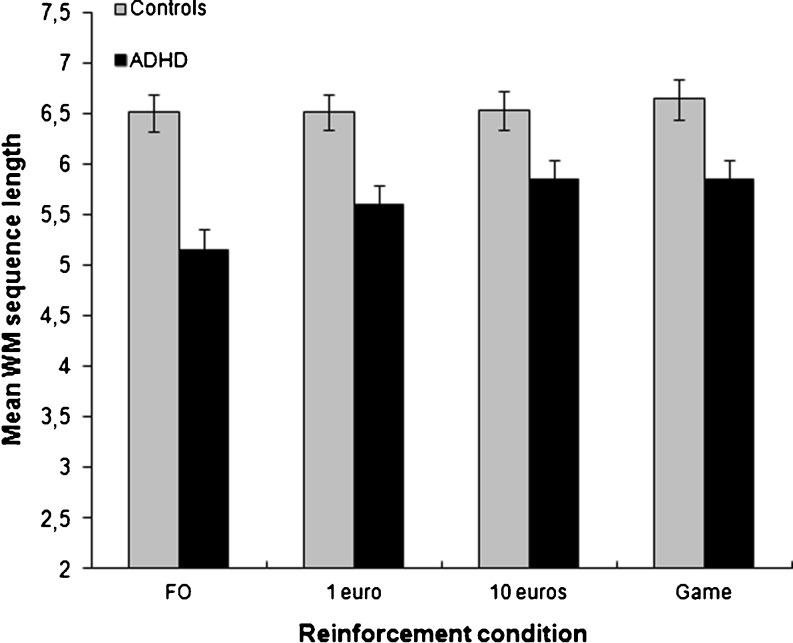
- In mean WM performance, there was a significant effect of reinforcement condition, a significant group effect, and a significant group × reinforcement interaction: F(3,177) = 7.74, p < 0.001, ηp² = 0.12; F(1,59) = 13.87, p < 0.001, ηp² = 0.19; F(3,177) = 3.69, p = 0.01, ηp² = 0.06.
- For children with ADHD, mean WM performance improved relative to feedback-only in all incentive conditions: 1 euro t(29) = −2.86, p = 0.008; 10 euros t(29) = −3.98, p < 0.001; game t(29) = −3.45, p = 0.002. Controls did not significantly improve with incentives.
- ADHD children still performed worse than controls in every condition: FO F(1,59) = 19.57, p < 0.001, ηp² = 0.25; 1 euro F(1,59) = 11.55, p = 0.001, ηp² = 0.16; 10 euros F(1,59) = 6.11, p = 0.016, ηp² = 0.09; game F(1,59) = 9.35, p = 0.003, ηp² = 0.14.
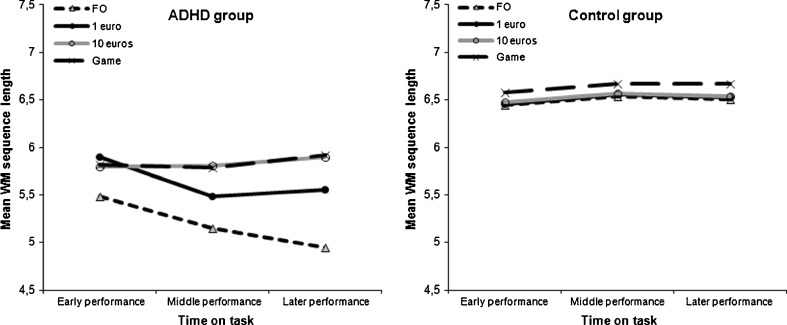
- In ADHD, performance declined over time in the feedback-only condition, and this decline was reduced by strong incentives: time effect F(2,58) = 3.47, p = 0.038, ηp² = 0.11; the reduction was significant for game F(1,29) = 8.80, p = 0.006, ηp² = 0.23 and 10 euros F(1,29) = 7.49, p = 0.010, ηp² = 0.21, but not 1 euro F(1,29) = 0.44, p = 0.511.
- The authors conclude that strong incentives normalized persistence of performance in ADHD, but did not fully normalize WM performance.
## Methods
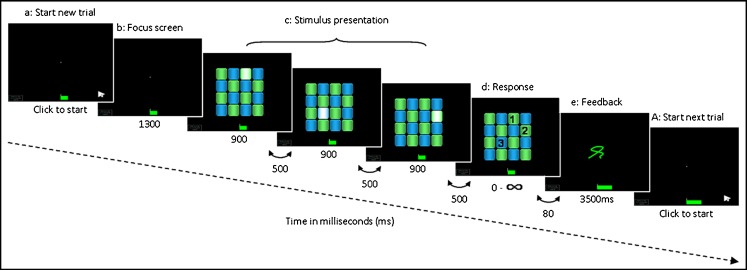
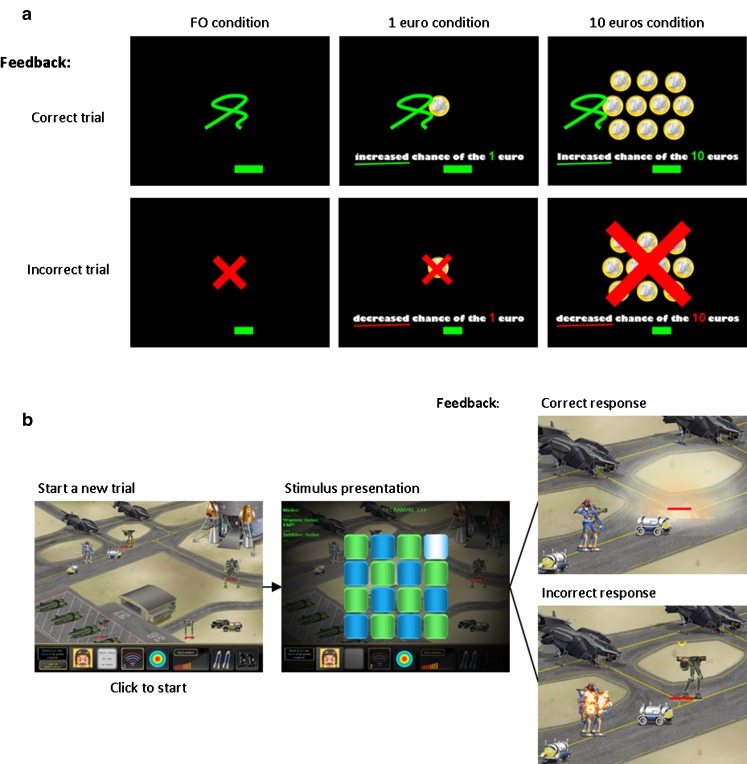
- Design: within-subject comparison of four reinforcement conditions—feedback-only, 1 euro, 10 euros, and computer gaming—with group (ADHD vs control) as a between-subject factor.
- Sample: 61 children aged 9–12 years; 30 with ADHD combined type and 31 controls. ADHD participants were recruited from outpatient mental-healthcare centers; controls from elementary schools.
- Analysis: repeated-measures ANOVAs for mean WM and time on task, plus paired t-tests and contrasts; effect sizes reported as partial eta squared.
## Limitations
- The paper states that it only examined children with ADHD combined-type, so findings may not generalize to other ADHD subtypes.
- The authors note that the specific game elements responsible for the gaming effect were not isolated, so the mechanism of the gaming benefit is unclear.
- Evident from the text: the study used a single visual-spatial WM task with a relatively small sample (n = 61), which limits broad generalization; the paper discusses this only indirectly, not as an explicit limitation.
Model-written summary. Check it against the paper before relying on it.
Integrity signals
Registry
Cites
Statistics
Figures
Verification
Claims the paper makes
4 Valid · 0 Not valid · 28 Not checked · 61 Own results and interpretations
Every source the paper cites for this claim was checked and supports it.
In the paper
“Furthermore, apart from the studies that have compared feedback-only with an incentive condition, only Kohls et al. (2009) compared the impact of different forms of reinforcement on executive performance between children with- and without ADHD.”
§ Can Motivation Normalize Working Memory and Task Persistence in Children with Attention-Deficit/Hyperactivity Disorder? The Effects of Money and Computer-Gaming > Introduction
What the sources say
- Supportedcites Kohls et al. 2009 matched to “Hyperresponsiveness to social rewards in children and adolescents with attention-deficit/hyperactivity disorder (ADHD)” (2009) source
The Discussion calls this the first study to compare tangible and non-tangible reinforcers on cognitive control accuracy in ADHD. The Background and Method describe a go/no-go task comparing social and monetary rewards in children with ADHD and healthy controls, matching the comparison attributed to Kohls et al. (LLM, conf=0.90)
plain- Asserted: passes — The authors put it forward as true.
- Checkable: passes — It can be checked against evidence.
- Load-bearing: passes — The paper’s conclusions depend on it.
- Based: passes — The paper gives a reason why it holds.
- Supported
A result the paper reports from its own data — it cites no other source for it, so there is none to check. The quote shows it is in the paper.
In the paper
“Feedback-only provided sufficient reinforcement for controls to reach optimal performance, while children with ADHD required extra reinforcement.”
§ Can Motivation Normalize Working Memory and Task Persistence in Children with Attention-Deficit/Hyperactivity Disorder? The Effects of Money and Computer-Gaming > Abstract
plainstates a cause- Asserted: passes — The authors put it forward as true.
- Checkable: passes — It can be checked against evidence.
- Load-bearing: passes — The paper’s conclusions depend on it.
- Based: passes — The paper gives a reason why it holds.
A result the paper reports from its own data — it cites no other source for it, so there is none to check. The quote shows it is in the paper.
In the paper
“Only children with ADHD showed a decrease in performance over time.”
§ Can Motivation Normalize Working Memory and Task Persistence in Children with Attention-Deficit/Hyperactivity Disorder? The Effects of Money and Computer-Gaming > Abstract
plain- Asserted: passes — The authors put it forward as true.
- Checkable: passes — It can be checked against evidence.
- Load-bearing: unclear — It is unclear whether the paper’s conclusions depend on it.
- Based: passes — The paper gives a reason why it holds.
A result the paper reports from its own data — it cites no other source for it, so there is none to check. The quote shows it is in the paper.
In the paper
“Although incentives significantly improved the WM performance of children with ADHD, even the strongest incentives (10 euros and Gaming) were unable to normalize their performance.”
§ Can Motivation Normalize Working Memory and Task Persistence in Children with Attention-Deficit/Hyperactivity Disorder? The Effects of Money and Computer-Gaming > Abstract
plainstates a cause- Asserted: passes — The authors put it forward as true.
- Checkable: passes — It can be checked against evidence.
- Load-bearing: passes — The paper’s conclusions depend on it.
- Based: passes — The paper gives a reason why it holds.
41 more claims
Create a free account to see all 93 claims and every source verdict.
- It may state two separate claims as one. 26
- Probably not a substantial claim. 28
Claims other papers make about this one
Each is checked against this paper’s own text: does it say what the citing paper says it does?
The source backs part of the claim, not all of it — or backs it for a different population, condition or comparison.
In the citing paper
“Research indeed shows that children with ADHD, in contrast to their TD peers, show suboptimal performance on visuospatial WM- and visuospatial STM tasks under regular reinforcement conditions (e.g., feedback-only), and require relatively high incentives (e.g., feedback ? 10 euros) to perform to their full abilities [13, 33, 34].”
From Prevalence and diagnostic validity of motivational impairments and deficits in visuospatial short-term memory and working memory in ADHD subtypes (2015) · cites this paper as [33]
Experimental — accuracy not yet measuredThe source backs part of the claim, not all of it — or backs it for a different population, condition or comparison.
In the citing paper
“On both task versions, the first 12 trials are required to reach the child's optimal difficulty level and were therefore excluded from analysis [13, 33]”
From Prevalence and diagnostic validity of motivational impairments and deficits in visuospatial short-term memory and working memory in ADHD subtypes (2015) · cites this paper as [33]
Experimental — accuracy not yet measuredThe source backs part of the claim, not all of it — or backs it for a different population, condition or comparison.
In the citing paper
“Recently several promising interventions have been introduced to increase response inhibition (Houben et al., 2011) and working memory (Klingberg et al., 2005, Dovis et al., 2012) in adolescents and young adults. These training methods contribute to an increase in executive control, and they might eventually postpone the age of the onset.”
From Weaknesses in executive functioning predict the initiating of adolescents' alcohol use (2015) · cites this paper as Dovis et al., 2012
Experimental — accuracy not yet measuredThe source backs part of the claim, not all of it — or backs it for a different population, condition or comparison.
In the citing paper
“Once these interventions have been terminated, lack of change in the underlying neurobiological substrate (Rubia et al., 2013) or neurocognitive performance (Dovis et al., 2012; Jarrett, 2013) may be the reason for the observed rapid return of pre-treatment symptoms/impairments.”
From Improving Outcomes for Youth with ADHD: A Conceptual Framework for Combined Neurocognitive and Skill-Based Treatment Approaches (2014) · cites this paper as Dovis et al., 2012
Experimental — accuracy not yet measuredThe source backs part of the claim, not all of it — or backs it for a different population, condition or comparison.
In the citing paper
“and the €10 condition and the gaming condition (Megabot) prevented this decrease.”
From Gamification of Cognitive Assessment and Cognitive Training: A Systematic Review of Applications and Efficacy (2016) · cites this paper as [22]
Experimental — accuracy not yet measured
13 more claims about this paper
Create a free account to see every claim other papers make about this one.
Statistics that don’t add up
Each reported p-value recomputed from its test statistic and degrees of freedom, each partial η² from its F, and each ratio, mean difference or B printed with a p checked against its own confidence interval.
Rated minor: it would not touch a result — a value no result rests on, a p-value that stays on the same side of the significance level, or a conflict that is clerical, resolved elsewhere in the paper, or outside its own findings.
In the paper
“F (1,59) = 3.206, p = 0.041”
§ Can Motivation Normalize Working Memory and Task Persistence in Children with Attention-Deficit/Hyperactivity Disorder? The Effects of Money and Computer-Gaming > Results > Time on Task
Reported p = .041 · recomputed p = .078
Rated minor: it would not touch a result — a value no result rests on, a p-value that stays on the same side of the significance level, or a conflict that is clerical, resolved elsewhere in the paper, or outside its own findings.
In the paper
“F (1,59) = 4.34, p = 0.040”
§ Can Motivation Normalize Working Memory and Task Persistence in Children with Attention-Deficit/Hyperactivity Disorder? The Effects of Money and Computer-Gaming > Results > Mean WM Performance
Reported p = .04 · recomputed p = .042
Rated minor: it would not touch a result — a value no result rests on, a p-value that stays on the same side of the significance level, or a conflict that is clerical, resolved elsewhere in the paper, or outside its own findings.
In the paper
“F (1,59) = 3.846, p < 0.05”
§ Can Motivation Normalize Working Memory and Task Persistence in Children with Attention-Deficit/Hyperactivity Disorder? The Effects of Money and Computer-Gaming > Results > Time on Task
Reported p < .05 · recomputed p = .055
Rated minor: it would not touch a result — a value no result rests on, a p-value that stays on the same side of the significance level, or a conflict that is clerical, resolved elsewhere in the paper, or outside its own findings.
In the paper
“F (3,87) = 6.14, p = 0.001, η p 2 = 0.18”
§ Can Motivation Normalize Working Memory and Task Persistence in Children with Attention-Deficit/Hyperactivity Disorder? The Effects of Money and Computer-Gaming > Results > Time on Task
Reported ηp² = .18 · recomputed ηp² .1747–.1748
Statistics recomputed
Every reported test result, recomputed from its test statistic and degrees of freedom. A result shows as not adding up only once an independent check has confirmed it.
- Doesn’t add upF(1, 59) = 4.34reported p = .04 · recomputed p = .042
“F (1,59) = 4.34, p = .040”
- Doesn’t add upF(1, 59) = 3.206reported p = .041 · recomputed p = .078
“F (1,59) = 3.206, p = .041”
- Doesn’t add upF(1, 59) = 3.846reported p < .05 · recomputed p = .055
“F (1,59) = 3.846, p < .05”
- ConsistentF(3, 177) = 7.74reported p < .001 · recomputed p < .001
“F (3,177) = 7.74, p < .001”
- ConsistentF(1, 59) = 13.87reported p < .001 · recomputed p < .001
“F (1,59) = 13.87, p < .001”
27 more recomputed tests
Create a free account to see every test the Stats check recomputed.
Self-check
Percentages, sums and reported differences re-computed from the paper’s own numbers.
Self-check results appear here once an independent check has confirmed them.
Citations
Cites
From dissertation abstracts international
(1974) · ACM SIGGRAPH Computer Graphics · doi:10.1145/988616.988619 · Cited by 12,099
Diagnostic and Statistical Manual of Mental Disorders, Fourth Edition, Text Revision (DSM-IV-TR)
American Psychiatric Association (2000) · doi:10.1176/appi.books.9780890423349 · Cited by 11,069
Attention Deficit Hyperactivity Disorder: A Handbook for Diagnosis and Treatment
Barkley, R. A., & Poillion, M. J. (1994) · Behavioral Disorders · doi:10.1177/019874299401900205 · Cited by 4,639
SHAFFER, D., FISHER, P., LUCAS, C. P., DULCAN, M. K., & SCHWAB-STONE, M. E. (2000) · Journal of the American Academy of Child & Adolescent Psychiatry · doi:10.1097/00004583-200001000-00014 · Cited by 3,505 · cited 1×
“Adequate psychometric properties have been reported (Oosterlaan et al. 2000), (c) meeting criteria for ADHD combined-type on the ADHD section of the Diagnostic Inter-view Schedule for Children, parent version (PDISC-IV; Shaffer et al. 2000).”
Computerized training of working memory in children with ADHD – a randomized, controlled trial
Klingberg, T., Fernell, E., Olesen, P. J., Johnson, M., Gustafsson, P., Dahlström, K., Gillberg, C. G., Forssberg, H., & Westerberg, H. (2005) · Journal of the American Academy of Child & Adolescent Psychiatry · doi:10.1097/00004583-200502000-00010 · Cited by 1,949 · cited 2×
“…no significant differences between the two groups in the number of times the reinforcement conditions (FO, 1 euro, 10 euros and game) were administered first ( χ 2 (3) 0 0.05, p 0 0.997), second ( χ 2 (3) 0 0.05, p 0 0.997), third ( χ 2 (3) 0 0.18, p 0 0.981) or last ( χ 2 (3) 0 0.05, p 0 0.997).”
InfluentialAttention-Deficit Hyperactivity Disorder: A Handbook for Diagnosis and Treatment
SPRAFKIN, J., & CARLSON, G. A. (1992) · American Journal of Psychiatry · doi:10.1176/ajp.149.9.1266 · Cited by 1,900
The Measurement and Appraisal of Adult Intelligence
Webster, A. S., & Wechsler, D. (1958) · The Journal of Criminal Law, Criminology, and Police Science · doi:10.2307/1141601 · Cited by 1,812
The Measurement and Appraisal of Adult Intelligence (4th ed.).
Wechsler, D. (1958) · doi:10.1037/11167-000 · Cited by 1,683 · cited 1×
“The Chessboard Task 1 is a newly developed WM performance measure based on two WM tasks; the Corsi Block Tapping Task (Corsi 1972) and the subtest Letter-Number Sequencing from the Wechsler Adult Intelligence Scale (WAIS; Wechsler 1958).”
Sattler, J. M. (1992) · Medical Entomology and Zoology · Cited by 1,677
Steinberg, L., Albert, D., Cauffman, E., Banich, M., Graham, S., & Woolard, J. (2008) · Developmental Psychology · doi:10.1037/a0012955 · Cited by 1,542 · cited 2×
“…factors on the performance and sensitivity to reward of children with ADHD should also be investigated; for example, there are reasons to expect a different (larger) response to reward in adolescence than in adulthood (Steinberg et al. 2008; but see also Scheres et al. 2007; Ströhle et al. 2008).”
MARTINUSSEN, R., HAYDEN, J., HOGG-JOHNSON, S., & TANNOCK, R. (2005) · Journal of the American Academy of Child & Adolescent Psychiatry · doi:10.1097/01.chi.0000153228.72591.73 · Cited by 1,297 · cited 4×
“We expected that, in the Feedback-only condition, children with ADHD would perform worse on the WM task compared to children without ADHD (Martinussen et al. 2005), that the difference in performance between children with- and without ADHD would be smaller in the incentive conditions (1 euro, 10 euros, and game) than…”
InfluentialHuman memory and the medial temporal region of the brain.
Corsi, P. M. (1972) · McGill University · doi:10.82308/6355 · Cited by 1,294
Teacher Ratings of DSM-III-R Symptoms for the Disruptive Behavior Disorders
PELHAM, W. E., GNAGY, E. M., GREENSLADE, K. E., & MILICH, R. (1992) · Journal of the American Academy of Child & Adolescent Psychiatry · doi:10.1097/00004583-199203000-00006 · Cited by 1,288 · cited 1×
“…combined-type by a child psychologist or psychiatrist, (b) a score within the clinical range (95th to 100th percentile) on the ADHD scales of both the parent and teacher version of the Disruptive Behavior Disorder Rating Scale (DBDRS; Pelham et al. 1992; Dutch translation Oosterlaan et al. 2000).”
Characterizing cognition in ADHD: beyond executive dysfunction
Castellanos, F. X., Sonuga-Barke, E. J. S., Milham, M. P., & Tannock, R. (2006) · Trends in Cognitive Sciences · doi:10.1016/j.tics.2006.01.011 · Cited by 1,170 · cited 2×
“, the dual pathway model, SonugaBarke 2002), and models that emphasize the intertwined nature of executive control and motivation to control (Castellanos et al. 2006; Gladwin et al. 2011; SonugaBarke et al. 2008).”
A Guide to Treatments that Work
Nathan, P. E., & Gorman, J. M. (2007) · Oxford University Press eBooks · doi:10.1093/med/9780195304145.001.0001 · Cited by 1,082
(2001) · Medical Entomology and Zoology · Cited by 1,044
Evidence-based psychosocial treatments for attention-deficit/hyperactivity disorder
Pelham, W. E., & Fabiano, G. A. (2008) · Journal of Clinical Child & Adolescent Psychology · doi:10.1080/15374410701818681 · Cited by 917 · cited 1×
“These interventions (Pelham and Fabiano 2008) aim at improving behavioral control in children with ADHD by teaching parents and teachers to use token (reward) systems/programs and techniques to unburden the WM of these children (e. g., providing reminders and a structured environment).”
Psychological heterogeneity in AD/HD—a dual pathway model of behaviour and cognition
Sonuga-Barke, E. J. S. (2002) · Behavioural Brain Research · doi:10.1016/s0166-4328(01)00432-6 · Cited by 901 · cited 1×
“…therefore support models that state that multiple deficits, both executive and motivational, give rise to ADHD (e.g., the dual pathway model, Sonuga-Barke 2002), and models that emphasize the intertwined nature of executive control and motivation to control (Castellanos et al. 2006; Gladwin…”
Nigg, J. T., Willcutt, E. G., Doyle, A. E., & Sonuga-Barke, E. J. S. (2005) · Biological Psychiatry · doi:10.1016/j.biopsych.2004.08.025 · Cited by 886 · cited 1×
“This is supported by the fact that not all studies find an executive dysfunction in children with ADHD (suggesting state dependency; e.g., see Luman et al. 2005), and that executive deficits only have moderate sensitivity and specificity (Nigg et al. 2005).”
Attention-Deficit Hyperactivity Disorder: A Handbook for Diagnosis and Treatment, 3rd ed
Lyon, G. J., & Coffey, B. J. (2008) · The Journal of Clinical Psychiatry · Cited by 755
The impact of reinforcement contingencies on AD/HD: A review and theoretical appraisal
Luman, M., Oosterlaan, J., & Sergeant, J. A. (2005) · Clinical Psychology Review · doi:10.1016/j.cpr.2004.11.001 · Cited by 541 · cited 4×
“These inconsistencies may be related to the heterogeneity in intensity and form of the reinforcers used (Luman et al. 2005).”
InfluentialHandbook of Disruptive Behavior Disorders
(1999) · Springer eBooks · doi:10.1007/978-1-4615-4881-2 · Cited by 507
(2001) · Cited by 506
Sonuga-Barke, E., Bitsakou, P., & Thompson, M. (2010) · Journal of the American Academy of Child & Adolescent Psychiatry · doi:10.1016/j.jaac.2009.12.018 · Cited by 504 · cited 1×
“In future research it would also be interesting to specify and map ADHD subgroups based on their cognitive and/or motivational impairments (Sonuga-Barke et al. 2010), and to include and investigate effects of comorbid-and/or related disorders (e.g., CD, ASD or learning disorders; e.g. see Demurie…”
Scheres, A., Milham, M. P., Knutson, B., & Castellanos, F. X. (2007) · Biological Psychiatry · doi:10.1016/j.biopsych.2006.04.042 · Cited by 499 · cited 2×
“…factors on the performance and sensitivity to reward of children with ADHD should also be investigated; for example, there are reasons to expect a different (larger) response to reward in adolescence than in adulthood (Steinberg et al. 2008; but see also Scheres et al. 2007; Ströhle et al. 2008).”
InfluentialA Guide to treatments that work
(1998) · Choice Reviews Online · doi:10.5860/choice.35-6516 · Cited by 381
Sonuga-Barke, E. J. S., Sergeant, J. A., Nigg, J., & Willcutt, E. (2008) · Child and Adolescent Psychiatric Clinics of North America · doi:10.1016/j.chc.2007.11.008 · Cited by 348 · cited 1×
“…that multiple deficits, both executive and motivational, give rise to ADHD (e.g., the dual pathway model, Sonuga-Barke 2002), and models that emphasize the intertwined nature of executive control and motivation to control (Castellanos et al. 2006; Gladwin et al. 2011; Sonuga-Barke et al. 2008).”
What causes ADHD?: understanding what goes wrong and why
(2006) · Choice Reviews Online · doi:10.5860/choice.44-1816 · Cited by 345 · cited 1×
“Many of the problems children with ADHD experience in daily life are thought to be the result of deficits in executive functioning (e.g., Nigg 2006).”
Information Processing and Energetic Factors in Attention-Deficit/Hyperactivity Disorder
Sergeant, J. A., Oosterlaan, J., & van der Meere, J. (1999) · Handbook of Disruptive Behavior Disorders · doi:10.1007/978-1-4615-4881-2_4 · Cited by 324 · cited 6×
“…children with-and without ADHD would be smaller in the incentive conditions (1 euro, 10 euros, and game) than in the Feedback-only condition (Sergeant et al. 1999), and that this difference would disappear in the high incentive condition (10 euros; Haenlein and Caul 1987; Slusarek et al.…”
InfluentialReward anticipation and outcomes in adult males with attention-deficit/hyperactivity disorder
Ströhle, A., Stoy, M., Wrase, J., Schwarzer, S., Schlagenhauf, F., Huss, M., Hein, J., Nedderhut, A., Neumann, B., Gregor, A., et al. (2008) · NeuroImage · doi:10.1016/j.neuroimage.2007.09.044 · Cited by 323 · cited 1×
“…factors on the performance and sensitivity to reward of children with ADHD should also be investigated; for example, there are reasons to expect a different (larger) response to reward in adolescence than in adulthood (Steinberg et al. 2008; but see also Scheres et al. 2007; Ströhle et al. 2008).”
Addiction, adolescence, and the integration of control and motivation
Gladwin, T. E., Figner, B., Crone, E. A., & Wiers, R. W. (2011) · Developmental Cognitive Neuroscience · doi:10.1016/j.dcn.2011.06.008 · Cited by 296 · cited 2×
“, the dual pathway model, SonugaBarke 2002), and models that emphasize the intertwined nature of executive control and motivation to control (Castellanos et al. 2006; Gladwin et al. 2011; SonugaBarke et al. 2008).”
Self-citationWhat Causes ADHD? Understanding What Goes Wrong and Why
Hammerman, S., & Rostain, A. L. (2007) · Journal of the American Academy of Child & Adolescent Psychiatry · doi:10.1097/01.chi.0000270794.82078.e2 · Cited by 294
Prins, P. J. M., Dovis, S., Ponsioen, A., ten Brink, E., & van der Oord, S. (2011) · Cyberpsychology, Behavior, and Social Networking · doi:10.1089/cyber.2009.0206 · Cited by 249 · cited 2×
“…no significant differences between the two groups in the number of times the reinforcement conditions (FO, 1 euro, 10 euros and game) were administered first ( χ 2 (3) 0 0.05, p 0 0.997), second ( χ 2 (3) 0 0.05, p 0 0.997), third ( χ 2 (3) 0 0.18, p 0 0.981) or last ( χ 2 (3) 0 0.05, p 0 0.997).”
InfluentialSelf-citationAttention Deficit Disorder With Hyperactivity: A Specific Hypothesis of Reward Dysfunction
HAENLEIN, M., & CAUL, W. F. (1987) · Journal of the American Academy of Child & Adolescent Psychiatry · doi:10.1097/00004583-198705000-00014 · Cited by 213 · cited 6×
“These differences may have produced inconsistent results because of the assumed elevated reward threshold in children with ADHD: According to Haenlein and Caul (1987) children with ADHD could reach optimal or even normal performance, but require much higher levels of reinforcement to reach this…”
InfluentialEffects of reward and response costs on inhibition in ADHD children.
Iaboni, F., Douglas, V. I., & Baker, A. G. (1995) · Journal of Abnormal Psychology · doi:10.1037//0021-843x.104.1.232 · Cited by 200 · cited 1×
“…with ADHD responded similarly to reinforcement as typically developing children (see Barber et al. 1996; Carlson et al. 2000; Demurie et al. 2011; Iaboni et al. 1995, 1997; Luman et al. 2008; Luman et al. 2009; Michel et al. 2005; Oosterlaan and Sergeant 1998; Scheres et al. 2001; Shanahan et…”
Rapport, M. D., Chung, K.-M., Shore, G., & Isaacs, P. (2001) · Journal of Clinical Child & Adolescent Psychology · doi:10.1207/s15374424jccp3001_6 · Cited by 198 · cited 1×
“…rooms were quiet and views from windows were blocked) and cognitive factors (e.g., the task was self-paced for optimal attention/vigilance) which could provoke errors on the task, our findings support the notion that visual-spatial WM is a core neurocognitive deficit in ADHD (Rapport et al. 2001).”
Motivational Effects on Inhibitory Control in Children With ADHD
SLUSAREK, M., VELLING, S., BUNK, D., & EGGERS, C. (2001) · Journal of the American Academy of Child & Adolescent Psychiatry · doi:10.1097/00004583-200103000-00016 · Cited by 184 · cited 7×
“…children with-and without ADHD would be smaller in the incentive conditions (1 euro, 10 euros, and game) than in the Feedback-only condition (Sergeant et al. 1999), and that this difference would disappear in the high incentive condition (10 euros; Haenlein and Caul 1987; Slusarek et al. 2001).”
InfluentialSensitivity to Reward Frequency in Boys With Attention Deficit Hyperactivity Disorder
Tripp, G., & Alsop, B. (1999) · Journal of Clinical Child Psychology · doi:10.1207/s15374424jccp280309 · Cited by 183 · cited 1×
“…Geurts et al. 2008; Kohls et al. 2009; Konrad et al. 2000; McInerny and Kerns 2003; Rapport et al. 1986; Shaw et al. 2005; Slusarek et al. 2001; Tripp and Alsop 1999, 2001), whereas the rest of these studies found that children with ADHD responded similarly to reinforcement as typically…”
Sensitivity to Reward Delay in Children with Attention Deficit Hyperactivity Disorder (ADHD)
Tripp, G., & Alsop, B. (2001) · Journal of Child Psychology and Psychiatry · doi:10.1111/1469-7610.00764 · Cited by 170 · cited 1×
“…Geurts et al. 2008; Kohls et al. 2009; Konrad et al. 2000; McInerny and Kerns 2003; Rapport et al. 1986; Shaw et al. 2005; Slusarek et al. 2001; Tripp and Alsop 1999, 2001), whereas the rest of these studies found that children with ADHD responded similarly to reinforcement as typically…”
Effects of reward and nonreward on frustration and attention in attention deficit disorder
Douglas, V. I., & Parry, P. A. (1994) · Journal of Abnormal Child Psychology · doi:10.1007/bf02168075 · Cited by 158 · cited 1×
“…Only half of these studies reported an abnormal response to reinforcement in children with ADHD (see Carlson and Tamm 2000; Crone et al. 2003; Douglas and Parry 1994; Geurts et al. 2008; Kohls et al. 2009; Konrad et al. 2000; McInerny and Kerns 2003; Rapport et al. 1986; Shaw et al. 2005;…”
Temporal reward discounting and ADHD: task and symptom specific effects
Scheres, A., Lee, A., & Sumiya, M. (2008) · Journal of Neural Transmission · doi:10.1007/s00702-007-0813-6 · Cited by 154 · cited 2×
“…no significant differences between the two groups in the number of times the reinforcement conditions (FO, 1 euro, 10 euros and game) were administered first ( χ 2 (3) 0 0.05, p 0 0.997), second ( χ 2 (3) 0 0.05, p 0 0.997), third ( χ 2 (3) 0 0.18, p 0 0.981) or last ( χ 2 (3) 0 0.05, p 0 0.997).”
InfluentialPsychophysiological response of ADHD children to reward and extinction
IABONI, F., DOUGLAS, V. I., & DITTO, B. (1997) · Psychophysiology · doi:10.1111/j.1469-8986.1997.tb02422.x · Cited by 146 · cited 1×
“…with ADHD responded similarly to reinforcement as typically developing children (see Barber et al. 1996; Carlson et al. 2000; Demurie et al. 2011; Iaboni et al. 1995, 1997; Luman et al. 2008; Luman et al. 2009; Michel et al. 2005; Oosterlaan and Sergeant 1998; Scheres et al. 2001; Shanahan et…”
Lawrence, V., Houghton, S., Tannock, R., Douglas, G., Durkin, K., & Whiting, K. (2002) · Journal of Abnormal Child Psychology · doi:10.1023/a:1019812829706 · Cited by 131 · cited 2×
“2005) could be a cost-effective way to optimize performance (see also Prins et al. 2011; Lawrence et al. 2002).”
Demurie, E., Roeyers, H., Baeyens, D., & Sonuga‐Barke, E. (2011) · Journal of Child Psychology and Psychiatry · doi:10.1111/j.1469-7610.2010.02374.x · Cited by 127 · cited 5×
“It is therefore possible that the reinforcement intensity of the monetary reward condition was not high enough (i.e. below the reward threshold of typically developing children) to detect an abnormal response in children with ADHD ( see also Demurie et al. 2011).”
InfluentialKonrad, K., Gauggel, S., Manz, A., & Schöll, M. (2000) · Child Neuropsychology · doi:10.1076/chin.6.4.286.3145 · Cited by 126 · cited 2×
“…to reinforcement in children with ADHD (see Carlson and Tamm 2000; Crone et al. 2003; Douglas and Parry 1994; Geurts et al. 2008; Kohls et al. 2009; Konrad et al. 2000; McInerny and Kerns 2003; Rapport et al. 1986; Shaw et al. 2005; Slusarek et al. 2001; Tripp and Alsop 1999, 2001), whereas the…”
Oosterlaan, J., & Sergeant, J. A. (1998) · Journal of Abnormal Child Psychology · doi:10.1023/a:1022650216978 · Cited by 124 · cited 2×
“2001; Tripp and Alsop 1999, 2001), whereas the rest of these studies found that children with ADHD responded similarly to reinforcement as typically developing children (see Barber et al. 1996; Carlson et al. 2000; Demurie et al. 2011; Iaboni et al. 1995, 1997; Luman et al. 2008; Luman et al. 2009; Michel et al. 2005;…”
Time Reproduction in Children With ADHD: Motivation Matters
McInerney, R. J., & Kerns, K. A. (2003) · Child Neuropsychology · doi:10.1076/chin.9.2.91.14506 · Cited by 120
Sensitivity to interference and response contingencies in attention-deficit/hyperactivity disorder
Crone, E. A., Richard Jennings, J., & Van Der Molen, M. W. (2003) · Journal of Child Psychology and Psychiatry · doi:10.1111/1469-7610.00115 · Cited by 119 · cited 2×
“…inconsistent results: Only half of these studies reported an abnormal response to reinforcement in children with ADHD (see Carlson and Tamm 2000; Crone et al. 2003; Douglas and Parry 1994; Geurts et al. 2008; Kohls et al. 2009; Konrad et al. 2000; McInerny and Kerns 2003; Rapport et al. 1986;…”
Carlson, C. L., & Tamm, L. (2000) · Journal of Consulting and Clinical Psychology · doi:10.1037/0022-006x.68.1.73 · Cited by 117 · cited 2×
“…than WM, have yielded inconsistent results: Only half of these studies reported an abnormal response to reinforcement in children with ADHD (see Carlson and Tamm 2000; Crone et al. 2003; Douglas and Parry 1994; Geurts et al. 2008; Kohls et al. 2009; Konrad et al. 2000; McInerny and Kerns 2003;…”
Shaw, R., Grayson, A., & Lewis, V. (2005) · Journal of Attention Disorders · doi:10.1177/1087054705278771 · Cited by 109 · cited 3×
“Finally, we expected that although the mean WM performance of children with ADHD would improve in all incentive conditions, only gaming would improve the persistence of performance over time in these children (Shaw et al. 2005; Solanto et al. 1997).”
Rapport, M. D., Tucker, S. B., DuPaul, G. J., Merlo, M., & Stoner, G. (1986) · Journal of Abnormal Child Psychology · doi:10.1007/bf00915440 · Cited by 101 · cited 1×
“…and Tamm 2000; Crone et al. 2003; Douglas and Parry 1994; Geurts et al. 2008; Kohls et al. 2009; Konrad et al. 2000; McInerny and Kerns 2003; Rapport et al. 1986; Shaw et al. 2005; Slusarek et al. 2001; Tripp and Alsop 1999, 2001), whereas the rest of these studies found that children with…”
Geurts, H. M., Luman, M., & Van Meel, C. S. (2008) · Journal of Child Psychology and Psychiatry · doi:10.1111/j.1469-7610.2008.01916.x · Cited by 98 · cited 2×
“When investigating the impact of reinforcement on WM in children with ADHD, it may be important to control for the intensity and form of the reinforcement, since reinforcement studies that investigated the impact of reinforcement on cognitive functions other than WM, have yielded inconsistent results: Only half of the…”
Scheres, A., Oosterlaan, J., & Sergeant, J. A. (2001) · Child Neuropsychology · doi:10.1076/chin.7.3.172.8746 · Cited by 93 · cited 2×
“2001; Tripp and Alsop 1999, 2001), whereas the rest of these studies found that children with ADHD responded similarly to reinforcement as typically developing children (see Barber et al. 1996; Carlson et al. 2000; Demurie et al. 2011; Iaboni et al. 1995, 1997; Luman et al. 2008; Luman et al. 2009; Michel et al. 2005;…”
Effects of Reward and Response Cost on the Performance and Motivation of Children with ADHD
Carlson, C., Mann, M., & Alexander, D. K. (2000) · Cognitive Therapy and Research · doi:10.1023/a:1005455009154 · Cited by 82 · cited 1×
“…rest of these studies found that children with ADHD responded similarly to reinforcement as typically developing children (see Barber et al. 1996; Carlson et al. 2000; Demurie et al. 2011; Iaboni et al. 1995, 1997; Luman et al. 2008; Luman et al. 2009; Michel et al. 2005; Oosterlaan and Sergeant…”
Kohls, G., Herpertz-Dahlmann, B., & Konrad, K. (2009) · Behavioral and Brain Functions · doi:10.1186/1744-9081-5-20 · Cited by 73
Luman, M., van Meel, C. S., Oosterlaan, J., Sergeant, J. A., & Geurts, H. M. (2009) · Psychiatry Research · doi:10.1016/j.psychres.2008.08.012 · Cited by 69 · cited 3×
“Few studies have investigated the impact of the intensity and form of reinforcement on the performance of children with ADHD (Demurie et al. 2011; Kohls et al. 2009; Luman et al. 2008, 2009; Slusarek et al. 2001).”
Huang-Pollock, C. L., Mikami, A. Y., Pfiffner, L., & McBurnett, K. (2007) · Journal of Clinical Child & Adolescent Psychology · doi:10.1080/15374410701274124 · Cited by 63 · cited 1×
“…it may be important to look at the different ADHD subtypes, since there is evidence that different subtypes of ADHD share similar neuropsychological weaknesses in cognitive control, but differ in their responses to success and failure (Huang-Pollock et al. 2007; see also Scheres et al. 2008).”
SOLANTO, M. V., WENDER, E. H., & BARTELL, S. S. (1997) · Journal of Child and Adolescent Psychopharmacology · doi:10.1089/cap.1997.7.123 · Cited by 58 · cited 4×
“Finally, we expected that although the mean WM performance of children with ADHD would improve in all incentive conditions, only gaming would improve the persistence of performance over time in these children (Shaw et al. 2005; Solanto et al. 1997).”
InfluentialModulation of Response Timing in ADHD, Effects of Reinforcement Valence and Magnitude
Luman, M., Oosterlaan, J., & Sergeant, J. A. (2008) · Journal of Abnormal Child Psychology · doi:10.1007/s10802-007-9190-8 · Cited by 52 · cited 3×
“Few studies have investigated the impact of the intensity and form of reinforcement on the performance of children with ADHD (Demurie et al. 2011; Kohls et al. 2009; Luman et al. 2008, 2009; Slusarek et al. 2001).”
Shiels, K., Hawk Jr., L. W., Lysczek, C. L., Tannock, R., Pelham Jr., W. E., Spencer, S. V., Gangloff, B. P., & Waschbusch, D. A. (2008) · Journal of Abnormal Child Psychology · doi:10.1007/s10802-008-9221-0 · Cited by 51 · cited 1×
“Only one study has looked at the impact of reinforcement on the visual-spatial WM performance of children with ADHD (Shiels et al. 2008).”
Do Motivational Incentives Reduce the Inhibition Deficit in ADHD?
Shanahan, M. A., Pennington, B. F., & Willcutt, E. W. (2008) · Developmental Neuropsychology · doi:10.1080/87565640701884238 · Cited by 50 · cited 2×
“2001; Tripp and Alsop 1999, 2001), whereas the rest of these studies found that children with ADHD responded similarly to reinforcement as typically developing children (see Barber et al. 1996; Carlson et al. 2000; Demurie et al. 2011; Iaboni et al. 1995, 1997; Luman et al. 2008; Luman et al. 2009; Michel et al. 2005;…”
(2000) · Ghent University Academic Bibliography (Ghent University) · Cited by 48
Solanto, M. V. (1990) · Journal of Child Psychology and Psychiatry · doi:10.1111/j.1469-7610.1990.tb00819.x · Cited by 42 · cited 2×
“2001; Tripp and Alsop 1999, 2001), whereas the rest of these studies found that children with ADHD responded similarly to reinforcement as typically developing children (see Barber et al. 1996; Carlson et al. 2000; Demurie et al. 2011; Iaboni et al. 1995, 1997; Luman et al. 2008; Luman et al. 2009; Michel et al. 2005;…”
Barber, M. A., Milich, R., & Welsch, R. (1996) · Journal of Clinical Child Psychology · doi:10.1207/s15374424jccp2501_8 · Cited by 35 · cited 1×
“…2001), whereas the rest of these studies found that children with ADHD responded similarly to reinforcement as typically developing children (see Barber et al. 1996; Carlson et al. 2000; Demurie et al. 2011; Iaboni et al. 1995, 1997; Luman et al. 2008; Luman et al. 2009; Michel et al. 2005;…”
The Effect of Reinforcement Variables on Inhibition in Children with ADHD
Michel, J. A., Kerns, K. A., & Mateer, C. A. (2005) · Child Neuropsychology · doi:10.1080/092970490911270 · Cited by 32 · cited 2×
“…children (see Barber et al. 1996; Carlson et al. 2000; Demurie et al. 2011; Iaboni et al. 1995, 1997; Luman et al. 2008; Luman et al. 2009; Michel et al. 2005; Oosterlaan and Sergeant 1998; Scheres et al. 2001; Shanahan et al. 2008; Solanto 1990; Van der Meere et al. 1995; for a review…”
Research works printed but not linked: 2
- Kort W Compaan EL Bleichrodt N Resing WCM Schittekatte M Bosmans M Vermeir G Verhaeghe P WISC-III NL Handleiding. (Dutch Manual) 2002 Amsterdam NIP
- Van der Meere J Hughes KA Börger N Sallee FR Sergeant JA The effect of reward on sustained attention in AD/HD children with and without CD European approach to hyperkinetic disorder 1995 Zurich Fotorotar 241 253
Cited by
Lumsden, J., Edwards, E. A., Lawrence, N. S., Coyle, D., & Munafò, M. R. (2016) · JMIR Serious Games · doi:10.2196/games.5888 · Cited by 555
“Dovis et al [22] studied whether different types of incentive could normalize ADHD children’s performance on working memory training.”
BackgroundRapport, M. D., Orban, S. A., Kofler, M. J., & Friedman, L. M. (2013) · Clinical Psychology Review · doi:10.1016/j.cpr.2013.08.005 · Cited by 517
Wiers, R. W., Gladwin, T. E., Hofmann, W., Salemink, E., & Ridderinkhof, K. R. (2013) · Clinical Psychological Science · doi:10.1177/2167702612466547 · Cited by 486
Self-citationDovis, S., Van der Oord, S., Wiers, R. W., & Prins, P. J. M. (2015) · PLOS ONE · doi:10.1371/journal.pone.0121651 · Cited by 272
“[40], [41], [42], [43]) suggest that children with ADHD are less stimulated by reinforcement (i.”
Self-citationVerbeken, S., Braet, C., Goossens, L., & van der Oord, S. (2013) · Behaviour Research and Therapy · doi:10.1016/j.brat.2013.02.006 · Cited by 206
Self-citation
Metadata
- Authors
- Dovis, S., Van der Oord, S., Wiers, R. W., & Prins, P. J. M.
- Affiliations
- University of Amsterdam (NL)
- Corresponding author
- Dovis, Sebastiaan
- Venue
- Journal of Abnormal Child Psychology
- Published
- 2011-12-21
- Volume
- 40
- Issue
- 5
- Pages
- 669-681
- ISSN
- 0091-0627 (ISSN-L)
- 1573-2835
- PMC
- PMC3375007
- OpenAlex
- W2146776974
- Semantic Scholar
- d6e23f6c53c96060ba6d15ea5322b414b2fb86ca
- Cited by
- 165
- References
- 67
- Citations by year
- 2026: 4 · 2025: 9 · 2024: 4 · 2023: 7 · 2022: 9 · 2021: 7 · 2020: 9 · 2019: 11 · 2018: 16 · 2017: 22 · 2016: 17 · 2015: 17 · 2014: 17 · 2013: 11 · 2012: 3
- FWCI
- 7.00
- Type
- journal article
- Language
- en
- Open access
- hybrid
- doi.org
- Licence
- cc-by-nc
- Locations
- Research on Child and Adolescent Psychopathology (publishedVersion, cc-by-nc)
- Europe PMC (PubMed Central) (publishedVersion, cc-by-nc)
- PubMed Central (publishedVersion, cc-by-nc)
- PubMed (publishedVersion)
- UvA-DARE (University of Amsterdam) (submittedVersion, other-oa)
- Data Archiving and Networked Services (DANS) (submittedVersion, other-oa)
- Topics
- Health Sciences › Medicine › Psychiatry and Mental health › Attention Deficit Hyperactivity Disorder
- Social Sciences › Psychology › Neuropsychology and Physiological Psychology › Developmental and Educational Neuropsychology
- Life Sciences › Neuroscience › Cognitive Neuroscience › Neural and Behavioral Psychology Studies
- Keywords
- attention deficit hyperactivity disorder, visuospatial working memory, executive function, motivation, reinforcement, financial incentives, computer gaming, task persistence, feedback, children
- MeSH terms
- Analysis of Variance, Attention Deficit Disorder with Hyperactivity, Child, Cost-Benefit Analysis, Feedback, Female, Humans, Male, Memory, Short-Term, Motivation, Psychological Tests, Psychomotor Performance, Reinforcement, Psychology, Time Factors, Case-Control Studies, Video Games, Executive Function
About these checks
Registry, retraction, Cites and statistics results are computed, not judged, with one exception: a printed reference that no index lists is read once by a model before it counts as a citation error. Claims are extracted by a model and kept only when their quote appears verbatim in the text; each cited source is then checked, with a model’s help, for whether it says what the claim relies on. Those verdicts can be wrong — read the claim’s quote and the cited source before relying on one.
A language model drew the claims from the paper on 2026-09-29, under version 3 of the claim definition (model deepseek-v4.1-flash, prompt extract-v3).
A second model labelled each claim on 2026-09-29 (model jev-1.13-20260917, definition revision gold-guideline-v0.2).
Cited sources are checked with a language model’s help (gpt-6-sol).
Statistics and arithmetic are recomputed, not judged.
Confidence bands are shown only for fields calibrated on our annotated test set. None is calibrated yet, so no band is shown.
What counts as a claim ›How we measure confidence ›How we check this ›
Are you an author, or do you see a problem with this page? Request a review
Data sources
Bibliographic data: Semantic Scholar, OpenAlex, Crossref.
Contains information from the Semantic Scholar Academic Graph Datasets, made available under the ODC Attribution License (ODC-BY 1.0).
Semantic Scholar’s data is described in: Kinney, R., et al. (2023). The Semantic Scholar Open Data Platform. arXiv:2301.10140.
