

What do we know about interventions to improve educator wellbeing? A systematic literature review
Open accessThe DOI matches its Crossref record; 117 of the 118 references it cites were found in a registry or an index, and 1 are not checked yet; 29 of the 135 sources its claims cite were checked for support.
Abstract
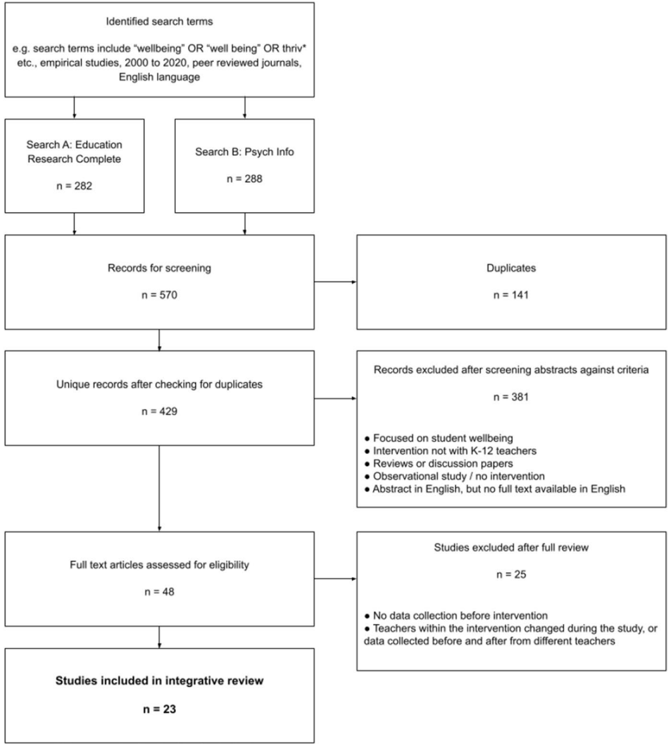
This systematic literature review summarises the research into interventions intended to improve the wellbeing of educators in the early childhood to secondary sectors. A search of articles published between 2000 and 2020 yielded 23 articles that met our inclusion criteria. Studies were included if they collected quantitative or qualitative data about educator wellbeing pre-intervention and post-intervention from the same group(s) of educators. We classified articles into five categories based on their content: multi-foci (several content areas included in a program), mindfulness, gratitude, professional development (classroom practice oriented), and physical environment. The articles revealed wide variations in: wellbeing theories underpinning interventions, the phenomena measured, and the effectiveness of the interventions. In some studies wellbeing was conceptualised as the absence of negative states (such as stress), in other studies to the presence of positive states (such as satisfaction), and in a few studies as the combination of both these approaches. Some of the gaps noted across the research include the lack of attention to the role of the school climate in determining the success of an intervention, and the lack of analysis to explore whether interventions work better for some individuals than others (for example, a lack of reporting of the characteristics of participants who drop out of the interventions). Overall, the multi-foci interventions show the most promise for improving educator wellbeing.
Verified 2026-11-22 · 1 reference not checked yet
Overview
CoChat Summary
TL;DR
This systematic review synthesizes 23 articles on 22 interventions to improve educator wellbeing in early childhood to secondary sectors. It finds wide variation in wellbeing theories, content, measures, and effects, with multi-foci interventions showing the most promise.
Key findings
- The 22 interventions were categorized as multi-foci (n = 9), mindfulness (n = 6), teacher professional development (5 articles on 4 interventions), gratitude (n = 2), and physical environment (n = 1).
- Multi-foci interventions had the largest percentage of measures showing improvement (71%); five of six multi-foci interventions showed significant improvements on the majority of measures, with medium to large effect sizes where provided.
- Gratitude interventions showed significant changes in 5 of 8 measures (63%), with small to large effect sizes; mindfulness interventions improved 47% of measures, but only 6 of 18 negative wellbeing measures (33%) improved; teacher professional development interventions improved only 33% of measures and were judged not effective at improving teacher wellbeing.
- Among controlled quantitative studies, RCTs showed significant change in 15 of 28 scales (54%), while non-RCT controlled studies showed significant change in 36 of 61 measures (59%).
Methods
- PRISMA-guided systematic review with an a priori protocol (not registered), searching Education Research Complete and PsychInfo for articles from 2000 to November 2020.
- Inclusion criteria were empirical studies with an intervention and pre/post data on educator wellbeing; from 429 unique articles, 48 were full-text screened and 23 met eligibility criteria.
- Qualitative coding used NVivo 12 with a priori codes for intervention content, providers, participants, context, theories, and measures; quantitative data were entered into Excel to tabulate scales, significant changes, and effect sizes.
Limitations
- The authors state the search likely missed some research because it focused on the broad term wellbeing rather than specific components or interventions commonly purported to improve wellbeing, and it did not search grey literature, with negative or non-significant results less likely to be published.
- The authors state they could not compare the same quantitative measure across intervention categories because measures were rarely used consistently, and each intervention category included only a small number of quantitative studies (one to six), so caution is needed when drawing conclusions about effectiveness.
- Evident in the text: many included quantitative studies had small samples and low statistical power; 13 of 18 studies had sample sizes less than 50, only three calculated power, and only Wolf et al. (2019) reported effect sizes detectable with >80% power.
Model-written summary. Check it against the paper before relying on it.
Integrity signals
Registry
Cites
Statistics
Figures
Verification
Claims the paper makes
24 Valid · 2 Not valid · 64 Not checked · 80 Own results and interpretations
Some cited sources support this claim and some don’t — read each source’s verdict below.
In the paper
“Many measures that had shown statistically significant improvement immediately post intervention were no longer significant at follow up: time urgency after six months (Jennings et al., 2019), burnout and teacher-child interaction quality after one year (Wolf et al., 2019), and positive and negative affect after six months (Rahm & Heise, 2019).”
§ What do we know about interventions to improve educator wellbeing? A systematic literature review > Effects for interventions using control groups.
What the sources say
- Not checked — no full text of the sourcecites Jennings et al., 2019 matched to “Long-term impacts of the CARE program on teachers' self-reported social and emotional competence and well-being” (2019) source
- Disputedcites Wolf et al., 2019 matched to “Experimental Impacts of the “Quality Preschool for Ghana” Interventions on Teacher Professional Well-being, Classroom Quality, and Children’s School Readiness” (2019) sourceExperimental — accuracy not yet measured
The Method section dates this paper’s follow-up to May–June 2016, during the intervention’s first year, not one year after it ended. At that follow-up, the Results report statistically significant reductions in burnout and improvements in two domains of teacher–child interaction quality—the opposite of the attributed loss of significance. (LLM, conf=0.88)
Checked by a reasoning model — may be wrong.
- Partly supportedcites Rahm & Heise, 2019 matched to “Teaching Happiness to Teachers - Development and Evaluation of a Training in Subjective Well-Being” (2019) sourceExperimental — accuracy not yet measured
The Results and Discussion report that improvements in the frequency of positive and negative emotions were significant immediately after training but not at the later follow-up. The timing is imprecise in the citing sentence: the paper describes that follow-up as approximately five months after training (19–25 weeks), not six months. (LLM, conf=0.84)
plain- Asserted: passes — The authors put it forward as true.
- Checkable: passes — It can be checked against evidence.
- Load-bearing: passes — The paper’s conclusions depend on it.
- Based: passes — The paper gives a reason why it holds.
Every source the paper cites for this claim was checked and supports it.
In the paper
“Collaborative and trusting school cultures are also strongly associated with greater teacher wellbeing (Cann et al., 2022).”
§ What do we know about interventions to improve educator wellbeing? A systematic literature review > Wellbeing
What the sources say
- Supportedcites Cann et al., 2022 matched to “The Power of School Conditions: Individual, Relational, and Organizational Influences on Educator Wellbeing” (2022) source
In the Discussion (Organizational Level Factors, Hypothesis 5), the authors state that wellbeing was most strongly associated with trusting and collaborative school conditions and that collaboration was strongly associated with wellbeing. The Practical Implications section likewise says these conditions explained the most variation in educator wellbeing. (LLM, conf=0.94)
boostedstates an association- Asserted: passes — The authors put it forward as true.
- Checkable: passes — It can be checked against evidence.
- Load-bearing: unclear — It is unclear whether the paper’s conclusions depend on it.
- Based: passes — The paper gives a reason why it holds.
- Supported
The cited sources support only part of this claim — read each source’s verdict below.
In the paper
“Stress is linked to negative impacts on school performance and attrition (Greenberg, 2016;Ingersoll, 2001)”
§ What do we know about interventions to improve educator wellbeing? A systematic literature review > Teacher wellbeing
What the sources say
- Not matchedcites Greenberg, 2016
An author–year citation the paper’s reference list doesn’t settle. We don’t search these by name.
- Partly supportedcites Ingersoll, 2001 matched to “Teacher Turnover and Teacher Shortages: An Organizational Analysis” (2001) sourceExperimental — accuracy not yet measured
The Reasons for Turnover section links teacher dissatisfaction and adverse organizational conditions to attrition. The Teacher Turnover, School Community, and School Effectiveness section suggests that turnover can disrupt school performance, but says this relationship was not explicitly examined. Neither passage establishes that stress itself is linked to both outcomes. (LLM, conf=0.76)
plainstates an association- Asserted: passes — The authors put it forward as true.
- Checkable: passes — It can be checked against evidence.
- Load-bearing: passes — The paper’s conclusions depend on it.
- Based: passes — The paper gives a reason why it holds.
- Not matched
Every source the paper cites for this claim was checked and supports it.
In the paper
“Student misbehaviour is associated with lower levels of teacher wellbeing (Aldrup et al., 2018;Kaynak, 2020).”
§ What do we know about interventions to improve educator wellbeing? A systematic literature review > Wellbeing
What the sources say
- Supportedcites Aldrup et al., 2018 matched to “Student misbehavior and teacher well-being: Testing the mediating role of the teacher-student relationship” (2018) source
The Results (section 3.2) link higher teacher-rated student misbehavior to greater emotional exhaustion and lower work enthusiasm over time, both measures of teacher well-being. The association was not statistically significant for student-rated misbehavior after adjustment, so the study's direct finding is strongest for teachers' perceptions. (LLM, conf=0.93)
- Supportedcites Kaynak, 2020
In the student-misbehaviour theme (page not specified), participant teachers identify misbehaviour as an obstacle to their well-being and describe it as stressful and exhausting. The 'Obstacles and Challenges to Well-being' section also reports that disrespectful, misbehaving students made teaching less manageable. (LLM, conf=0.92)
plainstates an association- Asserted: passes — The authors put it forward as true.
- Checkable: passes — It can be checked against evidence.
- Load-bearing: unclear — It is unclear whether the paper’s conclusions depend on it.
- Based: passes — The paper gives a reason why it holds.
- Supported
The cited sources that could be checked couldn’t confirm or dispute this claim.
In the paper
“However, positive education interventions rarely focus on improving teacher wellbeing alongside that of students.”
§ What do we know about interventions to improve educator wellbeing? A systematic literature review > Improving wellbeing in schools
What the sources say
- Could not verifycites Waters & Loton, 2019 matched to “SEARCH: A Meta-Framework and Review of the Field of Positive Education” (2019) sourceExperimental — accuracy not yet measured
The sections on mindfulness and emotional-intelligence interventions report student wellbeing outcomes, but do not assess how often interventions also aim to improve teacher wellbeing. A search for teacher or staff wellbeing alongside student wellbeing found no passage establishing the claimed rarity; the Gaps in Positive Education Research section discusses a different gap. (LLM, conf=0.70)
plain- Asserted: passes — The authors put it forward as true.
- Checkable: passes — It can be checked against evidence.
- Load-bearing: passes — The paper’s conclusions depend on it.
- Based: passes — The paper gives a reason why it holds.
- Could not verify
67 more claims · 6 with their cited sources checked
Create a free account to see all 170 claims and to verify the 2 references still open.
- Probably not a substantial claim. 51
- It may state two separate claims as one. 58
- The quote only partly states this claim. 1
Self-check
Percentages, sums and reported differences re-computed from the paper’s own numbers.
Each contradiction between two passages listed here was confirmed by an independent check.
Rated minor: it would not touch a result — a value no result rests on, a p-value that stays on the same side of the significance level, or a conflict that is clerical, resolved elsewhere in the paper, or outside its own findings.
In the paper
§ What do we know about interventions to improve educator wellbeing? A systematic literature review > Other intervention features
“The length of the interventions varied considerably, from five days to one year.”
§ What do we know about interventions to improve educator wellbeing? A systematic literature review > Dropouts.
“Dosage.The interventions varied considerably in terms of their duration, from five days to three years”
Rated minor: it would not touch a result — a value no result rests on, a p-value that stays on the same side of the significance level, or a conflict that is clerical, resolved elsewhere in the paper, or outside its own findings.
In the paper
§ What do we know about interventions to improve educator wellbeing? A systematic literature review > Other intervention features
“Apart from a three year long collaborative project to develop a multi-foci wellbeing intervention (Saaranen et al., 2007), all other interventions were 16 weeks or less”
§ What do we know about interventions to improve educator wellbeing? A systematic literature review > Other intervention features
“The teacher professional development interventions were generally the longest in duration, ranging from seven months to one year.”
Citations
Cites
A Global Measure of Perceived Stress
Cohen, S., Kamarck, T., & Mermelstein, R. (1983) · Journal of Health and Social Behavior · doi:10.2307/2136404 · Cited by 32,807 · cited 1×
“For example, across the 18 interventions using quantitative data the Perceived Stress Scale (Cohen et al., 1983) was used in seven studies, and was therefore one of the most used scales.”
Development and validation of brief measures of positive and negative affect: The PANAS scales.
Watson, D., Clark, L. A., & Tellegen, A. (1988) · Journal of Personality and Social Psychology · doi:10.1037/0022-3514.54.6.1063 · Cited by 32,433 · cited 1×
“The other wellbeing measures used scales which were context free, for example Watson et al.’s (1988) positive and negative affect scale which asks how frequently respondents have experienced particular emotions within a Where the measures used in a study included subscales such as depression and…”
Liberati, A., Altman, D. G., Tetzlaff, J., Mulrow, C., Gøtzsche, P. C., Ioannidis, J. P. A., Clarke, M., Devereaux, P. J., Kleijnen, J., & Moher, D. (2009) · PLoS Medicine · doi:10.1371/journal.pmed.1000100 · Cited by 28,164 · cited 2×
“The review was conducted using the Preferred Reporting Items for Systematic reviews and Meta-Analyses (PRISMA) guidelines (Liberati et al., 2009).”
InfluentialThe Ecology of Human Development: Experiments by Nature and Design
Bronfenbrenner, U. (1979) · Harvard University Press eBooks · doi:10.4159/9780674028845 · Cited by 26,084
Positive psychology: An introduction.
Seligman, M. E. P., & Csikszentmihalyi, M. (2000) · American Psychologist · doi:10.1037/0003-066x.55.1.5 · Cited by 11,351 · cited 2×
“Positive psychology—which has been described as the science of wellbeing—seeks to “understand and build the factors that allow individuals, communities, and societies to flourish” (Seligman & Csikszentmihalyi, 2000, p. 5).”
Liberati, A., Altman, D. G., Tetzlaff, J., Mulrow, C., Gøtzsche, P. C., Ioannidis, J. P. A., Clarke, M., Devereaux, P. J., Kleijnen, J., & Moher, D. (2009) · Journal of Clinical Epidemiology · doi:10.1016/j.jclinepi.2009.06.006 · Cited by 10,578
Power failure: why small sample size undermines the reliability of neuroscience
Button, K. S., Ioannidis, J. P. A., Mokrysz, C., Nosek, B. A., Flint, J., Robinson, E. S. J., & Munafò, M. R. (2013) · Nature Reviews Neuroscience · doi:10.1038/nrn3475 · Cited by 7,641 · cited 1×
“This low power leads to a larger variability in results and can lead to inflated effect size estimates (Button et al., 2013).”
Positive Psychology Progress: Empirical Validation of Interventions.
Seligman, M. E. P., Steen, T. A., Park, N., & Peterson, C. (2005) · American Psychologist · doi:10.1037/0003-066x.60.5.410 · Cited by 5,947 · cited 1×
“The two gratitude interventions used the ‘three good things’ intervention (Seligman et al., 2005), which is well known in the field of positive psychology for improving happiness and reducing depression.”
Flourish: A Visionary New Understanding of Happiness and Well-Being
(2011) · Choice Reviews Online · doi:10.5860/choice.48-7217 · Cited by 5,543 · cited 1×
“Positive relationships with colleagues and students are associated with greater educator wellbeing (for example: Seligman, 2011).”
The mental health continuum: from languishing to flourishing in life.
Keyes, C. L. M. (2002) · Journal of Health and Social Behavior · doi:10.2307/3090197 · Cited by 5,133
Gibbs, G. (2007) · doi:10.4135/9781849208574 · Cited by 4,299 · cited 1×
“Items coded to the same node were regularly compared to each other and to the codebook to avoid ‘definitional drift’, and to refine the codes to reflect the themes (DeCuir-Gunby et al., 2011; Gibbs, 2007).”
The New Zealand Medical Journal 1887-1987.
Rg, R. (1987) · PubMed · Cited by 3,673
Teacher Turnover and Teacher Shortages: An Organizational Analysis
Ingersoll, R. M. (2001) · American Educational Research Journal · doi:10.3102/00028312038003499 · Cited by 2,989 · cited 1×
“Stress is linked to negative impacts on school performance and attrition (Greenberg, 2016; Ingersoll, 2001) and negatively affects teachers who remain in the profession through reductions in teacher-efficacy, job satisfaction (Collie et al., 2012), optimism and motivation (Desrumaux et al., 2015).”
Issues in Educational Research
Keeves, J. P., & Lakomski, G. (1999) · Medical Entomology and Zoology · Cited by 2,531
Positive education: positive psychology and classroom interventions
Seligman, M. E. P., Ernst, R. M., Gillham, J., Reivich, K., & Linkins, M. (2009) · Oxford Review of Education · doi:10.1080/03054980902934563 · Cited by 2,106 · cited 1×
“…positive education emerged shortly after positive psychology was founded as schools became increasingly aware of the need to improve the wellbeing of their students (Seligman et al., 2009), prompted by data on the poor state of mental health for young people around the world (Slemp et al., 2017).”
Fowler, J. H., & Christakis, N. A. (2008) · BMJ · doi:10.1136/bmj.a2338 · Cited by 1,990
Flourishing Across Europe: Application of a New Conceptual Framework for Defining Well-Being
Huppert, F. A., & So, T. T. C. (2013) · Social Indicators Research · doi:10.1007/s11205-011-9966-7 · Cited by 1,864 · cited 2×
“However, resilience also encompasses ideas about how long it takes a person to recover after a setback (Huppert & So, 2013), so it could be argued it is more related to coping with negative conditions than being a measure of a positive state.”
Practical significance: a concept whose time has come
Kirk, R. E. (1996) · Educational and Psychological Measurement · doi:10.1177/0013164496056005002 · Cited by 1,778
What Schools Need to Know About Fostering School Belonging: a Meta-analysis
Allen, K., Kern, M. L., Vella-Brodrick, D., Hattie, J., & Waters, L. (2018) · Educational Psychology Review · doi:10.1007/s10648-016-9389-8 · Cited by 1,637
Publication bias in the social sciences: Unlocking the file drawer
Franco, A., Malhotra, N., & Simonovits, G. (2014) · Science · doi:10.1126/science.1255484 · Cited by 1,542 · cited 1×
“In particular, negative or non-significant results are far less likely to be published (Franco et al., 2014).”
DeCuir-Gunby, J. T., Marshall, P. L., & McCulloch, A. W. (2011) · Field Methods · doi:10.1177/1525822x10388468 · Cited by 1,456 · cited 1×
“Items coded to the same node were regularly compared to each other and to the codebook to avoid ‘definitional drift’, and to refine the codes to reflect the themes (DeCuir-Gunby et al., 2011; Gibbs, 2007).”
Collie, R. J., Shapka, J. D., & Perry, N. E. (2012) · Journal of Educational Psychology · doi:10.1037/a0029356 · Cited by 1,279 · cited 2×
“…working relationships with colleagues as contributing to developing confidence, reducing anxiety and stress and contributing to their wellbeing (Collie et al., 2012; Paterson & Grantham, 2016), and that collaborative relationships can help to offset some of the negative aspects of teaching…”
Classroom emotional climate, student engagement, and academic achievement.
Reyes, M. R., Brackett, M. A., Rivers, S. E., White, M., & Salovey, P. (2012) · Journal of Educational Psychology · doi:10.1037/a0027268 · Cited by 1,229 · cited 1×
“Teachers with poor wellbeing that remain in the profession have negative consequences for students, as teacher burnout is associated with poorer teacher-student relationships, student behavior, and academic achievement (Hoglund et al., 2015; Reyes et al., 2012).”
How Do Simple Positive Activities Increase Well-Being?
Lyubomirsky, S., & Layous, K. (2013) · Current Directions in Psychological Science · doi:10.1177/0963721412469809 · Cited by 1,197 · cited 1×
“Interventions are successful when they have a good ‘person-activity fit’ (Lyubomirsky & Layous, 2013), a concept that describes how successful wellbeing interventions are influenced by the fit between features of the intervention or activity (e.g. dosage or social support) and the person (e.g.…”
Environments in developmental perspective: Theoretical and operational models.
Bronfenbrenner, U. (1999) · Measuring environment across the life span: Emerging methods and concepts. · doi:10.1037/10317-001 · Cited by 1,129
TALIS 2018 Results (Volume I): Teachers and School Leaders as Lifelong Learners
OECD (2019) · TALIS · doi:10.1787/1d0bc92a-en · Cited by 1,084
Thriving not just surviving: A review of research on teacher resilience
Beltman, S., Mansfield, C., & Price, A. (2011) · Educational Research Review · doi:10.1016/j.edurev.2011.09.001 · Cited by 913 · cited 1×
“For example, resilience has been categorized as a positive wellbeing measure given that motivation and self-efficacy are important factors in determining resilience (Beltman et al., 2011).”
Causal Explanation, Qualitative Research, and Scientific Inquiry in Education
Maxwell, J. A. (2004) · Educational Researcher · doi:10.3102/0013189x033002003 · Cited by 778 · cited 1×
“In order to develop this understanding, researchers should make greater use of qualitative methodologies, which are useful for exploring the causal processes of an intervention (Maxwell, 2004).”
The Role of Subjective Well-Being in Positive Youth Development
Park, N. (2004) · The ANNALS of the American Academy of Political and Social Science · doi:10.1177/0002716203260078 · Cited by 764 · cited 1×
“Other studies reinforce the importance of relationships, for example the quality of individuals’ social interactions have been linked to their wellbeing (Park, 2004; Sun et al., 2019).”
Mindfulness for Teachers: A Pilot Study to Assess Effects on Stress, Burnout, and Teaching Efficacy
Flook, L., Goldberg, S. B., Pinger, L., Bonus, K., & Davidson, R. J. (2013) · Mind, Brain, and Education · doi:10.1111/mbe.12026 · Cited by 682 · cited 1×
“Therefore, the search method excluded some articles that focused on a narrower aspect of educator wellbeing (e.g., Mindfulness to reduce stress; Flook et al., 2013).”
Effectiveness of positive psychology interventions: a systematic review and meta-analysis
Carr, A., Cullen, K., Keeney, C., Canning, C., Mooney, O., Chinseallaigh, E., & O’Dowd, A. (2021) · The Journal of Positive Psychology · doi:10.1080/17439760.2020.1818807 · Cited by 645
Linton, M.-J., Dieppe, P., & Medina-Lara, A. (2016) · BMJ Open · doi:10.1136/bmjopen-2015-010641 · Cited by 638
Self-Compassion: The Proven Power of Being Kind to Yourself
Neff, K. D. (2011) · Medical Entomology and Zoology · Cited by 588
International Journal of Emotional Education
(2022) · International Journal of Emotional Education · doi:10.56300/ecbn5175 · Cited by 577
Thankful for the little things: A meta-analysis of gratitude interventions.
Davis, D. E., Choe, E., Meyers, J., Wade, N., Varjas, K., Gifford, A., Quinn, A., Hook, J. N., Van Tongeren, D. R., Griffin, B. J., et al. (2016) · Journal of Counseling Psychology · doi:10.1037/cou0000107 · Cited by 483 · cited 1×
“In order to fully evaluate the potential for a particular type of intervention to enhance teacher wellbeing it may be necessary to draw on meta-analyses from a range of contexts outside of education (for example: Davis et al., 2016).”
Aldrup, K., Klusmann, U., Lüdtke, O., Göllner, R., & Trautwein, U. (2018) · Learning and Instruction · doi:10.1016/j.learninstruc.2018.05.006 · Cited by 435 · cited 1×
“Student misbehaviour is associated with lower levels of teacher wellbeing (Aldrup et al., 2018; Kaynak, 2020).”
Huppert, F. A., & Johnson, D. M. (2010) · The Journal of Positive Psychology · doi:10.1080/17439761003794148 · Cited by 391 · cited 1×
“Although there is no one agreed upon definition of wellbeing within the field, a commonly used definition is “feeling good and functioning well” (Huppert & Johnson, 2010, p. 264).”
Third wave positive psychology: broadening towards complexity
Lomas, T., Waters, L., Williams, P., Oades, L. G., & Kern, M. L. (2021) · The Journal of Positive Psychology · doi:10.1080/17439760.2020.1805501 · Cited by 380 · cited 1×
“This would also align with the call for greater use of qualitative data within positive psychology to extend our understanding of wellbeing (Lomas et al., 2020).”
Measuring environment across the life span: Emerging methods and concepts.
(1999) · American Psychological Association eBooks · doi:10.1037/10317-000 · Cited by 368
Co-design of eHealth Interventions With Children and Young People
Thabrew, H., Fleming, T., Hetrick, S., & Merry, S. (2018) · Frontiers in Psychiatry · doi:10.3389/fpsyt.2018.00481 · Cited by 351 · cited 1×
“Adapting interventions through processes such as co-design can lead to interventions that are more engaging, satisfying, and useful for those taking part (Boyd et al., 2012; Thabrew et al., 2018).”
Improving healthcare through the use of co-design.
Boyd, H., McKernon, S., Mullin, B., & Old, A. (2012) · PubMed · Cited by 349
Veenhoven, R. (2023) · Encyclopedia of Quality of Life and Well-Being Research · doi:10.1007/978-3-031-17299-1_4049 · Cited by 342
Is well-being associated with the quantity and quality of social interactions?
Sun, J., Harris, K., & Vazire, S. (2020) · Journal of Personality and Social Psychology · doi:10.1037/pspp0000272 · Cited by 332
Hwang, Y.-S., Bartlett, B., Greben, M., & Hand, K. (2017) · Teaching and Teacher Education · doi:10.1016/j.tate.2017.01.015 · Cited by 277 · cited 1×
“While there are some reviews focused on particular interventions to improve teacher wellbeing (for example mindfulness: Hwang et al., 2017; Lomas et al., 2017; Zarate et al., 2019), reviews that examine the broad range of teacher wellbeing interventions offered are lacking.”
(2008) · Researching Hospitality and Tourism: A Student Guide · doi:10.4135/9781446280362.n10 · Cited by 276
Lomas, T., Medina, J. C., Ivtzan, I., Rupprecht, S., & Eiroa-Orosa, F. J. (2017) · Teaching and Teacher Education · doi:10.1016/j.tate.2016.10.008 · Cited by 258 · cited 1×
“While there are some reviews focused on particular interventions to improve teacher wellbeing (for example mindfulness: Hwang et al., 2017; Lomas et al., 2017; Zarate et al., 2019), reviews that examine the broad range of teacher wellbeing interventions offered are lacking.”
Geraghty, A. W. A., Wood, A. M., & Hyland, M. E. (2010) · Social Science & Medicine · doi:10.1016/j.socscimed.2010.03.007 · Cited by 241 · cited 1×
“Other research also shows that drop-outs have different baseline measures, such as lower internal locus of control, less accurate self-evaluation, and low expectations of an intervention (Davis & Addis, 1999; Geraghty et al., 2010).”
Systems informed positive psychology
Kern, M. L., Williams, P., Spong, C., Colla, R., Sharma, K., Downie, A., Taylor, J. A., Sharp, S., Siokou, C., & Oades, L. G. (2020) · The Journal of Positive Psychology · doi:10.1080/17439760.2019.1639799 · Cited by 230
Mental health, job satisfaction and occupational stress among UK teachers
Travers, C. J., & Cooper, C. L. (1993) · Work & Stress · doi:10.1080/02678379308257062 · Cited by 227 · cited 1×
“For example, teachers experience higher stress levels than the national population in the United Kingdom (Kidger et al., 2010; Travers & Cooper, 1993), China (Yang et al., 2009) and New Zealand (Milfont et al., 2008).”
Harris, A. R., Jennings, P. A., Katz, D. A., Abenavoli, R. M., & Greenberg, M. T. (2016) · Mindfulness · doi:10.1007/s12671-015-0451-2 · Cited by 221 · cited 7×
“All but one of these studies relied on self-report measures, such as sleep quality or medication use, whilst Harris et al. (2016) also used physical measures of blood pressure and tested the cortisol levels of educators via collecting saliva samples.”
InfluentialBurnout and wellbeing: Testing the Copenhagen Burnout inventory in New Zealand teachers
Milfont, T. L., Denny, S., Ameratunga, S., Robinson, E., & Merry, S. (2008) · Social Indicators Research · doi:10.1007/s11205-007-9229-9 · Cited by 214 · cited 1×
“For example, teachers experience higher stress levels than the national population in the United Kingdom (Kidger et al., 2010; Travers & Cooper, 1993), China (Yang et al., 2009) and New Zealand (Milfont et al., 2008).”
Yin, H., Huang, S., & Wang, W. (2016) · International Journal of Environmental Research and Public Health · doi:10.3390/ijerph13090907 · Cited by 214 · cited 1×
“Teachers’ trust in colleagues is positively associated with increased enthusiasm, teaching satisfaction, and contentment, and reduced anxiety, burnout, and depression (Huang et al., 2019; Yin et al., 2016, 2018).”
Hoglund, W. L. G., Klingle, K. E., & Hosan, N. E. (2015) · Journal of School Psychology · doi:10.1016/j.jsp.2015.06.002 · Cited by 207 · cited 1×
“Teachers with poor wellbeing that remain in the profession have negative consequences for students, as teacher burnout is associated with poorer teacher-student relationships, student behavior, and academic achievement (Hoglund et al., 2015; Reyes et al., 2012).”
Chan, D. W. (2010) · Educational Psychology · doi:10.1080/01443410903493934 · Cited by 207 · cited 7×
“In one study, satisfaction with life and gratitude only had statistically significant increases for people with low gratitude at baseline (Chan, 2010), suggesting this intervention is more effective for some participants than others.”
InfluentialKidger, J., Gunnell, D., Biddle, L., Campbell, R., & Donovan, J. (2010) · British Educational Research Journal · doi:10.1080/01411920903249308 · Cited by 198 · cited 1×
“For example, teachers experience higher stress levels than the national population in the United Kingdom (Kidger et al., 2010; Travers & Cooper, 1993), China (Yang et al., 2009) and New Zealand (Milfont et al., 2008).”
Frank, J. L., Reibel, D., Broderick, P., Cantrell, T., & Metz, S. (2015) · Mindfulness · doi:10.1007/s12671-013-0246-2 · Cited by 197 · cited 3×
“Of the 18 quantitative studies, three reported low statistical power as a limitation, but did not calculate the power (Frank et al., 2015; Harris et al., 2016; Hayes et al., 2020), and three calculated power (Jennings et al., 2019; Rahm & Heise, 2019; Wolf et al., 2019).”
Relationship between quality of life and occupational stress among teachers
Yang, X., Ge, C., Hu, B., Chi, T., & Wang, L. (2009) · Public Health · doi:10.1016/j.puhe.2009.09.018 · Cited by 191 · cited 1×
“For example, teachers experience higher stress levels than the national population in the United Kingdom (Kidger et al., 2010; Travers & Cooper, 1993), China (Yang et al., 2009) and New Zealand (Milfont et al., 2008).”
Quantifying teacher resilience: Context matters
Ainsworth, S., & Oldfield, J. (2019) · Teaching and Teacher Education · doi:10.1016/j.tate.2019.03.012 · Cited by 190 · cited 1×
“Contextual factors include support from school leadership, which is associated with greater teacher wellbeing and lower burnout (Ainsworth & Oldfield, 2019; Cann et al., 2021; Janovská et al., 2016).”
Jennings, P. A., Doyle, S., Oh, Y., Rasheed, D., Frank, J. L., & Brown, J. L. (2019) · Journal of School Psychology · doi:10.1016/j.jsp.2019.07.009 · Cited by 186 · cited 7×
“Of the 18 quantitative studies, three reported low statistical power as a limitation, but did not calculate the power (Frank et al., 2015; Harris et al., 2016; Hayes et al., 2020), and three calculated power (Jennings et al., 2019; Rahm & Heise, 2019; Wolf et al., 2019).”
InfluentialTeachers’ well-being: A framework for data collection and analysis
(2020) · OECD Education Working Papers · doi:10.1787/c36fc9d3-en · Cited by 175
Wolf, S., Aber, J. L., Behrman, J. R., & Tsinigo, E. (2019) · Journal of Research on Educational Effectiveness · doi:10.1080/19345747.2018.1517199 · Cited by 154 · cited 5×
“All three studies measured burnout, but only one intervention successfully decreased burnout (Wolf et al., 2019).”
InfluentialHuang, S., Yin, H., & Lv, L. (2019) · Educational Psychology · doi:10.1080/01443410.2018.1543855 · Cited by 148 · cited 1×
“Teachers’ trust in colleagues is positively associated with increased enthusiasm, teaching satisfaction, and contentment, and reduced anxiety, burnout, and depression (Huang et al., 2019; Yin et al., 2016, 2018).”
Desrumaux, P., Lapointe, D., Ntsame Sima, M., Boudrias, J.-S., Savoie, A., & Brunet, L. (2015) · European Review of Applied Psychology · doi:10.1016/j.erap.2015.06.003 · Cited by 147 · cited 1×
“Stress is linked to negative impacts on school performance and attrition (Greenberg, 2016; Ingersoll, 2001) and negatively affects teachers who remain in the profession through reductions in teacher-efficacy, job satisfaction (Collie et al., 2012), optimism and motivation (Desrumaux et al., 2015).”
A Model of Positive School Leadership to Improve Teacher Wellbeing
Cann, R. F., Riedel, R., & Powell, D. (2020) · International Journal of Applied Positive Psychology · doi:10.1007/s41042-020-00045-5 · Cited by 147 · cited 1×
“Contextual factors include support from school leadership, which is associated with greater teacher wellbeing and lower burnout (Ainsworth & Oldfield, 2019; Cann et al., 2021; Janovská et al., 2016).”
Self-citation(2017) · Adelaide Research & Scholarship (AR&S) (University of Adelaide) · Cited by 144
Beshai, S., McAlpine, L., Weare, K., & Kuyken, W. (2016) · Mindfulness · doi:10.1007/s12671-015-0436-1 · Cited by 141 · cited 3×
“Of the six mindfulness interventions, four also specifically stated that the intervention included learning to develop self-compassion (Beshai et al., 2016; Harris et al., 2016; Hwang et al., 2019; Jennings et al., 2019), as mindfulness is a core component of self-compassion (Neff, 2015).”
Predictors of attrition from behavioral medicine treatments
Davis, M. J., & Addis, M. E. (1999) · Annals of Behavioral Medicine · doi:10.1007/bf02895967 · Cited by 139 · cited 1×
“Other research also shows that drop-outs have different baseline measures, such as lower internal locus of control, less accurate self-evaluation, and low expectations of an intervention (Davis & Addis, 1999; Geraghty et al., 2010).”
SEARCH: A Meta-Framework and Review of the Field of Positive Education
Waters, L., & Loton, D. (2019) · International Journal of Applied Positive Psychology · doi:10.1007/s41042-019-00017-4 · Cited by 138 · cited 2×
“A review of 75 studies of positive education interventions revealed only 2% used whole-school approaches that sought to improve staff wellbeing (Waters & Loton, 2019).”
Hagermoser Sanetti, L. M., & Collier-Meek, M. A. (2019) · Journal of School Psychology · doi:10.1016/j.jsp.2019.07.008 · Cited by 129 · cited 1×
“When evaluating the evidence to support wellbeing programs, it is also important to consider the implementation of the program, especially given the implementation gap—where evidence based practices do not lead to changes when implemented in schools (Hagermoser Sanetti & Collier-Meek, 2019).”
Meta-analysis of mindfulness training on teacher well-being.
Zarate, K., Maggin, D. M., & Passmore, A. (2019) · Psychology in the Schools · doi:10.1002/pits.22308 · Cited by 119 · cited 1×
“While there are some reviews focused on particular interventions to improve teacher wellbeing (for example mindfulness: Hwang et al., 2017; Lomas et al., 2017; Zarate et al., 2019), reviews that examine the broad range of teacher wellbeing interventions offered are lacking.”
Yin, H., Huang, S., & Lv, L. (2018) · Frontiers in Psychology · doi:10.3389/fpsyg.2018.02395 · Cited by 118 · cited 1×
“Teachers’ trust in colleagues is positively associated with increased enthusiasm, teaching satisfaction, and contentment, and reduced anxiety, burnout, and depression (Huang et al., 2019; Yin et al., 2016, 2018).”
The sustainability and unsustainability of teachers’ and leaders’well-being
Shirley, D., Hargreaves, A., & Washington-Wangia, S. (2020) · Teaching and Teacher Education · doi:10.1016/j.tate.2019.102987 · Cited by 118 · cited 2×
“Consequently, understanding how to improve teacher wellbeing is critical to ensuring positive outcomes for students, including student wellbeing (Shirley et al., 2020), as well as addressing concerns about the sustainability of the profession (McCallum & Price, 2016; OECD, 2019).”
Trust in school: a pathway to inhibit teacher burnout?
Van Maele, D., & Van Houtte, M. (2015) · Journal of Educational Administration · doi:10.1108/jea-02-2014-0018 · Cited by 117 · cited 1×
“Beyond these studies, most did not attend to school cul-ture—a large gap in the research given its impact on intervention success (Halliday et al., 2019) and educator wellbeing (Cann et al., 2022, Paterson & Grantham, 2016; Van Maele & Van Houtte, 2015).”
Nurturing Wellbeing Development in Education
McCallum, F. L., & Price, D. A. (2015) · Routledge eBooks · doi:10.4324/9781315760834 · Cited by 112
Shuval, K., Harker, K., Roudsari, B., Groce, N. E., Mills, B., Siddiqi, Z., & Shachak, A. (2011) · PLoS ONE · doi:10.1371/journal.pone.0016937 · Cited by 110 · cited 1×
“The majority of studies in this review (18 out of 22) evaluated the effectiveness of their interventions using quantitative data—indeed, many view it as a more robust approach to evaluation than using qualitative approaches (Shuval et al., 2011).”
Cook, C. R., Miller, F. G., Fiat, A., Renshaw, T., Frye, M., Joseph, G., & Decano, P. (2017) · Psychology in the Schools · doi:10.1002/pits.21980 · Cited by 110 · cited 5×
“For example, Cook et al. (2017) assert that “efforts targeting teacher well-being should aim for more than simply reducing stress and burnout—they should also strive to cultivate positive patterns of thinking and feeling” (p. 15).”
InfluentialEcological influences on teachers’ well-being and “fitness”
Price, D., & McCallum, F. (2015) · Asia-Pacific Journal of Teacher Education · doi:10.1080/1359866x.2014.932329 · Cited by 108
Teacher wellbeing: Its effects on teaching practice and student learning
Turner, K., & Thielking, M. (2020) · Swinburne University of Technology · doi:10.25916/5e4c8eeca2765 · Cited by 102
The ecology of CLIL teachers in Austria – an ecological perspective on CLIL teachers’ wellbeing
Hofstadler, N., Babić, S., Lämmerer, A., Mercer, S., & Oberdorfer, P. (2020) · Innovation in Language Learning and Teaching · doi:10.1080/17501229.2020.1739050 · Cited by 99
Hobson, A. J., & Maxwell, B. (2017) · British Educational Research Journal · doi:10.1002/berj.3261 · Cited by 93 · cited 2×
“A broad array of self-report measures of wellbeing exist, with one review identifying 99 measures (Linton et al., factors explain more variance in teachers’ wellbeing than individual factors (Ains-worth & Oldfield, 2019; Hobson & Maxwell, 2017).”
Wessels, E., & Wood, L. A. (2019) · South African Journal of Education · doi:10.15700/saje.v39n1a1619 · Cited by 89 · cited 4×
“Qualitative methods were infrequently used—four studies used solely qualitative approaches (Cigala et al., 2019; Sharrocks, 2014; Turner & Theilking, 2019; Wessels & Wood, 2019), and two studies used mixed methods approaches (Hayes et al., 2020; Hwang et al., 2019).”
InfluentialTeaching Happiness to Teachers - Development and Evaluation of a Training in Subjective Well-Being
Rahm, T., & Heise, E. (2019) · Frontiers in Psychology · doi:10.3389/fpsyg.2019.02703 · Cited by 88 · cited 8×
“Only a few studies in this review analysed dropouts, with one finding that dropouts had significantly lower life satisfaction at baseline (Rahm & Heise, 2019).”
InfluentialPositive Education in Australia: Practice, Measurement, and Future Directions
Slemp, G. R., Chin, T.-C., Kern, M. L., Siokou, C., Loton, D., Oades, L. G., Vella-Brodrick, D., & Waters, L. (2017) · Social and Emotional Learning in Australia and the Asia-Pacific · doi:10.1007/978-981-10-3394-0_6 · Cited by 85 · cited 2×
“…positive education emerged shortly after positive psychology was founded as schools became increasingly aware of the need to improve the wellbeing of their students (Seligman et al., 2009), prompted by data on the poor state of mental health for young people around the world (Slemp et al., 2017).”
Helliwell, J., & Wang, S. (2010) · doi:10.3386/w15911 · Cited by 82
Fernandes, L., Peixoto, F., Gouveia, M. J., Silva, J. C., & Wosnitza, M. (2019) · The Australian Educational Researcher · doi:10.1007/s13384-019-00344-0 · Cited by 80 · cited 3×
“Only three studies did not include negatively focused measures: two gratitude interventions (Chan, 2010, 2013), and one multi-foci intervention ( Fernandes et al., 2019).”
Wolf, S., & Peele, M. E. (2019) · Teaching and Teacher Education · doi:10.1016/j.tate.2019.07.003 · Cited by 78 · cited 1×
“Four of the studies collected data at follow up points between six weeks to one year after the intervention ended in order to explore the sustained impacts of the intervention (Hwang et al., 2019; Jennings et al., 2019; Rahm & Heise, 2019; Wolf & Peele, 2019).”
Peter, T., Roberts, L. W., & Dengate, J. (2011) · International Journal of Mental Health Promotion · doi:10.1080/14623730.2011.9715646 · Cited by 67
Erratum: Power failure: why small sample size undermines the reliability of neuroscience
Button, K. S., Ioannidis, J. P. A., Mokrysz, C., Nosek, B. A., Jonathan Flint, C., Robinson, E. S. J., & Munafo, M. R. (2013) · Nature reviews. Neuroscience · doi:10.1038/nrn3502 · Cited by 65
Easy as (Happiness) Pie? A Critical Evaluation of a Popular Model of the Determinants of Well-Being
Brown, N. J. L., & Rohrer, J. M. (2020) · Journal of Happiness Studies · doi:10.1007/s10902-019-00128-4 · Cited by 64
Chan, D. W. (2013) · Educational Psychology · doi:10.1080/01443410.2013.785046 · Cited by 60 · cited 6×
“The online interventions used either written instructions (Chan, 2010, 2013), or an instructional video (Czer-winski et al., 2020), whilst the in person interventions were generally group training sessions.”
InfluentialContemporary school psychology
Catterall, C. D. (1971) · Journal of School Psychology · doi:10.1016/0022-4405(71)90097-5 · Cited by 58
Electromagnetic hypersensitivity: a critical review of explanatory hypotheses
Dieudonné, M. (2020) · Environmental Health · doi:10.1186/s12940-020-00602-0 · Cited by 58 · cited 1×
“…and Olstad’s (2008) intervention of fitting filters to the electrical supply in schools was founded on the theory that adverse symptoms of electrical hyper-sensitivity could be alleviated by reducing exposure to electromagnetic fields, a theory that has been severely critiqued (Dieudonné, 2020).”
Wolf, S., Torrente, C., Frisoli, P., Weisenhorn, N., Shivshanker, A., Annan, J., & Aber, J. L. (2015) · Teaching and Teacher Education · doi:10.1016/j.tate.2015.08.002 · Cited by 53 · cited 2×
“Apart from these two multi-foci intervention studies, four studies measured relationships—teacher-student relationships (Hwang et al., 2019; Wolf et al., 2015) and teacher relationships in general (Bradley et al., 2018; Harris et al., 2016).”
Occupational well-being of school staff members: a structural equation model
Saaranen, T., Tossavainen, K., Turunen, H., Kiviniemi, V., & Vertio, H. (2006) · Health Education Research · doi:10.1093/her/cyl073 · Cited by 52 · cited 7×
“However, a few interventions provided external resources and environments to support wellbeing, including elements such as aromatherapy, comfortable chairs, stress balls, food and drink (Sharrocks, 2014), and visits from occupational physiotherapists (Saaranen et al., 2007).”
InfluentialHwang, Y.-S., Noh, J.-E., Medvedev, O. N., & Singh, N. N. (2019) · Mindfulness · doi:10.1007/s12671-019-01236-1 · Cited by 47 · cited 7×
“Apart from these two multi-foci intervention studies, four studies measured relationships—teacher-student relationships (Hwang et al., 2019; Wolf et al., 2015) and teacher relationships in general (Bradley et al., 2018; Harris et al., 2016).”
InfluentialHayes, R., Titheradge, D., Allen, K., Allwood, M., Byford, S., Edwards, V., Hansford, L., Longdon, B., Norman, S., Norwich, B., et al. (2020) · British Journal of Educational Psychology · doi:10.1111/bjep.12284 · Cited by 45 · cited 9×
“For example, in Hayes et al.’s (2020) mixed method study, they did not see any significant improvement in quantitative measures, but interviews revealed some teachers created more positive cycles of behavior in their classes that helped them to feel more confident.”
InfluentialPositive Psychology Interventions in Practice
Lozada, M. C., Carro, N., Kapelmayer, M., et al. (2017) · Springer eBooks · doi:10.1007/978-3-319-51787-2 · Cited by 44
How to make teachers happy: An exploration of teacher wellbeing in the primary school context
Paterson, A., & Grantham, R. (2016) · Educational and Child Psychology · doi:10.53841/bpsecp.2016.33.2.90 · Cited by 42 · cited 2×
“…with colleagues as contributing to developing confidence, reducing anxiety and stress and contributing to their wellbeing (Collie et al., 2012; Paterson & Grantham, 2016), and that collaborative relationships can help to offset some of the negative aspects of teaching (Wigford & Higgins,…”
‘Learning from success’: A close look at a popular positive psychology course
Russo‐Netzer, P., & Ben‐Shahar, T. (2011) · The Journal of Positive Psychology · doi:10.1080/17439760.2011.634823 · Cited by 39 · cited 1×
“Positive education uses theories and models from positive psychology, such as Selig-man’s (2011) PERMA theory of wellbeing, and applies them in the form of interventions at educational institutions ranging from primary schools to universities (Russo-Netzer & Ben-Shahar, 2011; Waters & Loton, 2019).”
Huppert, F. A., & So, T. T. C. (2012) · Social Indicators Research · doi:10.1007/s11205-012-0030-z · Cited by 37
Ford, T. J., Hayes, R. A., Byford, S., Edwards, V., Fletcher, M., Logan, S., Norwich, B., Pritchard, W., Allen, K., Allwood, M., et al. (2019) · Public Health Research · doi:10.3310/phr07060 · Cited by 36
Mental health, job satisfaction and occupational stress among UK teachers
Travers, C. J. (2018) · Routledge eBooks · doi:10.4324/9781315196244-24 · Cited by 36
School staff perceptions of well-being and experience of an intervention to promote well-being
Sharrocks, L. (2014) · Educational Psychology in Practice · doi:10.1080/02667363.2013.868787 · Cited by 35 · cited 7×
“However, a few interventions provided external resources and environments to support wellbeing, including elements such as aromatherapy, comfortable chairs, stress balls, food and drink (Sharrocks, 2014), and visits from occupational physiotherapists (Saaranen et al., 2007).”
InfluentialBradley, C., Cordaro, D. T., Zhu, F., Vildostegui, M., Han, R. J., Brackett, M., & Jones, J. (2018) · Translational Issues in Psychological Science · doi:10.1037/tps0000162 · Cited by 35 · cited 3×
“In contrast, Bradley et al. (2018) proposed that teachers’ wellbeing would increase due to training about a wellbeing curriculum that they implemented within their class-rooms to teach students about wellbeing.”
Wellbeing in international schools: Teachers’ perceptions
Wigford, A., & Higgins, A. (2019) · Educational and Child Psychology · doi:10.53841/bpsecp.2019.36.4.46 · Cited by 33 · cited 1×
“…with colleagues as contributing to developing confidence, reducing anxiety and stress and contributing to their wellbeing (Collie et al., 2012; Paterson & Grantham, 2016), and that collaborative relationships can help to offset some of the negative aspects of teaching (Wigford & Higgins, 2019).”
Sottimano, I., Guidetti, G., Converso, D., & Viotti, S. (2018) · PLOS ONE · doi:10.1371/journal.pone.0206627 · Cited by 32 · cited 4×
“Two studies used a range of professionals as needed for different aspects of the intervention, for example psychologists, an architect, physi-otherapist, and speech therapist (Saaranen et al., 2007; Sottimano et al., 2018).”
InfluentialUnderstanding Factors Affecting Positive Education in Practice: an Australian Case Study
Halliday, A. J., Kern, M. L., Garrett, D. K., & Turnbull, D. A. (2020) · Contemporary School Psychology · doi:10.1007/s40688-019-00229-0 · Cited by 30 · cited 4×
“For example, organizational factors include the school’s readiness for the program, the social climate, and alignment of the program with school goals (Halliday et al., 2019).”
InfluentialCigala, A., Venturelli, E., & Bassetti, M. (2019) · Frontiers in Psychology · doi:10.3389/fpsyg.2019.02574 · Cited by 30 · cited 7×
“…meetings (Cigala et al., 2019; Wessels & Wood, 2019), video recording of teachers presenting their learning about wellbeing (Wessels & Wood, 2019), teachers written observational reports of classroom activities (Cigala et al., 2019), and teacher written reflections (Turner & Theilking, 2019).”
InfluentialTeachers and Mindful Colouring to Tackle Burnout and Increase Mindfulness, Resiliency and Wellbeing
Czerwinski, N., Egan, H., Cook, A., & Mantzios, M. (2021) · Contemporary School Psychology · doi:10.1007/s40688-020-00279-9 · Cited by 29 · cited 5×
“The interventions were mainly delivered in person, but also included three delivered online (Chan, 2010, 2013; Czerwinski et al., 2020).”
InfluentialCann, R. F., Sinnema, C., Daly, A. J., Rodway, J., & Liou, Y.-H. (2022) · Frontiers in Psychology · doi:10.3389/fpsyg.2022.775614 · Cited by 29 · cited 2×
“Collaborative and trusting school cultures are also strongly associated with greater teacher wellbeing (Cann et al., 2022).”
Self-citation(2020) · OAR@UM (University of Malta) · Cited by 23
Goodman, F., Disabato, D. J., & Kashdan, T. (2020) · Journal of Positive Psychology · doi:10.1080/17439760.2020.1818815 · Cited by 23
Using CALMERSS to Enhance Teacher Well-being: A Pilot Study
Taylor, M. J. (2018) · International Journal of Disability, Development and Education · doi:10.1080/1034912x.2017.1394985 · Cited by 19 · cited 2×
“Potential search terms were checked against known articles about interventions to improve educator wellbeing (Jennings et al., 2019; Taylor, 2018) in order to refine the list of search terms.”
Power quality affects teacher wellbeing and student behavior in three Minnesota Schools
Havas, M., & Olstad, A. (2008) · Science of The Total Environment · doi:10.1016/j.scitotenv.2008.04.046 · Cited by 18 · cited 5×
“One study used an intervention that changed only the physical environment, by adding filters to the electrical supply (Havas & Olstad, 2008).”
InfluentialJanovská, A., Orosová, O., & Janovský, J. (2017) · ORBIS SCHOLAE · doi:10.14712/23363177.2017.11 · Cited by 15 · cited 1×
“Contextual factors include support from school leadership, which is associated with greater teacher wellbeing and lower burnout (Ainsworth & Oldfield, 2019; Cann et al., 2021; Janovská et al., 2016).”
Self‐selection bias in sleep and psychophysiological studies of posttraumatic stress disorder
Woodward, S. H., Stegman, W. K., Pavao, J., Arsenault, N. J., Hartl, T. L., Drescher, K. D., & Weaver, C. M. (2007) · Journal of Traumatic Stress · doi:10.1002/jts.20236 · Cited by 11 · cited 1×
“For example, in research not in this review, Woodward et al. (2007) found voluntary participants in an intervention to treat post-traumatic stress were more likely to have less severe symptoms than non-participants.”
Transforming Our Schools Together: A Multi-School Collaboration to Implement Positive Education
Quinlan, D. M. (2017) · Positive Psychology Interventions in Practice · doi:10.1007/978-3-319-51787-2_8 · Cited by 7 · cited 1×
“Considering that addressing teacher wellbeing has been identified as an important first step in implementing whole school programs to promote student wellbeing (Quinlan, 2017; Slemp et al., 2017), this is an area in need of more systematic research.”
Is Well-Being Associated with the Quantity and Quality of Social Interactions?
Sun, J., Harris, K., & Vazire, S. (2019) · doi:10.31234/osf.io/xdvsa
Research works printed but not linked: 6
- 4. Barber, C. (2016). "It takes a village to raise a child": Pastoral Care for Māori and Pasifika secondary school students [Doctoral dissertation, The Universityof Auckland] ResearchSpace@ Auckland https:// resea rchsp ace. auckl and. ac. nz/ handle/ 2292/ 31174
- Bricheno, P., Brown, S., & Lubansky, R. (2009). Teacher wellbeing: A review of the evidence. Teacher Suport Network. https://scholar-google-com.ezproxy.auckland.ac.nz/scholar_lookup?title=Teacher%20wellbeing%3A%20A%20review%20of%20the%20evidence&publication_year=2009&author=P.%20Bricheno&author=S.%20Brown&author=R.%20Lubansky
- 18. Chandler, J., Cumpston, M., Thomas, J., Higgins, J., Deeks, J., & Clarke, M. (2022). Chapter I: Intro- duction. In J. Higgins, J. Thomas, J. Chandler, M. Cumpston, T. Li, M. Page, & V. Welch (Eds.), Cochrane Handbook for Systematic Reviews of Interventions version 6.3 (updated February 2022). https:// train ing. cochr ane. org/ handb ook/ curre nt/ chapt er-i
- 28. Dix, K., Kashfee, S. A., Carslake, T., Sniedze-Gregory, S., O'Grady, E., & Trevitt, J. (2020). A system- atic review of intervention research examining effective student wellbeing in schools and their aca- demic outcomes. Evidence for Learning.
- 43. Hattie, J. (2009). Visible Learning: A Synthesis of Meta-Analyses in Education. Routledge.
- 107. World Health Organization. (1948). Summary report on proceedings minutes and final acts of the inter- national health conference. http:// apps. who. int/ iris/ bitst ream/ handle/ 10665/ 85573/ Offic ial_ recor d2_ eng. pdf; jsess ionid= C491B BE0CA 46ECD E8AAE 125AF 7823D 1B? seque nce=1
Cited by
Nurturing positive mental health and wellbeing in educational settings – the PRICES model
Frazier, T., & Fosco, S. L. D. (2024) · Frontiers in Public Health · doi:10.3389/fpubh.2023.1287532 · Cited by 81
“It underscores the recognition that educators need not be fully adept before implementing change; rather, they can concurrently learn and apply new strategies to cultivate both student and educator mastery (66) while also cultivating their own personal practice (42, 67–74).”
BackgroundA systematic review of primary school teachers’ wellbeing: room for a holistic approach
Öztürk, M., Wigelsworth, M., & Squires, G. (2024) · Frontiers in Psychology · doi:10.3389/fpsyg.2024.1358424 · Cited by 81
“Despite limitations and inconsistencies in understanding teacher wellbeing, as cited in Cann et al. (2023), scholars have urged the field to expand beyond individual-focused approaches, recognize the impact of context on wellbeing, and embrace greater complexity (Kern et al., 2020; Lomas et al.,…”
BackgroundResearch on teacher well-being: a systematic review
Gámez-Genovart, M., Trobat, M. F. O., & Ramón, M. R. R. (2025) · Teaching and Teacher Education · doi:10.1016/j.tate.2025.105264 · Cited by 67
Karaferye, F., & Bellibaş, M. Ş. (2025) · Research Papers in Education · doi:10.1080/02671522.2025.2475496 · Cited by 38
“Scholars have identified several workplace factors that foster TWB, such as reduced teaching and administrative workload (Bellibaş, Gümüş, and Chen 2024), positive relationships with colleagues, collaborative school culture, and access to professional development opportunities (R. Cann et al. 2024).”
Durrani, N., & Makhmetova, Z. (2025) · Sustainability · doi:10.3390/su17030900 · Cited by 23
Metadata
- Authors
- Cann, R., Sinnema, C., Rodway, J., & Daly, A. J.
- Affiliations
- University of Auckland (NZ)
- Ontario Tech University (CA)
- University of California San Diego (US)
- Corresponding author
- Cann, Rachel
- Venue
- Journal of Educational Change
- Published
- 2023-09-14
- Volume
- 25
- Issue
- 2
- Pages
- 231-270
- ISSN
- 1389-2843 (ISSN-L)
- 1573-1812
- OpenAlex
- W4386742460
- Cited by
- 54
- References
- 111
- Citations by year
- 2026: 26 · 2025: 21 · 2024: 6 · 2023: 1
- FWCI
- 3.53
- Type
- journal article
- Language
- en
- Open access
- hybrid
- doi.org
- Licence
- cc-by
- creativecommons.org/licenses/by/4.0 (tdm)
- creativecommons.org/licenses/by/4.0 (vor)
- Locations
- Journal of Educational Change (publishedVersion, cc-by)
- Funders
- University of Auckland
- Topics
- Health Sciences › Medicine › Public Health, Environmental and Occupational Health › Occupational Health and Burnout
- Social Sciences › Psychology › Social Psychology › Stress and Burnout Research
- Social Sciences › Education › Teacher Education and Leadership Studies
- Keywords
- educator wellbeing, mindfulness, gratitude interventions, professional development, physical environment, school climate, teacher stress, teacher job satisfaction, early childhood educators, secondary school teachers, intervention effectiveness
About these checks
Registry, retraction, Cites and statistics results are computed, not judged, with one exception: a printed reference that no index lists is read once by a model before it counts as a citation error. Claims are extracted by a model and kept only when their quote appears verbatim in the text; each cited source is then checked, with a model’s help, for whether it says what the claim relies on. Those verdicts can be wrong — read the claim’s quote and the cited source before relying on one.
The claim verdicts this report counts are experimental: their accuracy is not yet measured.
A language model drew the claims from the paper on 2026-10-03, under version 3 of the claim definition (model deepseek-v4.1-flash, prompt extract-v3).
A second model labelled each claim on 2026-10-03 (model jev-1.13-20260917, definition revision gold-guideline-v0.2).
Cited sources are checked with a language model’s help (gpt-6-sol).
Statistics and arithmetic are recomputed, not judged.
Confidence bands are shown only for fields calibrated on our annotated test set. None is calibrated yet, so no band is shown.
What counts as a claim ›How we measure confidence ›How we check this ›
Are you an author, or do you see a problem with this page? Request a review
Data sources
Bibliographic data: Semantic Scholar, OpenAlex, Crossref.
Contains information from the Semantic Scholar Academic Graph Datasets, made available under the ODC Attribution License (ODC-BY 1.0).
Semantic Scholar’s data is described in: Kinney, R., et al. (2023). The Semantic Scholar Open Data Platform. arXiv:2301.10140.
