

Leader autonomy support in the workplace: A meta-analytic review
Open accessThe DOI matches its Crossref record; 107 of the 109 references it cites were found in a registry or an index.
Abstract
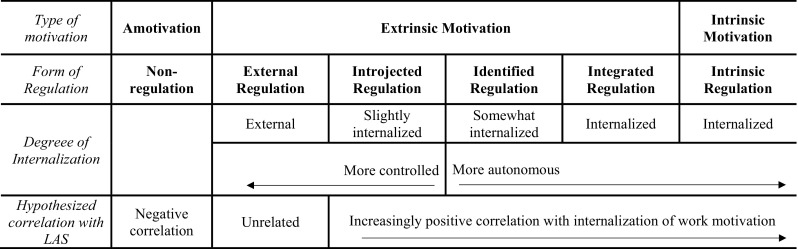
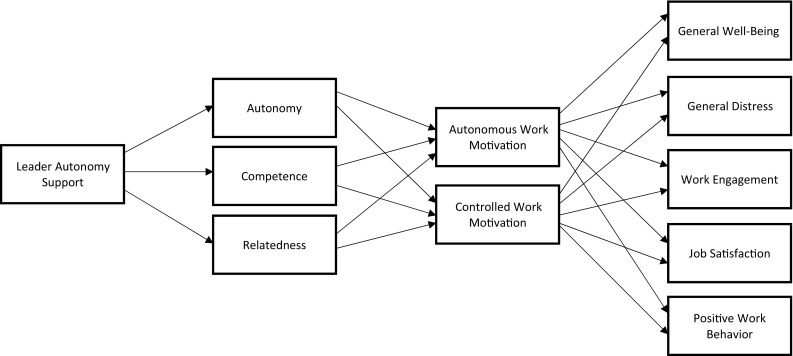
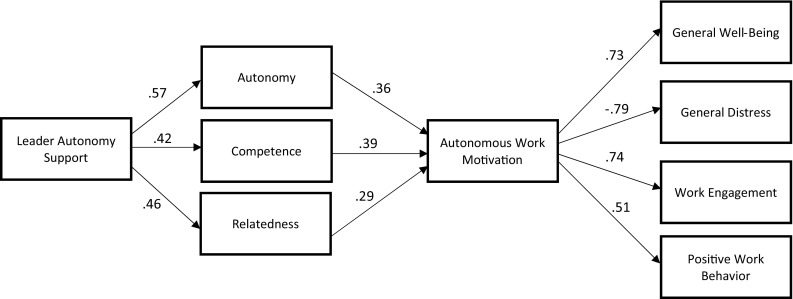
Leader autonomy support (LAS) refers to a cluster of supervisory behaviors that are theorized to facilitate self-determined motivation in employees, potentially enabling well-being and performance. We report the results of a meta-analysis of perceived LAS in work settings, drawing from a database of 754 correlations across 72 studies (83 unique samples, N = 32,870). Results showed LAS correlated strongly and positively with autonomous work motivation, and was unrelated to controlled work motivation. Correlations became increasingly positive with the more internalized forms of work motivation described by self-determination theory. LAS was positively associated with basic needs, well-being, and positive work behaviors, and was negatively associated with distress. Correlations were not moderated by the source of LAS, country of the sample, publication status, or the operationalization of autonomy support. In addition, a meta-analytic path analysis supported motivational processes that underlie LAS and its consequences in workplaces. Overall, our findings lend support for autonomy support as a leadership approach that is consistent with self-determination and optimal functioning in work settings.
Overview
The claims and statistics of this paper haven’t been checked yet.
Free: it reads the open-access text and checks the first 5 claims that cite a source we can check. Create a free account to check every claim.
Integrity signals
Registry
Cites
Statistics
Figures
Verification
Claims the paper makes
The claims and statistics of this paper haven’t been checked yet.
Free: it reads the open-access text and checks the first 5 claims that cite a source we can check. Create a free account to check every claim.
Claims other papers make about this one
Each is checked against this paper’s own text: does it say what the citing paper says it does?
The source backs part of the claim, not all of it — or backs it for a different population, condition or comparison.
In the citing paper
“Confirming existing research (Slemp et al., 2018(Slemp et al., , 2020)), the relationship between autonomy support and structure did not vary among individualistic versus collectivistic cultures in our sample.”
From Blending Teacher Autonomy Support and Provision of Structure in the Classroom for Optimal Motivation: A Systematic Review and Meta-Analysis (2025) · cites this paper as Slemp et al., 2018
Experimental — accuracy not yet measuredThe source backs part of the claim, not all of it — or backs it for a different population, condition or comparison.
In the citing paper
“it fosters agentic employee work behaviors and reduces employee job strain and burnout (Slemp et al., 2018).”
From Job Demands—Resources theory and self-regulation: New explanations and remedies for job burnout (2021) · cites this paper as Slemp et al., 2018
Experimental — accuracy not yet measuredThe cited source says what the claim attributes to it.
In the citing paper
“Meta-analytic evidence shows culture does not moderate the relationship between autonomy support and need satisfaction (Slemp et al., 2018) or teacher outcomes (Slemp et al., 2020).”
From Blending Teacher Autonomy Support and Provision of Structure in the Classroom for Optimal Motivation: A Systematic Review and Meta-Analysis (2025) · cites this paper as Slemp et al., 2018
The cited source says what the claim attributes to it.
In the citing paper
“Cross-cultural evidence has now been meta-analytically analyzed with autonomy as defined within BPNT appearing to carry similar benefits for individuals from diverse cultures (e.g., Slemp et al. 2018;Yu et al. 2018).”
From Basic psychological need theory: Advancements, critical themes, and future directions (2020) · cites this paper as Slemp et al. 2018
Self-check
Percentages, sums and reported differences re-computed from the paper’s own numbers.
The self-check needs the paper’s full text.
Citations
Cites
Hu, L., & Bentler, P. M. (1999) · Structural Equation Modeling A Multidisciplinary Journal · doi:10.1080/10705519909540118 · Cited by 108,788
Statistical Power Analysis for the Behavioral Sciences
Muller, K. (1989) · Technometrics · doi:10.1080/00401706.1989.10488618 · Cited by 99,167
Podsakoff, P. M., MacKenzie, S. B., Lee, J.-Y., & Podsakoff, N. P. (2003) · Journal of Applied Psychology · doi:10.1037/0021-9010.88.5.879 · Cited by 82,194 · cited 1×
“Finally, almost all of the measures in the studies were self-report instruments, which raises the possibility that our results are affected by self-report bias and shared method variance (Podsakoff et al. 2003).”
BackgroundStatistical power analysis for the behavioral sciences
(1990) · Computers, Environment and Urban Systems · doi:10.1016/0198-9715(90)90050-4 · Cited by 65,269
Ryan, R. M., & Deci, E. L. (2000) · American Psychologist · doi:10.1037//0003-066x.55.1.68 · Cited by 54,599 · cited 10×
“An important part of this SDT framework is the process of internalization, which refers to a natural tendency for people to transform controlled motivation into more autonomous forms of motivation (Ryan and Deci 2000).”
BackgroundResultInfluentialSelf-citationThe "what" and "why" of goal pursuits: Human needs and the self-determination of behavior
Deci, E. L., & Ryan, R. M. (2000) · Psychological Inquiry · doi:10.1207/s15327965pli1104_01 · Cited by 34,210 · cited 1×
“Relations of leader autonomy support to basic needs, well‑being, and work outcomes SDT posits that individuals experience optimal psychological functioning to the extent that three basic psychological needs for autonomy, competence, and relatedness are satisfied (Deci and Ryan 2000).”
BackgroundSelf-citationlavaan : An R Package for Structural Equation Modeling
Rosseel, Y. (2012) · Journal of Statistical Software · doi:10.18637/jss.v048.i02 · Cited by 27,955 · cited 1×
“The path analysis was performed using the lavaan package (Rosseel 2012) of the open source R software (version 3.3.1), using Ordinary Least Squares (OLS) estimation.”
MethodInfluentialCulture's Consequences: Comparing Values, Behaviors, Institutions, and Organizations across Nations
Bhagat, R. S., & Hofstede, G. (2002) · The Academy of Management Review · doi:10.2307/4134391 · Cited by 21,664
Borenstein, M., Hedges, L. V., Higgins, J. P. T., & Rothstein, H. R. (2009) · doi:10.1002/9780470743386 · Cited by 14,225
Self-Determination Theory: Basic Psychological Needs in Motivation, Development, and Wellness
(2017) · doi:10.1521/978.14625/28806 · Cited by 12,588
Self-citation
Research works printed but not linked: 2
- Schmidt FL Le H Software for the Hunter-Schmidt meta-analysis methods, version 2.0 2014 Iowa City, IA University of Iowa, Department of Management & Organizations
- Slemp GR Oades LG Steger MF Delle Fave A Passmore J Job Crafting The Wiley Blackwell handbook of the psychology of positivity and strengths-based approaches at work 2017 Hoboken Wiley 342 365
Cited by
Items 201–300 of 637
Huyghebaert‐Zouaghi, T., Morin, A. J. S., Ntoumanis, N., Thomas, J., & Gillet, N. (2024) · Applied Psychology · doi:10.1111/apps.12573 · Cited by 9
“Indeed, need-supportive behaviors have been found to be associated with a variety of adaptive outcomes, whereas need-thwarting behaviors rather predict maladaptive outcomes (Gillet et al., 2012; Slemp et al., 2018).”
WORK ENGAGEMENT AS A MEDIATOR BETWEEN AUTONOMY SUPPORT AND PSYCHOLOGICAL WELL-BEING
Embalsado, J. V. M., Gopez, B. B., Montoya, M. A. J. T., Mangalus, R. S., & Embalsado, R. L. C. (2025) · International Journal of Management Studies · doi:10.32890/ijms2025.32.1.5 · Cited by 9
Farid, H., Raza, J., Gul, H., & Hanif, N. (2021) · Current Psychology · doi:10.1007/s12144-021-01638-2 · Cited by 9
Sims, S. (2021) · Review of Education · doi:10.1002/rev3.3304 · Cited by 9
“Having said this, the scale is rooted in psychological theory about the underlying nature of human motivation and persistence at work, and in that sense it should be broadly applicable (Deci et al., 2001; Ryan & Deci, 2011; Slemp et al., 2018).”
BackgroundMagson, N. R., Craven, R. G., Ryan, R. M., Blacklock, F., Franklin, A., Mooney, J., Yeung, A. S., & Dillon, A. (2022) · Transcultural Psychiatry · doi:10.1177/13634615221111634 · Cited by 9
“As positive associations have been found between SDT ’ s need satisfaction at work and desirable wellbeing outcomes across other cultures (see meta-analysis by Slemp et al., 2018), it appears appropriate to evaluate these associations in Indigenous samples.”
Self-citationLeadership: A Self-Determination Theory Perspective
den Broeck, A. V., & Slemp, G. R. (2023) · Oxford University Press eBooks · doi:10.1093/oxfordhb/9780197600047.013.47 · Cited by 10
Self-citationTraining and maintaining autonomy-supportive supervisory style in low-skilled occupations
Yong, A., Roche, M., & Sutton, A. (2019) · Journal of Management & Organization · doi:10.1017/jmo.2019.67 · Cited by 10
“Recently, a meta-analysis by Slemp et al. (2018) found that leaders’ autonomy support, regardless of the proximity (direct leader or senior leaders), facilitated employees’ need satisfaction.”
BackgroundStrategies to Improve Employee Engagement in the Hospitality Industry
Taylor, C. Y. (2019) · ScholarWorks (Walden University) · Cited by 9
van der Baan, N. A., Lejeune, C., Beausaert, S. A. J., & Raemdonck, I. (2024) · European journal of training and development · doi:10.1108/ejtd-05-2024-0068 · Cited by 8
Dávid, D., & Lahindah, L. (2025) · Amkop Management Accounting Review. · doi:10.37531/amar.v5i1.2516 · Cited by 8
Marsh, H. W., Ryan, R. M., Dicke, T., Pekrun, R. H., Guo, J., Bradshaw, E. L., Reeve, J., Lüdtke, O., Clarke, T., & Waterschoot, J. (2025) · Educational Psychology Review · doi:10.1007/s10648-025-10079-3 · Cited by 8
“…to be more strongly predicted by highly supportive environments (e.g., job resources), whereas frustration is expected to be most strongly predicted by highly controlling or threatening conditions (e.g., job demands), not merely by the absence of support (Haerens et al., 2015; Slemp et al., 2018).”
Self-citationUnderstanding flooding events in Ghana: a social marketing and self-determination theory perspective
Tweneboah‐Koduah, E. Y., Adams, M., Amoakoh, M. N., & Braimah, S. M. (2022) · Journal of Social Marketing · doi:10.1108/jsocm-03-2021-0049 · Cited by 8
Exploring the Social Context of Self-directed Learning in the Contemporary Workplace
Hein, V., & Urban, K. (2024) · Human Affairs · doi:10.1515/humaff-2023-0122 · Cited by 9
“The fi ndings of another meta-analysis by Slemp et al. (2018) suggest that leader autonomy support at work predicts the satisfaction of all basic psychological needs, although unequally.”
Sales controls: a necessary condition perspective
Conde, R., & Sumlin, C. (2025) · Journal of Business and Industrial Marketing · doi:10.1108/jbim-07-2024-0473 · Cited by 8
The Motivation Competencies That Count Most: An Online International Study
Epstein, R., Ho, M., Scandalis, Z., & Ginther, A. (2022) · The Open Psychology Journal · doi:10.2174/18743501-v15-e2202030 · Cited by 8
Zhu, N., Liu, Y., & Zhang, J. (2023) · Behavioral Sciences · doi:10.3390/bs13060465 · Cited by 9
“The literature summarizes that the antecedents of employees’ well-being include organizational context, traits, the psychological states [14,15,32–38], and work behavior [39,40], such as autonomy support [41,42] and challenge and hindrance demands [43,44].”
BackgroundHuman Factors Engineering: Designing for Diversity and Accessibility
Stonewall, J. H., Roscoe, R. D., Mont'Alvão, C. R., Papautsky, E. L., Sanford, J. A., & Valdez, R. S. (2021) · Proceedings of the Human Factors and Ergonomics Society Annual Meeting · doi:10.1177/1071181321651046 · Cited by 8
Coleman, J., Mallett, C. J., Steffens, N. K., & Haslam, S. A. (2024) · Behavioral Sciences · doi:10.3390/bs14100946 · Cited by 7
Linking job autonomy to employee engagement and exhaustion: the role of employee cognitive appraisal
Muecke, S., & Greenwald, J. M. (2025) · Current Psychology · doi:10.1007/s12144-025-08885-7 · Cited by 7
“Considering recommendations for managers to adopt a more autonomy-supportive leadership style towards employees (Slemp et al., 2018), it is important to emphasize that decisions to grant employees more autonomy to influence employee engagement and exhaustion depend on differ - ent autonomy forms.”
Tóth‐Király, I., Morin, A. J. S., Vandenberghe, C., & Radanielina-Hita, M. L. (2023) · European Journal of Work and Organizational Psychology · doi:10.1080/1359432x.2023.2250088 · Cited by 7
“…which types of interventions are likely to be most effective at supporting need satisfaction (for reviews, see Cerasoli et al., 2016; Ryan et al., 2023; Slemp et al., 2018, 2021; Su & Reeve, 2011), leading to relatively clear practical recommendations for organizations (Gagné et al., 2022).”
BackgroundAkça, İ., & DEMİR, Ö. (2024) · International Journal of Gastronomy and Food Science · doi:10.1016/j.ijgfs.2024.100999 · Cited by 7
Rizal, G. L., & Fikry, Z. (2020) · Progress in Social Science, Humanities and Education Research Symposium (PSSHERS) · doi:10.2991/assehr.k.200824.039 · Cited by 7
Mukherjee, T. (2022) · Springer eBooks · doi:10.1007/978-981-16-8263-6_13 · Cited by 7
Bilodeau, G., Austin, S., Fernet, C., & Drouin‐Rousseau, S. (2023) · Psychologie du Travail et des Organisations · doi:10.1016/j.pto.2023.10.003 · Cited by 7
Yong, A., Roche, M., & Sutton, A. (2019) · Industrial and Commercial Training · doi:10.1108/ict-01-2019-0013 · Cited by 7
“A recent meta-analysis by Slemp et al. (2018) has found that autonomy-supportive supervision contributes to employees’ well-being and positive behaviours at work.”
BackgroundProtective factors that enhance teacher resilience in a private school in Johannesburg
Boatsi, T., & van der Merwe, M. (2024) · South African Journal of Childhood Education · doi:10.4102/sajce.v14i1.1380 · Cited by 7
“In any place of work, autonomy support is regarded as an important need-support that satisfies one’s basic psychological need for autonomy (Slemp et al. 2018).”
van Hees, S., Carlier, B. E., Joosen, M. C. W., Blonk, R. W. B., & Oomens, S. P. C. J. (2024) · Scandinavian Journal of Work and Organizational Psychology · doi:10.16993/sjwop.249 · Cited by 6
Testing self-supportive strategies to regulate autonomy and motivation
Flunger, B., Lilleholt, L., BOHM, R. M., Verdonschot, A., van Gog, T., & Zettler, I. (2024) · PLoS ONE · doi:10.1371/journal.pone.0311264 · Cited by 6
Tafvelin, S., & Stenling, A. (2025) · International Journal of Training and Development · doi:10.1111/ijtd.12373 · Cited by 6
Kärner, T. (2025) · Empirical research in vocational education and training · doi:10.1186/s40461-025-00183-7 · Cited by 6
“…et al. (2021a, b) identified a negative correlation between job autonomy and turnover intentions among employees ( r = − 0.42, − 0.39, and − 0.38), while Slemp et al. (2018) provided meta-analytic evidence of the relationship between leader autonomy support and turnover intentions (ρ = − 0.40).”
InfluentialCreativity Under Stress at Work: A Person-Centered Approach
Lin, S., Ivčević, Z., & Brackett, M. A. (2025) · Creativity Research Journal · doi:10.1080/10400419.2025.2594357 · Cited by 6
Eckley, D., Allen, A., Millear, P. M. R., Rune, K. T., & Mason, J. (2023) · Cognitive Therapy and Research · doi:10.1007/s10608-023-10403-7 · Cited by 6
“However, like the ECQ, the measurements of wellbeing within core needs studies has typically only assessed general mental health, such as positive and negative affect or quality of life (Ng et al., 2012; Slemp et al., 2018; Van den Broeck et al., 2016; Yu et al., 2018).”
BackgroundYang, J., Qi, Z., & Zhu, J. (2024) · Chinese Management Studies · doi:10.1108/cms-01-2024-0015 · Cited by 6
Makhanya, M. T. B., & Vezi-Magigaba, M. F. (2025) · IntechOpen eBooks · doi:10.5772/intechopen.1008282 · Cited by 6
Pratiwi, B. R., & Parahyanti, E. (2022) · Jurnal Ilmiah Psikologi Terapan · doi:10.22219/jipt.v10i1.16820 · Cited by 7
Öz Belirleme Kuramı Temelinde Bir Müdahale Aracı Olarak Video Oyunları
Sevinçli, M. C., & Eger, M. (2022) · Psikiyatride Guncel Yaklasimlar - Current Approaches in Psychiatry · doi:10.18863/pgy.974968 · Cited by 6
How adults maltreated as children relate to work supervisors: relational patterns and processes
Icekson, T., Kaye‐Tzadok, A., & Aharon-Peeri, N. (2021) · Current Psychology · doi:10.1007/s12144-021-02242-0 · Cited by 6
“Further to research demonstrating the positive effects of supervisor autonomy support (e.g., Slemp et al., 2018), the current study suggests that it may be especially beneficial for CM survivors.”
BackgroundKullberg, S., Edén, E., & Wänström, C. (2022) · Advances in transdisciplinary engineering · doi:10.3233/atde220141 · Cited by 6
Motivations and experiences of female expatriate educators teaching in Saudi Arabia
Hoke, T. (2020) · ScholarWorks (Walden University) · Cited by 6
Valachová, M., & Lisá, E. (2024) · Computers in Human Behavior · doi:10.1016/j.chb.2024.108465 · Cited by 5
Siddiqui, F., Khan, N. R., & Ali, A. (2024) · International journal of organizational analysis · doi:10.1108/ijoa-01-2024-4230 · Cited by 5
Perception of Generation Z towards Leadership in the Workplace (A Study at HIJ Company)
Nugraha, F., Prasetyo, B. E., Sugiarti, R., & Suhariadi, F. (2025) · Ranah Research Journal of Multidisciplinary Research and Development · doi:10.38035/rrj.v7i3.1557 · Cited by 5
“Similarly, Slemp et al. (2018) found that granting employees decision-making control enhances their ownership of outcomes, fostering greater engagement.”
Jauvin, F., Massaro, S., Coulombe, P., Brouillette, J., & Forest, J. (2025) · Motivation and Emotion · doi:10.1007/s11031-025-10120-6 · Cited by 5
Wang, H., Kamal, E. M., & Ulang, N. M. (2025) · Multidisciplinary Reviews · doi:10.31893/multirev.2025321 · Cited by 5
Dehkordi, S. S., Radević, I., Černe, M., & Bortoluzzi, G. (2025) · Creativity and Innovation Management · doi:10.1111/caim.70014 · Cited by 5
Kgadima, M. R., Coetzee, I., & Heyns, T. (2024) · Southern African Journal of Critical Care · doi:10.7196/sajcc.2024.v40i2.1282 · Cited by 5
Mühl, A., Schoellbauer, J., Straus, E., & Korunka, C. (2024) · The International Journal of Human Resource Management · doi:10.1080/09585192.2024.2439264 · Cited by 5
“Likewise, situational factors, such as communication norms (e.g. Ajzen, 2020) or leadership behavior (e.g. autonomy support; Slemp et al., 2018), should be further investigated.”
Hasibuan, M. (2025) · Journal of Digital Society · doi:10.63913/jds.v1i3.11 · Cited by 5
Unger, F., & Sann, U. (2023) · Springer eBooks · doi:10.1007/978-3-031-18038-5_16 · Cited by 5
The contribution of office design to the appraisal of job control: A longitudinal study
Nielsen, M. B., Christensen, J. O., & Knardahl, S. (2023) · Scandinavian Journal of Psychology · doi:10.1111/sjop.12933 · Cited by 6
Yulianto, E., Pratomo, T. P., Zein, Z., & Supardin, L. (2023) · International Conference on Industrial Engineering and Operations Management (IEOM) · doi:10.46254/na8.20230268 · Cited by 5
“Autonomy supportive leadership focus on leading employees by promoting their autonomous motivation (Slemp et al., 2018).”
Posada, X. L., Álvarez, E. M., Fernández, F. X. A., Fernández, A. B. M., & Fernández, A. G. (2023) · Journal of Social Work Education · doi:10.1080/10437797.2023.2248225 · Cited by 5
“In addition to the aforementioned research on teacher autonomy support, research has addressed coach autonomy support in athletes (Mossman et al., 2022), supervisor autonomy support in physicians (Sawatsky et al., 2022), or leader autonomy support in the workplace (Slemp et al., 2018).”
Tümer, M., & Dalḡar, İ. (2024) · Medicine · doi:10.1097/md.0000000000037327 · Cited by 5
“[21] Emotional stability (as a personality trait) was an independent factor for well-being and lower negative experience in our base-line survey.”
BackgroundCampbell, S., Manninen, M., & Yli-Piipari, S. R. (2022) · Journal of Physical Education Recreation & Dance · doi:10.1080/07303084.2021.2000531 · Cited by 5
A multilevel model of autonomous safety motivation and safety performance
Jiang, L., Zhang, Y., & Li, F. (2019) · Advances in Psychological Science · doi:10.3724/sp.j.1042.2019.01141 · Cited by 5
Psychological autonomy and well-being of employees in low-skilled occupations
Yong, A., Roche, M., & Sutton, A. (2019) · Research Commons (University of Waikato) · Cited by 5
Thriving at the U.S. Air Force Academy
Davis, K., DePorres, D., Esquivel, S., Ferrante, C. J., Heyler, S. G., Lévy, D., Packard, C. G. A., Tucker, E., & Blair, C. E. (2019) · Journal of Character and Leadership Development · Cited by 5
Clain, A., Oliveira, P. D., Minondo-Kaghad, B., & Salès-Wuillemin, É. (2021) · Psychologie du Travail et des Organisations · doi:10.1016/j.pto.2021.04.001 · Cited by 5
Gulevich, O. A., & Кривощеков, В. (2021) · PsyArXiv (OSF Preprints) · doi:10.31234/osf.io/ghrwe · Cited by 5
van der Vaart, L., Innstrand, S. T., & Christensen, M. (2025) · Scandinavian Journal of Psychology · doi:10.1111/sjop.13123 · Cited by 4
Motivación laboral en trabajadores de empresas privadas de Saltos del Guairá, Paraguay
Sánchez, D. D. D., Ranoni, O. C., & Tandis, J. A. B. (2025) · Ciencias administrativas · doi:10.24215/23143738e168 · Cited by 4
Illegitimate Tasks and Work Motivation: Examining the Full Continuum of Self‐Determination
Karkkola, P. (2025) · Scandinavian Journal of Psychology · doi:10.1111/sjop.70025 · Cited by 4
“The most potential determinants of autonomous motivation are satisfaction of the basic psychological needs and leader autonomy support (Slemp et al. 2018).”
Abdou, A. H., & Albohnayh, A. S. M. (2026) · Frontiers in Psychology · doi:10.3389/fpsyg.2026.1813978 · Cited by 4
“These effects have been observed across diverse contexts—including education, sports, and parenting—highlighting the broad applicability of ASL in promoting wellbeing (Slemp et al., 2018).”
Tran, D. T., & Howard, J. L. (2026) · Motivation and Emotion · doi:10.1007/s11031-026-10263-0 · Cited by 5
Morganson, V. J., Ford, M. T., & Golden, T. D. (2024) · Journal of Vocational Behavior · doi:10.1016/j.jvb.2024.104014 · Cited by 4
Hasselgren, C., & Jonsson, R. (2024) · The Career Development Quarterly · doi:10.1002/cdq.12363 · Cited by 4
Bellora-Bienengräber, L., Dalton, D. W., & McPhee, G. P. (2026) · Journal of Management Accounting Research · doi:10.2308/jmar-2023-088 · Cited by 4
Berger, S., & Voigt, J. (2026) · Creativity and Innovation Management · doi:10.1111/caim.70090 · Cited by 4
Soane, E. (2024) · Journal of Risk Research · doi:10.1080/13669877.2025.2485041 · Cited by 4
“For example, the decentralised decision-making associated with organic structures (Burns and Stalker 1961) creates autonomy that is motivating (Slemp et al., 2018).”
Developing a MODI Framework for Motivational Organizational Disconnection (MODI) Policies
Vranješ, I., Lacroix, A., & den Broeck, A. V. (2025) · Springer eBooks · doi:10.1007/978-3-031-76902-3_15 · Cited by 4
Empowering health, integrating privacy: a value-reflexive examination of smart health technologies
Zhang, J., Hassandoust, F., & Johnston, A. C. (2025) · European Journal of Information Systems · doi:10.1080/0960085x.2025.2567670 · Cited by 4
“This result aligns with numerous studies that suggest a positive influence of autonomy on patients’ health outcomes and well-being in different health informatics contexts (e.g., Robinson et al., 2020; Slemp et al., 2018; Williams et al., 2011).”
МОДЕЛЬ ЕВДЕМОНІЧНОЇ АКТИВНОСТІ ЯК ПОЯСНЮВАЛЬНА КОНЦЕПЦІЯ БЛАГОПОЛУЧЧЯ ОСОБИСТОСТІ
Боснюк, В. Ф. (2023) · Психологічні студії · doi:10.32782/psych.studies/2023.1.2 · Cited by 4
Harmokivi-Saloranta, P., Punna, M., & Laitinen‐Väänänen, S. (2024) · Theseus (Ammattikorkeakoulujen) · Cited by 4
Motivational orientations to mindfulness and wellbeing
Suh, H. (2019) · International Journal of Wellbeing · doi:10.5502/ijw.v9i1.725 · Cited by 4
Bagaimana Leader Autonomy Support Dapat Meningkatkan Perilaku Inovatif pada Karyawan?
Ulfa, B., & Salendu, A. (2021) · Jurnal Ilmu Perilaku · doi:10.25077/jip.5.1.57-75.2021 · Cited by 4
Mindfulness older workers and relational leadership
Roche, M., Shang, S., Bentley, T. A., Catley, B., Blackwood, K., Teo, S., & Sutton, A. (2022) · Journal of Management & Organization · doi:10.1017/jmo.2022.11 · Cited by 4
“LAS is an approach that promotes and provides choice, freedom, rationale and support for employees’ decisions (Gagne & Bhave, 2011; Slemp et al., 2018), in a climate of relatedness (Deci & Ryan, 2000, 2008).”
BackgroundInfluentialUzaktan Eğitime Özgü Beden Eğitimi Dersi Temel Psikolojik İhtiyaçlar Ölçeği Geliştirme Çalışması
Ada, E. N. (2021) · Türkiye Spor Bilimleri Dergisi · doi:10.32706/tusbid.926646 · Cited by 4
Autonomia da tarefa nas organizações: um estudo comparativo entre jovens, adultos e idosos
Marcon, S. R. A., Lucas, J. I. P., Kanan, L. A., Madalozzo, M. M., Michelin, F. T., & Diniz, N. C. F. (2022) · Conjecturas · doi:10.53660/conj-2195-2z55 · Cited by 3
Wang, H., Kamal, E. M., & Ulang, N. M. (2025) · PaperAsia · doi:10.59953/paperasia.v41i2b.407 · Cited by 3
“Leaders who adopt an autonomy-supportive approach acknowledge employees’ opinions, encourage self-initiation, offer opportunities for input and choice, communicate informatively rather than authoritatively, and refrain from using rewards or punishments to drive behavior (Slemp et al., 2018).”
Stenling, A., Lundmark, R., & Tafvelin, S. (2025) · International Journal of Human-Computer Interaction · doi:10.1080/10447318.2025.2558024 · Cited by 3
“These findings are consistent with previous studies emphasizing the importance of intrinsic and identified motivation in fostering job satisfaction and reducing employee turnover (Slemp et al., 2018; Van den Broeck et al., 2021).”
Examining Self-Determination Theory in the Context of Higher Education and Distance Education
Şanal, S. Ö., Torun, F., & Güler, T. D. (2025) · International Journal of Technology in Education · doi:10.46328/ijte.1245 · Cited by 3
“Satisfying basic psychological needs also affects the development and well-being of the person in basic areas of life (Chiu, 2022; Luarn et al., 2023; Rosli et al., 2022; Slemp et al., 2018; Siacor & Ng, 2024; Standage & Ryan 2020).”
Yao, W., Cheng, A., Cao, C.-H., Chen, I., Wei, X., & Malas, O. (2025) · Humanities and Social Sciences Communications · doi:10.1057/s41599-025-05901-w · Cited by 3
“Ful fi lling these needs promotes self-organization, adjustment, and fl ourishing across diverse cultural contexts (Slemp et al., 2018; Yu et al., 2018).”
Harrison, M. G., Mendoza, N. B., Hocson, S. M. G., & King, R. B. (2026) · British Journal of Guidance and Counselling · doi:10.1080/03069885.2025.2610616 · Cited by 3
“Research has shown that autonomy supportive leadership is positively associated with wellbeing and positive work behaviours (Slemp et al., 2018; Slemp et al., 2020).”
Kokubun, K., Ino, Y., & Ishimura, K. (2026) · Strategic Business Research · doi:10.1016/j.sbr.2026.100086 · Cited by 3
Wölk, J., & Kerschreiter, R. (2026) · Journal of Leadership & Organizational Studies · doi:10.1177/15480518261427516 · Cited by 3
“When leaders engage in empowering leadership, in terms of delegating authority and supporting employees ’ autonomous decision-making (Kirkman & Rosen, 1999), they foster employees ’ autonomy need satisfaction that may, in turn, entail bene fi cial consequences (Slemp et al., 2018).”
Sun, X., Swazan, I. S., & Youn, S. (2026) · The International Review of Retail Distribution and Consumer Research · doi:10.1080/09593969.2026.2641031 · Cited by 3
WORK FROM HOME, PERILAKU KEPEMIMPINAN DAN KINERJA KARYAWAN DALAM ERA KERJA HYBRID DI INDONESIA
Dewantara, D. M., & Rakhman, S. (2025) · Jurnal Ilmu Manajemen Indonesia · Cited by 3
What Motivates You? Benchmarking Automatic Detection of Basic Needs from Short Posts
Štajner, S., Yenikent, S., Ghanem, B., & Franco-Salvador, M. (2021) · doi:10.18653/v1/2021.acl-short.101 · Cited by 3
“…leadership and parenting skills, healthier relationships, satisfactory consumer experience and better designed digital media and well-being tools (Slemp et al., 2018; Rigby and Ryan, 2018; Ryan and Deci, 2017b; Knee et al., 2002; Gilal et al., 2019; Peters et al., 2020; Peng et al., 2012).”
BackgroundWhich leadership style do more narcissistic subordinates prefer in supervisors?
Eck, J., Schoel, C., Sedikides, C., Gebauer, J. E., & Stahlberg, D. (2024) · Journal of Personality · doi:10.1111/jopy.12950 · Cited by 3
“Taken together, the less dominant and more autonomy supportive leadership style of democratic supervisors is more admired by subordinates than the more dominant and less autonomy supportive leadership style of auto-cratic supervisors (Slemp et al., 2018; Van den Broeck et al., 2016).”
Time Dilation in Motivational Congruence Theory’s Paradigm
Hendijani, R. (2025) · Integrative Psychological and Behavioral Science · doi:10.1007/s12124-025-09890-y · Cited by 3
“On the other hand, elements such as collaboration in job decisions, promotion of self-initiated work, and provision of reasons for activities can foster an autonomy-supportive context (Su & Reeve, 2011; Slemp et al., 2018).”
Making impact through vocational behavior research: Engaging with the Sustainable Development Goals
Suzanne, P. A., Makarem, Y., Veldsman, N., Lysova, E. I., & Glösenberg, A. (2025) · Journal of Vocational Behavior · doi:10.1016/j.jvb.2025.104156 · Cited by 3
Management Competence for the Fourth Industrial Revolution: Engages and Develops the Workforce
Turner, P. A. (2021) · Springer eBooks · doi:10.1007/978-3-030-81062-7_9 · Cited by 3
de Jong, F. (2023) · Journal of Management and Strategy · doi:10.5430/jms.v14n1p31 · Cited by 3
SeTin, S., & Natalia, M. (2024) · Cogent Business & Management · doi:10.1080/23311975.2024.2392639 · Cited by 3
“…(De cooman et al., 2013). the motivation of autonomous is associated with high levels of effort (De cooman et al., 2013) and job involvement (slemp et al., 2018). employees with autonomous extrinsic motivation have choices and control over their involvement and roles in achieving budgeting…”
InfluentialThe Influence of Basic Psychological Needs on Insurance Agencies Performance
Shahren, N. M., Razak, N. A., & Koe, W. L. (2025) · Information Management and Business Review · doi:10.22610/imbr.v17i1(i).4362 · Cited by 3
“Although research conducted by Collie et al. and Slemp et al. offers valuable perspectives on need satisfaction within educational and organizational contexts, it does not explicitly pertain to the insurance business (Collie et al., 2015; Slemp et al., 2018, 2021).”
Kwon, J. H., Kim, H. E., Kim, J., Kim, E. J., & Kim, J. (2021) · Neuroscience Letters · doi:10.1016/j.neulet.2021.135798 · Cited by 3
Empowering leadership questionnaire: Brazilian adaptation and validation
Ferraro, T., & Lott, A. C. D. O. (2023) · Management Research The Journal of the Iberoamerican Academy of Management · doi:10.1108/mrjiam-05-2022-1301 · Cited by 3
Thomas, J., Berjot, S., & Huyghebaert‐Zouaghi, T. (2023) · Psychologie du Travail et des Organisations · doi:10.1016/j.pto.2023.09.002 · Cited by 3
The Influence of School Culture on School-University Partnerships
Green, C. A. (2024) · Springer eBooks · doi:10.1007/978-981-99-8838-9_20 · Cited by 3
Gonzales, L. L. (2021) · 360 Revista de Ciencias de la Gestión · doi:10.18800/360gestion.202106.012 · Cited by 3
Metadata
- Authors
- Slemp, G. R., Kern, M. L., Patrick, K. J., & Ryan, R. M.
- Affiliations
- The University of Melbourne (AU)
- University of Rochester (US)
- Corresponding author
- Slemp, Gavin R.
- Venue
- Motivation and Emotion
- Published
- 2018-05-17
- Volume
- 42
- Issue
- 5
- Pages
- 706-724
- ISSN
- 0146-7239 (ISSN-L)
- 1573-6644
- PMC
- PMC6133074
- OpenAlex
- W2804181490
- Semantic Scholar
- 17f7e93721aaf32132b9cc1e58e80c9eb0431dba
- Cited by
- 407
- References
- 109
- Citations by year
- 2026: 66 · 2025: 59 · 2024: 65 · 2023: 56 · 2022: 62 · 2021: 42 · 2020: 32 · 2019: 24
- FWCI
- 33.24
- Type
- journal article
- Language
- en
- Open access
- hybrid
- doi.org
- Licence
- cc-by
- creativecommons.org/licenses/by/4.0 (tdm)
- Locations
- Motivation and Emotion (publishedVersion, cc-by)
- Europe PMC (PubMed Central) (publishedVersion, other-oa)
- PubMed Central (publishedVersion, cc-by)
- PubMed (publishedVersion)
- Minerva Access (University of Melbourne) (submittedVersion, cc-by)
- Research Bank (Australian Catholic University) (submittedVersion, cc-by)
- Topics
- Social Sciences › Psychology › Social Psychology › Motivation and Self-Concept in Sports
- Social Sciences › Business, Management and Accounting › Organizational Behavior and Human Resource Management › Job Satisfaction and Organizational Behavior
- Health Sciences › Medicine › Public Health, Environmental and Occupational Health › Workplace Health and Well-being
- Keywords
- self-determination theory, employee motivation, autonomous motivation, controlled motivation, basic psychological needs, employee well-being, workplace leadership, supervisor behavior, employee performance
About these checks
Registry, retraction, Cites and statistics results are computed, not judged, with one exception: a printed reference that no index lists is read once by a model before it counts as a citation error. Claims are extracted by a model and kept only when their quote appears verbatim in the text; each cited source is then checked, with a model’s help, for whether it says what the claim relies on. Those verdicts can be wrong — read the claim’s quote and the cited source before relying on one.
Statistics and arithmetic are recomputed, not judged.
Confidence bands are shown only for fields calibrated on our annotated test set. None is calibrated yet, so no band is shown.
What counts as a claim ›How we measure confidence ›How we check this ›
Are you an author, or do you see a problem with this page? Request a review
Data sources
Bibliographic data: Semantic Scholar, OpenAlex, Crossref.
Contains information from the Semantic Scholar Academic Graph Datasets, made available under the ODC Attribution License (ODC-BY 1.0).
Semantic Scholar’s data is described in: Kinney, R., et al. (2023). The Semantic Scholar Open Data Platform. arXiv:2301.10140.
