

Leader autonomy support in the workplace: A meta-analytic review
Open accessThe DOI matches its Crossref record; 107 of the 109 references it cites were found in a registry or an index.
Abstract
Leader autonomy support (LAS) refers to a cluster of supervisory behaviors that are theorized to facilitate self-determined motivation in employees, potentially enabling well-being and performance. We report the results of a meta-analysis of perceived LAS in work settings, drawing from a database of 754 correlations across 72 studies (83 unique samples, N = 32,870). Results showed LAS correlated strongly and positively with autonomous work motivation, and was unrelated to controlled work motivation. Correlations became increasingly positive with the more internalized forms of work motivation described by self-determination theory. LAS was positively associated with basic needs, well-being, and positive work behaviors, and was negatively associated with distress. Correlations were not moderated by the source of LAS, country of the sample, publication status, or the operationalization of autonomy support. In addition, a meta-analytic path analysis supported motivational processes that underlie LAS and its consequences in workplaces. Overall, our findings lend support for autonomy support as a leadership approach that is consistent with self-determination and optimal functioning in work settings.
Overview
The claims and statistics of this paper haven’t been checked yet.
Free: it reads the open-access text and checks the first 5 claims that cite a source we can check. Create a free account to check every claim.
Integrity signals
Registry
Cites
Statistics
Figures
Verification
Claims the paper makes
The claims and statistics of this paper haven’t been checked yet.
Free: it reads the open-access text and checks the first 5 claims that cite a source we can check. Create a free account to check every claim.
Claims other papers make about this one
Each is checked against this paper’s own text: does it say what the citing paper says it does?
The source backs part of the claim, not all of it — or backs it for a different population, condition or comparison.
In the citing paper
“Confirming existing research (Slemp et al., 2018(Slemp et al., , 2020)), the relationship between autonomy support and structure did not vary among individualistic versus collectivistic cultures in our sample.”
From Blending Teacher Autonomy Support and Provision of Structure in the Classroom for Optimal Motivation: A Systematic Review and Meta-Analysis (2025) · cites this paper as Slemp et al., 2018
Experimental — accuracy not yet measuredThe source backs part of the claim, not all of it — or backs it for a different population, condition or comparison.
In the citing paper
“it fosters agentic employee work behaviors and reduces employee job strain and burnout (Slemp et al., 2018).”
From Job Demands—Resources theory and self-regulation: New explanations and remedies for job burnout (2021) · cites this paper as Slemp et al., 2018
Experimental — accuracy not yet measuredThe cited source says what the claim attributes to it.
In the citing paper
“Meta-analytic evidence shows culture does not moderate the relationship between autonomy support and need satisfaction (Slemp et al., 2018) or teacher outcomes (Slemp et al., 2020).”
From Blending Teacher Autonomy Support and Provision of Structure in the Classroom for Optimal Motivation: A Systematic Review and Meta-Analysis (2025) · cites this paper as Slemp et al., 2018
The cited source says what the claim attributes to it.
In the citing paper
“Cross-cultural evidence has now been meta-analytically analyzed with autonomy as defined within BPNT appearing to carry similar benefits for individuals from diverse cultures (e.g., Slemp et al. 2018;Yu et al. 2018).”
From Basic psychological need theory: Advancements, critical themes, and future directions (2020) · cites this paper as Slemp et al. 2018
Self-check
Percentages, sums and reported differences re-computed from the paper’s own numbers.
The self-check needs the paper’s full text.
Citations
Cites
Hu, L., & Bentler, P. M. (1999) · Structural Equation Modeling A Multidisciplinary Journal · doi:10.1080/10705519909540118 · Cited by 108,788
Statistical Power Analysis for the Behavioral Sciences
Muller, K. (1989) · Technometrics · doi:10.1080/00401706.1989.10488618 · Cited by 99,167
Podsakoff, P. M., MacKenzie, S. B., Lee, J.-Y., & Podsakoff, N. P. (2003) · Journal of Applied Psychology · doi:10.1037/0021-9010.88.5.879 · Cited by 82,194 · cited 1×
“Finally, almost all of the measures in the studies were self-report instruments, which raises the possibility that our results are affected by self-report bias and shared method variance (Podsakoff et al. 2003).”
BackgroundStatistical power analysis for the behavioral sciences
(1990) · Computers, Environment and Urban Systems · doi:10.1016/0198-9715(90)90050-4 · Cited by 65,269
Ryan, R. M., & Deci, E. L. (2000) · American Psychologist · doi:10.1037//0003-066x.55.1.68 · Cited by 54,599 · cited 10×
“An important part of this SDT framework is the process of internalization, which refers to a natural tendency for people to transform controlled motivation into more autonomous forms of motivation (Ryan and Deci 2000).”
BackgroundResultInfluentialSelf-citationThe "what" and "why" of goal pursuits: Human needs and the self-determination of behavior
Deci, E. L., & Ryan, R. M. (2000) · Psychological Inquiry · doi:10.1207/s15327965pli1104_01 · Cited by 34,210 · cited 1×
“Relations of leader autonomy support to basic needs, well‑being, and work outcomes SDT posits that individuals experience optimal psychological functioning to the extent that three basic psychological needs for autonomy, competence, and relatedness are satisfied (Deci and Ryan 2000).”
BackgroundSelf-citationlavaan : An R Package for Structural Equation Modeling
Rosseel, Y. (2012) · Journal of Statistical Software · doi:10.18637/jss.v048.i02 · Cited by 27,955 · cited 1×
“The path analysis was performed using the lavaan package (Rosseel 2012) of the open source R software (version 3.3.1), using Ordinary Least Squares (OLS) estimation.”
MethodInfluentialCulture's Consequences: Comparing Values, Behaviors, Institutions, and Organizations across Nations
Bhagat, R. S., & Hofstede, G. (2002) · The Academy of Management Review · doi:10.2307/4134391 · Cited by 21,664
Borenstein, M., Hedges, L. V., Higgins, J. P. T., & Rothstein, H. R. (2009) · doi:10.1002/9780470743386 · Cited by 14,225
Self-Determination Theory: Basic Psychological Needs in Motivation, Development, and Wellness
(2017) · doi:10.1521/978.14625/28806 · Cited by 12,588
Self-citationHandbook of Industrial and Organizational Psychology.
Hammer, T. H., Anderson, J., Gurdon, M., Jick, T., Petit, A., Stern, R., Schwartz, H., Vardi, Y., & Dunnette, M. D. (1977) · Administrative Science Quarterly · doi:10.2307/2391755 · Cited by 11,945
On Happiness and Human Potentials: A Review of Research on Hedonic and Eudaimonic Well-Being
Ryan, R. M., & Deci, E. L. (2001) · Annual Review of Psychology · doi:10.1146/annurev.psych.52.1.141 · Cited by 11,567 · cited 1×
“Numerous theories and definitions of psychological well-being exist, including ideas stemming from both hedonic (e.g., subjective well-being) and eudaimonic (e.g., meaning/purpose) traditions (Deci and Ryan 2008; Ryan and Deci 2001).”
BackgroundSelf-citationResearch in Organizational Behavior
Hammer, E. R., Cummings, L. L., & Staw, B. M. (1984) · The Academy of Management Review · doi:10.2307/258300 · Cited by 11,175
Borenstein, M., Hedges, L. V., Higgins, J. P. T., & Rothstein, H. R. (2021) · doi:10.1002/9781119558378 · Cited by 9,799
Motivation through the design of work: test of a theory
Hackman, J. R., & Oldham, G. R. (1976) · Organizational Behavior and Human Performance · doi:10.1016/0030-5073(76)90016-7 · Cited by 8,962 · cited 2×
“…broadly defined as the extent to which individual workers can self-govern how and when they perform the various tasks that make up their job (Hackman and Oldham 1976; Spector 1986), is often identified as a contextual antecedent of self-determination in the workplace (Johns 2006; Ryan and…”
BackgroundThe Measurement of Work Engagement With a Short Questionnaire: A Cross-National Study
Schaufeli, W. B., Bakker, A. B., & Salanova, M. (2006) · Educational and Psychological Measurement · doi:10.1177/0013164405282471 · Cited by 7,403 · cited 2×
“2015) and the Utrecht Work Engagement Scale (UWES; Schaufeli et al.”
MethodMethods of Meta-Analysis: Correcting Error and Bias in Research Findings
Schmidt, F. L., & Hunter, J. E. (2015) · doi:10.4135/9781483398105 · Cited by 5,542
Ethical leadership: A social learning perspective for construct development and testing
Brown, M. E., Treviño, L. K., & Harrison, D. A. (2005) · Organizational Behavior and Human Decision Processes · doi:10.1016/j.obhdp.2005.03.002 · Cited by 5,435 · cited 1×
“As such, leaders often display similar behaviors to the ones they observe in others, potentially because they use such observations as a model for their own behavior (Brown et al. 2005).”
BackgroundHandbook of industrial and organizational psychology
(1993) · Choice Reviews Online · doi:10.5860/choice.30-5278 · Cited by 5,339
The Principles of Scientific Management.
Woolf, L. S., Taylor, F. W., Scott, W. D., & Goldmark, J. (1912) · The Economic Journal · doi:10.2307/2221959 · Cited by 5,256
The Handbook of Research Synthesis and Meta-Analysis
(2019) · doi:10.7758/9781610448864 · Cited by 4,553 · cited 1×
“Integrative reviews make it possible to bridge across samples, even when no one primary study has investigated all of the variables of interest (Becker 2009; Schmidt 2010; Viswesvaran and Ones 1995).”
BackgroundMoral Identity and Developmental Theory
Lapsley, D. (2015) · Human Development · doi:10.1159/000435926 · Cited by 3,819
The Essential Impact of Context on Organizational Behavior
Johns, G. (2006) · Academy of Management Review · doi:10.5465/amr.2006.20208687 · Cited by 3,532 · cited 2×
“…defined as the extent to which individual workers can self-govern how and when they perform the various tasks that make up their job (Hackman and Oldham 1976; Spector 1986), is often identified as a contextual antecedent of self-determination in the workplace (Johns 2006; Ryan and Deci 2017).”
BackgroundPatterns of Aggressive Behavior in Experimentally Created “Social Climates”
Lewin, K., Lippitt, R., & White, R. K. (1939) · The Journal of Social Psychology · doi:10.1080/00224545.1939.9713366 · Cited by 3,253 · cited 1×
“Literature later differentiated autocratic from democratic leadership, suggesting that these leadership styles generate different motivational states in followers (Coch and French 1948; Lewin et al. 1939).”
BackgroundThe support of autonomy and the control of behavior.
Deci, E. L., & Ryan, R. M. (1987) · Journal of Personality and Social Psychology · doi:10.1037//0022-3514.53.6.1024 · Cited by 3,242 · cited 2×
“Hence, the style signals to employees that the leader is the initiator of action, shifting the perceived cause of one’s behavior to an external source (Deci et al. 1989; Deci and Ryan 1987).”
BackgroundSelf-citationSelf-Determination Theory in Work Organizations: The State of a Science
Deci, E. L., Olafsen, A. H., & Ryan, R. M. (2017) · Annual Review of Organizational Psychology and Organizational Behavior · doi:10.1146/annurev-orgpsych-032516-113108 · Cited by 3,199 · cited 3×
“The other need supportive behaviors are strongly related with autonomy support (Deci et al. 2017), with studies often collapsing them into a single variable (e.”
BackgroundInfluentialSelf-citation(2001) · Cited by 2,945
Facilitating Internalization: The Self‐Determination Theory Perspective
Deci, E. L., Eghrari, H., Patrick, B. C., & Leone, D. R. (1994) · Journal of Personality · doi:10.1111/j.1467-6494.1994.tb00797.x · Cited by 2,627 · cited 1×
“Within an autonomy supportive context, individuals are encouraged to value and assume responsibility for behaviors or goals (Deci et al. 1994).”
BackgroundPsychological Needs and the Facilitation of Integrative Processes
Ryan, R. M. (1995) · Journal of Personality · doi:10.1111/j.1467-6494.1995.tb00501.x · Cited by 2,245 · cited 4×
“This finding lends some support to prior research showing that the relation between autonomy support and positive individual outcomes is robust beyond individualistic cultures (Chirkov et al. 2003, 2010; Ryan 1995) and is consistent with autonomy being a universal human need.”
BackgroundResultInfluentialSelf-citationHedonia, eudaimonia, and well-being: an introduction
Deci, E. L., & Ryan, R. M. (2008) · Journal of Happiness Studies · doi:10.1007/s10902-006-9018-1 · Cited by 2,187 · cited 1×
“Numerous theories and definitions of psychological well-being exist, including ideas stemming from both hedonic (e.g., subjective well-being) and eudaimonic (e.g., meaning/purpose) traditions (Deci and Ryan 2008; Ryan and Deci 2001).”
BackgroundSelf-citationColquitt, J. A., LePine, J. A., & Noe, R. A. (2000) · Journal of Applied Psychology · doi:10.1037/0021-9010.85.5.678 · Cited by 2,126 · cited 1×
“2000), and is preferable to ML estimation when the data are in the form of correlations as opposed to covariances (Colquitt et al. 2000; Cudeck 1989; Podsakoff et al. 1996).”
MethodSelf-determination in a work organization.
Deci, E. L., Connell, J. P., & Ryan, R. M. (1989) · Journal of Applied Psychology · doi:10.1037//0021-9010.74.4.580 · Cited by 2,064 · cited 8×
“In addition to the design of jobs (Barrick and Mount 1993), perceived autonomy can stem from interpersonal characteristics, including the leader’s motivating style, which can range from highly supportive to highly controlling (Deci et al. 1989; Gagné et al. 2018; Reeve 2015).”
BackgroundMethodInfluentialSelf-citationOvercoming Resistance to Change
Coch, L., & French, J. R. P. (1948) · Human Relations · doi:10.1177/001872674800100408 · Cited by 2,058
Self-Determination Theory Applied to Health Contexts: A Meta-Analysis
Ng, J. Y. Y., Ntoumanis, N., Thøgersen-Ntoumani, C., Deci, E. L., Ryan, R. M., Duda, J. L., & Williams, G. C. (2012) · Perspectives on Psychological Science · doi:10.1177/1745691612447309 · Cited by 1,959
Self-citationDeci, E. L., Ryan, R. M., Gagné, M., Leone, D. R., Usunov, J., & Kornazheva, B. P. (2001) · Personality and Social Psychology Bulletin · doi:10.1177/0146167201278002 · Cited by 1,890 · cited 2×
“While this management style has generally been found to yield increased engagement, performance, and well-being (Baard et al. 2004; Deci et al. 2001; Hardré and Reeve 2009), there are some mixed effects across the literature.”
BackgroundSelf-citationBaard, P. P., Deci, E. L., & Ryan, R. M. (2004) · Journal of Applied Social Psychology · doi:10.1111/j.1559-1816.2004.tb02690.x · Cited by 1,886
Self-citationMeta-Analysis: Recent Developments in Quantitative Methods for Literature Reviews
Rosenthal, R., & DiMatteo, M. R. (2001) · Annual Review of Psychology · doi:10.1146/annurev.psych.52.1.59 · Cited by 1,780 · cited 1×
“Meta-analysis is particularly wellsuited to testing moderating factors (Rosenthal and DiMatteo 2001).”
BackgroundPrinciples of Scientific Management
(1993) · The FASEB Journal · doi:10.1096/fasebj.7.9.8330677 · Cited by 1,590
A Review of Self-Determination Theory’s Basic Psychological Needs at Work
Van den Broeck, A., Ferris, D. L., Chang, C.-H., & Rosen, C. C. (2016) · Journal of Management · doi:10.1177/0149206316632058 · Cited by 1,465
Chirkov, V., Ryan, R. M., Kim, Y., & Kaplan, U. (2003) · Journal of Personality and Social Psychology · doi:10.1037/0022-3514.84.1.97 · Cited by 1,425
Self-citationThe role of autonomy support and autonomy orientation in prosocial behavior engagement
Gagné, M. (2003) · Motivation and Emotion · doi:10.1023/a:1025007614869 · Cited by 1,397 · cited 6×
“As noted by Gagné (2003), “People are more likely to be intrinsically motivated … when they can freely choose to pursue the activity (autonomy), when they master the activity (competence), and when they feel connected and supported by important people, such as a manager, a parent, a teacher, or…”
BackgroundInfluentialSpector, P. E. (1986) · Human Relations · doi:10.1177/001872678603901104 · Cited by 1,393 · cited 2×
“…defined as the extent to which individual workers can self-govern how and when they perform the various tasks that make up their job (Hackman and Oldham 1976; Spector 1986), is often identified as a contextual antecedent of self-determination in the workplace (Johns 2006; Ryan and Deci 2017).”
BackgroundRyan, R. M., Mims, V., & Koestner, R. (1983) · Journal of Personality and Social Psychology · doi:10.1037/0022-3514.45.4.736 · Cited by 1,177 · cited 1×
“In contrast, a controlling leadership style involves leaders imposing external constraints on behavior with the intention of compelling individuals to produce specific outcomes (Ryan et al. 1983).”
BackgroundSelf-citationUnderstanding Self-Report Bias in Organizational Behavior Research
Donaldson, S. I., & Grant-Vallone, E. J. (2002) · Journal of Business and Psychology · doi:10.1023/a:1019637632584 · Cited by 1,068 · cited 1×
“Although this is consistent with other studies on work performance (Borman 1991; Donaldson and Grant-Vallone 2002), to lend weight to our findings, it is necessary for future research to confirm our associations using a variety of measures where possible, including objective employee data (e.g.,…”
ResultBartholomew, K. J., Ntoumanis, N., Ryan, R. M., Bosch, J. A., & Thøgersen-Ntoumani, C. (2011) · Personality and Social Psychology Bulletin · doi:10.1177/0146167211413125 · Cited by 1,064
Self-citationGagné, M., Forest, J., Vansteenkiste, M., Crevier-Braud, L., van den Broeck, A., Aspeli, A. K., Bellerose, J., Benabou, C., Chemolli, E., Güntert, S. T., et al. (2015) · European Journal of Work and Organizational Psychology · doi:10.1080/1359432x.2013.877892 · Cited by 1,051 · cited 6×
“, intrinsic motivation, identified regulation) and controlled motivation (introjected regulation, external regulation) using the Multidimensional Work Motivation Scale (Gagné et al. 2015).”
BackgroundMethodInfluentialTHEORY TESTING: COMBINING PSYCHOMETRIC META‐ANALYSIS AND STRUCTURAL EQUATIONS MODELING
VISWESVARAN, C., & ONES, D. S. (1995) · Personnel Psychology · doi:10.1111/j.1744-6570.1995.tb01784.x · Cited by 926 · cited 2×
“Integrative reviews make it possible to bridge across samples, even when no one primary study has investigated all of the variables of interest (Becker 2009; Schmidt 2010; Viswesvaran and Ones 1995).”
BackgroundMethodA Meta-analysis of the Effectiveness of Intervention Programs Designed to Support Autonomy
Su, Y.-L., & Reeve, J. (2011) · Educational Psychology Review · doi:10.1007/s10648-010-9142-7 · Cited by 924 · cited 4×
“An autonomy supportive style generally involves leaders acknowledging worker perspectives, encouraging self-initiation, offering opportunities for choice and input, communicating in an informational rather than a controlling manner, and avoiding the use of rewards or sanctions to motivate behavior (Baard et al. 2004;…”
BackgroundInfluentialBarrick, M. R., & Mount, M. K. (1993) · Journal of Applied Psychology · doi:10.1037//0021-9010.78.1.111 · Cited by 899 · cited 2×
“In addition to the design of jobs (Barrick and Mount 1993), perceived autonomy can stem from interpersonal characteristics, including the leader’s motivating style, which can range from highly supportive to highly controlling (Deci et al.”
BackgroundHunter, J. E., & Schmidt, F. L. (2000) · International Journal of Selection and Assessment · doi:10.1111/1468-2389.00156 · Cited by 833 · cited 1×
“The adoption of random effects models is supported by studies showing they lead to more accurate population effect size estimates that are generalizable beyond the database included in the analysis (Field 2003; Hunter and Schmidt 2000; Kisamore and Brannick 2008; Schmidt 2010).”
MethodSchmidt, F. L., Hunter, J. E., & Outerbridge, A. N. (1986) · Journal of Applied Psychology · doi:10.1037//0021-9010.71.3.432 · Cited by 772 · cited 1×
“Because attenuation caused by measurement error can produce biased path coefficients (Hunter and Gerbing 1983; Schmidt et al. 1986), we used three approaches to ensure the correlations in the matrix were corrected for both sampling and measurement error.”
MethodCorrelational effect size benchmarks
Bosco, F. A., Aguinis, H., Singh, K., Field, J. G., & Pierce, C. A. (2015) · Journal of Applied Psychology · doi:10.1037/a0038047 · Cited by 768 · cited 1×
“As Cohen (1988) effect size benchmarks bear little resemblance to effect size distributions in applied psychology (Bosco et al. 2015), we instead used Bosco et al.”
MethodA multidimensional approach to measuring well-being in students: Application of the PERMA framework
Kern, M. L., Waters, L. E., Adler, A., & White, M. A. (2015) · The Journal of Positive Psychology · doi:10.1080/17439760.2014.936962 · Cited by 743
Self-citationHowell, J. M., & Hall-Merenda, K. E. (1999) · Journal of Applied Psychology · doi:10.1037//0021-9010.84.5.680 · Cited by 678 · cited 1×
“2009) or physical (e.g., Howell and Hall-Merenda 1999; Humphreys 2002) distance.”
BackgroundThe Oxford Handbook of Work Engagement, Motivation, and Self-Determination Theory
(2014) · Oxford University Press eBooks · doi:10.1093/oxfordhb/9780199794911.001.0001 · Cited by 645
Fernet, C., Guay, F., Senécal, C., & Austin, S. (2012) · Teaching and Teacher Education · doi:10.1016/j.tate.2011.11.013 · Cited by 621
Analysis of correlation matrices using covariance structure models.
Cudeck, R. (1989) · Psychological Bulletin · doi:10.1037//0033-2909.105.2.317 · Cited by 567 · cited 2×
“2000), and is preferable to ML estimation when the data are in the form of correlations as opposed to covariances (Colquitt et al. 2000; Cudeck 1989; Podsakoff et al. 1996).”
MethodLeader distance: a review and a proposed theory
Antonakis, J., & Atwater, L. (2002) · The Leadership Quarterly · doi:10.1016/s1048-9843(02)00155-8 · Cited by 567 · cited 2×
“First, there is evidence to suggest that the effects of leader behaviors on employees may be affected by the physical and/or psychological distance between the leader and employee (Antonakis and Atwater 2002).”
BackgroundFrom autonomy to creativity: A multilevel investigation of the mediating role of harmonious passion.
Liu, D., Chen, X.-P., & Yao, X. (2011) · Journal of Applied Psychology · doi:10.1037/a0021294 · Cited by 553 · cited 1×
“Alternatively, leader behaviors across different sources in the organizational hierarchies tend to be positively correlated (Liu and Fu 2011; Liu et al. 2011), which may attenuate source-related influences.”
BackgroundJudge, T. A., & Kammeyer-Mueller, J. D. (2012) · Annual Review of Psychology · doi:10.1146/annurev-psych-120710-100511 · Cited by 511
Confusion of confidence intervals and credibility intervals in meta-analysis.
Whitener, E. M. (1990) · Journal of Applied Psychology · doi:10.1037/0021-9010.75.3.315 · Cited by 432 · cited 1×
“The width of the credibility interval (CV) is another useful way to suggest the presence of moderators (Whitener 1990), and we include it to supplement the percentage of variation in observed correlations explained by study artifacts.”
Background(2008) · Journal of International Crisis and Risk Communication Research · doi:10.4324/9780203809501 · Cited by 425
Podsakoff, P. M., MacKenzie, S. B., & Bommer, W. H. (1996) · Journal of Applied Psychology · doi:10.1037//0021-9010.81.4.380 · Cited by 415
Self-Determination Theory in Human Resource Development: New Directions and Practical Considerations
Rigby, C. S., & Ryan, R. M. (2018) · Advances in Developing Human Resources · doi:10.1177/1523422318756954 · Cited by 393 · cited 3×
“When done effectively, such interventions may help leaders to foster working environments that are conducive to employee basic need satisfaction and more volitional and autonomous work behavior, thus promoting increased mental health and well-being (Rigby and Ryan 2018).”
BackgroundResultInfluentialSelf-citationCulture Three Ways: Culture and Subcultures Within Countries
Oyserman, D. (2017) · Annual Review of Psychology · doi:10.1146/annurev-psych-122414-033617 · Cited by 303 · cited 1×
“While culture can be classified in a variety of ways, a basic classification that has been used in the literature—and which we use here—is between individualist and collectivist cultures (Oyserman 2017).”
BackgroundMindfulness, Work Climate, and Psychological Need Satisfaction in Employee Well-being
Schultz, P. P., Ryan, R. M., Niemiec, C. P., Legate, N., & Williams, G. C. (2015) · Mindfulness · doi:10.1007/s12671-014-0338-7 · Cited by 296
Self-citationGillet, N., Gagné, M., Sauvagère, S., & Fouquereau, E. (2013) · European Journal of Work and Organizational Psychology · doi:10.1080/1359432x.2012.665228 · Cited by 295
Workplace Well-Being: The Role of Job Crafting and Autonomy Support
Slemp, G. R., Kern, M. L., & Vella-Brodrick, D. A. (2015) · Psychology of Well-Being · doi:10.1186/s13612-015-0034-y · Cited by 270 · cited 2×
“Since then, research on autonomy support in leadership has grown substantially, with autonomy supportive practices shown to predict positive work behavior (e.g., proactive and prosocial work behavior; Gagné 2003; Slemp 2017; Slemp et al. 2015), as well as employee wellbeing and work engagement (e.”
BackgroundSelf-citationMethodology for Dealing With Duplicate Study Effects in a Meta-Analysis
Wood, J. '. (2008) · Organizational Research Methods · doi:10.1177/1094428106296638 · Cited by 264 · cited 1×
“Finally, eligible sources were screened using the procedure described by Wood (2008) to eliminate bias created by duplicate studies.”
MethodOn the Reliability of a Weighted Composite
Mosier, C. I. (1943) · Psychometrika · doi:10.1007/bf02288700 · Cited by 261 · cited 1×
“Moreover, because the facets of autonomy support or its criterion constructs were generally not orthogonal, Mosier (1943) reliabilities for composite variables were calculated when possible.”
BackgroundHoward, J. L., Gagné, M., Morin, A. J. S., & Forest, J. (2018) · Journal of Management · doi:10.1177/0149206316645653 · Cited by 258 · cited 1×
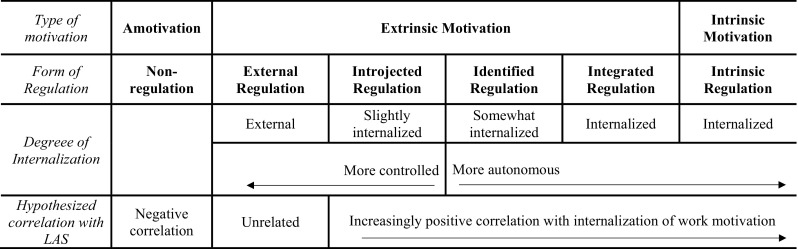
“Central to SDT is the distinction between forms of autonomous motivation, controlled motivation, and amotivation (see Fig. 1; Gagné et al. 2018; Howard et al. 2016; Ryan and Deci 2000).”
BackgroundJob behavior, performance, and effectiveness.
Borman, W. C. (1991) · Digital Commons - University of South Florida (University of South Florida) · Cited by 241
The Problems in Using Fixed-Effects Models of Meta-Analysis on Real-World Data
Field, A. P. (2003) · Understanding Statistics · doi:10.1207/s15328031us0202_02 · Cited by 237 · cited 1×
“The adoption of random effects models is supported by studies showing they lead to more accurate population effect size estimates that are generalizable beyond the database included in the analysis (Field 2003; Hunter and Schmidt 2000; Kisamore and Brannick 2008; Schmidt 2010).”
MethodHardré, P. L., & Reeve, J. (2009) · International Journal of Training and Development · doi:10.1111/j.1468-2419.2009.00325.x · Cited by 223 · cited 5×
“2004; Hardré and Reeve 2009; Su and Reeve 2011).”
BackgroundInfluentialTrépanier, S.-G., Fernet, C., & Austin, S. (2013) · Work & Stress · doi:10.1080/02678373.2013.782158 · Cited by 223
Olafsen, A. H., Halvari, H., Forest, J., & Deci, E. L. (2015) · Scandinavian Journal of Psychology · doi:10.1111/sjop.12211 · Cited by 219
Collie, R. J., Shapka, J. D., Perry, N. E., & Martin, A. J. (2016) · Journal of Educational Psychology · doi:10.1037/edu0000088 · Cited by 217 · cited 1×
“2015), positive job attitudes (e.g., organizational commitment; Chang et al. 2015; Collie et al. 2016) prosocial and proactive behaviors (e.”
BackgroundNie, Y., Chua, B. L., Yeung, A. S., Ryan, R. M., & Chan, W. Y. (2015) · International Journal of Psychology · doi:10.1002/ijop.12110 · Cited by 201 · cited 1×
“For instance, correlations between LAS and introjected regulation range from strongly positive (r = .42; Nie et al. 2015) to moderately negative (r = − .”
BackgroundSelf-citationLynch, M. F., Plant, R. W., & Ryan, R. M. (2005) · Professional Psychology: Research and Practice · doi:10.1037/0735-7028.36.4.415 · Cited by 194 · cited 1×
“1989), the Perceived Autonomy Support Scale for Employees (PASS-E, Mareau & Mageau, 2012), and the Personal and Institutional Autonomy Support scale (Lynch et al. 2005).”
MethodSelf-citationMoreau, E., & Mageau, G. A. (2012) · Motivation and Emotion · doi:10.1007/s11031-011-9250-9 · Cited by 175 · cited 7×
“2004), the Perceived Autonomy Support Scale for Employees (Moreau and Mageau 2012),”
BackgroundMethodInfluentialGüntert, S. T. (2014) · Motivation and Emotion · doi:10.1007/s11031-014-9412-7 · Cited by 171 · cited 2×
“2016) prosocial and proactive behaviors (e.g., Gagné 2003; Güntert 2015; Slemp 2017; Slemp et al.”
BackgroundDetecting and Correcting the Lies That Data Tell
Schmidt, F. (2010) · Perspectives on Psychological Science · doi:10.1177/1745691610369339 · Cited by 163 · cited 2×
“Integrative reviews make it possible to bridge across samples, even when no one primary study has investigated all of the variables of interest (Becker 2009; Schmidt 2010; Viswesvaran and Ones 1995).”
BackgroundMethodDe Cooman, R., Stynen, D., Van den Broeck, A., Sels, L., & De Witte, H. (2013) · Journal of Applied Social Psychology · doi:10.1111/jasp.12143 · Cited by 151
Schmidt, F. L., & Oh, I.-S. (2016) · Archives of Scientific Psychology · doi:10.1037/arc0000029 · Cited by 145 · cited 1×
“If publication bias is present in a literature, the likely upshot is an upward bias in mean effect sizes and a downward bias in the variability across effect sizes due to “missing” small effect-size studies (Schmidt and Hunter 2015; Schmidt and Oh 2016).”
BackgroundThe History of Self-Determination Theory in Psychology and Management
Gagné, M., Gagné, M., & Deci, E. L. (2014) · The Oxford Handbook of Work Engagement, Motivation, and Self-Determination Theory · doi:10.1093/oxfordhb/9780199794911.013.006 · Cited by 142
Chang, Y., Leach, N., & Anderman, E. M. (2015) · Social Psychology of Education · doi:10.1007/s11218-014-9289-z · Cited by 126 · cited 1×
“2015), positive job attitudes (e.g., organizational commitment; Chang et al. 2015; Collie et al. 2016) prosocial and proactive behaviors (e.”
BackgroundThe effects of autonomy and empowerment on employee turnover: Test of a multilevel model in teams.
Liu, D., Zhang, S., Wang, L., & Lee, T. W. (2011) · Journal of Applied Psychology · doi:10.1037/a0024518 · Cited by 126
Self-Determination Theory Applied to Work Motivation and Organizational Behavior
Gagné, M., Deci, E. L., & Ryan, R. M. (2017) · SAGE Publications Ltd eBooks · doi:10.4135/9781473914957.n6 · Cited by 122
Self-citationLeadership and Volunteer Motivation: A Study Using Self-Determination Theory
Oostlander, J., Güntert, S. T., van Schie, S., & Wehner, T. (2013) · Nonprofit and Voluntary Sector Quarterly · doi:10.1177/0899764013485158 · Cited by 121
An Illustration of the Consequences of Meta-Analysis Model Choice
Kisamore, J. L., & Brannick, M. T. (2008) · Organizational Research Methods · doi:10.1177/1094428106287393 · Cited by 116 · cited 1×
“The adoption of random effects models is supported by studies showing they lead to more accurate population effect size estimates that are generalizable beyond the database included in the analysis (Field 2003; Hunter and Schmidt 2000; Kisamore and Brannick 2008; Schmidt 2010).”
MethodSport event volunteers' engagement: management matters
Allen, J. B., & Bartle, M. (2013) · Managing Leisure · doi:10.1080/13606719.2013.849502 · Cited by 108 · cited 1×
“Mixed findings can also be observed in other studies (e.g., Allen and Bartle 2014).”
ResultOlafsen, A. H. (2016) · Motivation and Emotion · doi:10.1007/s11031-016-9592-4 · Cited by 106 · cited 1×
“SDT also predicts that need satisfaction results in individual well-being (Olafsen 2017).”
BackgroundBhagat, R. S. (2002) · Academy of Management Review · doi:10.5465/amr.2002.7389951 · Cited by 105 · cited 1×
“1 3 Hofstede (2001), each country was further classified as individualist (e.g., United States) or collectivist (e.g., China).”
BackgroundWilliams, G. C., Halvari, H., Niemiec, C. P., Sørebø, Ø., Olafsen, A. H., & Westbye, C. (2014) · Work & Stress · doi:10.1080/02678373.2014.971920 · Cited by 104 · cited 1×
“2015), as well as employee wellbeing and work engagement (e.g., Deci et al. 2001; Moreau and Mageau 2012; Schultz et al. 2015; Williams et al. 2014).”
BackgroundCole, M. S., Bruch, H., & Shamir, B. (2009) · Human Relations · doi:10.1177/0018726709346377 · Cited by 91
What Makes Lawyers Happy?: A Data-Driven Prescription to Redefine Professional SuccessPreprint
Krieger, L. S., & Sheldon, K. M. (2014) · SSRN Electronic Journal · doi:10.2139/ssrn.2398989 · Cited by 88 · cited 1×
“2015) to moderately negative (r = − .18; Krieger and Sheldon 2015).”
BackgroundGiving and Summoning Autonomy Support in Hierarchical Relationships
Reeve, J. (2015) · Social and Personality Psychology Compass · doi:10.1111/spc3.12189 · Cited by 83 · cited 5×
“2018; Reeve 2015).”
BackgroundInfluentialvan Schie, S., Güntert, S. T., Oostlander, J., & Wehner, T. (2015) · VOLUNTAS International Journal of Voluntary and Nonprofit Organizations · doi:10.1007/s11266-014-9472-z · Cited by 81
Liu, D., & Fu, P.-P. (2011) · Journal of Applied Psychology · doi:10.1037/a0024716 · Cited by 77 · cited 3×
“Alternatively, leader behaviors across different sources in the organizational hierarchies tend to be positively correlated (Liu and Fu 2011; Liu et al.”
BackgroundRoche, M., & Haar, J. M. (2013) · The International Journal of Human Resource Management · doi:10.1080/09585192.2013.770779 · Cited by 65 · cited 2×
“Correlations between LAS and intrinsic motivation range from relatively small (r = .15; Roche and Haar 2013) to large (r = .”
BackgroundTransformational leader behavior, proximity and successful services marketing
Humphreys, J. H. (2002) · Journal of Services Marketing · doi:10.1108/08876040210443373 · Cited by 63 · cited 1×
“2009) or physical (e.g., Howell and Hall-Merenda 1999; Humphreys 2002) distance.”
BackgroundIntroduction: The Struggle for Happiness and Autonomy in Cultural and Personal Contexts: An Overview
Chirkov, V., Sheldon, K. M., & Ryan, R. M. (2010) · Cross-cultural advancements in positive psychology · doi:10.1007/978-90-481-9667-8_1 · Cited by 44
Self-citationAction‐centered team leadership influences more than performance
Braun, F., Avital, M., & Martz, B. (2012) · Team Performance Management · doi:10.1108/13527591211241015 · Cited by 29 · cited 1×
“2016), performance (e.g., Baard et al. 2004; Braun et al. 2012), and turnover intentions (e.”
BackgroundLeadership processes and work motivation.
Zaccaro, S. J., Ely, K., & Nelson, J. K. (2008) · Cited by 20
Mindfulness improves work engagement, wellbeing and performance in a university setting
Atkins, P. W. B., Hassed, C. S., & Fogliati, V. J. (2015) · Edward Elgar Publishing eBooks · doi:10.4337/9781783474103.00020 · Cited by 18
Self-determination theory as a model for motivation in a training context.
Jones, J. E. (2002) · SHAREOK (University of Oklahoma; Oklahoma State University; Central Oklahoma University) · Cited by 12
Work Design for Performance: Expanding the Criterion Domain
Andrei, D., & Parker, S. (2017) · SAGE Publications Ltd eBooks · doi:10.4135/9781473914957 · Cited by 4 · cited 3×
“Our meta-analytic review has demonstrated that perceived LAS is an important predictor of positive individual outcomes in employees, with correlations that are generally consistent with SDT propositions in organizations (e.g., Deci et al. 2017; Gagné et al. 2018).”
BackgroundResult
Research works printed but not linked: 2
- Schmidt FL Le H Software for the Hunter-Schmidt meta-analysis methods, version 2.0 2014 Iowa City, IA University of Iowa, Department of Management & Organizations
- Slemp GR Oades LG Steger MF Delle Fave A Passmore J Job Crafting The Wiley Blackwell handbook of the psychology of positivity and strengths-based approaches at work 2017 Hoboken Wiley 342 365
Cited by
Basic psychological need theory: Advancements, critical themes, and future directions
Vansteenkiste, M., Ryan, R. M., & Soenens, B. (2020) · Motivation and Emotion · doi:10.1007/s11031-019-09818-1 · Cited by 1,891
“Abundant research, some of which has been summarized in meta-analyses (Ng et al. 2012; Slemp et al. 2018; Van den Broeck et al. 2016; Vasquez et al. 2016; Yu et al. 2018), has since shown that these three psychological needs indeed play a prominent role in development, adjustment, and wellness across cultures, with st…”
Self-citationNtoumanis, N., Ng, J. Y. Y., Prestwich, A., Quested, E., Hancox, J. E., Thøgersen-Ntoumani, C., Deci, E. L., Ryan, R. M., Lonsdale, C., & Williams, G. C. (2021) · Health Psychology Review · doi:10.1080/17437199.2020.1718529 · Cited by 1,154
Self-citationJob Demands—Resources theory and self-regulation: New explanations and remedies for job burnout
Bakker, A. B., & de Vries, J. D. (2021) · Anxiety, Stress, & Coping · doi:10.1080/10615806.2020.1797695 · Cited by 1,131
“, 2017); it fosters agentic employee work behaviors and reduces employee job strain and burnout (Slemp et al., 2018).”
BackgroundStudent Motivation and Associated Outcomes: A Meta-Analysis From Self-Determination Theory
Howard, J. L., Bureau, J., Guay, F., Chong, J. X. Y., & Ryan, R. M. (2021) · Perspectives on Psychological Science · doi:10.1177/1745691620966789 · Cited by 1,001
“Recent meta-analytic research in different domains, although not exactingly paralleling our methods, has in fact revealed findings that are generally consistent with those of the present study, holding promise for such generalizability (e.g., Ntoumanis et al., 2021; Slemp et al., 2018; Vasconcellos et al., 2019).”
ResultSelf-citationSelf-determination theory applied to physical education: A systematic review and meta-analysis.
Vasconcellos, D., Parker, P. D., Hilland, T., Cinelli, R., Owen, K. B., Kapsal, N., Lee, J., Antczak, D., Ntoumanis, N., Ryan, R. M., et al. (2020) · Journal of Educational Psychology · doi:10.1037/edu0000420 · Cited by 811
Self-citation
Metadata
- Authors
- Slemp, G. R., Kern, M. L., Patrick, K. J., & Ryan, R. M.
- Affiliations
- The University of Melbourne (AU)
- University of Rochester (US)
- Corresponding author
- Slemp, Gavin R.
- Venue
- Motivation and Emotion
- Published
- 2018-05-17
- Volume
- 42
- Issue
- 5
- Pages
- 706-724
- ISSN
- 0146-7239 (ISSN-L)
- 1573-6644
- PMC
- PMC6133074
- OpenAlex
- W2804181490
- Semantic Scholar
- 17f7e93721aaf32132b9cc1e58e80c9eb0431dba
- Cited by
- 407
- References
- 109
- Citations by year
- 2026: 66 · 2025: 59 · 2024: 65 · 2023: 56 · 2022: 62 · 2021: 42 · 2020: 32 · 2019: 24
- FWCI
- 33.24
- Type
- journal article
- Language
- en
- Open access
- hybrid
- doi.org
- Licence
- cc-by
- creativecommons.org/licenses/by/4.0 (tdm)
- Locations
- Motivation and Emotion (publishedVersion, cc-by)
- Europe PMC (PubMed Central) (publishedVersion, other-oa)
- PubMed Central (publishedVersion, cc-by)
- PubMed (publishedVersion)
- Minerva Access (University of Melbourne) (submittedVersion, cc-by)
- Research Bank (Australian Catholic University) (submittedVersion, cc-by)
- Topics
- Social Sciences › Psychology › Social Psychology › Motivation and Self-Concept in Sports
- Social Sciences › Business, Management and Accounting › Organizational Behavior and Human Resource Management › Job Satisfaction and Organizational Behavior
- Health Sciences › Medicine › Public Health, Environmental and Occupational Health › Workplace Health and Well-being
- Keywords
- self-determination theory, employee motivation, autonomous motivation, controlled motivation, basic psychological needs, employee well-being, workplace leadership, supervisor behavior, employee performance
About these checks
Registry, retraction, Cites and statistics results are computed, not judged, with one exception: a printed reference that no index lists is read once by a model before it counts as a citation error. Claims are extracted by a model and kept only when their quote appears verbatim in the text; each cited source is then checked, with a model’s help, for whether it says what the claim relies on. Those verdicts can be wrong — read the claim’s quote and the cited source before relying on one.
Statistics and arithmetic are recomputed, not judged.
Confidence bands are shown only for fields calibrated on our annotated test set. None is calibrated yet, so no band is shown.
What counts as a claim ›How we measure confidence ›How we check this ›
Are you an author, or do you see a problem with this page? Request a review
Data sources
Bibliographic data: Semantic Scholar, OpenAlex, Crossref.
Contains information from the Semantic Scholar Academic Graph Datasets, made available under the ODC Attribution License (ODC-BY 1.0).
Semantic Scholar’s data is described in: Kinney, R., et al. (2023). The Semantic Scholar Open Data Platform. arXiv:2301.10140.
