

Leader autonomy support in the workplace: A meta-analytic review
Open accessThe DOI matches its Crossref record; 107 of the 109 references it cites were found in a registry or an index.
Abstract
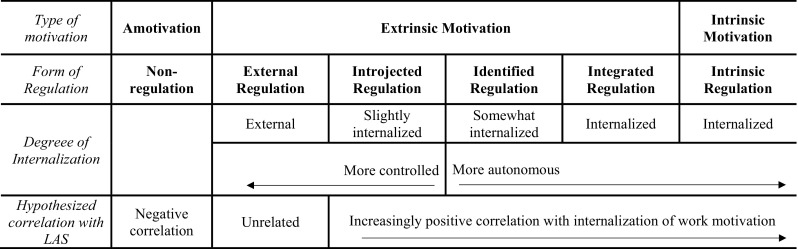
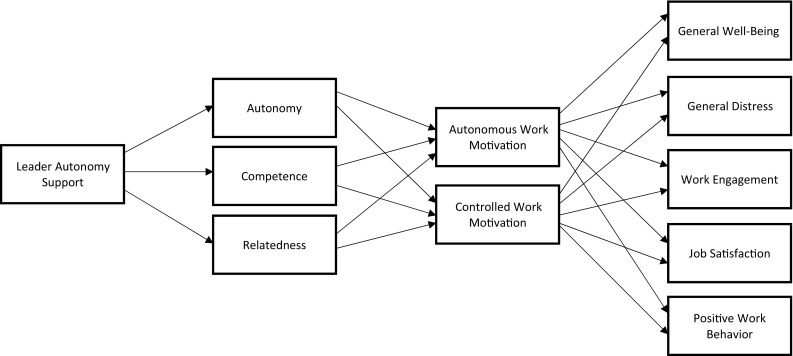
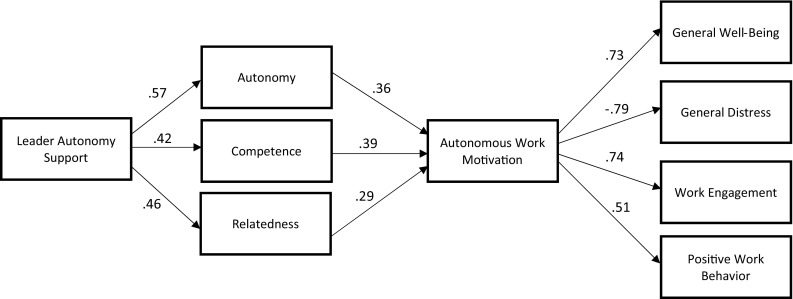
Leader autonomy support (LAS) refers to a cluster of supervisory behaviors that are theorized to facilitate self-determined motivation in employees, potentially enabling well-being and performance. We report the results of a meta-analysis of perceived LAS in work settings, drawing from a database of 754 correlations across 72 studies (83 unique samples, N = 32,870). Results showed LAS correlated strongly and positively with autonomous work motivation, and was unrelated to controlled work motivation. Correlations became increasingly positive with the more internalized forms of work motivation described by self-determination theory. LAS was positively associated with basic needs, well-being, and positive work behaviors, and was negatively associated with distress. Correlations were not moderated by the source of LAS, country of the sample, publication status, or the operationalization of autonomy support. In addition, a meta-analytic path analysis supported motivational processes that underlie LAS and its consequences in workplaces. Overall, our findings lend support for autonomy support as a leadership approach that is consistent with self-determination and optimal functioning in work settings.
Overview
The claims and statistics of this paper haven’t been checked yet.
Free: it reads the open-access text and checks the first 5 claims that cite a source we can check. Create a free account to check every claim.
Integrity signals
Registry
Cites
Statistics
Figures
Verification
Claims the paper makes
The claims and statistics of this paper haven’t been checked yet.
Free: it reads the open-access text and checks the first 5 claims that cite a source we can check. Create a free account to check every claim.
Claims other papers make about this one
Each is checked against this paper’s own text: does it say what the citing paper says it does?
The source backs part of the claim, not all of it — or backs it for a different population, condition or comparison.
In the citing paper
“Confirming existing research (Slemp et al., 2018(Slemp et al., , 2020)), the relationship between autonomy support and structure did not vary among individualistic versus collectivistic cultures in our sample.”
From Blending Teacher Autonomy Support and Provision of Structure in the Classroom for Optimal Motivation: A Systematic Review and Meta-Analysis (2025) · cites this paper as Slemp et al., 2018
Experimental — accuracy not yet measuredThe source backs part of the claim, not all of it — or backs it for a different population, condition or comparison.
In the citing paper
“it fosters agentic employee work behaviors and reduces employee job strain and burnout (Slemp et al., 2018).”
From Job Demands—Resources theory and self-regulation: New explanations and remedies for job burnout (2021) · cites this paper as Slemp et al., 2018
Experimental — accuracy not yet measuredThe cited source says what the claim attributes to it.
In the citing paper
“Meta-analytic evidence shows culture does not moderate the relationship between autonomy support and need satisfaction (Slemp et al., 2018) or teacher outcomes (Slemp et al., 2020).”
From Blending Teacher Autonomy Support and Provision of Structure in the Classroom for Optimal Motivation: A Systematic Review and Meta-Analysis (2025) · cites this paper as Slemp et al., 2018
The cited source says what the claim attributes to it.
In the citing paper
“Cross-cultural evidence has now been meta-analytically analyzed with autonomy as defined within BPNT appearing to carry similar benefits for individuals from diverse cultures (e.g., Slemp et al. 2018;Yu et al. 2018).”
From Basic psychological need theory: Advancements, critical themes, and future directions (2020) · cites this paper as Slemp et al. 2018
Self-check
Percentages, sums and reported differences re-computed from the paper’s own numbers.
The self-check needs the paper’s full text.
Citations
Cites
Hu, L., & Bentler, P. M. (1999) · Structural Equation Modeling A Multidisciplinary Journal · doi:10.1080/10705519909540118 · Cited by 108,788
Statistical Power Analysis for the Behavioral Sciences
Muller, K. (1989) · Technometrics · doi:10.1080/00401706.1989.10488618 · Cited by 99,167
Podsakoff, P. M., MacKenzie, S. B., Lee, J.-Y., & Podsakoff, N. P. (2003) · Journal of Applied Psychology · doi:10.1037/0021-9010.88.5.879 · Cited by 82,194 · cited 1×
“Finally, almost all of the measures in the studies were self-report instruments, which raises the possibility that our results are affected by self-report bias and shared method variance (Podsakoff et al. 2003).”
BackgroundStatistical power analysis for the behavioral sciences
(1990) · Computers, Environment and Urban Systems · doi:10.1016/0198-9715(90)90050-4 · Cited by 65,269
Ryan, R. M., & Deci, E. L. (2000) · American Psychologist · doi:10.1037//0003-066x.55.1.68 · Cited by 54,599 · cited 10×
“An important part of this SDT framework is the process of internalization, which refers to a natural tendency for people to transform controlled motivation into more autonomous forms of motivation (Ryan and Deci 2000).”
BackgroundResultInfluentialSelf-citationThe "what" and "why" of goal pursuits: Human needs and the self-determination of behavior
Deci, E. L., & Ryan, R. M. (2000) · Psychological Inquiry · doi:10.1207/s15327965pli1104_01 · Cited by 34,210 · cited 1×
“Relations of leader autonomy support to basic needs, well‑being, and work outcomes SDT posits that individuals experience optimal psychological functioning to the extent that three basic psychological needs for autonomy, competence, and relatedness are satisfied (Deci and Ryan 2000).”
BackgroundSelf-citationlavaan : An R Package for Structural Equation Modeling
Rosseel, Y. (2012) · Journal of Statistical Software · doi:10.18637/jss.v048.i02 · Cited by 27,955 · cited 1×
“The path analysis was performed using the lavaan package (Rosseel 2012) of the open source R software (version 3.3.1), using Ordinary Least Squares (OLS) estimation.”
MethodInfluentialCulture's Consequences: Comparing Values, Behaviors, Institutions, and Organizations across Nations
Bhagat, R. S., & Hofstede, G. (2002) · The Academy of Management Review · doi:10.2307/4134391 · Cited by 21,664
Borenstein, M., Hedges, L. V., Higgins, J. P. T., & Rothstein, H. R. (2009) · doi:10.1002/9780470743386 · Cited by 14,225
Self-Determination Theory: Basic Psychological Needs in Motivation, Development, and Wellness
(2017) · doi:10.1521/978.14625/28806 · Cited by 12,588
Self-citation
Research works printed but not linked: 2
- Schmidt FL Le H Software for the Hunter-Schmidt meta-analysis methods, version 2.0 2014 Iowa City, IA University of Iowa, Department of Management & Organizations
- Slemp GR Oades LG Steger MF Delle Fave A Passmore J Job Crafting The Wiley Blackwell handbook of the psychology of positivity and strengths-based approaches at work 2017 Hoboken Wiley 342 365
Cited by
Items 501–600 of 637
Cher, J. E., Barlas, J., Hennessy, M., Ramsay, J. E., & Aw, S. S. Y. (2025) · Substance Abuse Treatment Prevention and Policy · doi:10.1186/s13011-025-00691-5
“Accordingly, such organisational and systemic realities likely challenged participants’ sense of autonomy at work and, in turn, hindered personal growth and achievement of mastery [59].”
ТЕОРІЯ САМОДЕТЕРМІНАЦІЇ ЯК КЛЮЧ ДО РОЗУМІННЯ СТАВЛЕННЯ ГРОМАДЯН ДО ПОЛІТИЧНОЇ СИСТЕМИ
Волобуєв, В. (2025) · Наукові інновації та передові технології · doi:10.52058/2786-5274-2025-12(52)-730-748
Impact of Workplace Support on Career Advancement of Electrical Trade Teachers in Technical Colleges
Shodeinde, A. O., & Aderinto, I. D. (2025) · Asean Journal of Engineering Education · doi:10.11113/ajee2025.9n2.196
“This agrees with the study of Slemp, Kern, and Patrick (2018) which points to the fact that workplace assistance will help in fostering collaboration, lowering job stress, and improving job performance.”
Affekt- und Anreizmotivation: Wahrnehmung, Reflexion und Selbstintegration von Emotionen
Jonas, E., & Moser, A. (2026) · Springer eBooks · doi:10.1007/978-3-658-48449-1_17
Leadership Practices and Employee Ambassadorship: The Mediating Role of Basic Needs
Rys, M., van Hooft, E. A. J., Schollaert, E., & Hoye, G. V. (2026) · Review of Public Personnel Administration · doi:10.1177/0734371x251399926
Zakaria, S., Abrefah, R. G., & Baiden, B. K. A. (2026) · Science and Technology of Nuclear Installations · doi:10.1155/stni/5535689
Leadership experiment and development project (LEO). Evaluation of trainings Report
Leroy, H., den Broeck, A. V., Waltre, E. A., & Schaller, S. C. (2024) · Lirias (KU Leuven)
Negussie, B., Shishigu, A. D., & Mulugeta, M. A. (2025) · Abyssinia Journal of Business and Social Sciences · doi:10.20372/ajbs.2025.10.1.1162
Yap, C. K., Leow, C. S., Leong, W. S. V., & Humanology Sdn Bhd, 7.-3. A. B. P. (2025) · Business Organizations and Society · doi:10.26480/bosoc.02.2025.56.59
Somasiri, J. K. S. P., & Perera, G. A. T. R. (2025) · Sri Lanka Journal of Management Studies · doi:10.4038/sljms.v7i2.190
“This tends to reduce job strain such as anxiety of employees (Slemp et al., 2018).”
Tosun, E. K. (2023) · Dspace Repository (Marmara Üniversitesi)
All in Favor? Determinants of Nonprofit Employees' Strategic Change Commitment and Change Support
Meyfroodt, K., Suykens, B., & Desmidt, S. (2026) · Nonprofit Management and Leadership · doi:10.1002/nml.70040
What You Need is What You Get: Identifying Psychological Needs with SDT-Aware Neural Models
Varanasi, A. B., Sinha, M., & Dasgupta, T. (2026) · ACM International Conference on Intelligent User Interfaces (IUI) · doi:10.1145/3742414.3794741
“Human motivation is a fundamental driver of behavior, influencing decision-making, learning, and well-being across diverse contexts such as education, workplace, and social interactions[13–17].”
Rethinking Leadership Development
(2026) · MDPI eBooks · doi:10.3390/books978-3-7258-6863-6
Sarfraz, M. (2025) · Directory of Open access Books (OAPEN Foundation)
Halvari, H., Olafsen, A. H., Abrahamsen, F. E., Bentzen, M., Diseth, Å., Farholm, A., Frølund, C. W., Halvari, A. E. M., Haraldsen, H. M., Hatfield, J. L., et al. (2025) · Directory of Open access Books (OAPEN Foundation)
Çıkan, F. (2026) · OpenMETU (Middle East Technical University)
Belcher, E. (2024) · Staffordshire Online Repository (Staffordshire University)
Relationship between Motivational Needs and Professional Commitment among School Teachers
ul-Ain, Q., Bilal, A., & Munir, A. (2026) · The Critical Review of Social Sciences Studies · doi:10.59075/nq3zvk61
Ayetor, S. E., & Tembo, S. (2026) · Journal of Education and Practice · doi:10.47941/jep.3592
La Qualité de Vie en Service chez les personnels des Services d'Incendie et de Secours
Sandrin, É. (2020) · theses.fr (ABES) · doi:10.70675/2896d724z25a7z49eaz9d39z148eade16eca
Puzonė, G. (2024) · Lithuanian University of Health Sciences
Jadhav, A. R., & Debbarma, R. (2026) · World Journal of Advanced Research and Reviews · doi:10.30574/wjarr.2026.30.1.0957
Navigating the Bright and Dark Sides of Work Motivation and Nonwork Recovery: A Mixed‐Methods Study
Kujanpää, M., Nilsen, E. R., & Olafsen, A. H. (2026) · Stress and Health · doi:10.1002/smi.70179
Hyttinen, V. (2025) · LUTPub (LUT University)
Legault, L., Zhang, Y., & Paredes, J. (2026) · SSRN Electronic Journal · doi:10.2139/ssrn.6669938
Work–life conflict, coaching, and workplace harassment as determinants of employee well-being
Baek, E.-M., & Jo, H. (2026) · Scientific Reports · doi:10.1038/s41598-026-51240-4
A META-ANALYSIS OF AUTONOMOUS AND CONTROLLED FORMS OF TEACHER MOTIVATIONPreprint
Field, J. G., & Slemp, G. R. (2020) · OSF Preprints (OSF Preprints)
Self-citationSurti, A., Sarfraz, M. R., Usmani, A., Rehman, A., Tariq, M., & Huq, H. (2026) · Journal of Medical Education and Curricular Development · doi:10.1177/23821205261447952
“42,43 We deduced that levels of empathy varied significantly with demographic factors such as age, gender and extracurricular activities (ECAs).”
Aufbau und Lenkung von Humanressourcen
Fallgatter, M. J. (2026) · Springer eBooks · doi:10.1007/978-3-658-51661-1_4
Duan, W., Yang, C., Zhang, S., Ma, Z., & Wang, J. (2026) · Research on Social Work Practice · doi:10.1177/10497315261451222
Administrative Support and Teacher's Commitment in Public Elementary Educational Institutions
Rebelleza, J. M. (2026) · Nexus International Journal of Science and Education · doi:10.5281/zenodo.20354609
Itseohjautuvuus asiantuntijaprojektissa: case-tutkimus yrityksestä X
Junnikkala, J. (2026) · Theseus (Ammattikorkeakoulujen)
Zaidi, M., & Zohri, A. (2026) · International Journal For Multidisciplinary Research · doi:10.36948/ijfmr.2026.v08i03.79009
Nguon, S. O., Hart, B., & Meak, C. (2026) · Journal of Social Knowledge Education (JSKE) · doi:10.37251/jske.v7i3.3008
“A positive school vision that champions innovation encouraged teachers to take ownership of their instructional decision, thus directly supporting teacher autonomy [67], [81], [83].”
InfluentialMuzajjad, A., Rahayu, B., Nurhayati, W., & Aslichah, A. (2026) · Journal of Indonesian Economic Research · doi:10.61105/jier.v4i1.415
“Delegasi semata-mata tidak mencukupi jika tidak disertai dengan kepercayaan yang tulus, penerimaan perspektif orang lain, dan peluang untuk memilih cara tujuan dicapai (Slemp et al., 2018).”
InfluentialFang, H., Luo, K., & Zheng, J. (2026) · Community Work & Family · doi:10.1080/13668803.2026.2683091
Alsahhar, K. I. M. (2026) · Journal of Culture and Values in Education · doi:10.46303/jcve.2026.26
“In organizational environments, leadership practices that support autonomy have been shown to significantly enhance motivation, engagement, and psychological functioning among employees (Slemp et al., 2018).”
How Does Leader Self‐Sacrifice Lead to Subordinate Self‐Sacrifice? A Conformity Perspective
Yang, F., Yang, M., Liu, Y., Newman, A., & Wang, B. (2026) · Journal of Organizational Behavior · doi:10.1002/job.70102
Can media multitasking enhance creative performance? Insights from self-determination theory
Zhang, J.-J., Bai, B.-R., Zhou, X., & Zhang, H. (2026) · Thinking Skills and Creativity · doi:10.1016/j.tsc.2026.102290
Examining Teacher Autonomy Within the Framework of Facilitating Structure in School Bureaucracy
Akçay, P. (2026) · SAGE Open · doi:10.1177/21582440261456642
“Contemporary research emphasizes that autonomy is shaped not only by internal motivation but also by contextual and organizational factors that either support or restrict teachers’ professional discretion (Ryan & Deci, 2017; Slemp et al., 2018).”
Nejad, Z. B., Tajik, F., Fereidouni, Z., Karimivaselabadi, A., Beygi, N., & Taghinezhad, A. (2026) · BMC Medical Education · doi:10.1186/s12909-026-09731-5
Servant leadership and burnout among white-collar workers
Krajnčič, L. (2026) · Repository of the University of Ljubljana (University of Ljubljana)
Ledarskapets motsägelsefulla ideal
Roth, S., Andersson, C., & Kjernholm, I. (2026) · Lund University Publications Student Papers (Lund University)
Kayalı, B., Balat, Ş., & Yavuz, M. (2026) · Acta Psychologica · doi:10.1016/j.actpsy.2026.107297
Hartmann, É. (2024) · Le dépôt institutionnel (Université du Québec à Trois-Rivières)
RAHAYANI, M. P. (2026) · Unika Repository (Soegijapranata Catholic University)
Shafaei, A., & Nejati, M. (2026) · Australian Journal of Management · doi:10.1177/03128962261447132
How Individuals Experience Autonomy in Agile Project Teams
Armbruster, J., & Huemann, M. (2026) · Project Management Journal · doi:10.1177/87569728261460660
Organizational Psychology Theories in Graduate Medical Education: A Narrative Review
Saad, M. S., El-Aswad, N., Ghossoub, Z., Nadler, R., & Wasilewski, S. (2026) · HCA Healthcare Journal of Medicine · doi:10.36518/2689-0216.2314
Tera, I. (2026) · DSpace repository (University of Tartu)
Valkiainen, V. (2026) · DSpace repository (University of Tartu)
Mednarodno sodelovanje v vodenju zdravstvene nege
Doberšek, D. (2026) · Slovenian Nursing Review · doi:10.14528/snr.2026.60.2.3385
A Systemic Trap: How Micromanagement Becomes Institutionalized in India’s IT Sector
Sikidar, P., & Verma, S. (2026) · South Asian Journal of Business and Management Cases · doi:10.1177/22779779261466871
“Understanding micromanagement in this setting deepens cross-cultural leadership studies and cautions against applying Western theories without adjustments (Jain & Ahuja, 2024; Slemp et al., 2018).”
Lobos, K., Cobo‐Rendón, R., & Branada, C. F. (2026) · Springer eBooks · doi:10.1007/978-3-032-20072-3_19
RETAINING CULINARY TALENT: A CONCEPTUAL FRAMEWORK ON MOTIVATION, CONTENTMENT, AND FORTITUDE.
Othman, M. S., Nor, N. M. S. N. M., Zahari, M. S. M., & Piah, Z. H. M. (2026) · Journal of Tourism Hospitality and Environment Management · doi:10.35631/jthem.1144023
Bakshi, M. (2026) · IGI Global eBooks · doi:10.4018/979-8-2600-3189-6.ch003
Wijaya, A. R., & Salendu, A. (2026) · Dinasti International Journal of Management Science · doi:10.38035/dijms.v7i6.6979
“This finding aligns with SDT's explanation that individuals who actively manage their own growth satisfy their basic psychological needs, autonomy, competence, and relatedness, which in turn drives high-quality motivation and optimal work engagement (Deci et al., 2017; Slemp et al., 2018).”
Women at the helm: developing career adaptability through inclusive leadership in Indonesia
Adda, H. W., Djufri, M. R., & Corcoran‐Nantes, Y. (2026) · Journal of Management Development · doi:10.1108/jmd-02-2026-0099
Gelber, J. R. (2026) · Lincoln (University of Nebraska)
Henson, M. A. (2026) · Lincoln (University of Nebraska)
Development and Validation of the Chinese Employee Intertemporal Decision-Making Ability Scale
Wang, D., Li, M., Chen, X., Wang, Y., Mao, W., Pang, C., Qiu, F., Yu, P., & Hu, Y. (2026) · Behavioral Sciences · doi:10.3390/bs16081349
“More specifically, individuals who exhibit high levels of job autonomy necessarily possess the ability to transcend immediate situational stimuli and act in accordance with internally endorsed long-term goals (Gagné et al., 2022; Slemp et al., 2018).”
Basileo, L. D., Lyons, M. E., Toth, M. D., Otto, B., & Hofmann, F. (2026) · Discover Education · doi:10.1007/s44217-026-01982-0
“Autonomy-supportive leaders foster teacher initiative by providing meaningful choice, soliciting input, offering rationales for expectations, and minimizing controlling language and coercion [3, 29, 90, 94].”
Nitsche, J. (2026) · SSRN Electronic Journal · doi:10.2139/ssrn.7242859
Nyrhilä, P. (2026) · Osuva (University of Vaasa)
Jo, I., Chen, S., Aswandy, & Sofyan, Y. (2026) · Asia Pacific Journal of Management · doi:10.1007/s10490-026-10168-z
Syahkuala, I., Rivai, V., Kasmir, & Elmi, F. (2026) · Sustainability · doi:10.3390/su18168115
Self-determination and plasma donation: The role of autonomous motivation
Beurel, A., Terrade, F., David, J.-C., & Danic, B. (2026) · Journal of Health Psychology · doi:10.1177/13591053261467132
Hermawati, W. (2026) · Jurnal Riset Manajemen Bisnis Akuntansi dan Ekonomi · doi:10.58468/jambak.v5i1.223
Madiha Naseem 1, A. N. (2026) · Pakistan Journal of Social Science Review · doi:10.5281/zenodo.22048173
Motivational Strategies: A Predictor of Teachers’ Job Performance In Public Secondary Schools
Murtala, A. T., Tiamiyu, H., & Olasinde, B. A. (2026) · International Journal of Education Foundations · doi:10.33687/ijef.003.03.00132
“Studies have shown that intrinsic motivation is closely linked to sustained engagement, educational innovation and resilience among teachers (Slemp, Kern, Patrick, & Ryan, 2018; Han & Yin, 2023).”
Kornu, D. D., Kornu, E. S., Gyampo, S. K. O., & Nyarko, I. K. (2026) · International Journal of Business Studies and Innovation · doi:10.35745/ijbsi2026v06.02.0004
The commensality model: From team practice to organizational flourishing
Houdek, P. (2026) · Organizational Dynamics · doi:10.1016/j.orgdyn.2026.101267
Flamant, N., Vansteenkiste, M., Haerens, L. L., Vrijders, B., Prinzie, P., & Soenens, B. (2026) · Motivation and Emotion · doi:10.1007/s11031-026-10277-8
鉄道事業者の安全の推進に資するリーダーシップと組織風土の探求 : JR西日本の事例を通じた一考察
Ono, A. (2025) · Institutional Repositories DataBase (IRDB) · doi:10.32286/0002003759
Jauvin, F. (2026) · Archipel (Université du Québec à Montréal)
МОТИВАЦІЙНЕ СЕРЕДОВИЩЕ ЯК МЕХАНІЗМ РЕАЛІЗАЦІЇ ЕФЕКТИВНОГО ЛІДЕРСТВА В СУЧАСНИХ ОРГАНІЗАЦІЯХ
Pylypiv, N., Шеленко, Д., Ціжма, Ю. І., & Ціжма, О. А. (2026) · THE ACTUAL PROBLEMS OF REGIONAL ECONOMY DEVELOPMENT · doi:10.15330/apred.1.22.57-70
Riyadina, R. R., & Zurnali, C. (2026) · Journal of Creative Power and Ambition · doi:10.70610/jcpa.2048
Motivated to care: Unpacking work motivation and citizenship behavior among employees
Valdez, E. B., Macabeo, P., Marquez, R., Pascua, E., & Dosom, G. R. (2026) · Divine Word International Journal of Management and Humanities (DWIJMH) · doi:10.62025/dwijmh.v5i3.435
de Wiele, E. V., Baillien, E., Winne, S. D., Verbruggen, M., & den Broeck, A. V. (2026) · Cognition Technology & Work · doi:10.1007/s10111-026-00899-w
Salehi, A., Tremblay, D., & Alla, T. (2026) · International Journal of Business and Management (IJBM) · doi:10.56879/ijbm.v5i2.127
A Transtheoretical Proposal for a Domain Model of Emotional Needs
Faustino, B. (2026) · Journal of Rational-Emotive & Cognitive-Behavior Therapy · doi:10.1007/s10942-026-00687-5
“For a complete meta-analytic review see Ng et al. 2012; Slemp et al. 2018; Van den Broeck et al. 2016; Vasquez et al. 2016; Yu et al. 2018).”
Haswari, C., Suryatni, M., & Nururly, S. (2026) · Indonesian Interdisciplinary Journal of Sharia Economics (IIJSE) · doi:10.31538/iijse.v9i2.10495
The missed opportunities of the England and Wales police leadership commission
Davis-Crane, N. (2026) · Strategy and Leadership · doi:10.1108/sl-08-2026-0403
Vlerick, I. (2026) · Ghent University Academic Bibliography (Ghent University)
Pavlenok, K. S., Tiahur, L., Bondarchuk, O., Ovdiienko, I., & Balakhtar, V. (2026) · Interpersona An International Journal on Personal Relationships · doi:10.54899/iij.v20i1.851
The Tight–Loose–Tight Framework for Balancing Accountability and Autonomy in Organizations
Colgate, M., & Colgate, O. (2026) · Businesses · doi:10.3390/businesses6030051
“…managers’ autonomy support predicts employees’ need fulfillment, performance evaluations, and adjustment (Baard et al., 2004), and meta-analytic syntheses reach the same conclusion for leader autonomy support (Slemp et al., 2018) and for empowering leadership more broadly (A. Lee et al., 2018).”
Hasan, K. A. M. R. (2026) · International Journal of Organizational Leadership · doi:10.33844/ijol.2026.60561
“In a multilevel study of public service employees, Slemp et al. (2018) found that job autonomy significantly mediates the relationship between transformational leadership and innovative work behavior, empowering employees to explore innovative tasks beyond their prescribed roles.”
InfluentialJuliansyah, A., Hendrian, H., & Ali, H. (2026) · Jurnal Siber Multi Disiplin · doi:10.38035/jsmd.v4i2.1191
Martela, F., Mäkkeli, J., & Kostamo, T. (2026) · Journal of Organization Design · doi:10.1007/s41469-026-00207-w
Kim, J. (2026) · European Journal of Psychology and Educational Research · doi:10.12973/ejper.9.3.147
The Moderating Role of Gender in the Relationship Between Agile Leadership and Teacher Motivation
Yazıcı, Ş. (2026) · İnsan ve Toplum Bilimleri Araştırmaları Dergisi · doi:10.15869/itobiad.1844979
Singh, R., Raghuveer, K., Singh, A., Kumar, V., & Tran, T. V. T. (2026) · Strategy and Leadership · doi:10.1108/sl-05-2026-0241
Ownership is designed, not given: Human–AI fit and work sustainability in platform work
Kashyap, D., & Pandey, M. (2026) · Work · doi:10.1177/10519815261491973
Putsom, W. (2020) · Journal of Business Administration The Association of Private Higher Education Institutions of Thailand
Rantanen, J. (2025) · UEF eRepo (University of Eastern Finland)
Metadata
- Authors
- Slemp, G. R., Kern, M. L., Patrick, K. J., & Ryan, R. M.
- Affiliations
- The University of Melbourne (AU)
- University of Rochester (US)
- Corresponding author
- Slemp, Gavin R.
- Venue
- Motivation and Emotion
- Published
- 2018-05-17
- Volume
- 42
- Issue
- 5
- Pages
- 706-724
- ISSN
- 0146-7239 (ISSN-L)
- 1573-6644
- PMC
- PMC6133074
- OpenAlex
- W2804181490
- Semantic Scholar
- 17f7e93721aaf32132b9cc1e58e80c9eb0431dba
- Cited by
- 407
- References
- 109
- Citations by year
- 2026: 66 · 2025: 59 · 2024: 65 · 2023: 56 · 2022: 62 · 2021: 42 · 2020: 32 · 2019: 24
- FWCI
- 33.24
- Type
- journal article
- Language
- en
- Open access
- hybrid
- doi.org
- Licence
- cc-by
- creativecommons.org/licenses/by/4.0 (tdm)
- Locations
- Motivation and Emotion (publishedVersion, cc-by)
- Europe PMC (PubMed Central) (publishedVersion, other-oa)
- PubMed Central (publishedVersion, cc-by)
- PubMed (publishedVersion)
- Minerva Access (University of Melbourne) (submittedVersion, cc-by)
- Research Bank (Australian Catholic University) (submittedVersion, cc-by)
- Topics
- Social Sciences › Psychology › Social Psychology › Motivation and Self-Concept in Sports
- Social Sciences › Business, Management and Accounting › Organizational Behavior and Human Resource Management › Job Satisfaction and Organizational Behavior
- Health Sciences › Medicine › Public Health, Environmental and Occupational Health › Workplace Health and Well-being
- Keywords
- self-determination theory, employee motivation, autonomous motivation, controlled motivation, basic psychological needs, employee well-being, workplace leadership, supervisor behavior, employee performance
About these checks
Registry, retraction, Cites and statistics results are computed, not judged, with one exception: a printed reference that no index lists is read once by a model before it counts as a citation error. Claims are extracted by a model and kept only when their quote appears verbatim in the text; each cited source is then checked, with a model’s help, for whether it says what the claim relies on. Those verdicts can be wrong — read the claim’s quote and the cited source before relying on one.
Statistics and arithmetic are recomputed, not judged.
Confidence bands are shown only for fields calibrated on our annotated test set. None is calibrated yet, so no band is shown.
What counts as a claim ›How we measure confidence ›How we check this ›
Are you an author, or do you see a problem with this page? Request a review
Data sources
Bibliographic data: Semantic Scholar, OpenAlex, Crossref.
Contains information from the Semantic Scholar Academic Graph Datasets, made available under the ODC Attribution License (ODC-BY 1.0).
Semantic Scholar’s data is described in: Kinney, R., et al. (2023). The Semantic Scholar Open Data Platform. arXiv:2301.10140.
