

Leader autonomy support in the workplace: A meta-analytic review
Open accessThe DOI matches its Crossref record; 107 of the 109 references it cites were found in a registry or an index.
Abstract
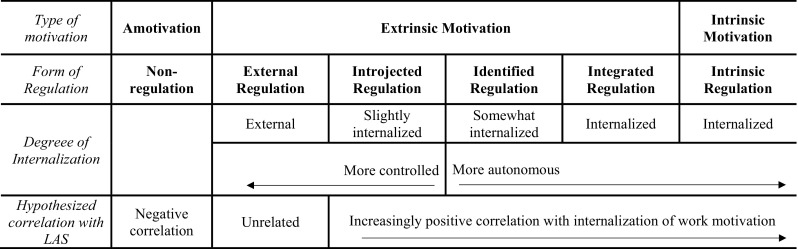
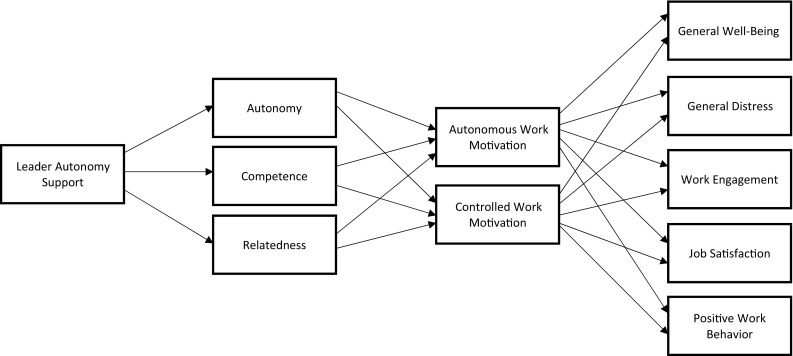
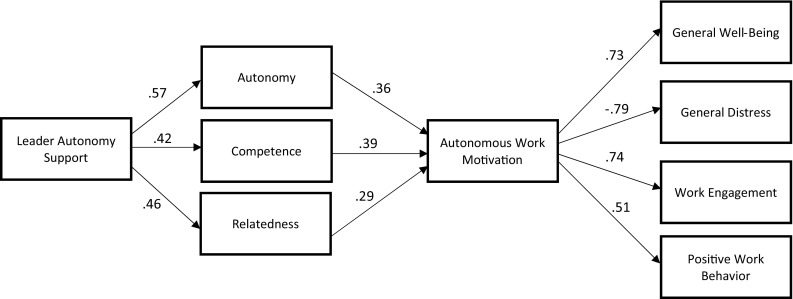
Leader autonomy support (LAS) refers to a cluster of supervisory behaviors that are theorized to facilitate self-determined motivation in employees, potentially enabling well-being and performance. We report the results of a meta-analysis of perceived LAS in work settings, drawing from a database of 754 correlations across 72 studies (83 unique samples, N = 32,870). Results showed LAS correlated strongly and positively with autonomous work motivation, and was unrelated to controlled work motivation. Correlations became increasingly positive with the more internalized forms of work motivation described by self-determination theory. LAS was positively associated with basic needs, well-being, and positive work behaviors, and was negatively associated with distress. Correlations were not moderated by the source of LAS, country of the sample, publication status, or the operationalization of autonomy support. In addition, a meta-analytic path analysis supported motivational processes that underlie LAS and its consequences in workplaces. Overall, our findings lend support for autonomy support as a leadership approach that is consistent with self-determination and optimal functioning in work settings.
Overview
The claims and statistics of this paper haven’t been checked yet.
Free: it reads the open-access text and checks the first 5 claims that cite a source we can check. Create a free account to check every claim.
Integrity signals
Registry
Cites
Statistics
Figures
Verification
Claims the paper makes
The claims and statistics of this paper haven’t been checked yet.
Free: it reads the open-access text and checks the first 5 claims that cite a source we can check. Create a free account to check every claim.
Claims other papers make about this one
Each is checked against this paper’s own text: does it say what the citing paper says it does?
The source backs part of the claim, not all of it — or backs it for a different population, condition or comparison.
In the citing paper
“Confirming existing research (Slemp et al., 2018(Slemp et al., , 2020)), the relationship between autonomy support and structure did not vary among individualistic versus collectivistic cultures in our sample.”
From Blending Teacher Autonomy Support and Provision of Structure in the Classroom for Optimal Motivation: A Systematic Review and Meta-Analysis (2025) · cites this paper as Slemp et al., 2018
Experimental — accuracy not yet measuredThe source backs part of the claim, not all of it — or backs it for a different population, condition or comparison.
In the citing paper
“it fosters agentic employee work behaviors and reduces employee job strain and burnout (Slemp et al., 2018).”
From Job Demands—Resources theory and self-regulation: New explanations and remedies for job burnout (2021) · cites this paper as Slemp et al., 2018
Experimental — accuracy not yet measuredThe cited source says what the claim attributes to it.
In the citing paper
“Meta-analytic evidence shows culture does not moderate the relationship between autonomy support and need satisfaction (Slemp et al., 2018) or teacher outcomes (Slemp et al., 2020).”
From Blending Teacher Autonomy Support and Provision of Structure in the Classroom for Optimal Motivation: A Systematic Review and Meta-Analysis (2025) · cites this paper as Slemp et al., 2018
The cited source says what the claim attributes to it.
In the citing paper
“Cross-cultural evidence has now been meta-analytically analyzed with autonomy as defined within BPNT appearing to carry similar benefits for individuals from diverse cultures (e.g., Slemp et al. 2018;Yu et al. 2018).”
From Basic psychological need theory: Advancements, critical themes, and future directions (2020) · cites this paper as Slemp et al. 2018
Self-check
Percentages, sums and reported differences re-computed from the paper’s own numbers.
The self-check needs the paper’s full text.
Citations
Cites
Hu, L., & Bentler, P. M. (1999) · Structural Equation Modeling A Multidisciplinary Journal · doi:10.1080/10705519909540118 · Cited by 108,788
Statistical Power Analysis for the Behavioral Sciences
Muller, K. (1989) · Technometrics · doi:10.1080/00401706.1989.10488618 · Cited by 99,167
Podsakoff, P. M., MacKenzie, S. B., Lee, J.-Y., & Podsakoff, N. P. (2003) · Journal of Applied Psychology · doi:10.1037/0021-9010.88.5.879 · Cited by 82,194 · cited 1×
“Finally, almost all of the measures in the studies were self-report instruments, which raises the possibility that our results are affected by self-report bias and shared method variance (Podsakoff et al. 2003).”
BackgroundStatistical power analysis for the behavioral sciences
(1990) · Computers, Environment and Urban Systems · doi:10.1016/0198-9715(90)90050-4 · Cited by 65,269
Ryan, R. M., & Deci, E. L. (2000) · American Psychologist · doi:10.1037//0003-066x.55.1.68 · Cited by 54,599 · cited 10×
“An important part of this SDT framework is the process of internalization, which refers to a natural tendency for people to transform controlled motivation into more autonomous forms of motivation (Ryan and Deci 2000).”
BackgroundResultInfluentialSelf-citationThe "what" and "why" of goal pursuits: Human needs and the self-determination of behavior
Deci, E. L., & Ryan, R. M. (2000) · Psychological Inquiry · doi:10.1207/s15327965pli1104_01 · Cited by 34,210 · cited 1×
“Relations of leader autonomy support to basic needs, well‑being, and work outcomes SDT posits that individuals experience optimal psychological functioning to the extent that three basic psychological needs for autonomy, competence, and relatedness are satisfied (Deci and Ryan 2000).”
BackgroundSelf-citationlavaan : An R Package for Structural Equation Modeling
Rosseel, Y. (2012) · Journal of Statistical Software · doi:10.18637/jss.v048.i02 · Cited by 27,955 · cited 1×
“The path analysis was performed using the lavaan package (Rosseel 2012) of the open source R software (version 3.3.1), using Ordinary Least Squares (OLS) estimation.”
MethodInfluentialCulture's Consequences: Comparing Values, Behaviors, Institutions, and Organizations across Nations
Bhagat, R. S., & Hofstede, G. (2002) · The Academy of Management Review · doi:10.2307/4134391 · Cited by 21,664
Borenstein, M., Hedges, L. V., Higgins, J. P. T., & Rothstein, H. R. (2009) · doi:10.1002/9780470743386 · Cited by 14,225
Self-Determination Theory: Basic Psychological Needs in Motivation, Development, and Wellness
(2017) · doi:10.1521/978.14625/28806 · Cited by 12,588
Self-citation
Research works printed but not linked: 2
- Schmidt FL Le H Software for the Hunter-Schmidt meta-analysis methods, version 2.0 2014 Iowa City, IA University of Iowa, Department of Management & Organizations
- Slemp GR Oades LG Steger MF Delle Fave A Passmore J Job Crafting The Wiley Blackwell handbook of the psychology of positivity and strengths-based approaches at work 2017 Hoboken Wiley 342 365
Cited by
Items 301–400 of 637
Yang, Y. C. (2022) · Digital Repository Service (Northeastern University) · doi:10.17760/d20455972 · Cited by 3
Empowerment in Place: The Well-Being and Engagement Equation of Hybrid Work EnvironmentsPreprint
Sharma, S. (2025) · SSRN Electronic Journal · doi:10.2139/ssrn.5184409 · Cited by 3
Stapleton, M. (2023) · Research Commons (University of Waikato) · Cited by 3
Ruffion, A. (2021) · theses.fr (ABES) · doi:10.70675/2f971686z95cbz4949zb993z276f281cfd3e · Cited by 3
Farwa, U., Khan, A. R., Shabbir, L. R., & Rafique, M. (2024) · Pakistan Journal of Humanities and Social Sciences · doi:10.52131/pjhss.2024.v12i1.2104 · Cited by 2
Briante, F., & Barabasch, A. (2024) · Journal of vocational, adult and continuing education and training · doi:10.14426/jovacet.v7i1.394 · Cited by 2
Kim, Y., & Richards, K. A. R. (2025) · Kinesiology Review · doi:10.1123/kr.2024-0060 · Cited by 2
Adaptação e Validação da Basic Psychological Need Satisfaction and Frustration Scale
Kleinschmitt, S., & Barbosa, M. L. L. (2025) · Psico-USF · doi:10.1590/1413-8271202530e277758 · Cited by 2
Philp, K. D., & Babb, K. E. (2025) · Victims & Offenders · doi:10.1080/15564886.2025.2509313 · Cited by 2
“Autonomy can be established by encouraging exploration, celebrating initiation, asking for input, and encouraging individual choice (Slemp et al., 2018).”
Drivers of front‑line sales employees’ retention: interaction, motivation, and performance
Vartiak, L., Škoda, M., Lajčin, D., Ižová, K., Sahoo, S. K., & Sahoo, T. R. (2025) · Journal of Entrepreneurship and Sustainability Issues · doi:10.9770/y2734537888 · Cited by 2
Lehtivuori, A., Kallio, T. J., & Auno, H. (2026) · Hallinnon Tutkimus · doi:10.37450/ht.162916 · Cited by 2
Cooperative environments bolster feelings of autonomy in dyads, teams, and organizations
Chai, V. E., & Halevy, N. (2026) · Proceedings of the National Academy of Sciences · doi:10.1073/pnas.2524773123 · Cited by 2
“Our work contributes to research showing that satisfying the need for autonomy promotes positive outcomes in organizations (65, 66).”
Deng, L., Li, Y., Fan, H., Qian, X., Chen, H., Ying, W., & Jing, C. (2026) · Transportation Research Part F Traffic Psychology and Behaviour · doi:10.1016/j.trf.2026.103569 · Cited by 2
Xiao, J., Lv, B., Zhou, Y., & Li, F. (2026) · Journal of Occupational and Organizational Psychology · doi:10.1111/joop.70110 · Cited by 2
Gulevich, O. A., & Semiletova, L. A. (2026) · Social Psychology and Society · doi:10.17759/sps.2026170103 · Cited by 2
Belhaj, F. A., Bayahya, W. Y., & Bayahya, A. Y. (2026) · Social Sciences & Humanities Open · doi:10.1016/j.ssaho.2026.102894 · Cited by 2
Bradshaw, E. L., & Ryan, R. M. (2026) · Emerald Group Publishing Limited eBooks · doi:10.1108/978-1-80686-869-820261005 · Cited by 2
Self-citationالرتيمي, ع., الرتيمي, س., Abdalati, A., & Salma, A.-R. (2026) · Libyan Journal of Educational Research and E-Learning (LJERE) · doi:10.65417/ljere.v2i1.77 · Cited by 2
Cuskelly, M., Moni, K., McMahon, M. L., Jobling, A., & Lloyd, J. (2023) · Journal of Applied Research in Intellectual Disabilities · doi:10.1111/jar.13180 · Cited by 2
Conscientiousness on Affective Commitment to Change: The Mediating Role of Psychological Ownership
Halim, M., Umaroh, R., Siahaan, N. H., Martini, A. N., & Nisa, R. K. (2024) · Hasanuddin Economics and Business Review · doi:10.26487/hebr.v8i1.5543 · Cited by 2
Pranaputra, R. D., Sobandi, A., & Senen, S. H. (2024) · Dinasti International Journal of Education Management And Social Science · doi:10.38035/dijemss.v6i2.3574 · Cited by 2
Effective Organizational Communication using Metaphor: Homeplus Case
Kim, J., & Kim, I. (2021) · Business Communication Research and Practice · doi:10.22682/bcrp.2021.4.1.51 · Cited by 2
Wang, H., & Haijin Wang, E. M. K. (2023) · Journal of Southwest Jiaotong University · doi:10.35741/issn.0258-2724.58.5.51 · Cited by 2
Ayaz, L., & Nazari, F. (2024) · Addiction and Health · doi:10.34172/ahj.2024.1359 · Cited by 2
“22,23 These three psychological needs, which have been summarized in meta-analyses, 24,25 appear to be an integral part of development, adjustment, and wellness across cultures, with significant implications for basic motivational science, applied practices, and even broad social policy development.”
BackgroundCorporate Liability: How can we Prevent?
Shamsu, N. A. T., Nazri, S. N. F. S. M., & Zolkaflil, S. (2024) · International Journal of Academic Research in Business and Social Sciences · doi:10.6007/ijarbss/v14-i12/24219 · Cited by 2
“It can lead to higher engagement, productivity, and performance levels because workers feel a sense of common purpose and commitment (Slemp et al., 2018).”
SAĞLIK ÇALIŞANLARININ İŞ TATMİNİ VE İŞE BAĞLILIK İLİŞKİSİNDE LİDER ÖZERKLİĞİ DESTEĞİNİN ARACI ROLÜ
Türkyılmaz, S. (2025) · Yönetim Bilimleri Dergisi · doi:10.35408/comuybd.1492807 · Cited by 2
Wibowo, S., & Nugroho, S. P. (2025) · PARADOKS Jurnal Ilmu Ekonomi · doi:10.57178/paradoks.v8i4.1649 · Cited by 2
Delgado, M., & Horta, J. B. G. (2025) · Politicas Sociales Sectoriales · doi:10.29105/pss3.3-187 · Cited by 2
Paixão, R. B., Rabelo, A. A. L., & Bruni, A. L. (2019) · Revista Meta Avaliação · doi:10.22347/2175-2753v11i31.1738 · Cited by 3
McMillan, G., & Milyavskaya, M. (2022) · Psychological Inquiry · doi:10.1080/1047840x.2022.2038001 · Cited by 2
Clain, A., & Oliveira, P. D. (2023) · Pratiques Psychologiques · doi:10.1016/j.prps.2023.03.004 · Cited by 2
The Thriving Lawyer: A Multidimensional Model of Well-Being for a Sustainable Legal Profession
Cipriano, T. (2023) · doi:10.4324/9781003285519 · Cited by 2
International Scientific-Business Conference – LIMEN 2022: Vol 8. Selected papers
(2022) · International scientific business conference LIMEN Leadership, innovation, manag. economics: Integrated politics of research · doi:10.31410/limen.s.p.2022 · Cited by 3
Muligheter og utfordringer ved fjernarbeid og hybride arbeidsordninger post‑pandemi
Olafsen, A. H., Stenling, A., Tafvelin, S., & Bentzen, M. (2023) · Magma · doi:10.23865/magma.v26.1292 · Cited by 3
Ballou, N. (2023) · Queen Mary Research Online (Queen Mary University of London) · Cited by 2
Diversity at a crossroads: How diversity research can contribute to the fight for social justice
Boroş, S. (2020) · Psihologia Resurselor Umane · doi:10.24837/pru.v18i2.472 · Cited by 2
McKinley, J. (2024) · ISU Red - Research and eData (Illinois State University) · doi:10.30707/etd2024.20240827063557524955.999974 · Cited by 2
The Laissez-Faire Leadership Paradox – The Invisible Heavy HandPreprint
Salamon, J., Ospina, J. P., Orosz, G., & Spencer, S. J. (2024) · OSF Preprints (OSF Preprints) · doi:10.31219/osf.io/bxujr · Cited by 2
The Identity Harmony Model of Inclusion: Development and Test of a New Theory
Brafford, A. (2024) · Scholarship - Claremont (Claremont Colleges) · doi:10.5642/cguetd.gjvt6895 · Cited by 2
Bell, B. (2023) · UNSWorks (UNSW Sydney) · doi:10.26190/unsworks/25165 · Cited by 2
The good, the bad, and the unknown about job autonomy
Mücke, S. (2024) · Habilitation Regulations of the Faculty of Mechanical Engineering (University of Paderborn) · doi:10.17619/unipb/1-2111 · Cited by 2
Telework and employee empowerment: effective practices amid the Covid-19 pandemic
Colnaghi, L. (2021) · Portuguese National Funding Agency for Science, Research and Technology (RCAAP Project by FCT) · Cited by 2
Neyra, R. A. (2021) · renati · Cited by 2
Self-Determination and Black Women Leaders
Turley, D. (2023) · Southwest Journal of Arts and Sciences · doi:10.62548/sjas23030101 · Cited by 1
Recognition and Social Worth: Community and Meaningful Work
Peucker, M. (2024) · Springer eBooks · doi:10.1007/978-981-97-8437-0_8 · Cited by 1
Gulevich, O. A., & Chernov, D. N. (2025) · Social Psychology and Society · doi:10.17759/sps.2025160103 · Cited by 1
Motivating Transparent Communications About Bias in Healthcare Technology Development
Tovmasyan, A., Liefgreen, A., Wachter, S., Mittelstadt, B., & Weinstein, N. (2025) · Collabra Psychology · doi:10.1525/collabra.136456 · Cited by 1
“Indeed, previous research found that consistent autonomy-supportive, as opposed to controlling, leadership is associated with increased employee’s engagement (Sarmah et al., 2022; Slemp et al., 2018).”
The Role of Islamic Autonomous Motivation in Sustainable Employee Innovative Behavior
Aisyah, S., Sulistyo, H., & Cahyono, B. (2025) · Journal of Posthumanism · doi:10.63332/joph.v5i5.1766 · Cited by 1
“LAS is a leadership style of superiors that brings up and supports the growth of motivation from company employees (Slemp et al., 2018).”
InfluentialTelework and Well-Being: Investigating the Role of Motivation in Shaping Remote Work Experiences
Couto, R., Lopes, S., Carvalho, V. S., & Chambel, M. J. (2025) · Lecture notes on multidisciplinary industrial engineering · doi:10.1007/978-3-031-89948-5_12 · Cited by 1
Lantto, R., Jungert, T., Probert-Lindström, S., NILSSON, M. H. L., & Westling, S. (2025) · Issues in Mental Health Nursing · doi:10.1080/01612840.2025.2506475 · Cited by 1
“Managerial autonomy support may affect psychological well-being (Slemp et al., 2018), and we identified a moderate correlation with relatedness in our sample.”
Supervisors’ need-related behaviors and employees’ functioning: A person-centered investigation
Paquette, V., Gillet, N., Huyghebaert‐Zouaghi, T., Trépanier, S., & Morin, A. J. S. (2025) · German Journal of Human Resource Management Zeitschrift für Personalforschung · doi:10.1177/23970022251357240 · Cited by 2
“…(Ryan and Deci, 2017), previous studies have shown that supervisors’ behaviors share relatively strong associations with employees’ levels of need satisfaction and psychosocial functioning at work (e.g. Chiniara and Bentein, 2016; Gillet et al., 2012; Rahmadani et al., 2019; Slemp et al., 2018).”
Leadership and job performance: relationships with autonomy, intrinsic motivation and engagement
de Queiroz, A. R., Mendonça, H., & Soares, V. N. (2025) · Revista de Administração da UFSM · doi:10.5902/1983465990595 · Cited by 1
“The SDT itself posits that intrinsic motivation is associated with engagement (Ryan & Deci, 2000), as corroborated by Gans (2024), Khan et al. (2024), and Slemp et al. (2018).”
Baka, Ł., Jurek, P., Kapica, Ł., & Nowakowska, I. (2025) · The International Journal of Human Resource Management · doi:10.1080/09585192.2025.2602084 · Cited by 1
“…2021; Vansteenkiste and Ryan, 2013) including proactive crafting behavior (Slemp & Vella-Brodrick, 2014; Toyama et al., 2022; Travaglianti et al., 2016) and the resources obtained in this way, e.g., opportunities for development and social support (Slemp et al., 2018; Van den Broeck et al., 2008).”
KELEBEK, E. F. E. (2025) · Türk Psikoloji Dergisi · doi:10.31828/turkpsikoloji.1581393 · Cited by 1
Toward a comprehensive assessment of work climate: scale development and validation across sectors
Çalışkan, A., & Köroğlu, E. Ö. (2025) · Pressacademia · doi:10.17261/pressacademia.2025.2009 · Cited by 1
Still Waiting for Rewards? User Entrepreneur’s Reward Delivery Performance in Crowdfunding
Oo, P. P., Allison, T. H., Escudero, S. B., & Srivastava, S. (2026) · Entrepreneurship Theory and Practice · doi:10.1177/10422587251404867 · Cited by 1
“This aligns with research showing that when individuals engage in work that is personally meaningful, they are less affected by external contingencies such as monetary incentives or external expectations (Gagne´ & Deci, 2005; Slemp et al., 2018).”
Xie, Z., Niu, Y., Liu, A., & Niu, X. (2026) · Chinese Management Studies · doi:10.1108/cms-11-2024-0880 · Cited by 1
Performance Coaching and Need Satisfaction in Customer-Facing Sales Roles: An Integrative Review
Hart, G., & Bracey, D. (2026) · Revista Academiei Forţelor Terestre · doi:10.2478/raft-2026-0007 · Cited by 1
“The literature supports the view that autonomy-supportive leadership and feedback are associated with greater persistence and engagement, making coaching style a realistic lever in high-pressure environments (Hart, 2025a; Hart, 2025b; Reeve et al., 2002; Slemp et al., 2018).”
InfluentialResults control and introjected motivation: the case of academia
Englund, H., & Gerdin, J. (2026) · Qualitative Research in Accounting & Management · doi:10.1108/qram-10-2024-0225 · Cited by 1
Psychometric Properties of the Work Autonomy Scale in the Brazilian Context
Louro, E. S., Gabardo-Martins, L. M. D., Júnior, C. E. D. S. C., & Gurgel, K. S. D. M. (2026) · Ciencias Psicológicas · doi:10.22235/cp.v20i1.4823 · Cited by 1
“…positions are generally more proactive because they have greater freedom to define their routines, establish priorities, delegate tasks, and make strategic decisions, which naturally contributes to a higher perception of autonomy (Diaa et al., 2024; Slemp et al., 2018; Yang et al., 2024).”
Saaidia, S., Henchiri, H., Znazen, H., Chaabeni, A., alotaibi, A., Alliheibi, A. H., Said, N. M. B., & Azaiez, F. (2026) · Healthcare · doi:10.3390/healthcare14091171 · Cited by 1
“The Passion Scale has demonstrated high levels of validity and reliability across several life domains, including work [6,9,13,14].”
Zhou, X., Xiong, Q., Ding, L., & Zhai, B. (2026) · BMC Psychology · doi:10.1186/s40359-026-04639-7 · Cited by 1
“…which highlights autonomy-supportive conditions as an important ante-cedent of self-determined motivation and positive work functioning; meta-analytic evidence further shows that such environments are positively associated with need satisfaction, well-being, and constructive work behaviors [39].”
Waterschoot, J., & Ryan, R. M. (2026) · Political Psychology · doi:10.1111/pops.70157 · Cited by 1
“As previously noted, meta-analytic findings have shown that autonomy-supportive conditions within domains such as parenting (Bradshaw et al., 2025), teaching (Howard et al., 2025), and employee management (Slemp et al., 2018) facilitate greater internalization, autonomy, and wellness.”
Self-citationLi, X., Lin, Z., Huang, G., & Cui, H. (2026) · Frontiers in Psychology · doi:10.3389/fpsyg.2026.1815184 · Cited by 1
Jo, H., & Ahn, H. (2026) · PLoS ONE · doi:10.1371/journal.pone.0350731 · Cited by 1
“From a JD-R perspective, autonomy functions as a job resource that activates the motivational pathway, enhancing job satisfaction through increased control, self-determination, and intrinsic motivation [45,46].”
Daily need experiences across office and remote workdays
Olafsen, A. H., Kujanpää, M., Stenling, A., Tafvelin, S., & Bentzen, M. (2026) · European Journal of Work and Organizational Psychology · doi:10.1080/1359432x.2026.2694513 · Cited by 1
Стили взаимодействия руководителя с сотрудником и их диагностика: адаптация нового инструмента
Gordeeva, T., Sychev, O., Сергеевна, Р. А., & Марчук, Л. (2025) · Организационная психология · doi:10.17323/2312-5942-2025-15-1-119-150 · Cited by 1
Agate, D. D., Gagné, M., & O’Neill, T. A. (2026) · Motivation and Emotion · doi:10.1007/s11031-026-10262-1 · Cited by 1
Work identity and the myth of mothers’ lower commitment
Hendrick, S., & Schultz, A. C. (2026) · Self and Identity · doi:10.1080/15298868.2026.2714080 · Cited by 1
Chandra, R., Yohana, C., & Effendi, M. S. (2025) · Proceeding of International Student Conference on Business, Education, Economics, Accounting, and Management. · Cited by 1
Ionescu, A.-F., & Iliescu, D. (2020) · Psihologia Resurselor Umane · doi:10.24837/pru.v18i2.474 · Cited by 1
Work motivation. Self-determination theory: literature review
Knorová, K., & Fibírová, J. (2021) · Český finanční a účetní časopis · doi:10.18267/j.cfuc.549 · Cited by 1
Efecto del Liderazgo sobre el Bienestar Subjetivo del Emprendedor
Vargas-Morúa, G. (2021) · Journal of Exact Sciences and Technological Applications · Cited by 1
Elseman, F. (2021) · SHAREOK (University of Oklahoma; Oklahoma State University; Central Oklahoma University) · Cited by 1
Autonomie en transition de carrière. Développement d’un modèle et validation d’une échelle originale
Prudhomme, N., Garnier, M., & Bernaud, J. (2021) · Pratiques Psychologiques · doi:10.1016/j.prps.2021.08.001 · Cited by 1
Arbeitszufriedenheit und Arbeitsmotivation in der Führung
Unger, F., Sann, U., & Martin, C. (2022) · Basiswissen Sozialwirtschaft und Sozialmanagement · doi:10.1007/978-3-658-36119-8_2 · Cited by 1
Interaktion und Kommunikation in der Führung
Unger, F., Sann, U., & Martin, C. (2022) · Basiswissen Sozialwirtschaft und Sozialmanagement · doi:10.1007/978-3-658-36119-8_3 · Cited by 1
Personalführung in der Sozialwirtschaft: Basiswissen und Perspektiven
Unger, F., Sann, U., & Martin, C. (2022) · Basiswissen Sozialwirtschaft und Sozialmanagement · doi:10.1007/978-3-658-36119-8_1 · Cited by 1
RETROSPECTIVE ANALYSIS OF INTRINSIC MOTIVATION IN THE CONTEXT OF THE MODERN ENTERPRISE
Ivanov, P., & Ушева, М. (2021) · Entrepreneurship · doi:10.37708/ep.swu.v9i1.2 · Cited by 1
Nijs, S., Engen, M. L. V., van der Meer, S., van Gestel, S., & Odstrčilíková, K. (2024) · Gedrag & Organisatie · doi:10.5117/go2024.2.002.nijs · Cited by 2
An Analysis and Evaluation of Basic Needs Theory and Transition Theory
Black-Dorn, W. (2024) · Nursing Science Quarterly · doi:10.1177/08943184241291564 · Cited by 1
“Examples include studies on work-place motivation (Slemp et al., 2018), academic achievement (Vasquez et al., 2015), psychology (Yu et al., 2017), and healthcare (Ng et al., 2012).”
Nowe odsłony i trendy psychologii w biznesie
Wach‐Kąkolewicz, A., & Metelski, A. (2025) · doi:10.18559/978-83-8211-255-9 · Cited by 1
Exploring Well-being – An Ephemeral, Dynamic, and Pragmatic State of Being
Mahanta, S., Rourke, T., Caunhye, S., Jeyakrishnan, T., Afshari-Mehr, A., Asurlekar, A., & Molodynski, A. (2025) · World Social Psychiatry · doi:10.4103/wsp.wsp_39_25 · Cited by 1
When Empowerment Intensifies Hidden Work and Self-Management Pressure
Gonzales, M., Santos, J., Cruz, A., & Reyes, C. (2024) · Journal of Applied Organizational Systems and Behavior · doi:10.51847/xb9zawfllg · Cited by 1
A longitudinal examination of the motivation and mental health of elite athletes
Sheehan, R. B. (2018) · University of Limerick Institutional Repository (University of Limerick) · doi:10.34961/5974 · Cited by 1
How leader autonomy support and competitive factors relate to employees’ motivation within retail.
Nörthen, O., & Säfström, C. (2020) · Lund University Publications Student Papers (Lund University) · Cited by 1
An Aspirations-led Capabilities Approach to Women’s Career Pathways in Quantity Surveying
Bowes, D. (2020) · WestminsterResearch (University of Westminster) · doi:10.34737/v1vvq · Cited by 1
Opplevelsen av autonomi i arbeidslivet: en kvalitativ studie basert på selvbestemmelsesteorien.
Ridderström, L. (2020) · NVA (Nasjonalt vitenarkiv) · Cited by 1
Navigating Motivation at Work: About Leadership, Purpose, Values, and Basic Psychological Needs
van Tuin, L. (2021) · Utrecht University Repository (Utrecht University) · doi:10.33540/270 · Cited by 3
Jin, T. (2022) · Digital Commons - Andrews University (Andrews University) · doi:10.32597/dissertations/1777/ · Cited by 1
The Cost of Accommodation: Psychological Need Conflicts in Distributed Audit SupervisionPreprint
Jefferson, D. P., & Andiola, L. M. (2025) · SSRN Electronic Journal · doi:10.2139/ssrn.5191546 · Cited by 1
Explanatory pathways of the association between receiving social support and teachers' well-being
Maas, J. (2023) · Leiden Repository (Leiden University) · doi:10.5167/uzh-234538 · Cited by 1
The dark side of empowering leadership
Noureen, R. (2024) · publish.UP (University of Potsdam) · doi:10.25932/publishup-65531 · Cited by 1
Havarangsi, P. (2021) · ScholarWorks (Walden University) · Cited by 1
Strategies for Reducing Employee Turnover of Hotel Frontline Employees
Holland, N. D. (2024) · ScholarWorks (Walden University) · Cited by 1
Kohonen, K. (2024) · Tampere University Institutional Repository (Tampere University) · Cited by 1
Sassi-Chamsi, H. (2022) · theses.fr (ABES) · doi:10.70675/85277fabze146z4a3cz8dc8zf502d0c933b7 · Cited by 1
McCourt, K. (2022) · UWE Research Repository (UWE Bristol) · Cited by 1
Yong, A. (2020) · Research Commons (University of Waikato)
The mental health of Australian lawyers: a self-determination theory based model
Lee, M. A. (2019) · Minerva Access (University of Melbourne)
Metadata
- Authors
- Slemp, G. R., Kern, M. L., Patrick, K. J., & Ryan, R. M.
- Affiliations
- The University of Melbourne (AU)
- University of Rochester (US)
- Corresponding author
- Slemp, Gavin R.
- Venue
- Motivation and Emotion
- Published
- 2018-05-17
- Volume
- 42
- Issue
- 5
- Pages
- 706-724
- ISSN
- 0146-7239 (ISSN-L)
- 1573-6644
- PMC
- PMC6133074
- OpenAlex
- W2804181490
- Semantic Scholar
- 17f7e93721aaf32132b9cc1e58e80c9eb0431dba
- Cited by
- 407
- References
- 109
- Citations by year
- 2026: 66 · 2025: 59 · 2024: 65 · 2023: 56 · 2022: 62 · 2021: 42 · 2020: 32 · 2019: 24
- FWCI
- 33.24
- Type
- journal article
- Language
- en
- Open access
- hybrid
- doi.org
- Licence
- cc-by
- creativecommons.org/licenses/by/4.0 (tdm)
- Locations
- Motivation and Emotion (publishedVersion, cc-by)
- Europe PMC (PubMed Central) (publishedVersion, other-oa)
- PubMed Central (publishedVersion, cc-by)
- PubMed (publishedVersion)
- Minerva Access (University of Melbourne) (submittedVersion, cc-by)
- Research Bank (Australian Catholic University) (submittedVersion, cc-by)
- Topics
- Social Sciences › Psychology › Social Psychology › Motivation and Self-Concept in Sports
- Social Sciences › Business, Management and Accounting › Organizational Behavior and Human Resource Management › Job Satisfaction and Organizational Behavior
- Health Sciences › Medicine › Public Health, Environmental and Occupational Health › Workplace Health and Well-being
- Keywords
- self-determination theory, employee motivation, autonomous motivation, controlled motivation, basic psychological needs, employee well-being, workplace leadership, supervisor behavior, employee performance
About these checks
Registry, retraction, Cites and statistics results are computed, not judged, with one exception: a printed reference that no index lists is read once by a model before it counts as a citation error. Claims are extracted by a model and kept only when their quote appears verbatim in the text; each cited source is then checked, with a model’s help, for whether it says what the claim relies on. Those verdicts can be wrong — read the claim’s quote and the cited source before relying on one.
Statistics and arithmetic are recomputed, not judged.
Confidence bands are shown only for fields calibrated on our annotated test set. None is calibrated yet, so no band is shown.
What counts as a claim ›How we measure confidence ›How we check this ›
Are you an author, or do you see a problem with this page? Request a review
Data sources
Bibliographic data: Semantic Scholar, OpenAlex, Crossref.
Contains information from the Semantic Scholar Academic Graph Datasets, made available under the ODC Attribution License (ODC-BY 1.0).
Semantic Scholar’s data is described in: Kinney, R., et al. (2023). The Semantic Scholar Open Data Platform. arXiv:2301.10140.
