

Leader autonomy support in the workplace: A meta-analytic review
Open accessThe DOI matches its Crossref record; 107 of the 109 references it cites were found in a registry or an index.
Abstract
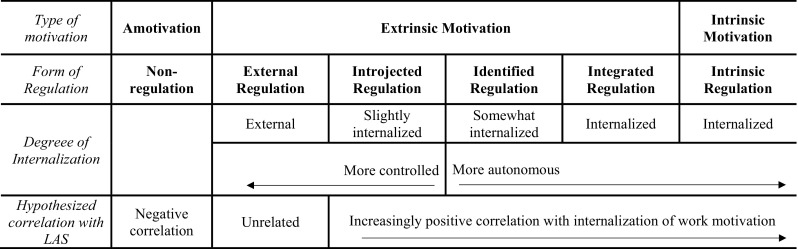
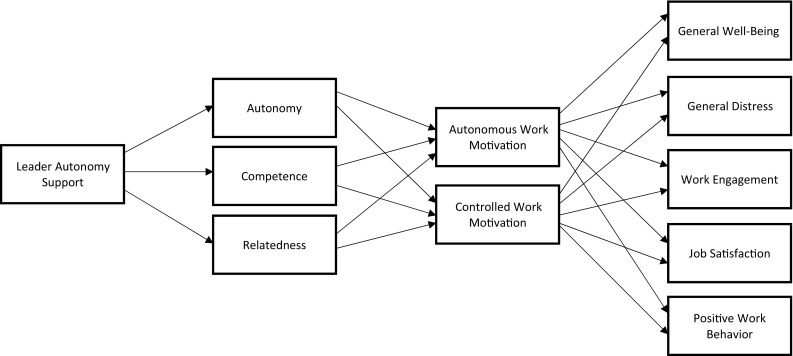
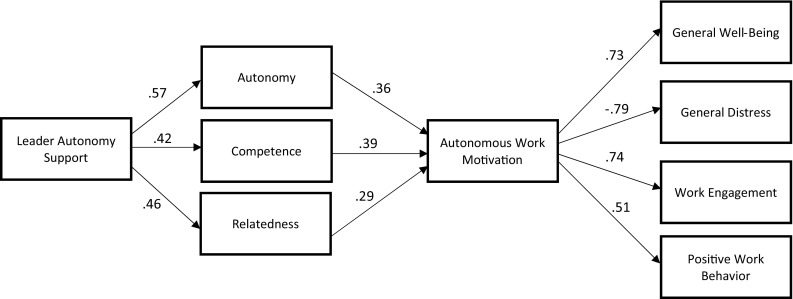
Leader autonomy support (LAS) refers to a cluster of supervisory behaviors that are theorized to facilitate self-determined motivation in employees, potentially enabling well-being and performance. We report the results of a meta-analysis of perceived LAS in work settings, drawing from a database of 754 correlations across 72 studies (83 unique samples, N = 32,870). Results showed LAS correlated strongly and positively with autonomous work motivation, and was unrelated to controlled work motivation. Correlations became increasingly positive with the more internalized forms of work motivation described by self-determination theory. LAS was positively associated with basic needs, well-being, and positive work behaviors, and was negatively associated with distress. Correlations were not moderated by the source of LAS, country of the sample, publication status, or the operationalization of autonomy support. In addition, a meta-analytic path analysis supported motivational processes that underlie LAS and its consequences in workplaces. Overall, our findings lend support for autonomy support as a leadership approach that is consistent with self-determination and optimal functioning in work settings.
Overview
The claims and statistics of this paper haven’t been checked yet.
Free: it reads the open-access text and checks the first 5 claims that cite a source we can check. Create a free account to check every claim.
Integrity signals
Registry
Cites
Statistics
Figures
Verification
Claims the paper makes
The claims and statistics of this paper haven’t been checked yet.
Free: it reads the open-access text and checks the first 5 claims that cite a source we can check. Create a free account to check every claim.
Claims other papers make about this one
Each is checked against this paper’s own text: does it say what the citing paper says it does?
The source backs part of the claim, not all of it — or backs it for a different population, condition or comparison.
In the citing paper
“Confirming existing research (Slemp et al., 2018(Slemp et al., , 2020)), the relationship between autonomy support and structure did not vary among individualistic versus collectivistic cultures in our sample.”
From Blending Teacher Autonomy Support and Provision of Structure in the Classroom for Optimal Motivation: A Systematic Review and Meta-Analysis (2025) · cites this paper as Slemp et al., 2018
Experimental — accuracy not yet measuredThe source backs part of the claim, not all of it — or backs it for a different population, condition or comparison.
In the citing paper
“it fosters agentic employee work behaviors and reduces employee job strain and burnout (Slemp et al., 2018).”
From Job Demands—Resources theory and self-regulation: New explanations and remedies for job burnout (2021) · cites this paper as Slemp et al., 2018
Experimental — accuracy not yet measuredThe cited source says what the claim attributes to it.
In the citing paper
“Meta-analytic evidence shows culture does not moderate the relationship between autonomy support and need satisfaction (Slemp et al., 2018) or teacher outcomes (Slemp et al., 2020).”
From Blending Teacher Autonomy Support and Provision of Structure in the Classroom for Optimal Motivation: A Systematic Review and Meta-Analysis (2025) · cites this paper as Slemp et al., 2018
The cited source says what the claim attributes to it.
In the citing paper
“Cross-cultural evidence has now been meta-analytically analyzed with autonomy as defined within BPNT appearing to carry similar benefits for individuals from diverse cultures (e.g., Slemp et al. 2018;Yu et al. 2018).”
From Basic psychological need theory: Advancements, critical themes, and future directions (2020) · cites this paper as Slemp et al. 2018
Self-check
Percentages, sums and reported differences re-computed from the paper’s own numbers.
The self-check needs the paper’s full text.
Citations
Cites
Hu, L., & Bentler, P. M. (1999) · Structural Equation Modeling A Multidisciplinary Journal · doi:10.1080/10705519909540118 · Cited by 108,788
Statistical Power Analysis for the Behavioral Sciences
Muller, K. (1989) · Technometrics · doi:10.1080/00401706.1989.10488618 · Cited by 99,167
Podsakoff, P. M., MacKenzie, S. B., Lee, J.-Y., & Podsakoff, N. P. (2003) · Journal of Applied Psychology · doi:10.1037/0021-9010.88.5.879 · Cited by 82,194 · cited 1×
“Finally, almost all of the measures in the studies were self-report instruments, which raises the possibility that our results are affected by self-report bias and shared method variance (Podsakoff et al. 2003).”
BackgroundStatistical power analysis for the behavioral sciences
(1990) · Computers, Environment and Urban Systems · doi:10.1016/0198-9715(90)90050-4 · Cited by 65,269
Ryan, R. M., & Deci, E. L. (2000) · American Psychologist · doi:10.1037//0003-066x.55.1.68 · Cited by 54,599 · cited 10×
“An important part of this SDT framework is the process of internalization, which refers to a natural tendency for people to transform controlled motivation into more autonomous forms of motivation (Ryan and Deci 2000).”
BackgroundResultInfluentialSelf-citationThe "what" and "why" of goal pursuits: Human needs and the self-determination of behavior
Deci, E. L., & Ryan, R. M. (2000) · Psychological Inquiry · doi:10.1207/s15327965pli1104_01 · Cited by 34,210 · cited 1×
“Relations of leader autonomy support to basic needs, well‑being, and work outcomes SDT posits that individuals experience optimal psychological functioning to the extent that three basic psychological needs for autonomy, competence, and relatedness are satisfied (Deci and Ryan 2000).”
BackgroundSelf-citationlavaan : An R Package for Structural Equation Modeling
Rosseel, Y. (2012) · Journal of Statistical Software · doi:10.18637/jss.v048.i02 · Cited by 27,955 · cited 1×
“The path analysis was performed using the lavaan package (Rosseel 2012) of the open source R software (version 3.3.1), using Ordinary Least Squares (OLS) estimation.”
MethodInfluentialCulture's Consequences: Comparing Values, Behaviors, Institutions, and Organizations across Nations
Bhagat, R. S., & Hofstede, G. (2002) · The Academy of Management Review · doi:10.2307/4134391 · Cited by 21,664
Borenstein, M., Hedges, L. V., Higgins, J. P. T., & Rothstein, H. R. (2009) · doi:10.1002/9780470743386 · Cited by 14,225
Self-Determination Theory: Basic Psychological Needs in Motivation, Development, and Wellness
(2017) · doi:10.1521/978.14625/28806 · Cited by 12,588
Self-citation
Research works printed but not linked: 2
- Schmidt FL Le H Software for the Hunter-Schmidt meta-analysis methods, version 2.0 2014 Iowa City, IA University of Iowa, Department of Management & Organizations
- Slemp GR Oades LG Steger MF Delle Fave A Passmore J Job Crafting The Wiley Blackwell handbook of the psychology of positivity and strengths-based approaches at work 2017 Hoboken Wiley 342 365
Cited by
Items 601–637 of 637
Longitudinal connections between types of work motivation, dedication, and cynicism
Nousiainen, L. (2024) · UEF eRepo (University of Eastern Finland)
Basic psychological need support, basic psychological needs, and job crafting
Hossi, L. (2024) · UEF eRepo (University of Eastern Finland)
Aziz, W. W., Hakim, A., & Suryadi, S. (2025) · Management Studies and Business Journal (PRODUCTIVITY) · doi:10.62207/gznwar52
Puja Khilwani, A. L., Lamba, A., & Sharma, R. (2023) · Journal for ReAttach Therapy and Developmental Diversities
Encouraging Businesses Classified as Medium and Small, for Albania and Bulgaria
Cenaj, L. (2024) · International Journal of Advanced Natural Sciences and Engineering Researches
Mazaya, U., & Sutarmin (2026) · Jurnal Sistem Informasi, Akuntansi dan Manajemen.
Octavia, A., & Defrizal, D. (2026) · International Journal of Education Vocational and Social Science · doi:10.63922/ijevss.v5i03.6189
Yuniarni, A. N., & Dunan, H. (2026) · International Journal of Education Vocational and Social Science · doi:10.63922/ijevss.v5i03.5721
Hellman, A. (2026) · UTUPub (University of Turku)
Why women eat intuitively: The role of the basic psychological needs and motivational profiles
Martin, H. (2025) · Otago University Research Archive (University of Otago)
Micromanagement and quiet quitting: a study of HEIs in South Asian Countries
Khatun, A., Joshi, A., Afaq, A., Abdullah, A., & Uddin, S. (2026) · SN Social Sciences · doi:10.1007/s43545-026-01829-3
“Consistent with this perspective, empirical evidence shows that autonomy-supportive leadership promotes employee motivation, whereas controlling supervisory behaviours may undermine psychological need satisfaction and motivation (Slemp et al. 2018; Jankelová et al. 2022).”
(2026) · International Journal of Business and Technology Management · doi:10.55057/ijbtm.2026.8.7.24
Pengaruh Reward terhadap Motivasi Belajar Mahasiswa
Steur, A. D., Sabillah, A. K. P., Pratiwi, A., & Kamillah, I. R. B. (2026) · AKADEMIK Jurnal Mahasiswa Humanis · doi:10.37481/jmh.v6i3.2208
“Namun, apabila penghargaan diberikan dengan cara yang bersifat mengendalikan (controlling reward), mahasiswa dapat memandang aktivitas belajar hanya sebagai sarana memperoleh hadiah sehingga motivasi intrinsiknya berpotensi menurun (Martela et al., 2021; Slemp et al., 2021).”
McKay, C. H., Vaisman, J. M., & Salois, M. J. (2026) · American Journal of Veterinary Research · doi:10.2460/ajvr.26.07.0316
Shahzad, M., Akhtar, M. A. F.-U.-Z., & Batool, S. (2025) · ACADEMIA International Journal for Social Sciences · doi:10.63056/academia.4.5.2025.2512
“Flexibility in project selection of work might be especially significant for some employees as it can offer more opportunity to manage work and personal responsibilities (Slemp et al., 2018; Su & Reeve, 2011; Vite et al., 2024).”
Atolagbe, A. A., & OMIDIJI, I. A. (2026) · International Journal of Research and Innovation in Social Science · doi:10.47772/ijriss.2026.1014mg0199
The supportive conditions of wuwei leadership: Laozi, autonomy, and employee well-being
Liu, P., & Gao, X. (2026) · Frontiers in Psychology · doi:10.3389/fpsyg.2026.2008668
Emirza, S., Tims, M., & Darouei, M. (2026) · Journal of Vocational Behavior · doi:10.1016/j.jvb.2026.104310
Lindeberg, P., Saunila, M., Lappalainen, P. H., & Ukko, J. (2026) · Strategy and Leadership · doi:10.1108/sl-06-2026-0298
The Leadership Challenge of Remote and Hybrid Work: Leveraging Organizational Identity
Litchfield, R. C., van Knippenberg, D., & Hirst, G. (2026) · Group & Organization Management · doi:10.1177/10596011261495365
Santoso, M. A., & Antonio, T. (2026) · JURNAL MANAJEMEN MOTIVASI · doi:10.29406/jmm.v22i2.9544
Job autonomy and job performance
Iseke, A., & Muecke, S. (2024) · Amtliche Mitteilungen (Universitätsbibliothek Paderborn) · doi:10.17619/unipb/1-2778
Collie, R. J. (2026) · Social Psychology of Education · doi:10.1007/s11218-026-10311-0
Internalizing Organizational Purpose: A Followership Perspective on Purpose-Driven Leadership
Adigun, O. H., & Oladele, S. (2026) · IGI Global eBooks · doi:10.4018/979-8-2600-2140-8.ch001
Sattar, M. (2026) · Massey Research Online (Massey University) · doi:10.82921/mro-115
Marescaux, B. P. C., Olafsen, A. H., & Kujanpää, M. (2026) · Motivation and Emotion · doi:10.1007/s11031-026-10290-x
Thriving at Work, Staying at Work: Well-Being in Workplace Settings
Murteira, C. (2026) · IGI Global eBooks · doi:10.4018/979-8-2600-0557-6.ch010
Peran Self-Determination dalam Kepatuhan Penggunaan Alat Pelindung Diri pada Perawat
Fernanda, P. A., Martono, M., Rasyid, M. A., & Imam, N. (2026) · Jurnal Penelitian Perawat Profesional · doi:10.37287/jppp.v8i3.2172
Cedaryana, C., Tampubolon, J. C. P., Susilowati, S., & Azzahrah, N. A. (2026) · Golden Ratio of Mapping Idea and Literature Format · doi:10.52970/grmilf.v7i1.2760
Rogel, J. E. G. (2025) · RIUFLO - Repositorio Institucional UFLO
Groves, K. S., Zehrer, A., Harc, M., & Nickel, V. (2026) · Journal of Family Business Management · doi:10.1108/jfbm-08-2026-0280
Тысленко, М. А. (2026) · Vestnik Universiteta · doi:10.26425/1816-4277-2026-6-261-273
Xue, H., Luo, Y., Luan, Y., & Wang, N. (2022) · doi:10.3389/fpsyg.2022.941161.s001
Coxen, L., van der Vaart, L., Van den Broeck, A., & Rothmann, S. (2021) · doi:10.3389/fpsyg.2021.698526.s001
Hou, Y., Funderburk, C. M., Barhate, B., Scrimpshire, A. J., & Ruffin, J. (2026) · European journal of training and development · doi:10.1108/ejtd-06-2026-0182
Metadata
- Authors
- Slemp, G. R., Kern, M. L., Patrick, K. J., & Ryan, R. M.
- Affiliations
- The University of Melbourne (AU)
- University of Rochester (US)
- Corresponding author
- Slemp, Gavin R.
- Venue
- Motivation and Emotion
- Published
- 2018-05-17
- Volume
- 42
- Issue
- 5
- Pages
- 706-724
- ISSN
- 0146-7239 (ISSN-L)
- 1573-6644
- PMC
- PMC6133074
- OpenAlex
- W2804181490
- Semantic Scholar
- 17f7e93721aaf32132b9cc1e58e80c9eb0431dba
- Cited by
- 407
- References
- 109
- Citations by year
- 2026: 66 · 2025: 59 · 2024: 65 · 2023: 56 · 2022: 62 · 2021: 42 · 2020: 32 · 2019: 24
- FWCI
- 33.24
- Type
- journal article
- Language
- en
- Open access
- hybrid
- doi.org
- Licence
- cc-by
- creativecommons.org/licenses/by/4.0 (tdm)
- Locations
- Motivation and Emotion (publishedVersion, cc-by)
- Europe PMC (PubMed Central) (publishedVersion, other-oa)
- PubMed Central (publishedVersion, cc-by)
- PubMed (publishedVersion)
- Minerva Access (University of Melbourne) (submittedVersion, cc-by)
- Research Bank (Australian Catholic University) (submittedVersion, cc-by)
- Topics
- Social Sciences › Psychology › Social Psychology › Motivation and Self-Concept in Sports
- Social Sciences › Business, Management and Accounting › Organizational Behavior and Human Resource Management › Job Satisfaction and Organizational Behavior
- Health Sciences › Medicine › Public Health, Environmental and Occupational Health › Workplace Health and Well-being
- Keywords
- self-determination theory, employee motivation, autonomous motivation, controlled motivation, basic psychological needs, employee well-being, workplace leadership, supervisor behavior, employee performance
About these checks
Registry, retraction, Cites and statistics results are computed, not judged, with one exception: a printed reference that no index lists is read once by a model before it counts as a citation error. Claims are extracted by a model and kept only when their quote appears verbatim in the text; each cited source is then checked, with a model’s help, for whether it says what the claim relies on. Those verdicts can be wrong — read the claim’s quote and the cited source before relying on one.
Statistics and arithmetic are recomputed, not judged.
Confidence bands are shown only for fields calibrated on our annotated test set. None is calibrated yet, so no band is shown.
What counts as a claim ›How we measure confidence ›How we check this ›
Are you an author, or do you see a problem with this page? Request a review
Data sources
Bibliographic data: Semantic Scholar, OpenAlex, Crossref.
Contains information from the Semantic Scholar Academic Graph Datasets, made available under the ODC Attribution License (ODC-BY 1.0).
Semantic Scholar’s data is described in: Kinney, R., et al. (2023). The Semantic Scholar Open Data Platform. arXiv:2301.10140.
