

Smart tourism: foundations and developments
Open accessThe DOI matches its Crossref record; 79 of the 81 references it cites were found in a registry or an index; 3 of the 66 sources its claims cite were checked for support.
Abstract
Abstract Smart tourism is a new buzzword applied to describe the increasing reliance of tourism destinations, their industries and their tourists on emerging forms of ICT that allow for massive amounts of data to be transformed into value propositions. However, it remains ill-defined as a concept, which hinders its theoretical development. The paper defines smart tourism, sheds light on current smart tourism trends, and then lays out its technological and business foundations. This is followed by a brief discussion on the prospects and drawbacks of smart tourism. The paper further draws attention to the great need for research to inform smart tourism development and management.
Overview
CoChat Summary
## TL;DR
This paper defines smart tourism and argues it is more than e-tourism or isolated tech projects: it is a destination-level system that uses integrated ICT and big data to create on-site experiences and business value. It also says the concept is under-theorized, heavily influenced by smart city ideas, and in need of much more critical research.
## Key findings
- Smart tourism is defined as “tourism supported by integrated efforts at a destination to collect and aggregate/harness data” from physical infrastructure, social connections, government/organizational sources, and human bodies/minds, using advanced technologies to transform that data into “on-site experiences and business value-propositions” with a focus on efficiency, sustainability, and experience enrichment.
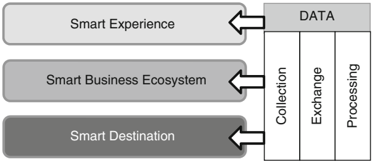
- The paper identifies three basic components of smart tourism: smart destinations, smart business ecosystems, and smart experiences; it also says smart tourism spans three layers: a smart information layer, smart exchange layer, and smart processing layer.
- The paper contrasts smart tourism with e-tourism: smart tourism bridges the digital and physical spheres, relies on sensors & smartphones rather than websites, focuses on the during-trip phase rather than pre- and post-travel, uses big data as its lifeblood, and is organized as an ecosystem rather than a value chain/intermediary structure.
- It notes that smart tourism research is still limited and mostly case-study based, with a strong consumer focus and an overly optimistic, uncritical stance; the paper itself proposes a research agenda and says existing smart tourism initiatives are mostly in development and often government-subsidized.
## Methods
- Conceptual/theoretical paper: it provides definitional clarification and an overview of the foundations of smart tourism rather than reporting an empirical dataset.
- It synthesizes prior literature on ICT, smart cities, service ecosystems, business models, and tourism technology to build its framework and definitions.
- It uses a conceptual comparison with e-tourism and organizes the discussion around technological foundations, business foundations, and research implications.
## Limitations
- The paper itself states that research in smart tourism is “very limited,” mostly case studies, and largely focused on the consumer perspective with an optimistic, uncritical stance.
- It explicitly says the proposed research agenda is “far from being comprehensive.”
- Evident from the text: the paper is conceptual and does not present original empirical data or tests, so its claims are theoretical rather than evidence from a study sample.
Model-written summary. Check it against the paper before relying on it.
Integrity signals
Registry
Cites
Statistics
Figures
Verification
Claims the paper makes
2 Valid · 17 Not valid · 47 Not checked · 59 Own results and interpretations
The cited sources support only part of this claim — read each source’s verdict below.
In the paper
“It has been identified as an important foundation for the services to be provided by smart tourism cities (Guo et al. 2014;Perera et al. 2014).”
§ Smart tourism: foundations and developments > Technological foundations of smart tourism
What the sources say
- Supportedcites Guo et al. 2014
The Introduction calls IoT technology the “core carrier” of the smart tourism information system. The Conclusion also identifies a tourism IoT information platform as critical to smart tourism development in China, supporting the claim that IoT is an important foundation for its services. (LLM, conf=0.93)
- Partly supportedcites Perera et al. 2014 matched to “Sensing as a service model for smart cities supported by Internet of Things” (2014) sourceExperimental — accuracy not yet measured
Section 3 (p. 2) describes an IoT-based sensing-as-a-service model as infrastructure for addressing smart-city challenges. The paper supports the general link between IoT and smart-city services, but the cited passages do not address tourism cities or their services specifically. (LLM, conf=0.85)
plainstates a cause- Asserted: passes — The authors put it forward as true.
- Checkable: passes — It can be checked against evidence.
- Load-bearing: unclear — It is unclear whether the paper’s conclusions depend on it.
- Based: passes — The paper gives a reason why it holds.
- Supported
A result the paper states — it cites no source for it, so there is none to check. The quote shows it is in the paper.
In the paper
“It also revealed a lack of critical literature that scrutinizes smart tourism assumptions and questioned its feasibility and positive experiential, economic and societal impacts.”
§ Smart tourism: foundations and developments > Conclusion
plain- Asserted: passes — The authors put it forward as true.
- Checkable: passes — It can be checked against evidence.
- Load-bearing: passes — The paper’s conclusions depend on it.
- Based: passes — The paper gives a reason why it holds.
In the paper
“Governments in China and South Korea are heavily funding initiatives mostly focused on building the technological infrastructure that supports smart tourism (Hwang et al. 2015).”
§ Smart tourism: foundations and developments > Abstract
What the sources say
- Not checked — no full text of the sourcecites Hwang et al. 2015 matched to “Constructivism in Smart Tourism Research : Seoul Destination Image” (2015) source
plain- Asserted: passes — The authors put it forward as true.
- Checkable: passes — It can be checked against evidence.
- Load-bearing: unclear — It is unclear whether the paper’s conclusions depend on it.
- Based: passes — The paper gives a reason why it holds.
A claim is checked only against the cited paper’s full text, never its abstract, and none is available for its sources.
In the paper
“Academic work is largely focused on describing the phenomenon in the form of case studies (e.g., Boes et al. 2015a, b;Bakıcı et al. 2013;Wang et al. 2013) or on discussing isolated technological developments (e.g., Huang and Chen 2015;Boes et al. 2015a, b) rather than on laying the theoretical foundations for its advancement and/or critique.”
§ Smart tourism: foundations and developments > Abstract
What the sources say
- Not checked — no full text of the sourcecites Boes et al. 2015a, b matched to “The Acceptance of NFC Smart Posters in Tourism” (2015) source
- Not checked — no full text of the sourcecites Bakıcı et al. 2013 matched to “A Smart City Initiative: the Case of Barcelona” (2013) source
- Not checked — no full text of the sourcecites Wang et al. 2013 matched to “China's “smart tourism destination” initiative: A taste of the service-dominant logic” (2013) source
plain- Asserted: passes — The authors put it forward as true.
- Checkable: passes — It can be checked against evidence.
- Load-bearing: passes — The paper’s conclusions depend on it.
- Based: passes — The paper gives a reason why it holds.
In the paper
“Remaining largely a vision at this stage, the Internet of Things has the potential to rapidly become a new reality as a technological infrastructure (Atzori et al. 2010).”
§ Smart tourism: foundations and developments > Technological foundations of smart tourism
What the sources say
- Not checked — no full text of the sourcecites Atzori et al. 2010 matched to “The Internet of Things: A survey” (2010) source
hedged- Asserted: passes — The authors put it forward as true.
- Checkable: passes — It can be checked against evidence.
- Load-bearing: unclear — It is unclear whether the paper’s conclusions depend on it.
- Based: passes — The paper gives a reason why it holds.
21 more claims
Create a free account to see all 125 claims and to verify the 3 references still open.
- It may state two separate claims as one. 46
- Probably not a substantial claim. 81
Citations
Cites
The Internet of Things: A survey
Atzori, L., Iera, A., & Morabito, G. (2010) · Computer Networks · doi:10.1016/j.comnet.2010.05.010 · Cited by 15,613
Business models, business strategy and innovation
Teece, D. J. (2010) · Long Range Planning · doi:10.1016/j.lrp.2009.07.003 · Cited by 8,335
Service-dominant logic: continuing the evolution
Vargo, S. L., & Lusch, R. F. (2008) · Journal of the Academy of Marketing Science · doi:10.1007/s11747-007-0069-6 · Cited by 7,824 · cited 1×
“In this vein, labels and roles assigned to players like travelers, firms and intermediaries are not valid anymore (Vargo and Lusch 2008).”
BackgroundBuhalis, D., & Law, R. (2008) · Tourism Management · doi:10.1016/j.tourman.2008.01.005 · Cited by 5,903 · cited 2×
“tion and of tourism consumers (Buhalis and Law 2008; Wang et al. 2012).”
BackgroundInternet of things: Vision, applications and research challenges
Miorandi, D., Sicari, S., De Pellegrini, F., & Chlamtac, I. (2012) · Ad Hoc Networks · doi:10.1016/j.adhoc.2012.02.016 · Cited by 3,578 · cited 1×
“Content and services will all be around us, persistently available, creating conditions for new applications and enabling new ways of working, interacting, entertainment, and living (Miorandi et al. 2012).”
BackgroundOn value and value co-creation: A service systems and service logic perspective
Vargo, S. L., Maglio, P. P., & Akaka, M. A. (2008) · European Management Journal · doi:10.1016/j.emj.2008.04.003 · Cited by 3,152 · cited 1×
“Vargo et al. (2008) and Spohrer et al. (2007) described a service ecosystem as a spontaneously sensing and responding spatial and temporal structure of largely loosely-coupled value-proposing social and economic actors interacting through institutions and technology, to: (1) co-produce service…”
BackgroundDahlander, L., & Gann, D. M. (2010) · Research Policy · doi:10.1016/j.respol.2010.01.013 · Cited by 2,435 · cited 1×
“Open innovation is based on the assumption that an organisation cannot just rely on its own resources, but has to engage with partners in order to innovate (Dahlander and Gann 2010; West and Gallagher 2006).”
BackgroundMacKenzie, D., & Millo, Y. (2003) · American Journal of Sociology · doi:10.1086/374404 · Cited by 1,464 · cited 1×
“By introducing new business models, firms develop new markets (Callon and Muniesa 2005; MacKenzie and Millo 2003; Pollock and Williams 2009; Inversini and Masiero 2014; Storbacka and Nenonen 2011).”
BackgroundPeripheral Vision: Economic Markets as Calculative Collective Devices
Callon, M., & Muniesa, F. (2005) · Organization Studies · doi:10.1177/0170840605056393 · Cited by 1,378 · cited 1×
“By introducing new business models, firms develop new markets (Callon and Muniesa 2005; MacKenzie and Millo 2003; Pollock and Williams 2009; Inversini and Masiero 2014; Storbacka and Nenonen 2011).”
Foundations for Smarter Cities
Harrison, C., Eckman, B., Hamilton, R., Hartswick, P., Kalagnanam, J., Paraszczak, J., & Williams, P. (2010) · IBM Journal of Research and Development · doi:10.1147/jrd.2010.2048257 · Cited by 1,347 · cited 1×
“Harrison et al. (2010) conceptualize smart as exploiting operational, near-real-time real-world data, integrating and sharing data, and using complex analytics, modelling, optimization and visualization to make better operational decisions.”
Background
Research works printed but not linked: 4
- 3. Anuar, F. I. & Gretzel, U. (2011). Privacy Concerns in the Context of Location Based Services for Tourism. ENTER 2011 Conference, Innsbruck, Austria, January 26-28, 2011. Accessed online (March 1, 2015) at http://ertr.tamu.edu/enter-2011-short-papers/.
- 16. Lopez de Avila, A. (2015). Smart Destinations: XXI Century Tourism. Presented at the ENTER2015 Conference on Information and Communication Technologies in Tourism, Lugano, Switzerland, February 4-6, 2015.
- 58. Tu, Q. & Liu, A. (2014). Framework of Smart Tourism Research and Related Progress in China. In International Conference on Management and Engineering (CME 2014), pp. 140-146.
- 77. In R. Egger, I. Gula, & D. Walcher (Eds.), Open Tourism - Open Innovation, Crowdsourcing and Collaborative Consumption challenging the tourism industry. Heidelberg: Springer Verlag.
Cited by
Items 1,801–1,900 of 2,494
Plan, Do, Watch: Making Tourism Sustainable Through Geographical Information Systems (GIS)
Balyalı, T. Ö., & İlhan, Ö. A. (2022) · Advances in hospitality, tourism and the services industry (AHTSI) book series · doi:10.4018/978-1-6684-4645-4.ch008
Wibowo, A. J. I., Sumarwan, U., Suharjo, B., & Simanjuntak, M. (2022) · Jurnal Manajemen Indonesia · doi:10.25124/jmi.v22i2.4291 · Cited by 3
Impact of Governance Structure, Infrastructure, and Terrorism on Tourism
Bashir, M. F., Ain, S. Q. U., Tariq, Y. B., et al. (2022) · Pertanika journal of social science & humanities · doi:10.47836//pjssh.30.4.08
Anttila, S. (2022) · Matkailututkimus · doi:10.33351/mt.119872 · Cited by 2
Proposta para fazer da Brotas, Brasil, um destino turístico inteligente
Bonfato, A. C., Coletti, G. F., Hauck, S. N. C., & Isaac, V. R. (2022) · Revista Rosa dos Ventos - Turismo e Hospitalidade · doi:10.18226/21789061.v14i4p1311
Ferramenta de pesquisas sobre estabelecimentos baseada na geolocalização
Ferreira, R. O. P., & Malta, G. A. P. (2022) · Revista Geografias · doi:10.35699/2237-549x.2019.19741
del Rosario, J. M. B., Molina, A. G., Eyzaguirre, C. B., & López, L. H. (2019) · doi:10.20420/1593.2020.534
Kyaw, K. S., Sattayaraksa, W. D., Sattayaraksa, T., et al. (2022) · Advances in economics, business and management research/Advances in Economics, Business and Management Research · doi:10.2991/978-94-6463-068-8_2
The Initial Impact of Technology Enabled Relationship Creation in Rural Lebanon
Inversini, A., Müller, M., & Talhouk, S. N. (2023) · Springer proceedings in business and economics · doi:10.1007/978-3-031-25752-0_1
Pasos, Año 2023, Vol. 21, Número 1
Santana Talavera, A. (2023) · PASOS Revista de Turismo y Patrimonio Cultural · doi:10.25145/j.pasos.2023.21
Aplikacja turystyczna „Łódzkie stadiony na wyciągnięcie ręki” – ocena funkcjonalności
Jasion, A., Zdulska, D., Szymala, M., et al. (2022) · Konwersatorium Wiedzy o Mieście · doi:10.18778/2543-9421.07.06
Business Intelligence Applied to Tourism
Ramos, C. M. Q. (2023) · IGI Global eBooks · doi:10.4018/978-1-7998-9220-5.ch034
تقییم ممارسات الاستدامة الذكیة فی المقاصد السیاحیة: مصر نموذجاً
مجدی, أ., فهمی, ت. م., & عبدالسميع, ح. (2022) · مجلة کلية السياحة والفنادق - جامعة مدينة السادات · doi:10.21608/mfth.2022.284687
أثر الاستدامة الذكیة علی جاذبیة المقصد السیاحی
مجدی, أ., فهمی, ت. م., & عبدالسميع, ح. (2022) · مجلة کلية السياحة والفنادق - جامعة مدينة السادات · doi:10.21608/mfth.2022.284689
Richter, N. (2023) · Springer eBooks · doi:10.1007/978-3-658-37545-4_22
Destination Design der Zukunft: Digitale, intelligente und nachhaltige Erlebnisse
Neuhofer, B., & Grundner, L. (2023) · Entrepreneurial Management und Standortentwicklung · doi:10.1007/978-3-658-39879-8_10 · Cited by 1
Turismo, patrimonio e innovación en el contexto actual
Cordero, M. Z., & Vidal, L. E. F. (2023) · Universidad de Colima eBooks · doi:10.53897/li.2023.0003.ucol · Cited by 1
CHALLENGES AND OPPORTUNITIES FOR NEWS MEDIA IN DIGITAL AND SOCIAL MEDIA ENVIRONMENT ABSTRACT
Meena, K. K. (2022) · SDES-International Journal of Interdisciplinary Research · doi:10.47997/sdes-ijir/3.6.2022.541-552
BOOKER PREDICTION FROM REQUESTS FOR QUOTATION VIA MACHINE LEARNING TECHNIQUES
RUNGGALDIER, S., Sottocornola, G., Janes, A., Stella, F., & Zanker, M. (2023) · Tourism and hospitality management · doi:10.20867/thm.29.1.3
Governance Principles for Sustainable Urban Tourism and Climate Transition
Черниш, І. В., Frecè, J. T., & Harder, D. L. (2023) · Springer eBooks · doi:10.1007/978-3-031-26277-7_3 · Cited by 2
Sommer, G., & Anger, S. (2022) · St. Galler Schriften für Tourismus und Verkehr/St. Galler Schriften für Tourismus und Verkehr · doi:10.37307/b.978-3-503-20916-3.08
Smartization of Iran's Tourism Industry: An emphasis on Social and Cultural Empowerment
Zangouei, F., آذر, ز. خ., & Sadaghiyani, J. S. (2022) · Social Studies in Tourism · doi:10.52547/journalitor.36283.10.19.335
Reisi, H., monfared, A. K., & hosseini, E. (2022) · Social Studies in Tourism · doi:10.52547/journalitor.35654.10.20.21
How to Increase Destination Loyalty in Smart Tourism of Southeast Asia?
Nugraha, D., & Astuty, E. (2023) · International Conference on Industrial Engineering and Operations Management (IEOM) · doi:10.46254/na07.20220171 · Cited by 1
أثر تكنولوجيا سلاسل الكتل على كفاءة وفعالية الخدمات السياحية
عبداللاه, م. ع. (2023) · مجلة کلية السياحة والفنادق - جامعة مدينة السادات · doi:10.21608/mfth.2023.300496
Component Technologies on Home-Based Enterprises: A Trend in Smart Cities Development
Ayo-Odifiri, S. O., & Emeana, R. C. (2023) · Research on humanities and social sciences · doi:10.7176/rhss/13-10-01 · Cited by 1
Covid-19 und geschäftliche Herausforderungen
Shimpi, D. (2023) · Springer eBooks · doi:10.1007/978-3-658-39277-2_1
Smart Tourism Design: Take Experience and Resource Integration as the Core
Huang, T., Li, Y., Li, Y., & Fesenmaier, D. R. (2023) · EAI/Springer Innovations in Communication and Computing · doi:10.1007/978-3-031-30514-6_5
Christopoulou, E., & Ringas, D. (2023) · EAI/Springer Innovations in Communication and Computing · doi:10.1007/978-3-031-30514-6_8
Destinos Turísticos Inteligentes: Domínio da produção científica e percursos das agendas de pesquisa
Sampaio, E. A. D. A., & Braga, D. C. (2023) · Revista Rosa dos Ventos - Turismo e Hospitalidade · doi:10.18226/21789061.v15i2p520 · Cited by 2
The Technological Impact on Local Tourism: The Case of Fafe
Mota, C., Borges, I., Braga, J. L., Brás, S., Silva, A., & Leite, S. R. (2023) · Smart innovation, systems and technologies · doi:10.1007/978-981-19-9960-4_14
The Growth of De Temporalisation in Tourism
Ali, A., & Murray, P. (2023) · Goodfellow Publishers Ltd eBooks · doi:10.23912/9781911635840-5467
Pasquinelli, C., & Trunfio, M. (2023) · Tourism on the verge · doi:10.1007/978-3-031-33677-5_5 · Cited by 1
Sehgal, G. (2023) · International Journal For Multidisciplinary Research · doi:10.36948/ijfmr.2023.v05i04.5549 · Cited by 3
PDCCA ENTRE VARIÁVEIS METEOROLÓGICAS NA CIDADE DE SALVADOR (BA)
Trindade, J. M., Brito, A. D. A., & Zebende, G. F. (2023) · doi:10.22533/at.ed.1732308232
RESULTADOS DA APLICAÇÃO DE UMA SEQUÊNCIA DIDÁTICA PARA O ENSINO DA GEOMETRIA ANALÍTICA
Porto, G., Hauenstein, D. M., & Ferreira, A. L. A. (2023) · doi:10.22533/at.ed.1732308235
Sousa, M. C. P. B., Fernandes, A. L., & Pequeno, V. M. (2023) · doi:10.22533/at.ed.1732308234
Investigação científica nas ciências exatas e da terra
de Almeida, F. M. (2023) · doi:10.22533/at.ed.173230823
CARACTERIZACIÓN DEL ÍNDICE ULTRAVIOLETA EN LA REGIÓN DE PUNO DURANTE EL AÑO 2022
Huaman, C. W. T., Arbieto, M. H., Mamani, E. G. M., Vilca, R. A. L., Cahuana, L. P., Rivera, T. J. C., & Barreto, M. R. (2023) · doi:10.22533/at.ed.1732308231
Kummer, A. C. B., Filho, H. G., Putti, F. F., & Justi, A. L. (2023) · doi:10.22533/at.ed.1732308233
de Oliveira, E. J., Lima, F. F. D. S., Fidelis, J. A. F., da Silva, B. B., & Barreto, C. L. (2023) · doi:10.22533/at.ed.1732308236
Yonghua, Y., & Amin, S. B. M. (2023) · International Journal of Academic Research in Business and Social Sciences · doi:10.6007/ijarbss/v13-i9/17969 · Cited by 1
Key Management Tools for Managing Tourism Firms and Destinations
Baiocco, S., & Paniccia, P. M. A. (2022) · International Thematic Monograph. Modern Management Tools and Economy of Tourism Sector in Present Era · doi:10.31410/tmt.2022-2023.1
Sampaio, E., & Braga, D. C. (2023) · Marketing & Tourism Review · doi:10.29149/mtr.v9i1.7685 · Cited by 1
A Bibliometric Analysis of Smart Manufacturing and Way Forward
Tiwari, S., & Trivedi, S. (2023) · Environmental footprints and eco-design of products and processes · doi:10.1007/978-981-99-4819-2_10
Cumhuriyetin 100 Yılında Turizm ve Teknolojinin Yolculuğu
ÇALLI, D. S., Bilgili, B., & Kumaş, G. (2023) · Anadolu İktisat ve İşletme Dergisi · doi:10.59293/anadoluiid.1363742 · Cited by 4
Liability of launching state on space tourism
Mulyana, S. P., & Raodah, P. (2023) · Ex Aequo Et Bono Journal Of Law · doi:10.61511/eaebjol.v1i1.2023.91
de Lacerda, L. L. L., Pimenta, A. F. P. D. S., Emmendoerfer, L., et al. (2023) · Revista Acadêmica Observatório de Inovação do Turismo · doi:10.61564/raoit.v17n1.6866
Bortoluzzi, C. R., Mutti, C. D. N., & Reginato, V. D. S. C. (2023) · Cuadernos de Educación y Desarrollo · doi:10.55905/cuadv15n10-038
Al-baharat, F., Alzbuon, N., & Khawaldah, H. A. (2023) · An-Najah University Journal for Research - B (Humanities) · doi:10.35552/0247.38.1.2141
أثر الاستدامة التكنولوجية على رضاء السائحين بالتطبيق على مدينه شرم الشيخ كمقصد سياحي
جودة, ح. أ. (2023) · مجلة کلية السياحة والفنادق - جامعة مدينة السادات · doi:10.21608/mfth.2023.323069
المقدم, م. ص., & العزمي, ع. ا. أ. م. (2023) · مجلة جامعة الإسکندرية للعلوم الإدارية · doi:10.21608/acj.2023.324643
Post-Pandemic Urban Planning and Use of Information Technologies in Smart Cities
Konak, S. (2023) · Emerald Group Publishing Limited eBooks · doi:10.1108/s1877-636120230000033002
(2023) · Emerald Group Publishing Limited eBooks · doi:10.1108/978-1-83797-575-420231012
Tourism of the future: Opportunities and challenges of smart technologies and digitalisation
(2023) · Eastern Journal of European Studies · doi:10.47743/ejes-2023-si
Diferenciais e Limitações da Inteligência em Turismo do Destino Cidade de São Paulo
de Oliveira, R. K. (2022) · Digital Library of Theses and Dissertations (Universidade de São Paulo) · doi:10.11606/d.100.2022.tde-25072022-203740 · Cited by 1
Jatav, S., Gupta, R., & Singh, V. (2023) · Advances in logistics, operations, and management science book series · doi:10.4018/979-8-3693-2065-5.ch009 · Cited by 1
Influencing Of Digitilization To Tourism Development: In Case Of Uzbekistan
Tursunov, B. O., Imomov, J., & Jenisbayevna, S. S. (2023) · Uluslararası Akademik Çalışmalar Dergisi · doi:10.29228/jacademia.74405
Long, H. C., & Quyet, P. X. (2023) · Tạp chí Nghiên cứu Tài chính - Marketing · doi:10.52932/jfm.vi6.442
Information technologies as a tool for improving the tourist offer
Trifunović, I., Spalević, Ž., Savić, S., & Prlincevic, B. P. (2023) · International Scientific Conference on Economics, Management and Information Technologies (ICEMIT) · doi:10.46793/icemit23.323t
Estudio Cienciométrico sobre Desarrollo Turístico
Montoya, G. R. Á. –. (2024) · Revista científica profundidad construyendo futuro · doi:10.22463/24221783.4317
Pacheco, G. J. A., Santibáñez, I. R., & Paniagua, C. F. O. (2023) · El Periplo Sustentable · doi:10.36677/elperiplo.v0i45.18935
Open Questions and Future Directions
Kontogianni, A., Alepis, E., Virvou, M. K., et al. (2024) · Intelligent systems reference library · doi:10.1007/978-3-031-50883-7_9
Blockchain for Transparent Food Supply Chains
Upman, K. K., Gautam, R., & Singh, M. (2019) · Türk bilgisayar ve matematik eğitimi dergisi · doi:10.61841/turcomat.v10i3.14401
Main Features of Smart Tourism Organization
Narzullaeva, U. (2023) · YASHIL IQTISODIYOT VA TARAQQIYOT · doi:10.55439/ged/vol1_issmaxsusson/a648
Smart Tourism: Pros, Cons and Potential Future Development
Baratov, A. (2023) · YASHIL IQTISODIYOT VA TARAQQIYOT · doi:10.55439/ged/vol1_issmaxsusson/a667
Влияние цифровых технологий на развитие туристского рынка в Узбекистане
Мустаева, Ш. (2023) · YASHIL IQTISODIYOT VA TARAQQIYOT · doi:10.55439/ged/vol1_issmaxsusson/a696
Smart Tourism Analysis and Future Trends
Safaeva, S. (2023) · YASHIL IQTISODIYOT VA TARAQQIYOT · doi:10.55439/ged/vol1_issmaxsusson/a605
Основные тенденции развития смарт туризма в условиях цифровой экономики в Республике Узбекистан
Екатерина, С. (2023) · YASHIL IQTISODIYOT VA TARAQQIYOT · doi:10.55439/ged/vol1_issmaxsusson/a621
Ахмеджанова, И., & Халилова, Н. (2023) · YASHIL IQTISODIYOT VA TARAQQIYOT · doi:10.55439/ged/vol1_issmaxsusson/a622
Smart Destination Management: Challenges and Practices
Oppokkhonov, N. (2023) · YASHIL IQTISODIYOT VA TARAQQIYOT · doi:10.55439/ged/vol1_issmaxsusson/a677
Appearances, Classification and Application of Smart Tourism
Akhmadjanova, M., Sharifboyeva, F., & Dadamirzayev, S. (2023) · YASHIL IQTISODIYOT VA TARAQQIYOT · doi:10.55439/ged/vol1_issmaxsusson/a618
Sh.Ruziyev, & M.Toʻxtanazarova (2023) · QO‘QON UNIVERSITETI XABARNOMASI · doi:10.54613/ku.v9i9.823 · Cited by 2
Mohd, N. S., & Najimudin, M. F. (2024) · Studies in systems, decision and control · doi:10.1007/978-3-031-51997-0_32 · Cited by 3
Soares, R. A. M. D. C., de Albuquerque, T. V., & Filho, L. M. (2024) · Marketing & Tourism Review · doi:10.29149/mtr.v9i1.8099
Estado da arte da pesquisa em Destino Turístico Inteligente (DTI) no Brasil
de Albuquerque, T. V., Souza, I. B., & de Araújo, M. V. P. (2024) · Marketing & Tourism Review · doi:10.29149/mtr.v9i1.8240
(2024) · International Journal of Advanced Trends in Computer Science and Engineering · doi:10.30534/ijatcse/2024/041322024
DESTINATION DYNAMICS: A DEEP DIVE INTO TOURISM MANAGEMENT SYSTEMS
Maurya, D. K., Rajbhar, S., Shrivastava, V., et al. (2024) · doi:10.55524/csistw.2024.12.1.51
Book review: Smart cities and tourism: Co-creating experiences, challenges and opportunities
Reif, J. (2024) · Journal of Tourism Futures · doi:10.1108/jtf-03-2024-301
Smart Tourism Destination in the Framework of Cyber Physical Social SystemsPreprint
Pasandideh, S., Gomes, L., pereira, P. H. S., & Martins, J. F. (2024) · SSRN Electronic Journal · doi:10.2139/ssrn.4807068
Utilizing Marketing Information Systems and Big Data Analytics in Promoting Tourism Destinations
Farheen, N. S. S., Bhandari, G. B., Abdulmannan, L., et al. (2024) · Advances in marketing, customer relationship management, and e-services book series · doi:10.4018/979-8-3693-3310-5.ch012
Metaverse as the New Challenge of Tourism in the Phygital Age: State of the Art and Research Agenda
Ayadi, S., & Zouari, A. (2024) · Advances in e-business research series · doi:10.4018/979-8-3693-2422-6.ch009 · Cited by 2
THE IMPORTANCE OF A SMART CITY IN ACHIEVING A SUSTAINABLE TOURISM SECTOR
Batyrova, N. T., Nakhipbekova, S., Kulbayeva, A., et al. (2023) · Bulletin of the International University of Tourism and Hospitality. · doi:10.62867/3007-0848.2023-2.03
Smart Cities on the Waterfront: Citizens’ Perspectives on Smart City in the Context of a Port City
Edelman, K., Franzén, R., Wahlström, I., et al. (2024) · doi:10.18690/um.fov.4.2024.30
Eibl, S., Fina, R., & Auinger, A. (2024) · Lecture notes in computer science · doi:10.1007/978-3-031-61315-9_11
Comparison of SMART Tourism Models of Selected European City Destinations
Palatková, M., & Ploch, J. (2024) · Smart innovation, systems and technologies · doi:10.1007/978-981-97-1552-7_52
Tourism 4.0 -The Digital Innovations in Hospitality and Tourism Industry
Singh, J., Mathur, R., Aslam, M., et al. (2024) · Contemporary Studies in Social Sciences · doi:10.31559/csss2024.2.1.6
Analisis Strategi Digital Marketing Terhadap Pertumbuhan Wisata Halal Di Kota Bengkulu
Pefriyadi, P., Yulinda, A. T., Sumarni, Y., et al. (2024) · Journal of Economic Bussines and Accounting (COSTING) · doi:10.31539/costing.v7i4.10306
Open Data and Smart Tourism Development in Viticultural Areas in Serbia
Jovanović, R., Michalijos, M. P., & Seciu, C. (2024) · Proceedings of the ... International Conference on Business Excellence · doi:10.2478/picbe-2024-0196
القصراوی, س. (2024) · المجلة العلمیة لکلیة السیاحة و الفنادق جامعة الأسکندریة · doi:10.21608/thalexu.2024.263674.1122
The Impact of Digital Marketing on Tourism in Albania
Kola, B., Gjermizi, J., & Tepelena, I. (2024) · Journal of Educational and Social Research · doi:10.36941/jesr-2024-0094
The Pillar of Accessibility in the Spanish Smart Tourism Destinations (DTI) Model
Leporiere, L., & Andrades, L. (2024) · Tourism, hospitality & event management · doi:10.1007/978-3-031-60709-7_8
Smart Tourism and Platforms. Italia.It, the Italian Tourism Digital Hub
Fenu, N., & Giaccaria, P. (2024) · Lecture notes in computer science · doi:10.1007/978-3-031-65332-2_1
Kulkarni, M. S., Varghese, B., & George, G. (2024) · Springer eBooks · doi:10.1007/978-981-97-2902-9_8
(2023) · Jurnal Sosial Humaniora Terapan · doi:10.7454/jsht.v6i2.1117 · Cited by 5
Çetinkaya, A. (2024) · Advances in business strategy and competitive advantage book series · doi:10.4018/979-8-3693-3743-1.ch018
ROLE OF INFORMATION TECHNOLOGY AND TOURISM PROMOTION IN BANGLADESH
Sarker, M. S. I., & Dash, S. C. (2024) · International Journal of Marketing Research Innovation · doi:10.46281/ijmri.v9i1.2240 · Cited by 4
Tirtosetianto, R. H., Sonya, A., & Widiastuti, H. (2024) · Akademika · doi:10.51881/jak.v22i2.130 · Cited by 1
Lasso, A. H., Wardana, A. D., & Saweho, J. B. (2024) · Sabbhata Yatra Jurnal Pariwisata dan Budaya · doi:10.53565/sabbhatayatra.v5i1.1229
Uporaba lokalnih podatkov za boljše spremljanje turističnih tokov: kritična perspektiva
Peceny, U. S., & Ilijaš, T. (2024) · Uporabna informatika · doi:10.31449/upinf.227
Metadata
- Authors
- Gretzel, U., Sigala, M., Xiang, Z., & Koo, C.
- Affiliations
- Virginia Tech (US)
- Kyung Hee University (KR)
- Corresponding author
- Koo, Chulmo
- Venue
- Electronic Markets
- Published
- 2015-08-01
- Volume
- 25
- Issue
- 3
- Pages
- 179-188
- ISSN
- 1019-6781 (ISSN-L)
- 1422-8890
- OpenAlex
- W974480840
- Cited by
- 2,589
- References
- 81
- Citations by year
- 2026: 532 · 2025: 364 · 2024: 307 · 2023: 255 · 2022: 283 · 2021: 239 · 2020: 232 · 2019: 163 · 2018: 93 · 2017: 82 · 2016: 36 · 2015: 2
- FWCI
- 234.92
- Type
- journal article
- Language
- en
- Open access
- hybrid
- doi.org
- Licence
- cc-by
- creativecommons.org/licenses/by/4.0/ (tdm)
- creativecommons.org/licenses/by/4.0/ (vor)
- Locations
- Electronic Markets (publishedVersion, cc-by)
- UniSA Research Outputs Repository (University of South Australia) (acceptedVersion)
- Adelaide Research & Scholarship (AR&S) (University of Adelaide) (submittedVersion, cc-by)
- Funders
- National Research Foundation
- National Research Foundation of Korea (NRF-2013S1A3A2043345)
- Topics
- Social Sciences › Business, Management and Accounting › Tourism, Leisure and Hospitality Management › Diverse Aspects of Tourism Research
- Social Sciences › Business, Management and Accounting › Management of Technology and Innovation › Digital Innovation in Industries
- Social Sciences › Business, Management and Accounting › Marketing › AI in Service Interactions
- Keywords
- smart tourism, information and communication technologies, tourism destinations, tourism industry, big data, value proposition, conceptual definitions, tourism management, technological foundations, business foundations
About these checks
Registry, retraction, Cites and statistics results are computed, not judged, with one exception: a printed reference that no index lists is read once by a model before it counts as a citation error. Claims are extracted by a model and kept only when their quote appears verbatim in the text; each cited source is then checked, with a model’s help, for whether it says what the claim relies on. Those verdicts can be wrong — read the claim’s quote and the cited source before relying on one.
The claim verdicts this report counts are experimental: their accuracy is not yet measured.
A language model drew the claims from the paper on 2026-10-10, under version 3 of the claim definition (model deepseek-v4.1-flash, prompt extract-v3).
A second model labelled each claim on 2026-10-10 (model jev-1.13-20260917, definition revision gold-guideline-v0.2).
Cited sources are checked with a language model’s help (gpt-6-sol).
Statistics and arithmetic are recomputed, not judged.
Confidence bands are shown only for fields calibrated on our annotated test set. None is calibrated yet, so no band is shown.
What counts as a claim ›How we measure confidence ›How we check this ›
Are you an author, or do you see a problem with this page? Request a review
Data sources
Bibliographic data: Semantic Scholar, OpenAlex, Crossref.
Contains information from the Semantic Scholar Academic Graph Datasets, made available under the ODC Attribution License (ODC-BY 1.0).
Semantic Scholar’s data is described in: Kinney, R., et al. (2023). The Semantic Scholar Open Data Platform. arXiv:2301.10140.
