

Smart tourism: foundations and developments
Open accessThe DOI matches its Crossref record; 79 of the 81 references it cites were found in a registry or an index; 3 of the 66 sources its claims cite were checked for support.
Abstract
Abstract Smart tourism is a new buzzword applied to describe the increasing reliance of tourism destinations, their industries and their tourists on emerging forms of ICT that allow for massive amounts of data to be transformed into value propositions. However, it remains ill-defined as a concept, which hinders its theoretical development. The paper defines smart tourism, sheds light on current smart tourism trends, and then lays out its technological and business foundations. This is followed by a brief discussion on the prospects and drawbacks of smart tourism. The paper further draws attention to the great need for research to inform smart tourism development and management.
Overview
CoChat Summary
## TL;DR
This paper defines smart tourism and argues it is more than e-tourism or isolated tech projects: it is a destination-level system that uses integrated ICT and big data to create on-site experiences and business value. It also says the concept is under-theorized, heavily influenced by smart city ideas, and in need of much more critical research.
## Key findings
- Smart tourism is defined as “tourism supported by integrated efforts at a destination to collect and aggregate/harness data” from physical infrastructure, social connections, government/organizational sources, and human bodies/minds, using advanced technologies to transform that data into “on-site experiences and business value-propositions” with a focus on efficiency, sustainability, and experience enrichment.
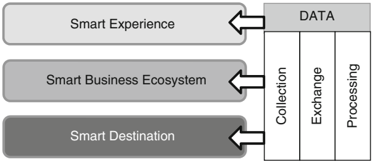
- The paper identifies three basic components of smart tourism: smart destinations, smart business ecosystems, and smart experiences; it also says smart tourism spans three layers: a smart information layer, smart exchange layer, and smart processing layer.
- The paper contrasts smart tourism with e-tourism: smart tourism bridges the digital and physical spheres, relies on sensors & smartphones rather than websites, focuses on the during-trip phase rather than pre- and post-travel, uses big data as its lifeblood, and is organized as an ecosystem rather than a value chain/intermediary structure.
- It notes that smart tourism research is still limited and mostly case-study based, with a strong consumer focus and an overly optimistic, uncritical stance; the paper itself proposes a research agenda and says existing smart tourism initiatives are mostly in development and often government-subsidized.
## Methods
- Conceptual/theoretical paper: it provides definitional clarification and an overview of the foundations of smart tourism rather than reporting an empirical dataset.
- It synthesizes prior literature on ICT, smart cities, service ecosystems, business models, and tourism technology to build its framework and definitions.
- It uses a conceptual comparison with e-tourism and organizes the discussion around technological foundations, business foundations, and research implications.
## Limitations
- The paper itself states that research in smart tourism is “very limited,” mostly case studies, and largely focused on the consumer perspective with an optimistic, uncritical stance.
- It explicitly says the proposed research agenda is “far from being comprehensive.”
- Evident from the text: the paper is conceptual and does not present original empirical data or tests, so its claims are theoretical rather than evidence from a study sample.
Model-written summary. Check it against the paper before relying on it.
Integrity signals
Registry
Cites
Statistics
Figures
Verification
Claims the paper makes
2 Valid · 17 Not valid · 47 Not checked · 59 Own results and interpretations
The cited sources support only part of this claim — read each source’s verdict below.
In the paper
“It has been identified as an important foundation for the services to be provided by smart tourism cities (Guo et al. 2014;Perera et al. 2014).”
§ Smart tourism: foundations and developments > Technological foundations of smart tourism
What the sources say
- Supportedcites Guo et al. 2014
The Introduction calls IoT technology the “core carrier” of the smart tourism information system. The Conclusion also identifies a tourism IoT information platform as critical to smart tourism development in China, supporting the claim that IoT is an important foundation for its services. (LLM, conf=0.93)
- Partly supportedcites Perera et al. 2014 matched to “Sensing as a service model for smart cities supported by Internet of Things” (2014) sourceExperimental — accuracy not yet measured
Section 3 (p. 2) describes an IoT-based sensing-as-a-service model as infrastructure for addressing smart-city challenges. The paper supports the general link between IoT and smart-city services, but the cited passages do not address tourism cities or their services specifically. (LLM, conf=0.85)
plainstates a cause- Asserted: passes — The authors put it forward as true.
- Checkable: passes — It can be checked against evidence.
- Load-bearing: unclear — It is unclear whether the paper’s conclusions depend on it.
- Based: passes — The paper gives a reason why it holds.
- Supported
A result the paper states — it cites no source for it, so there is none to check. The quote shows it is in the paper.
In the paper
“It also revealed a lack of critical literature that scrutinizes smart tourism assumptions and questioned its feasibility and positive experiential, economic and societal impacts.”
§ Smart tourism: foundations and developments > Conclusion
plain- Asserted: passes — The authors put it forward as true.
- Checkable: passes — It can be checked against evidence.
- Load-bearing: passes — The paper’s conclusions depend on it.
- Based: passes — The paper gives a reason why it holds.
In the paper
“Governments in China and South Korea are heavily funding initiatives mostly focused on building the technological infrastructure that supports smart tourism (Hwang et al. 2015).”
§ Smart tourism: foundations and developments > Abstract
What the sources say
- Not checked — no full text of the sourcecites Hwang et al. 2015 matched to “Constructivism in Smart Tourism Research : Seoul Destination Image” (2015) source
plain- Asserted: passes — The authors put it forward as true.
- Checkable: passes — It can be checked against evidence.
- Load-bearing: unclear — It is unclear whether the paper’s conclusions depend on it.
- Based: passes — The paper gives a reason why it holds.
A claim is checked only against the cited paper’s full text, never its abstract, and none is available for its sources.
In the paper
“Academic work is largely focused on describing the phenomenon in the form of case studies (e.g., Boes et al. 2015a, b;Bakıcı et al. 2013;Wang et al. 2013) or on discussing isolated technological developments (e.g., Huang and Chen 2015;Boes et al. 2015a, b) rather than on laying the theoretical foundations for its advancement and/or critique.”
§ Smart tourism: foundations and developments > Abstract
What the sources say
- Not checked — no full text of the sourcecites Boes et al. 2015a, b matched to “The Acceptance of NFC Smart Posters in Tourism” (2015) source
- Not checked — no full text of the sourcecites Bakıcı et al. 2013 matched to “A Smart City Initiative: the Case of Barcelona” (2013) source
- Not checked — no full text of the sourcecites Wang et al. 2013 matched to “China's “smart tourism destination” initiative: A taste of the service-dominant logic” (2013) source
plain- Asserted: passes — The authors put it forward as true.
- Checkable: passes — It can be checked against evidence.
- Load-bearing: passes — The paper’s conclusions depend on it.
- Based: passes — The paper gives a reason why it holds.
In the paper
“Remaining largely a vision at this stage, the Internet of Things has the potential to rapidly become a new reality as a technological infrastructure (Atzori et al. 2010).”
§ Smart tourism: foundations and developments > Technological foundations of smart tourism
What the sources say
- Not checked — no full text of the sourcecites Atzori et al. 2010 matched to “The Internet of Things: A survey” (2010) source
hedged- Asserted: passes — The authors put it forward as true.
- Checkable: passes — It can be checked against evidence.
- Load-bearing: unclear — It is unclear whether the paper’s conclusions depend on it.
- Based: passes — The paper gives a reason why it holds.
21 more claims
Create a free account to see all 125 claims and to verify the 3 references still open.
- It may state two separate claims as one. 46
- Probably not a substantial claim. 81
Citations
Cites
The Internet of Things: A survey
Atzori, L., Iera, A., & Morabito, G. (2010) · Computer Networks · doi:10.1016/j.comnet.2010.05.010 · Cited by 15,613
Business models, business strategy and innovation
Teece, D. J. (2010) · Long Range Planning · doi:10.1016/j.lrp.2009.07.003 · Cited by 8,335
Service-dominant logic: continuing the evolution
Vargo, S. L., & Lusch, R. F. (2008) · Journal of the Academy of Marketing Science · doi:10.1007/s11747-007-0069-6 · Cited by 7,824 · cited 1×
“In this vein, labels and roles assigned to players like travelers, firms and intermediaries are not valid anymore (Vargo and Lusch 2008).”
BackgroundBuhalis, D., & Law, R. (2008) · Tourism Management · doi:10.1016/j.tourman.2008.01.005 · Cited by 5,903 · cited 2×
“tion and of tourism consumers (Buhalis and Law 2008; Wang et al. 2012).”
BackgroundInternet of things: Vision, applications and research challenges
Miorandi, D., Sicari, S., De Pellegrini, F., & Chlamtac, I. (2012) · Ad Hoc Networks · doi:10.1016/j.adhoc.2012.02.016 · Cited by 3,578 · cited 1×
“Content and services will all be around us, persistently available, creating conditions for new applications and enabling new ways of working, interacting, entertainment, and living (Miorandi et al. 2012).”
BackgroundOn value and value co-creation: A service systems and service logic perspective
Vargo, S. L., Maglio, P. P., & Akaka, M. A. (2008) · European Management Journal · doi:10.1016/j.emj.2008.04.003 · Cited by 3,152 · cited 1×
“Vargo et al. (2008) and Spohrer et al. (2007) described a service ecosystem as a spontaneously sensing and responding spatial and temporal structure of largely loosely-coupled value-proposing social and economic actors interacting through institutions and technology, to: (1) co-produce service…”
BackgroundDahlander, L., & Gann, D. M. (2010) · Research Policy · doi:10.1016/j.respol.2010.01.013 · Cited by 2,435 · cited 1×
“Open innovation is based on the assumption that an organisation cannot just rely on its own resources, but has to engage with partners in order to innovate (Dahlander and Gann 2010; West and Gallagher 2006).”
BackgroundMacKenzie, D., & Millo, Y. (2003) · American Journal of Sociology · doi:10.1086/374404 · Cited by 1,464 · cited 1×
“By introducing new business models, firms develop new markets (Callon and Muniesa 2005; MacKenzie and Millo 2003; Pollock and Williams 2009; Inversini and Masiero 2014; Storbacka and Nenonen 2011).”
BackgroundPeripheral Vision: Economic Markets as Calculative Collective Devices
Callon, M., & Muniesa, F. (2005) · Organization Studies · doi:10.1177/0170840605056393 · Cited by 1,378 · cited 1×
“By introducing new business models, firms develop new markets (Callon and Muniesa 2005; MacKenzie and Millo 2003; Pollock and Williams 2009; Inversini and Masiero 2014; Storbacka and Nenonen 2011).”
Foundations for Smarter Cities
Harrison, C., Eckman, B., Hamilton, R., Hartswick, P., Kalagnanam, J., Paraszczak, J., & Williams, P. (2010) · IBM Journal of Research and Development · doi:10.1147/jrd.2010.2048257 · Cited by 1,347 · cited 1×
“Harrison et al. (2010) conceptualize smart as exploiting operational, near-real-time real-world data, integrating and sharing data, and using complex analytics, modelling, optimization and visualization to make better operational decisions.”
Background
Research works printed but not linked: 4
- 3. Anuar, F. I. & Gretzel, U. (2011). Privacy Concerns in the Context of Location Based Services for Tourism. ENTER 2011 Conference, Innsbruck, Austria, January 26-28, 2011. Accessed online (March 1, 2015) at http://ertr.tamu.edu/enter-2011-short-papers/.
- 16. Lopez de Avila, A. (2015). Smart Destinations: XXI Century Tourism. Presented at the ENTER2015 Conference on Information and Communication Technologies in Tourism, Lugano, Switzerland, February 4-6, 2015.
- 58. Tu, Q. & Liu, A. (2014). Framework of Smart Tourism Research and Related Progress in China. In International Conference on Management and Engineering (CME 2014), pp. 140-146.
- 77. In R. Egger, I. Gula, & D. Walcher (Eds.), Open Tourism - Open Innovation, Crowdsourcing and Collaborative Consumption challenging the tourism industry. Heidelberg: Springer Verlag.
Cited by
Items 1,701–1,800 of 2,494
CASTRO, A. R. C. D. (2020) · doi:10.17771/pucrio.acad.48288 · Cited by 4
(2017) · Emerald Group Publishing Limited eBooks · doi:10.1108/s2042-144320170000008027 · Cited by 1
Becka, L. F. (2023) · El Servicio de Difusión de la Creación Intelectual (National University of La Plata) · doi:10.35537/10915/153443 · Cited by 4
Doni, F., Nazir, S., Capocchi, A., & Sarfraz, A. (2023) · SSRN Electronic Journal · doi:10.2139/ssrn.4583344 · Cited by 3
Promoting Smart Tourism in Asia and the Pacific through Digital Cooperation
Bank, A. D. (2023) · doi:10.22617/tcs230494-2 · Cited by 4
Bourdin, S., Kebir, L., Ivanov, S., & Stoleriu, O. (2023) · Tourism of the future: Opportunities and challenges of smart technologies and digitalisation · doi:10.47743/ejes-2023-si01 · Cited by 1
Costa, K., & Nolo, L. M. M. (2024) · Preprints.org · doi:10.20944/preprints202403.0434.v1 · Cited by 1
Supplier Relationship Management as a Driver of Sustainable E-Commerce PracticesPreprint
Grant, O. (2024) · Preprints.org · doi:10.20944/preprints202407.1044.v1
Guo, Y. (2024) · Research Square · doi:10.21203/rs.3.rs-4877303/v1 · Cited by 1
Liu, D., Zhou, T., Duan, Y., & Yin, H. (2025) · Research Square · doi:10.21203/rs.3.rs-6845550/v1 · Cited by 1
Artificial Intelligence and the Search for Meaning in Support of Marketing Agility in Tourism
Bories, D., & Pichon, P. (2025) · Wiley eBooks · doi:10.1002/9781394388295.ch6 · Cited by 1
Mondal, D. (2025) · SSRN Electronic Journal · doi:10.2139/ssrn.5388167 · Cited by 1
Le tourisme à l’ère des technologies numériques
Safaa, L., Oruezabala, G., & Bidan, M. (2021) · Téoros Revue de recherche en tourisme · doi:10.7202/1084554ar · Cited by 28
A Recursive Algorithm For The Generation Of Space-Filling Curves
Breinholt, G., & Schierz, C. (1998) · INFM-OAR (INFN Catania) · doi:10.5281/zenodo.36946
Foundations for a Network Model of Destination Value Creation
Stienmetz, J. L. (2016) · TUScholarShare (Temple University)
Trip Basket: Web Characterization for Smart Tourism
Ngaogate, W. (2017) · Lecture notes in electrical engineering · doi:10.1007/978-981-10-6454-8_10
Biz, A. A., Cappelini, C., Rossetto, C. R., Camilotti, L., & Rodrigues, S. M. (2017) · Universidad de Alicante eBooks · doi:10.14198/destinos-turisticos-inteligentes.2017.13 · Cited by 5
Análise das contribuições participativas ao Paraná turístico 2026: pacto para um destino inteligente
Miskalo-Cruz, M., Klos, R. C., Lobo, Y. S., & Gândara, J. M. G. (2017) · Universidad de Alicante eBooks · doi:10.14198/destinos-turisticos-inteligentes.2017.06 · Cited by 5
Reiseblogging in der Cloud: Architektur, Funktionen und mobile App
Barton, T., & Graf, M. (2018) · Edition HMD · doi:10.1007/978-3-658-20967-4_8
Fiadotau, M., & Lassur, S. (2019) · Emerald Group Publishing Limited eBooks · doi:10.1108/978-1-78769-977-920191020
Arquitectura multiagente auto-adaptativa para la gestión de smart cities
Santos, P. C. (2017) · Gredos (University of Salamanca) · doi:10.14201/gredos.137350
Marketing turístico para millennials
Vázquez, B. L. C., & Álvarez, M. C. C. (2020) · Hitos de ciencias económico administrativas · doi:10.19136/hitos.a25n71.3601
Accessible@tourism 4.0: An Exploratory Approach to the Role of Industry 4.0 in Accessible Tourism
Teixeira, P., Teixeira, L. C., & Eusébio, C. (2020) · Advances in hospitality, tourism and the services industry (AHTSI) book series · doi:10.4018/978-1-7998-1947-9.ch012 · Cited by 2
Virtual Goniometer Using 3 Space Mocap Sensors for Lower Limbs Evaluation
Buele, J., Pilatásig, M., Angueta, H., Ruales, B., & Aldás, J. V. (2020) · Advances in intelligent systems and computing · doi:10.1007/978-3-030-40690-5_43
Blockchain acceptance and adoption in the tourism industry
Bolici, F., Acciarini, C., Marchegiani, L., & Pirolo, L. (2019) · IRIS - Institutional Research Information System (Libera Università Internazionale degli Studi Sociali Guido Carli) · Cited by 1
MÔ HÌNH LÝ THUYẾT VỀ ĐIỂM ĐẾN DU LỊCH THÔNG MINH
Lịch, K. D., & Nghĩa, N. T. M. (2019) · HUE UNIVERSITY JOURNAL OF SCIENCE SOCIAL SCIENCES AND HUMANITIES · doi:10.26459/hueuni-jssh.v128i6d.5248 · Cited by 1
SMART TOURISM CONCEPT IN SLOVAK MARKET CONDITIONS
Vaľko, L., & Smolkova, E. (2019) · International Scientific Conference ERAZ. Knowledge Based Sustainable Development · doi:10.31410/eraz.2019.223 · Cited by 1
SUSTAINABLE SUPPLY CHAIN RELATIONSHIPS: ANALYSIS OF A PACKAGING MANUFACTURING CASE
Marcone, M. R., & 60121 Ancona, I. (2019) · International Scientific Conference ERAZ. Knowledge Based Sustainable Development · doi:10.31410/eraz.2019.373
Re-aligning Business Ecosystem Data Sharing to Support City Hotel Operations Planning
Perko, I., & Smigoc, L. (2020) · Lecture notes in computer science · doi:10.1007/978-3-030-45096-0_49
What Can Smart Mobility Offer to Tourism Economy?
Guerra-Montenegro, J. A., Medina, J., Sánchez-Rodríguez, D., et al. (2020) · Lecture notes in computer science · doi:10.1007/978-3-030-45096-0_23
The Quantified Traveller: Implications for Designing Tourism Systems
Choe, Y., & Fesenmaier, D. R. (2016) · Cited by 1
Smart Destinations as a Reconversion Strategy for Rural Areas
Martínez, M. S. (2020) · Advances in information security, privacy, and ethics book series · doi:10.4018/978-1-7998-3817-3.ch009
Towards Consensus in IoT Driven Business Ecosystem Research : A Position Paper
Rezac, F. (2020) · Global Internet of Things Summit (GIoTS) · doi:10.1109/giots49054.2020.9119661 · Cited by 1
The Future of Tourism Guidance in the Scope of Industry 4.0 and Next-Generation Technologies
Topsakal, Y., Bahar, M., & Yüzbaşıoğlu, N. (2020) · Advances in hospitality, tourism and the services industry (AHTSI) book series · doi:10.4018/978-1-7998-3725-1.ch016
Vitale, V. N., Olivieri, M., Origlia, A., Pretto, N., Rodà, A., & Cutugno, F. (2020) · Lecture notes in computer science · doi:10.1007/978-3-030-50267-6_23
Leite, G. D. C., & Santos, C. N. (2020) · Revista Mbote · doi:10.47551/mbote.v1i1.9383 · Cited by 1
Agostinelli, C. (2020) · NVA (Nasjonalt vitenarkiv) · Cited by 3
Değişen Dünya, Teknolojik Dönüşüm, Küreselleşme ve COVID-19: Turizmin Distopyası mı
Çalışkan, C. (2020) · Turk Turizm Arastirmalari Dergisi · doi:10.26677/tr1010.2020.550
Laurindo, L. E. C., de Moura, I. R., Nolêto, C. D. O., et al. (2020) · Anais do Computer on the Beach · doi:10.14210/cotb.v11n1.p285-292
Escobar-Toledo, L., Montero-Lobato, N., & Galvis-Lista, E. A. (2020) · Congreso Internacional de Innovación y Tendencias en Ingeniería (CONIITI) · doi:10.1109/coniiti51147.2020.9240254
地域におけるスマートツーリズム開発 —観光情報サービス,データ連携,サービスポートフォリオ
笠原, 秀. (2019) · システム・制御・情報 · doi:10.11509/isciesci.63.1_2
Os terminais móveis contribuem com a renovação das práticas dos turistas? O caso da Champs Élysees
Delaplace, M., & Kebir, L. (2020) · Via Tourism Review · doi:10.4000/viatourism.6222
Business Ecosystems for Organizational Excellence
Bithas, G. (2021) · Springer proceedings in business and economics · doi:10.1007/978-3-030-57065-1_13
Delaplace, M., & Kebir, L. (2020) · Via Tourism Review · doi:10.4000/viatourism.6171
Lade, C., Strickland, P., Frew, E., Willard, P., Osorio, S. C., Nagpal, S., & Vitartas, P. (2020) · Goodfellow Publishers Ltd eBooks · doi:10.23912/9781911635222-4739
Kędziera, M. (2021) · Bogucki Wydawnictwo Naukowe eBooks · doi:10.12657/9788379863501-9
Smart tourism: effects on consumer experience and business competitiveness.
Díaz, E., Talaya, Á. E., & Andreu, L. (2019) · Ereview of tourism research · Cited by 1
Specific forms of interpretation of cultural heritage for tourists with various forms of disability
Jarolímková, L., Chaloupková, K., & Vaníček, J. (2021) · International Scientific Conference Central and Eastern Europe in the Changing Business Environment · doi:10.18267/pr.2021.krn.4816.6
Assessment of Inclusive Tourism in the Russian Federation in terms of the COVID-19 Pandemic
Voronova, O., Ilina, I., Khareva, V., et al. (2020) · Proceedings of the International Scientific Conference - Digital Transformation on Manufacturing, Infrastructure and Service · doi:10.1145/3446434.3446515
Vila, N. A., Muñiz, D. R.-T., & Cardoso, L. (2021) · Advances in hospitality, tourism and the services industry (AHTSI) book series · doi:10.4018/978-1-7998-6996-2.ch010
Small and Medium Tourism Enterprise Survival in Times of Crisis: “El Capricho de Gaudí”
Lopez-Fernandez, M.-C., Pérez-Pérez, M., Bedia, A. M. S., & Cobo-Gonzalez, A. (2021) · Advances in hospitality, tourism and the services industry (AHTSI) book series · doi:10.4018/978-1-7998-6996-2.ch005 · Cited by 1
DAĞLI, İ., & ÇELİKKAYA, S. (2021) · İktisadi İdari ve Siyasal Araştırmalar Dergisi · doi:10.25204/iktisad.901056 · Cited by 2
Opportunities and challenges of Blockchain-Oriented systems in the tourism industryPreprint
Caddeo, F., & Pinna, A. (2021) · arXiv (Cornell University) · doi:10.48550/arxiv.2107.06732
Mobile Sightseeing Applications: the Example of Mazowieckie Rezerwaty Przyrody
Manczak, I., & Bajak, M. (2021) · Scientific Papers of Silesian University of Technology Organization and Management Series · doi:10.29119/1641-3466.2021.151.25 · Cited by 2
連載:サービスイノベーション・ニューパラダイム 第3回:スマート・スーパーシティのサービス基盤 ─都市OS から「まちづくり」OS めざして─
孝太郎, 中., & Križaj, D. (2020) · 開発工学 · doi:10.11363/kaihatsukogaku.40.127
TURİZM İŞLETMELERİNDE YER ALAN HİZMETLERDE “ROBOT” KULLANIMINA YÖNELİK UYGULAMALAR
Açıksözlü, Ö., & Bozok, D. (2021) · the Journal of Academic Social Sciences · doi:10.29228/asos.51961
Koncepcja inteligentnej turystyki (smart tourism)
Iwaniuk, E. (2020) · Studia Ekonomiczne / Uniwersytet Ekonomiczny w Katowicach · Cited by 10
Mértola, vila museu e campo arqueológico: quatro décadas de musealização de olho na sustentabilidade
Cândido, M. M. D. (2021) · Unesc eBooks · doi:10.18616/pcultura10 · Cited by 1
Sánchez, D. G., & Bernabéu, M. A. C. (2021) · Investigaciones Regionales - Journal of Regional Research · doi:10.38191/iirr-jorr.21.021 · Cited by 14
BIBLIOGRAPHY AND VISUALIZED ANALYSIS OF INTERNET THINGS IN BUSINESS
Zakharkina, L., & Okhrimchuk, Y. (2021) · Vìsnik Sumsʹkogo deržavnogo unìversitetu · doi:10.21272/1817-9215.2021.1-34
FACTOR INFLUENCING THE LOYALTY OF DOMESTIC AND FOREIGN TOURISTS
Munandar, J. M. (2021) · Jurnal Aplikasi Manajemen · doi:10.21776/ub.jam.2021.019.04.15
Johnson, A. (2021) · Advances in hospitality, tourism and the services industry (AHTSI) book series · doi:10.4018/978-1-7998-8775-1.ch013
Data-driven Construction of Rural Persona Based on Text Mining and Knowledge Association
Zeng, X. B., Wu, J., & Liu, Z. (2021) · International Conference on Culture-oriented Science & Technology (ICCST) · doi:10.1109/iccst53801.2021.00056 · Cited by 1
Mainstream digitale e altre immagini urbane. Una ricerca empirica nel sito UNESCO di Palermo
Caravello, E. (2021) · Geography Notebooks · doi:10.7358/gn-2021-002-cara · Cited by 1
Innovation in Sustainability of Tourism After the COVID-19 Pandemic
Eşitti, B. B. (2021) · Advances in hospitality, tourism and the services industry (AHTSI) book series · doi:10.4018/978-1-7998-8528-3.ch024
Bengesser, C., & Waade, A. M. (2021) · Springer eBooks · doi:10.1007/978-981-16-6410-6_9
Ekanayake, E. M. T. B., & Fernando, I. N. (2021) · SSRN Electronic Journal · doi:10.2139/ssrn.3907877
A Taxonomical Study of Tourism Experience Based on Bibliometric Analysis
Jan-Fui, L., & Sulaiman, Z. (2022) · International Journal of Academic Research in Business and Social Sciences · doi:10.6007/ijarbss/v12-i1/11594
MANAGING ARTIFICIAL INTELLIGENCE AS A DRIVER FOR FUTURE TOURISM
Busila, A. V., & Cristache, N. (2022) · Proccedings of the International Management Conference · doi:10.24818/imc/2021/05.08
Virtual Dark Tourism: The Role of Sound Branding and Augmented Reality for Death Sites
Korstanje, M. E., & Handayani, B. (2020) · Advances in religious and cultural studies (ARCS) book series · doi:10.4018/978-1-7998-2871-6.ch011 · Cited by 3
DEVELOPING INFORMATION TECHNOLOGY-BASED TOURISM: STUDY ON A TOURIST VILLAGE
Nama, K., Pujiharjanto, A., & Santosa, B. (2021) · Jurnal Ekonomi-Qu · doi:10.35448/jequ.v11i2.13230
de Souza-Neto, V. R. (2022) · Thesis Commons (OSF Preprints) · doi:10.31237/osf.io/3waz9 · Cited by 2
Bădulescu, D., Fagadar, C. F., Trip, D. T., & Gavrilut, D. (2022) · MESTE eBooks · doi:10.12709/mon.1.g5 · Cited by 1
(2022) · MESTE eBooks · doi:10.12709/mon.1.0 · Cited by 2
Using Internet Of Things Technology For Make Smart Tourism Attractions And Destinations
Kaveh, K., Nekooeezade, M., & Alimohammadlo, M. (2022) · Roshd -e- Fanavari · doi:10.52547/jstpi.20966.18.69.21
Kokkranikal, J., Morrison, A. M., & Gowreesunkar, V. G. (2020) · International Journal of Tourism Cities · doi:10.1108/ijtc-09-2020-211
Mobility and IoT for the Smart Cities
Hernández-Callejo, L., & Nesmachnow, S. (2020) · MDPI eBooks · doi:10.3390/books978-3-03943-051-2 · Cited by 1
Technology-Enabled Experiential Marketing: Promotional Strategies Towards New Service Opportunities
Haenel, T., Loibl, W., & Wang, H. (2017) · IGI Global eBooks · doi:10.4018/978-1-5225-2589-9.ch009
Accessible@tourism 4.0: An Exploratory Approach to the Role of Industry 4.0 in Accessible Tourism
Teixeira, P., Teixeira, L. C., & Eusébio, C. (2021) · IGI Global eBooks · doi:10.4018/978-1-7998-8548-1.ch072
The Future of Tourism Guidance in the Scope of Industry 4.0 and Next-Generation Technologies
Topsakal, Y., Bahar, M., & Yüzbaşıoğlu, N. (2021) · IGI Global eBooks · doi:10.4018/978-1-7998-8548-1.ch071
Hardy, A. (2020) · Goodfellow Publishers Ltd eBooks · doi:10.23912/9781911635383-4577
Social media, knowledge management, market research, business intelligence, social media analytics
Σιγάλα, Μ. (2018) · Routledge eBooks · doi:10.4324/9781315565736-20
Developing a smart destination. Insights from Slovakia
Dzúriková, L., Maráková, V., & Timko, M. (2022) · International Conference on Tourism Research · doi:10.34190/ictr.15.1.144
Consumer Big Data Analytics: A Treasure for Businesses in the Socio-Digital Era
Gupta, P., & Khandelwal, R. (2022) · Advances in marketing, customer relationship management, and e-services book series · doi:10.4018/978-1-6684-4168-8.ch007 · Cited by 1
Tourist Spots Recommendation Method Corresponding to Place Names Appearing in Novel Contents
Ishii, Y., Nakanishi, T., Okada, R., & Minematsu, A. (2022) · International Conference on Business and Industrial Research (ICBIR) · doi:10.1109/icbir54589.2022.9786468
(2022) · International Journal of Development Research · doi:10.37118/ijdr.24721.06.2022
The Role of Douro River in the Emergence of Technological Entrepreneurship Initiatives
Almeida, F. L., Silva, Ó., & Dias, L. (2022) · Contributions to management science · doi:10.1007/978-3-030-97699-6_4
Wen, K. W., Ahmad, A., & Khatibi, A. (2022) · Springer eBooks · doi:10.1007/978-981-16-2210-6_52 · Cited by 1
Big Data in the Hospitality Industry: Context, Opportunities, and Challenges in Sri Lanka
Nawaz, S. S., Kaldeen, M., & Hassan, A. (2022) · Springer eBooks · doi:10.1007/978-981-16-2210-6_45
Technology Application in the Hong Kong Tourism and Hospitality Industry
Alauddin, M., Li, J., & Kamal, M. A. (2022) · Springer eBooks · doi:10.1007/978-981-16-2210-6_34 · Cited by 1
Liu, Y. (2021) · Artificial Intelligence and Complex Systems Conference (AICSconf) · doi:10.1145/3516529.3516596
INTERAÇÃO DA SMART CITY COM O DESEMPENHO DA SUPPLY CHAIN MANAGEMENT
de Vasconcelos, C. R. M., & Pereira, G. R. B. (2018) · Revista Inteligência Competitiva · doi:10.24883/iberoamericanic.v8i4.287
The ‘Smart’ Recalibration of Indian Tourism
Venkat-Kishore, S. (2022) · Emerald Group Publishing Limited eBooks · doi:10.1108/978-1-80262-937-820221012
A proposal for a common framework for smart tourism cities with regional revitalization
Nakamura, K., Sakamoto, H., & Križaj, D. (2021) · Smart Tourism · doi:10.54517/st.v2i1.1715 · Cited by 2
Fuchs, M., & Höpken, W. (2022) · Springer eBooks · doi:10.1007/978-3-030-48652-5_107
Technology-Assisted Mindfulness in the Co-creation of Tourist Experiences
Stankov, U., & Filimonau, V. (2022) · Springer eBooks · doi:10.1007/978-3-030-48652-5_128
Buhalis, D. (2022) · Springer eBooks · doi:10.1007/978-3-030-48652-5_6 · Cited by 1
Toste, A. A., Moura, D. C., & Aguiar, L. (2022) · Advances in marketing, customer relationship management, and e-services book series · doi:10.4018/978-1-6684-5538-8.ch011 · Cited by 3
Metadata
- Authors
- Gretzel, U., Sigala, M., Xiang, Z., & Koo, C.
- Affiliations
- Virginia Tech (US)
- Kyung Hee University (KR)
- Corresponding author
- Koo, Chulmo
- Venue
- Electronic Markets
- Published
- 2015-08-01
- Volume
- 25
- Issue
- 3
- Pages
- 179-188
- ISSN
- 1019-6781 (ISSN-L)
- 1422-8890
- OpenAlex
- W974480840
- Cited by
- 2,589
- References
- 81
- Citations by year
- 2026: 532 · 2025: 364 · 2024: 307 · 2023: 255 · 2022: 283 · 2021: 239 · 2020: 232 · 2019: 163 · 2018: 93 · 2017: 82 · 2016: 36 · 2015: 2
- FWCI
- 234.92
- Type
- journal article
- Language
- en
- Open access
- hybrid
- doi.org
- Licence
- cc-by
- creativecommons.org/licenses/by/4.0/ (tdm)
- creativecommons.org/licenses/by/4.0/ (vor)
- Locations
- Electronic Markets (publishedVersion, cc-by)
- UniSA Research Outputs Repository (University of South Australia) (acceptedVersion)
- Adelaide Research & Scholarship (AR&S) (University of Adelaide) (submittedVersion, cc-by)
- Funders
- National Research Foundation
- National Research Foundation of Korea (NRF-2013S1A3A2043345)
- Topics
- Social Sciences › Business, Management and Accounting › Tourism, Leisure and Hospitality Management › Diverse Aspects of Tourism Research
- Social Sciences › Business, Management and Accounting › Management of Technology and Innovation › Digital Innovation in Industries
- Social Sciences › Business, Management and Accounting › Marketing › AI in Service Interactions
- Keywords
- smart tourism, information and communication technologies, tourism destinations, tourism industry, big data, value proposition, conceptual definitions, tourism management, technological foundations, business foundations
About these checks
Registry, retraction, Cites and statistics results are computed, not judged, with one exception: a printed reference that no index lists is read once by a model before it counts as a citation error. Claims are extracted by a model and kept only when their quote appears verbatim in the text; each cited source is then checked, with a model’s help, for whether it says what the claim relies on. Those verdicts can be wrong — read the claim’s quote and the cited source before relying on one.
The claim verdicts this report counts are experimental: their accuracy is not yet measured.
A language model drew the claims from the paper on 2026-10-10, under version 3 of the claim definition (model deepseek-v4.1-flash, prompt extract-v3).
A second model labelled each claim on 2026-10-10 (model jev-1.13-20260917, definition revision gold-guideline-v0.2).
Cited sources are checked with a language model’s help (gpt-6-sol).
Statistics and arithmetic are recomputed, not judged.
Confidence bands are shown only for fields calibrated on our annotated test set. None is calibrated yet, so no band is shown.
What counts as a claim ›How we measure confidence ›How we check this ›
Are you an author, or do you see a problem with this page? Request a review
Data sources
Bibliographic data: Semantic Scholar, OpenAlex, Crossref.
Contains information from the Semantic Scholar Academic Graph Datasets, made available under the ODC Attribution License (ODC-BY 1.0).
Semantic Scholar’s data is described in: Kinney, R., et al. (2023). The Semantic Scholar Open Data Platform. arXiv:2301.10140.
