

Smart tourism: foundations and developments
Open accessThe DOI matches its Crossref record; 79 of the 81 references it cites were found in a registry or an index; 3 of the 66 sources its claims cite were checked for support.
Abstract
Abstract Smart tourism is a new buzzword applied to describe the increasing reliance of tourism destinations, their industries and their tourists on emerging forms of ICT that allow for massive amounts of data to be transformed into value propositions. However, it remains ill-defined as a concept, which hinders its theoretical development. The paper defines smart tourism, sheds light on current smart tourism trends, and then lays out its technological and business foundations. This is followed by a brief discussion on the prospects and drawbacks of smart tourism. The paper further draws attention to the great need for research to inform smart tourism development and management.
Overview
CoChat Summary
## TL;DR
This paper defines smart tourism and argues it is more than e-tourism or isolated tech projects: it is a destination-level system that uses integrated ICT and big data to create on-site experiences and business value. It also says the concept is under-theorized, heavily influenced by smart city ideas, and in need of much more critical research.
## Key findings
- Smart tourism is defined as “tourism supported by integrated efforts at a destination to collect and aggregate/harness data” from physical infrastructure, social connections, government/organizational sources, and human bodies/minds, using advanced technologies to transform that data into “on-site experiences and business value-propositions” with a focus on efficiency, sustainability, and experience enrichment.
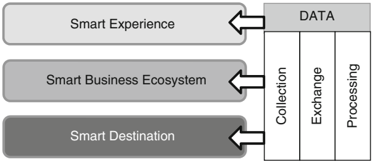
- The paper identifies three basic components of smart tourism: smart destinations, smart business ecosystems, and smart experiences; it also says smart tourism spans three layers: a smart information layer, smart exchange layer, and smart processing layer.
- The paper contrasts smart tourism with e-tourism: smart tourism bridges the digital and physical spheres, relies on sensors & smartphones rather than websites, focuses on the during-trip phase rather than pre- and post-travel, uses big data as its lifeblood, and is organized as an ecosystem rather than a value chain/intermediary structure.
- It notes that smart tourism research is still limited and mostly case-study based, with a strong consumer focus and an overly optimistic, uncritical stance; the paper itself proposes a research agenda and says existing smart tourism initiatives are mostly in development and often government-subsidized.
## Methods
- Conceptual/theoretical paper: it provides definitional clarification and an overview of the foundations of smart tourism rather than reporting an empirical dataset.
- It synthesizes prior literature on ICT, smart cities, service ecosystems, business models, and tourism technology to build its framework and definitions.
- It uses a conceptual comparison with e-tourism and organizes the discussion around technological foundations, business foundations, and research implications.
## Limitations
- The paper itself states that research in smart tourism is “very limited,” mostly case studies, and largely focused on the consumer perspective with an optimistic, uncritical stance.
- It explicitly says the proposed research agenda is “far from being comprehensive.”
- Evident from the text: the paper is conceptual and does not present original empirical data or tests, so its claims are theoretical rather than evidence from a study sample.
Model-written summary. Check it against the paper before relying on it.
Integrity signals
Registry
Cites
Statistics
Figures
Verification
Claims the paper makes
2 Valid · 17 Not valid · 47 Not checked · 59 Own results and interpretations
The cited sources support only part of this claim — read each source’s verdict below.
In the paper
“It has been identified as an important foundation for the services to be provided by smart tourism cities (Guo et al. 2014;Perera et al. 2014).”
§ Smart tourism: foundations and developments > Technological foundations of smart tourism
What the sources say
- Supportedcites Guo et al. 2014
The Introduction calls IoT technology the “core carrier” of the smart tourism information system. The Conclusion also identifies a tourism IoT information platform as critical to smart tourism development in China, supporting the claim that IoT is an important foundation for its services. (LLM, conf=0.93)
- Partly supportedcites Perera et al. 2014 matched to “Sensing as a service model for smart cities supported by Internet of Things” (2014) sourceExperimental — accuracy not yet measured
Section 3 (p. 2) describes an IoT-based sensing-as-a-service model as infrastructure for addressing smart-city challenges. The paper supports the general link between IoT and smart-city services, but the cited passages do not address tourism cities or their services specifically. (LLM, conf=0.85)
plainstates a cause- Asserted: passes — The authors put it forward as true.
- Checkable: passes — It can be checked against evidence.
- Load-bearing: unclear — It is unclear whether the paper’s conclusions depend on it.
- Based: passes — The paper gives a reason why it holds.
- Supported
A result the paper states — it cites no source for it, so there is none to check. The quote shows it is in the paper.
In the paper
“It also revealed a lack of critical literature that scrutinizes smart tourism assumptions and questioned its feasibility and positive experiential, economic and societal impacts.”
§ Smart tourism: foundations and developments > Conclusion
plain- Asserted: passes — The authors put it forward as true.
- Checkable: passes — It can be checked against evidence.
- Load-bearing: passes — The paper’s conclusions depend on it.
- Based: passes — The paper gives a reason why it holds.
In the paper
“Governments in China and South Korea are heavily funding initiatives mostly focused on building the technological infrastructure that supports smart tourism (Hwang et al. 2015).”
§ Smart tourism: foundations and developments > Abstract
What the sources say
- Not checked — no full text of the sourcecites Hwang et al. 2015 matched to “Constructivism in Smart Tourism Research : Seoul Destination Image” (2015) source
plain- Asserted: passes — The authors put it forward as true.
- Checkable: passes — It can be checked against evidence.
- Load-bearing: unclear — It is unclear whether the paper’s conclusions depend on it.
- Based: passes — The paper gives a reason why it holds.
A claim is checked only against the cited paper’s full text, never its abstract, and none is available for its sources.
In the paper
“Academic work is largely focused on describing the phenomenon in the form of case studies (e.g., Boes et al. 2015a, b;Bakıcı et al. 2013;Wang et al. 2013) or on discussing isolated technological developments (e.g., Huang and Chen 2015;Boes et al. 2015a, b) rather than on laying the theoretical foundations for its advancement and/or critique.”
§ Smart tourism: foundations and developments > Abstract
What the sources say
- Not checked — no full text of the sourcecites Boes et al. 2015a, b matched to “The Acceptance of NFC Smart Posters in Tourism” (2015) source
- Not checked — no full text of the sourcecites Bakıcı et al. 2013 matched to “A Smart City Initiative: the Case of Barcelona” (2013) source
- Not checked — no full text of the sourcecites Wang et al. 2013 matched to “China's “smart tourism destination” initiative: A taste of the service-dominant logic” (2013) source
plain- Asserted: passes — The authors put it forward as true.
- Checkable: passes — It can be checked against evidence.
- Load-bearing: passes — The paper’s conclusions depend on it.
- Based: passes — The paper gives a reason why it holds.
In the paper
“Remaining largely a vision at this stage, the Internet of Things has the potential to rapidly become a new reality as a technological infrastructure (Atzori et al. 2010).”
§ Smart tourism: foundations and developments > Technological foundations of smart tourism
What the sources say
- Not checked — no full text of the sourcecites Atzori et al. 2010 matched to “The Internet of Things: A survey” (2010) source
hedged- Asserted: passes — The authors put it forward as true.
- Checkable: passes — It can be checked against evidence.
- Load-bearing: unclear — It is unclear whether the paper’s conclusions depend on it.
- Based: passes — The paper gives a reason why it holds.
21 more claims
Create a free account to see all 125 claims and to verify the 3 references still open.
- It may state two separate claims as one. 46
- Probably not a substantial claim. 81
Citations
Cites
The Internet of Things: A survey
Atzori, L., Iera, A., & Morabito, G. (2010) · Computer Networks · doi:10.1016/j.comnet.2010.05.010 · Cited by 15,613
Business models, business strategy and innovation
Teece, D. J. (2010) · Long Range Planning · doi:10.1016/j.lrp.2009.07.003 · Cited by 8,335
Service-dominant logic: continuing the evolution
Vargo, S. L., & Lusch, R. F. (2008) · Journal of the Academy of Marketing Science · doi:10.1007/s11747-007-0069-6 · Cited by 7,824 · cited 1×
“In this vein, labels and roles assigned to players like travelers, firms and intermediaries are not valid anymore (Vargo and Lusch 2008).”
BackgroundBuhalis, D., & Law, R. (2008) · Tourism Management · doi:10.1016/j.tourman.2008.01.005 · Cited by 5,903 · cited 2×
“tion and of tourism consumers (Buhalis and Law 2008; Wang et al. 2012).”
BackgroundInternet of things: Vision, applications and research challenges
Miorandi, D., Sicari, S., De Pellegrini, F., & Chlamtac, I. (2012) · Ad Hoc Networks · doi:10.1016/j.adhoc.2012.02.016 · Cited by 3,578 · cited 1×
“Content and services will all be around us, persistently available, creating conditions for new applications and enabling new ways of working, interacting, entertainment, and living (Miorandi et al. 2012).”
BackgroundOn value and value co-creation: A service systems and service logic perspective
Vargo, S. L., Maglio, P. P., & Akaka, M. A. (2008) · European Management Journal · doi:10.1016/j.emj.2008.04.003 · Cited by 3,152 · cited 1×
“Vargo et al. (2008) and Spohrer et al. (2007) described a service ecosystem as a spontaneously sensing and responding spatial and temporal structure of largely loosely-coupled value-proposing social and economic actors interacting through institutions and technology, to: (1) co-produce service…”
BackgroundDahlander, L., & Gann, D. M. (2010) · Research Policy · doi:10.1016/j.respol.2010.01.013 · Cited by 2,435 · cited 1×
“Open innovation is based on the assumption that an organisation cannot just rely on its own resources, but has to engage with partners in order to innovate (Dahlander and Gann 2010; West and Gallagher 2006).”
BackgroundMacKenzie, D., & Millo, Y. (2003) · American Journal of Sociology · doi:10.1086/374404 · Cited by 1,464 · cited 1×
“By introducing new business models, firms develop new markets (Callon and Muniesa 2005; MacKenzie and Millo 2003; Pollock and Williams 2009; Inversini and Masiero 2014; Storbacka and Nenonen 2011).”
BackgroundPeripheral Vision: Economic Markets as Calculative Collective Devices
Callon, M., & Muniesa, F. (2005) · Organization Studies · doi:10.1177/0170840605056393 · Cited by 1,378 · cited 1×
“By introducing new business models, firms develop new markets (Callon and Muniesa 2005; MacKenzie and Millo 2003; Pollock and Williams 2009; Inversini and Masiero 2014; Storbacka and Nenonen 2011).”
Foundations for Smarter Cities
Harrison, C., Eckman, B., Hamilton, R., Hartswick, P., Kalagnanam, J., Paraszczak, J., & Williams, P. (2010) · IBM Journal of Research and Development · doi:10.1147/jrd.2010.2048257 · Cited by 1,347 · cited 1×
“Harrison et al. (2010) conceptualize smart as exploiting operational, near-real-time real-world data, integrating and sharing data, and using complex analytics, modelling, optimization and visualization to make better operational decisions.”
Background
Research works printed but not linked: 4
- 3. Anuar, F. I. & Gretzel, U. (2011). Privacy Concerns in the Context of Location Based Services for Tourism. ENTER 2011 Conference, Innsbruck, Austria, January 26-28, 2011. Accessed online (March 1, 2015) at http://ertr.tamu.edu/enter-2011-short-papers/.
- 16. Lopez de Avila, A. (2015). Smart Destinations: XXI Century Tourism. Presented at the ENTER2015 Conference on Information and Communication Technologies in Tourism, Lugano, Switzerland, February 4-6, 2015.
- 58. Tu, Q. & Liu, A. (2014). Framework of Smart Tourism Research and Related Progress in China. In International Conference on Management and Engineering (CME 2014), pp. 140-146.
- 77. In R. Egger, I. Gula, & D. Walcher (Eds.), Open Tourism - Open Innovation, Crowdsourcing and Collaborative Consumption challenging the tourism industry. Heidelberg: Springer Verlag.
Cited by
Items 2,101–2,200 of 2,494
Lu, P., & Khamcharoen, N. (2025) · New Horizon of Education · doi:10.63944/xy9.nhe
Le, H. N. (2026) · AI & Society · doi:10.1007/s00146-026-02874-5 · Cited by 4
Smart Solutions and Digital Spaces for Cultural Heritage
Fricano, S. (2025) · Business, management and economics · doi:10.5772/intechopen.1010935 · Cited by 1
Kumari, R., Dash, S. P., & Chatterjee, R. (2026) · Emerald Group Publishing Limited eBooks · doi:10.1108/978-1-83662-778-420261014
Robodestinations and the Managerial Transformation of Smart Tourism in the Era of Industry 5.0
Dinu, L., & Dinu, G. (2025) · Robotica & Management · doi:10.24193/rm.2025.2.11
Community Engagement in Tourism Architecture: Digital Platforms and Participatory Technologies
Bala, M. (2026) · SpringerBriefs in architectural design and technology · doi:10.1007/978-981-96-5794-0_14
Kurnaz, A. (2026) · SpringerBriefs in architectural design and technology · doi:10.1007/978-981-96-5794-0_3
Korstanje, M. E., & Maingi, S. W. (2026) · SpringerBriefs in architectural design and technology · doi:10.1007/978-981-96-5794-0_7
Semiotics and NLP Integration in Heritage Communication: A Case Study of Urban DestinationsPreprint
Çetin, Y., Islak, Y., Çınar, E. K., & HASSAN, A. (2026) · Research Square · doi:10.21203/rs.3.rs-8882435/v1
Kieu, N. T., & Lang, D. N. (2026) · Elsevier eBooks · doi:10.1016/b978-0-443-27698-9.00033-7
The techno-experiential turn in tourism marketing: A 30-year scientometric review (1990–2023)
Wang, S., Wan, S., & Amiri, M. (2026) · AIP Advances · doi:10.1063/5.0319229
Digital bricolage in sanctioned tourism ecosystems
Torabi, Z.-A., & Hall, C. M. (2026) · Annals of Tourism Research · doi:10.1016/j.annals.2026.104143 · Cited by 2
What Challenges and Opportunities Shape Tourism Development in China?
Mao, Q., & Huang, R. (2026) · Community and Social Development Journal · doi:10.57260/csdj.2026.286624 · Cited by 1
Sakyi, R., Pobee, F., & Jibril, A. B. (2026) · Emerald Group Publishing Limited eBooks · doi:10.1108/978-1-80686-169-920261002
Nutsugbodo, R. Y., Arthur-Amissah, A., & Ayentimi, D. T. (2026) · Emerald Group Publishing Limited eBooks · doi:10.1108/978-1-80686-169-920261006
Technológiai trendek és kihívások a sportrendezvények piacán
Grotte, J., Gondos, B., Laloumis, A., & Papagrigoriou, A. (2025) · Multidiszciplináris kihívások sokszínű válaszok · doi:10.33565/mksv.2025.02.01
Mensah, E. A., Yankholmes, A., Badu-Baiden, F., et al. (2026) · Emerald Group Publishing Limited eBooks · doi:10.1108/978-1-80686-169-920261011
Addressing the Dual Impacts of Smart City Technologies on Tourism Experiences
Bole, D. K. (2026) · Emerald Group Publishing Limited eBooks · doi:10.1108/978-1-83608-602-420261001
AI and Smart Technologies in Tourism
(2026) · Emerald Group Publishing Limited eBooks · doi:10.1108/978-1-83608-602-420261016
Huynh, A. D. T., Ho, L. T. H., & Vo, E. (2026) · Quality & Quantity · doi:10.1007/s11135-026-02660-x · Cited by 1
Symbiosis or rupture? Multi-PATH in symbiotic systems
Lei, X., Guo, W., & Liu, T. (2026) · Annals of Tourism Research · doi:10.1016/j.annals.2026.104149 · Cited by 1
Mari, M. A., & Ahmad, W. (2026) · Journal of Hospitality and Tourism Insights · doi:10.1108/jhti-09-2025-1113
RetractedCyclOps: Leveraging Semantic Technologies for AI and Data Life Cycle Management and Governance
Caballero, M., Queralt, A., Calvanese, D. C. D., et al. (2026) · Springer eBooks · doi:10.1007/978-3-032-10561-5_14
A survey on big data and machine learning in tourism and economic development
Theodorakopoulos, L., Kalliampakou, I., Theodoropoulou, A., Klavdianos, C., & Halkiopoulos, C. (2026) · Multidisciplinary Science Journal · doi:10.31893/multiscience.2026520
Phithak, T., Rattanakhiriphan, K., & Kamollimsakul, S. (2026) · Tourism and Hospitality · doi:10.3390/tourhosp7030077
Digital Storytelling and Tourist Behavior: A Narrative Review of Content, Trust, and Engagement
Gkikas, D. C., & Theodoridis, P. K. (2026) · Springer proceedings in business and economics · doi:10.1007/978-3-032-12968-0_86 · Cited by 1
The Cultural Heritage of the Archaeological Park of Dion, Pieria, Greece
Dimou, V., Tsagkalidou, E., Vasilliadis, C. A., et al. (2026) · Springer proceedings in business and economics · doi:10.1007/978-3-032-12968-0_7
Leveraging Telemedicine in Smart Destinations to Boost Rural Tourism and Digital Nomadism
Koumpouros, Y., & Kavoura, A. (2026) · Springer proceedings in business and economics · doi:10.1007/978-3-032-12968-0_107
Efstathiou, A., Vergopoulou, M., & Vergopoulou, C. (2026) · Springer proceedings in business and economics · doi:10.1007/978-3-032-12968-0_53
INTELIGÊNCIA TERRITORIAL EM CIDADE MÉDIA TURÍSTICA: LIMITES INSTITUCIONAIS AO DTI EM CALDAS NOVAS
Buzinhani, E. P. C., & Amaral, G. G. D. (2026) · Revista de Geopolítica · doi:10.56238/revgeov17n3-083
Lamichhane, P. K., Jun, Y., & Lamichhane, R. (2026) · International Journal of World Economic Research · doi:10.54097/d98kgs25
Research on the Multi-Faceted Utilization of Tourism Data Using Generative AI
Kanzaki, K., & Isahara, H. (2026) · International Conference on Knowledge and Smart Technology · doi:10.1109/kst67832.2026.11432316
Adım Adım Tarihin Kalbine: Mezopotamya Trail Koşusu Deneyimi
Yavaş, Ö. (2026) · Yalova Üniversitesi Spor Bilimleri Dergisi · doi:10.70007/yalovaspor.1812626
Khawas, A. (2026) · IGI Global eBooks · doi:10.4018/979-8-3373-4475-1.ch010
Nurhidayati, H., Nurchayati, Z., & Sugiarto (2026) · Research Square · doi:10.21203/rs.3.rs-8994226/v1
Puttinaovarat, S., Chai-Arayalert, S., & Saetang, W. (2026) · Sustainability · doi:10.3390/su18063145
Undertourism: From Crisis to Choice
Miftarević, S. B. (2026) · Elsevier eBooks · doi:10.1016/b978-0-443-27698-9.00061-1
Nayanajith, J., Thennakoon, T. M. S. P. K., Abeyrathna, A. W. G. N. M., et al. (2026) · Emerald Group Publishing Limited eBooks · doi:10.1108/978-1-80686-627-420261010
Bahri, K. S. K. A., & Kas, A. A. M. (2026) · Research Square · doi:10.21203/rs.3.rs-9190634/v1
Rifat, M. H. I., Acharjee, S. K., Bhowmik, R. C., Talukdar, M. M. U., & Mazumder, S. (2026) · Strategic Business Research · doi:10.1016/j.sbr.2026.100125
Integrating Public Health Marketing in the Digital Age
Sachan, S. (2026) · IGI Global eBooks · doi:10.4018/979-8-3373-5467-5.ch007
KAMACI, H. M., Karakoç, H. T., YİLMAZ, M. K., & Kahraman, Ö. (2026) · Güncel Turizm Araştırmaları Dergisi · doi:10.32572/guntad.1727497
Smart Tourism Destinations, Sustainability, and SDGs: A Systematic Literature Review
Dwivedi, I., J, S. P., & Ranjan, R. (2026) · Journal of Smart Tourism · doi:10.1177/27652157261438246 · Cited by 1
SOTO, C. M. D. (2026) · International Journal of Tourism Cities · doi:10.1080/20565607.2026.2642445
Digital live streaming and urban tourism demand: empirical evidence from Chinese cities
Hao, J., Ouyang, X., & Yao, X. (2026) · Applied Economics · doi:10.1080/00036846.2026.2648793 · Cited by 1
Strategic Integration of Technology-Driven Sport Events into Local Sustainable Tourism Development
Öztürk, E. N. (2026) · Journal of Global Tourism and Technology Research · doi:10.54493/jgttr.1894198
Mandira, T. K. N., & Godapitiya, M. V. N. (2026) · International Conference on Advanced Research in Computing (ICARC) · doi:10.1109/icarc68737.2026.11453805
Anand, S., Raj, A., & Sharma, K. (2026) · Lecture notes in networks and systems · doi:10.1007/978-3-032-14186-6_42
Bridging Sea and Sky: How Coastal Shipping Infrastructure Relates to Air Tourism in Insular Greece
Sitzimis, I. (2026) · Applied Spatial Analysis and Policy · doi:10.1007/s12061-026-09859-3
Perrain, D. (2018) · theses.fr (ABES) · doi:10.70675/a7585988zfb18z4ec4za04fz2b23b2de3cef · Cited by 1
Zhong, Z. (2019) · theses.fr (ABES) · doi:10.70675/c23bdb73z800ez452ezb92dz64d8606465b6 · Cited by 3
Feddane, W. (2021) · theses.fr (ABES) · doi:10.70675/9ef8204azada9z4070zaf98z2eff5e638b12 · Cited by 2
Ririmasse, O., Semuel, H., Wijaya, S., & Thio, S. (2026) · Discover Sustainability · doi:10.1007/s43621-026-03145-5 · Cited by 4
Gajdošík, T. (2026) · Elsevier eBooks · doi:10.1016/b978-0-443-27698-9.00064-7
Auffret, M. (2023) · theses.fr (ABES) · doi:10.70675/44c65190zd60cz491dzb41ez6a2d332d3a80
The contribution of event marketing to the structuring of a smart tourism value chain in morocco
Benlemlih, A., & Benjellou, A. (2025) · IEEE International Conference on Advanced Technologies in Supply Chain Management (ATSCM) · doi:10.1109/atscm67505.2025.11473645
Chaieb, S. (2025) · Journal of Rural Tourism · doi:10.70310/jrt.2026.030106107
The Economic Impact of the Accommodation Sector for Tourism Development in the Braj Region, India
Sharma, V., Srivastav, D. K., Jain, G., & Gupta, N. (2026) · Emerald Group Publishing Limited eBooks · doi:10.1108/978-1-80686-017-320261003
Liu, Q., Shen, Z., Rao, F., You, Y., Guo, H., & Ni, S. (2026) · Sustainability · doi:10.3390/su18083906 · Cited by 2
Datta, B., Badu, S. R., Sharma, S., et al. (2026) · IGI Global eBooks · doi:10.4018/979-8-3373-5418-7.ch009
Yetgin, D., Ay, E., & Yesirlili, U. (2026) · Anatolia Turizm Araştırmaları Dergisi · doi:10.17123/atad.1775713
AI-Enabled Recruitment in Qatar’s Events Sector: Implications for Smart Tourism Workforce Capability
Abdallah, A. (2026) · Journal of Smart Tourism · doi:10.1177/27652157261444321
Hao, F. J., Liu, K., & Li, M. (2026) · Academic Journal of History and Culture · doi:10.54097/v3zz3j08
Guerra, J., Fernández, S., Benavides, D., Caranqui-Sánchez, V., & Meneses, M. (2026) · Tourism and Hospitality · doi:10.3390/tourhosp7040113
Destination Marketing and Communication in Tourism
Passos, C., Abreu, J., Sousa, B. B., & Tarnanidis, T. K. (2026) · IGI Global eBooks · doi:10.4018/979-8-3373-3461-5.ch009
THE IMPACT OF RURAL TOURISM PERCEIVED VALUE ON TOURISTS’ BEHAVIOR INTENTION
Huang, Q., & Jiang, J. (2026) · The EUrASEANs journal on global socio-economic dynamics · doi:10.35678/2539-5645.11.2.2026.127
Santana-Padrón, A., Díaz-Farina, E., & Rodríguez, A. (2026) · Annals of Tourism Research Empirical Insights · doi:10.1016/j.annale.2026.100217
Tourism and Artificial Intelligence: A Bibliometric Analysis (2018–2025)
Ateş, Ö., Ergün, Z., BAYRAM, G. E., et al. (2026) · Lecture notes in networks and systems · doi:10.1007/978-3-032-15806-2_42
Salsabila, R. A., & Eddyono, F. (2026) · Ilomata International Journal of Social Science · doi:10.61194/ijss.v7i2.2102
Deeksha, D., Sachan, S., Arya, A., Kumar, A., Srivastava, V., & Singh, P. (2026) · ShodhKosh Journal of Visual and Performing Arts · doi:10.29121/shodhkosh.v7.i5s.2026.7173
Responsible Destination Management under Over-tourism Pressure: Evidence from PLS-SEM and NCA–fsQCAPreprint
Singh, V., Srivastava, S., Shukla, A., & Yadav, N. (2026) · Research Square · doi:10.21203/rs.3.rs-9506621/v1
Kosta, I. D., Njeguš, A., & Gajić, J. (2026) · The European Journal of Applied Economics · doi:10.5937/ejae23-62418
Sung, Y., Seo, W. S., & Viglia, G. (2026) · Tourism Review · doi:10.1108/tr-01-2026-0139
Sinaga, D. A., Zadeh, S. I., Fan, D. X. F., & Buhalis, D. (2026) · Journal of Destination Marketing & Management · doi:10.1016/j.jdmm.2026.101116 · Cited by 2
Creative Tourism and Art Tourism: Convergences and Divergences in Cultural Tourism Models
Benhaida, S., Lecaj, R., Medžiūnas, R., et al. (2026) · World sustainability series · doi:10.1007/978-3-032-15590-0_25
Sobhaeerooy, R., Lee, K. Y., Sheehan, L., Deng, Q., & Lee, M. (2026) · Industrial Management & Data Systems · doi:10.1108/imds-07-2025-0924
Decoding generational dynamics in the platform tourism ecosystem
David-Negre, T., Santana, A. A., Hernández, J. M., & Gil, S. M. (2026) · International Journal of Tourism Cities · doi:10.1080/20565607.2026.2666681 · Cited by 2
Image Aesthetics as a Tourism Lever: An Analysis of the Instagram Account “Visit Morocco”
Idbenssi, S., Benhaida, S., Safaa, L., et al. (2026) · World sustainability series · doi:10.1007/978-3-032-15590-0_22
Dumancela, E. L. V., Arias, M. A. S., & Báscones, G. G. U. (2026) · Revista Científica Multidisciplinar G-nerando · doi:10.66473/rcmg.v7i1.1090 · Cited by 1
Smart tourism destinations: A systematic literature review
Yuldosheva, L., Mansurova, N., Urunova, N., et al. (2025) · International Conference on Future Networks and Distributed Systems (ICFNDS) · doi:10.1145/3789692.3789778
Riquelme, N. E. C., Orden-Mejía, M. A., Carvache‐Franco, M., & Minchenkova, L. (2026) · Smart innovation, systems and technologies · doi:10.1007/978-3-032-16284-7_41
Mang, S. (2026) · Smart innovation, systems and technologies · doi:10.1007/978-3-032-16284-7_16
Identification of Factors Influencing Travellers’ Attitudes Towards Smart Tourism
Velčovská, Š., & Švajdová, L. (2026) · Lecture notes in networks and systems · doi:10.1007/978-3-032-07721-9_61
Shahzalal, M., Mahmud, S., Mollik, M. S., Sahabuddin, M., Mamadiyarov, Z., & Tabash, M. I. (2026) · Tourism and Hospitality · doi:10.3390/tourhosp7050130 · Cited by 2
Artificial Intelligence Adoption in Travel: The Motivation–Adoption–Outcome (MAO) Model
El‐Said, O. A., & Al-Naamani, K. (2026) · Journal of Travel Research · doi:10.1177/00472875261441571
Renanti, M. D., Nasir, M., Wicaksono, A., Aziezah, N., Fami, A., Barus, I. R., & Indriasari, S. (2026) · Multidisciplinary Science Journal · doi:10.31893/multiscience.2026595 · Cited by 1
Digital inclusion perception among retired tourists
Xu, H., Wang, D., Liu, Z., & Gu, J. (2026) · Tourism Recreation Research · doi:10.1080/02508281.2026.2652641
Souleiman, H. A., & SOULEIMAN, I. A. (2026) · Unveiling seven continents yearbook journal · doi:10.65326/u7y566767
IoT and Big Data Analytics to Monitor and Mitigate Environmental Impacts in Sustainable Tourism
Takuli, S., Rawal, Y. S., Sharma, S., et al. (2026) · Lecture notes in networks and systems · doi:10.1007/978-3-032-23577-0_20
Charoenboon, P., Lakkhongkha, K., & Benchakorn, B. (2026) · IEEE International Conference on Cybernetics and Innovations (ICCI) · doi:10.1109/icci68752.2026.11506479
Service Robotics for Automated Tourist Assistance in Smart Destinations
Al-shamaileh, M. O. F., Al-Orainat, L. M., Al-Ababneh, H. A., Elhaj, F. A., Ameen, A., Alzoubi, M., & Al-Amayreh, A. F. (2026) · IEEE International Conference on Advanced Systems and Emergent Technologies (IC_ASET) · doi:10.1109/ic_aset69920.2026.11502384
Vlahov, A., Hodak, D. F., & Mlinarić, D. (2026) · Tourism and Hospitality · doi:10.3390/tourhosp7050142
K, M. P., & Aithal, P. S. (2026) · ShodhKosh Journal of Visual and Performing Arts · doi:10.29121/shodhkosh.v7.i10s.2026.8099
Collaborative Innovation and Knowledge Transfer in the Tourism and Hospitality Industry
Kumari, M., Kumar, S., & Singh, T. (2026) · Springer eBooks · doi:10.1007/978-3-032-16120-8_7
Smart tourism services: Emerging trends and research agenda
Huynh, A. D. T., Do, Y. H., & Le-Cong-Ky, V. (2026) · Journal of Economics and Management · doi:10.22367/jem.2026.48.08 · Cited by 1
Barriers to smart tourism for the elderly: a qualitative exploration of challenges and needs
Nguyen, H. T. V. (2026) · Tourism Critiques Practice and Theory · doi:10.1108/trc-08-2025-0043 · Cited by 1
Construction and Application of a Digital Twin System for Rural Cultural Tourism Scenarios
Liu, F., Yu, C., Liu, Y., et al. (2025) · International Conference on Big Data Economy and Information Management (BDEIM) · doi:10.1145/3800000.3800019
Metadata
- Authors
- Gretzel, U., Sigala, M., Xiang, Z., & Koo, C.
- Affiliations
- Virginia Tech (US)
- Kyung Hee University (KR)
- Corresponding author
- Koo, Chulmo
- Venue
- Electronic Markets
- Published
- 2015-08-01
- Volume
- 25
- Issue
- 3
- Pages
- 179-188
- ISSN
- 1019-6781 (ISSN-L)
- 1422-8890
- OpenAlex
- W974480840
- Cited by
- 2,589
- References
- 81
- Citations by year
- 2026: 532 · 2025: 364 · 2024: 307 · 2023: 255 · 2022: 283 · 2021: 239 · 2020: 232 · 2019: 163 · 2018: 93 · 2017: 82 · 2016: 36 · 2015: 2
- FWCI
- 234.92
- Type
- journal article
- Language
- en
- Open access
- hybrid
- doi.org
- Licence
- cc-by
- creativecommons.org/licenses/by/4.0/ (tdm)
- creativecommons.org/licenses/by/4.0/ (vor)
- Locations
- Electronic Markets (publishedVersion, cc-by)
- UniSA Research Outputs Repository (University of South Australia) (acceptedVersion)
- Adelaide Research & Scholarship (AR&S) (University of Adelaide) (submittedVersion, cc-by)
- Funders
- National Research Foundation
- National Research Foundation of Korea (NRF-2013S1A3A2043345)
- Topics
- Social Sciences › Business, Management and Accounting › Tourism, Leisure and Hospitality Management › Diverse Aspects of Tourism Research
- Social Sciences › Business, Management and Accounting › Management of Technology and Innovation › Digital Innovation in Industries
- Social Sciences › Business, Management and Accounting › Marketing › AI in Service Interactions
- Keywords
- smart tourism, information and communication technologies, tourism destinations, tourism industry, big data, value proposition, conceptual definitions, tourism management, technological foundations, business foundations
About these checks
Registry, retraction, Cites and statistics results are computed, not judged, with one exception: a printed reference that no index lists is read once by a model before it counts as a citation error. Claims are extracted by a model and kept only when their quote appears verbatim in the text; each cited source is then checked, with a model’s help, for whether it says what the claim relies on. Those verdicts can be wrong — read the claim’s quote and the cited source before relying on one.
The claim verdicts this report counts are experimental: their accuracy is not yet measured.
A language model drew the claims from the paper on 2026-10-10, under version 3 of the claim definition (model deepseek-v4.1-flash, prompt extract-v3).
A second model labelled each claim on 2026-10-10 (model jev-1.13-20260917, definition revision gold-guideline-v0.2).
Cited sources are checked with a language model’s help (gpt-6-sol).
Statistics and arithmetic are recomputed, not judged.
Confidence bands are shown only for fields calibrated on our annotated test set. None is calibrated yet, so no band is shown.
What counts as a claim ›How we measure confidence ›How we check this ›
Are you an author, or do you see a problem with this page? Request a review
Data sources
Bibliographic data: Semantic Scholar, OpenAlex, Crossref.
Contains information from the Semantic Scholar Academic Graph Datasets, made available under the ODC Attribution License (ODC-BY 1.0).
Semantic Scholar’s data is described in: Kinney, R., et al. (2023). The Semantic Scholar Open Data Platform. arXiv:2301.10140.
