

Four Responsibility Gaps with Artificial Intelligence: Why they Matter and How to Address them
Open accessThe DOI matches its Crossref record; 86 of the 89 references it cites were found in a registry or an index, and 1 are not checked yet; 8 of the 53 sources its claims cite were checked for support.
Abstract
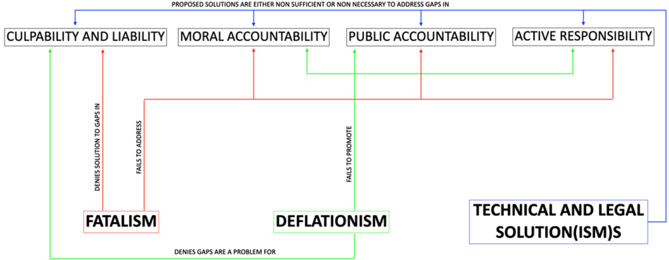
The notion of “responsibility gap” with artificial intelligence (AI) was originally introduced in the philosophical debate to indicate the concern that “learning automata” may make more difficult or impossible to attribute moral culpability to persons for untoward events. Building on literature in moral and legal philosophy, and ethics of technology, the paper proposes a broader and more comprehensive analysis of the responsibility gap. The responsibility gap, it is argued, is not one problem but a set of at least four interconnected problems – gaps in culpability, moral and public accountability, active responsibility—caused by different sources, some technical, other organisational, legal, ethical, and societal. Responsibility gaps may also happen with non-learning systems. The paper clarifies which aspect of AI may cause which gap in which form of responsibility, and why each of these gaps matter. It proposes a critical review of partial and non-satisfactory attempts to address the responsibility gap: those which present it as a new and intractable problem (“fatalism”), those which dismiss it as a false problem (“deflationism”), and those which reduce it to only one of its dimensions or sources and/or present it as a problem that can be solved by simply introducing new technical and/or legal tools (“solutionism”). The paper also outlines a more comprehensive approach to address the responsibility gaps with AI in their entirety, based on the idea of designing socio-technical systems for “meaningful human control", that is systems aligned with the relevant human reasons and capacities.
Verified 2026-11-25 · 1 reference not checked yet
Overview
CoChat Summary
TL;DR
The paper argues that the AI responsibility gap is not one problem but at least four interconnected gaps—culpability, moral accountability, public accountability, and active responsibility—arising from technical, organisational, legal, ethical, and societal sources. It critiques fatalist, deflationist, and solutionist responses and sketches a comprehensive approach based on designing sociotechnical systems for meaningful human control.
Key findings
- The responsibility gap should be reframed as at least four interconnected problems: gaps in culpability, moral accountability, public accountability, and active responsibility; these can occur with non-learning systems too and have multiple sources, some technical, organisational, legal, ethical, and societal.
- Current partial approaches distort the problem: “fatalism” treats it as new and intractable; “deflationism” dismisses it as not new and not a problem; “solutionism” treats it as solvable by simply introducing new technical and/or legal tools, with risks of “technical solutionism” and “legal solutionism.”
- The paper proposes meaningful human control (MHC) as a more comprehensive design-oriented approach, with two major conditions: “tracking” (the sociotechnical system responds to relevant human reasons and facts) and “tracing” (for each relevant action, at least one human agent along the design, development, and use chain has sufficient knowledge and moral awareness/capacity).
- It illustrates the gaps and proposed approach with examples including automated driving systems, AI-driven medical diagnosis, algorithmic public administration, and the Uber automated vehicle accident.
Methods
- Conceptual/normative analysis and critical literature review in moral and legal philosophy and ethics of technology; no empirical data collection or sample is reported.
- The analysis draws on philosophical, legal, and sociological theories of responsibility (e.g., Hart, Bovens, van de Poel, Gardner) to distinguish four forms of responsibility and map corresponding gaps and causes.
- It uses illustrative cases—automated driving, medical diagnosis, public administration, and the Uber accident—to show how gaps arise and how MHC tracking/tracing might address them.
Limitations
- Stated: the MHC proposal is a sketch; future research will develop it in more detail, and future philosophical, empirical, and technical work must clarify which responsibility gaps emerge in different systems and contexts and the extent to which MHC may effectively address them.
- Evident: the paper is conceptual and does not empirically test or operationalize MHC; its examples are illustrative rather than a systematic empirical sample.
- Evident: the critical review is described as a “representative sample” of the literature, not a systematic review.
Model-written summary. Check it against the paper before relying on it.
Integrity signals
Registry
Cites
Statistics
Figures
Verification
Claims the paper makes
6 Valid · 3 Not valid · 27 Not checked · 62 Own results and interpretations
The cited sources that could be checked couldn’t confirm or dispute this claim.
In the paper
“Moral accountability also has an instrumental value.”
What the sources say
- Not checked — no full text of the sourcecites Collingridge, 1980 matched to “The Social Control of Technology” (1982) source
- Could not verifycites Genus and Stirling (2018) matched to “Collingridge and the dilemma of control: Towards responsible and accountable innovation” (2018) sourceExperimental — accuracy not yet measured
The Introduction discusses ethical responsibility and accountability, but does not say that moral accountability has instrumental value. The Conclusion contrasts responsibility as a struggle against incumbent power with instrumental facilitation; it does not establish or explicitly deny the claimed value. Searches for “moral accountability” and “instrumental value accountability” found no passage addressing the claim. (LLM, conf=0.72)
- Could not verifycites Stilgoe et al., 2013 matched to “Developing a framework for responsible innovation” (2013) sourceExperimental — accuracy not yet measured
Our copy mentions 'moral accountability' only once (Introduction 1.2, 'A new scientific governance?'), describing the hope that unpredictability lets us escape it, and notes elsewhere that retrospective accountability tends to take precedence in a 'logic of unresponsiveness' (2.4, Responsiveness) and that retrospective accounts of responsibility are 'inherently limited' (1.1). No passage assigns moral accountability an instrumental value; searches for 'instrumental value of moral accountability', 'instrumental value', and 'accountability liability blame' returned only these passages plus unrelated uses of 'instrumental' (e.g. 'narrow instrumental expectations of innovators' in 1.1, 'no a priori instrumental conditioning' in 2.5). The paper therefore neither supports nor contradicts the attributed point. (LLM, conf=0.68)
plainstates a cause- Asserted: passes — The authors put it forward as true.
- Checkable: passes — It can be checked against evidence.
- Load-bearing: passes — The paper’s conclusions depend on it.
- Based: passes — The paper gives a reason why it holds.
Every source the paper cites for this claim was checked and supports it.
In the paper
“Most of these discussions point to the fact that algorithmic decision-making is often difficult to understand for - and explain to - human agents, due to the different, and sometimes inscrutable for persons, ways of AI operations: the so-called 'black box' problem (Castelvecchi, 2016).”
What the sources say
- Supportedcites Castelvecchi, 2016 matched to “Can we open the black box of AI?” (2016) source
The unlabelled opening passage describes neural networks as opaque and says their stored information is exceedingly difficult to decipher. The “ILLUSTRATION BY SIMON PRADES” passage explicitly calls this the black-box problem and says it can be difficult for humans to understand how such systems work or for the systems to explain themselves. The source discusses AI, particularly deep-learning neural networks, rather than every algorithmic decision system. (LLM, conf=0.93)
plainstates a cause- Asserted: passes — The authors put it forward as true.
- Checkable: passes — It can be checked against evidence.
- Load-bearing: passes — The paper’s conclusions depend on it.
- Based: passes — The paper gives a reason why it holds.
- Supported
The cited sources support only part of this claim — read each source’s verdict below.
In the paper
“Nor does this approach incentivise engineers to go beyond the current state of art in technology and look for innovative solutions which may improve the capabilities of current technology to better satisfy complex and potentially conflicting societal demands (Van den Hoven et al., 2012) such as, for instance, higher levels of safety combined with better predictability etc.”
What the sources say
- Partly supportedcites Van den Hoven et al., 2012 matched to “Engineering and the Problem of Moral Overload” (2012) sourceExperimental — accuracy not yet measured
The Introduction (page unavailable) says the standard response to conflicting engineering requirements is to weigh values and make trade-offs, while technical solutions are sometimes overlooked. “Moral Residues as Motors for Technological Innovation” argues that engineers should seek more advanced technology when current technology cannot meet their obligations. The paper does not specifically say that an old-style division of labour fails to incentivise engineers to do so. (LLM, conf=0.82)
plainstates a cause- Asserted: passes — The authors put it forward as true.
- Checkable: passes — It can be checked against evidence.
- Load-bearing: unclear — It is unclear whether the paper’s conclusions depend on it.
- Based: passes — The paper gives a reason why it holds.
- Partly supported
Every source the paper cites for this claim was checked and supports it.
In the paper
“By using Mecacci and Santoni de Sio's (2020) approach, we can more easily identify other actors whose higher-level plans and goals played or could have played a control role in the story, and may therefore have some form of responsibility in it.”
What the sources say
- Supportedcites Mecacci and Santoni de Sio's (2020) matched to “Meaningful human control as reason-responsiveness: the case of dual-mode vehicles” (2020) source
Split into 2 atoms — 2 confirmed, 0 partially supported, 0 disputed, 0 misattributed, 0 unverifiable. Expand the claim to see per-atom verdicts.
hedgedstates a cause- Asserted: passes — The authors put it forward as true.
- Checkable: passes — It can be checked against evidence.
- Load-bearing: passes — The paper’s conclusions depend on it.
- Based: passes — The paper gives a reason why it holds.
- Supported
A conclusion the paper draws from its own results — it cites no other source for it, so there is none to check. The quote shows it is in the paper.
In the paper
“The general concern is that AI may make individual persons less able to understand, explain, and reflect upon their own and other agents' behaviour. Let us call this the moral accountability gap .”
hedgedstates a possible cause- Asserted: passes — The authors put it forward as true.
- Checkable: passes — It can be checked against evidence.
- Load-bearing: passes — The paper’s conclusions depend on it.
- Based: passes — The paper gives a reason why it holds.
39 more claims
Create a free account to see all 98 claims and to verify the 7 references still open.
- Probably not a substantial claim. 37
- It may state two separate claims as one. 25
- The quote only partly states this claim. 1
Citations
Cites
Street-Level Bureaucracy: Dilemmas of the Individual in Public Services
Lipsky, M. (1981) · Michigan Law Review · doi:10.2307/1288305 · Cited by 8,981
The ethics of algorithms: Mapping the debate
Mittelstadt, B. D., Allo, P., Taddeo, M., Wachter, S., & Floridi, L. (2016) · Big Data & Society · doi:10.1177/2053951716679679 · Cited by 4,567 · cited 4×
“Risks of gaps have been identified in relation not only to the learning capacities of AI but first and foremost to the opacity, complexity, and unpredictability that these systems generally display (Mittelstadt et al., 2016).”
BackgroundInfluentialThe Black Box Society: The Secret Algorithms That Control Money and Information
Pasquale, F. (2015) · doi:10.4159/harvard.9780674736061 · Cited by 3,796
Automating Inequality: How High-Tech Tools Profile, Police, and Punish the Poor
Lebovits, H. (2019) · Public Integrity · doi:10.1080/10999922.2018.1511671 · Cited by 3,279 · cited 1×
“For example, in her book Automating Inequality , Virginia Eubanks (2018) tells the stories of private contractors not being able and/or willing of disclosing the reasons for the failures/mistakes in their digital systems used by some US states for welfare benefit allocation procedures.”
BackgroundStrawson, P. F. (1962) · PhilPapers (PhilPapers Foundation) · Cited by 3,223
Developing a framework for responsible innovation
Stilgoe, J., Owen, R., & Macnaghten, P. (2013) · Research Policy · doi:10.1016/j.respol.2013.05.008 · Cited by 3,184 · cited 2×
“The responsible innovation approach invites stakeholders to be responsive to one another and to the relevant values in the process of technological development (Stilgoe et al., 2013).”
BackgroundAnalysing and Assessing Accountability: A Conceptual Framework 1
Bovens, M. (2007) · European Law Journal · doi:10.1111/j.1468-0386.2007.00378.x · Cited by 2,667 · cited 2×
“Public accountability, 5 in Mark Bovens’ definition, is a “relationship between an actor and a forum, in which the actor has an obligation to explain and to justify his or her conduct, the forum can pose questions and pass judgement, and the actor may face conse-quences” (Bovens, 2007).”
BackgroundResponsibility and Control: A Theory of Moral Responsibility
Fischer, J. M., & Ravizza, M. (1998) · doi:10.1017/cbo9780511814594 · Cited by 2,249
Can we open the black box of AI?
Castelvecchi, D. (2016) · Nature · doi:10.1038/538020a · Cited by 1,773 · cited 2×
“The way knowledge is represented in the machine and the exact way the machine distinguishes between a positive and negative diagnosis are not only inaccessible to the doctor who uses the sys-tem but also, to an important extent, to those who designed it (Castelvecchi, 2016).”
BackgroundPereboom, D. (2001) · Cambridge University Press eBooks · doi:10.1017/cbo9780511498824 · Cited by 1,519
Research works printed but not linked: 2
- Van Eck, M. (2018). Geautomatiseerde ketenbesluiten & rechtsbescherming: Een onderzoek naar de praktijk van geautomatiseerde ketenbesluiten over een financieel belang in relatie tot rechtsbescherming . PhD Dissertation, Tilburg University. https:// resea rch. tilbu rguni versi ty. edu/ en/ publi catio ns/ autom ated- admin istra tive- chain- decis ions- amp- legal- prote ction- res.
- Zouridis, S., Bovens, M., & Van Eck, M. (2019). Digital discretion. In T. Evans & P. Hupe (Eds.), Discretion and the quest for controlled freedom . Palgrave/MacMillan.
Cited by
Items 201–300 of 470
Kumar, D., Suthar, N., Rodriguez, R. V., & Hemachandran, K. (2025) · Journal of Information Communication and Ethics in Society · doi:10.1108/jices-07-2025-0174 · Cited by 6
Stay Human or Go Machine? The Fate of Human Judgement in AI
Toscani, G. (2025) · Global Philosophy · doi:10.1007/s10516-025-09769-y · Cited by 4
“The integration of theoretical perspectives from AI literature (Chen et al. 2012; Ghahramani 2015), particularly regarding bias mitigation strategies (Santoni de Sio & Mecacci, 2021), allowed us to situate AI professionals’ experiences within both technical and human-centered dimensions.”
Trusting machines with morality — Delegating moral decisions to AI
Hüholt, N., & Szech, N. (2026) · European Economic Review · doi:10.1016/j.euroecorev.2025.105255 · Cited by 8
Artificial Intelligence-Powered Multimodal Approaches for Depression and Anxiety Detection: A Review
Liu, R., Guo, J., & Sophia, P. E. (2026) · Applied Artificial Intelligence · doi:10.1080/08839514.2026.2668204 · Cited by 4
Operational responsibility in AI governance: a user-centric liability framework
Chen, Z. (2026) · AI and Ethics · doi:10.1007/s43681-026-01163-7 · Cited by 8
“This framework also addresses the ‘responsibility gaps’ that emerge when AI development involves numerous actors with fragmented control (Santoni [80]).”
Xie, W., Liu, J., & Liu, S. (2026) · Journal of Medical Internet Research · doi:10.2196/91727 · Cited by 6
“PH-LLMs complicate this architecture by introducing an external source of personalized, clinically suggestive advice that generates diagnostic-style narratives and action-oriented recommendations without comparable mechanisms for auditability, oversight, or duty assignment [45,46].”
InfluentialFrom tool to collaborator: rethinking GIScience as GIS becomes agentic and autonomous
Kazazi, A. K., & Li, Z. (2026) · International Journal of Digital Earth · doi:10.1080/17538947.2026.2687228 · Cited by 7
“Responsibility, therefore, depends on traceability (Santoni de Sio and Mecacci 2021; Tabassi 2023).”
Mark Coeckelbergh, AI Ethics, Mit Press, 2021
de Sio, F. S. (2021) · Science and Engineering Ethics · doi:10.1007/s11948-021-00323-8 · Cited by 3
Self-citationGilbert, T. K., Qu, N. Z., Ju, W. G., & Li, J. J. (2023) · Transportation Research Part F Traffic Psychology and Behaviour · doi:10.1016/j.trf.2023.01.013 · Cited by 3
Nyholm, S. R. (2023) · Studies in applied philosophy, epistemology and rational ethics · doi:10.1007/978-3-031-39991-6_1 · Cited by 9
Generative AI-Augmented Decision-Making for Business Information Systems
Kromidha, E., & Davison, R. M. (2024) · IFIP advances in information and communication technology · doi:10.1007/978-3-031-67535-5_5 · Cited by 11
Matekaire, K., & Siriram, R. (2025) · Journal of Open Innovation Technology Market and Complexity · doi:10.1016/j.joitmc.2025.100566 · Cited by 13
Hitti, S., & Ramadan, A. (2025) · Competitiveness Review An International Business Journal incorporating Journal of Global Competitiveness · doi:10.1108/cr-03-2025-0104 · Cited by 7
Agree to disagree: the symmetry of burden of proof in human–AI collaboration
Jongsma, K. R., & Sand, M. (2022) · Journal of Medical Ethics · doi:10.1136/medethics-2022-108242 · Cited by 6
Ganesh, B. (2023) · Proceedings of the AAAI/ACM Conference on AI Ethics and Society · doi:10.1145/3600211.3604751 · Cited by 4
“3604751 society continues to bear the cost, but no one is ultimately held responsible [3, 14, 16, 19].”
BackgroundTwo remarks on the new AI control problem
Vacek, D. (2023) · AI and Ethics · doi:10.1007/s43681-023-00339-9 · Cited by 4
Statutory Professions in AI Governance and Their Consequences for Explainable AI
Fhaoláin, L. N., Hines, A., & Nallur, V. (2023) · Communications in computer and information science · doi:10.1007/978-3-031-44064-9_5 · Cited by 3
Quantifying Levels of Influence and Causal Responsibility in Dynamic Decision Making Events
Saad, Y., & Meyer, J. (2023) · ACM Transactions on Intelligent Systems and Technology · doi:10.1145/3631611 · Cited by 3
“…such as how aware the person was of the consequences and ramifications of the action, what was the person’s intent, who can/should carry the responsibility share attributed to the automation (the designer of the system, the manager who decided to deploy it, etc.) and so on [28, 44, 68, 71].”
BackgroundLegal Status of Artificial Intelligence from Quantum-Theoretic Perspective
Melnikova, E., & Суров, И. А. (2023) · BRICS Law Journal · doi:10.21684/2412-2343-2023-10-4-5-34 · Cited by 7
Hoover, B. A., Zaengle, D., Mark-Moser, M. K., Wingo, P. C., Suhag, A., & Rose, K. (2023) · Frontiers in Big Data · doi:10.3389/fdata.2023.1227189 · Cited by 4
Suryana, L. E., Nordhoff, S., Calvert, S. C., Zgonnikov, A., & van Arem, B. (2024) · IEEE Intelligent Vehicles Symposium · doi:10.1109/iv55156.2024.10588431 · Cited by 7
“In particular, delegating control to automated systems, either partially or fully, could create responsibility gaps —-situations where no human agent is responsible for the behavior of the system [3], [4].”
BackgroundBerber, A., & Mijić, J. (2024) · Theoria Beograd · doi:10.2298/theo2403177b · Cited by 5
Fabris, A., Dadà, S., & Grande, E. (2024) · Human perspectives in health sciences and technology · doi:10.1007/978-3-031-76961-0_2 · Cited by 6
The Rule of Law for Artificial Intelligence in Public Administration: A System Safety Perspective
Nouws, S., & Dobbe, R. (2024) · Information Technology and Law Series · doi:10.1007/978-94-6265-639-0_9 · Cited by 3
Why We Should Recognize AI as an Inventor
Bayındır, A. S., & Danaher, J. (2025) · Journal of Bioethical Inquiry · doi:10.1007/s11673-025-10429-4 · Cited by 3
“This is, indeed, the property of modern AI systems that has generated such a rich literature on responsibility gaps arising from their use (Matthias 2004; Santoni de Sio and Mecacci 2021).”
Carnat, I. (2024) · SSRN Electronic Journal · doi:10.2139/ssrn.4887438 · Cited by 3
AI Personhood, Criminal Law, and Punishment
Mamek, K. (2025) · Oxford University Press eBooks · doi:10.1093/9780198945215.003.0015 · Cited by 6
The Man Behind the Curtain: Appropriating Fairness in AI
Korecki, M., Köstner, G., Martinelli, E., & Carissimo, C. (2024) · Minds and Machines · doi:10.1007/s11023-024-09669-x · Cited by 4
After Harm: A Plea for Moral Repair after Algorithms Have Failed
Wong, P., & Rieder, G. (2025) · Science and Engineering Ethics · doi:10.1007/s11948-025-00555-y · Cited by 5
“In particular, advanced algorithmic systems are said to introduce a responsibility gap that makes it difficult to attribute responsibility, accountability, and/or culpability for their harmful consequences (see Matthias, 2004; Santoni de Sio & Mecacci, 2021).”
Strategies for Harmonizing Fragmented AI Ethics Frameworks, Standards, and Regulations
Schiff, D. S. (2025) · Springer eBooks · doi:10.1007/978-981-97-8440-0_82-1 · Cited by 14
Mirsch, M., Knoth, N., Schultz, B., Bata, K., Schleiß, J., & Leicht-Scholten, C. (2026) · European Journal of Engineering Education · doi:10.1080/03043797.2026.2620482 · Cited by 3
“As a consequence, unreprodu-cible errors raise questions of accountability (Santoni de Sio and Mecacci 2021), which are particularly pressing due to a certain degree of autonomy and scalability.”
Why “human‐ AI collaboration” obscures what actually happens in information seeking
Shah, C., & Tamine, L. (2026) · Journal of the Association for Information Science and Technology · doi:10.1002/asi.70059 · Cited by 2
The good, the bad and the ugly in artificial intelligence
Mery, D., Arriagada-Bruneau, G., & Dunstan, J. (2026) · AI and Ethics · doi:10.1007/s43681-026-01200-5 · Cited by 2
Positive psychology 4.0: a science of consequence for a world that can no longer wait
van Zyl, L. E. (2026) · Frontiers in Psychology · doi:10.3389/fpsyg.2026.1726065 · Cited by 3
“…both the right and the responsibility to approve or reject AI-generated recommendations based on professional judgment, therapeutic relationship quality, and contextual factors that may not be captured in the model’s training data (Byrnes and Robinson, 2025; Santoni de Sio and Mecacci, 2021).”
Flores, M. A. A. (2024) · Revista de derecho (Coquimbo) · doi:10.22199/issn.0718-9753-6632 · Cited by 3
Steen, M., Hogenelst, K., & Huijgen, H. (2024) · Journal of Military Ethics · doi:10.1080/15027570.2024.2444759 · Cited by 2
“…application of algorithms, notably in so-called decision support systems – notoriously, if (semi-autonomous) weapons are involved, and “ meaningful human control ” or “ human oversight ” are at stake (Santoni de Sio and Mecacci 2021; Steen et al. 2023; Verdiesen, Santoni de Sio, and Dignum 2021).”
Responsibly Engineering Control
Köhler, S., Mecacci, G., & Veluwenkamp, H. (2025) · American Philosophical Quarterly · doi:10.5406/21521123.62.2.02 · Cited by 4
Self-citationSánchez, L. J. L. (2025) · Teknokultura Revista de Cultura Digital y Movimientos Sociales · doi:10.5209/tekn.97189 · Cited by 9
Generative AI: Specific Legal Questions
Zou, M., Poncibò, C., Ebers, M., & Calo, R. (2025) · Cambridge University Press eBooks · doi:10.1017/9781009492553.018 · Cited by 1
Spatola, N. (2023) · Computers in Human Behavior Artificial Humans · doi:10.1016/j.chbah.2023.100023 · Cited by 4
Meaningful human control over AI systems: beyond talking the talk.Preprint
Siebert, L. C., Lupetti, M. L., Aizenberg, E., Beckers, N., Zgonnikov, A., Veluwenkamp, H., Abbink, D. A., Giaccardi, E., Houben, G., Jonker, C. M., et al. (2021) · arXiv (Cornell University) · Cited by 2
Stavropoulos, A. (2026) · Academia AI and Applications · doi:10.20935/acadai8435 · Cited by 2
Verständig, D., Kast, C., Stricker, J., & Nürnberger, A. (2022) · Verlag Barbara Budrich eBooks · doi:10.2307/j.ctv2xh53x1.3 · Cited by 4
Answerability, Accountability, and the Demands of Responsibility
Tollon, F. (2022) · Communications in computer and information science · doi:10.1007/978-3-031-22321-1_25 · Cited by 1
Public Insight and Policy Foresight: A Policy Review of AI Governance in India
Kadambi, P., Seshadri, R., Munjandira, C., & Appaji, A. (2024) · International Conference on Communication Systems & Networks (COMSNETS) · doi:10.1109/comsnets59351.2024.10427081 · Cited by 2
“The responsibility and accountability of AI systems, particularly in scenarios of error or bias, are critical areas of focus [10].”
BackgroundWhen to Fill Responsibility Gaps: A Proposal
Silva, M. D. (2024) · The Journal of Value Inquiry · doi:10.1007/s10790-024-10011-y · Cited by 1
Smuha, N. A. (2025) · Cambridge University Press eBooks · doi:10.1017/9781009367783.002 · Cited by 1
Benn, C. (2025) · Philosophy & Technology · doi:10.1007/s13347-025-00865-w · Cited by 3
Mansoor, S. I. U., Kausar, H., Khan, M. S. B., & Yadav, G. (2025) · Advances in computational intelligence and robotics book series · doi:10.4018/979-8-3693-9576-9.ch003 · Cited by 1
Why emotions and works of art are pertinent to the assessment of the ethical risks of AI
Danielsen, M., & Roeser, S. (2025) · Ethics and Information Technology · doi:10.1007/s10676-025-09849-y · Cited by 1
Sociotechnical Perspectives on Balancing Human Judgment and AI in Content Moderation
Hartono, B., Suasana, I. S., Muthohir, M., Suresh, R., & Prihatmoko, S. (2025) · International Conference on Creative Communication and Innovative Technology (ICCIT) · doi:10.1109/iccit65724.2025.11167561 · Cited by 3
“This emphasizes the need for robust feedback systems and clearer accountability mechanisms, as advocated in [26]–[28].”
Synthetic data as meaningful data. On Responsibility in data ecosystems
Capasso, M. (2025) · Big Data & Society · doi:10.1177/20539517251386053 · Cited by 7
“Responsibility has not only a negative backward-looking nature concerning blame or redress for something that has happened, but also a positive forward-looking nature that consists in promoting and achieving socially shared values (Nyholm, 2023; Santoni de Sio and Mecacci, 2021).”
Responsible Artificial Intelligence in Precision Psychiatry
Vesterinen, T. (2025) · Studies in applied philosophy, epistemology and rational ethics · doi:10.1007/978-3-031-99654-2_8 · Cited by 1
Beyond the Responsibility Gap: Distributed Non-anthropocentric Responsibility in the AI Era
Noh, H. (2025) · Topoi · doi:10.1007/s11245-025-10302-4 · Cited by 6
Public Perception of Accountability for AI Systems: The Influence of Age and Education
Ng, S. Y., Crockett, K. A., Latham, A., & Kaleem, M. (2025) · International Joint Conference on Neural Networks (IJCNN) · doi:10.1109/ijcnn64981.2025.11227931 · Cited by 2
“As highlighted by Santoni de Sio and Mecacci [8], AI systems have several responsibility gaps, including a lack of explainability in AI responses, unclear understanding of human control over AI, and differing perspectives on moral values and accountability.”
Cuestiones éticas sobre la implantación de la inteligencia artificial en la administración pública
Pérez, P. J. B. (2023) · Revista Canaria de Administración Pública · doi:10.36151/rcap.2023.8 · Cited by 8
Gong, D. (2025) · Ethics and Information Technology · doi:10.1007/s10676-025-09883-w · Cited by 2
“…in allocating various more concrete sub-types of responsibility, including “gaps in cul-pability, moral and public accountability, active responsibil-ity” (Santoni & Mecacci, 2021 , p. 1057), “retribution gaps” (Danaher, 2016 , p. 300) and “achievement gaps” (Dana - her & Nyholm, 2021 , p. 227).”
Agarwal, A., Agarwal, P., & Nene, M. J. (2026) · Computer law & security review · doi:10.1016/j.clsr.2026.106340 · Cited by 5
Behdadi, D., Vanfleteren, L. E. G. W., & Sundemo, D. S. (2025) · AI & Society · doi:10.1007/s00146-025-02806-9 · Cited by 2
“…of nonhuman autonomous systems into health care is widely considered to add to these challenges by, e.g., making it more difficult for human actors to control and predict certain outcomes and for making some outputs difficult, or even impossible, to explain (Santoni de Sio and Mecacci 2021).”
Against artificial achievements
Vacek, D. (2025) · Analysis · doi:10.1093/analys/anaf034 · Cited by 2
Engineering responsibility in the age of AI: amelioration or preservation?
Galvagni, E., & Tollon, F. (2026) · Inquiry · doi:10.1080/0020174x.2026.2615772 · Cited by 1
Meaningful Human Control Over AI Military Decision Support Systems: Exploring Key Challenges
Kozlovski, A. (2026) · Military and humanitarian health ethics · doi:10.1007/978-3-032-11331-3_8 · Cited by 2
Measuring AI responsibility: A cross-country validation of a multidimensional framework
Jaturat, N., Na-Nan, K., & Hu, B. (2026) · International Journal of Information Management Data Insights · doi:10.1016/j.jjimei.2026.100388 · Cited by 8
Public acceptance of various ways to use and treat AI: A predictive moral framework
Eriksson, K., Karlsson, S., Vartanova, I., & Strimling, P. (2026) · Computers in Human Behavior Artificial Humans · doi:10.1016/j.chbah.2026.100257 · Cited by 5
Institutionalizing trust in AI governance: from ethical principles to legal design
Lyu, X. (2026) · AI and Ethics · doi:10.1007/s43681-026-01009-2 · Cited by 2
“Current accountability debates in AI governance focus mainly on ex post liability, which often produces “responsibility gaps” in multi-actor contexts [78].”
Rethinking backward-looking moral responsibility as care robots move toward superintelligence
Kropf, M. (2026) · Discover Artificial Intelligence · doi:10.1007/s44163-026-01025-5 · Cited by 3
Conceptualising conceptual resilience. A comparative approach
Marchiori, S., & Maria, J. E. D. S. (2026) · Philosophy & Technology · doi:10.1007/s13347-026-01045-0 · Cited by 2
“For example, the advent of autonomous vehicles has led to (ongoing) sustained debates about the (in)adequacy of existing notions of responsibility (Goetze, 2022; Hindriks & Veluwenkamp, 2023; Matthias, 2004; Santoni de Sio & Mecacci, 2021).”
The value of vulnerability for trustworthy AI
Talamanca, G. F. (2026) · AI & Society · doi:10.1007/s00146-026-02892-3 · Cited by 1
“…moral culpability when a decision is carried out by, or with the support of, automated systems which not only cannot, as non-persons, be held responsible, but can also affect the proper attribution of responsibility to people interacting with them (Matthias 2004; Santoni de Sio and Mecacci 2021).”
Wegner, L., Mirsch, M., & Leicht-Scholten, C. (2026) · AI and Ethics · doi:10.1007/s43681-026-01036-z · Cited by 4
Rohlfing, K. J., Alpsancar, S., & Schulte, C. (2026) · Springer eBooks · doi:10.1007/978-981-96-5290-7_9 · Cited by 1
Wang, S., Zhang, Y., Xiao, Y., & Liang, Z. (2026) · Government Information Quarterly · doi:10.1016/j.giq.2026.102140 · Cited by 3
AI Agents for Health—Agency and Autonomy in AI-Driven Healthcare
Astobiza, A. M., Lozano, R. O., Alonso, M., & Salgado, J. E. L. (2026) · Law, governance and technology series · doi:10.1007/978-3-032-13063-1_10 · Cited by 1
Human-AI Interaction, Moral Responsibility and Epistemic Credit
Largo, J. (2026) · Philosophy & Technology · doi:10.1007/s13347-026-01104-6 · Cited by 1
“Yet, as the literature on responsibility gaps shows (Santoni de Sio & Mecacci, 2021), such attributions are multifactorial and can be context-relative, which makes it harder to know when they are appropriate, even when some stakeholders are clearly responsible for a concrete system’s malfunctioning.”
Große, A.-K. (2026) · Journal of Bioethical Inquiry · doi:10.1007/s11673-026-10566-4 · Cited by 1
Agential harms of chatbots: an ethical perspective
MirzaeiGhazi, S., & Osman, M. (2026) · AI and Ethics · doi:10.1007/s43681-026-01240-x · Cited by 2
“The harm here is phenomenological: it is the deeply alienating experience of being subjected to an impersonal authority that convincingly mimics human understanding to extract vulnerability, but lacks moral answerability [ 99 , 107].”
Berghea, F., Dinca, A. L., Ciuc, D. M., & Dincă, G. V. (2026) · Applied Sciences · doi:10.3390/app16168338 · Cited by 1
Chopra, V. (2026) · Philosophy & Technology · doi:10.1007/s13347-026-01165-7 · Cited by 1
Beyond Two Errors: Institutional Anthropomorphism and the Displacement of Responsibility
Sakr, J. (2026) · Philosophy & Technology · doi:10.1007/s13347-026-01173-7 · Cited by 1
“Meaningful human control likewise requires that relevant humans possess both the capacity and the institutional authority to respond to reasons (Santoni de Sio & Mecacci, 2021).”
Elements of AI Ethical Regulatory Framework and SDGs
Banerji, B., & Feroz, M. A. (2023) · Advances in environmental engineering and green technologies book series · doi:10.4018/979-8-3693-0892-9.ch007 · Cited by 2
Interactive and Explainable Robot Learning: A Comprehensive Review
Seraj, E., Lee, K. M., Zaidi, Z., Xiao, Q., Li, Z., Nascimento, A., van Waveren, S., Tambwekar, P., Paleja, R., Das, D., et al. (2024) · Foundations and Trends in Robotics · doi:10.1561/2300000081 · Cited by 7
Melnikova, E. (2024) · EURASIAN INTEGRATION economics law politics · doi:10.22394/2073-2929-2024-02-98-106 · Cited by 1
Meeting the AI achievement challenge: collective and vicarious achievements
Vacek, D. (2025) · Ethics and Information Technology · doi:10.1007/s10676-025-09836-3 · Cited by 4
“…responsibility gaps, as introduced by Matthias (2004) (see, for instance, Danaher (2016), Hakli and Mäkelä (2019), Gunkel (2020), Tigard (2021a), Santoni de Sio and Mecacci (2021), Glavan-icová and Pascucci (2022), Kiener (2022), Nyholm (2024)), focuses primarily on responsibility in the…”
Schlögl-Flierl, K., & Ziethmann, P. (2025) · Magdeburger Forschungen zu Bildungs-, Kultur- und Sozialwissenschaften · doi:10.1007/978-3-658-46631-2_3 · Cited by 2
Kruizinga, M. V., Zwart, H. A. E., & Frissen, V. (2025) · AI & Society · doi:10.1007/s00146-025-02482-9 · Cited by 3
“The ability to pin down these kinds of control through reasons and capacities is called the ‘tracking condition’ (Santoni de Sio and Mecacci 2021, p. 1077–78).”
InfluentialE-learning & Artificial Intelligence
(2023) · E-learning · doi:10.34916/el.2023.15 · Cited by 1
Determining Our Future: How Artificial Intelligence Creates a Deterministic WorldPreprint
Goldfus, Y., & Eder, N. (2023) · SSRN Electronic Journal · doi:10.2139/ssrn.4534217 · Cited by 1
Artificial Intelligence, Criminal Liability for
Giannini, A. (2023) · Springer eBooks · doi:10.1007/978-94-007-6730-0_1094-1 · Cited by 1
Pargman, T. C. (2025) · Springer eBooks · doi:10.1007/978-3-031-35469-4_84-1 · Cited by 2
Seo, J., Deldari, E., & Mentis, H. M. (2026) · ACM International Conference on Intelligent User Interfaces (IUI) · doi:10.1145/3742413.3789121 · Cited by 11
“Human-Computer Interaction (HCI) research has long recognized that developers’ sense of ownership [21, 32], responsibility [36], and perceptions of authorship [8, 11, 15] impact distribution of decision-making authority [25], clarity of responsibility boundaries [36], and the sense of personal…”
InfluentialUpadhyay, S., Pruss, D., DeVrio, A., Gajos, K. Z., & Karusala, N. (2026) · CHI Conference on Human Factors in Computing Systems · doi:10.1145/3772318.3791923 · Cited by 2
“On the other end of the equation, we found that algorithm deployers themselves may have limited understanding of their own tools, making it difficult to determine who is responsible when an algorithm does not function as intended [86].”
Unilateral Relationship Revision Power in Human-AI Companion InteractionPreprint
Lange, B. (2026) · SSRN Electronic Journal · doi:10.2139/ssrn.6463040 · Cited by 1
Accountability Chains: A Formal Specification for AI Agent DelegationPreprint
Arop, J. (2026) · doi:10.14293/pr2199.004019.v1 · Cited by 1
Everything but the Signature: A Proposal for AI-born JournalsPreprint
Floridi, L. (2026) · SSRN Electronic Journal · doi:10.2139/ssrn.6992158 · Cited by 2
Mizumoto, M., Ono, S., Okazaki, Y., & Kanetsuna, K. (2021) · doi:10.36227/techrxiv.16688941.v1
Ono, S., Okazaki, Y., Kanetsuna, K., & Mizumoto, M. (2023) · doi:10.36227/techrxiv.16688941
Mizumoto, M., Ono, S., Okazaki, Y., & Kanetsuna, K. (2022) · doi:10.36227/techrxiv.16688941.v2
Who Is in Control? Autonomy, Responsibility, Explainability
Fossa, F. (2022) · Studies in applied philosophy, epistemology and rational ethics · doi:10.1007/978-3-031-22982-4_5
ПРИНЦИПЫ ИДЕНТИФИКАЦИИ СТАТУСА ИСТИННОСТИ ОБЪЕКТОВ
Гаджиев, Ф. Г. Ф. (2023) · PAHTEI-Procedings of Azerbaijan High Technical Educational Institutions · doi:10.36962/pahtei30072023-268
Mizumoto, M., Ono, S., Okazaki, Y., & Kanetsuna, K. (2023) · doi:10.36227/techrxiv.16688941.v3
Franklin, M., Papakonstantinou, T., Chen, T., Fernandez‐Basso, C., & Lagnado, D. A. (2023) · Lecture notes in computer science · doi:10.1007/978-3-031-42935-4_18
Metadata
- Authors
- Santoni de Sio, F., & Mecacci, G.
- Affiliations
- Radboud University Nijmegen (NL)
- Venue
- Philosophy & Technology
- Published
- 2021-05-14
- Volume
- 34
- Issue
- 4
- Pages
- 1057-1084
- ISSN
- 2210-5433 (ISSN-L)
- 2210-5441
- OpenAlex
- W3160005967
- Cited by
- 490
- References
- 89
- Citations by year
- 2026: 165 · 2025: 117 · 2024: 88 · 2023: 72 · 2022: 35 · 2021: 13
- FWCI
- 64.99
- Type
- journal article
- Language
- en
- Open access
- hybrid
- doi.org
- Licence
- cc-by
- creativecommons.org/licenses/by/4.0 (tdm)
- creativecommons.org/licenses/by/4.0 (vor)
- Locations
- Philosophy & Technology (publishedVersion, cc-by)
- Radboud Repository (Radboud University) (submittedVersion)
- Research Repository (Delft University of Technology) (submittedVersion)
- Radboud Repository (Radboud University) (submittedVersion, other-oa)
- Data Archiving and Networked Services (DANS) (submittedVersion, other-oa)
- Funders
- Nederlandse Organisatie voor Wetenschappelijk Onderzoek (MVI.16.044)
- Topics
- Physical Sciences › Computer Science › Artificial Intelligence › Ethics and Social Impacts of AI
- Social Sciences › Law › Digitalization, Law, and Regulation
- Social Sciences › Law › Literary and Philosophical Studies
- Keywords
- responsibility gap, artificial intelligence, moral culpability, accountability, learning automata, fatalism, deflationism, solutionism, meaningful human control, socio-technical systems, ethics of technology, legal theory, ethics
About these checks
Registry, retraction, Cites and statistics results are computed, not judged, with one exception: a printed reference that no index lists is read once by a model before it counts as a citation error. Claims are extracted by a model and kept only when their quote appears verbatim in the text; each cited source is then checked, with a model’s help, for whether it says what the claim relies on. Those verdicts can be wrong — read the claim’s quote and the cited source before relying on one.
The claim verdicts this report counts are experimental: their accuracy is not yet measured.
A language model drew the claims from the paper on 2026-10-10, under version 3 of the claim definition (model deepseek-v4.1-flash, prompt extract-v3).
A second model labelled each claim on 2026-10-10 (model jev-1.13-20260917, definition revision gold-guideline-v0.2).
Cited sources are checked with a language model’s help (gpt-6-sol and qwen3.8-omni-flash).
Statistics and arithmetic are recomputed, not judged.
Confidence bands are shown only for fields calibrated on our annotated test set. None is calibrated yet, so no band is shown.
What counts as a claim ›How we measure confidence ›How we check this ›
Are you an author, or do you see a problem with this page? Request a review
Data sources
Bibliographic data: Semantic Scholar, OpenAlex, Crossref.
Contains information from the Semantic Scholar Academic Graph Datasets, made available under the ODC Attribution License (ODC-BY 1.0).
Semantic Scholar’s data is described in: Kinney, R., et al. (2023). The Semantic Scholar Open Data Platform. arXiv:2301.10140.
