

Four Responsibility Gaps with Artificial Intelligence: Why they Matter and How to Address them
Open accessThe DOI matches its Crossref record; 86 of the 89 references it cites were found in a registry or an index, and 1 are not checked yet; 8 of the 53 sources its claims cite were checked for support.
Abstract
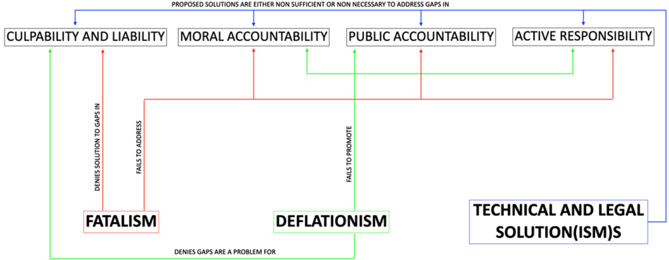
The notion of “responsibility gap” with artificial intelligence (AI) was originally introduced in the philosophical debate to indicate the concern that “learning automata” may make more difficult or impossible to attribute moral culpability to persons for untoward events. Building on literature in moral and legal philosophy, and ethics of technology, the paper proposes a broader and more comprehensive analysis of the responsibility gap. The responsibility gap, it is argued, is not one problem but a set of at least four interconnected problems – gaps in culpability, moral and public accountability, active responsibility—caused by different sources, some technical, other organisational, legal, ethical, and societal. Responsibility gaps may also happen with non-learning systems. The paper clarifies which aspect of AI may cause which gap in which form of responsibility, and why each of these gaps matter. It proposes a critical review of partial and non-satisfactory attempts to address the responsibility gap: those which present it as a new and intractable problem (“fatalism”), those which dismiss it as a false problem (“deflationism”), and those which reduce it to only one of its dimensions or sources and/or present it as a problem that can be solved by simply introducing new technical and/or legal tools (“solutionism”). The paper also outlines a more comprehensive approach to address the responsibility gaps with AI in their entirety, based on the idea of designing socio-technical systems for “meaningful human control", that is systems aligned with the relevant human reasons and capacities.
Verified 2026-11-25 · 1 reference not checked yet
Overview
CoChat Summary
TL;DR
The paper argues that the AI responsibility gap is not one problem but at least four interconnected gaps—culpability, moral accountability, public accountability, and active responsibility—arising from technical, organisational, legal, ethical, and societal sources. It critiques fatalist, deflationist, and solutionist responses and sketches a comprehensive approach based on designing sociotechnical systems for meaningful human control.
Key findings
- The responsibility gap should be reframed as at least four interconnected problems: gaps in culpability, moral accountability, public accountability, and active responsibility; these can occur with non-learning systems too and have multiple sources, some technical, organisational, legal, ethical, and societal.
- Current partial approaches distort the problem: “fatalism” treats it as new and intractable; “deflationism” dismisses it as not new and not a problem; “solutionism” treats it as solvable by simply introducing new technical and/or legal tools, with risks of “technical solutionism” and “legal solutionism.”
- The paper proposes meaningful human control (MHC) as a more comprehensive design-oriented approach, with two major conditions: “tracking” (the sociotechnical system responds to relevant human reasons and facts) and “tracing” (for each relevant action, at least one human agent along the design, development, and use chain has sufficient knowledge and moral awareness/capacity).
- It illustrates the gaps and proposed approach with examples including automated driving systems, AI-driven medical diagnosis, algorithmic public administration, and the Uber automated vehicle accident.
Methods
- Conceptual/normative analysis and critical literature review in moral and legal philosophy and ethics of technology; no empirical data collection or sample is reported.
- The analysis draws on philosophical, legal, and sociological theories of responsibility (e.g., Hart, Bovens, van de Poel, Gardner) to distinguish four forms of responsibility and map corresponding gaps and causes.
- It uses illustrative cases—automated driving, medical diagnosis, public administration, and the Uber accident—to show how gaps arise and how MHC tracking/tracing might address them.
Limitations
- Stated: the MHC proposal is a sketch; future research will develop it in more detail, and future philosophical, empirical, and technical work must clarify which responsibility gaps emerge in different systems and contexts and the extent to which MHC may effectively address them.
- Evident: the paper is conceptual and does not empirically test or operationalize MHC; its examples are illustrative rather than a systematic empirical sample.
- Evident: the critical review is described as a “representative sample” of the literature, not a systematic review.
Model-written summary. Check it against the paper before relying on it.
Integrity signals
Registry
Cites
Statistics
Figures
Verification
Claims the paper makes
6 Valid · 3 Not valid · 27 Not checked · 62 Own results and interpretations
The cited sources that could be checked couldn’t confirm or dispute this claim.
In the paper
“Moral accountability also has an instrumental value.”
What the sources say
- Not checked — no full text of the sourcecites Collingridge, 1980 matched to “The Social Control of Technology” (1982) source
- Could not verifycites Genus and Stirling (2018) matched to “Collingridge and the dilemma of control: Towards responsible and accountable innovation” (2018) sourceExperimental — accuracy not yet measured
The Introduction discusses ethical responsibility and accountability, but does not say that moral accountability has instrumental value. The Conclusion contrasts responsibility as a struggle against incumbent power with instrumental facilitation; it does not establish or explicitly deny the claimed value. Searches for “moral accountability” and “instrumental value accountability” found no passage addressing the claim. (LLM, conf=0.72)
- Could not verifycites Stilgoe et al., 2013 matched to “Developing a framework for responsible innovation” (2013) sourceExperimental — accuracy not yet measured
Our copy mentions 'moral accountability' only once (Introduction 1.2, 'A new scientific governance?'), describing the hope that unpredictability lets us escape it, and notes elsewhere that retrospective accountability tends to take precedence in a 'logic of unresponsiveness' (2.4, Responsiveness) and that retrospective accounts of responsibility are 'inherently limited' (1.1). No passage assigns moral accountability an instrumental value; searches for 'instrumental value of moral accountability', 'instrumental value', and 'accountability liability blame' returned only these passages plus unrelated uses of 'instrumental' (e.g. 'narrow instrumental expectations of innovators' in 1.1, 'no a priori instrumental conditioning' in 2.5). The paper therefore neither supports nor contradicts the attributed point. (LLM, conf=0.68)
plainstates a cause- Asserted: passes — The authors put it forward as true.
- Checkable: passes — It can be checked against evidence.
- Load-bearing: passes — The paper’s conclusions depend on it.
- Based: passes — The paper gives a reason why it holds.
Every source the paper cites for this claim was checked and supports it.
In the paper
“Most of these discussions point to the fact that algorithmic decision-making is often difficult to understand for - and explain to - human agents, due to the different, and sometimes inscrutable for persons, ways of AI operations: the so-called 'black box' problem (Castelvecchi, 2016).”
What the sources say
- Supportedcites Castelvecchi, 2016 matched to “Can we open the black box of AI?” (2016) source
The unlabelled opening passage describes neural networks as opaque and says their stored information is exceedingly difficult to decipher. The “ILLUSTRATION BY SIMON PRADES” passage explicitly calls this the black-box problem and says it can be difficult for humans to understand how such systems work or for the systems to explain themselves. The source discusses AI, particularly deep-learning neural networks, rather than every algorithmic decision system. (LLM, conf=0.93)
plainstates a cause- Asserted: passes — The authors put it forward as true.
- Checkable: passes — It can be checked against evidence.
- Load-bearing: passes — The paper’s conclusions depend on it.
- Based: passes — The paper gives a reason why it holds.
- Supported
The cited sources support only part of this claim — read each source’s verdict below.
In the paper
“Nor does this approach incentivise engineers to go beyond the current state of art in technology and look for innovative solutions which may improve the capabilities of current technology to better satisfy complex and potentially conflicting societal demands (Van den Hoven et al., 2012) such as, for instance, higher levels of safety combined with better predictability etc.”
What the sources say
- Partly supportedcites Van den Hoven et al., 2012 matched to “Engineering and the Problem of Moral Overload” (2012) sourceExperimental — accuracy not yet measured
The Introduction (page unavailable) says the standard response to conflicting engineering requirements is to weigh values and make trade-offs, while technical solutions are sometimes overlooked. “Moral Residues as Motors for Technological Innovation” argues that engineers should seek more advanced technology when current technology cannot meet their obligations. The paper does not specifically say that an old-style division of labour fails to incentivise engineers to do so. (LLM, conf=0.82)
plainstates a cause- Asserted: passes — The authors put it forward as true.
- Checkable: passes — It can be checked against evidence.
- Load-bearing: unclear — It is unclear whether the paper’s conclusions depend on it.
- Based: passes — The paper gives a reason why it holds.
- Partly supported
Every source the paper cites for this claim was checked and supports it.
In the paper
“By using Mecacci and Santoni de Sio's (2020) approach, we can more easily identify other actors whose higher-level plans and goals played or could have played a control role in the story, and may therefore have some form of responsibility in it.”
What the sources say
- Supportedcites Mecacci and Santoni de Sio's (2020) matched to “Meaningful human control as reason-responsiveness: the case of dual-mode vehicles” (2020) source
Split into 2 atoms — 2 confirmed, 0 partially supported, 0 disputed, 0 misattributed, 0 unverifiable. Expand the claim to see per-atom verdicts.
hedgedstates a cause- Asserted: passes — The authors put it forward as true.
- Checkable: passes — It can be checked against evidence.
- Load-bearing: passes — The paper’s conclusions depend on it.
- Based: passes — The paper gives a reason why it holds.
- Supported
A conclusion the paper draws from its own results — it cites no other source for it, so there is none to check. The quote shows it is in the paper.
In the paper
“The general concern is that AI may make individual persons less able to understand, explain, and reflect upon their own and other agents' behaviour. Let us call this the moral accountability gap .”
hedgedstates a possible cause- Asserted: passes — The authors put it forward as true.
- Checkable: passes — It can be checked against evidence.
- Load-bearing: passes — The paper’s conclusions depend on it.
- Based: passes — The paper gives a reason why it holds.
39 more claims
Create a free account to see all 98 claims and to verify the 7 references still open.
- Probably not a substantial claim. 37
- It may state two separate claims as one. 25
- The quote only partly states this claim. 1
Citations
Cites
Street-Level Bureaucracy: Dilemmas of the Individual in Public Services
Lipsky, M. (1981) · Michigan Law Review · doi:10.2307/1288305 · Cited by 8,981
The ethics of algorithms: Mapping the debate
Mittelstadt, B. D., Allo, P., Taddeo, M., Wachter, S., & Floridi, L. (2016) · Big Data & Society · doi:10.1177/2053951716679679 · Cited by 4,567 · cited 4×
“Risks of gaps have been identified in relation not only to the learning capacities of AI but first and foremost to the opacity, complexity, and unpredictability that these systems generally display (Mittelstadt et al., 2016).”
BackgroundInfluentialThe Black Box Society: The Secret Algorithms That Control Money and Information
Pasquale, F. (2015) · doi:10.4159/harvard.9780674736061 · Cited by 3,796
Automating Inequality: How High-Tech Tools Profile, Police, and Punish the Poor
Lebovits, H. (2019) · Public Integrity · doi:10.1080/10999922.2018.1511671 · Cited by 3,279 · cited 1×
“For example, in her book Automating Inequality , Virginia Eubanks (2018) tells the stories of private contractors not being able and/or willing of disclosing the reasons for the failures/mistakes in their digital systems used by some US states for welfare benefit allocation procedures.”
BackgroundStrawson, P. F. (1962) · PhilPapers (PhilPapers Foundation) · Cited by 3,223
Developing a framework for responsible innovation
Stilgoe, J., Owen, R., & Macnaghten, P. (2013) · Research Policy · doi:10.1016/j.respol.2013.05.008 · Cited by 3,184 · cited 2×
“The responsible innovation approach invites stakeholders to be responsive to one another and to the relevant values in the process of technological development (Stilgoe et al., 2013).”
BackgroundAnalysing and Assessing Accountability: A Conceptual Framework 1
Bovens, M. (2007) · European Law Journal · doi:10.1111/j.1468-0386.2007.00378.x · Cited by 2,667 · cited 2×
“Public accountability, 5 in Mark Bovens’ definition, is a “relationship between an actor and a forum, in which the actor has an obligation to explain and to justify his or her conduct, the forum can pose questions and pass judgement, and the actor may face conse-quences” (Bovens, 2007).”
BackgroundResponsibility and Control: A Theory of Moral Responsibility
Fischer, J. M., & Ravizza, M. (1998) · doi:10.1017/cbo9780511814594 · Cited by 2,249
Can we open the black box of AI?
Castelvecchi, D. (2016) · Nature · doi:10.1038/538020a · Cited by 1,773 · cited 2×
“The way knowledge is represented in the machine and the exact way the machine distinguishes between a positive and negative diagnosis are not only inaccessible to the doctor who uses the sys-tem but also, to an important extent, to those who designed it (Castelvecchi, 2016).”
BackgroundPereboom, D. (2001) · Cambridge University Press eBooks · doi:10.1017/cbo9780511498824 · Cited by 1,519
Research works printed but not linked: 2
- Van Eck, M. (2018). Geautomatiseerde ketenbesluiten & rechtsbescherming: Een onderzoek naar de praktijk van geautomatiseerde ketenbesluiten over een financieel belang in relatie tot rechtsbescherming . PhD Dissertation, Tilburg University. https:// resea rch. tilbu rguni versi ty. edu/ en/ publi catio ns/ autom ated- admin istra tive- chain- decis ions- amp- legal- prote ction- res.
- Zouridis, S., Bovens, M., & Van Eck, M. (2019). Digital discretion. In T. Evans & P. Hupe (Eds.), Discretion and the quest for controlled freedom . Palgrave/MacMillan.
Cited by
Ali, S., Abuhmed, T., El-Sappagh, S., Muhammad, K., Alonso-Moral, J. M., Confalonieri, R., Guidotti, R., Del Ser, J., Díaz-Rodríguez, N., & Herrera, F. (2023) · Information Fusion · doi:10.1016/j.inffus.2023.101805 · Cited by 1,762
Agentic AI: Autonomous intelligence for complex goals–a comprehensive survey
Acharya, D. B., Kuppan, K., & Divya, B. (2025) · IEEE Access · doi:10.1109/access.2025.3532853 · Cited by 717
“Some approaches suggest an AI responsibility chain , which separates the roles and responsibilities of each stakeholder during the development and deployment process to prevent over-reliance on one individual [97].”
Esmaeilzadeh, P. (2024) · Artificial Intelligence in Medicine · doi:10.1016/j.artmed.2024.102861 · Cited by 377
REVIEWING THE ETHICAL IMPLICATIONS OF AI IN DECISION MAKING PROCESSES
Osasona, F., Amoo, O. O., Atadoga, A., Abrahams, T. O., Farayola, O. A., & Ayinla, B. S. (2024) · International Journal of Management & Entrepreneurship Research · doi:10.51594/ijmer.v6i2.773 · Cited by 188
Bleher, H., & Braun, M. (2022) · AI and Ethics · doi:10.1007/s43681-022-00135-x · Cited by 164
“Various voices in current debates on responsibility in the context of AI systems have identified a “responsibility gap”—or a multiplicity of different gaps, as Santoni de Sio and Mecacci [24] propose—as a major problem with the systems’ use [25–30].”
BackgroundA Computer Science Perspective on Digital Transformation in Production
Brauner, P., Dalibor, M., Jarke, M., Kunze, I., Koren, I., Lakemeyer, G., Liebenberg, M., Michael, J., Pennekamp, J., Quix, C., et al. (2022) · ACM Transactions on Internet of Things · doi:10.1145/3502265 · Cited by 143
“On the one hand, more and smarter automation raises the question of responsibility and control [93, 133], and on the other hand, new forms of hybrid intelligence as the collaboration between human operators and the IoP must be designed that harness the potentials of both artificial and human intelligence [44, 89].”
BackgroundMeaningful human control: actionable properties for AI system development
Cavalcante Siebert, L., Lupetti, M. L., Aizenberg, E., Beckers, N., Zgonnikov, A., Veluwenkamp, H., Abbink, D., Giaccardi, E., Houben, G.-J., Jonker, C. M., et al. (2023) · AI and Ethics · doi:10.1007/s43681-022-00167-3 · Cited by 138
“Meaningful human control relates not only to the engineering of the AI agent, but also to the design of the socio-technical environment that surrounds it, including social and institutional practices [11, 27, 28].”
BackgroundArtificial intelligence and responsibility gaps: what is the problem?
Königs, P. (2022) · Ethics and Information Technology · doi:10.1007/s10676-022-09643-0 · Cited by 162
From Responsibility to Reason-Giving Explainable Artificial Intelligence
Baum, K., Mantel, S., Schmidt, E., & Speith, T. (2022) · Philosophy & Technology · doi:10.1007/s13347-022-00510-w · Cited by 103
Evidence, ethics and the promise of artificial intelligence in psychiatry
McCradden, M., Hui, K., & Buchman, D. Z. (2023) · Journal of Medical Ethics · doi:10.1136/jme-2022-108447 · Cited by 97
The loopholes of algorithmic public services: an “intelligent” accountability research agenda
Bracci, E. (2023) · Accounting, Auditing & Accountability Journal · doi:10.1108/aaaj-06-2022-5856 · Cited by 89
The Ethics of AI Ethics. A Constructive Critique
Heilinger, J. (2022) · Philosophy & Technology · doi:10.1007/s13347-022-00557-9 · Cited by 145
“• Who bears responsibility in the event of harm resulting from the use of an AI system (cf. e.g. Santoni de Sio & Mecacci, 2021; Sparrow, 2007)?”
BackgroundNarrative responsibility and artificial intelligence
Coeckelbergh, M. (2023) · AI & SOCIETY · doi:10.1007/s00146-021-01375-x · Cited by 81
“These are important questions, which are being discussed in the literature on ethics of robotics and AI (Hakli 2019; Johnson 2014; Santoro et al. 2008; Coeckel-bergh 2020; Yeung 2018; Santoni de Sio and Mecacci 2021).”
BackgroundGenerative AI for self-adaptive systems: State of the art and research roadmap
Li, J., Zhang, M., Li, N., Weyns, D., Jin, Z., & Tei, K. (2024) · ACM Transactions on Autonomous and Adaptive Systems · doi:10.1145/3686803 · Cited by 77
Ortega-Bolaños, R., Bernal-Salcedo, J., Germán Ortiz, M., Galeano Sarmiento, J., Ruz, G. A., & Tabares-Soto, R. (2024) · Artificial Intelligence Review · doi:10.1007/s10462-024-10740-3 · Cited by 76
“It is essential to avoid technical or methodological solutionism, the mis-taken belief that complex socio-technical and political problems can be solved or avoided entirely by applying new techniques (Hagendorff 2022a; Santoni de Sio and Mecacci 2021).”
Democratization of quantum technologies
Seskir, Z. C., Umbrello, S., Coenen, C., & Vermaas, P. E. (2023) · Quantum Science and Technology · doi:10.1088/2058-9565/acb6ae · Cited by 103
“This is grounded on an understanding of accountability where there is an active relationship between stakeholders and a forum where the conduct of those stakeholders is uncovered, debated, and justified in continuous public dialogue (Bovens et al., 2014; Santoni de Sio & Mecacci, 2021).”
BackgroundReasoning about responsibility in autonomous systems: challenges and opportunities
Yazdanpanah, V., Gerding, E., Stein, S., Dastani, M. M., Jonker, C. M., Norman, T. J., & Ramchurn, S. D. (2022) · AI & Society · doi:10.1007/s00146-022-01607-8 · Cited by 107
“To be specific, we focus on their applicability for (1) addressing the so-called responsibility voids (Santoni de Sio and Mecacci 2021), defined as situations in which a collective is known to be responsible, but determining individuals’ degree of responsibility is not straightforward, and (2)…”
Callari, T. C., Segate, R. V., Hubbard, E., Daly, A., & Lohse, N. (2024) · Technology in Society · doi:10.1016/j.techsoc.2024.102680 · Cited by 105
Floridi, L. (2025) · Philosophy & Technology · doi:10.1007/s13347-025-00858-9 · Cited by 154
“Some scholars warn that attributing agency to AI systems risks creating “responsibility gaps”, in which neither humans nor machines can be held appropriately accountable for harmful outcomes (Matthias, 2004; Santoni de Sio & Mecacci 2021).”
Zafar, F., Fakhare Alam, L., Vivas, R. R., Wang, J., Whei, S. J., Mehmood, S., Sadeghzadegan, A., Lakkimsetti, M., & Nazir, Z. (2024) · Cureus · doi:10.7759/cureus.56472 · Cited by 55
Authorship and ChatGPT: a Conservative View
van Woudenberg, R., Ranalli, C., & Bracker, D. (2024) · Philosophy & Technology · doi:10.1007/s13347-024-00715-1 · Cited by 92
The risks of autonomous machines: from responsibility gaps to control gaps
Hindriks, F., & Veluwenkamp, H. (2023) · Synthese · doi:10.1007/s11229-022-04001-5 · Cited by 60
“Because of this, enablers might not have known enough about what they were supposed to do (Santoni de Sio & Mecacci, 2021).”
BackgroundFrom the “rush to ethics” to the “race for governance” in Artificial Intelligence
Koniakou, V. (2022) · Information Systems Frontiers · doi:10.1007/s10796-022-10300-6 · Cited by 101
Ruschemeier, H. (2023) · ERA Forum · doi:10.1007/s12027-022-00725-6 · Cited by 59
The Conflict Between Explainable and Accountable Decision-Making Algorithms
Lima, G., Grgić-Hlača, N., Jeong, J. K., & Cha, M. (2022) · ACM Conference on Fairness, Accountability, and Transparency (FAccT) · doi:10.1145/3531146.3534628 · Cited by 99
“It is worth noting that one of the issues covered by the responsibility gap is blameworthiness [30].”
BackgroundResponsibility Gaps and Black Box Healthcare AI: Shared Responsibilization as a Solution
Lang, B. H., Nyholm, S. R., & Blumenthal‐Barby, J. (2023) · Digital Society · doi:10.1007/s44206-023-00073-z · Cited by 73
“For another classification of different types of responsibility gaps, see Santoni de Sio and Mecacci (2021).”
BackgroundTragic Choices and the Virtue of Techno-Responsibility Gaps
Danaher, J. (2022) · Philosophy & Technology · doi:10.1007/s13347-022-00519-1 · Cited by 77
“…share the common belief that the true extent of machine autonomy can be overstated and that the alleged gaps can, contrary to what Matthias suggested, be plugged by tracking and tracing the actions of machines back to humans (Santoni de Sio and Mecacci 2021; Santoni de Sio and Van den Hoven 2018).”
BackgroundMethodBlame It on the AI? On the Moral Responsibility of Artificial Moral Advisors
Constantinescu, M., Vică, C., Uszkai, R., & Voinea, C. (2022) · Philosophy & Technology · doi:10.1007/s13347-022-00529-z · Cited by 70
“…special attention on its own (Constantinescu et al., 2021) — with a particular focus, for instance, on the intricacies of linear and radial approaches to responsibility (Taddeo et al., 2021), and on various types of responsibility gaps surrounding AI deployment (Santoni de Sio & Mecacci, 2021).”
BackgroundDesigning Collaborative Intelligence Systems for Employee-AI Service Co-Production
Blaurock, M., Büttgen, M., & Schepers, J. (2025) · Journal of Service Research · doi:10.1177/10946705241238751 · Cited by 55
“This outcome is important as AI service co-production may raise responsibility issues (Santoni de Sio and Mecacci 2021).”
Li, Y., Wu, B., Huang, Y., Liu, J., Wu, J., & Luan, S. (2024) · International Journal of Human-Computer Interaction · doi:10.1080/10447318.2024.2356909 · Cited by 73
“How product providers should handle and protect such data had been a major issue of discussion (Santoni de Sio & Mecacci, 2021).”
Time Machines: Artificial Intelligence, Process, and Narrative
Coeckelbergh, M. (2021) · Philosophy & Technology · doi:10.1007/s13347-021-00479-y · Cited by 69
Artificial Intelligence and the Future of Work: Mapping the Ethical Issues
de Sio, F. S. (2024) · The Journal of Ethics · doi:10.1007/s10892-024-09493-6 · Cited by 67
“This may be called an accountability gap (Santoni de Sio and Mecacci 2021).”
Self-citationProcedural fairness in algorithmic decision-making: the role of public engagement
Decker, M. C., Wegner, L., & Leicht-Scholten, C. (2024) · Ethics and Information Technology · doi:10.1007/s10676-024-09811-4 · Cited by 80
Towards common ethical and safe ‘behaviour’ standards for automated vehicles
Papadimitriou, E., Farah, H., van de Kaa, G., de Sio, F. S., Hagenzieker, M., & van Gelder, P. H. A. J. M. (2022) · Accident Analysis & Prevention · doi:10.1016/j.aap.2022.106724 · Cited by 59
Self-citationde Sio, F. S. (2021) · Ethics and Information Technology · doi:10.1007/s10676-021-09609-8 · Cited by 52
Self-citationMachine learning and power relations
Maas, J. (2022) · AI & Society · doi:10.1007/s00146-022-01400-7 · Cited by 64
“…characteristic weak-ens the causal relation between the design process and the system’s behaviour, which creates so-called responsibility and accountability gaps where no individual can be reasonably held responsible for the system’s behaviour (Matthias 2004; Santoni de Sio and Mecacci 2021).”
BackgroundCurrent State and Prospects of Artificial Intelligence in Allergy
van Breugel, M., Fehrmann, R. S. N., Bügel, M., Rezwan, F. I., Holloway, J. W., Nawijn, M. C., Fontanella, S., Custovic, A., & Koppelman, G. H. (2023) · Allergy · doi:10.1111/all.15849 · Cited by 43
Hohma, E., Boch, A., Trauth, R., & Lütge, C. (2023) · Frontiers in Psychology · doi:10.3389/fpsyg.2023.1073686 · Cited by 67
Automated driving regulations – where are we now?
Sever, T., & Contissa, G. (2024) · Transportation Research Interdisciplinary Perspectives · doi:10.1016/j.trip.2024.101033 · Cited by 90
Ethics of using artificial intelligence (AI) in veterinary medicine
Coghlan, S., & Quinn, T. P. (2023) · AI & Society · doi:10.1007/s00146-023-01686-1 · Cited by 63
“The difficulty of assigning or determining liability is called the’responsibility gap’ (Santoni de Sio and Mecacci 2021).”
David, A. J., Yiğitcanlar, T., Desouza, K. C., Li, R. Y. M., Cheong, P. H., Mehmood, R., & Corchado, J. M. (2024) · Cities · doi:10.1016/j.cities.2024.105502 · Cited by 69
Designing Culturally Aware Learning Analytics: A Value Sensitive Perspective
Viberg, O., Jivet, I., & Scheffel, M. (2023) · Advances in analytics for learning and teaching · doi:10.1007/978-3-031-27646-0_10 · Cited by 54
What ethics can say on artificial intelligence: Insights from a systematic literature review
Giarmoleo, F. V., Ferrero, I., Rocchi, M., & Pellegrini, M. M. (2024) · Business and Society Review · doi:10.1111/basr.12336 · Cited by 68
Xu, C. G., Sun, Y., & Zhou, H. (2024) · Journal of Business Ethics · doi:10.1007/s10551-024-05837-2 · Cited by 52
“…holistic approach to understanding and addressing the challenges and opportunities presented by AI in artistic creativity, particularly considering the shared contributions and responsibilities of both artists and AI in the creative process (Santoni de Sio & Mecacci, 2021; Taddeo & Floridi, 2018).”
The Responsibility Gap and LAWS: a Critical Mapping of the Debate
Oimann, A. (2023) · Philosophy & Technology · doi:10.1007/s13347-022-00602-7 · Cited by 60
“Exceptions in this regard are: (Santoni de Sio & Mecacci, 2021; Tigard, 2020).”
BackgroundInfluentialResponsible nudging for social good: new healthcare skills for AI-driven digital personal assistants
Capasso, M., & Umbrello, S. (2021) · Medicine Health Care and Philosophy · doi:10.1007/s11019-021-10062-z · Cited by 50
Waelen, R., & Wieczorek, M. (2022) · Philosophy & Technology · doi:10.1007/s13347-022-00548-w · Cited by 38
Funer, F., Liedtke, W., Tinnemeyer, S., Klausen, A. D., Schneider, D., Zacharias, H. U., Langanke, M., & Salloch, S. (2024) · Journal of Medical Ethics · doi:10.1136/jme-2022-108814 · Cited by 36
When AI Fails, Who Do We Blame? Attributing Responsibility in Human–AI Interactions
Schoenherr, J. R., & Thomson, R. (2024) · IEEE Transactions on Technology and Society · doi:10.1109/tts.2024.3370095 · Cited by 53
“From legal and ethical standpoints, there is currently a debate as to how to assign responsibility when an AI fails [34], [35], [36], [37].”
BackgroundChernikova, O., Sommerhoff, D., Stadler, M. J., Holzberger, D., Nickl, M., Seidel, T., Kasneci, E., Küchemann, S., Kühn, J., Fischer, F., et al. (2024) · Educational Research Review · doi:10.1016/j.edurev.2024.100662 · Cited by 61
Ethics of artificial intelligence in prenatal and pediatric genomic medicine
Coghlan, S., Gyngell, C., & Vears, D. F. (2023) · Journal of Community Genetics · doi:10.1007/s12687-023-00678-4 · Cited by 46
“A responsibility gap (Santoni de Sio and Mecacci 2021) may emerge when there is a failure to clearly assign liability amongst practitioners, tech companies, hospitals, and health systems.”
BackgroundGladden, M. E., Fortuna, P., & Modliński, A. (2022) · Human Technology · doi:10.14254/1795-6889.2022.18-2.2 · Cited by 48
“As with the other issues discussed above, the question of which of these options for assigning responsibility makes a team most likely to successfully adapt is unclear and requires further investigation (see, e.g., Santoni de Sio and Mecacci 2021).”
BackgroundEthics in Artificial Intelligence: an Approach to Cybersecurity
López-González, A., Espino, M. M., Román, A. C. M., Hadfeg-Fernández, Y., & Pérez, N. C. (2024) · INTELIGENCIA ARTIFICIAL · doi:10.4114/intartif.vol27iss73pp38-54 · Cited by 59
“Some key aspects of this challenge are [64]: • Lack of regulation and legal framework: As AI continues to advance, many jurisdictions have yet to establish clear laws and regulations on liability for AI decisions.”
BackgroundOwning Decisions: AI Decision-Support and the Attributability-Gap
Zeiser, J. (2024) · Science and Engineering Ethics · doi:10.1007/s11948-024-00485-1 · Cited by 62
“6 In addition, some authors have recently also taken answerability into view, i.e. the demand for explanation and justification for an AI’s behaviour (Himmelreich, 2019; Kiener, 2022; Santoni de Sio & Mecacci, 2021; Tigard, 2021).”
BackgroundArtificial intelligence (AI) and ethical concerns: a review and research agenda
Ghosh, M. (2025) · Cogent Business & Management · doi:10.1080/23311975.2025.2551809 · Cited by 61
“…(ryan, 2020). aI development and deployment should adhere to principles that do not lead to contradictions when applied to various contexts and scenarios. therefore, the Kantian ethical concept ensures trust, justice, and respect for individuals in the digital age (santoni de sio & mecacci 2021).”
Responsibility Gaps, Value Alignment, and Meaningful Human Control over Artificial Intelligence
Nyholm, S. (2023) · Risk and Responsibility in Context · doi:10.4324/9781003276029-14 · Cited by 30
Realising Meaningful Human Control Over Automated Driving Systems: A Multidisciplinary Approach
de Sio, F. S., Mecacci, G., Calvert, S. C., Heikoop, D. D., Hagenzieker, M., & van Arem, B. (2022) · Minds and Machines · doi:10.1007/s11023-022-09608-8 · Cited by 47
“Santoni de Sio & Mecacci (2021) also clarify that responsibility gaps may be caused by different sources, some of which are old, i.e. the complexity and multi-agential nature of social and technical systems, some new, i.e. the data-driven learning features of present-day AI; some more technical,…”
Self-citationBlaming Humans and Machines: What Shapes People’s Reactions to Algorithmic Harm
Lima, G., Grgić-Hlača, N., & Cha, M. (2023) · Proceedings of the 2023 CHI Conference on Human Factors in Computing Systems · doi:10.1145/3544548.3580953 · Cited by 30
“Blameworthiness is one of the components of the responsibility gap [31], raising the question of whether any actor is a suitable subject of blame when machines cause harm.”
BackgroundKurki, V. (2023) · Cambridge University Press eBooks · doi:10.1017/9781009025614 · Cited by 52
Diffusing the Creator: Attributing Credit for Generative AI Outputs
Khosrowi, D., Finn, F., & Clark, E. (2023) · Proceedings of the AAAI/ACM Conference on AI Ethics and Society · doi:10.1145/3600211.3604716 · Cited by 40
Callari, T. C., & Puppione, L. (2025) · Journal of Workplace Learning · doi:10.1108/jwl-11-2024-0258 · Cited by 60
The value of responsibility gaps in algorithmic decision-making
Munch, L. A., Mainz, J. T., & Bjerring, J. C. (2023) · Ethics and Information Technology · doi:10.1007/s10676-023-09699-6 · Cited by 40
Responsibility Gap(s) Due to the Introduction of AI in Healthcare: An Ubuntu-Inspired Approach
Ferlito, B., Segers, S., Proost, M. D., & Mertes, H. (2024) · Science and Engineering Ethics · doi:10.1007/s11948-024-00501-4 · Cited by 40
“AI systems’ self-learning capabilities and opacity—‘the black box problem’-have been identified as a reason for concluding that stakeholders cannot foresee consequences, and hence cannot be held responsible (Matthias, 2004; Santoni de Sio & Mecacci, 2021).”
BackgroundCusters, B. H. M., Lahmann, H., & Scott, B. I. (2025) · AI & Society · doi:10.1007/s00146-024-02137-1 · Cited by 58
Reflection Machines: Supporting Effective Human Oversight Over Medical Decision Support Systems
Haselager, P., Schraffenberger, H., Thill, S., Fischer, S. W. S., Lanillos, P., van de Groes, S., & van Hooff, M. L. (2023) · Cambridge Quarterly of Healthcare Ethics · doi:10.1017/s0963180122000718 · Cited by 38
The Conflict Between People’s Urge to Punish AI and Legal Systems
Lima, G., Cha, M., Jeon, C., & Park, K. S. (2021) · Frontiers in Robotics and AI · doi:10.3389/frobt.2021.756242 · Cited by 50
Vicarious liability: a solution to a problem of AI responsibility?
Glavaničová, D., & Pascucci, M. (2022) · Ethics and Information Technology · doi:10.1007/s10676-022-09657-8 · Cited by 39
“In comparison, Santoni de Sio and Mecacci (2021) claim that there are four different responsibility gaps (a culpability gap, a moral accountability gap, a public accountability gap, and an active responsibility * Matteo Pascucci matteopascucci.”
BackgroundTechnology as Driver for Morally Motivated Conceptual Engineering
Veluwenkamp, H., Capasso, M., Maas, J., & Marin, L. (2022) · Philosophy & Technology · doi:10.1007/s13347-022-00565-9 · Cited by 28
“This means that responsibility gaps can be avoided (see also Santoni de Sio & Mecacci, 2021).”
BackgroundToward Sociotechnical AI: Mapping Vulnerabilities for Machine Learning in Context
Dobbe, R., & Wolters, A. (2024) · Minds and Machines · doi:10.1007/s11023-024-09668-y · Cited by 25
Are we justified attributing a mistake in diagnosis to an AI diagnostic system?
Babushkina, D. (2022) · AI and Ethics · doi:10.1007/s43681-022-00189-x · Cited by 31
“19 We could assume that in this possible world, people can modify their brain in a way that allow them to perform the same type of computations as algorithms, in exactly the same manner.”
BackgroundWilczek, B., Thäsler-Kordonouri, S., & Eder, M. (2024) · AI & Society · doi:10.1007/s00146-024-02138-0 · Cited by 53
“…scholars argue that due to the opaque operating logic of these AI systems and their increasing autonomy as collaborative agents in certain situations, it may become increasingly difficult to hold humans accountable for the (adverse) outcomes of AI-based processes (Santoni de Sio and Mecacci 2021).”
Popova, K., Figueras, C., Höök, K., & Lampinen, A. (2024) · Proceedings of the ACM on Human-Computer Interaction · doi:10.1145/3637434 · Cited by 31
“That said, we join claims to refrain from framing ethical matters as matters of individual decision-making and responsibility [8, 87].”
BackgroundIs explainable AI responsible AI?
Taylor, I. (2024) · AI & Society · doi:10.1007/s00146-024-01939-7 · Cited by 33
“Moreover, since we have seen that responsibility gaps can arise from a lack of knowledge on the part of human users (a point also made in Santoni de Sio and Mecacci 2021: 1064–1065; Sparrow 2007: 70; Taddeo & Blanchard 2022: 6–8), XAI may seem like a natural solution to them.”
Douglas, D. M., Lacey, J., & Howard, D. (2025) · AI and Ethics · doi:10.1007/s43681-024-00549-9 · Cited by 18
“● Using AI systems for decision-making may lead to ‘re-sponsibility gaps’, where there is uncertainty about responsibility for the decisions recommended (or actions taken) by AI systems [13, 14].”
What is conceptual disruption?
Marchiori, S., & Scharp, K. A. (2024) · Ethics and Information Technology · doi:10.1007/s10676-024-09749-7 · Cited by 24
“However, the disruption is not limited to one concept, but leads to more concepts linked to the first one also being disrupted (e.g., moral responsibility, as in Babushkina, 2020; Santoni de Sio & Mecacci, 2021; Sebastián, 2021), somewhat like a domino effect.”
BackgroundPsychological consequences of legal responsibility misattribution associated with automated vehicles
Liu, P., Du, M., & Li, T. (2021) · Ethics and Information Technology · doi:10.1007/s10676-021-09613-y · Cited by 20
Meaningful human control and variable autonomy in human-robot teams for firefighting
Verhagen, R., Neerincx, M. A., & Tielman, M. L. (2024) · Frontiers in Robotics and AI · doi:10.3389/frobt.2024.1323980 · Cited by 30
Kim, T., Usman, U., Garvey, A. M., & Duhachek, A. (2025) · Consumer Psychology Review · doi:10.1002/arcp.70008 · Cited by 43
Hemmet, A. (2023) · American Journal of Smart Technology and Solutions · doi:10.54536/ajsts.v2i2.2239 · Cited by 61
“The meaningful human control of AI algorithms is important to deal with the ethical, legal, organizational, technical and societal issues to enhance the moral values of AI systems (Santoni de Sio & Mecacci, 2021).”
BackgroundAI‐Based Emotion Detection System in Healthcare for Patient
Jain, A., & Jain, A. (2025) · Wiley eBooks · doi:10.1002/9781394280735.ch23 · Cited by 23
Rehill, P., & Biddle, N. (2024) · Data & Policy · doi:10.1017/dap.2024.35 · Cited by 26
Drivers of partially automated vehicles are blamed for crashes that they cannot reasonably avoid
Beckers, N., Siebert, L. C., Bruijnes, M., Jonker, C. M., & Abbink, D. A. (2022) · Scientific Reports · doi:10.1038/s41598-022-19876-0 · Cited by 37
Understanding data professionals in the police: a qualitative study of system-level bureaucrats
Donatz-Fest, I., Schäfer, M. T., van Dijck, J., & Meijer, A. J. (2023) · Public Management Review · doi:10.1080/14719037.2023.2222734 · Cited by 33
“…for a variety of jobs, including ‘data analysts’, ‘data scientists’, ‘data specialists’, ‘data architect’, ‘database administrator’ or ‘data modeller’ (Kennan 2017; Santoni de Sio and Mecacci 2021; Virkus and Garoufallou 2020; Gotterbarn and Kreps 2021; van ; Eck, Bovens, and Zouridis 2018).”
BackgroundLancaster, C., Schulenberg, K., Flathmann, C., McNeese, N. J., & Freeman, G. (2024) · ACM Journal on Responsible Computing · doi:10.1145/3632121 · Cited by 38
Autonomous weapon systems and responsibility gaps: a taxonomy
Wood, N. G. (2023) · Ethics and Information Technology · doi:10.1007/s10676-023-09690-1 · Cited by 30
Tao, L., Wan, J., & Wen, B. (2025) · Public Management Review · doi:10.1080/14719037.2024.2411632 · Cited by 18
Beyond Code and Algorithms: Navigating Ethical Complexities in Artificial Intelligence
Ľuptáková, I. D., Pospíchal, J., & Huraj, L. (2024) · Lecture notes in networks and systems · doi:10.1007/978-3-031-54813-0_30 · Cited by 30
Reflection machines: increasing meaningful human control over Decision Support Systems
Cornelissen, N. A. J., van Eerdt, R. J. M., Schraffenberger, H., & Haselager, P. (2022) · Ethics and Information Technology · doi:10.1007/s10676-022-09645-y · Cited by 20
Furizal, F., Ma’arif, A., Maghfiroh, H., Suwarno, I., Prayogi, D., Kariyamin, K., Lonang, S., & Sharkawy, A. (2025) · Social Sciences & Humanities Open · doi:10.1016/j.ssaho.2025.101882 · Cited by 61
Huang, G. I., Zhang, C., Torres, W. C. Z., Xiong, X., & Li, H. (2025) · Tourism Management · doi:10.1016/j.tourman.2025.105315 · Cited by 26
Responsible application of artificial intelligence in health care
Obasa, A. E., & Palk, A. C. (2023) · South African Journal of Science · doi:10.17159/sajs.2023/14889 · Cited by 26
XAI Requirements in Smart Production Processes: A Case Study
Baum, D., Baum, K. L., Gros, T. P., & Wolf, V. (2023) · Communications in computer and information science · doi:10.1007/978-3-031-44064-9_1 · Cited by 19
Norms for Academic Writing in the Era of Advanced Artificial Intelligence
Friederich, S., & Symons, J. (2023) · Digital Society · doi:10.1007/s44206-023-00079-7 · Cited by 25
“…publishing should preferably close any “responsibility gaps” when it comes to harm from AI use in academic publishing—especially in respect of culpability for harm and active responsibility to fulfil moral obligations in respect of AI system design (Matthias, 2004; Santoni de Sio & Mecacci, 2021).”
BackgroundAn interdisciplinary perspective on AI-supported decision making in medicine
Ammeling, J., Aubreville, M., Fritz, A., Kießig, A., Krügel, S., & Uhl, M. (2024) · Technology in Society · doi:10.1016/j.techsoc.2024.102791 · Cited by 23
Passlack, N., Hammerschmidt, T., & Posegga, O. (2024) · Behaviour and Information Technology · doi:10.1080/0144929x.2024.2431050 · Cited by 19
Digital Dybbuks and virtual Golems: the ethics of digital duplicates in Holocaust testimony
Kozlovski, A., & Makhortykh, M. (2025) · Memory Mind & Media · doi:10.1017/mem.2025.10006 · Cited by 37
“In this respect, the use of generative AI capabilities to enhance testimony not only risks harming different stakeholders, a topic we expand on below, but may also call into question whether this should still be considered a ‘testimony’ and whether it harms its educational value.”
Simmler, M. (2023) · Information Communication & Society · doi:10.1080/1369118x.2023.2239895 · Cited by 30
“The complexity of technology developments and unpredictability of (partially) autonomous machines challenge responsibility attribution (Santoni de Sio & Mecacci, 2021).”
BackgroundInfluentialBe careful what you explain: Benefits and costs of explainable AI in a simulated medical task
Rieger, T., Manzey, D., Meussling, B., Onnasch, L., & Roesler, E. (2023) · Computers in Human Behavior Artificial Humans · doi:10.1016/j.chbah.2023.100021 · Cited by 20
Engaging the many-hands problem of generative-AI outputs: a framework for attributing credit
Khosrowi, D., Finn, F., & Clark, E. (2024) · AI and Ethics · doi:10.1007/s43681-024-00440-7 · Cited by 42
Intentionality gap and preter-intentionality in generative artificial intelligence
Redaelli, R. (2024) · AI & Society · doi:10.1007/s00146-024-02007-w · Cited by 34
“One example of this need is the so-called responsibility gap (Matthias 2004), which calls for a redefinition of the notion of responsibility (see, e.g., Santoni de Sio & Mecacci 2021; Faroldi 2021; Gunkel 2020; Loh & Loh 2017; Hanson 2009).”
Metadata
- Authors
- Santoni de Sio, F., & Mecacci, G.
- Affiliations
- Radboud University Nijmegen (NL)
- Venue
- Philosophy & Technology
- Published
- 2021-05-14
- Volume
- 34
- Issue
- 4
- Pages
- 1057-1084
- ISSN
- 2210-5433 (ISSN-L)
- 2210-5441
- OpenAlex
- W3160005967
- Cited by
- 490
- References
- 89
- Citations by year
- 2026: 165 · 2025: 117 · 2024: 88 · 2023: 72 · 2022: 35 · 2021: 13
- FWCI
- 64.99
- Type
- journal article
- Language
- en
- Open access
- hybrid
- doi.org
- Licence
- cc-by
- creativecommons.org/licenses/by/4.0 (tdm)
- creativecommons.org/licenses/by/4.0 (vor)
- Locations
- Philosophy & Technology (publishedVersion, cc-by)
- Radboud Repository (Radboud University) (submittedVersion)
- Research Repository (Delft University of Technology) (submittedVersion)
- Radboud Repository (Radboud University) (submittedVersion, other-oa)
- Data Archiving and Networked Services (DANS) (submittedVersion, other-oa)
- Funders
- Nederlandse Organisatie voor Wetenschappelijk Onderzoek (MVI.16.044)
- Topics
- Physical Sciences › Computer Science › Artificial Intelligence › Ethics and Social Impacts of AI
- Social Sciences › Law › Digitalization, Law, and Regulation
- Social Sciences › Law › Literary and Philosophical Studies
- Keywords
- responsibility gap, artificial intelligence, moral culpability, accountability, learning automata, fatalism, deflationism, solutionism, meaningful human control, socio-technical systems, ethics of technology, legal theory, ethics
About these checks
Registry, retraction, Cites and statistics results are computed, not judged, with one exception: a printed reference that no index lists is read once by a model before it counts as a citation error. Claims are extracted by a model and kept only when their quote appears verbatim in the text; each cited source is then checked, with a model’s help, for whether it says what the claim relies on. Those verdicts can be wrong — read the claim’s quote and the cited source before relying on one.
The claim verdicts this report counts are experimental: their accuracy is not yet measured.
A language model drew the claims from the paper on 2026-10-10, under version 3 of the claim definition (model deepseek-v4.1-flash, prompt extract-v3).
A second model labelled each claim on 2026-10-10 (model jev-1.13-20260917, definition revision gold-guideline-v0.2).
Cited sources are checked with a language model’s help (gpt-6-sol and qwen3.8-omni-flash).
Statistics and arithmetic are recomputed, not judged.
Confidence bands are shown only for fields calibrated on our annotated test set. None is calibrated yet, so no band is shown.
What counts as a claim ›How we measure confidence ›How we check this ›
Are you an author, or do you see a problem with this page? Request a review
Data sources
Bibliographic data: Semantic Scholar, OpenAlex, Crossref.
Contains information from the Semantic Scholar Academic Graph Datasets, made available under the ODC Attribution License (ODC-BY 1.0).
Semantic Scholar’s data is described in: Kinney, R., et al. (2023). The Semantic Scholar Open Data Platform. arXiv:2301.10140.
