

Four Responsibility Gaps with Artificial Intelligence: Why they Matter and How to Address them
Open accessThe DOI matches its Crossref record; 86 of the 89 references it cites were found in a registry or an index, and 1 are not checked yet; 8 of the 53 sources its claims cite were checked for support.
Abstract
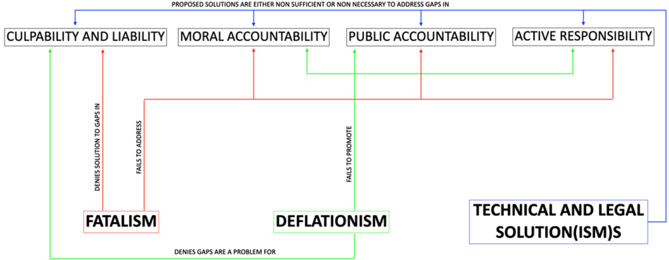
The notion of “responsibility gap” with artificial intelligence (AI) was originally introduced in the philosophical debate to indicate the concern that “learning automata” may make more difficult or impossible to attribute moral culpability to persons for untoward events. Building on literature in moral and legal philosophy, and ethics of technology, the paper proposes a broader and more comprehensive analysis of the responsibility gap. The responsibility gap, it is argued, is not one problem but a set of at least four interconnected problems – gaps in culpability, moral and public accountability, active responsibility—caused by different sources, some technical, other organisational, legal, ethical, and societal. Responsibility gaps may also happen with non-learning systems. The paper clarifies which aspect of AI may cause which gap in which form of responsibility, and why each of these gaps matter. It proposes a critical review of partial and non-satisfactory attempts to address the responsibility gap: those which present it as a new and intractable problem (“fatalism”), those which dismiss it as a false problem (“deflationism”), and those which reduce it to only one of its dimensions or sources and/or present it as a problem that can be solved by simply introducing new technical and/or legal tools (“solutionism”). The paper also outlines a more comprehensive approach to address the responsibility gaps with AI in their entirety, based on the idea of designing socio-technical systems for “meaningful human control", that is systems aligned with the relevant human reasons and capacities.
Verified 2026-11-25 · 1 reference not checked yet
Overview
CoChat Summary
TL;DR
The paper argues that the AI responsibility gap is not one problem but at least four interconnected gaps—culpability, moral accountability, public accountability, and active responsibility—arising from technical, organisational, legal, ethical, and societal sources. It critiques fatalist, deflationist, and solutionist responses and sketches a comprehensive approach based on designing sociotechnical systems for meaningful human control.
Key findings
- The responsibility gap should be reframed as at least four interconnected problems: gaps in culpability, moral accountability, public accountability, and active responsibility; these can occur with non-learning systems too and have multiple sources, some technical, organisational, legal, ethical, and societal.
- Current partial approaches distort the problem: “fatalism” treats it as new and intractable; “deflationism” dismisses it as not new and not a problem; “solutionism” treats it as solvable by simply introducing new technical and/or legal tools, with risks of “technical solutionism” and “legal solutionism.”
- The paper proposes meaningful human control (MHC) as a more comprehensive design-oriented approach, with two major conditions: “tracking” (the sociotechnical system responds to relevant human reasons and facts) and “tracing” (for each relevant action, at least one human agent along the design, development, and use chain has sufficient knowledge and moral awareness/capacity).
- It illustrates the gaps and proposed approach with examples including automated driving systems, AI-driven medical diagnosis, algorithmic public administration, and the Uber automated vehicle accident.
Methods
- Conceptual/normative analysis and critical literature review in moral and legal philosophy and ethics of technology; no empirical data collection or sample is reported.
- The analysis draws on philosophical, legal, and sociological theories of responsibility (e.g., Hart, Bovens, van de Poel, Gardner) to distinguish four forms of responsibility and map corresponding gaps and causes.
- It uses illustrative cases—automated driving, medical diagnosis, public administration, and the Uber accident—to show how gaps arise and how MHC tracking/tracing might address them.
Limitations
- Stated: the MHC proposal is a sketch; future research will develop it in more detail, and future philosophical, empirical, and technical work must clarify which responsibility gaps emerge in different systems and contexts and the extent to which MHC may effectively address them.
- Evident: the paper is conceptual and does not empirically test or operationalize MHC; its examples are illustrative rather than a systematic empirical sample.
- Evident: the critical review is described as a “representative sample” of the literature, not a systematic review.
Model-written summary. Check it against the paper before relying on it.
Integrity signals
Registry
Cites
Statistics
Figures
Verification
Claims the paper makes
6 Valid · 3 Not valid · 27 Not checked · 62 Own results and interpretations
The cited sources that could be checked couldn’t confirm or dispute this claim.
In the paper
“Moral accountability also has an instrumental value.”
What the sources say
- Not checked — no full text of the sourcecites Collingridge, 1980 matched to “The Social Control of Technology” (1982) source
- Could not verifycites Genus and Stirling (2018) matched to “Collingridge and the dilemma of control: Towards responsible and accountable innovation” (2018) sourceExperimental — accuracy not yet measured
The Introduction discusses ethical responsibility and accountability, but does not say that moral accountability has instrumental value. The Conclusion contrasts responsibility as a struggle against incumbent power with instrumental facilitation; it does not establish or explicitly deny the claimed value. Searches for “moral accountability” and “instrumental value accountability” found no passage addressing the claim. (LLM, conf=0.72)
- Could not verifycites Stilgoe et al., 2013 matched to “Developing a framework for responsible innovation” (2013) sourceExperimental — accuracy not yet measured
Our copy mentions 'moral accountability' only once (Introduction 1.2, 'A new scientific governance?'), describing the hope that unpredictability lets us escape it, and notes elsewhere that retrospective accountability tends to take precedence in a 'logic of unresponsiveness' (2.4, Responsiveness) and that retrospective accounts of responsibility are 'inherently limited' (1.1). No passage assigns moral accountability an instrumental value; searches for 'instrumental value of moral accountability', 'instrumental value', and 'accountability liability blame' returned only these passages plus unrelated uses of 'instrumental' (e.g. 'narrow instrumental expectations of innovators' in 1.1, 'no a priori instrumental conditioning' in 2.5). The paper therefore neither supports nor contradicts the attributed point. (LLM, conf=0.68)
plainstates a cause- Asserted: passes — The authors put it forward as true.
- Checkable: passes — It can be checked against evidence.
- Load-bearing: passes — The paper’s conclusions depend on it.
- Based: passes — The paper gives a reason why it holds.
Every source the paper cites for this claim was checked and supports it.
In the paper
“Most of these discussions point to the fact that algorithmic decision-making is often difficult to understand for - and explain to - human agents, due to the different, and sometimes inscrutable for persons, ways of AI operations: the so-called 'black box' problem (Castelvecchi, 2016).”
What the sources say
- Supportedcites Castelvecchi, 2016 matched to “Can we open the black box of AI?” (2016) source
The unlabelled opening passage describes neural networks as opaque and says their stored information is exceedingly difficult to decipher. The “ILLUSTRATION BY SIMON PRADES” passage explicitly calls this the black-box problem and says it can be difficult for humans to understand how such systems work or for the systems to explain themselves. The source discusses AI, particularly deep-learning neural networks, rather than every algorithmic decision system. (LLM, conf=0.93)
plainstates a cause- Asserted: passes — The authors put it forward as true.
- Checkable: passes — It can be checked against evidence.
- Load-bearing: passes — The paper’s conclusions depend on it.
- Based: passes — The paper gives a reason why it holds.
- Supported
The cited sources support only part of this claim — read each source’s verdict below.
In the paper
“Nor does this approach incentivise engineers to go beyond the current state of art in technology and look for innovative solutions which may improve the capabilities of current technology to better satisfy complex and potentially conflicting societal demands (Van den Hoven et al., 2012) such as, for instance, higher levels of safety combined with better predictability etc.”
What the sources say
- Partly supportedcites Van den Hoven et al., 2012 matched to “Engineering and the Problem of Moral Overload” (2012) sourceExperimental — accuracy not yet measured
The Introduction (page unavailable) says the standard response to conflicting engineering requirements is to weigh values and make trade-offs, while technical solutions are sometimes overlooked. “Moral Residues as Motors for Technological Innovation” argues that engineers should seek more advanced technology when current technology cannot meet their obligations. The paper does not specifically say that an old-style division of labour fails to incentivise engineers to do so. (LLM, conf=0.82)
plainstates a cause- Asserted: passes — The authors put it forward as true.
- Checkable: passes — It can be checked against evidence.
- Load-bearing: unclear — It is unclear whether the paper’s conclusions depend on it.
- Based: passes — The paper gives a reason why it holds.
- Partly supported
Every source the paper cites for this claim was checked and supports it.
In the paper
“By using Mecacci and Santoni de Sio's (2020) approach, we can more easily identify other actors whose higher-level plans and goals played or could have played a control role in the story, and may therefore have some form of responsibility in it.”
What the sources say
- Supportedcites Mecacci and Santoni de Sio's (2020) matched to “Meaningful human control as reason-responsiveness: the case of dual-mode vehicles” (2020) source
Split into 2 atoms — 2 confirmed, 0 partially supported, 0 disputed, 0 misattributed, 0 unverifiable. Expand the claim to see per-atom verdicts.
hedgedstates a cause- Asserted: passes — The authors put it forward as true.
- Checkable: passes — It can be checked against evidence.
- Load-bearing: passes — The paper’s conclusions depend on it.
- Based: passes — The paper gives a reason why it holds.
- Supported
A conclusion the paper draws from its own results — it cites no other source for it, so there is none to check. The quote shows it is in the paper.
In the paper
“The general concern is that AI may make individual persons less able to understand, explain, and reflect upon their own and other agents' behaviour. Let us call this the moral accountability gap .”
hedgedstates a possible cause- Asserted: passes — The authors put it forward as true.
- Checkable: passes — It can be checked against evidence.
- Load-bearing: passes — The paper’s conclusions depend on it.
- Based: passes — The paper gives a reason why it holds.
39 more claims
Create a free account to see all 98 claims and to verify the 7 references still open.
- Probably not a substantial claim. 37
- It may state two separate claims as one. 25
- The quote only partly states this claim. 1
Citations
Cites
Street-Level Bureaucracy: Dilemmas of the Individual in Public Services
Lipsky, M. (1981) · Michigan Law Review · doi:10.2307/1288305 · Cited by 8,981
The ethics of algorithms: Mapping the debate
Mittelstadt, B. D., Allo, P., Taddeo, M., Wachter, S., & Floridi, L. (2016) · Big Data & Society · doi:10.1177/2053951716679679 · Cited by 4,567 · cited 4×
“Risks of gaps have been identified in relation not only to the learning capacities of AI but first and foremost to the opacity, complexity, and unpredictability that these systems generally display (Mittelstadt et al., 2016).”
BackgroundInfluentialThe Black Box Society: The Secret Algorithms That Control Money and Information
Pasquale, F. (2015) · doi:10.4159/harvard.9780674736061 · Cited by 3,796
Automating Inequality: How High-Tech Tools Profile, Police, and Punish the Poor
Lebovits, H. (2019) · Public Integrity · doi:10.1080/10999922.2018.1511671 · Cited by 3,279 · cited 1×
“For example, in her book Automating Inequality , Virginia Eubanks (2018) tells the stories of private contractors not being able and/or willing of disclosing the reasons for the failures/mistakes in their digital systems used by some US states for welfare benefit allocation procedures.”
BackgroundStrawson, P. F. (1962) · PhilPapers (PhilPapers Foundation) · Cited by 3,223
Developing a framework for responsible innovation
Stilgoe, J., Owen, R., & Macnaghten, P. (2013) · Research Policy · doi:10.1016/j.respol.2013.05.008 · Cited by 3,184 · cited 2×
“The responsible innovation approach invites stakeholders to be responsive to one another and to the relevant values in the process of technological development (Stilgoe et al., 2013).”
BackgroundAnalysing and Assessing Accountability: A Conceptual Framework 1
Bovens, M. (2007) · European Law Journal · doi:10.1111/j.1468-0386.2007.00378.x · Cited by 2,667 · cited 2×
“Public accountability, 5 in Mark Bovens’ definition, is a “relationship between an actor and a forum, in which the actor has an obligation to explain and to justify his or her conduct, the forum can pose questions and pass judgement, and the actor may face conse-quences” (Bovens, 2007).”
BackgroundResponsibility and Control: A Theory of Moral Responsibility
Fischer, J. M., & Ravizza, M. (1998) · doi:10.1017/cbo9780511814594 · Cited by 2,249
Can we open the black box of AI?
Castelvecchi, D. (2016) · Nature · doi:10.1038/538020a · Cited by 1,773 · cited 2×
“The way knowledge is represented in the machine and the exact way the machine distinguishes between a positive and negative diagnosis are not only inaccessible to the doctor who uses the sys-tem but also, to an important extent, to those who designed it (Castelvecchi, 2016).”
BackgroundPereboom, D. (2001) · Cambridge University Press eBooks · doi:10.1017/cbo9780511498824 · Cited by 1,519
Research works printed but not linked: 2
- Van Eck, M. (2018). Geautomatiseerde ketenbesluiten & rechtsbescherming: Een onderzoek naar de praktijk van geautomatiseerde ketenbesluiten over een financieel belang in relatie tot rechtsbescherming . PhD Dissertation, Tilburg University. https:// resea rch. tilbu rguni versi ty. edu/ en/ publi catio ns/ autom ated- admin istra tive- chain- decis ions- amp- legal- prote ction- res.
- Zouridis, S., Bovens, M., & Van Eck, M. (2019). Digital discretion. In T. Evans & P. Hupe (Eds.), Discretion and the quest for controlled freedom . Palgrave/MacMillan.
Cited by
Items 301–400 of 470
Cybersecurity In The Age Of Artificial Intelligence – Who Should Be Culpable?
Chaturvedi, M. A., & Tiwari, R. (2023) · Journal Of Advanced Zoology · doi:10.17762/jaz.v44is-5.1290
Fonseca, A. K. D. S. (2022) · Revista da Faculdade de Direito Universidade de São Paulo · doi:10.11606/issn.2318-8235.v117p357-376 · Cited by 1
The Peculium of the Robot: Artificial Intelligence and Slave Law
Rizzuti, M. (2023) · Law, governance and technology series · doi:10.1007/978-3-031-41081-9_2 · Cited by 1
اثار قيام المسؤولية المدنية الناشئة على استخدام تقنية الذكاء الاصطناعي
الحيارى, ا. ف. م., & المحاسنة, ا. ي. ع. م. (2023) · Journal of Educational and Human Sciences · doi:10.33193/jeahs.29.2023.412
EXPLORING THE HORIZON OF SCIENCE: A BRIEF INTRODUCTION TO AI ETHICS
Stojadinović, M. (2023) · ГОДИШЊАК ЗА ПСИХОЛОГИЈУ · doi:10.46630/gpsi.20.2023.09
Epigenetics and Responsibility
Moormann, E., Smajdor, A., & Cutas, D. (2024) · Bristol University Press eBooks · doi:10.47674/9781529225440
AI and Epigenetic Responsibility
Hedlund, M. (2024) · Bristol University Press eBooks · doi:10.51952/9781529225440.ch006 · Cited by 1
AI and Epigenetic Responsibility
Hedlund, M. (2024) · Bristol University Press eBooks · doi:10.56687/9781529225440-008
Imputation System for Negligence Crime Involving AI
Zhao, S. (2024) · Artificial intelligence and the rule of law · doi:10.1007/978-981-97-0722-5_3
AI in Higher Education: Utopia or Reality?
da Silva, N. S. A., & Álvarez, I. (2023) · E-learning · doi:10.34916/el.2023.15.05 · Cited by 3
Cai, J., & Ngoi, M. (2024) · doi:10.5121/csit.2024.1405112
“Some of the limitations in our application are the accuracy of the Artificial Intelligence (AI) and the limited amount of body points [7].”
BackgroundWho is to Blame? Extended Physicians and the Responsibility Gap
Stier, M. (2024) · Techno:Phil · doi:10.1007/978-3-662-68362-0_9
王, 娟., 汤, 书., & 秦, 庆. (2023) · Global Journal of Media Studies · doi:10.26599/gjms.2023.9330057
Understanding Local Government Responsible Ai Strategy: Review of Municipal Policy DocumentsPreprint
David, A., Yiğitcanlar, T., Desouza, K. C., Li, Y. L., Cheong, P. H., Mehmood, R., & Corchado, J. M. (2024) · SSRN Electronic Journal · doi:10.2139/ssrn.4829216
A Comprehensive Review on Artificial Intelligence for Health Care
Sudha, S., Kumari, D. A., & Nirmal Raaghav, N. (2024) · International Conference on Smart Technologies and Systems for Next Generation Computing (ICSTSN) · doi:10.1109/icstsn61422.2024.10671023
“The implementation of AI provides ideas of various treatments available through machine learning algorithms enhanced in it [24] reveals the Black box concept in AI is used for trust ability and ethical concern purposes.”
BackgroundThe “Trolley Problem” in Fully Automated AI-Driven Media: A Challenge Beyond Autonomous Driving
Wang, J., & Ye, B. (2024) · Journal of Media Ethics · doi:10.1080/23736992.2024.2418053 · Cited by 1
“The first condition, known as the “tracking” condition, requires the system to be responsive to the moral reasons of humans involved in its design and deployment, as well as to relevant facts within its operational environment (Santoni de Sio & Mecacci, 2018, Santoni de Sio & Mecacci, 2021).”
InfluentialSuryana, L. E., Nordhoff, S., Calvert, S. C., et al. (2024) · SSRN Electronic Journal · doi:10.2139/ssrn.5020991
Legal Challenges for Human–Robot Interaction
Barfield, W., Weng, Y.-H., & Pagallo, U. (2024) · Cambridge University Press eBooks · doi:10.1017/9781009386708.039
Ensuring Accountability for Robots and AI under Criminal Law
Simmler, M. (2024) · Cambridge University Press eBooks · doi:10.1017/9781009386708.050 · Cited by 3
Du, H. (2024) · AIP conference proceedings · doi:10.1063/5.0223437
Schäffner, V. (2024) · Verlag Karl Alber eBooks · doi:10.5771/9783495992043
Artificial Intelligence as a Director of a Limited Liability Company from a Legal Perspective
Muthia, S. D., & Sendrawan, T. (2024) · Asian Journal of Engineering Social and Health · doi:10.46799/ajesh.v3i12.470
“The idea of giving AIs the same legal status as humans is considered to destroy the existing legal system and foundations of the state (Santoni de Sio & Mecacci, 2021).”
El rol de la agencia en la identidad híbrida de los pacientes neurotecnológicos
Fuentes, J. I., & Paz, A. W. (2024) · Revista de filosofía · doi:10.5354/0718-4360.2024.75106 · Cited by 2
Melnikova, E. (2025) · Moscow Journal of International Law · doi:10.24833/0869-0049-2024-4-132-145 · Cited by 5
Saad, Y., & Meyer, J. (2025) · IEEE Transactions on Human-Machine Systems · doi:10.1109/thms.2025.3553015 · Cited by 2
“Analyses of the causal responsibility can help to bridge the responsibility gap [37], [38] that may exist with intelligent automation.”
Towards Moral Sensitivity in AI PracticePreprint
Gavorník, A., & Podroužek, J. (2025) · SSRN Electronic Journal · doi:10.2139/ssrn.5195678
de Villiers, C., Dimes, R., Dissanayake, D. M. R., & Kuruppu, S. (2025) · SSRN Electronic Journal · doi:10.2139/ssrn.5244449 · Cited by 1
Tamburrini, G. (2025) · Springer eBooks · doi:10.1007/978-3-319-77267-7_8
Human Perceptions of AI-Caused Harm
Lima, G., & Cha, M. (2025) · Cambridge University Press eBooks · doi:10.1017/9781009170901.028
Tobia, K. (2025) · Cambridge University Press eBooks · doi:10.1017/9781009170901.025
Unpacking the Accountability Dilemma: Individual Criminality for Autonomous Weapon Systems
Wengo, S. H. (2025) · Balkan yearbook of European and international law · doi:10.1007/978-3-031-89952-2_4
Arena, C., & Mazzitelli, D. (2025) · Emerald Group Publishing Limited eBooks · doi:10.1108/978-1-83549-105-820251008 · Cited by 2
Königs, P. (2025) · Springer eBooks · doi:10.1007/978-3-662-70086-0_44-1
Challenges and Opportunities of Artificial Intelligence in the Media: A Theoretical Approach
Londoño-Proaño, C., & Buele, J. (2025) · Lecture notes in networks and systems · doi:10.1007/978-3-031-93106-2_32
Hossain, A., Shazed, A. N., Haque, M. M., Alif, A., & Alam, S. (2025) · Advances in computational intelligence and robotics book series · doi:10.4018/979-8-3373-6018-8.ch009 · Cited by 1
Generative AI and Criminal Guilt: When No One Meant to Harm
Panattoni, B. (2025) · Cambridge University Press eBooks · doi:10.1017/9781009492553.027 · Cited by 3
The 3D model of ethical AI practice
Ball, B., & Helliwell, A. C. (2025) · AI and Ethics · doi:10.1007/s43681-025-00812-7 · Cited by 1
“As noted by Santoni de Sio and Mecacci [40] ‘Culpability gaps are concerning insofar as the more persons designing, regulating, and operating the system can legitimately (and possibly systematically) avoid blame for their wrong behaviour, the less these agents will be incentivised to prevent these…”
Bracanović, T. (2025) · AI & Society · doi:10.1007/s00146-025-02588-0 · Cited by 1
“The conceptual link between the principles of discrimination 14 The responsibility gap debate has become increasingly nuanced (for useful overviews cf. Santoni de Sio and Mecacci 2021; Oimann 2023).”
Autonomous Systems are Mere Tools: Legal Fiction or Reality?
Zhai, X. (2025) · Lecture notes in computer science · doi:10.1007/978-3-032-05179-0_7
Autonomous weapons: considering the rights and interests of soldiers
Haiden, M., & Richter, F. (2025) · Ethics and Information Technology · doi:10.1007/s10676-025-09859-w
“Furthermore, while there is widespread discussion in AI ethics about responsibility gaps (Santoni de Sio & Mecacci, 2021), and particularly regarding AWSs (Sparrow, 2007, 2016), there are certain proposals to mitigate this gap in other technological areas, such as in the case of self-driving cars.”
Morandín-Ahuerma, F. (2025) · International Journal of Human-Computer Interaction · doi:10.1080/10447318.2025.2565393 · Cited by 1
“There is no sound philosophical justification for excluding this possibility in artificial systems whose design incorporates exploration, learning, and adaptation if classical compatibilism allows us to speak of freedom in causally conditioned human agents (Santoni de Sio & Mecacci, 2021).”
InfluentialSchmitz, A., & Braun, H. (2025) · Journal of Physics Conference Series · doi:10.1088/1742-6596/3123/1/012044 · Cited by 1
Kuilman, S. K., Nyholm, S. R., Buijsman, S., & Siebert, L. C. (2025) · Philosophy & Technology · doi:10.1007/s13347-025-00976-4 · Cited by 2
“For example, these systems may be taking over tasks involving important moral and legal responsibilities (Milano & Nyholm, 2024; Santoni de Sio & Mecacci, 2021 ).”
Zimmermann, F., Coimbra, M. E., & Durst, S. (2025) · Palgrave studies in financial services technology · doi:10.1007/978-3-032-03523-3_2 · Cited by 1
Królikiewicz, O. (2025) · Problemy Prawa Karnego · doi:10.31261/ppk.2025.09.02.04
Bridging Responsibility Gaps for Warfighting AI
Davidovic, J. (2025) · Oxford University Press eBooks · doi:10.1093/9780198945215.003.0110
Strategic Delegation of Moral Decisions to AIPreprint
Tontrup, S. W., & Sprigman, C. J. (2025) · SSRN Electronic Journal · doi:10.2139/ssrn.5696827 · Cited by 2
Hruška, A., & Roubík, H. (2025) · ADCAIJ ADVANCES IN DISTRIBUTED COMPUTING AND ARTIFICIAL INTELLIGENCE JOURNAL · doi:10.14201/adcaij.32644 · Cited by 1
“The autonomous decision-making capabilities of GenAI can sometimes lead to a sense of powerlessness, particularly when these systems make critical decisions or create responsibility gaps, as noted by Santoni de Sio & Mecacci (2021).”
Human: The Final Decision-Maker in the Technological Era
Fung, K. C., Cheung, K. Y., & Lai, C. Y. (2025) · Signals and communication technology · doi:10.1007/978-3-031-96855-6_9
Discontent with Governance by Technological Management
Brownsword, R., & DiMatteo, L. A. (2025) · Cambridge University Press eBooks · doi:10.1017/9781009522519.007
Technology’s Ability to Escape the Legal System
Gavaghan, C., & Charlesworth, A. (2025) · Cambridge University Press eBooks · doi:10.1017/9781009522519.008 · Cited by 1
ALMAN HUKUKUNDA OTONOM ARAÇ KAZALARINDAN DOĞAN CEZA SORUMLULUĞU
Demiral, M. U. (2025) · Dokuz Eylül Üniversitesi Hukuk Fakültesi Dergisi · doi:10.33717/deuhfd.1755639
Sakr, J. (2025) · Laws · doi:10.3390/laws14060091
“A significant challenge within this framework is the “responsibility gap,” defined as “the risk that no human agent might be legitimately blamed or held culpable for the unwanted outcomes of actions mediated by AI systems” (Santoni de Sio and Mecacci 2021).”
Transformation of the Concept of Responsibility in Human-Artifacts Networks
Naoe, K. (2025) · Journal of the Japan Association for Philosophy of Science · doi:10.4288/kisoron.53.1-2_27
Ethics Review of AI research: An approach to reviewing and revising existing governance structures
Kerasidou, A., Melham, K., Giubilini, A., Kerasidou, C., Lucivero, F., Morrison, M. C., Georgieva, A., Fletcher, A. J., Harford, M., Johnson, C. L., et al. (2025) · Research Ethics · doi:10.1177/17470161251406299 · Cited by 2
“However, the prospect of ‘responsibility gaps’ in the use of AI (Santoni de Sio and Mecacci, 2021), and particularly in the case of autonomous AI, has the potential for making this technology ethi-cally disruptive and, therefore, exceptional.”
Mao, Z., Keung, J., Sun, Y., et al. (2025) · SSRN Electronic Journal · doi:10.2139/ssrn.5933269
When Actions Train AI: Emerging Responsibilities for Decision-MakersPreprint
Innocenti, M., & Redaelli, R. (2025) · SSRN Electronic Journal · doi:10.2139/ssrn.5769563
Young, T. (2026) · SSRN Electronic Journal · doi:10.2139/ssrn.6015794 · Cited by 1
Accelerating Software-Intensive Innovation via Living Labs: Evidence from the AIAMO Project
Peine, K., Ortgiese, M., Sohr, A., Schiffers, L., & Hornig, T. (2026) · Lecture notes in business information processing · doi:10.1007/978-3-032-14518-5_26
Humanitarian Healthcare, Digital Infrastructure, and AI: An Ethics Talk Diagnostic
Sandvik, K. B. (2026) · Military and humanitarian health ethics · doi:10.1007/978-3-032-11331-3_11
Autonomous Systems With State Self-Assessment and Functional Awareness Simulation
Majewski, M., Kacalak, W., Budniak, Z., & Czarnowski, I. (2026) · IEEE Access · doi:10.1109/access.2026.3656845 · Cited by 1
“Santoni de Sio and Mecacci [34] analyze responsibility from a philosophical perspective without implementation proposals, which poses numerous challenging issues.”
Personal Autonomy and Autonomous Systems: Sameness and Difference
Battaglia, F. (2026) · Integrated science · doi:10.1007/978-3-032-14537-6_6
Decision Ownership and Deference to Healthcare AI
Slome, E. (2026) · Journal of Bioethical Inquiry · doi:10.1007/s11673-025-10518-4 · Cited by 2
“…on artificial intelligence (AI) and algorithmic decision-making, many have argued that we should be wary of making high-stakes decisions via deference to such technology (Bjerring and Busch 2021; Fleisher 2022; Molnar 2020; Lang, Nyholm, and Blumenthal-Barby 2023; Santoni de Sio and Mecacci 2021).”
Lee, P., Ahmad, T., Waheed, S. M., & Kenning, A. (2026) · AI and Ethics · doi:10.1007/s43681-025-00967-3 · Cited by 1
“Trustworthiness is therefore dependent on the combined effects of accountability, closing responsibility gaps around design, deployment, failure-response [73, 81 ], training and operational use.”
李, 嘉. (2026) · Advances in Psychology · doi:10.12677/ap.2026.162064
Dominek, D. L. (2025) · Central and Eastern European eDem and eGov Days · doi:10.1145/3773002.3773018
“Without a well-defined liability regime, the opacity of algorithmic systems may result in a responsibility gap, in which no actor can be held fully accountable for harmful outcomes [29] [30].”
Accuracy is not all you need! The Reasons to Require AI Explainability
Buijsman, S. (2026) · Minds and Machines · doi:10.1007/s11023-026-09768-x · Cited by 2
“This issue is well represented in the literature, typically in the context of responsibility gaps (Santoni de Sio & Mecacci, 2021).”
Expectation-response gap: A challenge in human - AI interaction
Kavitha, K., Sundari, R. M. S., Moorthy, C. S., Banu, S. P., Celia, B. R., & Anuradha, S. (2026) · AIP conference proceedings · doi:10.1063/5.0308850
McCallion, B. (2026) · SSRN Electronic Journal · doi:10.2139/ssrn.6242458
Havyarimana, J. C. (2026) · SSRN Electronic Journal · doi:10.2139/ssrn.6081771 · Cited by 1
From Tool to Collaborator: Rethinking GIScience as GIS Becomes Agentic and AutonomousPreprint
Kazazi, A. K., & Li, Z. (2026) · SSRN Electronic Journal · doi:10.2139/ssrn.6392818
المسؤولية الجنائية عن جرائم تقنية الذكاء الاصطناعي
عرعارة, ن. م. (2025) · Journal of the Academic Forum · doi:10.59743/jaf.v9i3.834
Large Language Model-Based Translation Agents: A Review and Future Perspectives
Qi, Y. (2026) · Literature Language and Cultural Studies · doi:10.63313/llcs.9146
What even are AI-generated responsibility gaps?
Königs, P. (2026) · AI and Ethics · doi:10.1007/s43681-026-01047-w
Fulfillment as a form of law implementation in the context of modern technological development
Сунєгін, С. О. (2026) · Yearly journal of scientific articles “Pravova derzhava” · doi:10.33663/0869-2491-2026-37-162-173
Ethical AI in Human Resources: Balancing Innovation With Fairness
Kayyali, M. (2026) · IGI Global eBooks · doi:10.4018/979-8-3373-2878-2.ch002
Normative Reasoning and Military AI: DILEMA’s Dilemmas
Soltanzadeh, S. (2026) · T.M.C. Asser Press eBooks · doi:10.1007/978-94-6265-759-5_2 · Cited by 1
The Concept of Co-Action: Its Roots and its Place in the Philosophy of Technology
Richter, F. (2026) · Law, governance and technology series · doi:10.1007/978-3-032-13063-1_3
Holding the egg: ethical tensions of care in safety-critical technologies
Oviedo-Trespalacios, Ó. (2026) · Safety Science · doi:10.1016/j.ssci.2026.107228
Artificial intelligence and the question of moral personhood: A philosophical enquiry
Khagayi, S., ODOYO, C., JEPCHIRCHIR, A., Muhanga, C. M., & Ocholi, H. (2026) · African Quarterly Social Science Review · doi:10.51867/aqssr.3.2.21
“Santoni de Sio and Mecacci (2021) noted that AI cannot meaningfully participate in moral learning, offer apologies, or accept blame, making it inherently nonsensical to attribute moral responsibility to such systems.”
InfluentialMuxtarjonovich, X. F., Alisher, A., N., R. R., Umarbek, J., Aarthi, S., & Mangaiyarkarasi, P. (2026) · IGI Global eBooks · doi:10.4018/979-8-3373-8362-0.ch011
The Rise of Autonomous AI in Corporate Operations
Ravindran, K., Tabassum, F., Pandian, P., Baluchamy, S. P., & Park, J. Y. (2026) · Advances in computational intelligence and robotics book series · doi:10.4018/979-8-3373-6390-5.ch001
From assistants to agents: a relational framework for human–AI co-agency
Ali, M. S. (2026) · AI and Ethics · doi:10.1007/s43681-026-01111-5
“This problem is closely connected to the literature on responsibility gaps in learning and AI systems [8, 12].”
InfluentialAgentic AI and the Algorithm of Good
Gounaris, A., & Kosteletos, G. (2026) · AI · doi:10.3390/ai7090352
Chawla, S., Verma, S., & Malik, R. (2026) · Studies in systems, decision and control · doi:10.1007/978-3-032-20714-2_9
From embodied AI to cobodied AI: Foundations and frontiers
Feng, L., Ruijia, P. A. N. G., Qi, B., & Zhao, Q. (2026) · Virtual Reality & Intelligent Hardware · doi:10.1016/j.vrih.2026.03.001
Yapay Zeka Sistemleri ve İnsan İşbirliğinin Psikolojik, Sosyal ve Eğitsel Etkileri
Bulut, M. A., Kaya, N., Ortak, A., & Baghırlı, S. N. A. (2026) · Erzurum Teknik Universitesi Sosyal Bilimler Enstitusu Dergisi · doi:10.29157/etusbed.1794583
Liability for AI-Driven Crimes: Human, Machine, or Shared Responsibility?
(2026) · Advances in computational intelligence and robotics book series · doi:10.4018/979-8-2600-0273-5.ch006
415The Importance of EthicsAI ethics in AI-Powered Digital Security: Making Decisions
Nayak, A., Satpathy, I., & Jain, V. (2025) · De Gruyter eBooks · doi:10.1515/9783112212158-016
Sánchez, L. J. L., Tornay-Márquez, C., & Gómez, E. R. Z. (2025) · INTERdisciplina · doi:10.22201/ceiich.24485705e.2026.38.90909
Political responsibility for responsibility gaps
Kuilman, S. K. (2026) · Ethics and Information Technology · doi:10.1007/s10676-026-09908-y
“…there is a large and growing debate about the difficulties of respon - sibility attribution when it comes to AI systems (Matthias, 2004 ; Sparrow, 2007; Danaher, 2016 ; Collins, 2019 ; Coeck - elbergh, 2020 ; Santoni de Sio & Mecacci, 2021; Tigard, 2021; Königs, 2022; Nyholm, 2023a, b, 2025 ).”
Sharma, K., Sharma, P., & Sharma, P. (2026) · Indian Heart Journal · doi:10.1016/j.ihj.2026.06.002 · Cited by 4
Ahdadou, M. (2026) · Futures · doi:10.1016/j.futures.2026.103873 · Cited by 1
Impact of Artificial Intelligence on the Accuracy of Digital Evidence Analysis
Khare, A., & Sharma, K. (2026) · Advances in computational intelligence and robotics book series · doi:10.4018/979-8-2600-2278-8.ch004
Omeljanciuk, A., Peičius, E., Urbonienė, A., & Urbonas, G. (2026) · Healthcare · doi:10.3390/healthcare14121638 · Cited by 2
Artificial Systems: Entities or Agents?
Tollon, F. (2026) · Techné Research in Philosophy and Technology · doi:10.5840/techne2026610225
Селиванова, Е. С., & Вартановна, С. В. (2026) · Актуальные проблемы экономики и права · doi:10.21202/2782-2923.2026.2.341-360 · Cited by 1
AI-Augmented Leadership and Digital Decision-Making Models
Roos, G. (2026) · Advances in computational intelligence and robotics book series · doi:10.4018/979-8-2600-2541-3.ch002
Khairallah, M. (2026) · International Symposium of Systems, Advanced Technologies and Knowledge (ISSATK) · doi:10.1109/issatk69667.2026.11566843
“Accountability in AIS has been identified as structurally complex [57,58], but AS introduce a novel type of accountability failure: distributed responsibility across multiple autonomous agents, system components, and organizational actors creates conditions where no single entity can be held…”
Metadata
- Authors
- Santoni de Sio, F., & Mecacci, G.
- Affiliations
- Radboud University Nijmegen (NL)
- Venue
- Philosophy & Technology
- Published
- 2021-05-14
- Volume
- 34
- Issue
- 4
- Pages
- 1057-1084
- ISSN
- 2210-5433 (ISSN-L)
- 2210-5441
- OpenAlex
- W3160005967
- Cited by
- 490
- References
- 89
- Citations by year
- 2026: 165 · 2025: 117 · 2024: 88 · 2023: 72 · 2022: 35 · 2021: 13
- FWCI
- 64.99
- Type
- journal article
- Language
- en
- Open access
- hybrid
- doi.org
- Licence
- cc-by
- creativecommons.org/licenses/by/4.0 (tdm)
- creativecommons.org/licenses/by/4.0 (vor)
- Locations
- Philosophy & Technology (publishedVersion, cc-by)
- Radboud Repository (Radboud University) (submittedVersion)
- Research Repository (Delft University of Technology) (submittedVersion)
- Radboud Repository (Radboud University) (submittedVersion, other-oa)
- Data Archiving and Networked Services (DANS) (submittedVersion, other-oa)
- Funders
- Nederlandse Organisatie voor Wetenschappelijk Onderzoek (MVI.16.044)
- Topics
- Physical Sciences › Computer Science › Artificial Intelligence › Ethics and Social Impacts of AI
- Social Sciences › Law › Digitalization, Law, and Regulation
- Social Sciences › Law › Literary and Philosophical Studies
- Keywords
- responsibility gap, artificial intelligence, moral culpability, accountability, learning automata, fatalism, deflationism, solutionism, meaningful human control, socio-technical systems, ethics of technology, legal theory, ethics
About these checks
Registry, retraction, Cites and statistics results are computed, not judged, with one exception: a printed reference that no index lists is read once by a model before it counts as a citation error. Claims are extracted by a model and kept only when their quote appears verbatim in the text; each cited source is then checked, with a model’s help, for whether it says what the claim relies on. Those verdicts can be wrong — read the claim’s quote and the cited source before relying on one.
The claim verdicts this report counts are experimental: their accuracy is not yet measured.
A language model drew the claims from the paper on 2026-10-10, under version 3 of the claim definition (model deepseek-v4.1-flash, prompt extract-v3).
A second model labelled each claim on 2026-10-10 (model jev-1.13-20260917, definition revision gold-guideline-v0.2).
Cited sources are checked with a language model’s help (gpt-6-sol and qwen3.8-omni-flash).
Statistics and arithmetic are recomputed, not judged.
Confidence bands are shown only for fields calibrated on our annotated test set. None is calibrated yet, so no band is shown.
What counts as a claim ›How we measure confidence ›How we check this ›
Are you an author, or do you see a problem with this page? Request a review
Data sources
Bibliographic data: Semantic Scholar, OpenAlex, Crossref.
Contains information from the Semantic Scholar Academic Graph Datasets, made available under the ODC Attribution License (ODC-BY 1.0).
Semantic Scholar’s data is described in: Kinney, R., et al. (2023). The Semantic Scholar Open Data Platform. arXiv:2301.10140.
