

Four Responsibility Gaps with Artificial Intelligence: Why they Matter and How to Address them
Open accessThe DOI matches its Crossref record; 86 of the 89 references it cites were found in a registry or an index, and 1 are not checked yet; 8 of the 53 sources its claims cite were checked for support.
Abstract
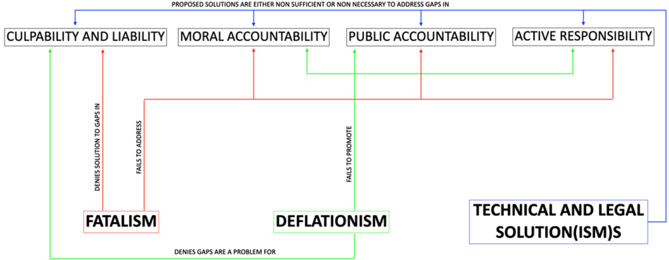
The notion of “responsibility gap” with artificial intelligence (AI) was originally introduced in the philosophical debate to indicate the concern that “learning automata” may make more difficult or impossible to attribute moral culpability to persons for untoward events. Building on literature in moral and legal philosophy, and ethics of technology, the paper proposes a broader and more comprehensive analysis of the responsibility gap. The responsibility gap, it is argued, is not one problem but a set of at least four interconnected problems – gaps in culpability, moral and public accountability, active responsibility—caused by different sources, some technical, other organisational, legal, ethical, and societal. Responsibility gaps may also happen with non-learning systems. The paper clarifies which aspect of AI may cause which gap in which form of responsibility, and why each of these gaps matter. It proposes a critical review of partial and non-satisfactory attempts to address the responsibility gap: those which present it as a new and intractable problem (“fatalism”), those which dismiss it as a false problem (“deflationism”), and those which reduce it to only one of its dimensions or sources and/or present it as a problem that can be solved by simply introducing new technical and/or legal tools (“solutionism”). The paper also outlines a more comprehensive approach to address the responsibility gaps with AI in their entirety, based on the idea of designing socio-technical systems for “meaningful human control", that is systems aligned with the relevant human reasons and capacities.
Verified 2026-11-25 · 1 reference not checked yet
Overview
CoChat Summary
TL;DR
The paper argues that the AI responsibility gap is not one problem but at least four interconnected gaps—culpability, moral accountability, public accountability, and active responsibility—arising from technical, organisational, legal, ethical, and societal sources. It critiques fatalist, deflationist, and solutionist responses and sketches a comprehensive approach based on designing sociotechnical systems for meaningful human control.
Key findings
- The responsibility gap should be reframed as at least four interconnected problems: gaps in culpability, moral accountability, public accountability, and active responsibility; these can occur with non-learning systems too and have multiple sources, some technical, organisational, legal, ethical, and societal.
- Current partial approaches distort the problem: “fatalism” treats it as new and intractable; “deflationism” dismisses it as not new and not a problem; “solutionism” treats it as solvable by simply introducing new technical and/or legal tools, with risks of “technical solutionism” and “legal solutionism.”
- The paper proposes meaningful human control (MHC) as a more comprehensive design-oriented approach, with two major conditions: “tracking” (the sociotechnical system responds to relevant human reasons and facts) and “tracing” (for each relevant action, at least one human agent along the design, development, and use chain has sufficient knowledge and moral awareness/capacity).
- It illustrates the gaps and proposed approach with examples including automated driving systems, AI-driven medical diagnosis, algorithmic public administration, and the Uber automated vehicle accident.
Methods
- Conceptual/normative analysis and critical literature review in moral and legal philosophy and ethics of technology; no empirical data collection or sample is reported.
- The analysis draws on philosophical, legal, and sociological theories of responsibility (e.g., Hart, Bovens, van de Poel, Gardner) to distinguish four forms of responsibility and map corresponding gaps and causes.
- It uses illustrative cases—automated driving, medical diagnosis, public administration, and the Uber accident—to show how gaps arise and how MHC tracking/tracing might address them.
Limitations
- Stated: the MHC proposal is a sketch; future research will develop it in more detail, and future philosophical, empirical, and technical work must clarify which responsibility gaps emerge in different systems and contexts and the extent to which MHC may effectively address them.
- Evident: the paper is conceptual and does not empirically test or operationalize MHC; its examples are illustrative rather than a systematic empirical sample.
- Evident: the critical review is described as a “representative sample” of the literature, not a systematic review.
Model-written summary. Check it against the paper before relying on it.
Integrity signals
Registry
Cites
Statistics
Figures
Verification
Claims the paper makes
6 Valid · 3 Not valid · 27 Not checked · 62 Own results and interpretations
The cited sources that could be checked couldn’t confirm or dispute this claim.
In the paper
“Moral accountability also has an instrumental value.”
What the sources say
- Not checked — no full text of the sourcecites Collingridge, 1980 matched to “The Social Control of Technology” (1982) source
- Could not verifycites Genus and Stirling (2018) matched to “Collingridge and the dilemma of control: Towards responsible and accountable innovation” (2018) sourceExperimental — accuracy not yet measured
The Introduction discusses ethical responsibility and accountability, but does not say that moral accountability has instrumental value. The Conclusion contrasts responsibility as a struggle against incumbent power with instrumental facilitation; it does not establish or explicitly deny the claimed value. Searches for “moral accountability” and “instrumental value accountability” found no passage addressing the claim. (LLM, conf=0.72)
- Could not verifycites Stilgoe et al., 2013 matched to “Developing a framework for responsible innovation” (2013) sourceExperimental — accuracy not yet measured
Our copy mentions 'moral accountability' only once (Introduction 1.2, 'A new scientific governance?'), describing the hope that unpredictability lets us escape it, and notes elsewhere that retrospective accountability tends to take precedence in a 'logic of unresponsiveness' (2.4, Responsiveness) and that retrospective accounts of responsibility are 'inherently limited' (1.1). No passage assigns moral accountability an instrumental value; searches for 'instrumental value of moral accountability', 'instrumental value', and 'accountability liability blame' returned only these passages plus unrelated uses of 'instrumental' (e.g. 'narrow instrumental expectations of innovators' in 1.1, 'no a priori instrumental conditioning' in 2.5). The paper therefore neither supports nor contradicts the attributed point. (LLM, conf=0.68)
plainstates a cause- Asserted: passes — The authors put it forward as true.
- Checkable: passes — It can be checked against evidence.
- Load-bearing: passes — The paper’s conclusions depend on it.
- Based: passes — The paper gives a reason why it holds.
Every source the paper cites for this claim was checked and supports it.
In the paper
“Most of these discussions point to the fact that algorithmic decision-making is often difficult to understand for - and explain to - human agents, due to the different, and sometimes inscrutable for persons, ways of AI operations: the so-called 'black box' problem (Castelvecchi, 2016).”
What the sources say
- Supportedcites Castelvecchi, 2016 matched to “Can we open the black box of AI?” (2016) source
The unlabelled opening passage describes neural networks as opaque and says their stored information is exceedingly difficult to decipher. The “ILLUSTRATION BY SIMON PRADES” passage explicitly calls this the black-box problem and says it can be difficult for humans to understand how such systems work or for the systems to explain themselves. The source discusses AI, particularly deep-learning neural networks, rather than every algorithmic decision system. (LLM, conf=0.93)
plainstates a cause- Asserted: passes — The authors put it forward as true.
- Checkable: passes — It can be checked against evidence.
- Load-bearing: passes — The paper’s conclusions depend on it.
- Based: passes — The paper gives a reason why it holds.
- Supported
The cited sources support only part of this claim — read each source’s verdict below.
In the paper
“Nor does this approach incentivise engineers to go beyond the current state of art in technology and look for innovative solutions which may improve the capabilities of current technology to better satisfy complex and potentially conflicting societal demands (Van den Hoven et al., 2012) such as, for instance, higher levels of safety combined with better predictability etc.”
What the sources say
- Partly supportedcites Van den Hoven et al., 2012 matched to “Engineering and the Problem of Moral Overload” (2012) sourceExperimental — accuracy not yet measured
The Introduction (page unavailable) says the standard response to conflicting engineering requirements is to weigh values and make trade-offs, while technical solutions are sometimes overlooked. “Moral Residues as Motors for Technological Innovation” argues that engineers should seek more advanced technology when current technology cannot meet their obligations. The paper does not specifically say that an old-style division of labour fails to incentivise engineers to do so. (LLM, conf=0.82)
plainstates a cause- Asserted: passes — The authors put it forward as true.
- Checkable: passes — It can be checked against evidence.
- Load-bearing: unclear — It is unclear whether the paper’s conclusions depend on it.
- Based: passes — The paper gives a reason why it holds.
- Partly supported
Every source the paper cites for this claim was checked and supports it.
In the paper
“By using Mecacci and Santoni de Sio's (2020) approach, we can more easily identify other actors whose higher-level plans and goals played or could have played a control role in the story, and may therefore have some form of responsibility in it.”
What the sources say
- Supportedcites Mecacci and Santoni de Sio's (2020) matched to “Meaningful human control as reason-responsiveness: the case of dual-mode vehicles” (2020) source
Split into 2 atoms — 2 confirmed, 0 partially supported, 0 disputed, 0 misattributed, 0 unverifiable. Expand the claim to see per-atom verdicts.
hedgedstates a cause- Asserted: passes — The authors put it forward as true.
- Checkable: passes — It can be checked against evidence.
- Load-bearing: passes — The paper’s conclusions depend on it.
- Based: passes — The paper gives a reason why it holds.
- Supported
A conclusion the paper draws from its own results — it cites no other source for it, so there is none to check. The quote shows it is in the paper.
In the paper
“The general concern is that AI may make individual persons less able to understand, explain, and reflect upon their own and other agents' behaviour. Let us call this the moral accountability gap .”
hedgedstates a possible cause- Asserted: passes — The authors put it forward as true.
- Checkable: passes — It can be checked against evidence.
- Load-bearing: passes — The paper’s conclusions depend on it.
- Based: passes — The paper gives a reason why it holds.
39 more claims
Create a free account to see all 98 claims and to verify the 7 references still open.
- Probably not a substantial claim. 37
- It may state two separate claims as one. 25
- The quote only partly states this claim. 1
Citations
Cites
Street-Level Bureaucracy: Dilemmas of the Individual in Public Services
Lipsky, M. (1981) · Michigan Law Review · doi:10.2307/1288305 · Cited by 8,981
The ethics of algorithms: Mapping the debate
Mittelstadt, B. D., Allo, P., Taddeo, M., Wachter, S., & Floridi, L. (2016) · Big Data & Society · doi:10.1177/2053951716679679 · Cited by 4,567 · cited 4×
“Risks of gaps have been identified in relation not only to the learning capacities of AI but first and foremost to the opacity, complexity, and unpredictability that these systems generally display (Mittelstadt et al., 2016).”
BackgroundInfluentialThe Black Box Society: The Secret Algorithms That Control Money and Information
Pasquale, F. (2015) · doi:10.4159/harvard.9780674736061 · Cited by 3,796
Automating Inequality: How High-Tech Tools Profile, Police, and Punish the Poor
Lebovits, H. (2019) · Public Integrity · doi:10.1080/10999922.2018.1511671 · Cited by 3,279 · cited 1×
“For example, in her book Automating Inequality , Virginia Eubanks (2018) tells the stories of private contractors not being able and/or willing of disclosing the reasons for the failures/mistakes in their digital systems used by some US states for welfare benefit allocation procedures.”
BackgroundStrawson, P. F. (1962) · PhilPapers (PhilPapers Foundation) · Cited by 3,223
Developing a framework for responsible innovation
Stilgoe, J., Owen, R., & Macnaghten, P. (2013) · Research Policy · doi:10.1016/j.respol.2013.05.008 · Cited by 3,184 · cited 2×
“The responsible innovation approach invites stakeholders to be responsive to one another and to the relevant values in the process of technological development (Stilgoe et al., 2013).”
BackgroundAnalysing and Assessing Accountability: A Conceptual Framework 1
Bovens, M. (2007) · European Law Journal · doi:10.1111/j.1468-0386.2007.00378.x · Cited by 2,667 · cited 2×
“Public accountability, 5 in Mark Bovens’ definition, is a “relationship between an actor and a forum, in which the actor has an obligation to explain and to justify his or her conduct, the forum can pose questions and pass judgement, and the actor may face conse-quences” (Bovens, 2007).”
BackgroundResponsibility and Control: A Theory of Moral Responsibility
Fischer, J. M., & Ravizza, M. (1998) · doi:10.1017/cbo9780511814594 · Cited by 2,249
Can we open the black box of AI?
Castelvecchi, D. (2016) · Nature · doi:10.1038/538020a · Cited by 1,773 · cited 2×
“The way knowledge is represented in the machine and the exact way the machine distinguishes between a positive and negative diagnosis are not only inaccessible to the doctor who uses the sys-tem but also, to an important extent, to those who designed it (Castelvecchi, 2016).”
BackgroundPereboom, D. (2001) · Cambridge University Press eBooks · doi:10.1017/cbo9780511498824 · Cited by 1,519
Research works printed but not linked: 2
- Van Eck, M. (2018). Geautomatiseerde ketenbesluiten & rechtsbescherming: Een onderzoek naar de praktijk van geautomatiseerde ketenbesluiten over een financieel belang in relatie tot rechtsbescherming . PhD Dissertation, Tilburg University. https:// resea rch. tilbu rguni versi ty. edu/ en/ publi catio ns/ autom ated- admin istra tive- chain- decis ions- amp- legal- prote ction- res.
- Zouridis, S., Bovens, M., & Van Eck, M. (2019). Digital discretion. In T. Evans & P. Hupe (Eds.), Discretion and the quest for controlled freedom . Palgrave/MacMillan.
Cited by
Items 401–470 of 470
Don't Trust the Process: When Verifiability Undermines AI Accountability
Paris, T., Moon, A., & Guo, J. (2026) · ACM Conference on Fairness, Accountability, and Transparency (FAccT) · doi:10.1145/3805689.3812373 · Cited by 1
Finn, F., Khosrowi, D., Mello, C. C. S., Düring, M., & Guido, D. (2026) · ACM Conference on Fairness, Accountability, and Transparency (FAccT) · doi:10.1145/3805689.3812238
Hand-off Zones in AI Accountability: Beyond Static-Gap FramingsPreprint
Saviano, S. (2026) · SSRN Electronic Journal · doi:10.2139/ssrn.6886800
Chen, W. (2026) · International Journal of Information Management · doi:10.1016/j.ijinfomgt.2026.103095
Overview of artificial intelligence-based smart healthcare systems
Taherdoost, H. (2026) · Elsevier eBooks · doi:10.1016/b978-0-443-27692-7.00002-2
Empathetic leadership in the age of AI: humanizing the algorithmic workplace
Kiran, T. (2026) · Strategy and Leadership · doi:10.1108/sl-12-2025-0437 · Cited by 2
Producing Models Without Systemic Inquiry?: A Response to West (2026)
Bürger, K. (2026) · Systemic Practice and Action Research · doi:10.1007/s11213-026-09773-2
“Moreover, delegating analytical or framing tasks to opaque, proprietary systems may also create accountability gaps, with responsibility distributed among developers, organisations, and users (Santoni de Sio and Mecacci 2021 ; Lancaster et al. 2024 ; Constantinescu et al. 2025 ).”
How continuity distinguishes autonomy from agency in agentic AI
Kahl, P. (2026) · Discover Artificial Intelligence · doi:10.1007/s44163-026-01675-5 · Cited by 3
“Santoni de Sio and Mecacci later distinguished four kinds of responsibility gaps — culpability, moral accountability, public accountability, and active responsibility gaps — thereby showing that the problem is not unitary Santoni de Sio and Mecacci [29].”
Zhang, S., Zhang, J., Li, P., Zuo, M., & Feng, L. (2026) · Information · doi:10.3390/info17070649
Who bears the responsibility? Legal liability allocation for AI agent conduct in platform ecosystem
Zhang, Z., & He, J. (2026) · Cogent Social Sciences · doi:10.1080/23311886.2026.2691325 · Cited by 3
Varypaiev, O. (2026) · Philosophies · doi:10.3390/philosophies11040115
“While Matthias describes such a loss of direct control for learning systems [61], Santoni de Sio and Mecacci specify it through accountability embedded in the order of AI use [57].”
InfluentialHabeebullah, S. M., Wahyuni, S., Ekowati, N. A., & Otim, M. (2026) · Al-Qarawiyyin Jurnal Ilmu Ushuluddin · doi:10.64691/d6akkv87
Kocot, M., Soboń, J., Bondyra, K., & Kwasek, A. (2026) · Journal for Perspectives of Economic Political and Social Integration · doi:10.18290/pepsi-2026-0004
“At the same time, it is emphasized that AI systems can generate so-called “accountability gaps”, in which it becomes difficult to assign the blame for a decision to either the system or the human (Santoni de Sio & Mecacci, 2021).”
Examining the AI’s legal status from legal and theoretical perspectives
Labanieh, M. F., Yusoff, Z. M., Ayub, Z. A., Wahab, H. A., & Shariffuddin, M. D. K. (2026) · Multidisciplinary Science Journal · doi:10.31893/multiscience.2026779 · Cited by 1
Martin, N., Kopp, T., Vetter, P., & Kinkel, S. (2026) · Human Factors The Journal of the Human Factors and Ergonomics Society · doi:10.1177/00187208261461812
Who Is Accountable When the Agent Speaks? Toward Accountability Graphs for Conversational AI Chains
Haklıdır, M. (2026) · ACM Conference on Conversational User Interfaces (CUI) · doi:10.1145/3816046.3816264
“Santoni de Sio and Mecacci [20] identify four types of responsibility gaps in AI.”
Voinea, D. V. (2026) · Social Sciences · doi:10.3390/socsci15080496 · Cited by 1
“…of blame become harder to apply when learning systems behave in ways that operators cannot fully predict (Matthias 2004), and that the apparent single gap separates into gaps in culpability, moral accountability, public accountability, and active responsibility (Santoni de Sio and Mecacci 2021).”
Setting ethical boundaries for AI in peer review
Nguyen, N. P. (2026) · JME Practical Bioethics · doi:10.1136/jmepb-2025-000056
From product to operative artefact: practical authority and operational answerability in AI ethics
Velotto, G. (2026) · AI and Ethics · doi:10.1007/s43681-026-01285-y · Cited by 2
“Active responsibility concerns the capacities and organisational conditions needed for agents to discharge their roles responsibly [37].”
From bad calls to system errors: accountability in automated and assisted sports officiating
Kwon, J. W. (2026) · Frontiers in Sports and Active Living · doi:10.3389/fspor.2026.1788299
Durango, R. A. B., Correa, D. A. C., Flores, E. A. R., & Zuluaga, C. D. J. G. (2026) · Philosophies · doi:10.3390/philosophies11040133
“First, in‑depth qualitative case studies should connect the heuristics of fear to concrete AI governance decisions—moratoria, de‑ ployment thresholds, meaningful human‑control models—assessing when the Jonasian precautionary logic should prevail over acceptable‑risk approaches [29–32 ,42,64, 88, 89”
InfluentialKimura, D. (2026) · SSRN Electronic Journal · doi:10.2139/ssrn.7010279
Does distrust priming reduce AI stereotypes? Testing applicability to AI acceptance
Dan, K., & Hoshino, T. (2026) · Computers in Human Behavior Reports · doi:10.1016/j.chbr.2026.101232
Artificial Intelligence in the Medical Diagnostic Process: Issues of Responsibility and Care Ethics
Brandt, W., Fritz, A., & Kießig, A. (2026) · Springer eBooks · doi:10.1007/978-3-032-23721-7_8
Responsible Application of Artificial Intelligence (AI) In Healthcare
Olusanya, O. O., Omoniyi, T. V., Oguntokun, O. O., & Daniyan, I. A. (2026) · BENTHAM SCIENCE PUBLISHERS eBooks · doi:10.2174/9798898816186126010010
The Institutional Conditions of Governance in EcosystemsPreprint
Sekino, M. (2026) · SSRN Electronic Journal · doi:10.2139/ssrn.7242779
Accountability in emotional AI: Legal responsibilities and implications of misinterpreted emotions
Singh, M., Srivastava, S., & Agrawal, K. (2026) · Elsevier eBooks · doi:10.1016/b978-0-443-44744-0.00013-8
Faqir, R. S. A. (2026) · Advances in Science, Technology & Innovation/Advances in science, technology & innovation · doi:10.1007/978-3-032-24784-1_4
AI Workslop: The Moral Significance of Withholding Effort
Licht, K. D. F. (2026) · Philosophy & Technology · doi:10.1007/s13347-026-01164-8
“Santoni de Sio and Mecacci ( 2021 ) argue that the responsibility gap is not a single problem but a family of problems, including gaps in culpability, moral and public accountability, and active, forward-looking responsibility.”
Algorithmic Truth: The Rise of Probabilistic Epistemology
Shin, D. (2026) · Oxford University Press eBooks · doi:10.1093/9780197849644.003.0004 · Cited by 1
Systemic explainability for autonomous driving: connecting ethics to law and society
Sanchi, M. (2026) · AI & Society · doi:10.1007/s00146-026-03259-4 · Cited by 2
Verifiable Personhood: Zero-Knowledge Proofs for Human Rights Defense Against AI Identity Theft
Balaha, H. M., El-Gendy, E. M., & Balaha, M. H. (2026) · Advances in computational intelligence and robotics book series · doi:10.4018/979-8-2600-1990-0.ch010
Meaningful Work after Automation Reshapes Identity and Skill
Alvarez, M., Herrera, S., Cruz, D., & Castro, A. (2024) · Journal of Applied Organizational Systems and Behavior · doi:10.51847/py8rnrtget
Empirically Derived AI Harm Profiles and the Case for Context-Sensitive Moral ResponsibilityPreprint
Mumtaz, U., Noor, R., & Mumtaz, S. (2026) · Research Square · doi:10.21203/rs.3.rs-10542055/v1
Moon, W.-K. (2026) · Springer eBooks · doi:10.1007/978-3-031-75316-9_118-1
Rahman, S., Zaki, A., Huda, N., Faisal, A., & Wei, L. (2026) · Journal of Applied Organizational Systems and Behavior · doi:10.51847/qgqp66ji4d
Chen, R., & Gulavani, S. S. (2026) · Sport Business and Management An International Journal · doi:10.1108/sbm-03-2026-0094
Korzyński, P., Wojtczuk‐Turek, A., Turek, D., Meglio, O., & Zabicka-Wlodarczyk, M. (2026) · Journal of Change Management · doi:10.1080/14697017.2026.2719997 · Cited by 2
“Attributing intentions to such systems, a tendency Dennett (1987) termed the intentional stance, encourages their psychological reification and fosters both a responsibility gap (Santoni de Sio & Mecacci, 2021) and moral outsourcing (Krügel et al., 2025).”
Smet, W. D., Dam, L. V., & Janssens, P. (2026) · Annals of Organizational Culture Leadership and External Engagement Journal · doi:10.51847/zyogeeulsn
The Problem of Moral Agency in the Context of Accounting and Auditing Automation
Chernaya, S. N. (2026) · Auditor · doi:10.12737/1998-0701-2026-12-8-16-22
Alves, J. N., & Tseng, H. (2026) · AI and Ethics · doi:10.1007/s43681-026-01343-5
“…produced by this destabilization is the responsibility gap, first identi - fied by Matthias [ 48] and developed by Santoni de Sio and Mecacci [68]: a condition where consequential decisions are made, yet no specific actor can be authoritatively identi - fied as the agent of that decision in…”
The authority gap: why meaningful human control fails at the tier where it is signed
Oktenli, B. (2026) · Digital War · doi:10.1057/s42984-026-00113-1
“It requires a traceable account, across the tiers and across the system’s life, of how the authority to act was distributed, exercised and recorded (Santoni de Sio and van den Hoven 2018; Santoni de Sio and Mecacci 2021).”
Displacement, Dilemma, and Exit: The Ethical Stakes of Algorithmic Decision-Making
Kong, L., & Chang, Y. (2026) · Social Sciences · doi:10.3390/socsci15090593
Chiffi, D., & Moroni, S. (2026) · AI & Society · doi:10.1007/s00146-026-03285-2
Scientific Blind Spots in Materials AI—A Systematic Conceptual Mapping: A Review Study
Walker, J., & Harris, O. (2023) · Journal of Artificial Intelligence for Materials Science · doi:10.68159/c779131545
When responsibility cannot arise: algorithmic mediation and the preconditions of moral imputability
Elden, Å. (2026) · AI and Ethics · doi:10.1007/s43681-026-01359-x · Cited by 1
Salah, M., Abdelfattah, F., Araimi, A. A., BaLashwar, K. M. H., Halbusi, H. A., & Noor, A. A. S. (2026) · Frontiers in Human Dynamics · doi:10.3389/fhumd.2026.1917746
Jurmu, M., Naumanen, M., Westerstrand, S., Lämsä, A., Myllymaa, K., & Ailisto, H. J. (2026) · Applied Artificial Intelligence · doi:10.1080/08839514.2026.2721301
Before agentic AI scales in government: the democratic authorization gap
Salah, M., Abdelfattah, F., Araimi, A. A., & Noor, A. A. S. (2026) · Frontiers in Political Science · doi:10.3389/fpos.2026.1956489 · Cited by 1
Yu, T. M., Zheng, X., & Ng, H.-K. (2026) · AI and Ethics · doi:10.1007/s43681-026-01360-4 · Cited by 1
“The responsibility gap describes situations in which autonomous or learning systems make responsibility attri - bution difficult because they contribute to consequential decisions or actions [35, 48 ].”
When AI outperforms humans, who bears the burden of proof?
Aeon, B., & Gruda, D. (2026) · AI & Society · doi:10.1007/s00146-026-03375-1 · Cited by 2
Kong, C. Y. (2026) · AI and Ethics · doi:10.1007/s43681-026-01383-x · Cited by 4
“…[7] and others have generalised the concern into a family of “retribution gaps” and “accountability gaps” that allegedly widen as systems become more autonomous, more opaque, and more adaptive; Santoni de Sio and Mecacci (25) distinguish four such gaps, arguing that each requires distinct remedies.”
The Responsibility Cascade: Moral Attribution and Governance Challenges in Agentic AI Systems
Kalluri, R. (2026) · Digital Society · doi:10.1007/s44206-026-00288-w · Cited by 3
“Santoni de Sio and Mecacci (2021 ) later elaborated four distinct responsibility gaps: culpability gaps, moral accountability gaps, public accountability gaps, and active responsibility gaps.”
Adapting Socio-Technical Congruence to Human-Agent Collectives
Oppenlaender, J., Visuri, A., & Hosio, S. J. (2026) · ACM Conference on Human-AI Complementarity and Alignment · doi:10.1145/3834580.3838753
Early Warning Systems, Emerging Technologies, and Inductive Risk
Canali, S., & Ongaro, M. (2026) · Digital Society · doi:10.1007/s44206-026-00289-9 · Cited by 1
“Here, systems using big data and machine learning techniques often make human control and the allocation of responsibility to human persons very difficult if not impossible – an issue usually referred to with the notion of “responsibility gap” (see e.g. Santoni De Sio & Mecacci, 2021).”
Will AI save ethics—and make ethicists obsolete?
Tretter, M. (2026) · AI and Ethics · doi:10.1007/s43681-026-01384-w
“Yet critics argue that AI systems cannot meaningfully be held morally or legally accountable for what they produce [8, 54, 55].”
The Geopolitics of Artificial Intelligence
Babic, B., & Wong, B. Y. S. (2026) · Cambridge University Press eBooks · doi:10.1017/9781009731904 · Cited by 2
Balazadeh, K., Nygren, J., Gama, F., da Silva, M. A. R., Ploug, T., & Svedberg, P. (2026) · Research Square · doi:10.21203/rs.3.rs-11085511/v1
Ajibola, A. (2026) · AI and Ethics · doi:10.1007/s43681-026-01335-5
“Federal agencies need unambiguous responsibility distribution and prospective accountability systems [ 62].”
InfluentialDA EXTISPÍCIA AO PROFETA BIG DATA: PREDIÇÃO, APLICAÇÃO E A ESTRUTURA DO DECIDIR
Dietrich, P., & Dietrich, M. G. D. S. (2026) · Revista de Geopolítica · doi:10.56238/revgeov17n9-130
AI Work Under Guardrails: Task Framing for Responsible Delegation in BPM
Antal, K. (2026) · Lecture notes in business information processing · doi:10.1007/978-3-032-36710-5_1
Legal Status of the AI-Transparency Duties at the Consumer-Facing InterfacePreprint
Osovsky, M., Krikunova, E., & Shonubi, R. (2026) · Research Square · doi:10.21203/rs.3.rs-11168215/v1 · Cited by 1
Against speech liberalism for generative AI
Dobler, T. (2026) · Asian Journal of Philosophy · doi:10.1007/s44204-026-00454-4
“This critique does not extend to purpose-specific uses of speech vocabulary or broader reconceptualizations of AI responsibility (e.g. Shoemaker, 2011; Floridi, 2016; Santoni de Sio & Mecacci, 2021; Tigard 2021; Nyholm, 2023).”
Persada, S. F., Murniati, Adhi Murti Citra Amalia, H., et al. (2026) · International Conference on ICT for Smart Society (ICISS) · doi:10.1109/iciss71466.2026.11715496
“First, major literature elaborates on the use of AI in the context of operational aspects, few discussed on behavioral context [4].”
Yapay Zeka ve Devlet Egemenliğinin İcrası: Bağımlılık, Denetim ve Meşruiyet
Kürşat, K. A. N. (2026) · Ömer Halisdemir Üniversitesi İktisadi ve İdari Bilimler Fakültesi Dergisi · doi:10.25287/ohuiibf.1920158
Semantic indeterminacy in agentic negotiation: agreement after the recession of the principal
Okuhara, S. (2026) · AI and Ethics · doi:10.1007/s43681-026-01436-1
“Santoni de Sio and Mecacci [32] systematize this into four distinct gaps, in culpability, moral accountability, public accountability, and active responsibility, traced to the opacity, complexity, and unpredictability of AI systems.”
Authorship responsibilities of scientists who use AI research agents
Resnik, D. B., Hosseini, M., & Pennock, R. T. (2026) · Frontiers in Genetics · doi:10.3389/fgene.2026.1954843
Kynatun, M. (2025) · American Journal of Advanced Technology and Engineering Solutions · doi:10.63125/kzcdyz73 · Cited by 15
Intelligent Leadership in the Age of AI: Navigating Paradox, Uncertainty, and Hybrid Decision-Making
Truong, N., Kumar, V., & Hasan, M. (2026) · Advances in computational intelligence and robotics book series · doi:10.4018/979-8-2600-1488-2.ch010
Cheung, K. T., & Ramamoorti, S. (2026) · AI and Ethics · doi:10.1007/s43681-026-01434-3 · Cited by 2
“…with an indication of which inputs contributed most strongly to a given output” [60, p. 1699], but that tells us 12 Santoni de Sio and Mecacci [ 48 ] also take the distinction seriously, but they further develop four different gaps, namely, culpability and liability gap, moral accountability…”
Metadata
- Authors
- Santoni de Sio, F., & Mecacci, G.
- Affiliations
- Radboud University Nijmegen (NL)
- Venue
- Philosophy & Technology
- Published
- 2021-05-14
- Volume
- 34
- Issue
- 4
- Pages
- 1057-1084
- ISSN
- 2210-5433 (ISSN-L)
- 2210-5441
- OpenAlex
- W3160005967
- Cited by
- 490
- References
- 89
- Citations by year
- 2026: 165 · 2025: 117 · 2024: 88 · 2023: 72 · 2022: 35 · 2021: 13
- FWCI
- 64.99
- Type
- journal article
- Language
- en
- Open access
- hybrid
- doi.org
- Licence
- cc-by
- creativecommons.org/licenses/by/4.0 (tdm)
- creativecommons.org/licenses/by/4.0 (vor)
- Locations
- Philosophy & Technology (publishedVersion, cc-by)
- Radboud Repository (Radboud University) (submittedVersion)
- Research Repository (Delft University of Technology) (submittedVersion)
- Radboud Repository (Radboud University) (submittedVersion, other-oa)
- Data Archiving and Networked Services (DANS) (submittedVersion, other-oa)
- Funders
- Nederlandse Organisatie voor Wetenschappelijk Onderzoek (MVI.16.044)
- Topics
- Physical Sciences › Computer Science › Artificial Intelligence › Ethics and Social Impacts of AI
- Social Sciences › Law › Digitalization, Law, and Regulation
- Social Sciences › Law › Literary and Philosophical Studies
- Keywords
- responsibility gap, artificial intelligence, moral culpability, accountability, learning automata, fatalism, deflationism, solutionism, meaningful human control, socio-technical systems, ethics of technology, legal theory, ethics
About these checks
Registry, retraction, Cites and statistics results are computed, not judged, with one exception: a printed reference that no index lists is read once by a model before it counts as a citation error. Claims are extracted by a model and kept only when their quote appears verbatim in the text; each cited source is then checked, with a model’s help, for whether it says what the claim relies on. Those verdicts can be wrong — read the claim’s quote and the cited source before relying on one.
The claim verdicts this report counts are experimental: their accuracy is not yet measured.
A language model drew the claims from the paper on 2026-10-10, under version 3 of the claim definition (model deepseek-v4.1-flash, prompt extract-v3).
A second model labelled each claim on 2026-10-10 (model jev-1.13-20260917, definition revision gold-guideline-v0.2).
Cited sources are checked with a language model’s help (gpt-6-sol and qwen3.8-omni-flash).
Statistics and arithmetic are recomputed, not judged.
Confidence bands are shown only for fields calibrated on our annotated test set. None is calibrated yet, so no band is shown.
What counts as a claim ›How we measure confidence ›How we check this ›
Are you an author, or do you see a problem with this page? Request a review
Data sources
Bibliographic data: Semantic Scholar, OpenAlex, Crossref.
Contains information from the Semantic Scholar Academic Graph Datasets, made available under the ODC Attribution License (ODC-BY 1.0).
Semantic Scholar’s data is described in: Kinney, R., et al. (2023). The Semantic Scholar Open Data Platform. arXiv:2301.10140.
