

Four Responsibility Gaps with Artificial Intelligence: Why they Matter and How to Address them
Open accessThe DOI matches its Crossref record; 86 of the 89 references it cites were found in a registry or an index, and 1 are not checked yet; 8 of the 53 sources its claims cite were checked for support.
Abstract
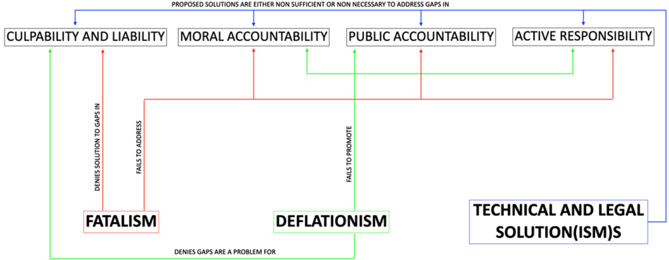
The notion of “responsibility gap” with artificial intelligence (AI) was originally introduced in the philosophical debate to indicate the concern that “learning automata” may make more difficult or impossible to attribute moral culpability to persons for untoward events. Building on literature in moral and legal philosophy, and ethics of technology, the paper proposes a broader and more comprehensive analysis of the responsibility gap. The responsibility gap, it is argued, is not one problem but a set of at least four interconnected problems – gaps in culpability, moral and public accountability, active responsibility—caused by different sources, some technical, other organisational, legal, ethical, and societal. Responsibility gaps may also happen with non-learning systems. The paper clarifies which aspect of AI may cause which gap in which form of responsibility, and why each of these gaps matter. It proposes a critical review of partial and non-satisfactory attempts to address the responsibility gap: those which present it as a new and intractable problem (“fatalism”), those which dismiss it as a false problem (“deflationism”), and those which reduce it to only one of its dimensions or sources and/or present it as a problem that can be solved by simply introducing new technical and/or legal tools (“solutionism”). The paper also outlines a more comprehensive approach to address the responsibility gaps with AI in their entirety, based on the idea of designing socio-technical systems for “meaningful human control", that is systems aligned with the relevant human reasons and capacities.
Verified 2026-11-25 · 1 reference not checked yet
Overview
CoChat Summary
TL;DR
The paper argues that the AI responsibility gap is not one problem but at least four interconnected gaps—culpability, moral accountability, public accountability, and active responsibility—arising from technical, organisational, legal, ethical, and societal sources. It critiques fatalist, deflationist, and solutionist responses and sketches a comprehensive approach based on designing sociotechnical systems for meaningful human control.
Key findings
- The responsibility gap should be reframed as at least four interconnected problems: gaps in culpability, moral accountability, public accountability, and active responsibility; these can occur with non-learning systems too and have multiple sources, some technical, organisational, legal, ethical, and societal.
- Current partial approaches distort the problem: “fatalism” treats it as new and intractable; “deflationism” dismisses it as not new and not a problem; “solutionism” treats it as solvable by simply introducing new technical and/or legal tools, with risks of “technical solutionism” and “legal solutionism.”
- The paper proposes meaningful human control (MHC) as a more comprehensive design-oriented approach, with two major conditions: “tracking” (the sociotechnical system responds to relevant human reasons and facts) and “tracing” (for each relevant action, at least one human agent along the design, development, and use chain has sufficient knowledge and moral awareness/capacity).
- It illustrates the gaps and proposed approach with examples including automated driving systems, AI-driven medical diagnosis, algorithmic public administration, and the Uber automated vehicle accident.
Methods
- Conceptual/normative analysis and critical literature review in moral and legal philosophy and ethics of technology; no empirical data collection or sample is reported.
- The analysis draws on philosophical, legal, and sociological theories of responsibility (e.g., Hart, Bovens, van de Poel, Gardner) to distinguish four forms of responsibility and map corresponding gaps and causes.
- It uses illustrative cases—automated driving, medical diagnosis, public administration, and the Uber accident—to show how gaps arise and how MHC tracking/tracing might address them.
Limitations
- Stated: the MHC proposal is a sketch; future research will develop it in more detail, and future philosophical, empirical, and technical work must clarify which responsibility gaps emerge in different systems and contexts and the extent to which MHC may effectively address them.
- Evident: the paper is conceptual and does not empirically test or operationalize MHC; its examples are illustrative rather than a systematic empirical sample.
- Evident: the critical review is described as a “representative sample” of the literature, not a systematic review.
Model-written summary. Check it against the paper before relying on it.
Integrity signals
Registry
Cites
Statistics
Figures
Verification
Claims the paper makes
6 Valid · 3 Not valid · 27 Not checked · 62 Own results and interpretations
The cited sources that could be checked couldn’t confirm or dispute this claim.
In the paper
“Moral accountability also has an instrumental value.”
What the sources say
- Not checked — no full text of the sourcecites Collingridge, 1980 matched to “The Social Control of Technology” (1982) source
- Could not verifycites Genus and Stirling (2018) matched to “Collingridge and the dilemma of control: Towards responsible and accountable innovation” (2018) sourceExperimental — accuracy not yet measured
The Introduction discusses ethical responsibility and accountability, but does not say that moral accountability has instrumental value. The Conclusion contrasts responsibility as a struggle against incumbent power with instrumental facilitation; it does not establish or explicitly deny the claimed value. Searches for “moral accountability” and “instrumental value accountability” found no passage addressing the claim. (LLM, conf=0.72)
- Could not verifycites Stilgoe et al., 2013 matched to “Developing a framework for responsible innovation” (2013) sourceExperimental — accuracy not yet measured
Our copy mentions 'moral accountability' only once (Introduction 1.2, 'A new scientific governance?'), describing the hope that unpredictability lets us escape it, and notes elsewhere that retrospective accountability tends to take precedence in a 'logic of unresponsiveness' (2.4, Responsiveness) and that retrospective accounts of responsibility are 'inherently limited' (1.1). No passage assigns moral accountability an instrumental value; searches for 'instrumental value of moral accountability', 'instrumental value', and 'accountability liability blame' returned only these passages plus unrelated uses of 'instrumental' (e.g. 'narrow instrumental expectations of innovators' in 1.1, 'no a priori instrumental conditioning' in 2.5). The paper therefore neither supports nor contradicts the attributed point. (LLM, conf=0.68)
plainstates a cause- Asserted: passes — The authors put it forward as true.
- Checkable: passes — It can be checked against evidence.
- Load-bearing: passes — The paper’s conclusions depend on it.
- Based: passes — The paper gives a reason why it holds.
Every source the paper cites for this claim was checked and supports it.
In the paper
“Most of these discussions point to the fact that algorithmic decision-making is often difficult to understand for - and explain to - human agents, due to the different, and sometimes inscrutable for persons, ways of AI operations: the so-called 'black box' problem (Castelvecchi, 2016).”
What the sources say
- Supportedcites Castelvecchi, 2016 matched to “Can we open the black box of AI?” (2016) source
The unlabelled opening passage describes neural networks as opaque and says their stored information is exceedingly difficult to decipher. The “ILLUSTRATION BY SIMON PRADES” passage explicitly calls this the black-box problem and says it can be difficult for humans to understand how such systems work or for the systems to explain themselves. The source discusses AI, particularly deep-learning neural networks, rather than every algorithmic decision system. (LLM, conf=0.93)
plainstates a cause- Asserted: passes — The authors put it forward as true.
- Checkable: passes — It can be checked against evidence.
- Load-bearing: passes — The paper’s conclusions depend on it.
- Based: passes — The paper gives a reason why it holds.
- Supported
The cited sources support only part of this claim — read each source’s verdict below.
In the paper
“Nor does this approach incentivise engineers to go beyond the current state of art in technology and look for innovative solutions which may improve the capabilities of current technology to better satisfy complex and potentially conflicting societal demands (Van den Hoven et al., 2012) such as, for instance, higher levels of safety combined with better predictability etc.”
What the sources say
- Partly supportedcites Van den Hoven et al., 2012 matched to “Engineering and the Problem of Moral Overload” (2012) sourceExperimental — accuracy not yet measured
The Introduction (page unavailable) says the standard response to conflicting engineering requirements is to weigh values and make trade-offs, while technical solutions are sometimes overlooked. “Moral Residues as Motors for Technological Innovation” argues that engineers should seek more advanced technology when current technology cannot meet their obligations. The paper does not specifically say that an old-style division of labour fails to incentivise engineers to do so. (LLM, conf=0.82)
plainstates a cause- Asserted: passes — The authors put it forward as true.
- Checkable: passes — It can be checked against evidence.
- Load-bearing: unclear — It is unclear whether the paper’s conclusions depend on it.
- Based: passes — The paper gives a reason why it holds.
- Partly supported
Every source the paper cites for this claim was checked and supports it.
In the paper
“By using Mecacci and Santoni de Sio's (2020) approach, we can more easily identify other actors whose higher-level plans and goals played or could have played a control role in the story, and may therefore have some form of responsibility in it.”
What the sources say
- Supportedcites Mecacci and Santoni de Sio's (2020) matched to “Meaningful human control as reason-responsiveness: the case of dual-mode vehicles” (2020) source
Split into 2 atoms — 2 confirmed, 0 partially supported, 0 disputed, 0 misattributed, 0 unverifiable. Expand the claim to see per-atom verdicts.
hedgedstates a cause- Asserted: passes — The authors put it forward as true.
- Checkable: passes — It can be checked against evidence.
- Load-bearing: passes — The paper’s conclusions depend on it.
- Based: passes — The paper gives a reason why it holds.
- Supported
A conclusion the paper draws from its own results — it cites no other source for it, so there is none to check. The quote shows it is in the paper.
In the paper
“The general concern is that AI may make individual persons less able to understand, explain, and reflect upon their own and other agents' behaviour. Let us call this the moral accountability gap .”
hedgedstates a possible cause- Asserted: passes — The authors put it forward as true.
- Checkable: passes — It can be checked against evidence.
- Load-bearing: passes — The paper’s conclusions depend on it.
- Based: passes — The paper gives a reason why it holds.
39 more claims
Create a free account to see all 98 claims and to verify the 7 references still open.
- Probably not a substantial claim. 37
- It may state two separate claims as one. 25
- The quote only partly states this claim. 1
Citations
Cites
Street-Level Bureaucracy: Dilemmas of the Individual in Public Services
Lipsky, M. (1981) · Michigan Law Review · doi:10.2307/1288305 · Cited by 8,981
The ethics of algorithms: Mapping the debate
Mittelstadt, B. D., Allo, P., Taddeo, M., Wachter, S., & Floridi, L. (2016) · Big Data & Society · doi:10.1177/2053951716679679 · Cited by 4,567 · cited 4×
“Risks of gaps have been identified in relation not only to the learning capacities of AI but first and foremost to the opacity, complexity, and unpredictability that these systems generally display (Mittelstadt et al., 2016).”
BackgroundInfluentialThe Black Box Society: The Secret Algorithms That Control Money and Information
Pasquale, F. (2015) · doi:10.4159/harvard.9780674736061 · Cited by 3,796
Automating Inequality: How High-Tech Tools Profile, Police, and Punish the Poor
Lebovits, H. (2019) · Public Integrity · doi:10.1080/10999922.2018.1511671 · Cited by 3,279 · cited 1×
“For example, in her book Automating Inequality , Virginia Eubanks (2018) tells the stories of private contractors not being able and/or willing of disclosing the reasons for the failures/mistakes in their digital systems used by some US states for welfare benefit allocation procedures.”
BackgroundStrawson, P. F. (1962) · PhilPapers (PhilPapers Foundation) · Cited by 3,223
Developing a framework for responsible innovation
Stilgoe, J., Owen, R., & Macnaghten, P. (2013) · Research Policy · doi:10.1016/j.respol.2013.05.008 · Cited by 3,184 · cited 2×
“The responsible innovation approach invites stakeholders to be responsive to one another and to the relevant values in the process of technological development (Stilgoe et al., 2013).”
BackgroundAnalysing and Assessing Accountability: A Conceptual Framework 1
Bovens, M. (2007) · European Law Journal · doi:10.1111/j.1468-0386.2007.00378.x · Cited by 2,667 · cited 2×
“Public accountability, 5 in Mark Bovens’ definition, is a “relationship between an actor and a forum, in which the actor has an obligation to explain and to justify his or her conduct, the forum can pose questions and pass judgement, and the actor may face conse-quences” (Bovens, 2007).”
BackgroundResponsibility and Control: A Theory of Moral Responsibility
Fischer, J. M., & Ravizza, M. (1998) · doi:10.1017/cbo9780511814594 · Cited by 2,249
Can we open the black box of AI?
Castelvecchi, D. (2016) · Nature · doi:10.1038/538020a · Cited by 1,773 · cited 2×
“The way knowledge is represented in the machine and the exact way the machine distinguishes between a positive and negative diagnosis are not only inaccessible to the doctor who uses the sys-tem but also, to an important extent, to those who designed it (Castelvecchi, 2016).”
BackgroundPereboom, D. (2001) · Cambridge University Press eBooks · doi:10.1017/cbo9780511498824 · Cited by 1,519
Research works printed but not linked: 2
- Van Eck, M. (2018). Geautomatiseerde ketenbesluiten & rechtsbescherming: Een onderzoek naar de praktijk van geautomatiseerde ketenbesluiten over een financieel belang in relatie tot rechtsbescherming . PhD Dissertation, Tilburg University. https:// resea rch. tilbu rguni versi ty. edu/ en/ publi catio ns/ autom ated- admin istra tive- chain- decis ions- amp- legal- prote ction- res.
- Zouridis, S., Bovens, M., & Van Eck, M. (2019). Digital discretion. In T. Evans & P. Hupe (Eds.), Discretion and the quest for controlled freedom . Palgrave/MacMillan.
Cited by
Items 101–200 of 470
Klinische Entscheidungsfindung mit Künstlicher Intelligenz: Ein interdisziplinärer Governance-Ansatz
Samhammer, D., Beck, S., Budde, K., Burchardt, A., Faber, M., Gerndt, S., Möller, S., Osmanodja, B., Roller, R., & Dabrock, P. (2023) · Essentials · doi:10.1007/978-3-662-67008-8 · Cited by 18
Responsibility Gaps and Retributive Dispositions: Evidence from the US, Japan and Germany
Kneer, M., & Christen, M. (2024) · Science and Engineering Ethics · doi:10.1007/s11948-024-00509-w · Cited by 23
“In simple terms, Santoni de Sio & Mecacci (2021) seem to hold that we – and in particular engineers as well as governmental and industry stake-holders – have a duty of care in the design and use of novel technological systems.”
BackgroundInfluentialResponsibility Gaps, LLMs & Organisations: Many Agents, Many Levels, and Many Interactions
Constantinescu, M., & Kaptein, M. (2025) · Science and Engineering Ethics · doi:10.1007/s11948-025-00560-1 · Cited by 23
“…2004), others attempt to bridge them (Baum et al., 2022 ; Glavaničová & Pascucci, 2022; Hev-elke & Nida-Rümelin, 2015; List, 2021; Nyholm, 2018; Santoni de Sio & Mecacci, 2021), reduce their relevance (Königs, 2022), or even to deny their existence (Himmelreich, 2019; Hindriks & Veluwenkamp,…”
InfluentialWhat responsibility gaps are and what they should be
Veluwenkamp, H. (2025) · Ethics and Information Technology · doi:10.1007/s10676-025-09823-8 · Cited by 26
“Different authors emphasize different dimensions of responsibility (Santoni de Sio and Mecacci 2021).”
Command responsibility in military AI contexts: balancing theory and practicality
Oimann, A., & Salatino, A. (2024) · AI and Ethics · doi:10.1007/s43681-024-00512-8 · Cited by 18
Risk and Responsibility in Context
Placani, A., & Broadhead, S. (2023) · Routledge eBooks · doi:10.4324/9781003276029 · Cited by 14
L’intelligence artificielle peut-elle être une innovation responsable ?
Vuarin, L., Lopes, P. G., & Massé, D. (2023) · Innovations · doi:10.3917/inno.pr2.0153 · Cited by 18
Perceived responsibility in AI-supported medicine
Krügel, S., Ammeling, J., Aubreville, M., Fritz, A., Kießig, A., & Uhl, M. (2024) · AI & Society · doi:10.1007/s00146-024-01972-6 · Cited by 25
“In a seminal paper, Matthias (2004) has introduced the notion of a “responsibility gap” in the context of learning machines.”
Artificial intelligence in low-altitude flight: Developmental opportunity or ethical challenge?
Li, J., Liu, S., Huang, W., & Yan, B. (2025) · The Aeronautical Journal · doi:10.1017/aer.2025.2 · Cited by 15
The EU AI Liability Directive (AILD): Bridging Information Gaps
Ziosi, M., Mökander, J., Novelli, C., Casolari, F., Taddeo, M., & Floridi, L. (2023) · doi:10.2139/ssrn.4470725 · Cited by 12
Artificial Intelligence and Society: Pros and Cons of the Present, Future Prospects
Nikolenko, K. (2022) · Futurity Philosophy. · doi:10.57125/fp.2022.06.30.05 · Cited by 25
“The issue of liability for the adverse effects of artificial intelligence also remains uncertain (de Sio & Mecacci, 2021).”
Identifying AI Hazards and Responsibility Gaps
Cummings, M. L. (2025) · IEEE Access · doi:10.1109/access.2025.3552200 · Cited by 17
“Santoni de Sio [38] recently proposed that one solution to emerging AI responsibility gaps in military applications is for stronger advocacy for ‘‘meaningful human control’’, which means direct human oversight.”
The trend and future of techno-ethics: a bibliometric analysis of three decades
Verma, S., & Garg, N. (2023) · Library Hi Tech · doi:10.1108/lht-10-2022-0477 · Cited by 13
Tretter, M., Samhammer, D., & Dabrock, P. (2023) · Ethik in der Medizin · doi:10.1007/s00481-023-00789-z · Cited by 24
Reactive Attitudes and AI-Agents – Making Sense of Responsibility and Control Gaps
Rebera, A. P. (2024) · Philosophy & Technology · doi:10.1007/s13347-024-00808-x · Cited by 11
“For many people, conscious or unconscious frame - 6 Santoni De Sio and Mecacci ( 2021 ) identify what they call the moral accountability gap , namely that “AI may make individual persons less able to understand, explain, and reflect upon their own and other agents’ behaviour”.”
InfluentialResponsibility Attribution in Human Interactions with Everyday AI Systems
Brailsford, J., Vetere, F., & Velloso, E. (2025) · CHI Conference on Human Factors in Computing Systems · doi:10.1145/3706598.3713126 · Cited by 25
“Matthias, for example, describes the responsibility gap as unintended or unforeseen outputs that result from the system interacting with and learning from its environment that cannot currently be traced back to a single entity [49, 59].”
Embedding AI ethics in the data lifecycle: A framework for enterprise AI governance
Huang, X., Kou, T., & Zhou, Q. (2026) · Technology in Society · doi:10.1016/j.techsoc.2026.103261 · Cited by 15
Learning to Live with Strange Error: Beyond Trustworthiness in Artificial Intelligence Ethics
Rathkopf, C. A., & Heinrichs, B. (2023) · Cambridge Quarterly of Healthcare Ethics · doi:10.1017/s0963180122000688 · Cited by 17
Law and technology: The impact of innovations on the legal system and its regulation
Zyhrii, O., Trufanova, Y., Паращук, Л. Г., Сампара, Н. М., & Tsvigun, I. (2023) · Social & Legal Studios · doi:10.32518/sals4.2023.267 · Cited by 28
Infrastructural justice for responsible software engineering,
Robinson, S., Buckley, J., Ciolfi, L., Linehan, C., McInerney, C., Nuseibeh, B., Twomey, J., Rauf, I., & McCarthy, J. (2024) · Journal of Responsible Technology · doi:10.1016/j.jrt.2024.100087 · Cited by 11
Ethics of AI: Toward a “Design for Values” Approach
Buijsman, S., Klenk, M., & van den Hoven, J. (2025) · Cambridge University Press eBooks · doi:10.1017/9781009367783.005 · Cited by 20
Augmented Intelligence, Augmented Responsibility?
Lüthi, N., Matt, C., Myrach, T., & Junglas, I. A. (2023) · Business & Information Systems Engineering · doi:10.1007/s12599-023-00789-9 · Cited by 15
“…responsibility gaps can arise due to the use of technologies (Matthias 2004), as well as perceptions of technology as amoral can become reasons for the emergence of responsibility gaps and how adequate design processes can prevent these (Johnson 2015; Martin 2019a; Santoni de Sio and Mecacci 2021).”
BackgroundHuman–machine coordination in mixed traffic as a problem of Meaningful Human Control
Mecacci, G., Calvert, S. C., & de Sio, F. S. (2023) · AI & Society · doi:10.1007/s00146-022-01605-w · Cited by 16
“On the ethical side, failure to obtain satisfactory human machine coordination through technical solutions could result in what has been called moral (Danaher 2016) and legal (Santoni de Sio and Mecacci 2021) scapegoat-ing.”
BackgroundSelf-citationA way forward for responsibility in the age of AI
Gogoshin, D. L. (2025) · Inquiry · doi:10.1080/0020174x.2024.2312455 · Cited by 9
“Santoni de Sio and Mecacci (2021) argue that discussants in the debate mistakenly lump di ff erent types of responsibility together and so make unwarranted assumptions about responsibility gaps.”
BackgroundHenderson, M. D. (2025) · Leadership & Organization Development Journal · doi:10.1108/lodj-05-2025-0319 · Cited by 15
Beyond principles: Embedding ethical AI risks in public sector risk management practice
Sattlegger, A., & Bharosa, N. (2024) · Annual International Conference on Digital Government Research · doi:10.1145/3657054.3657063 · Cited by 21
Mamak, K. (2024) · AI & Society · doi:10.1007/s00146-024-02036-5 · Cited by 13
Silva, M. D. (2024) · Philosophy Compass · doi:10.1111/phc3.70002 · Cited by 15
“Such “solutionism” (de Sio & Mecacci, 2021, pp. 1073–1074) also includes legal (e.g., compensation schemes, AI personhood, and no ‐ fault regimes) and technical methods for addressing apparent gaps.”
Uncovering the gap: challenging the agential nature of AI responsibility problems
Albareda, J. L. (2025) · AI and Ethics · doi:10.1007/s43681-025-00685-w · Cited by 18
“This interpretation of the consequences of the introduction of new AI systems is markedly fatalistic [60].”
A sociotechnological-system approach to AI ethics
Riesen, E. (2025) · AI & Society · doi:10.1007/s00146-025-02335-5 · Cited by 19
A capability approach to ethical development and internal auditing of AI technology
Graves, M., & Ratti, E. (2025) · Journal of Responsible Technology · doi:10.1016/j.jrt.2025.100121 · Cited by 16
Future proofing expertise: AI as a power-up, not a takeover
Toscani, G. (2025) · Futures · doi:10.1016/j.futures.2025.103728 · Cited by 12
Allioui, H., Allioui, A., & Mourdi, Y. (2024) · Multimedia Tools and Applications · doi:10.1007/s11042-024-19038-6 · Cited by 19
AI in Governance and Policy Making
Saxena, A. K. (2024) · International Journal of Science and Research (IJSR) · doi:10.21275/sr24519015426 · Cited by 15
Nagpal, M., Cremer, D. D., & Hiel, A. V. (2024) · Business & Society · doi:10.1177/00076503241271298 · Cited by 17
“With respect to the first part, past research on technosolutionism makes it clear that technosolutionism is encapsulated by an undue “belief that technology can fully solve complex societal problems” (Dolejšová et al., 2018; Santoni de Sio & Mecacci, 2021).”
Funer, F., Tinnemeyer, S., Liedtke, W., & Salloch, S. (2024) · BMC Medical Ethics · doi:10.1186/s12910-024-01109-w · Cited by 11
Muller, S. H. A., van Rijssel, T. I., & van Thiel, G. J. M. W. (2025) · Drug Discovery Today · doi:10.1016/j.drudis.2025.104309 · Cited by 11
A Neo-Republican Critique of AI ethics
Maas, J. (2021) · Journal of Responsible Technology · doi:10.1016/j.jrt.2021.100022 · Cited by 12
Explainable Artificial Intelligence (xAI): Reflections on Judicial System
Chaudhary, G. (2024) · Kutafin Law Review · doi:10.17803/2713-0533.2023.4.26.872-889 · Cited by 19
Zhao, W., Rachwalski, A., Berndt‐Goke, M., & Jin, Y. (2025) · Journal of Contingencies and Crisis Management · doi:10.1111/1468-5973.70031 · Cited by 7
Wang, X., Xie, F., Cheng, G., & Shehzadi, K. (2025) · Information Development · doi:10.1177/02666669251329032 · Cited by 15
Lang, B. H., Kostick, K. M., Smith, J. N., Hurley, M. E., Dexter, R., & Blumenthal‐Barby, J. (2025) · AJOB Empirical Bioethics · doi:10.1080/23294515.2025.2497755 · Cited by 11
“Theoretically, these gaps are generated whenever an inculpable machine is causally related to an outcome or consequence such that there is no plausible moral agent (human) we could claim was responsible (Danaher 2016; Santoni De Sio and Mecacci 2021).”
Human-centered AI design: developers’ perspectives
Karekezi, P., Moore, G., & Luo, J. (2025) · Journal of Engineering Design · doi:10.1080/09544828.2025.2518907 · Cited by 8
“5) Responsibility: Developers and organisations should proactively manage ethical risks and act in the best interests of users and society (Santoni de Sio and Mecacci 2021).”
The bright side of AI in hiring: Collaborating with algorithms supports ethical decision-making
Leszczyński, G., Gaczek, P., & Ławrynowicz, M. (2025) · Journal of Business Research · doi:10.1016/j.jbusres.2025.115812 · Cited by 19
Akgün, F. E., & Akgün, M. (2026) · Healthcare · doi:10.3390/healthcare14081098 · Cited by 14
Balancing Human Rights and the Use of Artificial Intelligence in Border Security in Africa
Bor, S., & Koech, N. (2023) · Journal of intellectual property and information technology law · doi:10.52907/jipit.v3i1.260 · Cited by 17
Responsibility before freedom: closing the responsibility gaps for autonomous machines
MirzaeiGhazi, S., & Stenseke, J. (2024) · AI and Ethics · doi:10.1007/s43681-024-00503-9 · Cited by 10
“…itself: e.g., by clarifying the arguments and tensions between the camps [30], differentiating between different kinds of responsibility gaps [34], or exploring RG in relation to retribution [8], accountability [7], and broader issues pertaining collective and distributed responsibility [5,…”
InfluentialSoysal, T. (2023) · Türkiye Adalet Akademisi Dergisi · doi:10.54049/taad.1231807 · Cited by 11
Harmful epistemic dependence on medical machine learning and its moral implications
Pozzi, G., Buijsman, S., & van den Hoven, J. (2025) · Journal of Medical Ethics · doi:10.1136/jme-2024-110552 · Cited by 9
Taking responsibility for the outcomes of autonomous technologies
Conradie, N. H., & Nagel, S. K. (2025) · Ethics and Information Technology · doi:10.1007/s10676-025-09830-9 · Cited by 10
“…of autonomous technologies stands to impact our responsibility practices (Danaher, 2016, 2022; Johnson & Verdicchio, 2017; Matthias, 2004; Santoni de Sio & Mecacci, 2021; Sparrow, 2007; Tigard et al., 2020; Hin-driks & Veluwenkamp, 2023; Coecklebergh 2023; Oimann, 2023; Vaseashta, 2023;…”
Skouloudis, A., & Venkatraman, A. (2025) · AI · doi:10.3390/ai6080169 · Cited by 12
Responsible artificial intelligence?
Vacek, D. (2025) · AI & Society · doi:10.1007/s00146-025-02604-3 · Cited by 12
“(2017) on accountability; Robillard (2018) on collective responsibility; Santoni de Sio and Mecacci (2021) on culpability, moral and public accountability, and active responsibility; Tigard (2021) on attributability, answerabil-ity, and accountability; Kiener (2022) on taking responsibility and, in…”
Epistemic Justice as a Condition for Meaningful Human Control Over Medical AI
Pozzi, G., & de Sio, F. S. (2026) · Minds and Machines · doi:10.1007/s11023-026-09762-3 · Cited by 11
“This starts by protecting physicians’ moral accountability and active responsibility for the care rela - tionship (Pozzi & Van den Hoven, 2023; Santoni de Sio & Mecacci, 2021).”
Self-citationAI-driven food bioprocessing: How far its integration with practice?
Wang, Q., Tan, Y., Li, W., Zeng, H., & Wang, Y. (2026) · Trends in Food Science & Technology · doi:10.1016/j.tifs.2026.105662 · Cited by 11
Is AI a Problem for Forward Looking Moral Responsibility? The Problem Followed by a Solution
Tollon, F. (2022) · Communications in computer and information science · doi:10.1007/978-3-030-95070-5_20 · Cited by 8
A Comparative Defense of Self-initiated Prospective Moral Answerability for Autonomous Robot harm
Champagne, M., & Tonkens, R. (2023) · Science and Engineering Ethics · doi:10.1007/s11948-023-00449-x · Cited by 7
“(Santoni de Sio & Mecacci, 2021 , pp. 1070–1071) Because we are only concerned with the case of autonomous robots, no person acti - vating such a robot could have known that it would cause harm.”
BackgroundThe Importance of Ethical Reasoning in Next Generation Tech Education
Reis, S. S., Coelho, L., Sarmet, M., Araújo, J., & Corchado, J. M. (2023) · International Conference of the Portuguese Society for Engineering Education (CISPEE) · doi:10.1109/cispee58593.2023.10227651 · Cited by 9
Moral judgements of errors by AI systems and humans in civil and criminal law
Parlangeli, O., Currò, F., Palmitesta, P., & Guidi, S. (2023) · Behaviour and Information Technology · doi:10.1080/0144929x.2023.2283622 · Cited by 9
“The major issue in assigning responsibility to arti fi - cial agents may be the distribution of responsibility across the various decision-makers involved in the process (Matthias 2004; Santoni de Sio and Mecacci 2021).”
Sánchez, L. J. L., & Rojas, M. Á. B. (2024) · Sintaxis · doi:10.36105/stx.2024n13.05 · Cited by 8
Suryana, L. E., Nordhoff, S., Calvert, S., Zgonnikov, A., & van Arem, B. (2025) · Transportation Research Part F: Traffic Psychology and Behaviour · doi:10.1016/j.trf.2025.04.026 · Cited by 16
The Hard Problem of AI Alignment: Value Forks in Moral Judgment
Kneer, M., & Viehoff, J. (2025) · ACM Conference on Fairness, Accountability, and Transparency (FAccT) · doi:10.1145/3715275.3732174 · Cited by 11
Strategies for Harmonizing Fragmented AI Ethics Frameworks, Standards, and Regulations
Schiff, D. S. (2026) · Springer eBooks · doi:10.1007/978-981-95-3658-0_82 · Cited by 9
Sars, N. (2022) · Ethics and Information Technology · doi:10.1007/s10676-022-09660-z · Cited by 8
Take five? A coherentist argument why medical AI does not require a new ethical principle
Segers, S., & Proost, M. D. (2024) · Metamedicine · doi:10.1007/s11017-024-09676-0 · Cited by 7
“…should be comprehended from two perspectives: in the epistemological sense of intelligibility (related to the question of ‘how does it work?’ and the notorious ‘black box problem’) and in the ethical sense of accountability (related to concerns of who is responsible for the way it works) [29].”
The Ethical Assessment of Autonomous Systems in Practice
Trusilo, D., & Burri, T. (2021) · J — Multidisciplinary Scientific Journal · doi:10.3390/j4040051 · Cited by 7
Generative AI and criminal law
Panattoni, B. (2025) · Cambridge Forum on AI: Law and Governance · doi:10.1017/cfl.2024.9 · Cited by 5
“The many-hands-problem (Nissenbaum, 1996; Santoni de Sio & Mecacci, 2021; Thompson, 1980), wherein responsibility is distributed among numerous agents, combined with the “black box” nature of AI, complicates accountability.”
Barman, K. G., Pawłowski, P., & Debrabander, J. (2025) · Journal of Medical Ethics · doi:10.1136/jme-2024-110600 · Cited by 6
Towards ethical evolution: responsible autonomy of artificial intelligence across generations
Terziyan, V. Y., Tiihonen, T., Shukla, A. K., Gryshko, S., Golovianko, M., Terziyan, O., & Vitko, O. (2025) · AI and Ethics · doi:10.1007/s43681-025-00759-9 · Cited by 19
It Is Not About AI, It’s About Humans. Responsibility Gaps and Medical AI
Giubilini, A. (2025) · Journal of Bioethical Inquiry · doi:10.1007/s11673-025-10423-w · Cited by 14
“Santoni de Sio and Mecacci (2021) have argued that discussion about responsibility gaps in AI typically fails to acknowledge the different senses in which we talk about responsibility and the different senses “responsibility” has in the philosophical literature.”
Reeder, S. C., Howard, M., Sparrow, R., Foster, E., Ge, Z., & Kwan, P. (2025) · Epilepsy & Behavior · doi:10.1016/j.yebeh.2025.110720 · Cited by 7
Rethinking human roles in AI warfare
Davidovic, J. (2025) · Nature Machine Intelligence · doi:10.1038/s42256-025-01123-6 · Cited by 4
Decoding AI ethics: What do ethical tools tell us about ethics?
Portegies, T. C., Hajri, O., Willemsen, L. M., & Harbers, M. (2025) · Ethics and Information Technology · doi:10.1007/s10676-025-09860-3 · Cited by 9
Doing Responsibilities with Automated Grading Systems: An Empirical Multi-Stakeholder Exploration
Figueras, C., Rossitto, C., & Pargman, T. C. (2024) · Nordic Conference on Human-Computer Interaction · doi:10.1145/3679318.3685334 · Cited by 8
Verständig, D., Kast, C., Stricker, J., Nürnberger, A., & Budrich, V. B. (2022) · Verlag Barbara Budrich eBooks · doi:10.3224/84742520 · Cited by 13
Transportation Research Challenges Based on the Analysis of EU Projects
Esztergár‐Kiss, D. (2023) · PROMET - Traffic&Transportation · doi:10.7307/ptt.v35i4.181 · Cited by 9
“Thus, it seems that liability and legislation are behind the technological development, which hinders the spread of the new paradigms [30].”
BackgroundHow to ensure control of cooperative vehicle and truck platoons using Meaningful Human Control
Calvert, S. C., Mecacci, G., Heikoop, D. D., & Janssen, R. (2021) · European journal of transport and infrastructure research · doi:10.18757/ejtir.2021.21.2.5354 · Cited by 4
Self-citationHulstijn, J. (2023) · International Conference on Artificial Intelligence and Law · doi:10.1145/3594536.3595122 · Cited by 9
Ono, S., Okazaki, Y., Kanetsuna, K., & Mizumoto, M. (2023) · IEEE Access · doi:10.1109/access.2023.3320041 · Cited by 6
“As the system contains artificial intelligence (AI), such as autonomous cars, the practical application becomes realistic, and this kind of moral dilemma is attracting more and more attention [7], [8], [9].”
BackgroundMitigating Climate Change: AI and the Revolution of Environmental Regulatory Frameworks
Sahu, S., Mallick, N., & Patnaik, S. (2024) · Practice, progress, and proficiency in sustainability · doi:10.4018/979-8-3693-6336-2.ch007 · Cited by 5
Agentic AI has a Human Oversight ProblemPreprint
Passi, S. (2025) · SSRN Electronic Journal · doi:10.2139/ssrn.5529058 · Cited by 23
How predictive medicine leads to solidarity gaps in health
Braun, M. (2025) · npj Digital Medicine · doi:10.1038/s41746-025-01497-2 · Cited by 6
Do GenAI avatars open new responsibility gaps?
Constantinescu, M. (2025) · AI & Society · doi:10.1007/s00146-025-02660-9 · Cited by 8
“Santoni de Sio and Mecacci (2021) identify four distinct responsibility gaps: culpability, moral accountability, public accountability, and active/forward-looking responsibility.”
Readiness of the Legal Education System in Indonesia in Facing the Era of Artificial Intelligence
Arianto, H. (2024) · International Journal of Social health · doi:10.58860/ijsh.v3i2.163 · Cited by 13
“This consists of a sense of ethics and responsibility in the use of AI technology, as well as knowledge of the laws governing artificial intelligence (Santoni de Sio & Mecacci, 2021).”
BackgroundHuman-AI collaboration for enhanced safety
Wen, H. (2024) · Methods in chemical process safety · doi:10.1016/bs.mcps.2024.07.001 · Cited by 13
Herbener, A. B., Klincewicz, M., Frank, L. E., & Damholdt, M. F. (2025) · Computers in Human Behavior Artificial Humans · doi:10.1016/j.chbah.2025.100182 · Cited by 6
Wang, S., Zhang, Y., Xiao, Y., & Liang, Z. (2025) · Big Data & Society · doi:10.1177/20539517251392100 · Cited by 6
“…under the “ narrow ” conception of accountability (Bovens, 2007), AI creates ambiguity concerning which actors and how they are responsible for explaining behaviors and facing consequences, leading to the “ problem of many hands ” and the “ problem of many eyes ” (Santoni De Sio and Mecacci, 2021).”
InfluentialSustainable Climate Engineering Innovation and the Need for Accountability
Capasso, M., & Umbrello, S. (2023) · Routledge eBooks · doi:10.1201/9781003325086-4 · Cited by 6
Cost-effectiveness and algorithmic decision-making
Mainz, J. T., Munch, L. A., & Bjerring, J. C. (2024) · AI and Ethics · doi:10.1007/s43681-024-00528-0 · Cited by 5
“41 Santoni de Sio and Mecacci ([76], p. 1077).”
InfluentialGenerative Artificial Intelligence and Authorship Gaps
Nawar, T. (2024) · American Philosophical Quarterly · doi:10.5406/21521123.61.4.05 · Cited by 11
Winkel, M. (2024) · AI and Ethics · doi:10.1007/s43681-024-00604-5 · Cited by 11
“Santoni de Sio et al. [17] and Tigard [18], on the other hand, point out that there does not necessarily have to be a responsibility gap; rather, the social definitions of responsibility (and ethics) must be reflected upon with regard to their application to AI.”
We need better images of AI and better conversations about AI
Steen, M., Timan, T., van Diggelen, J., & Vethman, S. (2024) · AI & Society · doi:10.1007/s00146-024-02101-z · Cited by 8
“Zooming-out to the level of society, we can imagine feedback loops that feed into policy cycles (Rahwan 2018; Santoni de Sio and Mecacci 2021).”
Why algorithmic speed can be more important than algorithmic accuracy
Mainz, J. T., Munch, L. A., Bjerring, J. C., & Godtfredsen, S. J. (2022) · Clinical Ethics · doi:10.1177/14777509221138750 · Cited by 6
Brauner, P., Schaar, A. K., & Ziefle, M. (2022) · Springer eBooks · doi:10.1007/978-3-030-99235-4_14 · Cited by 4
Nnawuchi, U., & George, C. E. (2025) · Discover Computing · doi:10.1007/s10791-025-09559-5 · Cited by 9
“This knowledge gap is fundamental, as awareness of harm is necessary for claimants to hold those responsible to account and to close the broader accountability gap [56].”
InfluentialKumar, R., Kaur, A., Dangi, H. K., Kumari, P., & Kumar, N. (2025) · FIIB Business Review · doi:10.1177/23197145251342714 · Cited by 3
“Governments must establish concrete guidelines for holding AI accountable for establishing trust for AI-facilitated fire safety (De Sio & Mecacci, 2021).”
Verhagen, R., Neerincx, M. A., & Tielman, M. L. (2025) · ACM Conference on Fairness, Accountability, and Transparency (FAccT) · doi:10.1145/3715275.3732157 · Cited by 5
“We believe more training and interactions with the less autonomous artificial moral agent can combat these issues [20, 80, 102].”
InfluentialNaser, M. Z. (2025) · Technology in Society · doi:10.1016/j.techsoc.2025.103039 · Cited by 5
Černý, M. (2025) · European Journal of Investigation in Health Psychology and Education · doi:10.3390/ejihpe15100197 · Cited by 7
“Students emphasise the human aspects of communication, such as responsibility (Coeckel-bergh, 2023; Santoni de Sio & Mecacci, 2021) or the philosophically and psychologically crucial dimension of “caring or caring for the other” (Liu, 2024).”
Digitizing Dignity: Analyzing Digital Twins Through the Lens of Multidimensional Human Dignity
Barnhart, A. J. (2025) · Bioethics · doi:10.1111/bioe.70045 · Cited by 4
Newen, C., Müller, E., & Newen, A. (2025) · Topoi · doi:10.1007/s11245-025-10287-0 · Cited by 7
Metadata
- Authors
- Santoni de Sio, F., & Mecacci, G.
- Affiliations
- Radboud University Nijmegen (NL)
- Venue
- Philosophy & Technology
- Published
- 2021-05-14
- Volume
- 34
- Issue
- 4
- Pages
- 1057-1084
- ISSN
- 2210-5433 (ISSN-L)
- 2210-5441
- OpenAlex
- W3160005967
- Cited by
- 490
- References
- 89
- Citations by year
- 2026: 165 · 2025: 117 · 2024: 88 · 2023: 72 · 2022: 35 · 2021: 13
- FWCI
- 64.99
- Type
- journal article
- Language
- en
- Open access
- hybrid
- doi.org
- Licence
- cc-by
- creativecommons.org/licenses/by/4.0 (tdm)
- creativecommons.org/licenses/by/4.0 (vor)
- Locations
- Philosophy & Technology (publishedVersion, cc-by)
- Radboud Repository (Radboud University) (submittedVersion)
- Research Repository (Delft University of Technology) (submittedVersion)
- Radboud Repository (Radboud University) (submittedVersion, other-oa)
- Data Archiving and Networked Services (DANS) (submittedVersion, other-oa)
- Funders
- Nederlandse Organisatie voor Wetenschappelijk Onderzoek (MVI.16.044)
- Topics
- Physical Sciences › Computer Science › Artificial Intelligence › Ethics and Social Impacts of AI
- Social Sciences › Law › Digitalization, Law, and Regulation
- Social Sciences › Law › Literary and Philosophical Studies
- Keywords
- responsibility gap, artificial intelligence, moral culpability, accountability, learning automata, fatalism, deflationism, solutionism, meaningful human control, socio-technical systems, ethics of technology, legal theory, ethics
About these checks
Registry, retraction, Cites and statistics results are computed, not judged, with one exception: a printed reference that no index lists is read once by a model before it counts as a citation error. Claims are extracted by a model and kept only when their quote appears verbatim in the text; each cited source is then checked, with a model’s help, for whether it says what the claim relies on. Those verdicts can be wrong — read the claim’s quote and the cited source before relying on one.
The claim verdicts this report counts are experimental: their accuracy is not yet measured.
A language model drew the claims from the paper on 2026-10-10, under version 3 of the claim definition (model deepseek-v4.1-flash, prompt extract-v3).
A second model labelled each claim on 2026-10-10 (model jev-1.13-20260917, definition revision gold-guideline-v0.2).
Cited sources are checked with a language model’s help (gpt-6-sol and qwen3.8-omni-flash).
Statistics and arithmetic are recomputed, not judged.
Confidence bands are shown only for fields calibrated on our annotated test set. None is calibrated yet, so no band is shown.
What counts as a claim ›How we measure confidence ›How we check this ›
Are you an author, or do you see a problem with this page? Request a review
Data sources
Bibliographic data: Semantic Scholar, OpenAlex, Crossref.
Contains information from the Semantic Scholar Academic Graph Datasets, made available under the ODC Attribution License (ODC-BY 1.0).
Semantic Scholar’s data is described in: Kinney, R., et al. (2023). The Semantic Scholar Open Data Platform. arXiv:2301.10140.
