

The DOI matches its Crossref record; 80 of the 80 references it cites were found in a registry or an index; 2 of the 162 sources its claims cite were checked for support.
Dietary Nitrate Supplementation and Exercise Performance
Open accessAbstract
Dietary nitrate is growing in popularity as a sports nutrition supplement. This article reviews the evidence base for the potential of inorganic nitrate to enhance sports and exercise performance. Inorganic nitrate is present in numerous foodstuffs and is abundant in green leafy vegetables and beetroot. Following ingestion, nitrate is converted in the body to nitrite and stored and circulated in the blood. In conditions of low oxygen availability, nitrite can be converted into nitric oxide, which is known to play a number of important roles in vascular and metabolic control. Dietary nitrate supplementation increases plasma nitrite concentration and reduces resting blood pressure. Intriguingly, nitrate supplementation also reduces the oxygen cost of submaximal exercise and can, in some circumstances, enhance exercise tolerance and performance. The mechanisms that may be responsible for these effects are reviewed and practical guidelines for safe and efficacious dietary nitrate supplementation are provided.
Overview
AI snapshot
Written from the paper’s full text.
TL;DR
Dietary nitrate supplementation increases plasma nitrite, lowers resting blood pressure, reduces the oxygen cost of submaximal exercise, and can improve exercise tolerance and time-trial performance in some settings. Effects are less consistent in highly trained endurance athletes and depend on factors such as training status, exercise intensity/duration, and supplementation duration.
Key findings
- In early studies, sodium nitrate (0.1 mmol/kg body mass/day for 3 days) elevated resting plasma nitrite by 82%, reduced systolic and diastolic blood pressure by 8 and 6 mmHg, reduced the oxygen cost of submaximal exercise by 5%, and improved gross efficiency from 19.7 ± 1.6 to 21.1 ± 1.3% and delta efficiency from 22.1 ± 1.6 to 22.9 ± 1.9%.
- Beetroot juice studies reported elevated plasma nitrite by 95%, reduced systolic blood pressure by 8 mmHg, reduced steady-state oxygen uptake by 5%, reduced the high-intensity slow component by 23%, and increased time to exhaustion by 16% (9.7 ± 2.4 to 11.3 ± 3.4 min) and by 25% in knee-extensor exercise (9.8 ± 1.3 to 12.2 ± 1.8 min).
- Performance effects were mixed: acute beetroot juice improved 4-km and 16.1-km cycling time trials by 2.8% and 2.7%, and 6 days of concentrated beetroot juice improved 10-km time trial time (15.9 ± 0.3 vs. 16.1 ± 0.3 min) and power (294 ± 12 vs. 288 ± 12 W); however, several studies in highly trained endurance athletes (VO2max approximately 60–70 ml/kg/min) found no ergogenic effect, including no difference in a 50-mile time trial (136.7 ± 5.6 vs. 137.9 ± 6.4 min).
- Mechanistic evidence includes a 19% increase in mitochondrial P/O ratio correlated with reduced whole-body oxygen uptake during submaximal cycling (r = −0.80), altered Ca2+ handling and contractile force in mouse fast-twitch muscle, and a 38% increase in muscle blood flow in nitrate-fed rats.
Methods
- Narrative review of the evidence base for inorganic nitrate and exercise performance, focusing entirely on young, healthy, physically active individuals exercising in normoxia.
- Synthesizes human and animal studies using varied protocols, including sodium nitrate (e.g., 0.1 mmol/kg body mass/day), beetroot juice (e.g., 0.5 L/day; 5.2–6.2 mmol nitrate), and approximately 5–9 mmol nitrate/day for 1–15 days.
- No primary data collection, systematic search strategy, or meta-analysis is described.
Limitations
- The paper states that the dose–response relationship has yet to be established, acute supplementation effects are inconsistent, and the precise conditions in which nitrate is ergogenic are not firmly established.
- The paper states that whether longer-term nitrate supplementation supports, augments, or hinders training adaptations is unknown, and long-term safety of high-nitrate vegetable products is not established.
- Evident from the text: this is a narrative review without a described systematic search or risk-of-bias assessment, and its scope is restricted to young, healthy, physically active individuals in normoxia, so findings may not generalize to older, clinical, or hypoxic-exercise populations.
Model-written summary. Check it against the paper before relying on it.
Integrity signals
Registry
Cites
Statistics
Figures
Verification
Claims the paper makes
99 Not checked yet · 12 Own interpretation · 1 Supported · 1 Supported so far
None of the sources cited for this claim have been checked yet.
In the paper
“Dietary nitrate supplementation increases plasma nitrite concentration and reduces resting blood pressure.”
§ Dietary Nitrate Supplementation and Exercise Performance > Abstract
What the sources say
- Not checked yetcites [13] Webb AJ, Patel N, Loukogeorgakis S, et al. Acute blood pressure lowering, vasoprotective, and antiplatelet properties of dietary nitrate via bioconversion to nitrite. Hypertension. 2008;51:784–90. source
- Not checked yetcites [14] Cosby K, Partovi KS, Crawford JH, et al. Nitrite reduction to nitric oxide by deoxyhemoglobin vasodilates the human circulation. Nat Med. 2003;9:1498–505. source
- Not checked yetcites [30] Larsen FJ, Ekblom B, Sahlin K, et al. Effects of dietary nitrate on blood pressure in healthy volunteers. N Engl J Med. 2006;355:2792–3. source
plaindirect- Asserted: passes — The authors put it forward as true.
- Checkable: passes — It can be checked against evidence.
- Load-bearing: passes — The paper’s conclusions depend on it.
- Based: passes — The paper gives a reason why it holds.
None of the sources cited for this claim have been checked yet.
In the paper
“Intriguingly, nitrate supplementation also reduces the oxygen cost of submaximal exercise and can, in some circumstances, enhance exercise tolerance and performance.”
§ Dietary Nitrate Supplementation and Exercise Performance > Abstract
What the sources say
- Not checked yetcites [35] Larsen FJ, Weitzberg E, Lundberg JO, et al. Effects of dietary nitrate on oxygen cost during exercise. Acta Physiol. 2007;191:59–66. source
- Not checked yetcites [39] Bailey SJ, Winyard P, Vanhatalo A, et al. Dietary nitrate supplementation reduces the O2 cost of low-intensity exercise and enhances tolerance to high-intensity exercise in humans. J Appl Physiol. 2009;107:1144–55. source
- Not checked yetcites [44] Vanhatalo A, Bailey SJ, Blackwell JR, et al. Acute and chronic effects of dietary nitrate supplementation on blood pressure and the physiological responses to moderate-intensity and incremental exercise. Am J Physiol. 2010;299:1121–31.
plaindirect- Asserted: passes — The authors put it forward as true.
- Checkable: passes — It can be checked against evidence.
- Load-bearing: passes — The paper’s conclusions depend on it.
- Based: passes — The paper gives a reason why it holds.
None of the sources cited for this claim have been checked yet.
In the paper
“Intriguingly, nitrate supplementation also reduces the oxygen cost of submaximal exercise and can, in some circumstances, enhance exercise tolerance and performance.”
§ Dietary Nitrate Supplementation and Exercise Performance > Abstract
What the sources say
- Not checked yetcites [39] Bailey SJ, Winyard P, Vanhatalo A, et al. Dietary nitrate supplementation reduces the O2 cost of low-intensity exercise and enhances tolerance to high-intensity exercise in humans. J Appl Physiol. 2009;107:1144–55. source
- Not checked yetcites [46] Lansley KE, Winyard PG, Fulford J, et al. Dietary nitrate supplementation reduces the O2 cost of walking and running: a placebo-controlled study. J Appl Physiol. 2011;110:591–600. source
- Not checked yetcites [48] Lansley KE, Winyard PG, Bailey SJ, et al. Acute dietary nitrate supplementation improves cycling time trial performance. Med Sci Sports Exerc. 2011;43:1125–31. source
plainconditional- Asserted: passes — The authors put it forward as true.
- Checkable: passes — It can be checked against evidence.
- Load-bearing: passes — The paper’s conclusions depend on it.
- Based: passes — The paper gives a reason why it holds.
None of the sources cited for this claim have been checked yet.
In the paper
“Dietary nitrate supplementation increases plasma nitrite concentration and reduces resting blood pressure.”
§ Dietary Nitrate Supplementation and Exercise Performance > Abstract
What the sources say
- Not checked yetcites [35] Larsen FJ, Weitzberg E, Lundberg JO, et al. Effects of dietary nitrate on oxygen cost during exercise. Acta Physiol. 2007;191:59–66. source
- Not checked yetcites [39] Bailey SJ, Winyard P, Vanhatalo A, et al. Dietary nitrate supplementation reduces the O2 cost of low-intensity exercise and enhances tolerance to high-intensity exercise in humans. J Appl Physiol. 2009;107:1144–55. source
- Not checked yetcites [46] Lansley KE, Winyard PG, Fulford J, et al. Dietary nitrate supplementation reduces the O2 cost of walking and running: a placebo-controlled study. J Appl Physiol. 2011;110:591–600. source
plaindirect- Asserted: passes — The authors put it forward as true.
- Checkable: passes — It can be checked against evidence.
- Load-bearing: passes — The paper’s conclusions depend on it.
- Based: passes — The paper gives a reason why it holds.
In the paper
“In conditions of low oxygen availability, nitrite can be converted into nitric oxide, which is known to play a number of important roles in vascular and metabolic control.”
§ Dietary Nitrate Supplementation and Exercise Performance > Abstract
What the sources say
- Not checked yetcites [19] Stamler JS, Meissner G. Physiology of nitric oxide in skeletal muscle. Physiol Rev. 2001;81:209–37. source
boosted- Asserted: passes — The authors put it forward as true.
- Checkable: passes — It can be checked against evidence.
- Load-bearing: passes — The paper’s conclusions depend on it.
- Based: passes — The paper gives a reason why it holds.
None of the sources cited for this claim have been checked yet.
In the paper
“In addition to its generation by means of the NOS system, body stores of nitrate and nitrite may also be increased exogenously through the diet, particularly through the consumption of green leafy vegetables such as lettuce, spinach, rocket, celery, cress, and beetroot”
§ Dietary Nitrate Supplementation and Exercise Performance > Introduction
What the sources say
- Not checked yetcites [2] Bryan NS. Nitrite in nitric oxide biology: cause or consequence? A systems-based review. Free Radic Biol Med. 2006;41:691–701. source
- Not checked yetcites [5] Lundberg JO, Gladwin MT, Ahluwalia A, et al. Nitrate and nitrite in biology, nutrition and therapeutics. Nat Chem Biol. 2009;5:865–9. source
- Not checked yetcites [7] Hord NG, Tang Y, Bryan NS. Food sources of nitrates and nitrites: the physiologic contact for potential health benefits. Am J Clin Nutr. 2009;90:1–10. source
hedgeddirect- Asserted: passes — The authors put it forward as true.
- Checkable: passes — It can be checked against evidence.
- Load-bearing: passes — The paper’s conclusions depend on it.
- Based: passes — The paper gives a reason why it holds.
In the paper
“This process is facilitated in conditions of low oxygen availability (ischemia and hypoxia) and low pH [17], enabling NO to be produced where it is most required.”
§ Dietary Nitrate Supplementation and Exercise Performance > Introduction
What the sources say
- Not checked yetcites [17] Modin A, Björne H, Herulf M, et al. Nitrite-derived nitric oxide: a possible mediator of ‘acidic-metabolic’ vasodilation. Acta Physiol Scand. 2001;171:9–16.
plaindirect- Asserted: passes — The authors put it forward as true.
- Checkable: passes — It can be checked against evidence.
- Load-bearing: passes — The paper’s conclusions depend on it.
- Based: passes — The paper gives a reason why it holds.
None of the sources cited for this claim have been checked yet.
In the paper
“However, it is now known that nitrate and nitrite can be reduced back to NO and other bioactive nitrogen oxides in vivo”
§ Dietary Nitrate Supplementation and Exercise Performance > Introduction
What the sources say
- Not checked yetcites [2] Bryan NS. Nitrite in nitric oxide biology: cause or consequence? A systems-based review. Free Radic Biol Med. 2006;41:691–701. source
- Not checked yetcites [3] Gladwin MT, Schechter AN, Kim-Shapiro DB, et al. The emerging biology of the nitrite anion. Nat Chem Biol. 2005;1:308–14. source
- Not checked yetcites [4] Lundberg JO, Carlström M, Larsen FJ, et al. Roles of dietary inorganic nitrate in cardiovascular health and disease. Cardiovasc Res. 2011;89:525–32. source
- Not checked yetcites [5] Lundberg JO, Gladwin MT, Ahluwalia A, et al. Nitrate and nitrite in biology, nutrition and therapeutics. Nat Chem Biol. 2009;5:865–9. source
plaindirect- Asserted: passes — The authors put it forward as true.
- Checkable: passes — It can be checked against evidence.
- Load-bearing: passes — The paper’s conclusions depend on it.
- Based: passes — The paper gives a reason why it holds.
None of the sources cited for this claim have been checked yet.
In the paper
“Commensal facultative anaerobic bacteria residing in the crypts on the surface of the tongue reduce nitrate to nitrite [9, 10].”
§ Dietary Nitrate Supplementation and Exercise Performance > Introduction
What the sources say
- Not checked yetcites [9] Duncan C, Dougall H, Johnston P, et al. Chemical generation of nitric oxide in the mouth from the enterosalivary circulation of dietary nitrate. Nat Med. 1995;1:546–51. source
- Not checked yetcites [10] Govoni M, Jansson EA, Weitzberg E, et al. The increase in plasma nitrite after a dietary nitrate load is markedly attenuated by an antibacterial mouthwash. Nitric Oxide. 2008;19:333–7. source
plaindirect- Asserted: passes — The authors put it forward as true.
- Checkable: passes — It can be checked against evidence.
- Load-bearing: passes — The paper’s conclusions depend on it.
- Based: passes — The paper gives a reason why it holds.
In the paper
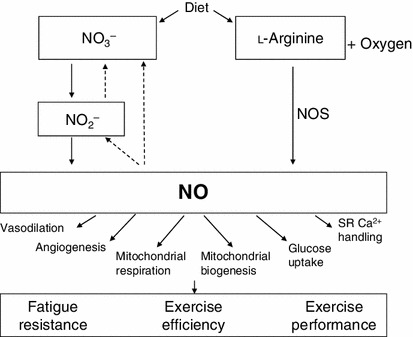
“NO can modulate skeletal muscle function through its role in the regulation of blood flow, contractility, glucose and calcium homeostasis, and mitochondrial respiration and biogenesis [19].”
§ Dietary Nitrate Supplementation and Exercise Performance > Introduction
What the sources say
- Not checked yetcites [19] Stamler JS, Meissner G. Physiology of nitric oxide in skeletal muscle. Physiol Rev. 2001;81:209–37. source
plaindirect- Asserted: passes — The authors put it forward as true.
- Checkable: passes — It can be checked against evidence.
- Load-bearing: passes — The paper’s conclusions depend on it.
- Based: passes — The paper gives a reason why it holds.
- It may state two separate claims as one. 40
- Probably not a substantial claim. 10
- The quote only partly states this claim. 3
Every source the paper cites for this claim was checked and supports it.
In the paper
“These striking effects on intracellular Ca2+ handling resulted in significantly increased contractile force at 50 Hz or less and a faster rate of force development at 100 Hz stimulation.”
§ Dietary Nitrate Supplementation and Exercise Performance > Mechanisms
What the sources say
- Supportedcites [59] Hernández A, Schiffer TA, Ivarsson N, et al. Dietary nitrate increases tetanic [Ca2+]i and contractile force in mouse fast-twitch muscle. J Physiol. 2012;590:3575–83. source
The Results report significantly greater force in nitrate-treated fibres at stimulation frequencies up to 50 Hz. They also report a markedly faster rise in force during 100 Hz contractions, with time to reach 50% of maximum force about 35% shorter than in controls. The Discussion links these effects to altered intracellular Ca2+ handling. (LLM, conf=0.94)
plaindirect- Asserted: passes — The authors put it forward as true.
- Checkable: passes — It can be checked against evidence.
- Load-bearing: passes — The paper’s conclusions depend on it.
- Based: passes — The paper gives a reason why it holds.
It may state two separate claims as one.
- Supported
The sources with a verdict support this claim; the rest weren’t checked yet, have no full text we could read, or their verdicts aren’t rated yet.
In the paper
“Evidence for positive effects of nitrate supplementation on both mitochondrial efficiency [61] and muscle contractile function [59] has recently been presented.”
§ Dietary Nitrate Supplementation and Exercise Performance > Mechanisms
What the sources say
- Not checked yetcites [61] Larsen FJ, Schiffer TA, Borniquel S, et al. Dietary inorganic nitrate improves mitochondrial efficiency in humans. Cell Metab. 2011;13:149–59. source
- Supportedcites [59] Hernández A, Schiffer TA, Ivarsson N, et al. Dietary nitrate increases tetanic [Ca2+]i and contractile force in mouse fast-twitch muscle. J Physiol. 2012;590:3575–83. source
Citation [59] is attached to muscle contractile function, not mitochondrial efficiency, which has a separate citation. The Abstract and Discussion report that nitrate supplementation increased contractile force in fast-twitch muscles of mice; the study found no force increase in slow-twitch muscles. (LLM, conf=0.94)
plaindirectn = 14- Asserted: passes — The authors put it forward as true.
- Checkable: passes — It can be checked against evidence.
- Load-bearing: passes — The paper’s conclusions depend on it.
- Based: passes — The paper gives a reason why it holds.
It may state two separate claims as one.
In the paper
“Following bolus nitrate ingestion, plasma nitrate concentration ([nitrate]) peaks after 1–2 h and plasma [nitrite] peaks after 2–3 h, after which both gradually fall, arriving back at baseline values after about 24 h [13].”
§ Dietary Nitrate Supplementation and Exercise Performance > Introduction
What the sources say
- Not checked yetcites [13] Webb AJ, Patel N, Loukogeorgakis S, et al. Acute blood pressure lowering, vasoprotective, and antiplatelet properties of dietary nitrate via bioconversion to nitrite. Hypertension. 2008;51:784–90. source
plaindirect- Asserted: passes — The authors put it forward as true.
- Checkable: passes — It can be checked against evidence.
- Load-bearing: fails — The paper’s conclusions may not depend on it.
- Based: passes — The paper gives a reason why it holds.
Probably not a substantial claim. The paper’s conclusions may not depend on it. It may state two separate claims as one.
In the paper
“In that study, nine well trained subjects consumed 0.1 mmol/kg body mass (BM) per day of sodium nitrate or a placebo for 3 days before completing a continuous incremental cycle ergometer test. Nitrate supplementation significantly elevated resting plasma [nitrite] (by 82 %) and reduced resting systolic and diastolic blood pressure (by 8 and 6 mmHg).”
§ Dietary Nitrate Supplementation and Exercise Performance > Nitrate Reduces Oxygen Cost of Exercise and Improves Exercise Tolerance
What the sources say
- Not checked yetcites [35] Larsen FJ, Weitzberg E, Lundberg JO, et al. Effects of dietary nitrate on oxygen cost during exercise. Acta Physiol. 2007;191:59–66. source
plaindirectn = 9- Asserted: passes — The authors put it forward as true.
- Checkable: passes — It can be checked against evidence.
- Load-bearing: passes — The paper’s conclusions depend on it.
- Based: passes — The paper gives a reason why it holds.
It may state two separate claims as one.
None of the sources cited for this claim have been checked yet.
In the paper
“Following ingestion, nitrate is converted in the body to nitrite and stored and circulated in the blood.”
§ Dietary Nitrate Supplementation and Exercise Performance > Abstract
What the sources say
- Not checked yetcites [8] Spiegelhalder B, Eisenbrand G, Preussmann R. Influence of dietary nitrate on nitrite content of human saliva: possible relevance to in vivo formation of N-nitroso compounds. Food Cosmet Toxicol. 1976;14:545–8. source
- Not checked yetcites [11] Dejam A, Hunter CJ, Schechter AN, et al. Emerging role of nitrite in human biology. Blood Cells Mol Dis. 2004;32:423–9. source
- Not checked yetcites [12] Lundberg JO, Govoni M. Inorganic nitrate is a possible source for systemic generation of nitric oxide. Free Radic Biol Med. 2004;37:395–400. source
plaindirect- Asserted: passes — The authors put it forward as true.
- Checkable: passes — It can be checked against evidence.
- Load-bearing: passes — The paper’s conclusions depend on it.
- Based: passes — The paper gives a reason why it holds.
It may state two separate claims as one.
In the paper
“The findings of Larsen et al. [35] are remarkable because a basic tenet of human exercise physiology is that the oxygen cost of submaximal exercise at a given work rate is immutable, that is, essentially fixed, irrespective of age, health, and fitness status, and insensitive to known physical, nutritional, or pharmacological interventions [36].”
§ Dietary Nitrate Supplementation and Exercise Performance > Nitrate Reduces Oxygen Cost of Exercise and Improves Exercise Tolerance
What the sources say
- Not checked yetcites [36] Poole DC, Richardson RS. Determinants of oxygen uptake. Implications for exercise testing. Sports Med. 1997;24:308–20. source
plain- Asserted: passes — The authors put it forward as true.
- Checkable: passes — It can be checked against evidence.
- Load-bearing: passes — The paper’s conclusions depend on it.
- Based: passes — The paper gives a reason why it holds.
Probably not a substantial claim.
In the paper
“There was no difference in blood [lactate], heart rate, ventilation, or respiratory exchange ratio between nitrate and placebo for any of the submaximal work rates”
§ Dietary Nitrate Supplementation and Exercise Performance > Nitrate Reduces Oxygen Cost of Exercise and Improves Exercise Tolerance
What the sources say
- Not checked yetcites [35] Larsen FJ, Weitzberg E, Lundberg JO, et al. Effects of dietary nitrate on oxygen cost during exercise. Acta Physiol. 2007;191:59–66. source
plainn = 9- Asserted: passes — The authors put it forward as true.
- Checkable: passes — It can be checked against evidence.
- Load-bearing: passes — The paper’s conclusions depend on it.
- Based: passes — The paper gives a reason why it holds.
It may state two separate claims as one.
In the paper
“Ingested inorganic nitrate circulates in the plasma, and a portion (~25 %) is taken up by the salivary glands and concentrated in the saliva [8].”
§ Dietary Nitrate Supplementation and Exercise Performance > Introduction
What the sources say
- Not checked yetcites [8] Spiegelhalder B, Eisenbrand G, Preussmann R. Influence of dietary nitrate on nitrite content of human saliva: possible relevance to in vivo formation of N-nitroso compounds. Food Cosmet Toxicol. 1976;14:545–8. source
plaindirect- Asserted: passes — The authors put it forward as true.
- Checkable: passes — It can be checked against evidence.
- Load-bearing: passes — The paper’s conclusions depend on it.
- Based: passes — The paper gives a reason why it holds.
It may state two separate claims as one.
None of the sources cited for this claim have been checked yet.
In the paper
“Inorganic nitrate is present in numerous foodstuffs and is abundant in green leafy vegetables and beetroot.”
§ Dietary Nitrate Supplementation and Exercise Performance > Abstract
What the sources say
- Not checked yetcites [2] Bryan NS. Nitrite in nitric oxide biology: cause or consequence? A systems-based review. Free Radic Biol Med. 2006;41:691–701. source
- Not checked yetcites [5] Lundberg JO, Gladwin MT, Ahluwalia A, et al. Nitrate and nitrite in biology, nutrition and therapeutics. Nat Chem Biol. 2009;5:865–9. source
- Not checked yetcites [7] Hord NG, Tang Y, Bryan NS. Food sources of nitrates and nitrites: the physiologic contact for potential health benefits. Am J Clin Nutr. 2009;90:1–10. source
plain- Asserted: passes — The authors put it forward as true.
- Checkable: passes — It can be checked against evidence.
- Load-bearing: fails — The paper’s conclusions may not depend on it.
- Based: passes — The paper gives a reason why it holds.
Probably not a substantial claim. The paper’s conclusions may not depend on it. It may state two separate claims as one.
None of the sources cited for this claim have been checked yet.
In the paper
“Some of the swallowed nitrite is reduced to NO in the acidic environment of the stomach, but a substantial amount of nitrite enters the systemic circulation, elevating the plasma nitrite concentration ([nitrite]) [11, 12].”
§ Dietary Nitrate Supplementation and Exercise Performance > Introduction
What the sources say
- Not checked yetcites [11] Dejam A, Hunter CJ, Schechter AN, et al. Emerging role of nitrite in human biology. Blood Cells Mol Dis. 2004;32:423–9. source
- Not checked yetcites [12] Lundberg JO, Govoni M. Inorganic nitrate is a possible source for systemic generation of nitric oxide. Free Radic Biol Med. 2004;37:395–400. source
plaindirect- Asserted: passes — The authors put it forward as true.
- Checkable: passes — It can be checked against evidence.
- Load-bearing: passes — The paper’s conclusions depend on it.
- Based: passes — The paper gives a reason why it holds.
It may state two separate claims as one.
In the paper
“Over the four lowest work rates, there were significant improvements in gross efficiency (calculated as the work output per unit energy expended, from 19.7 ± 1.6 to 21.1 ± 1.3 %) and delta efficiency (calculated as the change in work output per unit change in energy expended, from 22.1 ± 1.6 to 22.9 ± 1.9 %) following nitrate supplementation.”
§ Dietary Nitrate Supplementation and Exercise Performance > Nitrate Reduces Oxygen Cost of Exercise and Improves Exercise Tolerance
What the sources say
- Not checked yetcites [35] Larsen FJ, Weitzberg E, Lundberg JO, et al. Effects of dietary nitrate on oxygen cost during exercise. Acta Physiol. 2007;191:59–66. source
plaindirectn = 9- Asserted: passes — The authors put it forward as true.
- Checkable: passes — It can be checked against evidence.
- Load-bearing: passes — The paper’s conclusions depend on it.
- Based: passes — The paper gives a reason why it holds.
It may state two separate claims as one.
In the paper
“On days 4–6 of the supplementation periods, plasma [nitrite] was significantly elevated following nitrate intake compared with placebo (95 %), and systolic blood pressure was significantly reduced (by an average of 8 mmHg).”
§ Dietary Nitrate Supplementation and Exercise Performance > Nitrate Reduces Oxygen Cost of Exercise and Improves Exercise Tolerance
What the sources say
- Not checked yetcites [39] Bailey SJ, Winyard P, Vanhatalo A, et al. Dietary nitrate supplementation reduces the O2 cost of low-intensity exercise and enhances tolerance to high-intensity exercise in humans. J Appl Physiol. 2009;107:1144–55. source
plaindirectn = 8- Asserted: passes — The authors put it forward as true.
- Checkable: passes — It can be checked against evidence.
- Load-bearing: passes — The paper’s conclusions depend on it.
- Based: passes — The paper gives a reason why it holds.
It may state two separate claims as one.
In the paper
“Time trial performance (15.9 ± 0.3 vs. 16.1 ± 0.3 min) and power output (294 ± 12 vs. 288 ± 12 W) were significantly improved after beetroot juice compared with placebo supplementation.”
§ Dietary Nitrate Supplementation and Exercise Performance > Effects on Exercise Performance
What the sources say
- Not checked yetcites [49] Cermak NM, Gibala MJ, van Loon LJ. Nitrate supplementation’s improvement of 10-km time-trial performance in trained cyclists. Int J Sport Nutr Exerc Metab. 2012;22:64–71. source
plaindirect- Asserted: passes — The authors put it forward as true.
- Checkable: passes — It can be checked against evidence.
- Load-bearing: passes — The paper’s conclusions depend on it.
- Based: passes — The paper gives a reason why it holds.
It may state two separate claims as one.
In the paper
“The authors concluded that dietary nitrate reduces during maximal exercise using a large active muscle mass but with a trend towards improved performance due to enhanced muscle energetic function.”
§ Dietary Nitrate Supplementation and Exercise Performance > Nitrate Reduces Oxygen Cost of Exercise and Improves Exercise Tolerance
What the sources say
- Not checked yetcites [42] Larsen FJ, Weitzberg E, Lundberg JO, et al. Dietary nitrate reduces maximal oxygen consumption while maintaining work performance in maximal exercise. Free Radic Biol Med. 2010;48:342–7. source
plaindirect- Asserted: passes — The authors put it forward as true.
- Checkable: passes — It can be checked against evidence.
- Load-bearing: passes — The paper’s conclusions depend on it.
- Based: passes — The paper gives a reason why it holds.
It may state two separate claims as one.
In the paper
“At 1.8 km into the 5-km run, the rating of perceived exertion was significantly lower and running speed over the last 1.8 km of the 5-km distance was 5 % faster in the beetroot trial.”
§ Dietary Nitrate Supplementation and Exercise Performance > Effects on Exercise Performance
What the sources say
- Not checked yetcites [50] Murphy M, Eliot K, Heuertz RM, et al. Whole beetroot consumption acutely improves running performance. J Acad Nutr Diet. 2012;112:548–52. source
plaindirect- Asserted: passes — The authors put it forward as true.
- Checkable: passes — It can be checked against evidence.
- Load-bearing: passes — The paper’s conclusions depend on it.
- Based: passes — The paper gives a reason why it holds.
It may state two separate claims as one.
None of the sources cited for this claim have been checked yet.
In the paper
“Assuming that the other factors remain unchanged, an improvement in muscle efficiency would be expected to enable a greater work output for the same energy cost and translate into improved exercise performance [37, 38].”
§ Dietary Nitrate Supplementation and Exercise Performance > Nitrate Reduces Oxygen Cost of Exercise and Improves Exercise Tolerance
What the sources say
- Not checked yetcites [37] Coyle EF. Integration of the physiological factors determining endurance performance ability. Exerc Sport Sci Rev. 1995;23:25–63. source
- Not checked yetcites [38] Jones AM, Carter H. The effect of endurance training on parameters of aerobic fitness. Sports Med. 2000;29:373–86. source
hedgedconditional- Asserted: passes — The authors put it forward as true.
- Checkable: passes — It can be checked against evidence.
- Load-bearing: passes — The paper’s conclusions depend on it.
- Based: passes — The paper gives a reason why it holds.
Probably not a substantial claim. It may state two separate claims as one.
- The authors state this as an assumption: Other determinants of endurance exercise performance, such as maximal oxygen uptake and its fractional utilization, remain unchanged when muscle efficiency improves.
In the paper
“In addition to nitrate, beetroot juice also contains other compounds that may be independently bioactive or that may act synergistically with nitrate, including antioxidants (betaine and vitamins) and the polyphenols, resveratrol and quercetin [45].”
§ Dietary Nitrate Supplementation and Exercise Performance > Nitrate Reduces Oxygen Cost of Exercise and Improves Exercise Tolerance
What the sources say
- Not checked yetcites [45] Wootton-Beard PC, Ryan L. Combined use of multiple methodologies for the measurement of total antioxidant capacity in UK commercially available vegetable juices. Plant Foods Hum Nutr. 2012;67:142–7. source
hedgedconditional- Asserted: passes — The authors put it forward as true.
- Checkable: passes — It can be checked against evidence.
- Load-bearing: fails — The paper’s conclusions may not depend on it.
- Based: passes — The paper gives a reason why it holds.
Probably not a substantial claim. The paper’s conclusions may not depend on it.
In the paper
“Similarly, Peacock et al. [53] found that the consumption of 614 mg (~10 mmol) of potassium nitrate 2.5 h before exercise neither reduced submaximal during a low-intensity warm-up nor enhanced 5-km running performance compared with placebo in ten highly trained cross-country skiers (, 70 ml/kg per minute).”
§ Dietary Nitrate Supplementation and Exercise Performance > Effects on Exercise Performance
What the sources say
- Not checked yetcites [53] Peacock O, Tjonna AE, James P, et al. Dietary nitrate does not enhance running performance in elite cross-country skiers. Med Sci Sports Exerc. 2012;44:2213–9. source
plain- Asserted: passes — The authors put it forward as true.
- Checkable: passes — It can be checked against evidence.
- Load-bearing: unclear — It is unclear whether the paper’s conclusions depend on it.
- Based: passes — The paper gives a reason why it holds.
It may state two separate claims as one.
In the paper
“In a subsequent study using knee extensor exercise, Bailey et al. [41] confirmed that, compared with placebo, beetroot juice consumption reduced submaximal during low-intensity exercise, reduced the slow component, and increased time to exhaustion by 25 % (from 9.8 ± 1.3 to 12.2 ± 1.8 min) during high-intensity exercise.”
§ Dietary Nitrate Supplementation and Exercise Performance > Nitrate Reduces Oxygen Cost of Exercise and Improves Exercise Tolerance
What the sources say
- Not checked yetcites [41] Bailey SJ, Fulford J, Vanhatalo A, et al. Dietary nitrate supplementation enhances muscle contractile efficiency during knee-extensor exercise in humans. J Appl Physiol. 2010;109:135–48. source
plaindirect- Asserted: passes — The authors put it forward as true.
- Checkable: passes — It can be checked against evidence.
- Load-bearing: passes — The paper’s conclusions depend on it.
- Based: passes — The paper gives a reason why it holds.
It may state two separate claims as one.
In the paper
“During moderate-intensity exercise, steady-state was reduced by 5 %.”
§ Dietary Nitrate Supplementation and Exercise Performance > Nitrate Reduces Oxygen Cost of Exercise and Improves Exercise Tolerance
What the sources say
- Not checked yetcites [39] Bailey SJ, Winyard P, Vanhatalo A, et al. Dietary nitrate supplementation reduces the O2 cost of low-intensity exercise and enhances tolerance to high-intensity exercise in humans. J Appl Physiol. 2009;107:1144–55. source
plaindirectn = 8- Asserted: passes — The authors put it forward as true.
- Checkable: passes — It can be checked against evidence.
- Load-bearing: passes — The paper’s conclusions depend on it.
- Based: passes — The paper gives a reason why it holds.
The quote only partly states this claim.
None of the sources cited for this claim have been checked yet.
In the paper
“Collectively, these studies suggest that both acute [48] and more chronic [49] dietary nitrate supplementation improves cycle efficiency and time trial performance, at least for events of approximately 5–30 min duration in trained but sub-elite cyclists ( of approximately 53–63 ml/kg per minute).”
§ Dietary Nitrate Supplementation and Exercise Performance > Effects on Exercise Performance
What the sources say
- Not checked yetcites [48] Lansley KE, Winyard PG, Bailey SJ, et al. Acute dietary nitrate supplementation improves cycling time trial performance. Med Sci Sports Exerc. 2011;43:1125–31. source
- Not checked yetcites [49] Cermak NM, Gibala MJ, van Loon LJ. Nitrate supplementation’s improvement of 10-km time-trial performance in trained cyclists. Int J Sport Nutr Exerc Metab. 2012;22:64–71. source
hedgeddirect- Asserted: passes — The authors put it forward as true.
- Checkable: passes — It can be checked against evidence.
- Load-bearing: passes — The paper’s conclusions depend on it.
- Based: passes — The paper gives a reason why it holds.
It may state two separate claims as one.
In the paper
“For example, a 15 % improvement in time to exhaustion following a given intervention might be expected to translate into a 1 % improvement in time trial performance over an equivalent duration [47].”
§ Dietary Nitrate Supplementation and Exercise Performance > Effects on Exercise Performance
What the sources say
- Not checked yetcites [47] Hopkins WG, Hawley JA, Burke LM. Design and analysis of research on sport performance enhancement. Med Sci Sports Exerc. 1999;31:472–85. source
hedgedcorrelational- Asserted: passes — The authors put it forward as true.
- Checkable: passes — It can be checked against evidence.
- Load-bearing: passes — The paper’s conclusions depend on it.
- Based: passes — The paper gives a reason why it holds.
It may state two separate claims as one.
In the paper
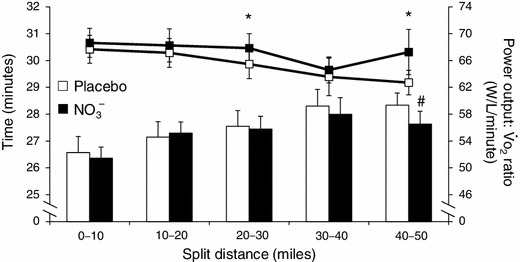
“There was no significant difference in time trial performance between treatments (beetroot juice 136.7 ± 5.6 vs. placebo 137.9 ± 6.4 min), although there was a tendency for the ratio of power output to to be higher following nitrate supplementation (Fig. 3).”
§ Dietary Nitrate Supplementation and Exercise Performance > Effects on Exercise Performance
What the sources say
- Not checked yetcites [54] Wilkerson DP, Hayward GM, Bailey SJ, et al. Influence of acute dietary nitrate supplementation on 50 mile time trial performance in well-trained cyclists. Eur J Appl Physiol. 2012;112:4127–34. source
plain- Asserted: passes — The authors put it forward as true.
- Checkable: passes — It can be checked against evidence.
- Load-bearing: passes — The paper’s conclusions depend on it.
- Based: passes — The paper gives a reason why it holds.
It may state two separate claims as one.
In the paper
“The oxygen cost of treadmill walking and moderate-intensity treadmill running were significantly reduced.”
§ Dietary Nitrate Supplementation and Exercise Performance > Nitrate Reduces Oxygen Cost of Exercise and Improves Exercise Tolerance
What the sources say
- Not checked yetcites [46] Lansley KE, Winyard PG, Fulford J, et al. Dietary nitrate supplementation reduces the O2 cost of walking and running: a placebo-controlled study. J Appl Physiol. 2011;110:591–600. source
plaindirectn = 9- Asserted: passes — The authors put it forward as true.
- Checkable: passes — It can be checked against evidence.
- Load-bearing: passes — The paper’s conclusions depend on it.
- Based: passes — The paper gives a reason why it holds.
The quote only partly states this claim.
In the paper
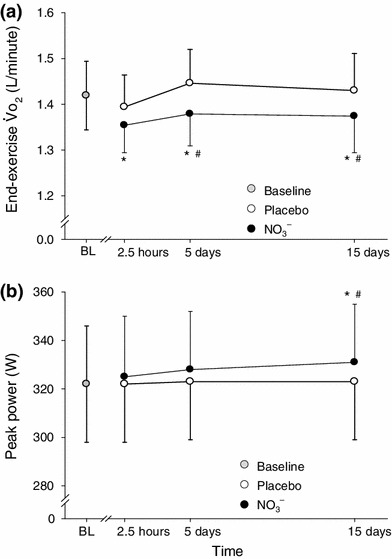
“The steady-state during moderate-intensity exercise was significantly reduced (by approximately 4 %) 2.5 h after beetroot juice intake compared with pre-supplementation control, and it remained significantly reduced after 5 and 15 days of supplementation compared with placebo (Fig. 2).”
§ Dietary Nitrate Supplementation and Exercise Performance > Nitrate Reduces Oxygen Cost of Exercise and Improves Exercise Tolerance
What the sources say
- Not checked yetcites [44] Vanhatalo A, Bailey SJ, Blackwell JR, et al. Acute and chronic effects of dietary nitrate supplementation on blood pressure and the physiological responses to moderate-intensity and incremental exercise. Am J Physiol. 2010;299:1121–31.
plaindirectn = 8- Asserted: passes — The authors put it forward as true.
- Checkable: passes — It can be checked against evidence.
- Load-bearing: passes — The paper’s conclusions depend on it.
- Based: passes — The paper gives a reason why it holds.
It may state two separate claims as one.
In the paper
“The authors concluded that beetroot juice supplementation conferred a likely benefit to mean repetition time compared with placebo (0.4 %, 95 % confidence limits ±1.0 %) and an almost certain benefit for repetitions 4–6 (1.7 %, 95 % confidence limits ±1.0 %).”
§ Dietary Nitrate Supplementation and Exercise Performance > Effects on Exercise Performance
What the sources say
- Not checked yetcites [51] Bond H, Morton L, Braakhuis AJ. Dietary nitrate supplementation improves rowing performance in well-trained rowers. Int J Sport Nutr Exerc Metab. 2012;22:251–6. source
hedgeddirect- Asserted: passes — The authors put it forward as true.
- Checkable: passes — It can be checked against evidence.
- Load-bearing: passes — The paper’s conclusions depend on it.
- Based: passes — The paper gives a reason why it holds.
It may state two separate claims as one.
In the paper
“Consequently, compared with placebo, beetroot juice significantly improved 4-km performance (2.8 %) and 16.1-km performance (2.7 %).”
§ Dietary Nitrate Supplementation and Exercise Performance > Effects on Exercise Performance
What the sources say
- Not checked yetcites [48] Lansley KE, Winyard PG, Bailey SJ, et al. Acute dietary nitrate supplementation improves cycling time trial performance. Med Sci Sports Exerc. 2011;43:1125–31. source
plaindirect- Asserted: passes — The authors put it forward as true.
- Checkable: passes — It can be checked against evidence.
- Load-bearing: passes — The paper’s conclusions depend on it.
- Based: passes — The paper gives a reason why it holds.
It may state two separate claims as one.
In the paper
“Whole-body fuel selection and plasma lactate, glucose, and insulin concentrations did not differ between treatments.”
§ Dietary Nitrate Supplementation and Exercise Performance > Effects on Exercise Performance
What the sources say
- Not checked yetcites [49] Cermak NM, Gibala MJ, van Loon LJ. Nitrate supplementation’s improvement of 10-km time-trial performance in trained cyclists. Int J Sport Nutr Exerc Metab. 2012;22:64–71. source
plain- Asserted: passes — The authors put it forward as true.
- Checkable: passes — It can be checked against evidence.
- Load-bearing: unclear — It is unclear whether the paper’s conclusions depend on it.
- Based: passes — The paper gives a reason why it holds.
It may state two separate claims as one.
In the paper
“Consistent with the study of Larsen et al. [35], nitrate did not alter blood [lactate], heart rate, ventilation, or respiratory exchange ratio for either moderate- or high-intensity exercise.”
§ Dietary Nitrate Supplementation and Exercise Performance > Nitrate Reduces Oxygen Cost of Exercise and Improves Exercise Tolerance
What the sources say
- Not checked yetcites [39] Bailey SJ, Winyard P, Vanhatalo A, et al. Dietary nitrate supplementation reduces the O2 cost of low-intensity exercise and enhances tolerance to high-intensity exercise in humans. J Appl Physiol. 2009;107:1144–55. source
plain- Asserted: passes — The authors put it forward as true.
- Checkable: passes — It can be checked against evidence.
- Load-bearing: unclear — It is unclear whether the paper’s conclusions depend on it.
- Based: passes — The paper gives a reason why it holds.
It may state two separate claims as one. The quote only partly states this claim.
In the paper
“An alternative explanation for the coincident reductions in steady-state and PCr is that nitrate supplementation simultaneously improves muscle oxygenation (thus sparing muscle PCr) [70] and improves mitochondrial efficiency (thus lowering ).”
§ Dietary Nitrate Supplementation and Exercise Performance > Mechanisms
What the sources say
- Not checked yetcites [70] Wilson DF. Factors affecting the rate and energetics of mitochondrial oxidative phosphorylation. Med Sci Sports Exerc. 1994;26:37–43. source
hedgeddirect- Asserted: passes — The authors put it forward as true.
- Checkable: passes — It can be checked against evidence.
- Load-bearing: fails — The paper’s conclusions may not depend on it.
- Based: passes — The paper gives a reason why it holds.
Probably not a substantial claim. The paper’s conclusions may not depend on it. It may state two separate claims as one.
None of the sources cited for this claim have been checked yet.
In the paper
“Those studies [71, 72] indicate that nitrate supplementation, which may reduce both the ATP and oxygen cost of muscle contraction [41, 59, 61], simultaneously increases muscle oxygen delivery.”
§ Dietary Nitrate Supplementation and Exercise Performance > Mechanisms
What the sources say
- Not checked yetcites [71] Ferguson SK, Hirai DM, Copp SW, et al. Impact of dietary nitrate supplementation via beetroot juice on exercising muscle vascular control in rats. J Physiol. 2013;591:547–57. source
- Not checked yetcites [72] Ferguson SK, Hirai DM, Copp SW, et al. Effects of nitrate supplementation via beetroot juice on contracting rat skeletal muscle microvascular oxygen pressure dynamics. Respir Physiol Neurobiol. 2013;187:250–5. source
- Not checked yetcites [41] Bailey SJ, Fulford J, Vanhatalo A, et al. Dietary nitrate supplementation enhances muscle contractile efficiency during knee-extensor exercise in humans. J Appl Physiol. 2010;109:135–48. source
- Not checked yetcites [59] Hernández A, Schiffer TA, Ivarsson N, et al. Dietary nitrate increases tetanic [Ca2+]i and contractile force in mouse fast-twitch muscle. J Physiol. 2012;590:3575–83. source
- Not checked yetcites [61] Larsen FJ, Schiffer TA, Borniquel S, et al. Dietary inorganic nitrate improves mitochondrial efficiency in humans. Cell Metab. 2011;13:149–59. source
hedgeddirect- Asserted: passes — The authors put it forward as true.
- Checkable: passes — It can be checked against evidence.
- Load-bearing: passes — The paper’s conclusions depend on it.
- Based: passes — The paper gives a reason why it holds.
It may state two separate claims as one.
In the paper
“Highly trained subjects would be expected to have greater skeletal muscle capillarization [58], perhaps minimizing any hypoperfusion of metabolically active tissue during exercise, and therefore reducing the requirement for NO production through the reduction of nitrite.”
§ Dietary Nitrate Supplementation and Exercise Performance > Effects on Exercise Performance
What the sources say
- Not checked yetcites [58] Jensen L, Bangsbo J, Hellsten Y. Effect of high intensity training on capillarization and presence of angiogenic factors in human skeletal muscle. J Physiol. 2004;557:571–82. source
hedgedconditional- Asserted: passes — The authors put it forward as true.
- Checkable: passes — It can be checked against evidence.
- Load-bearing: passes — The paper’s conclusions depend on it.
- Based: passes — The paper gives a reason why it holds.
It may state two separate claims as one.
In the paper
“Moreover, highly trained subjects may have higher plasma [nitrite] values than sedentary or lesser trained subjects [57], such that the response to a standard dose of nitrate may be diminished.”
§ Dietary Nitrate Supplementation and Exercise Performance > Effects on Exercise Performance
What the sources say
- Not checked yetcites [57] Poveda JJ, Riestra A, Salas E, et al. Contribution of nitric oxide to exercise-induced changes in healthy volunteers: effects of acute exercise and long-term physical training. Eur J Clin Invest. 1997;27:967–71. source
hedgedconditional- Asserted: passes — The authors put it forward as true.
- Checkable: passes — It can be checked against evidence.
- Load-bearing: passes — The paper’s conclusions depend on it.
- Based: passes — The paper gives a reason why it holds.
It may state two separate claims as one.
In the paper
“Nitrate supplementation resulted in a 19 % increase in the mitochondrial P/O ratio (the amount of oxygen consumed per ATP produced), which was closely correlated (r = −0.80) with the reduction in whole-body during submaximal cycling.”
§ Dietary Nitrate Supplementation and Exercise Performance > Mechanisms
What the sources say
- Not checked yetcites [61] Larsen FJ, Schiffer TA, Borniquel S, et al. Dietary inorganic nitrate improves mitochondrial efficiency in humans. Cell Metab. 2011;13:149–59. source
plaindirectn = 14- Asserted: passes — The authors put it forward as true.
- Checkable: passes — It can be checked against evidence.
- Load-bearing: passes — The paper’s conclusions depend on it.
- Based: passes — The paper gives a reason why it holds.
It may state two separate claims as one.
A conclusion the paper draws from its own results — it cites no other source for it, so there is none to check. The quote shows it is in the paper.
In the paper
“The net result is a higher ratio of oxygen delivery to oxygen utilization, which would be expected to reduce the muscle metabolic perturbation and be conducive to muscle fatigue resistance.”
§ Dietary Nitrate Supplementation and Exercise Performance > Mechanisms
hedgedconditional- Asserted: passes — The authors put it forward as true.
- Checkable: passes — It can be checked against evidence.
- Load-bearing: passes — The paper’s conclusions depend on it.
- Based: passes — The paper gives a reason why it holds.
It may state two separate claims as one.
A conclusion the paper draws from its own results — it cites no other source for it, so there is none to check. The quote shows it is in the paper.
In the paper
“Muscle oxygen delivery was therefore substantially elevated in the low oxidative, highly fatigable fibers, such that oxygen might be considered to be more appropriately distributed across and within the active muscles.”
§ Dietary Nitrate Supplementation and Exercise Performance > Mechanisms
hedgeddirect- Asserted: passes — The authors put it forward as true.
- Checkable: passes — It can be checked against evidence.
- Load-bearing: passes — The paper’s conclusions depend on it.
- Based: passes — The paper gives a reason why it holds.
It may state two separate claims as one.
In the paper
“Highly trained subjects are likely to have high NOS activity [56], which might render the nitrate–nitrite–NO pathway relatively less important for NO production.”
§ Dietary Nitrate Supplementation and Exercise Performance > Effects on Exercise Performance
What the sources say
- Not checked yetcites [56] McConell GK, Bradley SJ, Stephens TJ, et al. Skeletal muscle nNOS protein content is increased by exercise training in humans. Am J Physiol. 2007;293:R821–8.
hedgedconditional- Asserted: passes — The authors put it forward as true.
- Checkable: passes — It can be checked against evidence.
- Load-bearing: passes — The paper’s conclusions depend on it.
- Based: passes — The paper gives a reason why it holds.
It may state two separate claims as one.
In the paper
“Following nitrate supplementation, the expression of adenine nucleotide translocase (ANT), a protein involved in mitochondrial proton conductance, was reduced, thus reducing leak respiration and improving the efficiency of oxidative phosphorylation.”
§ Dietary Nitrate Supplementation and Exercise Performance > Mechanisms
What the sources say
- Not checked yetcites [61] Larsen FJ, Schiffer TA, Borniquel S, et al. Dietary inorganic nitrate improves mitochondrial efficiency in humans. Cell Metab. 2011;13:149–59. source
plaindirectn = 14- Asserted: passes — The authors put it forward as true.
- Checkable: passes — It can be checked against evidence.
- Load-bearing: passes — The paper’s conclusions depend on it.
- Based: passes — The paper gives a reason why it holds.
It may state two separate claims as one.
In the paper
“Exercising blood pressure and blood [lactate] were significantly lower following nitrate feeding, and there was a striking (38 %) increase in muscle blood flow between nitrate-fed and placebo-fed rats.”
§ Dietary Nitrate Supplementation and Exercise Performance > Mechanisms
What the sources say
- Not checked yetcites [71] Ferguson SK, Hirai DM, Copp SW, et al. Impact of dietary nitrate supplementation via beetroot juice on exercising muscle vascular control in rats. J Physiol. 2013;591:547–57. source
plaindirect- Asserted: passes — The authors put it forward as true.
- Checkable: passes — It can be checked against evidence.
- Load-bearing: passes — The paper’s conclusions depend on it.
- Based: passes — The paper gives a reason why it holds.
It may state two separate claims as one.
In the paper
“This might be expected to reduce substrate-level phosphorylation, improve metabolic control and exercise efficiency, and be advantageous to performance [40].”
§ Dietary Nitrate Supplementation and Exercise Performance > Mechanisms
What the sources say
- Not checked yetcites [40] Jones AM, Grassi B, Christensen PM, et al. Slow component of O2 kinetics: mechanistic bases and practical applications. Med Sci Sports Exerc. 2011;43:2046–62. source
hedgedconditional- Asserted: passes — The authors put it forward as true.
- Checkable: passes — It can be checked against evidence.
- Load-bearing: passes — The paper’s conclusions depend on it.
- Based: passes — The paper gives a reason why it holds.
Probably not a substantial claim. It may state two separate claims as one.
A conclusion the paper draws from its own results — it cites no other source for it, so there is none to check. The quote shows it is in the paper.
In the paper
“From the above review, it appears clear that dietary nitrate has the potential to reduce blood pressure, lower the oxygen cost of exercise, and, at least in some circumstances, enhance exercise capacity.”
§ Dietary Nitrate Supplementation and Exercise Performance > Practical Considerations
hedgedconditional- Asserted: passes — The authors put it forward as true.
- Checkable: passes — It can be checked against evidence.
- Load-bearing: passes — The paper’s conclusions depend on it.
- Based: passes — The paper gives a reason why it holds.
It may state two separate claims as one.
A conclusion the paper draws from its own results — it cites no other source for it, so there is none to check. The quote shows it is in the paper.
In the paper
“This may be related to the lower intensity of such exercise and the associated reduced likelihood of the development of local mismatching of perfusion to metabolic rate in muscle (i.e. loci that are relatively hypoxic and acidic).”
§ Dietary Nitrate Supplementation and Exercise Performance > Practical Considerations
hedgedconditional- Asserted: passes — The authors put it forward as true.
- Checkable: passes — It can be checked against evidence.
- Load-bearing: passes — The paper’s conclusions depend on it.
- Based: fails — The paper may give no reason why it holds.
Probably not a substantial claim. The paper may give no reason why it holds.
A conclusion the paper draws from its own results — it cites no other source for it, so there is none to check. The quote shows it is in the paper.
In the paper
“For example, the efficacy of nitrate might well depend on factors such as the type of subject, including age, diet, and health and fitness status; the intensity, duration, and nature of the exercise challenge; and the dose applied and duration of the nitrate supplementation regimen.”
§ Dietary Nitrate Supplementation and Exercise Performance > Conclusions
hedgedconditional- Asserted: passes — The authors put it forward as true.
- Checkable: passes — It can be checked against evidence.
- Load-bearing: passes — The paper’s conclusions depend on it.
- Based: fails — The paper may give no reason why it holds.
Probably not a substantial claim. The paper may give no reason why it holds. It may state two separate claims as one.
None of the sources cited for this claim have been checked yet.
In the paper
“Acute nitrate intake may rapidly influence vascular tone and peripheral tissue oxygenation [33, 44], but more time may be necessary to permit changes in mitochondrial and contractile proteins to influence exercise performance [59, 61].”
§ Dietary Nitrate Supplementation and Exercise Performance > Practical Considerations
What the sources say
- Not checked yetcites [33] Kenjale AA, Ham KL, Stabler T, et al. Dietary nitrate supplementation enhances exercise performance in peripheral arterial disease. J Appl Physiol. 2011;110:1582–91. source
- Not checked yetcites [44] Vanhatalo A, Bailey SJ, Blackwell JR, et al. Acute and chronic effects of dietary nitrate supplementation on blood pressure and the physiological responses to moderate-intensity and incremental exercise. Am J Physiol. 2010;299:1121–31.
- Not checked yetcites [59] Hernández A, Schiffer TA, Ivarsson N, et al. Dietary nitrate increases tetanic [Ca2+]i and contractile force in mouse fast-twitch muscle. J Physiol. 2012;590:3575–83. source
- Not checked yetcites [61] Larsen FJ, Schiffer TA, Borniquel S, et al. Dietary inorganic nitrate improves mitochondrial efficiency in humans. Cell Metab. 2011;13:149–59. source
hedgedconditional- Asserted: passes — The authors put it forward as true.
- Checkable: passes — It can be checked against evidence.
- Load-bearing: passes — The paper’s conclusions depend on it.
- Based: passes — The paper gives a reason why it holds.
It may state two separate claims as one.
None of the sources cited for this claim have been checked yet.
In the paper
“The effects of acute supplementation on performance are less consistent, with some studies showing a positive effect [33, 48, 50, 73] and others showing no effect [52–54, 74].”
§ Dietary Nitrate Supplementation and Exercise Performance > Practical Considerations
What the sources say
- Not checked yetcites [33] Kenjale AA, Ham KL, Stabler T, et al. Dietary nitrate supplementation enhances exercise performance in peripheral arterial disease. J Appl Physiol. 2011;110:1582–91. source
- Not checked yetcites [48] Lansley KE, Winyard PG, Bailey SJ, et al. Acute dietary nitrate supplementation improves cycling time trial performance. Med Sci Sports Exerc. 2011;43:1125–31. source
- Not checked yetcites [50] Murphy M, Eliot K, Heuertz RM, et al. Whole beetroot consumption acutely improves running performance. J Acad Nutr Diet. 2012;112:548–52. source
- Not checked yetcites [73] Wylie LJ, Mohr M, Krustrup P, et al. Dietary nitrate supplementation improves team sport-specific intense intermittent exercise performance. Eur J Appl Physiol. 2013;113:1673–84. source
- Not checked yetcites [52] Cermak NM, Res P, Stinkens R, et al. No improvement in endurance performance following a single dose of beetroot juice. Int J Sport Nutr Exerc Metab. 2012;22:470–8. source
- Not checked yetcites [53] Peacock O, Tjonna AE, James P, et al. Dietary nitrate does not enhance running performance in elite cross-country skiers. Med Sci Sports Exerc. 2012;44:2213–9. source
- Not checked yetcites [54] Wilkerson DP, Hayward GM, Bailey SJ, et al. Influence of acute dietary nitrate supplementation on 50 mile time trial performance in well-trained cyclists. Eur J Appl Physiol. 2012;112:4127–34. source
- Not checked yetcites [74] Christensen PM, Nyberg M, Bangsbo J. Influence of nitrate supplementation on V O 2 kinetics and endurance of elite cyclists. Scand J Med Sci Sports. 2013;23:e21–31. source
plain- Asserted: passes — The authors put it forward as true.
- Checkable: passes — It can be checked against evidence.
- Load-bearing: passes — The paper’s conclusions depend on it.
- Based: passes — The paper gives a reason why it holds.
It may state two separate claims as one.
None of the sources cited for this claim have been checked yet.
In the paper
“The expert consensus view is that nitrate supplementation with vegetable products such as beetroot juice is very unlikely to be harmful [78, 79].”
§ Dietary Nitrate Supplementation and Exercise Performance > Practical Considerations
What the sources say
- Not checked yetcites [78] Lundberg JO, Larsen FJ, Weitzberg E. Supplementation with nitrate and nitrite salts in exercise: a word of caution. J Appl Physiol. 2011;111:616–7. source
- Not checked yetcites [79] Jones AM, Bailey SJ, Vanhatalo A, et al. Reply to Lundberg, Larsen, and Weitzberg. J Appl Physiol. 2011;111:619. source
hedged- Asserted: passes — The authors put it forward as true.
- Checkable: passes — It can be checked against evidence.
- Load-bearing: fails — The paper’s conclusions may not depend on it.
- Based: passes — The paper gives a reason why it holds.
Probably not a substantial claim. The paper’s conclusions may not depend on it.
The authors state this as an assumption.
Other determinants of endurance exercise performance, such as maximal oxygen uptake and its fractional utilization, remain unchanged when muscle efficiency improves.
“Assuming that the other factors remain unchanged, an improvement in muscle efficiency would be expected to enable a greater work output for the same energy cost and translate into improved exercise performance [37, 38].”
The authors state this as an assumption.
Any harmful effect of nitrosation requires the presence of secondary amines in the saliva or stomach.
“It is pertinent to note that any possible harmful effect of nitrosation (which assumes the presence of secondary amines in the saliva or stomach) is very effectively inhibited [77] by the antioxidants that accompany nitrate in vegetables [45].”
The paper relies on this without support.
5–9 mmol nitrate can readily be consumed within the normal diet.
“It should be emphasized that 5–9 mmol nitrate can readily be consumed within the normal diet and there is presently no evidence that additional nitrate intake produces greater benefits.”
Claims other papers make about this one
Each is checked against this paper’s own text: does it say what the citing paper says it does?
The source backs part of the claim, not all of it — or backs it for a different population, condition or comparison.
In the citing paper
“Dietary nitrate is sequentially reduced to nitrite and then to NO. This enhances oxygen delivery, reduces the oxygen cost of submaximal exercise, and improves endurance performance. This is likely due to improved mitochondrial efficiency and muscle perfusion [41,42,43,44].”
From Dietary Nitrate-Rich Vegetables as Natural Modulators of Health: Mechanisms and Benefits in Ageing Populations (2026) · cites this paper as [43]
Experimental — accuracy not yet measuredThe source backs part of the claim, not all of it — or backs it for a different population, condition or comparison.
In the citing paper
“Short-term nitrate supplementation has been shown to improve muscle oxygenation and reduce the oxygen cost of submaximal exercise, thereby enhancing muscular efficiency [43].”
From Dietary Nitrate-Rich Vegetables as Natural Modulators of Health: Mechanisms and Benefits in Ageing Populations (2026) · cites this paper as [43]
Experimental — accuracy not yet measuredIn the citing paper
“There is also some evidence that nitrates can improve exercise performance in specific conditions [81, 82].”
From Periodized Nutrition for Athletes (2017) · cites this paper as [82]
In the citing paper
“Nevertheless, there seems good evidence that nitrate/BJ supplementation can enhance sports performance in moderate caliber athletes and individuals among elite athlete populations [130], with emphasis on adequate supplementation protocols and sports or scenarios which rely on the recruitment of the lessoxidative type II muscle fibres, and local or environmental conditions of hypoxia or acidosis (e”
From New strategies in sport nutrition to increase exercise performance (2016) · cites this paper as [130]
In the citing paper
“Reasons for this observation include a greater dietary nitrate intake and/or greater capacity for arginine-derived production of NO in highly trained individuals, as well as better genetic and training-supported characteristics in the muscle, which enhance oxygen delivery and buffer metabolic acidosis, thus reducing the conditions under which the nitrate-nitrite-NO pathway may be important [130].”
From New strategies in sport nutrition to increase exercise performance (2016) · cites this paper as [130]
In the citing paper
“In addition to a number of health and benefits in clinical populations, enhanced NO availability appears to be responsible for improved exercise capacity via mechanisms including an increase in oxygen economy and direct effects on muscle contractility [130].”
From New strategies in sport nutrition to increase exercise performance (2016) · cites this paper as [130]
In the citing paper
“an effect that over 14 studies have confirmed with reduced VO2 and increased work capacity in response to nitrate during submaximal exercise in healthy individuals[128,129] (reviewed in:[130,131]) and in certain chronic diseases[127,132].”
From Enterosalivary nitrate metabolism and the microbiome: Intersection of microbial metabolism, nitric oxide and diet in cardiac and pulmonary vascular health (2017) · cites this paper as [131]
Self-check
Percentages, sums and reported differences re-computed from the paper’s own numbers.
Each contradiction between two passages listed here was confirmed by an independent check.
Rated minor: it would not touch a result — a value no result rests on, a p-value that stays on the same side of the significance level, or a conflict that is clerical, resolved elsewhere in the paper, or outside its own findings.
In the paper
§ Dietary Nitrate Supplementation and Exercise Performance > Mechanisms
“Nitrate supplementation resulted in a 19 % increase in the mitochondrial P/O ratio (the amount of oxygen consumed per ATP produced)”
§ Dietary Nitrate Supplementation and Exercise Performance > Mechanisms
“Following nitrate supplementation, the expression of adenine nucleotide translocase (ANT), a protein involved in mitochondrial proton conductance, was reduced, thus reducing leak respiration and improving the efficiency of oxidative phosphorylation.”
Citations
Cites
The L-Arginine-Nitric Oxide Pathway
Epstein, F. H., Moncada, S., & Higgs, A. (1993) · New England Journal of Medicine · doi:10.1056/nejm199312303292706 · Cited by 6,678
The nitrate-nitrite-nitric oxide pathway in physiology and therapeutics
Lundberg, J. O., Weitzberg, E., & Gladwin, M. T. (2008) · Nature Reviews Drug Discovery · doi:10.1038/nrd2466 · Cited by 2,739 · cited 1×
“It has been suggested that this alternative pathway may complement the L-arginine–NOS–NO pathway by enabling NO production in conditions of low oxygen availability in which NOS activity (which is oxygen dependent) may be reduced [6].”
BackgroundSkeletal muscle fatigue: cellular mechanisms
Allen, D. G., Lamb, G. D., & Westerblad, H. (2008) · Physiological Reviews · doi:10.1152/physrev.00015.2007 · Cited by 2,495
Nitrite reduction to nitric oxide by deoxyhemoglobin vasodilates the human circulation
Cosby, K., Partovi, K. S., Crawford, J. H., Patel, R. P., Reiter, C. D., Martyr, S., Yang, B. K., Waclawiw, M. A., Zalos, G., Xu, X., et al. (2003) · Nature Medicine · doi:10.1038/nm954 · Cited by 1,807
Cleeter, M. W. J., Cooper, J. M., Darley-Usmar, V. M., Moncada, S., & Schapira, A. H. V. (1994) · FEBS Letters · doi:10.1016/0014-5793(94)00424-2 · Cited by 1,241
Physiology of Nitric Oxide in Skeletal Muscle
Stamler, J. S., & Meissner, G. (2001) · Physiological Reviews · doi:10.1152/physrev.2001.81.1.209 · Cited by 1,080
Webb, A. J., Patel, N., Loukogeorgakis, S., Okorie, M., Aboud, Z., Misra, S., Rashid, R., Miall, P., Deanfield, J., Benjamin, N., et al. (2008) · Hypertension · doi:10.1161/hypertensionaha.107.103523 · Cited by 1,078
Food sources of nitrates and nitrites: The physiologic context for potential health benefits
Hord, N. G., Tang, Y., & Bryan, N. S. (2009) · The American Journal of Clinical Nutrition · doi:10.3945/ajcn.2008.27131 · Cited by 1,069
Brown, G. C., & Cooper, C. E. (1994) · FEBS Letters · doi:10.1016/0014-5793(94)01290-3 · Cited by 1,055
The Effect of Endurance Training on Parameters of Aerobic Fitness
Jones, A. M., & Carter, H. (2000) · Sports Medicine · doi:10.2165/00007256-200029060-00001 · Cited by 935
Self-citation
Cited by
Sorted by citations
Items 301–400 of 451
Liang, J., Huang, T., Li, J., Yang, Z., Ni, J., & Wang, Y. (2026) · RSC Advances · doi:10.1039/d6ra00317f · Cited by 4
Thomas, R., Williams, M. M. A., Newyton, R. U., Kenfield, S. A., & Aldous, J. (2026) · Journal of Ageing and Longevity · doi:10.3390/jal6020035 · Cited by 2
Lin, X., Zhang, Y., Pu, J., & Peng, Y. (2026) · Frontiers in Nutrition · doi:10.3389/fnut.2025.1739173 · Cited by 2
Stout, J. R., Housh, T. J., & Bergstrom, H. C. (2026) · Journal of the International Society of Sports Nutrition · doi:10.1080/15502783.2026.2711031 · Cited by 2
Shariffi, B., Dillon, K. N., Gillum, T., Boyer, W. R., Sullivan, S., Lee, E., & Kim, J.-K. (2022) · Journal of Dietary Supplements · doi:10.1080/19390211.2021.2023246 · Cited by 2
Nutrition and supplementation in football - practical guidelines based on current literature review
Staśkiewicz‐Bartecka, W. (2022) · Journal of Education Health and Sport · doi:10.12775/jehs.2022.12.10.012 · Cited by 2
da Silva, W. T., Machado, P. G., Mesquita, V. S. P. A., Andrade, E. F., Lima, R. R., & Pereira, L. J. (2022) · Science & Sports · doi:10.1016/j.scispo.2022.02.004 · Cited by 2
Application of beetroot's nitrates juice in team sports
Dorożyński, B., Osowski, M., Balwierz, R. J., Biernat, P., & Jasicka-Misiak, І. (2023) · Science & Sports · doi:10.1016/j.scispo.2022.04.010 · Cited by 2
The Effects of L-Citrulline and Malic Acid on Substrate Utilisation and Lactate Elimination
Baráth, A., Annár, D., Györe, I., & Szmodis, M. (2024) · Applied Sciences · doi:10.3390/app14178055 · Cited by 2
Viribay, A., Alcántara, J. M. A., López, I., Mielgo‐Ayuso, J., & Castañeda-Babarro, A. (2024) · European Journal of Applied Physiology · doi:10.1007/s00421-024-05636-7 · Cited by 4
Ergonutrition Supplementation and Recovery in Water Polo: A Systematic Review
Miguel‐Ortega, Á., Barrenetxea-García, J., Rodríguez-Rodrigo, M.-A., Ordóñez, E. G., Mielgo‐Ayuso, J., & Calleja-González, J. (2025) · Nutrients · doi:10.3390/nu17081319 · Cited by 2
Ramírez-Munera, M., Arcusa, R., López-Román, F. J., Ávila-Gandía, V., Pérez-Piñero, S., Muñoz-Carrillo, J. C., Luque-Rubia, A. J., & Marhuenda, J. (2025) · Nutrients · doi:10.3390/nu17142381 · Cited by 2
Nitric oxide and hypoxia at adaptation to muscular work (brief review)
Radchenko, A. S. (2016) · Reviews on Clinical Pharmacology and Drug Therapy · doi:10.17816/rcf14178-88 · Cited by 2
Revisão abrangente sobre os principais suplementos ergogenicos utilizados
Filho, J. C. L. (2024) · Brazilian Journal of Health Review · doi:10.34119/bjhrv7n1-525 · Cited by 2
Nafi'an, M. R. T., Sabirin, R. M., Wibowo, R. A., Sofyana, M., Zahra, I. H., Wiryawan, D. A., Wijayatno, Q. J., & Rohman, A. (2024) · Nitric Oxide · doi:10.1016/j.niox.2024.07.003 · Cited by 2
Variation in Chemicals and Growth Parameters of Taşköprü Garlic
Turfan, N. (2020) · Turkish Journal of Agriculture - Food Science and Technology · doi:10.24925/turjaf.v8i4.847-854.2969 · Cited by 2
Nicikowski, J., & Reguła, J. (2021) · Acta Scientiarum Polonorum Technologia Alimentaria · doi:10.17306/j.afs.2021.0992 · Cited by 2
Nicikowski, J., & Reguła, J. (2021) · Acta Scientiarum Polonorum Technologia Alimentaria · doi:10.17306/j.afs.0992 · Cited by 2
Nutritional Supplementation for the Prevention of Muscle Atrophy in Older People
Edwards, H., Jones, H. S., Moseley, J., Marshall, T., El‐Khamisy, S. F., Aung, M. N., & Farrow, M. (2023) · Nutrition Today · doi:10.1097/nt.0000000000000606 · Cited by 2
The Effect of Purwoceng (Pimpella alpina Molk.) on Oxidative Stress and Immunity in Wistar Rats
Hadi, Putriningtyas, N. D., Yudhistira, Cahyati, W. H., & Rachmawati, L. (2025) · Tropical Journal of Natural Product Research · doi:10.26538/tjnpr/v9i6.19 · Cited by 2
Barreto, G. (2022) · Physician Assistant Clinics · doi:10.1016/j.cpha.2022.06.005 · Cited by 2
Monzoni, R., Lucertini, F., Lonzi, B., Aluigi, M., Mari, F., Banci, L., Vignaroli, M., & Federici, A. (2017) · Sport Sciences for Health · doi:10.1007/s11332-017-0384-3 · Cited by 2
fard, E. S. H., & Ebrahimi, M. (2022) · Journal of Sport and Exercise Physiology · doi:10.52547/joeppa.15.3.102 · Cited by 1
Eastman, A. Q., Sloop, O., Gokhale, R., & Ferguson-Stegall, L. M. (2023) · Journal of Kinesiology & Wellness · doi:10.56980/jkw.v12i1.116 · Cited by 1
The Effect of Nitrate Supplementation on Sportive Performance
Eyipınar, C. D. (2023) · The Eurasia Proceedings of Health Environment and Life Sciences · doi:10.55549/ephels.88 · Cited by 1
Zhang, W., Ling, J., Li, L., Guo, Q., Ruan, Y., & Wu, D. (2025) · Scientific Reports · doi:10.1038/s41598-025-14052-6 · Cited by 1
Wang, B., Xiong, Y., Lin, N., Shi, J., Zou, B., Ma, X., Zeng, K., & Kang, C. (2025) · Frontiers in Nutrition · doi:10.3389/fnut.2025.1658950 · Cited by 1
Zhang, L., Zhang, Q., Huang, T., Jiang, H., Song, B., Sun, C., Qin, Q., Li, Y., Yang, Q., Yang, X., et al. (2026) · Journal of Plant Growth Regulation · doi:10.1007/s00344-026-12242-8 · Cited by 1
Mănescu, D. C., Cerullo, G., Petri, C., Petcu, C., Bidiugan, R., Voinea, A., Bidiugan, S., IACOBINI, A. R., Dragomir, A., Gavrila, A. A., et al. (2026) · Nutrients · doi:10.3390/nu18152523 · Cited by 1
López-León, I., Moreno-Lara, J., Sánchez-Oliver, A. J., Rico, E., Muñoz‐López, A., Muñoz-Llerena, A., & Domínguez, R. (2025) · Cultura Ciencia y Deporte · doi:10.12800/ccd.v20i64.2235 · Cited by 1
Association between HEI-2020 and sarcopenia in US adults: A study based on the 2011-2018 NHANES data
Li, S., & Xiao, M. (2025) · Nutrition Research · doi:10.1016/j.nutres.2025.12.003 · Cited by 1
Plant Secondary Metabolites: Impact on Human Health and Performance in Connection with Nutrigenomics
Jain, K., Malik, A., Sharma, N., Suthar, M., Verma, S., & Marwal, A. (2026) · Springer eBooks · doi:10.1007/978-981-95-3823-2_9 · Cited by 1
Panda, R., & MAYROVITZ, H. N. (2026) · Cureus · doi:10.7759/cureus.102674 · Cited by 1
Ferreira, J. F., Maia, F., Ferreira, R. M., Martinho, D. V., Fernandes, L. G., Leão, C., & Pimenta, N. (2026) · Nutrition and Health · doi:10.1177/02601060261439102 · Cited by 1
Hagele, A. M., Sunderland, K. L., Mumford, P. W., & Kerksick, C. M. (2026) · Nutrients · doi:10.3390/nu18091463 · Cited by 1
Eroğlu, M. N., Pancar, S., Torres, O. L., & Fernández-Elías, V. E. (2026) · Nutrients · doi:10.3390/nu18152513 · Cited by 1
Li, X., Cao, Z., Jiang, O., Wu, S., Zhou, B., Feng, Y., Chen, X., Wang, J., Zhou, J., Yan, R., et al. (2026) · Developmental Cell · doi:10.1016/j.devcel.2026.09.001 · Cited by 1
Chapman, S., Chung, H. C., Trott, M., Smith, L., & Roberts, J. (2021) · Physiology News · doi:10.36866/122.18 · Cited by 1
Willems, M. E. T., Naderi, A., Sunoo, S., & Ziegenfuss, T. N. (2016) · Physical Activity and Nutrition · doi:10.20463/jenb.2016.12.20.4.3 · Cited by 1
McMahon, N. F., Brooker, P. G., Pavey, T., & LEVERITT, M. D. (2023) · Frontiers in Nutrition · doi:10.3389/fnut.2023.1291431 · Cited by 2
A Comprehensive Review of the Safety of Dietary Supplements Used to Enhance Athletic Performance
Banerjee, S., Reyed, R. M., Sharma, U., & Srivastava, S. (2024) · Advances in medical diagnosis, treatment, and care (AMDTC) book series · doi:10.4018/979-8-3693-6317-1.ch001 · Cited by 1
Functional Nutritional Strategies for Peak Athletic Performance
Can, S., & Can, H. (2025) · IGI Global eBooks · doi:10.4018/979-8-3693-8699-6.ch001 · Cited by 1
Ketelhut, S., Möhle, M., & Hottenrott, L. (2025) · Journal of the International Society of Sports Nutrition · doi:10.1080/15502783.2025.2516004 · Cited by 1
Mueller, B. J., McIntosh, M. C., Tiede, D., Anglin, D. A., Kontos, G. J., Lewis, D. T., Goodlett, M. D., Frugé, A. D., Mobley, C. B., Judd, R. L., et al. (2026) · European Journal of Applied Physiology · doi:10.1007/s00421-026-06460-x · Cited by 1
Air pollution and me: What do we know and what should I do?
Whitehouse, A. L. (2021) · Physiology News · doi:10.36866/122.30 · Cited by 1
The Rights Retention Strategy – what is it and why does it matter?
Rallison, S., Baines, D. L., & Stewart, A. (2021) · Physiology News · doi:10.36866/122.11 · Cited by 1
Futbolda Kullanılan Ergojenik Destekler ve Performans Üzerindeki Etkileri
Kenger, E. B., BAYAR, D., ARSLAN, E., & Karahan, T. Ö. (2022) · International Journal of Sport Exercise & Training Sciences · doi:10.18826/useeabd.1104040 · Cited by 1
Suplementos nutricionales para el rendimiento deportivo: una revisión narrativa
Montserrat Uberuaga, R., Álvaro Bustamante, M., & Morán-Bravo, M. (2018) · Archivos de la Sociedad Chilena de Medicina del Deporte · doi:10.59856/arch.soc.chil.med.deporte.v63i2.31 · Cited by 1
Mayo, J. J., Lyons, B. C., Tucker, W. S., & Wax, B. (2023) · Journal of Exercise and Nutrition · doi:10.53520/jen2023.103149 · Cited by 1
Curtis, K. (2016) · Spiral (Imperial College London) · doi:10.25560/44728 · Cited by 1
Matta, G., Edwards, A. M., Roelands, B., Hettinga, F. J., & Hurst, P. (2023) · doi:10.22541/au.169688708.86433095/v1 · Cited by 1
Long, G., Coggan, A. R., Lahm, T., & Brown, M. B. (2025) · American Journal of Physiology-Regulatory, Integrative and Comparative Physiology · doi:10.1152/ajpregu.00209.2025 · Cited by 1
The role of sarcoplasmic calcium in skeletal muscle training adaptation
Ivarsson, N. (2015) · Figshare
Optimizing Nutrition for Endurance Training
Buell, J. L. (2016) · Springer eBooks · doi:10.1007/978-3-319-32982-6_19
The effect of dietary nitrates on vascular function and exercise capacity in chronic kidney disease
Ramick, M. G. (2024) · Library, Museums and Press - UDSpace (University of Delaware) · doi:10.58088/03xe-ca03
Dietary nitrate and sports performance
Jonvik (2018) · Research Publications (Maastricht University) · doi:10.26481/dis.20180913kj
Ergogenic effects of dietary nitrate
Nyakayiru (2019) · Research Publications (Maastricht University) · doi:10.26481/dis.20190213jn
Beet-ing Muscle Dysfunction and Exercise Intolerance in Pulmonary Hypertension
Long, G. (2019) · IUScholarWorks (Indiana University) · doi:10.7912/c2/1407
Ross, M. K. (2020) · Open Access at Essex (University of Essex)
L-Arginine Improves Endurance to High-Intensity Interval Exercises in Overweight Men
Daraei, A., Ahmadizad, S., Rahmani, H., Hackney, A. C., Johnson, K. E., Laher, I., Saeidi, A., & Zouhal, H. (2020) · International Journal of Sport Nutrition and Exercise Metabolism · doi:10.1123/ijsnem.2020-0054
Nameni, F., & Tajik, M. I. (2020) · Journal of North Khorasan University of Medical Sciences · doi:10.29252/nkjmd-12027
Rotatory nystagmus after granisetron administration
Abualfraj, A., Ismail, A., AL-Jabarti, A., & Jamjoom, M. (2021) · Saudi Journal of Emergency Medicine · doi:10.24911/sjemed/72-1597503713
Optimiser la supplémentation nutritionnelle chez les sportifs
Kruseman, M., & Grémeaux, V. (2020) · JMIG · doi:10.53738/revmed.2020.16.701.1401
Gut Reaction: Habitual Dietary Nitrate Intake as a Modulator of Skeletal Muscle Contractile Function
Yates, B. A., & Coggan, A. R. (2021) · Journal of Nutrition · doi:10.1093/jn/nxab023
Physiological mechanisms of exertional dyspnea in mild-to-moderate obesity
Pham, K. M. (2015) · eScholarship@McGill (McGill) · doi:10.82308/31516
Preedy, M. E. J. (2021) · Physiology News · doi:10.36866/122.12
One hundred years of insulin: An alternative history
Brown, A. M. (2021) · Physiology News · doi:10.36866/122.14
Avoiding the traveller’s blues: Understanding the physiology of jet lag
Lewis, P., & Erren, T. C. (2021) · Physiology News · doi:10.36866/122.22
The Society’s In Vivo Taskforce
Donaldson, L. F., & Trafford, A. W. (2021) · Physiology News · doi:10.36866/122.10
Paterson, D. J. (2021) · Physiology News · doi:10.36866/122.6
Crossing the barriers in health care education
Wood, A., & Chandler, C. (2021) · Physiology News · doi:10.36866/122.42
An introduction to Stewart acid–base: Clinically useful or chemical bookkeeping?
Kenny, J. S. (2021) · Physiology News · doi:10.36866/122.26
Chief Executive’s View: The importance of community
Burdass, D. (2021) · Physiology News · doi:10.36866/122.7
Long-lasting cellular imprinting: Performance hacking towards the Olympics?
Eftestøl, E., & Bruusgaard, J. C. (2021) · Physiology News · doi:10.36866/122.34
Óxido nítrico e o aumento do desempenho nas atividades físicas com a suplementação de origem vegetal
dos Anjos, A. F., Peres, A. L. D. S., Alcântara, C. C. D. S., & Ferreira, J. C. D. S. (2021) · Research Society and Development · doi:10.33448/rsd-v10i12.20652
Miralles-Mayol, M., González, J. R., Fernandez, A. R., & Castillo, D. (2021) · RICYDE Revista Internacional de Ciencias del Deporte · doi:10.5232/ricyde2021.06701
Valverde, M. M. F., Calsavara, L. N., & Zordão, O. P. (2022) · doi:10.22533/at.ed.91522060119
de Souza, L. F., Marinho, D., & Weis, G. C. C. (2022) · doi:10.22533/at.ed.9152206012
Correia, M. J. A., da Silva, G. F. S., & Ocrécio, T. G. M. (2022) · doi:10.22533/at.ed.91522060117
dos Santos, A. F. P., Buarque, M. C. N., & de Menezes, I. B. C. (2022) · doi:10.22533/at.ed.9152206014
Silva, C. D. A., & Nogueira, G. B. (2022) · doi:10.22533/at.ed.9152206015
Ribeiro, J. C. S., & dos Santos, S. M. C. (2022) · doi:10.22533/at.ed.9152206016
A IMPORTÂNCIA DO ALEITAMENTO MATERNO ATÉ OS 6 MESES DE VIDA DO LACTENTE
Negreiros, Y. C. D., Freitas, F. M. N. D. O., Figueiredo, R. S., & Lobo, R. H. (2022) · doi:10.22533/at.ed.91522060111
ESTRATÉGIAS NUTRICIONAIS NO COMBATE À DEPRESSÃO
da Silva, C. F. F., da Costa, E. B., & Freitas, F. M. N. D. O. (2022) · doi:10.22533/at.ed.91522060120
COMUNICAÇÃO E ENVELHECIMENTO: UM ESTUDO SOBRE AS PUBLICIDADES DE SUPLEMENTOS VITAMÍNICOS
Bogni, M. F. B., & Zanon, C. J. (2022) · doi:10.22533/at.ed.91522060110
CORRELAÇÃO DE SATISFAÇÃO DE VIVÊNCIA EM ILPI E RISCO PARA DISFAGIA
Silva, I. R. V., & de Barros, R. M. (2022) · doi:10.22533/at.ed.91522060116
DOENÇA CELÍACA EM CRIANÇAS E ADOLESCENTES PORTADORES DE DIABETES MELLITUS TIPO 1: REVISÃO NARRATIVA
das Neves, A. C., Ferreira, J. F., Mendes, V. R., Brito, J. S. A., Gaspar, L. M. M., Oliveira, W. K. S., Ferreira, H. S. S., Sousa, D. P. D. P., da Silva, E. P., Castro, M. G. M., et al. (2022) · doi:10.22533/at.ed.91522060118
HÁBITOS ALIMENTARES E A OBESIDADE INFANTIL: REVISÃO INTEGRATIVA
da Silva, E. P., Castro, M. G. M., de Oliveira, V. G., Mendes, V. R., Brito, J. S. A., Gaspar, L. M. M., das Neves, A. C., Ferreira, J. F., Oliveira, W. K. S., Sousa, D. P. D. P., et al. (2022) · doi:10.22533/at.ed.91522060114
RECOMENDAÇÕES NUTRICIONAIS E COVID-19
Abreu, L. L. D. C., da Rocha, R. E., de Carvalho, L. C. M., Pereira, A. R. S., & de Melo, A. G. S. (2022) · doi:10.22533/at.ed.9152206011
PRINCIPAIS FATORES QUE INFLUENCIAM A FORMAÇÃO DE HÁBITOS E COMPORTAMENTOS ALIMENTARES DAS CRIANÇAS
Santos, A. S. C. D., Moura, E. M. D. S., & Barbosa, J. H. P. (2022) · doi:10.22533/at.ed.91522060112
ACUTE DIETARY NITRATE SUPPLEMENTATION FAILS TO IMPROVE EXERCISE ECONOMY IN ELDERLY
Driller, M. W., Thompson, L., McQuillan, J. A., & Masters, R. (2017) · Journal of Aging Research and Lifestyle · doi:10.14283/jarcp.2017.10
Varnier, D., & Borges, V. C. (2022) · doi:10.22533/at.ed.9152206013
Physiology 2021: Meeting preview
(2021) · Physiology News · doi:10.36866/122.39
Influência da suplementação de sumo de beterraba na melhoria da performance em atletas de CrossFit
Curado, B., Faria, A., & Loureiro, H. (2021) · Acta Portuguesa de Nutrição · doi:10.21011/apn.2020.2512
Tansey, E. A., Roe, S., & Johnson, C. D. (2021) · Physiology News · doi:10.36866/122.46
Potential Neuroprotective Strategies for Ischemic Injuries
Farooqui, A. A. (2018) · Elsevier eBooks · doi:10.1016/b978-0-12-813596-9.00003-1 · Cited by 1
Plasma Nitrate and Nitrite as Biological Indicators of Health and Disease in Nutritional Studies
Martin, K. R., & Bloomer, R. J. (2022) · Biomarkers in disease · doi:10.1007/978-3-030-81304-8_5-1
Effects of Age on Exercise Metabolism
Hinkley, J. M., Coen, P. M., & Goodpaster, B. H. (2022) · Physiology in health and disease · doi:10.1007/978-3-030-94305-9_14
Effect of Nitrates on Endurance Athletes- A Case Control Study
-, K. L., -, S. A., & -, B. C. (2023) · International Journal For Multidisciplinary Research · doi:10.36948/ijfmr.2023.v05i01.1436
Metadata
- Authors
- Jones, A. M.
- Affiliations
- University of Exeter (GB)
- Corresponding author
- Jones, Andrew M.
- ORCID
- Jones, Andrew M.
- Venue
- Sports Medicine
- Published
- 2014-05
- Volume
- 44
- Issue
- S1
- Pages
- 35-45
- ISSN
- 0112-1642 (ISSN-L)
- 1179-2035
- PMC
- PMC4008816
- OpenAlex
- W2012172244
- Semantic Scholar
- 59927dad5862ae7063e492a2c87cd093a2c9e60c
- Cited by
- 442
- References
- 80
- Citations by year
- 2026: 47 · 2025: 32 · 2024: 30 · 2023: 31 · 2022: 43 · 2021: 50 · 2020: 42 · 2019: 36 · 2018: 37 · 2017: 29 · 2016: 27 · 2015: 28 · 2014: 10
- FWCI
- 8.62
- Type
- journal article
- Language
- en
- Open access
- hybrid
- doi.org
- Locations
- Sports Medicine (publishedVersion, cc-by)
- Europe PMC (PubMed Central) (publishedVersion, cc-by)
- PubMed Central (publishedVersion, cc-by)
- PubMed (publishedVersion)
- Funders
- PepsiCo
- Gran Sasso Science Institute
- Topics
- Health Sciences › Medicine › Physiology (medical) › Cardiovascular and exercise physiology
- Health Sciences › Medicine › Physiology (medical) › Exercise and Physiological Responses
- Health Sciences › Nursing › Nutrition and Dietetics › Muscle metabolism and nutrition
- Keywords
- dietary nitrate, inorganic nitrate supplementation, exercise performance, nitric oxide, nitrite, beetroot, leafy vegetables, oxygen cost of exercise, exercise tolerance, blood pressure, sports nutrition
- MeSH terms
- Energy Metabolism, Humans, Nitrates, Oxygen Consumption, Exercise, Exercise Tolerance, Muscle, Skeletal, Dietary Supplements, Athletic Performance, Sports Nutritional Physiological Phenomena
About these checks
Registry, retraction, Cites and statistics results are computed, not judged, with one exception: a printed reference that no index lists is read once by a model before it counts as a citation error. Claims are extracted by a model and kept only when their quote appears verbatim in the text; each cited source is then checked, with a model’s help, for whether it says what the claim relies on. Those verdicts can be wrong — read the claim’s quote and the cited source before relying on one.
A language model drew the claims from the paper on 2026-10-07, under version 3 of the claim definition (model deepseek-v4.1-flash, prompt extract-v3).
A second model labelled each claim on 2026-10-07 (model jev-1.13-20260917, definition revision gold-guideline-v0.2).
Cited sources are checked with a language model’s help (gpt-6-sol).
Statistics and arithmetic are recomputed, not judged.
Confidence bands are shown only for fields calibrated on our annotated test set. None is calibrated yet, so no band is shown.
What counts as a claim ›How we measure confidence ›How we check this ›
Are you an author, or do you see a problem with this page? Request a review
