

New Horizons in Carbohydrate Research and Application for Endurance Athletes
Open accessThe DOI matches its Crossref record; 189 of the 191 references it cites were found in a registry or an index; 3 of the 209 sources its claims cite were checked for support.
Abstract
The importance of carbohydrate as a fuel source for exercise and athletic performance is well established. Equally well developed are dietary carbohydrate intake guidelines for endurance athletes seeking to optimize their performance. This narrative review provides a contemporary perspective on research into the role of, and application of, carbohydrate in the diet of endurance athletes. The review discusses how recommendations could become increasingly refined and what future research would further our understanding of how to optimize dietary carbohydrate intake to positively impact endurance performance. High carbohydrate availability for prolonged intense exercise and competition performance remains a priority. Recent advances have been made on the recommended type and quantity of carbohydrates to be ingested before, during and after intense exercise bouts. Whilst reducing carbohydrate availability around selected exercise bouts to augment metabolic adaptations to training is now widely recommended, a contemporary view of the so-called train-low approach based on the totality of the current evidence suggests limited utility for enhancing performance benefits from training. Nonetheless, such studies have focused importance on periodizing carbohydrate intake based on, among other factors, the goal and demand of training or competition. This calls for a much more personalized approach to carbohydrate recommendations that could be further supported through future research and technological innovation (e.g., continuous glucose monitoring). Despite more than a century of investigations into carbohydrate nutrition, exercise metabolism and endurance performance, there are numerous new important discoveries, both from an applied and mechanistic perspective, on the horizon.
Overview
CoChat Summary
TL;DR
This narrative review synthesizes contemporary evidence on carbohydrate intake for endurance athletes, emphasizing periodized and increasingly personalized carbohydrate availability for training and competition. It concludes that high carbohydrate availability remains central for performance, while the “train-low” approach has limited utility for enhancing training performance benefits and may mainly offer time efficiency.
Key findings
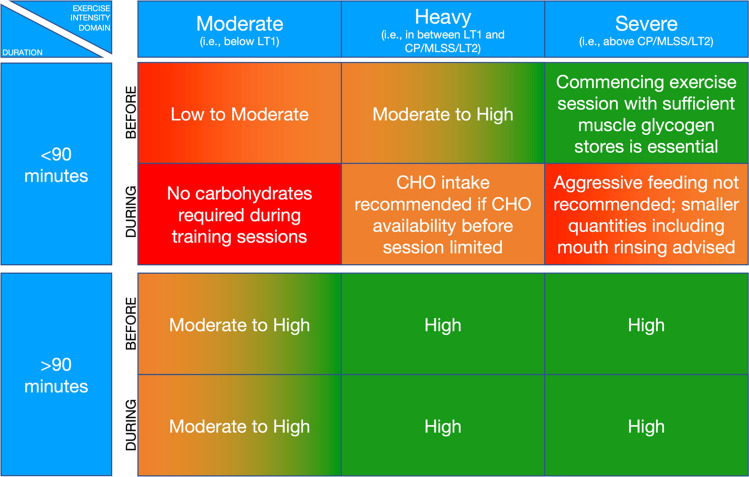
- Pre-competition glycogen loading is recommended at 10–12 g·kg⁻¹ body mass for 36–48 h before competition, but is not currently recommended for events shorter than 90 min; muscle glycogen concentrations can reach 793 ± 170 mmol·kg⁻¹ dry mass in highly trained populations.
- During exercise, up to 60 g·h⁻¹ of rapidly oxidized carbohydrates is recommended for sessions up to 3 h; when intake exceeds 60 g·h⁻¹, glucose-fructose blends in a ratio approaching unity (1:0.8) appear superior to the commonly used 2:1 ratio for oxidation efficiency and gut comfort. Current guidelines do not advise more than 90 g·h⁻¹, though limited data suggest up to 120 g·h⁻¹ may be tolerated and may benefit recovery markers, with performance benefit still unclear.
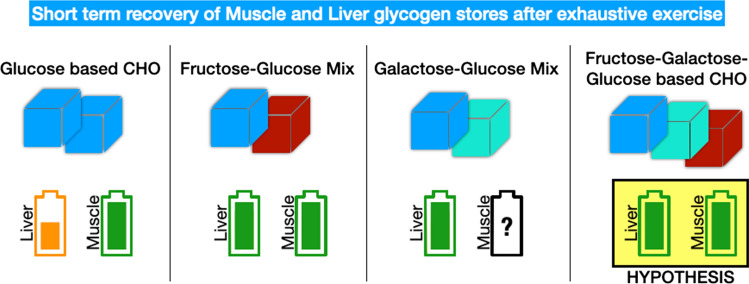
- Post-exercise rapid glycogen repletion is recommended at 1.0–1.2 g·kg⁻¹ BM·h⁻¹ for the first 4 h; glucose-fructose mixtures may better target both liver and muscle glycogen repletion, whereas galactose-glucose favorably affects liver glycogen but muscle glycogen effects are unknown.
- A contemporary view of carbohydrate periodization and “train-low” suggests limited utility for enhancing performance benefits from training, though it may be a time-efficient strategy; personalized carbohydrate intake is advocated, but continuous glucose monitoring during exercise cannot currently be advised due to limited validity.
Methods
- Narrative review of existing literature on carbohydrate nutrition, exercise metabolism, and endurance performance; no primary data collection or systematic meta-analysis is reported.
- The paper synthesizes current dietary guidelines and selected studies across pre-exercise, during-exercise, post-exercise, training adaptation, and personalization topics, and presents research questions in Table 1 and frameworks in Figs. 1–2.
- Main analysis is interpretive/narrative synthesis, with recommendations based on cited evidence rather than a formal systematic search or quantitative pooling.
Limitations
- The paper states that many scientific unknowns remain and lists numerous research questions in Table 1, including optimal glycogen storage with <24 h between sessions, liver glycogen supercompensation, exogenous carbohydrate oxidation at high absolute intensities, and recovery carbohydrate doses for elite athletes.
- The paper states that most research has investigated carbohydrate intake in healthy male populations and that current knowledge is often based on moderately trained rather than elite athletes; it also notes limited validity of continuous glucose monitoring during exercise and no successful independent validation of ultrasound for muscle glycogen.
- Evident from the text: as a narrative review, it does not report a systematic search strategy, risk-of-bias assessment, or meta-analytic synthesis, so recommendations reflect the authors’ selected interpretation of the literature.
Model-written summary. Check it against the paper before relying on it.
Integrity signals
Registry
Cites
Statistics
Figures
Verification
Claims the paper makes
3 Valid · 2 Not valid · 129 Not checked · 31 Own results and interpretations
The cited sources support only part of this claim — read each source’s verdict below.
In the paper
“While energy for adenosine triphosphate (ATP) production can be derived both from fats and carbohydrates, it is carbohydrates that are primarily utilized at high exercise intensities [14, 15].”
§ New Horizons in Carbohydrate Research and Application for Endurance Athletes > Importance of Carbohydrates for Competition and High-Intensity Training Sessions
What the sources say
- Not checked — no full text of the sourcecites [14] Romijn JA Coyle EF Sidossis LS Gastaldelli A Horowitz JF Endert E Regulation of endogenous fat and carbohydrate metabolism in relation to exercise intensity and duration Am J Physiol-Endocrinol Metab 1993 265 E380 E391 10.1152/ajpendo.1993.265.3.E380 8214047 source
- Partly supportedcites [15] van Loon LJC Greenhaff PL Constantin-Teodosiu D Saris WH Wagenmakers AJM The effects of increasing exercise intensity on muscle fuel utilisation in humans J Physiol 2001 536 295 304 10.1111/j.1469-7793.2001.00295.x 11579177 PMC2278845 sourceExperimental — accuracy not yet measured
Our copy of van Loon et al. (2001) consists only of the abstract (itself cut off mid-sentence at 'muscle pyruvate dehydrogenase') plus repository metadata; repeated searches for Results/Discussion text returned nothing further. The Abstract supports the direction of the claim: muscle glycogen and plasma glucose (carbohydrate) oxidation rates rose with every increment in intensity (40, 55, 75% W(max)) while whole-body fat oxidation peaked at 55% W(max) (32 +/- 2 kJ min(-1)) and declined at 75% W(max) (19 +/- 2 kJ min(-1)). However, no passage in our copy states that carbohydrates are the primary/predominant fuel, and the data are confined to eight trained cyclists exercising up to 75% W(max), so the 'primarily utilized at high exercise intensities' part of the attribution is not established by the text we hold. (LLM, conf=0.68)
plainstates an association- Asserted: passes — The authors put it forward as true.
- Checkable: passes — It can be checked against evidence.
- Load-bearing: passes — The paper’s conclusions depend on it.
- Based: passes — The paper gives a reason why it holds.
Every source the paper cites for this claim was checked and supports it.
In the paper
“However, endogenous carbohydrate oxidation was not further spared by the higher carbohydrate dose, and thus whether there would be an additional performance benefit requires clarification.”
§ New Horizons in Carbohydrate Research and Application for Endurance Athletes > Importance of Carbohydrates for Competition and High-Intensity Training Sessions > During Competition
What the sources say
- Supportedcites [71] Podlogar T Bokal Š Cirnski S Increased exogenous but unaltered endogenous carbohydrate oxidation with combined fructose-maltodextrin ingested at 120 g h−1 versus 90 g h−1 at different ratios Eur J Appl Physiol 2022 10.1007/s00421-022-05019-w PMC9560939 35951130 source
The Abstract Results and Results (Substrate oxidation rates and blood metabolites, p. 6) state that endogenous CHO oxidation did not differ between the 120 g h−1 and 90 g h−1 conditions (2.15 ± 0.30 vs 2.20 ± 0.33 g min−1; p = 0.786). The Discussion explicitly says 'there was no sparing of endogenous CHO stores with an ingestion rate of 120 g h−1 as compared with 90 g h−1', and the Conclusion reiterates 'no additional sparing of endogenous carbohydrates'. The hedged follow-up about performance benefits is likewise mirrored in the Abstract Conclusions ('Further studies should investigate potential performance effects'). (LLM, conf=0.95)
plain- Asserted: passes — The authors put it forward as true.
- Checkable: passes — It can be checked against evidence.
- Load-bearing: passes — The paper’s conclusions depend on it.
- Based: passes — The paper gives a reason why it holds.
- Supported
Every source the paper cites for this claim was checked and supports it.
In the paper
“We have recently shown higher exogenous carbohydrate oxidation during prolonged endurance exercise in highly trained athletes with carbohydrate ingestion at 120 g·h−1 as compared to 90 g·h−1 [71].”
§ New Horizons in Carbohydrate Research and Application for Endurance Athletes > Importance of Carbohydrates for Competition and High-Intensity Training Sessions > During Competition
What the sources say
- Supportedcites [71] Podlogar T Bokal Š Cirnski S Increased exogenous but unaltered endogenous carbohydrate oxidation with combined fructose-maltodextrin ingested at 120 g h−1 versus 90 g h−1 at different ratios Eur J Appl Physiol 2022 10.1007/s00421-022-05019-w PMC9560939 35951130 source
The Abstract Results (p.1) report exogenous CHO oxidation of 1.51 ± 0.22 g min−1 at 120 g h−1 versus 1.29 ± 0.16 g min−1 at 90 g h−1 (p = 0.026) during 3 h of endurance exercise in highly trained cyclists, and the Discussion and Conclusions state this as increased exogenous CHO oxidation at 120 g h−1 compared with the recommended 90 g h−1. The only qualifier the citing sentence omits is that the two conditions also differed in fructose-to-glucose-based ratio (0.8:1 vs 1:2), which the source explicitly notes; the rate comparison itself is exactly what the source reports. (LLM, conf=0.93)
plainstates a cause- Asserted: passes — The authors put it forward as true.
- Checkable: passes — It can be checked against evidence.
- Load-bearing: passes — The paper’s conclusions depend on it.
- Based: passes — The paper gives a reason why it holds.
- Supported
None of the sources cited for this claim have been checked yet.
In the paper
“and this shows that sufficient carbohydrate intake is required to start an exercise session with normal liver glycogen stores.”
§ New Horizons in Carbohydrate Research and Application for Endurance Athletes > Importance of Carbohydrates for Competition and High-Intensity Training Sessions > Pre-competition
What the sources say
- Not checked yetcites [41] Nilsson LH Hultman E Liver glycogen in man—the effect of total starvation or a carbohydrate-poor diet followed by carbohydrate refeeding Scand J Clin Lab Investig 1973 32 325 330 10.3109/00365517309084355 4771102 source
Checked before — its earlier verdict is held back until a new check runs.
plainstates a cause- Asserted: passes — The authors put it forward as true.
- Checkable: passes — It can be checked against evidence.
- Load-bearing: passes — The paper’s conclusions depend on it.
- Based: passes — The paper gives a reason why it holds.
- Not checked yet
None of the sources cited for this claim have been checked yet.
In the paper
“Varying carbohydrate intake does indeed change fasting liver glycogen concentrations [41]”
§ New Horizons in Carbohydrate Research and Application for Endurance Athletes > Importance of Carbohydrates for Competition and High-Intensity Training Sessions > Pre-competition
What the sources say
- Not checked yetcites [41] Nilsson LH Hultman E Liver glycogen in man—the effect of total starvation or a carbohydrate-poor diet followed by carbohydrate refeeding Scand J Clin Lab Investig 1973 32 325 330 10.3109/00365517309084355 4771102 source
Checked before — its earlier verdict is held back until a new check runs.
boostedstates a cause- Asserted: passes — The authors put it forward as true.
- Checkable: passes — It can be checked against evidence.
- Load-bearing: passes — The paper’s conclusions depend on it.
- Based: passes — The paper gives a reason why it holds.
- Not checked yet
112 more claims
Create a free account to see all 165 claims and to verify the 205 references still open.
- It may state two separate claims as one. 27
- Probably not a substantial claim. 22
Claims other papers make about this one
Each is checked against this paper’s own text: does it say what the citing paper says it does?
The source backs part of the claim, not all of it — or backs it for a different population, condition or comparison.
In the citing paper
“Complete replenishment of muscle glycogen stores typically unfolds over a 24–36 h period post-exercise, provided that 7–12 g·kg−1 carbohydrate are consumed per day [15–18].”
From Nutritional Strategies to Improve Post-exercise Recovery and Subsequent Exercise Performance: A Narrative Review (2025) · cites this paper as [18]
Experimental — accuracy not yet measuredThe source backs part of the claim, not all of it — or backs it for a different population, condition or comparison.
In the citing paper
“it is inferred that the co-ingestion of glucose and fructose-based carbohydrates during the post-exercise recovery phase is likely more beneficial than other carbohydrate sources, given its superior efficacy in faster gastrointestinal absorption and glycogen stores and its association with reduced gastrointestinal discomfort when an optimal carbohydrate dosage of 1–1.2 g·kg−1⋅h−1 is consumed [18]”
From Nutritional Strategies to Improve Post-exercise Recovery and Subsequent Exercise Performance: A Narrative Review (2025) · cites this paper as [18]
Experimental — accuracy not yet measuredThe cited source says what the claim attributes to it.
In the citing paper
“Carbohydrate ingestion during endurance exercise is a well-established strategy for enhancing performance (1 -3).”
From Carbohydrate ingestion during prolonged exercise and net skeletal muscle glycogen utilization: A meta-analysis. (2026) · cites this paper as [1]
The cited source says what the claim attributes to it.
In the citing paper
“Nevertheless, co-ingestion of glucose with fructose is preferred owing to reduced gastrointestinal complaints and the beneficial effect on liver glycogen replenishment, as discussed below [18, 22, 26]”
From Nutritional Strategies to Improve Post-exercise Recovery and Subsequent Exercise Performance: A Narrative Review (2025) · cites this paper as [18]
In the citing paper
“Moreover, CHO should account for 45–65% of total caloric intake (60, 61).”
From Junior athletes’ nutritional demands: a narrative review of consumption and prevalence of eating disorders (2024) · cites this paper as [60]
Citations
Cites
Romijn, J. A., Coyle, E. F., Sidossis, L. S., Gastaldelli, A., Horowitz, J. F., Endert, E., & Wolfe, R. R. (1993) · American Journal of Physiology-Endocrinology and Metabolism · doi:10.1152/ajpendo.1993.265.3.e380 · Cited by 1,747 · cited 2×
“2 of this article, it appears that absolute exercise intensity during exercise is a large determinant of total energy, and consequently carbohydrate [14] and exogenous carbohydrate oxidation rates [172, 173].”
BackgroundDiet, muscle glycogen and physical performance.
Bergström, J., Hermansen, L., Hultman, E., & Saltin, B. (1967) · Acta Physiologica Scandinavica · doi:10.1111/j.1748-1716.1967.tb03720.x · Cited by 1,740 · cited 2×
“, a reduction in exercise capacity [27, 53] and thus a reduction in training intensity and/or duration.”
BackgroundExercise, GLUT4, and skeletal muscle glucose uptake
Richter, E. A., & Hargreaves, M. (2013) · Physiological Reviews · doi:10.1152/physrev.00038.2012 · Cited by 1,407 · cited 2×
“The latter could in turn result in accumulation of glucose within the cell and a reduced glucose gradient between muscle cells and blood [115, 116].”
BackgroundNutrition and Athletic Performance
(2016) · Medicine & Science in Sports & Exercise · doi:10.1249/mss.0000000000000852 · Cited by 1,305
Biomarkers of mitochondrial content in skeletal muscle of healthy young human subjects
Larsen, S., Nielsen, J., Hansen, C. N., Nielsen, L. B., Wibrand, F., Stride, N., Schroder, H. D., Boushel, R., Helge, J. W., Dela, F., et al. (2012) · The Journal of Physiology · doi:10.1113/jphysiol.2012.230185 · Cited by 1,180 · cited 1×
“A recent study indicated that the capacity to utilize fat during exercise in an overnight fasted state is best correlated with CS activity [162], a marker of mitochondrial content [163] that is itself well correlated with training volume [144].”
BackgroundMuscle glycogen utilization during prolonged strenuous exercise when fed carbohydrate
Coyle, E. F., Coggan, A. R., Hemmert, M. K., & Ivy, J. L. (1986) · Journal of Applied Physiology · doi:10.1152/jappl.1986.61.1.165 · Cited by 1,022 · cited 1×
“Carbohydrate ingestion during exercise maintains stable blood glucose levels over long exercise sessions [52] and maintains carbohydrate oxidation rates despite declining muscle glycogen stores so that ingested carbohydrates substitute endogenous carbohydrate stores [53, 54].”
BackgroundCarbohydrates for training and competition
Burke, L. M., Hawley, J. A., Wong, S. H. S., & Jeukendrup, A. E. (2011) · Journal of Sports Sciences · doi:10.1080/02640414.2011.585473 · Cited by 985 · cited 10×
“2 g·kg−1BM·h−1 to optimize repletion of glycogen stores for the first 4 h, when rapid repletion of glycogen stores is required, after which a normal diet reflecting daily fuel needs, which may be up to 12 g·kg−1 BM, is recommended [1, 2, 120].”
BackgroundInfluentialThe effects of increasing exercise intensity on muscle fuel utilisation in humans
van Loon, L. J. C., Greenhaff, P. L., Constantin‐Teodosiu, D., Saris, W. H. M., & Wagenmakers, A. J. M. (2001) · The Journal of Physiology · doi:10.1111/j.1469-7793.2001.00295.x · Cited by 897 · cited 1×
“While energy for adenosine triphosphate (ATP) production can be derived both from fats and carbohydrates, it is carbohydrates that are primarily utilized at high exercise intensities [14, 15].”
BackgroundJoyner, M. J., & Casey, D. P. (2015) · Physiological Reviews · doi:10.1152/physrev.00035.2013 · Cited by 833 · cited 1×
“It could be that athletes whose energy turnover rates during exercise are very high and thus have a high glucose flux to muscle due to increased blood flow proportional to absolute exercise intensity [83] could benefit from carbohydrate ingestion rates that are higher than currently recommended, but this requires furt…”
BackgroundMeasurement of substrate oxidation during exercise by means of gas exchange measurements
Jeukendrup, A. E., & Wallis, G. A. (2005) · International Journal of Sports Medicine · doi:10.1055/s-2004-830512 · Cited by 799 · cited 1×
“However, the importance of an ability to oxidize fats at high intensities should not be discounted [18], as a valid method to quantify its contribution to ATP production during exercise at high intensities is yet to be established [19].”
BackgroundSelf-citation
Research works printed but not linked: 3
- Hawley JA Schabort E Noakes TD Dennis SC Carbohydrate-loading and exercise performance an update Sports Med. 1997 24 2 73 81 10.2165/00007256-199724020-00001 9291549 · DOI · Paper page
- Jentjens RLPG, Achten J, Jeukendrup AE. High oxidation rates from combined carbohyrates ingested during exercise. Med Sci Sports Exerc. 2004;36:1551–8. http://journals.lww.com/00005768-200409000-00014. 15354037 · DOI · Paper page
- Pirnay F, Crielaard JM, Pallikarakis N, Lacroix M, Mosora F, Krzentowski G, et al. Fate of exogenous glucose during exercise of different intensities in humans. 1982. www.physiology.org/journal/jappl. Accessed 23 Apr 2022. 7153158 · DOI · Paper page
Cited by
Items 101–139 of 139
Estimation of Carbohydrate Loading by Using Glycogen Depletion Protocols
Nazir, A., Itrat, N., Mushtaq, Z., Saroosh, R., Iftikhar, H., & Shahid, A. (2025) · Methods and protocols in food science · doi:10.1007/978-1-0716-4370-9_4
Mensah, T., Moses, M. O., & Hagan, J. E. (2025) · Journal of Kinesiology and Exercise Sciences · doi:10.5604/01.3001.0055.0945 · Cited by 1
Food and Nutrition for Athletics: Redefining the Role and Application
(2025) · Frontiers research topics · doi:10.3389/978-2-8325-6264-2
Schierbauer, J., Altenberg, O., Voit, T., Zimmermann, P., & Moser, O. (2025) · European Journal of Sport Science · doi:10.1002/ejsc.12326
O impacto da suplementação de carboidratos no desempenho esportivo de atletas de corrida
Araujo, A. F. E., & Pereira, A. A. S. (2025) · Research Society and Development · doi:10.33448/rsd-v14i6.49078 · Cited by 1
Development and Standardization of a Carbohydrate-Rich Purple Rice–Quinoa Energy Bar
Painuly, L., Milky, W., Malik, K., Taliwal, C., & Mekam, M. (2025) · World sustainability series · doi:10.1007/978-3-031-98200-2_18
Setko, A. G., & Rusakov, V. N. (2025) · Hygiene and Sanitation · doi:10.47470/0016-9900-2025-104-10-1334-1340
Iqba, M., Nugroho, S., Rismayanthi, C., Budayati, E. S., Indra, E. N., & Hidayat, R. A. (2025) · International Journal of Multicultural and Multireligious Understanding · doi:10.18415/ijmmu.v12i1.6396
Grigoriadis, K. (2025) · PhilPapers (PhilPapers Foundation) · doi:10.17613/xh0dp-2y129
Prehranski status profesionalnih rokometašev iz dveh klubov
Potrebuješ, G. (2024) · Repository of the University of Ljubljana (University of Ljubljana)
LAMB, C. (2024) · Cronfa (Swansea University)
Povezava strategije športne prehrane na sestavo telesa pri smučarskih skakalcih
Jarc, U. (2023) · University of Maribor digital library (University of Maribor)
No Performance Effects of Altered Carbohydrate Distribution During Intense Cycling
Podlogar, T., Grmek, B., Pungerčar, L., Cirnski, S., Sparovec, T. G., & Rowlands, D. S. (2025) · International Journal of Sport Nutrition and Exercise Metabolism · doi:10.1123/ijsnem.2025-0059
Self-citationVpliv strategije vnosa ogljikovih hidratov na zmogljivost med simulacijo kolesarske dirke
Grmek, B. (2024) · Repository of the University of Primorsk (University of Primorska)
Mušič, P. (2023) · Repository of the University of Primorsk (University of Primorska)
Tarrit, B., Moretton, C., Duclos, M., Metz, L., Chanséaume, E., Ennequin, G., Thivel, D., & RANNOU, F. (2026) · The Journal of Sports Medicine and Physical Fitness · doi:10.23736/s0022-4707.25.17488-4
Nutritional considerations for athletes with diabetes: optimizing performance and glycemic control
Xu, L., & Zhang, W. (2026) · Frontiers in Nutrition · doi:10.3389/fnut.2026.1737219
“As one of the macronutrients that may be metabolized both aerobically and anaerobically, carbohydrates are very important for athletic performance (81, 82).”
Juybari, E. A., Farimani, M. M., & Asadollahi, M. (2026) · Scientific Reports · doi:10.1038/s41598-026-42880-7
Simpson, A., O'Hanlon, R., Easton, C., Henriquez, F. L., & Burleigh, M. C. (2026) · BMJ Open Sport & Exercise Medicine · doi:10.1136/bmjsem-2026-003230
“…questionnaire was distributed via email to staff at a dental hospital, who may not be representative of all UK-based DHPs. Similarly, athletes who perceived their dental health as affecting performance and coaches who valued their role in athlete well-being may have been more inclined to respond.”
Petri, C., Barreira, J., Costa, J. A., Suarez-Arrones, L. J., Buccolini, A., Mascherini, G., & Pengue, L. (2026) · Applied Sciences · doi:10.3390/app16094458
The Anti-Fatigue Properties of Polysaccharides: A Mechanistic Insight
Mourgan, F. H. A. E., Bekir, W. M. A., Hefny, N. E. D. A., & Ali, E. (2026) · Current Traditional Medicine · doi:10.2174/0122150838429723260106081340
Effects of Carbohydrate Mouth Rinsing on Cognition and Motor Skills in Sports Psychology
Lakshyashree, Lenka, S. R., Nahak, P. K., Gajjar, P., & Bawiskar, D. (2026) · The Bioscan. · doi:10.63001/tbs.2026.v21.i02.pp407-415
Rebelo‐Marques, A., Costa, A., & Lages, A. D. S. (2026) · Springer eBooks · doi:10.1007/978-981-95-1304-8_58
Sports nutrition and mental toughness in athletes: a systematic review of mechanistic evidence
Humaedi, H., Saparia, A., Manik, S., Gontara, S. Y., & Wahyudi, A. S. B. S. E. (2026) · JRTI (Jurnal Riset Tindakan Indonesia) · doi:10.29210/30036848000
O'Reilly, J., & Sheridan, S. (2026) · Proceedings of The Nutrition Society · doi:10.1017/s0029665126103528
Macrae, H. Z., Reynolds, K. M., Sellors, C., Wickham, P. E., Cable, T. G., Wallis, G. A., Goosey-Tolfrey, V. L., Funnell, M. P., Mears, S. A., & James, L. J. (2026) · Journal of Applied Physiology · doi:10.1152/japplphysiol.01192.2025 · Cited by 1
Self-citationBianchi, E., Tucci, M., Perna, S., Martini, D., Bo’, C. D., Leone, A., Menichetti, F., Bertoli, S., Battezzati, A., & Riso, P. (2026) · Frontiers in Nutrition · doi:10.3389/fnut.2026.1858754
Plank, E. N., Noakes, T. D., Buxton, J. D., & Prins, P. (2026) · International journal of exercise science · doi:10.70252/ijes2026608
Browarska, E., Superson, K., Miemczyk, K., Gajewska, N., Mszyca, I., Aksamit, A., Wołek, F. T., Mularczyk, K. N., Kucharski, K., & Michalski, Ł. (2026) · Quality in Sport · doi:10.12775/qs.2026.67.74262
de Oliveira, M. E. D., da Silva, E. M., & Paixão, M. P. C. P. (2026) · doi:10.65458/978-65-02-29246-4
Mahdiyan, M. T., Sentani, M. R., Prameswari, F. S. P., & Amrinanto, A. H. (2026) · Jambura Health and Sport Journal · doi:10.37311/jhsj.v8i2.40739
Liu, W., Ai, H., Li, X., Yang, J., Jiang, D., & Chang, C. (2026) · The Innovation Medicine · doi:10.59717/j.xinn-med.2026.100260
Kokelj, A. (2026) · Repository of the University of Ljubljana (University of Ljubljana)
Disminución del rendimiento deportivo en triatleta asociado al desbalance energético
Márquez, A. M. (2026) · Revista Científica de Salud BIOSANA · doi:10.62305/biosana.v6i4.1273
PERAN RACE FOOD PADA PERFORMA TRIATHLON
Agripina, C. B., & Pramono, B. A. (2026) · Jurnal Prestasi Olahraga
Uso culinario y propiedades nutricionales de la oca como alimento funcional para deportistas
Morales-Chaglla, A. S., Poveda-Morales, T. C., & Estrada-Velasco, L. J. (2026) · CIENCIAMATRIA · doi:10.35381/cm.v12i4.3030
SIMONI, L. (n.d.) · Padua Research Archive (University of Padova)
Fuadi, T. K., & Damayanti, D. (2025) · Penelitian Gizi dan Makanan (The Journal of Nutrition and Food Research) · doi:10.36457/pgm.v48i1.822
Lee, S. (n.d.) · Murdoch University Research Portal
Metadata
- Authors
- Podlogar, T., & Wallis, G. A.
- Affiliations
- University of Birmingham (GB)
- Corresponding author
- Wallis, Gareth A.
- Venue
- Sports Medicine
- Published
- 2022-09-29
- Volume
- 52
- Issue
- S1
- Pages
- 5-23
- ISSN
- 0112-1642 (ISSN-L)
- 1179-2035
- PMC
- PMC9734239
- OpenAlex
- W4297964698
- Semantic Scholar
- bec187988f8e8e27ed3764a69494fd8466102c21
- Cited by
- 109
- References
- 191
- Citations by year
- 2026: 19 · 2025: 43 · 2024: 34 · 2023: 12 · 2022: 1
- FWCI
- 3.23
- Type
- journal article
- Language
- en
- Open access
- hybrid
- doi.org
- Licence
- cc-by
- creativecommons.org/licenses/by/4.0 (tdm)
- creativecommons.org/licenses/by/4.0 (vor)
- Locations
- Sports Medicine (publishedVersion, cc-by)
- PubMed Central (publishedVersion, cc-by)
- PubMed (publishedVersion)
- University of Birmingham Research Portal (University of Birmingham) (submittedVersion, cc-by)
- University of Birmingham Research Portal (University of Birmingham) (submittedVersion, other-oa)
- Funders
- PepsiCo
- Gran Sasso Science Institute
- Topics
- Health Sciences › Nursing › Nutrition and Dietetics › Muscle metabolism and nutrition
- Health Sciences › Medicine › Orthopedics and Sports Medicine › Sports Performance and Training
- Health Sciences › Medicine › Physiology (medical) › Cardiovascular and exercise physiology
- Keywords
- carbohydrate intake, endurance athletes, endurance performance, carbohydrate availability, exercise metabolism, carbohydrate supplementation, continuous glucose monitoring, personalized nutrition
- MeSH terms
- Blood Glucose, Dietary Carbohydrates, Humans, Physical Endurance, Blood Glucose Self-Monitoring, Athletic Performance, Athletes
About these checks
Registry, retraction, Cites and statistics results are computed, not judged, with one exception: a printed reference that no index lists is read once by a model before it counts as a citation error. Claims are extracted by a model and kept only when their quote appears verbatim in the text; each cited source is then checked, with a model’s help, for whether it says what the claim relies on. Those verdicts can be wrong — read the claim’s quote and the cited source before relying on one.
The claim verdicts this report counts are experimental: their accuracy is not yet measured.
A language model drew the claims from the paper on 2026-11-19, under version 3 of the claim definition (model deepseek-v4.1-flash, prompt extract-v3).
A second model labelled each claim on 2026-11-19 (model jev-1.13-20260917, definition revision gold-guideline-v0.2).
Cited sources are checked with a language model’s help (qwen3.8-omni-flash).
Statistics and arithmetic are recomputed, not judged.
Confidence bands are shown only for fields calibrated on our annotated test set. None is calibrated yet, so no band is shown.
What counts as a claim ›How we measure confidence ›How we check this ›
Are you an author, or do you see a problem with this page? Request a review
Data sources
Bibliographic data: Semantic Scholar, OpenAlex, Crossref.
Contains information from the Semantic Scholar Academic Graph Datasets, made available under the ODC Attribution License (ODC-BY 1.0).
Semantic Scholar’s data is described in: Kinney, R., et al. (2023). The Semantic Scholar Open Data Platform. arXiv:2301.10140.
