

Operationalising ethics in artificial intelligence for healthcare: a framework for AI developers
Open accessThe DOI matches its Crossref record; 156 of the 165 references it cites were found in a registry or an index; 29 of the 138 sources its claims cite were checked for support.
Abstract
Artificial intelligence (AI) offers much promise for improving healthcare. However, it runs the looming risk of causing individual and societal harms; for instance, exacerbating inequalities amongst minority groups, or enabling compromises in the confidentiality of patients’ sensitive data. As such, there is an expanding, unmet need for ensuring AI for healthcare is developed in concordance with human values and ethics. Augmenting “principle-based” guidance that highlight adherence to ethical ideals (without necessarily offering translation into actionable practices), we offer a solution-based framework for operationalising ethics in AI for healthcare. Our framework is built from a scoping review of existing solutions of ethical AI guidelines, frameworks and technical solutions to address human values such as self-direction in healthcare. Our view spans the entire length of the AI lifecycle: data management, model development, deployment and monitoring. Our focus in this paper is to collate actionable solutions (whether technical or non-technical in nature), which can be steps that enable and empower developers in their daily practice to ensuring ethical practices in the broader picture. Our framework is intended to be adopted by AI developers, with recommendations that are accessible and driven by the existing literature. We endorse the recognised need for ‘ethical AI checklists’ co-designed with health AI practitioners, which could further operationalise the technical solutions we have collated. Since the risks to health and wellbeing are so large, we believe a proactive approach is necessary for ensuring human values and ethics are appropriately respected in AI for healthcare.
Overview
CoChat Summary
TL;DR
The paper proposes a solution-based framework for operationalising ethics across the AI lifecycle in healthcare, organising actionable technical and non-technical recommendations into data management, model development, and deployment/monitoring. It builds on scoping reviews of ethical issues and existing guidelines, and calls for co-designed ethical AI checklists to further translate principles into practice.
Key findings
- The framework maps four human values most cited in software engineering—security, self-direction, benevolence, and universalism—to ethical principles drawn from a scoping review of 84 AI ethics guidelines that identified 11 key principles.
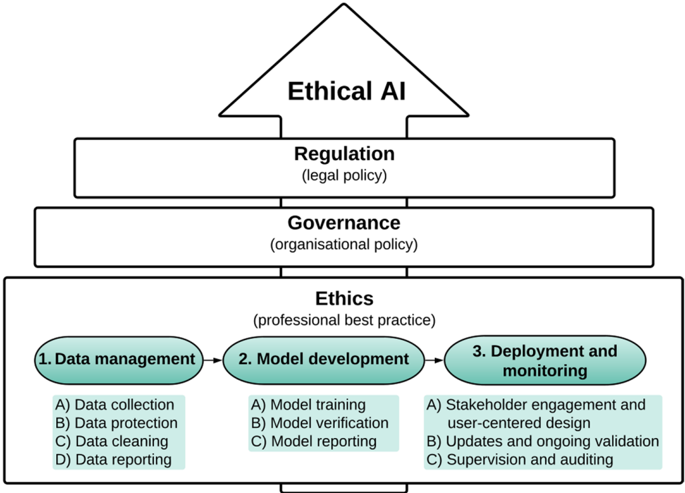
- It provides actionable recommendations at each AI lifecycle stage: data management (collection, protection, cleaning, reporting), model development (training, verification, reporting), and deployment/monitoring (stakeholder engagement and user-centred design, updates and ongoing validation, supervision and auditing).
- It argues that principle-based guidance alone is insufficient and recommends focusing on the ethical principles most pertinent to each lifecycle stage, documenting trade-offs, and supporting implementation through governance, auditing, and AI ethics checklists co-designed with health AI practitioners.
- It illustrates ethical risks with examples such as melanoma-detecting AI trained largely on images of white skin and suicide prediction algorithms whose false positives or false negatives can cause harm, but reports no quantitative outcomes from an empirical evaluation.
Methods
- Two literature reviews were performed: a scoping review on ethical issues in AI for healthcare searching PubMed and Web of Science, assessing titles and abstracts of the first 200 articles from each repository; and a scoping review of existing ethical AI frameworks, guidelines, and recommendations searching Scopus and Google Scholar, assessing the first 200 articles from each, followed by forward and backward snowballing.
- Ethical issues were organised using Schwartz’s theory of basic human values—referencing the four values most cited in software engineering—and subcategorised into ethical principles from a scoping review of 84 AI ethics guidelines.
- The AI lifecycle was separated into distinct stages based on existing literature, and actionable recommendations were collated for each stage. No datasets were generated or analysed.
Limitations
- The paper states that the mapping between human values and ethical principles is arbitrary and used only as an organising foundation; that governance and regulatory mechanisms develop slowly and may be viewed as costly or counterproductive; that GDPR provides little support to small business; that auditors may not adequately understand evolving AI techniques; and that checklists risk people delegating their thinking to checklists alone.
- Evident from the text: the scoping reviews assessed the first 200 articles per repository and used snowballing, rather than being described as systematic reviews with formal quality appraisal.
- Evident from the text: the framework’s recommendations are collated from existing literature and are not empirically validated in this paper; the authors state that a comprehensive ethical AI checklist would need to be developed and comprehensively validated through active stakeholder involvement.
Model-written summary. Check it against the paper before relying on it.
Integrity signals
Registry
Cites
Statistics
Figures

Verification
Claims the paper makes
21 Valid · 0 Not valid · 83 Not checked · 4 Own results and interpretations
The sources with a verdict support this claim; the rest weren’t checked yet, have no full text we could read, or their verdicts aren’t rated yet.
In the paper
“they emphasise adherence to 'ethical principles' [15] without complementary translations into actionable practices [16,17].”
§ Operationalising ethics in artificial intelligence for healthcare: a framework for AI developers > 1 Introduction
What the sources say
- Not checked yetcites [15] Morley, J., Floridi, L.: An ethically mindful approach to AI for health care. Lancet 395(10220), 254-255 (2020) source
- Supportedcites [16] Morley, J., et al.: From what to how: an initial review of publicly available AI ethics tools, methods and research to translate prin- ciples into practices. Sci. Eng. Ethics 26(4), 2141-2168 (2020) source
The passage attributed to this source is the 'without complementary translations into actionable practices' clause (the 'emphasise adherence to ethical principles' part is carried by the adjacent citation [15]). Morley et al. state exactly this in 'Moving from Principles to Practices' (p. 4): the agreed principles 'supports but does not yet bring about actual change in the design of algorithmic systems', and, citing Hagendorff 2019, 'almost all of the guidelines that have been produced to date suggest that technical solutions exist, but very few provide technical explanations'. The same section continues that a 'lack of practical guidance on how to produce ethical ML' means the community must embark on 'translating between the \u2018what\u2019 and the \u2018how\u2019', with 'the gap between principles and practice ... large'. A further read_indexed_paper query on guidelines lacking practical implementation returned no contrary statement. (LLM, conf=0.90)
- Supportedcites [17] Madaio, M.A., et al.: Co-designing checklists to understand organizational challenges and opportunities around fairness in AI. In: Proceedings of the 2020 CHI Conference on Human Fac- tors in Computing Systems, pp. 1-14 (2020) source
The Related Work section ('AI Ethics Principles and Software Toolkits', p. 2) states that many public- and private-sector organizations have published 'principles, tenets, or value statements intended to guide the ethical development and deployment of AI systems,' converging on concepts like fairness, accountability, transparency and privacy — i.e. an emphasis on adherence to ethical principles, which is the part citation [15] is attached to. The same section also supports the accompanying gap: 'the abstract nature of AI ethics principles makes them difficult for practitioners to operationalize' and principles 'can fail to achieve their intended goal if they are not accompanied by other mechanisms.' Our copy is complete (not truncated), so the paraphrase holds on either reading. (LLM, conf=0.88)
plain- Asserted: passes — The authors put it forward as true.
- Checkable: passes — It can be checked against evidence.
- Load-bearing: passes — The paper’s conclusions depend on it.
- Based: passes — The paper gives a reason why it holds.
Every source the paper cites for this claim was checked and supports it.
In the paper
“Although the terms and conditions of health apps may be presented, these are seldom read or comprehended by users [31].”
§ Operationalising ethics in artificial intelligence for healthcare: a framework for AI developers > 3.2.1 Freedom and autonomy
What the sources say
- Supportedcites [31] Jacobson, N.C., et al.: Ethical dilemmas posed by mobile health and machine learning in psychiatry research. Bull. World Health Organ 98(4), 270-276 (2020) source
The Informed consent section says digital platforms frequently obtain consent through terms-of-service agreements that are written in incomprehensible legalese and rarely read. In the paper’s mobile-health context, this supports the claim that users seldom read or comprehend such terms. (LLM, conf=0.92)
plain- Asserted: passes — The authors put it forward as true.
- Checkable: passes — It can be checked against evidence.
- Load-bearing: unclear — It is unclear whether the paper’s conclusions depend on it.
- Based: passes — The paper gives a reason why it holds.
- Supported
The cited sources support only part of this claim — read each source’s verdict below.
In the paper
“The right to privacy is recognised to be in ongoing tension with the open advancement of AI for healthcare [31]”
§ Operationalising ethics in artificial intelligence for healthcare: a framework for AI developers > 3.2.3 Privacy
What the sources say
- Partly supportedcites [31] Jacobson, N.C., et al.: Ethical dilemmas posed by mobile health and machine learning in psychiatry research. Bull. World Health Organ 98(4), 270-276 (2020) sourceExperimental — accuracy not yet measured
The section “The right to privacy versus the advancement of science” (page unavailable) explicitly describes a tension between participants’ data rights and scientific advancement using mobile health technology. Its discussion of open-access data sharing supports the “open advancement” aspect, but the paper addresses mobile health and machine learning in psychiatry research, not AI for healthcare generally. (LLM, conf=0.84)
plainstates an association- Asserted: passes — The authors put it forward as true.
- Checkable: passes — It can be checked against evidence.
- Load-bearing: unclear — It is unclear whether the paper’s conclusions depend on it.
- Based: passes — The paper gives a reason why it holds.
- Partly supported
The sources with a verdict support this claim; the rest weren’t checked yet, have no full text we could read, or their verdicts aren’t rated yet.
In the paper
“Technical failures, such as AI chatbots that cease to function properly [29], or AI initiatives that fail during a network failure [30], may result in unintended harm.”
§ Operationalising ethics in artificial intelligence for healthcare: a framework for AI developers > 3.1.1 Non-maleficence
What the sources say
- Supportedcites [29] Fiske, A., Henningsen, P., Buyx, A.: Your robot therapist will see you now: ethical implications of embodied artificial intelligence in psychiatry, psychology, and psychotherapy. J Med Internet Res 21(5), e13216 (2019) source
The Results section (Harm Prevention and Data Ethics Issues) says that chatbots and avatars could stop working or malfunction, and discusses preventing harm when AI devices malfunction. The network-failure example is attached to a different citation, so it is not attributed to this source. (LLM, conf=0.93)
- Not checked yetcites [30] Luxton, D.D., Anderson, S.L., Anderson, M.: Ethical issues and artificial intelligence technologies in behavioral and mental health care. In: Artificial Intelligence in Behavioral and Mental Health Care, pp. 255-276 (2016) source
hedgedstates a possible cause- Asserted: passes — The authors put it forward as true.
- Checkable: passes — It can be checked against evidence.
- Load-bearing: passes — The paper’s conclusions depend on it.
- Based: passes — The paper gives a reason why it holds.
- Supported
The cited sources support only part of this claim — read each source’s verdict below.
In the paper
“Economic factors (e.g.different billing rates for specific groups) could also influence what and how information is collected in healthcare [41].”
§ Operationalising ethics in artificial intelligence for healthcare: a framework for AI developers > 3.4.1 Justice and fairness
What the sources say
- Partly supportedcites [41] Walsh, C.G., et al.: Stigma, biomarkers, and algorithmic bias: recommendations for precision behavioral health with artificial intelligence. JAMIA Open 3(1), 9-15 (2020) sourceExperimental — accuracy not yet measured
The Challenges section (‘Potential for algorithmic bias’; page not provided) says reimbursement, billing, and other financial incentives could affect what information is collected and how it is recorded. It does not identify different billing rates for specific groups as an example. (LLM, conf=0.84)
hedgedstates a possible cause- Asserted: passes — The authors put it forward as true.
- Checkable: passes — It can be checked against evidence.
- Load-bearing: unclear — It is unclear whether the paper’s conclusions depend on it.
- Based: passes — The paper gives a reason why it holds.
- Partly supported
57 more claims · 8 with their cited sources checked
Create a free account to see all 108 claims and to verify the 109 references still open.
- Probably not a substantial claim. 25
- It may state two separate claims as one. 28
Claims other papers make about this one
Each is checked against this paper’s own text: does it say what the citing paper says it does?
The cited source says what the claim attributes to it.
In the citing paper
“For example, Solanki et al [96] developed a comprehensive framework for AI developers that includes ethics oversight during different phases of the AI development life cycle.”
From Barriers to and facilitators of artificial intelligence adoption in health care: scoping review (2024) · cites this paper as [96]
The check wasn’t confident either way, so it gives no verdict — never disputed.
In the citing paper
“The domains are drawn from the domains of the CASoF, which are “Value Proposition,” “Data,” “Human-AI Interaction,” “Organization and Culture,” “Technical,” and “Monitoring and Support” [31].”
From Checklist Approach to Developing and Implementing AI in Clinical Settings: Instrument Development Study (2025) · cites this paper as [31]
Experimental — accuracy not yet measuredIn the citing paper
“The digital divide further exacerbates the issue, creating discrepancies in accessing AI services and information, particularly for disadvantaged populations [103].”
From Ethical Framework for Harnessing the Power of AI in Healthcare and Beyond (2024) · cites this paper as [103]
In the citing paper
“Lack of genuine empathy; risk of providing inappropriate advice in a crisis; potential for emotional dependency [48][49][50][51][52][53][54].”
From Gamification in Digital Mental Health Interventions: A Systematic Review of the Engagement–Efficacy–Ethics Trilemma (2026) · cites this paper as [52]
In the citing paper
“The potential for manipulation also becomes far more sophisticated; an adaptive system can learn an individual's psychological vulnerabilities and tailor its persuasive strategies accordingly, making manipulation more effective and almost impossible to detect [48][49][50][51][52][53][54].”
From Gamification in Digital Mental Health Interventions: A Systematic Review of the Engagement–Efficacy–Ethics Trilemma (2026) · cites this paper as [52]
Citations
Cites
SMOTE synthetic minority over-sampling technique
Chawla, N. V., Bowyer, K. W., Hall, L. O., & Kegelmeyer, W. P. (2002) · Journal of Artificial Intelligence Research · doi:10.1613/jair.953 · Cited by 32,865 · cited 5×
“Voluntarily increase diversity of imbalanced datasets [50-53] 4.”
BackgroundMethodInfluentialDermatologist-level classification of skin cancer with deep neural networks
Esteva, A., Kuprel, B., Novoa, R. A., Ko, J., Swetter, S. M., Blau, H. M., & Thrun, S. (2017) · Nature · doi:10.1038/nature21056 · Cited by 14,362 · cited 2×
“…more likely to report behavioural symptoms to digital agents than humans, but sociocultural sensitivity can only be provided by a human agent; hence, care should be taken to ensure methods of data collection are appropriate [41], and the collected data itself is more diverse and inclusive [46–49].”
BackgroundArrieta, A. B., Díaz-Rodríguez, N., Del Ser, J., Bennetot, A., Tabik, S., Barbado, A., García, S., Gil-López, S., Molina, D., Benjamins, R., et al. (2019) · arXiv · doi:10.48550/arxiv.1910.10045 · Cited by 11,321
Rudin, C. (2019) · Nature Machine Intelligence · doi:10.1038/s42256-019-0048-x · Cited by 10,561 · cited 3×
“For a particular project context or specific parameter, It may be possible to convert black box models to ‘glass box’ explainable models, as argued in [122].”
BackgroundBarredo Arrieta, A., Díaz-Rodríguez, N., Del Ser, J., Bennetot, A., Tabik, S., Barbado, A., Garcia, S., Gil-Lopez, S., Molina, D., Benjamins, R., et al. (2020) · Information Fusion · doi:10.1016/j.inffus.2019.12.012 · Cited by 10,423
Dissecting racial bias in an algorithm used to manage the health of populations
Obermeyer, Z., Powers, B., Vogeli, C., & Mullainathan, S. (2019) · Science · doi:10.1126/science.aax2342 · Cited by 7,137 · cited 2×
“Some biases may even be correctible with post-hoc techniques involving re-labelling, such as for racial bias [140].”
BackgroundThe global landscape of AI ethics guidelines
Jobin, A., Ienca, M., & Vayena, E. (2019) · Nature Machine Intelligence · doi:10.1038/s42256-019-0088-2 · Cited by 6,220 · cited 10×
“…believing they are interacting with a human or other force; individuals Descriptions of human values and ethical principles adapted from [22] and [14] respectively Human value [22] Ethical principle [14] Security (safety, harmony, and stability of society, of relationships, and of self)…”
BackgroundMethodInfluentialA Survey on Bias and Fairness in Machine Learning
Mehrabi, N., Morstatter, F., Saxena, N., Lerman, K., & Galstyan, A. (2022) · ACM Computing Surveys · doi:10.1145/3457607 · Cited by 5,812 · cited 4×
“This involves raising practitioners’ awareness of the contextual nature and demands of particular ethical principles such as fairness, and actively building ethically-aware and diverse teams to address potential systemic biases [45, 56–64].”
BackgroundInfluentialA Survey on Bias and Fairness in Machine Learning
Mehrabi, N., Morstatter, F., Saxena, N., Lerman, K., & Galstyan, A. (2019) · arXiv · doi:10.48550/arxiv.1908.09635 · Cited by 5,812
Artificial intelligence in healthcare: past, present and future
Jiang, F., Jiang, Y., Zhi, H., Dong, Y., Li, H., Ma, S., Wang, Y., Dong, Q., Shen, H., & Wang, Y. (2017) · Stroke and Vascular Neurology · doi:10.1136/svn-2017-000101 · Cited by 4,837 · cited 1×
“AI for healthcare encompasses numerous approaches, including machine learning (ML) algorithms on structured text- or image-based data, and natural language processing (NLP) on unstructured data such as clinical notes or medical journals [3].”
BackgroundFloridi, L., Cowls, J., Beltrametti, M., Chatila, R., Chazerand, P., Dignum, V., Luetge, C., Madelin, R., Pagallo, U., Rossi, F., et al. (2018) · Minds and Machines · doi:10.1007/s11023-018-9482-5 · Cited by 4,774 · cited 1×
“Operationalising ethics in AI for healthcare necessitates an active governance model, one that implements policies, procedures, and standards to align practices with some overarching ethical principles [178].”
BackgroundThe potential for artificial intelligence in healthcare
Davenport, T., & Kalakota, R. (2019) · Future Healthcare Journal · doi:10.7861/futurehosp.6-2-94 · Cited by 3,800 · cited 1×
“This is despite the fact that purposefully aligning AI with human values can produce many benefits, such as improving cancer care and patient engagement [27].”
Backgroundt-Closeness: Privacy Beyond k-Anonymity and l-Diversity
Li, N., Li, T., & Venkatasubramanian, S. (2007) · 2007 IEEE 23rd International Conference on Data Engineering · doi:10.1109/icde.2007.367856 · Cited by 3,451 · cited 4×
“Avoid loss of data (critical to the owner of the information) [72, 83] 9.”
BackgroundMethodInfluentialDoyle, T. (2017) · The Information Society · doi:10.1080/01972243.2017.1354593 · Cited by 3,071 · cited 1×
“Although the exponential growth of Artificial Intelligence (AI) for healthcare is promising, its benefits are being increasingly overshadowed by its propensity to cause individual or societal harm quickly at a large scale [1, 2].”
BackgroundFitzpatrick, K. K., Darcy, A., & Vierhile, M. (2017) · JMIR Mental Health · doi:10.2196/mental.7785 · Cited by 2,730 · cited 1×
“…the presence of type 2 diabetes from clinical risk factors, [4] or the risk of suicide from social media posts [5]), detection (e.g. detecting breast cancer tumours from mammography scans [6]), and management of diseases (e.g. using NLP-driven chatbots to deliver cognitive behavioural therapy [7]).”
BackgroundModel Cards for Model Reporting
Mitchell, M., Wu, S., Zaldivar, A., Barnes, P., Vasserman, L., Hutchinson, B., Spitzer, E., Raji, I. D., & Gebru, T. (2019) · Proceedings of the Conference on Fairness, Accountability, and Transparency · doi:10.1145/3287560.3287596 · Cited by 2,681 · cited 4×
“Clear documentation with ‘model cards’ is recommended for summarising a model’s attributes and performance; this is further detailed in [144].”
BackgroundInfluentialCodella, N. C. F., Gutman, D., Celebi, M. E., Helba, B., Marchetti, M. A., Dusza, S. W., Kalloo, A., Liopyris, K., Mishra, N., Kittler, H., et al. (2018) · 2018 IEEE 15th International Symposium on Biomedical Imaging (ISBI 2018) · doi:10.1109/isbi.2018.8363547 · Cited by 2,620
Gebru, T., Morgenstern, J., Vecchione, B., Vaughan, J. W., Wallach, H., Daumé, H., & Crawford, K. (2018) · arXiv · doi:10.48550/arxiv.1803.09010 · Cited by 2,474 · cited 2×
“The full documentation processes are outlined in [45, 164] for ML datasets, and in [110, 111] for NLP data.”
BackgroundMethodGebru, T., Morgenstern, J., Vecchione, B., Vaughan, J. W., Wallach, H., III, H. D., & Crawford, K. (2021) · Communications of the ACM · doi:10.1145/3458723 · Cited by 2,469 · cited 2×
“The full documentation processes are outlined in [45, 164] for ML datasets, and in [110, 111] for NLP data.”
BackgroundMethodGuidelines for Human-AI Interaction
Amershi, S., Weld, D., Vorvoreanu, M., Fourney, A., Nushi, B., Collisson, P., Suh, J., Iqbal, S., Bennett, P. N., Inkpen, K., et al. (2019) · Proceedings of the 2019 CHI Conference on Human Factors in Computing Systems · doi:10.1145/3290605.3300233 · Cited by 2,439 · cited 9×
“The language of the AI system should not reinforce unfair stereotypes; a validated set of guidelines for human-AI interaction is available in [51].”
BackgroundMethodInfluentialThe practical implementation of artificial intelligence technologies in medicine
He, J., Baxter, S. L., Xu, J., Xu, J., Zhou, X., & Zhang, K. (2019) · Nature Medicine · doi:10.1038/s41591-018-0307-0 · Cited by 2,246 · cited 3×
“Increase team diversity and AI literacy of AI, ML and data science teams [56-62] 6.”
BackgroundMethodRaji, I. D., Smart, A., White, R. N., Mitchell, M., Gebru, T., Hutchinson, B., Smith-Loud, J., Theron, D., & Barnes, P. (2020) · Proceedings of the 2020 Conference on Fairness, Accountability, and Transparency · doi:10.1145/3351095.3372873 · Cited by 2,245
The Ethics of AI Ethics: An Evaluation of Guidelines
Hagendorff, T. (2020) · Minds and Machines · doi:10.1007/s11023-020-09517-8 · Cited by 1,911 · cited 2×
“…policy to address these issues at the legal level [11] and governance frameworks to address these issues at the organisational level [12] are slowly emerging, but there remain few practical recommendations that developers and users of AI for healthcare can utilise throughout the AI lifecycle [13].”
BackgroundThe Ethics of AI Ethics -- An Evaluation of Guidelines
Hagendorff, T. (2019) · arXiv · doi:10.48550/arxiv.1903.03425 · Cited by 1,907 · cited 2×
“…policy to address these issues at the legal level [11] and governance frameworks to address these issues at the organisational level [12] are slowly emerging, but there remain few practical recommendations that developers and users of AI for healthcare can utilise throughout the AI lifecycle [13].”
BackgroundPrinciples alone cannot guarantee ethical AI
Mittelstadt, B. (2019) · Nature Machine Intelligence · doi:10.1038/s42256-019-0114-4 · Cited by 1,886 · cited 3×
“Although there has been significant work in mapping the ethical principles in AI for healthcare, this understanding alone does not translate readily into actionable practices [16, 19].”
BackgroundCausability and explainability of artificial intelligence in medicine
Holzinger, A., Langs, G., Denk, H., Zatloukal, K., & Müller, H. (2019) · WIREs Data Mining and Knowledge Discovery · doi:10.1002/widm.1312 · Cited by 1,885 · cited 2×
“Adhere to interpretability based on regulatory and efficiency demands and users’ needs [118, 119, 122-125] 14.”
BackgroundImplementing Machine Learning in Health Care — Addressing Ethical Challenges
Char, D. S., Shah, N. H., & Magnus, D. (2018) · New England Journal of Medicine · doi:10.1056/nejmp1714229 · Cited by 1,857 · cited 2×
“using common yet biased datasets for AI systems [45, 63, 64]”
BackgroundMethodRAPPOR: Randomized Aggregatable Privacy-Preserving Ordinal Response
Erlingsson, Ú., Pihur, V., & Korolova, A. (2014) · Proceedings of the 2014 ACM SIGSAC Conference on Computer and Communications Security · doi:10.1145/2660267.2660348 · Cited by 1,838 · cited 2×
“A number of practical tools, techniques and frameworks have been developed to used for procting data used in ML [79–81, 84, 85] some of which allow a degree of trans-parency to the applied privacy processes [78].”
MethodEnsuring fairness in machine learning to advance health equity.
Rajkomar, A., Hardt, M., Howell, M. D., Corrado, G., & Chin, M. H. (2018) · Annals of Internal Medicine · doi:10.7326/m18-1990 · Cited by 1,341 · cited 5×
“To validate the AI system, performance metrics should be systematically and continuously evaluated after the AI has been deployed [159].”
BackgroundMethodInfluentialData preprocessing techniques for classification without discrimination
Kamiran, F., & Calders, T. (2012) · Knowledge and Information Systems · doi:10.1007/s10115-011-0463-8 · Cited by 1,305 · cited 2×
“Apply discrimination prevention techniques on data to address direct and indirect discrimination [91, 96, 97] 8.”
MethodWhat Differences Make a Difference?: The Promise and Reality of Diverse Teams in Organizations
Mannix, E., & Neale, M. A. (2005) · Psychological Science in the Public Interest · doi:10.1111/j.1529-1006.2005.00022.x · Cited by 1,276
Do no harm: a roadmap for responsible machine learning for health care
Wiens, J., Saria, S., Sendak, M., Ghassemi, M., Liu, V. X., Doshi-Velez, F., Jung, K., Heller, K., Kale, D., Saeed, M., et al. (2019) · Nature Medicine · doi:10.1038/s41591-019-0548-6 · Cited by 1,266 · cited 9×
“When reporting the final, verified model, the data source, participants, predictors and outcome variables should be clearly reported, as should the features of the model (e.g. regression coefficients) and the specific environment/s in which it has been verified [28].”
BackgroundMethodInfluentialMironov, I. (2017) · 2017 IEEE 30th Computer Security Foundations Symposium (CSF) · doi:10.1109/csf.2017.11 · Cited by 1,255 · cited 2×
“A number of practical tools, techniques and frameworks have been developed to used for procting data used in ML [79–81, 84, 85] some of which allow a degree of trans-parency to the applied privacy processes [78].”
MethodEthical and legal challenges of artificial intelligence-driven healthcare
Gerke, S., Minssen, T., & Cohen, G. (2020) · Artificial Intelligence in Healthcare · doi:10.1016/b978-0-12-818438-7.00012-5 · Cited by 1,170 · cited 3×
“Although models that are less interpretable tend to have higher accuracy [123], interpretable models are generally preferred, as this aids transparency and trust [9, 167].”
BackgroundSoftware Engineering for Machine Learning: A Case Study
Amershi, S., Begel, A., Bird, C., DeLine, R., Gall, H., Kamar, E., Nagappan, N., Nushi, B., & Zimmermann, T. (2019) · 2019 IEEE/ACM 41st International Conference on Software Engineering: Software Engineering in Practice (ICSE-SEIP) · doi:10.1109/icse-seip.2019.00042 · Cited by 1,135 · cited 2×
“These stages are as follows [2, 24, 25]: We present our operationalised ethical AI framework across these three stages, providing actionable solutions to prevent, mitigate and address ethical issues.”
BackgroundMethodThe ethics of AI in health care: A mapping review
Morley, J., Machado, C. C. V., Burr, C., Cowls, J., Joshi, I., Taddeo, M., & Floridi, L. (2020) · Social Science & Medicine · doi:10.1016/j.socscimed.2020.113172 · Cited by 1,105 · cited 2×
“…the presence of type 2 diabetes from clinical risk factors, [4] or the risk of suicide from social media posts [5]), detection (e.g. detecting breast cancer tumours from mammography scans [6]), and management of diseases (e.g. using NLP-driven chatbots to deliver cognitive behavioural therapy [7]).”
BackgroundAdversarial attacks on medical machine learning
Finlayson, S. G., Bowers, J. D., Ito, J., Zittrain, J. L., Beam, A. L., & Kohane, I. S. (2019) · Science · doi:10.1126/science.aaw4399 · Cited by 1,088
A governance model for the application of AI in health care
Reddy, S., Allan, S., Coghlan, S., & Cooper, P. (2020) · Journal of the American Medical Informatics Association · doi:10.1093/jamia/ocz192 · Cited by 979 · cited 1×
“Regulatory policy to address these issues at the legal level [11] and governance frameworks to address these issues at the organisational level [12] are slowly emerging, but there remain few practical recommendations that developers and users of AI for healthcare can utilise throughout the AI…”
BackgroundOptimized Pre-Processing for Discrimination Prevention
Calmon, F. P., Wei, D., Vinzamuri, B., Ramamurthy, K. N., & Varshney, K. R. (2017) · neural information processing systems · Cited by 979
A Survey on Data Collection for Machine Learning: A Big Data - AI Integration Perspective
Roh, Y., Heo, G., & Whang, S. E. (2021) · IEEE Transactions on Knowledge and Data Engineering · doi:10.1109/tkde.2019.2946162 · Cited by 968 · cited 3×
“Improve data quality by removing noise within data and placing data integrity constraints [65, 99-101]”
BackgroundMethodQuestioning the AI: Informing Design Practices for Explainable AI User Experiences
Liao, Q. V., Gruen, D., & Miller, S. (2020) · Proceedings of the 2020 CHI Conference on Human Factors in Computing Systems · doi:10.1145/3313831.3376590 · Cited by 925 · cited 3×
“Apply human-centered approaches and keep Explainability to (potentially impacted) humans in mind [118, 119] 12.”
BackgroundMorley, J., Floridi, L., Kinsey, L., & Elhalal, A. (2020) · Science and Engineering Ethics · doi:10.1007/s11948-019-00165-5 · Cited by 882 · cited 2×
“Although there has been significant work in mapping the ethical principles in AI for healthcare, this understanding alone does not translate readily into actionable practices [16, 19].”
BackgroundFiske, A., Henningsen, P., & Buyx, A. (2019) · Journal of Medical Internet Research · doi:10.2196/13216 · Cited by 857 · cited 4×
“Data may be collected by multiple sources (e.g. smartphone geolocation and online forum activity) [31], by AI robots [29], or by passive means (e.g. screen taps or voice inflection) [35].”
BackgroundInfluentialBender, E. M., & Friedman, B. (2018) · Transactions of the Association for Computational Linguistics · doi:10.1162/tacl_a_00041 · Cited by 854 · cited 4×
“For NLP, documentation should encompass the following areas: curation rationale, language variety, speaker demographic, annotator demographic, speech situation, text characteristics, and recording quality [110].”
BackgroundMethodInfluentialImproving Fairness in Machine Learning Systems: What Do Industry Practitioners Need?
Holstein, K., Wortman Vaughan, J., Daumé, H., Dudik, M., & Wallach, H. (2019) · Proceedings of the 2019 CHI Conference on Human Factors in Computing Systems · doi:10.1145/3290605.3300830 · Cited by 777 · cited 2×
“Integration of guidelines into existing AI pipelines can take many shapes, but an approach supported by current literature is developing ‘AI ethics checklists’ [2, 17, 21, 192].”
BackgroundMethodThree naive Bayes approaches for discrimination-free classification.
Calders, T., & Verwer, S. (2010) · Data Mining and Knowledge Discovery · doi:10.1007/s10618-010-0190-x · Cited by 764 · cited 1×
“Add ethics-inspired regularization to penalize unfair decisions made by models under training [116, 117] 11.”
BackgroundEthical Machine Learning in Healthcare
Chen, I. Y., Pierson, E., Rose, S., Joshi, S., Ferryman, K., & Ghassemi, M. (2021) · Annual Review of Biomedical Data Science · doi:10.1146/annurev-biodatasci-092820-114757 · Cited by 645
What do we need to build explainable AI systems for the medical domain?
Holzinger, A., Biemann, C., Pattichis, C. S., & Kell, D. B. (2017) · arXiv · doi:10.48550/arxiv.1712.09923 · Cited by 636 · cited 1×
“These principles can be further operationalized to target explainable medicine by developing explainable interfaces that allowing experts to understand machine diagnosis/outcome and its influencing factors or causality [124, 125].”
BackgroundTowards Making Systems Forget with Machine Unlearning
Cao, Y., & Yang, J. (2015) · 2015 IEEE Symposium on Security and Privacy · doi:10.1109/sp.2015.35 · Cited by 622 · cited 3×
“Use post-hoc techniques and auditing to identify under-preforming groups and address racial bias [140-143]”
BackgroundMethodA comparative study of fairness-enhancing interventions in machine learning
Friedler, S. A., Scheidegger, C., Venkatasubramanian, S., Choudhary, S., Hamilton, E. P., & Roth, D. (2019) · Proceedings of the Conference on Fairness, Accountability, and Transparency · doi:10.1145/3287560.3287589 · Cited by 601 · cited 2×
“Applying data pre-processing techniques [68, 69] to improve the quality of data (regarding diversity and inclusion) often proves more effective than dealing with unfairness resulting from feeding biased data into models for decision making and predictions [54, 55].”
MethodAn Empirical Comparison of Model Validation Techniques for Defect Prediction Models
Tantithamthavorn, C., McIntosh, S., Hassan, A. E., & Matsumoto, K. (2017) · IEEE Transactions on Software Engineering · doi:10.1109/tse.2016.2584050 · Cited by 574 · cited 2×
“Avoid unethical corrections to models that sacrifice fairness for accuracy [68, 139]”
BackgroundDifferential Privacy Techniques for Cyber Physical Systems: A Survey
Hassan, M. U., Rehmani, M. H., & Chen, J. (2020) · IEEE Communications Surveys & Tutorials · doi:10.1109/comst.2019.2944748 · Cited by 564 · cited 4×
“Apply privacy-preserving algorithms when publicising e-health data [74, 107]”
BackgroundMethodInfluentialAligning AI With Shared Human Values
Hendrycks, D., Burns, C., Basart, S., Critch, A., Li, J., Song, D., & Steinhardt, J. (2020) · arXiv · doi:10.48550/arxiv.2008.02275 · Cited by 517 · cited 2×
“Model training can also be nudged towards ethics using training them on ethical datasets such as ETHICS and presenting the model with contrasting ethical and unethical scenarios to enhance its ability to analyse ethical expectations and behaviours [115].”
BackgroundMethodNatural language processing of social media as screening for suicide risk
Coppersmith, G., Leary, R., Crutchley, P., & Fine, A. (2018) · Biomedical Informatics Insights · doi:10.1177/1178222618792860 · Cited by 506 · cited 1×
“…to the prediction (e.g. predicting the presence of type 2 diabetes from clinical risk factors, [4] or the risk of suicide from social media posts [5]), detection (e.g. detecting breast cancer tumours from mammography scans [6]), and management of diseases (e.g. using NLP-driven chatbots to…”
BackgroundHoloClean: holistic data repairs with probabilistic inference
Rekatsinas, T., Chu, X., Ilyas, I. F., & Ré, C. (2017) · Proceedings of the VLDB Endowment · doi:10.14778/3137628.3137631 · Cited by 480
Madaio, M. A., Stark, L., Wortman Vaughan, J., & Wallach, H. (2020) · Proceedings of the 2020 CHI Conference on Human Factors in Computing Systems · doi:10.1145/3313831.3376445 · Cited by 436 · cited 7×
“Since the distribution of ethical issues is not uniform across the AI lifecycle, we suggest that rather than considering a single ethical principle as done in some guidelines [17], developers should focus on the principles most pertinent to the specific stage of the AI lifecycle they are working on.”
BackgroundMethodInfluentialA Layered Model for AI Governance
Gasser, U., & Almeida, V. A. F. (2017) · IEEE Internet Computing · doi:10.1109/mic.2017.4180835 · Cited by 431 · cited 3×
“Adherence to such governing principles ensures desired outcomes are delivered appropriately and with minimum risks [20].”
BackgroundIdentifying Ethical Considerations for Machine Learning Healthcare Applications
Char, D. S., Abràmoff, M. D., & Feudtner, C. (2020) · The American Journal of Bioethics · doi:10.1080/15265161.2020.1819469 · Cited by 415 · cited 1×
“To what degree this obligation to maintain confidentiality extends to AI in healthcare—which often require access to large amounts of sensitive health data to be effective—remains a matter of debate [36].”
BackgroundThieme, A., Belgrave, D., & Doherty, G. (2020) · ACM Transactions on Computer-Human Interaction · doi:10.1145/3398069 · Cited by 406 · cited 1×
“This is particularly important in high-risk situations; for instance, suicide prediction algorithms’ false positives could result in an individual being wrongly detained by a health service [43], whilst false negatives could mean an otherwise preventable suicide is missed [40].”
BackgroundBig data privacy: a technological perspective and review
Jain, P., Gyanchandani, M., & Khare, N. (2016) · Journal of Big Data · doi:10.1186/s40537-016-0059-y · Cited by 392 · cited 1×
“De-identify personal information within datasets by Anonymizing (removing private data from a record) [51][70-72]”
BackgroundDong, J., Roth, A., & Su, W. J. (2019) · arXiv · doi:10.48550/arxiv.1905.02383 · Cited by 389 · cited 2×
“As evidenced by the numerous attacks and security breaches commonly reported in the media, many malicious actors continue to develop a variety of adversarial attacks on sensitive data, posing ongoing threats to data security and privacy measures [51, 74, 76].”
BackgroundMethodThe ethics of algorithms: key problems and solutions
Tsamados, A., Aggarwal, N., Cowls, J., Morley, J., Roberts, H., Taddeo, M., & Floridi, L. (2022) · AI & SOCIETY · doi:10.1007/s00146-021-01154-8 · Cited by 384 · cited 2×
“Implement both mathematical and ethically grounded fairness definitions [67, 129] 17.”
BackgroundAvoiding Discrimination through Causal Reasoning
Kilbertus, N., Rojas-Carulla, M., Parascandolo, G., Hardt, M., Janzing, D., & Schölkopf, B. (2017) · arXiv · doi:10.48550/arxiv.1706.02744 · Cited by 358 · cited 1×
“Apply causal reasoning to identify and understand and discrimination based on protected attributes [128]”
BackgroundCutillo, C. M., Sharma, K. R., Foschini, L., Kundu, S., Mackintosh, M., Mandl, K. D., MI in Healthcare Workshop Working Group, Beck, T., Collier, E., Colvis, C., et al. (2020) · npj Digital Medicine · doi:10.1038/s41746-020-0254-2 · Cited by 337 · cited 4×
“Where possible, the AI algorithm should be tested across multiple healthcare systems, socioeconomic groups, or age ranges [28, 169]; if the proposed scale of application is particularly large, proportionally greater scrutiny is warranted [140, 170].”
BackgroundInfluentialLysaght, T., Lim, H. Y., Xafis, V., & Ngiam, K. Y. (2019) · Asian Bioethics Review · doi:10.1007/s41649-019-00096-0 · Cited by 332 · cited 1×
“If only patients deemed high-risk by the AI are offered further screening or treatment (without appropriate input from clinicians), this has the potential to become a self-fulfilling prophecy [39].”
BackgroundForgetting personal data and revoking consent under the GDPR: Challenges and proposed solutions
Politou, E., Alepis, E., & Patsakis, C. (2018) · Journal of Cybersecurity · doi:10.1093/cybsec/tyy001 · Cited by 313 · cited 1×
“Another barrier is how governance and regulatory mechanisms often develop at a relatively slow pace, with regulations like the GDPR providing little support to small business to facilitate easy implementation [191].”
BackgroundA Methodology for Direct and Indirect Discrimination Prevention in Data Mining
Hajian, S., & Domingo-Ferrer, J. (2013) · IEEE Transactions on Knowledge and Data Engineering · doi:10.1109/tkde.2012.72 · Cited by 312 · cited 1×
“Apply discrimination prevention techniques on data to address direct and indirect discrimination [91, 96, 97]”
MethodToward Trustworthy AI Development: Mechanisms for Supporting Verifiable Claims
Brundage, M., Avin, S., Wang, J., Belfield, H., Krueger, G., Hadfield, G., Khlaaf, H., Yang, J., Toner, H., Fong, R., et al. (2020) · arXiv · doi:10.48550/arxiv.2004.07213 · Cited by 306 · cited 2×
“Perform ethics-based auditing to compare aspired vs practiced ethics and take corrective measures [150, 151]”
BackgroundThe legal and ethical concerns that arise from using complex predictive analytics in health care
Cohen, I. G., Amarasingham, R., Shah, A., Xie, B., & Lo, B. (2014) · Health Affairs · doi:10.1377/hlthaff.2014.0048 · Cited by 300 · cited 6×
“If model developers are charging a licensing fee to healthcare services, one method to promote accessibility is to reduce or waive fees for organisations working in disadvantaged settings [147].”
BackgroundMethodInfluentialGender bias in artificial intelligence: the need for diversity and gender theory in machine learning
Leavy, S. (2018) · Proceedings of the 1st International Workshop on Gender Equality in Software Engineering · doi:10.1145/3195570.3195580 · Cited by 284 · cited 1×
“To assist in thoughtful design, efforts should be made for the team developing and implementing AI to feature sociocultural diversity [159], including an appropriate representation of women [172], ensuring that the needs of these groups are not implicitly ignored by the AI initiative.”
BackgroundA large, open source dataset of stroke anatomical brain images and manual lesion segmentations
Liew, S.-L., Anglin, J. M., Banks, N. W., Sondag, M., Ito, K. L., Kim, H., Chan, J., Ito, J., Jung, C., Khoshab, N., et al. (2018) · Scientific Data · doi:10.1038/sdata.2018.11 · Cited by 283
Hutchinson, B., Smart, A., Hanna, A., Denton, R., Greer, C., Kjartansson, O., Barnes, P., & Mitchell, M. (2021) · Proceedings of the 2021 ACM Conference on Fairness, Accountability, and Transparency · doi:10.1145/3442188.3445918 · Cited by 279
Ethics-Based Auditing to Develop Trustworthy AI
Mökander, J., & Floridi, L. (2021) · Minds and Machines · doi:10.1007/s11023-021-09557-8 · Cited by 268 · cited 2×
“Once a model of governance—such as that presented in [20]—is in place, the governance can be supported through mechanisms such as internal and external ethics-based auditing [184].”
BackgroundActiveClean: interactive data cleaning for statistical modeling
Krishnan, S., Wang, J., Wu, E., Franklin, M. J., & Goldberg, K. (2016) · Proceedings of the VLDB Endowment · doi:10.14778/2994509.2994514 · Cited by 264
From ethics washing to ethics bashing: a view on tech ethics from within moral philosophy
Bietti, E. (2020) · Proceedings of the 2020 Conference on Fairness, Accountability, and Transparency · doi:10.1145/3351095.3372860 · Cited by 261 · cited 1×
“However, on its own, a “principles based” approach is insufficient for ensuring the implementation of ethical principles [13, 19, 179, 180].”
BackgroundDefense-GAN: Protecting Classifiers Against Adversarial Attacks Using Generative Models
Samangouei, P., Kabkab, M., & Chellappa, R. (2018) · arXiv (Cornell University) · doi:10.48550/arxiv.1805.06605 · Cited by 260 · cited 2×
“This requires practitioners to ensure data privacy and security measures are up to date, using state-of-the-art defence techniques such as DP [86, 87] to prevent unnecessary data exposure and preserve data integrity [82].”
BackgroundMethodNebeker, C., Torous, J., & Bartlett Ellis, R. J. (2019) · BMC Medicine · doi:10.1186/s12916-019-1377-7 · Cited by 241 · cited 4×
“As such, there remains a pressing need to operationalise ethics throughout the development pipeline of AI for healthcare [18].”
BackgroundInfluentialArtificial intelligence: Who is responsible for the diagnosis?
Neri, E., Coppola, F., Miele, V., Bibbolino, C., & Grassi, R. (2020) · La radiologia medica · doi:10.1007/s11547-020-01135-9 · Cited by 240 · cited 1×
“The nature of AI in healthcare as one of shared responsibility should also be emphasised [175].”
BackgroundLessons from archives: strategies for collecting sociocultural data in machine learning
Jo, E. S., & Gebru, T. (2020) · Proceedings of the 2020 Conference on Fairness, Accountability, and Transparency · doi:10.1145/3351095.3372829 · Cited by 240 · cited 4×
“Applying data pre-processing techniques [68, 69] to improve the quality of data (regarding diversity and inclusion) often proves more effective than dealing with unfairness resulting from feeding biased data into models for decision making and predictions [54, 55].”
BackgroundMethodInfluentialFraming the challenges of artificial intelligence in medicine
Yu, K.-H., & Kohane, I. S. (2019) · BMJ Quality & Safety · doi:10.1136/bmjqs-2018-008551 · Cited by 233 · cited 3×
“Although models that are less interpretable tend to have higher accuracy [123], interpretable models are generally preferred, as this aids transparency and trust [9, 167].”
BackgroundSocial media, big data, and mental health: current advances and ethical implications
Conway, M., & O’Connor, D. (2016) · Current Opinion in Psychology · doi:10.1016/j.copsyc.2016.01.004 · Cited by 231 · cited 3×
“Regarding social media and mental health, users generally expect their privacy to be respected online [37], with most feeling their data should not be used for mental health research without their explicit consent [34].”
BackgroundHatherley, J. J. (2020) · Journal of Medical Ethics · doi:10.1136/medethics-2019-105935 · Cited by 230 · cited 1×
“Keep humans in the loop to achieve ethical model training and desired ethical outcomes [120, 121] 13.”
BackgroundStackelberg games for adversarial prediction problems
Brückner, M., & Scheffer, T. (2011) · Proceedings of the 17th ACM SIGKDD international conference on Knowledge discovery and data mining · doi:10.1145/2020408.2020495 · Cited by 229 · cited 1×
“Evasion attacks can be protected against by devising systems composed of multiple classifiers, as outlined in [137], or other adversary-aware learning algorithms (e.g. one-and-a-half-class multiple classifiers) as outlined in [135].”
BackgroundCasting out Demons: Sanitizing Training Data for Anomaly Sensors
Cretu, G. F., Stavrou, A., Locasto, M. E., Stolfo, S. J., & Keromytis, A. D. (2008) · 2008 IEEE Symposium on Security and Privacy (sp 2008) · doi:10.1109/sp.2008.11 · Cited by 226 · cited 3×
“Improve data quality by removing noise within data and placing data integrity constraints [65, 99-101]”
BackgroundMethodAI ethics should not remain toothless! A call to bring back the teeth of ethics
Rességuier, A., & Rodrigues, R. (2020) · Big Data & Society · doi:10.1177/2053951720942541 · Cited by 224
Martinez-Martin, N., & Kreitmair, K. (2018) · JMIR Mental Health · doi:10.2196/mental.9423 · Cited by 221 · cited 5×
“Additionally, those who are high-risk, such as those with severe depression, may need more comprehensive treatment than AI initiatives alone [35].”
BackgroundInfluentialsharma (2018) · doi:10.1109/mic.2018.112102519 · Cited by 220 · cited 1×
“Apply privacy-preserving algorithms when publicising e-health data [74, 107]”
MethodValue-Sensitive Algorithm Design: Method, Case Study, and Lessons
Zhu, H., Yu, B., Halfaker, A., & Terveen, L. (2018) · Proceedings of the ACM on Human-Computer Interaction · doi:10.1145/3274463 · Cited by 220 · cited 1×
“To ensure needs are being met, stakeholders should be consulted extensively throughout the AI lifecycle, and particularly during deployment [171].”
BackgroundBig Data and Machine Learning Based Secure Healthcare Framework
Kaur, P., Sharma, M., & Mittal, M. (2018) · Procedia Computer Science · doi:10.1016/j.procs.2018.05.020 · Cited by 218 · cited 4×
“One such framework is detailed in [84] for building data security into health information systems.”
BackgroundMethodInfluentialData Lifecycle Challenges in Production Machine Learning: A Survey
Polyzotis, N., Roy, S., Whang, S. E., & Zinkevich, M. (2018) · ACM SIGMOD Record · doi:10.1145/3299887.3299891 · Cited by 214
A Taxonomy of Ethical Tensions in Inferring Mental Health States from Social Media
Chancellor, S., Birnbaum, M. L., Caine, E. D., Silenzio, V. M. B., & De Choudhury, M. (2019) · Proceedings of the Conference on Fairness, Accountability, and Transparency · doi:10.1145/3287560.3287587 · Cited by 214 · cited 9×
“The issue with ‘black boxes’ algorithms is that humans can understand the inputs and outputs, but cannot clearly understand the process connecting the two [34].”
BackgroundInfluentialFacilitating Innovation in Diverse Science Teams Through Integrative Capacity
Salazar, M. R., Lant, T. K., Fiore, S. M., & Salas, E. (2012) · Small Group Research · doi:10.1177/1046496412453622 · Cited by 212 · cited 1×
“Increase team diversity and AI literacy of AI, ML and data science teams [56-62]”
BackgroundWeBuildAI: Participatory Framework for Algorithmic Governance
Lee, M. K., Kusbit, D., Kahng, A., Kim, J. T., Yuan, X., Chan, A., See, D., Noothigattu, R., Lee, S., Psomas, A., et al. (2019) · Proceedings of the ACM on Human-Computer Interaction · doi:10.1145/3359283 · Cited by 206 · cited 1×
“A comprehensive ethical AI checklist that could address every aspect of AI development lifecycle, would need to be developed and comprehensively validated through active involvement of other stakeholders [193].”
BackgroundSocial media based surveillance systems for healthcare using machine learning: A systematic review
Gupta, A., & Katarya, R. (2020) · Journal of Biomedical Informatics · doi:10.1016/j.jbi.2020.103500 · Cited by 203 · cited 1×
“Although social media data may be easy to collect, the privacy of users should be acknowledged and respected [152].”
BackgroundAuditing Data Provenance in Text-Generation Models
Song, C., & Shmatikov, V. (2018) · arXiv · doi:10.48550/arxiv.1811.00513 · Cited by 199
How does Machine Learning Change Software Development Practices?
Wan, Z., Xia, X., Lo, D., & Murphy, G. C. (2020) · IEEE Transactions on Software Engineering · doi:10.1109/tse.2019.2937083 · Cited by 181 · cited 2×
“Moreover, software engineering has had decades of development in data management, which could be readily adapted to AI practices in many cases [190].”
BackgroundRaji, I. D., Smart, A., White, R. N., Mitchell, M., Gebru, T., Hutchinson, B., Smith-Loud, J., Theron, D., & Barnes, P. (2020) · arXiv · doi:10.48550/arxiv.2001.00973 · Cited by 179
The Dataset Nutrition Label: A Framework To Drive Higher Data Quality Standards
Holland, S., Hosny, A., Newman, S., Joseph, J., & Chmielinski, K. (2018) · arXiv · doi:10.48550/arxiv.1805.03677 · Cited by 175 · cited 1×
“Use dataset statements to report biases in data and enable transparent model development [110-112]”
MethodMachine learning in suicide science: Applications and ethics
Linthicum, K. P., Schafer, K. M., & Ribeiro, J. D. (2019) · Behavioral Sciences & the Law · doi:10.1002/bsl.2392 · Cited by 163 · cited 6×
“For developers, clearly stating the limitations of their work is a key consideration [37]; for instance, most suicide risk predictions do not predict when an individual may attempt suicide, and hence whether invol-untary restraint is warranted [40].”
BackgroundInfluentialZhang, L., Wang, Y., Niu, M., Wang, C., & Wang, Z. (2020) · Scientific Reports · doi:10.1038/s41598-020-61123-x · Cited by 152 · cited 1×
“These approaches are being applied to the prediction (e.g. predicting the presence of type 2 diabetes from clinical risk factors, [4] or the risk of suicide from social media posts [5]), detection (e.g. detecting breast cancer tumours from mammography scans [6]), and management of diseases (e.g.…”
MethodRodríguez-Barroso, N., Stipcich, G., Jiménez-López, D., Ruiz-Millán, J. A., Martínez-Cámara, E., González-Seco, G., Luzón, M. V., Veganzones, M. A., & Herrera, F. (2020) · Information Fusion · doi:10.1016/j.inffus.2020.07.009 · Cited by 148
DataSynthesizer: Privacy-Preserving Synthetic Datasets
Ping, H., Stoyanovich, J., & Howe, B. (2017) · Proceedings of the 29th International Conference on Scientific and Statistical Database Management · doi:10.1145/3085504.3091117 · Cited by 144 · cited 5×
“Generate (new privacy preserving) synthetic data [50][77, 78] 5.”
BackgroundMethodInfluentialAn ethics framework for big data in health and research
Xafis, V., Schaefer, G. O., Labude, M. K., Brassington, I., Ballantyne, A., Lim, H. Y., Lipworth, W., Lysaght, T., Stewart, C., Sun, S., et al. (2019) · Asian Bioethics Review · doi:10.1007/s41649-019-00099-x · Cited by 136 · cited 1×
“Trade-offs between ethical principles should be care-fully reasoned in this context and clearly documented [123], making use of frameworks such as that offered in [185] to evaluate ethical tensions.”
BackgroundLearning Optimal and Fair Decision Trees for Non-Discriminative Decision-Making
Aghaei, S., Azizi, M. J., & Vayanos, P. (2019) · Proceedings of the AAAI Conference on Artificial Intelligence · doi:10.1609/aaai.v33i01.33011418 · Cited by 135 · cited 2×
“Add ethics-inspired regularization to penalize unfair decisions made by models under training [116, 117] 11.”
BackgroundAdoption and Effects of Software Engineering Best Practices in Machine Learning
Serban, A., van der Blom, K., Hoos, H., & Visser, J. (2020) · Proceedings of the 14th ACM / IEEE International Symposium on Empirical Software Engineering and Measurement (ESEM) · doi:10.1145/3382494.3410681 · Cited by 127 · cited 1×
“From a technical standpoint, since AI development is so closely related to software engineering [26], AI developers should draw from existing relevant practices in software engineering [188, 189].”
BackgroundEnsuring that biomedical AI benefits diverse populations
Zou, J., & Schiebinger, L. (2021) · EBioMedicine · doi:10.1016/j.ebiom.2021.103358 · Cited by 124
On the Security of Machine Learning in Malware C&C Detection: A Survey
Gardiner, J., & Nagaraja, S. (2017) · ACM Computing Surveys · doi:10.1145/3003816 · Cited by 121
Machine Learning in Adversarial Settings
McDaniel, P., Papernot, N., & Celik, Z. B. (2016) · IEEE Security & Privacy · doi:10.1109/msp.2016.51 · Cited by 120 · cited 1×
“perturbations in input causing minimal changes to output), which can be increased by smoothing ML decision boundaries [168].”
BackgroundLearning from Failure: De-biasing Classifier from Biased Classifier
Nam, J. H., Cha, H., Ahn, S., Lee, J., & Shin, J. (2020) · neural information processing systems · Cited by 120
Beyond a Human Rights-Based Approach to AI Governance: Promise, Pitfalls, Plea
Smuha, N. A. (2020) · Philosophy & Technology · doi:10.1007/s13347-020-00403-w · Cited by 120 · cited 1×
“Many AI governance approaches emphasise the necessity of regulatory influence to ensure compliance [181, 182], the importance of human-centred governance to achieve shared goals [177], and even the possibility of going beyond the Westernised human rights-based approach to ethics [183].”
BackgroundAI Governance by Human Rights-Centred Design, Deliberation and Oversight: An End to Ethics Washing
Yeung, K., Howes, A., & Pogrebna, G. (2019) · SSRN Electronic Journal · doi:10.2139/ssrn.3435011 · Cited by 118 · cited 2×
“AI systems in healthcare bring new risks and amplifies existing ones, in large part due to their capacity for operating automatically and at scale [177].”
BackgroundWalsh, C. G., Chaudhry, B., Dua, P., Goodman, K. W., Kaplan, B., Kavuluru, R., Solomonides, A., & Subbian, V. (2020) · JAMIA Open · doi:10.1093/jamiaopen/ooz054 · Cited by 118 · cited 10×
“Importantly, the performance of an AI algo-rithm must not only be considered on an overall scale; the performance on marginalised groups should be specifically evaluated [2, 41].”
BackgroundInfluential(2018) · International Conference on Machine Learning · Cited by 116
Efficient resampling methods for training support vector machines with imbalanced datasets
Batuwita, R., & Palade, V. (2010) · The 2010 International Joint Conference on Neural Networks (IJCNN) · doi:10.1109/ijcnn.2010.5596787 · Cited by 115 · cited 1×
“Other techniques, including resampling (oversampling and under sampling [163]) and removing poisoned samples [101], can also be applied to tackle data imbalance [93–95].”
BackgroundThe Robust Manifold Defense: Adversarial Training using Generative Models
Jalal, A., Ilyas, A., Daskalakis, C., & Dimakis, A. G. (2017) · arXiv (Cornell University) · doi:10.48550/arxiv.1712.09196 · Cited by 111 · cited 3×
“Practical methods for assessing this are detailed in [85] for quantitative datasets and in [87] for image-based datasets.”
BackgroundMethodMitigating Poisoning Attacks on Machine Learning Models: A Data Provenance Based Approach
Baracaldo, N., Chen, B., Ludwig, H., & Safavi, J. A. (2017) · Proceedings of the 10th ACM Workshop on Artificial Intelligence and Security · doi:10.1145/3128572.3140450 · Cited by 108 · cited 3×
“A number of practical tools, techniques and frameworks have been developed to used for procting data used in ML [79–81, 84, 85] some of which allow a degree of trans-parency to the applied privacy processes [78].”
BackgroundMethod‘AI gone mental’: engagement and ethics in data-driven technology for mental health
Carr, S. (2020) · Journal of Mental Health · doi:10.1080/09638237.2020.1714011 · Cited by 108 · cited 1×
“Due to these possibilities, delegating decision-making to “machines alone” has been criticised [44].”
BackgroundAuditing Data Provenance in Text-Generation Models
Song, C., & Shmatikov, V. (2019) · Proceedings of the 25th ACM SIGKDD International Conference on Knowledge Discovery & Data Mining · doi:10.1145/3292500.3330885 · Cited by 103
Xu, J., Wei, L., Wu, W., Wang, A., Zhang, Y., & Zhou, F. (2020) · Future Generation Computer Systems · doi:10.1016/j.future.2018.04.018 · Cited by 102 · cited 1×
“While there is an inherent trade-off between the integrity of data and maintenance of privacy, a verification system for ensuring that both integrity and privacy are preserved in health data systems is detailed in [156].”
BackgroundMcCradden, M. D., Baba, A., Saha, A., Ahmad, S., Boparai, K., Fadaiefard, P., & Cusimano, M. D. (2020) · CMAJ Open · doi:10.9778/cmajo.20190151 · Cited by 101 · cited 3×
“There remains no consensus of the threshold of health data that requires individual consent for use, but in some cases, deidentification (including of name, date of birth, address, and/or health card number) may be deemed satisfactory for bypassing this step [153].”
BackgroundKamiran, F., Žliobaitė, I., & Calders, T. (2013) · Knowledge and Information Systems · doi:10.1007/s10115-012-0584-8 · Cited by 99 · cited 1×
“…is planned, specific pre-processing methods can be applied to prevent discrimination, including minimally intrusive data modifications that lead to an unbiased dataset [92, 96] with additional techniques involving selective instances relabel-ling (‘massaging’), suppression and reweighing [96, 162].”
MethodNebeker, C., Bartlett Ellis, R. J., & Torous, J. (2020) · Translational Behavioral Medicine · doi:10.1093/tbm/ibz074 · Cited by 99 · cited 3×
“Integration of guidelines into existing AI pipelines can take many shapes, but an approach supported by current literature is developing ‘AI ethics checklists’ [2, 17, 21, 192].”
BackgroundMethodOperationalizing Human-Centered Perspectives in Explainable AI
Ehsan, U., Wintersberger, P., Liao, Q. V., Mara, M., Streit, M., Wachter, S., Riener, A., & Riedl, M. O. (2021) · Extended Abstracts of the 2021 CHI Conference on Human Factors in Computing Systems · doi:10.1145/3411763.3441342 · Cited by 97 · cited 2×
“Apply human-centered approaches and keep Explainability to (potentially impacted) humans in mind [118, 119] 12.”
BackgroundStudying Software Engineering Patterns for Designing Machine Learning Systems
Washizaki, H., Uchida, H., Khomh, F., & Gueheneuc, Y.-G. (2019) · 2019 10th International Workshop on Empirical Software Engineering in Practice (IWESEP) · doi:10.1109/iwesep49350.2019.00017 · Cited by 89 · cited 1×
“From a technical standpoint, since AI development is so closely related to software engineering [26], AI developers should draw from existing relevant practices in software engineering [188, 189].”
BackgroundDiversity and Inclusion Metrics in Subset Selection
Mitchell, M., Baker, D., Moorosi, N., Denton, R., Hutchinson, B., Hanna, A., Gebru, T., & Morgenstern, J. (2020) · Proceedings of the AAAI/ACM Conference on AI, Ethics, and Society · doi:10.1145/3375627.3375832 · Cited by 87 · cited 3×
“Apply ‘bias transforming’ metrics to achieve substantive/true fairness and tackle inequalities [90] 4.”
BackgroundMethodInfluentialFAHT: An Adaptive Fairness-aware Decision Tree Classifier
Zhang, W., & Ntoutsi, E. (2019) · Proceedings of the Twenty-Eighth International Joint Conference on Artificial Intelligence · doi:10.24963/ijcai.2019/205 · Cited by 85
High Hopes for “Deep Medicine”? AI, Economics, and the Future of Care
Sparrow, R., & Hatherley, J. J. (2020) · The Hastings Center Report · doi:10.1002/hast.1079 · Cited by 84 · cited 1×
“Keep humans in the loop to achieve ethical model training and desired ethical outcomes [120, 121] 13.”
BackgroundSlice Finder: Automated Data Slicing for Model Validation
Chung, Y., Kraska, T., Polyzotis, N., Tae, K. H., & Whang, S. E. (2019) · 2019 IEEE 35th International Conference on Data Engineering (ICDE) · doi:10.1109/icde.2019.00139 · Cited by 83
Secure Kernel Machines against Evasion Attacks
Russu, P., Demontis, A., Biggio, B., Fumera, G., & Roli, F. (2016) · ACM Workshop on Artificial Intelligence and Security (AISec) · doi:10.1145/2996758.2996771 · Cited by 80 · cited 1×
“To plan against an attack, the equilibrium between an attacker and the system can be identified using zero-sum game theory, as detailed in [134].”
MethodEthical dilemmas posed by mobile health and machine learning in psychiatry research
Jacobson, N. C., Bentley, K. H., Walton, A., Wang, S. B., Fortgang, R. G., Millner, A. J., Coombs, G., Rodman, A. M., & Coppersmith, D. D. L. (2020) · Bulletin of the World Health Organization · doi:10.2471/blt.19.237107 · Cited by 76 · cited 9×
“A key issue is whether individuals feel comfortable about their data being collected in each of these cases, including when they are unaware that it is taking place [31].”
BackgroundInfluentialCan we trust AI not to further embed racial bias and prejudice?
Noor, P. (2020) · BMJ · doi:10.1136/bmj.m363 · Cited by 71 · cited 1×
“A prominent example of this is how melanoma-detecting AI algorithms are presently trained largely on images of white skin, making them inaccurate at detecting melanoma in darker-skinned people (despite the fact that melanoma is more lethal in African populations) [10].”
BackgroundLee, M. S. A., Floridi, L., & Singh, J. (2021) · AI and Ethics · doi:10.1007/s43681-021-00067-y · Cited by 71 · cited 4×
“Implement both mathematical and ethically grounded fairness definitions [67, 129] 17.”
BackgroundInfluentialAmirruddin, A. D., Muharam, F. M., Ismail, M. H., Tan, N. P., & Ismail, M. F. (2022) · Computers and Electronics in Agriculture · doi:10.1016/j.compag.2021.106646 · Cited by 70 · cited 2×
“Voluntarily increase diversity of imbalanced datasets [50-53]”
BackgroundAn ethically mindful approach to AI for health care
Morley, J., & Floridi, L. (2020) · The Lancet · doi:10.1016/s0140-6736(19)32975-7 · Cited by 69 · cited 1×
“1 3 Existing ethical AI guidelines have two issues: firstly, very few are specific to healthcare [14], despite the fact that AI for healthcare involves unique ethical issues [2]; and secondly, they emphasise adherence to ‘ethical principles’ [15] without complementary translations into actionable practices [16, 17].”
BackgroundDatasheets for Datasets help ML Engineers Notice and Understand Ethical Issues in Training Data
Boyd, K. L. (2021) · Proceedings of the ACM on Human-Computer Interaction · doi:10.1145/3479582 · Cited by 67 · cited 2×
“All datasets should have accompanying documentation to enhance transparency and help ML engineers identify and understand issues in training data [104, 154, 164].”
BackgroundMethodA study on the prevalence of human values in software engineering publications, 2015 -- 2018
Perera, H., Hussain, W., Whittle, J., Nurwidyantoro, A., Mougouei, D., Shams, R. A., & Oliver, G. (2020) · Proceedings of the ACM/IEEE 42nd International Conference on Software Engineering · doi:10.1145/3377811.3380393 · Cited by 63 · cited 3×
“Of the ten total human values in this theory, we reference only the four found to be most cited in software engineering literature [23].”
BackgroundSelf-citationData Cleaning for Accurate, Fair, and Robust Models: A Big Data - AI Integration Approach
Tae, K. H., Roh, Y., Oh, Y. H., Kim, H., & Whang, S. E. (2019) · Proceedings of the 3rd International Workshop on Data Management for End-to-End Machine Learning · doi:10.1145/3329486.3329493 · Cited by 62
Computing schizophrenia: ethical challenges for machine learning in psychiatry
Starke, G., De Clercq, E., Borgwardt, S., & Elger, B. S. (2021) · Psychological Medicine · doi:10.1017/s0033291720001683 · Cited by 62 · cited 2×
“Obtaining consent may be difficult for black box algorithms that are too opaque to be fully understood by humans [33], and may not be practically feasible for social media or other large datasets encompassing millions of individuals [34].”
BackgroundHuman Values in Software Engineering: Contrasting Case Studies of Practice
Hussain, W., Perera, H., Whittle, J., Nurwidyantoro, A., Hoda, R., Shams, R. A., & Oliver, G. (2022) · IEEE Transactions on Software Engineering · doi:10.1109/tse.2020.3038802 · Cited by 59 · cited 4×
“Empirical research in software engineering has noted that human values can be embedded into software development by evolution, rather than revolution, of existing practices [186].”
BackgroundInfluentialSelf-citationDPSynthesizer: differentially private data synthesizer for privacy preserving data sharing
Li, H., Xiong, L., Zhang, L., & Jiang, X. (2014) · Proceedings of the VLDB Endowment · doi:10.14778/2733004.2733059 · Cited by 54 · cited 3×
“…[155], and hence, data should be stored, handled and used with best security practices e.g. the use of de-identification, anonymization [51, 70–72] and other approaches such as Differential Privacy to to procted data from malicious attacks and maintain and data integrity [50, 73–75, 77, 78, 82].”
BackgroundMethodLearning Norms from Stories: A Prior for Value Aligned Agents
Nahian, M. S. A., Frazier, S., Riedl, M. O., & Harrison, B. E. (2020) · Proceedings of the AAAI/ACM Conference on AI Ethics and Society · doi:10.1145/3375627.3375825 · Cited by 48
Biggio, B., Corona, I., He, Z.-M., Chan, P. P. K., Giacinto, G., Yeung, D. S., & Roli, F. (2015) · Lecture Notes in Computer Science · doi:10.1007/978-3-319-20248-8_15 · Cited by 47 · cited 2×
“Secure models through the use of adversary-aware learning algorithms [134-136]”
MethodHörnle, J. (2019) · International Journal of Law and Information Technology · doi:10.1093/ijlit/eaz002 · Cited by 43
Multiple Classifier Systems for Adversarial Classification Tasks
Biggio, B., Fumera, G., & Roli, F. (2009) · Lecture notes in computer science · doi:10.1007/978-3-642-02326-2_14 · Cited by 40 · cited 2×
“A ‘hardness of evasion’ score for measuring a model’s sturdiness against adversarial attacks is detailed in [138].”
BackgroundThe frequency of missed breast cancers in women participating in a high-risk MRI screening program
Vreemann, S., Gubern-Merida, A., Lardenoije, S., Bult, P., Karssemeijer, N., Pinker, K., & Mann, R. M. (2018) · Breast Cancer Research and Treatment · doi:10.1007/s10549-018-4688-z · Cited by 37 · cited 1×
“For instance, if a patients’ high-risk genetic mutation is known to radiologists, the number of missed breast lesions on MRI scans is known to decrease considerably [38].”
BackgroundMachine learning and software engineering in health informatics
Clifton, D. A., Gibbons, J., Davies, J., & Tarassenko, L. (2012) · doi:10.1109/raise.2012.6227968 · Cited by 37 · cited 2×
“…process transparency) also entails clearly defining those allowed to access the data, with access levels layered for different agents (users, admin-istrators, etc.) [93], and a log populated that shows who has accessed the data, when they accessed the data, and what actions they have taken [93].”
BackgroundEthical Issues and Artificial Intelligence Technologies in Behavioral and Mental Health Care
Luxton, D. D., Anderson, S. L., & Anderson, M. (2016) · Artificial Intelligence in Behavioral and Mental Health Care · doi:10.1016/b978-0-12-420248-1.00011-8 · Cited by 36 · cited 8×
“…non-subversion) Self-direction (independence in thought and action; creating, exploring, being curious) feeling upset if a humanoid robot invokes a creepy sense of repulsion (termed the “uncanny valley”); and individuals not having an easy way to safely end the therapeutic relationship [30].”
BackgroundInfluentialOptimized Data Pre-Processing for Discrimination Prevention
Calmon, F. P., Wei, D., Ramamurthy, K. N., & Varshney, K. R. (2017) · arXiv (Cornell University) · doi:10.48550/arxiv.1704.03354 · Cited by 36 · cited 3×
“…from vulnerable groups remains inadequate despite a concerted effort, numerous techniques may be employed such as synthetically creating diverse datasets [54, 55] using techniques such as convex optimization [95] to address the inadequacy of available data. missing data and training the models.”
BackgroundMethodIncorporating Behavioral Constraints in Online AI Systems
Balakrishnan, A., Bouneffouf, D., Mattei, N., & Rossi, F. (2019) · Proceedings of the AAAI Conference on Artificial Intelligence · doi:10.1609/aaai.v33i01.33013 · Cited by 36
Using Search Queries to Understand Health Information Needs in Africa
Abebe, R., Hill, S., Vaughan, J. W., Small, P. M., & Schwartz, H. A. (2019) · Proceedings of the International AAAI Conference on Web and Social Media · doi:10.1609/icwsm.v13i01.3360 · Cited by 30
Distributed Ledger for Provenance Tracking of Artificial Intelligence Assets
Lüthi, P., Gagnaux, T., & Gygli, M. (2020) · IFIP advances in information and communication technology · doi:10.1007/978-3-030-42504-3_26 · Cited by 29
Secure and efficient outsourcing differential privacy data release scheme in Cyber–physical system
Ye, H., Liu, J., Wang, W., Li, P., Li, T., & Li, J. (2018) · Future Generation Computer Systems · doi:10.1016/j.future.2018.03.034 · Cited by 28 · cited 2×
“…[155], and hence, data should be stored, handled and used with best security practices e.g. the use of de-identification, anonymization [51, 70–72] and other approaches such as Differential Privacy to to procted data from malicious attacks and maintain and data integrity [50, 73–75, 77, 78, 82].”
BackgroundMethodA Methodology for Creating AI FactSheets
Richards, J., Piorkowski, D., Hind, M., Houde, S., & Mojsilović, A. (2020) · arXiv · doi:10.48550/arxiv.2006.13796 · Cited by 28 · cited 2×
“Share AI services information using appropriate templates for transparency and public awareness [108, 109]”
BackgroundMethodDirect and Indirect Discrimination Prevention Methods
Hajian, S., & Domingo-Ferrer, J. (2013) · Studies in Applied Philosophy, Epistemology and Rational Ethics · doi:10.1007/978-3-642-30487-3_13 · Cited by 27 · cited 1×
“A number of techniques that can be employed to prevent discrimination during data cleaning are outlined in [161].”
BackgroundArtificial Intelligence: Australia's Ethics Framework
Dawson, D., Schleiger, E., Horton, J., McLaughlin, J., Robinson, C., Quezada, G., Scowcroft, J., & Hajkowicz, S. A. (2019) · CSIRO · doi:10.25919/ydfm-5p75 · Cited by 26
Boselli, R., Cesarini, M., Mercorio, F., & Mezzanzanica, M. (2014) · Proceedings of the International Conference on Automated Planning and Scheduling · doi:10.1609/icaps.v24i1.13667 · Cited by 24 · cited 1×
“Methods to automatically identify the appropriate data cleaning activities for an incomplete or biased dataset are still emerging, but could be achieved with the use of frameworks such as MLClean (that removes data poisoning to help training accurate and fair models [100]) and tools such as like HoloClean, Activeclean…”
MethodHow can Automated Machine Learning Help Business Data Science Teams?
Ebadi, A., Gauthier, Y., Tremblay, S., & Paul, P. (2019) · International Conference on Machine Learning and Applications · doi:10.1109/icmla.2019.00196 · Cited by 23
Five things every clinician should know about AI ethics in intensive care
Shaw, J., Sethi, N., & Block, B. L. (2020) · Intensive Care Medicine · doi:10.1007/s00134-020-06277-y · Cited by 22 · cited 1×
“Hence, a purposeful effort should be undertaken to appropriately train users, encompassing numerous dimensions as outlined in [174]: understanding how AI works; building patient trust; appraising evidence; assessing training data; and mitigating bias.”
BackgroundJaigirdar, F. T., Rudolph, C., Oliver, G., Watts, D., & Bain, C. (2020) · 2020 IEEE 6th International Conference on Collaboration and Internet Computing (CIC) · doi:10.1109/cic50333.2020.00030 · Cited by 18 · cited 3×
“To assist in transparency, users should be provided with sufficient meta-information about the model (including addressing the questions ‘who’, ‘which’, ‘what’, ‘why’, ‘when’ and ‘where’), an approach further detailed in the explainable AI framework provided by [146].”
BackgroundInfluentialCase-Based Explanation for Artificial Neural Nets
Caruana, R. (2000) · Perspectives in neural computing · doi:10.1007/978-1-4471-0513-8_46 · Cited by 17 · cited 1×
“Apply hybrid approaches to enhance interpretability [126, 127]”
A Balanced Perspective on Prediction and Inference for Data Science in Industry
Sanders, N. E. (2019) · Harvard Data Science Review · doi:10.1162/99608f92.644ef4a4 · Cited by 17 · cited 1×
“Increase team diversity and AI literacy of AI, ML and data science teams [56-62]”
BackgroundMT-Adapted Datasheets for Datasets: Template and RepositoryPreprint
Costa‐jussà, M. R., Castanyer, R. C., Domingo, O., Domínguez, A., Escobar, M., López, C., Garcia, M., & Geleta, M. (2020) · arXiv (Cornell University) · doi:10.48550/arxiv.2005.13156 · Cited by 17 · cited 2×
“Use data characteristics to encourage transparency and data usage aligned with deployment context [102-104]”
MethodBeyond a Human Rights-based approach to AI Governance: Promise, Pitfalls, PleaPreprint
Smuha, N. A. (2020) · SSRN Electronic Journal · doi:10.2139/ssrn.3543112 · Cited by 13
A Short Review of Ethical Challenges in Clinical Natural Language Processing
Suster, S., Tulkens, S., & Daelemans, W. (2017) · Proceedings of the First ACL Workshop on Ethics in Natural Language Processing · doi:10.18653/v1/w17-1610 · Cited by 6 · cited 1×
“creating an identical dataset with identifying details purposely altered) has been shown not to guarantee individual privacy [157].”
BackgroundConstructing a Visual Dataset to Study the Effects of Spatial Apartheid in South Africa
Sefala, R., Gebru, T., Mfupe, L. P., Moorosi, N., & Klein, R. (2021) · neural information processing systems · Cited by 2
Research works printed but not linked: 27
- O'Neil, C.: Weapons of Math Destruction: How Big Data Increases Inequality and Threatens Democracy. Crown Publish- ing Group, New York (2016)
- Guan, J.: Artificial intelligence in healthcare and medicine: prom- ises, ethical challenges and governance. Chin. Med. Sci. J. 34(2), 76-83 (2019)
- Calo, R.: Artificial intelligence policy: a primary and roadmap. Univ. Bologna Law Rev. 3, 180-218 (2017)
- Schwartz, S.H.: An overview of the Schwartz theory of basic values. Online Read. Psychol. Culture 2(1), 1-20 (2012)
- Fleming, M.N.: Considerations for the ethical implementation of psychological assessment through social media via machine learning. Ethics Behav. 31(3), 1-12 (2020)
- Buolamwini, J., Gebru, T.: Gender shades: Intersectional accu- racy disparities in commercial gender classification. In: Con- ference on fairness, accountability and transparency. PMLR (2018)
- Rock, D., Grant, H.: Why diverse teams are smarter. Harv. Bus. Rev. 4(4), 2-5 (2016)
- Kamiran, F., Zliobaite, I.: Explainable and non-explainable discrimination in classification. In: Magnani, L. (ed.) Studies in Applied Philosophy, Epistemology and Rational Ethics, pp. 155-170. Springer, Berlin (2013)
- Chen, I., Johansson, F.D., Sontag, D.: Why is my classifier discriminatory? Adv. Neural Inf. Process. Syst. 31, 3543-3554 (2018)
- Thanamani, A.S.: Comparison and analysis of anonymization techniques for preserving privacy in big data. Adv. Comput. Sci. Technol 10(2), 247-253 (2017)
- Surendra, H., Mohan, H.: A review of synthetic data genera- tion methods for privacy preserving data publishing. Int. J. Sci. Technol. Res. 6(3), 95-101 (2017)
- Dwork, C., Rothblum, G.N.: Concentrated differential privacy. arXiv: 1603. 01887 (2016)
- Wiegand, M., Ruppenhofer, J., Kleinbauer, T.: Detection of abusive language: the problem of biased datasets. In: Proceed- ings of the 2019 Conference of the North American Chapter of the Association for Computational Linguistics: Human Lan- guage Technologies, Volume 1 (Long and Short Papers) (2019)
- Wachter, S., Mittelstadt, B., Russell, C.: Bias preservation in machine learning: the legality of fairness metrics under EU non-discrimination law. W. Va. L. Rev. 123, 735 (2020)
- Arnold, M., et al.: FactSheets: increasing trust in AI services through supplier's declarations of conformity. IBM J. Res. Dev. 63(4-5), 1-6 (2019). (13) 109. Richards, J., et al.: A methodology for creating AI FactSheets. arXiv: 2006. 13796 (2020) 110.
- McMillan-Major, A., Bender, E.M., Friedman, B.: Data State- ments: documenting the datasets used for training and testing natural language processing systems. In: Presented at: Schol- arly Communication in Linguistics: Resource Workshop and Poster Session (2022) 112.
- Riedl, M.O., Harrison, B.: Using stories to teach human val- ues to artificial agents. In: Workshops at the Thirtieth AAAI Conference on Artificial Intelligence (2016) 114.
- Deldjoo, Y., Di Noia, T., Merra, F.A.: A survey on adversarial recommender systems: from attack/defense strategies to gen- erative adversarial networks. ACM Comput. Surv. 1(1), 1-37 (2020) 131.
- Ilyas, A., et al.: The robust manifold defense: Adversarial training using generative models. arXiv: 1712. 09196 (2017) 134.
- Amershi, S., et al.: Guidelines for human-AI interaction. In: Pro- ceedings of the 2019 chi conference on human factors in comput- ing systems (2019) 146. · DOI · Paper page
- Jo, E.S., Gebru, T.: Lessons from archives: strategies for collect- ing sociocultural data in machine learning. In: Proceedings of the 2020 Conference on Fairness, Accountability, and Transparency, pp. 306-316 (2020) 155. · DOI · Paper page
- Xu, J., et al.: Privacy-preserving data integrity verification by using lightweight streaming authenticated data structures for healthcare cyber-physical system. Future Gener. Comput. Syst. 108, 1287-1296 (2020) 157. · DOI · Paper page
- Batuwita, R., Palade, V.: Efficient resampling methods for training support vector machines with imbalanced datasets. In: The 2010 International Joint Conference on Neural Networks (IJCNN). IEEE (2010) 164. · DOI · Paper page
- Leavy, S.: Gender bias in artificial intelligence. In: Proceedings of the 1st International Workshop on Gender Equality in Soft- ware Engineering, pp. 14-16 (2018) 173. DataEthics. Data Ethics Impact Assessment. https:// datae thics. eu/ (2021) 174.
- Hagendorff, T.: AI virtues: the missing link in putting AI ethics into practice, pp. 1-22 (2021) 181.
- Mökander, J., Floridi, L.: Ethics-based auditing to develop trust- worthy AI. Minds Mach. 31, 323-327 (2021) 185. · DOI · Paper page
- Ammanath, B., Blackman, R.: Everyone in your organization needs to understand AI ethics. In: Business Ethics. Harvard Busi- ness Review: Harvard Business Review (2021) 188.
Cited by
Lekadir, K., Frangi, A. F., Porras, A. R., Glocker, B., Cintas, C., Langlotz, C. P., Weicken, E., Asselbergs, F. W., Prior, F., Collins, G. S., et al. (2025) · BMJ · doi:10.1136/bmj-2024-081554 · Cited by 957
Economics of artificial intelligence in healthcare: Diagnosis vs. treatment
Khanna, N. N., Maindarkar, M. A., Viswanathan, V., Fernandes, J. F. E., Paul, S., Bhagawati, M., Ahluwalia, P., Ruzsa, Z., Sharma, A., Kolluri, R., et al. (2022) · Healthcare · doi:10.3390/healthcare10122493 · Cited by 347
Barriers to and facilitators of artificial intelligence adoption in health care: scoping review
Hassan, M., Kushniruk, A., & Borycki, E. (2024) · JMIR Human Factors · doi:10.2196/48633 · Cited by 435
“For example, Solanki et al [96] developed a comprehensive framework for AI developers that includes ethics oversight during different phases of the AI development life cycle.”
Ning, Y., Teixayavong, S., Shang, Y., Savulescu, J., Nagaraj, V., Miao, D., Mertens, M., Ting, D. S. W., Ong, J. C. L., Liu, M., et al. (2024) · The Lancet Digital Health · doi:10.1016/s2589-7500(24)00143-2 · Cited by 212
“…the TREGAI checklist live online 55 to allow timely updates, so that we can incorporate additional ethical principles (eg, from existing literature 26,39 and emerging multimodal GenAI research 2 ), updates in recommended actions, or future progress in GenAI regulations and guidelines to…”
BackgroundMethodInfluentialKale, M., Wankhede, N., Pawar, R., Ballal, S., Kumawat, R., Goswami, M., Khalid, M., Taksande, B., Upaganlawar, A., Umekar, M., et al. (2024) · Ageing Research Reviews · doi:10.1016/j.arr.2024.102497 · Cited by 183
Metadata
- Authors
- Solanki, P., Grundy, J., & Hussain, W.
- Affiliations
- Monash University (AU)
- Corresponding author
- Solanki, Pravik
- Venue
- AI and Ethics
- Published
- 2022-07-19
- Volume
- 3
- Issue
- 1
- Pages
- 223-240
- ISSN
- 2730-5953 (ISSN-L)
- 2730-5961
- OpenAlex
- W4285799063
- Cited by
- 157
- References
- 153
- Citations by year
- 2026: 31 · 2025: 56 · 2024: 45 · 2023: 23 · 2022: 2
- FWCI
- 9.50
- Type
- journal article
- Language
- en
- Open access
- hybrid
- doi.org
- Licence
- cc-by
- creativecommons.org/licenses/by/4.0 (tdm)
- creativecommons.org/licenses/by/4.0 (vor)
- Locations
- AI and Ethics (publishedVersion, cc-by)
- Funders
- HumanISE Lab, Monash University (Student Grant)
- Monash University
- Topics
- Health Sciences › Medicine › Health Informatics › Artificial Intelligence in Healthcare and Education
- Physical Sciences › Computer Science › Artificial Intelligence › Ethics and Social Impacts of AI
- Physical Sciences › Computer Science › Artificial Intelligence › Explainable Artificial Intelligence (XAI)
- Keywords
- AI ethics, artificial intelligence in healthcare, AI developers, AI lifecycle, human values, self-direction, data management, health disparities, patient data confidentiality
About these checks
Registry, retraction, Cites and statistics results are computed, not judged, with one exception: a printed reference that no index lists is read once by a model before it counts as a citation error. Claims are extracted by a model and kept only when their quote appears verbatim in the text; each cited source is then checked, with a model’s help, for whether it says what the claim relies on. Those verdicts can be wrong — read the claim’s quote and the cited source before relying on one.
The claim verdicts this report counts are experimental: their accuracy is not yet measured.
A language model drew the claims from the paper on 2026-10-05, under version 3 of the claim definition (model deepseek-v4.1-flash, prompt extract-v3).
A second model labelled each claim on 2026-10-05 (model jev-1.13-20260917, definition revision gold-guideline-v0.2).
Cited sources are checked with a language model’s help (qwen3.8-omni-flash and gpt-6-sol).
Statistics and arithmetic are recomputed, not judged.
Confidence bands are shown only for fields calibrated on our annotated test set. None is calibrated yet, so no band is shown.
What counts as a claim ›How we measure confidence ›How we check this ›
Are you an author, or do you see a problem with this page? Request a review
Data sources
Bibliographic data: Semantic Scholar, OpenAlex, Crossref.
Contains information from the Semantic Scholar Academic Graph Datasets, made available under the ODC Attribution License (ODC-BY 1.0).
Semantic Scholar’s data is described in: Kinney, R., et al. (2023). The Semantic Scholar Open Data Platform. arXiv:2301.10140.
