

Who speaks when machines read scripture: boundary-making and interpretive authority in AI-mediated religious knowledge
Open accessThe DOI matches its Crossref record; 31 of the 32 references it cites were found in a registry or an index; 23 of the 102 sources its claims cite were checked for support.
Abstract
This article examines how large language models increasingly mediate access to religious and culturally normative knowledge, where interpretive claims carry institutional and moral authority rather than merely informational value. It develops a boundary-making account of AI governance that treats interpretive authority not as a function of representational accuracy but as an outcome of sociotechnical practices across the AI pipeline, from the formalization of sacred corpora into datasets to model alignment and platform circulation. Drawing on science and technology studies, the analysis shows how these transformations shape both what meanings become legible and who is authorized to speak in the name of the text. The article introduces the Minimum Reporting Standards for Digital Analysis of Sacred Texts (MRS-DST) as a governance framework centered on disclosure across textual, algorithmic, and institutional domains, repositioning AI as an assistive analytic instrument rather than an interpretive arbiter in religious knowledge systems.
Overview
CoChat Summary
TL;DR
The article argues that AI-mediated religious interpretation should be governed as a problem of interpretive authority, not technical accuracy, because authority is institutionally and sociotechnically produced across the AI pipeline. It proposes MRS-DST, a disclosure-based reporting framework with five governance domains to keep AI as an assistive analytic instrument rather than an interpretive arbiter.
Key findings
- Interpretive authority is defined as the institutionally authorized, socially recognized, and sociotechnically enacted capacity to produce, validate, and circulate interpretations on behalf of a community of meaning; it is distinct from computational expertise and algorithmic authority.
- AI systems may acquire algorithmic credibility but cannot authorize themselves to speak for a religious tradition; the paper distinguishes AI as *musāʿid* (assistive agent) from AI as *muḥakkim* (arbiter).
- MRS-DST comprises five governance domains: textual authority, methodological traceability, algorithmic mediation, interpretive accountability, and ethical oversight, operationalized through a reviewer-facing checklist for journals, ethics committees, and academic institutions.
- Two illustrative applications—Qur’anic stylistic analysis and ḥadīth variant stability—show how completed checklists document corpus provenance, human-machine role separation, model constraints, validation pathways, and ethical framing; the paper presents these as conceptual illustrations, not empirical validation.
Methods
- Conceptual and theoretical synthesis integrating Weber’s legitimate authority, Pitkin’s representation, Saward’s representative claims, STS (Latour, Haraway, Longino, Jasanoff, Daston and Galison), Digital Religion, and AI governance scholarship.
- No empirical data were generated or analyzed; the paper states “No datasets were generated or analysed during the current study.”
- The authors develop MRS-DST and present reviewer-facing checklist excerpts and supporting documentation tables for two illustrative cases: AI-assisted Qur’anic stylistic analysis and model-assisted ḥadīth variant stability analysis.
Limitations
- Stated: the study is intentionally situated within Islamic interpretive traditions (tafsīr, sharḥ, sanad-matn); transferability to other religious or cultural traditions is treated as an empirical question requiring contextual validation, not assumed universal applicability.
- Stated: rapid evolution of large language models, platforms, and deployment environments means the proposed standards should be adaptive and periodically revised.
- Stated: no systematic cross-tradition comparison is undertaken; future research should examine how MRS-DST translates into Buddhist, Confucian, Hindu, and Christian governance ecologies. Evident from the text: the two applications are illustrative governance scenarios rather than empirical validation studies.
Model-written summary. Check it against the paper before relying on it.
Integrity signals
Registry
Cites
Statistics
Figures
Verification
Claims the paper makes
19 Valid · 9 Not valid · 57 Not checked · 124 Own results and interpretations
The cited sources support only part of this claim — read each source’s verdict below.
In the paper
“Contemporary AI ethics frameworks generally assume that improvements in accuracy, explainability, transparency, and fairness enhance the reliability of AI-generated interpretations [13].”
§ AI-mediated religious knowledge > 2.1 What is interpretive authority?
What the sources say
- Partly supportedcites [13] 13. Floridi, L., Cowls, J., Beltrametti, M., Chatila, R., Chazerand, P., Dignum, V., Vayena, E.: AI4People-an ethical framework for a good AI society. Minds Mach. 28(4), 689-707 (2018). h t t p s : / / d o i . o r g / 1 0 . 1 0 0 7 / s 1 1 0 2 3 -0 1 8 -9 4 8 2 -5 sourceExperimental — accuracy not yet measured
In “Explicability: Enabling the Other Principles Through Intelligibility and Accountability” (page unavailable), the paper identifies transparency and intelligibility as recurring AI-ethics principles. The “Action Points” also recommend clearer explanations and audits for unfair bias. Neither passage says that improving accuracy, explainability, transparency, and fairness enhances the reliability of AI-generated interpretations. (LLM, conf=0.85)
plainstates a cause- Asserted: passes — The authors put it forward as true.
- Checkable: passes — It can be checked against evidence.
- Load-bearing: passes — The paper’s conclusions depend on it.
- Based: passes — The paper gives a reason why it holds.
- Partly supported
The cited sources support only part of this claim — read each source’s verdict below.
In the paper
“Across the generative pipeline, successive transformations from cultural corpora to datasets, from datasets to base models, and from base models to instruction-tuned systems enact epistemic and normative boundaries that delimit what forms of meaning become legible, what interpretive options are foregrounded, and which traditions of validation remain visible or are displaced [11,17,22].”
§ AI-mediated religious knowledge > 1 Introduction
What the sources say
- Not matchedcites [11] 11. Daston, L., Galison, P.: Objectivity. Zone Books (2007)
We searched by its title and found no matching paper.
- Partly supportedcites [17] 17. Hila, A.: The epistemological consequences of large language models: rethinking collective intelligence and institutional knowledge. AI Soc. 40(1), 1-15 (2025) sourceExperimental — accuracy not yet measured
Split into 2 atoms — 0 confirmed, 2 partially supported, 0 disputed, 0 misattributed, 0 unverifiable. Expand the claim to see per-atom verdicts.
- Not checked — no full text of the sourcecites [22] 22. Longino, H.: Science as Social Knowledge: Values and Objectiv- ity in Scientific Inquiry. Princeton University Press (1990) source
plainstates a cause- Asserted: passes — The authors put it forward as true.
- Checkable: unclear — It is unclear whether it could be checked against evidence.
- Load-bearing: passes — The paper’s conclusions depend on it.
- Based: passes — The paper gives a reason why it holds.
- Not matched
Every source the paper cites for this claim was checked and supports it.
In the paper
“Building on this insight, Atallah [5] argues that AIassisted religious guidance is best understood as a problem of institutional mediation rather than technological substitution.”
§ AI-mediated religious knowledge > 2.2 Authority and representative mediation
What the sources say
- Supportedcites [5] 5. Atallah, F.A.: Digital mediation and fatwa authority in contempo- rary Islam: a critical Islamic legal and media-theoretical frame- work. Religions 17(3), 350 (2026) source
Section 4.4 describes AI as an assistive instrument under qualified scholars’ supervision, rather than a replacement for juristic authority. Section 5.6 calls for institutional accountability mechanisms governing AI-assisted fatwas, and the Conclusions say AI systems should remain assistive rather than substitutive. Together, these passages support the paraphrase. (LLM, conf=0.93)
plain- Asserted: passes — The authors put it forward as true.
- Checkable: unclear — It is unclear whether it could be checked against evidence.
- Load-bearing: passes — The paper’s conclusions depend on it.
- Based: passes — The paper gives a reason why it holds.
- Supported
Every source the paper cites for this claim was checked and supports it.
In the paper
“More recent governance frameworks extend this emphasis by prioritizing accountability, contestability, and meaningful human oversight [26].”
§ AI-mediated religious knowledge > 2.1 What is interpretive authority?
What the sources say
- Supportedcites [26] 26. Novelli, C., Taddeo, M., Floridi, L.: Accountability in artificial intelligence: what it is and how it works. AI Soc. 39(4), 1871- 1882 (2023). https:/ /doi.or g/10.10 07/s0 0146-023-01635-y source
The Abstract identifies accountability as central to AI governance. Section 7, “The goals of accountability in AI” (page unavailable), describes a right to object to automated decisions and says oversight is essential to AI governance. Section 6 adds that the AI Act provides for natural persons to oversee high-risk systems during use, supporting the claim’s reference to human oversight. (LLM, conf=0.88)
plain- Asserted: passes — The authors put it forward as true.
- Checkable: passes — It can be checked against evidence.
- Load-bearing: unclear — It is unclear whether the paper’s conclusions depend on it.
- Based: passes — The paper gives a reason why it holds.
- Supported
The cited sources that could be checked couldn’t confirm or dispute this claim.
In the paper
“It is a problem of governance and authority: when systems are asked to explain scripture, justify ethical claims, or translate doctrinal concepts into actionable guidance, they participate in shaping what counts as legitimate knowledge, who is authorized to speak, and under what institutional conditions interpretive claims acquire normative force [10,13,18].”
§ AI-mediated religious knowledge > 1 Introduction
What the sources say
- Not checked — no full text of the sourcecites [10] 10. Cooper, G., Tang, K.-S., Rappa, N.A.: Generative artificial intel- ligence as epistemic authority? Perspectives from higher educa- tion. In: Crompton, H., Burke, D. (eds.) Artificial Intelligence Applications in Higher Education: Theories, Ethics, and Case Studies for Universities, pp. 106-122. Routledge (2024). h t t p s : / / d o i . o r g / 1 0 . 4 3 2 4 / 9 7 8 1 0 0 3 4 4 0 1 7 8 -7 source
- Could not verifycites [13] 13. Floridi, L., Cowls, J., Beltrametti, M., Chatila, R., Chazerand, P., Dignum, V., Vayena, E.: AI4People-an ethical framework for a good AI society. Minds Mach. 28(4), 689-707 (2018). h t t p s : / / d o i . o r g / 1 0 . 1 0 0 7 / s 1 1 0 2 3 -0 1 8 -9 4 8 2 -5 sourceExperimental — accuracy not yet measured
Split into 2 atoms — 0 confirmed, 0 partially supported, 0 disputed, 0 misattributed, 2 unverifiable. Expand the claim to see per-atom verdicts.
- Not checked — no full text of the sourcecites [18] 18. Jasanoff, S.: States of Knowledge: The Co-Production of Science and Social Order. Routledge (2004) source
plainstates a cause- Asserted: passes — The authors put it forward as true.
- Checkable: unclear — It is unclear whether it could be checked against evidence.
- Load-bearing: passes — The paper’s conclusions depend on it.
- Based: passes — The paper gives a reason why it holds.
68 more claims · 8 with their cited sources checked
Create a free account to see all 209 claims and every source verdict.
- Probably not a substantial claim. 118
- It may state two separate claims as one. 46
- The quote only partly states this claim. 1
Self-check
Percentages, sums and reported differences re-computed from the paper’s own numbers.
Each contradiction between two passages listed here was confirmed by an independent check.
Rated minor: it would not touch a result — a value no result rests on, a p-value that stays on the same side of the significance level, or a conflict that is clerical, resolved elsewhere in the paper, or outside its own findings.
In the paper
§ AI-mediated religious knowledge > 2.1 What is interpretive authority?
“Building on Weber's theory of legitimate authority [37], Pitkin's [30] account of authorized representation”
§ AI-mediated religious knowledge > References
“37. Star, S.L., Griesemer, J.R.: Institutional ecology, "translations" and boundary objects. Soc. Stud. Sci. 19(3), 387-420 (1989)”
Rated minor: it would not touch a result — a value no result rests on, a p-value that stays on the same side of the significance level, or a conflict that is clerical, resolved elsewhere in the paper, or outside its own findings.
In the paper
§ AI-mediated religious knowledge > 4.2 The five governance domains
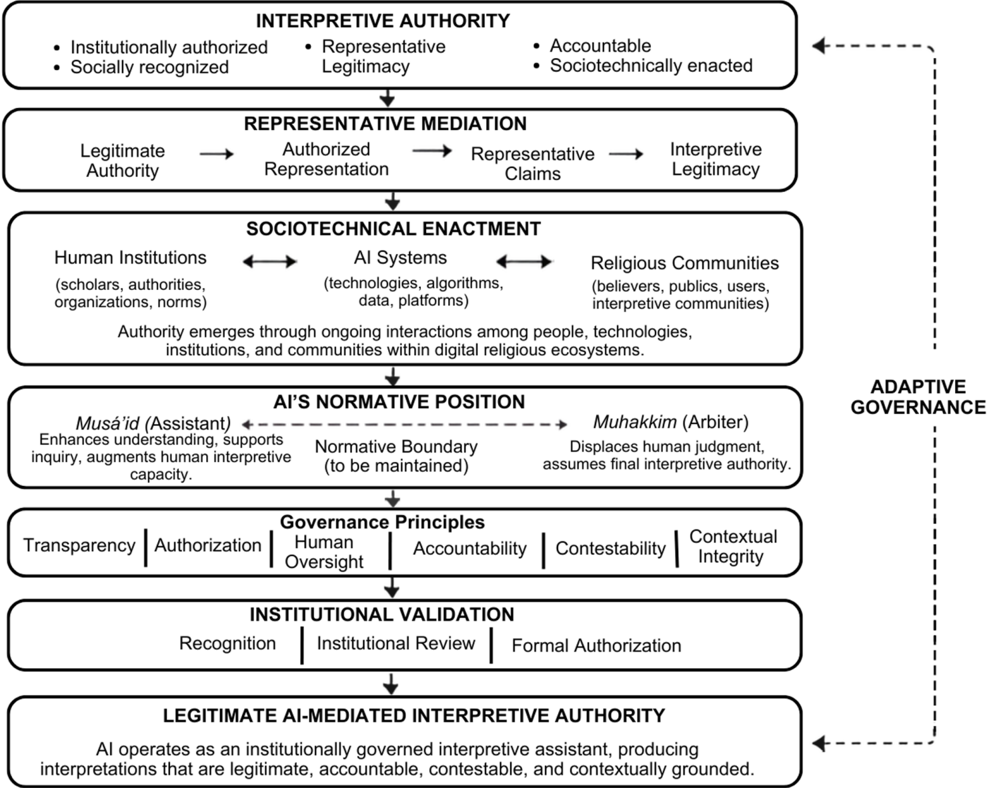
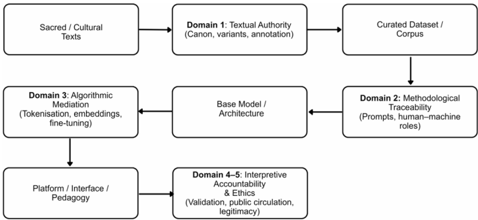
“Figure 1 maps the five governance domains of MRS-DST (Table 1) onto successive stages of the AI interpretation pipeline”
§ AI-mediated religious knowledge > 8 Conclusion
“Figure: 1 Fig. 1 Fig. 1 Theoretical model of AI-mediated interpretive authority”
Citations
Cites
Situated Knowledges: The Science Question in Feminism and the Privilege of Partial Perspective
Haraway, D. (1988) · Feminist Studies · doi:10.2307/3178066 · Cited by 18,364
Reassembling the Social: An Introduction to Actor-Network-Theory
Latour, B. (2005) · doi:10.1093/oso/9780199256044.001.0001 · Cited by 16,778
Star, S. L., & Griesemer, J. R. (1989) · Social Studies of Science · doi:10.1177/030631289019003001 · Cited by 10,847
Sorting Things Out: Classification and Its Consequences
Bowker, G. C., & Star, S. L. (1999) · doi:10.7551/mitpress/6352.001.0001 · Cited by 6,188
Fenichel Pitkin, H. (1967) · doi:10.1525/9780520340503 · Cited by 5,162
Floridi, L., Cowls, J., Beltrametti, M., Chatila, R., Chazerand, P., Dignum, V., Luetge, C., Madelin, R., Pagallo, U., Rossi, F., et al. (2018) · Minds and Machines · doi:10.1007/s11023-018-9482-5 · Cited by 4,774
Science as Social Knowledge: Values and Objectivity in Scientific Inquiry
Longino, H. E. (1990) · doi:10.1515/9780691209753 · Cited by 3,092
(2004) · doi:10.4324/9780203413845 · Cited by 2,963
The Mangle of Practice: Time, Agency, and Science
Pickering, A. (1995) · University of Chicago Press eBooks · doi:10.7208/chicago/9780226668253.001.0001 · Cited by 2,699
Fairness and Abstraction in Sociotechnical Systems
Selbst, A. D., Boyd, D., Friedler, S. A., Venkatasubramanian, S., & Vertesi, J. (2019) · Proceedings of the Conference on Fairness, Accountability, and Transparency · doi:10.1145/3287560.3287598 · Cited by 1,631 · cited 1×
“This shift aligns with contemporary critiques of solution-ist AI ethics, which caution against reducing sociotechnical problems to engineering challenges [33].”
Saward, M. (2006) · Contemporary Political Theory · doi:10.1057/palgrave.cpt.9300234 · Cited by 1,471 · cited 5×
“Saward [32] reconceptu-alizes representation as an ongoing process of representative claim-making rather than a fixed institutional status.”
InfluentialPandora’s Hope: Essays on the Reality of Science Studies
(1999) · Choice Reviews Online · doi:10.5860/choice.37-1511 · Cited by 1,428
Gillespie, T. (2014) · Media Technologies · doi:10.7551/mitpress/9042.003.0013 · Cited by 1,016
Big Data in Education: The digital future of learning, policy and practice
Williamson, B. (2017) · doi:10.4135/9781529714920 · Cited by 883 · cited 1×
“This perspective aligns with sociological analyses of AI in education that emphasize the redistribution of agency and the reconfiguration of pedagogical power [ 34, 41].”
An Introduction to Islamic Law
Hallaq, W. B. (2009) · doi:10.1017/cbo9780511801044 · Cited by 570
Responsible Artificial Intelligence Governance: A Review and Research Framework
Papagiannidis, E., Mikalef, P., & Conboy, K. (2025) · The Journal of Strategic Information Systems · doi:10.1016/j.jsis.2024.101885 · Cited by 565 · cited 1×
“Recent analyses of AI governance demonstrate that validation protocols, institutional review practices, and organizational policies function as formal sites where inter-pretive responsibility is assigned, constrained, and made publicly accountable [27].”
Expanding Explainability: Towards Social Transparency in AI systems
Ehsan, U., Liao, Q. V., Muller, M., Riedl, M. O., & Weisz, J. D. (2021) · Proceedings of the 2021 CHI Conference on Human Factors in Computing Systems · doi:10.1145/3411764.3445188 · Cited by 538 · cited 1×
“At the platform level, MRS-DST challenges designers and service providers to treat disclosure as a core design principle rather than a peripheral policy statement.”
Accountability in artificial intelligence: what it is and how it works
Novelli, C., Taddeo, M., & Floridi, L. (2024) · AI & SOCIETY · doi:10.1007/s00146-023-01635-y · Cited by 495 · cited 6×
“Recent work on AI governance emphasizes that legitimacy in automated knowledge systems depends on institutional mechanisms of answerability, contestability, and limitation of power, particularly in settings where interpretive claims carry pedagogical, legal, or moral consequences [26, 36].”
Influential(2013) · doi:10.4324/9780203084861 · Cited by 484
Cloud Ethics: Algorithms and the Attributes of Ourselves and Others
Amoore, L. (2020) · doi:10.1215/9781478009276 · Cited by 155
Artificial Intelligence in Religious Education: Ethical, Pedagogical, and Theological Perspectives
Papakostas, C. (2025) · Religions · doi:10.3390/rel16050563 · Cited by 78 · cited 1×
“These developments demonstrate that AI transforms the ecology of religious authority rather than replacing it [28].”
Automating epistemology: how AI reconfigures truth, authority, and verification
Shin, D. (2026) · AI & SOCIETY · doi:10.1007/s00146-025-02560-y · Cited by 57 · cited 2×
“In doing so, the framework responds to growing concerns about "algorithmic truth" and the redistribution of epistemic authority in digital knowledge systems [36].”
Sun, Y., & Xu, C. (2026) · Journal of Knowledge Management · doi:10.1108/jkm-02-2025-0252 · Cited by 23 · cited 2×
“At the platform level, MRS-DST challenges designers and service providers to treat disclosure as a core design principle rather than a peripheral policy statement.”
Generative Artificial Intelligence as Epistemic Authority?
Cooper, G., Tang, K.-S., & Rappa, N. A. (2024) · Artificial Intelligence Applications in Higher Education · doi:10.4324/9781003440178-7 · Cited by 16
Hila, A. (2026) · AI & SOCIETY · doi:10.1007/s00146-025-02426-3 · Cited by 14
Milella, F., & Cabitza, F. (2026) · Machine Learning and Knowledge Extraction · doi:10.3390/make8020036 · Cited by 11 · cited 1×
“Recent empirical research indicates that users increasingly attribute epistemic authority to generative AI despite limited awareness of its methodological constraints, uncertainty, and embedded biases [25].”
Artificial Intelligence and Islamic Thought: Two Distinctive Challenges
Malik, S. A. (2023) · Journal of Islamic and Muslim Studies · doi:10.2979/jims.00020 · Cited by 10
Atallah, F. A. (2026) · Religions · doi:10.3390/rel17030350 · Cited by 5
Digital Islamic authority: a revolutionary shift or mere hype? a systematic review
Wahid, S. H., & Abdulloh, S. (2026) · SN Social Sciences · doi:10.1007/s43545-026-01328-5 · Cited by 4 · cited 1×
“Wahid and Abdulloh [39], for example, demonstrate that digital religious authority is negotiated through the combined influence of textual evidence, affective engage - ment, algorithmic visibility, and participatory interaction.”
The Future of Artificial Intelligence in/and of Islam: A View from Muslim Southeast Asia
Anoraga, B. (2024) · Journal of Islamic and Muslim Studies · doi:10.2979/jims.00031 · Cited by 4 · cited 1×
“In Islamic epistemology, interpretive practices such as tafsīr, syarḥ , and sanad–matn reasoning function as institutionalized systems of validation that embed interpretation within chains of transmission, ethical discipline ( adab ), and communal accountability [15, 31, 3].”
Hallaq, W. B. (2009) · Cambridge University Press eBooks · doi:10.1017/cbo9780511801044.010
Research works printed but not linked: 11
- 1. Al-Shāṭibī, I.: Al-Muwāfaqāt fī uṣūl al-sharīʿah. Dār Ibn ʿAffān (2004)
- 4. Asad, T.: The idea of an anthropology of Islam. Georgetown Uni- versity, Occasional Papers Series (1986)
- 7. Brown, J.A.C.: Hadith: Muhammad's Legacy in the Medieval and Modern World. Oneworld (2009)
- 9. Cheong, P.H.: Authority. In: Campbell, H.A. (ed.) Digital Reli- gion: Understanding Religious Practice in New Media Worlds, pp. 72-87. Routledge (2013)
- 11. Daston, L., Galison, P.: Objectivity. Zone Books (2007)
- 19. Jasanoff, S.: The Ethics of Invention: Technology and the Human Future. W. W. Norton (2016)
- 23. Mahmood, S.: Politics of Piety: The Islamic Revival and the Fem- inist Subject. Princeton University Press (2005)
- 31. Reinhart, A.K.: Before Revelation: The Boundaries of Muslim Moral Thought. SUNY Press (2010)
- 34. Selwyn, N.: Should Robots Replace Teachers? AI and the Future of Education. Polity Press (2019)
- 35. Serres, M. (2007). The parasite (L. R. Schehr, Trans.). University of Minnesota Press. (Original work published 1980)
- 40. Weber, M. (1978). Economy and society: an outline of interpre- tive sociology (G. Roth & C. Wittich, Eds.). University of Cali- fornia Press
Cited by
Why AI resembles a charismatic religious leader
Shipley, M. (2026) · doi:10.64628/aai.yssxqudwk
Metadata
- Authors
- Ahmad, H., & Ghafar, N. A.
- Affiliations
- Universiti Sains Islam Malaysia (MY)
- Corresponding author
- Ahmad, Hishomudin
- Ghafar, Norfarhana Ahmad
- Venue
- AI and Ethics
- Published
- 2026-08-13
- Volume
- 6
- Issue
- 5
- ISSN
- 2730-5953 (ISSN-L)
- 2730-5961
- OpenAlex
- W7202397459
- Semantic Scholar
- 84bbf1e1e713b7f58be21ebe50b82f3b7fac0ffe
- Cited by
- 3
- References
- 27
- Citations by year
- 2026: 3
- FWCI
- 16.88
- Type
- journal article
- Language
- en
- Open access
- hybrid
- doi.org
- Licence
- cc-by
- creativecommons.org/licenses/by/4.0 (tdm)
- creativecommons.org/licenses/by/4.0 (vor)
- Locations
- AI and Ethics (publishedVersion, cc-by)
- Funders
- Universiti Sains Islam Malaysia
- Topics
- Physical Sciences › Computer Science › Artificial Intelligence › Ethics and Social Impacts of AI
- Social Sciences › Arts and Humanities › Religious studies › Media, Religion, Digital Communication
- Social Sciences › Arts and Humanities › Literature and Literary Theory › Digital Humanities and Scholarship
- Keywords
- large language models, religious knowledge, religious texts, interpretive authority, boundary-making, AI governance, model alignment, digital humanities, disclosure, algorithmic mediation, religious interpretation, sociotechnical practices
About these checks
Registry, retraction, Cites and statistics results are computed, not judged, with one exception: a printed reference that no index lists is read once by a model before it counts as a citation error. Claims are extracted by a model and kept only when their quote appears verbatim in the text; each cited source is then checked, with a model’s help, for whether it says what the claim relies on. Those verdicts can be wrong — read the claim’s quote and the cited source before relying on one.
The claim verdicts this report counts are experimental: their accuracy is not yet measured.
A language model drew the claims from the paper on 2026-10-12, under version 3 of the claim definition (model deepseek-v4.1-flash, prompt extract-v3).
A second model labelled each claim on 2026-10-12 (model jev-1.13-20260917, definition revision gold-guideline-v0.2).
Cited sources are checked with a language model’s help (gpt-6-sol).
Statistics and arithmetic are recomputed, not judged.
Confidence bands are shown only for fields calibrated on our annotated test set. None is calibrated yet, so no band is shown.
What counts as a claim ›How we measure confidence ›How we check this ›
Are you an author, or do you see a problem with this page? Request a review
Data sources
Bibliographic data: Semantic Scholar, OpenAlex, Crossref.
Contains information from the Semantic Scholar Academic Graph Datasets, made available under the ODC Attribution License (ODC-BY 1.0).
Semantic Scholar’s data is described in: Kinney, R., et al. (2023). The Semantic Scholar Open Data Platform. arXiv:2301.10140.
