

The DOI matches its Crossref record; 152 of the 153 references it cites were found in a registry or an index.
ROS and the DNA damage response in cancer
Open accessAbstract
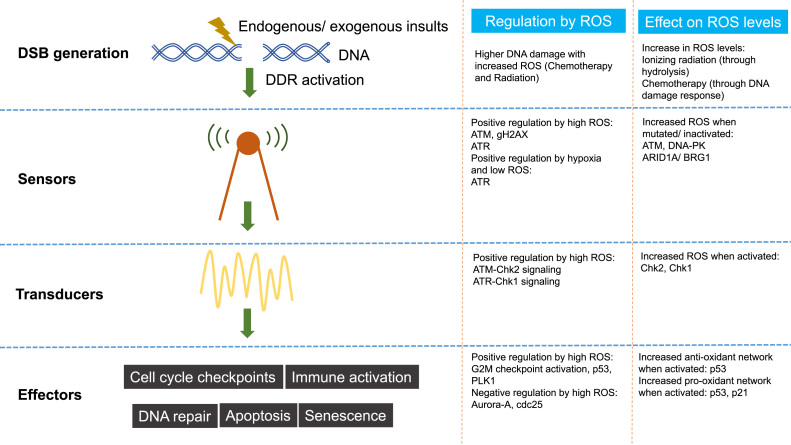
Reactive oxygen species (ROS) are a group of short-lived, highly reactive, oxygen-containing molecules that can induce DNA damage and affect the DNA damage response (DDR). There is unequivocal pre-clinical and clinical evidence that ROS influence the genotoxic stress caused by chemotherapeutics agents and ionizing radiation. Recent studies have provided mechanistic insight into how ROS can also influence the cellular response to DNA damage caused by genotoxic therapy, especially in the context of Double Strand Breaks (DSBs). This has led to the clinical evaluation of agents modulating ROS in combination with genotoxic therapy for cancer, with mixed success so far. These studies point to context dependent outcomes with ROS modulator combinations with Chemotherapy and radiotherapy, indicating a need for additional pre-clinical research in the field. In this review, we discuss the current knowledge on the effect of ROS in the DNA damage response, and its clinical relevance.
Overview
The claims and statistics of this paper haven’t been checked yet.
Run the check — free, no account needed. It reads the open-access text and checks the sources it cites.
Integrity signals
Registry
Cites
Statistics
Figures
Verification
Claims the paper makes
The claims and statistics of this paper haven’t been checked yet.
Run the check — free, no account needed. It reads the open-access text and checks the sources it cites.
Claims other papers make about this one
Each is checked against this paper’s own text: does it say what the citing paper says it does?
In the citing paper
“The most frequently occurring mutations in the tumor suppressor gene TP53 in lung cancer are Guanine → Thymine and Guanine → Adenine transversions (Srinivas et al. 2019; Gibbons et al. 2014).”
From Reactive Oxygen Species, Toxicity, Oxidative Stress, and Antioxidants: Chronic Diseases and Aging (2023) · cites this paper as Srinivas et al. 2019
Self-check
Percentages, sums and reported differences re-computed from the paper’s own numbers.
The self-check needs the paper’s full text.
Citations
Cites
Vogelstein, B., Lane, D., & Levine, A. J. (2000) · Nature · doi:10.1038/35042675 · Cited by 6,607 · cited 1×
“p53 is a well-studied tumor suppressor that is mutated in over 50% of all cancers [87,88], and affects multiple cellular responses to DNA U.”
BackgroundDNA double-stranded breaks induce histone H2AX phosphorylation on serine 139
Rogakou, E. P., Pilch, D. R., Orr, A. H., Ivanova, V. S., & Bonner, W. M. (1998) · Journal of Biological Chemistry · doi:10.1074/jbc.273.10.5858 · Cited by 5,438
(1994) · New England Journal of Medicine · doi:10.1056/nejm199404143301501 · Cited by 4,737
The DNA Damage Response: Making It Safe to Play with Knives
Ciccia, A., & Elledge, S. J. (2010) · Molecular Cell · doi:10.1016/j.molcel.2010.09.019 · Cited by 4,368 · cited 1×
“This response includes DNA damage recognition, activation of checkpoints, cell cycle arrest, and eventually final outcomes of repair, apoptosis and immune clearance [4,5].”
BackgroundRadiobiology for the Radiologist.
(1974) · Annals of Internal Medicine · doi:10.7326/0003-4819-80-3-438_1 · Cited by 3,498
Molecular Mechanisms of Mammalian DNA Repair and the DNA Damage Checkpoints
Sancar, A., Lindsey-Boltz, L. A., Ünsal-Kaçmaz, K., & Linn, S. (2004) · Annual Review of Biochemistry · doi:10.1146/annurev.biochem.73.011303.073723 · Cited by 3,317 · cited 1×
“Depending on the nature of the lesion in DNA, specific pathways are activated to facilitate identification of the damaged regions and their repair [2,3].”
BackgroundImmunogenic Cell Death in Cancer Therapy
Kroemer, G., Galluzzi, L., Kepp, O., & Zitvogel, L. (2013) · Annual Review of Immunology · doi:10.1146/annurev-immunol-032712-100008 · Cited by 3,303 · cited 1×
“to eventual T-cell mediated killing [116].”
Yang, Y., Li, S., Yang, Q., Shi, Y., Zheng, M., Liu, Y., Chen, F., Song, G., Xu, H., Wan, T., et al. (2014) · Cellular Physiology and Biochemistry · doi:10.1159/000358696 · Cited by 3,263
ATM and ATR Substrate Analysis Reveals Extensive Protein Networks Responsive to DNA Damage
Matsuoka, S., Ballif, B. A., Smogorzewska, A., McDonald, E. R., Hurov, K. E., Luo, J., Bakalarski, C. E., Zhao, Z., Solimini, N., Lerenthal, Y., et al. (2007) · Science · doi:10.1126/science.1140321 · Cited by 3,075
Association of reactive oxygen species levels and radioresistance in cancer stem cells
Diehn, M., Cho, R. W., Lobo, N. A., Kalisky, T., Dorie, M. J., Kulp, A. N., Qian, D., Lam, J. S., Ailles, L. E., Wong, M., et al. (2009) · Nature · doi:10.1038/nature07733 · Cited by 2,555
Cited by
Sorted by citations
Items 1,001–1,002 of 1,002
Oxidative stress in lung cancer
Mousapasandi, A., Loke, W. S. J., Herbert, C. A., & Thomas, P. S. (2021) · Cancer · doi:10.1016/b978-0-12-819547-5.00003-1 · Cited by 5
Uti, D. E., Egbung, J. E., Anthony, B. O., Omari, O. R., Omang, W. A., Aggad, W. S., Almohaimeed, H. M., Bainsal, N., Shukla, S. K., Ealla, K. K. R., et al. (2026) · Discover Nano · doi:10.1186/s11671-026-04681-9 · Cited by 3
“In parallel, exosomal cargos may induce cell-cycle arrest at radiosensitive stages like G2/M which increased cytotoxicity further [136].”
Metadata
- Authors
- Srinivas, U. S., Tan, B. W. Q., Vellayappan, B. A., & Jeyasekharan, A. D.
- Affiliations
- National University of Singapore (SG)
- National University Hospital (SG)
- Corresponding author
- Jeyasekharan, Anand D.
- Venue
- Redox Biology
- Publisher
- Elsevier BV
- Published
- 2019-07
- Volume
- 25
- Pages
- 101084
- ISSN
- 2213-2317 (ISSN-L)
- PMC
- PMC6859528
- OpenAlex
- W2906120852
- Cited by
- 2,144
- References
- 153
- Citations by year
- 2026: 217 · 2025: 396 · 2024: 392 · 2023: 381 · 2022: 335 · 2021: 262 · 2020: 132 · 2019: 26
- FWCI
- 10.28
- Type
- journal article
- Language
- en
- Open access
- gold
- doi.org
- Licence
- Locations
- Redox Biology (publishedVersion, cc-by)
- PubMed Central (publishedVersion, cc-by)
- PubMed (publishedVersion)
- National University of Singapore (submittedVersion, cc-by-nc-nd)
- DOAJ (DOAJ: Directory of Open Access Journals) (submittedVersion, cc-by-sa)
- Funders
- National Medical Research Council (NMRC/TA/0052/2016)
- AstraZeneca
- Ministry of Health -Singapore
- Meso Scale Diagnostics
- National Research Foundation Singapore
- Ministry of Education - Singapore
- Janssen Pharmaceuticals
- Topics
- Life Sciences › Biochemistry, Genetics and Molecular Biology › Molecular Biology › Redox biology and oxidative stress
- Life Sciences › Biochemistry, Genetics and Molecular Biology › Molecular Biology › DNA Repair Mechanisms
- Health Sciences › Medicine › Radiology, Nuclear Medicine and Imaging › Effects of Radiation Exposure
- Keywords
- reactive oxygen species, DNA damage response, cancer, DNA double-strand breaks, genotoxic stress, anticancer agents, ionizing radiation, radiosensitizers, combination therapy, oxidative DNA damage
- MeSH terms
- Animals, DNA Damage, DNA Repair, Humans, Neoplasms, Tumor Suppressor Protein p53, Apoptosis, Reactive Oxygen Species
About these checks
Registry, retraction, Cites and statistics results are computed, not judged, with one exception: a printed reference that no index lists is read once by a model before it counts as a citation error. Claims are extracted by a model and kept only when their quote appears verbatim in the text; each cited source is then checked, with a model’s help, for whether it says what the claim relies on. Those verdicts can be wrong — read the claim’s quote and the cited source before relying on one.
Statistics and arithmetic are recomputed, not judged.
Confidence bands are shown only for fields calibrated on our annotated test set. None is calibrated yet, so no band is shown.
What counts as a claim ›How we measure confidence ›How we check this ›
Are you an author, or do you see a problem with this page? Request a review
